Lesson 57 of 60 · about 9 minutes
John Witherspoon: The Preacher Who Taught the Founders and Signed for Independence
You'll be able to
- Trace Witherspoon from a Scottish parish to the presidency of Princeton and a seat in Congress
- Explain what the May 1776 sermon on the dominion of Providence said and why it spread
- Weigh the claim that he shaped Madison and the Constitution against what the evidence shows
- Describe his ownership of enslaved people and his 1790 committee, in his own recorded words
On May 17, 1776 John Witherspoon climbed into a pulpit in Princeton, New Jersey, on a fast day appointed by Congress, and did something he said he had never done. "You are all my witnesses, that this is the first time of my introducing any political subject into the pulpit."12 He was fifty-three, a Scot, the president of a church college. Five weeks later he was elected to the Continental Congress.2
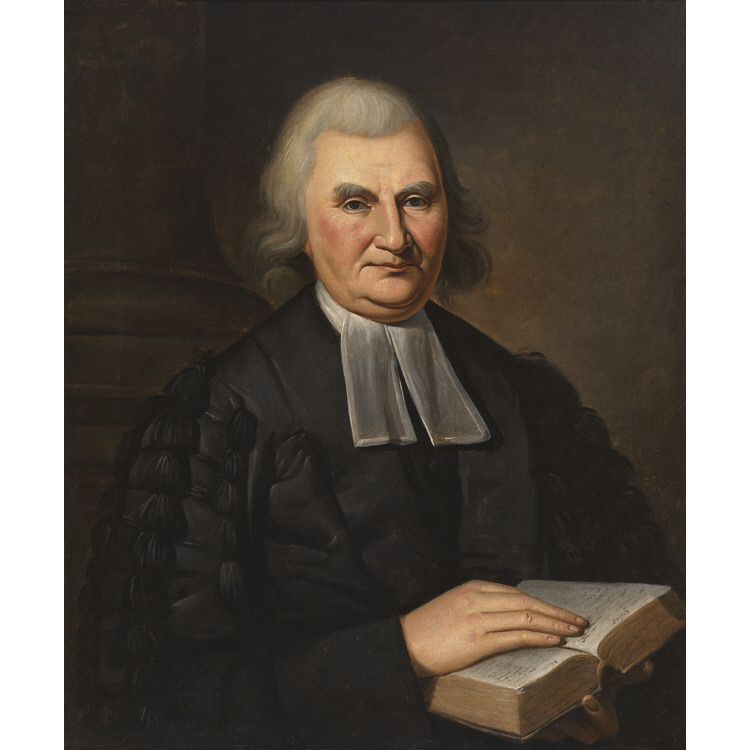
A Minister from East Lothian
Sources do not agree on where or exactly when he was born. The Battlefield Trust and the Constitution Center say Yester, Scotland. Britannica says Gifford, East Lothian, and gives the day as February 15, 1723 (February 5, 1722 in the old calendar).345 His father was the minister there. At thirteen John entered the University of Edinburgh, and by the Battlefield Trust's account he was running his own parish two months after turning twenty-two.3 Britannica puts him at Beith in 1745 and Paisley in 1757.4
He was a conservative churchman with a sharp pen. His satire Ecclesiastical Characteristics (1753) went after the patronage system in the Church of Scotland.34 In 1745 he sided against the Jacobite rising and was briefly jailed after the battle of Falkirk.3 He married Elizabeth Montgomery in 1748. Five of their children lived to adulthood. Sources say nine or ten were born.35
Rush, Stockton and a Wife Who Said No
The trustees of the College of New Jersey wanted a president, and in 1766 Richard Stockton went to Britain to press the case. The Founder of the Day site says Stockton recruited Benjamin Rush, then a medical student at Edinburgh, to help win Witherspoon over.6 (Rush has his own lesson, here.) Princeton Alumni Weekly says the pair, with several clergymen of the Popular Party, persuaded the forty-three-year-old that Princeton offered a chance to advance evangelical faith across the Atlantic world. His wife strongly opposed the move and feared being left a widow in North America, and it took two years to bring her around.7 The family arrived in 1768.7
He found a college in debt. He raised money at home and abroad, modeled the course on Edinburgh, bought scientific equipment and gave hundreds of his own books to the library.3 He eased Jonathan Edwards Jr. out of his tutorship, and he began bringing in Scottish common sense and moral-sense philosophy in place of the idealism of Berkeley and Edwards.7 He also pulled in Southern students. Before the war almost half of a typical class entered the pulpit. By the early 1790s fewer than 10 percent of students chose a clerical career.7
What He Taught Madison
The Battlefield Trust counts among his students 49 future U.S. congressmen, 28 senators, three Supreme Court justices, Aaron Burr and James Madison.3 Madison was Princeton class of 1771.8
Popular accounts go further and make Witherspoon the source of the Constitution. The evidence is thinner. A Princeton Alumni Weekly essay says the conventional view is that Witherspoon introduced Madison to Hume, which "may be correct," and argues from parallels in language that Madison probably took a broader lesson about self-control and balanced government. The essay's own wording is hedged: "may be correct," "likely," "probably."8 Witherspoon taught, and Madison learned. How much of the Federalist came from that room is a guess.
The Sermon and the Signature
The May 1776 sermon was titled The Dominion of Providence over the Passions of Men. It was printed in Philadelphia that year and was reprinted widely.23 In it Witherspoon said that "the cause in which America is now in arms, is the cause of justice, of liberty, and of human nature." He also drew a line that a modern reader might not expect from a clergyman: "Whoever is an avowed enemy to God, I scruple not to call him an enemy to his country."2
He presided over the Somerset County committee of correspondence and served in two provincial congresses, then went to Philadelphia as one of five New Jersey delegates.43 Britannica says he served in Congress from 1776 to 1779 and again from 1780 to 1782. He sat on more than a hundred committees.9 He was the only clergyman to sign the Declaration, and the Constitution Center calls him the only active clergyman and college president to do so.45 The Constitution Center's page gives his service as June 1777 to November 1784, which does not match Britannica's dates.5
Myth: Witherspoon said the country was "ripe, and rotting"
The story says that when a delegate warned that America was not ready for independence, Witherspoon answered that it was "not only ripe for the measure, but in danger of rotting for the want of it."9 The Battlefield Trust introduces that wording with "according to legend." The Liberty Fund prints a shorter version, "we are not only ripe, but rotting," in an introduction, not in the sermon itself.23 Neither page cites a record made at the time, and the sermon text does not contain the line. Two wordings and no record from the time. Treat it as legend.
In 1781, according to Etymonline, he coined the word "Americanism."10
A Son Lost at Germantown
His son James, a Princeton graduate of 1770, rose to brigade major and served as aide to General Francis Nash. He was killed at Germantown on October 4, 1777.11 Founder of the Day says the same ball that hit Nash killed him instantly, and gives his age as 26. The New Jersey Society of the Cincinnati lists a birth date of November 17, 1751, which would make him 25.11
Enslaved People at Tusculum
Witherspoon spoke against slavery in principle and owned human beings. Princeton's own research project records that he baptized an enslaved Virginian named Jamie Montgomery in Scotland in 1756, that Montgomery ran away soon after, that Witherspoon bought two people to farm Tusculum in 1779 when he moved there, and that his estate listed two enslaved people in 1794.12
His lectures show a man who saw the wrong and would not act on it. "I do not think there lies any necessity on those who found men in a state of slavery, to make them free to their own ruin," he said. And then: "it is very doubtful whether any original cause of servitude can be defended, but legal punishment for the commission of crimes."13 In 1790, as a New Jersey legislator, he chaired a committee on abolishing slavery. The editor of the 1912 edition of the lectures says it advised no action, because the law already forbade importing slaves and encouraged voluntary freeing. He also suggested a law freeing slaves born after its passage at a set age, such as 28 as in Pennsylvania, and guessed that slavery would be gone within 28 years.13 It was not. New Jersey passed gradual emancipation in 1804.12
In 1774 he did tutor two Black men, Bristol Yamma and John Quamino, who had bought their own freedom, so they could become missionaries.14
Blind and Buried at Princeton
After the war he sat in the 1787 New Jersey convention that ratified the Constitution and worked on a constitution for the new Presbyterian Church.3 He preached the opening sermon at the church's first General Assembly in 1789. Some references call him its first moderator, but the Presbyterian history site names the Rev. John Rodgers as the one chosen.1516 His eyes failed after several injuries, and he was blind by 1792.5 His wife Elizabeth died in 1789. In 1791, at 68, he married Ann Dill, a 24-year-old widow, and they had two daughters, one of whom lived to adulthood.516 He died on November 15, 1794 at Tusculum and was buried in the president's lot at Princeton.164 Sources differ on when his presidency ended, with some saying 1792 and others 1794.914
Witherspoon's Life at a Glance
- 1723 Born in Yester parish, East Lothian (the exact day is disputed).
- 1745 Takes his own parish at Beith.
- 1748 Marries Elizabeth Montgomery.
- 1768 Arrives in Princeton as president of the College of New Jersey.
- May 17, 1776 Preaches the sermon on the dominion of Providence.
- June 22, 1776 Elected to the Continental Congress.
- October 4, 1777 His son James is killed at Germantown.
- 1779 Moves to Tusculum and buys two enslaved people.
- 1790 Chairs the New Jersey committee on abolition, which advises no action.
- November 15, 1794 Dies at Tusculum.
Learn more
- Liberty Fund: The Dominion of Providence over the Passions of Men: the full 1776 sermon
- Princeton and Slavery: Witherspoon and Slavery: what the university's own researchers found
- Lectures on Moral Philosophy (1912 edition): his own words on slavery and much else
- Princeton Alumni Weekly: Witherspoon, Madison and the Constitution: a careful look at the claimed influence
Notes
- John Witherspoon, The Dominion of Providence over the Passions of Men (1776), reprinted by Clearly Reformed, for the sentence beginning "You are all my witnesses" and the fast day appointed by Congress; the same words appear in the Online Library of Liberty text. Read it online. ↩
- John Witherspoon, The Dominion of Providence over the Passions of Men (Philadelphia, 1776), Online Library of Liberty, for the quotations on "the cause of justice" and "an enemy to his country," the 1776 publication, his election to Congress on June 22, 1776, and the introduction's version of the "ripe, but rotting" remark. Read it online. ↩
- American Battlefield Trust, "John Witherspoon," on his birth in the parish of Yester, Edinburgh at thirteen, his first parish, Falkirk, his marriage, the Princeton reforms and gifts, his students, the five New Jersey delegates, the "according to legend" remark and the 1787 convention. Read it online. ↩
- Encyclopaedia Britannica, "John Witherspoon," on Gifford, the February 15 birth date, Beith, Paisley, Ecclesiastical Characteristics, the Somerset County committee, his terms in Congress, his signing as the only clergyman and his death at Tusculum. Read it online. ↩
- U.S. Constitution Center, "John Witherspoon," on Yester, ten children of whom five survived, the service dates of June 1777 to November 1784, the only active clergyman and college president to sign, his marriage to Ann Dill and his blindness by 1792. Read it online. ↩
- Founder of the Day, "Future Signers in Edinburgh: The Persuasive Richard Stockton," on Stockton's 1766 trip and Rush's help. Read it online. ↩
- Princeton Alumni Weekly, January 24, 1996, "Feature," on the recruitment by Stockton and Rush, Elizabeth Witherspoon's opposition, the 1768 arrival, the curriculum and the fall in ministers. Read it online. ↩
- Princeton Alumni Weekly, "Essay: Witherspoon, Madison, Moral Philosophy, and the Constitution," on Madison's class year and the hedged claim of influence. Read it online. ↩
- Ushistory.org, "John Witherspoon," on more than a hundred committees, the remark quoted as "not only ripe for the measure, but in danger of rotting for the want of it," and a presidency lasting until 1792. Read it online. ↩
- Online Etymology Dictionary, "Americanism," crediting Witherspoon with the term in 1781. Read it online. ↩
- Founder of the Day, "Two Revolutionaries, One Ball: The Tragedy of James Witherspoon," on his death beside General Nash and his age; New Jersey Society of the Cincinnati, "Brigade Major James Witherspoon," on the birth date of November 17, 1751, his 1770 degree, his service and his death at Germantown on October 4, 1777. Read it online. ↩
- Princeton and Slavery, "Witherspoon and Slavery," on Jamie Montgomery, the two people bought in 1779 when he moved to Tusculum, the 1790 committee, the 1804 law and the estate. Read it online. ↩
- John Witherspoon, Lectures on Moral Philosophy, ed. Varnum Lansing Collins (Princeton: Princeton University Press, 1912), p. 74 and the editor's note on the 1790 committee. Read it online. ↩
- The Conversation, "5 facts about John Witherspoon, a slaveholder and the only university president to sign the Declaration of Independence," on Yamma and Quamino in 1774 and a presidency from 1768 to 1794. Read it online. ↩
- PCA History, "May 21: The First General Assembly," on Witherspoon's opening sermon and the election of the Rev. John Rodgers as the first moderator. Read it online. ↩
- Encyclopedia.com, "Witherspoon, John," on the 1789 General Assembly, his 1791 marriage to Ann Dill, his death in 1794 and burial in the president's lot at Princeton. Read it online. ↩
Terms in this lesson
- College of New Jersey
- The Presbyterian college in Princeton that Witherspoon led from 1768. It was later renamed Princeton University.
- Fast day
- A day of public prayer and humiliation. Congress appointed one for the colonies, and Witherspoon preached on it on May 17, 1776.
- Scottish common sense philosophy
- A school of moral thought from Hutcheson and others holding that people share a natural moral sense. Witherspoon brought it into the Princeton curriculum.
- Americanism
- A word or phrase used in America that differs from British use. Etymonline credits Witherspoon with coining the term in 1781.
- Gradual emancipation
- A plan to free the children of enslaved people when they reached a set age. New Jersey adopted one in 1804.
- Tusculum
- Witherspoon's farm just outside Princeton, where he lived from 1779 and died in 1794.
Sources
- Liberty Fund, Witherspoon, The Dominion of Providence over the Passions of Men (1776) checked 2026-10
- American Battlefield Trust, John Witherspoon checked 2026-10
- Encyclopaedia Britannica, John Witherspoon checked 2026-10
- Princeton and Slavery, Witherspoon and Slavery checked 2026-10
- Witherspoon, Lectures on Moral Philosophy, ed. Varnum Lansing Collins (Princeton, 1912) checked 2026-10
- Princeton Alumni Weekly, Witherspoon, Madison, Moral Philosophy, and the Constitution checked 2026-10
- New Jersey Society of the Cincinnati, Brigade Major James Witherspoon checked 2026-10