Lesson 52 of 60 · about 9 minutes
Samuel Adams: The Tax Collector Who Organized a Revolution
You'll be able to
- Trace Adams from Harvard and a family money disaster to the Boston Town Meeting
- Explain what the Committees of Correspondence did and why they mattered
- Separate what the record shows about the Boston Massacre and the Tea Party from the legends
- Describe how Adams treated rebellion against a republic after the war
On June 12, 1775, General Thomas Gage, the British governor in Boston, offered the King's pardon to every rebel who would lay down his arms. He named two exceptions. Samuel Adams and John Hancock had committed offences "of too flagitious a Nature to admit of any other Consideration than that of condign Punishment."1 Adams was fifty-two, a failed businessman and a tax collector who often did not collect. Gage still thought him worth singling out.
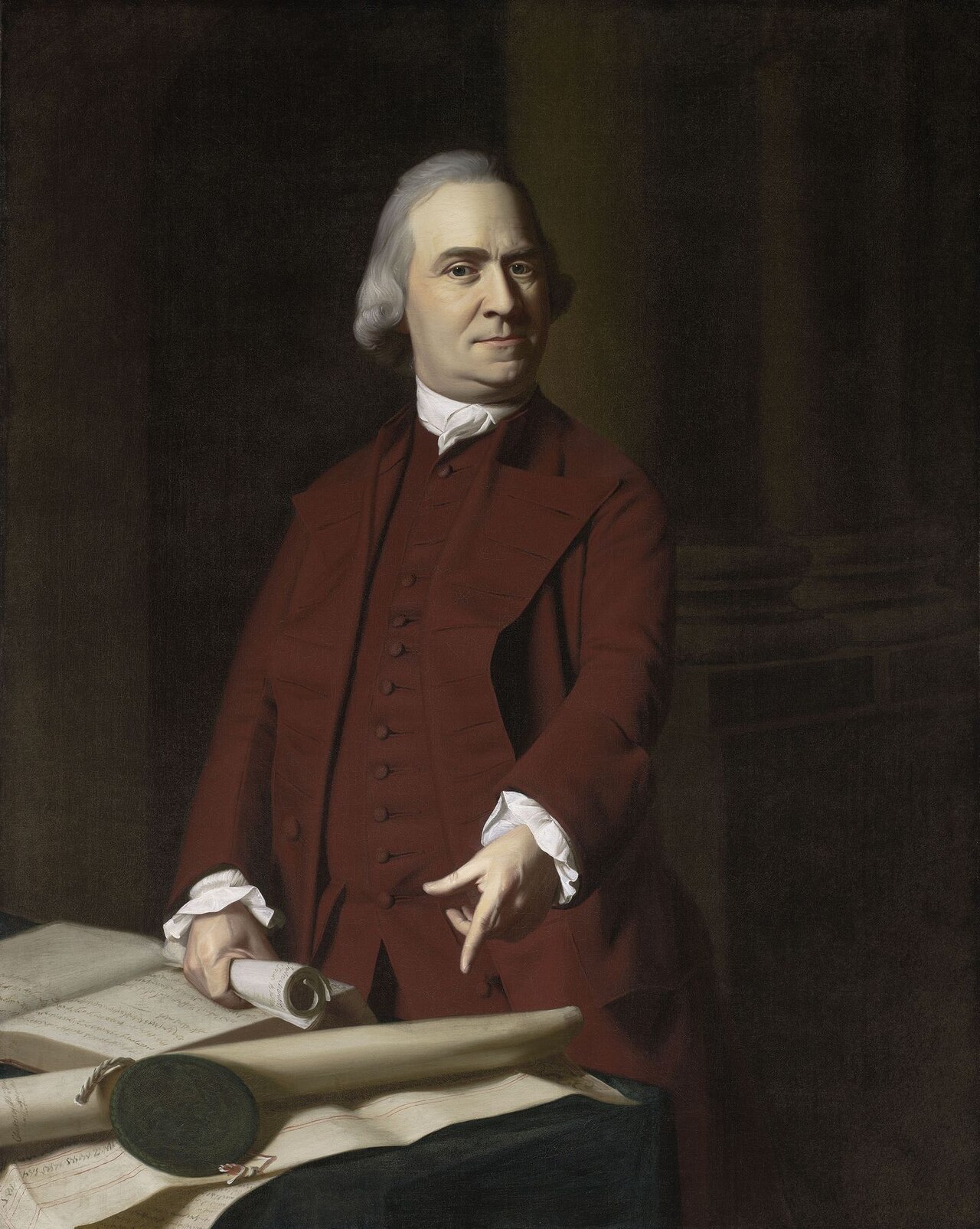
A Failed Businessman With a Cause
Adams was born in Boston on September 16, 1722, Old Style, which converts to September 27 in the modern calendar.2 He entered Harvard in 1736, and the Battlefield Trust says he was fourteen. His father, Deacon Samuel Adams, was a successful malter who worked Boston politics through church and caucus.34 In 1739 the Deacon helped start a land bank that issued paper money against mortgaged land. Parliament ordered it shut down in 1741 and held its directors liable for the paper in circulation, which sent the Deacon into ruinous debt.5
For his master's thesis in 1743 the son took up the question "Whether it be lawful to resist the supreme magistrate, if the commonwealth cannot be otherwise preserved?"4 Business did not suit him. His father set him up with money, and he lost it quickly. He worked in the family malthouse. In 1756 Boston made him a tax collector, and the Park Service says he often failed to collect, being easy on neighbors who could not pay. By 1765 he owed the town about 8,000 pounds in uncollected taxes, a debt that was later forgiven once he had become a popular political figure.45
The Stamp Act and the Town Meeting
Adams was already writing against Parliament in 1764, when the Sugar Act put a duty on imported sugar. The Battlefield Trust quotes him: "The most essential rights of British Subjects" are "those of being represented in the same Body which exercises the Power of levying Taxes upon them."3 It says he pressed New England merchants to boycott goods tied to the tax, and that when the Stamp Act replaced the Sugar Act in 1765 he protested louder still.3
The record does not settle whether he led the crowds. A secret group called the Loyal Nine organized the August 1765 protests. The Park Service calls Adams closely associated with them and calls the Loyal Nine a precursor to the Sons of Liberty. Another account says he did not take part in the August riots, though people accused him of stirring them up.45
His real tool was the committee. On November 20, 1772, a Boston committee of correspondence issued a statement of colonial rights that Adams drafted. It opened: "Among the natural rights of the colonists are these: First, a right to life; secondly to liberty; thirdly to property; together with the right to support and defend them in the best manner they can."6 Adams had proposed the committee at the town meeting earlier that month, and Boston's letters went out to other towns.4 Governor Thomas Hutchinson wondered "whether there is a greater incendiary in the king's dominion or a man of greater malignity of heart." His second cousin John Adams called him "zealous, ardent, and keen."6
The Massacre and the Tea
When British soldiers killed five Bostonians on March 5, 1770, Adams moved fast. The Park Service says he led a committee on March 6 demanding that the troops be removed from the town.4 The Colonial Society of Massachusetts describes a confrontation with Hutchinson at the Council that day, and Adams later told James Warren, "I observ'd his Knees to tremble."7
On the trial, the sources do not match. The Battlefield Trust says Adams stressed that the soldiers deserved a fair trial and convinced his cousin John to defend them.3 John Adams's own account has a merchant, James Forrest, coming to his office the morning after the shooting with a request from Captain Preston, and Samuel does not appear in it.8 The Park Service says Samuel cared less about the verdict than about Boston being seen as the victim, though he knew a fair trial was essential.4
The Tea Act passed in May 1773. On December 16 a mass meeting at the Old South Meeting House drew thousands, and that night disguised men dumped the tea into the harbor.9 The Park Service counts 342 chests and the Massachusetts Historical Society about 340. The Historical Society puts the disguised men at between 30 and 60, the Battlefield Trust at about 100.493
Myth: Adams shouted a signal and the Tea Party began
The tale says Adams announced that the meeting could do nothing more to save the country, and that the words were the raiders' cue. The Journal of the American Revolution traces how it grew. William Gordon's 1788 history has an unnamed man in Indian dress give a war-whoop. George Bancroft's 1854 history put Adams's words just before the whoop, and William V. Wells's 1865 biography of Adams called them "the signal." The Sewall manuscript records that "About 10 or 15 minutes later, I heard a hideous yelling," and other accounts have Adams trying to keep people in their seats.10 The Park Service says there is no evidence Adams took part in the destruction of the tea.4 He did defend it afterward. Writing of the tea, he said, "Our Enemies must acknowledge that these people have acted upon pure and upright Principle."3 Sources also differ on his trade. The Battlefield Trust speaks of his father's brewing company, while the Park Service calls the elder Adams a successful malter.34
Independence and Its Costs
Parliament answered the tea with the Coercive Acts, which the Historical Society says closed the port and garrisoned the town with thousands of soldiers.9 Adams sat in the Continental Congress from 1774 to 1781.2 Before leaving for the second Congress, he and Hancock stayed with the Rev. Jonas Clarke in Lexington, and troops reached the town on April 19, 1775, just as the two men slipped away.4 Adams signed the Declaration of Independence. The Battlefield Trust also credits him with helping frame the Articles of Confederation.3
At home he helped draft the Massachusetts Constitution with John Adams and James Bowdoin, and the towns approved it in 1780.4
A Republic Is Not a Crown
When farmers in western Massachusetts shut down the county courts in 1786 in what became Shays's Rebellion, Adams sided with the state. A Springfield college archive calls him an influential adviser to Governor Bowdoin and says the harsh tone of the governor's proclamation reflected his belief that "in monarchies the crime of treason and rebellion may admit of being pardoned or lightly punished, but the man who dares rebel against the laws of a republic ought to suffer death." The archive gives no original source for the wording, so treat it with care.11 The contrast in the line is plain enough: a monarchy could be pardoned, a government the people elected could not.
In the Massachusetts ratifying convention of early 1788, Governor Hancock offered amendments, and the Massachusetts Historical Society says that after Adams spoke in favor of Hancock's "conciliatory proposition," enough delegates shifted to approve. The state ratified on February 6, 1788, by 187 to 168.1213 Adams served as lieutenant governor under Hancock from 1789 to 1793. When Hancock died in office, Adams took over, and the voters then elected him to three one-year terms. He retired in 1797.4 He died on October 2, 1803, aged 81, and lies in the Granary Burying Ground.24
Samuel Adams's Life at a Glance
- 1722 Born in Boston, September 16 (Old Style).
- 1743 Earns a Harvard master's degree; his thesis takes up the question of resisting a supreme magistrate.
- 1764 Writes against the Sugar Act on representation and taxes.
- March 5, 1770 Boston Massacre; he leads a committee demanding the troops' removal.
- November 1772 Boston's committee of correspondence issues a statement of rights.
- December 16, 1773 Tea destroyed in Boston Harbor.
- June 12, 1775 Gage excepts Adams and Hancock from a royal pardon.
- 1776 Signs the Declaration of Independence.
- 1788 Backs Hancock's amendments; Massachusetts ratifies the Constitution, 187 to 168.
- 1794 to 1797 Governor of Massachusetts, after serving as lieutenant governor from 1789.
- October 2, 1803 Dies at 81.
Learn more
- American Battlefield Trust: Samuel Adams: a short biography with his words on representation
- National Park Service: Samuel Adams, Boston's Radical Revolutionary: a longer life from the Boston National Historical Park
- The Rights of the Colonists (1772): the full text of the Boston statement of rights
- The Signal of Sam Adams: how the Tea Party legend grew
- Massachusetts Historical Society: Massachusetts Considers Ratifying the Constitution: documents from the 1788 convention
- Joseph Warren and Mercy Otis Warren: two other Massachusetts Patriots in this module
Notes
- American Battlefield Trust, "1775: 'In His Majesty's Name, Offer and Promise, His Most Gracious Pardon,'" Gage's proclamation of June 12, 1775, on the exception of Samuel Adams and John Hancock. Read it online. ↩
- Encyclopaedia Britannica, "Samuel Adams," on his birth date (September 27 [September 16, Old Style], 1722), his Continental Congress service (1774 to 1781), his offices and his death on October 2, 1803, aged 81. Read it online. ↩
- American Battlefield Trust, "Samuel Adams," on Harvard at fourteen, his father, the Sugar Act and Stamp Act, the Massacre trial, the Tea Party and the Articles of Confederation. Read it online. ↩
- National Park Service, "Samuel Adams: Boston's Radical Revolutionary," Boston National Historical Park, on Harvard and the thesis question, his father's trade, the malthouse, his work as tax collector, the Loyal Nine, the committees of correspondence, the Massacre, the Tea Party, Lexington, the Massachusetts Constitution and his offices. Read it online. ↩
- World History Encyclopedia, "Samuel Adams," on the land bank of 1739 to 1741, the tax arrears of about 8,000 pounds by 1765 and the Loyal Nine, citing Middlekauff, Schiff and others. Read it online. ↩
- Samuel Adams and the Boston Committee of Correspondence, "The Rights of the Colonists," November 20, 1772, Teaching American History, with Robert M. S. McDonald's introduction quoting Hutchinson and John Adams on Samuel Adams. Read it online. ↩
- Colonial Society of Massachusetts, "The Boston Massacre," on the removal of the troops and Adams's letter to James Warren. Read it online. ↩
- John Adams, Autobiography, part 1, "John Adams," through 1776, Adams Family Papers: An Electronic Archive, Massachusetts Historical Society, on Forrest's request on behalf of Captain Preston. Read it online. ↩
- Massachusetts Historical Society, "The Boston Tea Party," on the mass meeting, the 340 chests, the 30 to 60 disguised men and the Coercive Acts. Read it online. ↩
- Journal of the American Revolution, "The Signal of Sam Adams" (2014), on Gordon, Bancroft, Wells and the Sewall manuscript. Read it online. ↩
- Shays' Rebellion archive, Springfield Technical Community College, "Governor's Proclamation, September 2, 1786," on Adams as adviser to Governor Bowdoin; the page gives no original source for the quotation. Read it online. ↩
- Massachusetts Historical Society, "Federal Superstructure," on Hancock's proposal of amendments, Adams's support and the ratification vote of 187 to 168 on February 6, 1788. Read it online. ↩
- Massachusetts Historical Society, "Massachusetts Considers Ratifying the U. S. Constitution," on Adams and Hancock recommending amendments to the First Congress. Read it online. ↩
Terms in this lesson
- Town meeting
- The New England assembly of local voters. Adams used the Boston Town Meeting as his main platform for years.
- Committee of Correspondence
- A standing committee that wrote to other towns and colonies to share news and coordinate resistance. Boston's was formed in November 1772.
- Loyal Nine
- A small Boston group that organized the 1765 Stamp Act protests. Adams was closely associated with them, and sources differ on whether he was a member.
- Land bank
- A 1739 Massachusetts scheme that issued paper money against mortgaged land. Parliament shut it down in 1741 and its directors, including Adams's father, were left liable.
- Maltster
- A person who prepares malt for brewers. Adams worked in the family malthouse. Some accounts call the business a brewery.
- Pardon exception
- A named person left out of an offer of royal forgiveness. Gage's June 1775 proclamation excepted Adams and Hancock.
Sources
- American Battlefield Trust, Samuel Adams checked 2026-10
- American Battlefield Trust, Gage's proclamation of June 12, 1775 checked 2026-10
- National Park Service, Samuel Adams: Boston's Radical Revolutionary checked 2026-10
- Teaching American History, The Rights of the Colonists (1772) checked 2026-10
- Massachusetts Historical Society, The Boston Tea Party checked 2026-10
- Journal of the American Revolution, The Signal of Sam Adams checked 2026-10
- Massachusetts Historical Society, Massachusetts Considers Ratifying the U.S. Constitution checked 2026-10
- Encyclopaedia Britannica, Samuel Adams checked 2026-10