Lesson 26 of 60 · about 9 minutes
Abigail Adams: The Farmer Who Told John to Remember the Ladies
You'll be able to
- Describe how Abigail Adams ran the Braintree farm and household while John was away
- Say what her March 31, 1776 letter asked for, what John answered on April 14, and how she replied on May 7
- Explain why the letter is about the legal power of husbands and not about the ballot
- Follow her views on slavery, wartime inflation, and her years in Europe and the capitals
On June 17, 1775, Abigail Adams took her seven-year-old son John Quincy up Penn's Hill in Braintree, Massachusetts, to watch the battle of Bunker Hill from afar.1 Her husband was in Philadelphia with Congress. The next day she wrote to him, "The Day; perhaps the decisive Day is come on which the fate of America depends." She also told him that "Charlstown is laid in ashes" and that their friend Dr. Joseph Warren "is no more."2
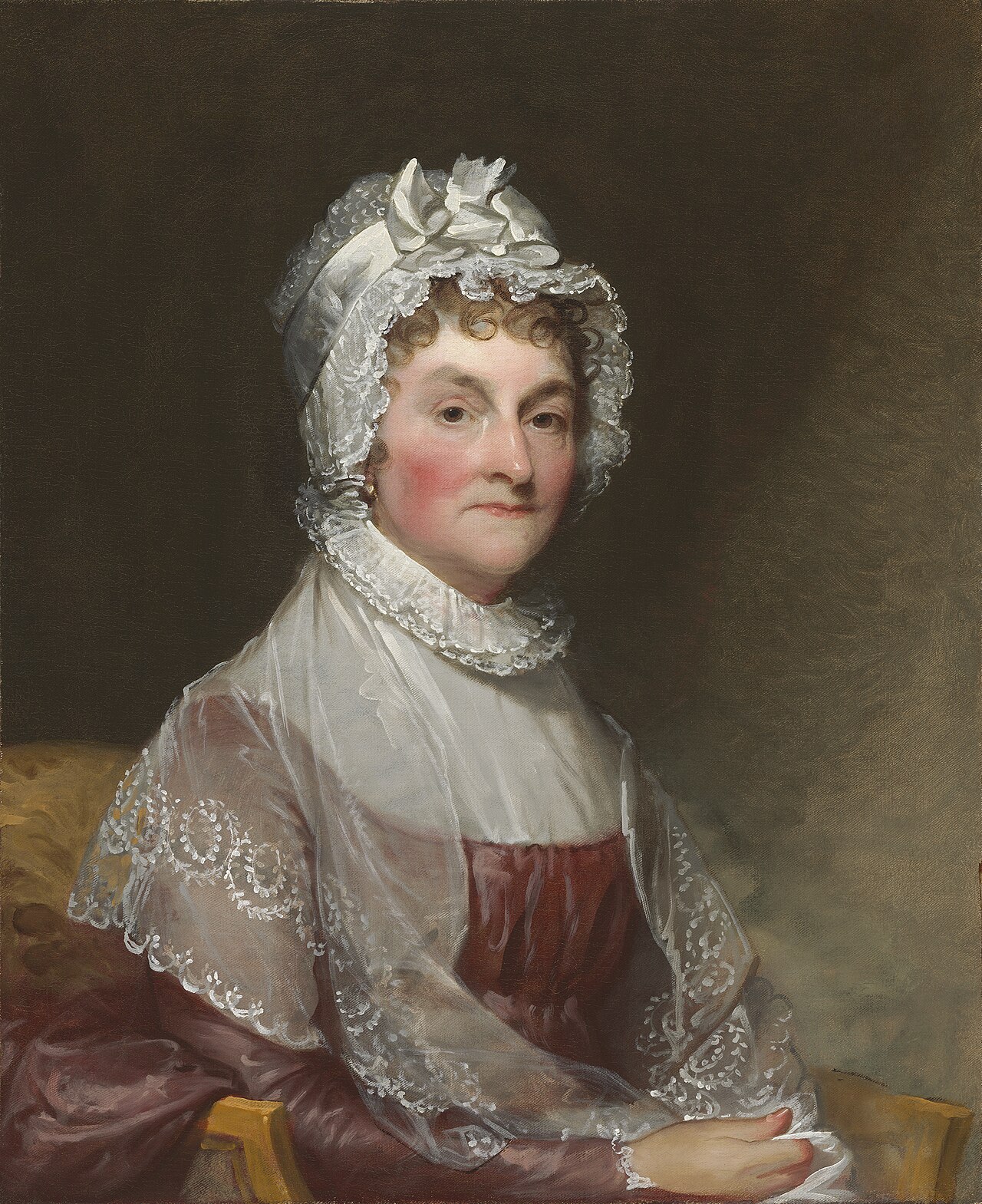
A Farm to Manage
She was born Abigail Smith in Weymouth, Massachusetts, on November 11, 1744, which is November 22 by the calendar we use now. Her father was a minister. She had no formal schooling and read Shakespeare, Milton and Pope on her own.34 She married John Adams on October 25, 1764, and moved to his family's home in Braintree, now Quincy.5
Then John went away. Court circuits first, then the Continental Congress, then Europe. Abigail stayed with a farm, tenants, a household and children, and the work was hers.3 The White House Historical Association says she oversaw the farm and its tenants and handled the family's finances and investments.5 The strain shows in a letter from August 1776, when she told John she had neglected her affairs at home for weeks and feared what that would cost.6
Smallpox in the summer of 1776
That summer she made a medical decision on her own. Boston was inoculating its citizens against smallpox, and Abigail took her children in. She had told John in June that she would be in the first class with all the children if a hospital opened, and she did not wait for his reply. She did not write to him again until July 13, after the inoculations were done. He had already heard from others, and he wrote that nothing but the critical state of public affairs kept him from flying to Boston.7 Nine-year-old John Quincy had a mild case. Ten-year-old Nabby had a severe one. Six-year-old Charles needed three inoculations in all.7 By mid-August Abigail could report that Johnny and Tommy had recovered, and that Nabby, who had fallen ill, was reinoculated.6
Slavery, Written in 1774
Abigail wrote to John from Boston on September 22, 1774: "I wish most sincerely there was not a Slave in the province." She called the whole business "a most iniquitious Scheme" (her spelling) and said Americans fought for liberty while "daily robbing and plundering from those who have as good a right to freedom as we have."8 It was a private remark to a husband. The words are hers and they are plain.
"Remember the Ladies"
On March 31, 1776, writing from Braintree, she told John she longed to hear that Congress had declared independence. Then she went on: "in the new Code of Laws which I suppose it will be necessary for you to make I desire you would Remember the Ladies, and be more generous and favourable to them than your ancestors."9
She named what worried her. "Do not put such unlimited power into the hands of the Husbands. Remember all Men would be tyrants if they could." She added a threat that sounds like a joke and may be one: "If perticuliar care and attention is not paid to the Laidies we are determined to foment a Rebelion, and will not hold ourselves bound by any Laws in which we have no voice, or Representation."9
What she asked for
Read the words again. The target is the power of husbands, which in her day meant coverture: a married woman had no separate legal identity, and her husband controlled her property. Historian Cassandra Good, quoted in Smithsonian Magazine, reads the passage that way and says, "She's not explicitly saying women should have a vote."10 The word vote does not appear in the letter.9 The same piece quotes Sara Georgini as saying, "I don't think she would have a specific laundry list."10 She used the colonists' own vocabulary of tyranny, rebellion and representation, and she aimed it at the household.
Myth: Abigail Adams demanded the vote for women
Many casual readers take the letter that way, and the Smithsonian notes that even a 2007 children's book says she sought voting rights.10 The letter does not use the word. The Smithsonian article adds that votes for women were almost unthinkable in 1776. Her phrase "no voice, or Representation" echoes the Revolution's slogan, but what she asked John to restrain was husbands.
John's answer and hers
John replied on April 14. "As to your extraordinary Code of Laws, I cannot but laugh." He said the Revolution had loosened every kind of authority, with children disobedient and "Negroes grew insolent to their Masters," and then declined to give up more: "Depend upon it, We know better than to repeal our Masculine systems." Men, he said, had "only the Name of Masters," and surrendering even that would bring on "the Despotism of the Peticoat."11
Abigail answered on May 7, signing as Portia. "I can not say that I think you very generous to the Ladies." She pointed at the gap between his public cause and his house: "whilst you are proclaiming peace and good will to Men, Emancipating all Nations, you insist upon retaining an absolute power over Wives."12 Nothing in the record shows John took up the request. No code of laws appeared that settled it.
Prices and Paper Money
The war reached her through the market. On June 8, 1779, she told John that corn cost 4 dollars in hard money a bushel, that a day's labor was 8 dollars and expected to reach 12, and that molasses ran 20 dollars a gallon and tea 40 dollars. She called the depreciating currency "the source of all our Evils" and said she paid 500 dollars in rates with about 200 more coming from a new Continental assessment.13 Anyone running a farm in 1779 learned what inflation does to people who hold paper.
Europe and the Capitals
In 1784 she crossed the ocean to join John and John Quincy in Europe with her daughter Abigail, and she kept a journal of the month-long voyage. She came home in 1788.3 During the twelve years of John's vice presidency and presidency she moved between Quincy and the capitals at New York, Philadelphia and Washington.3 She was First Lady from 1797 to 1801 and described the position as being "fastened up hand and foot and tongue to be shot at."414
She had six children, and four lived to adulthood. She died at home in Quincy on October 28, 1818, at 73, and lies in the family crypt at United First Parish Church.35 Her son John Quincy, the boy on Penn's Hill, became the sixth president.4
Abigail Adams's Life at a Glance
- November 11, 1744 Born in Weymouth, Massachusetts (November 22 on the modern calendar).
- October 25, 1764 Marries John Adams and moves to Braintree.
- September 22, 1774 Writes that she wishes there were not a slave in the province.
- June 17, 1775 Watches the Bunker Hill fighting from Penn's Hill with John Quincy.
- March 31, 1776 Asks John to "Remember the Ladies."
- April 14 and May 7, 1776 John laughs the request off; Abigail answers as Portia.
- Summer 1776 Has herself and the children inoculated against smallpox in Boston.
- June 8, 1779 Reports corn at 4 hard dollars a bushel and paper money failing.
- 1784 to 1788 Lives in Europe with John.
- 1797 to 1801 First Lady.
- October 28, 1818 Dies at home in Quincy.
Learn more
- Abigail Adams to John Adams, 31 March 1776: the whole letter, with her spelling, on Founders Online
- John Adams to Abigail Adams, 14 April 1776: his reply, which you should read next to hers
- Smithsonian Magazine on "Remember the Ladies": historians on what the letter did and did not ask
- Massachusetts Historical Society: Abigail Smith Adams: a short biography from the keepers of the Adams Papers
- All Things Liberty on the 1776 inoculation: the letters between Boston and Philadelphia that summer
Notes
- National Park Service, "Abigail Adams Cairn," on Abigail taking seven-year-old John Quincy to the top of Penn's Hill to watch the battle from afar. Read it online. ↩
- Abigail Adams to John Adams, 18 June 1775, Adams Family Papers, Massachusetts Historical Society, Adams Papers Digital Edition. Read it online. ↩
- Massachusetts Historical Society, Adams Family Biographical Sketches, "Abigail Smith Adams," on her birth in Weymouth on 11 November 1744, her lack of formal schooling, her management of the farm and tenants, the 1784 voyage, the return in 1788, the twelve years of the vice presidency and presidency, and her death on 28 October 1818. Read it online. ↩
- Encyclopaedia Britannica, "Abigail Adams," on the date November 22 (New Style), her service as First Lady from 1797 to 1801, her death at 73, and her son John Quincy as sixth president. Read it online. ↩
- White House Historical Association, "Abigail Adams," on her marriage on October 25, 1764, her oversight of the farm, tenants and family finances, six children of whom four reached adulthood, and her burial in the family crypt at United First Parish Church. Read it online. ↩
- Abigail Adams to John Adams, ca. 12 August 1776, Adams Family Correspondence, vol. 2, Adams Papers Digital Edition, on her neglected affairs at home and the cost of her stay in Boston. Read it online. ↩
- All Things Liberty, "Abigail Adams and Smallpox Inoculation during the Revolution" (April 2026), on the Boston inoculation, John's July 16 reply, and the cases of John Quincy, Nabby and Charles. Read it online. ↩
- Abigail Adams to John Adams, 22 September 1774, Adams Papers Digital Edition, Massachusetts Historical Society. Read it online. ↩
- Abigail Adams to John Adams, 31 March 1776, Founders Online, National Archives (Adams Family Correspondence, vol. 1, ed. L. H. Butterfield). Read it online. ↩
- Ellen Wexler, "Abigail Adams Asked Her Husband to Remember the Ladies as He Drafted America's Laws. Here's What She Really Meant," Smithsonian Magazine, March 31, 2026, quoting Cassandra Good, Sara Georgini and Woody Holton. Read it online. ↩
- John Adams to Abigail Adams, 14 April 1776, Founders Online, National Archives. Read it online. ↩
- Abigail Adams to John Adams, 7 May 1776, Braintree, Adams Papers Digital Edition, Massachusetts Historical Society. Read it online. ↩
- Abigail Adams to John Adams, 8 June 1779, Founders Online, National Archives, on prices, wages, depreciation and her tax bill. Read it online. ↩
- American Battlefield Trust, "Abigail Adams," on her description of the First Lady's role. Read it online. ↩
Terms in this lesson
- Coverture
- The English common law rule that a married woman had no separate legal identity. Her husband controlled her property and her earnings.
- Code of Laws
- The new body of law Abigail expected the independent states to write. She asked John to keep women in mind when it was drafted.
- Inoculation
- The 1700s method of giving a person a small dose of smallpox matter on purpose, to bring on a milder case and lasting immunity. It was risky and required weeks of recovery.
- Depreciation
- The fall in value of Continental paper money during the war, which pushed prices up sharply.
- Portia
- The pen name Abigail signed to her May 7, 1776 letter and some others.
Sources
- Founders Online, Abigail Adams to John Adams, 31 March 1776 checked 2026-10
- Founders Online, John Adams to Abigail Adams, 14 April 1776 checked 2026-10
- Massachusetts Historical Society, Adams Family Biographical Sketches: Abigail Smith Adams checked 2026-10
- Smithsonian Magazine, Ellen Wexler, Abigail Adams Asked Her Husband to Remember the Ladies checked 2026-10
- All Things Liberty, Abigail Adams and Smallpox Inoculation during the Revolution checked 2026-10