Lesson 53 of 60 · about 9 minutes
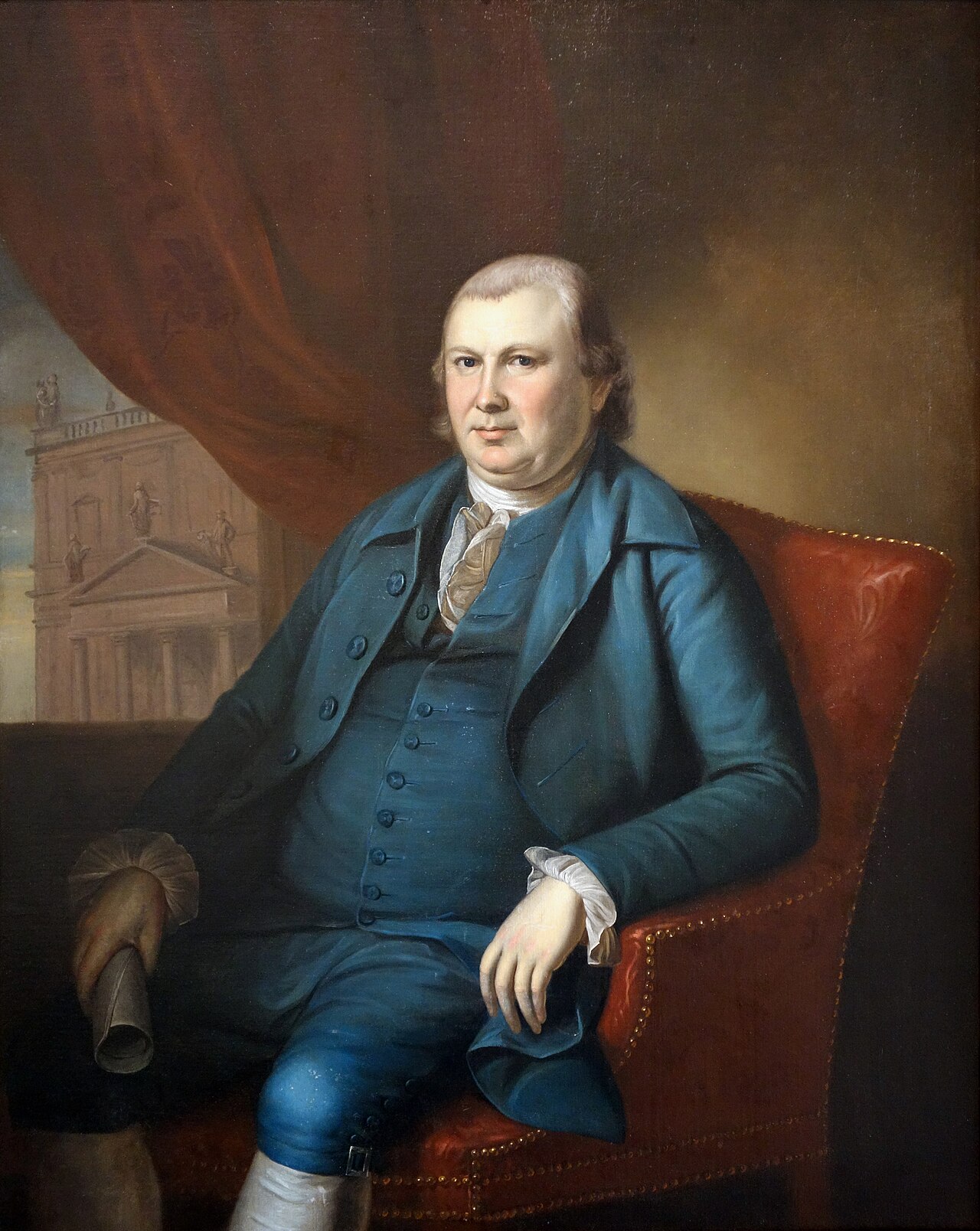
Robert Morris: The Merchant Who Financed the Revolution and Died Broke
You'll be able to
- Explain why Morris resisted independence and then signed the Declaration anyway
- Describe how he raised money for Washington in December 1776 and for the Yorktown march in 1781
- Note where sources disagree on dates and sums in his finance career
- Follow his rise and collapse through land speculation to prison and death in 1806
On New Year's Day 1777, Robert Morris sat down in Philadelphia and wrote to Washington at Trenton. Washington had asked for help with one of the worst problems an army can have: most of his soldiers' enlistments ran out that day, and he had no money to persuade them to stay. Morris answered with a sum and a sentence. "You will receive that Sum with this letter," he wrote, and the sum was "fifty thousand Dollars." Later in the letter he said he was "heartily glad" that 1776 was over.1
From Liverpool to a Philadelphia Counting House
Morris was born in Liverpool on January 20, 1734. In 1747 he crossed the Atlantic to join his father, a tobacco agent, in Oxford, Maryland. Two years later he went to Philadelphia as an apprentice to the merchant Charles Willing.2 The firm of Willing, Morris and Company was set up on May 1, 1757, with Willing's son Thomas as his partner.3
The firm was good at shipping and not squeamish about cargo. The Battlefield Trust says it "primarily dealt with merchant goods but also traded African slaves on occasion."4 Wikipedia, citing notices in the Pennsylvania Gazette and Charles Rappleye's biography, gives details: a voyage of the ship Nancy in 1762 sold about 170 people bought on the Gold Coast, and in 1765 the firm advertised 17 more for sale from the Marquis de Granby before the owner took them on to Jamaica. It calls that the firm's last involvement. The Battlefield Trust confirms the general fact, and the voyage details rest on Wikipedia's reading of those notices.5 The trade belongs in any honest account of the financier of the Revolution.
The Reluctant Signer
In 1765 Morris served on a committee of Philadelphia merchants formed to protest the Stamp Act. By 1775 he sat on the Pennsylvania Committee of Safety and eventually chaired it.3
He did not want a break with Britain in 1776. He feared war would be ruinous. A Groningen University biography says he voted against independence on July 1, which he thought premature, and on July 2 "purposely absented himself to facilitate an affirmative ballot by his delegation."6 Emerging Revolutionary War agrees that he left the room.3 The Battlefield Trust puts it more simply: he did not vote for independence. He signed in August. He explained: "I am not one of those politicians that run testy when my own plans are not adopted. I think it is the duty of a good citizen to follow when he cannot lead."2
Trenton, Hard Money and the Brink
In December 1776 Washington was camped across the Delaware, and he wrote to Morris in Philadelphia. On December 22 Washington feared the British were waiting for ice on the river and "the dissolution of the poor remains of our debilitated Army."7 On December 30 he asked for coin: "We have the greatest Occasion at present for hard Money, to pay a certain set of People who are of particular use to us." The editors of the Washington Papers note that the money was for the payment of spies.8 The next day, with enlistments ending, Washington told Morris he had promised each man 10 dollars to stay a month, had no money to pay it, and wrote, "If it be possible, Sir, to give us Assistance do it, borrow Money where it can be done."9
Morris answered on January 1 with the fifty thousand dollars.1 Emerging Revolutionary War quotes his remark: "The year 1776 is over, I am heartily glad of it and hope you nor America will ever be plagued with such another." It adds that Washington kept a force of about 3,000 men.10
Superintendent of Finance
By 1781 Congress had little power to raise money and had issued so much paper that inflation ran wild. It created a new post, Superintendent of Finance. Congress elected Morris to it unanimously on February 20, 1781, and he served until 1784.211 The Bank of North America began operations on January 7, 1782. He also issued notes backed by his own name.11 Haym Salomon helped him look for money, and his story is in his own lesson.
The Yorktown march of 1781 shows what that credit bought. A study in the Journal of the American Revolution says Washington asked Morris to cover the move, and Morris committed his own credit when the government had no hard money. Through local deputy quartermasters he contracted for 31 vessels on the Delaware and 59 on the Chesapeake. Shipping alone cost more than 8,000 pounds, and with food the bill rose to nearly 10,000. He borrowed $20,000 from Rochambeau against funds the French fleet was bringing, fell $6,200 short, and made up the gap from his own funds or from friends. In his own words, "the late movements of the Army have so entirely drained me of money."12
Myth: Morris paid for the Revolution out of his own pocket
He did put his name and credit behind loans and contracts, and the Yorktown study says the effort left him temporarily without cash or credit.12 But the economists Robert Wright and David Cowen write that such notes were in the end "met with French coin."11 The record shows French money and his credit working together, and no audit supports the idea that he paid for a war from his own savings.
He also fell short. By March 1783 the army was unpaid, and the Newburgh Address, written by Major John Armstrong, urged officers to press Congress. Washington talked them down. Mount Vernon says the nationalists in Philadelphia, the group Morris led, "attempted to stoke the army's unrest," and calls it uncertain whether such prompting caused the crisis. The Battlefield Trust says Morris had nothing to do with it.134 The historians do not agree, and the record does not settle it. His term as Superintendent ended in 1784.2
The Convention, the Senate and the Land
When the Convention opened in Philadelphia on May 25, 1787, Franklin had meant to nominate Washington to preside, but the weather and his health kept him home. Morris made the motion instead, and Washington was elected unanimously.14 Morris signed the Constitution and was one of only six men who signed both it and the Declaration.3 Franklin's part in that summer is told in Franklin at the Convention. Morris served as a senator from Pennsylvania from March 1789 to March 1795.15 Mount Vernon says Washington offered him the post of first Secretary of the Treasury, and that he declined and recommended Alexander Hamilton.16
Then came the land. The National Constitution Center says Morris turned to land speculation to recover his fortune, that war in Europe ruined the land market, and that the company he ran collapsed. The Battlefield Trust adds the financial crisis of 1797.172 He built an enormous Philadelphia mansion that people called "Morris' Folly" and never finished it.6
Prison and the Quiet End
Creditors had Morris arrested at his Philadelphia home on February 16, 1798, and he was taken to the Prune Street Jail. He was released on August 26, 1801, after the Bankruptcy Act of 1800. His debts ran to millions of dollars.18 The Battlefield Trust dates the imprisonment to 1799 through 1801, but the arrest date and the Groningen biography put it in 1798.26 He died on May 8, 1806, and was buried in the churchyard of Christ Church.15
Robert Morris's Life at a Glance
- 1734 Born in Liverpool, January 20.
- 1757 Becomes a partner in Willing, Morris and Company.
- July 1776 Opposes independence; signs the Declaration in August.
- January 1, 1777 Sends Washington $50,000 at Trenton.
- February 20, 1781 Congress elects him Superintendent of Finance; he backs the Yorktown march that fall.
- January 7, 1782 Bank of North America opens.
- 1787 Nominates Washington to preside over the Convention; signs the Constitution.
- 1798 to 1801 Debtors' prison, from February 16, 1798 to August 26, 1801.
- May 8, 1806 Dies in Philadelphia.
Learn more
- American Battlefield Trust: Robert Morris: a short biography with his signing remarks
- Robert Morris to George Washington, 1 January 1777: the letter itself, at Founders Online
- All Things Liberty: Supplying the Means: the figures behind the Yorktown march
- Haym Salomon: the broker who worked beside Morris
- Comte de Rochambeau: the French commander whose coin backed the campaign
Notes
- Robert Morris to George Washington, January 1, 1777, Founders Online, National Archives, on the fifty thousand dollars and his gladness that 1776 was over. Read it online. ↩
- American Battlefield Trust, "Robert Morris," on his birth, arrival, apprenticeship, signing remarks, the Superintendency and debtors' prison. Read it online. ↩
- Emerging Revolutionary War, "Six Signing Signers," on the firm of 1757, the Stamp Act committee, the Committee of Safety, leaving the room on July 2 and the six men who signed both documents. Read it online. ↩
- American Battlefield Trust, "Robert Morris: Financier of the American Revolution," on the firm's trade in slaves and on Newburgh. Read it online. ↩
- Wikipedia, "Robert Morris (financier)," section on Willing, Morris and Company, citing Pennsylvania Gazette notices of 1762 and 1765 and Charles Rappleye, Robert Morris: Financier of the American Revolution (2010). Used as a lead only. Read it online. ↩
- University of Groningen American Studies, "A Biography of Robert Morris, 1734-1806," on the July 1 vote, his absence on July 2, "Morris' Folly" and his arrest in 1798 and release in 1801. Read it online. ↩
- George Washington to Robert Morris, December 22, 1776, American Battlefield Trust primary source. Read it online. ↩
- George Washington to Robert Morris, December 30, 1776, Founders Online, with the editors' note on spy payments. Read it online. ↩
- George Washington to Robert Morris, December 31, 1776, Founders Online, on the ten-dollar bounty. Read it online. ↩
- Emerging Revolutionary War, "New Year's Eve, 1776: 'Your country is at stake,'" on the bounty, Morris's New Year's Day letter and Washington's remaining force of about 3,000. Read it online. ↩
- American Revolution Museum at Yorktown, "Building an Economy," excerpting Robert E. Wright and David J. Cowen, Financial Founding Fathers (University of Chicago Press, 2006), pp. 123-128, on the February 20, 1781 election, the bank, the notes and Salomon. Read it online. ↩
- All Things Liberty, "Supplying the Means: The Role of Robert Morris in the Yorktown Campaign" (2025), on vessels, costs, the Rochambeau loan and Morris's letter. Read it online. ↩
- Mount Vernon, "Newburgh Conspiracy," Digital Encyclopedia, on the unpaid army, Armstrong's address and the nationalists. Read it online. ↩
- James Madison, notes of the Federal Convention, May 25, 1787, on Morris's nomination of Washington and Franklin's absence. Read it online. ↩
- U.S. House of Representatives, History, Art and Archives, "Morris, Robert," on his Senate service, the declined Treasury post, his death and interment at Christ Church. Read it online. ↩
- Mount Vernon, "Department of the Treasury," Digital Encyclopedia, on Washington's offer of the Treasury to Morris and his recommendation of Hamilton. Read it online. ↩
- National Constitution Center, "Robert Morris Jr.," on land speculation and the collapse of his company. Read it online. ↩
- American Bankruptcy Institute, "The Story of Robert Morris," on the arrest of February 16, 1798, the Prune Street Jail, the release of August 26, 1801 and the Bankruptcy Act of 1800. Read it online. ↩
Terms in this lesson
- Specie
- Gold and silver coin. Continental paper money lost value, so soldiers, spies and foreign sellers often had to be paid in specie.
- Superintendent of Finance
- The executive post Congress created in 1781 to run national money. Morris held it from 1781 to 1784.
- Morris notes
- Promissory notes backed by Morris's own credit, used to pay for army supplies.
- Bank of North America
- The first commercial bank in the United States. It opened in Philadelphia on January 7, 1782.
- Willing, Morris and Company
- Morris's Philadelphia shipping and trading firm, formed in 1757.
- Bankruptcy Act of 1800
- The first federal bankruptcy law. Morris was released from debtors' prison under it in 1801.
Sources
- American Battlefield Trust, Robert Morris checked 2026-10
- Founders Online, Robert Morris to George Washington, 1 January 1777 checked 2026-10
- Founders Online, George Washington to Robert Morris, 30 December 1776 checked 2026-10
- All Things Liberty, Supplying the Means: The Role of Robert Morris in the Yorktown Campaign checked 2026-10
- American Revolution Museum at Yorktown, Building an Economy checked 2026-10
- National Constitution Center, Robert Morris Jr. checked 2026-10
- American Bankruptcy Institute, The Story of Robert Morris checked 2026-10