Lesson 8 of 60 · about 9 minutes
Daniel Morgan: The Wagoner Who Won at Cowpens
You'll be able to
- Follow Morgan from the Virginia frontier through Quebec and Saratoga to the South
- Explain the three-line plan at Cowpens and why it worked
- Compare the casualty figures different sources give for Cowpens
- Separate the well-known story of Morgan's 500 lashes from what the sources confirm
On the night of January 16, 1781, Daniel Morgan stayed up. He walked among the campfires at the Cowpens, a pasture in the South Carolina backcountry, talking to militia who had arrived overnight. Behind him, six miles back, ran the flooded Broad River. Somewhere ahead was Banastre Tarleton, who had been after him since January 12.1 Morgan had decided to stop running.
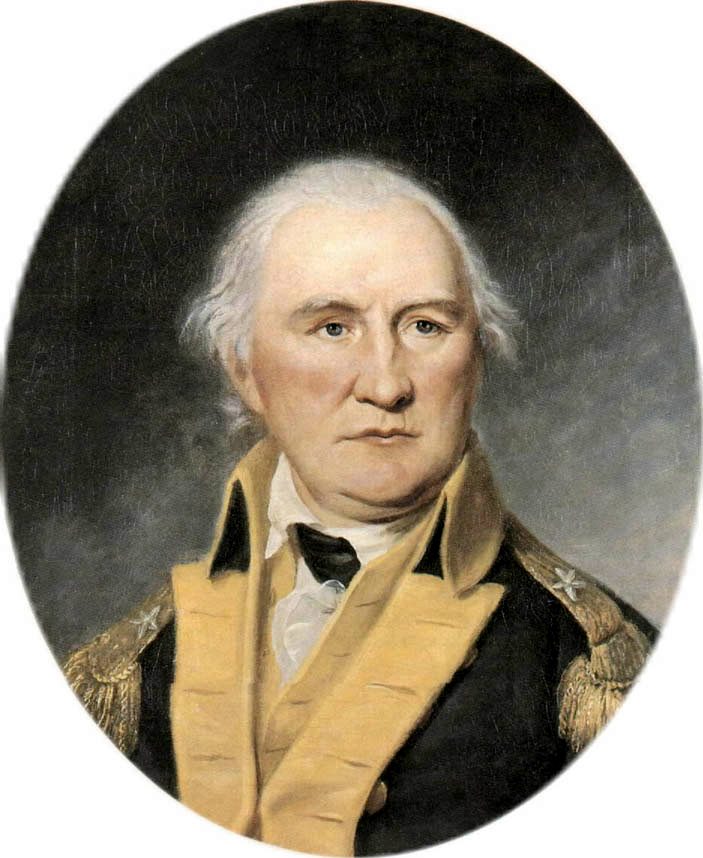
A Frontier Wagoner
Morgan was born in 1736 in Hunterdon County, New Jersey, according to Britannica, though Pennsylvania and Virginia also claimed him. The Battlefield Trust gives July 6, 1736. Mount Vernon says 1735 and calls the place of birth uncertain.2 He moved to Virginia around 1753, to Winchester, and worked as a teamster hauling freight in the Shenandoah Valley. The nickname "Old Wagoner" came from that work.3
The story most told about him comes from the French and Indian War. Morgan, driving wagons for Braddock's army, struck a British officer and was reportedly given 500 lashes. He later joked that the British had miscounted and given him 499. The Battlefield Trust passes it on as a punishment Morgan later joked about, and the Mount Vernon essay does not mention it at all.4 It makes a good story. The sources do not confirm it.
Quebec and Saratoga
In 1775 Morgan was commissioned a captain of Virginia riflemen and went to Canada with Benedict Arnold. In the assault on Quebec on December 31, 1775, his riflemen pushed deep into the town. Arnold was wounded, Morgan took command, and he was trapped and forced to surrender.5 He was released in late 1776 or early 1777, depending on the source.5 In the fall of 1777 he joined Horatio Gates and fought in both battles at Saratoga. The Battlefield Trust credits one of his riflemen with killing the British general Simon Fraser there.6
Passed over for promotion in 1779, Morgan left the army out of wounded pride. After Gates lost to Cornwallis at Camden in 1780, he came back as a brigadier general.7
Choosing the Ground
In the winter of 1780 and 1781 Nathanael Greene divided his small army, and Morgan took a detachment west.8 On January 12 Tarleton's scouts found Morgan at Grindal Shoals on the Pacolet River. On January 16, with Tarleton much closer than expected, Morgan fell back hastily and left his breakfast behind. He turned onto the Green River Road and chose the Cowpens, with the Broad River behind him. The Park Service notes that left him no safe way to cross.1
That was deliberate. Open ground with a few old trees, a ravine and a swampy patch would look to Tarleton like scattered Americans he could ride down, as he had done at other South Carolina battles.9
Three Lines and a Reserve
He arranged the army in three lines. Handpicked marksmen straddled the road and were told to hit officers and then fall back. Behind them, about 100 yards, stood the militia. Behind them again, about 150 yards, were Continental regulars and Virginia state troops.9 William Washington's cavalry stayed hidden.9 The militia were to fire two or three well-aimed volleys and fall back behind the regulars, which would look to Tarleton like a retreat.9
"Just hold up your heads boys, give them three fires and you will be free."
Daniel Morgan to his militia, as remembered by Thomas Young and quoted by the National Park Service. 9
On the morning of January 17 the weather was clear and bitterly cold. Morgan woke his men with a shout the Park Service gives as "Boys, get up! Benny's coming!"1 The fight went close to plan. The militia fired and fell back. Then Howard's Continentals misheard an order to face right as an order to retreat, and several companies began to withdraw. Morgan rode up, asked Howard whether he was beaten, took his assurance that the line was intact, and rallied the men. The Park Service quotes him calling out "form, form, my brave fellows! Old Morgan was never beaten!"1 The volley and a bayonet charge broke the British. The militia, re-formed, and Washington's cavalry closed on both flanks.1
The numbers differ
The battle lasted less than an hour. The Park Service reports 110 British dead, over 200 wounded and 500 captured, with 12 American dead and 60 wounded by Morgan's count.1 Mount Vernon says the British lost 110 killed and 702 captured.10 The Battlefield Trust gives 868 British and 149 American casualties.11 These do not match and no source here explains the gaps. Historians who study the battle work from the same few returns and reports, written in haste after a fight.
After Cowpens
Morgan buried the dead and moved north. He wanted to retreat into the mountains, but Greene chose to march toward Virginia, and Morgan left active duty because of ill health.1 Cornwallis burned his baggage and chased Greene toward the Dan River. At Guilford Courthouse the British won but lost about 500 men, dead or wounded, and a member of the House of Commons is reported to have said that another such victory would ruin the British army.1 The Park Service puts Cowpens at the start of that chain. Congress voted him a gold medal for Cowpens in 1781, and the Battlefield Trust dates the award to 1790.11 In 1794 he led Virginia militia into western Pennsylvania against the Whiskey Rebellion, and from 1797 to 1799 he served in the House as a Federalist.12 He died in Winchester on July 6, 1802.12
Morgan's Life at a Glance
- 1736 Born in New Jersey (1735 by Mount Vernon's reckoning).
- About 1753 Moves to the Shenandoah Valley and works as a wagoner.
- 1775 Commissioned a captain of Virginia riflemen; December 31, assault on Quebec.
- 1777 Fights in both battles at Saratoga.
- 1779 Resigns after being passed over.
- 1780 Returns as a brigadier general after Camden.
- January 17, 1781 Wins at Cowpens.
- 1790 Congressional Gold Medal.
- 1794 Leads Virginia militia against the Whiskey Rebellion.
- 1797 to 1799 Serves in the House of Representatives.
- 1802 Dies July 6 in Winchester, Virginia.
Learn more
- NPS: The Battle of Cowpens: the clearest hour-by-hour account
- American Battlefield Trust: Daniel Morgan: a short biography with the casualty figures
- Mount Vernon: Daniel Morgan: a longer treatment of Quebec, resignation and Cowpens
- Britannica: Daniel Morgan: birth, career and death at a glance
Notes
- National Park Service, "The Battle of Cowpens," Cowpens National Battlefield, on the pursuit from January 12, the retreat of January 16, the choice of ground with the Broad River behind, Morgan's talks with the militia, the shout "Boys, get up! Benny's coming!", the confusion in Howard's line, Morgan's cry "form, form, my brave fellows! Old Morgan was never beaten!", the envelopment, the casualty figures and the aftermath. Read it online. ↩
- Britannica, "Daniel Morgan," on his birth in Hunterdon County, New Jersey, in 1736; American Battlefield Trust, "Daniel Morgan," on July 6, 1736; Mount Vernon Digital Encyclopedia, "Daniel Morgan," on 1735 and the competing claims of Pennsylvania and Virginia. Read it online. ↩
- American Battlefield Trust, same article, on his teamster work and the nickname "Old Wagoner"; Mount Vernon, same article, on his move to Winchester around 1752. Read it online. ↩
- American Battlefield Trust, same article, on the report of 500 lashes after Braddock's campaign; Mount Vernon, same article, which does not mention it. Read it online. ↩
- Britannica, same article, on the assault on Quebec on December 31, 1775, Morgan's surrender and his release in late 1776; Mount Vernon, same article, giving early 1777 and describing Arnold's and Montgomery's fall. Read it online. ↩
- American Battlefield Trust, same article, on Saratoga in 1777 and the death of Simon Fraser. Read it online. ↩
- Mount Vernon, same article, on his retirement in 1779 after being passed over, and his return after Camden; Britannica, same article, on his rank as brigadier general. Read it online. ↩
- American Battlefield Trust, "Nathanael Greene," on Greene dividing his forces so that Morgan won at Cowpens. Read it online. ↩
- National Park Service, "Morgan's Plan of Battle at Cowpens," teaching page, on the choice of ground, the three lines, the cavalry reserve and Thomas Young's memoir of Morgan's words. Read it online. ↩
- Mount Vernon, same article, on British losses of 110 killed and 702 captured. Read it online. ↩
- American Battlefield Trust, same article, giving 868 British and 149 American casualties and the Congressional Gold Medal of 1790. Read it online. ↩
- Britannica, same article, on the Whiskey Rebellion, his term in Congress from 1797 to 1799 and his death on July 6, 1802. Read it online. ↩
Terms in this lesson
- Rifleman
- A soldier armed with a long rifle, which was accurate at far greater range than a musket but slow to load.
- Militia
- Part-time citizen soldiers called up by the states. At Cowpens Morgan used them in a way that fit their habits.
- Feigned retreat
- A planned pullback meant to draw the enemy into an exposed position.
- Double envelopment
- An attack in which both flanks of the enemy are wrapped at once.
- Congressional Gold Medal
- The highest civilian honor Congress gives. Morgan received one for Cowpens.
Sources
- National Park Service, The Battle of Cowpens checked 2026-10
- National Park Service, Morgan's Plan of Battle at Cowpens checked 2026-10
- American Battlefield Trust, Daniel Morgan checked 2026-10
- Mount Vernon Digital Encyclopedia, Daniel Morgan checked 2026-10
- Britannica, Daniel Morgan checked 2026-10