Lesson 16 of 60 · about 9 minutes
Polly Cooper: The Oneida Woman Who Fed Valley Forge
You'll be able to
- Explain why the Oneida broke with the rest of the Haudenosaunee Confederacy and sided with the Americans
- Tell which parts of the Polly Cooper story rest on documents and which rest on Oneida oral tradition
- Describe the versions of the refused payment and the shawl without picking one for the reader
- Trace what happened to Oneida land from 1784 to the Supreme Court's 2005 Sherrill decision and how the Oneida commemorate her today
In May 1778 an Oneida delegation walked into the army camp at Valley Forge, Pennsylvania. The National Park Service says an Oneida woman named Polly Cooper was with it, and that according to oral tradition the Oneida brought white corn for an army that had little to eat.1 Her statue stands in Washington, D.C. What she did there, and what the Oneida were paid for it, takes some sorting.
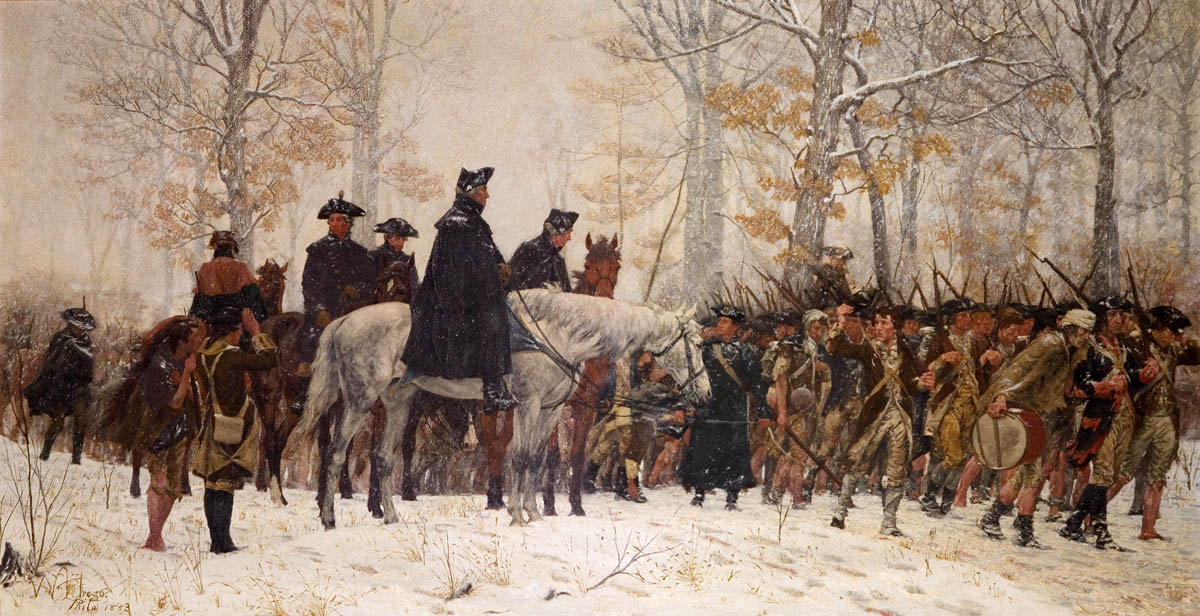
A Confederacy Divided
The Oneida belonged to the Haudenosaunee Confederacy, six nations that had kept a common council for generations. At the start of the war they tried to stay out. An Oneida message to the governor of New York said they were "unwilling to join either side of such a contest, for we love you both, Old England and New."3 Pressure from both sides ended that. In 1777 the council fire kept by the Onondaga was put out, and the Confederacy came apart.4
The Mohawk, Onondaga, Cayuga and Seneca generally went with the British, who had at least nominally upheld their land rights. The Oneida and most of the Tuscarora went with the Americans.4 One reason the Oneida leaned that way was the missionary Samuel Kirkland, who had lived among them since 1766.5 Another was a grievance over the boundary treaty of 1768 at Fort Stanwix, which pushed the line deep into Oneida country.5
The choice cost lives. At Oriskany on August 6, 1777, Oneida scouts fought beside General Nicholas Herkimer's militia against British-aligned Iroquois, and the war chief Han Yerry Tewahangarahken is said to have killed nine of the enemy.6 Mount Vernon records that the retreating Mohawk plundered the Oneida village afterward.7
What the Record Shows
The Oneida part of the story stands on firm ground. The Park Service says 50 Oneida men served with Washington's army in the winter of 1777 and 1778. In May 1778 the Oneida fought under Lafayette at Barren Hill, and Han Yerry's party lost six warriors there.56 Ten Oneida became officers in the Continental Army.7
Polly Cooper herself is harder to pin down. The American Battlefield Trust says historians have found few details about her life in the archival record.8 The Oneida Indian Nation, which keeps the story, says the same thing in its own way. Non-Native written sources "neither confirm nor deny" it. The Nation also quotes official praise of the Oneida from 1777, 1784 and 1794, and none of those passages names her. The Nation does confirm that an Oneida woman called Polly Cooper by English speakers was alive during the Revolution and cooked for the American cause in the War of 1812.9
The fuller account comes from Oneida oral tradition. William Honyost Rockwell, who lived from 1870 to 1960, heard it as a child and wrote it down several times between the 1930s and the 1950s.9 A community that keeps its own history this way is keeping a record. It is a different kind of record from a muster roll, and this lesson marks which is which. Even the dates wobble. The Nation's tradition has the gift arriving over the winter and spring of 1777 and 1778, while the Park Service dates the delegation's arrival to May 1778.91
Corn, Payment and the Shawl
The tradition says the corn was white corn, which has to be hulled and cooked before it is safe to eat, and that Cooper taught the soldiers and their families how to prepare it. The Park Service repeats that she taught the army to cook it, and that she stayed to nurse soldiers after many of her companions went home.1 A local historical society's account adds that soldiers tried to eat it raw and were stopped.10
Myth: Polly Cooper's corn saved Washington's army
It makes a good line, and it is repeated often. The sources do not carry it that far. The gift was several hundred bushels, which that same local account says was not enough to feed the whole army, and the Park Service puts the arrival in May, after the winter that nearly broke the camp.101 What the sources do support is a gift of food, a woman who knew how to prepare it, and care for the sick. That is plenty to honor.
The refused payment comes in the Oneida Indian Nation's words: "Polly Cooper was offered payment for her service, but refused, saying it was her moral duty."9 The shawl comes in three versions. In one, Martha Washington took her to Philadelphia and bought her a shawl and bonnet. In Rockwell's telling, Polly saw a black shawl in a shop window while walking with officers' wives, and Congress approved the money for it as payment for cooking for the officers.9 The Park Service says simply that Martha Washington gave her the shawl, and the Trust says the tradition credits soldiers' wives or possibly Martha herself.18 Nobody disputes the shawl itself. Her descendants have kept it for generations.8
What the Oneida Got
The refusal belonged to one woman. The Oneida as a people did ask to be paid. In April 1793 four Oneida officers wrote to President Washington that the Oneida were "the only Nation of Indians, who held fast the Covenant chain," and asked for the half pay that other officers had received. The editors note that Secretary of War Henry Knox had recommended against it in 1791, and that a treaty in December 1794 settled their wartime losses with $5,000.11
Land went the same way. The Treaty of Fort Stanwix in 1784 promised the Oneida and Tuscarora their lands, but the new government never enforced the promise.5 At the nation's birth the Oneida homeland ran to about six million acres. In 1788 they ceded it to New York and kept a reservation of about 300,000 acres, and in 1794 the Treaty of Canandaigua recognized that reservation. Then New York kept buying, including about 100,000 acres in 1795. By 1838 all but about 5,000 acres were gone, and by 1920 the Oneida held 32 acres in New York.12 Many moved west. By 1820 many had moved to Wisconsin, and two more groups went to Ontario in 1840 and 1845.5
The Oneida Indian Nation bought parcels back in the 1990s. In 2005, in City of Sherrill v. Oneida Indian Nation, the Supreme Court ruled 8 to 1 that the Nation could not revive its sovereignty over them. Justice Ruth Bader Ginsburg wrote that "the Oneidas long ago relinquished the reins of government and cannot regain them through open-market purchases from current titleholders." The Court pointed the Nation to the federal trust process instead.12
Remembered Today
The Nation gave the Smithsonian's National Museum of the American Indian a bronze group by the sculptor Edward Hlavka, Allies in War, Partners in Peace, which the museum first received in 2004. It shows Washington, Polly Cooper and Skenandoah under a white pine, the tree of the Great Law of Peace.13 A sound-and-light installation around it was reported by the museum in March 2018, and Oneida representative Ray Halbritter said the exhibit commemorates the friendship forged between the Oneida Nation and the United States.13 The Oneida County Historical Society inducted her into its Hall of Fame in 2005.14
In 2026 the U.S. Mint put her on the Native American $1 coin. The reverse shows Cooper with Washington, holding a basket of white corn.15 Halbritter said at the announcement, "The Oneida people became America's First Allies on some of the bloodiest battlefields of the Revolutionary War."15
Polly Cooper's Life at a Glance
- 1766 Samuel Kirkland begins his mission among the Oneida.
- August 6, 1777 Oneida scouts fight beside Herkimer's militia at Oriskany.
- 1777 The council fire of the Confederacy is put out and the Six Nations divide.
- May 1778 An Oneida delegation reaches Valley Forge. The Park Service names Polly Cooper in it.
- May 20, 1778 The Oneida fight under Lafayette at Barren Hill.
- 1784 Treaty of Fort Stanwix promises the Oneida their lands.
- 1788 The Oneida cede their homeland to New York and keep about 300,000 acres.
- 1794 Treaty of Canandaigua recognizes the reservation. A treaty settles Oneida wartime losses with $5,000.
- 1920 The Oneida hold 32 acres in New York.
- March 29, 2005 The Supreme Court decides Sherrill.
- 2026 Cooper appears on the Native American $1 coin.
Learn more
- National Park Service: The Oneida Nation in the American Revolution: a short, careful overview of the alliance and its costs
- Oneida Indian Nation: The Polly Cooper Shawl: the Nation's own account, which says plainly where the written record is silent
- American Battlefield Trust: Polly Cooper: a concise biography that separates the archival record from oral tradition
- City of Sherrill v. Oneida Indian Nation: the full opinion, with the history of the land in its opening pages
Notes
- National Park Service, Valley Forge, "The Women Present at Valley Forge," entry for Polly Cooper under Allied American Indian Women: arrival of an Oneida delegation in May 1778, white corn "according to oral tradition," her teaching the army to cook it, her remaining to care for soldiers, and the shawl from Martha Washington. The page cites no document for the entry. Read it online. ↩
- American Revolution Museum, collection entry for William B. T. Trego, The March to Valley Forge, December 19, 1777, exhibited at the Pennsylvania Academy of the Fine Arts in 1883, oil on canvas. Read it online. ↩
- National Park Service, "The Six Nations Confederacy During the American Revolution," quoting the Oneida message to the governor of New York on neutrality. Read it online. ↩
- Fort Ticonderoga, "Iroquoia," on the failure of neutrality, the extinguished council fire of 1777, and the Mohawk, Onondaga, Cayuga and Seneca siding with the British while the Oneida and Tuscarora sided with the Americans. The Park Service article in note 3 agrees that only the Oneida and Tuscarora gave major support to the Americans. Read it online. ↩
- National Park Service, "The Oneida Nation in the American Revolution," on Kirkland (1766), the Boundary Line Treaty of 1768, Oneida service at Oriskany and Valley Forge, the 1784 Treaty of Fort Stanwix, the $5,000 of 1794, and migrations to Wisconsin and Ontario. Read it online. ↩
- American Battlefield Trust, American Revolution Experience, "Han Yerry Tewahangaraghkan," on Oriskany (August 6, 1777), nine enemy killed, and Barren Hill (May 20, 1778), where six Oneida warriors died. Read it online. ↩
- George Washington's Mount Vernon, "Oneida," on the pillaging of the Oneida village by the retreating Mohawk and on ten Oneida becoming Continental officers. Read it online. ↩
- American Battlefield Trust, "Polly Cooper," on the scarcity of archival detail, the tradition of a black shawl from soldiers' wives or possibly Martha Washington, and the descendants who kept it. Read it online. ↩
- Oneida Indian Nation, "The Polly Cooper Shawl: Testimony to a Pact of the Revolutionary War" (February 5, 2023), on Rockwell, the refused payment, the shawl versions, the silence of the 1777, 1784 and 1794 documents, and the 1812 service. Read it online. ↩
- KOP History, "Oneidas and Polly Cooper," a local historical account, on the corn, the raw-corn danger, and the "several hundred bushels." Read it online. ↩
- Founders Online, "To George Washington from the Oneida Indians, 7 April 1793," with editorial notes on Knox's 1791 recommendation and the December 1794 treaty settling losses at $5,000. Read it online. ↩
- City of Sherrill v. Oneida Indian Nation of New York, 544 U.S. 197 (2005), decided March 29, 2005, opinion of Justice Ginsburg, on six million acres, the 1788 and 1794 treaties, sales through 1920, the quoted holding and the trust route. Read it online. ↩
- Smithsonian Magazine, "New Sound-and-Light Installation Brings to Life the Oneida Nation's Aid to the American Revolution," March 15, 2018, on the Hlavka statue and Halbritter's remarks. Read it online. ↩
- Valley Forge Muster Roll, "Polly Cooper," on her 2005 induction into the Oneida County Historical Society Hall of Fame. I found no second source for the date. Read it online. ↩
- CoinWeek, "U.S. Mint Honors Oneida War Heroine Polly Cooper on the 2026 Native American $1 Coin," January 30, 2026, on the reverse design and Halbritter's statement. Read it online. ↩
Terms in this lesson
- Haudenosaunee
- The people the English called the Iroquois. Their Confederacy, also called the Six Nations, joined the Mohawk, Oneida, Onondaga, Cayuga, Seneca and Tuscarora.
- Oral tradition
- History carried by telling and retelling inside a community. It is a record kept by people, and it can be checked against paper records but is not the same kind of evidence.
- Skenandoah
- An Oneida leader, also written Oskanondonha, who is named in the tradition as the man who sent the corn to Valley Forge.
- Treaty of Canandaigua
- An agreement of 1794 in which the United States acknowledged the Oneida reservation and promised the Oneida free use and enjoyment of it.
- Sherrill decision
- City of Sherrill v. Oneida Indian Nation (2005), in which the Supreme Court held that the Oneida could not revive tribal sovereignty over land they bought back on the open market.
Sources
- National Park Service, The Oneida Nation in the American Revolution checked 2026-10
- National Park Service, Valley Forge: The Women Present at Valley Forge checked 2026-10
- Oneida Indian Nation, The Polly Cooper Shawl: Testimony to a Pact of the Revolutionary War checked 2026-10
- American Battlefield Trust, Polly Cooper checked 2026-10
- City of Sherrill v. Oneida Indian Nation of New York, 544 U.S. 197 (2005) checked 2026-10
- Founders Online, To George Washington from the Oneida Indians, 7 April 1793 checked 2026-10