Lesson 49 of 60 · about 9 minutes
John Barry: The Irish-Born Captain Who Held Commission Number One
You'll be able to
- Trace Barry from County Wexford to Philadelphia and command of the Lexington
- Describe his fights ashore and afloat on the Delaware, and his wounding aboard the Alliance in 1781
- Explain what Commission Number One means and why "Commodore" was never an official rank in his day
- Weigh the claim that he is the Father of the American Navy and a popular story about a bribe
On March 10, 1783, the frigate Alliance, Captain John Barry commanding, met the British frigate Sybille (spelled Sybil in some accounts) off Florida. The fight lasted about forty-five minutes.1 It was the last sea battle of the Revolution, and peace was declared a month later.1 The Catholic Encyclopedia says the British ship hauled off damaged, and a 2017 Military Times article says she disengaged and withdrew.12 Barry had fought the whole war, and he would still be fighting for the Navy fourteen years later.
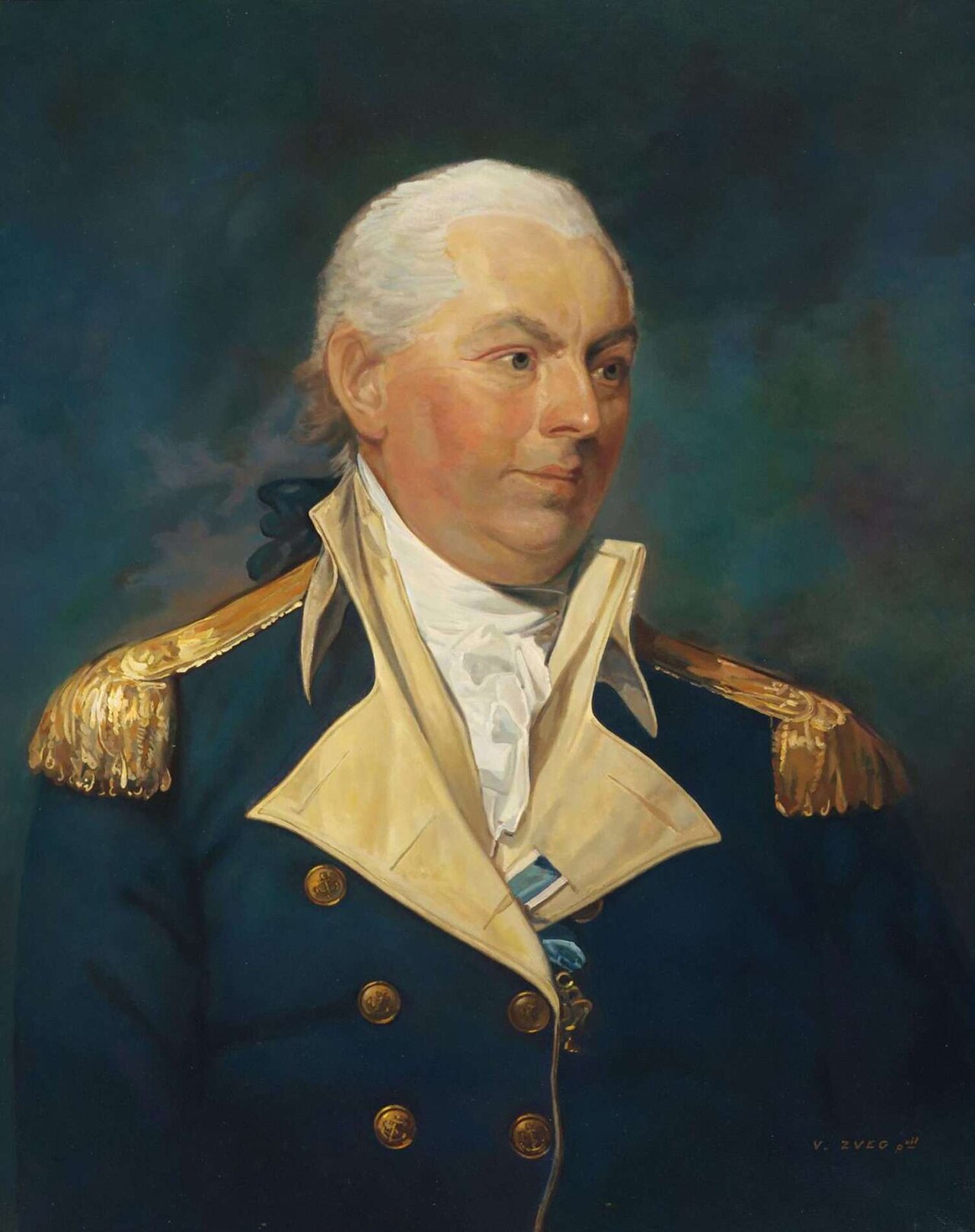
From Wexford to Philadelphia
Barry was born March 25, 1745, at Tacumshane, County Wexford.13 The ushistory.org biography says a landlord evicted the family and they moved to Rosslare, where an uncle fished.4 He started as a cabin boy. He reached Philadelphia at fifteen, and by twenty-one he was a merchant shipmaster out of that port.15 In December 1774 he sailed the Black Prince to Bristol and came home in October 1775. Then he sold the ship to the cause.16
The Lexington and the Edward
On December 7, 1775, Congress gave Barry command of the 14-gun Lexington, one of the first ships bought for the Navy.37 His formal captain's commission, signed by John Hancock, is dated March 14, 1776.4 On April 7 he took the Edward, a tender of HMS Liverpool, off the Virginia Capes. ushistory.org says the fight took an hour and cost two of his men killed and two wounded.4 HistoryNet says more than an hour.8 His report to the Marine Committee said that "all our people behaved with much courage."4
Several popular articles call the Edward the first Royal Navy vessel to surrender to an American warship. One of them gives no source for it.8 The Naval Institute's Naval History magazine is more careful and says only that she was one of the first.9 The claim holds only if you define "first" narrowly enough.
The Delaware, Trenton and Princeton
Barry went ashore too. In December 1776 he joined Washington's army and fought at Trenton and Princeton.1 At Princeton on January 3, 1777, he was with John Cadwalader's Pennsylvania Brigade.9 The frigate Effingham, his assigned ship, never got to sea. She was scuttled below Bordentown on November 2, 1777, and the British burned her on May 9, 1778.10
In March 1778, with Philadelphia held by the British, he raided river traffic in small boats. His letter to Washington from Port Penn on March 9 survives.
"Tis with the Greatest Satisfaction Imaginable I inform You of Capturing two Ships & a Schooner of the Enemy."
Captain John Barry to George Washington, Port Penn, March 9, 1778. 11
The transports, bound from Rhode Island, were loaded with forage that the enemy badly needed, and he burned one when small enemy vessels appeared.11 Later that year the Raleigh, which he sailed out of Boston, was run ashore on September 27 after fighting two British warships, and Barry set her on fire to keep her out of enemy hands.1
The Alliance
This was the same Alliance whose fire hurt John Paul Jones's flagship at Flamborough Head, as the Jones lesson tells. Barry took her over in November 1780. On February 11, 1781, he sailed for France with Colonel John Laurens, who was going on a mission for Congress (see the lesson on Laurens).1
On the way home the Alliance met two British sloops, the Atlanta and the Trepassey. The Catholic Encyclopedia dates the fight May 28, and a U.S. Navy history article says May 29. Both agree that the two ships struck.16 A shot wounded Barry in the shoulder, and by the ushistory.org account he lost consciousness from loss of blood before the end. When the British captain handed over his sword, Barry gave it back and is reported to have said: "I return it to you, Sir. You have merited it, and your King ought to give you a better ship."4 In December 1781 he carried Lafayette home to France from Boston.1
Commission Number One
When the war ended the Alliance was sold and the country had no navy. Congress rebuilt one on March 27, 1794. Washington named six captains, and Barry headed the list.1 His commission was signed on February 22, 1797, and set his rank from June 4, 1794. It was "Registered No. 1."1 A 2005 House resolution gives the rank date as June 7, 1794, so even that detail has two versions.12 He supervised the building of the frigate United States, and he served in the Quasi-War with France.7 His sea service ended in 1801.1
The title "Commodore" needs a footnote of its own. The Catholic Encyclopedia notes that the Navy had no such grade until July 17, 1862. Captain was the highest rank, and "commodore" was a courtesy applied to a captain commanding several ships.1 Congress did not mind. In 2005 the House resolved that "Commodore John Barry is recognized, and is hereby honored, as the first flag officer of the United States Navy."12 President Reagan had already proclaimed September 13, 1981, Commodore John Barry Day.7 Members of the House in 2005 also called him the Father of the American Navy, a title that Jones and John Adams are credited with as well.128
Myth: Barry turned down 20,000 guineas to surrender his ship
The story says a visitor, possibly Barry's Tory brother-in-law William Austin, offered 20,000 gold guineas and a Royal Navy command if he would give up the Effingham in mid-September 1777.8 The Military Times says only that the offer "is believed to have" been made.2 Neither article cites a document, and the American Battlefield Trust says just that the English tried to bribe him.3 No document that supports the story turned up in checking.
Death
Barry died of asthma at his country home, Strawberry Hill, near Philadelphia, at 58. Most sources give September 13, 1803. ushistory.org says September 12.64 He was buried at St. Mary's Church in Philadelphia, beside his two wives, in a grave with an epitaph written by Dr. Benjamin Rush. He had no children.1
John Barry's Life at a Glance
- 1745 Born March 25 in County Wexford, Ireland.
- December 1775 Given command of the Lexington.
- April 7, 1776 Takes the British tender Edward.
- 1776 and 1777 Fights ashore at Trenton and Princeton.
- March 1778 Captures ships and a schooner on the Delaware and writes to Washington.
- May 1781 Wounded in the fight with the Atlanta and the Trepassey.
- March 10, 1783 Fights the Sybille in the last sea action of the war.
- February 22, 1797 Receives Commission Number One.
- September 1803 Dies at Strawberry Hill.
Learn more
- Founders Online: Barry to Washington, March 9, 1778: his own words after a raid
- Proclamation 4853, Commodore John Barry Day: how the President of 1981 summed him up
- ushistory.org: Commodore Barry: a short life with local Philadelphia detail
- Catholic Encyclopedia: John Barry: a dated list of his commands
Notes
- Catholic Encyclopedia, "John Barry," on his birth, the Black Prince, Trenton and Princeton, the Effingham, the Raleigh, the Alliance, Laurens, Lafayette, the Sybille and its withdrawal, the 1794 and 1797 commissions, the rank of commodore, the end of his sea service in 1801, his marriages and his burial. Read it online. ↩
- Military Times, "5 facts about the true father of the US Navy" (November 3, 2017), which says the guinea offer "is believed to have" been made and that the Sybille disengaged and withdrew. Read it online. ↩
- American Battlefield Trust, "John Barry," on his birth on March 25, 1745, the commissioning of the Lexington on December 7, 1775, and the statement that the English tried to bribe him. Read it online. ↩
- ushistory.org, "Commodore Barry," on the eviction, the Hancock commission of March 14, 1776, the Edward fight and his report, the sword and his death. Read it online. ↩
- Mariner.ie, "Commodore John Barry," on his career as a Philadelphia merchant shipmaster at twenty-one. Read it online. ↩
- U.S. Navy, "Commodore John Barry," Navy Live, on the sale of the Black Prince, the date of the Atlanta fight (May 29, 1781) and his death. Read it online. ↩
- Ronald Reagan, Proclamation 4853, "Commodore John Barry Day," August 20, 1981, American Presidency Project, on the Lexington as one of the first ships bought for the Navy, the Quasi-War and the 1981 observance. Read it online. ↩
- HistoryNet, "Father of the Navy," on the first-surrender claim, the length of the Edward fight, the shared title and the guinea story, with Austin as a possible visitor and the date of mid-September 1777. Read it online. ↩
- U.S. Naval Institute, Naval History (June 2009), "I Passed Philadelphia Two Boats," on the Edward and Barry at Princeton. Read it online. ↩
- Naval History and Heritage Command, Dictionary of American Naval Fighting Ships, "Effingham," on her scuttling below Bordentown on November 2, 1777, and her burning by the British on May 9, 1778. Read it online. ↩
- John Barry to George Washington, March 9, 1778, Founders Online, Papers of George Washington, Revolutionary War series, vol. 14. Read it online. ↩
- Congressional Record, vol. 151 (2005), pt. 21, pp. 28374 to 28375, House debate on the Commodore John Barry resolution (H.J. Res. 38). Read it online. ↩
Terms in this lesson
- Commission Number One
- The first captain's commission of the permanent U.S. Navy, signed by Washington on February 22, 1797, and ranking from 1794. It went to Barry.
- Commodore
- A courtesy title for a captain commanding several ships. It was not an official U.S. Navy rank until July 17, 1862.
- Tender
- A small vessel that serves a larger warship. The Edward was a tender of HMS Liverpool.
- Marine Committee
- The committee of the Continental Congress that ran naval affairs and issued Barry's first orders.
- Quasi-War
- The undeclared naval conflict between the United States and France from 1798 to 1800, in which Barry commanded in the West Indies.
Sources
- Catholic Encyclopedia, John Barry checked 2026-10
- Founders Online, John Barry to George Washington, 9 March 1778 checked 2026-10
- ushistory.org, Commodore Barry checked 2026-10
- American Presidency Project, Proclamation 4853, Commodore John Barry Day checked 2026-10
- Congressional Record, Volume 151 (2005), Commodore John Barry resolution checked 2026-10
- U.S. Navy, Commodore John Barry (Navy Live) checked 2026-10