Lesson 25 of 60 · about 9 minutes
The First Rhode Island Regiment: The Black Soldiers of Yorktown
You'll be able to
- Read what the Rhode Island act of February 1778 said about freedom and about payment to owners
- Compare the different counts of Black and Native soldiers and see why they disagree
- Follow the regiment from the Battle of Rhode Island to Pines Bridge and Yorktown
- Describe what happened to the men after demobilization in 1783
On February 14, 1778, the Rhode Island General Assembly met with the enemy holding the capital and much of the state, and voted that "every able-bodied Negro, Mulatto, or Indian Man Slave" could enlist in the state's two Continental battalions.1 A man who passed muster before Colonel Christopher Greene was to be "immediately discharged from the service of his master or mistress, and be absolutely free."1 The state was out of white recruits. So it offered the thing the army could afford and the enlisted men most wanted.
The Act of February 1778
General James Varnum, a Rhode Islander, raised the idea at Valley Forge that winter. He wrote that "it is imagined that a battalion of Negroes can be easily raised" in the state, and Washington passed the proposal to Governor Cooke.3
Freedom was not free to the state. The act paid each owner "a Sum according to his Worth," up to 120 pounds for the most valuable man, set by a committee of five, one from each county, and paid in a treasury note at 6 percent interest. The owner had to hand over the recruit's clothes first or lose the payment.1 Two modern summaries put the cap at $400, which does not match the act's own text.45 Rhode Island freed these men by buying them from the people who held them. It also soon lost its nerve. After the April elections the new Assembly repealed the act, and enslaved men could enlist only until June 10, 1778.3
How Many Men?
Nobody agrees, and the gap is wide. The count depends on whether a writer means the enslaved recruits of 1778, the regiment at its peak or the Black share of it.
| Estimate | Source |
|---|---|
| 88 enslaved men enlisted in four months, plus some free Black and Native men | Wikipedia11 |
| Over 130 enslaved men enlisted | All Things Liberty3; History.com5 |
| Fewer than 200 men from the 1778 scheme | americanrevolution.org2 |
| About 250 men joined the regiment | Adams, H-Net4 |
| 225 men in all, as many as 140 Black | Wikipedia11; Mount Vernon6 |
| About 140 Black and 85 Native men | Lorén Spears, in the Boston Globe9 |
Mount Vernon calls the 140 of 225 the highest share of Black soldiers in any Continental unit.6 Across the whole army, Adams puts the number of Black men who served at about 5,000.7
The Native soldiers
The act named "Indian" men as well, and Narragansett men served. Gretchen Adams says "a few Narragansett Indians" were there from the start.7 A review of Robert Geake's book reports about seventy Narragansett men enlisted, and Spears of the Tomaquag Museum puts Native soldiers near 85.89 Those figures cannot all be right. The review adds that after Narragansett families intermarried with Black neighbors, white officials listed their children as "colored," which helped erase the record of Native service.8
August 29, 1778
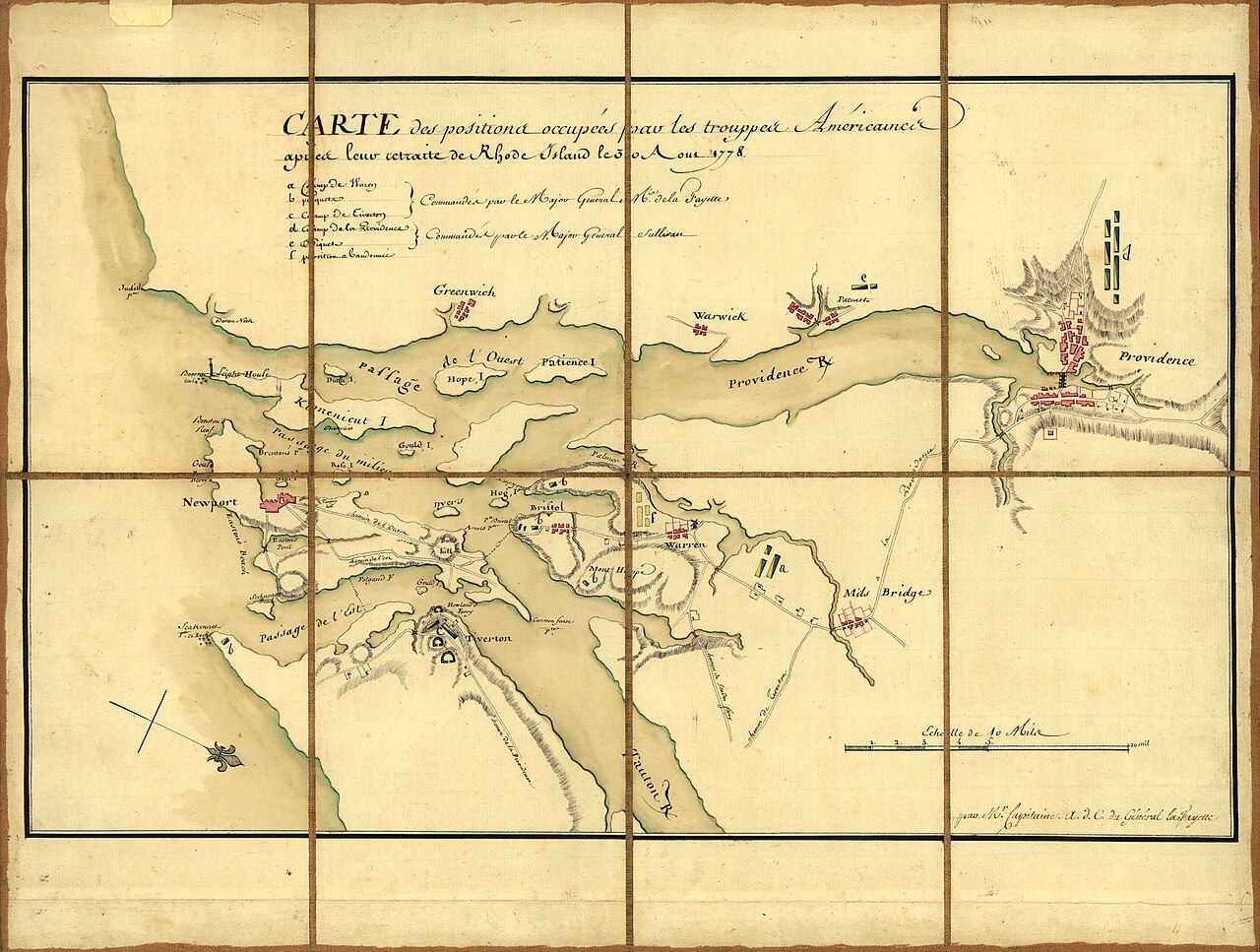
The regiment's first battle came on Aquidneck Island on August 29, 1778. General John Sullivan's force of about 10,100 had besieged Newport with French help, but a storm damaged the French fleet, the French left for Boston, and Sullivan gave up the siege. The fighting of August 29 ended without a winner, with casualties of 181 Americans and about 260 British.10 The regiment, under Major Samuel Ward Jr., held the end of the American line nearest the Hessians.11 A popular story says the regiment alone beat back three Hessian charges. Sullivan's letter to the governor says the enemy tried three times and was repulsed, but by a force of several regiments, and Rhode Island historian Sidney Rider wrote in 1880 that the story about the Black regiment doing it "cannot be true."16 Sullivan's orders the next day said the regiment was "entitled to a proper share of the honor of the day."16 Rider lists three killed, nine wounded and eleven missing for the Americans in the regiment's part of the field.16
Greene, Olney and Pines Bridge
Christopher Greene, a Rhode Island colonel who had been taken prisoner at Quebec, was named to command at Washington's suggestion.2 Lieutenant Colonel Jeremiah Olney later took his place. On January 1, 1781, the state's two regiments were merged, and a January 1781 order, as All Things Liberty reports it, said "negroes will not be received" as new recruits.312
On May 14, 1781, Loyalists under James De Lancey struck Greene's post near the Croton River at dawn. Greene, forty-four, and Major Ebenezer Flagg were killed. Washington wrote that Greene "died upon the Road."13 The record contradicts itself on details. The date is May 13 in some accounts, and the place of his death varies between the road, a bank and the woods. Wikipedia says six Black soldiers died defending him and that his body was mutilated as punishment for leading Black troops, but the careful study of the evidence in All Things Liberty does not say that, and much of its testimony was recorded decades later.1113 The name is usually spelled Pines Bridge, and sometimes Pine's or Points Bridge. Olney took command that day.14
Yorktown, 1781
The merged Rhode Island Regiment marched south and served at the siege in Colonel Elias Dayton's brigade of General Benjamin Lincoln's division.14
Disputed: Did the Black regiment storm Redoubt 10?
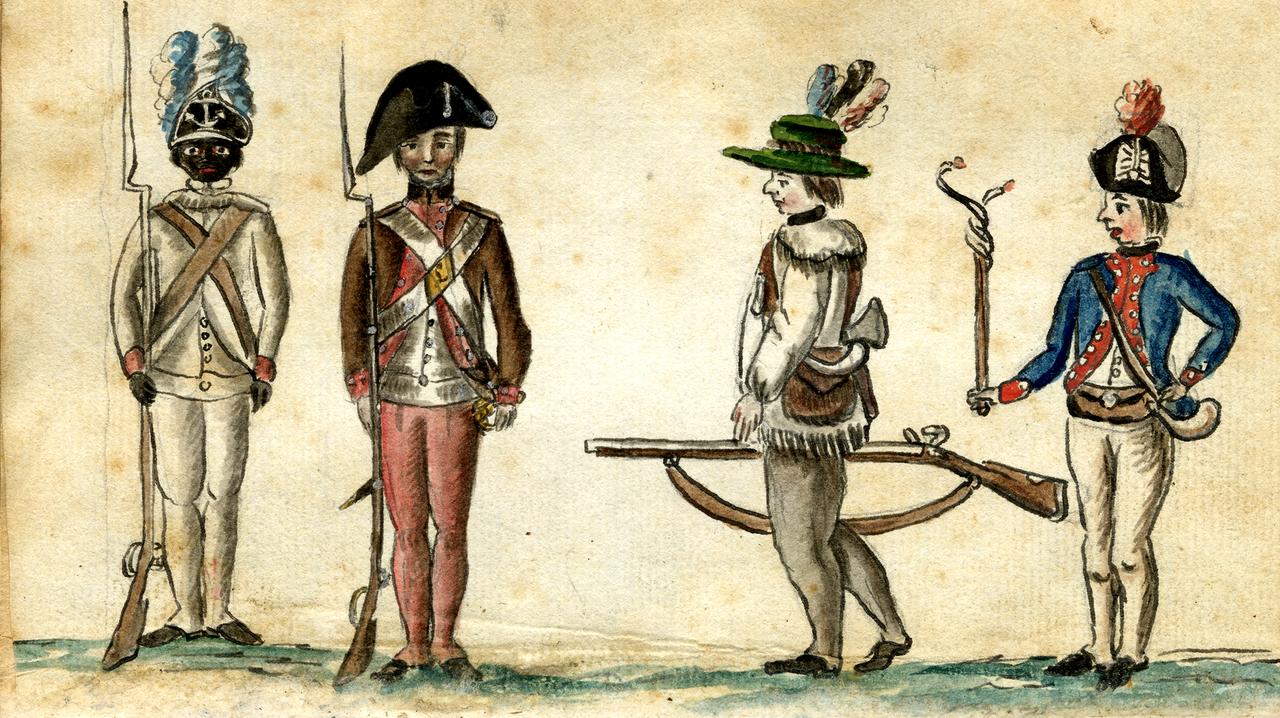
Geake's reviewer writes that Black troops from the regiment took part in the night assault on Redoubt 10.8 The Wikipedia article on the light infantry at Yorktown says the Rhode Island company that led the van there was Captain Stephen Olney's, drawn mainly from white veterans of the 2nd Rhode Island, and "never was part of the Black 1st Regiment."15 The sources do not settle it. What is clear is that the regiment was at Yorktown and that a French officer drew a Black soldier in its uniform that fall.
After the War
The Black soldiers were sent home from Saratoga in June 1783. Olney praised their "valor and good conduct," and later helped men resisting attempts to re-enslave them and backed claims for pay and pensions.7 Wikipedia gives the date of the regiment's final disbanding as December 25, 1783.11
The record after that is hard. Former slaves got no land or other aid and often did temporary labor. The Assembly left veterans to the poor relief of their home towns, and some families were "warned out" of towns, including the partner and daughter of Briton Saltonstall, who were forcibly removed to New York.8 Wikipedia says that in 1784 thirteen Black veterans hired a man to pursue back pay.11 Congress did not pass a pension for indigent veterans until 1818.8 Some men gave their pensions and bounties to former owners to repay the price of their freedom.9 Olney, by contrast, became Collector of Customs at Providence in 1790 and died there in 1812.14
The Regiment's Life at a Glance
- February 14, 1778 Rhode Island's Assembly lets enslaved men enlist and pays their owners.
- June 10, 1778 Enlistment of enslaved men ends.
- August 29, 1778 Battle of Rhode Island; the regiment helps hold the line against the Hessians.
- January 1, 1781 Rhode Island's two regiments are merged.
- May 14, 1781 Greene is killed at Pines Bridge; Olney takes command.
- September to October 1781 The regiment serves in the siege of Yorktown.
- June 1783 Black soldiers are demobilized at Saratoga.
- 1818 Congress passes the first pension for indigent veterans.
Learn more
- Rhode Island State Archives: Black Regiment: the act of February 14, 1778, transcribed
- Gretchen Adams: "Deeds of Desperate Valor": a short essay on the regiment and its demobilization
- All Things Liberty: The Death of Colonel Greene: the conflicting accounts of Pines Bridge
- American Battlefield Trust: Battle of Rhode Island: forces, storm and outcome
Notes
- Rhode Island State Archives, "Black Regiment," transcript of the General Assembly's Act of February 14, 1778 (Acts and Resolves, vol. 17, no. 14): eligibility, payment "according to his Worth" up to 120 pounds, the committee of five and the 6 percent treasury note. The page says it summarizes the original. Read it online. ↩
- "1778: 1st Rhode Island Regiment Opens to Non-Whites," americanrevolution.org, quoting the act's freedom clause and the appointment of Greene. Read it online. ↩
- "The 1st Rhode Island Regiment and Revolutionary America's Lost Opportunity," All Things Liberty, January 2018, on Varnum's letter, Washington forwarding the plan, the repeal after the April elections, the June 10 cutoff and the January 1781 order that "negroes will not be received." Read it online. ↩
- Gretchen A. Adams, "Deeds of Desperate Valor": The First Rhode Island Regiment, H-Net, giving compensation of up to $400 in Continental currency. Read it online. ↩
- Farrell Evans, "The First Black Regiment of the American Revolution," History.com, giving up to $400 for owners and more than 130 recruits. Read it online. ↩
- Mount Vernon, "African Americans in the Revolutionary War," on 140 Black soldiers of 225 and about 5,000 Black men in Continental forces. Read it online. ↩
- Adams, same essay, on "a few Narragansett Indians," the Battle of Rhode Island, Olney's farewell, Saratoga in June 1783 and the claims for pay and pensions. Read it online. ↩
- Review of Robert Geake, From Slaves to Soldiers: The 1st Rhode Island Regiment in the American Revolution (Westholme, 2016), by Christian McBurney, Small State Big History, May 11, 2017, on about seventy Narragansett men, Redoubt 10, poor relief, warnings out, and the pension law of 1818. Read it online. ↩
- "First Rhode Island Regiment 250th," Boston Globe, July 1, 2026, on 225 soldiers with about 140 Black and 85 Native men (Lorén Spears) and veterans who repaid former owners. Read it online. ↩
- American Battlefield Trust, "Battle of Rhode Island," on the forces, the storm, the French departure and casualties of 181 Americans and 260 British. Read it online. ↩
- "1st Rhode Island Regiment," Wikipedia, on the counts of 88 and 225, Major Samuel Ward Jr., Pines Bridge, the 1784 back-pay effort and the disbanding of December 25, 1783. Read it online. ↩
- "Jeremiah Olney," Wikipedia, on the merger of the two regiments on January 1, 1781. Read it online. ↩
- "The Death of Colonel Christopher Greene at Pine's Bridge, May 1781," All Things Liberty, May 2026, on the attack, Greene's age of 44, Washington's phrase "died upon the Road" and the conflicting accounts. Read it online. ↩
- "Jeremiah Olney," Wikipedia, on Olney's command after May 14, 1781, Dayton's brigade in Lincoln's division at Yorktown, the Customs post in 1790 and his death on November 10, 1812. Read it online. ↩
- "Light Infantry Division at Yorktown (1781)," Wikipedia, on Captain Stephen Olney's company at Redoubt 10 and the statement that it was never part of the Black 1st Regiment. Read it online. ↩
- Sidney S. Rider, The Black Regiment of the Revolution, Rhode Island Historical Tract No. 10 (Providence, 1880), quoting Sullivan's letter to the governor and his after orders of August 30, 1778, and giving the loss as three killed, nine wounded and eleven missing. Read it online. ↩
Terms in this lesson
- Slave Enlistment Act
- The Rhode Island law of February 14, 1778, that let enslaved men enlist, freed them on muster and paid their owners a set value.
- Muster
- The formal inspection and enrollment of a recruit before a commanding officer. Under the 1778 act, a man became free when he passed muster.
- Redoubt
- A small, closed earthwork used for defense. The British held Redoubts 9 and 10 on the edge of their line at Yorktown.
- Narragansett
- The Native nation of southern Rhode Island, whose men served in the regiment.
- Demobilization
- Releasing soldiers from service at the end of a war. The Black soldiers of the regiment were sent home from Saratoga in 1783.
Sources
- Rhode Island State Archives, Black Regiment (transcript of the Act of February 14, 1778) checked 2026-10
- Gretchen A. Adams, "Deeds of Desperate Valor": The First Rhode Island Regiment (H-Net) checked 2026-10
- All Things Liberty, The 1st Rhode Island Regiment and Revolutionary America's Lost Opportunity checked 2026-10
- American Battlefield Trust, Battle of Rhode Island checked 2026-10
- All Things Liberty, The Death of Colonel Christopher Greene at Pine's Bridge, May 1781 checked 2026-10
- Small State Big History, review of Robert Geake, From Slaves to Soldiers (Westholme, 2016) checked 2026-10
- Sidney S. Rider, The Black Regiment of the Revolution, Rhode Island Historical Tract No. 10 (1880) checked 2026-10
- Mount Vernon, African Americans in the Revolutionary War checked 2026-10