Lesson 18 of 60 · about 9 minutes
Nancy Ward: The Beloved Woman of the Cherokee
You'll be able to
- Explain what the Cherokee office of Beloved Woman was and what powers came with it
- Separate the documented parts of Nanye'hi's life from the Taliwa tradition
- Trace her part in the 1776 war, the treaties of 1777, 1781 and 1785, and the women's letter of 1817
- State plainly that she held enslaved people and say what the sources do and do not show
On November 23, 1785, at Hopewell on the Keowee River in South Carolina, Old Tassel of Chota finished a long list of Cherokee grievances against American settlers and then said one of "our beloved women" wished to speak. The commissioners' journal calls her "the War-woman of Chota." She said, "I am fond of hearing that there is a peace, and I hope you have now taken us by the hand in real friendship." She gave the commissioners a pipe and a little tobacco to smoke. And she added, "I have seen much trouble during the late war."1
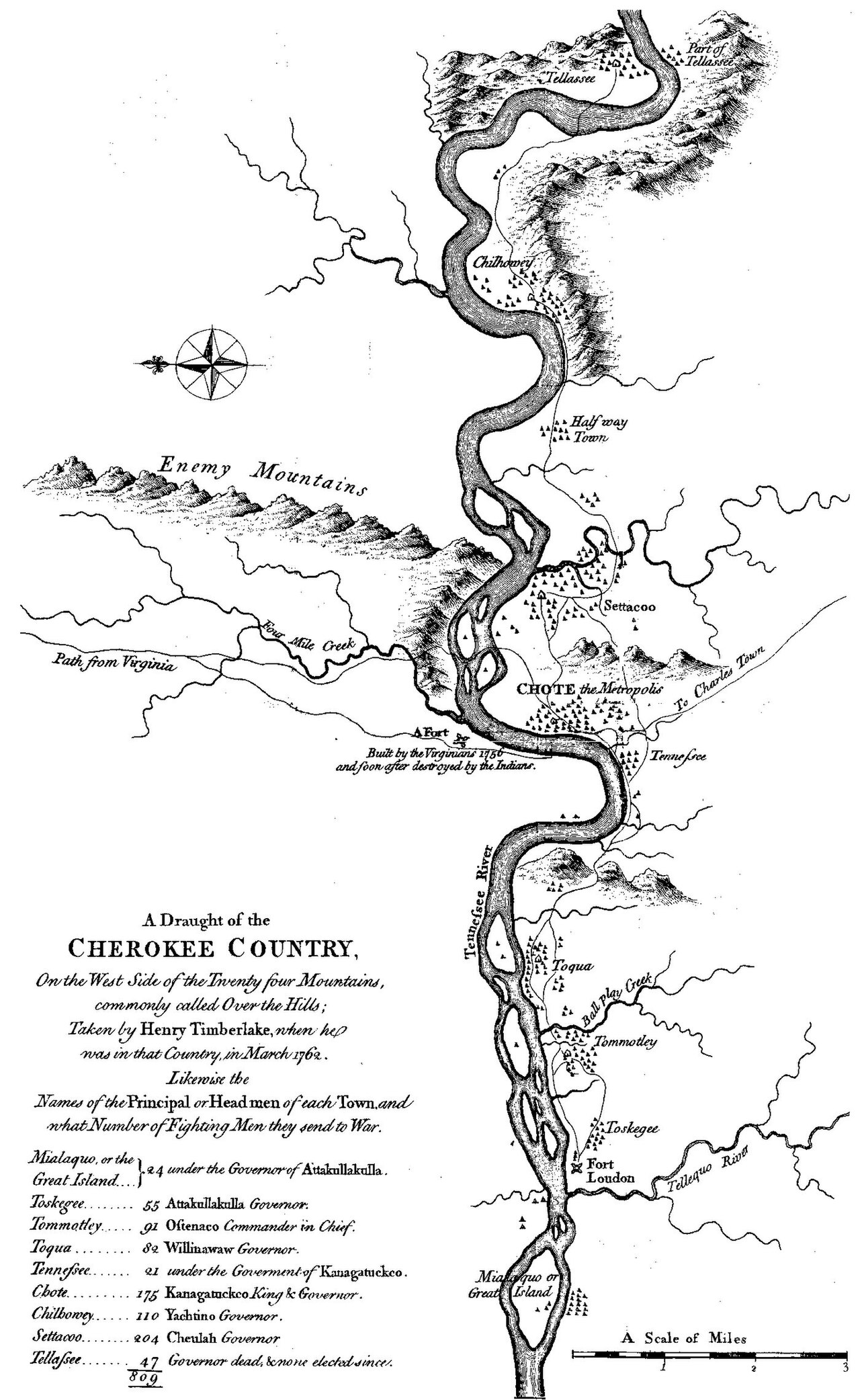
She was Nanye'hi, called Nancy Ward by the settlers. Born about 1738 at Chota, she belonged to the Wolf clan through her mother, a sister of the civil chief Attakullakulla. The Cherokee reckoned descent through the mother's line.2
What a Beloved Woman Did
The office was called Ghigau, and English speakers rendered it Beloved Woman. Colonial Williamsburg describes the holder as someone who took part in rituals, joined council meetings, advised the chiefs and decided whether war captives would be killed, spared or adopted.3 The New-York Historical Society adds that she led the Women's Council of clan representatives and was the only woman with a vote in the Cherokee General Council.4 That is why Tassel handed her the floor at Hopewell, and why the commissioners wrote down what she said.
Nobody can say when she took the office. Colonial Williamsburg and the Tennessee Encyclopedia both tie it to Taliwa, and neither gives a date for the choice.32
Taliwa: Tradition, Not Record
The popular story runs like this. In 1755 her husband, Kingfisher, fell at Taliwa while Cherokee warriors fought the Creeks. She took up his rifle, rallied the men and won the day, and the clans made her Beloved Woman for it.23
Look at where the story comes from. James Mooney, the ethnologist who wrote it down in 1900, put the battle "about 1755 or a few years later" on Mountain Creek or Long Swamp Creek, which run into the Etowah River in Georgia. He added, "All our information concerning it is traditional," gathered from James Wafford, who heard it around 1815 from an old trader named Brian Ward, said to have seen the fight sixty years before. Mooney's account of the battle does not mention Nanye'hi.5 The picture of a woman behind a log, chewing bullets so they would tear flesh, is in Emmet Starr's 1921 history of the Cherokee, which describes a fight with the Muskogees and does not name Taliwa.6 Colonial Williamsburg treats the bullet detail as tradition, not verified fact.3
Myth: Nancy Ward won the Battle of Taliwa
Mooney's informants remembered a Cherokee victory at Taliwa. Her part in it is tradition, and the earliest print source I found for the rifle and the bullets is Starr in 1921, sixty-six years after the fight. Keep it as a story people tell, and rest her standing on what the documents show.
1776: The Warning and the War
Here the record gets firmer. Mooney reports that in 1776 a warning came from Nancy Ward, "a noted friendly Indian woman of great authority," that seven hundred Cherokee warriors were advancing on the Watauga and Holston settlements. Holston men met one column near Long Island and beat it, and the fort at Watauga held. A captive, Mrs. Bean, was condemned to burn and was saved "by the interposition of Nancy Ward."5 The Tennessee Encyclopedia says she sent a man named Isaac Thomas to warn John Sevier of attacks on at least two occasions and kept Lydia Bean at her own house for a time.2 The New-York Historical Society says she freed three white prisoners and told them of the raid so they could warn the settlers.4
The Cherokee paid anyway. By Mooney's count, four armies from Virginia, North Carolina, South Carolina and Georgia entered Cherokee country that year. Virginia's force of about two thousand under Colonel William Christian reached the Little Tennessee towns in early November, found them empty and burned them one by one. Chota, the "peace town," was left alone. Christian stopped when headmen agreed to surrender prisoners and cede the land the Tennessee settlers occupied.5 Dragging Canoe refused Christian's overtures, and his followers, who became known as the Chickamauga, kept fighting.7
Long Island and Hopewell
The Treaty of the Long Island of the Holston was made in July 1777 between Virginia and North Carolina commissioners and the Cherokee, and Washington's agent Nathaniel Gist sat in on it. The historian Kristin Brig notes, citing Cynthia Cumfer, that Cherokee women did not take part in those negotiations, and that the Women's Council saw the treaty as "primarily for warriors."7 So the 1777 treaty is not the place to look for her voice. Old Tassel remembered it at Hopewell eight years later. He said that Colonel Christie and the others who treated with him had "in a manner compelled" him to give land in 1777.1
Her documented moment at Long Island came in July 1781, following settler attacks on Cherokee towns. After Old Tassel spoke, she asked for a lasting peace on behalf of white and Indian women, and Colonel Christian answered with praise for her humanity. The resulting treaty took no Cherokee land.2 Hopewell came four years later. The commissioners promised that settlers would leave Cherokee land within six months. They did not leave, and the Cherokee were pressed into more cessions.2
1817: The Women's Letter
On May 2, 1817, at a council of chiefs and warriors at Amovey, in present Tennessee, the Cherokee women present had heard talk of selling more land and of some Cherokee crossing the Mississippi. They put their answer in a written address, now among the Andrew Jackson papers at the Library of Congress.8 It said: "Your mothers, your sisters, ask and beg of you not to part with any more of our land." It told the men to stay, enlarge their farms and raise corn and cotton, and promised that the women would make the clothing. Under it Nancy Ward added her own lines: "Although I am very old, yet [I] cannot but pity the situation in which you will hear of their minds. I have great many grandchildren which [I] wish them to do well on our land."9
Twelve other women signed.8 The land went anyway. The Hiwassee cession of 1819 forced Ward out of Chota, and she ran an inn on the Federal Road near the Ocoee River until her death in 1822, the year the Tennessee Encyclopedia gives. Five years later the written Cherokee constitution of 1827 gave women no formal role.29
A Slaveholder Too
Nancy Ward held enslaved people. Emmet Starr wrote in 1921 that after the Creek defeat "Kingfisher's widow was given a negro that had been captured from the vanquished," making her "the first slave owner among the Cherokees." J. B. Davis repeated this in 1933 and then undercut the word "first," noting that other slaves were probably held elsewhere in the Cherokee country already.10 The New-York Historical Society credits her with bringing slaveholding to her community.4 I found no census, inventory or will in the sources I read, so I cannot say how many people she held or for how long. The claim itself rests on Starr, who gives it in the same passage as the bullet-chewing story. It fits the period: the Rabun County Historical Society dates the Cherokee elite's turn to plantation farming and the purchase of enslaved Africans to the late 1700s, and says the federal agent Return J. Meigs counted 583 enslaved people in the Cherokee Nation by 1810.11
Nancy Ward's Life at a Glance
- About 1738 Born at Chota.
- About 1755 Battle of Taliwa against the Creeks. Her part in it is tradition.
- 1776 Warns settlers of an attack. Virginia's army spares Chota in November.
- July 1777 Treaty of the Long Island of the Holston. Cherokee women did not take part.
- July 1781 Speaks for peace at Long Island.
- November 23, 1785 Speaks at Hopewell.
- May 2, 1817 Women's address to the council, with her own note.
- 1819 Leaves Chota after the Hiwassee cession.
- 1822 Dies near the Ocoee River, by most accounts.
Learn more
- Tennessee Encyclopedia: Nancy Ward: a short, dated biography
- Teaching American History: Petitions of Cherokee Women: the full 1817 address and two later ones
- Hopewell Treaty Negotiations, 1785: the day-by-day journal with her speech
- East Tennessee Historical Society: Planting the Corn and Hunting the British: the 1777 Long Island treaty
- Colonial Williamsburg: Nanyehi: the Beloved Woman office, with tradition flagged as tradition
Notes
- "Hopewell Treaty Negotiations" (journal of November 18 to 29, 1785), transcribed from Walter Lowrie, ed., American State Papers: Indian Affairs, vol. 1 (1832), pp. 40-43, entries for November 23 and 29, 1785. Read it online. ↩
- David Ray Smith, "Ward, Nancy," Tennessee Encyclopedia (University of Tennessee Press, 2002, online 2018), on her birth, her clan, the Taliwa account, Isaac Thomas, Lydia Bean, the July 1781 Long Island talks, Hopewell, the 1819 Hiwassee Purchase and her death in 1822. Read it online. ↩
- Colonial Williamsburg, "Nanyehi (Nancy Ward): A Beloved Woman of Chota," on the duties of a Beloved Woman, the lack of a date for her appointment and the bullet-chewing detail as tradition. Read it online. ↩
- New-York Historical Society, Women & the American Story, "Nanyehi (Nancy Ward)," on the Women's Council, her vote in the General Council, the freed prisoners and slaveholding. Read it online. ↩
- James Mooney, Myths of the Cherokee, 19th Annual Report of the Bureau of American Ethnology, Part 1 (1900), historical sketch on Taliwa, the 1776 campaigns and Christian's march. Read it online. ↩
- Emmet Starr, History of the Cherokee Indians and Their Legends and Folk Lore (Oklahoma City: Warden Company, 1921), genealogical note A22. Read it online. ↩
- Kristin Brig, "Planting the Corn and Hunting the British: The Treaty of the Long Island of the Holston and the American Revolution," Journal of East Tennessee History 88 (2016), on the July 1777 treaty, Dragging Canoe, and note 41 (citing Cumfer) on women's absence. Read it online. ↩
- Bill of Rights Institute, "Cherokee Women Address Their Nation (1817)," on the manuscript in the Andrew Jackson papers, Library of Congress, and the names signed. Read it online. ↩
- "Petitions of Cherokee Women," petition of May 2, 1817, in Theda Perdue and Michael D. Green, The Cherokee Removal: A Brief History with Documents (Boston: Bedford/St. Martin's, 2016), pp. 122-127. Read it online. ↩
- J. B. Davis, "Slavery in the Cherokee Nation," Chronicles of Oklahoma 11, no. 4 (December 1933), pp. 1057-1058, quoting Starr's account. Read it online. ↩
- Rabun County Historical Society, "Slavery in the Cherokee Nation: Selling Captured Warriors, Buying African Slaves," on the Cherokee elite, plantation farming and Meigs's 1810 count. Read it online. ↩
Terms in this lesson
- Beloved Woman (Ghigau)
- A Cherokee woman honored for valor or wisdom who could speak in council and decide the fate of captives.
- Overhill Cherokee
- The Cherokee towns on the Little Tennessee River, west of the mountains. Chota was their capital.
- Chota (Echota)
- The Overhill capital and a traditional town of peace, where Nanye'hi lived.
- Dragging Canoe
- A Cherokee war leader who opposed land cessions and led a faction south to Chickamauga after 1777.
- Cession
- A treaty transfer of land from one nation to another, often under pressure.
- Oral tradition
- History passed by spoken retelling. It can preserve real events, but details may shift before anyone writes them down.
Sources
- Tennessee Encyclopedia, Nancy Ward checked 2026-10
- James Mooney, Myths of the Cherokee (1900), Project Gutenberg checked 2026-10
- Hopewell Treaty Negotiations, 1785 (American State Papers text) checked 2026-10
- Teaching American History, Petitions of Cherokee Women (1817) checked 2026-10
- Journal of East Tennessee History, Planting the Corn and Hunting the British (2016) checked 2026-10
- J. B. Davis, Slavery in the Cherokee Nation, Chronicles of Oklahoma (1933) checked 2026-10