Lesson 46 of 60 · about 9 minutes
Thomas Sumter: The Carolina Gamecock
You'll be able to
- Trace Sumter from a Virginia mill to London, South Carolina and the backcountry war of 1780
- Separate what is documented about his battles from the legend of the burned house
- Explain Sumter's Law, who approved it, who refused it, and what it meant for the people it treated as pay
- Describe his quarrels with Greene, his years in Congress, and how Fort Sumter got its name
On the afternoon of August 18, 1780, Thomas Sumter lay under a wagon beside the Catawba River, partly undressed, taking a nap. He had posted two sentries. He had about a hundred regulars and some seven hundred militia, and he was hauling a captured British supply train.1 Banastre Tarleton came in with roughly a hundred dragoons and sixty infantrymen riding double. Sumter got out shoeless and half-naked, boosted onto a horse by Captain John Steele. About 150 of his men were lost and 300 captured.1 Three months later he beat the same Tarleton. The man could lose an army by napping and raise another in weeks.
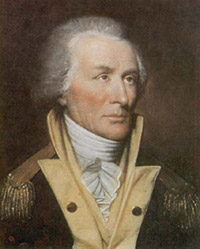
A Miller's Son in London
Sumter was born August 14, 1734, in Hanover County, Virginia. His father was a miller who had come over as an indentured servant, and his mother was a midwife. He spent his boyhood at the mill and with livestock instead of in school, then joined the provincial militia in the French and Indian War and rose to sergeant.2
In 1761 he joined the Timberlake expedition to the Overhill Cherokee towns. The next May he sailed to England with Henry Timberlake and three Cherokee leaders, Ostenaco among them, and the party reached London in early June 1762. In July the Cherokee met King George III.34 Sumter came home to debt and landed in a Virginia jail. The sources disagree on how he got out. The South Carolina Encyclopedia says he escaped, and the Tennessee Historical Society says a friend lent him the money.24
Around 1764 he settled near the Santee River in South Carolina and opened a country store. In 1767 he married Mary Cantey Jameson, a wealthy widow about eleven years older than he was, and moved to her plantation, Great Savannah.23 The household ran on enslaved labor. A pension witness later placed some of Sumter's slaves at his Great Savannah plantation in 1781.5 He fought in the Cherokee campaign of 1776, the same nation whose leaders he had escorted to London fourteen years before.3 In September 1778 he resigned his commission after a quarrelsome Florida campaign. He sat out the defense of Charleston in 1780.5
The Waxhaws and the Burned House
Charleston fell on May 12, 1780. On May 29, Tarleton's British Legion caught Colonel Abraham Buford's Virginia Continentals at the Waxhaws and cut down men who were trying to surrender. "Remember Waxhaws" became a Patriot rallying cry.6 Sumter, retired and living near the Santee, now turned partisan. Refugees gathered at Charlotte, North Carolina, elected him their leader, and Governor John Rutledge made the rank of brigadier general official that October.7
Myth: Tarleton's men burned Sumter's house and that made him fight
The story is everywhere. The American Battlefield Trust biography says Tarleton's raiders burned the home, and its page on Fishing Creek names a Captain Charles Campbell as the officer.89 The South Carolina Encyclopedia says British troops burned it in May 1780 and that Sumter took it personally.2 Harris and Baxley, who studied the question, found that the first mention was William Dobein James's 1821 life of Marion, that a later biographer added details with no source, that no part of Campbell's regiment was with Tarleton at the time, and that Tarleton never mentioned such a raid in his own papers.5 Maybe it happened. The record that survives does not prove it.
Hanging Rock, Fishing Creek and Blackstock's
Sumter's first big try, at Rocky Mount on July 30, failed against Loyalist defenders when a late-day thunderstorm put out the roof fire he had set.10 On August 6 he hit the Loyalist camp at Hanging Rock and won, though the day ended raggedly when many of his men stopped to plunder the camp and walked off with what they could carry, and Sumter called off the attack.10 He was bitter even in victory. "We had got a great victory," he is quoted as saying, but nobody would hear of it because he led "a handful of raw militia" instead of Continentals.5 Twelve days later came Fishing Creek.
Blackstock's was the redemption. On November 20, 1780, Tarleton rode up the Enoree after Sumter's roughly 1,000 militia with 270 men. Sumter put riflemen in the log barn and farm buildings with the Tyger River at his back. The Trust counts the British loss at 92 killed and 100 wounded against three Americans killed and four wounded, and calls it the first time militia beat Tarleton's Legion.11 Sumter took six buckshot, one chipping his spine, and was out for months.11 Three days later Cornwallis wrote that Sumter was "the greatest plague in this country."5 The South Carolina Encyclopedia says the nickname Gamecock came from his daring and tenacity in the summer of 1780. A tale that Tarleton coined it after Blackstock's circulates in secondary books, and no primary source for it turned up.2
Sumter's Law
By spring 1781 volunteers came and went as they chose, and South Carolina had no government to print money. So Sumter proposed to Greene a ten-month state force paid in slaves taken from Loyalists. A trooper was to get one "Negro" for his service, and officers got more, a lieutenant one grown and one small. Greene approved.12 The South Carolina Encyclopedia adds that Sumter did not yet have the slaves when he promised them. He was counting on Loyalist plantations to supply them.13
It worked as a recruiting tool. Peter Horry, a lieutenant colonel trying to raise a cavalry regiment and competing with Sumter for recruits, complained to Greene that men could not be had for less bounty, since Sumter's slave "is Equal to a Dollar per day to Each private."12 Harris and Baxley say that snatching enslaved people from family and friends and using them like money crossed a line. Sumter himself called the plan "disagreeable" and "justified only by our circumstances and the necessity of the case." Francis Marion lent Horry money but would "not Suffer negroes to be Seized on or taken out of his Brigade."12 Greene later explained that Sumter "could effect nothing unless he promised to pay them in Negroes" and that, with the crisis at hand, "I did not discourage it."12 Both sides plundered property in the Carolina war. Sumter's plan made enslaved people the wage itself. By 1784 about 210 grown slaves had been delivered and more than 570 were still owed, and the legislature settled the debt that year by offering each man 94 pounds sterling in place of a slave.12
South Carolina's legislature had refused John Laurens's plan to arm enslaved men and free them (see John Laurens). It let Sumter pay white recruits in the same people.13
Quarrels with Greene
Sumter never took orders well. When Nathanael Greene took the Southern army in December 1780, Sumter was nursing his wound. Greene wrote him on January 8, 1781: "Partizan strokes in war are like the garnish of a table, they give splendor to the Army and reputation to the Officers, but they afford no substantial national security."512 By early February Sumter was complaining that Daniel Morgan's command embarrassed him, and Greene answered that he was at a loss to imagine how.5 Greene wanted a regular army and a few decisive fights. Sumter wanted outposts and raids. On May 16, 1781, Sumter offered his resignation and Greene refused it.12
They still worked together. In mid-July 1781 Greene gave Sumter the "Dog Days" raid toward Charleston, with Francis Marion's brigade and Henry Lee's Legion joined to his own.12 Sumter resigned for good in February 1782, still smarting over command changes and the reorganization of the militia.23 The National Park Service puts the cause bluntly: "Sumter's pride made him ill-suited to accept command from others."3
The Senator Who Outlived Them All
Sumter served five terms in the U.S. House between 1789 and 1801. He resigned from the House on December 15, 1801, moved to the Senate, and stayed there until he resigned on December 16, 1810.2 He was a Jeffersonian.2 In 1829 construction began on a fort on a shoal at the mouth of Charleston harbor, and it was named for him.14 On April 12, 1861, Confederate guns opened on Fort Sumter and the Civil War began. A man who once paid soldiers in human beings gave his name to the fort where the war over slavery started.
He died June 1, 1832, at his plantation South Mount near Stateburg, at the age of 97, the last surviving general of the Revolution.23 His birth and death dates make it 97.
Sumter's Life at a Glance
- 1734 Born August 14 in Hanover County, Virginia.
- 1762 Sails to London with Henry Timberlake and three Cherokee leaders.
- 1767 Marries Mary Cantey Jameson.
- May 29, 1780 Tarleton destroys Buford's force at the Waxhaws; Sumter returns to the field.
- August 6, 1780 Wins at Hanging Rock.
- August 18, 1780 Routed at Fishing Creek.
- November 20, 1780 Repulses Tarleton at Blackstock's and is wounded.
- Spring 1781 Offers slaves taken from Loyalists as pay for ten-month troops.
- February 1782 Resigns his commission.
- 1789 to 1810 Serves in the U.S. House and then the Senate.
- June 1, 1832 Dies at South Mount, aged 97.
Learn more
- American Battlefield Trust: Blackstock's Plantation: the fight in detail, with eyewitness accounts
- Harris and Baxley: Thomas Sumter's Raid of the Dog Days of 1781: the best treatment of Sumter's Law and its appendix of letters
- South Carolina Encyclopedia: Thomas Sumter: a short life with his political career
- National Park Service: Thomas Sumter: a brief profile
Notes
- American Battlefield Trust, "Fishing Creek," on Sumter's camp, the sentries, Tarleton's approach, Captain Steele, and the casualty figures. Read it online. ↩
- South Carolina Encyclopedia, "Thomas Sumter," on his parents, militia service, his settlement near the Santee, marriage in 1767, the house burned in May 1780, the Gamecock nickname, his resignation in 1782, his terms in Congress, and his death at 97. Read it online. ↩
- National Park Service, "Thomas Sumter," on the 1762 London trip, his move to Great Savannah, the 1776 Cherokee campaign, his resignation in February 1782, the quoted line on his pride, and his death. Read it online. ↩
- Tennessee Historical Society, "Henry Timberlake," on the Cherokee chiefs' audience with George III in July 1762 and on a friend lending Sumter the money to leave debtors' prison. Read it online. ↩
- C. Leon Harris and Charles B. Baxley, "'To Keep Up the Spirits of the People and Alarm the Enemy': Sumter's Rounds in South Carolina," Journal of the Southern Campaigns of the American Revolution (August 8, 2024), on the burned-house tradition and its sources (note 4), Sumter's 1778 resignation, the Hanging Rock quotation from McJunkin's narrative, and Greene's letter to Sumter of January 8, 1781 (Greene Papers 7:74), and Cornwallis's remark of November 23, 1780 (Cornwallis to Tarleton, as cited there). The Great Savannah testimony is from Isaac Gillham's pension statement as quoted there. Read it online. ↩
- American Battlefield Trust, "Waxhaws," on May 29, 1780, Colonel Abraham Buford, and the "Remember Waxhaws" cry. Read it online. ↩
- C. Leon Harris and Charles B. Baxley, "Thunder Even at the Gates of Charlestown: Thomas Sumter's Raid of the Dog Days of 1781," Journal of the Southern Campaigns of the American Revolution (August 9, 2024), on Charlotte and Rutledge's October commission. Read it online. ↩
- American Battlefield Trust, "Thomas Sumter," on his birth and death dates, the London trip, and the statement that Tarleton's raiders burned his home. Read it online. ↩
- American Battlefield Trust, "Fishing Creek," on Captain Charles Campbell as the officer who burned Sumter's home. Read it online. ↩
- American Battlefield Trust, "Rocky Mount" and "Hanging Rock," on the attack of July 30, 1780, the thunderstorm that put out the roof fire, the battle of August 6, and the plundering that ended the Hanging Rock attack. Read it online. ↩
- American Battlefield Trust, "Blackstock's Plantation," on the forces, the position, the casualties, Sumter's wounds and the claim that this was the first defeat of Tarleton's Legion by militia. Read it online. ↩
- Harris and Baxley, "Thunder Even at the Gates of Charlestown," text and Appendix A ("Sumter's Wages"), quoting Sumter's 1818 pension-file recollection, Peter Horry to Greene (June 28, 1781), Sumter to Marion (March 28, 1781), Greene to Thomas McKean (August 25, 1781), the 1784 pay bill and the legislature's resolution of April 1, 1784; also Sumter to Greene and Greene to Sumter on May 16 and 17, 1781, and the Dog Days raid of July 13 to 17, 1781. Read it online. ↩
- South Carolina Encyclopedia, "African Americans in the Revolutionary War," on the legislature's rejection of Laurens's plan, Sumter's offer of slaves as bounty to white recruits, the fact that he did not yet hold them, and Marion's rejection of the plan. Read it online. ↩
- South Carolina Encyclopedia, "Fort Sumter," on the naming for Thomas Sumter, the start of construction in 1829, and the bombardment of April 12, 1861. Read it online. ↩
Terms in this lesson
- Partisan
- A leader of irregular troops who raids outposts and supply lines instead of fighting set battles. Sumter and Marion were the main partisans of South Carolina.
- Sumter's Law
- The 1781 pay plan under which ten-month state troops were promised slaves taken from Loyalists. The name was applied by later writers to the plan.
- Loyalist
- A colonist who stayed loyal to the Crown. Sumter's men took Loyalist property, including enslaved people, as plunder.
- Plunder
- Property taken from an enemy or from civilians. Both sides in the Carolina war practiced it, and Greene complained of it often.
- Timberlake expedition
- A 1761-62 mission to the Overhill Cherokee towns led by Henry Timberlake, which ended with a Cherokee delegation sailing to London.
- Brigadier general
- A rank above colonel. Governor John Rutledge made Sumter a brigadier general of South Carolina militia in October 1780.
Sources
- American Battlefield Trust, Thomas Sumter checked 2026-10
- South Carolina Encyclopedia, Thomas Sumter checked 2026-10
- National Park Service, Thomas Sumter checked 2026-10
- Harris and Baxley, Sumter's Rounds in South Carolina (Journal of the Southern Campaigns of the American Revolution, 2024) checked 2026-10
- Harris and Baxley, Thomas Sumter's Raid of the Dog Days of 1781 (Journal of the Southern Campaigns of the American Revolution, 2024) checked 2026-10
- South Carolina Encyclopedia, African Americans in the Revolutionary War checked 2026-10
- American Battlefield Trust, Blackstock's Plantation checked 2026-10
- Tennessee Historical Society, Henry Timberlake checked 2026-10
- American Battlefield Trust, Rocky Mount and Hanging Rock checked 2026-10
- South Carolina Encyclopedia, Fort Sumter checked 2026-10