Lesson 21 of 60 · about 9 minutes
Phillis Wheatley: The Enslaved Poet Washington Answered
You'll be able to
- Describe how Wheatley came to Boston in 1761 and how her 1773 book was published in London
- Say who signed the 1772 attestation and what the record does and does not show about her examination
- Read her 1774 letter to Samson Occom and Washington's 1776 reply in their own words
- Tell what is documented about her freedom, her marriage and her death in 1784
On February 28, 1776, from his headquarters at Cambridge, Massachusetts, George Washington answered a poem. It had been sitting on his desk for months. "I thank you most sincerely for your polite notice of me, in the elegant Lines you enclosed," he wrote, and he told its author that "the style and manner exhibit a striking proof of your great poetical Talents."1 The author was a young woman in Boston who was legally free by then, but who had arrived in that city fifteen years earlier as a frail child for sale.
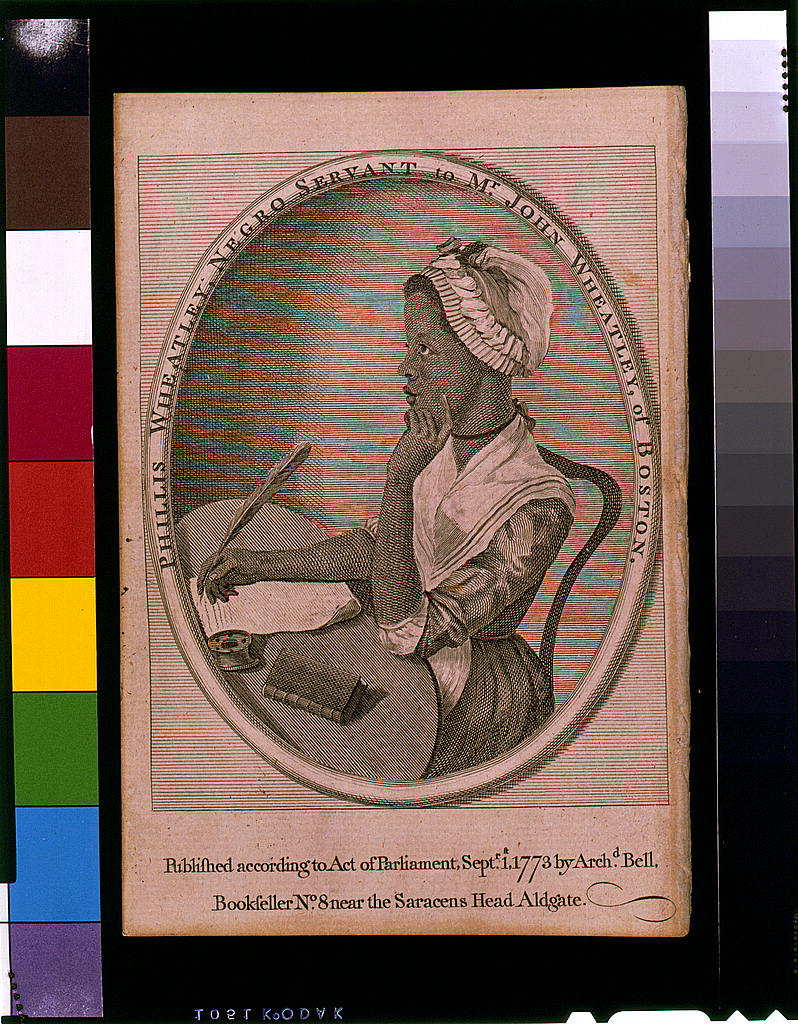
Sold in Boston, 1761
Wheatley was born in West Africa about 1753. She was named for the ship, the Phillis, that brought her to Boston on July 11, 1761, and for the family that bought her, the Wheatleys.2 John Wheatley was a merchant. His wife Susanna chose the frail child, then seven or eight, as a servant and companion. The couple's daughter Mary taught her English, Latin, history, geography and the Bible, and she read Pope.2 Her first published poem appeared in the Newport Mercury in 1767. Her elegy on the evangelist George Whitefield in 1770 drew notice in England.2
Eighteen Names and a London Publisher
No Boston printer would take a book from an enslaved woman. So the Wheatleys sought proof that she wrote it. The result was an attestation "To the Publick," printed in the 1773 book. It says she "has been examined by some of the best Judges, and is thought qualified to write them."3 Eighteen men signed: Governor Thomas Hutchinson, Lieutenant-Governor Andrew Oliver, Thomas Hubbard, John Erving, James Pitts, Harrison Gray, James Bowdoin, John Hancock, Joseph Green, Richard Carey, the ministers Charles Chauncey, Mather Byles, Ed. Pemberton, Andrew Elliot, Samuel Cooper, Samuel Mather and John Moorhead, and her owner John Wheatley.3
Whether there was a single sitting is not clear. One account dates a panel of eighteen to July 31, 1772. Henry Louis Gates Jr. says only that the examination came sometime before October 8, 1772. The attestation itself gives no date and no questions.4 What it does show is how the men saw her: the same page calls her "a young Negro Girl" brought "an uncultivated Barbarian from Africa."3
In May 1773 she sailed to England with the Wheatleys' son Nathaniel, and her book came out in London that September while she was already home.2 It held about forty poems.3 In "On Being Brought from Africa to America" she calls the people who look down on "our sable race" to remember that Black Christians can be saved. To the Earl of Dartmouth she wrote of "my love of Freedom," tracing it to being "snatch'd from Afric's fancy'd happy seat."3
Freedom and a Letter on Liberty
On October 18, 1773, she wrote to David Wooster: "Since my return to America my Master, has at the desire of my friends in England given me my freedom."2 Mount Vernon credits Susanna Wheatley, but Wheatley's own letter says "my Master."5 Susanna died in March 1774.2
Her letter to the Mohegan minister Samson Occom, dated February 11, 1774, was printed in newspapers, and the Museum of the American Revolution holds the Connecticut Journal printing of April 1, 1774.6 In it she wrote that "in every human Breast, God has implanted a Principle, which we call Love of Freedom; it is impatient of Oppression, and pants for Deliverance." She asked how "the Cry for Liberty" could agree with "the reverse disposition for the Exercise of Oppressive Power over others," and said it "does not require the Penetration of a Philosopher to determine."7 The colonists were shouting for liberty while holding people in bondage, and she said so in print.
Washington's Answer
On October 26, 1775, she sent Washington a poem. It calls him "great chief" and uses the name "Columbia" for America.8 Her letter reached him in mid-December, and he apologized for the delay. He told her he would have published it, but feared it would look like vanity.1 Then he sent it to Joseph Reed in Philadelphia on February 10, 1776, and it appeared in the Virginia Gazette on March 30 and in the Pennsylvania Magazine in April.8
"If you should ever come to Cambridge, or near Head Quarters, I shall be happy to see a person so favourd by the Muses, and to whom nature has been so liberal and beneficent in her dispensations."
George Washington to Phillis Wheatley, Cambridge, February 28, 1776. 1
Disputed: Did Washington and Wheatley meet at Cambridge in March 1776?
Many retellings say she visited his headquarters. The editors of Founders Online say he "apparently met" her there in March 1776, and the only document they cite is his invitation letter.8 Mount Vernon's encyclopedia discusses only the correspondence and says there is "little evidence" that she knew him before his appointment.5 The invitation is in the record. The editors cite no record of the visit itself.
His reply is polite and says nothing about slavery.1
Marriage and Death
Wheatley married John Peters, a free Black man in Boston, reportedly in April 1778.29 The couple had three children, and the Massachusetts Historical Society says two may have died in infancy.2 A second volume of poems was proposed but never appeared, probably because of wartime shortages in Boston, and the manuscript was lost.2 By 1784 she was living in a boardinghouse. She died in Boston on December 5, 1784, in her early thirties, and her third child died the same month. Their burial place is unknown.29
She made the argument for natural rights from the inside. The founders cited those rights against King George, and Wheatley turned them on the people who cited them.
Wheatley's Life at a Glance
- about 1753 Born in West Africa.
- July 11, 1761 Arrives in Boston aboard the Phillis and is bought by the Wheatleys.
- 1767 First poem published, in the Newport Mercury.
- 1772 Eighteen Boston men vouch for her authorship.
- September 1773 Poems on Various Subjects, Religious and Moral is published in London.
- October 1773 Writes that her master has given her freedom.
- February 11, 1774 Writes to Samson Occom on the love of freedom.
- October 26, 1775 Sends her poem to George Washington.
- February 28, 1776 Washington answers from Cambridge.
- December 5, 1784 Dies in Boston.
Learn more
- Washington to Wheatley, 28 February 1776: his reply, with editors' notes
- Poems on Various Subjects, Religious and Moral: the 1773 book, attestation included
- MHS: Phillis Wheatley: manuscripts and a short life
- National Constitution Center: Letter to Samson Occom: the 1774 letter on liberty
Notes
- George Washington to Phillis Wheatley, Cambridge, February 28, 1776, Papers of George Washington, Founders Online, on his thanks, her delayed letter, his worry about vanity and the invitation to Cambridge. Read it online. ↩
- Massachusetts Historical Society, "Phillis Wheatley," in African Americans and the End of Slavery in Massachusetts, on her arrival on July 11, 1761, her education, the 1773 trip and book, her freedom, the letter to Wooster, Susanna Wheatley's death, her marriage, children and death. Read it online. ↩
- Phillis Wheatley, Poems on Various Subjects, Religious and Moral (London: A. Bell, 1773), the attestation "To the Publick," the count of about forty poems, "On Being Brought from Africa to America" and "To the Right Honourable William, Earl of Dartmouth." Read it online. ↩
- Henry Louis Gates Jr., "Phillis Wheatley on Trial," The New Yorker, January 20, 2003, on the examination "sometime before October 8, 1772," and When and Where in Boston, "Wheatley Panel Is Convened," on a July 31, 1772 date. Read the first. Read the second. ↩
- Mount Vernon, "Phillis Wheatley," Digital Encyclopedia, on who freed her, the Washington correspondence and the evidence for a meeting. Read it online. ↩
- Fine Books Magazine, "1774 Printing of Phillis Wheatley Letter Acquired by MOAR," on the February 11, 1774 date and the April 1, 1774 Connecticut Journal printing. Read it online. ↩
- Phillis Wheatley, letter to Samson Occom, 1774, text as given by the National Constitution Center from the Library of Congress. Read it online. ↩
- "Enclosure: Poem by Phillis Wheatley, 26 October 1775," Founders Online, with the editors' note on Reed, the Virginia Gazette, the Pennsylvania Magazine and the "apparent" March 1776 meeting. Read it online. ↩
- Poetry Foundation, "Phillis Wheatley," on the April 1778 marriage to John Peters and her death on December 5, 1784. Read it online. ↩
Terms in this lesson
- Attestation
- A signed statement vouching for a fact. Eighteen Boston men signed one saying they believed Wheatley wrote her poems.
- Frontispiece
- An illustration facing the title page of a book. Wheatley's 1773 book opens with an engraved portrait of her.
- Elegy
- A poem of mourning. Her elegy on George Whitefield in 1770 made her known on both sides of the Atlantic.
- Manumission
- The act of an owner freeing an enslaved person. Wheatley wrote that her master gave her freedom after her return from England.
- Samson Occom
- A Mohegan Presbyterian minister. Wheatley's letter to him in February 1774 defended the natural right of Africans to freedom.
Sources
- George Washington to Phillis Wheatley, 28 February 1776, Founders Online checked 2026-10
- Enclosure: Poem by Phillis Wheatley, 26 October 1775, Founders Online checked 2026-10
- Wheatley, Poems on Various Subjects, Religious and Moral (1773), Project Gutenberg checked 2026-10
- Massachusetts Historical Society, Phillis Wheatley checked 2026-10
- National Constitution Center, Letter to Reverend Samuel Occum (1774) checked 2026-10
- Mount Vernon, Phillis Wheatley checked 2026-10