Lesson 42 of 60 · about 8 minutes
Johann de Kalb: The Self-Made Baron Who Held the Line at Camden
You'll be able to
- Trace de Kalb from a Bavarian village to the French army and then to Congress's commission in 1777
- Explain why Congress at first refused the rank Silas Deane had promised him
- Describe what happened to him at the Battle of Camden on August 16, 1780
- Separate the surviving record of his death from the quotations attached to it later
On the morning of August 16, 1780, the American line north of Camden, South Carolina, came apart. The Virginia and North Carolina militia ran when the British bayonets reached them, and General Horatio Gates, the commander, was swept away in the rout.1 On the right, the Maryland and Delaware regulars stayed. Their division commander, Johann de Kalb, was fifty-nine, a peasant's son from what is now Bavaria, and he fought on foot after his horse was shot under him. He held that ground until the bayonets found him.12
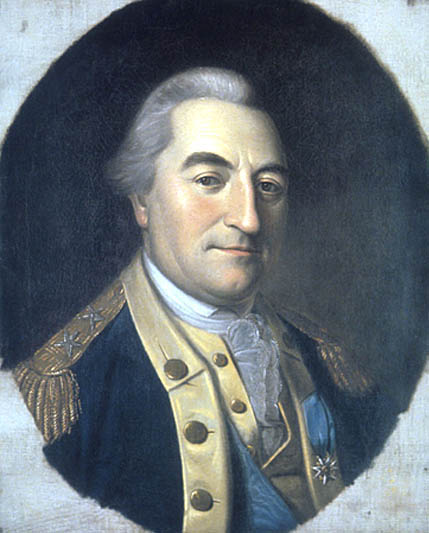
A Peasant's Son Becomes a Baron
He was born Johann Kalb in 1721 in Hüttendorf, a village near Erlangen in the principality of Bayreuth. The day is in dispute. The American Battlefield Trust gives June 19, while the Maryland State Archives and the 1911 Britannica give June 29.134 His parents were peasants. He left home at sixteen to work as a waiter or butler, and by 1743 he appeared as a lieutenant in a German regiment in French service, calling himself Jean de Kalb.4
The "de" and the title that came with it were his own work. The Maryland State Archives calls him a "self-styled nobleman," and the historian Dieter Cunz wrote that nothing justified the claim except the prejudice of an officer class that kept commoners out of high rank.35 A. E. Zucker, summing up Friedrich Kapp's 1862 biography, reported that church records show a Bavarian freeholder's son and no noble family.6 The record favors Kapp.
The soldiering was real. He served in the War of the Austrian Succession, became a captain in 1747 and a major in 1756, and fought in the Seven Years' War in the corps of the Comte de Broglie.46 In April 1764 he married Anna Elizabeth Emilie van Robais, the daughter of a rich cloth merchant, and settled near Versailles.31
A French Agent in the Colonies
The foreign minister, the Duc de Choiseul, sent him across the Atlantic to find out how the colonists felt about Britain and whether France could expect to profit from a quarrel.1 Sources disagree on the dates. The Maryland State Archives has him in the colonies from April 1767 until January 1768, when he was discovered, the 1911 Britannica says 1768 to 1769, and Wikipedia describes a four-month trip in 1768.347 Choiseul fell from office before the report could be used.1
The General Congress Did Not Want
In 1777 Silas Deane promised de Kalb a major general's commission in Paris, and he sailed with Lafayette.1 The South Carolina Encyclopedia has them off Georgetown in June. The 1911 Britannica puts him at Philadelphia in July.84 Congress turned down every appointment but Lafayette's and tried to send the rest home.2 De Kalb wrote back sharply, calling it "ridiculous" to make men cross the sea "under a thousand different dangers, to be received and to be looked at with contempt by those from whom you were to expect but warm thanks."2
Congress backed down. De Kalb had started for home when a dispatch reached him in Pennsylvania naming him a major general.2 The date varies by source. The 1911 Britannica and a Valley Forge history site say September 15, 1777. Wikipedia says September 5, and the Maryland State Archives says October 9.4973 He wintered at Valley Forge and went to Albany with Lafayette in early 1778 for a Canadian expedition that was cancelled for lack of preparation.14 The 1911 Britannica adds that he came to admire Washington and turned against the Comte de Broglie's scheme to put a European officer in chief command.4
Camden
In April 1780 Washington sent him south from Morristown with the Maryland and Delaware regulars, about 1,400 men by the Maryland State Archives count and fewer than 1,000 Continentals by the end of June in one modern account.32 Charleston fell on May 12 before he got there. Congress then gave the Southern command to Gates, who joined the army on July 25 according to the Britannica and the South Carolina Encyclopedia. The Battlefield Trust says the first week of July, but de Kalb was still writing letters to Gates on July 16, which fits the later date better.4812
At a council around 2:30 on the morning of the battle, Gates asked, "Gentlemen, what is best to be done?" Virginia's General Stevens answered, "Gentlemen, is it not too late now to do any thing but fight?" No other advice was offered.2 Gates put the Continentals on the right and the militia on the left and in the center. When the militia broke, de Kalb led a counterattack. His horse was killed, and he went down fighting. His aide, the Chevalier du Buysson, wrote that the baron was "pierced with eight wounds of bayonets and three musket balls."210
Three Days in Camden
The British took him prisoner. Du Buysson later wrote that Cornwallis and Lord Rawdon "treated us with the greatest civility," and that the baron, dying of his wounds, was buried with all the honors of war and followed by the British officers.2 He died on August 19. Du Buysson said two days after the action, but August 16 to 19 is three.12
Congress voted in October 1780 for a monument at Annapolis, which Maryland did not raise until 1886 by the State Archives count. The 1911 Britannica says 1887.34 Lafayette laid the cornerstone of a monument at Camden in 1825.14
Myth: De Kalb's dying speech and Washington's graveside tribute
Popular accounts have de Kalb telling a British officer he died "the death of a soldier fighting for the rights of man," and Washington standing at his grave to call him "the generous stranger." The Emerging Revolutionary War blog, which prints both, says it cannot fully verify either one.11 Wikipedia's sources for them are books of 1849 and 1856, decades after the events.7 What can be checked is du Buysson's letters, written within days, and the blunt record of a man who stayed on the field.
De Kalb's Life at a Glance
- 1721 Born Johann Kalb in Hüttendorf, Bayreuth (June 19 or 29, sources differ).
- 1743 Appears as a lieutenant in French service, calling himself Jean de Kalb.
- April 1764 Marries Anna Elizabeth Emilie van Robais.
- 1767 to 1769 Reports on the colonies for Choiseul (dates vary by source).
- Fall 1777 Commissioned major general by Congress.
- April 1780 Marches south with the Maryland and Delaware Continentals.
- August 16, 1780 Wounded at Camden.
- August 19, 1780 Dies in Camden.
Learn more
- American Battlefield Trust: Johann de Kalb: a short life with the Camden fight
- Journal of the American Revolution: Baron de Kalb's Last Campaign: his Southern march, with du Buysson's letters
- South Carolina Encyclopedia: De Kalb, Johann: a two-minute summary
- Maryland State Archives: Johann de Kalb: the blunt account of the title
- Marquis de Lafayette: the young general who sailed with him and argued his case
- Thomas Sumter: the partisan whose own force was destroyed two days after Camden
Notes
- American Battlefield Trust, "Johann de Kalb," on his mission for Choiseul, the voyage with Lafayette, Valley Forge, the march south, Gates's flight, the eleven wounds and the 1825 reburial. Read it online. ↩
- Wayne Lynch, "Baron de Kalb's Last Campaign," Journal of the American Revolution, June 26, 2014, quoting de Kalb's petition, Otho Holland Williams's account of the council and du Buysson's letters of August 26 and September 2, 1780. Read it online. ↩
- Maryland State Archives, "Johann de Kalb (1721-1780)," Biographical Series, MSA SC 3520-14859, on his birth date, marriage, "self-styled nobleman," the October 9 commission, the 1,400 troops and the monument. Read it online. ↩
- "Kalb, Johann," Encyclopaedia Britannica, 11th ed., vol. 15 (1911), on his birth, early service, the Philadelphia arrival, the September 15 commission, Broglie's scheme, Gates's arrival and the monuments. Read it online. ↩
- Dieter Cunz, "De Kalb and Maryland," pp. 18-22 (hosted by the Loyola Notre Dame Library as Report 25), on his origins and the unjustified title. Read it online. ↩
- A. E. Zucker, "An Interesting Baron de Kalb Letter," pp. 59-62 (Loyola Notre Dame Library, Report 31), summarizing Kapp's 1862 biography and the church records. Read it online. ↩
- Wikipedia, "Johann de Kalb," cited only for its September 5 commission date, its date for the mission to the colonies, and the sources it lists for the dying words and Washington's reported tribute (Ells, 1849; Griswold, 1856). Read it online. ↩
- Samuel K. Fore, "De Kalb, Johann," South Carolina Encyclopedia, on the June landing near Georgetown, Gates taking command on July 25 and the 1825 cornerstone. Read it online. ↩
- Independence Hall Association, ushistory.org, "Major General Baron Johann DeKalb," on the commission of September 15, 1777. Read it online. ↩
- American Battlefield Trust, "Camden," on the deployment, the militia collapse and de Kalb's wounds. Read it online. ↩
- Emerging Revolutionary War, "De Kalb has died, as he has lived, the unconquered friend of liberty," August 19, 2019, printing both quotations and saying they cannot be verified completely. Read it online. ↩
Terms in this lesson
- Major general
- The highest rank Congress commonly gave in the Continental Army. De Kalb held it from the fall of 1777.
- Continentals
- The regular soldiers of the Continental Army, enlisted for long terms and drilled, as opposed to short-term state militia.
- Maryland Line
- The Continental regiments raised by Maryland. De Kalb led a division of Maryland and Delaware Continentals south in 1780.
- Self-styled title
- A rank of nobility a man claims for himself without a grant from a ruler. Historians use the phrase for de Kalb's 'baron.'
- Aide-de-camp
- A personal staff officer. De Kalb's aide, the Chevalier du Buysson, wrote the best surviving account of his last day.
Sources
- American Battlefield Trust, Johann de Kalb checked 2026-10
- Maryland State Archives, Johann de Kalb (Biographical Series) checked 2026-10
- Encyclopaedia Britannica, 11th ed., Kalb, Johann (Wikisource) checked 2026-10
- South Carolina Encyclopedia, De Kalb, Johann checked 2026-10
- Journal of the American Revolution, Baron de Kalb's Last Campaign checked 2026-10
- Independence Hall Association, Major General Baron Johann DeKalb (Valley Forge) checked 2026-10
- Emerging Revolutionary War, De Kalb has died, as he has lived checked 2026-10