Lesson 27 of 60 · about 8 minutes
Nancy Hart: The Georgia Legend and What the Record Holds
You'll be able to
- Tell the cabin story as Elizabeth Ellet printed it in 1848
- Separate what sources document about the Harts from what rests on tradition
- Explain why the dates in the legend do not agree with each other or with the Battle of Kettle Creek
- Weigh the 1912 skeletons and say what they can and cannot prove
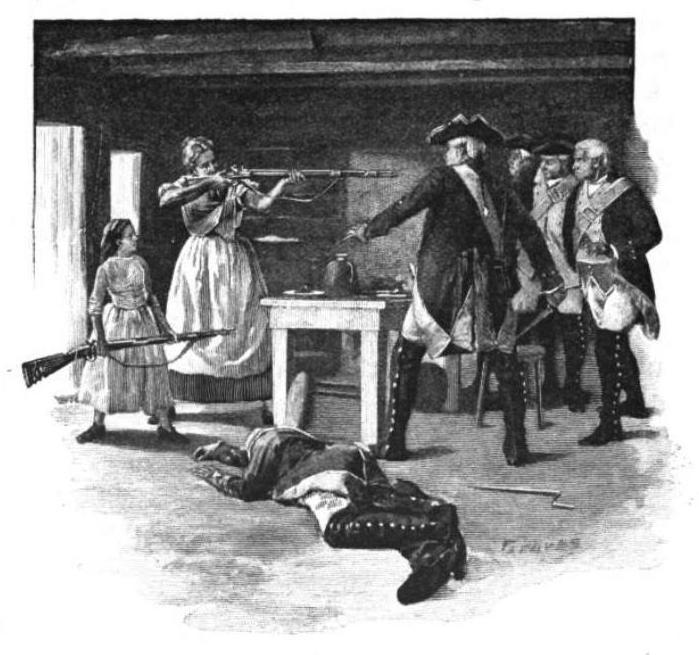
Five men in Loyalist service ride up to a log cabin on Broad River in Georgia. They shoot the family's last turkey, order the woman of the house to cook it, and drink her liquor while she works. She sends her daughter Sukey to the spring for water, with orders to blow a conch shell and call her husband. Then she pulls a piece of chinking from between the logs and starts passing their muskets outside, one at a time.1
That is the story of Nancy Hart as Elizabeth Ellet printed it in The Women of the American Revolution, and Georgia has been telling it ever since.
The Cabin Story as Ellet Told It
Ellet set the scene near Dye's and Webb's ferries on Broad River, in what is now Elbert County, beside a stream called "War-woman's Creek." Her Nancy was "a zealous lover of liberty and of the 'liberty boys,' as she called the whigs," cross-eyed, uneducated and fierce.1 The five visitors had come, in Ellet's telling, from a party that had killed Colonel John Dooly in his bed.
When the men sat down to eat, Nancy had already slipped two of the five guns outside. A third was in her hands when they noticed. She shot one dead, shot a second, and held the rest until Mr. Hart and the neighbors arrived. The men wanted to shoot the prisoners. She said they had surrendered to her and that "shooting was too good for them." They were hanged. Ellet closed with a remark she credited to a man who in 1828 pointed out the hanging tree: "Poor Nancy! she was a honey of a patriot, but the devil of a wife!"1
What the Record Holds
Very little. Nancy Hart's own date of birth is a guess. The Georgia Encyclopedia says around 1735, probably in North Carolina though some think Pennsylvania, and the DAR file says 1747.23 The State Library of North Carolina gives her parents as Thomas and Rebecca Morgan and says she married Benjamin Hart about 1760.4 They had eight children, among them a daughter Sukey and a son John.3
Benjamin leaves more of a trail. The DAR says he joined the Georgia militia as a lieutenant under Elijah Clarke, and that in Brunswick, Georgia, he later served as a magistrate and owned land and enslaved people.3 The New-York Historical Society says he died in 1801 before a land sale was complete.5 Where she died is also unsettled. Tradition says Henderson County, Kentucky, in 1830.2 Her grave marker, placed around 1932, reads 1735 to 1830. The DAR article says the exact date of her death is unknown and that many believe she lived to 1840, and adds that documentation on file with the DAR shows 1747 to 1840. The New-York Historical Society points out that her son John died in 1821 and did not mention her in his will.35
The wartime deeds are thinner still. The DAR states that "no historical records exist" of her exploits. The Historical Society adds that her actions were never mentioned in local government records and that she was not recognized for bravery in her lifetime.35 Even her family ties are tradition. Britannica says the claims that she was kin to Daniel Boone and General Daniel Morgan have "no real evidence in either case."6
Kettle Creek and a Calendar That Will Not Line Up
Some retellings put Nancy at the Battle of Kettle Creek. The DAR and the Battlefield Trust both say only that some accounts claim she was there, and neither points to a document.37 The battle was real. It was fought on February 14, 1779, in Wilkes County, and Georgia and South Carolina militia under Andrew Pickens, John Dooly and Elijah Clarke beat a Loyalist force whose commander, James Boyd, was mortally wounded. Of the roughly 150 Loyalists eventually taken prisoner, seven were hanged, five of them at Ninety Six, South Carolina.8 Whether that has any link to the hangings in the cabin story, nobody can show.
The dates do not help. The State Library of North Carolina places the turkey dinner in July 1779.4 Ellet ties it to the killing of Colonel Dooly, and All Things Liberty says Dooly was murdered "on or after August 6, 1780," at the hands of men who are still disputed.9 The two dates sit about a year apart. Tales of Nancy catching Dooly's killers belong in that same pile of legend.9
When the Story First Appeared
The earliest printing the sources name is 1825. The State Library says the story was first published about fifty years after the event, in the Milledgeville Southern Recorder, and gives the date as October 6, 1825. The Georgia Historical Society gives the same date for the Savannah Republican reprint, so the exact date of the first printing is unsettled.4 The Georgia Historical Society notes that the Savannah Republican described the story as "incontrovertible facts."10 Britannica says the account was a newspaper reminiscence prompted by the Marquis de Lafayette's 1825 tour.6 The Historical Society writes that "there is no historical evidence to support it" and that historians suspect the story was written for that newspaper.5
Ellet's book came next, in 1848, and it said the tale came to her from a gentleman in Georgia.5 Her version gave the story its shape. Later tellers added the soap-water attack on a Tory spy, the spy missions, and a height above six feet.5 Ellet had her cross-eyed. The six-foot Nancy came afterward.
Myth: The skeletons found in 1912 prove the cabin story
Workers grading a railroad bed less than a mile from the cabin site in 1912 found six skeletons buried in a row. Several had broken necks, and they were judged at least a century old.3 The Georgia Historical Society says the stories "are all supported by six bodies."10 Six bodies, buried together in a backcountry that saw real killings and hangings, show that someone buried six men there. They do not name them or give a date, and Ellet's story has five visitors, one dead and one wounded, though the Georgia Historical Society and the Battlefield Trust tell it with six.107 The DAR itself says only that the find may mean some version of the legend is true.3
How Georgia Remembers Her
Hart County was named for her in 1853 and its seat, Hartwell, in 1856.6 In 1932 the Stephen Heard and Nancy Hart chapters of the DAR built a replica cabin at the approximate site of the original, which a flood had washed away.3 During the Civil War, women in LaGrange formed a militia company called the Nancy Harts, and in 1997 she was inducted into Georgia Women of Achievement.2
A fair judgment is short. A woman named Nancy Hart lived on the Broad River, married Benjamin, raised eight children. The Revolution in Georgia's backcountry was brutal enough that a story like this could grow in it. Beyond that, the cabin story stands on a newspaper piece written fifty years later and on a book that retold it. Told as a tradition, it holds up.
Nancy Hart's Life at a Glance
- About 1735 Born, probably in North Carolina or Pennsylvania (sources give 1735 or 1747).
- About 1760 Marries Benjamin Hart.
- Early 1770s The family settles in Georgia's Broad River valley.
- February 14, 1779 Patriot militia win at Kettle Creek; some accounts put Nancy there.
- August 1780 or later Colonel Dooly is murdered, the event Ellet ties to the cabin visit.
- October 1825 The cabin story appears in Georgia newspapers (sources give October 6).
- 1848 Ellet prints the full version.
- 1853 Hart County is named for her.
- 1912 Railroad workers find six skeletons near the cabin site.
- 1932 DAR builds the replica cabin.
Learn more
- Ellet, The Women of the American Revolution, vol. 2: chapter XLIII is the full 1848 story, free to read
- DAR on Nancy Hart: the organization that built the cabin admits how little is documented
- New-York Historical Society on Nancy Morgan Hart: the 1825 and 1848 printings compared
- New Georgia Encyclopedia: Battle of Kettle Creek: the real battle her legend is attached to
Notes
- Elizabeth F. Ellet, The Women of the American Revolution, vol. 2, ch. XLIII, "Nancy Hart" (Philadelphia: George W. Jacobs, 1900 edition of the work first issued 1848), including "War-woman's Creek," the five visitors, the conch shell, the muskets passed through the chinking, the hangings and the 1828 remark. Read it online. ↩
- New Georgia Encyclopedia, "Nancy Hart (ca. 1735-1830)," on her birth around 1735, her death in Kentucky in 1830, the Nancy Harts of LaGrange and Georgia Women of Achievement in 1997. Read it online. ↩
- Daughters of the American Revolution, "Nancy Hart" (2021), on the birth of 1747, the death date dispute, her marker, Benjamin Hart's militia service and later life, the eight children, the 1912 skeletons, the 1932 replica cabin and the lack of records of her exploits. Read it online. ↩
- Megan Morrow, "Nancy Hart," State Library of North Carolina, Government and Heritage Library (August 2023), on her parents, her marriage about 1760, the July 1779 date for the turkey episode and the first printing on October 6, 1825. Read it online. ↩
- New-York Historical Society, Women and the American Story, "Nancy Morgan Hart," on the absence of any mention in local records, Benjamin Hart's death in 1801, John Hart's will, the 1825 Southern Recorder printing, Ellet's 1848 version and later additions. Read it online. ↩
- Encyclopaedia Britannica, "Nancy Hart," on the lack of evidence for her kinship to Boone and Morgan, the 1825 newspaper reminiscence tied to Lafayette's visit, Ellet's 1848 retelling and the naming of Hart County in 1853 and Hartwell in 1856. Read it online. ↩
- American Battlefield Trust, "Nancy Hart," on the claim in "some accounts" that she was at Kettle Creek, and on her birth around 1735. Read it online. ↩
- New Georgia Encyclopedia, "Battle of Kettle Creek," on the date of February 14, 1779, the Wilkes County location, the commanders, Boyd's mortal wound and the seven hanged Loyalists. Read it online. ↩
- All Things Liberty, "The Murder of Colonel Dooly of Georgia: A Revolutionary War Mystery" (May 2017), on the date "on or after August 6, 1780," the disputed killers and the tales of Nancy Hart capturing them. Read it online. ↩
- Georgia Historical Society, "Marker Monday: Nancy Hart," on the October 6, 1825 Savannah Republican printing and the six bodies of 1912. Read it online. ↩
Terms in this lesson
- Whig
- In Revolutionary-era writing, a supporter of the American cause. Ellet uses the word for Georgia patriots.
- Tory
- A colonist who stayed loyal to the Crown, also called a Loyalist. Georgia's backcountry war pitted neighbors of both kinds against each other.
- Oral tradition
- History passed along by retelling, with no document behind it. It can hold true memories, and it changes as it travels.
- Kettle Creek
- A Georgia battle fought on February 14, 1779, in Wilkes County, where Patriot militia defeated a Loyalist force under James Boyd.
- Chinking
- The clay or wood fill packed between the logs of a cabin. In Ellet's version, Hart pulled a piece out and passed muskets through the gap.
Sources
- Elizabeth F. Ellet, The Women of the American Revolution, vol. 2, ch. XLIII, Nancy Hart (Project Gutenberg, 1900 edition) checked 2026-10
- Daughters of the American Revolution, Nancy Hart checked 2026-10
- New-York Historical Society, Women and the American Story, Nancy Morgan Hart checked 2026-10
- State Library of North Carolina, Nancy Hart (Megan Morrow, 2023) checked 2026-10
- New Georgia Encyclopedia, Nancy Hart checked 2026-10
- Encyclopaedia Britannica, Nancy Hart checked 2026-10