Lesson 45 of 60 · about 9 minutes
The Overmountain Men: The Frontiersmen Who Won Kings Mountain
You'll be able to
- Explain why Ferguson's threat brought the Overmountain Men over the mountains in September 1780
- Name the main Patriot colonels and follow the march from Sycamore Shoals to Kings Mountain
- Tell what happened after the surrender, including the hangings at Biggerstaff's farm, and where the accounts differ
- Show how the battle changed the southern war and where the Overmountain Victory National Historic Trail runs
Patrick Ferguson taught himself to fence with his left hand after Brandywine shattered his right arm, and his men called him Bulldog.1 In the late summer of 1780 he sent a warning over the Blue Ridge to the settlers on the far side. Quit resisting the Crown, it said, or he would march over the mountains, hang their leaders and lay their country waste "with fire and sword."2 Within weeks about 900 mounted riflemen were riding at him.3
Ferguson's Message
Ferguson was a Scottish major and the only Briton in the force he led.3 Lord Cornwallis, fresh from his victory at Camden on August 16, 1780, had sent him into western North Carolina to recruit Loyalist militia and guard the army's left flank.3 Charleston had fallen in May and Camden followed in August, so few Patriots in the Carolinas had reason to think the war was going well. Sources word the threat a little differently, and they agree on "fire and sword."23 The message reached Isaac Shelby, who talked it over with John Sevier. They agreed to go after Ferguson before he came for them.1
Sycamore Shoals
They called the muster for September 25 at Sycamore Shoals on the Watauga River, now Elizabethton, Tennessee.14 Sevier and Shelby each brought 240 men. Charles McDowell was there with 160 North Carolina riflemen, and William Campbell marched in with 400 Virginians.1 The minister Samuel Doak preached on Gideon, whose small band beat a larger army.2 The men set out on September 26.5
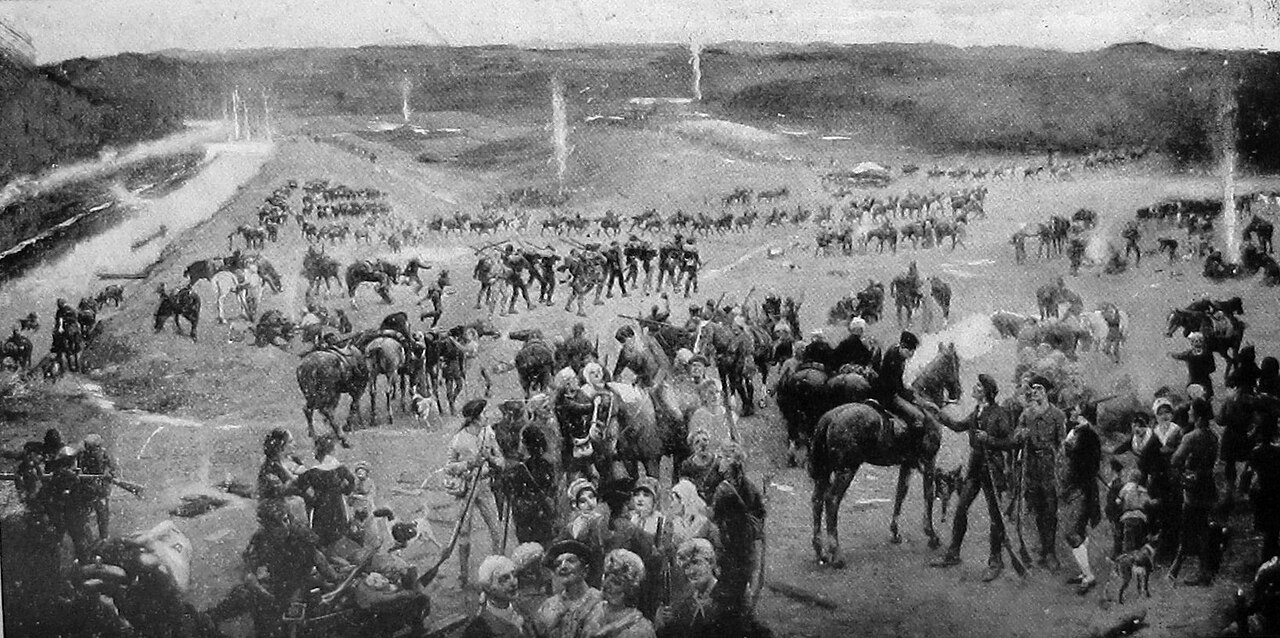
The Shoals had a history. In 1775 the speculator Richard Henderson bought some 20 million acres from the Cherokee there in the Transylvania Purchase. About twelve hundred Cherokee attended, and Dragging Canoe denounced the deal as unfair and unwise.4 The Overmountain settlements grew out of that push west, and the men who gathered in 1780 had fought the Cherokee for years. Their war cry and their habit of fighting from tree to tree came from that experience.2 After Kings Mountain they went back to fighting the Cherokee.6
The Colonels
Shelby, born in Maryland in 1750, moved with his family in 1771 to Sapling Grove, now Bristol.7 Sevier farmed, speculated in land and fought Indians.8 Campbell, a Virginian married to Patrick Henry's sister, was known as the "bloody tyrant of Washington County" for his harshness toward Loyalists.9 Benjamin Cleveland, a North Carolina colonel, reportedly had the nickname "Terror of the Tories."9 James Williams, a South Carolina colonel, would be the highest-ranking Patriot killed in the battle.10
The Ride to the Mountain
Two of Sevier's men deserted on the way and warned Ferguson.610 He pulled back and dug in on a small hill, Kings Mountain.3 Cleveland joined at Quaker Meadows on September 30 with 350 North Carolinians, and the officers elected Campbell commander.1 By October 6, between 1,600 and 1,800 men had gathered at the Cowpens. Their officers picked the 900 best marksmen, put them on the 900 sturdiest horses and rode 35 miles through a cold, rainy night.10
October 7, 1780
They reached the mountain early in the afternoon and split into four columns, two on each side.1 Shelby had told his men to fight frontier style: "shelter yourselves and give them Indian play! advance from tree to tree."7 The riflemen could hit a target at 200 or 300 yards, while the Loyalists mostly carried muskets.3 Loyalist bayonet charges drove the attackers back, but only on one side at a time, and the riflemen came again from another.311 Ferguson rode out to break through and was shot from the saddle. Captain Abraham DePeyster, his second in command, raised a white flag.1 Colonel Williams, mortally wounded near the end, lived long enough to hear of the surrender and said, "I die contented, since we have gained the victory."11
The counts differ. The North Carolina Encyclopedia has Ferguson and 119 of his men killed, 123 wounded and 664 captured, and the Battlefield Trust has 157 killed, 163 wounded and 698 captured. Both give the Patriots 28 dead and 62 wounded.13 Pension records name five Black men who served with the Overmountain Men. John Broddy was enslaved by Campbell, and Ishmael Titus fought as a substitute for the man who held him and was freed for it.2
Myth: Kings Mountain was Americans against the British
The American Battlefield Trust calls it a battle fought entirely between Americans, with Ferguson the only Briton on the field.3 Robert Campbell's narrative counted a hundred British regulars among 810 prisoners, which the Trust's account contradicts.11 The Carolina backcountry was already a civil war, with neighbor set against neighbor, and that helps explain what came next.12
After the Surrender
The firing did not stop at once. Several minutes passed before the surrender took hold, and more Loyalists died. Some Americans did not grasp what was happening. Others remembered Tarleton's men cutting down Buford's surrendering Americans that year.1 On the ride home Campbell had to order his officers to halt the killing of prisoners.1
On Friday, October 13, the army reached Aaron Biggerstaff's farm in Rutherford County, North Carolina. (Some sources spell it Bickerstaff.) Patriot officers, among them Cleveland, tried the prisoners the next day.13 Shelby later said 36 were convicted of "breaking open houses, killing the men, turning the women and children out of doors and burning the houses." Campbell's report says 32 were condemned, and a modern site says 30 to 32.11113 Nine were hanged at night, three at a time, before the officers stopped it.6 One of the dead, Ambrose Mills, was charged with inciting the Cherokee, a charge the historian Lyman Draper himself thought "very likely without foundation."13 Shelby had just learned that nine Whigs had been hanged at Ninety Six, South Carolina.13 The same site warns that many details of the hangings trace back to one historian, Draper, in 1881. Of about 700 prisoners marched toward Hillsborough, many escaped or died, and about 130 reached the stockade at Bethabara.6
Why It Turned the War
Cornwallis lost his left wing and fell back into South Carolina, putting off his invasion of North Carolina.3 Sir Henry Clinton later called the defeat the "first Link of a Chain of Evils" that ended in "the total loss of America," and Jefferson spoke of "the turn of the tide of success."13 On December 2, 1780, Nathanael Greene took command of the Southern Army at Charlotte.10 Daniel Morgan beat Tarleton at the Cowpens on January 17, 1781, and some Overmountain veterans served under him there.612 Francis Marion was making South Carolina hard to hold, and after Tarleton failed to catch him in November 1780 he became the Swamp Fox.14 Cornwallis surrendered at Yorktown 12 months and 12 days after Kings Mountain.6
Shelby later became governor of Kentucky. In 1818 he helped negotiate the Jackson Purchase, which took the Chickasaw's western Kentucky and Tennessee lands.7
The Trail
In 1980 Congress designated the Overmountain Victory National Historic Trail. It runs about 330 miles through Virginia, Tennessee, North Carolina and South Carolina.1015 A celebration at Sycamore Shoals marks the muster every September.4
The Overmountain Men's Campaign at a Glance
- August 16, 1780 Cornwallis wins at Camden.
- September 25, 1780 Overmountain Men muster at Sycamore Shoals.
- September 30, 1780 Cleveland joins at Quaker Meadows.
- October 6, 1780 900 picked riflemen leave the Cowpens on horseback.
- October 7, 1780 Ferguson killed; Loyalists surrender.
- October 14, 1780 Nine prisoners hanged at Biggerstaff's farm.
- December 2, 1780 Greene takes command in the South.
- January 17, 1781 Morgan wins at the Cowpens.
- October 19, 1781 Cornwallis surrenders at Yorktown.
- 1980 Congress designates the Overmountain Victory National Historic Trail.
Learn more
- NCpedia on King's Mountain: the best short account of the march, battle and trial
- American Battlefield Trust on Kings Mountain: casualty estimates, maps and the rifle-versus-musket question
- AmRevNC on Bickerstaff's Old Fields: the hangings, with honest notes on the sources
- National Park Service, Overmountain Victory Trail: where to walk and drive the route
Notes
- NCpedia (Encyclopedia of North Carolina), "Battle of King's Mountain," by Noel Yancey (UNC Press, 2006), on Ferguson, the muster and its numbers, the march, the attack, the surrender, the casualties, the prisoners, Clinton's remark and the court-martial. Read it online. ↩
- TeachTNHistory, "The Battle of King's Mountain," on the message Ferguson sent, the sermon of Samuel Doak, the war cry learned in Cherokee fighting and the five Black men identified in pension records. Read it online. ↩
- American Battlefield Trust, "Kings Mountain," on Cornwallis's orders to Ferguson, the proclamation, rifles and muskets, the casualty estimates, the 60-foot hill, Jefferson's phrase and the point that Ferguson was the only Briton on the field. Read it online. ↩
- Carroll Van West, "Sycamore Shoals State Historic Area," Tennessee Encyclopedia, on the 1775 Transylvania Purchase, Dragging Canoe's protest, the muster of September 25, 1780 and the yearly celebration. Read it online. ↩
- TeachTNHistory, "The Battle of King's Mountain," on the departure from Sycamore Shoals on September 26 (read it online), and National Park Service, Overmountain Victory National Historic Trail chronology, on the muster of September 25 and the first night at Shelving Rock on September 26 (read it online). ↩
- Mitchell County Historical Society, "The Battle of Kings Mountain: The Turn of the Tide of Success," on the march of the prisoners, the Cherokee fighting after the battle, the veterans who joined Morgan and the interval to Yorktown. Read it online. ↩
- Carroll Van West, "Shelby, Isaac," Tennessee Encyclopedia, on his birth, his address to his men and the Jackson Purchase of 1818. Read it online. ↩
- Tennessee Encyclopedia, "Sevier, John," on his farming, land dealing and Indian fighting. Read it online. ↩
- American Battlefield Trust biographies of William Campbell, Benjamin Cleveland and James Williams, on Campbell's marriage and nickname, Cleveland's nickname and Williams's death. Read it online. ↩
- Randell Jones, "The Battle of King's Mountain," Charlotte Museum of History, on the gathering at the Cowpens, the 900 picked riflemen, the Georgia and South Carolina men, Williams's death, Greene's arrival and the 1980 trail. Read it online. ↩
- Robert Campbell, "Narrative of the Battle of King's Mountain," October 1780, on the bayonet charges, Williams's last words, the prisoners and the court-martial that condemned 32 and executed nine. Read it online. ↩
- American Battlefield Trust, "Cowpens," on the battle of January 17, 1781 and Greene's decision to send Morgan southwest of the Catawba. Read it online. ↩
- AmRevNC, "Bickerstaff's Old Fields," on the camp near Rutherfordton, the trial on October 14, the charge against Ambrose Mills, the nine hanged and the warning that many details come from Lyman Draper (1881). Read it online. ↩
- American Battlefield Trust, "Francis Marion," on his guerrilla raids and Tarleton's chase in November 1780. Read it online. ↩
- National Park Service, "Overmountain Victory National Historic Trail," on its 330 miles through four states (Spanish-language page). Read it online. ↩
Terms in this lesson
- Overmountain Men
- Settlers who lived west of the Blue Ridge, in what is now eastern Tennessee and southwest Virginia, and rode east to fight Ferguson.
- Loyalist
- An American who stayed loyal to the Crown. Also called a Tory. Nearly all of Ferguson's men were Loyalists born in America.
- Militia
- Part-time soldiers raised by a county or state. Both sides at Kings Mountain were militia.
- Sycamore Shoals
- A ford on the Watauga River at today's Elizabethton, Tennessee, where the Overmountain Men gathered on September 25, 1780.
- Court-martial
- A military trial. The Patriot officers held one for Loyalist prisoners on October 14, 1780, and hanged nine of them.
- National Historic Trail
- A route recognized by Congress for its place in American history. The Overmountain Victory Trail follows the Patriot march.
Sources
- NCpedia, Battle of King's Mountain (Noel Yancey) checked 2026-10
- American Battlefield Trust, Kings Mountain checked 2026-10
- Charlotte Museum of History, The Battle of King's Mountain (Randell Jones) checked 2026-10
- Robert Campbell, Narrative of the Battle of King's Mountain (October 1780) checked 2026-10
- AmRevNC, Bickerstaff's Old Fields checked 2026-10
- Tennessee Encyclopedia, Sycamore Shoals State Historic Area checked 2026-10
- TeachTNHistory, The Battle of King's Mountain checked 2026-10
- National Park Service, Overmountain Victory National Historic Trail checked 2026-10