Lesson 20 of 60 · about 9 minutes
Crispus Attucks: What the Record Shows About the Boston Massacre
You'll be able to
- Separate what witnesses and John Adams said about Attucks in 1770 from what later writers added
- Describe how the soldiers were tried, who was convicted, and why Adams called his defense a service to his country
- Explain why Revere's engraving is propaganda and what it leaves out
- Trace how Attucks went from a name in a trial record to the 1888 monument on Boston Common
It was about nine o'clock on the night of March 5, 1770, and snow lay in King Street.3 A tall man stood in the crowd leaning on a long stick, "resting his breast upon it," as one witness put it later.1 Within minutes British soldiers fired into the crowd. By March 14 five men were dead. One of them was Crispus Attucks, and almost everything people say about him now was written after the smoke cleared.
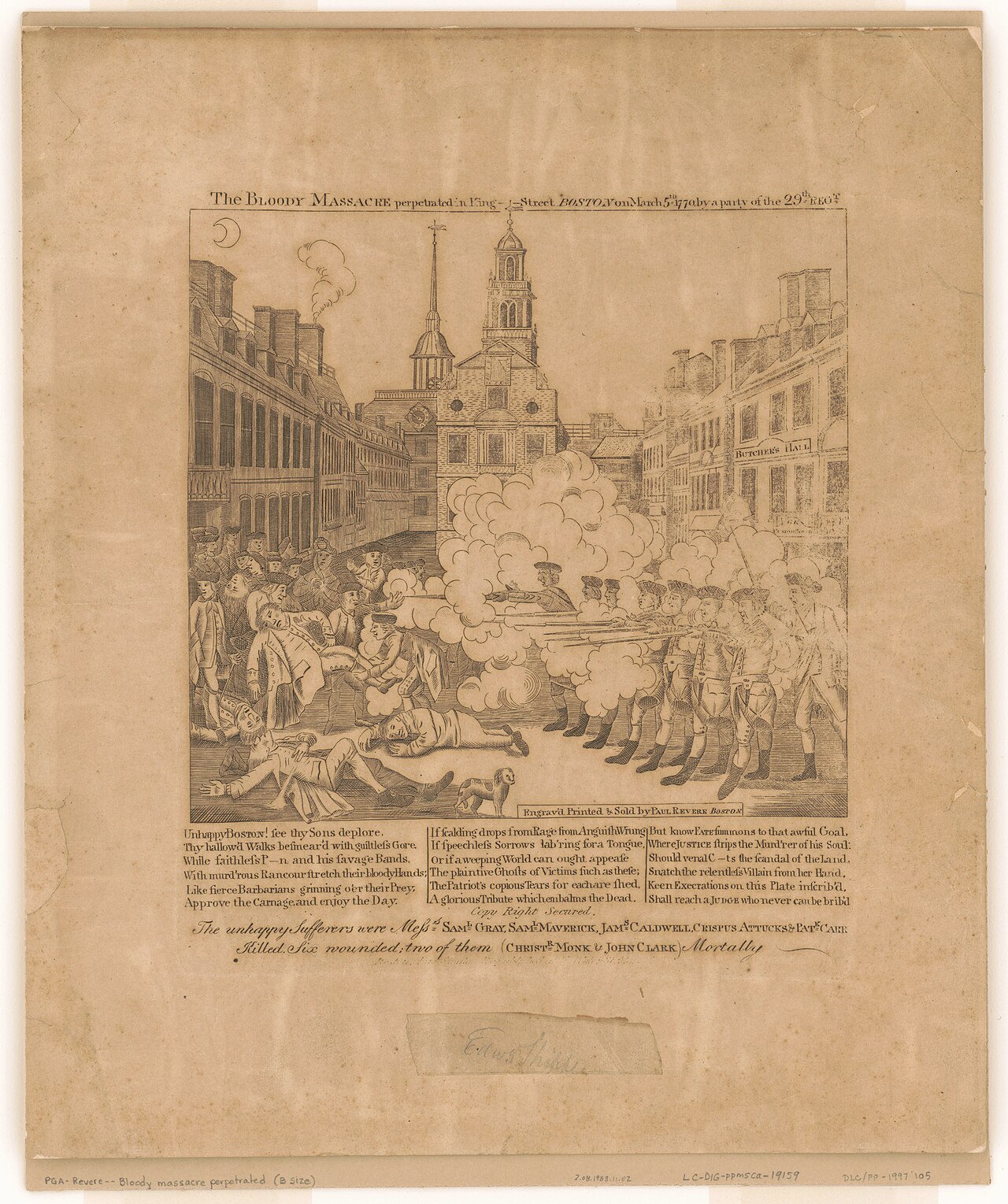
The Night on King Street
Captain Thomas Preston and eight soldiers of the 29th Regiment faced a crowd at the Custom House. Samuel Gray, James Caldwell and Attucks died on the spot. Samuel Maverick died the next morning, March 6, and Patrick Carr on March 14.2 One witness at the trial counted two shots that hit nobody, then three that "killed Attucks and Gray," then two more that killed Caldwell.1 So by that count the first guns did not kill him, and the label "first to die" is later shorthand. A boy of eleven, Christopher Seider, had been shot by a customs employee on February 22.2
What the Witnesses Said
Witnesses at the trial called Attucks "the Molatto," and some placed him at the head of a gang of sailors with clubs. James Bailey saw him "at the Head of 25 or 30 sailors" in Cornhill minutes before the shooting, and Bailey also said, "It was not the Mollato that struck Montgomery."1 Patrick Keaton said he saw "a tall Molatto fellow, the same that was killed" handing out cordwood sticks.3
An enslaved man named Andrew, listed in the transcript as "Mr. Oliver Wendall's Negro," described a stout man with a long stick who struck at the officer, grabbed a bayonet and cried "kill the dogs." Asked who that was, Andrew answered, "I thought, and still think it was the Molatto who was shot."3 Other witnesses, including Bailey, said the man who hit Montgomery was someone else, and one swore Attucks said nothing at all.1 The record is split. It does not settle who did what.
John Adams Takes the Case
Preston was tried first and found not guilty on October 30, 1770. The eight soldiers went to trial on November 27 before a jury with no Boston resident on it, and the verdicts came on December 5, nine months to the day after the shooting.4 Six were acquitted. Matthew Kilroy and Hugh Montgomery were found "Not guilty of murder, but guilty of manslaughter," claimed benefit of clergy, and were "burnt in the hand, in open Court, and discharged."5
Adams, thirty-five, joined Josiah Quincy Jr., Sampson Salter Blowers and Robert Auchmuty on the defense. The assignment was unpopular in Boston, and he took the case anyway.4 His argument turned on the crowd. He called it "a motley rabble of saucy boys, negroes and molattoes, Irish teagues and out landish jack tarrs," and he pointed to Attucks as its leader: "a stout Molatto fellow, whose very looks, was enough to terrify any person." The carnage, he said, was "chiefly to be ascribed" to Attucks's "mad behaviour."6
"Facts are stubborn things; and whatever may be our wishes, our inclinations, or the dictates of our passions, they cannot alter the state of facts and evidence."
John Adams, Argument for the Defense, December 3-4, 1770, as printed in the trial report. 6
Three years later Adams wrote that his part in the defense "procured me Anxiety, and Obloquy enough," and that it was "one of the best Pieces of Service I ever rendered my Country." A death sentence, he said, "would have been as foul a Stain upon this Country as the Executions of the Quakers or Witches."7 I think he was right about the law. Soldiers accused of a crime get a defense, even when the town hates them. But his portrait of a dead man was advocacy, and it came from a lawyer working for the other side.
What Is Not Known
Attucks's origins are thin. A 1750 runaway notice from William Brown of Framingham described "a Molatto Fellow, about 27 Years of Age, named Crispas." Historians believe it is him, based on the rare name and his height, but it is an inference, not a certainty.8 His parents are undocumented. Witnesses called him "Molatto" and sometimes "Indian," and his surname appears to be Native in origin.89 Early reports and investigations call him Michael Johnson, possibly an alias, and the papers placed him as a sailor tied to the Bahamas and bound for North Carolina.89 The National Park Service gives 1723 as his birth year. That date matches the ad's "27 years."9
Myth: Attucks was the first to die and the organizer of a plot
Neither claim survives the record. A witness counted two shots that killed no one before the shots that killed him, and Seider had died weeks earlier.12 As for leadership, witnesses disagreed, and the main source for the picture of Attucks as ringleader is Adams's argument for the defense.6
Revere's Engraving
Paul Revere advertised his print on March 26, 1770, three weeks after the shooting. The design was Henry Pelham's. Pelham lent Revere a version, and Revere engraved it, added a title and a verse, and labeled the Custom House "Butcher's Hall."10 It shows soldiers firing in a neat line on Preston's order to a crowd of unarmed citizens. Whether Preston gave the order was contested at his trial, and the jury acquitted him.42 No print from 1770 shows Attucks as a Black man, and the earliest known one dates from 1855.10
The Monument and the Memory
William C. Nell's 1855 book The Colored Patriots of the American Revolution made Attucks a hero of Black history.8 Nell worked for a monument until his death in 1874, and Black Bostonians such as Lewis Hayden carried on.11 The Boston Massacre Memorial by Robert Kraus was unveiled on Boston Common on November 14, 1888, with Irish poet John Boyle O'Reilly on the committee. The Massachusetts Historical Society petitioned the governor against it.1112
The record leaves Attucks a man who was there, who died, and whose story others have kept writing. Adams's portrait and the later memorial both ask us to know a person from whom we have almost nothing in his own voice. The night itself offers a better lesson for a republic that wants power held to account. Soldiers fired into a crowd, five people died, and nine months later a jury sorted the facts from the anger. So tell it straight, and say plainly where the record runs out.
Attucks's Life at a Glance
- September 30, 1750 A man named "Crispas" runs from William Brown of Framingham; the ad runs from October 2.
- February 22, 1770 Christopher Seider, age eleven, is shot by a customs employee.
- March 5, 1770 British soldiers fire in King Street; Attucks, Gray and Caldwell die at once.
- March 26, 1770 Revere advertises his engraving.
- October 30, 1770 Captain Preston is found not guilty.
- December 5, 1770 Six soldiers are acquitted and two convicted of manslaughter.
- 1855 Nell's book makes Attucks a patriot of the Black community.
- November 14, 1888 The Boston Massacre Memorial is unveiled on Boston Common.
Learn more
- Adams' Argument for the Defense: the full speech, with the passages about Attucks
- MHS: Crispus Attucks source set: testimony, Nell and later memory side by side
- Journal of the American Revolution: The Hidden Life of Crispus Attucks: what the 1750 ad and the witnesses support
- MHS: The Trials: the indictments, dates and verdicts
Notes
- Massachusetts Historical Society, Legal Papers of John Adams, vol. 3, "Transcript of Remaining Defense Evidence," November 30-December 1, 1770, testimony of Patrick Keaton and Andrew. Read it online. ↩
- Massachusetts Historical Society, Legal Papers of John Adams, vol. 3, "Adams' Minutes of Crown Evidence, Continued," November 28, 1770, on the testimony of Bailey and other witnesses, including the count of shots and the man "resting his breast upon" a stick. Read it online. ↩
- History of Massachusetts, "Boston Massacre Timeline," on the five dead, the deaths of Maverick on March 6 and Carr on March 14, the shooting of Christopher Seider on February 22, 1770, and the acquittal of Preston because the evidence did not settle whether he gave the order. Read it online. ↩
- Massachusetts Historical Society, "The Trials," on Preston's trial of October 24-30, 1770, the soldiers' trial from November 27, the jury and the defense team. Read it online. ↩
- Massachusetts Historical Society, Legal Papers of John Adams, vol. 3, "Verdicts," December 5, 1770, on the six acquittals, the manslaughter verdict and the sentence. Read it online. ↩
- Massachusetts Historical Society, Legal Papers of John Adams, vol. 3, "Adams' Argument for the Defense," December 3-4, 1770, as printed in the 1770 trial report, with the passages on the mob, Attucks and stubborn facts. Read it online. ↩
- John Adams, diary entry of March 5, 1773, Diary of John Adams, vol. 2, Massachusetts Historical Society. Read it online. ↩
- Massachusetts Historical Society, "Crispus Attucks" source set, on the runaway ad, the testimony and Nell's 1855 book. Read it online. See also Journal of the American Revolution (formerly All Things Liberty), "The Hidden Life of Crispus Attucks" (2014), on the ad's date, the Framingham records and the uncertainty about his origins. Read it online. ↩
- National Park Service, "Crispus Attucks," on his surname, the name Michael Johnson, his work as a sailor and the 1723 birth year. Read it online. ↩
- Boston Athenaeum, "The Bloody Massacre," on Pelham, Revere, the March 26 advertisement, the title "Butcher's Hall" and the 1855 first depiction of Attucks as a Black man. Read it online. ↩
- Revolutionary Spaces, "Reflecting Attucks," on Nell's campaign, Lewis Hayden, the coalition behind the monument and the opposition to it. Read it online. ↩
- Irish Boston, "Local Black and Irish Leaders Unveil the Boston Massacre Memorial on Boston Common, November 14, 1888," on the date, the committee and the Historical Society's petition. The sculptor's name, Robert Kraus, is from Culture Now, "Boston Massacre / Crispus Attucks Monument." Read it online. ↩
Terms in this lesson
- Benefit of clergy
- An old English rule that let a person convicted of manslaughter escape hanging by claiming it. The two convicted soldiers used it and were burned in the hand instead.
- Manslaughter
- An unlawful killing without the planning or malice that makes it murder. The jury found two soldiers guilty of it.
- Propaganda
- Pictures or words made to move opinion rather than to record events. Revere's print of the shooting is the standard example.
- Runaway advertisement
- A newspaper notice offering a reward for an escaped enslaved person. One from 1750 is the main evidence for Attucks's early life.
- Molatto
- The eighteenth-century spelling of a word used then for people of mixed African and other ancestry. It appears in the quotations below because witnesses and Adams used it, and it is now regarded as an offensive term.
Sources
- Massachusetts Historical Society, Legal Papers of John Adams, vol. 3: Adams' Argument for the Defense, 3-4 December 1770 checked 2026-10
- Massachusetts Historical Society, Legal Papers of John Adams, vol. 3: Transcript of Remaining Defense Evidence checked 2026-10
- Massachusetts Historical Society, Diary of John Adams, 5 March 1773 checked 2026-10
- Massachusetts Historical Society, Crispus Attucks source set checked 2026-10
- All Things Liberty, The Hidden Life of Crispus Attucks checked 2026-10
- National Park Service, Crispus Attucks checked 2026-10