Lesson 29 of 60 · about 9 minutes
Mary Katharine Goddard: The Printer Who Put the Signers' Names on the Declaration
You'll be able to
- Describe how Goddard came to run the Maryland Journal and what her brother William's part was
- Explain what Congress ordered on January 18, 1777 and what the Goddard Broadside added to earlier printings
- Follow her dismissal as postmaster in 1789 and the petitions to Washington and the Senate
- Note where sources disagree on dates and where popular claims about her go too far
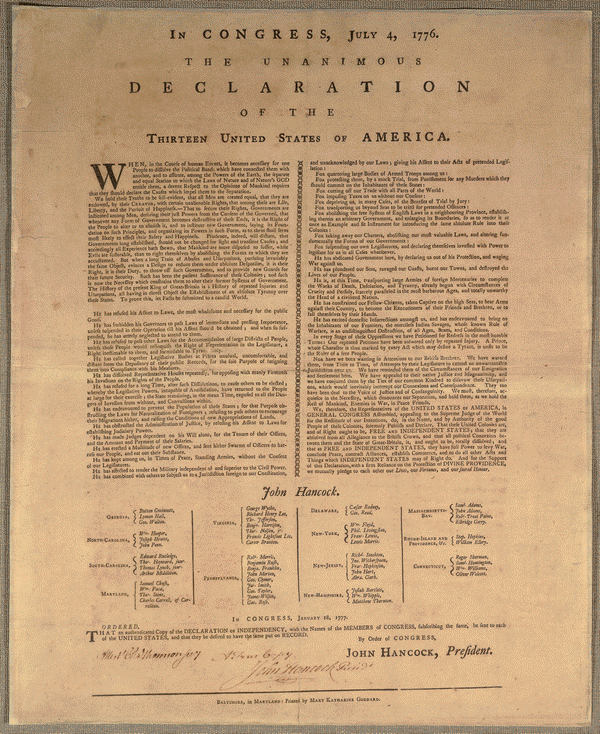
The sheet is about twenty-one inches tall, set in two columns of type with four more columns of names below. At the bottom it says "Baltimore, in Maryland: Printed by Mary Katharine Goddard." In January 1777 that line did something no earlier printing of the Declaration of Independence had done. It was the first printing to tell the public who had signed.1
A Printer's Daughter from New London
Mary Katharine Goddard was born on June 16, 1738, in New London, Connecticut, the daughter of Dr. Giles Goddard and Sarah Updike Goddard. The Maryland State Archives gives that date. The National Park Service gives 1739, one more case of an old record that does not agree with itself.23 After her father died in 1762 she and her mother joined her brother William in Providence, where he had set up a printing shop, and she worked on the Providence Gazette.4
William was the restless one. He started newspapers in Providence, Philadelphia and Baltimore and often moved on, leaving his sister to run what he began. In 1768 she joined his Philadelphia office, which published the Pennsylvania Chronicle, and managed the shop. By one account her brother later called her "an expert and correct compositor of types."45
The Maryland Journal
William founded Baltimore's first newspaper, the Maryland Journal, in 1773. When the Philadelphia shop closed in February 1774, Mary Katharine moved to Baltimore to run the Baltimore press and paper. By May 10, 1775, the masthead read "Published by M. K. Goddard."4 She used it for the patriot side, printing news of the Boston blockade and Thomas Paine's Common Sense in installments.5
The partnership ended badly. In January 1784 William took the paper back,2 and by Smithsonian's account he later attacked her in an almanac. She did not attend his 1786 wedding.5 The Postal Museum puts it simply as a bitter quarrel.6
Postmaster of Baltimore
In 1775 she became Baltimore's postmaster, probably the first woman to hold a postmaster's post in the colonies. Sources split on the month. The Park Service says July and Smithsonian says October.57 The Postal Museum places her under Postmaster General Benjamin Franklin and says her brother William had helped build the new system.6 She kept the office through the war, and she later wrote that she paid post riders in hard money out of her own pocket when her earnings were small.8
The Goddard Broadside
In December 1776 the British threatened Philadelphia and Congress moved to Baltimore, where it sat from December 20, 1776 to March 4, 1777.1 After Washington's victories at Trenton and Princeton, Congress decided to send every state an authenticated copy of the Declaration with the names of the members who had signed it.1 The order of January 18, 1777 reads, in the text printed on the broadside itself: "Ordered, that an authenticated copy of the Declaration of Independency, with the names of the members of Congress, subscribing the same, be sent to each of the United States, and that they be desired to have the same put on record." It is signed "By order of Congress, John Hancock, president."9
Congress turned to Goddard, whose shop was a few blocks away.7 The Library of Congress describes the result as 54 by 44 centimeters, with the Declaration in two columns and the signers in four, and quotes the bibliographer Lawrence C. Wroth calling it the first issue of the Declaration printed with the signers' names, except that of Thomas McKean.9 The Library's record dates the printing only as 1777. The Park Service dates it to January 18, while Smithsonian says January 1777, so the safest statement is that Congress ordered it on January 18 and Goddard printed it that winter.15
Myth: Goddard printed the first Declaration of Independence
The Declaration was first printed in July 1776 by John Dunlap, Congress's official printer, who produced his broadsides overnight. Joseph Towne Wheeler's Maryland bibliography, published online by the Maryland State Archives, counts at least eight printings before hers. What she printed was the first official issue with the signers' names. Only nine Goddard broadsides are known to survive.11011
Dunlap's version carried only the names of Hancock and Charles Thomson. Goddard's lists the rest. One name is absent: Thomas McKean of Delaware, who likely signed after the type was set.12 She usually signed her work "M. K. Goddard," and here she put her full name in the imprint. Smithsonian says she recognized her role in a historical moment. The Park Service adds that no known image of her exists.57
Dismissed in 1789
She held the Baltimore post for fourteen years. In the autumn of 1789 the new government's Postmaster General, Samuel Osgood, replaced her with John White of Annapolis. Smithsonian says October, and her own Senate petition says she kept the office until November. The Postal Museum says Osgood wanted Baltimore as a regional center and called the job too much travel for a woman, and the author argues the real motive was a plum post for a political ally.56 Her own view was blunt. She wrote that she had been removed "without any previous official notice," and she told the Senate she had been discharged "without the smallest imputation of any Fault."813
More than 200 Baltimore residents, and by some counts over 230, signed a petition for her return.6 On December 23, 1789 she wrote to President Washington. He answered on January 6, 1790 that he had "uniformly avoided interfering with any appointments which do not require my official agency," and sent her memorial on to Osgood. Osgood replied the next day that a postmaster general answers for his deputies and should use his own judgment. He wrote that he was fully convinced White would serve better than she did. He gave no charge of misconduct.8 She then petitioned the Senate on January 29, 1790, calling fourteen years of service "poor rewards indeed for fourteen Years faithful Services." The Senate did not act.137
A Bookshop and a Will
She kept the Baltimore bookshop she had begun as an adjunct to the printing business until 1809 or 1810.4 She died on August 12, 1816 at age 78 and is buried in the graveyard of St. Paul's Parish.4 Her will gave freedom to an enslaved woman, Belinda Starling, "aged about 26 years," and left her property to Starling.23 That detail belongs in the record. A woman who lost a government post to a politician's friend had, herself, held a human being as property, and the will is how we know she ended it.
Goddard's Life at a Glance
- June 16, 1738 Born in New London, Connecticut (the Park Service says 1739).
- 1762 Joins her brother William in Providence after her father's death.
- Feb. 1774 Moves to Baltimore to run the Maryland Journal.
- 1775 Named Baltimore postmaster (sources say July or October).
- Jan. 18, 1777 Congress orders authenticated copies of the Declaration, with names, sent to each state.
- Jan. 1784 William takes back the Maryland Journal.
- Autumn 1789 Osgood replaces her with John White.
- Dec. 23, 1789 Writes to Washington; he declines on January 6, 1790.
- Aug. 12, 1816 Dies in Baltimore.
Learn more
- Library of Congress catalog record for the Goddard Broadside: the printed order of Congress and Wroth's description
- Founders Online: Goddard to Washington, 23 December 1789: her petition with Washington's and Osgood's replies in the notes
- Smithsonian Magazine profile: her career, her brother and the 1789 fight
- Maryland Women's Hall of Fame entry: a dated outline of her years in Providence, Philadelphia and Baltimore
- National Park Service on the Goddard Broadside: why Congress was in Baltimore and how many copies survive
Notes
- National Park Service, "Mary Katharine Goddard," on the January 18, 1777 printing with signers' names, Congress's stay in Baltimore from December 20, 1776 to March 4, 1777, and the nine known copies. Read it online. ↩
- Maryland State Archives, Archives of Maryland Biographical Series, "Mary Katherine Goddard," giving her birth as June 16, 1738 in New London, Connecticut, William's name replacing hers on the paper in January 1784, and the text of her will. Read it online. ↩
- National Park Service, "Mary Katharine Goddard," Independence National Historical Park, giving a birth year of 1739, and her will freeing Belinda Starling. Read it online. ↩
- Maryland State Archives, Maryland Women's Hall of Fame, "Mary Katherine Goddard," on 1762 in Providence, 1768 in Philadelphia, the move to Baltimore in 1774, the May 10, 1775 masthead, the bookshop, her death and burial. Read it online. ↩
- Erick Trickey, "Mary Katharine Goddard, the Woman Whose Name Appears on the Declaration of Independence," Smithsonian Magazine, on William's role, Common Sense, the 1784 takeover, the October 1775 appointment and the 1789 dismissal. Read it online. ↩
- National Postal Museum, "Early Postal Women," on her service under Franklin, Osgood's reasons, John White and the bitter quarrel with William. Read it online. ↩
- National Park Service, Independence National Historical Park, same article, on July 1775 as the appointment, the shop near Congress and the absence of any known image of her. Read it online. ↩
- Founders Online, "Mary Katherine Goddard to George Washington, 23 December 1789," with editorial notes giving Washington's reply of January 6, 1790 and Osgood's reply of January 7, 1790. Read it online. ↩
- Library of Congress, "In Congress, July 4, 1776. The unanimous declaration of the thirteen United States of America" (Baltimore: Mary Katharine Goddard, [1777]), LCCN 90898037, Continental Congress Broadside Collection no. 21, quoting Wroth and the January 18, 1777 order. Read it online. ↩
- Joseph Towne Wheeler, The Maryland Press, 1777-1790, Archives of Maryland vol. 438, entry 29 (Maryland State Archives online), on the Goddard broadside, noting at least eight earlier printings and that it was the first official issue with the signers. Read it online. ↩
- Colonial Williamsburg, "Publishing and Publicizing the Declaration of Independence," on John Dunlap's July 1776 broadsides, produced overnight, and the second printing by Goddard. Read it online. ↩
- New York Public Library, "Mary Katherine Goddard's Declaration of Independence," June 29, 2016, on Hancock and Thomson as the only names on earlier printings and McKean's absence. Read it online. ↩
- The First Federal Congress Project, "Petition of Mary Katherine Goddard to the Senate," January 29, 1790. Read it online. ↩
Terms in this lesson
- Broadside
- A single large sheet printed on one side, meant to be posted or passed around. The Goddard Broadside carries the Declaration in two columns and the signers' names in four.
- Postmaster
- The local official who runs a post office, receives the mail and sends it on. In Goddard's day he or she also arranged the riders who carried it.
- Post rider
- A person on horseback who carried mail between towns. Goddard said she paid riders from her own money during the war.
- Authenticated copy
- A copy certified as true. The Goddard Broadside ends with the printed name of John Hancock as president of Congress, and the Library of Congress copy carries a handwritten attestation by Charles Thomson.
- Memorial
- A formal written request to a government body. Goddard sent one to Washington and a petition to the Senate.
Sources
- Library of Congress, In Congress, July 4, 1776. The unanimous declaration of the thirteen United States of America (Goddard Broadside) checked 2026-10
- National Park Service, Mary Katharine Goddard and the Declaration checked 2026-10
- Smithsonian Magazine, Mary Katharine Goddard, the Woman Whose Name Appears on the Declaration of Independence checked 2026-10
- Founders Online, Mary Katherine Goddard to George Washington, 23 December 1789 checked 2026-10
- Maryland State Archives, Maryland Women's Hall of Fame: Mary Katherine Goddard checked 2026-10
- National Postal Museum, Early Postal Women checked 2026-10