Lesson 12 of 60 · about 9 minutes
Bernardo de Galvez: The Spaniard Who Opened the Mississippi
You'll be able to
- Describe the supplies Galvez sent the Americans from Louisiana before Spain entered the war
- List his campaigns of 1779, 1780 and 1781 and where sources give different dates
- Explain the argument that Pensacola helped make Yorktown possible, and what that argument leaves out
- Say how Galvez has been honored in the United States
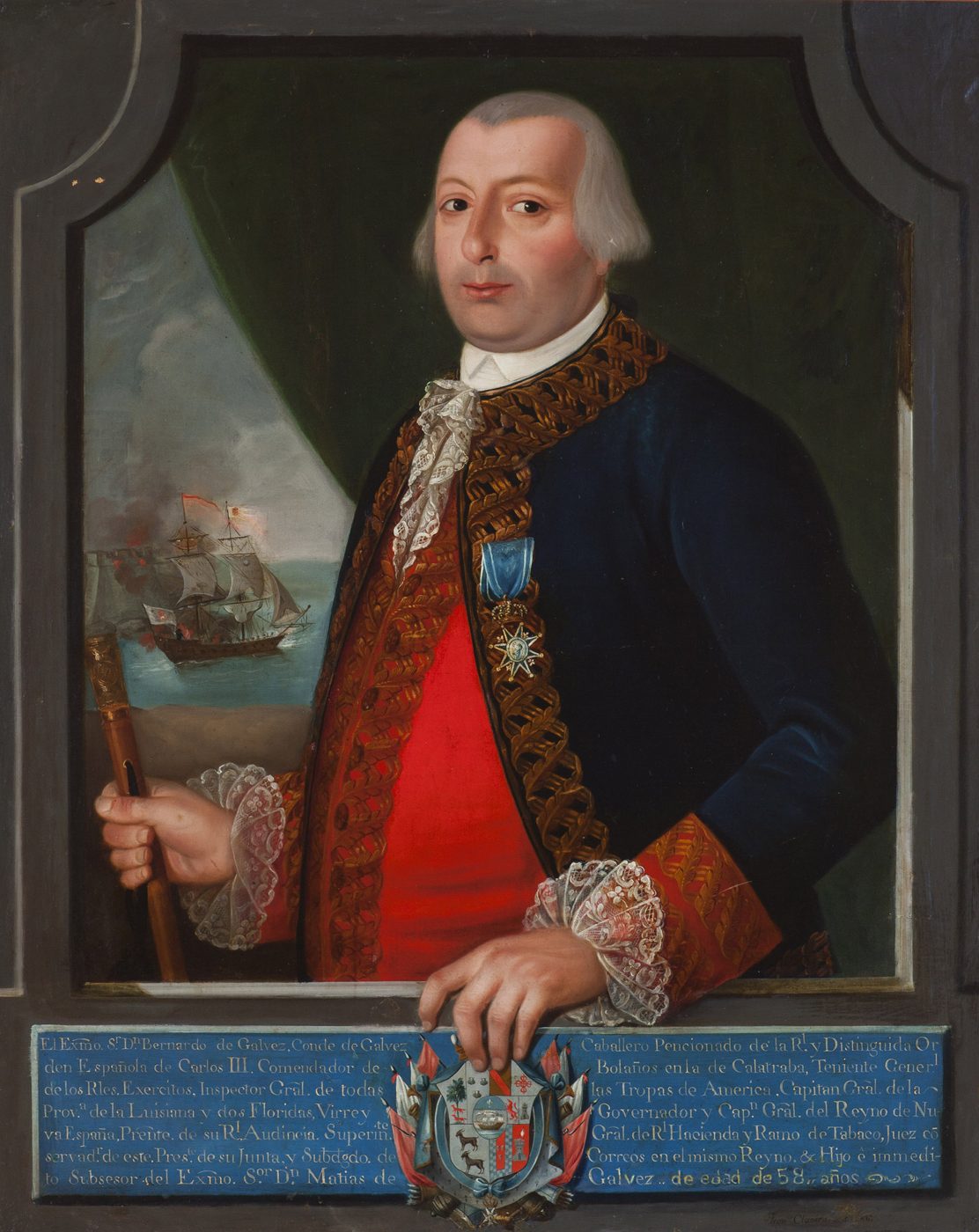
Bernardo de Galvez governed Spanish Louisiana while the King of Spain was officially neutral in the American war. That did not stop him. By 1777 gunpowder, muskets, uniforms and medicine were moving up the Mississippi and Ohio rivers toward Pittsburgh and Philadelphia.1
A Governor with a Quiet Policy
Galvez was born July 23, 1746, in Macharaviya, near Malaga, Spain.1 Sources disagree on when he took charge of Louisiana. The Park Service says 1776 at age 29, the Smithsonian says 1777 at age 30, and the Battlefield Trust says he became colonel and interim governor in 1777.231 That year, according to the Park Service, he secretly sent about $70,000 in goods up the Mississippi while appearing to stay neutral.2 Spain wanted to hurt Britain and to control the Gulf and shipping on the Mississippi. The Smithsonian quotes the historian Larrie Ferreiro as saying Galvez "knew what the crown was after."3
The Smithsonian quotes Ferreiro on what Pensacola meant to Madrid. It was a "dagger in the heart of Spanish trade," a major British port on the Gulf that threatened Spain's control of the Mississippi.3 Spain and France, in the same account, wanted to supply the Americans to "keep the British on the back foot."3 That is a statement about motive, and a useful one. Galvez was not acting from an American cause. He was acting for the king of Spain, who wanted the British out of the Gulf, and the Americans happened to want the same.
The Lower Mississippi, 1779
Spain declared war on Britain in 1779, though the sources give June and August.32 Galvez then acted openly. Between June and September 1779 his forces took four British forts on the lower Mississippi, including Baton Rouge and Natchez, with 550 prisoners and two naval vessels.4
Mobile and Pensacola
In March 1780 Spanish troops besieged Fort Charlotte at Mobile. The Encyclopedia of Alabama says the siege ran from March 2 to 14 under José Manuel de Ezpeleta and ended with the British commander, Elias Durnford, surrendering.4 The Park Service says Galvez's fleet was wrecked at the mouth of the bay and that he pressed the siege, with Mobile falling in less than a day. The Smithsonian says it took a two-week siege.56 The three accounts do not fit, and nothing in them says which is right.
The prize was Pensacola, the main British base on the Gulf. Hurricanes delayed the attack until March 1781, and the siege ran from March 9 to May 8.7 The Park Service describes a failed first attempt and a second in which Galvez led ships through the pass ahead of the fleet's commander, who had hesitated.5 The British surrendered in May 1781, after about two months.6 The Battlefield Trust calls it one of the longest battles of the Revolution.7
"the victory at Yorktown really was the result of the victory at Pensacola"
Larrie Ferreiro, historian, quoted in Smithsonian Magazine. 8
How much did Pensacola matter?
Ferreiro's claim is an argument and not a settled fact. The Smithsonian reports that with the British short of naval forces in the Caribbean, the French could move much of their fleet to Chesapeake Bay. The Park Service says the loss of Pensacola reduced the troops and ships Britain could send to Yorktown.89 Both are claims about timing and about what the British could spare. Neither says Pensacola decided the siege. The French fleet in the Chesapeake and Washington's march south are the better-known parts of the Yorktown story, and these sources add Pensacola to them without replacing them.
A name Americans forget
The Smithsonian says Galvez is less acknowledged than figures such as Lafayette, even though cities and streets in the South bear his name.10 Part of that is simple. His war was fought on the Gulf, away from the New England and Mid-Atlantic battles that fill American textbooks, and he fought it for Spain and not for Congress. His campaigns of 1779 to 1781 swept the British from the lower Mississippi and the Gulf Coast, from Baton Rouge and Natchez in the first year to Pensacola in the last.11
Honors and Death
Charles III made him a count and a lieutenant general in charge of Spanish military operations in the Americas.9 He became governor and captain-general of Cuba in October 1784. After his father died in November 1784 he was named viceroy of New Spain. He died at Tacubaya, now part of Mexico City, on November 30, 1786, at the age of 40.12 The Battlefield Trust gives November 8 in its text and November 30 in its header, and says some have speculated he was poisoned, which it does not support.13
In the United States, Galveston, Texas, carries his name, and a plaque in Natchez, Mississippi, honors him.9 A bronze equestrian statue went up in Washington, D.C., in 1976 for the Bicentennial, and on December 16, 2014, Congress made him an honorary citizen of the United States.13
Galvez's Life at a Glance
- 1746 Born July 23 in Macharaviya, Spain.
- 1776 or 1777 Takes charge of Louisiana (sources differ).
- 1777 Begins secret shipments up the Mississippi.
- 1779 Spain enters the war; Galvez takes Baton Rouge and Natchez.
- March 1780 Mobile falls (sources differ on the length of the siege).
- March 9 to May 8, 1781 Siege and capture of Pensacola.
- 1784 Governor of Cuba; later viceroy of New Spain.
- November 30, 1786 Dies at Tacubaya at age 40.
- December 16, 2014 Congress grants honorary U.S. citizenship.
Learn more
- Smithsonian: This Spanish Officer Besieged the British: Ferreiro on Pensacola and Yorktown
- NPS: Bernardo de Galvez: the Park Service's account of Pensacola
- Encyclopedia of Alabama: Bernardo de Galvez: the Mobile siege in detail
- American Battlefield Trust: Bernardo de Galvez: a short life with the 2014 citizenship
Notes
- American Battlefield Trust, "Bernardo de Galvez," on his birth on July 23, 1746, his rank as colonel and interim governor in 1777, and the secret shipments of gunpowder, muskets, uniforms and medicine via the Mississippi and Ohio rivers. Read it online. ↩
- National Park Service, "Bernardo de Galvez," on his appointment as governor in 1776 at age 29, about $70,000 in secret aid in 1777, and Spain's declaration of war in August 1779. Read it online. ↩
- Smithsonian Magazine, "This Spanish Officer Besieged the British during the American Revolution," on his taking the post in 1777, Spain's declaration of war in June 1779, and Larrie Ferreiro on Spain's motives and Galvez as "their guy." Read it online. ↩
- Encyclopedia of Alabama, "Bernardo de Galvez," on the campaign from June to September 1779 that took four British forts with 550 prisoners and two vessels, and the siege of Fort Charlotte at Mobile from March 2 to 14, 1780. Read it online. ↩
- National Park Service, same article, on the wrecked fleet at Mobile, the hurricanes that delayed Pensacola until March 1781, and Galvez leading ships through the pass ahead of a hesitant fleet commander. Read it online. ↩
- Smithsonian Magazine, same article, on the two-week siege of Mobile and the British surrender at Pensacola in May 1781 after about two months. Read it online. ↩
- American Battlefield Trust, same article, on the Pensacola siege from March 9 to May 8, 1781, as one of the longest battles of the Revolution. Read it online. ↩
- Smithsonian Magazine, same article, quoting Larrie Ferreiro that "the victory at Yorktown really was the result of the victory at Pensacola," and on the French fleet moving to the Chesapeake. Read it online. ↩
- National Park Service, same article, on the effect of Pensacola on British reinforcements, his honors from Charles III, and the places named for him. Read it online. ↩
- Smithsonian Magazine, same article, on Galvez being less acknowledged than Lafayette and the places in the South that bear his name. Read it online. ↩
- Encyclopedia of Alabama, same article, and National Park Service, same article, on the capture of Baton Rouge, Natchez, Mobile and Pensacola from 1779 to 1781. Read it online. ↩
- Encyclopedia of Alabama, same article, on his governorship of Cuba in October 1784, his viceroyalty and his death at Tacubaya on November 30, 1786. Read it online. ↩
- American Battlefield Trust, same article, on the two death dates, the poisoning speculation, the 1976 statue and the honorary citizenship of December 16, 2014. Read it online. ↩
Terms in this lesson
- Spanish Louisiana
- The territory west of the Mississippi and the city of New Orleans, held by Spain from 1763 to 1800.
- West Florida
- The Gulf Coast strip held by Britain until Galvez took it; its main town was Pensacola.
- Neutrality
- Staying out of a war. Spain was officially neutral until 1779 while its governor in Louisiana helped the Americans.
- Viceroy
- A governor who rules a colony in the name of a king. Galvez became viceroy of New Spain in 1785.
- Siege
- Surrounding a fortified place and cutting it off until it surrenders.
Sources
- American Battlefield Trust, Bernardo de Galvez checked 2026-10
- National Park Service, Bernardo de Galvez checked 2026-10
- Smithsonian Magazine, This Spanish Officer Besieged the British during the American Revolution checked 2026-10
- Encyclopedia of Alabama, Bernardo de Galvez checked 2026-10