Lesson 24 of 60 · about 9 minutes
Boston King and Thomas Peters: Two Black Loyalists Who Left America
You'll be able to
- Read the wording of Dunmore's Proclamation of 1775 and Clinton's proclamation of 1779 and see who each one freed and who it left out
- Follow Boston King and Thomas Peters from slavery through the Book of Negroes to Nova Scotia
- Explain why many enslaved people judged the Crown the better bet, and what that choice cost them
- Tell which parts of the Peters story are documented and which are legend
In the summer of 1783 a clerk in British-held New York wrote a twenty-three-year-old carpenter into a ledger as a "Stout fellow."1 The carpenter was Boston King, born into slavery near Charleston. The ledger was the Book of Negroes, and the entry was his ticket out of a city that American masters were combing for runaways. He had run toward the British flag three years earlier. Now he was running again, this time to Nova Scotia.
Two Offers From the British
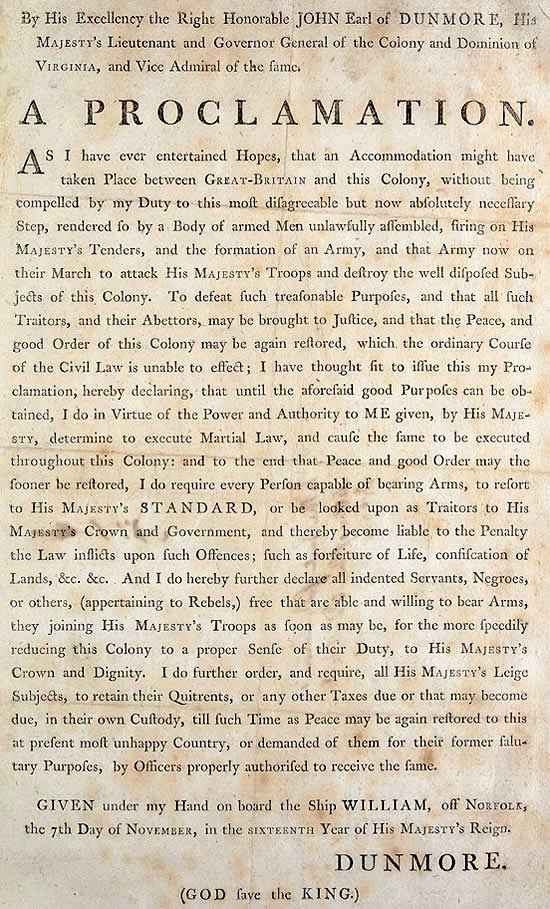
Lord Dunmore, Virginia's royal governor, had fled the capital and was aboard a ship off Norfolk when he signed his proclamation on November 7, 1775. It declared martial law and ordered every man able to bear arms to join the King's standard or be treated as a traitor. One sentence went further, declaring "all indentured Servants, Negroes, or others, (appertaining to Rebels,) free that are able and willing to bear Arms," if they joined the King's troops.2
Read the parenthesis. Dunmore freed the enslaved people of rebels. He did not free those held by Loyalists, and he said nothing against slavery itself. He wanted soldiers and he wanted to hurt the planters. Estimates of how many answered run from about 800 to 2,000. The Ethiopian Regiment he formed began with perhaps 200 to 300 men and lost many to smallpox, and when Dunmore sailed off in August 1776 he took perhaps 300 people.3
Sir Henry Clinton widened the offer. On June 30, 1779, from his headquarters at Philipsburg, New York, he forbade anyone "to sell or claim Right over any NEGROE, the property of a Rebel" who took refuge with the army, and promised "full Security to follow within these Lines" any occupation he chose to every Negro who deserted the rebel side.4 Fighting was no longer required. Running was enough.
Boston King Goes to Charleston
King was born about 1760 on Richard Waring's plantation near Charleston, trained as a house servant, and at about sixteen was apprenticed to a carpenter who beat him.5 When the British took Charleston in May 1780, he wrote, "I determined to go Charles-Town, and throw myself into the hands of the English." Once there he "began to feel the happiness of liberty, of which I knew nothing before."6
Freedom came with smallpox. Black patients were moved a mile from camp so the soldiers would not catch it, and for a time went without food or drink until a man King knew brought him supplies. He recovered, carried a dispatch on foot through country held by the enemy, served aboard a warship and ended up in New York, where he married a woman named Violet.6 Later an American whaleboat crew captured him. He swam a river at night while the guards argued over whether they had seen him, and walked back into New York.6
Thomas Peters and the Black Pioneers
Peters was about thirty-eight in 1776 and enslaved by William Campbell at Wilmington, North Carolina.7 Dunmore's offer had reached North Carolina, and Peters ran. He ended up in New York and enlisted in the Black Pioneers, the British company that did the army's digging and building, and by 1779 he was a sergeant.789
Myth: Peters was an African prince
Popular accounts give Peters a noble birth in West Africa and a kidnapping as a young man. The Dictionary of Canadian Biography calls the noble birth a legend and says the earliest document places him in 1776 as a 38-year-old slave in Wilmington. It also calls untrue the later stories that he went to England in 1793, became the first elected mayor of Freetown or faced Queen Victoria with the British betrayal of his people.7
New York, 1783
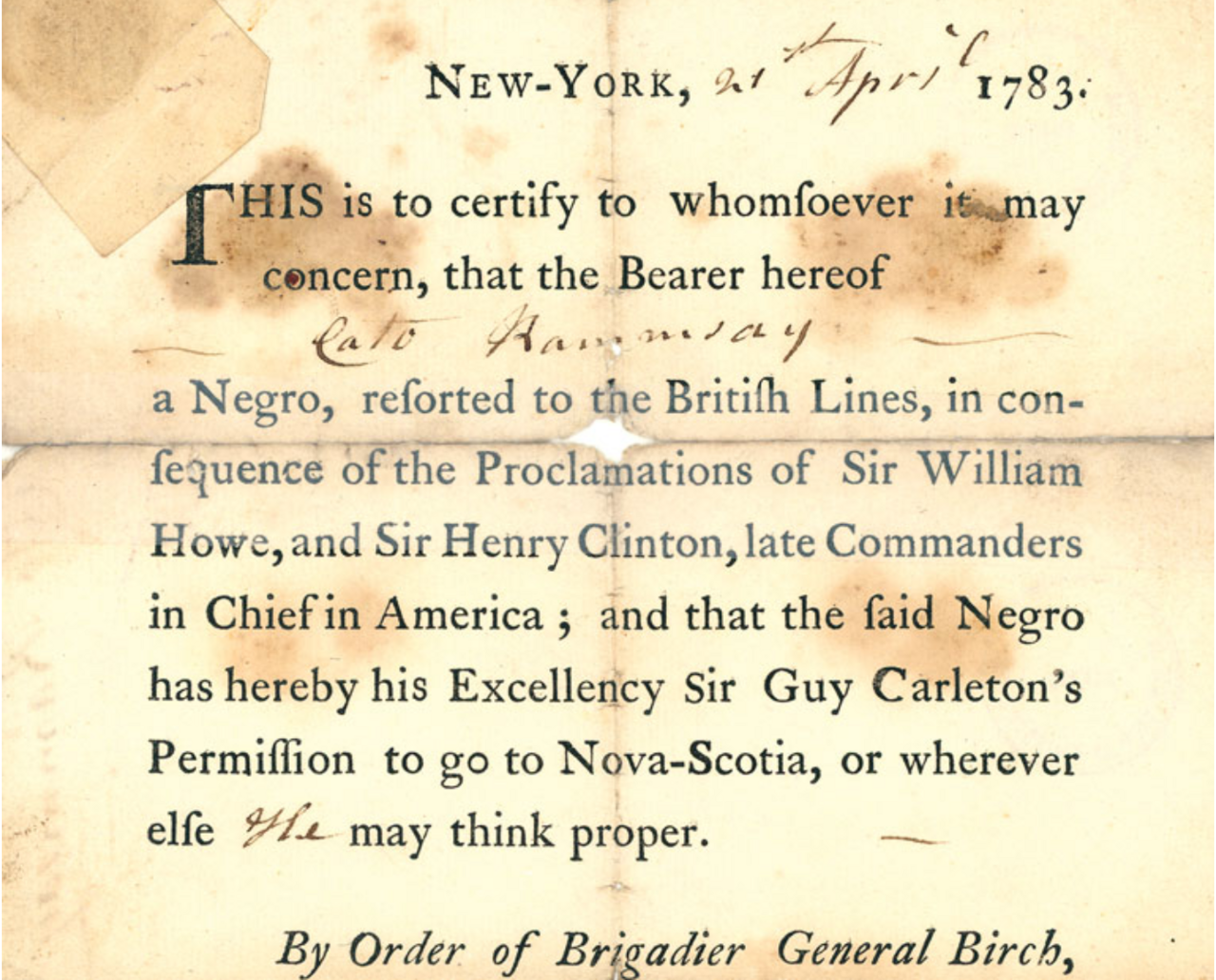
The peace treaty promised that Britain would withdraw without "carrying away any Negroes." Carleton, the British commander, answered by having every Black refugee examined and recorded before he could board a ship.10 King remembered the fear. A rumor ran through the Black quarter that some 2,000 people would be handed back to their owners, and masters arrived from Virginia and North Carolina and seized people in the streets. A certificate signed by a British officer "dispelled all our fears."6
The register that came out of it lists each person with age, description and any claimant. It counts 3,000 embarked, and the Nova Scotia Museum puts the total leaving New York for all destinations as high as 5,000.1011 King sailed on July 31, 1783, and landed at Birchtown on August 27.1 Peters and his wife Sally were still in New York then. The Dictionary of Canadian Biography says their ship went first to Bermuda in 1783 and they came ashore at Annapolis Royal in May 1784.7
Promises Broken in Nova Scotia
About 3,500 Black Loyalists reached Nova Scotia, among some 40,000 Loyalists who arrived there between 1776 and 1785.12 Birchtown held roughly 1,200 people under Colonel Stephen Blucke, and a January 1784 muster counted 1,521, which made it the largest free Black settlement in North America.1 Britain had promised land and rations. Of 649 Black men who applied, only 187 got land, and Blucke himself waited four years for 200 acres.12 The Dictionary of Canadian Biography adds that the Black settlers of Annapolis County got only 80 days of provisions and had to work on the roads. At Brindley Town the surveyor laid out one-acre town plots for 76 Black families, and when they tried to settle larger farm plots they were twice removed over conflicting claims.713
King found work as a carpenter and preacher. He was converted in early 1785 and in 1791 was appointed to preach to the Black congregation at Preston, near Halifax.1 Peters petitioned Governor Parr in 1784 and New Brunswick's governor in 1785 and got nowhere. By 1790 he had made five petitions to colonial officials, and hundreds of Black Loyalists gave him power of attorney to carry their grievances to the Crown.713 He reached London by November 1790. There Granville Sharp introduced him to the directors of the Sierra Leone Company, which would take him and his people to West Africa at the government's expense.713
Freetown, 1792
On January 15, 1792, fifteen ships left Halifax carrying 1,196 people, about 540 families.14 King sailed with the Preston group on the Eleanor.1 Peters had expected special standing and quarreled with John Clarkson, the company's agent and soon its governor. On April 7 the settlers chose Peters to speak for them, and Clarkson, who feared a rival government, called him a traitor before the whole settlement. On May 1 he was accused of stealing from the trunk of a settler who had died of fever. His defense, that he had recovered property owed to him, was not accepted, and he was ordered to return the goods and take a public reprimand. He died of fever on the night of June 25, 1792.7 The Dictionary of Canadian Biography says he "died in dishonour," yet argues he should be remembered as a courageous opponent of injustice.7
King lost Violet to fever soon after landing. He went on to teach and preach, was sent to England in 1794 to study at Kingswood School near Bristol, and wrote his memoirs there. They appeared in the Methodist Magazine in 1798. He returned to Sierra Leone and died there about 1802.1
Why the Crown Looked Like the Better Bet
The Patriot cause was fought by masters who held people in bondage. George Washington himself barred Black men from the Continental Army in 1775, then reversed course within months as the army needed men and Dunmore's offer threatened to send Black recruits to the British.15 The British were not freeing anyone out of principle, but they were putting freedom in writing, and for an enslaved carpenter near Charleston that was a better offer than any he had been given by the other side. Many who chose the Crown were right about that. Many were also wrong about what came next. They gave up home, family and in some cases their lives to smallpox and fever, and the land they were promised came late or never. Britain also left some Black people enslaved in the hands of Loyalist owners.10 Black Americans also fought for independence. Lessons 02, 03 and 23 in this module tell their stories.
Peters did not give up on a government that had broken its word. He wrote petitions, crossed an ocean, and made the Crown answer for what it had promised. The answer was a fleet of fifteen ships and a colony in Africa.
Their Lives at a Glance
- November 7, 1775 Dunmore proclaims freedom for rebels' slaves who join the King's troops.
- 1776 Thomas Peters, enslaved at Wilmington, North Carolina, flees to the British.
- June 30, 1779 Clinton's Philipsburg Proclamation offers security to any Black man who deserts the rebel side.
- May 1780 Boston King enters British lines at Charleston.
- Summer 1783 King is entered in the Book of Negroes and sails July 31 for Nova Scotia.
- 1784 Peters settles in Nova Scotia and petitions for land.
- 1790 Peters carries the settlers' grievances to London.
- January 15, 1792 Fifteen ships carry 1,196 people from Halifax to Sierra Leone.
- June 25, 1792 Peters dies at Freetown.
- 1798 King's Memoirs appear in the Methodist Magazine; he dies about 1802.
Learn more
- Boston King recalls fighting for the British (American Yawp): his own words on Charleston, smallpox and the fear of 1783
- Dictionary of Canadian Biography: Thomas Peters: the most careful life, with the legend separated from the record
- The National Archives (UK): The Book of Negroes: what the register records and how it was made
- Black Loyalist Heritage: Communities in Nova Scotia: Birchtown, Shelburne and the land numbers
- Encyclopedia Virginia: Dunmore's Proclamation: the full text
Notes
- James W. St G. Walker, "King, Boston," Dictionary of Canadian Biography, vol. 5, on his birth about 1760, Birchtown's 1,521 people in the January 1784 muster, the Book of Negroes entry ("Stout fellow," aged 23), the sailing of July 31 and landing at Birchtown on August 27, 1783, the conversion in 1785, Preston in 1791, the voyage on the Eleanor in January 1792, Kingswood School, the 1798 publication and his death in 1802. Read it online. ↩
- "Lord Dunmore's Proclamation," November 7, 1775, "Given under my Hand on Board the Ship William, off Norfolk," transcription at Encyclopedia Virginia. Read it online. ↩
- History.com Editors, "Dunmore's Proclamation," on the 800 to 2,000 men who joined, the smallpox losses and the roughly 300 who left in August 1776; the Nova Scotia Museum, "Who Were the Black Loyalists?" gives about 2,000. Read it online. ↩
- "The Philipsburg Proclamation (June 30, 1779)," Our American Revolution, quoting Clinton's clause forbidding anyone "to sell or claim Right over any NEGROE, the property of a Rebel," and the promise of "full Security to follow within these Lines." Read it online. ↩
- Walker, "King, Boston," on Richard Waring's plantation, his training as a house servant and the beating in his apprenticeship. Read it online. ↩
- Boston King, "Memoirs of the Life of Boston King, a Black Preacher," Methodist Magazine (London), 1798, excerpted in the American Yawp Reader: the decision to go to Charleston, "the happiness of liberty," smallpox, the dispatch to Nelson's Ferry, the escape by swimming, the rumor of 1783 and the certificate that "dispelled all our fears." Read it online. ↩
- "Peters, Thomas," Dictionary of Canadian Biography, vol. 4, on his age and owner in 1776, flight under the influence of Dunmore's proclamation, rank of sergeant, marriage to Sally, the voyage via Bermuda to Annapolis Royal in May 1784, 80 days of provisions, Brindley Town, the five petitions, the London trip of 1790, Clarkson, the theft accusation of May 1, 1792, his death on June 25, the legends the entry calls untrue and the phrase "died in dishonour." Read it online. ↩
- "Thomas Peters," NC Anchor (State Library of North Carolina), on his enslavement at Wilmington and his owner William Campbell. Read it online. ↩
- "Black Pioneers," NC Anchor (State Library of North Carolina), on the unit's formation in North Carolina in 1776 and its work for the British army. Read it online. ↩
- The National Archives (UK), "The Book of Negroes," on Carleton's orders of April 15 and May 22, 1783, the Seventh Article ("carrying away any Negroes"), the 3,000 embarked and the note that some people remained enslaved by colonists sailing to Nova Scotia. Read it online. ↩
- Nova Scotia Museum, "Who Were the Black Loyalists?" on the 114 ships inspected and as many as 5,000 Black people leaving New York for all destinations. Read it online. ↩
- Black Loyalist Heritage, "Black Loyalist Communities in Nova Scotia," on the 3,500 Black Loyalists among some 40,000 Loyalist arrivals, Birchtown, Stephen Blucke, the land promises and the 187 of 649 who received land. Read it online. ↩
- "Thomas Peters," The Canadian Encyclopedia, on the petitions of 1784 and 1785, the choice of Peters by about 200 settlers in 1790 and his meeting with Granville Sharp and the Sierra Leone Company. Read it online. ↩
- Dalhousie University, "Remembering the Sierra Leone Migration, 230 years later," on the 15 ships, 1,196 people and 540 families leaving Halifax on January 15, 1792. Read it online. ↩
- Mount Vernon, "African Americans in the Revolutionary War," on Washington's ban of 1775 and its later reversal. Read it online. ↩
Terms in this lesson
- Black Loyalist
- A person of African descent who sided with the British during the Revolution, most often by escaping slavery and reaching British lines.
- Black Pioneers
- A British unit of Black soldiers that dug, built and repaired for the army. Thomas Peters rose to sergeant in it.
- Book of Negroes
- The register kept in New York in 1783 of Black refugees cleared to leave with the British. About 3,000 people were listed as embarked.
- Birchtown
- A Black Loyalist settlement near Shelburne, Nova Scotia, named for the British general who signed many of the freedom certificates.
- Sierra Leone Company
- The British company that took about 1,200 Nova Scotian settlers to West Africa in 1792 to found Freetown.
- Proclamation
- A formal public announcement by a governor or commander. Dunmore and Clinton each used one to offer something to the enslaved people of their enemies.
Sources
- Dictionary of Canadian Biography, King, Boston checked 2026-10
- Dictionary of Canadian Biography, Peters, Thomas checked 2026-10
- Encyclopedia Virginia, Lord Dunmore's Proclamation (1775) checked 2026-10
- Our American Revolution, The Philipsburg Proclamation (June 30, 1779) checked 2026-10
- The National Archives (UK), The Book of Negroes checked 2026-10
- American Yawp Reader, Boston King recalls fighting for the British and securing his freedom, 1798 checked 2026-10
- Black Loyalist Heritage, Black Loyalist Communities in Nova Scotia checked 2026-10