Lesson 38 of 60 · about 9 minutes
Marquis de Lafayette: The Teenage General Who Wanted Slavery Ended
You'll be able to
- Trace Lafayette from his voyage on the Victoire to the Virginia campaign and Yorktown
- Explain what Congress gave him in 1777 and how Washington treated him
- Describe his 1783 proposal to Washington on freeing the enslaved and what came of it
- Spot the places where sources disagree and the famous line Lafayette never said
On July 31, 1777, the Continental Congress made a 19-year-old Frenchman a major general.1 He was a captain of dragoons with no battle experience, and he spoke little English. Congress did not hand him a division. It gave him a rank, a seat at Washington's table, and a chance to bleed.
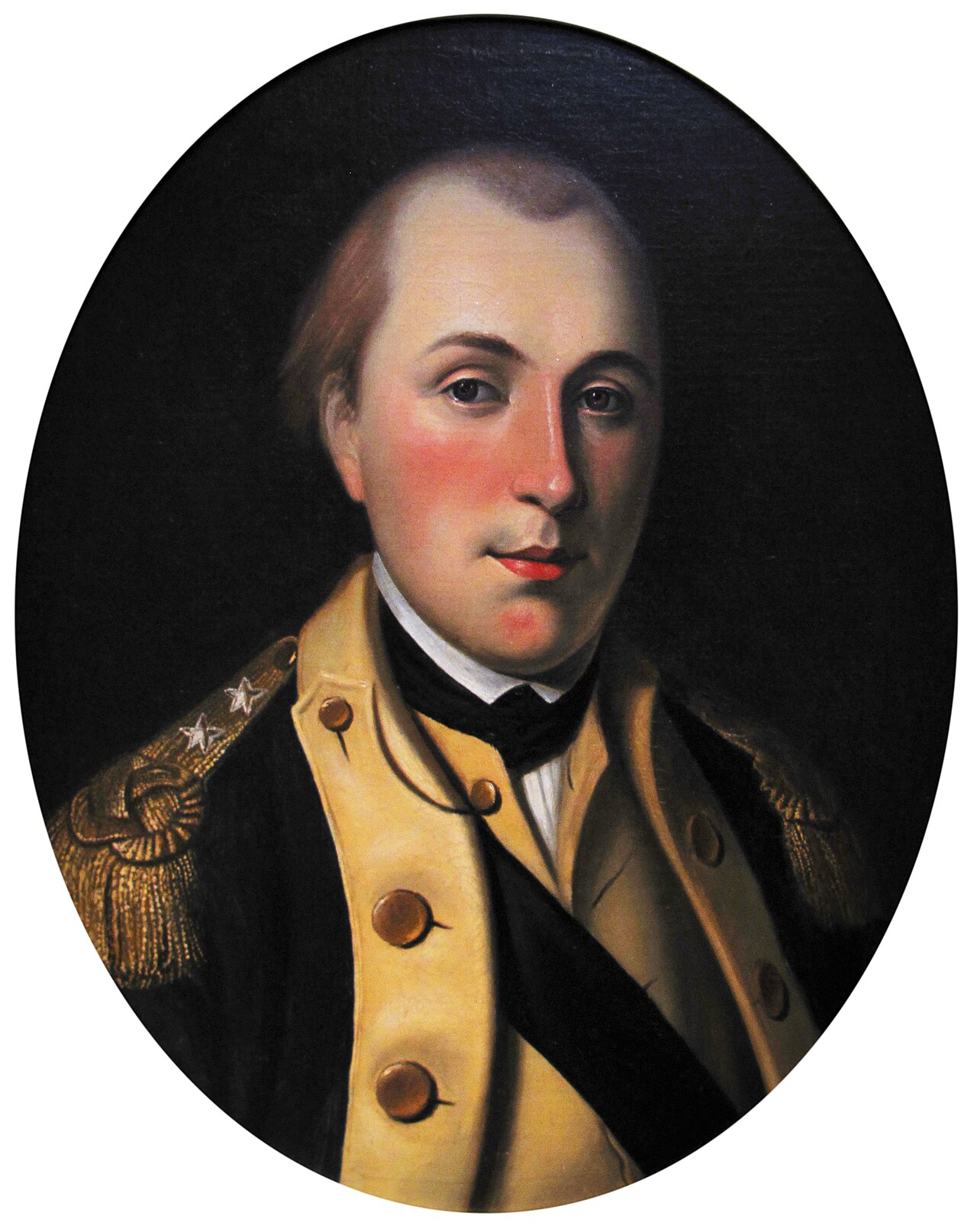
A Nobleman With His Own Ship
Gilbert du Motier, Marquis de Lafayette, was born September 6, 1757, at Chavaniac in France. By the time he was 14 he held a commission in the Musketeers, and he had inherited a large fortune after the deaths of his mother, father and grandfather.1 A royal decree barred French officers from serving in America. He bought a ship, the Victoire, with his own money and sailed in April 1777 anyway.1 Wikipedia puts his landing near Georgetown, South Carolina, on June 13 after a two-month crossing.2
Philadelphia was not thrilled. Mount Vernon's encyclopedia says Congressman James Lovell at first refused to meet him, then recommended him once he saw Lafayette's wealth, connections and sincerity. Silas Deane had already offered him a commission in Paris.3 The resolution that passed on July 31 accepted his services and, "in consideration of his zeal, illustrious family, and connexions," gave him "the rank and commission of major-general." The preamble noted that he had come over at his own expense.4 So the rank rested partly on his name. What he did with it is the better story.
Brandywine and Washington's Table
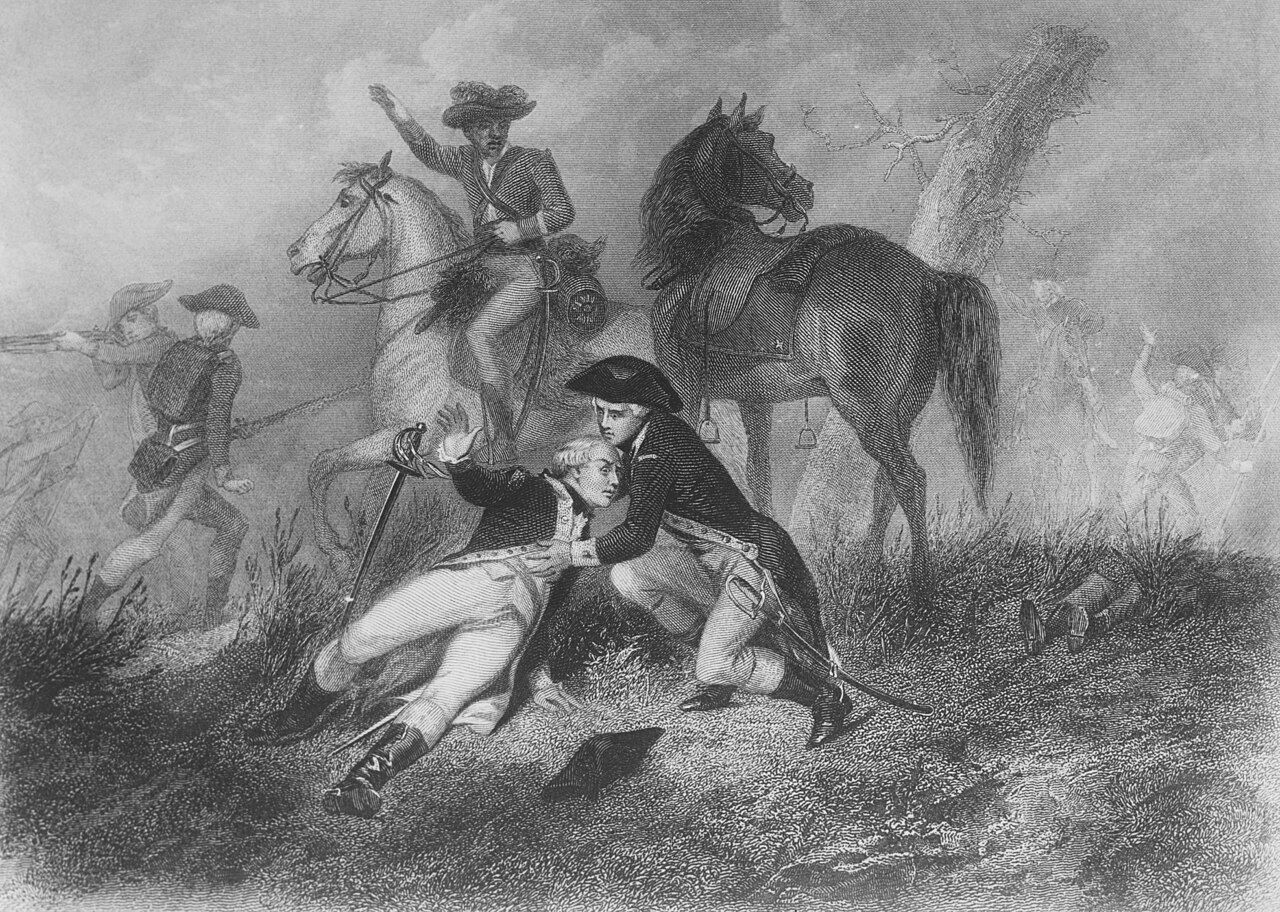
On September 11, 1777, at Brandywine, Washington's army lost. Writing near midnight to John Hancock, Washington listed the casualties and added one sentence: "The Marquis La Fayette was wounded in the leg, & General Woodford in the hand."5 The Battlefield Trust says Lafayette rallied troops in the retreat and Washington soon recommended him for command of a division.1
Mount Vernon reports that Washington sent his own surgeon and told the doctors, "Treat him as if he were my son." That is a traditional line, and no primary source for it is known.3 Encyclopedia Virginia, discussing the famous engraving, says it is unlikely Washington ever cradled the wounded Lafayette in his arms, though the young man's courage did impress him.6
From Valley Forge to Yorktown
He spent the winter of 1777 and 1778 at Valley Forge with Washington and the troops.1 In May 1778 he slipped out of a British trap at Barren Hill, Pennsylvania.2 In January 1779 he sailed from Boston for France aboard the Alliance, and he was briefly confined at home for leaving without the king's leave.72
He came back aboard the Hermione. The Park Service has him reaching Boston on April 28, 1780, carrying word that France would send troops.7 Wikipedia says April 27. Either way, the news was good.
Virginia was his hardest assignment. The Park Service dates his arrival there to March 14, 1781. He faced Cornwallis, who arrived in May with over 7,000 men. At Green Spring on July 6 the Americans lost about 28 killed, 99 wounded and 12 missing.8 Lafayette wrote to Washington that he was "not Strong enough even to get Beaten."8 He shadowed the British until Cornwallis settled at Yorktown, and, in the Battlefield Trust's account, held them there until Washington arrived. Cornwallis surrendered October 19, 1781.81 James Armistead, the enslaved man who spied for him, has his own lesson: James Armistead Lafayette.
The Letter About the Enslaved
On February 5, 1783, Lafayette wrote to Washington from Cadiz: "Let us Unite in Purchasing a small Estate Where We May try the Experiment to free the Negroes, and Use them only as tenants."9 Washington answered on April 5, opening with "The scheme my dear Marqs which you propose as a precedent, to encourage the emancipation of the black people" and saying he would gladly join in, with the details left for when they met.10
Mount Vernon records what followed. In June 1785 Lafayette had his attorney buy a plantation in French Guiana, on condition that none of the enslaved people there be sold. In February 1786 he told Washington, calling the project his "Hobby Horse." Washington replied on May 10, 1786, praising his "generous and noble proof of your humanity" and wishing "a like spirit would diffuse itself generally into the minds of the people of this country."11 Washington never bought the shared estate. Lafayette's Cayenne estate was itself a plantation with enslaved people on it, bought in the hope of changing how it ran.
Myth: Pershing said "Lafayette, we are here"
General John J. Pershing is often given the line. Colonel Charles E. Stanton spoke it at Lafayette's grave in Picpus Cemetery in Paris on July 4, 1917, and Pershing credited Stanton himself.12
After the War
Lafayette went home to France in December 1781.7 He presented a draft Declaration of the Rights of Man to the French Assembly on July 11, 1789. Austrian forces captured him in 1792, and he left the prison at Olmutz on September 19, 1797. He returned to the United States in 1824 and toured all 24 states in 13 months, from August 1824 to September 1825.2 In Boston that year, over 100,000 people turned out to greet him.7 He died in Paris on May 20, 1834, and was buried under soil from Bunker Hill.2 In 2002 Congress made him an honorary American citizen.13 Related lessons: Friedrich von Steuben, John Laurens and the Comte de Rochambeau.
Lafayette's Life at a Glance
- 1757 Born September 6 at Chavaniac, France.
- April 1777 Sails on the Victoire against the king's decree.
- July 31, 1777 Congress commissions him a major general.
- September 11, 1777 Wounded in the leg at Brandywine.
- 1777 to 1778 Winter at Valley Forge; Barren Hill in May.
- 1779 to 1780 Returns to France, then back to Boston by April 1780.
- 1781 Virginia campaign from March; Cornwallis surrenders October 19.
- February 5, 1783 Proposes to Washington an experiment freeing the enslaved as tenants.
- 1824 to 1825 Tours the United States.
- May 20, 1834 Dies in Paris.
Learn more
- American Battlefield Trust: Marquis de Lafayette: a short biography with the Brandywine and Yorktown story
- NPS Yorktown: Lafayette and the Virginia Campaign of 1781: a dated timeline with his own letters
- Mount Vernon: Marquis de Lafayette's Plan for Slavery: the emancipation experiment and Washington's replies
- Founders Online: Washington to Lafayette, 5 April 1783: Washington's answer in full
Notes
- American Battlefield Trust, "Marquis de Lafayette," on his birth, early fortune, the Victoire, the royal decree, Brandywine, Valley Forge and his return to France at the beginning of 1779. Read it online. ↩
- Wikipedia, "Gilbert du Motier, Marquis de Lafayette," on the June 13, 1777 landing, Barren Hill, the January 1779 sailing and house arrest, the 1789 draft declaration, Olmutz, his death and the Bunker Hill soil; American Battlefield Trust, "The Lafayette Trail," on the 13-month tour of 24 states. Read it online. The Lafayette Trail. ↩
- Mount Vernon, Digital Encyclopedia, "Marquis de Lafayette," on James Lovell, Silas Deane, Washington's surgeon and the "Treat him as if he were my son" line. Read it online. ↩
- Journals of Congress, July 31, 1777, as printed in A Complete History of the Marquis de Lafayette (Columbus: J. and H. Miller, 1858), p. 22. Read it online. ↩
- George Washington to John Hancock, Chester, Pennsylvania, 11 September 1777, Founders Online, Washington Papers. Read it online. ↩
- Encyclopedia Virginia, "Lafayette Wounded at Brandywine," on the Jeens engraving and Washington's response to the wound. Read it online. ↩
- National Park Service, "Lafayette in Boston," on his departure from Boston in January 1779, his arrival on the Hermione on April 28, 1780, his departure in December 1781, the 1824 visit and the crowd of over 100,000. Read it online. ↩
- National Park Service, Colonial National Historical Park, "Lafayette and the Virginia Campaign 1781," on the March 14 arrival, Cornwallis, Green Spring, his letters to Washington and the surrender. Read it online. ↩
- Lafayette to Washington, Cadiz, 5 February 1783, Founders Online, Washington Papers. Read it online. ↩
- Washington to Lafayette, Newburgh, 5 April 1783, Founders Online, Washington Papers. Read it online. ↩
- Mount Vernon, Digital Encyclopedia, "Marquis de Lafayette's Plan for Slavery," on the 1785 purchase in French Guiana, the "Hobby Horse" letter of February 1786 and Washington's reply of May 10, 1786. Read it online. ↩
- Wikipedia, "Charles E. Stanton," citing Boller and George, They Never Said It (Oxford University Press, 1989), p. 104; and Lafayette College, "Pershing at Picpus," whose caption credits Stanton with the words at Picpus Cemetery on July 4, 1917. Read it online. Lafayette College. ↩
- Senator Dick Durbin, press release of October 22, 2009, listing Lafayette (2002) among honorary U.S. citizens. Read it online. ↩
Terms in this lesson
- Major general
- The highest rank in the Continental Army under Washington's own. Congress gave Lafayette the rank at 19.
- Victoire
- The ship Lafayette bought with his own money and sailed to America in 1777.
- Brandywine
- The September 11, 1777 battle in Pennsylvania where Lafayette was shot in the leg.
- Green Spring
- A July 6, 1781 battle near Williamsburg, Virginia, in which Lafayette's force was outmatched by Cornwallis.
- Cayenne
- The French colony in South America where Lafayette bought a plantation in 1785 for his emancipation experiment.
- Tenant farmer
- A farmer who works land he does not own and pays rent. Lafayette wanted freed people to live this way.
Sources
- American Battlefield Trust, Marquis de Lafayette checked 2026-10
- Founders Online, Washington to Hancock, 11 September 1777 checked 2026-10
- National Park Service, Lafayette and the Virginia Campaign of 1781 checked 2026-10
- Founders Online, Lafayette to Washington, 5 February 1783 checked 2026-10
- Founders Online, Washington to Lafayette, 5 April 1783 checked 2026-10
- Mount Vernon, Marquis de Lafayette's Plan for Slavery checked 2026-10