Lesson 19 of 60 · about 9 minutes
Samson Occom: The Mohegan Minister Who Funded Dartmouth
You'll be able to
- Follow Occom from Mohegan and Wheelock's school to ordination and the British fundraising tour
- Explain how the money became Dartmouth College and why Occom broke with Wheelock
- Describe the Moses Paul execution sermon of 1772 and the Wheatley letter of 1774
- Say where Occom stood in the Revolution and what the surviving letters show
Samson Occom wrote his life story in 1768, and he wrote it angry. Home from his fundraising tour of Britain, he set down what the missionary commissioners had paid him for twelve years among the Montauk on Long Island: 180 pounds. Another missionary, he noted, had received that sum for one year. "I speak like a fool, but I am constrained," he wrote, and went on: "I was my own interpreter. I was both a schoolmaster and minister to the Indians." He told of an Indian boy bound out to an English family and beaten almost daily, who believed he was beaten most of the time "because I am an Indian." Occom's verdict on his own case: "I believe it is because I am a poor Indian. I can't help that God has made me so; I did not make myself so."1
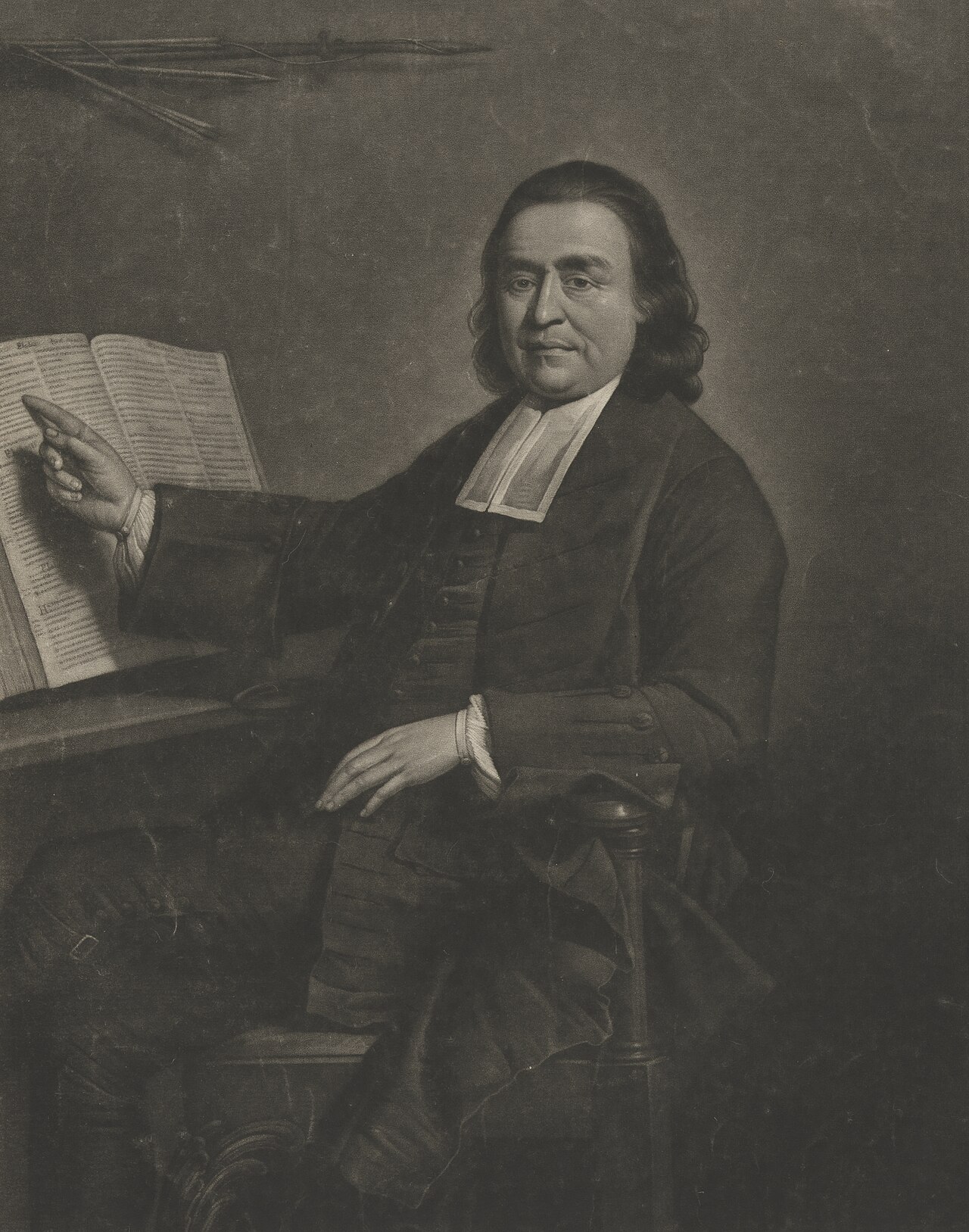
The Dartmouth archive lists the manuscript as undated, and editors place it in 1768. It is the earliest known autobiography by an Indigenous person in North America.1
From Mohegan to Wheelock's School
Occom was born in 1723 at Mohegan, near New London, Connecticut. In his own telling the Great Awakening reached the Mohegan when he was sixteen. He taught himself to read from a primer and neighbors' help, and at nineteen he asked the Lebanon minister Eleazar Wheelock to take him for a week or two. He stayed four years, until his eyes gave out.1 Dartmouth's library says he came away reading Greek, Hebrew, Latin and English, spent about twelve years teaching and preaching at Montauk, married Mary Fowler in 1751, and was ordained a Presbyterian minister in 1759.2 At Montauk he had nearly thirty pupils in a winter, and he lived in a wigwam.1
Wheelock took Occom's success as the case for a school of his own, Moor's Indian Charity School.3
Two Years in Britain
In December 1765 Occom sailed for England with the minister Nathaniel Whitaker to raise money for the school. Dartmouth's library says he met George Whitefield, Lord Dartmouth and King George III and preached across England and Scotland.2 A Connecticut local-history account counts more than three hundred sermons.4 The total was about 12,000 pounds, though sources count it differently. Dartmouth's library gives 12,026 pounds, and the Occom Circle's own note on the trust says nearly 10,000 in England plus 2,000 in Scotland.35 It was far more than anyone had expected.5
The Break With Wheelock
While Occom was away, Wheelock had grown more interested in a college. New Hampshire's governor, John Wentworth, granted a royal charter on December 13, 1769. Wheelock took the school and the money to New Hampshire.3 Back in Connecticut, Occom learned that his own family had been neglected while he traveled.2
On July 24, 1771, he wrote Wheelock a letter that ended the friendship. He told Wheelock that the "College has too much worldly grandeur for the Poor Indians they'll never have much benefit of it." He had believed, he said, "that your institution was Intended Purely for the poor Indians," and he had sailed "to help forward your School" on that belief. Now he feared the two of them would "be deemed as Liars and Deceivers in Europe, unless you gather Indians quickly to your College."6 They never met again, and Occom never set foot on the campus his fundraising had made possible.23
The Sermon for Moses Paul
Moses Paul, a Wampanoag man, was convicted of killing Moses Cook, a Waterbury man, after a quarrel at a Bethany, Connecticut, tavern. Paul said Cook had beaten him first. His appeal failed. When he was hanged at New Haven on September 2, 1772, he had asked that Occom preach.4 A large crowd of Native people and colonists came. Occom told Paul to repent and told the Native listeners to quit the drinking that was ruining families, and he stressed that all people, of any race, were sinners and that redemption was offered to all.4
The printed sermon sold. The scholar Joanna Brooks counts nineteen editions and writes that they ranked Occom as the sixth leading author in the American colonies during the 1770s. The nineteen comes from a list W. DeLoss Love printed in 1899, and an Amherst College librarian has since found twenty-two separate editions. Amherst College's librarians say it is generally regarded as the first book published by a Native American author as his own work.7
The Letter From Phillis Wheatley
On February 11, 1774, Phillis Wheatley wrote to Occom from Boston: "I have this day received your obliging kind Epistle, and am greatly satisfied with your Reasons respecting the Negroes, and think highly reasonable what you offer in Vindication of their natural Rights." She went on: "in every human Breast, God has implanted a Principle, which we call Love of Freedom; it is impatient of Oppression, and pants for Deliverance." She hoped to convince people "of the strange Absurdity of their Conduct whose Words and Actions are so diametrically opposite."8 The Connecticut Journal printed it on its front page on April 1, 1774. Trinity College's Hidden Literacies project counts more than ten colonial newspapers.910 The Wheatley household in Boston belonged to the evangelical network that backed Occom's ministry.10
Myth: Occom wrote the famous 1774 letter on liberty
The letter that carries his name belongs to Wheatley, and it was addressed to him. His own letter to her, the one that earned her praise for his reasons, is not in any source I read. Occom's record on slavery also has a mark against it. Dartmouth's library says that before he sailed to England he asked Wheelock for the use of a slave and a yoke of oxen for his farm, and that he later spoke against slavery, including in a sermon in 1787.2
Brothertown and the War
By the early 1770s Occom was working on a way out. Native communities in New England were losing land, and in the Mason land case the Mohegan lost in 1773.2 He and others arranged with the Oneida for land in New York. Early in 1775 Joseph Johnson, Occom's son-in-law, planned to set out on March 13 with upwards of sixty young men from the New England tribes, and Occom promised to preach to those still held back by debt.11
The war overtook them. Occom's side is clearest in his own words. In a January 1, 1777 letter from Mohegan to his English patron John Thornton, he wrote that the Indians "choose Strict Neutrality," that Congress had sent commissioners to tell them to stay quiet, and that he wished the king "would Command all his officers in North America to let the poor miserable Indians alone."12 W. DeLoss Love prints an address to Native listeners, dated by him to early 1776 from a Connecticut Historical Society manuscript I did not see, that urges them to stay out of "the Family Contentions of the English." The same page leans one way: "the present King of England wants to make them Slaves to himself," Occom wrote, and if they must join a side, "you cant join the oppresser, but will help the oppressed."11
Washington asked the same of the Six Nations in a February 1776 message carried by Johnson: the colonies did not ask them to fight for the cause, only not to fight against it.13 Many younger Brothertown men went further. Love says most of them came home and enlisted, and that in 1783 William Williams testified that eighteen Mohegans had died in the service. Johnson set out on a mission west in the summer of 1776 and died within months, aged twenty-four.11 Occom stayed in Connecticut, and his 1777 letter is headed Mohegan. Nothing I read shows him serving or taking a side beyond these letters. His position was neutrality for his people, with a tilt toward the colonists in 1776 that the 1777 letter does not repeat.
He moved his family to Brothertown in 1789. Love puts his last move in the winter of 1791, over the hill to be near the Stockbridge people, and gives his death as July 14, 1792.211 The Brothertown community moved to Wisconsin in the 1830s.3
Samson Occom's Life at a Glance
- 1723 Born at Mohegan, near New London, Connecticut.
- 1743 Goes to study with Eleazar Wheelock and stays four years.
- 1751 Marries Mary Fowler at Montauk.
- 1759 Ordained a Presbyterian minister.
- December 1765 Sails for Britain to raise money for Wheelock's school.
- 1768 Back in Connecticut; writes his autobiography.
- December 13, 1769 Dartmouth receives its royal charter.
- July 24, 1771 Writes Wheelock his letter of break.
- September 2, 1772 Preaches at the hanging of Moses Paul.
- February 11, 1774 Wheatley writes to him; the letter is printed that spring.
- January 1, 1777 Tells Thornton the Indians "choose Strict Neutrality."
- July 14, 1792 Dies in New York.
Learn more
- A Short Narrative of My Life: Occom's 1768 autobiography in his own words
- Occom to Wheelock, July 24, 1771: the letter of break, in the Dartmouth archive
- Dartmouth Libraries: Samson Occom: a short biography by Dartmouth's own library
- Phillis Wheatley to Samson Occom, 1774: the full excerpt from the Library of Congress copy
- Samson Occom and the Christian Indians of New England: Love's 1899 biography, with the Revolution-era papers
Notes
- Samson Occom, "A Short Narrative of My Life," ed. Jace Weaver, Teaching American History (original manuscript in the Occom Circle, Dartmouth), on his pay, the boy bound out to an English family, his schooling under Wheelock and his work at Montauk. Read it online. ↩
- Dartmouth Libraries, Dartmouth and Slavery Project, "Samson Occom," on his education, Montauk, ordination, the British tour, the charter of December 13, 1769, the Mason land case, his request for a slave and oxen, and his move to Brothertown in 1789. Read it online. ↩
- Dartmouth Libraries, Dartmouth and Slavery Project, "Wheelock, Occom, and Moor's Indian Charity School," on the 12,026 pounds raised, Occom's refusal ever to visit the campus and the Wisconsin move of the 1830s. Read it online. ↩
- Bethany Connecticut History, "The Hanging of Moses Paul, an Indian," on the trial, Paul's account, the execution on September 2, 1772, Occom's sermon and the number of Occom's sermons in Britain. Read it online. ↩
- The Occom Circle, Dartmouth Digital Collections, background note "Trust in England," shown with Occom's letter to John Thornton of January 1, 1777, on the roughly 10,000 and 2,000 pounds raised. Read it online. ↩
- Samson Occom to Eleazar Wheelock, July 24, 1771, The Occom Circle, Dartmouth Digital Collections, normalized transcription, pages 1v to 2r. Read it online. ↩
- Amherst College Archives & Special Collections, "Research Leave Progress Report: Samson Occom," quoting Joanna Brooks, The Collected Writings of Samson Occom, Mohegan (Oxford University Press, 2006), p. 23, and on the twenty-two editions the librarian found, against the nineteen in Love's list of 1899. Read it online. ↩
- Phillis Wheatley to Samson Occom, February 11, 1774, text from the Library of Congress copy as given by the National Constitution Center. Read it online. ↩
- Museum of the American Revolution, press release on its acquisition of the front page of the Connecticut Journal, April 1, 1774. Read it online. ↩
- Trinity College, Hidden Literacies, "Phillis Wheatley's Writing in Newspapers," on Susanna Wheatley's place in Occom's network of patrons and the printing of the 1774 letter in more than ten newspapers. Read it online. ↩
- W. DeLoss Love, Samson Occom and the Christian Indians of New England (Boston: Pilgrim Press, 1899), chapters XII and XIII and the account of Occom's last years, citing the Wheelock Papers and Connecticut Historical Society Indian Papers. Read it online. ↩
- Samson Occom to John Thornton, January 1, 1777, The Occom Circle, Dartmouth Digital Collections, normalized transcription, page 1v. Read it online. ↩
- George Washington to Joseph Johnson, February 20, 1776, Founders Online, National Archives. Read it online. ↩
Terms in this lesson
- Mohegan
- A Native nation of southeastern Connecticut. Occom was born at Mohegan, near New London.
- Moor's Indian Charity School
- Eleazar Wheelock's school in Lebanon, Connecticut, for Native students. It moved to New Hampshire and became tied to Dartmouth College.
- Execution sermon
- A sermon preached on the day of a hanging, often printed and sold afterward.
- Brothertown
- A settlement of Christian Native people from several New England nations, begun in 1775 on land the Oneida granted in New York.
- Neutrality
- Refusing to fight for either side. Many Native communities chose it in the Revolution, and many were pulled in anyway.
Sources
- Samson Occom, A Short Narrative of My Life (Teaching American History) checked 2026-10
- Dartmouth Libraries, Samson Occom checked 2026-10
- The Occom Circle, Occom to Wheelock, July 24, 1771 checked 2026-10
- The Occom Circle, Occom to John Thornton, January 1, 1777 checked 2026-10
- National Constitution Center, Phillis Wheatley to Samson Occom, 1774 checked 2026-10
- W. DeLoss Love, Samson Occom and the Christian Indians of New England (1899) checked 2026-10