Lesson 28 of 60 · about 9 minutes
Lydia Darragh: The Quaker Housewife and the Whitemarsh Warning
You'll be able to
- Describe life in Philadelphia under British occupation in 1777 and 1778 and where the Darragh family fit
- Tell the Whitemarsh story and name the writers who first set it down
- Separate what is documented about Darragh from what rests on family tradition
- Explain how her Quaker meeting treated the Darraghs and where she is buried
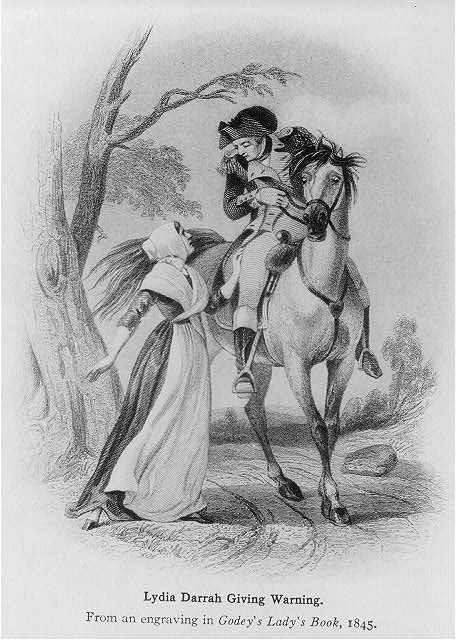
On the night of December 2, 1777, a British officer knocked at a house on Second Street in Philadelphia and told the woman who lived there that her family should go to bed early. Officers would be meeting there that evening. The woman was Lydia Darragh, a Quaker midwife in her late forties, and what she did next is one of the best-loved stories of the Revolution. It is also a story that rests on far less paper than most people assume.1
A Quaker Family on Second Street
Lydia Barrington was born in Dublin in 1729. In 1753 she married William Darragh, a teacher who had tutored her family, and the couple crossed to Philadelphia.2 The Daughters of the American Revolution give the wedding date as November 2, 1753, and list children that include Charles, born in 1755, and Ann, born in 1757. They put her own birth in 1728, a year before the Battlefield Trust and Britannica do.3 Lydia worked as a nurse and midwife while William kept school.
Both were Quakers, and Quakers of that day held to a peace testimony. Members were supposed to stay out of the war on both sides. Charles did not. He joined the Continental Army and served in the 2nd Pennsylvania Regiment.2 A son in uniform would shape everything his mother did later, and every account of her has to reckon with it.
Philadelphia Under the British
General William Howe's army entered Philadelphia on September 26, 1777, after the defeat of Washington at Brandywine.1 Howe took a house across the street from the Darraghs for his headquarters. According to the Battlefield Trust, he then tried to take over the Darragh house as well, and a second cousin serving in the British army helped Lydia persuade him to let the family stay in exchange for the use of their parlor as a meeting place.2 Ushistory.org tells it differently: Major John Andre ordered her out, and a Captain Barrington, a second cousin, got her allowed to stay.4 Neither version points to a document.
That is how a Quaker household came to host the enemy staff. Washington's army, meanwhile, had pulled back to Whitemarsh, about sixteen miles north of the city.2
The Story of December 2
In the version most often told, the officers met in the house on the night of December 2 and sent the family to bed. Lydia pretended to sleep, crept to the door or a nearby closet, and heard the order for a surprise march on Whitemarsh two nights later.4 The next morning she asked for a pass to buy flour at a mill in Frankford, carried an empty sack past the British lines and passed the warning to an American officer on the road, usually named as Thomas Craig.4 Howe marched out on December 4 with more than 15,000 men, found the Americans ready, skirmished for several days and went back to Philadelphia for the winter.1
Afterward Major John Andre is said to have asked whether anyone in the house had stayed awake. She said no, and he believed her.4
Where the accounts disagree
The retellings do not match. Some send her to the Rising Sun Tavern, some to the road, and some date her walk to December 3 and others to December 4.45 In one version the warning reached Washington through Elias Boudinot, who recorded that an old woman handed him a needle book with a rolled note inside. Ushistory.org says that account differs from the family's in many details, especially over who carried the news onward.4
Myth: She sent coded messages sewn under coat buttons
Popular articles say Lydia hid notes under cloth-covered buttons on her son's coat so he could carry them to Charles in the army. Robert Fanelli, author of the 2025 biography Lydia's Tale, told Smithsonian Magazine there is "no evidence of any kind" for the button story.6
What the Record Actually Holds
The earliest print version is a magazine article by Robert Walsh Jr. in 1827, about fifty years after the events and nearly forty years after Lydia died. It leaned on a Quaker woman who had known her.67 The Journal of the American Revolution adds Hannah Marshall Haines, who wrote an account, and later retellers John Fanning Watson and Henry Darrach.7 Elizabeth Ellet's Women of the American Revolution has a chapter titled "Lydia Darrah." It says Walsh's article, in the first number of the American Quarterly Review, was said to be taken from Lydia's own narration.89 Sources also disagree about the daughter's part. Ushistory.org says Ann Darragh told the story years later. Smithsonian dates an account passed down from Ann to 1916 and says it differs from the others. PhillyVoice says Ann first published the story in 1827, but the 1827 article was Walsh's.4610
So the chain is long and every link was written after the fact. Ushistory.org says plainly that there is "no concrete proof of their stories," meaning hers and Betsy Ross's.4 A 2009 CIA public affairs report, as quoted in the Journal of the American Revolution, called it "colorful but uncorroborated."7
The case that something happened
Fanelli argues the core is sound. He traced the story to people who knew Lydia and had heard it from her, and he concluded the intelligence she passed on "was pretty accurate."6 The same review reports that letters by Craig show he knew of the attack beforehand, though not how he learned it, and that women did get passes to leave the city, which answers the objection that she could not have walked out alone.7 A harder question is whether it mattered. Washington had other spies in Philadelphia, and the flour trip may have been an ordinary errand.11
Read Out of Meeting
The Quakers kept their own records, and they show the family under pressure long before the Whitemarsh story reached print. The Free Quakers site says the Friends disowned Charles Darragh "for engaging in matters of a warlike nature." Christopher Marshall wrote in October 1783 that the Society had dismissed Lydia for attending meetings of disowned Friends.12 Other accounts date the family's break to 1781, the year the Free Quakers organized, and a few say the whole household was pushed out then.11 The sources give dates from 1781 to 1783.
Notice what that means. Her meeting punished her for the company she kept and for her son's war service. It did not cite a December 1777 act of espionage, and nobody can say the meeting even knew of one.
The Last Years
William Darragh died in 1783, and Lydia kept raising the children while she worked in a store.2 She died in Philadelphia on December 28, 1789.13 Despite the disownment she was buried in the burial ground of the Arch Street Meeting House, in the Quaker cemetery where her husband lay.12
Her best evidence may be her own silence. She told the story to friends and family only after the British left Philadelphia in June 1778, and a woman who kept a secret that long was likely not inventing it.1 That is a judgment, not a document. The honest label for the Whitemarsh warning is a credible family tradition, recorded decades late, with one outside fact that fits it.
Darragh's Life at a Glance
- 1729 Born Lydia Barrington in Dublin, Ireland (the DAR says 1728).
- Nov. 2, 1753 Marries William Darragh and later settles in Philadelphia.
- Sept. 26, 1777 Howe's army enters Philadelphia.
- Dec. 2, 1777 Traditional date of the officers' meeting in her house.
- Dec. 4, 1777 Howe marches on Whitemarsh and finds the Americans prepared.
- 1781 Free Quakers organize; the Darraghs' break with the meeting begins.
- 1783 William dies; Marshall records Lydia's dismissal in October.
- Dec. 28, 1789 Dies in Philadelphia; buried at Arch Street.
- 1827 First printed version of the Whitemarsh story.
Learn more
- Smithsonian Magazine on Lydia Darragh: the clearest popular account of Fanelli's research
- Journal of the American Revolution review of Lydia's Tale: lists the early sources and the doubts
- Free Quakers, Early Organizers: how Friends who backed the war were disowned
- ushistory.org on Lydia Darragh: a plain summary that flags the lack of documents
- American Battlefield Trust biography: short outline of her life and the Whitemarsh story
Notes
- Smithsonian Magazine, "Who Was Lydia Darragh, Quaker Spy of the American Revolution?", on the occupation beginning September 26, 1777, the December events, Howe's march with more than 15,000 troops, her silence until June 1778 and her burial at Arch Street. Read it online. ↩
- American Battlefield Trust, "Lydia Barrington Darragh," on her birth in Dublin in 1729, her marriage and move to Philadelphia, her son Charles in the 2nd Pennsylvania Regiment, Howe's headquarters across the street and the second cousin who helped her, Whitemarsh sixteen miles north of the city, and William's death in 1783. Read it online. ↩
- Daughters of the American Revolution, Honoring Our Patriots, "Lydia Darrah," on the November 2, 1753 marriage, a birth year of 1728 and the children. Read it online. ↩
- ushistory.org, "Lydia Darragh," on Major John Andre and Captain Barrington, the December 2 meeting, the pass, Thomas Craig, Elias Boudinot's account, Ann Darragh's account and the statement that there is "no concrete proof of their stories." Read it online. ↩
- Encyclopaedia Britannica, "Lydia Barrington Darragh," placing her pass and walk on December 4 and her death in 1789. Read it online. ↩
- Smithsonian Magazine, same article, quoting historian Robert Fanelli on the button story and on the accuracy of the intelligence, on Walsh's 1827 account and the Quaker woman who was his main source, and on the 1916 account from Ann Darragh. Read it online. ↩
- Journal of the American Revolution, review of Robert N. Fanelli, Lydia's Tale (Westholme, 2025), January 2026, on Walsh, Haines, Watson and Darrach, the CIA report, and women's passes. Read it online. ↩
- American Revolution.org, "Lydia Darrah (Darrach) Biography," a retelling credited to Elizabeth F. Ellet that says the story was said to be taken from Lydia's own narration. Read it online. ↩
- Elizabeth F. Ellet, The Women of the American Revolution, vol. 1, Project Gutenberg ebook 49411, chapter XII, "Lydia Darrah." Read it online. ↩
- PhillyVoice, "Philly History: Lydia Darragh," crediting her daughter Ann with the first publication in 1827, a date that conflicts with Smithsonian's account. Read it online. ↩
- Daughters of Liberty, "Her curiosity was excited," on the 1781 push against the Darragh family, the Free Quakers, Washington's other spies and the flour errand. Read it online. ↩
- Free Quakers, "Early Organizers," on the Free Quakers' founding in 1781, Charles Darragh's disownment, and Christopher Marshall's October 1783 note on Lydia. Read it online. ↩
- Encyclopaedia Britannica, same article, on her death in Philadelphia on December 28, 1789. Read it online. ↩
Terms in this lesson
- Society of Friends
- The formal name of the Quakers. Friends of Darragh's day held to a peace testimony and expected members to stay out of war.
- Disownment
- A meeting's formal decision that a member had broken its rules and was no longer part of the body. Quaker records of the time often call it being read out of meeting.
- Free Quakers
- A Philadelphia group organized in 1781 by Friends who had been disowned for supporting the Revolution. Darragh was among those who joined.
- Whitemarsh
- The place north of Philadelphia where Washington's army camped in the autumn of 1777. British and American forces skirmished there in early December.
- Family tradition
- A story handed down by relatives and first written long after the event. It can be true, but it needs outside evidence before a historian will rely on it.
Sources
- Smithsonian Magazine, Who Was Lydia Darragh, Quaker Spy of the American Revolution? checked 2026-10
- American Battlefield Trust, Lydia Barrington Darragh checked 2026-10
- ushistory.org, Lydia Darragh checked 2026-10
- Journal of the American Revolution, review of Lydia's Tale checked 2026-10
- Free Quakers, Early Organizers checked 2026-10
- Encyclopaedia Britannica, Lydia Barrington Darragh checked 2026-10