Lesson 2 of 60 · about 9 minutes
Peter Salem and Salem Poor: Two Black Soldiers of Bunker Hill
You'll be able to
- Trace the documented service of Peter Salem and Salem Poor from 1775 to 1780
- Read the December 5, 1775 petition that praised Salem Poor and explain what the legislature did with it
- Explain why historians doubt that either man shot Major John Pitcairn
- Connect their service to the Continental Army's changing policy on Black enlistment
On December 5, 1775, thirteen Continental officers and a brigade surgeon signed a short paper to the Massachusetts General Court. Colonel William Prescott, who had commanded the redoubt on Breed's Hill, was one of them. The paper was about a single private, and it said this:
"The Subscribers begg leave to Report to your Honble. House, (which wee do in Justice to the Character of So Brave a Man) that under Our Own observation, Wee declare that A Negro Man Called Salem Poor of Col. Fryes Regiment Capt. Ames. Company in the late Battle at Charlestown, behaved like an Experienced officer, as Well as an Excellent Soldier, to Set forth Particulars of his Conduct Would be Tedious, Wee Would Only begg leave to Say in the Person of this Sd. Negro Centers a Brave & gallant Soldier."
Petition of fourteen officers to the Massachusetts General Court, December 5, 1775, as transcribed by J. L. Bell. 1
No other soldier at Bunker Hill received a written tribute like it. The legislature gave the officers "leave to withdraw," which was the polite way of saying no, and Salem Poor got no official reward in his lifetime.1 Another Black soldier named Salem fought on the same hill that day. His name is Peter Salem, and for two centuries he got credit for a famous shot that probably never happened.
Salem Poor of Andover
Salem Poor was born enslaved in Andover, Massachusetts, and baptized there in 1747. On July 10, 1769, he paid his master, John Poor, 27 pounds for his freedom, about a working man's earnings for a year.2 Two years later he married Nancy Parker, a free woman of African and Native descent.3
Charlestown, June 17, 1775
Poor joined the Massachusetts army in the spring of 1775. The officers who praised Poor did not "Set forth Particulars," so we do not know what he did. J. L. Bell notes how extraordinary it was in 1775 for white gentlemen to compare a Black private to an experienced officer like themselves.1
Andover tradition, written down by Sarah Loring Bailey in 1880, says Poor shot Lt. Col. James Abercrombie as the officer leapt onto the redoubt shouting "The day is ours." That is word for word the story others told about Peter Salem and Major Pitcairn, which is reason for caution. And Don Hagist, using British letters, has shown that Abercrombie was carried back to Boston alive and that officers who spoke with him believed the fatal ball came from behind, from his own men.4
Five More Years of War
Poor kept serving. In May 1776 he went north with a Maine militia regiment to Fort George on Lake George. On May 11, 1777, he enlisted in the Continental Army for three years in Col. Edward Wigglesworth's regiment, which fought in the Saratoga campaign and then wintered at Valley Forge. He was discharged March 20, 1780.2
His later life was hard. The Park Service records him in the Boston Almshouse in 1793 and briefly jailed in 1799 for breach of the peace. Researchers disagree about when he died. George Quintal's 2002 study for the Park Service said neither date nor place had been found; the current Park Service biography gives 1802 and burial at Copp's Hill in Boston.3 In 1975 the Postal Service put him on a ten-cent stamp.2
Peter Salem of Framingham
Peter Salem was born in Framingham, probably around 1750, enslaved by Capt. Jeremiah Belknap, who sold him to Maj. Lawson Buckminster before the war. On April 19, 1775, he marched to Concord as a minute man in Capt. Simon Edgell's company. Five days later he enlisted in Capt. Thomas Drury's company of Col. John Nixon's regiment. Enlistment meant freedom: as Leicester historian Emory Washburn later put it, no slave could be mustered into the army, so a master who allowed it "worked a practical emancipation."5
Salem's record is long. He fought at Bunker Hill and in the New York campaign of 1776, including White Plains. On January 1, 1777, he enlisted for three years in Col. Thomas Nixon's 6th Massachusetts, which fought at Saratoga, wintered at Valley Forge, and fought at Monmouth. His company was among the light infantry who stormed Stony Point on July 16, 1779, though no record names him in the attack. He was discharged March 1, 1780.5
Who Shot Major Pitcairn?
Maj. John Pitcairn of the Royal Marines was the most hated British officer in New England after Lexington, where colonists believed he had ordered the first volley. Americans wanted to know who killed him at Bunker Hill.1
Myth: Peter Salem shot Pitcairn as he mounted the redoubt
The story grew in stages. Jeremy Belknap noted in 1787 that "a negro man belonging to Groton" shot Pitcairn. Samuel Swett in 1818 named "a black soldier named Salem." In 1826 Emory Washburn claimed that soldier was Peter Salem of Leicester, but offered no evidence beyond his regiment. Abolitionists like William C. Nell repeated it in 1855. Against all of it stands Lt. John Waller, adjutant of Pitcairn's own battalion, who wrote days after the battle that the major fell "close by me" at the foot of the slope below the redoubt, before the marines reached the wall. Another early note said Pitcairn took four balls, which points to several shooters.1
Bell concludes that none of the American stories of Pitcairn being shot on the parapet is reliable. Older Framingham historians such as J. H. Temple held the opposite view and wrote that a "concurrence of testimony" left no doubt the shot was Peter Salem's.5 The evidence favors Bell. Peter Salem's real record needs no borrowed glory: seven years of service, from Concord to Stony Point, by a man who went in enslaved and came out free.
Changing Army Policy
Both men served through a reversal in policy. In October 1775 Washington, his council of war and a committee of Congress agreed to stop Black soldiers from reenlisting. Washington reversed himself in his general orders of December 30, 1775: "As the General is informed, that Numbers of Free Negroes are desirous of inlisting, he gives leave to the recruiting Officers, to entertain them, and promises to lay the matter before the Congress, who he doubts not will approve of it." Congress agreed on January 16, 1776, but only for free Black men who had already served at Cambridge.6 Bell suggests that praise like the Poor petition may have helped. The Park Service counts at least 5,000 African Americans who served on the American side during the war, while many more sought freedom with the British.3
Old Age and Memory
Peter Salem married Katy Benson in 1783 and later moved to Leicester, where he made baskets and mended chairs and told children about his years "out with Massa Nixon." When he grew too poor to keep himself, the overseers sent him back to Framingham, his legal settlement. His former masters, Buckminster and Belknap, with Samuel Hemenway, posted a bond to support him for life. He died August 16, 1816. In 1882 the town spent $150 on a granite stone that reads "Peter Salem, a soldier of the Revolution, Concord, Bunker Hill, Saratoga."7
Washburn asked whether anyone would deny a place in the town's annals to a man who "periled his life ... for that freedom for others which he had never been permitted to share till he won it personally by personal valor." The answer, a century and a half on, should be plain enough.7
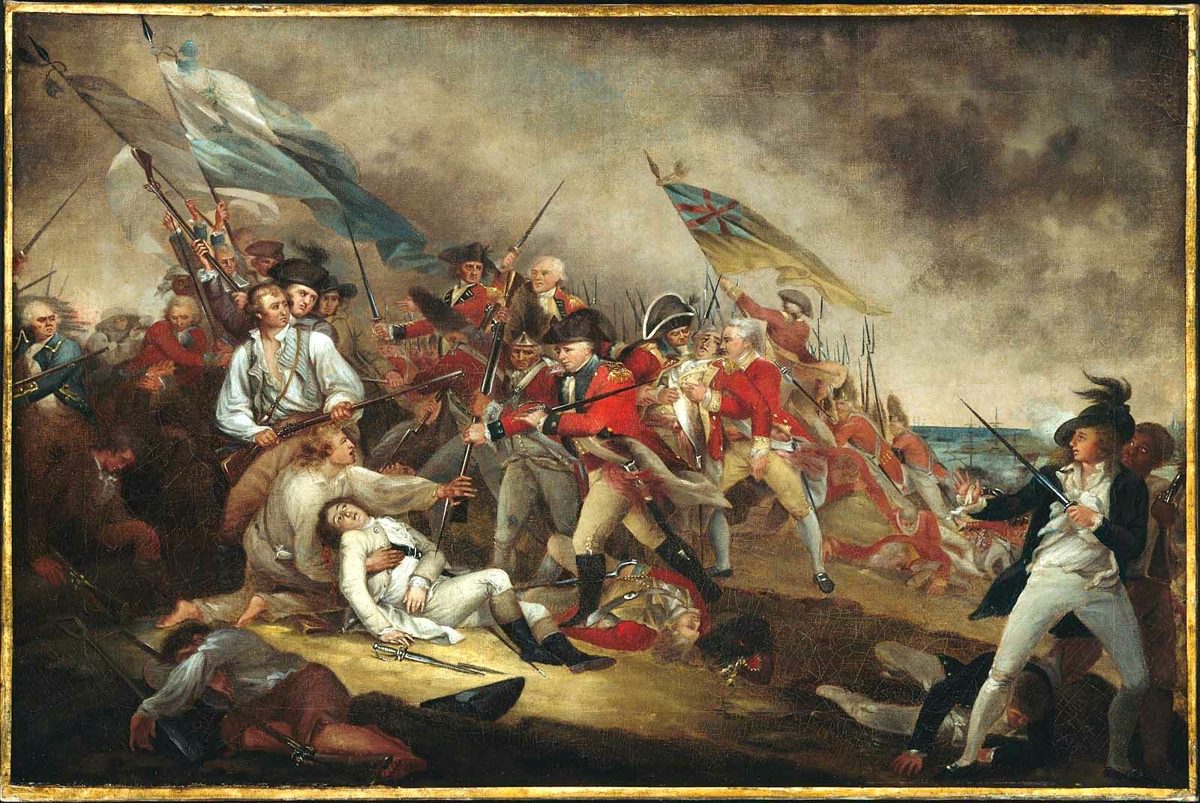
Memory has its own errors. For generations the armed Black man at the edge of Trumbull's Bunker Hill painting was called Peter Salem. Trumbull himself described the figure only as "a faithful negro" attending the wounded Lt. Thomas Grosvenor, and the Yale Center for British Art now identifies him as Asaba, a man enslaved in Grosvenor's household.8 The painting still shows something true: Black men stood in that fight with muskets in their hands.
Two Lives in Dates
- 1747 Salem Poor baptized in Andover (born enslaved).
- c. 1750 Peter Salem born in Framingham, enslaved.
- 1769 July 10: Salem Poor buys his freedom for 27 pounds.
- 1775 April 19: Peter Salem marches to Concord. June 17: both fight at Bunker Hill. December 5: officers petition for Poor.
- 1777 Both enlist for three years in Continental regiments that serve at Saratoga and Valley Forge.
- 1779 July 16: Salem's light infantry company storms Stony Point.
- 1780 Salem discharged March 1; Poor discharged March 20.
- 1802 Salem Poor's death, by current Park Service reckoning.
- 1816 August 16: Peter Salem dies in Framingham.
Learn more
- Who Killed Major John Pitcairn?: J. L. Bell's careful sorting of every Pitcairn story, with the petition text.
- NPS: Salem Poor: a full biography with George Quintal's research notes on each record.
- NPS: Peter Salem: muster rolls, Washburn's portrait of his old age, and the Framingham monument.
- Patriots of Color: the Park Service study of Black and Native men at Battle Road and Bunker Hill.
- James Abercrombie, Victim of Friendly Fire: Don Hagist on the British evidence.
- Trumbull's Grosvenor sketch: Yale on who the Black figure in the painting really is.
Notes
- J. L. Bell, "Peter Salem? Salem Poor? Who Killed Major John Pitcairn?," Journal of the American Revolution, June 18, 2018, quoting the December 5, 1775 petition, Belknap's 1787 notes, Swett (1818), Washburn (1826) and Lt. John Waller's letters of June 21 and 22, 1775. Read it online. ↩
- George Quintal Jr., Patriots of Color: "A Peculiar Beauty and Merit" (National Park Service, 2002), entry for Salem Poor, citing Massachusetts Soldiers and Sailors of the Revolutionary War, 12:561, and the 1769 manumission at the Phillips Library, Peabody Essex Museum; reprinted on the NPS Salem Poor page. Read it online. ↩
- National Park Service, "Salem Poor," biography with notes on his marriages, the almanac and jail records, the disputed birth and death dates, and the estimate of 5,000 African American patriot soldiers. Read it online. ↩
- Don N. Hagist, "James Abercrombie, Much Lamented Victim of Friendly Fire at Bunker Hill," Journal of the American Revolution, June 14, 2017; Sarah Loring Bailey, Historical Sketches of Andover (Boston: Houghton, 1880), 323-324, as quoted by Quintal and Bell. Read it online. ↩
- George Quintal Jr., Patriots of Color, entry for Peter Salem, quoting J. H. Temple's history of Framingham and Emory Washburn, Historical Sketches of the Town of Leicester (1860); reprinted on the NPS Peter Salem page. Read it online. ↩
- George Washington, General Orders, December 30, 1775, Founders Online, National Archives, with the editors' note quoting the Continental Congress resolution of January 16, 1776. Read it online. ↩
- Same, on Salem's marriage, his years in Leicester, the 1816 death, and the 1882 monument; see also National Park Service, "Peter Salem: A Legacy of Courage and Freedom." Read it online. ↩
- Yale Center for British Art, "Lieutenant Thomas Grosvenor (1744-1825) and His Negro Servant," on Trumbull's c. 1797 oil sketch (Yale University Art Gallery, 1932.302) and the identification of Asaba. Read it online. ↩
Terms in this lesson
- Manumission
- The formal act of freeing an enslaved person. Salem Poor received his on July 10, 1769, after paying 27 pounds.
- Minute man
- A Massachusetts militiaman in a company organized to turn out on short notice. Peter Salem marched as one on April 19, 1775.
- Redoubt
- An enclosed earthwork fort. The Americans built one on Breed's Hill the night before the Battle of Bunker Hill.
- Leave to withdraw
- An eighteenth-century legislative phrase that politely rejected a petition. The Massachusetts General Court gave it to the officers who praised Salem Poor.
- Patriots of Color
- George Quintal Jr.'s 2002 National Park Service study identifying African American and Native American men at Battle Road and Bunker Hill.
Sources
- J. L. Bell, Peter Salem? Salem Poor? Who Killed Major John Pitcairn?, Journal of the American Revolution, 2018 checked 2026-10
- National Park Service, Salem Poor checked 2026-10
- National Park Service, Peter Salem checked 2026-10
- National Park Service, Peter Salem: A Legacy of Courage and Freedom checked 2026-10
- Minute Man NHP, Patriots of Color study (George Quintal Jr.) checked 2026-10
- Yale Center for British Art, Lieutenant Thomas Grosvenor and His Negro Servant checked 2026-10
- Don N. Hagist, James Abercrombie, Much Lamented Victim of Friendly Fire at Bunker Hill, Journal of the American Revolution, 2017 checked 2026-10