Lesson 36 of 60 · about 9 minutes
Benedict Arnold: The Hero Who Sold West Point
You'll be able to
- Trace Arnold's record as a fighting general from Ticonderoga in 1775 to Saratoga in 1777
- Explain how debt, a court-martial and a new marriage led to the West Point plot of 1780
- Say what the British paid him and where the sources disagree
- Separate the documented story of the plan to seize Arnold from the legend around it
On October 7, 1777, a rider in a Continental general's coat jumped the line at Saratoga and led men at a log-and-earth fort the Germans called the Breymann Redoubt. A musket ball hit his leg and brought his horse down on top of him. The rider was Benedict Arnold, and Americans still honor the spot. They just do not say his name there.1
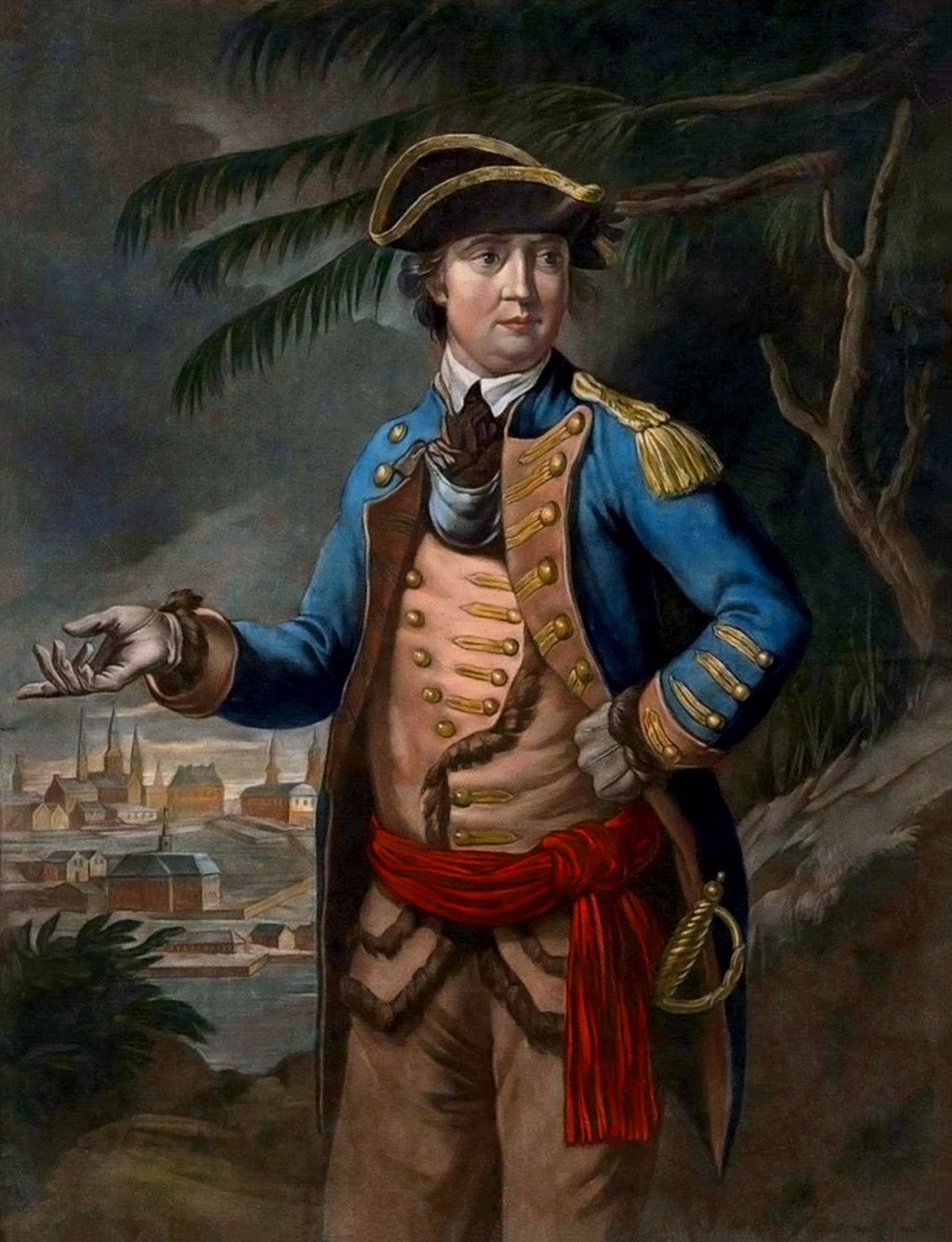
A Fighter Before He Was a Traitor
Arnold was born January 14, 1741, in Norwich, Connecticut, one of the few of his brothers and sisters to survive childhood. Most of them died young. He worked as an apothecary and a merchant before the war.2 In 1775 the Massachusetts Committee of Safety made him a colonel, and on May 10 he was at Fort Ticonderoga with Ethan Allen's Green Mountain Boys. The two men quarreled over who commanded and settled on sharing it. The fort fell at dawn, and its cannon later went to Boston with Henry Knox.3
That autumn he took about 1,100 men up the Kennebec River in Maine toward Quebec. A third of them turned back. Before dawn on December 31, in a gale and blinding snow, the attack on the Lower Town failed, General Richard Montgomery was killed, and a musket ball shattered Arnold's leg.4 In October 1776 his small lake fleet lost the fight at Valcour Island, with most of the ships captured or burned, but the battle delayed the British push toward the Hudson by a season.5 At Ridgefield in April 1777 he lost a horse to British fire and shot a soldier who ran up to take him.5
Saratoga and a monument with no name
Congress had passed him over for major general five times. He got the rank in 1777, and then came Saratoga.2 On October 7 he went onto the field, and the sources disagree about whether General Horatio Gates allowed it. One account has Gates letting him go after Arnold promised not to start a full battle. Another says Arnold ignored Gates's orders and rode out. He pushed the assault on the Balcarres Redoubt and then rode against the Breymann Redoubt with troops from Learned's brigade. The Americans took it.6 In 1887 John Watts de Peyster, a New York militia general, put up a small monument there: a boot and a major general's epaulette on a howitzer barrel. It says "most brilliant soldier of the Continental Army" and "desperately wounded on this spot." It leaves out the name.1
Debts, a Trial and a Marriage
Washington made Arnold military commander of Philadelphia in June 1778, after the British left.7 Arnold spent like a rich man, and carriages, theater nights and shaky deals left him deep in debt.8 On April 8, 1779, he married Peggy Shippen, 18, whose father was a moderate Loyalist and whose friends included British officers from the occupation.8
Joseph Reed, head of Pennsylvania's Supreme Executive Council, brought charges that winter, among them favoritism and using public wagons to move Arnold's own goods. The court-martial sat at Morristown from December 23, 1779, to January 26, 1780. It cleared him on two of the four charges and found against him on the other two, and Congress confirmed the sentence on February 12, 1780.9 Washington's reprimand came in General Orders on April 6, 1780. He called the wagon request "imprudent and improper" and the permit for a vessel "peculiarly reprehensible."9 Arnold saw it as the last insult to his honor. He had already begun talking with the British before the trial started.10
The West Point Plot
Arnold lobbied for command of West Point and got it in early August 1780. He had already told the British he meant to weaken the post and hand it over.8 The go-between was Major John André, the British adjutant general, whose part in the plot is the subject of lesson 37. On July 24, 1780, André wrote that General Clinton would pay 20,000 pounds for West Point and its garrison, and 10,000 pounds even if Arnold could not deliver.11 Arnold and André met near Haverstraw on September 21.
It came apart in two days. Militiamen stopped André near Tarrytown, found the papers, and handed him to Lieutenant Colonel John Jameson. Jameson sent a note to Arnold, which would have warned him. Major Benjamin Tallmadge, Washington's intelligence chief and the Culper Ring's organizer (his story is in lesson 34), reached camp, grew suspicious and talked Jameson into pulling André back.12 Arnold still got the news by courier on September 25, over breakfast. He called for a horse, left Peggy upstairs, took a boat down the Hudson and boarded the British sloop Vulture. Washington rode into the house shortly after.13
Washington's reaction
The next day Washington's General Orders announced, "Treason of the blackest dye was yesterday discovered!" He wrote Rochambeau that Arnold "has sullied his former glory by the blackest treason."14 To John Laurens he blamed Jameson's "egregious folly" for letting Arnold slip.14 André was hanged at Tappan on October 2.7 Peggy raved at the officers who arrived. Washington let her choose between New York and her family in Philadelphia, and she chose Philadelphia. Historians still argue whether she was acting. The evidence of her part is circumstantial, though in 1782 the Crown gave her a pension for her services, and the sources differ on the amount.8
Myth: Washington's plot to kidnap Arnold
The core is true. On October 20, 1780, Washington wrote to Major Henry Lee approving a scheme to take Arnold and insisting that he be "brought to me alive," so that he could be made a public example. A sergeant, John Champe, deserted to the British to do it.15 The idea was Lee's, not Washington's. The famous details come from Lee's Memoirs, published in 1812, and are shakier: Champe's time inside Arnold's circle rests mostly on Lee, and Lee's claim that Champe acted to save André cannot be right, since André was dead before Champe left.15 A line often placed in Washington's mouth at the discovery, "Arnold has betrayed us. Whom can we trust now?", is repeated in popular retellings, but none of the contemporary documents cited here records it. Lafayette's own recollection was of a silent, reserved dinner.13
What the British Paid
The sources disagree, and the gap is worth seeing. The 20,000 pounds was promised only for West Point itself. One account says the British would pay 6,000 pounds if the plot was found out, another that Clinton set a floor of 6,000, and a third that Arnold had asked for 10,000 and was refused.16 The Canadian Encyclopedia says he received 6,315 pounds and a pension, a brigadier general's commission in the British service and leave to raise a Loyalist battalion, the American Legion.17 The Dictionary of Canadian Biography puts the pension at 360 pounds a year.17 The safe summary is a few thousand pounds, a rank and a pension, a fraction of the first offer. Biography.com adds that the British never fully trusted him and passed him over for big commands.7
Why he did it
Historians offer motives and rank them differently. Money, anger at Congress, a bad court-martial, chronic pain from his leg and a young wife with British friends all fit. W. D. Wetherell, writing in American Heritage, gave "married the wrong person" as a quick answer to a stranger and then went on to complicate it. Nathaniel Philbrick gives Peggy a significant part, though that view reaches us second-hand.10 Arnold was talking to the British before the verdict came down, so the court-martial cannot be the whole reason.
Virginia, New London and a Spy in His Camp
Arnold sailed for Virginia with a British fleet that left Sandy Hook on December 21, 1780. He landed on January 4, 1781, and took Richmond the next day. Governor Jefferson refused his offer to spare the city in return for tobacco and valuables.18 It was in Arnold's camp that James Armistead, posing as a runaway, began feeding information to Lafayette, as lesson 3 tells.19
On September 6, 1781, he led the western half of a British force of about 1,700 against New London, Connecticut. Most residents had fled. The raiders burned more than a hundred homes, stores and ships. Across the river the other column took Fort Griswold, and eyewitnesses say it killed Colonel William Ledyard and many men who had surrendered. About 85 of an estimated 150 to 170 defenders died.20
London, Saint John and the End
Arnold sailed for England in December 1781. George III and the Tories received him well, but the Whigs and most army officers did not.21 In late 1785 or early 1786 he and his son Richard moved to Saint John, New Brunswick, to run a West Indies trade. In 1791 a jury found for him in a slander suit against Monson Hayt but awarded him only 20 shillings. Arnold returned to England soon after, and the family followed by December 1791.21 He died in London on June 14, 1801, aged 60, and was buried at St. Mary's, Battersea. A deathbed wish to die in "this old uniform" is a story that might be made up.21
Arnold's Life at a Glance
- January 14, 1741 Born in Norwich, Connecticut.
- May 10, 1775 Helps take Fort Ticonderoga with Ethan Allen.
- December 31, 1775 Shattered leg in the failed assault on Quebec.
- October 11, 1776 Loses his lake fleet at Valcour Island, delaying the British.
- October 7, 1777 Wounded storming the Breymann Redoubt at Saratoga.
- April 8, 1779 Marries Peggy Shippen.
- April 6, 1780 Washington reprimands him after the court-martial.
- September 25, 1780 Flees to the Vulture after André's capture.
- January 5, 1781 Occupies Richmond as a British brigadier general.
- September 6, 1781 Leads the raid on New London.
- 1785 or 1786 to 1791 Lives in Saint John, New Brunswick.
- June 14, 1801 Dies in London.
Learn more
- National Park Service, Boot Monument: the inscription and the story of the monument that does not name him
- Washington to Henry Lee, October 20, 1780: the letter approving the plan to seize Arnold alive
- American Battlefield Trust, Arnold and Peggy Shippen: the marriage, the court-martial and the argument over her role
- Mount Vernon, Benedict Arnold: Washington's own words on the discovery
Notes
- National Park Service, "Boot Monument," Saratoga National Historical Park, on the inscription and the October 7, 1777 wound; American Revolution Institute, "The Boot Monument" (PDF), and The Clio, "Boot Monument," on the 1887 monument erected by John Watts de Peyster and the omission of Arnold's name. Read it online. American Revolution Institute (PDF). The Clio. ↩
- American Battlefield Trust, "Benedict Arnold," on his birth in Connecticut on January 14, 1741 (per Wikipedia, Norwich), his early trades, and Congress passing him over for major general; Mount Vernon, "Benedict Arnold," on the early deaths of most of his brothers and sisters. Read it online. Mount Vernon. ↩
- New England Historical Society, "Ethan Allen and Benedict Arnold Capture Fort Ticonderoga, 1775," on the dawn capture of May 10, 1775, Arnold's Massachusetts commission and the shared command. Read it online. ↩
- HistoryNet, "America's Disastrous Invasion of Quebec," on the 1,100 men, the one-third who turned back, the December 31 attack and Arnold's leg wound. Read it online. ↩
- American Battlefield Trust, "Valcour Island, October 11, 1776," on the loss of Arnold's ships and the delay of the British advance; Connecticut History, "The Battle of Ridgefield, 1777," on his horse and the soldier he shot. Valcour Island. Ridgefield. ↩
- American Battlefield Trust, "The Battle of Bemis Heights," on Gates and Arnold on the field, the Breymann Redoubt and the musket ball that struck his leg; Dictionary of Canadian Biography, "Arnold, Benedict," which says Arnold ignored Gates's orders. Read it online. Dictionary of Canadian Biography. ↩
- Mount Vernon, "Benedict Arnold," Digital Encyclopedia, on the Philadelphia command of June 1778, the discovery and André's execution; Biography.com, "Benedict Arnold," on October 2, 1780 at Tappan. Read it online. Biography.com. ↩
- American Battlefield Trust, "10 Facts: Benedict Arnold and Peggy Shippen," on the debts, the April 8, 1779 marriage, the West Point command, Peggy's behavior at the discovery and her 1782 pension (500 pounds a year by this account; other sources give different figures). Read it online. ↩
- George Washington, "General Orders, 6 April 1780," Founders Online, with editorial notes on the four charges, the court's findings against him on two, its sitting from December 23 to January 26 and Congress's resolution of February 12, 1780. Read it online. ↩
- Wikipedia, "Benedict Arnold," on the opening of talks before the court-martial and, second-hand, the view of Nathaniel Philbrick; W. D. Wetherell, American Heritage, on "married the wrong person." Read it online. ↩
- Emerging Revolutionary War, "Arnold's Treason: 240 Years Later, August 30, 1780," on André's letter of July 24, 1780 and the offers of 20,000 and 10,000 pounds. Read it online. ↩
- Emerging Revolutionary War, "The Capture of Major Andre, September 23, 1780," on the capture, Jameson and Tallmadge. Read it online. ↩
- New England Historical Society, "Benedict Arnold's Treason Unmasked to Washington, in Arnold's Own House," on the breakfast, the escape to the Vulture, Washington's arrival and Lafayette's remark about the dinner. Read it online. ↩
- Mount Vernon, "Benedict Arnold," on the General Orders of September 26, 1780; Washington to Rochambeau, September 26, 1780, and Washington to John Laurens, October 13, 1780, Founders Online. To Rochambeau. To Laurens. ↩
- Washington to Henry Lee, October 20, 1780, Founders Online, with editorial note; Robert Moore, "The Escape of John Champe," All Things Liberty (January 2023), on Lee's 1812 Memoirs and the gaps in the record. Letter to Lee. All Things Liberty. ↩
- Emerging Revolutionary War, same article, on 20,000 and 10,000 pounds; Paul Chase, "Betrayal of Benedict Arnold" (Sons of the American Revolution), on 6,000 pounds and Arnold's later demand; Frank McLynn, review in the Literary Review, on a 6,000 pound floor. Chase (PDF). Literary Review. ↩
- The Canadian Encyclopedia, "Benedict Arnold," on 6,315 pounds, the brigadier general's rank and the American Legion; Dictionary of Canadian Biography, "Arnold, Benedict," on the annual pension of 360 pounds. Read it online. Dictionary of Canadian Biography. ↩
- Virginia Places, "Benedict Arnold and William Phillips in Virginia, 1780-1781," on the sailing date, landing, Richmond and Jefferson's refusal. Read it online. ↩
- Historynet, "The Slave Who Spied: James Armistead's Role in the Revolutionary War," on Armistead posing as a runaway in Arnold's camp. Read it online. ↩
- Today in Connecticut History, "September 6: Benedict Arnold's Deadly Raid on New London and Groton," on the force, the burning and the casualties at Fort Griswold. Read it online. ↩
- Dictionary of Canadian Biography, "Arnold, Benedict," on the move to Saint John in 1785 or 1786 and the 1791 Hayt suit; Wikipedia, "Benedict Arnold," on the December 1791 departure, death and burial; UNB Loyalist Collection, on his years in Saint John; The Canadian Encyclopedia, same article, on the departure amid controversy; Biography.com, on December 1781 and the move to New Brunswick. UNB Loyalist Collection. Dictionary of Canadian Biography. Wikipedia. ↩
Terms in this lesson
- Court-martial
- A military trial. Arnold's court-martial sat at Morristown from December 1779 to January 1780 and ended in a reprimand.
- Reprimand
- A formal written or spoken rebuke. Washington delivered Arnold's in General Orders on April 6, 1780.
- Redoubt
- A small, enclosed earth fort. Arnold was wounded storming the Breymann Redoubt at Saratoga on October 7, 1777.
- Brigadier general
- A general officer's rank. Arnold held it in the Continental Army from 1776 and again in the British service after 1780.
- American Legion
- A Loyalist regiment Arnold was authorized to raise after he changed sides.
Sources
- National Park Service, Boot Monument (Saratoga National Historical Park) checked 2026-10
- Mount Vernon, Benedict Arnold checked 2026-10
- Founders Online, George Washington to Major Henry Lee, 20 October 1780 checked 2026-10
- Founders Online, George Washington to John Laurens, 13 October 1780 checked 2026-10
- American Battlefield Trust, 10 Facts: Benedict Arnold and Peggy Shippen checked 2026-10
- Dictionary of Canadian Biography, Arnold, Benedict checked 2026-10
- The Canadian Encyclopedia, Benedict Arnold checked 2026-10
- Emerging Revolutionary War, Arnold's Treason: 240 Years Later checked 2026-10