Lesson 48 of 60 · about 9 minutes
John Paul Jones: The Scottish Captain Who Raided Britain's Own Coast
You'll be able to
- Trace Jones from a Scottish gardener's cottage to the Continental Navy, including the killing on Tobago that sent him to Virginia
- Describe the 1778 raids on Whitehaven and St Mary's Isle and what he did with the stolen silver
- Follow the fight between the Bonhomme Richard and the Serapis on September 23, 1779
- Explain why the famous quotation cannot be treated as a record of what he said
The two ships were lashed together off Flamborough Head, on the Yorkshire coast, on the evening of September 23, 1779. The Bonhomme Richard was a thirteen-year-old French merchantman that had been fitted out as a warship. The Serapis was newer, faster and more heavily armed.1 Her captain, Richard Pearson, asked the American commander whether he wanted quarter. What John Paul Jones said back is the most quoted line in the history of the U.S. Navy. The words everyone repeats did not appear in print for forty-six years.
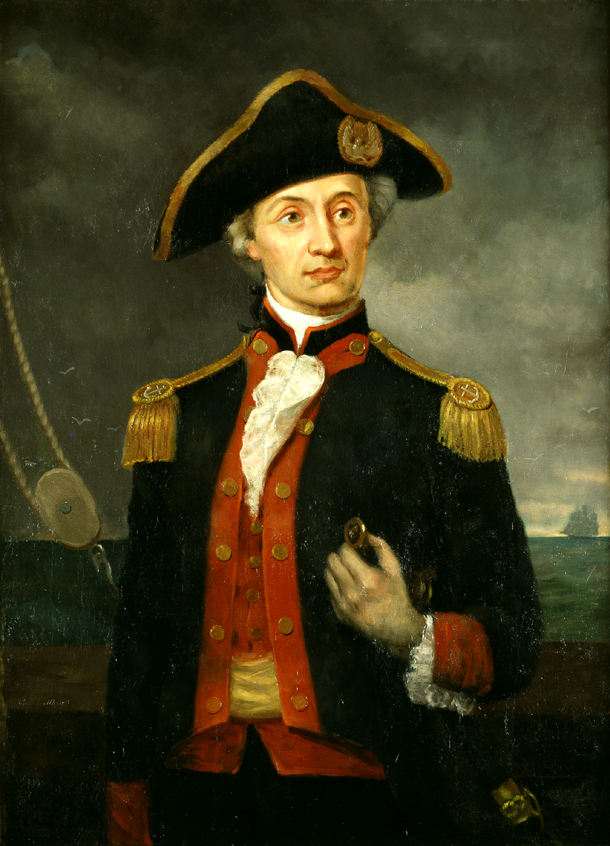
A Gardener's Son Who Went to Sea
He was born John Paul on July 6, 1747, in Kirkbean, Scotland, where his father was head gardener on the Arbigland estate. At thirteen he was apprenticed to a merchant shipper. At seventeen he entered the slave trade, and by 1766 he was first mate of the Two Friends out of Kingston, Jamaica. He later quit and called it an "abominable trade."2 Both halves of that belong in the record. He got in, and he got out.
Trouble followed him. In 1770, as master of the John, he had his carpenter Mungo Maxwell flogged. Maxwell died of yellow fever on another ship, and his father, Robert Maxwell, brought a murder charge.3 The Battlefield Trust says he was acquitted on the evidence.2 Then came Tobago. In 1773, as master of the Betsy, he argued with his crew over wages and a sailor died on his sword. The Trust calls the man a mutiny ringleader. The only account of the fight is Paul's own, a letter to Benjamin Franklin of March 6, 1789, in which the man attacks with a cudgel and runs onto the blade.4 Nobody else's version survives. Paul left the island under cover, reached Virginia and added "Jones" to his name.2
Whitehaven and St Mary's Isle
Congress commissioned him a first lieutenant in December 1775. In 1776 he commanded the Alfred and the Providence, and in June 1777 he was given the new Ranger. She reached Brest in May 1778, and his cruise in the Irish Sea made him a household name in Britain.2
The raid on Whitehaven came in the small hours of April 23, 1778, though one source dates it April 22.5 Jones knew the harbor. He had sailed from it as a boy. He took thirty volunteers in two boats, spiked the guns of the southern fort and tried to burn the Thompson, a collier loaded for Ireland. A sailor who had deserted knocked on doors and raised the town, and the fire was put out before it spread.6
Next came the Earl of Selkirk. Jones meant to kidnap him at St Mary's Isle, near Kirkcudbright, and trade him for American prisoners. The earl was in London. About fifteen men went ashore posing as a press-gang, and the crew carried off the countess's silver plate.5 Jones then bought the plate from his own crew and sent it back with a letter of explanation. The teapot, local tradition says, still sits in the Stewartry Museum with tea leaves in it.5
Flamborough Head, September 23, 1779
Jones sailed from Brest in August with seven ships.2 Off Flamborough Head he sighted British merchantmen, and by about 6:30 in the evening the Serapis and the Bonhomme Richard were within hailing distance.7 The Serapis was rated at 44 guns and carried 50. The Richard carried about 380 men and boys, roughly 300 of them American, against 305 British.8 Gun counts differ from source to source. At least one of his old 18-pounders, and by one account two, burst early and killed its crew.71
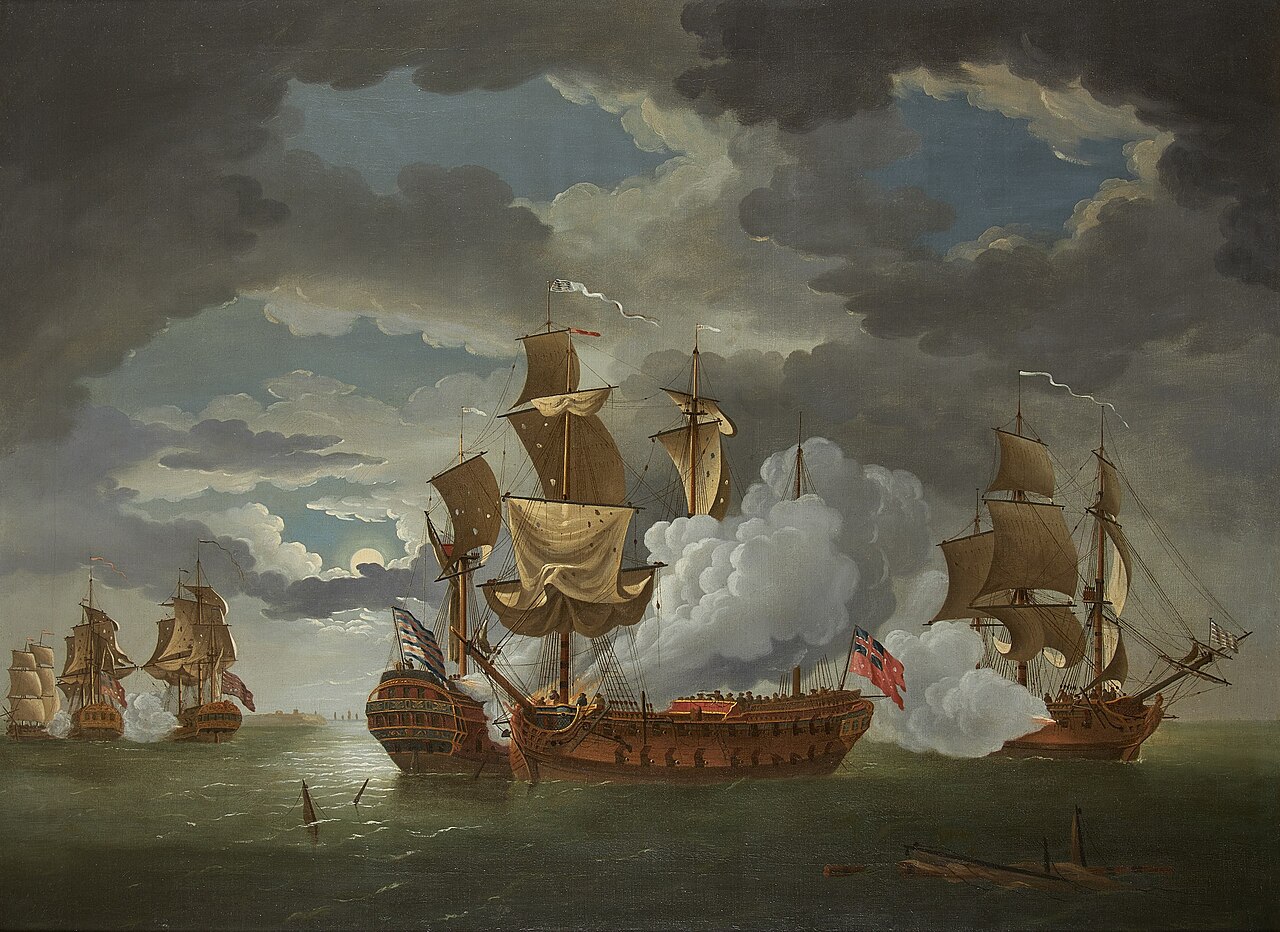
Jones lashed his ship to the Serapis so that her better guns and faster hull counted for less. The Trust puts the fight at about three and a half hours, and another account calls it a four-hour battle under moonlight.28 The Alliance, under Pierre Landais, fired into the Richard and hurt her own side.8 The Pallas took the smaller Countess of Scarborough.7 Pearson struck his colors with his mainmast tottering.1 The Richard sank on September 25, and Jones brought the Serapis into the Texel on October 3.71 One reference work counts roughly 70 to 80 killed on each side.7
"The English Commodore Asked me if I Demanded Quarters."
John Paul Jones to Benjamin Franklin, October 3, 1779, on board the Serapis. 9
Jones went on to say he "Answered him in the most determined Negative."9 That is the report he signed ten days after the fight, and it holds no battle cry.
Myth: Jones shouted "I have not yet begun to fight" and the crew wrote it down
The words come from Richard Dale, Jones's first lieutenant, who gave them to the biographer John Henry Sherburne in 1825, when Dale was in his late sixties. That is 46 years after the battle.1011 Accounts written sooner give other wording, along the lines of "I may sink, but I'm damned if I'll strike."10 Ensign Nathaniel Fanning remembered Jones saying they would lower the colors only when they could fight no longer.11 Pearson later claimed he heard no reply at all.1 Every account agrees on the refusal. Nobody can say the exact words.
After the War
Louis XVI gave him a gold sword and the Order of Military Merit. In 1787 Congress voted him thanks and a gold medal.2 He then served Catherine II of Russia as a rear admiral for about two years, and in May 1790 he went back to Paris in failing health.2 He died in his apartment on July 18, 1792, at 45.2
His grave in Paris went unmarked for nearly a century. It was found in 1905, and the USS Brooklyn carried the body home. In 1913 he was placed in a marble sarcophagus in the chapel crypt at the Naval Academy in Annapolis.2 He is often called the Father of the American Navy. So is Commodore John Barry, whose lesson follows this one, and the title is still argued.
John Paul Jones's Life at a Glance
- 1747 Born John Paul on July 6 in Kirkbean, Scotland.
- 1773 A sailor dies on his sword on Tobago; he reaches Virginia and adds "Jones."
- December 1775 Commissioned first lieutenant by Congress.
- April 1778 Raids Whitehaven and St Mary's Isle from the Ranger.
- September 23, 1779 Fights the Serapis off Flamborough Head.
- 1787 Congress votes him thanks and a gold medal.
- July 18, 1792 Dies in Paris at 45.
- 1905 and 1913 Body found in Paris; placed in the Naval Academy crypt.
Learn more
- American Battlefield Trust: John Paul Jones: a plain short biography
- Founders Online: Jones to Franklin, October 3, 1779: his own report on the battle
- Naval Institute Proceedings: Words vs. Deeds: where the famous line came from
- Kirkcudbright History Society: Raid on St Mary's Isle: the silver and the teapot
Notes
- Emerging Revolutionary War, "I Have not Yet Begun to Fight! or Words to that Effect" (September 23, 2019), on the age and character of the two ships, one or two worn 18-pounders bursting, the sinking of the Richard on September 25 and Pearson's claim that he heard no reply. Read it online. ↩
- American Battlefield Trust, "John Paul Jones," on his birth, apprenticeship, the slave trade, the 1773 killing, his commissions, the Ranger, the length of the battle, his honors, his service in Russia, his death and burial. Read it online. ↩
- John Paul Jones Birthplace Museum, article on the Tobago incident and the Maxwell case of 1770. Read it online. ↩
- Caribbean Beat, "John Paul Jones: Turning Point in Tobago," issue 99, on his letter to Franklin of March 6, 1789, as the only account of the killing. Read it online. ↩
- Kirkcudbright History Society, "Raid on St Mary's Isle," on the raid, the earl's absence, the plate and the return of the silver; the same page dates Whitehaven April 22, 1778. Read it online. ↩
- Mental Floss, "That Time America Attacked the British Isles," on the Whitehaven raid: thirty volunteers, the spiked fort guns, the Thompson and the deserter; it gives April 23. Read it online. ↩
- Encyclopedia.com, "Bonhomme Richard-Serapis Engagement," on the times, the squadron, two guns bursting, the Pallas, the Texel arrival and the casualty estimate. Read it online. ↩
- All Things Liberty, "The Battle between Bonhomme Richard and Serapis" (August 2019), on the ratings and guns of both ships, the crew sizes and the "four-hour battle under moonlight." Read it online. ↩
- John Paul Jones to Benjamin Franklin, October 3, 1779, Founders Online, Papers of Benjamin Franklin, vol. 30. Read it online. ↩
- U.S. Naval Institute Proceedings, "Words vs. Deeds" (August 2011), on Dale, Sherburne and the 46-year gap. Read it online. ↩
- Naval History and Heritage Command, Z-file on John Paul Jones, on Dale's account to Sherburne, the earlier wording and Fanning's account; the page gives Dale's age as 65, but the Navy's own biography of Dale dates his birth to November 6, 1756, which makes him 68 in 1825. Read it online. ↩
Terms in this lesson
- Quarter
- Mercy granted to a surrendering enemy. To ask for quarter is to surrender. Captain Pearson's question to Jones was about quarter.
- Prize
- An enemy or neutral ship captured at sea. Crews were paid shares of the sale, which is why raiding was a business as well as a war measure.
- Bonhomme Richard
- Jones's flagship in 1779, an old French merchantman named for Benjamin Franklin and his Poor Richard almanac. She sank two days after the battle.
- Flamborough Head
- A headland on the Yorkshire coast of England, off which the battle was fought on the evening of September 23, 1779.
- Texel
- A Dutch island and anchorage where Jones brought his prize and wounded in October 1779.
Sources
- American Battlefield Trust, John Paul Jones checked 2026-10
- Founders Online, John Paul Jones to Benjamin Franklin, 3 October 1779 checked 2026-10
- Emerging Revolutionary War, Bonhomme Richard vs. Serapis checked 2026-10
- U.S. Naval Institute Proceedings, Words vs. Deeds checked 2026-10
- Naval History and Heritage Command, Jones, John Paul (Z-file) checked 2026-10
- Kirkcudbright History Society, Raid on St Mary's Isle checked 2026-10