Lesson 5 of 14 · about 45 minutes
American Communism and Anti-Communism Year by Year, 1919 to 1991
Updated November 6, 2026
You'll be able to
- Place the main events of American communism and anti-communism from 1919 to 1991 in order, with their dates and sources.
- Explain how the party's line changed in 1935, 1939, 1941, 1944 and 1945 and what each change shows about Moscow's control.
- Trace the laws, orders and committees of the response from the Palmer Raids to the Communist Control Act and the court decisions that narrowed them.
- Read party membership figures critically, telling party claims, dues counts and FBI or press estimates apart.
- Separate party membership, espionage, sympathy and association in the events of the chronology, and rate common claims about them.
- Find the module 81 lesson that tells each event in depth.
Start here: the short version
The American communist movement lasted from two rival founding conventions in Chicago in the first week of September 1919 to the collapse of its patron, the Soviet Union, in December 1991.12 In those seventy-two years the party was small, never polling more than about 103,000 votes for president (William Z. Foster's 102,991 in 1932), and its membership peaked somewhere between 75,000 and 90,000 in the late 1930s and middle 1940s.345 It was also financed and directed from Moscow from its first year to its last: the opened Soviet archives show jewels handed to John Reed in 1919 and 1920 and a final payment of $3 million in 1988.6 Its secret apparatus fed Soviet intelligence in the 1930s and 1940s, a fact confirmed by the Venona decrypts released from July 1995.78
The American answer to the movement came in layers: deportations and raids in 1919 and 1920, House committees from 1934, statutes in 1938, 1939 and 1940, the loyalty program of 1947, the Smith Act prosecutions from 1948, the espionage cases of 1948 to 1953, the Internal Security Act of 1950, Senator McCarthy's four years from February 1950 to his censure in December 1954, and then a long period in which the Supreme Court narrowed the laws and the FBI turned to covert disruption.91011121314 This lesson lays the two stories side by side, year by year, so a reader can see what happened first, what answered what, and where module 81 tells each part in depth. Each year's entry is short and points to the module 81 lesson that carries the full account.
How to use this chronology
The entries run from 1919 to 1991 in order. Each gives the date, what happened, the source for it, and a pointer to the lesson of module 81 or of this module where the event is told at length. Years with nothing of note are grouped. Two kinds of events are mixed on purpose: things the communist movement did (founding, line changes, money, espionage) and things the government, Congress, the courts and private groups did in response. Readers who want the world story behind the American one will find it in lesson 02 (1917 to 1945) and lesson 03 (1945 to 1991). People named here have entries in lessons 06, 07, 08 and 09, and the groups in lesson 11. The economics of the system the party wanted to build are in module 51, lesson 07.
Four claims stay separate throughout, as they do in module 81: membership in the Communist Party, espionage for a Soviet service, sympathy with the Soviet Union or its aims, and association with communists. The chronology records which of the four the evidence for any event supports. A Smith Act conviction, for example, was a conviction for conspiring to teach and advocate overthrow of the government; it was not a finding of espionage.15 A name in a Venona decrypt is a lead that has to be matched to a person; lesson 12 gives the cover names and the basis for each identification.
The sources and their limits
Three kinds of source carry this lesson. The first is the public record of the time: statutes, executive orders, court opinions, the Congressional Record, committee reports and press reports. The second is the record that came out after 1991: the Comintern and American party files in Moscow, of which the Library of Congress acquired a microfilm copy, and the Venona decrypts the National Security Agency released in six batches from July 1995.47 The third is the work of historians who read those records, on both sides of a long argument. John Earl Haynes and Harvey Klehr (The Secret World of American Communism, 1995, with Fridrikh Firsov; Venona, 1999) read the archives as proof of Soviet control and of the party's role in espionage.8 Ellen Schrecker (Many Are the Crimes, 1998) accepted the espionage evidence for the major cases while arguing that the response did more harm to American institutions than the party ever did.16 M. Stanton Evans (Blacklisted by History, 2007) and Arthur Herman (Joseph McCarthy, 2000) defended the anti-communist investigators, McCarthy included, more than most historians do; David Oshinsky (A Conspiracy So Immense, 1983) and Richard Rovere (Senator Joe McCarthy, 1959) judged McCarthy harshly.1718 Ted Morgan's Reds (2003) covers the whole century of American anti-communism and its excesses in one volume.19 Where this lesson uses their readings it names them; where it states a fact it cites the record.
Membership numbers deserve a warning before they appear. The party counted dues payers, registered members and claimed members, and these differ; the FBI made its own estimates; and journalists repeated whatever figure they had. A University of Washington project that rebuilt the counts from party records reports that party officials estimated registered membership ran 10 to 20 percent above the number paying dues, so dues-based figures probably undercount.20 Every number below is given with its source and treated as an estimate.
The timeline at a glance
The chart below sets out the main events of the seventy-two years on one page. Blue marks what the party and Moscow did, red-brown what Congress and the executive branch did, green the decisions of the Supreme Court, and gold the espionage cases.
The founding years, 1919 to 1929
1919: Two parties in Chicago, and the first raids
The American movement began as a split in the Socialist Party. In Chicago the Communist Labor Party held its founding convention from August 31 to September 5, 1919, and the Communist Party of America from September 1 to 7.1 The Library of Congress exhibit on the opened Soviet archives says the Americans "were so divided they created two parties instead" of one; the exhibit describes one party drawn mainly from recent immigrants from Russia and Eastern Europe and the other led by native-born radicals.4 Moscow was involved from the start. Sam Tanenhaus, reviewing the second volume of documents drawn from the Soviet files, describes the Comintern records of 1919 to 1920 that list "one million rubles' worth of jewels and other valuable objects entrusted to the journalist John Reed," one of the founders of the Communist Labor Party.6 The Library of Congress summary of the party records describes "A 1919 letter from Nikolai Bukharin, head of the Communist International in Soviet Russia," urging American radicals to form a party.21 The party claimed a membership of about 60,000 by August 1919 according to a standard legal reference work; since that date comes before the founding conventions, the figure can only describe the claimed strength of the communist factions as they left the Socialist Party.3
The government's first answer came before the year was out. On November 7, 1919, federal and local officers raided the New York headquarters of the Union of Russian Workers, an anarchist group, and arrested more than 200 people. On December 21, 249 deportees, among them the anarchist Emma Goldman, sailed for Russia on the army transport Buford, which the press called the "Soviet Ark."9 Attorney General A. Mitchell Palmer had created a small intelligence division and placed a young Justice Department lawyer, J. Edgar Hoover, in charge of it.22 Module 81's lesson 01 tells the world events of 1917 to 1919 that made the fear real.
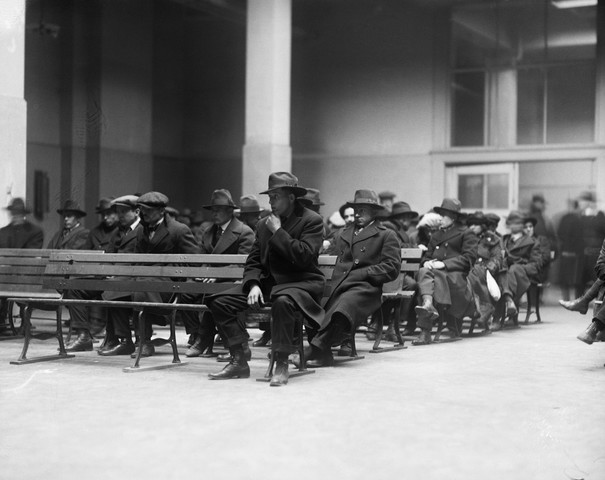

1920: The January raids and the reaction
The largest raids came on January 2, 1920, when, by the estimates collected in Britannica's account, between 3,000 and 10,000 people were arrested in more than 30 cities.9 The FBI's own history describes simultaneous raids in major cities in early January, with local police arresting "thousands of suspected anarchists."22 The arrests were sweeping and many were unlawful. Louis Post, the Acting Secretary of Labor, whose department controlled deportation, reversed more than 70 percent of the 1,600 deportation warrants that reached him.9 The raids drove both communist parties underground and cut their membership: the same reference that gives 60,000 for August 1919 gives about 7,000 for 1920, though it states that figure in a passage whose chronology is confused, so it is a rough indication only.3 In May 1920 a unity convention at Bridgman, Michigan, produced the United Communist Party.1
1921: The legal party
The underground parties merged under Comintern pressure at Woodstock, New York, in May 1921, and from December 23 to 26, 1921, a legal, above-ground Workers Party of America was founded in New York.1 For two years the movement had two faces: a secret party that answered to the Comintern and a public one that ran candidates and published newspapers. The Library of Congress exhibit says that in 1922 the Comintern forced the two American parties, then "about 12,000 members," to unite and follow the line set in Moscow.4
1922 to 1928: Bridgman, the merger and the first campaigns
On August 22, 1922, state and federal officers raided a secret party convention at Bridgman, Michigan.1 The underground party voted to liquidate itself into the legal one in April 1923.1 The party ran William Z. Foster for president in 1924 and won 35,361 votes.3 Its records from these years, shipped to Moscow and held in what is now the Russian State Archive of Social and Political History, include a 1926 memo explaining that "Different Soviet agencies subsidized different American Communist activities," in the words of the Library of Congress summary of the microfilm, and a 1924 Comintern letter confirming "a subsidy of $1,282 to send 10 black Americans" to school in Moscow.21
1929: Stalin settles an American quarrel
In 1929 the party's majority faction, led by Jay Lovestone, refused to accept a Comintern decision about its leadership. Stalin answered the American delegation in speeches of May 6 and May 14, 1929, telling them, "At present you still have a formal majority," and making clear that the Comintern, not that majority, would decide.23 Lovestone lost the leadership and was expelled (module 81, lesson 01). The episode is the cleanest early proof of who governed the American party, and it turned Lovestone into one of the most effective anti-communists in the American labor movement. William Z. Foster and Earl Browder led the party into the 1930s. Module 81's lesson 01 tells the Lovestone affair in detail.
Depression and Popular Front, 1930 to 1939
1930 to 1933: A small revolutionary party
The Depression gave the party its first real audience. William Z. Foster ran for president again in 1932 and won 102,991 votes, the party's best presidential result.3 Its membership stayed small all the same. The University of Washington project, working from party dues records, finds membership below 20,000 until 1933.20 Until 1935 it remained, in module 81's phrase, "small and openly revolutionary," and the change came only when Moscow changed the line.
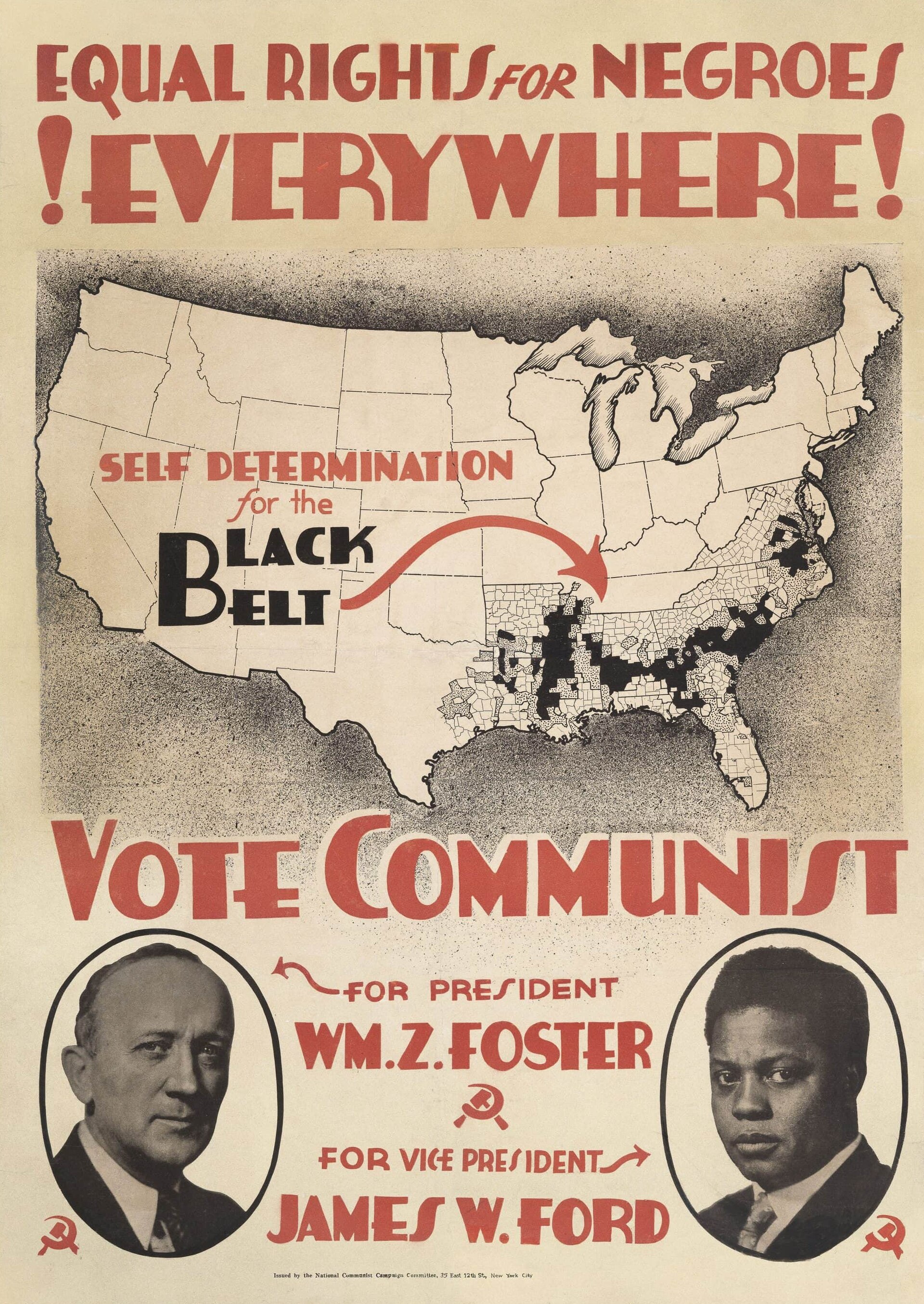

1934: The first House committee, and the Washington underground
On March 20, 1934, the House created a special committee under John McCormack of Massachusetts and Samuel Dickstein of New York to look into Nazi and "certain other" propaganda. Its report of February 15, 1935, found that the American Nazi movement took orders from Germany and, in a parallel finding, that the Communist Party of the United States was a section of the Communist International and took its direction from Moscow.2425 The same years saw the start of the secret side of the story. Whittaker Chambers, a courier for the party's underground who broke with it in 1938, later told HUAC that a group organized by Harold Ware among young New Deal officials had as its original purpose "the Communist infiltration of the American Government," with espionage as "one of its eventual objectives."26 Module 81's lesson 03 covers the committee and lesson 01 the Ware group; the members and handlers are in lesson 12.
1935: The Popular Front
At the Seventh World Congress of the Communist International in Moscow, Georgi Dimitrov gave the main report on August 2, 1935, calling on communists to build a common front against fascism with parties and groups they had attacked until then.27 In the United States the new line put communists into coalitions with people who were not communists: in the new industrial unions, civil rights campaigns, writers' and youth groups, and the campaign for the Spanish Republic. Many joined front groups without knowing who ran them. The Popular Front became the party's most successful period; the Library of Congress exhibit says membership "rose to about 75,000 by 1938."4 Lesson 11 of this module lists the front groups later named on the Justice Department's list.
1936 and 1937: Growth, and Browder's passports
Earl Browder, the party's leader through the Popular Front years, had been traveling on passports obtained by false statements, and he used them to re-enter the country in April 1937 and February 1938. Those re-entries became the counts on which he was convicted, a conviction the Supreme Court upheld on February 17, 1941.28 In Moscow the Great Terror was under way (lesson 02 gives the numbers).
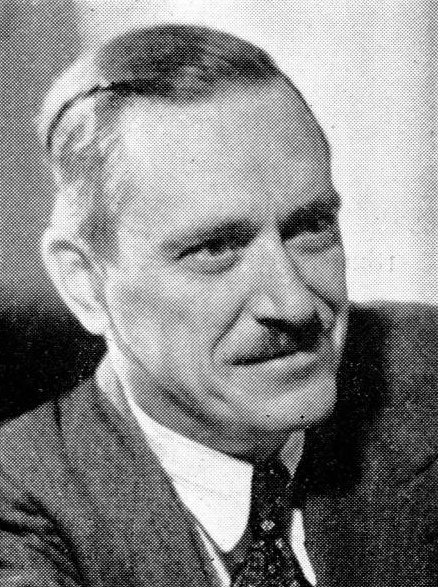

1938: The Dies committee and the registration law
On May 26, 1938, the House adopted House Resolution 282 creating the Special Committee on Un-American Activities, chaired from 1938 to 1944 by Martin Dies Jr. of Texas.25 Two weeks later, on June 8, the Foreign Agents Registration Act became law; it required agents of foreign principals to register and disclose their work, and it was the first law built on the 1935 committee's recommendations and it applied to Nazi and Soviet propagandists alike.2924 Module 81's lesson 06 sets the Dies committee beside its successors.
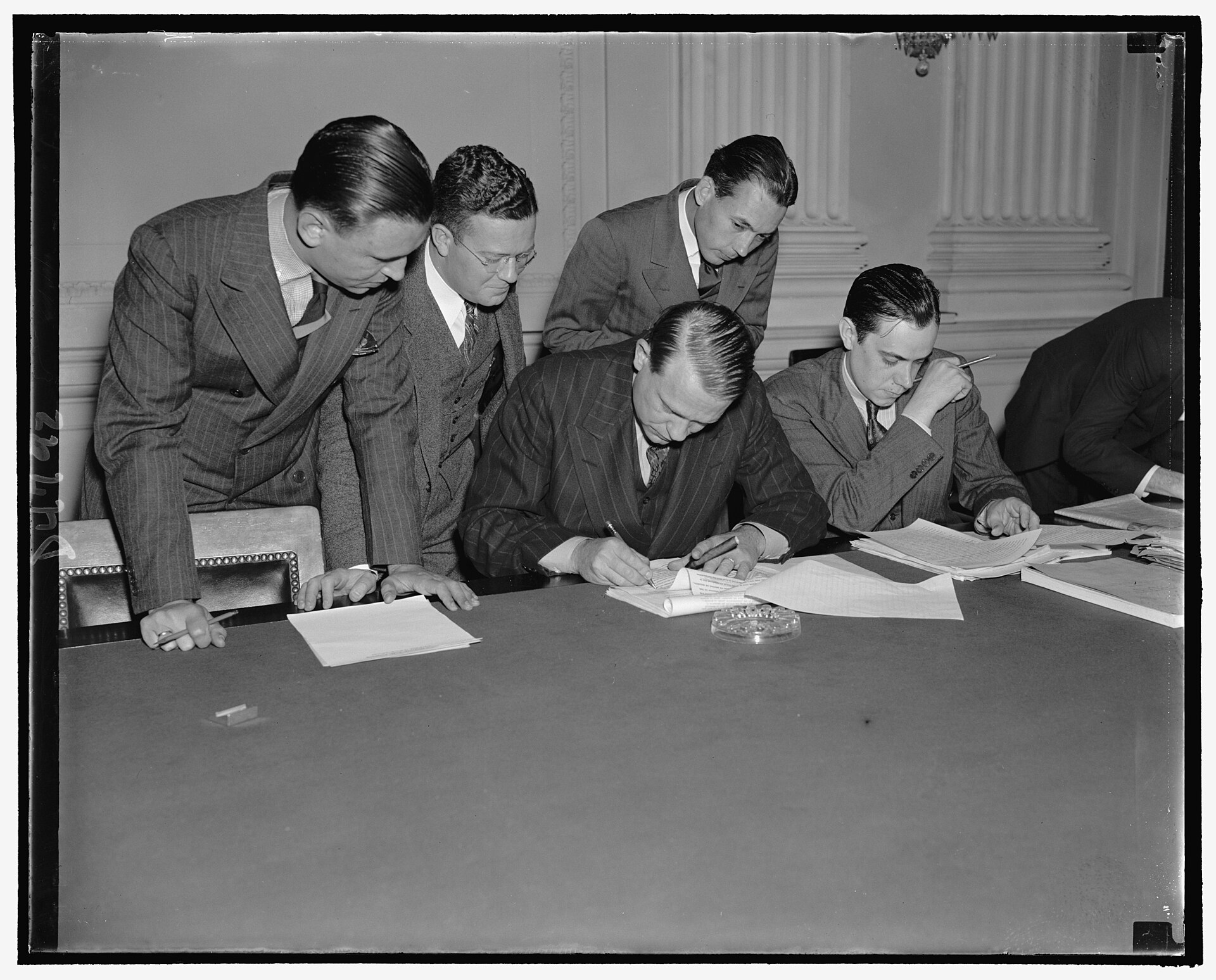

1939: The Hatch Act, the Pact and the break
The Hatch Act, approved August 2, 1939, made it unlawful for any federal employee "to have membership in any political party or organization which advocates the overthrow of our constitutional form of government in the United States."30 It was the first federal bar on communist membership in government service and the legal root of the later loyalty program. Three weeks later, on August 23, 1939, Germany and the Soviet Union signed their nonaggression treaty in Moscow, with a secret protocol dividing Eastern Europe between them.31 The American party dropped its anti-fascist campaign and called for American neutrality. The Library of Congress exhibit records that "many members left the party after the signing of the Nazi-Soviet Nonaggression Pact of 1939."4 The University of Washington count of registered members gives 66,000 for 1939, before the losses.20 In September 1939, days after the Pact, Chambers told Assistant Secretary of State Adolf Berle what he knew of the Washington underground; little was done with it for years (module 81, lesson 03).26
War and the turns of the line, 1940 to 1946
1940: The Smith Act
The Alien Registration Act, approved June 28, 1940, is remembered by the name of its author, Representative Howard Smith of Virginia. Title I made it a crime "to knowingly or willfully advocate, abet, advise, or teach the duty, necessity, desirability, or propriety of overthrowing or destroying any government in the United States by force or violence," and a crime to organize such a group or "to be or become a member of, or affiliate with, any such society, group, or assembly of persons, knowing the purposes thereof." The penalty was a fine of up to $10,000, up to ten years in prison, or both.10 The Act was written while the party was following the Pact line, and it would become the main weapon against the party's leaders after 1948. Module 81's lesson 03 covers the Act and its first uses.
1941: Browder in prison, and the line reverses
On February 17, 1941, the Supreme Court affirmed Browder's conviction for using fraudulently obtained passports, and he went to federal prison on a four-year sentence.2832 On June 22, 1941, Germany invaded the Soviet Union. The party's line reversed the same day. The clearest record is that of the American Peace Mobilization, a party-led group that had picketed the White House against aid to Britain; on June 22 it changed its name to the American People's Mobilization and began calling for aid to Britain and the Soviet Union, according to the historical note to the group's records at the Swarthmore College Peace Collection; module 81's lesson 01 quotes them.33 From then to the end of the war the party backed the war effort and the Roosevelt administration.
The turns of the line are easier to see in one picture. The diagram below sets out the five reversals of 1935 to 1946 and what drove each.
1942: Browder released
In 1942, with the Soviet Union now an ally, President Roosevelt commuted the four-year sentence Browder had received two years earlier.32 The commutation is a matter of record; the source cited here does not give Roosevelt's reasons.
1943: The Comintern dissolved, and Venona begins
On May 15, 1943, the Executive Committee of the Communist International proposed to its member parties that the International be dissolved, and it was wound up once they agreed.34 Dissolution changed the form more than the substance: Soviet money kept flowing to the American party for another forty-five years.6 Lesson 10 describes the Comintern and its successors. In February 1943 American Army codebreakers began the secret program later named Venona to read Soviet diplomatic and intelligence cables, the program that would identify many of the Soviet sources in the United States.7 Module 81's lesson 02 explains how it worked.
1944: The Communist Political Association
Browder carried the wartime line to its end. In May 1944 he dissolved the party and reconstituted it on May 22 as the Communist Political Association, on the theory that Soviet and American cooperation could continue after the war.35 Membership was at or near its peak: Frederick Chary gives a wartime peak of about 75,000, and the party's own claim, reported in a reference work cited in module 81, lesson 01, was about 80,000 at the start of 1944.35
1945: Duclos, Amerasia, Gouzenko and Bentley
The year 1945 opened the American story's second act. On January 3, 1945, the House made the Committee on Un-American Activities a standing committee by adopting John Rankin's amendment to the House rules, 208 to 186.36 In April 1945 the French communist Jacques Duclos published an article in Cahiers du Communisme attacking Browder's dissolution: "In truth, nothing justifies the dissolution of the American Communist Party, in our opinion."37 American communists read the article as Moscow speaking, and the archives later proved them right: Tanenhaus reports that page proofs of a Russian version of the article carry corrections by officials in Moscow.6 At a convention in July 1945 the party was reconstituted and Browder was denied a seat on its national committee; William Z. Foster was put back at the head of the party.3235
The espionage cases began to break the same year. In June 1945 the FBI arrested Philip Jaffe, editor of the magazine Amerasia, and five others after classified government reports turned up in the magazine's files; the case ended with a guilty plea and a no-contest plea on a charge of unauthorized possession of government documents, and no trial.38 On September 5, 1945, Igor Gouzenko, a cipher clerk at the Soviet embassy in Ottawa, walked out for the last time with documents on Soviet espionage in Canada; the Royal Canadian Mounted Police later arrested 39 suspects, and 18 were convicted.39 In November 1945 Elizabeth Bentley, a courier for Soviet intelligence, confessed to the FBI and named her contacts, setting off what Michael Warner of the CIA History Staff calls an 18-month effort against them.40 Module 81's lesson 01 tells all three stories and lesson 07 follows the Amerasia case to John Stewart Service and McCarthy.
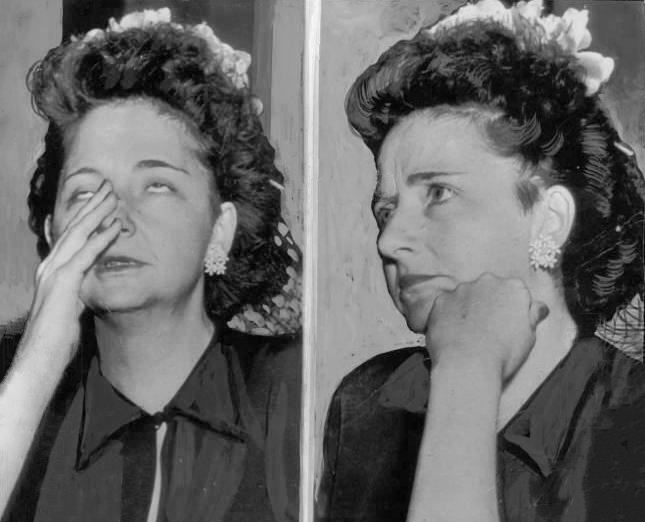

1946: Browder expelled
The party's National Board met Browder on February 5, 1946, and expelled him; its decision ran in the Daily Worker on February 7. Browder appealed to the National Committee on February 8, protesting the decision "expelling me from membership in the Party," without success.4132 Abroad, Winston Churchill gave his "iron curtain" address at Fulton, Missouri, on March 5, 1946 (lesson 03).
The machinery is built, 1947 to 1950
1947: The loyalty order, Taft-Hartley, Hollywood and the list
On March 21, 1947, President Truman signed Executive Order 9835, which put every federal employee and applicant through a loyalty investigation and set up loyalty boards to hear cases.11 On June 23, 1947, the Labor Management Relations Act, the Taft-Hartley Act, became law; its section 9(h) required union officers to file affidavits that they were not Communist Party members before their unions could use the National Labor Relations Board (module 81, lesson 01, quotes the section from the Supreme Court's 1950 opinion upholding it).42 The University of Washington count puts party membership above 75,000 at the start of 1947, the last high point before the long decline.20
In October 1947 HUAC held hearings on communism in the motion picture industry. Ten screenwriters and directors refused to say whether they were party members, and the House cited them for contempt on November 24, 1947; the vote on Albert Maltz was 346 to 17.43 The next day the studio heads issued the Waldorf Statement, pledging not to knowingly employ communists (module 81, lesson 03, quotes it from its source). John Howard Lawson and Dalton Trumbo were tried in April and May 1948, and the other eight in 1950 after the appeals in the first two cases failed; eight of the Ten received a year in prison and a $1,000 fine, and Herbert Biberman and Edward Dmytryk six months and $500.44 In December 1947 the Justice Department made public its list of subversive organizations for use in the loyalty program: about 90 groups, 47 of them designated earlier under Roosevelt. Robert Justin Goldstein, writing in the National Archives' journal Prologue, describes how publication turned a screening tool into what amounted to "an official black list."45 Lesson 11 of this module describes the groups on it.
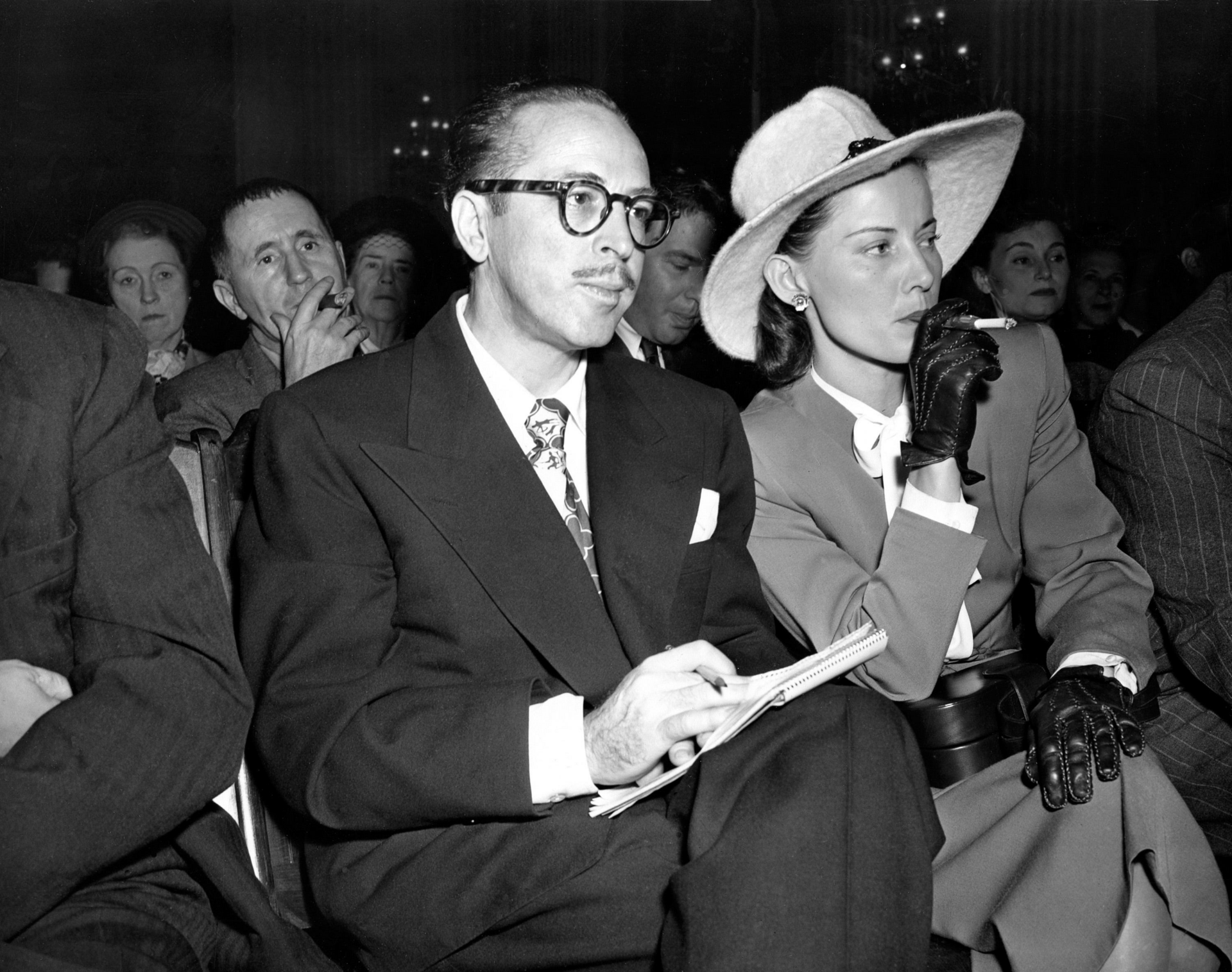

1948: Mundt-Nixon, the indictments, Bentley, Chambers and Wallace
On May 19, 1948, the House passed the Mundt-Nixon bill, which would have required communist organizations to register, by 319 to 58; it died in the Senate and returned two years later inside the McCarran Act.43 In July 1948 a federal grand jury in New York indicted the party's national leaders under the Smith Act for conspiring to teach and advocate the overthrow of the government.15 On July 31 Elizabeth Bentley testified in public before HUAC, and on August 3 Whittaker Chambers named Alger Hiss, among others, as a member of the Ware group.26 Hiss denied it. In early December Chambers produced the microfilm known as the Pumpkin Papers, and Hiss was charged with perjury, because, as the FBI's history notes, the statute of limitations had run out on espionage.46 Module 81's lesson 03 tells the Hiss case in full.
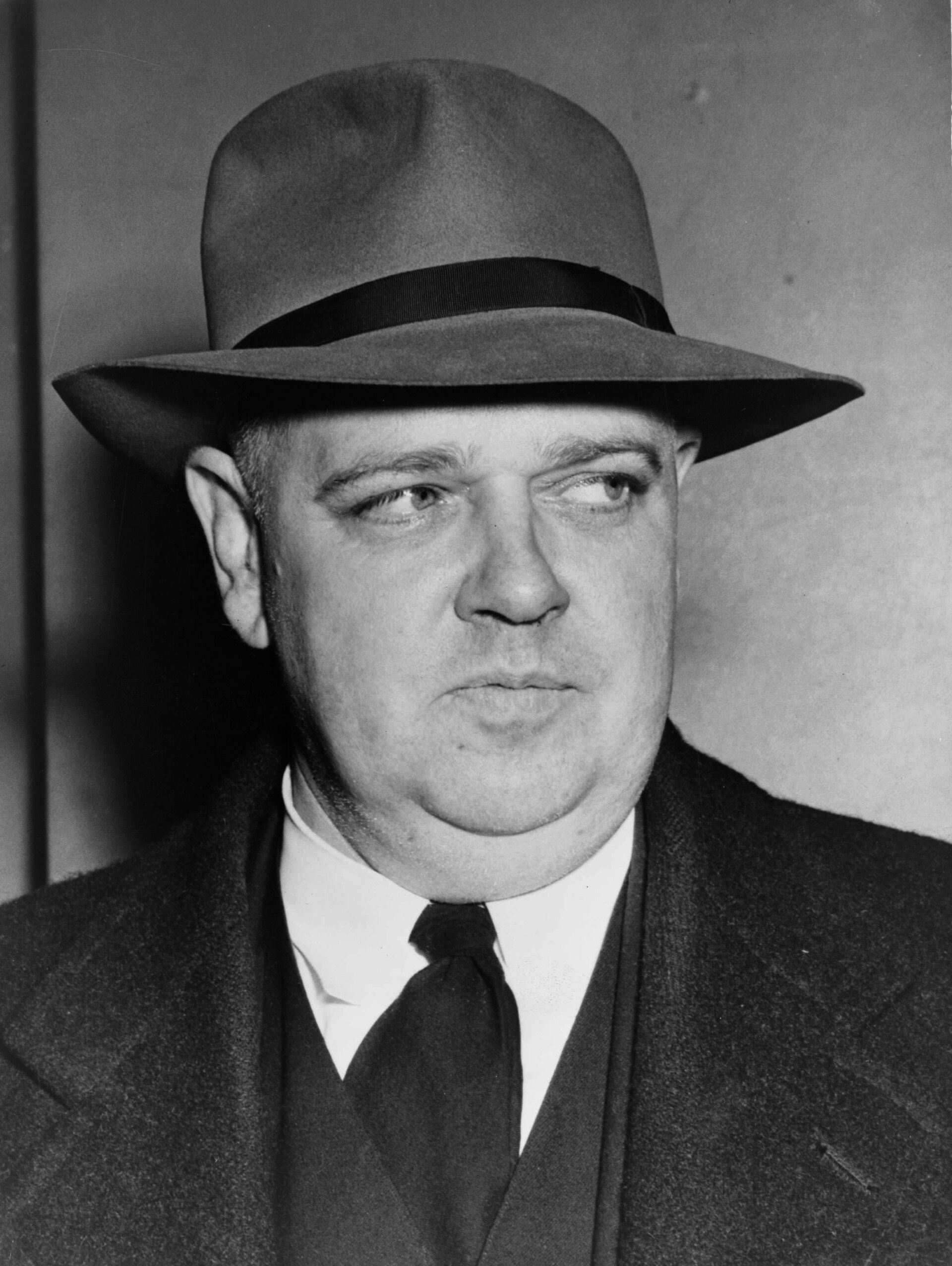

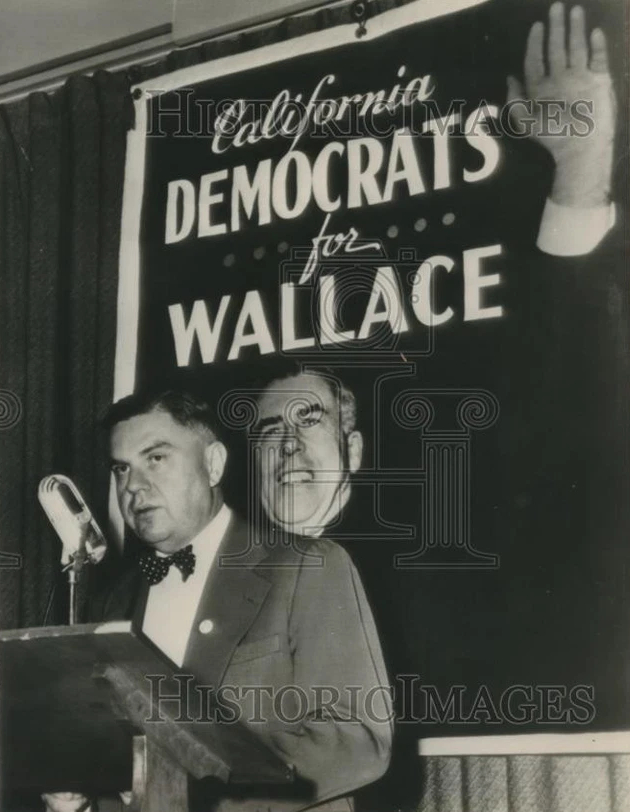
The presidential election of November 1948 was the party's last attempt at mass politics. Henry A. Wallace, Roosevelt's former vice president, ran on a new Progressive Party ticket that the Communist Party endorsed and helped to build; his failure to repudiate that support hurt him with voters.47 Wallace won 1,156,103 votes by Britannica's table, about 13,000 fewer than Strom Thurmond's 1,169,114, against 24,105,810 for Truman.4849 Idaho's Senator Glen Taylor was Wallace's running mate; module 74, lesson 06, tells his story and what the record does and does not show about him. The sources cited here describe party endorsement and organizing help, which is evidence of association; none of them makes Wallace a party member.

1949: Foley Square, Coplon and the CIO
The Smith Act trial of eleven party leaders opened at the Foley Square courthouse in New York on January 17, 1949, ran nine months, and ended in guilty verdicts on October 14, 1949.15 The case was for conspiracy to teach and advocate overthrow; no defendant was charged with espionage. The party's chairman, William Z. Foster, was indicted with the others but severed from the trial for ill health (module 81, lesson 03). On March 4, 1949, the FBI arrested Judith Coplon, a Justice Department analyst, in the first prosecution that grew out of Venona leads (module 81, lesson 02). The first Hiss trial ended in a hung jury.46
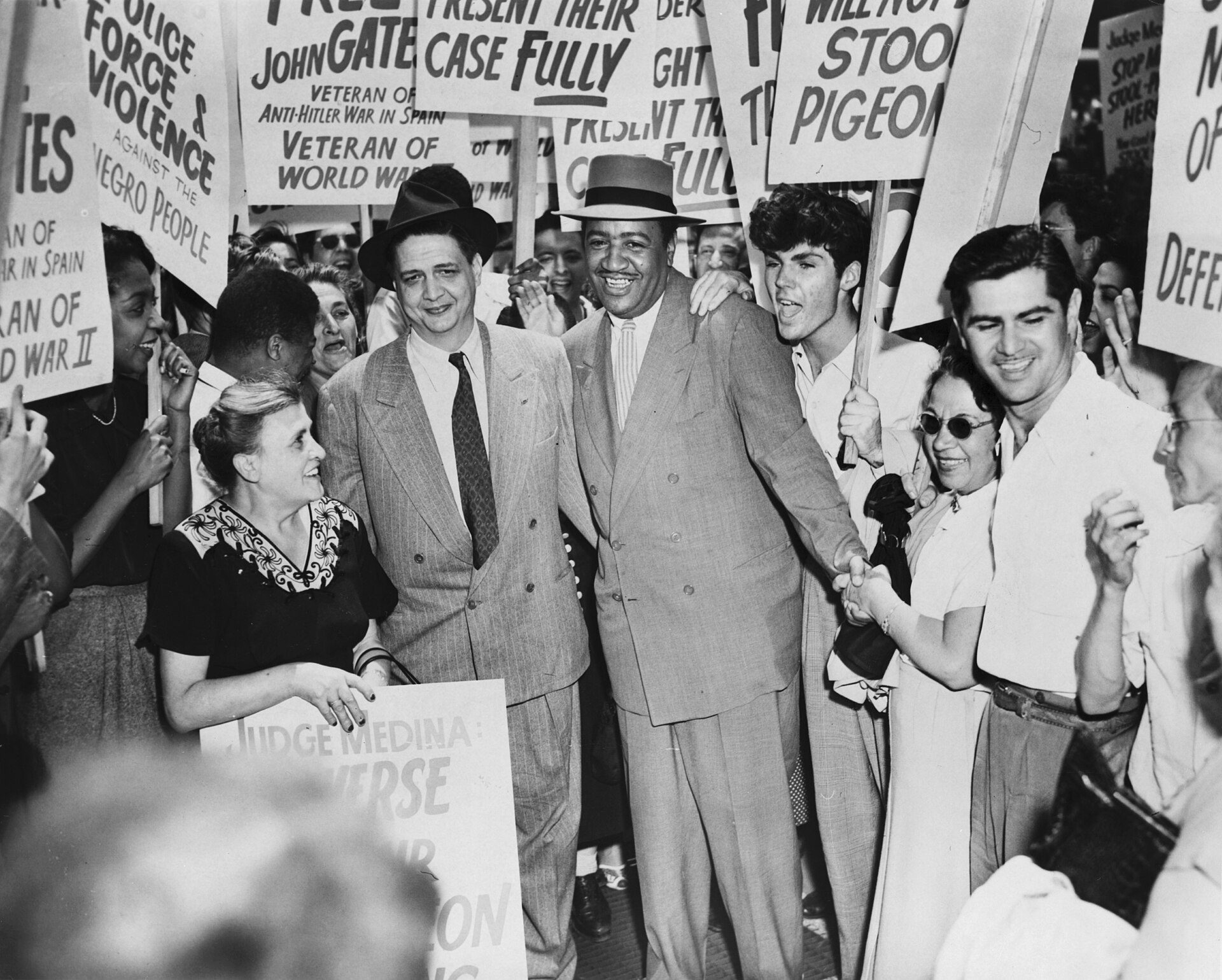

The labor movement acted on its own. At its convention in Cleveland from October 31 to November 4, 1949, the Congress of Industrial Organizations revoked the charters of the United Electrical Workers and the Farm Equipment Workers and expelled them; a new rival union for electrical workers was formed on November 2.50 Within a year nine more affiliates were expelled, and the eleven unions together represented about one million members.51 The CIO purge was carried out by anti-communist unionists, not by the government, and it did more than any statute to end the party's influence in organized labor. Lesson 11 names the eleven unions.
1950: Hiss, Fuchs, Wheeling, the Rosenbergs and the McCarran Act
The year that gave McCarthy his opening was crowded. On January 21, 1950, a second jury convicted Alger Hiss on two counts of perjury, and he was sentenced to five years.46 In Britain, the physicist Klaus Fuchs confessed to atomic espionage early in the year (lesson 12 and module 81, lesson 01). On February 9, 1950, Senator Joseph McCarthy of Wisconsin gave a Lincoln Day address in Wheeling, West Virginia, claiming to have a list of known communists still working in the State Department.52 Module 81's lesson 05 takes up the speech, the numbers and the Tydings subcommittee. The Senate Historical Office has noted that the word "McCarthyism," coined by the cartoonist Herblock in 1950, came to cover all the congressional investigations of communists, including HUAC's and the Senate Internal Security Subcommittee's, which had no direct connection to McCarthy's own subcommittee.53
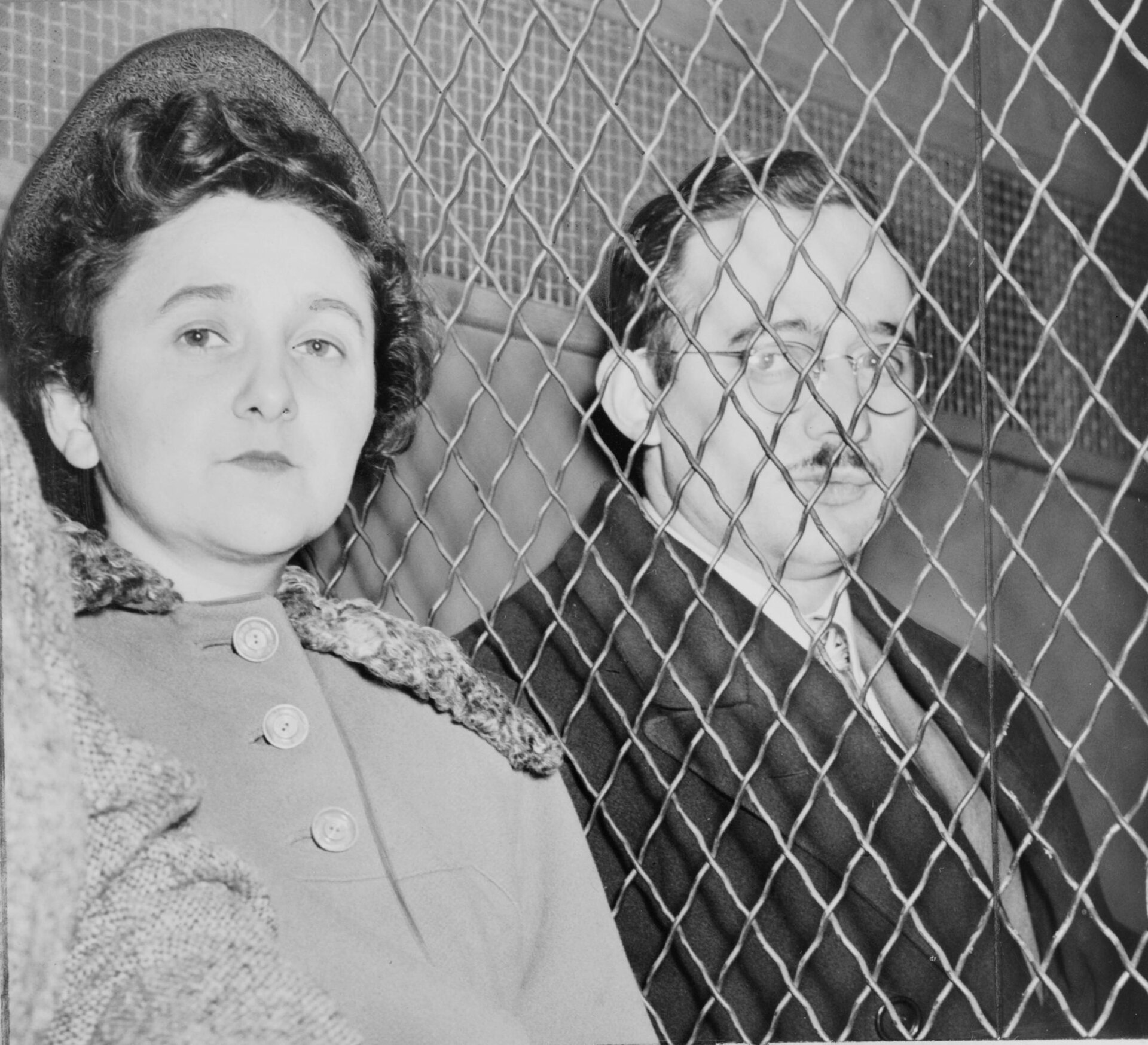
Harry Gold confessed on May 22, 1950. David Greenglass was arraigned on June 16, Julius Rosenberg arrested on July 17 and Ethel Rosenberg on August 11.54 The Korean War began on June 25 (module 81, lesson 01). On September 22 Truman vetoed the Internal Security Act, writing, "H.R. 9490 would not hurt the communists. Instead, it would help them." Congress overrode him the next day.5543 The law created the Subversive Activities Control Board, required communist organizations to register, and in Title II authorized detention of suspected saboteurs and spies in a declared internal security emergency.12 Party membership, by the figure Time printed in 1953, was about 54,000 in 1950.5
The height and the turn, 1951 to 1959
1951: Dennis upheld, the Rosenbergs sentenced
The Rosenberg trial opened on March 6, 1951. On March 29 the jury found Julius and Ethel Rosenberg and Morton Sobell guilty, and on April 5 the Rosenbergs were sentenced to death and Sobell to thirty years; David Greenglass, Ethel's brother and the government's main witness, received fifteen years after pleading guilty.54 On June 4, 1951, the Supreme Court upheld the Smith Act convictions in Dennis v. United States. Chief Justice Fred Vinson adopted the test Judge Learned Hand had written for the court of appeals: courts must ask whether "the gravity of the 'evil,' discounted by its improbability, justifies such invasion of free speech" as is needed to avoid the danger.15 Module 81's lesson 09 covers Dennis and its successors.

1952: The party goes partly underground
Time reported in January 1953 that the party's open membership "is down to less than 30,000."5 The Senate Internal Security Subcommittee under Pat McCarran finished its hearings on the Institute of Pacific Relations in June 1952 (module 81, lesson 07).
1953: McCarthy's chairmanship, the security order and the executions
With the new Congress in January 1953 McCarthy became chairman of the Permanent Subcommittee on Investigations.52 On April 27, 1953, President Eisenhower signed Executive Order 10450, which replaced the Truman loyalty standard with a broader security standard: employment had to be "clearly consistent with the interests of the national security."56 Julius and Ethel Rosenberg were executed at Sing Sing on June 19, 1953, Julius at 8:05 p.m. and Ethel at 8:15 p.m.54 What Venona and later admissions show about each of them is set out in lesson 12 and module 81, lesson 10. In short: the evidence that Julius ran a spy ring is now overwhelming, and the evidence on Ethel supports knowledge and some help, not the central role for which she was executed, a reading Ronald Radosh and Joyce Milton set out in The Rosenberg File (1983).578
1954: Army-McCarthy, the Communist Control Act and the censure
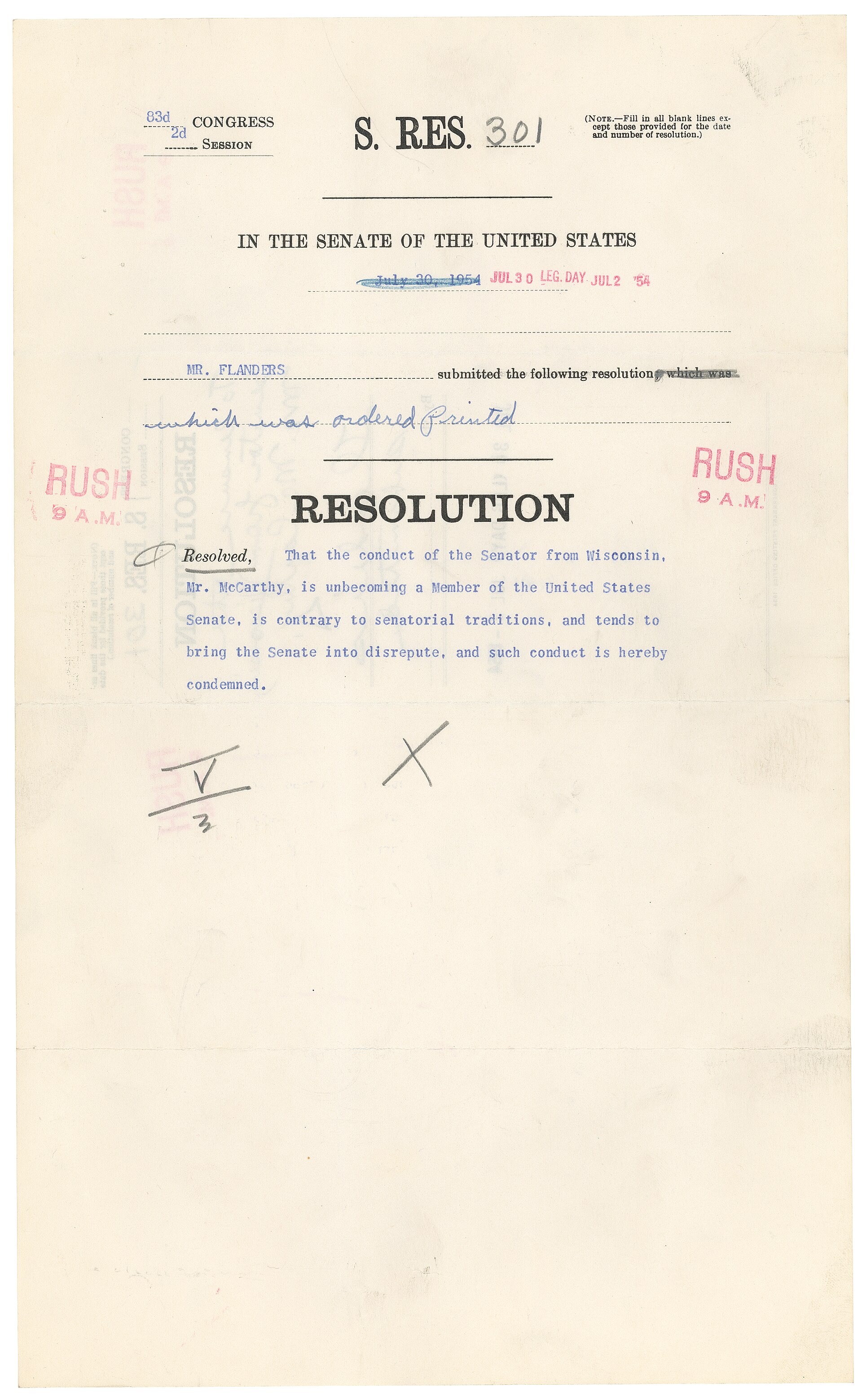
The Army-McCarthy inquiry ran from March 16 to June 17, 1954, by the Senate Historical Office's dating, which counts the subcommittee's closed session of March 16; the televised public hearings opened on April 22 (module 81, lesson 08).58 On August 2 the Senate sent a censure resolution to a select committee under Arthur Watkins of Utah.13 On August 24 Congress passed the Communist Control Act, declaring that the Communist Party, "although purportedly a political party," "is in fact an instrumentality of a conspiracy to overthrow the Government of the United States," and stripping it of the rights, privileges and immunities of legal bodies.59 On December 2, 1954, the Senate voted 67 to 22 to censure McCarthy.13 Module 81's lesson 08 and lesson 09 tell the fall.

1955: The decline shows
The FBI estimated that by the end of 1955 party membership was down to about 20,000, a figure reported by the American Jewish Committee's study of the party at the end of 1956.60 That figure comes before the events of 1956: the party had already lost more than half its 1950 membership during the years of prosecution, the CIO expulsions and the security programs.
1956: Khrushchev, Hungary and COINTELPRO
On February 25, 1956, Nikita Khrushchev told a closed session of the Twentieth Congress of the Soviet Communist Party of Stalin's crimes, in the speech "On the Cult of Personality and Its Consequences."61 The American party's paper was slow to face it: the American Jewish Committee study notes that "it was not until March 13 that the Daily Worker acknowledged the Soviet attacks on Stalin."60 In the same study, the editor John Gates accepted the criticism of Stalin, while William Z. Foster tried to defend Stalin against Khrushchev. When Soviet troops crushed the Hungarian revolution in November, the party's National Committee divided. Its open letter of November 19, 1956, called the first use of Soviet troops, at the request of the Hungarian party leader Erno Gero in October, "a tragic error for which the Soviet Union must also take responsibility," while justifying the November intervention against the Nagy government, and the members split over it.60 On April 2, 1956, the Supreme Court held in Pennsylvania v. Nelson that the federal Smith Act pre-empted Pennsylvania's sedition law.62 The same year the FBI began COINTELPRO, a counterintelligence program "to disrupt the activities of the Communist Party of the United States."14
1957: Red Monday and the collapse
On June 17, 1957, the Supreme Court decided three cases against the government. Yates v. United States held that the Smith Act reached advocacy of action toward overthrow and not advocacy of abstract doctrine, and it ordered five of the California defendants acquitted and nine retried.63 Watkins v. United States reversed a contempt conviction because HUAC had not made clear what its inquiry was about, with Chief Justice Earl Warren writing, "We have no doubt that there is no congressional power to expose for the sake of exposure."64 Service v. Dulles, the same day,65 set aside the State Department's discharge of John Stewart Service because the department had not followed its own regulations (module 81, lesson 07). Membership fell to about 10,000 by 1957.3 The Library of Congress exhibit puts it simply: "Others left in 1956 after Nikita Khrushchev exposed some of Stalin's crimes and Soviet forces invaded Hungary."4
1958 and 1959: Barenblatt, and Gus Hall takes over
The Court did not keep moving in one direction. On June 8, 1959, it upheld by 5 to 4, in Barenblatt v. United States, the contempt conviction of a former university teacher who had refused to answer HUAC's questions about party membership, holding that the government's interest outweighed his interest in keeping his associations private.66 In 1959 Gus Hall, who had been convicted with the other leaders in 1949 and served five years at Leavenworth, was elected the party's general secretary.67

The long decline, 1960 to 1991
1961: The registration case and Scales
On June 5, 1961, the Supreme Court decided two cases on the same day. In Communist Party v. Subversive Activities Control Board it upheld the Board's order requiring the party to register as a "Communist-action organization," holding that an organization can be controlled by a foreign power through sustained voluntary compliance, without any power to compel obedience.68 In Scales v. United States it upheld the Smith Act's membership clause, but only as applied to active members who knew the party's illegal aims and specifically intended to further them.69 The government won both cases, but Scales narrowed the membership clause to active members with specific intent.
1962 to 1965: Passports and registration struck down
The registration scheme then failed on its own terms. On June 22, 1964, in Aptheker v. Secretary of State, the Court struck down section 6 of the Subversive Activities Control Act, which denied passports to members of registered communist organizations, because it "too broadly and indiscriminately restricts the right to travel."70 On November 15, 1965, in Albertson v. Subversive Activities Control Board, it held that ordering individual members to register violated the Fifth Amendment privilege against self-incrimination, because the forms compelled admissions that could be used to prosecute them.71
1966 to 1969: Brandenburg and the end of HUAC's name
On June 9, 1969, in Brandenburg v. Ohio, a Ku Klux Klan case, the Court held that a state may not forbid advocacy of force "except where such advocacy is directed to inciting or producing imminent lawless action" and is likely to produce it, and it overruled Whitney v. California (1927).72 The same year the House renamed HUAC the Committee on Internal Security.73 The courts' path from Dennis to Brandenburg is drawn in the chart below.
1970 to 1975: COINTELPRO ends, the committee abolished
The FBI had extended COINTELPRO beyond the party to the Ku Klux Klan, the Socialist Workers Party and the Black Panther Party, among others; all COINTELPRO operations ended in 1971.14 In 1975 the House abolished the Committee on Internal Security and moved its jurisdiction to the Judiciary Committee, ending the line that ran from the Dies committee of 1938.73
1976 to 1986: Hall's campaigns and the hidden subsidy
Gus Hall ran for president in 1976, winning 58,992 votes, and ran again in 1980 and 1984 with Angela Davis as his running mate.367 In public the party presented itself as a small American party. In private it remained on Moscow's payroll. The Soviet files reviewed by Klehr, Haynes and Kyrill Anderson, as Tanenhaus summarized them, show Moscow still paying the party in the late 1980s.6
1987 to 1989: The last payments
In 1987 Hall wrote to the Soviet official Anatoly Dobrynin making the case for the party's annual stipend "to be doubled, to $4 million." In 1988 Moscow gave him three million dollars. "It was the last such contribution the Party got," Tanenhaus writes, and "When Hall denounced the Gorbachev reforms a year later, the handouts stopped altogether."6 That puts the end of Soviet funding in 1989, seventy years after the jewels given to John Reed.
1990 and 1991: The end of the patron
On December 25, 1991, Mikhail Gorbachev resigned as president of the Soviet Union, and the Soviet flag was lowered over the Kremlin for the last time.2 The Library of Congress exhibit records that after the collapse the archives of the Soviet party revealed "the continued financial as well as ideological dependency of the American Communists on the Soviet party."4 The American party's own records, shipped secretly to Moscow over the decades, were filmed for the Library of Congress; the microfilm runs to 435,165 frames on 326 reels.21 The NSA released the first of six batches of Venona translations in July 1995, about 3,000 in all.7 What those records show is the subject of module 81, lesson 02, and of lesson 04 of this module, which carries the story of the archives and of the parties that remain into 2026.
How large was the party?
The chart below gathers the membership figures this lesson could trace to a source, from the party's founding claim of 1919 to the FBI's estimate of 1955 and the reference figure for 1957. It shows ranges where sources differ, and it marks which figures are the party's claims, which are counts from party records, and which are outside estimates.
Three cautions apply. The 1919 figure is a claim made in the first weeks, before the raids. The figures for 1922 to 1950 rest on party records the Library of Congress and the University of Washington project worked from, which count dues payers or registered members and may undercount.420 The figures after 1950 are outside estimates, by the FBI and the press, of a party that was hiding part of its membership.560 Read together they show a party that was never large, that grew fastest when it hid its aims under the Popular Front and during the wartime alliance, and that lost most of its members between 1950 and 1957.
What the record shows and what it does not
Documented fact. The party was founded in September 1919 in two pieces, merged under Comintern pressure, and accepted Moscow's ruling on its own leadership in 1929 and again in 1945 and 1946.1233741 Congress passed the Hatch Act (1939), the Smith Act (1940), the Internal Security Act (1950) and the Communist Control Act (1954); the Supreme Court upheld the Smith Act in 1951 and narrowed it in 1957 and 1961.30101259156369
In their own words. Duclos in April 1945: "In truth, nothing justifies the dissolution of the American Communist Party, in our opinion."37 Truman in September 1950: "H.R. 9490 would not hurt the communists. Instead, it would help them."55 Congress in August 1954: the party "is in fact an instrumentality of a conspiracy to overthrow the Government of the United States."59
The accusation. From the McCormack-Dickstein report of 1935 to the findings of the 1950 and 1954 Acts, the charge against the party was foreign direction and a secret apparatus.241259
The archive evidence. The Moscow files show money from 1919 to 1988 and direction throughout; Venona shows that the party's secret apparatus supplied Soviet intelligence with American sources in the 1930s and 1940s.62178
The scholarly reading. Haynes and Klehr read the files as proof that the party was a Soviet instrument and a recruiting pool for espionage.8 Schrecker accepts the major espionage cases but holds that the response did more damage to American institutions than the party did.16 Allen Weinstein and Alexander Vassiliev (The Haunted Wood, 1999) and Haynes, Klehr and Vassiliev (Spies, 2009) add the KGB file notes to the Venona record.74
Open questions. Exact membership in any year; how many members knew of the secret apparatus; and how much the government's actions, as against the party's own reversals and the 1956 revelations, caused the collapse of 1950 to 1957.
Claims checked
Each claim below is common in books, films, websites and speeches about the period. Each is rated on the evidence available in 2026.
"The Communist Party of the United States was an American party like any other." Refuted.
The party's founding was urged from Moscow, its money came from Moscow from 1919 to 1988, and its leadership was set by Moscow in 1929 and 1945.2162337 Klehr, Haynes and Anderson concluded from the files, as Tanenhaus quotes them, that "the American Communist party was a creature of the Comintern and, through it, of the Soviet Union."6 Its members included many Americans who joined for domestic reasons; that is a fact about the members, not about how the party was run.
"The Palmer Raids broke American communism in 1920." Partly supported.
The raids drove both parties underground and the membership claimed for 1919 fell to about 7,000 by 1920.39 The movement regrouped as a legal party by December 1921 and reached about 75,000 members by 1938.14 The raids also arrested thousands who were not communists, and the Labor Department reversed most of the deportation warrants it reviewed.9
"Communist Party members were Soviet spies." Refuted as a general claim; supported for a subset.
Most of the tens of thousands who passed through the party had no part in espionage. A smaller group in the secret apparatus did work for Soviet intelligence, and Venona and the KGB file notes identify many of them by cover name.874 Lesson 12 and module 81, lesson 02, give the names and the basis for each.
"McCarthy started the Red Scare." Refuted.
By the time of Wheeling in February 1950 the House had investigated communist propaganda in 1934 and 1935 and had kept a committee on un-American activities since 1938, the Hatch Act and Smith Act were about ten years old, the loyalty program had run for three years, the Hollywood Ten had been cited, the party leaders had been convicted and Hiss had been convicted.24301011431546 McCarthy's chairmanship of the Permanent Subcommittee on Investigations began only in 1953.52 Module 81, lesson 03, makes this case in full.
"The Smith Act defendants were convicted of spying." Refuted.
The charge in Dennis was conspiracy to organize the party as a group to teach and advocate overthrow of the government by force and violence, and to teach and advocate it.15 No Smith Act defendant in the 1949 trial was charged with espionage. The spies of the period were prosecuted under other laws or, like Hiss, for perjury.4654
"The Supreme Court struck down the anti-communist laws in 1957." Partly supported.
Yates and Watkins narrowed the Smith Act and the committees' power in 1957, but the Court upheld HUAC's questioning in Barenblatt (1959) and the registration order and membership clause in 1961.6364666869 The registration scheme fell only in 1964 and 1965, and the general advocacy rule changed only with Brandenburg in 1969.707172
"Soviet money for the American party ended with Stalin." Refuted.
The last payment, $3 million, was made in 1988, and the money stopped after Hall denounced Gorbachev's reforms.6
"Khrushchev's speech and Hungary emptied the party." Supported, with a qualification.
Membership fell from about 20,000 at the end of 1955 to about 10,000 by 1957, and the Library of Congress exhibit names 1956 as a year of mass departures.6034 The qualification is that the party had already fallen from about 54,000 in 1950 to about 20,000 before the speech.560
"Henry Wallace's 1948 campaign was a communist operation." Partly supported.
The party endorsed Wallace and helped organize the Progressive campaign, and his refusal to repudiate that support hurt him.47 None of the sources cited here makes Wallace himself a party member, and his 1,156,103 votes are not a count of communists.48 The claim is about association; it says nothing about membership or espionage.
"COINTELPRO was aimed only at communists." Refuted.
It began in 1956 against the Communist Party and was later extended to the Ku Klux Klan, the Socialist Workers Party and the Black Panther Party, among other groups, until all operations ended in 1971.14
Hard questions and answers
If the party never had more than about 90,000 members, why did it matter?
An anti-communist of the period would give three answers, and the record supports all three. The party was directed and paid by a foreign power that became an adversary after 1945.6 Its secret apparatus supplied Soviet intelligence with sources inside the government and the atomic project.854 And it held influence far beyond its numbers through the unions: the eleven CIO unions expelled in 1949 and 1950 represented about one million members.51 A historian such as Schrecker would add that its small size is also why the response looks out of proportion.16
Did the Smith Act punish people for what they believed?
A civil liberties advocate would say yes in practice: the 1949 defendants were convicted for teaching and advocating a doctrine, not for any act of violence, and Yates and Brandenburg later moved the line toward incitement to action.156372 The government's answer in 1949, accepted by the Court in 1951, was that the party was a disciplined conspiracy directed from abroad and that the danger of an organized attempt justified acting before it began.15 The archives settled the question of direction in the government's favor; they did not settle whether a criminal trial for advocacy was the right tool.
Was Browder's dissolution of the party in 1944 a sign that American communists could act on their own?
It looked like it for a year. The Duclos article of April 1945, which the archives show was corrected in Moscow, reversed the decision, removed Browder from the leadership by July and led to his expulsion in February 1946.3763241 The episode is evidence of the opposite.
What caused the collapse of the 1950s: the government or the party itself?
Both, in sequence. The fall from about 54,000 in 1950 to about 20,000 at the end of 1955 came during the prosecutions, the loss of the CIO unions and the security programs.56051 The fall from about 20,000 to about 10,000 came after Khrushchev's speech and Hungary, when members learned from Moscow itself what they had defended.60361 Haynes and Klehr give more weight to the party's own failures; Schrecker gives more to the repression.816
Why does this timeline run for thirty-seven years after McCarthy's censure?
Because most of the legal story and all of the money story came later. The registration fight ran until 1965, the advocacy rule changed in 1969, COINTELPRO ran from 1956 to 1971, HUAC's successor lasted until 1975, and Soviet money flowed until 1988.717214736 McCarthy is four years of a seventy-two-year record.
How should a reader treat membership numbers from the period?
As estimates with a known bias. Party claims ran high, dues counts ran low, and FBI figures after 1950 measured a party that hid part of itself.20560 The safe practice is to give the source with every number, as this lesson does, and to compare figures only from the same kind of source.
Related reading on this site
- Module 81: 01, why the fear was real; 02, Venona and the archives; 03, the machinery before McCarthy; 04, McCarthy's early life; 05, Wheeling; 06, the three committees; 07, the cases; 08, the Army-McCarthy hearings; 09, censure and the courts; 10, what it cost; 11, the assertions assessed; 12, method versus mission; 13, foreign influence in 2026; 14, a reporter's guide.
- This module: 04, world communism since 1991; 11, American groups; 12, spy networks and cover names; 13, glossary; 14, numbers and sources.
- Other modules: module 51, lesson 07, communism as an economic system; module 52, ordered liberty; module 74, lesson 04, communists in Idaho; module 74, lesson 06, Glen Taylor and Herman Welker.
Still open
These items could not be confirmed against a primary source before publication. The lesson states them as open, and they stay on the fact-check list.
- The membership figure of 60,000 for August 1919 comes from West's Encyclopedia of American Law, which dates it before the founding conventions of September 1919; it can only reflect the claimed strength of the factions and is not checked against party records.
- The party's claim of about 80,000 members at the start of 1944 is taken from module 81, lesson 01 (which cites a 1973 reference work); it was not reopened for this lesson.
- Wallace's 1948 vote is given as 1,156,103 from Britannica's table; other tallies (for example 1,157,328) differ slightly and no official recapitulation was opened.
- Glen Taylor's place as Wallace's 1948 running mate is stated from module 74, lesson 06; the Congress biographical directory could not be fetched.
- The House roll-call figures (Maltz contempt 346 to 17; Mundt-Nixon 319 to 58; McCarran override 286 to 48 and 57 to 10 in the Senate) are taken from module 81, lesson 03's Voteview compilation and were not reopened.
- The HUAC hearing record (Bentley on July 31 and Chambers on August 3, 1948) and the quotations from Chambers's testimony are taken from module 81's reading of the hearings; the volume was not reopened for this lesson.
- The 1935 McCormack-Dickstein findings and the 1934 and 1938 House resolutions are as summarized in module 81, lesson 03, not reopened.
- The exact day of Roosevelt's 1942 commutation of Browder's sentence (often given as May 16, 1942) was not confirmed; only the year is stated.
- The exact dates in 1969 (renaming of HUAC) and 1975 (abolition of the Committee on Internal Security) were not confirmed; the National Archives guide gives only the years.
- Membership figures after 1950 (Time's 54,000 for 1950 and under 30,000 for 1952; the FBI's 20,000 for 1955; about 10,000 for 1957) are outside estimates, not party records.
- West's Encyclopedia of American Law gives 7,000 members for 1920 in a passage whose order of events is confused (it places the figure after events of 1924 and later); the figure was not checked against party records. Its presidential vote totals (William Z. Foster 102,991 in 1932 and 35,361 in 1924; Hall 58,992 in 1976) differ from other published tallies and no official count was opened.
- The date of the National Committee's open letter on Hungary (November 19, 1956) and the reference to Gero are from the American Jewish Committee study (1956), a contemporary secondary report, not the party's own text.
Learn more
- Library of Congress, Revelations from the Russian Archives: The 1992 exhibit that first showed Americans the Comintern files on their own communist party.
- Sam Tanenhaus, "Keeping the Faith" (1998): A clear review of what the Soviet files show about money and direction, from John Reed to Gus Hall.
- Dennis v. United States (1951): The opinion and the dissents of Justices Black and Douglas, the best single text on the Smith Act debate.
- Yates v. United States (1957): How the Court separated advocacy of doctrine from advocacy of action six years after Dennis.
- Truman, Veto of the Internal Security Bill (1950): A president who built the loyalty program explains why he thought Congress went too far.
- Appeal of Earl Browder (1946): The expelled leader's own account of his fall, a primary source on how the party disciplined its leaders.
- American Jewish Committee, The Communist Party, U.S.A., in Crisis (1956): A contemporary account of the party's reaction to Khrushchev's speech and Hungary.
- FBI Vault: COINTELPRO: The FBI's released files on the program that began against the party in 1956.
Notes
- Marxists Internet Archive, "Early American Marxism: Communist Party of America History Page" (convention dates 1919 to 1923, including the Communist Party of America convention of Sept. 1 to 7, 1919, the Communist Labor Party convention of Aug. 31 to Sept. 5, 1919, Bridgman, May 26 to 31, 1920, Woodstock, May 15 to 28, 1921, the Workers Party convention of Dec. 23 to 26, 1921, the Bridgman raid of Aug. 22, 1922, and the April 1923 liquidation of the underground party) (retrieved Nov. 5, 2026). Read it online. ↩
- Office of the Historian, U.S. Department of State, "The Collapse of the Soviet Union," Milestones in the History of U.S. Foreign Relations, 1989 to 1992 (Gorbachev's resignation and the lowering of the Soviet flag on December 25, 1991) (retrieved Nov. 5, 2026). Read it online. ↩
- "Communist Party," West's Encyclopedia of American Law (Gale), via Encyclopedia.com (membership of 60,000 by August 1919 and 7,000 by 1920; about 10,000 by 1957; William Z. Foster's votes of 35,361 in 1924 and 102,991 in 1932; Gus Hall's 58,992 in 1976). A reference work, used here for figures the primary records do not give in one place (retrieved Nov. 5, 2026). Read it online. ↩
- Library of Congress, Revelations from the Russian Archives, online exhibit, section "Soviet Union and the United States" (exhibit 1992) (retrieved Nov. 5, 2026). Read it online. ↩
- "Communists: How Stands the Party?" Time, January 5, 1953 (about 90,000 in 1938 including the Young Communist League; about 54,000 in 1950; open membership below 30,000 at the end of 1952) (retrieved Nov. 5, 2026). Read it online. ↩
- Sam Tanenhaus, "Keeping the Faith," New York Review of Books, June 25, 1998, review of Harvey Klehr, John Earl Haynes and Kyrill M. Anderson, The Soviet World of American Communism (Yale University Press, 1998): the John Reed jewels of 1919 to 1920, Gus Hall's 1987 request for a $4 million stipend, the $3 million of 1988 as the last contribution, the end of payments after Hall denounced Gorbachev's reforms, and the authors' conclusion quoted in the text (retrieved Nov. 5, 2026). Read it online. ↩
- National Security Agency, "Venona," Declassification and Transparency Initiatives, Historical Releases (program begun February 1943, canceled 1980; first of six public releases July 1995; about 3,000 translations) (retrieved Nov. 5, 2026). Read it online. ↩
- John Earl Haynes and Harvey Klehr, Venona: Decoding Soviet Espionage in America (New Haven: Yale University Press, 1999); Harvey Klehr, John Earl Haynes and Fridrikh Igorevich Firsov, The Secret World of American Communism (Yale University Press, 1995). Summarized in this lesson's words, not quoted Read it online. ↩
- Gregory Dehler, "Palmer Raids," Encyclopaedia Britannica (raid of Nov. 7, 1919; the Buford, Dec. 21, 1919, 249 deportees; raids of Jan. 2, 1920, in more than 30 cities, estimates of 3,000 to 10,000 arrests; Louis Post's reversal of more than 70 percent of 1,600 warrants) (retrieved Nov. 5, 2026). Read it online. ↩
- Alien Registration Act, June 28, 1940, ch. 439, Title I, sections 2 and 5, 54 Stat. 670 to 671 (the Smith Act) (retrieved Nov. 5, 2026). Read it online. ↩
- Executive Order 9835, "Prescribing Procedures for the Administration of an Employees Loyalty Program in the Executive Branch of the Government," March 21, 1947, Harry S. Truman Library and Museum Read it online. ↩
- Internal Security Act of 1950, September 23, 1950, ch. 1024, Public Law 831, 81st Cong., 64 Stat. 987 (Title I, Subversive Activities Control Act; Title II, Emergency Detention Act) Read it online. ↩
- U.S. Senate Historical Office, "The Censure Case of Joseph McCarthy of Wisconsin (1954)," adapted from Anne M. Butler and Wendy Wolff, United States Senate Election, Expulsion, and Censure Cases, 1793-1990, S. Doc. 103-33 (GPO, 1995) (referral to a select committee on August 2, 1954; censure by 67 to 22 on December 2, 1954) (retrieved Nov. 5, 2026). Read it online. ↩
- Federal Bureau of Investigation, FBI Records: The Vault, "COINTELPRO" (begun in 1956 to disrupt the Communist Party of the United States; later expanded to the Ku Klux Klan, the Socialist Workers Party and the Black Panther Party; all operations ended in 1971) (retrieved Nov. 5, 2026). Read it online. ↩
- Dennis v. United States, 341 U.S. 494 (1951), decided June 4, 1951 (indictment of July 1948; trial set for January 17, 1949, lasting nine months; verdict of October 14, 1949; the Learned Hand formula adopted by Chief Justice Vinson) (retrieved Nov. 5, 2026). Read it online. ↩
- Ellen Schrecker, Many Are the Crimes: McCarthyism in America (Boston: Little, Brown, 1998). Summarized in this lesson's words, not quoted Read it online. ↩
- M. Stanton Evans, Blacklisted by History (New York: Crown Forum, 2007); Arthur Herman, Joseph McCarthy: Reexamining the Life and Legacy of America's Most Hated Senator (New York: Free Press, 2000). Summarized in this lesson's words, not quoted Read it online. ↩
- David M. Oshinsky, A Conspiracy So Immense: The World of Joe McCarthy (New York: Free Press, 1983); Richard H. Rovere, Senator Joe McCarthy (New York: Harcourt, Brace, 1959). Summarized in this lesson's words, not quoted Read it online. ↩
- Ted Morgan, Reds: McCarthyism in Twentieth-Century America (New York: Random House, 2003). Summarized in this lesson's words, not quoted Read it online. ↩
- University of Washington, Mapping American Social Movements Project, "Communist Party membership by districts, 1922 to 1950" (membership below 20,000 until 1933; 66,000 in 1939; above 75,000 at the start of 1947; party officials estimated registered membership exceeded dues collections by 10 to 20 percent; sources in party records, the Browder papers and FBI files) (retrieved Nov. 5, 2026). Read it online. ↩
- "Red Ink," Library of Congress Information Bulletin 60, no. 2 (February 2001), on the CPUSA records microfilm (435,165 frames on 326 reels; the 1919 Bukharin letter; the 1924 subsidy of $1,282; the 1926 memo on Soviet agencies' subsidies) (retrieved Nov. 5, 2026). Read it online. ↩
- Federal Bureau of Investigation, "Palmer Raids," FBI History: Famous Cases and Criminals (Palmer's intelligence division under J. Edgar Hoover; simultaneous raids in early January 1920) (retrieved Nov. 5, 2026). Read it online. ↩
- J. V. Stalin, speeches on the American Communist Party to the American Commission of the Presidium of the ECCI, May 6, 1929, and to the Presidium of the ECCI, May 14, 1929; text at Marxists Internet Archive (retrieved Nov. 5, 2026). Read it online. ↩
- U.S. House of Representatives, Special Committee on Un-American Activities, Investigation of Nazi and Other Propaganda, H. Rept. 153, 74th Cong., 1st sess., February 15, 1935 (Serial Set 9890); as read and summarized in module 81, lesson 03, not reopened for this lesson Read it online. ↩
- National Archives and Records Administration, Guide to the Records of the U.S. House of Representatives at the National Archives, 1789 to 1989, chapter 22, on the special committees of 1934 (H. Res. 198) and 1938 (H. Res. 282, May 26, 1938, the Dies committee); as cited in module 81, lesson 03 Read it online. ↩
- U.S. House of Representatives, Committee on Un-American Activities, Hearings Regarding Communist Espionage in the United States Government, 80th Cong., 2nd sess., July 31 to September 9, 1948 (GPO, 1948): Bentley testimony, July 31; Chambers testimony, August 3, pp. 564 to 565; as quoted and cited in module 81, lessons 01 and 03 Read it online. ↩
- Georgi Dimitrov, "The Fascist Offensive and the Tasks of the Communist International in the Struggle of the Working Class against Fascism," main report to the Seventh World Congress of the Communist International, August 2, 1935; text at Marxists Internet Archive Read it online. ↩
- Browder v. United States, 312 U.S. 335 (1941), argued January 16, decided February 17, 1941 (use of passports obtained by false statements, on re-entry in April 1937 and February 1938) (retrieved Nov. 5, 2026). Read it online. ↩
- An Act to require the registration of certain persons employed by agencies to disseminate propaganda in the United States, June 8, 1938, ch. 327, 52 Stat. 631 (Foreign Agents Registration Act) Read it online. ↩
- An Act To prevent pernicious political activities, August 2, 1939, ch. 410, Public No. 252, 76th Cong., 53 Stat. 1147, section 9A (the Hatch Act) (retrieved Nov. 5, 2026). Read it online. ↩
- Treaty of Nonaggression between Germany and the Union of Soviet Socialist Republics and Secret Additional Protocol, Moscow, August 23, 1939, in Nazi-Soviet Relations 1939 to 1941 (U.S. Department of State, 1948); Avalon Project, Yale Law School Read it online. ↩
- "Earl Russell Browder," Encyclopedia of World Biography (Gale), via Encyclopedia.com (born May 20, 1891; died June 27, 1973; four-year sentence commuted by Roosevelt in 1942; the Communist Political Association; denied a seat on the national committee in July 1945; expelled early in 1946) (retrieved Nov. 5, 2026). Read it online. ↩
- Swarthmore College Peace Collection, "American Peoples Mobilization Collected Records, 1940 to 1941," historical note (Emergency Peace Mobilization conference, Chicago, August 31 to September 2, 1940; White House vigil of 1,784 persons for 1,029 hours; change of name and position on June 22, 1941) (retrieved Nov. 5, 2026). Read it online. ↩
- Executive Committee of the Communist International, "Dissolution of the Communist International," resolution of May 15, 1943; text at Marxists Internet Archive (retrieved Nov. 5, 2026). Read it online. ↩
- Frederick B. Chary, "Communist Party USA (1940s)," EBSCO Research Starters, 2019 (reconstitution as the Communist Political Association on May 22, 1944; wartime peak of about 75,000) (retrieved Nov. 5, 2026). Read it online. ↩
- Congressional Record, House, 79th Cong., 1st sess., vol. 91, pt. 1, January 3, 1945, pp. 10 to 15 (Rankin amendment to H. Res. 5 making the Committee on Un-American Activities a standing committee, adopted 208 to 186); as cited in module 81, lesson 03 Read it online. ↩
- Jacques Duclos, "On the Dissolution of the Communist Party of the United States," Cahiers du Communisme, April 1945; text at Marxists Internet Archive (retrieved Nov. 5, 2026). Read it online. ↩
- Kenneth O'Reilly, "Amerasia Case," Dictionary of American History (Gale), via Encyclopedia.com (June 1945 arrests of editor Philip Jaffe and five others; guilty and no-contest pleas; no trial) (retrieved Nov. 5, 2026). Read it online. ↩
- "Igor Sergeievich Gouzenko," The Canadian Encyclopedia, Historica Canada (left the Soviet embassy for the last time on September 5, 1945; 39 arrested, 18 convicted) (retrieved Nov. 5, 2026). Read it online. ↩
- Michael Warner, CIA History Staff, review of Kathryn S. Olmsted, Red Spy Queen: A Biography of Elizabeth Bentley (University of North Carolina Press, 2002), Studies in Intelligence 47, no. 2 (2003) ("Bentley finally confessed in November 1945"; the 18-month FBI effort that followed) (retrieved Nov. 5, 2026). Read it online. ↩
- Earl Browder, "Appeal of Earl Browder to the National Committee, CPUSA, Against the Decision of the National Board for His Expulsion," Yonkers, N.Y., February 8, 1946 (National Board meeting of February 5; decision published in the Daily Worker on February 7, 1946); PDF at Marxists Internet Archive (retrieved Nov. 5, 2026). Read it online. ↩
- Labor Management Relations Act, 1947, June 23, 1947, ch. 120, Public Law 101, 80th Cong., 61 Stat. 136 (section 9(h) non-communist affidavit) (retrieved Nov. 5, 2026). Read it online. ↩
- Jeffrey B. Lewis and others, Voteview: Congressional Roll-Call Votes Database, UCLA: House vote of November 24, 1947 (Maltz contempt, 346 to 17), May 19, 1948 (Mundt-Nixon bill, 319 to 58), September 22, 1950 (H.R. 9490 override, 286 to 48), and the Senate override vote of 57 to 10; as compiled in module 81, lesson 03, not reopened for this lesson Read it online. ↩
- Bernard Ryan Jr., "Hollywood Ten Trials: 1948-50," Great American Trials, via Encyclopedia.com (trials of Lawson, April 12 to 19, 1948, and Trumbo, May 3 to 5, 1948; eight sentenced to one year and $1,000, Biberman and Dmytryk to six months and $500; Lawson and Trumbo began their terms June 9, 1950) (retrieved Nov. 5, 2026). Read it online. ↩
- Robert Justin Goldstein, "Prelude to McCarthyism: The Making of a Blacklist," Prologue (National Archives), vol. 38, no. 3, Fall 2006 (the list made public in December 1947; about 90 organizations, 47 designated earlier) (retrieved Nov. 5, 2026). Read it online. ↩
- Federal Bureau of Investigation, "Alger Hiss," FBI History: Famous Cases and Criminals (statute of limitations barred an espionage charge; hung jury in 1949; verdict and five-year sentence) (retrieved Nov. 5, 2026). Read it online. ↩
- GlobalSecurity.org, "1948 Election: Progressive Party" (Communist Party endorsement of Wallace and its effect on his campaign). A secondary summary (retrieved Nov. 5, 2026). Read it online. ↩
- "United States presidential election of 1948: The campaign," Encyclopaedia Britannica (Wallace, Progressive, 1,156,103 votes, about 13,000 fewer than Thurmond) (retrieved Nov. 5, 2026). Read it online. ↩
- Gerhard Peters and John T. Woolley, The American Presidency Project, University of California, Santa Barbara, "1948" election statistics (Truman 24,105,810; Dewey 21,970,064; Thurmond 1,169,114) (retrieved Nov. 5, 2026). Read it online. ↩
- "CIO (Purge) Convention," Encyclopedia of Cleveland History, Case Western Reserve University (convention of October 31 to November 4, 1949; charters of the United Electrical Workers and the Farm Equipment Workers revoked) (retrieved Nov. 5, 2026). Read it online. ↩
- Lisa Kannenberg, "CIO Anticommunist Drive," Dictionary of American History (Gale), via Encyclopedia.com (nine further affiliates expelled within a year; the eleven unions represented about one million members) (retrieved Nov. 5, 2026). Read it online. ↩
- U.S. Senate Historical Office, "Joseph R. McCarthy: A Featured Biography," senate.gov (Lincoln Day address in Wheeling, West Virginia, February 9, 1950; chairman of the Permanent Subcommittee on Investigations in 1953) (retrieved Nov. 5, 2026). Read it online. ↩
- Donald A. Ritchie, Senate Historical Office, introduction to Executive Sessions of the Senate Permanent Subcommittee on Investigations of the Committee on Government Operations, vol. 1 (83rd Cong., 1953), S. Prt. 107-84 (GPO, 2003); as quoted in module 81, lesson 03 Read it online. ↩
- Federal Bureau of Investigation, "Atom Spy Case/Rosenbergs," FBI History: Famous Cases and Criminals (Julius arrested July 17, 1950; Ethel August 11, 1950; trial from March 6, 1951; verdict March 29; sentences April 5, 1951; executions June 19, 1953; Greenglass 15 years; Sobell 30 years; Gold's confession of May 22, 1950) (retrieved Nov. 5, 2026). Read it online. ↩
- Harry S. Truman, "Veto of the Internal Security Bill," September 22, 1950, Public Papers of the Presidents, Harry S. Truman Library and Museum, with editor's note on the override of September 23 (retrieved Nov. 5, 2026). Read it online. ↩
- Executive Order 10450, "Security requirements for Government employment," April 27, 1953, National Archives, Federal Register codification (retrieved Nov. 5, 2026). Read it online. ↩
- Ronald Radosh and Joyce Milton, The Rosenberg File (New York: Holt, Rinehart and Winston, 1983); Sam Tanenhaus, Whittaker Chambers: A Biography (New York: Random House, 1997). Summarized, not quoted Read it online. ↩
- U.S. Senate Historical Office, "McCarthy and Army-McCarthy Hearings," senate.gov (hearings dated March 16 to June 17, 1954; report August 31, 1954); the April 22 opening of the public hearings is as recorded in module 81, lesson 08 (retrieved Nov. 5, 2026). Read it online. ↩
- Communist Control Act of 1954, August 24, 1954, ch. 886, Public Law 637, 83rd Cong., 68 Stat. 775, sections 2 and 3 (retrieved Nov. 5, 2026). Read it online. ↩
- American Jewish Committee, Library of Jewish Information, The Communist Party, U.S.A., in Crisis, dated December 23, 1956 (FBI estimate of about 20,000 members by the end of 1955; the Daily Worker's acknowledgment of the Soviet attacks on Stalin on March 13, 1956; the National Committee's statement on Hungary; William Z. Foster's defense of Stalin); PDF at Marxists Internet Archive (retrieved Nov. 5, 2026). Read it online. ↩
- Nikita Khrushchev, "On the Cult of Personality and Its Consequences," speech to the Twentieth Congress of the Communist Party of the Soviet Union, February 25, 1956, Wilson Center Digital Archive (retrieved Nov. 5, 2026). Read it online. ↩
- Pennsylvania v. Nelson, 350 U.S. 497 (1956), decided April 2, 1956 (retrieved Nov. 5, 2026). Read it online. ↩
- Yates v. United States, 354 U.S. 298 (1957), decided June 17, 1957 (five petitioners ordered acquitted, nine granted new trials) (retrieved Nov. 5, 2026). Read it online. ↩
- Watkins v. United States, 354 U.S. 178 (1957), decided June 17, 1957 (retrieved Nov. 5, 2026). Read it online. ↩
- Service v. Dulles, 354 U.S. 363 (1957), decided June 17, 1957 (retrieved Nov. 5, 2026). Read it online. ↩
- Barenblatt v. United States, 360 U.S. 109 (1959), decided June 8, 1959, 5 to 4, opinion of Justice Harlan (retrieved Nov. 5, 2026). Read it online. ↩
- United Press International, "Gus Hall, U.S. Communist Party leader, dies," October 16, 2000 (age 90; elected general secretary in 1959; convicted in 1949; five years at Leavenworth; campaigns of 1976, 1980 and 1984 with Angela Davis) (retrieved Nov. 5, 2026). Read it online. ↩
- Communist Party of the United States v. Subversive Activities Control Board, 367 U.S. 1 (1961), argued October 11 to 12, 1960, decided June 5, 1961 (retrieved Nov. 5, 2026). Read it online. ↩
- Scales v. United States, 367 U.S. 203 (1961), decided June 5, 1961 (retrieved Nov. 5, 2026). Read it online. ↩
- Aptheker v. Secretary of State, 378 U.S. 500 (1964), decided June 22, 1964 (retrieved Nov. 5, 2026). Read it online. ↩
- Albertson v. Subversive Activities Control Board, 382 U.S. 70 (1965), decided November 15, 1965 (retrieved Nov. 5, 2026). Read it online. ↩
- Brandenburg v. Ohio, 395 U.S. 444 (1969), decided June 9, 1969, per curiam, overruling Whitney v. California (1927) (retrieved Nov. 5, 2026). Read it online. ↩
- National Archives and Records Administration, Guide to the Records of the U.S. House of Representatives, chapter 14, section 14.107 (HUAC a standing committee in 1945; renamed the Committee on Internal Security in 1969; abolished in 1975, jurisdiction to the Judiciary Committee) (retrieved Nov. 5, 2026). Read it online. ↩
- Allen Weinstein and Alexander Vassiliev, The Haunted Wood: Soviet Espionage in America, the Stalin Era (New York: Random House, 1999); John Earl Haynes, Harvey Klehr and Alexander Vassiliev, Spies: The Rise and Fall of the KGB in America (Yale University Press, 2009). Summarized, not quoted Read it online. ↩
Check yourself
1. Where and when were the two American communist parties founded?
The Communist Labor Party met from August 31 to September 5, 1919, and the Communist Party of America from September 1 to 7, both in Chicago. The legal Workers Party was founded in New York in December 1921.
2. According to the Soviet records summarized by Sam Tanenhaus, when did Moscow make its last payment to the American party?
Hall asked in 1987 for the stipend to be doubled to $4 million; Moscow gave $3 million in 1988, the last contribution, and payments stopped after Hall denounced Gorbachev's reforms.
3. What did the Hatch Act of August 2, 1939, forbid?
Section 9A made it unlawful for a federal employee to have membership in any political party or organization which advocates the overthrow of the constitutional form of government.
4. What did the Jacques Duclos article of April 1945 lead to?
Duclos condemned Browder's 1944 dissolution of the party; the party was reconstituted in July 1945, Browder was removed, and he was expelled in February 1946.
5. What were the eleven party leaders convicted of at Foley Square on October 14, 1949?
The Smith Act charge was conspiracy to teach and advocate overthrow by force and violence. None was charged with espionage.
6. What did the Supreme Court hold in Yates v. United States on June 17, 1957?
Yates narrowed the Act; five petitioners were ordered acquitted and nine retried.
7. Which estimate does the American Jewish Committee's 1956 study report for party membership at the end of 1955?
The study says the FBI estimated membership at about 20,000 by the end of 1955, before the Khrushchev speech and Hungary.
8. When did COINTELPRO begin and end, and what was its first target?
The FBI began COINTELPRO in 1956 to disrupt the Communist Party, later extended it to other groups, and ended all operations in 1971.
Terms in this lesson
- Workers Party of America
- The legal, above-ground communist party founded in New York in December 1921, while the underground party still existed; the underground party dissolved into it in 1923.
- Palmer Raids
- Justice Department raids on suspected radicals in November 1919 and January 1920, under Attorney General A. Mitchell Palmer, with mass arrests and deportations.
- Popular Front
- The Comintern line adopted in 1935 calling on communists to ally with non-communists against fascism; the American party's period of fastest growth.
- Communist Political Association
- The name Earl Browder gave the party when he dissolved it in May 1944; it was turned back into a party in July 1945 after the Duclos article.
- Duclos article
- An April 1945 article by the French communist Jacques Duclos condemning Browder's dissolution of the party; the Soviet archives show a Russian version corrected in Moscow.
- Smith Act
- Title I of the Alien Registration Act of June 28, 1940, making it a crime to advocate or teach violent overthrow of the government or to organize or knowingly join a group that does.
- Hatch Act (1939)
- The law of August 2, 1939, that among other things barred federal employees from membership in a party or organization advocating overthrow of the constitutional form of government.
- Internal Security Act of 1950
- Also called the McCarran Act; passed over Truman's veto on September 23, 1950, it created the Subversive Activities Control Board and required communist organizations to register.
- Communist Control Act
- The law of August 24, 1954, declaring the Communist Party an instrumentality of a conspiracy to overthrow the government and stripping it of the rights of legal bodies.
- Red Monday
- A name later given to June 17, 1957, when the Supreme Court decided Yates, Watkins and Service v. Dulles against the government.
- COINTELPRO
- The FBI counterintelligence program begun in 1956 to disrupt the Communist Party, later extended to other groups and ended in 1971.
- Subsidy
- The secret Soviet payments to the American party documented in the Moscow archives, from the jewels given to John Reed in 1919 and 1920 to the $3 million of 1988.
Sources
- Library of Congress, Revelations from the Russian Archives: Soviet Union and the United States (1992) checked 2026-10
- "Red Ink," Library of Congress Information Bulletin (February 2001) checked 2026-10
- Marxists Internet Archive, Communist Party of America History Page (1919 to 1923) checked 2026-10
- Gregory Dehler, "Palmer Raids," Encyclopaedia Britannica (n.d.) checked 2026-10
- FBI, "Palmer Raids" (n.d.) checked 2026-10
- Sam Tanenhaus, "Keeping the Faith," New York Review of Books (June 25, 1998) checked 2026-10
- Stalin, speeches on the American Communist Party (May 6 and 14, 1929) checked 2026-10
- H. Rept. 153, Investigation of Nazi and Other Propaganda (February 15, 1935) checked 2026-10
- Dimitrov, report to the Seventh World Congress of the Comintern (August 2, 1935) checked 2026-10
- HUAC, Hearings Regarding Communist Espionage in the United States Government (July 31 to September 9, 1948) checked 2026-10
- Foreign Agents Registration Act, 52 Stat. 631 (June 8, 1938) checked 2026-10
- NARA, Guide to House Records, chapter 22 (1989) checked 2026-10
- Hatch Act, 53 Stat. 1147 (August 2, 1939) checked 2026-10
- Nazi-Soviet Pact secret additional protocol, Avalon Project (August 23, 1939) checked 2026-10
- Alien Registration Act (Smith Act), 54 Stat. 670 (June 28, 1940) checked 2026-10
- Browder v. United States, 312 U.S. 335 (February 17, 1941) checked 2026-10
- "Earl Russell Browder," Encyclopedia of World Biography (n.d.) checked 2026-10
- Swarthmore College Peace Collection, American Peoples Mobilization records (1940 to 1941) checked 2026-10
- Dissolution of the Communist International (May 15, 1943) checked 2026-10
- Frederick B. Chary, "Communist Party USA (1940s)," EBSCO (2019) checked 2026-10
- Jacques Duclos, "On the Dissolution of the Communist Party of the United States" (April 1945) checked 2026-10
- Appeal of Earl Browder to the National Committee, CPUSA (February 8, 1946) checked 2026-10
- Congressional Record, House, January 3, 1945 (January 3, 1945) checked 2026-10
- Kenneth O'Reilly, "Amerasia Case" (n.d.) checked 2026-10
- "Igor Sergeievich Gouzenko," The Canadian Encyclopedia (n.d.) checked 2026-10
- Michael Warner, review of Red Spy Queen, Studies in Intelligence (2003) checked 2026-10
- Executive Order 9835 (March 21, 1947) checked 2026-10
- Labor Management Relations Act, 61 Stat. 136 (June 23, 1947) checked 2026-10
- Bernard Ryan Jr., "Hollywood Ten Trials: 1948-50" (n.d.) checked 2026-10
- Robert Justin Goldstein, "Prelude to McCarthyism," Prologue (Fall 2006) checked 2026-10
- Voteview: Congressional Roll-Call Votes Database (n.d.) checked 2026-10
- FBI, "Alger Hiss" (n.d.) checked 2026-10
- Britannica, "United States presidential election of 1948: The campaign" (n.d.) checked 2026-10
- American Presidency Project, 1948 election statistics (n.d.) checked 2026-10
- GlobalSecurity.org, "1948 Election: Progressive Party" (n.d.) checked 2026-10
- Dennis v. United States, 341 U.S. 494 (June 4, 1951) checked 2026-10
- Encyclopedia of Cleveland History, "CIO (Purge) Convention" (n.d.) checked 2026-10
- Lisa Kannenberg, "CIO Anticommunist Drive" (n.d.) checked 2026-10
- Senate Historical Office, "Joseph R. McCarthy: A Featured Biography" (n.d.) checked 2026-10
- Ritchie, introduction to the PSI executive sessions (2003) checked 2026-10
- Internal Security Act of 1950, 64 Stat. 987 (September 23, 1950) checked 2026-10
- Truman, Veto of the Internal Security Bill (September 22, 1950) checked 2026-10
- FBI, "Atom Spy Case/Rosenbergs" (n.d.) checked 2026-10
- Executive Order 10450 (April 27, 1953) checked 2026-10
- Senate Historical Office, "McCarthy and Army-McCarthy Hearings" (n.d.) checked 2026-10
- Communist Control Act of 1954, 68 Stat. 775 (August 24, 1954) checked 2026-10
- Senate Historical Office, "The Censure Case of Joseph McCarthy" (1995) checked 2026-10
- American Jewish Committee, The Communist Party, U.S.A., in Crisis (December 23, 1956) checked 2026-10
- Khrushchev, "On the Cult of Personality and Its Consequences," Wilson Center Digital Archive (February 25, 1956) checked 2026-10
- Pennsylvania v. Nelson, 350 U.S. 497 (April 2, 1956) checked 2026-10
- FBI Vault, COINTELPRO (n.d.) checked 2026-10
- Yates v. United States, 354 U.S. 298 (June 17, 1957) checked 2026-10
- Watkins v. United States, 354 U.S. 178 (June 17, 1957) checked 2026-10
- Service v. Dulles, 354 U.S. 363 (June 17, 1957) checked 2026-10
- Barenblatt v. United States, 360 U.S. 109 (June 8, 1959) checked 2026-10
- UPI, "Gus Hall, U.S. Communist Party leader, dies" (October 16, 2000) checked 2026-10
- Communist Party v. SACB, 367 U.S. 1 (June 5, 1961) checked 2026-10
- Scales v. United States, 367 U.S. 203 (June 5, 1961) checked 2026-10
- Aptheker v. Secretary of State, 378 U.S. 500 (June 22, 1964) checked 2026-10
- Albertson v. SACB, 382 U.S. 70 (November 15, 1965) checked 2026-10
- Brandenburg v. Ohio, 395 U.S. 444 (June 9, 1969) checked 2026-10
- NARA, Guide to House Records, chapter 14 (1989) checked 2026-10
- NSA, Venona historical releases (1995 to 1996) checked 2026-10
- University of Washington, Mapping American Social Movements, CP membership (n.d.) checked 2026-10
- "Communists: How Stands the Party?" Time (January 5, 1953) checked 2026-10
- West's Encyclopedia of American Law, "Communist Party" (n.d.) checked 2026-10
- Office of the Historian, "The Collapse of the Soviet Union" (n.d.) checked 2026-10
- Haynes and Klehr, Venona (1999); Klehr, Haynes and Firsov, The Secret World of American Communism (1995) (1995, 1999) checked 2026-10
- Ellen Schrecker, Many Are the Crimes (1998) (1998) checked 2026-10
- M. Stanton Evans, Blacklisted by History (2007); Arthur Herman, Joseph McCarthy (2000) (2000, 2007) checked 2026-10
- David Oshinsky, A Conspiracy So Immense (1983); Richard Rovere, Senator Joe McCarthy (1959) (1959, 1983) checked 2026-10
- Ted Morgan, Reds (2003) (2003) checked 2026-10
- Weinstein and Vassiliev, The Haunted Wood (1999); Haynes, Klehr and Vassiliev, Spies (2009) (1999, 2009) checked 2026-10
- Radosh and Milton, The Rosenberg File (1983); Tanenhaus, Whittaker Chambers (1997) (1983, 1997) checked 2026-10