Lesson 1 of 14 · about 55 minutes
How to Use This Companion, and the Roots of World Communism, 1848 to 1917
Updated November 6, 2026
You'll be able to
- You'll be able to use this companion beside module 81: find a person, group, network or term, and read an entry and its rating.
- You'll be able to explain the four separate claims (party membership, espionage, sympathy, association) and why evidence for one does not prove another.
- You'll be able to quote accurately what the Communist Manifesto (1848) says about class struggle, private property and the forcible overthrow of existing conditions, and say where the phrase 'dictatorship of the proletariat' comes from.
- You'll be able to place the First International, the Paris Commune, the Gotha and Erfurt programs, the Second International, the 1903 Bolshevik and Menshevik split and the 1905 revolution in order.
- You'll be able to explain why the Second International collapsed in August 1914 and how Zimmerwald and the April Theses led toward a new, Moscow-based International.
- You'll be able to rate popular claims about this period, including the 'German agent' charge against Lenin and the claim that the Manifesto's ten measures are already American law.
Start here: the short version
This companion is the reference shelf for module 81, Joseph McCarthy, the Committees and the Communist Threat. Module 81 tells the story of the American investigations and rates the claims made in them. This module holds the material a reader needs beside that story: the history of world communism from 1848 to 2026, a year-by-year American timeline, entries on the people and the groups, the Soviet spy networks and their Venona cover names, a glossary and the numbers. Every entry keeps four claims apart (party membership, espionage, sympathy and association) and rates the main claim as Supported, Partly supported, Unsupported, Refuted or Unresolved.
The second half of this lesson tells where the movement came from. In February 1848 Karl Marx and Friedrich Engels published a short pamphlet for a small secret society, the Communist League.1 Over the next seventy years their ideas passed through the First International, the Paris Commune, the great German Social Democratic Party, the Second International and the Russian Marxist underground, where Vladimir Lenin built a party of disciplined professional revolutionaries. When the European socialist parties voted for war in August 1914 the Second International fell apart, and in April 1917 Lenin came home to Petrograd and called for a new International and for all power to the soviets.2 The Bolshevik seizure of power, the Comintern and the American party that joined it are the subjects of lesson 02 and of module 81, lesson 01.
How to use this companion
What this module is for
Module 81 is a narrative. It starts with the evidence that the fear of communist subversion in 1950 was grounded in real events, follows Joseph McCarthy from Wisconsin to Wheeling and through the Tydings hearings, compares the three congressional committees, works through the cases, the Army-McCarthy hearings and the censure, counts the costs, rates McCarthy's assertions one by one from the vantage of 2026, and ends with present-day espionage and a guide for reporters. A narrative has to keep moving, so it cannot stop for every name, every front group and every term. This companion stops for them.
The stance is the same as module 81's. The communist threat was real. Soviet intelligence recruited Americans inside the United States government in the 1930s and 1940s, the Communist Party of the United States was funded and directed from Moscow, and communist governments killed millions of their own people. The effort to meet that threat is treated with sympathy. At the same time, every specific claim about a specific person or group is tested against the evidence available in 2026 and rated, because a real threat does not make every accusation true, and a false accusation does not make the threat imaginary.
A reader can use this module in three ways. The first is as a companion read alongside module 81: when a name or term in a module 81 lesson is unfamiliar, look it up here. The second is as a self-standing course on the history of communism, read from lesson 01 to lesson 05 for the history, then the entries. The third is as a reference for reporting or research: the people, groups, networks and glossary lessons are arranged alphabetically or by organization so that a single entry can be found and cited on its own.
The fourteen lessons, one paragraph each
01. How to use this companion, and the roots of world communism, 1848 to 1917 (this lesson). The organization of the module, how to read an entry and a rating, and then the movement's first seventy years, from the Communist Manifesto to Lenin's return to Russia in April 1917. It sets out the ideas and organizations that the communists of the twentieth century claimed as their inheritance and that American anti-communists later quoted against them.
02. World communism, 1917 to 1945. The February and October revolutions of 1917, the Cheka, the dissolution of the Constituent Assembly, the Red Terror and the Civil War, the founding of the Comintern in 1919 and its Twenty-One Conditions, the founding of the Soviet Union, Stalin's victory over Trotsky, collectivization, the Ukrainian famine, the Gulag and the Great Terror, the Nazi-Soviet Pact, Katyn, the war and the conferences at Tehran and Yalta. Pair it with module 81, lesson 01, which tells how the American party was built to Moscow's specifications.
03. World communism, 1945 to 1991. From Yalta to the end of the Soviet Union: Soviet control of Eastern Europe, the Truman Doctrine and the Marshall Plan, the Berlin blockade, the Soviet bomb, the People's Republic of China, Korea, Stalin's death, Khrushchev's secret speech, Hungary in 1956, the Great Leap Forward, Cuba, the Berlin Wall, the Cultural Revolution, Prague in 1968, Vietnam and Cambodia, Afghanistan, Solidarity, Gorbachev and 1989. The events of 1945 to 1950 that shaped American opinion are also told, from the American side, in module 81, lesson 01.
04. World communism, 1991 to 2026. The five states still ruled by a communist party, the opening of the Soviet archives, the release of Venona, the Mitrokhin and Vassiliev material, the count of the dead and the arguments over it, communist parties that compete in elections, and the Chinese party's United Front work. For espionage cases of the 2020s it points to module 81, lesson 13, instead of retelling them.
05. American communism and anti-communism year by year, 1919 to 1991. A short entry for each year, from the founding of the two American communist parties in 1919 to the end of Soviet funding in 1989, each linked to the module 81 lesson where the event matters. It is the quickest way to put a module 81 event in order.
06 to 09. People, alphabetical. A to F, G to L, M to R and S to Z. Spies, officials, accusers, the accused, defense counsel, scholars of the period and the Soviet and world communist leaders whose decisions shaped the American story. Each entry gives dates, a one-line role, what the record shows, the person's own words where they are documented, what scholars on each side have written, a rating of the main claim about the person, and links to the module 81 lessons where the person appears.
10. Soviet and international organizations. The Comintern and its departments, the line of Soviet security services from the Cheka to the KGB and its successors, military intelligence (the GRU), SMERSH, the Cominform, the Warsaw Pact, Comecon, the international front organizations and Amtorg as a cover. Pair it with module 81, lesson 02.
11. American groups. The Communist Party of the United States and its structure, the front groups named on the Attorney General's list, the unions expelled from the CIO, the congressional committees, the executive-branch loyalty bodies, and the anti-communist organizations. For the committees it points to module 81, lesson 06.
12. Spy networks and Venona cover names. The Ware, Silvermaster, Perlo and Golos-Bentley groups, the Rosenberg ring, the atomic spies, the Amerasia case, the Canadian ring exposed by Igor Gouzenko and the Cambridge Five, with a table of cover names and the basis for each identification, including the identifications that are still disputed.
13. Glossary A to Z. The vocabulary of the movement, of espionage, of the investigations and the law, and the slang of the era, with dates of origin where they are known and links to the lessons where each term matters.
14. Numbers, pictures and infographics, sources and a reading guide. The key numbers in one place with their sources and ranges, a gallery of the most important pictures, a map of the archives, the books on each side and a reading path. It complements module 81, lesson 14, which is a reporter's guide to the same record.
How to read an entry
The people, groups and networks lessons use one pattern. The heading gives the name as it appears in the records, with birth and death years. A one-line role follows (for example, "Treasury official; source for a Soviet network" or "Senate investigator"). Then comes the record: what the person or group did, with a footnote for each fact; the person's own words, quoted only from a document that was opened while writing the entry; the scholarly readings, with the author, book and year named; and a rating of the main claim. Each entry ends with links to the module 81 lessons where the subject appears.
Four claims are kept apart in every entry about a person. Party membership is a claim that the person held a Communist Party card or was carried on party rolls. Espionage is a claim that the person passed information or documents to a Soviet intelligence service or worked for one. Sympathy is a claim that the person agreed with communist aims or with Soviet policy. Association is a claim that the person knew communists, joined groups communists also joined, or signed petitions they circulated. The evidence for each is different, and the record often supports one of the four and not the others. A party member was not necessarily a spy, some sources for Soviet intelligence were never party members, and association proves neither. Module 81 makes the same separation; its lesson 01 sets out Whittaker Chambers's own distinction between infiltration and espionage.
Venona entries need one more step. A name that appears in a decrypted Soviet cable is not the same as an identified source. Each Venona entry gives the cover name, says who identified it (the National Security Agency and FBI analysts, the person's own admission, Soviet documents such as the notebooks Alexander Vassiliev copied in the KGB archive, a trial verdict) and on what evidence. When scholars disagree about an identification, the entry says so and names them.
The five ratings
| Rating | What it means here | Example of the kind of evidence |
|---|---|---|
| Supported | The evidence available in 2026 establishes the claim. Independent sources agree, and at least one is a primary record. | A confession, a trial verdict upheld on appeal, or Soviet documents that agree with Venona. |
| Partly supported | The core of the claim holds, but a part of it (the scale, the date, the motive, the label) goes beyond what the record shows. | A person was a party member, but the evidence of espionage is thin or absent. |
| Unsupported | No credible evidence for the claim has come to light, although the claim has not been disproved. | An accusation repeated in testimony with no document or second witness behind it. |
| Refuted | The evidence shows the claim is false. | A person named as a spy who, the opened records show, was not the person behind a cover name. |
| Unresolved | Serious evidence points both ways, and qualified scholars who have examined it disagree. | An identification from a single decrypt that later archive material neither confirms nor rules out. |
A rating applies to a stated claim, not to a person's character. A person can be the subject of one supported claim and one refuted claim in the same entry. The ratings also change when new evidence arrives, which is why each entry says what the rating rests on.
Dates, calendars, names and numbers
Russian dates need care. Until early 1918 Russia used the Julian calendar, which in the twentieth century ran thirteen days behind the Gregorian calendar used in Western Europe and the United States. The Soviet government decreed the change in January 1918, and, as one historian of the period puts it, on the morning of February 1, 1918, citizens "awoke to discover that it was February 14."3 This companion gives Russian dates before February 1918 in the Russian (Julian) calendar first, with the Western (Gregorian) date in parentheses where it matters. Lenin, for example, arrived in Petrograd on the night of April 3, 1917, by the Russian calendar (April 16 by the Western one).4
Names are given in the spelling most common in English-language records of the period, with other spellings noted where a reader is likely to meet them in documents: Zinoviev and Zinovyev, Bukharin, Plekhanov and Plekhanoff, Menshevik and Menshevist. Soviet cover names are printed in capitals, as they appear in the Venona translations. Large numbers, especially death tolls, are always given as a range with the estimator, the date and the method, because the honest answer to most such questions is a range.
Every fact, date, number and quotation carries a footnote. Primary sources come first: the texts themselves at the Marxists Internet Archive and Project Gutenberg, government records, court opinions, congressional documents and archive releases. Books by scholars are named for interpretation. Wikipedia was used only to find primary sources and is not cited for any fact.
The roots of world communism, 1848 to 1917
The communist parties of the twentieth century, including the American party that module 81 examines, traced their descent from a short list of texts and organizations: the Communist Manifesto of 1848, Marx's Capital, the International Workingmen's Association, the Paris Commune, the German Social Democrats and the Second International, and the Russian Marxists from whom Lenin's Bolsheviks split. American anti-communists of the 1940s and 1950s quoted the same texts back at the party, especially the Manifesto's call for "the forcible overthrow of all existing social conditions" and the phrase "dictatorship of the proletariat." Knowing where those words came from, and what their authors meant by them, is the first step in judging how they were later used.
This lesson gives the history in order and stops at April 1917. The economics of communism, and the record of planned economies, are the subject of module 51, lesson 07: Communism. Marx's theory of class is the subject of module 58, lesson 09: Marx and the Theory of Class. The framework this site uses for weighing liberty and order is set out in module 52: Ordered Liberty. This lesson does not reteach those subjects. It tells who did what, when, and with what words.
The Communist Manifesto, 1848
The Communist League and the commission
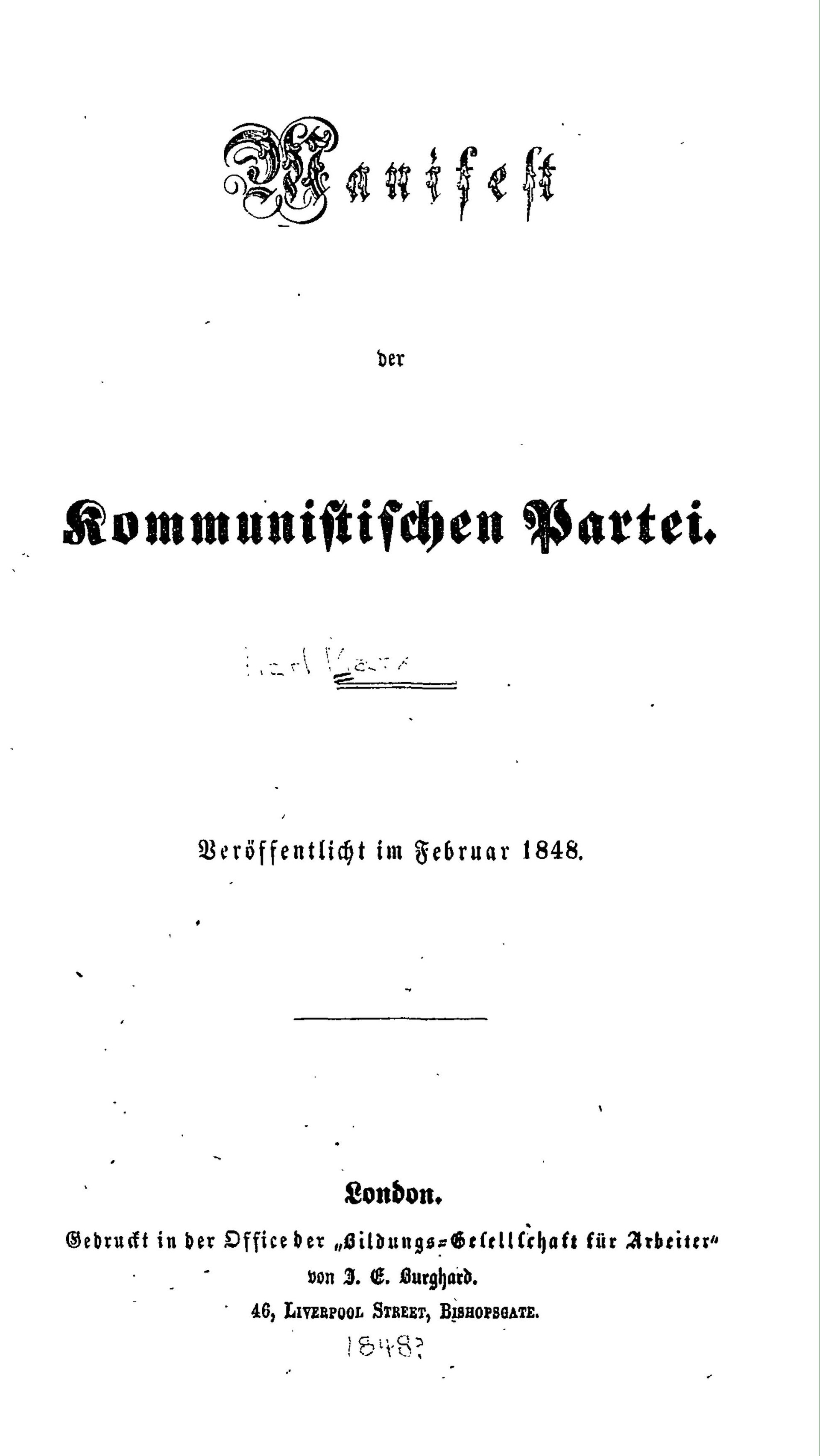
The Manifesto was written to order. In the preface to the German edition of 1872, Marx and Engels explained that the Communist League, "an international association of workers, which could of course be only a secret one, under conditions obtaining at the time," had commissioned them "at the Congress held in London in November 1847, to write for publication a detailed theoretical and practical programme for the Party."1 The manuscript, they wrote, "travelled to London to be printed a few weeks before the February [French] Revolution" of 1848.1 The first edition was in German. The first English version appeared in 1850 in the London paper the Red Republican, translated by Helen Macfarlane, and the standard English text is the translation of 1888 by Samuel Moore, which Engels said he and Moore "revised in common."1 The quotations in this lesson are from the Moore translation as published by the Marxists Internet Archive.
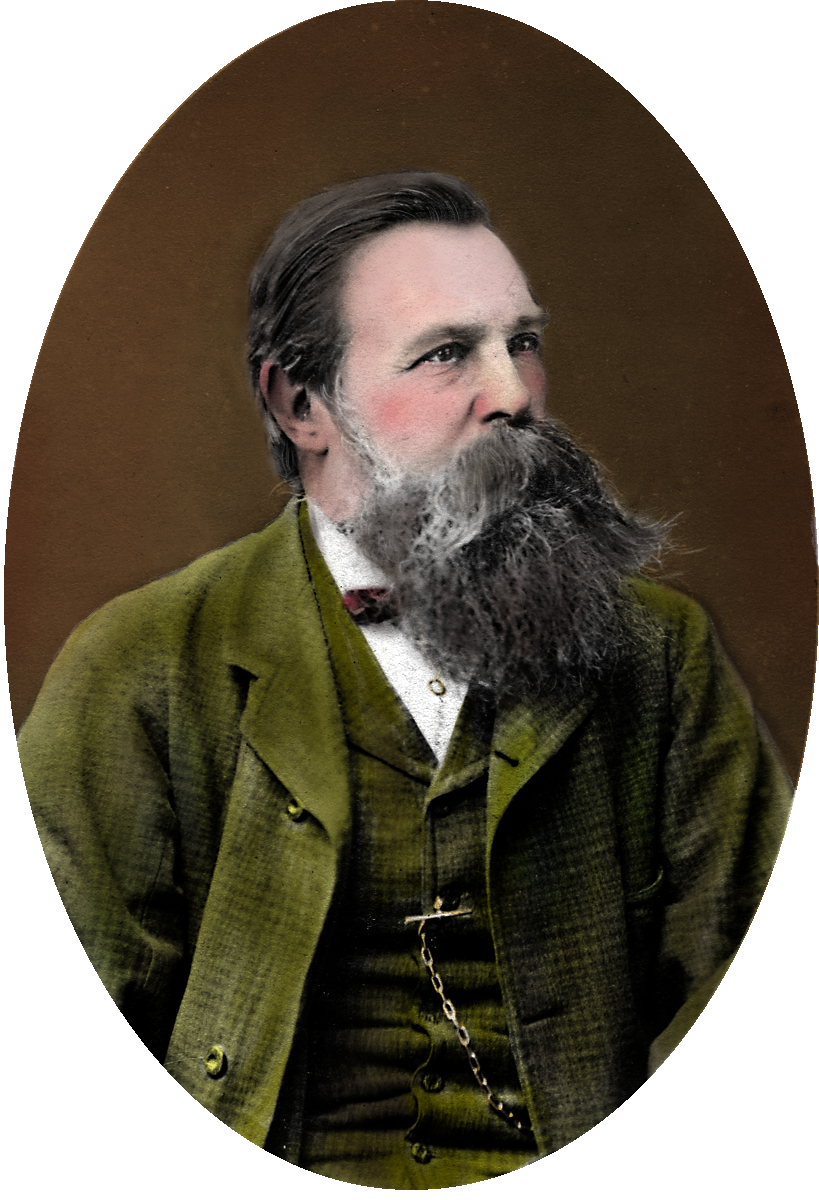
The two authors were young men in 1848. Karl Marx (1818 to 1883) was a German writer and journalist.5 Friedrich Engels (1820 to 1895) was his lifelong co-worker and co-author; Engels translated many of Marx's works into English and, in his last years, was the leading figure of the young Second International.6 Engels's 1888 preface explains the choice of name. "When it was written," he wrote, "we could not have called it a socialist manifesto," because in 1847 the word meant the followers of the utopian systems of Robert Owen in England and Charles Fourier in France, along with reformers who promised to fix social grievances "without any danger to capital and profit." The part of the working class that wanted "total social change" called itself communist. "Thus, in 1847," Engels wrote, "socialism was a middle-class movement, communism a working-class movement."1
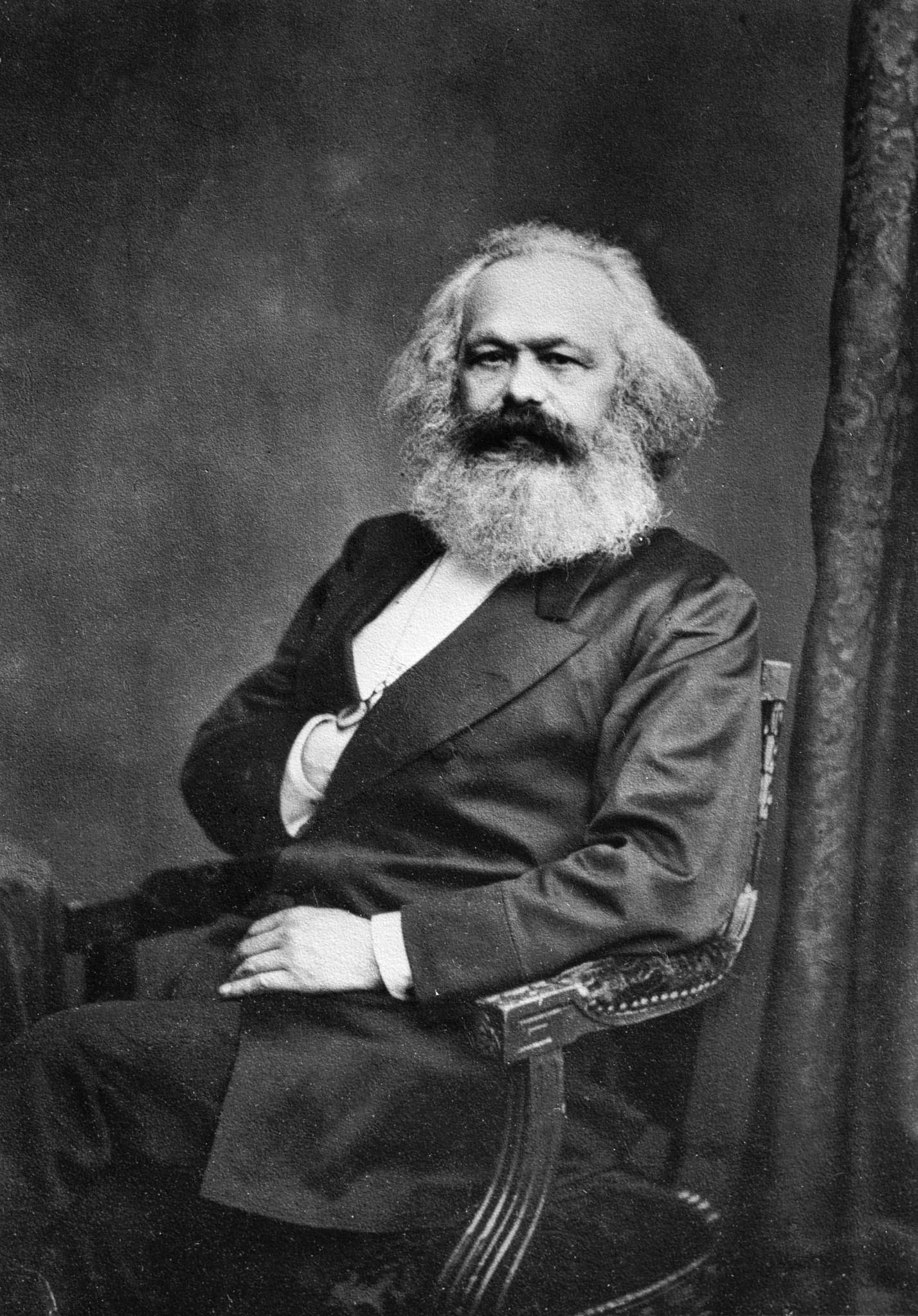

What the Manifesto says, in its own words
The text opens with a famous image: "A spectre is haunting Europe, the spectre of communism," with "all the powers of old Europe" allied to exorcise it.7 (The Marxists Internet Archive prints a dash after "Europe"; it is replaced with a comma here under this site's punctuation rule.) The first chapter states the theory of history in one sentence: "The history of all hitherto existing society is the history of class struggles."7 It continues: "Freeman and slave, patrician and plebeian, lord and serf, guild-master and journeyman, in a word, oppressor and oppressed, stood in constant opposition to one another."7 The authors gave the modern capitalist class, the bourgeoisie, its due: "The bourgeoisie, during its rule of scarce one hundred years, has created more massive and more colossal productive forces than have all preceding generations together."7 Their argument was that this class had also created the wage-earning working class, the proletariat, that would overthrow it.
The second chapter states the program. "In this sense, the theory of the Communists may be summed up in the single sentence: Abolition of private property."8 It says that "the first step in the revolution by the working class is to raise the proletariat to the position of ruling class," and that the proletariat "will use its political supremacy to wrest, by degrees, all capital from the bourgeoisie, to centralise all instruments of production in the hands of the State, i.e., of the proletariat organised as the ruling class."8
The fourth and last chapter ends with the lines that American prosecutors, committee counsel and anti-communist writers quoted for a century:
"The Communists disdain to conceal their views and aims. They openly declare that their ends can be attained only by the forcible overthrow of all existing social conditions. Let the ruling classes tremble at a Communistic revolution. The proletarians have nothing to lose but their chains. They have a world to win. Working Men of All Countries, Unite!"9
The slogan often quoted in English as "Workers of the world, unite!" does not appear in that form in the Moore translation, which reads "Working Men of All Countries, Unite!" The founding address of the First International, written by Marx in 1864, ended with "Proletarians of all countries, unite!"10
The ten measures
The second chapter lists measures that, the authors wrote, "in most advanced countries, the following will be pretty generally applicable."8 The list is short enough to give in part, word for word: "1. Abolition of property in land and application of all rents of land to public purposes. 2. A heavy progressive or graduated income tax. 3. Abolition of all rights of inheritance. 4. Confiscation of the property of all emigrants and rebels. 5. Centralisation of credit in the hands of the state, by means of a national bank with State capital and an exclusive monopoly. 6. Centralisation of the means of communication and transport in the hands of the State."8 The remaining four call for the extension of factories owned by the State, "Equal liability of all to work" with the "Establishment of industrial armies, especially for agriculture," the combination of agriculture with manufacturing, and "Free education for all children in public schools" with the abolition of children's factory labor "in its present form."8 Two of the ten (a graduated income tax and free public schooling) later became ordinary policy in countries that never became communist, which is the source of a popular claim tested in the claims section below.

The revolutions of 1848
The Manifesto had almost no part in the revolutions that broke out within weeks of its printing. Risings began in Sicily in January 1848, and on February 24 a revolution in Paris overthrew the French monarchy; from there the movement spread across the German and Italian states and the Austrian Empire.11 These were mostly revolutions of liberals and nationalists demanding constitutions, a free press and national unity, joined in some cities by workers and artisans. The Encyclopaedia Britannica summary records that they "all ended in failure and repression."11 Marx, in the summary of the historian Saul Padover, was "Exiled from his native Germany, thrown out of Belgium, and expelled from France," and "found refuge in the British capital in 1849."12 He lived in London for the rest of his life. The Manifesto mattered later, as the founding text of a movement that did not yet exist in 1848.

"Dictatorship of the proletariat": where the phrase comes from
The phrase most often quoted against communists in American hearings is not in the Manifesto. Marx used it in a private letter of March 5, 1852, to Joseph Weydemeyer, a German socialist then living in New York. Marx wrote that "no credit is due to me for discovering the existence of classes in modern society or the struggle between them," and that what he had done that was new was to prove "(1) that the existence of classes is only bound up with particular historical phases in the development of production, (2) that the class struggle necessarily leads to the dictatorship of the proletariat, (3) that this dictatorship itself only constitutes the transition to the abolition of all classes and to a classless society."13 He used it again, publicly, in his 1875 criticism of the German party's program (discussed below), and Engels applied it to the Paris Commune in 1891. What Marx meant by "dictatorship" (rule by a class, which he thought every state was, or rule by a party over a class) became the central dispute between Lenin's party and the European social democrats after 1917, and it matters for reading later uses of the phrase.
Marx in London and Capital, 1849 to 1867
Exile, and an American newspaper
Marx's London years were poor ones. Padover's account, reprinted in the Marxists Internet Archive's encyclopedia, says that in the fifteen years before 1864 Marx "eked out a living from journalism," was "saved from actual starvation by Frederick Engels, who was in the textile business in Manchester," and spent most of his time "writing, reading, and researching (in the British Museum)."12 Much of that journalism was American. In the early 1850s Marx, with Engels writing some of the pieces, sent news summaries on European affairs to the New-York Daily Tribune, then one of the largest papers in the United States, and the articles ran from 1852 into the early 1860s.14 It is one of the first threads tying the movement to the United States, decades before an American communist party existed.
Capital, volume one, 1867
Marx's major work, Capital: A Critique of Political Economy, appeared in its first volume in German in 1867. The first English edition, translated by Samuel Moore and Edward Aveling and edited by Engels, came out in 1887.15 The second and third volumes were assembled by Engels from Marx's manuscripts after Marx's death. The economic argument of Capital (the labor theory of value, surplus value, and the prediction that competition would concentrate capital and impoverish workers) is covered in module 51, lesson 07. For this companion the relevant point is that by the 1880s Marx's followers had a large, systematic body of writing that they called "scientific socialism," and that later communist parties treated as doctrine.
The First International, 1864 to 1876
St. Martin's Hall, September 28, 1864
The International Workingmen's Association, later called the First International, was founded at a public meeting in St. Martin's Hall, London, on September 28, 1864.10 The meeting was a mixture. Padover describes "English Owenites and Chartists, French Proudhonists and Blanquists, Irish nationalists, Polish patriots, Italian Mazzinists, and German Socialists," united "not by a commonly shared ideology" but by grievances.12 Marx did not speak; he was, as he later wrote, "a silent figure on the platform." He was put on the committee that drafted the rules and the founding address, and he wrote both.12 He remained the dominant figure on the General Council in London until 1872.12
The General Rules of 1864 begin with a principle that both Marxists and anarchists claimed: "Considering, That the emancipation of the working classes must be conquered by the working classes themselves, that the struggle for the emancipation of the working classes means not a struggle for class privileges and monopolies, but for equal rights and duties, and the abolition of all class rule."16 The Inaugural Address urged workers to watch their governments' foreign policies and ended with the call "Proletarians of all countries, unite!"10
The International was smaller than it looked. Contemporaries, Britannica notes, believed it had millions of members and almost unlimited resources, but its core of individual members "probably seldom exceeded 20,000."17 It was a federation of trade unions, political clubs and national sections, and its General Council met weekly in London.12 One of its documents was addressed to an American president: the Council's address to Abraham Lincoln carried 58 signatures.12
Marx against Bakunin: the first split
The International's great quarrel was between Marx and the Russian anarchist Mikhail Bakunin. Both wanted a society without classes. They disagreed about the state. Marx held that the workers must take political power and use it during a period of transition. Bakunin held that any state, including one run in the workers' name, would become a new tyranny. In Statism and Anarchy (1873), without naming Marx, Bakunin described his opponents' position this way: "They say that such a yoke, dictatorship is a transitional step towards achieving full freedom for the people," and replied, "They insist that only dictatorship (of course their own) can create freedom for the people. We reply that all dictatorship has no objective other than self-perpetuation, and that slavery is all it can generate and instill in the people who suffer it."18 (The source uses a dash after "yoke"; a comma replaces it here.) After 1917 his warning was quoted often, by anarchists and by anti-communists, as a forecast of the Soviet state.
The quarrel was settled by a vote. The Hague Congress of the International met from September 2 to 7, 1872.19 A committee reported that Bakunin's secret Alliance "was established with rules entirely opposed to those of the International," and the congress voted to exclude Bakunin (27 for, 6 against, 7 abstentions) and his associate James Guillaume (25 for, 9 against, 8 abstentions).20 It also voted 26 to 23, with 9 abstentions, to move the General Council out of London, and then 30 to 14, with 12 abstentions, to move it to New York.20 The resolutions note that the votes on the Alliance were taken "after a great number of French and German delegates had been obliged to leave."20 Britannica's account says the move to New York was made to "prevent the Bakuninists from gaining control."17
The end in Philadelphia, 1876
Moving the General Council to New York ended the International as a working body. The Council was formally disbanded at a conference in Philadelphia in July 1876.17 From 1872 the Marxist and anarchist movements went their own ways and remained rivals, a rivalry that lesson 02 follows into the Russian Civil War and the Spanish Civil War.
The Paris Commune, March 18 to May 28, 1871

Ten weeks in Paris
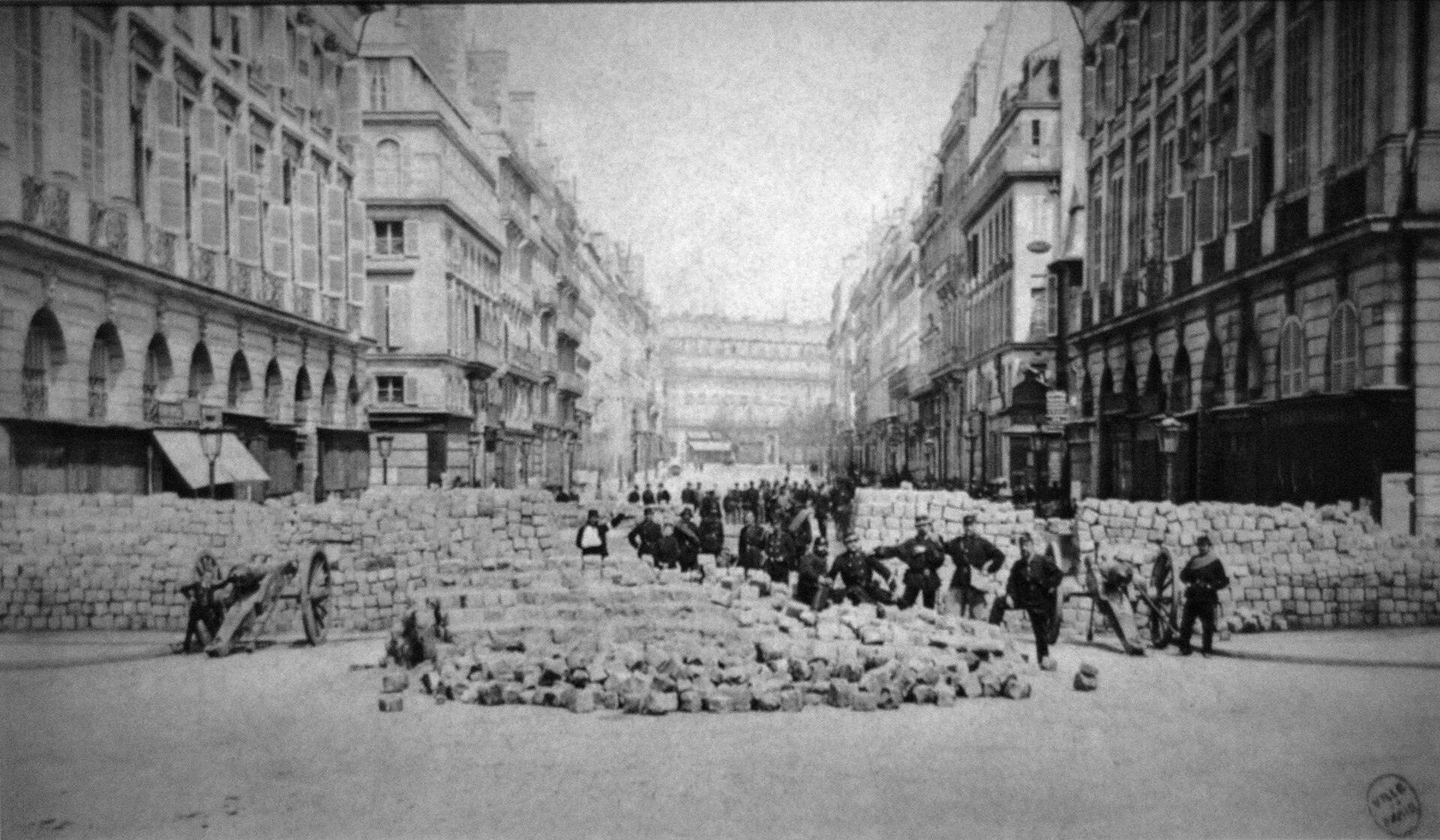
The Commune came out of France's defeat in the Franco-Prussian War. On March 18, 1871, resistance broke out in the city when the national government tried to remove the cannons held by the Paris National Guard. Municipal elections on March 26 gave the revolutionaries a majority, and they formed a city government, the Commune. Government troops entered the city on May 21, and the insurrection ended on May 28.21 The week of street fighting and executions from May 21 to 28 is called the "bloody week," la semaine sanglante.21
The Commune was not a communist party government in the twentieth-century sense. Its members came from several revolutionary traditions, and Marx himself, writing privately ten years later, called it "merely the rising of a town under exceptional conditions" and said that "the majority of the Commune was in no sense socialist, nor could it be."22 In public, in 1871, Marx described its form in his address for the General Council: "The Commune was formed of the municipal councillors, chosen by universal suffrage in the various wards of the town, responsible and revocable at short terms. The majority of its members were naturally working men, or acknowledged representatives of the working class."23 It replaced the standing army with the armed people, he wrote.23
Marx's The Civil War in France
Marx's address, The Civil War in France, issued for the General Council in May 1871, turned a defeated uprising into a model. Its key lesson for later Marxists was a sentence that Marx and Engels then inserted into the 1872 preface of the Manifesto: "the working class cannot simply lay hold of the ready-made state machinery, and wield it for its own purposes."231 The existing state, with its "standing army, police, bureaucracy, clergy, and judicature," had to be broken up and replaced.23 The address closed with a memorial: "Working men's Paris, with its Commune, will be forever celebrated as the glorious harbinger of a new society. Its martyrs are enshrined in the great heart of the working class."24
Twenty years later, on the anniversary of March 18, Engels went further and tied the Commune to the phrase Marx had used in 1852 and 1875. "Of late," he wrote in 1891, "the Social-Democratic philistine has once more been filled with wholesome terror at the words: Dictatorship of the Proletariat. Well and good, gentlemen, do you want to know what this dictatorship looks like? Look at the Paris Commune. That was the Dictatorship of the Proletariat."25 The passage matters for a reader of later debates. Engels pointed to a city government elected by universal male suffrage, with recallable officials. Lenin's party, after 1917, used the same phrase for the rule of a single party that dissolved an elected assembly and built a secret police. Both sides of the argument after 1917 claimed the 1891 passage.
Bloody Week and the count of the dead
How many Parisians were killed in the suppression is a good first example of a contested number. Older accounts gave figures from 15,000 to 40,000; the historian Quentin Deluermoz, reviewing the debate in 2011, summed up a revision by the British historian Robert Tombs as "6.500 au lieu de 15.000-40.000" (about 6,500 instead of 15,000 to 40,000).26 Tombs had himself once accepted much higher figures; Karine Varley's response to his revision records that his new estimate was between about 6,000 and 7,500, based on burial and cemetery records, and that he concluded "around half of all the deaths occurred after the fighting," in summary executions and courts-martial.27 Britannica's account still gives about 20,000 insurgents killed, against about 750 government troops, with about 38,000 people arrested and more than 7,000 deported.21 This companion therefore gives the range: roughly 6,000 to 20,000 or more killed, with the lower figure resting on Tombs's documentary count and the higher figures on contemporary and older estimates.
German Social Democracy: Gotha, Erfurt and the revisionism dispute
Gotha, 1875, and Marx's critique
The largest Marxist party of the nineteenth century was German. In 1875 two German workers' parties merged at a congress in the town of Gotha to form the United Workers' Party of Germany, and Marx, in London, wrote sharp private notes on the draft program between April and early May of that year.28 The notes, now called the Critique of the Gotha Programme, were published only in 1891, abridged, in the party journal Die Neue Zeit, with a foreword by Engels.28 They contain two of the most quoted passages in the Marxist canon. The first describes the "higher phase" of communist society, when "society inscribe on its banners: From each according to his ability, to each according to his needs!"29 The second describes what comes before it: "Between capitalist and communist society there lies the period of the revolutionary transformation of the one into the other. Corresponding to this is also a political transition period in which the state can be nothing but the revolutionary dictatorship of the proletariat."30 Marx complained that the German program's political demands contained "nothing beyond the old democratic litany familiar to all."30
The Anti-Socialist Law and the Erfurt Program, 1891
The German party grew under persecution. Under Chancellor Otto von Bismarck an Anti-Socialist Law put the party under what the editors of German History in Documents and Images call "a state-sanctioned policy of persecution," which ended when the law expired and Bismarck resigned, in 1890.31 At its congress at Erfurt, October 14 to 20, 1891, the party, now the Social Democratic Party of Germany, adopted a new program.31 Its first part restated Marx's analysis: economic development "invariably leads to the ruin of small business," turns the worker "into a propertyless proletarian," and makes the means of production "the monopoly of a relatively small number of capitalists and large landowners."31 Its second part made practical demands, beginning with "Universal, equal, and direct suffrage with secret ballot in all elections, for all citizens of the Reich over the age of twenty, without distinction of sex."31 The editors of German History in Documents and Images, who published the translation, note that the program "continues to call for revolution" while showing "a new practical orientation" toward working "through existing political institutions."31 That double character (revolutionary theory, parliamentary practice) defined the Second International.
Bernstein and revisionism, 1899
In 1899 Eduard Bernstein, a German Social Democrat, published Die Voraussetzungen des Sozialismus und die Aufgaben der Sozialdemokratie (The Premises of Socialism and the Tasks of Social Democracy), translated into English in 1907 as Evolutionary Socialism.32 The book questioned parts of Marx's forecast and opened a long dispute within the movement over whether socialism would come through gradual reform inside existing states or through revolution. Bernstein's position was called "revisionism" by its opponents. The movement held both kinds of party: the Marxists Internet Archive's history of the Second International describes it as including "openly reformist type organizations" as well as "revolutionary workers parties."33 Lenin, in Russia, took the revolutionary side of the dispute; What Is To Be Done? (1902) warns against "the fashionable preaching of opportunism."34 The word "revisionism" is defined in the glossary.
The Second International, 1889 to 1914
Paris, July 14, 1889
The Second International, also called the Socialist International, was founded at an international workers' congress in Paris that opened on July 14, 1889, the hundredth anniversary of the storming of the Bastille, and ran to July 21.3536 It was organized "with the help of Engels," and its largest section was the German Social Democratic Party.33 Wilhelm Liebknecht, a founder of the German party, told the opening session: "The treaty of alliance does not need to be made, it has been made!"35 (The translation uses a dash where a comma appears here.) Unlike the First International, the Second was a loose federation of national parties, most of which called themselves Marxist.33 It met in periodic congresses until 1914 and, at several of them, passed resolutions against war and colonialism, although the German party was itself divided on the colonial question.33
A small Russian delegation attended the 1889 congress. Georgi Plekhanov (1856 to 1918), one of the founders of Russian Marxism, told the delegates that Russian revolutionaries had failed because they were "isolated from the masses of the people," and that the task was to adopt "the views of modern scientific socialism, spread them among the workers, and, with the help of the workers, storm the stronghold of autocracy." He ended: "The revolutionary movement in Russia can triumph only as the revolutionary movement of the workers. There is not and cannot be any other way out for us!"363738
Anarchists versus Marxists after 1872
The quarrel that split the First International shaped the Second. The Marxist parties pursued elections and legal unions wherever the law allowed, while anarchists rejected elections and the state itself. The anarchist argument, in Bakunin's words, was that "Freedom can be created only by freedom, by a total rebellion of the people, and by a voluntary organization of the people from" the bottom up.18 The Marxist argument, in the words of the 1872 Manifesto preface, was that the working class could not simply take over the old state; it had to build a new one.1 Both claimed the 1864 principle that the emancipation of the workers must be the workers' own act.16
Russian Marxism, 1883 to 1914
Plekhanov and the Emancipation of Labour group
Russia in the 1880s was an autocracy with a small but growing industrial working class. Many Russian revolutionaries of the time looked to the peasant village commune as the seed of a socialist Russia. Plekhanov rejected that hope and argued that the tsarist government was itself building capitalism in Russia, and was "thus digging its own grave," because the industrial proletariat it created "will strike a mortal blow at the autocracy."36 His works of the period include Socialism and the Political Struggle (1883) and the program he drafted in 1884 for the émigré Emancipation of Labour group.37 In the 1889 speech quoted above he called the village commune, "once so dear even to certain socialists," the "main buttress of Russian absolutism."36
Minsk, 1898: the party is founded
The Russian Social Democratic Labor Party (in Russian, RSDRP; also translated as the Russian Social-Democratic Workers' Party) was founded at a small congress in Minsk in 1898. Most of the leaders it elected were soon arrested.38 The organizing center became the émigré newspaper Iskra (The Spark), whose supporters, the "Iskra-ists" in Lenin's word, dominated the next congress.39
What Is To Be Done?, 1902
Vladimir Ilyich Ulyanov (1870 to 1924), who wrote as N. Lenin, published What Is To Be Done? Burning Questions of Our Movement as a separate work in March 1902, after writing it between the autumn of 1901 and February 1902.4041 It is the founding text of the Leninist party. Three passages carry the argument. "Without revolutionary theory there can be no revolutionary movement."34 Socialist consciousness, Lenin wrote, "would have to be brought to them from without," because "The history of all countries shows that the working class, exclusively by its own effort, is able to develop only trade union consciousness."42 And, recalling the amateurism of earlier circles: "Give us an organisation of revolutionaries, and we will overturn Russia."43
Read beside the Comintern's Twenty-One Conditions of 1920 (quoted in module 81, lesson 01), What Is To Be Done? is the origin of the model that American investigators later described: a small, disciplined, centrally directed party of full-time revolutionaries, with a public face and a hidden apparatus. Lenin's book was written for the conditions of tsarist Russia, where every socialist organization was illegal. The Comintern later required the same model of parties in democracies.
The split of 1903: Bolsheviks and Mensheviks
The party's Second Congress met in Brussels and then in London in July and August 1903.38 It agreed on a program and split over organization. Britannica describes the dispute as one over Lenin's proposal for a party of "disciplined professional revolutionaries."38 The test case was the first paragraph of the party rules, which defined a member. The wording of Julius Martov counted as a member anyone who rendered the party "regular personal assistance under the direction of one of its organisations"; Lenin wanted a narrower party of committed revolutionaries, while the group that became the Mensheviks, among them Pavel Axelrod, wanted membership as broad as possible.3944 Lenin answered Martov at length in One Step Forward, Two Steps Back (Geneva, May 1904), objecting that Martov's wording would let "every striker" call himself a party member.39 The congress then divided over the election of the party's central bodies. Lenin's plan, by his own account, was that the congress "shall elect three persons to the editorial board of the Central Organ and three to the Central Committee."45 His side carried those elections, and his faction took the name Bolsheviks, from the Russian word for "majority"; their opponents, led by Martov and Pavel Axelrod, became the Mensheviks, the "minority."44 Plekhanov, Britannica notes, took a generally middle position.38 The two factions worked sometimes together and sometimes apart for years afterward; the definitive break, in Britannica's account, came in the turmoil of 1917.38
The names have misled readers ever since. The Bolsheviks were the majority only in those votes at one congress, and the name says nothing about their strength in the country.
The revolution of 1905
On Sunday, January 9, 1905 (January 22 by the Western calendar), troops fired on a peaceful procession of workers in front of the Winter Palace in St. Petersburg; Britannica calls it a "massacre of peaceful demonstrators."46 Strikes, peasant risings and mutinies followed through the year, including the mutiny of the crew of the battleship Potemkin at Odessa in June. A railroad strike that began on October 7 (20) became a general strike in most large cities, and on October 13 (26) workers' delegates in the capital formed the St. Petersburg Soviet (council), which directed the strike and took on, in Britannica's words, "the character of a revolutionary government."46 Leon Trotsky was elected its president after the arrest of its first chairman, the Menshevik G. S. Khrustalev-Nosar, at the end of November.3846 On October 17 (30), Tsar Nicholas II issued the October Manifesto promising a constitution and an elected legislature, the Duma.46 The government arrested the Soviet's leaders on December 3 (16), and an armed rising in Moscow in December was put down.46 The soviet, a council of delegates from factories and barracks, was the institution that reappeared in 1917 and gave the Soviet state its name.
War and the collapse of the International, 1914 to 1917
August 4, 1914
The Second International had promised for years to resist a European war. When the war came, its largest parties backed their own governments. On August 4, 1914, the German Reichstag met to approve the first war credits, and the Social Democratic deputies voted for them unanimously.47 Their leader, Hugo Haase, read the party's statement: "We are face to face with destiny." The party blamed "imperialist policies" for the war, warned of "A victory of Russian despotism," and declared: "in the hour of danger, we are not deserting the Fatherland. In doing so, we feel that we are in accord with the International." It closed: "With these principles in mind, we vote for the proposed war loans."48 The socialist parties of France and Britain also supported their countries' war efforts.33 Trotsky called August 1914 "the effective death of the International."33
For the history of communism, August 1914 is the point of no return. Lenin concluded that the parties of the Second International had betrayed the workers and that a new International had to be built against the "social-chauvinists," his word for the socialists who supported the war.2 The Comintern, founded in Moscow in March 1919, was that International, and its Twenty-One Conditions of 1920 bound every member party to Moscow's decisions.49 Module 81, lesson 01, and lesson 02 of this module take up that story.
Zimmerwald, September 1915
From September 5 to 8, 1915, thirty-eight socialists who opposed the war met in the Swiss village of Zimmerwald.50 The Swiss Social Democrat Robert Grimm became secretary of the International Socialist Commission it set up. A draft resolution by Lenin calling for the imperialist war to be turned into a civil war was rejected, 19 to 12, but all the delegates then signed a common manifesto.50 It began: "Proletarians of Europe! The war has lasted more than a year. Millions of corpses cover the battlefields. Millions of human beings have been crippled for the rest of their lives. Europe is like a gigantic human slaughterhouse."51 It ended with the old slogan, "Proletarians of all countries, unite!" and was signed for the Russian delegation by "N. Lenin, Paul Axelrod, M. Bobrov," a Bolshevik and a Menshevik side by side.51 The vote of 19 to 12 against Lenin's resolution shows how small his following was even among the war's socialist opponents in 1915.
The sealed train and the April Theses, April 1917
Lenin spent the war in Switzerland. The February revolution of 1917 in Petrograd forced Nicholas II to abdicate on March 2 (15), 1917, by the Marxists Internet Archive's chronology.4 The way home from Switzerland ran through Germany, then at war with Russia. The German government agreed to let a party of Russian émigrés cross its territory on condition that they travel in a sealed carriage.52 The Swiss National Museum's account says the group left Zurich on April 9, 1917, with the Swiss socialist Fritz Platten organizing the departure, and that a chalk line marked the inside of the carriage as extraterritorial.53 The museum calls the sealing of the train "one of the many myths that surround Lenin": in its account there were no passport controls and no one was allowed to board or leave the train during the journey.53 The size of the party is given differently by different accounts: the Swiss National Museum says Lenin and about 30 others, including Nadezhda Krupskaya, Karl Radek and Grigory Zinoviev, and another account says about two dozen.5352 The route ran across Germany to the Baltic island of Rügen and by ferry from Sassnitz to Trelleborg in Sweden.52 Lenin, Zinoviev and others reached Petrograd on April 3 (16), 1917, and were met at the station by workers, soldiers and party members.4

The next day, April 4, Lenin read his theses at two meetings held during the All-Russia Conference of Soviets of Workers' and Soldiers' Deputies, and they were printed in Pravda on April 7, 1917, signed "N. Lenin."2 He said himself that he could speak "only on my own behalf," having arrived the night before.2 The third thesis read: "No support for the Provisional Government; the utter falsity of all its promises should be made clear."2 The fifth demanded: "Not a parliamentary republic, to return to a parliamentary republic from the Soviets of Workers' Deputies would be a retrograde step, but a republic of Soviets of Workers', Agricultural Labourers' and Peasants' Deputies throughout the country, from top to bottom. Abolition of the police, the army and the bureaucracy."2 (The source uses dashes where commas appear here.) The ninth and tenth called for a change of the party's name and for "A new International," to be built "against the social-chauvinists and against the 'Centre'."2 Within two years the party had renamed itself the Russian Communist Party (Bolshevik) and founded the Comintern; those events open lesson 02.49
German help and the "German agent" question
The German government's reasons were practical: it wanted Russia out of the war, and it expected the returning revolutionaries to press for an immediate peace.53 German Foreign Ministry documents published by Z. A. B. Zeman in 1958 showed that German help went beyond the train. A review of the collection by Brian Pearce in 1958 described German agents buying Bolshevik publications through Stockholm, and quoted a memorandum of September 29, 1917, by State Secretary Richard von Kühlmann claiming that the Bolshevik movement "could never have attained the scale or the influence" it had without German support.54 Pearce also noted that German officials "seem to have convinced themselves that the Bolsheviks really were their 'agents'," and were then shocked when the Bolsheviks directed revolutionary appeals at German soldiers.54 The question is rated in the claims section below.
American echoes before 1917
The movement touched the United States long before there was an American communist party. Marx's longest run of paid journalism was for a New York paper, the New-York Daily Tribune.14 The First International's General Council sent an address to Abraham Lincoln, and in 1872 the Hague Congress moved the General Council itself to New York, where it was formally disbanded four years later at Philadelphia.122017 Marx's 1852 letter on the "dictatorship of the proletariat" went to a German socialist living in New York.13 After August 1914, in the Marxists Internet Archive's account, the majority of the Socialist Party of America, which it describes as led by Eugene V. Debs, joined the socialists who opposed the war.33 In 1919 a faction that broke away from the Socialist Party founded two rival communist parties in Chicago, both seeking admission to the new Comintern; module 81, lesson 01, tells that story, and lesson 05 of this module follows it year by year.49 For a regional view, module 74, lesson 04, examines what communist organizing in Idaho actually amounted to, and lesson 06 covers Glen Taylor, Herman Welker and the Red Scare in that state.
What the record shows and what it does not
Documented fact. The Manifesto was commissioned by the Communist League in November 1847 and printed in London weeks before the February revolution of 1848.1 The First International was founded on September 28, 1864, expelled Bakunin by vote at The Hague in September 1872 and was disbanded at Philadelphia in July 1876.102017 The Paris Commune held the city from March 18 to May 28, 1871.21 The German Social Democrats voted unanimously for war credits on August 4, 1914.47 Lenin reached Petrograd on April 3 (16), 1917, after crossing Germany with German permission.452
Their own words. Marx and Engels wrote that communist ends "can be attained only by the forcible overthrow of all existing social conditions."9 Marx wrote privately in 1852, and publicly in 1875, that the class struggle leads to a "dictatorship of the proletariat."1330 Lenin wrote in 1902 that workers left to themselves reach only "trade union consciousness" and that socialist ideas must be "brought to them from without."42
The accusation. American anti-communists after 1919 argued that these texts showed communism to be a movement committed to violent revolution and run by a disciplined elite. Module 81, lesson 01, shows that they cited the Comintern's Twenty-One Conditions for the same purpose.
The archive evidence. For this period the primary record is mostly published: the texts themselves, congress minutes and resolutions, party programs and parliamentary records. German Foreign Ministry files on aid to the Bolsheviks were published in 1958.54 The Commune death toll rests on burial and military records that historians still read differently.2726
Scholarly reading. Historians agree on the dates and the texts. They disagree on how much the twentieth-century communist states followed from Marx and how much from Lenin's party model and Russian conditions. That dispute runs through the scholarship cited in lessons 02 to 04, from Richard Pipes's The Russian Revolution (1990) to The Black Book of Communism (1997) and its critics.
Open question. What Marx meant by "dictatorship" (the rule of a class, in which every state was in his view a class dictatorship, or something closer to what Lenin built) cannot be settled from the few passages where he used the word. The texts support more than one reading.
Claims checked
"The Communist Manifesto openly called for violent revolution."
Rating: Supported. The closing paragraph says the Communists "openly declare that their ends can be attained only by the forcible overthrow of all existing social conditions."9 Defenders of Marx sometimes point out that the 1872 preface called parts of the program "antiquated," which is true, but the preface did not withdraw the call for revolution; it added the lesson of the Commune that the old state machinery could not simply be taken over.1
"Socialism and communism meant the same thing to Marx and Engels."
Rating: Refuted for 1847 and 1848. Engels explained in 1888 that "we could not have called it a socialist manifesto," because socialism in 1847 meant utopian sects and middle-class reformers, while communism meant a working-class movement for total social change.1 Later Marxist usage, including Marx's own distinction in 1875 between a first and a "higher phase" of communist society, made the words overlap in other ways, and the glossary in lesson 13 traces them.29
"The Manifesto's ten measures are already American law: the income tax and public schools prove it."
Rating: Partly supported as to two measures; the conclusion is Unsupported. The Manifesto called for "A heavy progressive or graduated income tax" and "Free education for all children in public schools."8 The United States adopted a federal income tax through the Sixteenth Amendment, passed by Congress on July 2, 1909, and ratified February 3, 1913, and public schooling was well established in the states before that.55 The other measures, beginning with "Abolition of property in land" and "Abolition of all rights of inheritance," were never adopted, and graduated taxes and public schools were also adopted by many countries for reasons that had nothing to do with the Manifesto.8 Two shared measures out of ten do not show that a country adopted the program.
"The Paris Commune was the first communist government."
Rating: Partly supported. Marx hailed it as "the glorious harbinger of a new society," and Engels in 1891 called it the dictatorship of the proletariat.2425 Communists afterward claimed it as their own. Marx himself, writing privately in 1881, said "the majority of the Commune was in no sense socialist, nor could it be."22 It was a revolutionary city government of mixed membership that lasted ten weeks, and it was claimed as a model after the fact.
"'Dictatorship of the proletariat' meant a one-party police state from the start."
Rating: Unresolved as to Marx's meaning; Supported that the phrase is Marx's own. The phrase comes from Marx in 1852 and 1875.1330 Engels, asked what it looked like, pointed to a city council "chosen by universal suffrage," in Marx's description, whose members were "responsible and revocable at short terms."2523 Bakunin, in 1873, predicted that any such dictatorship would serve only "self-perpetuation."18 What the Bolsheviks built after 1917 is a matter of record (lesson 02); whether it followed from Marx's phrase or departed from it is a question of interpretation on which historians still disagree.
"The Bolsheviks were the majority of Russian socialists."
Rating: Refuted as a general description. The name means "majority" and came from votes at the 1903 congress.44 It did not describe Russian socialism as a whole. Even among the socialists who opposed the war in 1915, Lenin's resolution at Zimmerwald lost, 19 to 12.50
"Lenin was a German agent."
Rating: Partly supported. The German government let Lenin's party cross Germany in a sealed carriage because it hoped he would take Russia out of the war, and German Foreign Ministry documents published in 1958 record further German support for Bolshevik propaganda.535254 That is documented. The claim that Lenin took orders from Berlin is not: he pursued his own aims, which included revolution in Germany, and the German officials who thought of the Bolsheviks as their agents were, in Pearce's reading of the documents, mistaken.54 "Agent" in the sense this companion uses for Soviet sources in the United States (a person working under a foreign service's direction) is Unsupported for Lenin; "accepted German help for his own purposes" is Supported.
"The Second International died in August 1914 because its parties chose nation over class."
Rating: Supported in the main. The German party voted unanimously for war credits, saying it would not desert "the Fatherland" in "the hour of danger," and the French and British socialist parties supported their governments.484733 Minorities in each party opposed the war, and the International reformed after 1918 without its revolutionary wing, which went to the Comintern.33
"Anarchists and communists were the same movement."
Rating: Refuted. The two split by recorded vote at The Hague in 1872, when the congress voted to exclude Bakunin, 27 to 6.20 Bakunin's objection to the Marxist idea of a transitional dictatorship was explicit.18 They shared some goals and some enemies, but they were separate and rival movements.
Hard questions and answers
If the Manifesto calls for "forcible overthrow," were American prosecutors and committees right to quote it against the Communist Party?
An anti-communist would say yes, and the text supports the point: the words are there, and the party published and taught the Manifesto. The harder question is what the quotation proves about a particular person. A party's founding text shows what the party's doctrine taught; it does not show what any individual member intended or did. The Supreme Court's Smith Act decisions of the 1950s, covered in module 81, lesson 09, turned on that gap between teaching a doctrine and urging action.56 This companion's four-claims rule applies here: the Manifesto is evidence about the party's aims, and a separate kind of evidence is needed for any claim of espionage by a person.
Did Lenin distort Marx, or carry out what Marx wrote?
Both readings have support in the texts. The phrase "dictatorship of the proletariat," the call for forcible overthrow and the abolition of private property are Marx's.1398 The small party of professional revolutionaries that brings consciousness to the workers "from without" is Lenin's, and it sits uneasily beside the 1864 principle that the emancipation of the workers "must be conquered by the working classes themselves."4216 Bakunin's 1873 warning shows that the danger of a self-perpetuating revolutionary dictatorship was seen inside the movement when Lenin was a small child.18 A reader can weigh the continuity and the break; the record does not force a single answer.
Why should a reader interested in McCarthy and the 1950s care about 1848 to 1917?
Because the American party of the 1930s and 1940s was built on this inheritance and said so. It joined the International that Lenin's April Theses called for, accepted the Leninist model that the Comintern imposed in 1920, and was answered by opponents who quoted these texts against it.49 Module 81, lesson 01, and lesson 03 show the texts in use. Knowing what the texts actually say lets a reader tell an accurate quotation from a distorted one, in either direction.
A civil liberties advocate asks: is it fair to judge twentieth-century American communists by a nineteenth-century pamphlet?
It is fair to judge a party by the doctrine it taught and the organization it joined, and the American party chose to join an International that required obedience to Moscow. It is not fair to treat that as proof against an individual. Many Americans read Marx, joined a front group for a season or signed a petition without becoming party members, and many party members never passed a secret. The people entries in lessons 06 to 09 are written to keep those cases apart.
Was Lenin's secretive, centralized party only a response to tsarist repression?
In part. Lenin wrote for a country where every socialist organization was illegal, and his argument in What Is To Be Done? is framed around police persecution and the amateurism of the early circles.4344 But the model did not end when the repression ended. After 1917 the Bolsheviks kept it in power, and through the Comintern they required it of parties working in democracies, including the requirement to build a "parallel illegal organisation" quoted in module 81, lesson 01.49 An explanation from Russian conditions accounts for the origin; it does not account for the export.
Did German money make the Bolshevik revolution?
German help mattered: it got Lenin home in April 1917 and paid for propaganda.5354 The German state secretary's claim that the movement could never have grown without German support was written by an official with a reason to claim credit.54 The events of 1917 (the collapse of the army, the land seizures, the soviets) are the subject of lesson 02, and no serious account attributes them to German money alone. The honest rating is that German support was real and helpful to the Bolsheviks, and its decisive weight is Unresolved.
Where to go next
Continue with lesson 02: World Communism, 1917 to 1945. For the American story that follows from this one, read module 81, lesson 01: Why the Fear Was Real, 1917 to 1950, and lesson 05 of this module. For the ideas themselves, module 58, lesson 09, covers Marx's theory of class and module 51, lesson 07, covers communism as an economic system. For terms used in this lesson (bourgeoisie, proletariat, dictatorship of the proletariat, International, soviet, Bolshevik, Menshevik, revisionism), see the glossary.
Still open
These items could not be confirmed against a primary source before publication. The lesson states them as open, and they stay on the fact-check list.
- The 1903 congress: that Lenin's side carried the elections to the party's central bodies (the source of the name Bolshevik) is the standard account and is consistent with Lenin's own description of the plan, but the vote totals were not confirmed from a source opened for this lesson. Whether Martov's wording of paragraph 1 was adopted was not confirmed and is not stated.
- The size of Lenin's party on the sealed train: the Swiss National Museum says Lenin and about 30 others; Hidden Europe says about two dozen. Not reconciled. The two sources also differ on the 'sealed' carriage: Hidden Europe says the Germans required one; the Swiss National Museum calls the sealing a myth. Both are reported in the text.
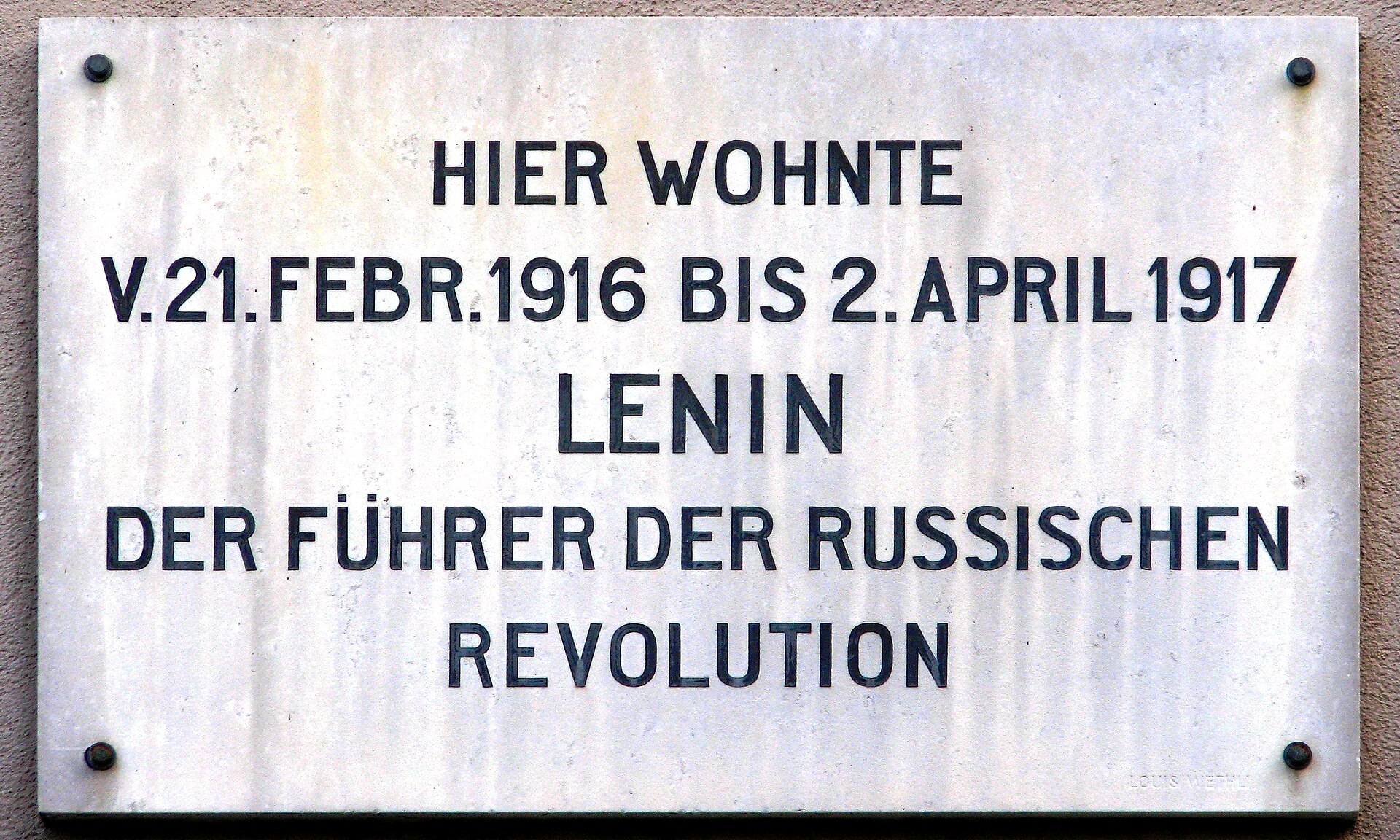
- Lenin's Zurich residence: the Commons description of the memorial plate gives February 21, 1916, to April 2, 1917, while the Swiss National Museum gives the train's departure from Zurich as April 9, 1917. The two dates were not reconciled.
- Paris Commune death toll: given as a range (about 6,000 to 7,500 per Tombs's revision; about 20,000 per Britannica; older estimates 15,000 to 40,000). Tombs's own Historical Journal article was not opened; his figures are taken from the 2011 responses by Varley and Deluermoz.
- The Kuhlmann memorandum of September 29, 1917, is quoted from Pearce's 1958 review of Zeman's document collection, not from the document itself.
- The Manifesto title page image: the Commons record (Gale, The Making of the Modern World) gives no edition or date, so the caption does not claim it is the February 1848 first edition.
- The Engels portrait is a modern hand-colored version (Alvaro Marques Hijazo); the Commons record dates the underlying photograph to 1879, while the image file name used for this module says 1877. The caption follows the Commons record.
- Marx's death in London in 1883 is stated without a separately opened source beyond the Marxists Internet Archive glossary dates (1818-1883).
- The statement that the majority of the Socialist Party of America under Debs opposed the war in 1914 rests on the Marxists Internet Archive's history of the Socialist International.
Learn more
- Manifesto of the Communist Party, full text with the prefaces: Short enough to read in an hour; read the 1872 and 1888 prefaces too, where the authors revise and explain it.
- Resolutions of the Hague Congress, 1872: The recorded votes that split Marxists from anarchists.
- Lenin, What Is To Be Done? (1902): The founding text of the Leninist party model that the Comintern later imposed on its member parties, including the American one.
- The Socialists Support the War (August 4, 1914), German History in Documents and Images: The statement that marked the collapse of the Second International, in a scholarly translation.
- Module 81, lesson 01: Why the Fear Was Real, 1917 to 1950: Picks up the story with the Comintern, the Twenty-One Conditions and the American party.
Notes
- Karl Marx and Frederick Engels, Manifesto of the Communist Party, prefaces to the German edition of 1872 and the English edition of 1888 (Engels, London, January 30, 1888); English translation by Samuel Moore, 1888. Marxists Internet Archive (retrieved Nov. 6, 2026). Read it online. ↩
- V. I. Lenin, 'The Tasks of the Proletariat in the Present Revolution' (the April Theses), Pravda No. 26, April 7, 1917, signed N. Lenin; in Lenin, Collected Works, vol. 24 (Moscow: Progress Publishers, 1964), pp. 19 to 26. Marxists Internet Archive (retrieved Nov. 6, 2026). Read it online. ↩
- Lewis Siegelbaum, 'The New Calendar and Alphabet Reform,' subject essay, Seventeen Moments in Soviet History, Michigan State University (retrieved Nov. 6, 2026). Read it online. ↩
- Marxists Internet Archive, 'Soviet History: Timeline, 1917,' entries for March 2, April 3 and April 4, 1917 (Russian calendar) (retrieved Nov. 6, 2026). Read it online. ↩
- Marxists Internet Archive, Encyclopedia of Marxism, Glossary of People, 'Marx, Karl (1818-1883)' (retrieved Nov. 6, 2026). Read it online. ↩
- Marxists Internet Archive, Encyclopedia of Marxism, Glossary of People, 'Engels, Frederick (1820-1895)' (retrieved Nov. 6, 2026). Read it online. ↩
- Marx and Engels, Manifesto of the Communist Party (1848), chapter I, 'Bourgeois and Proletarians,' Moore translation (1888). Marxists Internet Archive (retrieved Nov. 6, 2026). Read it online. ↩
- Marx and Engels, Manifesto of the Communist Party (1848), chapter II, 'Proletarians and Communists,' Moore translation (1888). Marxists Internet Archive (retrieved Nov. 6, 2026). Read it online. ↩
- Marx and Engels, Manifesto of the Communist Party (1848), chapter IV, 'Position of the Communists in Relation to the Various Existing Opposition Parties,' Moore translation (1888). Marxists Internet Archive (retrieved Nov. 6, 2026). The same text, with minor variations, is at Project Gutenberg, eBook No. 61. Read it online. ↩
- Karl Marx, 'Inaugural Address of the International Working Men's Association' (London, 1864), from the original pamphlet Address and Provisional Rules of the International Working Men's Association. Marxists Internet Archive (retrieved Nov. 6, 2026). Read it online. ↩
- Encyclopaedia Britannica, 'Revolutions of 1848' (retrieved Nov. 6, 2026). Read it online. ↩
- Marxists Internet Archive, Encyclopedia of Marxism, Glossary of Organisations, 'First International (International Workingmen's Association),' quoting Saul K. Padover's introduction to a volume of Marx's writings for the International; includes the composition of the General Council and the address to Lincoln (retrieved Nov. 6, 2026). Read it online. ↩
- Karl Marx to J. Weydemeyer in New York, London, March 5, 1852 (extract). Marxists Internet Archive (retrieved Nov. 6, 2026). Read it online. ↩
- Marxists Internet Archive, 'Articles by Karl Marx in The New York Daily Tribune, 1852-61,' index and note (retrieved Nov. 6, 2026). Read it online. ↩
- Karl Marx, Capital: A Critique of Political Economy, vol. 1 (first published in German, 1867; first English edition 1887, translated by Samuel Moore and Edward Aveling, edited by Frederick Engels), edition note. Marxists Internet Archive (retrieved Nov. 6, 2026). Read it online. ↩
- International Working Men's Association, 'General Rules' (London, 1864). Marxists Internet Archive (retrieved Nov. 6, 2026). Read it online. ↩
- Encyclopaedia Britannica, 'First International' (retrieved Nov. 6, 2026). Read it online. ↩
- Mikhail Bakunin, Statism and Anarchy (1873), extracts as translated in Sam Dolgoff, ed., Bakunin on Anarchy (1971). Marxists Internet Archive (retrieved Nov. 6, 2026). Read it online. ↩
- Marxists Internet Archive, 'History of the International Workingmen's Association,' contents page, listing 'The Hague Congress of The International, 2-7 September 1872' (retrieved Nov. 6, 2026). Read it online. ↩
- International Working Men's Association, 'Resolutions of the Congress' held at The Hague, September 2 to 7, 1872, with recorded votes. Marxists Internet Archive (retrieved Nov. 6, 2026). Read it online. ↩
- Encyclopaedia Britannica, 'Commune of Paris (1871)' (retrieved Nov. 6, 2026). Read it online. ↩
- Karl Marx to Ferdinand Domela Nieuwenhuis in The Hague, London, February 22, 1881 (extract), Marx and Engels Correspondence (International Publishers, 1968), translated by Donna Torr. Marxists Internet Archive (retrieved Nov. 6, 2026). Read it online. ↩
- Karl Marx, The Civil War in France (Address of the General Council of the International Working Men's Association, 1871), section on the Paris Commune, English edition of 1871. Marxists Internet Archive (retrieved Nov. 6, 2026). Read it online. ↩
- Karl Marx, The Civil War in France (1871), closing section. Marxists Internet Archive (retrieved Nov. 6, 2026). Read it online. ↩
- Frederick Engels, Introduction to Marx's The Civil War in France, London, March 18, 1891 (the 20th anniversary of the Commune). Marxists Internet Archive (retrieved Nov. 6, 2026). Read it online. ↩
- Quentin Deluermoz, 'Les morts de la Semaine sanglante: retour sur la violence sociale et politique française au XIXe siècle,' H-France Salon 3 (2011), responding to Robert Tombs, 'How Bloody was la Semaine sanglante of 1871? A Revision,' The Historical Journal (Cambridge University Press) (retrieved Nov. 6, 2026). Read it online. ↩
- Karine Varley, 'Reassessing the Paris Commune of 1871: a response to Robert Tombs, How bloody was la semaine sanglante? a revision,' H-France Salon 3 (2011); repository record and abstract, Strathprints, University of Strathclyde (retrieved Nov. 6, 2026). Read it online. ↩
- Karl Marx, Critique of the Gotha Programme (written April or early May 1875; first published, abridged, in Die Neue Zeit, 1890-91, with a foreword by Engels), editorial note. Marxists Internet Archive (retrieved Nov. 6, 2026). Read it online. ↩
- Karl Marx, Critique of the Gotha Programme (1875), part I. Marxists Internet Archive (retrieved Nov. 6, 2026). Read it online. ↩
- Karl Marx, Critique of the Gotha Programme (1875), part IV. Marxists Internet Archive (retrieved Nov. 6, 2026). Read it online. ↩
- Social Democratic Party of Germany, Erfurt Program (1891), from Protokoll des Parteitages der Sozialdemokratischen Partei Deutschlands, abgehalten zu Erfurt vom 14. bis 20. Oktober 1891 (Berlin, 1891), pp. 3 to 6, translated by Thomas Dunlap for German History in Documents and Images, with the editors' introduction; as reproduced by the Marxists Internet Archive (retrieved Nov. 6, 2026). Read it online. ↩
- Eduard Bernstein, Die Voraussetzungen des Sozialismus und die Aufgaben der Sozialdemokratie (Stuttgart, 1899); English translation Evolutionary Socialism (Independent Labour Party, 1907), translated by Edith C. Harvey; contents page. Marxists Internet Archive (retrieved Nov. 6, 2026). Read it online. ↩
- Marxists Internet Archive, Encyclopedia of Marxism, Glossary of Organisations, 'Socialist International (also: Second International; social-democracy)' (retrieved Nov. 6, 2026). This entry dates the Zimmerwald conference to 1916; the conference met in September 1915 (see the note citing Osterroth and Schuster). Read it online. ↩
- Lenin, What Is To Be Done? (1902), chapter I, 'Dogmatism and Freedom of Criticism.' Marxists Internet Archive (retrieved Nov. 6, 2026). Read it online. ↩
- Wilhelm Liebknecht, opening speech to the International Workers' Congress, July 14, 1889, translated by Graham Seaman. Marxists Internet Archive (retrieved Nov. 6, 2026). Read it online. ↩
- Georgi Plekhanov, Speech at the International Workers' Socialist Congress in Paris (14 to 21 July 1889), in Plekhanov, Selected Philosophical Works, vol. 1 (Moscow, 1981), pp. 451 to 454. Marxists Internet Archive (retrieved Nov. 6, 2026). Read it online. ↩
- Marxists Internet Archive, Georgi Plekhanov Internet Archive (1856-1918), list of works, including Socialism and the Political Struggle (1883) and the 'Programme of Social-Democratic Emancipation of Labour Group' (1884) (retrieved Nov. 6, 2026). Read it online. ↩
- Encyclopaedia Britannica, 'Russian Social-Democratic Workers' Party' (retrieved Nov. 6, 2026). Read it online. ↩
- V. I. Lenin, One Step Forward, Two Steps Back (The Crisis in Our Party) (Geneva, May 1904), section I, 'Paragraph One of the Rules,' and contents list, Collected Works, vol. 7 (Moscow, 1964). Marxists Internet Archive (retrieved Nov. 6, 2026). Read it online. ↩
- V. I. Lenin, What Is To Be Done? Burning Questions of Our Movement (written autumn 1901 to February 1902; first published as a separate work, March 1902), Collected Works, vol. 5 (Moscow, 1961), pp. 347 to 530; edition note. Marxists Internet Archive (retrieved Nov. 6, 2026). Read it online. ↩
- Marxists Internet Archive, Encyclopedia of Marxism, Glossary of People, 'Lenin, Vladimir Ilyich (1870-1924)' (retrieved Nov. 6, 2026). Read it online. ↩
- Lenin, What Is To Be Done? (1902), chapter II, 'The Spontaneity of the Masses and the Consciousness of the Social-Democrats.' Marxists Internet Archive (retrieved Nov. 6, 2026). Read it online. ↩
- Lenin, What Is To Be Done? (1902), chapter IV, 'The Primitiveness of the Economists and the Organisation of the Revolutionaries.' Marxists Internet Archive (retrieved Nov. 6, 2026). Read it online. ↩
- Marxists Internet Archive, Encyclopedia of Marxism, Glossary of Organisations, 'Bolshevik party' (retrieved Nov. 6, 2026). Read it online. ↩
- V. I. Lenin, One Step Forward, Two Steps Back (1904), section M, 'The Elections. End of the Congress.' Marxists Internet Archive (retrieved Nov. 6, 2026). Read it online. ↩
- Encyclopaedia Britannica, 'Russian Revolution of 1905' (retrieved Nov. 6, 2026). Read it online. ↩
- Franz Osterroth and Dieter Schuster, Chronik der deutschen Sozialdemokratie, vol. 1, 2nd ed. (1975), entry for August 4, 1914; electronic edition, Friedrich-Ebert-Stiftung Library, 2001 (retrieved Nov. 6, 2026). Read it online. ↩
- Hugo Haase, Social Democratic Party statement on the outbreak of the war, Reichstag, August 4, 1914, Verhandlungen des Reichstags, XIII. LP., II. Sess., 1914, Bd. 306, pp. 8 ff.; translated by Jeffrey Verhey; German History in Documents and Images, German Historical Institute (retrieved Nov. 6, 2026). Read it online. ↩
- Liberty and the Republic, module 81, lesson 01, 'Why the Fear Was Real, 1917 to 1950' (updated October 28, 2026), on the founding of the Comintern (March 1919), the renaming of the Bolshevik party (March 1918), the Twenty-One Conditions (1920) and the American parties of 1919, with its citations to the Library of Congress exhibit Revelations from the Russian Archives and to Comintern texts. Read it online. ↩
- Osterroth and Schuster, Chronik der deutschen Sozialdemokratie, vol. 1, entry for September 5 to 8, 1915 (Zimmerwald); Friedrich-Ebert-Stiftung Library (retrieved Nov. 6, 2026). Read it online. ↩
- International Socialist Conference at Zimmerwald, Manifesto, September 1915, transcribed from Sam Marcy, The Bolsheviks and War. Marxists Internet Archive (retrieved Nov. 6, 2026). Read it online. ↩
- Hidden Europe, 'April 1917: Lenin returns to Russia,' Letter from Europe, April 2017 (retrieved Nov. 6, 2026). Read it online. ↩
- Swiss National Museum, 'By train to the revolution,' blog of the Swiss National Museum, April 2017 (retrieved Nov. 6, 2026). Read it online. ↩
- B. P. (Brian Pearce), review of Z. A. B. Zeman, ed., Germany and the Revolution in Russia, 1915-1918: Documents from the Archives of the German Foreign Ministry (1958), Labour Review, August to September 1958. Marxists Internet Archive (retrieved Nov. 6, 2026). Read it online. ↩
- National Archives, Milestone Documents, '16th Amendment to the U.S. Constitution: Federal Income Tax (1913)': passed by Congress July 2, 1909, ratified February 3, 1913 (retrieved Nov. 6, 2026). Read it online. ↩
- Liberty and the Republic, module 81, lesson 09, 'Censure, Watkins, Yates, Barenblatt and the Courts' (updated October 2026), on the Supreme Court's communist cases from Dennis v. United States (1951) through Yates v. United States (1957) to Brandenburg v. Ohio (1969) and the line between advocacy of doctrine and incitement. Read it online. ↩
Check yourself
1. Who commissioned Marx and Engels to write the Communist Manifesto, and when?
The 1872 preface says the Communist League, 'an international association of workers,' commissioned them at its London congress in November 1847; the manuscript was printed in London weeks before the February 1848 revolution.
2. Where does the phrase 'dictatorship of the proletariat' first appear in Marx's writing, as quoted in this lesson?
Marx wrote to Weydemeyer that the class struggle 'necessarily leads to the dictatorship of the proletariat.' He used it publicly in the 1875 Critique of the Gotha Programme. It is not in the Manifesto.
3. What did the Hague Congress of the First International decide in September 1872?
The congress voted 27 to 6, with 7 abstentions, to exclude Bakunin, and 30 to 14, with 12 abstentions, to seat the General Council in New York. The Council was disbanded at Philadelphia in July 1876.
4. Which range best reflects the current estimates of Parisians killed in the suppression of the Commune in May 1871?
Tombs's revision put the toll at about 6,000 to 7,500; Britannica gives about 20,000; older estimates ran from 15,000 to 40,000. About 750 is the government troops killed; 38,000 is the number arrested.
5. What was the dispute at the 1903 congress of the Russian Social Democratic Labor Party mainly about?
The split came over the first paragraph of the rules, defining membership, and the election of the central bodies. Lenin wanted a party of disciplined professional revolutionaries; Martov wanted a broader membership.
6. On August 4, 1914, what did the German Social Democratic deputies in the Reichstag do?
The party faction voted unanimously for the war credits, and Hugo Haase declared that 'in the hour of danger, we are not deserting the Fatherland.' The vote marked the collapse of the Second International.
7. At the Zimmerwald conference of September 1915, what happened to Lenin's draft resolution calling for the war to be turned into a civil war?
The Chronik der deutschen Sozialdemokratie records that Lenin's draft was rejected 19 to 12; all delegates then signed a common manifesto, including Lenin and the Menshevik Axelrod.
8. How does this lesson rate the claim that 'Lenin was a German agent'?
German permission for the sealed train and German Foreign Ministry documents published in 1958 show real help. Taking orders from Berlin is not shown, and Pearce read the documents as showing German officials mistaken in thinking the Bolsheviks were their agents.
Terms in this lesson
- Communist League
- A small, secret international association of workers that, at its London congress in November 1847, commissioned Marx and Engels to write the Communist Manifesto.
- Proletariat and bourgeoisie
- In the Manifesto, the class of wage workers who own no means of production, and the modern capitalist class that owns them. Marx and Engels held that the first would overthrow the second.
- Dictatorship of the proletariat
- Marx's phrase (1852, 1875) for the political rule of the working class during the transition from capitalism to communism. Engels pointed to the Paris Commune as an example (1891); the Bolsheviks later used it for one-party rule.
- First International
- The International Workingmen's Association, founded in London on September 28, 1864, split between Marxists and anarchists at The Hague in 1872, and disbanded at Philadelphia in July 1876.
- Paris Commune
- The revolutionary city government of Paris from March 18 to May 28, 1871, suppressed in the 'bloody week' of May 21 to 28. Marx and Engels treated it as a model of working-class rule.
- Second International
- The Socialist International, a federation of national socialist parties founded in Paris on July 14, 1889, and broken by the war votes of August 1914.
- Revisionism
- The term used by its opponents for Eduard Bernstein's 1899 argument that parts of Marx's forecast were wrong and that socialism could come through gradual reform.
- Bolsheviks and Mensheviks
- The two factions of the Russian Social Democratic Labor Party after its 1903 congress: Lenin's 'majority' faction, which wanted a party of disciplined professional revolutionaries, and the 'minority' led by Martov and Axelrod.
- Vanguard party
- The model set out in Lenin's What Is To Be Done? (1902): a small, centralized organization of professional revolutionaries that brings socialist consciousness to the workers 'from without.'
- Soviet
- Russian for 'council'; a council of delegates from factories and barracks, first formed in St. Petersburg in October 1905 and revived in 1917.
- Zimmerwald conference
- The meeting of 38 anti-war socialists in Switzerland, September 5 to 8, 1915, which issued a joint manifesto against the war and rejected Lenin's call to turn it into a civil war.
- April Theses
- Lenin's program of April 1917, published in Pravda on April 7: no support for the Provisional Government, all power to the soviets, a change of the party's name and a new International.
- Julian and Gregorian calendars
- Russia used the Julian calendar, 13 days behind the Western Gregorian calendar in the twentieth century, until February 1918; this companion gives both dates for Russian events before then.
Sources
- Manifesto of the Communist Party (Moore translation, 1888), prefaces and chapters I, II and IV (1848; English translation 1888) checked 2026-10
- The Communist Manifesto, Project Gutenberg eBook No. 61 (1848; English translation 1888) checked 2026-10
- Marx to J. Weydemeyer, March 5, 1852 (1852-03-05) checked 2026-10
- Inaugural Address of the International Working Men's Association (1864) checked 2026-10
- General Rules of the International Working Men's Association (1864) checked 2026-10
- Capital, volume one, edition note (1867; English 1887) checked 2026-10
- The Civil War in France (1871) and Engels's 1891 introduction (1871; 1891) checked 2026-10
- Resolutions of the Hague Congress of the International, September 2 to 7, 1872 (1872-09) checked 2026-10
- Bakunin, Statism and Anarchy (1873), extracts (1873) checked 2026-10
- Marx, Critique of the Gotha Programme (1875) checked 2026-10
- Marx to Domela Nieuwenhuis, February 22, 1881 (1881-02-22) checked 2026-10
- Liebknecht, opening speech, Paris congress, July 14, 1889 (1889-07-14) checked 2026-10
- Plekhanov, speech at the Paris congress, July 1889 (1889-07) checked 2026-10
- Erfurt Program (1891), German History in Documents and Images translation (1891-10) checked 2026-10
- Bernstein, Evolutionary Socialism (1899; English 1907) (1899) checked 2026-10
- Lenin, What Is To Be Done? (1902) (1902-03) checked 2026-10
- Lenin, One Step Forward, Two Steps Back (1904) (1904-05) checked 2026-10
- Haase, SPD statement in the Reichstag, August 4, 1914 (1914-08-04) checked 2026-10
- Zimmerwald Manifesto, September 1915 (1915-09) checked 2026-10
- Lenin, April Theses, Pravda No. 26 (1917-04-07 (Russian calendar)) checked 2026-10
- Osterroth and Schuster, Chronik der deutschen Sozialdemokratie, vol. 1 (FES digital edition) (1975; digital 2001) checked 2026-10
- Pearce, review of Zeman, Germany and the Revolution in Russia (1958) (1958-08) checked 2026-10
- Varley, response to Tombs on la semaine sanglante (H-France Salon, 2011) (2011) checked 2026-10
- Deluermoz, Les morts de la Semaine sanglante (H-France Salon, 2011) (2011) checked 2026-10
- Siegelbaum, The New Calendar and Alphabet Reform (Seventeen Moments in Soviet History) (n.d.) checked 2026-10
- Marxists Internet Archive, Encyclopedia of Marxism entries (First International, Socialist International, Bolshevik party; Marx, Engels, Lenin) (n.d.) checked 2026-10
- Marxists Internet Archive, Soviet history timeline, 1917 (n.d.) checked 2026-10
- Encyclopaedia Britannica: Revolutions of 1848; First International; Commune of Paris; Russian Social-Democratic Workers' Party; Russian Revolution of 1905 (n.d.) checked 2026-10
- Swiss National Museum, By train to the revolution (2017-04) checked 2026-10
- Hidden Europe, April 1917: Lenin returns to Russia (2017-04) checked 2026-10
- National Archives, 16th Amendment (Milestone Documents) (1913) checked 2026-10
- Wikimedia Commons: Karl Marx photograph by J. J. E. Mayall (before 1875-08-24) checked 2026-10
- Wikimedia Commons: Manifest der Kommunistischen Partei, title page (undated in Commons record) checked 2026-10
- Wikimedia Commons: Barricade, Place Vendome, Paris Commune 1871 (1871) checked 2026-10
- Wikimedia Commons: Friedrich Engels, hand-colored portrait (Alvaro Marques Hijazo) (photo 1879 per Commons) checked 2026-10
- Wikimedia Commons: Lenin memorial plate, Spiegelgasse 14, Zurich (Roland zh) (2008-10-30) checked 2026-10