Lesson 13 of 14 · about 75 minutes
Glossary A to Z: Terms of the Movement, Espionage, the Investigations and the Law
Updated November 6, 2026
You'll be able to
- Define the main terms of the communist movement (democratic centralism, the line, the Popular Front, the dictatorship of the proletariat) in the movement's own words and place each in time.
- Tell apart the espionage vocabulary of the Venona era (agent, source, handler, cover name, legal and illegal, rezident, one-time pad) and use it accurately when reading a decrypt.
- Explain the legal terms of the investigations (contempt of Congress, pertinency, the Fifth Amendment privilege, the Smith Act, the Attorney General's list, the clear and present danger, Dennis and incitement tests) with the statute or case that defines each.
- Give the documented origin of key words of the era, including Herblock's coinage of McCarthyism on March 29, 1950, and Trotsky's use of fellow traveler in 1923.
- Sort any accusation into one of four claims (membership, espionage, sympathy, association) by the words used, and name the evidence each claim requires.
- Recognize which words were used as weapons by each side and write about the period without repeating an accusation as fact.
Start here: the short version
This glossary defines 189 words and phrases a reader meets in the record of communism and anti-communism: the movement's own vocabulary (cadre, democratic centralism, the line, the Popular Front), the names of Soviet and world communist bodies (Cheka, Comintern, Cominform, Gulag), the tradecraft words of Soviet espionage (illegal, rezident, cover name, one-time pad), the terms of the American investigations and the law (contempt of Congress, the Fifth Amendment privilege, the Smith Act, the Attorney General's list, clear and present danger), and the slang of the era (pinko, comsymp, red-baiting, McCarthyism). Each entry gives a short definition, a date or origin where one can be documented, a footnote to the source, and a link to the lesson of this module or of module 81 where the term matters most. Two warnings apply throughout. Many of these words were weapons as well as descriptions, so the entries say who used a word and for what. And the four claims that the fairness rules of this module keep apart (party membership, espionage, sympathy and association) each have their own vocabulary: a reader who learns which words belong to which claim can read a hearing transcript or a Venona decrypt far more accurately.
How to use this glossary
Terms are listed alphabetically under letter headings. Each entry has a category tag, used to build the chart below: Movement and ideology (32 terms) for the words communists used about their own theory and organization; Soviet and world communist bodies and events (35 terms); Espionage and intelligence (45 terms); Investigations, law and government programs (61 terms); and Slang and labels of the era (16 terms). A date in an entry is the date of the document or event named. Where a dictionary gives a "first known use" in English, the entry says so and names the dictionary, because a dictionary's earliest citation is a floor, not a birth certificate: a word can be older than its earliest recorded printed use, and words borrowed from Russian often circulated in Russian for years before they appeared in English.
The people behind many of these terms have their own entries in lesson 06 (A to F), lesson 07 (G to L), lesson 08 (M to R) and lesson 09 (S to Z). The organizations are treated at length in lesson 10 (Soviet and international bodies) and lesson 11 (American groups), and the cover names of the Venona cables in lesson 12. The economics of communism (surplus value, the labor theory of value, central planning) is taught in module 51, lesson 07 and is only touched on here.
Some definitions quote the movement's own reference works, chiefly the Encyclopedia of Marxism on the Marxists Internet Archive. Those sources are written from within the Marxist tradition and sometimes from one faction of it. They are useful for what communists meant by their words, and they are cited as that; where their account of a historical fact differs from archival or government sources, the entry follows the archival source and says so.
Four claims, four vocabularies
The commonest error in reading the record of the 1940s and 1950s is to let a word that belongs to one claim stand in for another. "Member," "card-carrying" and "cell" belong to the claim of party membership. "Agent," "source," "cover name" and "handler" belong to the claim of espionage. "Fellow traveler," "sympathizer" and "comsymp" belong to the claim of sympathy. "Front," "affiliation," "the Attorney General's list" and "guilt by association" belong to the claim of association. Executive Order 9835 itself mixed the categories: it let loyalty boards consider "membership in, affiliation with or sympathetic association with" a designated organization.1 Whittaker Chambers drew a working line inside the communist underground between infiltration (placing members in government jobs to shape policy) and espionage (passing secret material to a Soviet service).2 The diagram below sets the four claims side by side.
The glossary by category and by date
The chart counts the entries by category. The timeline after it shows when some of the key words entered use, in the original language where a document fixes the date (Marx in 1875, Trotsky in 1923, Churchill in 1946, Herblock in 1950, Khrushchev in 1956) and otherwise by the "first known use" in English that Merriam-Webster gives.
A
- Active measures
- The Soviet intelligence term for influence operations: forgeries, planted stories, disinformation, front groups and agents of influence used to shape opinion abroad, as distinct from collecting secrets. Christopher Andrew and Vasili Mitrokhin describe the KGB's active measures from the Mitrokhin papers, which mainly concern the decades after 1950.12 In lesson 10.
- Agent
- A person working secretly for an intelligence service, usually as a source of information, as opposed to a staff officer of that service. The International Spy Museum's glossary defines an agent as "A person unofficially employed by an intelligence service, often as a source of information."13 In the Venona cables a recruited American was an agent; the Soviet officer who ran him was not. In lesson 12.
- Agent of influence
- A person who uses a position in government, the press or public life to move policy or opinion in the direction a foreign service wants, whether or not he also passes documents. The category is harder to prove than espionage, because the evidence is usually the service's own claim in its files that it was influencing someone.12 Claims that a named American official was an agent of influence are among the most disputed in the record: see the entries on Harry Dexter White and Harry Hopkins in lesson 09 and lesson 07.
- Agitprop
- Short for agitation and propaganda, the communist parties' name for the work of spreading the party's message, and the name of the departments that ran it. Merriam-Webster gives 1925 as the first known use of the word in English.14
- ALES
- The cover name of a Soviet military intelligence (GRU) source described in a KGB cable from Washington dated March 30, 1945. NSA and FBI analysts identified ALES as probably Alger Hiss; the identification is accepted by Haynes and Klehr and disputed by some other writers, who have proposed other State Department officials.15 The full argument is in module 81, lesson 02 and lesson 12. Rating of the identification of ALES as Hiss: Partly supported (strong but circumstantial).
- Amerasia case
- The 1945 arrest of the editor of the magazine Amerasia and others, including the diplomat John Stewart Service, after classified government documents turned up at the magazine. Service had passed the editor copies of his own reports; a grand jury declined to indict him. The case became a staple of later charges that the government had covered up espionage.16 In module 81, lesson 07 and lesson 12.
- Amtorg
- The Amtorg Trading Corporation, the Soviet Union's trading company in New York. Soviet intelligence used it, the Soviet consulates and other official bodies as legal cover for officers; the NSA and CIA Venona volume names Amtorg as one of the Soviet establishments that housed intelligence officers.17 In lesson 10.
- Anti-communist
- A person or organization opposed to communism and to the Soviet Union's influence. This module uses the word as a factual description of a position people held, which ran from Catholic labor priests and union leaders who fought communist control of their unions to the American Legion, the founders of Americans for Democratic Action in 1947 and the John Birch Society in 1958. The anti-communist organizations are described in lesson 11.
- Apparat
- The Russian word for apparatus: the full-time machinery of a communist party, its paid functionaries and departments, as opposed to its ordinary members. In American usage "the apparatus" also meant the party's secret side. Merriam-Webster dates the word in English to 1941.18 See also secret apparatus.
- Apparatchik
- A member of the apparat; a career functionary of the party, and by extension any loyal official who follows orders. Merriam-Webster defines it as "a member of a Communist apparat" and gives 1941 as its first known use in English.19
- Arlington Hall
- The former girls' school in Arlington, Virginia, that housed the U.S. Army's codebreakers. The work later named Venona began there on February 1, 1943.15 In module 81, lesson 02.
- Army-McCarthy hearings
- The televised hearings of the Senate Permanent Subcommittee on Investigations, sitting with McCarthy off the panel, on the Army's charges that McCarthy and his counsel Roy Cohn sought favors for Private G. David Schine and on McCarthy's countercharges. The Senate Historical Office dates the hearings March 16 to June 17, 1954, and the report August 31, 1954; the public sessions opened April 22.20 21 In module 81, lesson 08.
- Asset
- Any secret source or resource of an intelligence service, most often a person. The Spy Museum's definition is "A clandestine source or method, usually an agent."13
- Attorney General's list
- The list of organizations that the Attorney General designated "totalitarian, fascist, communist or subversive" under Executive Order 9835 of March 21, 1947, for the use of the Loyalty Review Board.1 Robert Justin Goldstein's history in the National Archives' Prologue shows that the list burst into public view in December 1947, that the groups named were given no notice, charges or hearings, and that state governments, the military, defense contractors and even hotels adopted it for purposes it was never meant to serve.22 It is the clearest example of the association claim turned into an official tool. In module 81, lesson 03 and lesson 11.
B
- Balancing
- The method by which the Supreme Court, in Barenblatt v. United States (June 8, 1959), weighed the government's interest in an inquiry against a witness's First Amendment interest. The syllabus states that resolving such a claim "always involves a balancing by the courts of the competing private and public interests at stake in the particular circumstances shown."23 Barenblatt's contempt conviction for refusing to answer a HUAC subcommittee was upheld, in an opinion by Justice Harlan. In module 81, lesson 09.
- Bill of attainder
- A law that punishes named people, or an easily identified group, without a trial. The Constitution forbids it (Article I, section 9). In United States v. Lovett (June 3, 1946) the Supreme Court struck down a rider, pressed by the Dies committee, that cut off the salaries of three named federal employees accused of subversive associations.24 In module 81, lesson 03.
- Black Friday
- The name used inside American signals intelligence for the change in Soviet cipher systems in late 1948 that cut off much of the traffic Western codebreakers had been reading. Venona's reading of the 1940s cables continued, but the window on current Soviet traffic closed.15
- Blacklist
- A list, written or understood, of people whom employers would not hire. Merriam-Webster dates the noun to 1624.25 In this period it means above all the refusal of the film, radio, television and teaching professions to employ people named as communists or who refused to answer questions about it. The film blacklist began with the producers' Waldorf statement of November 1947, after the Hollywood Ten were cited for contempt.26 It was a private practice built on public testimony. In module 81, lesson 10. See also graylist and Red Channels.
- Bolshevik
- From the Russian for "majority": Lenin's faction of the Russian Social Democratic Labor Party after the split of 1903, which seized power in Petrograd in November 1917 (October by the old Russian calendar). The Library of Congress notes that in March 1918 the Bolsheviks named their party the Russian Communist Party (Bolshevik).27 The opposing faction were the Mensheviks. In lesson 01 and lesson 02.
- Bourgeoisie
- In Marxist usage, the class that owns the means of production as capital, set against the proletariat. The Encyclopedia of Marxism defines it as the class "who own the social means of production as their Private Property, i.e., as capital."28 "Bourgeois" became the movement's all-purpose word of contempt for ideas, people and institutions outside it, including "bourgeois legality" in the Comintern's 1920 conditions.4
- Brainwashing
- Coercive persuasion: the breaking down and remaking of a prisoner's beliefs by isolation, exhaustion and repetition. The word spread in English in the early 1950s, during the Korean War. Merriam-Webster gives 1950 as its first known use.29
- Brezhnev Doctrine
- The Soviet claim, announced to justify the Warsaw Pact invasion of Czechoslovakia on August 20, 1968, that Moscow had the right to intervene wherever a communist government was threatened. The State Department's Office of the Historian notes it was later the main justification for the Soviet invasion of Afghanistan in 1979.30 In lesson 03.
- Brush pass
- A handoff in which an officer and an agent pass material in a moment of contact, in a crowd or a doorway, without stopping to talk. The Spy Museum calls it "A brief encounter where something is passed between case officer and agent."13
C
- Cadre
- A trained, trusted party worker, or the core of such workers around whom an organization is built; communist parties kept "cadre departments" that vetted and assigned them. The word is French and military in origin; Merriam-Webster dates its first known use in English to 1763.31
- Card-carrying Communist
- A formal, dues-paying member of the Communist Party, who in the open years held a party card. McCarthy used the phrase for his "57" in February 1950; the documents behind his numbers did not describe their subjects that way.32 The phrase belongs to the membership claim and says nothing about espionage. In module 81, lesson 05.
- Case officer
- A staff officer of an intelligence service who recruits and manages agents; in Soviet practice, an officer working from a rezidentura. The Spy Museum: "A staff officer who manages agents and runs operations."13 See handler.
- Cell
- The smallest unit of a communist party, a handful of members in one workplace or neighborhood, meeting regularly under a leader who reported upward. The Comintern's 1920 conditions required "Communist cells" in every military unit, mostly to be organized illegally.4 The American party also used the words "unit," "branch" and "club" for its basic bodies, and "fraction" for members acting together inside another organization.
- Censure
- A formal vote of a legislative body disapproving a member's conduct. It carries no automatic penalty. On December 2, 1954, the Senate voted 67 to 22 that McCarthy's conduct toward the Subcommittee on Privileges and Elections and toward the Senate itself was "condemned"; the Senate Historical Office lists the case among its censures.33 In module 81, lesson 09.
- Center (the Center)
- Soviet intelligence's own name for its Moscow headquarters, to which each overseas station reported and from which it took orders. The Venona translations show stations sending reports "to the Center."17
- Cheka
- The All-Russian Extraordinary Commission for Combating Counter-Revolution and Sabotage, the first Soviet secret police, created in December 1917 (on December 20) under Feliks Dzerzhinsky. The Library of Congress exhibit on the Russian archives notes it was meant to be temporary, soon "acquired powers of summary justice," and was replaced in 1922.34 Its officers' name, chekist, stayed in use for every successor service. The line from Cheka to GPU, OGPU, NKVD, NKGB, MGB, KGB and the post-1991 services is charted in lesson 10.
- China hands
- The State Department's career specialists on China, among them John Stewart Service, John Paton Davies Jr., John Carter Vincent and O. Edmund Clubb, whose careers were ended or damaged after the communist victory in China in 1949, when they were blamed for reporting that the Nationalist government was failing.26 In module 81, lesson 07 and lesson 10.
- Clear and present danger
- The test Justice Oliver Wendell Holmes stated in Schenck v. United States (March 3, 1919) for when speech loses the protection of the First Amendment: when words "are of such a nature as to create a clear and present danger that they will bring about the substantive evils that Congress has a right to prevent." He added: "It is a question of proximity and degree."35 In Dennis (1951) the Court restated the test in a form that let it uphold the convictions of the communist leaders; see Dennis test and incitement test.
- Code of Fair Procedures
- House Resolution 151, approved by voice vote on March 23, 1955, which set minimum rules for House investigative hearings: among them that no subcommittee could have fewer than two members, ending one-man hearings, and that witnesses could bring counsel.36 In module 81, lesson 12.
- COINTELPRO
- The FBI's Counterintelligence Program, a set of covert actions against domestic political groups. The Senate's Church Committee found that "COINTELPRO began in 1956," in part out of frustration with Supreme Court rulings limiting overt prosecution, that the first program was aimed at the Communist Party, that more than 2,000 actions were approved, and that it ended in 1971 under the threat of public exposure.37 The committee called the program's name a misnomer, since much of it was disruption, not counterintelligence. In lesson 11.
- Cold War
- The rivalry between the Soviet bloc and the United States and its allies short of general war. The State Department's Office of the Historian dates it 1947 to 1989; others end it with the Soviet Union's dissolution on December 26, 1991.8 In lesson 03.
- Collectivization
- The forced merger of Soviet peasant farms into collective farms (kolkhozy) and state farms, begun in 1929. The Library of Congress exhibit records that about one million kulak households, "some five million people," were deported, that the policy caused the catastrophic famine of 1932 to 1933, and that by 1940 about 97 percent of peasant households had been collectivized.34 In lesson 02; for the economics, module 51, lesson 07.
- Cominform
- The Information Bureau of the Communist and Workers' Parties, founded at Szklarska Poreba in Poland at a conference that opened September 22, 1947, with the parties of the Soviet Union, six East European states, France and Italy. It expelled Yugoslavia in 1948 and was dissolved on April 17, 1956.38 In lesson 10.
- Comintern
- The Communist International, or Third International, founded in Moscow in March 1919 to lead the world's communist parties, which joined it as sections bound by its decisions. The Library of Congress exhibit states that the Comintern forced the two rival American parties to merge in 1922.27 Its Executive Committee proposed its dissolution on May 15, 1943.39 In lesson 10 and module 81, lesson 01.
- Commie
- Slang for communist, used as noun and adjective. Merriam-Webster dates it to 1924.40 Like "Red," it was used of party members and of people who merely held views the speaker disliked, so it proves nothing about which claim is meant.
- Communism
- As a goal, the classless, stateless society that Marx expected to follow socialism, distributing goods by need; the Encyclopedia of Marxism opens its entry with Marx's formula from the Critique of the Gotha Programme.41 As a movement, the parties that followed Lenin and joined the Comintern after 1919. As a system, the one-party states ruled by those parties, five of which remain in 2026 (lesson 04). The three meanings should be kept apart in reading any source.
- Communist-action organization
- A category created by the Subversive Activities Control Act of 1950 (Title I of the Internal Security Act): an organization "substantially directed, dominated, or controlled" by the foreign government controlling the world communist movement, required to register with the Attorney General.42 The Subversive Activities Control Board found in 1953 that the Communist Party was such an organization, and the Supreme Court upheld the registration order in 1961.43 In Albertson (1965) the Court held that forcing individual members to register violated the privilege against self-incrimination.44
- Communist Control Act of 1954
- The law of August 24, 1954, in which Congress found that the Communist Party, "although purportedly a political party, is in fact an instrumentality of a conspiracy to overthrow the Government of the United States," and stripped the party of the rights and privileges of a legal body.45 It added "Communist-infiltrated organizations" to the 1950 act's categories. In lesson 05.
- Comsymp
- Short for communist sympathizer. Merriam-Webster defines it as "a person sympathetic to Communist causes" and dates its first known use to about 1961.46 It belongs to the sympathy claim, the weakest of the four, and was often applied to people whose only offense was disagreement.
- Containment
- The American strategy of resisting Soviet expansion by applying counter-pressure wherever it appeared, set out by the diplomat George F. Kennan in his anonymous "X" article in Foreign Affairs in 1947, which called for "a long-term, patient but firm and vigilant containment of Russian expansive tendencies."8 The Truman Doctrine of March 12, 1947, was its first public form.47 In lesson 03.
- Contempt of Congress
- The federal misdemeanor, in 2 U.S.C. 192, of failing to answer a congressional subpoena or refusing to answer "any question pertinent to the question under inquiry," punishable by a fine of $100 to $1,000 and one to twelve months in jail.48 Eight of the Hollywood Ten were sentenced to a year and a $1,000 fine under it, two to six months.49 The Supreme Court's pertinency rulings in Watkins (1957) and later cases are the main route by which courts review a committee's methods. In module 81, lesson 06.
- Counterintelligence
- The work of detecting and defeating a foreign service's spies, by investigation, surveillance, double agents and codebreaking. Venona, the FBI's espionage investigations and the debriefing of defectors were counterintelligence; the Church Committee judged that much of the FBI's COINTELPRO, despite its name, was something else.37
- Courier
- A person who carries documents or messages between agents and their Soviet handlers, so that the two need not meet. Elizabeth Bentley, Harry Gold and Whittaker Chambers all worked as couriers; Haynes, Klehr and Vassiliev trace their routes in Spies (2009).50 In lesson 12.
- Cover
- The occupation or story that hides an officer's or agent's real work. Officers with "legal" cover held diplomatic or trade posts; "illegals" lived under false identities. The Spy Museum: "The purported occupation or purpose of an agent; it must be consistent with the agent's background."13
- Cover name
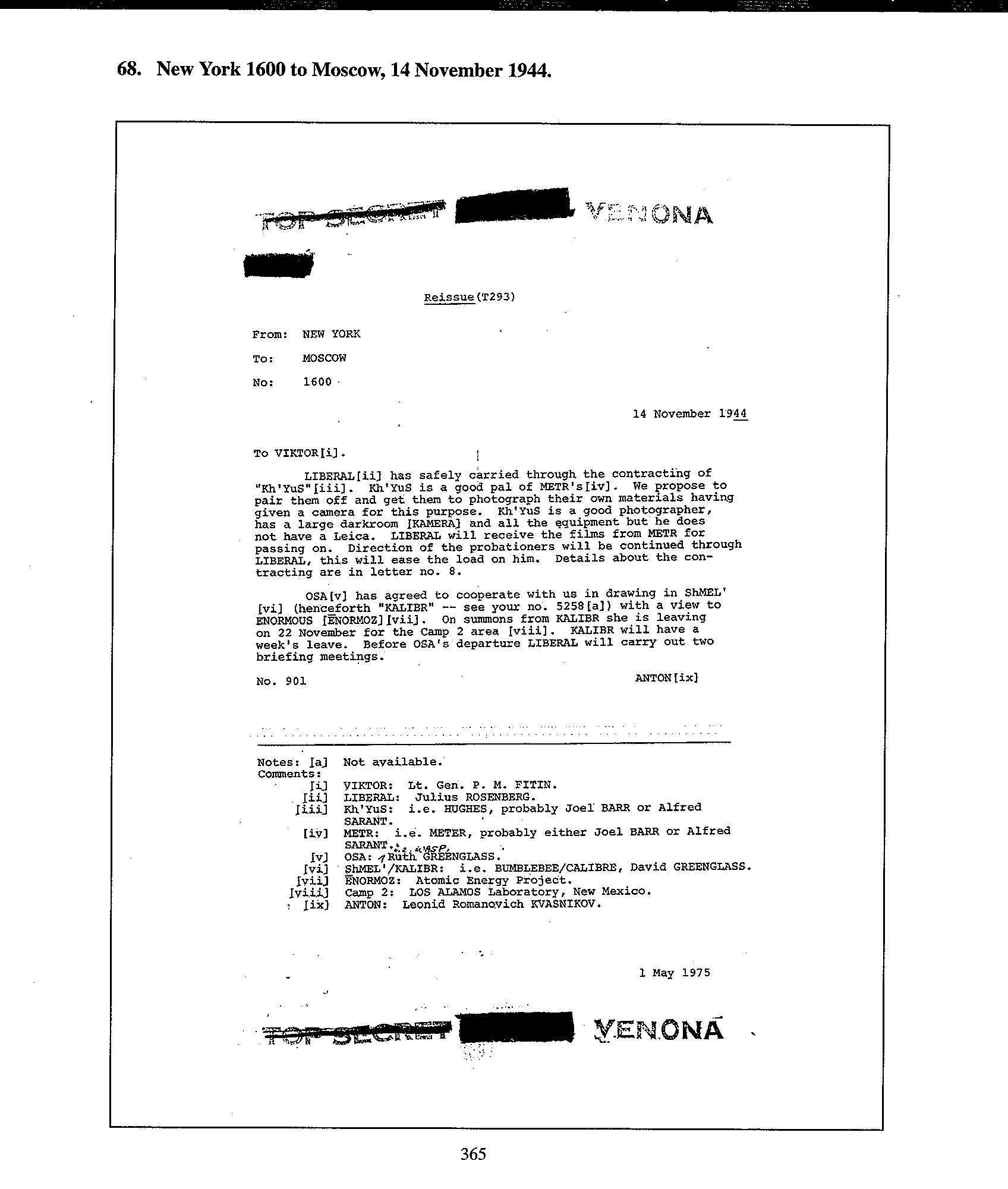
- The code name a Soviet cable used for a person, place or project, also written covername or cryptonym. The NSA and CIA Venona volume gives examples such as "Jacob Golos (covername SOUND)."17 Haynes and Klehr counted 349 Americans with covert ties in the decrypts and noted that fewer than half could be identified by their real names.51 Matching a cover name to a person is the central interpretive problem of Venona; the cover-name table is in lesson 12.
- Cult of personality
- The glorification of a single leader. Khrushchev's secret speech to the Twentieth Party Congress on February 25, 1956, condemned "the cult of the individual and about its harmful consequences" under Stalin, in the translation used by Fordham's sourcebook.11 The phrase "cult of personality" is the usual later rendering. In lesson 03.
- Cutout
- A go-between who keeps an agent and an officer from knowing each other, so that one arrest does not expose the whole chain. The Spy Museum: "A mechanism or person used to create a compartment between the members of an operation."13

D
- Dangle
- A person sent by one service to offer himself to a rival service as a recruit or defector, in order to learn its methods or feed it false information. The Spy Museum: "A person sent by the intelligence agency of his or her own country who approaches an intelligence agency" of another.13 Every walk-in had to be tested against this possibility.
- Dead drop
- A hiding place where one party leaves material for another to collect later, so that the two never meet. Merriam-Webster: "a prearranged hiding place for the deposit and pickup of information obtained through espionage."52 The Spy Museum's wording is "A secret location where materials can be left for another party to retrieve."13
- Declaration of Conscience
- Senator Margaret Chase Smith's speech in the Senate on June 1, 1950, joined by a statement of six other Republican senators, condemning the methods McCarthy had brought into the Senate without naming him.53 In module 81, lesson 05 and lesson 12.
- Defector
- A member of a government or intelligence service who abandons it and gives information to the other side. Igor Gouzenko, the Soviet military intelligence cipher clerk who left the Ottawa embassy with documents on September 5, 1945, did more than any other defector to start the Canadian and American espionage investigations.2 Walter Krivitsky and Alexander Orlov, officers who broke with Soviet intelligence in the late 1930s, were earlier ones.50 Elizabeth Bentley and Whittaker Chambers were American couriers who went to the authorities, and are better called former agents than defectors. In lesson 07 and lesson 12.
- Democratic centralism
- Lenin's rule of party organization: free discussion until a decision is made, then strict discipline and obedience of lower bodies to higher ones. The Encyclopedia of Marxism sums it up in the slogan "democracy in discussion, centralism in action" (its dash replaced here by a comma) and dates general use of the term to about 1917.54 The Library of Congress exhibit describes the same principle in practice as "subordinating members and organizations unconditionally to the decisions of higher authorities," which every national party of the Comintern had to accept.27 The Comintern's 1920 conditions made it a requirement of membership.4 In lesson 10.
- Dennis test
- The restatement of the clear and present danger test that the Supreme Court adopted in Dennis v. United States (June 4, 1951), upholding the Smith Act convictions of the Communist Party's leaders. Chief Justice Vinson quoted Judge Learned Hand: courts "must ask whether the gravity of the 'evil,' discounted by its improbability, justifies such invasion of free speech as is necessary to avoid the danger," and wrote, "We adopt this statement of the rule."55 The test let a grave but distant danger justify punishment. Yates (1957) narrowed it and Brandenburg (1969) replaced it. In module 81, lesson 09.
- Deviation
- In the party's language, any departure from the current line, labeled by the direction it took or by the person blamed for it ("Trotskyist deviation," "Browderism," "Titoism"). Deviation was a charge, and the remedy was self-criticism, demotion or expulsion. The Library of Congress exhibit notes that Stalin had Nikolai Bukharin denounced as a "right opposition" for resisting forced collectivization.34 See line.
- Dialectical materialism
- The philosophy the communist parties taught as the scientific basis of Marxism: the world is material, and it develops through the conflict of opposites. The Encyclopedia of Marxism: "a way of understanding reality; whether thoughts, emotions, or the material world," combining "Dialectics and Materialism."56 Under Stalin it became an official doctrine taught in every party school. See also historical materialism.
- Dictatorship of the proletariat
- Marx's name for the period of rule by the working class between capitalism and communism. In the Critique of the Gotha Programme (1875) he wrote that between capitalist and communist society lies a political transition period in which "the state can be nothing but the revolutionary dictatorship of the proletariat."3 Lenin made it the justification for one-party rule and the Cheka. In lesson 01.
- Dies committee
- The House Special Committee on Un-American Activities, created by House Resolution 282 on May 26, 1938, and chaired by Martin Dies Jr. of Texas until 1944; the direct predecessor of HUAC.57 In module 81, lesson 03 and lesson 06.
- Doctor Draft Act
- The law under which drafted physicians and dentists were commissioned and promoted according to their professional qualifications. Irving Peress, an Army dentist who had refused to answer loyalty questions, was promoted to major under it in 1953, and McCarthy's question "Who promoted Peress?" led to the confrontation with the Army.16 In module 81, lesson 07.
- Domino theory
- The argument that the fall of one country to communism would bring down its neighbors in turn. President Eisenhower stated it at his news conference of April 7, 1954, speaking of Indochina: "You have a row of dominoes set up, you knock over the first one, and what will happen to the last one is the certainty that it will go over very quickly."10 He called it the "falling domino" principle; Merriam-Webster dates "domino theory" in English to 1965.58
- Double agent
- A spy who appears to work for one service while really working for its opponent. The Spy Museum: "A spy who pretends to be working against one country but who is in fact working for that country's opponent."13 Boris Morros, a Hollywood producer recruited by Soviet intelligence who later worked for the FBI against it, is the best-known American case of the period.50 In lesson 08.
E
- Emergency detention
- Title II of the Internal Security Act of 1950, the Emergency Detention Act, which authorized the President, in a declared internal security emergency, to detain "each person as to whom there is reasonable ground to believe that such person probably will engage in, or probably will conspire with others to engage in, acts of espionage or of sabotage."42 President Truman returned the whole bill "without my approval" on September 22, 1950; Congress passed it over his veto.59
- Espionage
- Gathering or passing secret information for a foreign power, a federal crime under the Espionage Act of 1917 (18 U.S.C. 793 and 794).60 It is a different claim from membership, sympathy or association. Alger Hiss was convicted of perjury in 1950, not espionage, because the statute of limitations on the espionage itself had run.61 In module 81, lesson 02 and lesson 12.
- Eurocommunism
- The tendency among communist parties, mainly in Western Europe, from about 1968 to the early 1980s, to claim independence from Moscow and accept parliamentary democracy. The Encyclopedia of Marxism dates it "from 1968 up to the early 1980s" and ties it to autonomy from "the Soviet and Chinese parties."62 The American party did not join it.
- Executive Order 9835
- President Truman's order of March 21, 1947, creating a loyalty program for the federal civilian workforce, with agency loyalty boards and a Loyalty Review Board. Its standard was that "on all the evidence, reasonable grounds exists for belief that the person involved is disloyal to the Government of the United States" (the grammar is the order's own).1 In module 81, lesson 03.
- Executive Order 10450
- President Eisenhower's order of April 27, 1953, which replaced the loyalty standard with a security standard: employment had to be "clearly consistent with the interests of the national security." Its list of disqualifying conduct ran from deliberate falsification to drug addiction and "sexual perversion," the clause behind the purge of gay federal employees.63 In module 81, lesson 10. See security risk and Lavender Scare.
- Executive privilege
- A president's claim of a right to withhold internal executive communications from Congress. Eisenhower's letter to the Secretary of Defense of May 17, 1954, during the Army-McCarthy hearings, applied it to advice within the executive branch about the dispute.21 In module 81, lesson 08.
- Executive session
- A closed committee meeting. The Senate Historical Office records that McCarthy's Permanent Subcommittee on Investigations held 160 closed executive sessions in the 83rd Congress, questioning 395 witnesses, and that the records were closed for 50 years to protect them.20 Donald Ritchie's introduction to the published transcripts appeared in the Senate print dated 2003; the Senate's hearings page gives 2004 for the five volumes.64 In module 81, lesson 06.
F
- FARA (Foreign Agents Registration Act)
- The 1938 law requiring agents of foreign principals engaged in political activities to register with the Justice Department and disclose the relationship and their activities. The Justice Department: "The Foreign Agents Registration Act (FARA) was enacted in 1938."65 It grew out of the McCormack-Dickstein committee's recommendation, after its inquiry into Nazi propaganda, that foreign propaganda agents be registered,61 and it is the main tool against foreign influence in 2026 (module 81, lesson 13).
- Fellow traveler
- A person who supports the communist cause without joining the party. The phrase is older than the American Red Scare: Leon Trotsky's Literature and Revolution (1923) called the non-party writers who accepted the revolution "her artist 'fellow-travellers', in the sense in which this word was used by the old Socialists."5 Merriam-Webster defines it as one who "sympathizes with and often furthers the ideals and program of an organized group (such as the Communist party) without membership" and dates the English use to 1925.66 It names the sympathy claim, not membership or espionage.
- Fifth Amendment privilege
- The constitutional right not to be "compelled in any criminal case to be a witness against himself,"67 which witnesses before committees invoked when asked about party membership, since membership could be evidence under the Smith Act. In Quinn v. United States (1955) the Court held that a privilege must be "construed liberally" and that no special form of words was needed to claim it.68 In Slochower (1956) it held that a city could not fire a professor merely for invoking it: "we must condemn the practice of imputing a sinister meaning to the exercise of a person's constitutional right under the Fifth Amendment."69 In module 81, lesson 06 and lesson 12.
- Fifth Amendment Communist
- McCarthy's label for witnesses who invoked the privilege against self-incrimination when asked about party membership, treating the claim of privilege as an admission.57 Many who took the Fifth had been party members; others took it to avoid naming friends or to avoid perjury traps. The Supreme Court rejected the inference as a basis for punishment in Slochower (1956).69 The label belongs to no claim of the four, since it infers membership from silence.
- Five-year plan
- The Soviet system of central economic plans, each setting production targets for five years. The Library of Congress exhibit notes that the First Five-Year Plan "called for the collectivization of only twenty percent of peasant households," a target far exceeded by force.34 In lesson 02 and module 51, lesson 07.
- Feinberg Law
- New York's 1949 law directing the Board of Regents to list "subversive" organizations and to disqualify or remove teachers on loyalty grounds, with membership treated as evidence. The Supreme Court upheld it in Adler v. Board of Education (1952) and struck down its key provisions in Keyishian v. Board of Regents (January 23, 1967).70 26 In module 81, lesson 10.
- Front (front organization)
- An organization that presented itself as independent but was created or controlled by the Communist Party to reach people who would not join it, such as the American League for Peace and Democracy or the Civil Rights Congress. The Internal Security Act of 1950 defined a "Communist-front organization" as one "substantially directed, dominated, or controlled by a Communist-action organization" and operated primarily to give it aid and support.42 Membership in a front was evidence of association only; many members were not communists and did not know who ran the group. The fronts are listed in lesson 11.

G
- Glasnost
- Russian for openness or publicity: Mikhail Gorbachev's policy, from 1986, of loosening censorship and allowing public criticism of the Soviet past and present. The Library of Congress exhibit describes glasnost in 1986 as "challenging the foundations of censorship" and "marking the beginning of the end of Communist party censorship."34 Merriam-Webster dates the English use to 1986.71 In lesson 03 and lesson 04.
- Gorsky memo
- A December 1948 memorandum by the KGB officer Anatoly Gorsky, preserved in the Vassiliev notebooks, listing Soviet sources in America likely to have been exposed by the defections of Elizabeth Bentley, Whittaker Chambers and others. Haynes and Klehr treat it as important confirming evidence for several identifications.15 In lesson 12.
- Gouzenko affair
- The exposure of a Soviet military intelligence network in Canada after the cipher clerk Igor Gouzenko left the Soviet embassy in Ottawa on September 5, 1945, with documents, two months before Elizabeth Bentley gave her statement to the FBI in November 1945. A Canadian royal commission (Kellock-Taschereau) investigated the network; its report is dated June 27, 1946.2 In lesson 07 and lesson 12.
- GPU and OGPU
- The successors of the Cheka: the State Political Directorate (GPU), formed in 1922 when the Cheka's functions were transferred to it,34 and the Unified State Political Directorate (OGPU), which the NSA and CIA Venona volume dates 1923 to 1934, when it was folded into the NKVD.17 The full chain of names is charted in lesson 10.
- Graylist
- An informal term for the people in broadcasting and film who were not openly blacklisted but found work scarce, or needed to be "cleared" by an employer's security officer or by a private anti-communist publication before they could be hired. Encyclopaedia Britannica describes the clearance practice: Ed Sullivan, for one, used Counterattack "to determine whether he would clear a guest," and networks hired staff to vet employees.72 The word's first use has not been traced to a dated source here. See blacklist.
- GRU
- Soviet military intelligence, in the Venona volume's translation the "Chief Directorate for Intelligence, Red Army General Staff,".17 It ran its own networks in America alongside the NKVD and NKGB; KGB cables refer to the GRU as "the neighbors."15 Whittaker Chambers's apparatus and the Canadian ring exposed by Gouzenko were GRU operations. In lesson 10 and lesson 12.
- Great Terror
- Stalin's mass purge of the party, the army and the population, from 1936 to 1938. The Library of Congress exhibit: it "included the notorious show trials of Stalin's former Bolshevik opponents in 1936 to 1938 and reached its peak in 1937 and 1938," when "millions of innocent Soviet citizens were sent off to labor camps or killed in prison" (its dash replaced here by "to").34 The name is the title of Robert Conquest's 1968 history.73 The NKVD's own count of executions in 1937 and 1938, and the wider estimates, are given with their sources in lesson 02 and lesson 14.
- Guilt by association
- Inferring disloyalty from a person's relatives, friends, petitions or organizations, instead of from his own conduct. Donald Ritchie of the Senate Historical Office lists it among the marks of what the word McCarthyism came to mean: "character assassination, smears, mudslinging, sensationalism, and guilt by association."64 In module 81, lesson 12.
- Gulag
- The Soviet system of forced labor camps, named for the acronym of its administration, the Main Directorate of Camps. The Library of Congress exhibit says the camps were first established in 1919 under the Cheka, that the Gulag ("Main Directorate for Corrective Labor Camps") was by 1934 under the NKVD, and that prisoners built canals, railways and mines.34 The exhibit's figure of "several million inmates" by 1934 is higher than the archive-based counts for that year; the camp and death figures, with their ranges and methods, are in lesson 02 and lesson 14. Anne Applebaum's Gulag: A History (2003) is the standard account in English.74 Merriam-Webster dates "gulag" as an English common noun to 1974.75
H
- Handler
- The officer, or sometimes the trusted courier, who meets an agent, gives him tasks and collects his material. The Spy Museum: "A case officer who is responsible for handling agents in operations."13 The handler-to-source diagrams of the Silvermaster and Rosenberg groups are in lesson 12.
- "Have you no sense of decency?"
- The question Joseph Welch, the Army's counsel, put to McCarthy on June 9, 1954, after McCarthy charged that a young lawyer of Welch's firm had ties to a communist organization. The Senate Historical Office records Welch's words: "Let us not assassinate this lad further, senator. You have done enough. Have you no sense of decency?"76 The same page says McCarthy died three years later "48 years old," a figure consistent with the birth date of November 14, 1908, that module 81 takes from the Biographical Directory of Congress (his Senate-era Wisconsin Blue Book biographies give 1909).76 In module 81, lesson 08.
- Historical materialism
- Marx's theory that a society's way of producing its material life shapes its politics, law, religion and ideas, and that history moves through the conflict of classes. The Encyclopedia of Marxism opens its entry with the passage from Marx and Engels's German Ideology that takes "the material production of life itself" as "the basis of all history."77 In lesson 01.
- Hollywood Ten
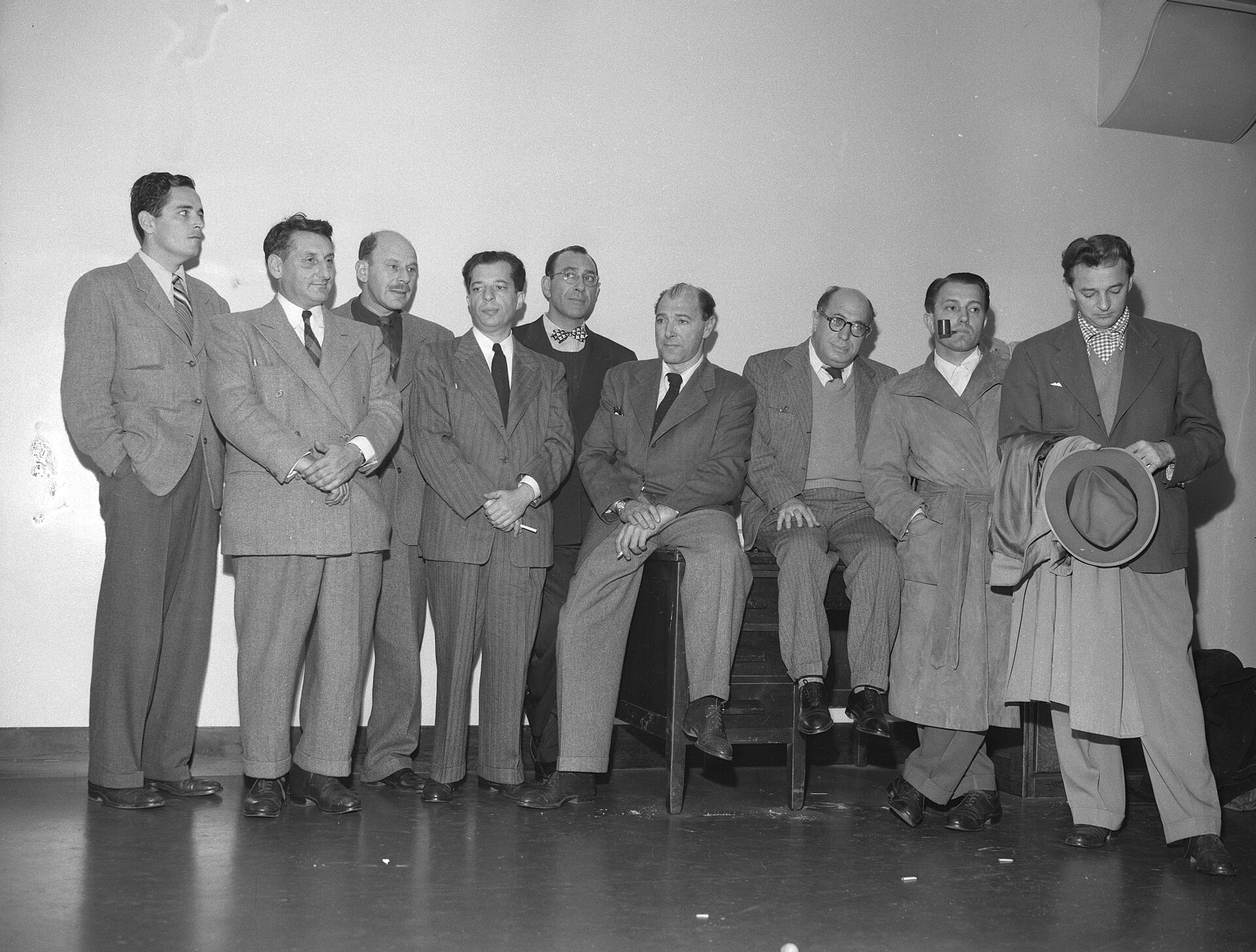
- Ten screenwriters and directors (Alvah Bessie, Herbert Biberman, Lester Cole, Edward Dmytryk, Ring Lardner Jr., John Howard Lawson, Albert Maltz, Samuel Ornitz, Adrian Scott and Dalton Trumbo) who refused in October 1947 to tell HUAC whether they were Communist Party members, were convicted of contempt of Congress, and went to prison in 1950. Eight received a year and a $1,000 fine, two received six months.49 Most had in fact been party members. In module 81, lesson 03.
- Holodomor
- The Ukrainian name, meaning death by hunger, for the famine of 1932 to 1933 in Soviet Ukraine. The Library of Congress exhibit calls it "the result of Joseph Stalin's policy of forced collectivization," records that the heaviest losses were in Ukraine, and notes that in 1932 Stalin raised Ukraine's grain procurement quotas "by forty-four percent."34 The death estimates and their sources are in lesson 02 and lesson 14.
- Honey trap
- Recruitment or blackmail through a sexual relationship arranged by an intelligence service. The Spy Museum calls it "Slang for use of men or women in sexual situations to intimidate or snare others."13
- HUAC
- The House Committee on Un-American Activities (abbreviated HCUA in government documents of the period), a standing committee of the House from January 3, 1945, renamed the Committee on Internal Security in 1969 and abolished in 1975; the National Archives files its records under the heading House Un-American Activities Committee, 1945 to 1975.78 17 57 It heard Elizabeth Bentley and Whittaker Chambers in 1948. McCarthy, a senator, was never a member. In module 81, lesson 06.
I
- Illegal
- A Soviet intelligence officer working abroad without diplomatic or official cover, under a false identity and nationality. The Venona volume's preface describes illegals as "Soviet intelligence officers usually living under false identities."17 An illegal could not be expelled as a diplomat; if caught he could be tried. Iskhak Akhmerov, who ran the Silvermaster group's material for a time, was an illegal.50 In lesson 12. The movement used the same word for party work done in secret: the Comintern's 1920 conditions told parties to combine "legal and illegal work."4
- Incitement test
- The rule of Brandenburg v. Ohio (June 9, 1969) that replaced the Dennis test: the state may not forbid advocacy of force or law violation "except where such advocacy is directed to inciting or producing imminent lawless action and is likely to incite or produce such action."79 Under it, the 1949 Smith Act prosecutions of party leaders for teaching doctrine would almost certainly fail. In module 81, lesson 09.
- Infiltration
- Placing party members or sympathizers in government, unions or other organizations to influence them from inside. Whittaker Chambers distinguished infiltration (placing members to shape policy) from espionage (passing secret material to a Soviet service), and said the Ware group began as the first and turned toward the second.2 The distinction is often lost in popular accounts. In module 81, lesson 01.
- Informant
- A person who reported to the FBI, or testified, about others' political activity, sometimes for pay. Informants ranged from FBI plants inside the party who were reliable on facts they witnessed, such as Herbert Philbrick, to paid witnesses later shown to have lied, such as Harvey Matusow, who recanted in 1955. Each informant's testimony needs corroboration.80 In lesson 08 and module 81, lesson 14.
- Institute of Pacific Relations (IPR)
- A private research body on Asian affairs, founded in 1925, which the Senate Internal Security Subcommittee investigated in 1951 and 1952 on the charge that communists had used it to shape American policy toward China. The hearings centered on Owen Lattimore.16 In module 81, lesson 07.
- Internal Security Act of 1950 (McCarran Act)
- The law of September 23, 1950, sponsored by Senator Pat McCarran, combining the Subversive Activities Control Act (registration of communist-action and communist-front organizations, a Subversive Activities Control Board of five members, and bars on members' passports and defense jobs) with the Emergency Detention Act and new immigration exclusions.42 Congress passed it over Truman's veto of September 22.59 In module 81, lesson 03.
- Iron curtain
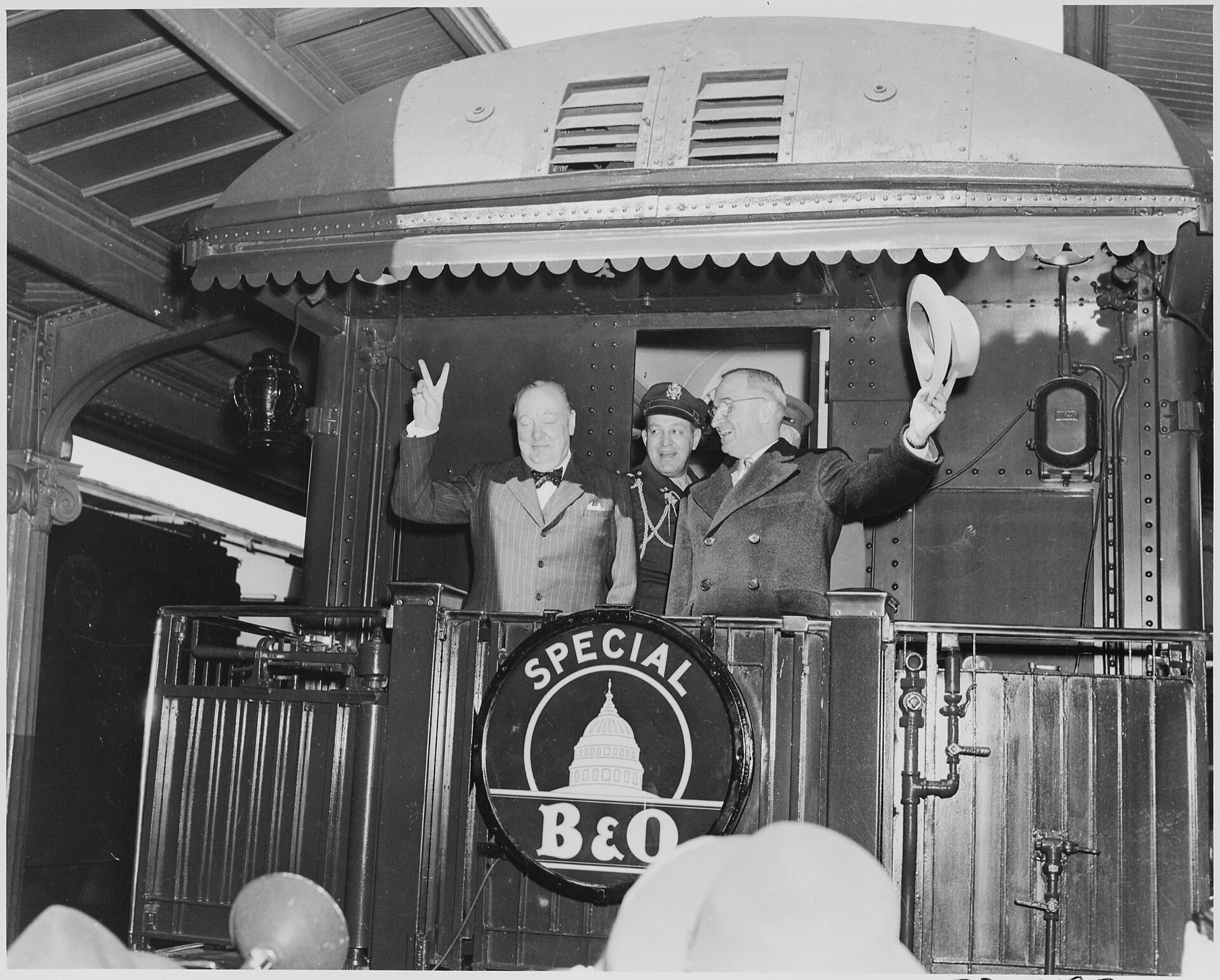
- The boundary between Soviet-controlled Eastern Europe and the West. Winston Churchill fixed the phrase at Fulton, Missouri, on March 5, 1946: "From Stettin in the Baltic to Trieste in the Adriatic, an iron curtain has descended across the Continent."7 The phrase itself is much older; Merriam-Webster dates "iron curtain" in English, in its general sense of an impenetrable barrier, to 1819.81 In lesson 03.

J
- Jenner-Butler bill
- S. 2646 of the 85th Congress, Senator William Jenner's bill of July 1957 to strip the Supreme Court of appellate jurisdiction over several kinds of internal security cases and reverse decisions of 1956 and 1957, amended by Senator John Marshall Butler; the Senate tabled it, 49 to 41, in August 1958.82 In module 81, lesson 09.
K
- KGB
- The Committee for State Security, the Soviet security and foreign intelligence service from March 1954 to 1991, successor of the NKVD, NKGB and MGB. The Venona volume's abbreviations list gives "KGB: Committee for State Security, from 1954".17 Historians often use "KGB" loosely for its predecessors as well. After 1991 its foreign directorate became the SVR and its internal security functions passed to what became the FSB. In lesson 10.
- Kolkhoz
- A Soviet collective farm. The Encyclopedia of Marxism: "Collective Farms in the Soviet Union, operated by peasants who were paid on the basis of the labour contributed," launched by Stalin in 1929.83 The state farm was a sovkhoz. See collectivization.
- Kulak
- From the Russian for fist: a better-off peasant, and in Stalin's collectivization drive a political category applied to peasants marked for elimination as a class. The Library of Congress exhibit says Stalin "focused particular hostility on the wealthier peasants, or kulaks" and that about one million kulak households were deported.34 The Encyclopedia of Marxism's description of kulaks as rural "landlords" overstates their wealth.84 Merriam-Webster dates the word in English to 1877.85 In lesson 02.
L
- Lavender Scare
- The historian David K. Johnson's name for the removal of gay men and lesbians from federal jobs under the loyalty and security programs. A Senate subcommittee chaired by Clyde Hoey reported on December 15, 1950, that homosexuals were "unsuitable for employment in the Federal Government" and were "security risks in positions of public trust."86 Executive Order 10450 (1953) wrote "sexual perversion" into the security standard.63 In module 81, lesson 10.
- Lee list
- The list of 108 unresolved State Department security cases compiled in 1947 by investigators for the House Appropriations Committee under its lead investigator, Robert E. Lee. John Earl Haynes found that most, though not all, of McCarthy's numbered cases of February 20, 1950, were drawn from it.87 In module 81, lesson 05.
- Legal (legal rezident, legal cover)
- In Soviet intelligence usage, an officer working under official cover, as a diplomat, consular or trade official or a correspondent of a Soviet news agency, protected from prosecution by diplomatic status in many cases and exposed only to expulsion. The chief of such a station was the legal rezident; the Spy Museum defines a rezident as the "KGB or GRU (Soviet and Russian military intelligence) chief of station in any foreign location."13 Compare illegal.
- Legend
- The false life story of an illegal or agent, backed by documents. The Spy Museum: "A spy's claimed background or biography, usually supported by documents and memorized details."13
- Legislative Reorganization Act of 1946
- Public Law 79-601 of August 2, 1946, which reorganized the committees of Congress, wrote HUAC's jurisdiction into the House rules, gave Senate committees subpoena power and gave standing committees professional staffs.57 It is the legal base of the investigations of 1947 to 1954. In module 81, lesson 06.
- Levering Act
- California's law of 1950 requiring a loyalty oath of all state employees. In Tolman v. Underhill (1952) the California Supreme Court held that it displaced the University of California Regents' own oath, under which faculty who refused to sign had been dismissed.26 In module 81, lesson 10.
- Line (the party line)
- The current policy of the party on any question, set in Moscow for the parties of the Comintern and binding on members until changed. The Library of Congress exhibit says the Comintern forced the American factions in 1922 "to follow the party line established in Moscow."27 The American party's line reversed in August 1939, after the Nazi-Soviet Pact, from the antifascist Popular Front to opposition to aid for Britain, and reversed again on June 22, 1941, when Germany invaded the Soviet Union.2 The changes are traced year by year in lesson 05.
- Loyalty oath
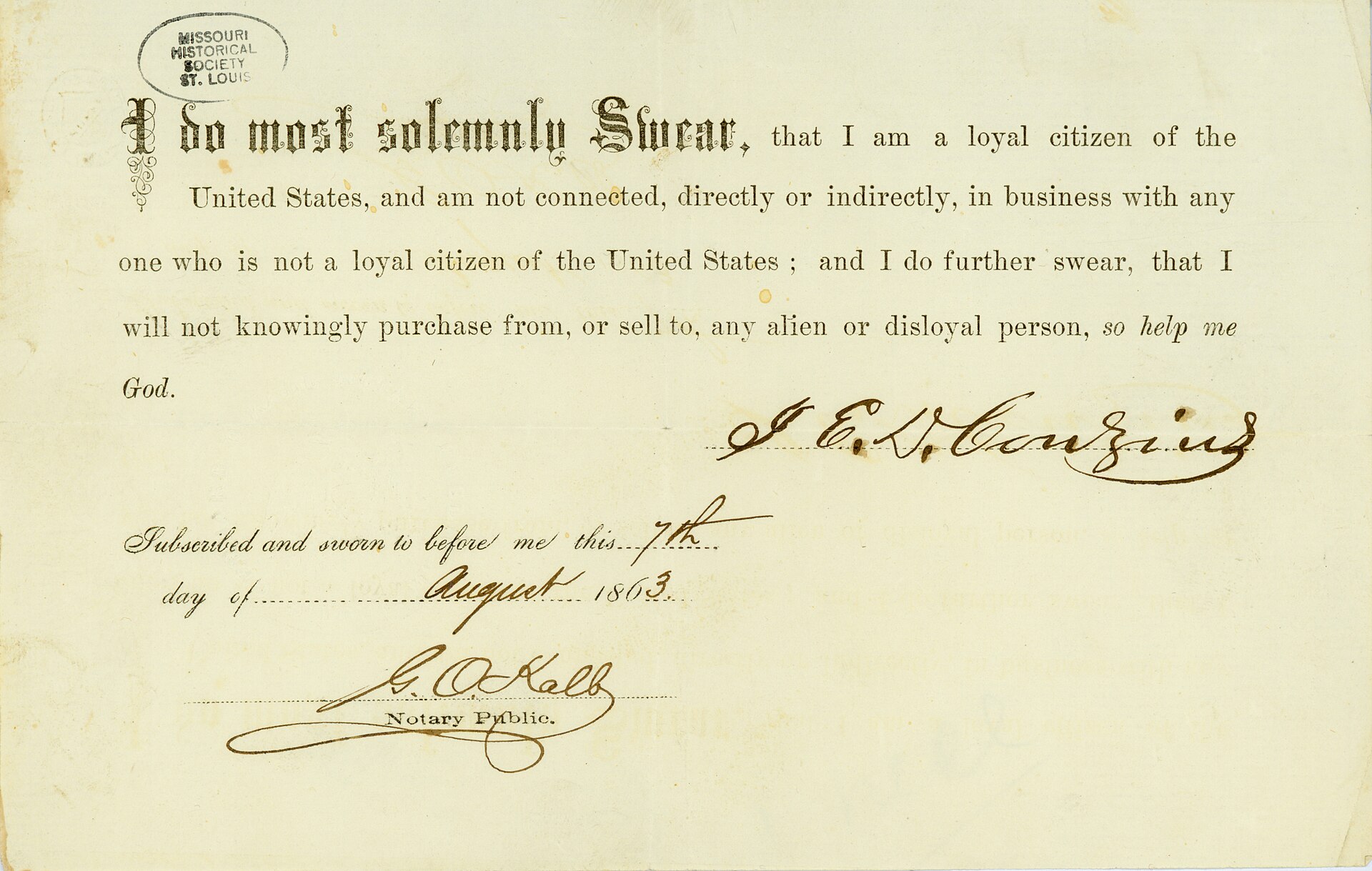
- A sworn statement of loyalty, often with a denial of membership in named organizations, required of public employees, teachers or union officers. Oaths are older than the Cold War (the figure below shows one from 1863), but they spread after 1947: California's Levering Act of 1950 required one of all state employees, and the University of California's own oath of 1949 to 1950 led to the dismissal of faculty who refused to sign.26 The 1947 Taft-Hartley affidavit, upheld in American Communications Association v. Douds (1950), was a union version.88 See also section 9(h) affidavit.
- Loyalty Review Board
- The board within the Civil Service Commission created by Executive Order 9835 to hear appeals and review loyalty cases across the government, and to receive and circulate the Attorney General's designations of organizations.1 In December 1951 it found a reasonable doubt as to John Stewart Service's loyalty after earlier boards had cleared him.16 In module 81, lesson 03.

M
- Maoism
- The version of Marxism-Leninism developed by Mao Zedong, putting the peasantry at the center of revolution and stressing continuing struggle after the seizure of power. The Encyclopedia of Marxism calls it a theory that "claims to be an advancement of Marxism, developed as a critique of the Soviet Union."89 Merriam-Webster dates the English word to 1950.90 In lesson 03.
- Marxism-Leninism
- The official doctrine of the Soviet party and of the parties that followed it: Marx's theory as interpreted by Lenin, with the vanguard party, democratic centralism and the dictatorship of the proletariat. The Encyclopedia of Marxism notes that the label was given after Lenin's death and "was the official political theory of the former Soviet state."91
- McCarran Act
- The common name of the Internal Security Act of 1950, after its sponsor, Senator Pat McCarran of Nevada. See Internal Security Act of 1950.42 The McCarran-Walter Act of 1952 is a different law, on immigration.
- McCarthyism
- The word was coined by the Washington Post cartoonist Herbert Block (Herblock) in his cartoon of March 29, 1950, "You mean I'm supposed to stand on that?", in which, in the exhibit's words, Republican senators and their national chairman "push a reluctant GOP elephant to mount the unsavory platform."992 The Library of Congress exhibit text states: "This was the first use of the word 'McCarthyism.'"92 Merriam-Webster also dates it to 1950.93 Donald Ritchie of the Senate Historical Office records that the word came to mean "any investigation that flouts the rights of individuals," that "even Senator McCarthy employed it, redefining it as 'the fight for America,'" and that it has been "applied collectively to all congressional investigations of suspected Communists."64 McCarthy's defenders, such as M. Stanton Evans, argue that the word has been used to discredit anti-communism as a whole; Ellen Schrecker uses it for the whole apparatus of repression, of which McCarthy was a late part.94 80 This glossary uses it for the methods: public accusation of disloyalty with insufficient regard to evidence. McCarthy's own career is in lesson 08 and every lesson of module 81.
- MGB
- The Ministry for State Security, the name of the Soviet security and foreign intelligence service in 1946 to 1947 and 1952 to 1953, according to the Venona volume's abbreviations list.17 In lesson 10.
- Mitrokhin archive
- The notes that the KGB archivist Vasili Mitrokhin made from foreign intelligence files and brought to Britain when he defected in 1992; they are held at the Churchill Archives Centre in Cambridge, and Christopher Andrew published a history based on them, The Sword and the Shield (1999).12 They mainly concern the decades after the 1950s. In lesson 04.
- Mole
- An agent placed or recruited inside an opponent's government or intelligence service, often for a long time. The Spy Museum: "An agent of one organization sent to penetrate a specific intelligence agency by gaining employment" there.13 Kim Philby of the British Secret Intelligence Service is the classic case of the era (lesson 08).
- Moynihan Commission
- The Commission on Protecting and Reducing Government Secrecy, chaired by Senator Daniel Patrick Moynihan, whose 1997 report used Venona as a case study of the costs of keeping evidence secret from the public and even from senior officials.15 In module 81, lesson 02.
- Mundt-Nixon bill
- H.R. 5852 of 1948, sponsored by Representatives Karl Mundt and Richard Nixon of HUAC, which would have required communists to register and barred them from federal employment and passports. Mundt told the committee's 1948 espionage hearings that the bill had been "reported unanimously by this committee, passed by the House by 319 to 56 and now before the Senate."95 The recorded House vote of May 19, 1948, was 319 to 58, as module 81 lesson 03 gives it from the roll call; Mundt's figure was his own.61 It did not become law, but its registration and passport provisions returned in the Internal Security Act of 1950.42 In lesson 05.
N
- National Lawyers Guild
- A lawyers' association that HUAC described in a 1950 report as a "legal bulwark of the Communist Party." That description was a committee report, not a finding by any court or by the Attorney General's list process. Fred Fisher, the young associate of Joseph Welch whom McCarthy named on June 9, 1954, had belonged to it.21 In module 81, lesson 08 and lesson 11.
- Nazi-Soviet Pact
- The Treaty of Nonaggression between Germany and the Soviet Union, signed in Moscow on August 23, 1939, by Foreign Ministers Ribbentrop and Molotov, with a secret additional protocol dividing Eastern Europe into spheres of influence and stating that it "shall be treated by both parties as strictly secret."96 Communist parties everywhere reversed their antifascist line to follow it. In lesson 02.
- Neighbors
- The KGB's word in its cables for the GRU, Soviet military intelligence, and sometimes for other Soviet services. A message about "the neighbors" concerns the other service's sources.15
- New Economic Policy (NEP)
- Lenin's retreat of 1921 from war communism, which allowed peasants to sell their grain and small private traders to operate while the state kept heavy industry. The Encyclopedia of Marxism: "initiated in 1921 to replace the policy of War Communism," as "a temporary measure allowing a limited revival of free trade."97 Stalin abandoned it with the forced collectivization launched in 1929.83 In lesson 02.
- NKGB
- The People's Commissariat for State Security, the Soviet foreign intelligence and security service from 1943 to 1946, split from the NKVD, as dated in the Venona volume's abbreviations list.17
- NKVD
- The People's Commissariat for Internal Affairs, which from 1934 held the secret police, foreign intelligence and the Gulag. The Venona volume calls it "Moscow's secret police and quasi-civilian intelligence service" and dates it 1934 to 1943 in that role.17 It carried out the Great Terror; its chiefs are listed in lesson 10.
- Nomenklatura
- The list of important posts that only the party could fill, and of the reliable people eligible to fill them; by extension the privileged ruling class of a communist state. Encyclopaedia Britannica describes it as "a list of politically reliable people" and as "the ruling elite at the national and local level" with "lavish benefits."98
O
- One-man hearing
- A hearing at which a single member of a committee takes sworn testimony. McCarthy used it routinely in 1953, often away from Washington.57 The House ended one-man subcommittees with the Code of Fair Procedures of March 23, 1955, which required at least two members.36 In module 81, lesson 12.
- One-time pad
- A cipher key of random numbers, printed in pads of which each page is to be used once and destroyed; used correctly it cannot be broken. The Spy Museum: "Strings of random numbers for singular use as a key in enciphering messages."13 The Venona volume explains that Soviet pads were "periodically pouched to Soviet consular missions in sealed packets."17 The Soviet manufacturer duplicated some pages in 1942, and the reuse is what let American codebreakers read part of the traffic.15 In module 81, lesson 02.
P
- Perlo group
- A network of federal employees named for Victor Perlo of the War Production Board, which Elizabeth Bentley handled from about March 1944 and described to the FBI in November 1945.15 Its members and handlers are in lesson 12.
- Perestroika
- Russian for restructuring: Mikhail Gorbachev's program of economic and political reform in the second half of the 1980s, which loosened central planning and party control and, with glasnost, opened the way to the collapse of communist rule in Eastern Europe in 1989 and of the Soviet Union in 1991. Merriam-Webster dates the English use to 1986.99 The Library of Congress exhibit gives perestroika its own section among the internal workings of the Soviet state.34 In lesson 03.
- Perjury
- Lying under oath. Several of the period's best-known cases were perjury cases because the underlying espionage could not be charged: Alger Hiss was convicted in January 1950 on two counts of perjury for denying that he had passed documents to Whittaker Chambers, the statute of limitations on espionage having run.61 William Remington was convicted of perjury in 1953,26 and Owen Lattimore was indicted for it in 1952 and again in 1954, with the central counts dismissed by the courts.16 In module 81, lesson 03 and lesson 07.
- Permanent revolution
- Leon Trotsky's theory that in a backward country such as Russia the democratic revolution could only win as a socialist one led by the working class, and that it would have to spread abroad to survive. The Encyclopedia of Marxism quotes Trotsky's summary: the democratic revolution would give "a powerful impetus to the international socialist revolution."100 Stalin's socialism in one country was the opposing doctrine.
- Permanent Subcommittee on Investigations (PSI)
- The investigating subcommittee of the Senate Committee on Government Operations (before 1952, Expenditures in the Executive Departments), authorized January 28, 1948, which McCarthy chaired in 1953 and 1954. It is distinct from HUAC and from the Senate Internal Security Subcommittee.57 Its 160 executive sessions of the 83rd Congress were published in 2003 and 2004.20 In module 81, lesson 06.
- Pertinency
- The requirement in the contempt statute that a question be "pertinent to the question under inquiry."48 In Watkins v. United States (June 17, 1957) the Supreme Court reversed a contempt conviction because the witness had not been told the subject of the inquiry clearly enough to judge whether the questions were pertinent.101 In module 81, lesson 09.
- Pink, pinko
- A sneer at a person thought to lean toward communism without being a full "Red." Merriam-Webster dates "pinko" to 1925.102 Its targets were usually people who held views on economics or foreign policy that the speaker disliked, so the word is weak evidence of anything. It belongs to the sympathy claim.
- Point of order
- A parliamentary objection that a proceeding breaks the rules. McCarthy's constant interruptions with "Point of order, Mr. Chairman" during the Army-McCarthy hearings made the phrase a national catchphrase in 1954.21
- Popular Front
- The Comintern line, adopted at its Seventh World Congress in the summer of 1935 on the report of Georgi Dimitrov, which told communist parties to form broad alliances with socialists, liberals and others against fascism.6 It replaced the "Third Period" line of 1928 to 1935, under which communists had attacked socialists as "social fascists."103 104 The American party grew under it, to about 75,000 members by 1938 by the Library of Congress exhibit's figure, and lost many members when the Nazi-Soviet Pact ended it in 1939.27 In lesson 05.
- Proletariat
- The class of wage workers who own no means of production. The Encyclopedia of Marxism quotes Engels: "The proletariat is that class in society which lives entirely from the sale of its labour power and does not draw profit from any kind of capital."105 See dictatorship of the proletariat.
- Pumpkin papers
- Rolls of microfilm of 1938 State Department documents that Whittaker Chambers hid in a hollowed-out pumpkin on his Maryland farm and handed to HUAC investigators on December 2, 1948. The film helped convict Alger Hiss of perjury.61 In module 81, lesson 03.
- Purge
- The removal of members from a communist party, by expulsion and in the Soviet Union of the 1930s by arrest and death. The Library of Congress exhibit: Stalin "proceeded to purge the party rank and file and to terrorize the entire country with widespread arrests and executions."34 American usage stretched the word to dismissals from government jobs. See Great Terror.

R
- Red-baiting
- Attacking a person or group as communist, usually to discredit them whether or not the charge is true. Merriam-Webster defines it as "the act of attacking or persecuting as a Communist or as communistic" and dates it to 1927.106 The committees themselves knew the word: during HUAC's espionage hearings of 1948, Representative F. Edward Hebert said "this committee is not witch hunting or Red baiting, but is trying to get the facts of what is going on."95
- Red Channels
- Red Channels: The Report of Communist Influence in Radio and Television, published in June 1950 by the publishers of the newsletter Counterattack, which three former FBI agents had started in 1947. It "listed 151 entertainment industry employees," in Encyclopaedia Britannica's words.72 Networks and sponsors used it to decide whom to hire. In module 81, lesson 10.
- Red Monday
- June 17, 1957, when the Supreme Court decided four cases against the government in internal security matters: Watkins v. United States, Yates v. United States, Sweezy v. New Hampshire and Service v. Dulles.101 107 Opponents of the decisions used the name, and it became the title of Arthur Sabin's history; who coined it has not been traced.82 In module 81, lesson 09.
- Red Scare
- A period of intense public fear of communist subversion. Historians speak of a first Red Scare, in 1919 and 1920, the years of the Palmer raids, and a second, from the late 1940s to the mid 1950s. Robert Justin Goldstein, writing in the National Archives' Prologue, calls the Attorney General's list one of the most central aspects of the second Red Scare, "which has popularly become known as 'McCarthyism.'"22 The first is in lesson 05.
- Revisionism
- Two different things. In the movement, the charge of altering Marxism's foundations, made against reformist socialists and later traded between Moscow and Beijing after their split. The Encyclopedia of Marxism: "A fundamental alteration of a theory," replacing it with a new one.108 Merriam-Webster dates the general word to 1856.109 Among historians of American communism, "revisionist" names the school that emphasized the party's domestic roots and the harms of anti-communism, against the "traditionalist" school that emphasized Moscow's control; John Earl Haynes called Ellen Schrecker's Many Are the Crimes "easily the most impressive revisionist book of recent years."15
- Rezident
- The chief of a Soviet intelligence station abroad. The Spy Museum: "KGB or GRU (Soviet and Russian military intelligence) chief of station in any foreign location."13 A "legal" rezident worked under diplomatic or official cover; an "illegal" rezident ran a network without it. The New York KGB rezident Vasily Zarubin is treated in lesson 09.
- Rezidentura
- A Soviet intelligence station, also called a residency, headed by a rezident. The Venona volume notes that Soviet establishments in America, such as the consulates and the Amtorg Trading Corporation, housed KGB residencies under legal cover.17 In lesson 12.
S
- Samizdat
- Russian for self-publishing: texts banned or unpublishable in the Soviet bloc, copied by hand or typewriter and passed from reader to reader. The KGB counted them; the Library of Congress exhibit includes a KGB statistical report of March 21, 1988, on its 1987 investigations of "the distribution of anonymous publications hostile to the Soviet government and the Communist Party."34 Merriam-Webster dates the English use to 1967.110
- Secret apparatus (underground)
- The hidden side of the American Communist Party, kept separate from its open organization, which handled secret members and liaison with Soviet intelligence. Comintern files opened in the 1990s show it was linked to Soviet espionage.2 The Library of Congress exhibit adds that the opened archives revealed "the continued financial as well as ideological dependency of the American Communists on the Soviet party."27 Its best-known chief in the 1930s was J. Peters (lesson 08).
- Section 9(h) affidavit
- The oath required by the Taft-Hartley Act of 1947 (section 9(h) of the National Labor Relations Act as amended) of every officer of a union that wanted the protection of the National Labor Relations Board, swearing that he was not a member of or affiliated with the Communist Party. The Supreme Court upheld it in American Communications Association v. Douds, decided May 8, 1950.88 In lesson 11.
- Security risk
- Under Executive Order 10450 (1953), an employee whose employment was not "clearly consistent with the interests of the national security," a much broader category than disloyalty. The order's list of grounds took in falsification, "habitual use of intoxicants to excess," drug addiction, "sexual perversion" and mental illness as well as political associations.63 A person could be a security risk without any suspicion of disloyalty. In module 81, lesson 10.
- Show trial
- A public trial staged to display a defendant's guilt, with the verdict settled beforehand and the defendants' confessions as the centerpiece. The Library of Congress exhibit refers to "the notorious show trials of Stalin's former Bolshevik opponents" between 1936 and 1938.34 In lesson 02.
- SISS
- The Senate Internal Security Subcommittee of the Judiciary Committee, authorized by Senate Resolution 366 on December 21, 1950, and chaired in turn by Pat McCarran, William Jenner and James Eastland until it was abolished in 1977.57 The National Archives holds its large body of records with the Judiciary Committee's.111 It ran the Institute of Pacific Relations inquiry. McCarthy was not a member of its leadership and it was not his committee. In module 81, lesson 06.
- Silvermaster group
- The Soviet espionage network of federal employees centered on the economist Nathan Gregory Silvermaster, which Elizabeth Bentley described to the FBI in 1945. Venona later corroborated much of her account, but no member was convicted of espionage.26 15 The handler-to-source diagram is in lesson 12.
- Sleeper
- An agent placed in a country to live an ordinary life until activated. The Spy Museum: an "Agent living as an ordinary citizen in a foreign country; acts only when a hostile situation develops."13
- Smith Act
- Title I of the Alien Registration Act of June 28, 1940, which made it a crime "to knowingly or willfully advocate, abet, advise, or teach the duty, necessity, desirability, or propriety of overthrowing or destroying any government in the United States by force or violence," to organize a group that does so, or "to be or become a member of, or affiliate with, any such society, group, or assembly of persons, knowing the purposes thereof."112 The Supreme Court upheld the convictions of the party's leaders in Dennis (1951), narrowed the advocacy clause in Yates (1957), and upheld the membership clause, read to require active membership with specific intent, in Scales (1961).55 107 113 The Smith Act does not name the Communist Party. In module 81, lesson 03 and lesson 09.
- The Comintern's charge, during the "Third Period" of 1928 to 1934 or 1935, that social democratic parties were a wing of fascism, which kept communists from joining with socialists against the Nazis in Germany. The Encyclopedia of Marxism: a "Theory made famous by Stalin from 1928 to 1934" that held "social democracy and fascism were one in the same."104 The Popular Front reversed it.
- Stalin's doctrine, first stated in 1924 after Lenin's death, that socialism could be built in the Soviet Union alone without revolutions abroad. The Encyclopedia of Marxism calls it "A foundation of the Stalinist political theory, introduced for the first time in 1924," opposed to the earlier Bolshevik view that the revolution depended on revolutions in Europe.114 It put the defense of the Soviet state ahead of every foreign party's interests.
- Source
- A person who supplies information to an intelligence service; in the Venona cables, an American giving material to a Soviet officer. Haynes and Klehr's count of 349 Americans with covert relationships to Soviet intelligence counts sources, couriers, talent spotters and others together.51 A source in a cable is not always witting, and the cables sometimes describe as sources people who only talked to a Soviet contact.
- Stalinism
- The system of rule associated with Stalin: one-man dictatorship, terror by the secret police, the cult of the leader, forced collectivization and central planning; as an epithet, any rigid loyalty to Moscow. Merriam-Webster dates the word to 1927.115 The Encyclopedia of Marxism's entry, written from a Trotskyist point of view, defines Stalinism as "the politics of the bureaucracy that hovers over a workers' state."116
- Subpoena
- A legal order to appear and testify or to produce documents. Under the Legislative Reorganization Act of 1946, HUAC's chairman could sign subpoenas personally, while Senate committees held the power as bodies.57 Refusing a subpoena or a pertinent question could lead to prosecution for contempt of Congress.
- Subversive
- Tending to overthrow or undermine the government. The word was an official category: Executive Order 9835 told the Attorney General to designate organizations that were "totalitarian, fascist, communist or subversive."1 It was never defined in the order, which is one reason the Attorney General's list grew to cover groups of very different kinds.22
- Subversive Activities Control Board (SACB)
- The five-member board created by the Internal Security Act of 1950 to decide, after hearings, whether an organization was a communist-action or communist-front organization required to register.42 It ordered the Communist Party to register in 1953, an order the Supreme Court upheld in 1961; the registration of individual members was struck down in Albertson (1965).43 44 In lesson 11.
T
- Third Period
- The Comintern's line from 1928 to 1935, which held that capitalism had entered its final crisis and that communists should refuse alliances with socialists, whom they called "social fascists." The Encyclopedia of Marxism describes it as an insurrectionary line ended by the failure of the German Communist Party against the Nazis, after which the Popular Front was adopted.103 In lesson 05.
- Titoism
- Independence of a communist state from Moscow, after Josip Broz Tito of Yugoslavia, whose party was expelled from the Cominform in 1948. Stalin answered with a campaign against "Titoism" across Eastern Europe, and the Cominform's last meeting, in Hungary in November 1949, was given over to it.38 In lesson 03.
- Tradecraft
- The working methods of espionage: cover, cutouts, dead drops, recognition signals, ciphers and the rest. The Spy Museum: "The methods developed by intelligence operatives to conduct their operations."13 Haynes, Klehr and Vassiliev argue from the KGB files that Soviet tradecraft in America was often careless during the war, with sources who knew one another and a few couriers serving several networks, which is why Bentley's defection exposed so much.50
- Trotskyist
- A follower of Leon Trotsky, who opposed Stalin after Lenin's death and was expelled from the party in late 1927 with Grigorii Zinoviev and Lev Kamenev; he was later exiled and in August 1940 murdered in Mexico by a Soviet agent (lesson 02). Merriam-Webster: "a follower of Trotsky: an adherent of Trotskyism."117 34 In the Stalinist parties "Trotskyite" was a charge that could end a career or, in the Soviet Union, a life. The American Trotskyists of the Socialist Workers Party were the first people prosecuted under the Smith Act, in Minneapolis in 1941.61 The Encyclopedia of Marxism's account of Trotskyism is in its entry.118
- Truman Doctrine
- President Truman's policy, announced to a joint session of Congress on March 12, 1947, of giving political, military and economic aid to democratic nations under threat, beginning with Greece, whose government was fighting a civil war against the Greek Communist Party, and Turkey.47 In lesson 03.
- Twenty-One Conditions
- The terms for admission to the Comintern adopted at its Second Congress in July and August 1920. They required parties to purge reformists, to build "a parallel illegal organisation" alongside their legal one, to form "Communist cells" in armed forces, to accept the Comintern's decisions as binding and to support the Soviet republics.4 2 In lesson 02 and lesson 10.
- Two camps
- The Soviet doctrine, restated by Andrei Zhdanov at the founding conference of the Cominform in September 1947, that the world was divided into an imperialist camp led by the United States and a "democratic" camp of the Soviet Union and its allies.38 It was Moscow's answer to the Truman Doctrine and the Marshall Plan.
- Tydings committee
- The five-member subcommittee of the Senate Foreign Relations Committee, chaired by Millard Tydings of Maryland, that held hearings on McCarthy's State Department charges from March 8 to June 28, 1950; its majority report called them "a fraud and a hoax."32 In module 81, lesson 05.
U
- Underground
- The party's secret organization and the members who belonged to it without public membership. See secret apparatus.2
- United front
- A tactic of temporary alliance with other working-class parties on agreed aims, without merging. The Encyclopedia of Marxism: a tactic "in which two or more subjects, especially political parties, collaborate against a common enemy or for any agreed objective, without giving up their differences."119 In China the Communist Party's United Front Work Department still carries the name (lesson 04).
V
- Vanguard party
- Lenin's idea of a party of disciplined, full-time revolutionaries that leads the working class instead of following it, set out in What Is To Be Done?, written between the autumn of 1901 and February 1902 and published in March 1902.120 The Encyclopedia of Marxism describes the vanguard as groups "more resolute and committed, better organised and able to take a leading role in the struggle."121 The idea justified the party's claim to rule for the class it spoke for.
- Vassiliev notebooks
- Notebooks of notes and transcriptions from KGB archival files on Soviet intelligence in the United States, made in the 1990s by the former KGB officer Alexander Vassiliev for a book project, given to the Library of Congress and published online by the Wilson Center's Cold War International History Project in 2009.122 Module 81 counts nine notebooks of 1,115 pages.15 They are the basis of Haynes, Klehr and Vassiliev's Spies (2009). In module 81, lesson 02.
- Venona
- The U.S. Army's and later NSA's program, begun at Arlington Hall on February 1, 1943, to break Soviet intelligence and diplomatic cables of the 1940s; the code name was adopted later. The NSA and CIA volume speaks of "some 2,900 Soviet intelligence messages" translated and released from July 1995.17 Haynes and Klehr counted 349 Americans with covert relationships to Soviet intelligence in the decrypts.51 No Venona cable was used as evidence in any trial of the period.26 In module 81, lesson 02 and lesson 12.
- Voice of America (VOA)
- The government's overseas radio service, created during the Second World War inside the Office of War Information. McCarthy's 1953 hearings alleged waste and sabotage in its transmitter planning.16 In module 81, lesson 07.
W
- Waldorf statement
- The declaration of November 25, 1947, issued by Eric Johnston for the film producers after a meeting at the Waldorf-Astoria Hotel in New York, that they would discharge or suspend without pay the Hollywood Ten and would "not knowingly employ a Communist."26 It began the industry blacklist. In module 81, lesson 10.
- Walk-in
- A person who volunteers to spy or defect by walking into an embassy or other official building. The Spy Museum: "A defector who declares his or her intentions by walking into an official installation."13 Merriam-Webster gives 1924 for the noun in its general sense.123
- War communism
- The Bolshevik economic policy of the Civil War, 1918 to 1921: nationalization, a ban on private trade and forced requisition of grain from the peasants. The Encyclopedia of Marxism: "One primary function of War Communism was the requisition of grain from the peasantry, in order to feed the starving urban population."124 The NEP replaced it. In lesson 02.
- Ware group
- The underground organization of party members in Washington in the 1930s, developed by Harold Ware, that Whittaker Chambers described to HUAC in August 1948; it aimed first at infiltration and later at espionage. Chambers named Alger Hiss, Lee Pressman, Nathan Witt, John Abt and others as members; Pressman, Witt and Abt were called before the committee on August 20, 1948.2 95 In lesson 12.
- Warsaw Pact
- The Warsaw Treaty Organization, the military alliance of the Soviet Union and its East European states established on May 14, 1955, which the State Department's historians describe as a counterbalance to NATO after West Germany joined it.125 Its forces invaded Czechoslovakia in August 1968.30 It was dissolved in 1991, the year the Soviet Union ended. In lesson 10.
- Watkins committee
- The Select Committee to Study Censure Charges, six senators chaired by Arthur Watkins of Utah, which held hearings from August 31 to September 13, 1954, and recommended censure on two counts.82 33 In module 81, lesson 09.
- Witch hunt
- A campaign against people accused of disloyalty on flimsy evidence. Merriam-Webster dates the term to 1853.126 Critics of the investigations used it from the start, and the investigators answered it: in HUAC's 1948 espionage hearings Representative Hebert insisted the committee "is not witch hunting or Red baiting."95 The metaphor implies there were no witches; the Venona decrypts show there were spies, and also that many people accused were not among them.51
Y
- Yates distinction (advocacy of doctrine and advocacy of action)
- The line drawn by the Supreme Court in Yates v. United States (June 17, 1957), reversing the Smith Act convictions of 14 leaders of the Communist Party in California: the Smith Act reached advocacy of action, not of abstract doctrine. Justice Harlan wrote: "The essential distinction is that those to whom the advocacy is addressed must be urged to do something, now or in the future, rather than merely to believe in something."107 In module 81, lesson 09.
Words as weapons: reading the vocabulary of both sides
Both sides of the struggle used words to win arguments. Communist parties called opponents "fascists," "social fascists" or "Trotskyites" and called their own fronts "peace" and "democratic" organizations; the Cominform's founding conference divided the world into an imperialist camp and a "democratic" one.38 American anti-communists, for their part, used "pink," "comsymp" and "fellow traveler" for people whose offense was a petition or an opinion, and McCarthy's "Fifth Amendment Communist" converted a constitutional right into a confession.69 The critics of the investigations answered with "witch hunt" and "McCarthyism," words that carry the conclusion that there was nothing to find. The archives show that there was something to find and that much of the hunting missed it: Haynes and Klehr identified 349 Americans with covert ties to Soviet intelligence, and John Earl Haynes's own review of the 159 people on McCarthy's lists found substantial evidence that nine had assisted Soviet espionage, with a tenth ambiguous.51 87 The fairest reading uses the words that fit the evidence for each person: member, source, sympathizer or associate, and says which.
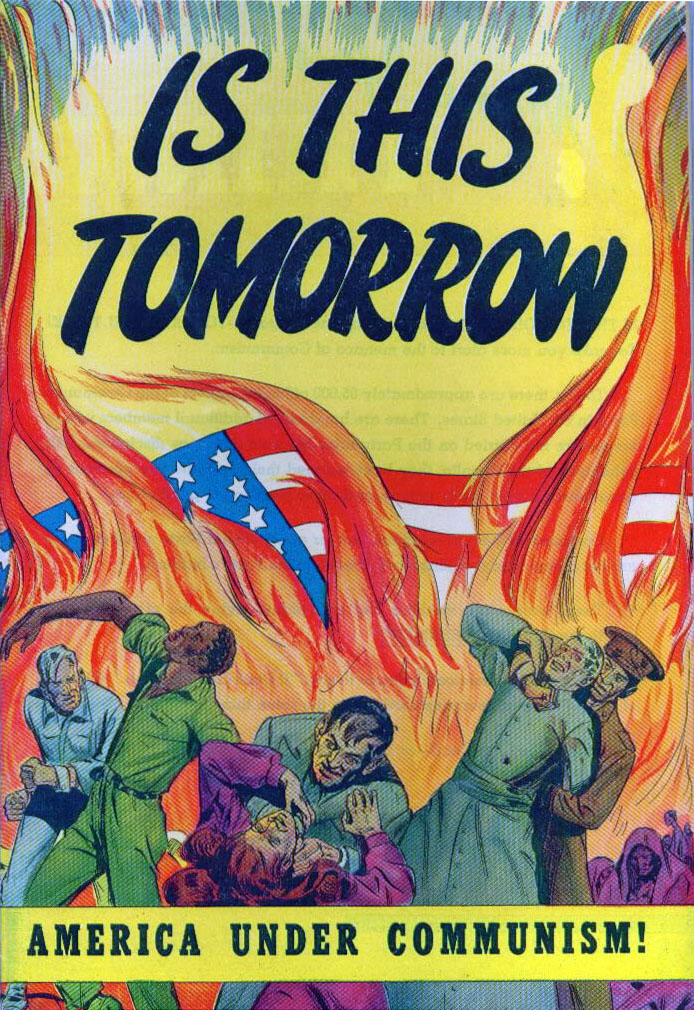

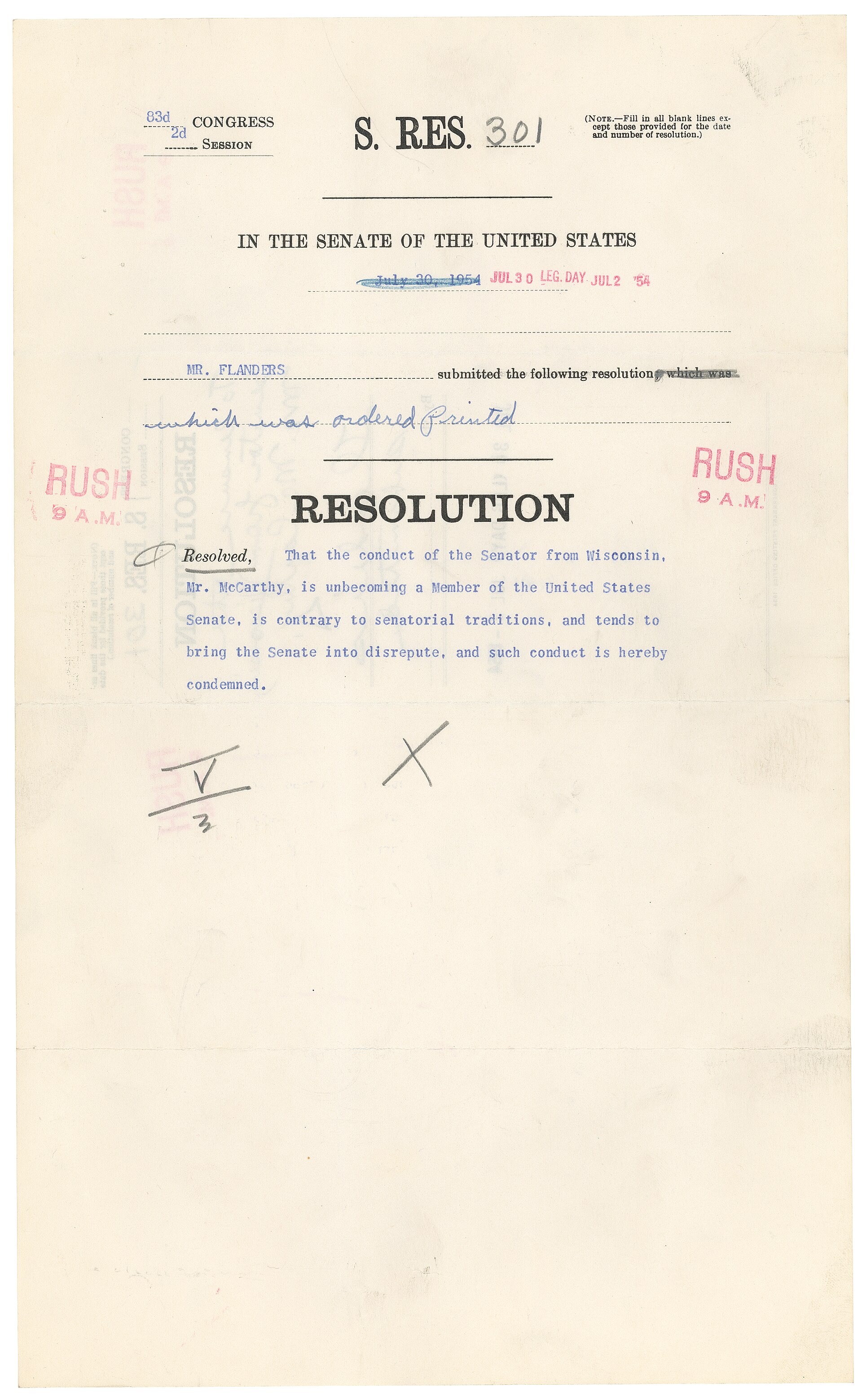

What the record shows and what it does not
Documented fact. The dates and texts of the legal terms in this glossary are fixed by primary documents: the Smith Act (June 28, 1940), Executive Order 9835 (March 21, 1947), the Internal Security Act (September 23, 1950), Executive Order 10450 (April 27, 1953), the Communist Control Act (August 24, 1954), and the Supreme Court's opinions in Schenck (1919), Dennis (1951), Slochower (1956), Watkins and Yates (1957), Barenblatt (1959), Scales (1961), Albertson (1965) and Brandenburg (1969).112 1 42 63 45 The word "McCarthyism" first appeared in Herblock's cartoon of March 29, 1950.92
The people's own words. Trotsky's "fellow-travellers" (1923), Marx's "dictatorship of the proletariat" (1875), Churchill's "iron curtain" (1946), Eisenhower's "falling domino" (1954) and Khrushchev's "cult of the individual" (1956) are quoted from texts opened for this lesson.5 3 7 10 11
The accusation. Many words in this glossary were accusations: "card-carrying," "Fifth Amendment Communist," "comsymp," "pinko," "Trotskyite," "revisionist." Each is defined here by what the accuser meant and by what the evidence for that kind of claim would have to be.
The archive evidence. The Venona decrypts, the Vassiliev notebooks, the Mitrokhin papers and the Comintern files are the sources for the espionage vocabulary and for the cover names.17 122 12
Scholarly reading. Haynes and Klehr and other scholars of their school read the archives as proof of a large, Moscow-directed espionage effort; Schrecker accepts the espionage and argues that the domestic response did more harm than good; Herman and Evans defend McCarthy's mission while disputing parts of the record against him.51 80 127 94
Open questions. Several origins could not be fixed to a dated primary source: who first said "graylist," who coined "Red Monday," and the earliest uses of "comsymp" and "pinko" beyond the dictionary's first known dates. These are listed as unverified.
Claims checked
"Herblock coined the word McCarthyism." Supported.
The Library of Congress exhibit on Herblock's work says of his Washington Post cartoon of March 29, 1950, "This was the first use of the word 'McCarthyism,'" and the Senate Historical Office's Donald Ritchie also credits Herblock with coining it in 1950.92 64 A dictionary may yet find an earlier stray use in print, but the cartoon is the documented origin of the word's public career.
"'Fellow traveler' was invented by American anti-communists as a smear." Refuted.
Trotsky used "fellow-travellers" in Literature and Revolution (1923) for writers who accepted the revolution without joining the party, and said the word was already used "by the old Socialists."5 The American use as a political insult came later; Merriam-Webster's first English date is 1925.66
"A witness who took the Fifth was admitting he was a Communist." Refuted as a rule of law; Unresolved person by person.
The Supreme Court held in Slochower (1956) that imputing "a sinister meaning" to the exercise of the privilege was improper and could not by itself justify dismissal.69 As a matter of history, many who took the Fifth had been party members and some had been sources for Soviet intelligence, while others took it to avoid naming friends or to avoid a perjury charge. Whether a given witness was a member has to be shown from other evidence.
"The Smith Act outlawed the Communist Party." Refuted.
The Smith Act does not name the party. It punished advocating violent overthrow, organizing a group that taught it, and knowing membership in such a group.112 The law that named the party, the Communist Control Act of 1954, declared it an "instrumentality of a conspiracy" and stripped it of the rights of a legal body.45
"The Hollywood blacklist was a government list." Partly supported.
The government's own list, the Attorney General's list, named organizations, not people, and was meant for federal loyalty boards.22 The blacklist of people was kept by employers: it began with the producers' Waldorf statement of November 1947 and was fed by private publications such as Red Channels.26 72 Government hearings supplied the names, and the government list was adopted by private employers, so the claim is right about the source of the pressure and wrong about who kept the list.
"It was a witch hunt: there were no real spies." Refuted.
The Venona decrypts alone show 349 Americans with covert relationships to Soviet intelligence in the 1940s, by Haynes and Klehr's count, and the Vassiliev notebooks add more.51 122 The claim that the investigations of the 1950s often missed the real spies and hit the innocent is a separate claim, and the record supports it in part: Haynes's review found substantial evidence of espionage assistance for nine of the 159 people on McCarthy's lists, while judging "perhaps a majority" likely security risks.87 The full assessment is in module 81, lesson 11.
"McCarthyism means what Joseph McCarthy did." Partly supported.
The word began as a name for McCarthy's methods, but Ritchie notes it was soon "applied collectively to all congressional investigations of suspected Communists," including those of HUAC and of bodies McCarthy never sat on.64 The loyalty program, the Attorney General's list, the Smith Act and the Hollywood blacklist all predate his Wheeling speech of February 9, 1950. In module 81, lesson 03.
"Gulag is the Russian word for prison camp." Partly supported.
Gulag is an acronym for the camp administration, which the Library of Congress exhibit renders "Main Directorate for Corrective Labor Camps"; it became a common noun for the whole camp system, and in English for any such system, by the 1970s.34 75
Hard questions and answers
An anti-communist asks: why does this glossary use the word McCarthyism at all, if it was coined to discredit the fight against communism?
Because the word is in the record and the reader will meet it everywhere, and because a glossary has to define what words meant to the people who used them. The entry gives its documented origin (Herblock, March 29, 1950), McCarthy's own attempt to redefine it as "the fight for America," and the case made by Evans and others that it has been used against anti-communism as a whole.64 94 This module uses the word for a method, public accusation with insufficient regard to evidence, and keeps it away from the separate question of whether the threat was real, which the archives answer yes.
A civil liberties advocate asks: why put espionage tradecraft beside words like "Fifth Amendment" and "blacklist"? Doesn't that tie the victims of the blacklist to spies?
The opposite is intended. Putting the vocabularies side by side shows how different the claims were. A person on the Attorney General's list of associations, or on Red Channels, was accused of association or sympathy; an agent with a cover name in the Venona cables was a participant in espionage. Executive Order 9835's own mixing of "membership in, affiliation with or sympathetic association with" is what blurred the categories in 1947, and the four-claims diagram above exists to unblur them.1
A skeptic asks: why rely on the Marxists Internet Archive's encyclopedia for the movement's words?
Because the question for those entries is what the movement meant by its own words, and the movement's own reference works answer it. The encyclopedia is cited as a statement of that meaning, not as an authority on history. Where it states a historical fact that other evidence contradicts, such as its description of kulaks as "landlords," this glossary follows the Library of Congress's archive-based account of "wealthier peasants" and says so.84 34
A historian asks: are dictionary "first known use" dates good enough?
They are a floor. Merriam-Webster's dates record the earliest citation its editors found in English, and an earlier use may surface. For words borrowed from Russian (apparatchik, samizdat, gulag, glasnost, perestroika) the Russian word is older than the English one. Where a dated document exists, such as Trotsky's 1923 book, Churchill's 1946 speech or Herblock's 1950 cartoon, the glossary gives the document.5 7 9
A reader asks: which of these legal terms still matter in 2026?
Several. Contempt of Congress under 2 U.S.C. 192 is still the statute for refusing a committee.48 Brandenburg's incitement test still governs advocacy of force.79 The Smith Act's advocacy section remains in the federal code, read through Yates and Brandenburg. FARA, from 1938, is the main disclosure tool against foreign influence, and the cases of 2026 are in module 81, lesson 13.65 The loyalty program, the Attorney General's list and the Subversive Activities Control Board are gone.
A reporter asks: how should these words be used in writing today?
Say which claim the evidence supports and use the word that fits it. Write "party member" when membership is documented, "Soviet source" or "agent" when espionage is documented and by what evidence (a cover name identified by whom, a confession, a verdict), "sympathizer" only for documented statements of sympathy, and "associated with" only with the name of the group and the date. Avoid the era's insults (pinko, comsymp, Fifth Amendment Communist) except in quotation, and put "McCarthyism" and "witch hunt" in the mouths of the people who used them. Module 81, lesson 14 is a reporter's guide to the record.
Still open
These items could not be confirmed against a primary source before publication. The lesson states them as open, and they stay on the fact-check list.
- The first use of "graylist" for the informal broadcasting and film exclusions was not traced to a dated source; the entry relies on Britannica's description of the clearance practice.
- Who coined "Red Monday" for June 17, 1957, has not been traced; module 81 lesson 09 records the same open question.
- Merriam-Webster's first known use dates (comsymp about 1961, pinko 1925, red-baiting 1927, commie 1924 and others) are dictionary floors; earlier printed uses may exist. The common attribution of "comsymp" to John Birch Society writers was not checked and is not made in the text.
- The meaning of Holodomor as "death by hunger" is a standard translation not checked against a Ukrainian dictionary for this lesson. (Kulak as "fist" is confirmed by Merriam-Webster's etymology.)
- The Library of Congress exhibit's statement that the Gulag had "several million inmates" by 1934 is higher than archive-based counts for that year; the lesson flags the conflict and points to lessons 02 and 14 for the figures.
- The Senate Historical Office page gives 2004 for the publication of the five volumes of McCarthy's executive session transcripts; the Senate print (S. Prt. 107-84) and module 81 give 2003. Both are reported in the text.
- Harvey Matusow's recantation (1955) is cited from Schrecker's book as summarized, not checked against a primary source.
- Iskhak Akhmerov's role as an illegal who handled Silvermaster group material, Boris Morros's double role and the careless wartime tradecraft are taken from Haynes, Klehr and Vassiliev, Spies (2009), as summarized, not re-read for this lesson.
- Trotsky's murder in Mexico in August 1940 and the dissolution of the Warsaw Pact in 1991 are stated from the brief and lessons 02 and 10 of this module without a separate footnote.
Learn more
- Library of Congress: Revelations from the Russian Archives, Internal Workings of the Soviet Union: Archive documents with translations on the secret police, the Gulag, collectivization, the famine and censorship; the source for many of the Soviet terms here.
- NSA and CIA, Venona: Soviet Espionage and the American Response (front matter and abbreviations): The government's own introduction to the decrypts, with the list of Soviet service names and their dates.
- International Spy Museum: Language of Espionage: Short definitions of the tradecraft vocabulary, from agent to walk-in.
- Marxists Internet Archive: Encyclopedia of Marxism glossary: The movement's own definitions of its terms; read as a statement of what communists meant, not as neutral history.
- Robert Justin Goldstein, "Prelude to McCarthyism: The Making of a Blacklist" (Prologue, 2006): The history of the Attorney General's list from the National Archives' own journal.
- Senate Historical Office: Executive Sessions of the Permanent Subcommittee on Investigations, introduction: Donald Ritchie on what McCarthyism came to mean and on the sealed transcripts.
- Module 81, lesson 14: Reading the Record, a Reporter's Guide: How to use these words, and the records behind them, in writing about the period.
Notes
- Executive Order 9835, "Prescribing Procedures for the Administration of an Employees Loyalty Program in the Executive Branch of the Government," March 21, 1947, Part III and Part V, Harry S. Truman Library and Museum (retrieved Nov. 6, 2026). Read it online. ↩
- Module 81, lesson 01, "Why the Fear Was Real, 1917 to 1950," Liberty and the Republic, jeffapierson.com (Chambers's distinction between infiltration and espionage; the secret apparatus) (retrieved Nov. 6, 2026). Read it online. ↩
- Karl Marx, Critique of the Gotha Programme (written 1875), part IV, Marxists Internet Archive (retrieved Nov. 6, 2026). Read it online. ↩
- V. I. Lenin, "Terms of Admission into Communist International," July 1920 (the 21 conditions), condition 3 on combining legal and illegal work, Marxists Internet Archive (retrieved Nov. 6, 2026). Read it online. ↩
- Leon Trotsky, Literature and Revolution (Moscow, 1923; English translation 1925), chapter 2, "The Literary 'Fellow-Travellers' of the Revolution," Marxists Internet Archive (retrieved Nov. 6, 2026). Read it online. ↩
- Georgi Dimitrov, "The Fascist Offensive and the Tasks of the Communist International," main report to the Seventh World Congress of the Communist International, August 2, 1935, Marxists Internet Archive (retrieved Nov. 6, 2026). Read it online. ↩
- Winston S. Churchill, "The Sinews of Peace," address at Westminster College, Fulton, Missouri, March 5, 1946, text at America's National Churchill Museum (retrieved Nov. 6, 2026). Read it online. ↩
- Office of the Historian, U.S. Department of State, "Kennan and Containment, 1947," Milestones in the History of U.S. Foreign Relations (retrieved Nov. 6, 2026). Read it online. ↩
- Library of Congress, Herblock's History: Political Cartoons from the Crash to the Millennium (exhibition, 2000), checklist entry "You mean I'm supposed to stand on that?" Washington Post, March 29, 1950, as preserved by the End of Term Web Archive (retrieved Nov. 6, 2026). Read it online. ↩
- Dwight D. Eisenhower, The President's News Conference, April 7, 1954, The American Presidency Project, University of California, Santa Barbara (retrieved Nov. 6, 2026). Read it online. ↩
- Nikita S. Khrushchev, speech to the Twentieth Congress of the Communist Party of the Soviet Union, February 25, 1956 ("On the Cult of Personality and Its Consequences"), excerpt in the Internet Modern History Sourcebook, Fordham University (retrieved Nov. 6, 2026). Read it online. ↩
- Christopher Andrew and Vasili Mitrokhin, The Sword and the Shield: The Mitrokhin Archive and the Secret History of the KGB (New York: Basic Books, 1999); the Mitrokhin papers are held at the Churchill Archives Centre, University of Cambridge. Summarized, not quoted. Read it online. ↩
- International Spy Museum, "Language of Espionage" (glossary) (retrieved Nov. 6, 2026). Read it online. ↩
- Merriam-Webster Dictionary, "agitprop," definition and "First Known Use" section (retrieved Nov. 6, 2026). Read it online. ↩
- Module 81, lesson 02, "Venona and the Archives: What We Know Now," Liberty and the Republic, jeffapierson.com (terms list and notes on Arlington Hall, the one-time pad, Black Friday, the Gorsky memo and the Moynihan Commission) (retrieved Nov. 6, 2026). Read it online. ↩
- Module 81, lesson 07, "The Cases," Liberty and the Republic, jeffapierson.com (Voice of America, Fort Monmouth, Peress and the Doctor Draft Act, the China hands) (retrieved Nov. 6, 2026). Read it online. ↩
- Robert Louis Benson and Michael Warner, eds., Venona: Soviet Espionage and the American Response, 1939 to 1957 (Washington: National Security Agency and Central Intelligence Agency, 1996), front matter, introduction, chronology and list of abbreviations (retrieved Nov. 6, 2026). Read it online. ↩
- Merriam-Webster Dictionary, "apparat," definition and "First Known Use" section (retrieved Nov. 6, 2026). Read it online. ↩
- Merriam-Webster Dictionary, "apparatchik," definition and "First Known Use" section (retrieved Nov. 6, 2026). Read it online. ↩
- U.S. Senate, Senate Historical Office, "McCarthy and Army-McCarthy Hearings" (160 closed executive sessions and 395 witnesses in the 83rd Congress; records closed for 50 years) (retrieved Nov. 6, 2026). Read it online. ↩
- Module 81, lesson 08, "The Army-McCarthy Hearings and the Fall," Liberty and the Republic, jeffapierson.com (retrieved Nov. 6, 2026). Read it online. ↩
- Robert Justin Goldstein, "Prelude to McCarthyism: The Making of a Blacklist," Prologue (National Archives) 38, no. 3 (Fall 2006) (retrieved Nov. 6, 2026). Read it online. ↩
- Barenblatt v. United States, 360 U.S. 109 (1959), decided June 8, 1959, opinion of Justice Harlan, Library of Congress U.S. Reports (retrieved Nov. 6, 2026). Read it online. ↩
- United States v. Lovett, 328 U.S. 303 (1946), decided June 3, 1946, Library of Congress U.S. Reports (retrieved Nov. 6, 2026). Read it online. ↩
- Merriam-Webster Dictionary, "blacklist," definition and "First Known Use" section (retrieved Nov. 6, 2026). Read it online. ↩
- Module 81, lesson 10, "What It Cost," Liberty and the Republic, jeffapierson.com (the Waldorf statement, Red Channels, the Feinberg Law, the Levering Act, the China hands) (retrieved Nov. 6, 2026). Read it online. ↩
- Library of Congress, Revelations from the Russian Archives, section "The Soviet Union and the United States" (retrieved Nov. 6, 2026). Read it online. ↩
- Marxists Internet Archive, Encyclopedia of Marxism, glossary entry "Bourgeoisie" (a reference written from within the Marxist tradition; used here for the movement's own definition) (retrieved Nov. 6, 2026). Read it online. ↩
- Merriam-Webster Dictionary, "brainwashing," definition and "First Known Use" section (retrieved Nov. 6, 2026). Read it online. ↩
- Office of the Historian, U.S. Department of State, "Soviet Invasion of Czechoslovakia, 1968," Milestones in the History of U.S. Foreign Relations (retrieved Nov. 6, 2026). Read it online. ↩
- Merriam-Webster Dictionary, "cadre," definition and "First Known Use" section (retrieved Nov. 6, 2026). Read it online. ↩
- Module 81, lesson 05, "Wheeling and the List," Liberty and the Republic, jeffapierson.com (the Byrnes letter, the Lee list, S. Res. 231, the composite photograph) (retrieved Nov. 6, 2026). Read it online. ↩
- U.S. Senate, Senate Historical Office, "The Censure Case of Joseph McCarthy of Wisconsin (1954)," adapted from Anne M. Butler and Wendy Wolff, United States Senate Election, Expulsion, and Censure Cases, 1793 to 1990, S. Doc. 103-33 (1995) (retrieved Nov. 6, 2026). Read it online. ↩
- Library of Congress, Revelations from the Russian Archives, section "Internal Workings of the Soviet Union" (sections on the secret police, the Gulag, collectivization, the Ukrainian famine and censorship) (retrieved Nov. 6, 2026). Read it online. ↩
- Schenck v. United States, 249 U.S. 47 (1919), decided March 3, 1919, opinion of Justice Holmes, Library of Congress U.S. Reports (retrieved Nov. 6, 2026). Read it online. ↩
- Deschler's Precedents of the United States House of Representatives, vol. 4, ch. 15, section 13 (House Resolution 151, the Code of Fair Procedures, approved by voice vote March 23, 1955, and the end of one-member subcommittees), govinfo (retrieved Nov. 6, 2026). Read it online. ↩
- U.S. Senate, Select Committee to Study Governmental Operations with Respect to Intelligence Activities (Church Committee), Final Report, Book III, "COINTELPRO: The FBI's Covert Action Programs Against American Citizens" (S. Rept. 94-755, 1976), Assassination Archives and Research Center copy (retrieved Nov. 6, 2026). Read it online. ↩
- Gale Stokes, "Communist Information Bureau," Encyclopedia of Russian History, via Encyclopedia.com (conference at Szklarska Poreba opened September 22, 1947; Zhdanov's two-camp speech; last meeting November 1949; dissolved April 17, 1956) (retrieved Nov. 6, 2026). Read it online. ↩
- Executive Committee of the Communist International, statement on the dissolution of the Communist International, May 15, 1943, Marxists Internet Archive (retrieved Nov. 6, 2026). Read it online. ↩
- Merriam-Webster Dictionary, "commie," definition and "First Known Use" section (retrieved Nov. 6, 2026). Read it online. ↩
- Marxists Internet Archive, Encyclopedia of Marxism, glossary entry "Communism" (a reference written from within the Marxist tradition; used here for the movement's own definition) (retrieved Nov. 6, 2026). Read it online. ↩
- Internal Security Act of 1950, September 23, 1950, ch. 1024, 64 Stat. 987 (Title I, the Subversive Activities Control Act; Title II, emergency detention), govinfo (retrieved Nov. 6, 2026). Read it online. ↩
- Communist Party of the United States v. Subversive Activities Control Board, 367 U.S. 1 (1961), decided June 5, 1961, Library of Congress U.S. Reports (retrieved Nov. 6, 2026). Read it online. ↩
- Albertson v. Subversive Activities Control Board, 382 U.S. 70 (1965), decided November 15, 1965, Library of Congress U.S. Reports (retrieved Nov. 6, 2026). Read it online. ↩
- Communist Control Act of 1954, Public Law 637, 83rd Congress, August 24, 1954, 68 Stat. 775, sections 2 and 3, govinfo (retrieved Nov. 6, 2026). Read it online. ↩
- Merriam-Webster Dictionary, "comsymp," definition and "First Known Use" section (retrieved Nov. 6, 2026). Read it online. ↩
- Office of the Historian, U.S. Department of State, "The Truman Doctrine, 1947," Milestones in the History of U.S. Foreign Relations (retrieved Nov. 6, 2026). Read it online. ↩
- 2 U.S.C. 192, "Refusal of witness to testify or produce papers," Legal Information Institute, Cornell Law School (retrieved Nov. 6, 2026). Read it online. ↩
- Bernard Ryan Jr., "Hollywood Ten Trials: 1948 to 50," in Great American Trials, via Encyclopedia.com (retrieved Nov. 6, 2026). Read it online. ↩
- John Earl Haynes, Harvey Klehr and Alexander Vassiliev, Spies: The Rise and Fall of the KGB in America (New Haven: Yale University Press, 2009). Summarized, not quoted. Read it online. ↩
- John Earl Haynes and Harvey Klehr, Venona: Decoding Soviet Espionage in America (New Haven: Yale University Press, 1999), chapter 1, "Venona and the Cold War" (349 Americans with covert relationships; fewer than half identified by real name) (retrieved Nov. 6, 2026). Read it online. ↩
- Merriam-Webster Dictionary, "dead drop," definition and "First Known Use" section (retrieved Nov. 6, 2026). Read it online. ↩
- U.S. Senate, Senate Historical Office, "A Declaration of Conscience" (June 1, 1950) (retrieved Nov. 6, 2026). Read it online. ↩
- Marxists Internet Archive, Encyclopedia of Marxism, glossary entry "Democratic Centralism" (a reference written from within the Marxist tradition; used here for the movement's own definition) (retrieved Nov. 6, 2026). Read it online. ↩
- Dennis v. United States, 341 U.S. 494 (1951), decided June 4, 1951, opinion of Chief Justice Vinson at 510, quoting Learned Hand, 183 F.2d at 212, Library of Congress U.S. Reports (retrieved Nov. 6, 2026). Read it online. ↩
- Marxists Internet Archive, Encyclopedia of Marxism, glossary entry "Dialectical Materialism" (a reference written from within the Marxist tradition; used here for the movement's own definition) (retrieved Nov. 6, 2026). Read it online. ↩
- Module 81, lesson 06, "Three Committees Compared," Liberty and the Republic, jeffapierson.com (HUAC, SISS, the PSI, one-man hearings, the Legislative Reorganization Act of 1946) (retrieved Nov. 6, 2026). Read it online. ↩
- Merriam-Webster Dictionary, "domino theory," definition and "First Known Use" section (retrieved Nov. 6, 2026). Read it online. ↩
- Harry S. Truman, "Veto of the Internal Security Bill," September 22, 1950, Public Papers of the Presidents, Harry S. Truman Library and Museum (retrieved Nov. 6, 2026). Read it online. ↩
- Module 81, lesson 13, "Foreign Influence and Espionage in 2026," Liberty and the Republic, jeffapierson.com (FARA, 18 U.S.C. 951, transnational repression) (retrieved Nov. 6, 2026). Read it online. ↩
- Module 81, lesson 03, "The Machinery Before McCarthy," Liberty and the Republic, jeffapierson.com (McCormack-Dickstein committee, Hiss perjury and the statute of limitations, the pumpkin papers, the 1941 Minneapolis Smith Act case) (retrieved Nov. 6, 2026). Read it online. ↩
- Marxists Internet Archive, Encyclopedia of Marxism, glossary entry "Eurocommunism" (a reference written from within the Marxist tradition; used here for the movement's own definition) (retrieved Nov. 6, 2026). Read it online. ↩
- Executive Order 10450, "Security Requirements for Government Employment," April 27, 1953, 18 Fed. Reg. 2489, National Archives, Federal Register codification (retrieved Nov. 6, 2026). Read it online. ↩
- Donald A. Ritchie, Senate Historical Office, introduction to Executive Sessions of the Senate Permanent Subcommittee on Investigations of the Committee on Government Operations, vol. 1, S. Prt. 107-84 (Washington: GPO, 2003) (retrieved Nov. 6, 2026). Read it online. ↩
- U.S. Department of Justice, National Security Division, "Foreign Agents Registration Act" (FARA Unit home page) (retrieved Nov. 6, 2026). Read it online. ↩
- Merriam-Webster Dictionary, "fellow traveler," definition and "First Known Use" section (retrieved Nov. 6, 2026). Read it online. ↩
- Constitution of the United States, Fifth Amendment, Bill of Rights transcription, National Archives (retrieved Nov. 6, 2026). Read it online. ↩
- Quinn v. United States, 349 U.S. 155 (1955), decided May 23, 1955, Library of Congress U.S. Reports (retrieved Nov. 6, 2026). Read it online. ↩
- Slochower v. Board of Higher Education of New York City, 350 U.S. 551 (1956), decided April 9, 1956, opinion of Justice Clark, Library of Congress U.S. Reports (retrieved Nov. 6, 2026). Read it online. ↩
- Keyishian v. Board of Regents, 385 U.S. 589 (1967), decided January 23, 1967 (the Feinberg Law), Library of Congress U.S. Reports (retrieved Nov. 6, 2026). Read it online. ↩
- Merriam-Webster Dictionary, "glasnost," definition and "First Known Use" section (retrieved Nov. 6, 2026). Read it online. ↩
- Encyclopaedia Britannica, "Television in the United States: The red scare" (Counterattack, 1947; Red Channels, June 1950, listing 151 people) (retrieved Nov. 6, 2026). Read it online. ↩
- Robert Conquest, The Great Terror: Stalin's Purge of the Thirties (New York: Macmillan, 1968). Cited for the book title as a name for the period; summarized, not quoted. Read it online. ↩
- Anne Applebaum, Gulag: A History (New York: Doubleday, 2003). Summarized, not quoted. Read it online. ↩
- Merriam-Webster Dictionary, "gulag," definition and "First Known Use" section (retrieved Nov. 6, 2026). Read it online. ↩
- U.S. Senate, Senate Historical Office, "'Have You No Sense of Decency?'" (June 9, 1954) (retrieved Nov. 6, 2026). Read it online. ↩
- Marxists Internet Archive, Encyclopedia of Marxism, glossary entry "Historical Materialism" (a reference written from within the Marxist tradition; used here for the movement's own definition) (retrieved Nov. 6, 2026). Read it online. ↩
- National Archives, Guide to the Records of the U.S. House of Representatives at the National Archives, 1789 to 1989, chapter 14 (records of the House Un-American Activities Committee, 1945 to 1975) (retrieved Nov. 6, 2026). Read it online. ↩
- Brandenburg v. Ohio, 395 U.S. 444 (1969), decided June 9, 1969, per curiam, Library of Congress U.S. Reports (retrieved Nov. 6, 2026). Read it online. ↩
- Ellen Schrecker, Many Are the Crimes: McCarthyism in America (Boston: Little, Brown, 1998). Interpretation summarized in this lesson's words, not quoted. Read it online. ↩
- Merriam-Webster Dictionary, "iron curtain," definition and "First Known Use" section (retrieved Nov. 6, 2026). Read it online. ↩
- Module 81, lesson 09, "Censure, Watkins, Yates, Barenblatt and the Courts," Liberty and the Republic, jeffapierson.com (Red Monday, the Jenner-Butler bill) (retrieved Nov. 6, 2026). Read it online. ↩
- Marxists Internet Archive, Encyclopedia of Marxism, glossary entry "Kolkhoz (Collective Farm)" (a reference written from within the Marxist tradition; used here for the movement's own definition) (retrieved Nov. 6, 2026). Read it online. ↩
- Marxists Internet Archive, Encyclopedia of Marxism, glossary entry "Kulak" (a reference written from within the Marxist tradition; used here for the movement's own definition) (retrieved Nov. 6, 2026). Read it online. ↩
- Merriam-Webster Dictionary, "kulak," definition and "First Known Use" section (retrieved Nov. 6, 2026). Read it online. ↩
- Judith Adkins, "'These People Are Frightened to Death': Congressional Investigations and the Lavender Scare," Prologue (National Archives) 48, no. 2 (Summer 2016) (retrieved Nov. 6, 2026). Read it online. ↩
- John Earl Haynes, "Senator Joseph McCarthy's Lists and Venona" (April 2007), johnearlhaynes.org (retrieved Nov. 6, 2026). Read it online. ↩
- American Communications Association v. Douds, 339 U.S. 382 (1950), decided May 8, 1950 (section 9(h) of the National Labor Relations Act as amended in 1947), Library of Congress U.S. Reports (retrieved Nov. 6, 2026). Read it online. ↩
- Marxists Internet Archive, Encyclopedia of Marxism, glossary entry "Maoism" (a reference written from within the Marxist tradition; used here for the movement's own definition) (retrieved Nov. 6, 2026). Read it online. ↩
- Merriam-Webster Dictionary, "Maoism," definition and "First Known Use" section (retrieved Nov. 6, 2026). Read it online. ↩
- Marxists Internet Archive, Encyclopedia of Marxism, glossary entry "Marxism-Leninism" (a reference written from within the Marxist tradition; used here for the movement's own definition) (retrieved Nov. 6, 2026). Read it online. ↩
- Library of Congress, Herblock's History exhibition text for the March 29, 1950 cartoon ("This was the first use of the word 'McCarthyism'"), as preserved in the govdocs1 corpus copy of the exhibition page (retrieved Nov. 6, 2026). Read it online. ↩
- Merriam-Webster Dictionary, "McCarthyism," definition and "First Known Use" section (retrieved Nov. 6, 2026). Read it online. ↩
- M. Stanton Evans, Blacklisted by History: The Untold Story of Senator Joe McCarthy and His Fight Against America's Enemies (New York: Crown Forum, 2007). Interpretation summarized, not quoted. Read it online. ↩
- U.S. House of Representatives, Committee on Un-American Activities, Hearings Regarding Communist Espionage in the United States Government, 80th Cong., 2d sess., July 31 to September 9, 1948 (Washington: GPO, 1948), statement of Rep. Karl Mundt on the Mundt-Nixon bill and remark of Rep. F. Edward Hebert; contents list for August 20, 1948 (Abt, Pressman, Witt), Internet Archive full text (retrieved Nov. 6, 2026). Read it online. ↩
- Treaty of Nonaggression between Germany and the Union of Soviet Socialist Republics and Secret Additional Protocol, Moscow, August 23, 1939, in Nazi-Soviet Relations 1939 to 1941 (U.S. Department of State, 1948), Avalon Project, Yale Law School (retrieved Nov. 6, 2026). Read it online. ↩
- Marxists Internet Archive, Encyclopedia of Marxism, glossary entry "New Economic Policy (NEP)" (a reference written from within the Marxist tradition; used here for the movement's own definition) (retrieved Nov. 6, 2026). Read it online. ↩
- Encyclopaedia Britannica, topic page "nomenklatura" (excerpts from the articles on Poland and on Soviet law) (retrieved Nov. 6, 2026). Read it online. ↩
- Merriam-Webster Dictionary, "perestroika," definition and "First Known Use" section (retrieved Nov. 6, 2026). Read it online. ↩
- Marxists Internet Archive, Encyclopedia of Marxism, glossary entry "Permanent revolution" (a reference written from within the Marxist tradition; used here for the movement's own definition) (retrieved Nov. 6, 2026). Read it online. ↩
- Watkins v. United States, 354 U.S. 178 (1957), decided June 17, 1957, opinion of Chief Justice Warren, Library of Congress U.S. Reports (retrieved Nov. 6, 2026). Read it online. ↩
- Merriam-Webster Dictionary, "pinko," definition and "First Known Use" section (retrieved Nov. 6, 2026). Read it online. ↩
- Marxists Internet Archive, Encyclopedia of Marxism, glossary entry "Popular Front (aka People's Front)" (a reference written from within the Marxist tradition; used here for the movement's own definition) (retrieved Nov. 6, 2026). Read it online. ↩
- Marxists Internet Archive, Encyclopedia of Marxism, glossary entry "Social fascism" (a reference written from within the Marxist tradition; used here for the movement's own definition) (retrieved Nov. 6, 2026). Read it online. ↩
- Marxists Internet Archive, Encyclopedia of Marxism, glossary entry "Proletariat" (a reference written from within the Marxist tradition; used here for the movement's own definition) (retrieved Nov. 6, 2026). Read it online. ↩
- Merriam-Webster Dictionary, "red-baiting," definition and "First Known Use" section (retrieved Nov. 6, 2026). Read it online. ↩
- Yates v. United States, 354 U.S. 298 (1957), decided June 17, 1957, opinion of Justice Harlan, Library of Congress U.S. Reports (retrieved Nov. 6, 2026). Read it online. ↩
- Marxists Internet Archive, Encyclopedia of Marxism, glossary entry "Revisionism" (a reference written from within the Marxist tradition; used here for the movement's own definition) (retrieved Nov. 6, 2026). Read it online. ↩
- Merriam-Webster Dictionary, "revisionism," definition and "First Known Use" section (retrieved Nov. 6, 2026). Read it online. ↩
- Merriam-Webster Dictionary, "samizdat," definition and "First Known Use" section (retrieved Nov. 6, 2026). Read it online. ↩
- National Archives, Guide to the Records of the U.S. Senate at the National Archives, chapter 13 (Judiciary Committee records, including the Senate Internal Security Subcommittee) (retrieved Nov. 6, 2026). Read it online. ↩
- Alien Registration Act, June 28, 1940, ch. 439, Title I, section 2, 54 Stat. 670 to 671 (the Smith Act), govinfo (retrieved Nov. 6, 2026). Read it online. ↩
- Scales v. United States, 367 U.S. 203 (1961), decided June 5, 1961 (the membership clause of the Smith Act), Library of Congress U.S. Reports (retrieved Nov. 6, 2026). Read it online. ↩
- Marxists Internet Archive, Encyclopedia of Marxism, glossary entry "Socialism in one country" (a reference written from within the Marxist tradition; used here for the movement's own definition) (retrieved Nov. 6, 2026). Read it online. ↩
- Merriam-Webster Dictionary, "Stalinism," definition and "First Known Use" section (retrieved Nov. 6, 2026). Read it online. ↩
- Marxists Internet Archive, Encyclopedia of Marxism, glossary entry "Stalinism" (a reference written from within the Marxist tradition; used here for the movement's own definition) (retrieved Nov. 6, 2026). Read it online. ↩
- Merriam-Webster Dictionary, "Trotskyist," definition and "First Known Use" section (retrieved Nov. 6, 2026). Read it online. ↩
- Marxists Internet Archive, Encyclopedia of Marxism, glossary entry "Trotskyism" (a reference written from within the Marxist tradition; used here for the movement's own definition) (retrieved Nov. 6, 2026). Read it online. ↩
- Marxists Internet Archive, Encyclopedia of Marxism, glossary entry "United Front" (a reference written from within the Marxist tradition; used here for the movement's own definition) (retrieved Nov. 6, 2026). Read it online. ↩
- V. I. Lenin, What Is To Be Done? Burning Questions of Our Movement (written autumn 1901 to February 1902; first published March 1902), Marxists Internet Archive (retrieved Nov. 6, 2026). Read it online. ↩
- Marxists Internet Archive, Encyclopedia of Marxism, glossary entry "Vanguard and Mass" (a reference written from within the Marxist tradition; used here for the movement's own definition) (retrieved Nov. 6, 2026). Read it online. ↩
- Cold War International History Project, Wilson Center, "CWIHP Publishes the Vassiliev Notebooks Online" (2009) (retrieved Nov. 6, 2026). Read it online. ↩
- Merriam-Webster Dictionary, "walk-in," definition and "First Known Use" section (retrieved Nov. 6, 2026). Read it online. ↩
- Marxists Internet Archive, Encyclopedia of Marxism, glossary entry "War Communism" (a reference written from within the Marxist tradition; used here for the movement's own definition) (retrieved Nov. 6, 2026). Read it online. ↩
- Office of the Historian, U.S. Department of State, "The Warsaw Treaty Organization, 1955," Milestones in the History of U.S. Foreign Relations (retired series) (retrieved Nov. 6, 2026). Read it online. ↩
- Merriam-Webster Dictionary, "witch hunt," definition and "First Known Use" section (retrieved Nov. 6, 2026). Read it online. ↩
- Arthur Herman, Joseph McCarthy: Reexamining the Life and Legacy of America's Most Hated Senator (New York: Free Press, 2000). Interpretation summarized, not quoted. Read it online. ↩
Check yourself
1. Where did the word "McCarthyism" first appear, according to the Library of Congress?
The Library of Congress exhibit on Herblock says the cartoon of March 29, 1950, "You mean I'm supposed to stand on that?", was the first use of the word.
2. Leon Trotsky used the term "fellow-travellers" in 1923 to describe whom?
In Literature and Revolution Trotsky called the non-party writers who accepted the revolution its artist "fellow-travellers," a word he said the old socialists already used.
3. In Soviet intelligence usage, what was an "illegal"?
The NSA and CIA Venona volume describes illegals as Soviet intelligence officers usually living under false identities, unlike legal officers under official cover.
4. What did the Supreme Court hold in Slochower v. Board of Higher Education (1956)?
Justice Clark wrote that the Court must "condemn the practice of imputing a sinister meaning" to the exercise of the privilege.
5. Which standard did Executive Order 10450 (1953) set for federal employment?
Eisenhower's order replaced Truman's loyalty standard with the broader security standard "clearly consistent with the interests of the national security."
6. What made it possible for American codebreakers to read part of the Soviet cable traffic in the Venona project?
One-time pads are unbreakable if each page is used once; the duplication of pages in 1942 created the reuse that Venona exploited.
7. Which statement about the Smith Act is accurate?
The 1940 act punished advocacy, organizing and knowing membership; it did not name the party. Registration came from the 1950 Internal Security Act, and Dennis upheld the Smith Act.
8. Under the four-claims framework of this module, which word belongs to the claim of association?
Membership in or support for a front organization is evidence of association; cover names belong to espionage, card-carrying to membership and fellow traveler to sympathy.
Terms in this lesson
- Agent
- A person working secretly for an intelligence service, usually as a source of information, as opposed to a staff officer of that service.
- Attorney General's list
- The list of organizations designated totalitarian, fascist, communist or subversive under Executive Order 9835, published in December 1947 without hearings for the groups named.
- Blacklist
- The refusal of employers, above all in film, broadcasting and teaching, to hire people named as communists or who refused to answer questions; begun in film by the Waldorf statement of November 1947.
- Cadre
- A trained, trusted party worker, or the core of such workers around whom a communist organization was built.
- Clear and present danger
- Justice Holmes's 1919 test (Schenck) for when speech loses First Amendment protection; restated in Dennis (1951) and replaced by the incitement test of Brandenburg (1969).
- Comintern
- The Communist International, founded in Moscow in March 1919 to lead the world's communist parties; dissolved on the proposal of its Executive Committee of May 15, 1943.
- Contempt of Congress
- The federal misdemeanor (2 U.S.C. 192) of refusing a subpoena or a pertinent question, punishable by one to twelve months in jail and a fine.
- Cover name
- The code name a Soviet cable used for a person, place or project; matching cover names to people is the central problem of reading Venona.
- Democratic centralism
- Lenin's rule of party organization: discussion until a decision, then binding discipline of lower bodies by higher ones.
- Dennis test
- Learned Hand's formula, adopted by the Supreme Court in 1951: whether the gravity of the evil, discounted by its improbability, justifies the invasion of free speech.
- Fellow traveler
- A person who supports the communist cause without joining the party; used by Trotsky in 1923 and in English from 1925.
- Fifth Amendment Communist
- McCarthy's label for witnesses who invoked the privilege against self-incrimination, treating the claim as an admission; the inference was rejected in Slochower (1956).
- Front organization
- A group that presented itself as independent but was created or controlled by the Communist Party; membership in one shows association, not party membership.
- Gulag
- The Soviet forced labor camp system, named for the acronym of its administration, the Main Directorate of Camps.
- Illegal
- A Soviet intelligence officer working abroad under a false identity without diplomatic or official cover.
- McCarthyism
- A word coined by Herblock on March 29, 1950; used for public accusation of disloyalty with insufficient regard to evidence, and by extension for the whole anti-communist investigative effort.
- One-time pad
- A cipher key of random numbers to be used once; Soviet reuse of duplicated pages made the Venona breaks possible.
- Popular Front
- The Comintern line of 1935 to 1939 calling for broad antifascist alliances, announced by Georgi Dimitrov at the Seventh World Congress.
- Rezident
- The chief of a Soviet intelligence station abroad, either legal (under official cover) or illegal.
- Smith Act
- The 1940 law making it a crime to advocate violent overthrow, organize a group that teaches it, or knowingly join one; upheld in Dennis (1951), narrowed in Yates (1957).
Sources
- Executive Order 9835, "Prescribing Procedures for the Administration of an Employees Loyalty Program in the Executive Branch of the Government," March 21, 1947, Part III and Part V, Harry S. Truman Library and Museum (1947-03-21) checked 2026-10
- Module 81, lesson 01, "Why the Fear Was Real, 1917 to 1950," Liberty and the Republic, jeffapierson.com (Chambers's distinction between infiltration and espionage; the secret apparatus) checked 2026-10
- Karl Marx, Critique of the Gotha Programme (written 1875), part IV, Marxists Internet Archive (1875) checked 2026-10
- V. I. Lenin, "Terms of Admission into Communist International," July 1920 (the 21 conditions), condition 3 on combining legal and illegal work, Marxists Internet Archive (1920-07) checked 2026-10
- Leon Trotsky, Literature and Revolution (Moscow, 1923; English translation 1925), chapter 2, "The Literary 'Fellow-Travellers' of the Revolution," Marxists Internet Archive (1923) checked 2026-10
- Georgi Dimitrov, "The Fascist Offensive and the Tasks of the Communist International," main report to the Seventh World Congress of the Communist International, August 2, 1935, Marxists Internet Archive (1935-08-02) checked 2026-10
- Winston S. Churchill, "The Sinews of Peace," address at Westminster College, Fulton, Missouri, March 5, 1946, text at America's National Churchill Museum (1946-03-05) checked 2026-10
- Office of the Historian, U.S. Department of State, "Kennan and Containment, 1947," Milestones in the History of U.S. Foreign Relations (1947) checked 2026-10
- Library of Congress, Herblock's History: Political Cartoons from the Crash to the Millennium (exhibition, 2000), checklist entry "You mean I'm supposed to stand on that?" Washington Post, March 29, 1950, as preserved by the End of Term Web Archive (1950-03-29) checked 2026-10
- Dwight D. Eisenhower, The President's News Conference, April 7, 1954, The American Presidency Project, University of California, Santa Barbara (1954-04-07) checked 2026-10
- Nikita S. Khrushchev, speech to the Twentieth Congress of the Communist Party of the Soviet Union, February 25, 1956 ("On the Cult of Personality and Its Consequences"), excerpt in the Internet Modern History Sourcebook, Fordham University (1956-02-25) checked 2026-10
- Christopher Andrew and Vasili Mitrokhin, The Sword and the Shield: The Mitrokhin Archive and the Secret History of the KGB (New York: Basic Books, 1999); the Mitrokhin papers are held at the Churchill Archives Centre, University of Cambridge. Summarized, not quoted. (1999) checked 2026-10
- International Spy Museum, "Language of Espionage" (glossary) checked 2026-10
- Merriam-Webster Dictionary, "agitprop," definition and "First Known Use" section checked 2026-10
- Module 81, lesson 02, "Venona and the Archives: What We Know Now," Liberty and the Republic, jeffapierson.com (terms list and notes on Arlington Hall, the one-time pad, Black Friday, the Gorsky memo and the Moynihan Commission) checked 2026-10
- Module 81, lesson 07, "The Cases," Liberty and the Republic, jeffapierson.com (Voice of America, Fort Monmouth, Peress and the Doctor Draft Act, the China hands) checked 2026-10
- Robert Louis Benson and Michael Warner, eds., Venona: Soviet Espionage and the American Response, 1939 to 1957 (Washington: National Security Agency and Central Intelligence Agency, 1996), front matter, introduction, chronology and list of abbreviations (1996) checked 2026-10
- Merriam-Webster Dictionary, "apparat," definition and "First Known Use" section checked 2026-10
- Merriam-Webster Dictionary, "apparatchik," definition and "First Known Use" section checked 2026-10
- U.S. Senate, Senate Historical Office, "McCarthy and Army-McCarthy Hearings" (160 closed executive sessions and 395 witnesses in the 83rd Congress; records closed for 50 years) checked 2026-10
- Module 81, lesson 08, "The Army-McCarthy Hearings and the Fall," Liberty and the Republic, jeffapierson.com checked 2026-10
- Robert Justin Goldstein, "Prelude to McCarthyism: The Making of a Blacklist," Prologue (National Archives) 38, no. 3 (Fall 2006) (2006) checked 2026-10
- Barenblatt v. United States, 360 U.S. 109 (1959), decided June 8, 1959, opinion of Justice Harlan, Library of Congress U.S. Reports (1959-06-08) checked 2026-10
- United States v. Lovett, 328 U.S. 303 (1946), decided June 3, 1946, Library of Congress U.S. Reports (1946-06-03) checked 2026-10
- Merriam-Webster Dictionary, "blacklist," definition and "First Known Use" section checked 2026-10
- Module 81, lesson 10, "What It Cost," Liberty and the Republic, jeffapierson.com (the Waldorf statement, Red Channels, the Feinberg Law, the Levering Act, the China hands) checked 2026-10
- Library of Congress, Revelations from the Russian Archives, section "The Soviet Union and the United States" (1992) checked 2026-10
- Marxists Internet Archive, Encyclopedia of Marxism, glossary entry "Bourgeoisie" (a reference written from within the Marxist tradition; used here for the movement's own definition) checked 2026-10
- Merriam-Webster Dictionary, "brainwashing," definition and "First Known Use" section checked 2026-10
- Office of the Historian, U.S. Department of State, "Soviet Invasion of Czechoslovakia, 1968," Milestones in the History of U.S. Foreign Relations (1968-08-20) checked 2026-10
- Merriam-Webster Dictionary, "cadre," definition and "First Known Use" section checked 2026-10
- Module 81, lesson 05, "Wheeling and the List," Liberty and the Republic, jeffapierson.com (the Byrnes letter, the Lee list, S. Res. 231, the composite photograph) checked 2026-10
- U.S. Senate, Senate Historical Office, "The Censure Case of Joseph McCarthy of Wisconsin (1954)," adapted from Anne M. Butler and Wendy Wolff, United States Senate Election, Expulsion, and Censure Cases, 1793 to 1990, S. Doc. 103-33 (1995) (1995) checked 2026-10
- Library of Congress, Revelations from the Russian Archives, section "Internal Workings of the Soviet Union" (sections on the secret police, the Gulag, collectivization, the Ukrainian famine and censorship) (1992) checked 2026-10
- Schenck v. United States, 249 U.S. 47 (1919), decided March 3, 1919, opinion of Justice Holmes, Library of Congress U.S. Reports (1919-03-03) checked 2026-10
- Deschler's Precedents of the United States House of Representatives, vol. 4, ch. 15, section 13 (House Resolution 151, the Code of Fair Procedures, approved by voice vote March 23, 1955, and the end of one-member subcommittees), govinfo (1955-03-23) checked 2026-10
- U.S. Senate, Select Committee to Study Governmental Operations with Respect to Intelligence Activities (Church Committee), Final Report, Book III, "COINTELPRO: The FBI's Covert Action Programs Against American Citizens" (S. Rept. 94-755, 1976), Assassination Archives and Research Center copy (1976) checked 2026-10
- Gale Stokes, "Communist Information Bureau," Encyclopedia of Russian History, via Encyclopedia.com (conference at Szklarska Poreba opened September 22, 1947; Zhdanov's two-camp speech; last meeting November 1949; dissolved April 17, 1956) checked 2026-10
- Executive Committee of the Communist International, statement on the dissolution of the Communist International, May 15, 1943, Marxists Internet Archive (1943-05-15) checked 2026-10
- Merriam-Webster Dictionary, "commie," definition and "First Known Use" section checked 2026-10
- Marxists Internet Archive, Encyclopedia of Marxism, glossary entry "Communism" (a reference written from within the Marxist tradition; used here for the movement's own definition) checked 2026-10
- Internal Security Act of 1950, September 23, 1950, ch. 1024, 64 Stat. 987 (Title I, the Subversive Activities Control Act; Title II, emergency detention), govinfo (1950-09-23) checked 2026-10
- Communist Party of the United States v. Subversive Activities Control Board, 367 U.S. 1 (1961), decided June 5, 1961, Library of Congress U.S. Reports (1961-06-05) checked 2026-10
- Albertson v. Subversive Activities Control Board, 382 U.S. 70 (1965), decided November 15, 1965, Library of Congress U.S. Reports (1965-11-15) checked 2026-10
- Communist Control Act of 1954, Public Law 637, 83rd Congress, August 24, 1954, 68 Stat. 775, sections 2 and 3, govinfo (1954-08-24) checked 2026-10
- Merriam-Webster Dictionary, "comsymp," definition and "First Known Use" section checked 2026-10
- Office of the Historian, U.S. Department of State, "The Truman Doctrine, 1947," Milestones in the History of U.S. Foreign Relations (1947-03-12) checked 2026-10
- 2 U.S.C. 192, "Refusal of witness to testify or produce papers," Legal Information Institute, Cornell Law School (1938) checked 2026-10
- Bernard Ryan Jr., "Hollywood Ten Trials: 1948 to 50," in Great American Trials, via Encyclopedia.com checked 2026-10
- John Earl Haynes, Harvey Klehr and Alexander Vassiliev, Spies: The Rise and Fall of the KGB in America (New Haven: Yale University Press, 2009). Summarized, not quoted. (2009) checked 2026-10
- John Earl Haynes and Harvey Klehr, Venona: Decoding Soviet Espionage in America (New Haven: Yale University Press, 1999), chapter 1, "Venona and the Cold War" (349 Americans with covert relationships; fewer than half identified by real name) (1999) checked 2026-10
- Merriam-Webster Dictionary, "dead drop," definition and "First Known Use" section checked 2026-10
- U.S. Senate, Senate Historical Office, "A Declaration of Conscience" (June 1, 1950) (1950-06-01) checked 2026-10
- Marxists Internet Archive, Encyclopedia of Marxism, glossary entry "Democratic Centralism" (a reference written from within the Marxist tradition; used here for the movement's own definition) checked 2026-10
- Dennis v. United States, 341 U.S. 494 (1951), decided June 4, 1951, opinion of Chief Justice Vinson at 510, quoting Learned Hand, 183 F.2d at 212, Library of Congress U.S. Reports (1951-06-04) checked 2026-10
- Marxists Internet Archive, Encyclopedia of Marxism, glossary entry "Dialectical Materialism" (a reference written from within the Marxist tradition; used here for the movement's own definition) checked 2026-10
- Module 81, lesson 06, "Three Committees Compared," Liberty and the Republic, jeffapierson.com (HUAC, SISS, the PSI, one-man hearings, the Legislative Reorganization Act of 1946) checked 2026-10
- Merriam-Webster Dictionary, "domino theory," definition and "First Known Use" section checked 2026-10
- Harry S. Truman, "Veto of the Internal Security Bill," September 22, 1950, Public Papers of the Presidents, Harry S. Truman Library and Museum (1950-09-22) checked 2026-10
- Module 81, lesson 13, "Foreign Influence and Espionage in 2026," Liberty and the Republic, jeffapierson.com (FARA, 18 U.S.C. 951, transnational repression) checked 2026-10
- Module 81, lesson 03, "The Machinery Before McCarthy," Liberty and the Republic, jeffapierson.com (McCormack-Dickstein committee, Hiss perjury and the statute of limitations, the pumpkin papers, the 1941 Minneapolis Smith Act case) checked 2026-10
- Marxists Internet Archive, Encyclopedia of Marxism, glossary entry "Eurocommunism" (a reference written from within the Marxist tradition; used here for the movement's own definition) checked 2026-10
- Executive Order 10450, "Security Requirements for Government Employment," April 27, 1953, 18 Fed. Reg. 2489, National Archives, Federal Register codification (1953-04-27) checked 2026-10
- Donald A. Ritchie, Senate Historical Office, introduction to Executive Sessions of the Senate Permanent Subcommittee on Investigations of the Committee on Government Operations, vol. 1, S. Prt. 107-84 (Washington: GPO, 2003) (2003) checked 2026-10
- U.S. Department of Justice, National Security Division, "Foreign Agents Registration Act" (FARA Unit home page) checked 2026-10
- Merriam-Webster Dictionary, "fellow traveler," definition and "First Known Use" section checked 2026-10
- Constitution of the United States, Fifth Amendment, Bill of Rights transcription, National Archives (1791) checked 2026-10
- Quinn v. United States, 349 U.S. 155 (1955), decided May 23, 1955, Library of Congress U.S. Reports (1955-05-23) checked 2026-10
- Slochower v. Board of Higher Education of New York City, 350 U.S. 551 (1956), decided April 9, 1956, opinion of Justice Clark, Library of Congress U.S. Reports (1956-04-09) checked 2026-10
- Keyishian v. Board of Regents, 385 U.S. 589 (1967), decided January 23, 1967 (the Feinberg Law), Library of Congress U.S. Reports (1967-01-23) checked 2026-10
- Merriam-Webster Dictionary, "glasnost," definition and "First Known Use" section checked 2026-10
- Encyclopaedia Britannica, "Television in the United States: The red scare" (Counterattack, 1947; Red Channels, June 1950, listing 151 people) checked 2026-10
- Robert Conquest, The Great Terror: Stalin's Purge of the Thirties (New York: Macmillan, 1968). Cited for the book title as a name for the period; summarized, not quoted. (1968) checked 2026-10
- Anne Applebaum, Gulag: A History (New York: Doubleday, 2003). Summarized, not quoted. (2003) checked 2026-10
- Merriam-Webster Dictionary, "gulag," definition and "First Known Use" section checked 2026-10
- U.S. Senate, Senate Historical Office, "'Have You No Sense of Decency?'" (June 9, 1954) checked 2026-10
- Marxists Internet Archive, Encyclopedia of Marxism, glossary entry "Historical Materialism" (a reference written from within the Marxist tradition; used here for the movement's own definition) checked 2026-10
- National Archives, Guide to the Records of the U.S. House of Representatives at the National Archives, 1789 to 1989, chapter 14 (records of the House Un-American Activities Committee, 1945 to 1975) (1989) checked 2026-10
- Brandenburg v. Ohio, 395 U.S. 444 (1969), decided June 9, 1969, per curiam, Library of Congress U.S. Reports (1969-06-09) checked 2026-10
- Ellen Schrecker, Many Are the Crimes: McCarthyism in America (Boston: Little, Brown, 1998). Interpretation summarized in this lesson's words, not quoted. (1998) checked 2026-10
- Merriam-Webster Dictionary, "iron curtain," definition and "First Known Use" section checked 2026-10
- Module 81, lesson 09, "Censure, Watkins, Yates, Barenblatt and the Courts," Liberty and the Republic, jeffapierson.com (Red Monday, the Jenner-Butler bill) checked 2026-10
- Marxists Internet Archive, Encyclopedia of Marxism, glossary entry "Kolkhoz (Collective Farm)" (a reference written from within the Marxist tradition; used here for the movement's own definition) checked 2026-10
- Marxists Internet Archive, Encyclopedia of Marxism, glossary entry "Kulak" (a reference written from within the Marxist tradition; used here for the movement's own definition) checked 2026-10
- Merriam-Webster Dictionary, "kulak," definition and "First Known Use" section checked 2026-10
- Judith Adkins, "'These People Are Frightened to Death': Congressional Investigations and the Lavender Scare," Prologue (National Archives) 48, no. 2 (Summer 2016) (2016) checked 2026-10
- John Earl Haynes, "Senator Joseph McCarthy's Lists and Venona" (April 2007), johnearlhaynes.org (2007-04) checked 2026-10
- American Communications Association v. Douds, 339 U.S. 382 (1950), decided May 8, 1950 (section 9(h) of the National Labor Relations Act as amended in 1947), Library of Congress U.S. Reports (1950-05-08) checked 2026-10
- Marxists Internet Archive, Encyclopedia of Marxism, glossary entry "Maoism" (a reference written from within the Marxist tradition; used here for the movement's own definition) checked 2026-10
- Merriam-Webster Dictionary, "Maoism," definition and "First Known Use" section checked 2026-10
- Marxists Internet Archive, Encyclopedia of Marxism, glossary entry "Marxism-Leninism" (a reference written from within the Marxist tradition; used here for the movement's own definition) checked 2026-10
- Library of Congress, Herblock's History exhibition text for the March 29, 1950 cartoon ("This was the first use of the word 'McCarthyism'"), as preserved in the govdocs1 corpus copy of the exhibition page (1950-03-29) checked 2026-10
- Merriam-Webster Dictionary, "McCarthyism," definition and "First Known Use" section checked 2026-10
- M. Stanton Evans, Blacklisted by History: The Untold Story of Senator Joe McCarthy and His Fight Against America's Enemies (New York: Crown Forum, 2007). Interpretation summarized, not quoted. (2007) checked 2026-10
- U.S. House of Representatives, Committee on Un-American Activities, Hearings Regarding Communist Espionage in the United States Government, 80th Cong., 2d sess., July 31 to September 9, 1948 (Washington: GPO, 1948), statement of Rep. Karl Mundt on the Mundt-Nixon bill and remark of Rep. F. Edward Hebert; contents list for August 20, 1948 (Abt, Pressman, Witt), Internet Archive full text (1948) checked 2026-10
- Treaty of Nonaggression between Germany and the Union of Soviet Socialist Republics and Secret Additional Protocol, Moscow, August 23, 1939, in Nazi-Soviet Relations 1939 to 1941 (U.S. Department of State, 1948), Avalon Project, Yale Law School (1939-08-23) checked 2026-10
- Marxists Internet Archive, Encyclopedia of Marxism, glossary entry "New Economic Policy (NEP)" (a reference written from within the Marxist tradition; used here for the movement's own definition) checked 2026-10
- Encyclopaedia Britannica, topic page "nomenklatura" (excerpts from the articles on Poland and on Soviet law) checked 2026-10
- Merriam-Webster Dictionary, "perestroika," definition and "First Known Use" section checked 2026-10
- Marxists Internet Archive, Encyclopedia of Marxism, glossary entry "Permanent revolution" (a reference written from within the Marxist tradition; used here for the movement's own definition) checked 2026-10
- Watkins v. United States, 354 U.S. 178 (1957), decided June 17, 1957, opinion of Chief Justice Warren, Library of Congress U.S. Reports (1957-06-17) checked 2026-10
- Merriam-Webster Dictionary, "pinko," definition and "First Known Use" section checked 2026-10
- Marxists Internet Archive, Encyclopedia of Marxism, glossary entry "Popular Front (aka People's Front)" (a reference written from within the Marxist tradition; used here for the movement's own definition) checked 2026-10
- Marxists Internet Archive, Encyclopedia of Marxism, glossary entry "Social fascism" (a reference written from within the Marxist tradition; used here for the movement's own definition) checked 2026-10
- Marxists Internet Archive, Encyclopedia of Marxism, glossary entry "Proletariat" (a reference written from within the Marxist tradition; used here for the movement's own definition) checked 2026-10
- Merriam-Webster Dictionary, "red-baiting," definition and "First Known Use" section checked 2026-10
- Yates v. United States, 354 U.S. 298 (1957), decided June 17, 1957, opinion of Justice Harlan, Library of Congress U.S. Reports (1957-06-17) checked 2026-10
- Marxists Internet Archive, Encyclopedia of Marxism, glossary entry "Revisionism" (a reference written from within the Marxist tradition; used here for the movement's own definition) checked 2026-10
- Merriam-Webster Dictionary, "revisionism," definition and "First Known Use" section checked 2026-10
- Merriam-Webster Dictionary, "samizdat," definition and "First Known Use" section checked 2026-10
- National Archives, Guide to the Records of the U.S. Senate at the National Archives, chapter 13 (Judiciary Committee records, including the Senate Internal Security Subcommittee) (1989) checked 2026-10
- Alien Registration Act, June 28, 1940, ch. 439, Title I, section 2, 54 Stat. 670 to 671 (the Smith Act), govinfo (1940-06-28) checked 2026-10
- Scales v. United States, 367 U.S. 203 (1961), decided June 5, 1961 (the membership clause of the Smith Act), Library of Congress U.S. Reports (1961-06-05) checked 2026-10
- Marxists Internet Archive, Encyclopedia of Marxism, glossary entry "Socialism in one country" (a reference written from within the Marxist tradition; used here for the movement's own definition) checked 2026-10
- Merriam-Webster Dictionary, "Stalinism," definition and "First Known Use" section checked 2026-10
- Marxists Internet Archive, Encyclopedia of Marxism, glossary entry "Stalinism" (a reference written from within the Marxist tradition; used here for the movement's own definition) checked 2026-10
- Merriam-Webster Dictionary, "Trotskyist," definition and "First Known Use" section checked 2026-10
- Marxists Internet Archive, Encyclopedia of Marxism, glossary entry "Trotskyism" (a reference written from within the Marxist tradition; used here for the movement's own definition) checked 2026-10
- Marxists Internet Archive, Encyclopedia of Marxism, glossary entry "United Front" (a reference written from within the Marxist tradition; used here for the movement's own definition) checked 2026-10
- V. I. Lenin, What Is To Be Done? Burning Questions of Our Movement (written autumn 1901 to February 1902; first published March 1902), Marxists Internet Archive (1902-03) checked 2026-10
- Marxists Internet Archive, Encyclopedia of Marxism, glossary entry "Vanguard and Mass" (a reference written from within the Marxist tradition; used here for the movement's own definition) checked 2026-10
- Cold War International History Project, Wilson Center, "CWIHP Publishes the Vassiliev Notebooks Online" (2009) (2009) checked 2026-10
- Merriam-Webster Dictionary, "walk-in," definition and "First Known Use" section checked 2026-10
- Marxists Internet Archive, Encyclopedia of Marxism, glossary entry "War Communism" (a reference written from within the Marxist tradition; used here for the movement's own definition) checked 2026-10
- Office of the Historian, U.S. Department of State, "The Warsaw Treaty Organization, 1955," Milestones in the History of U.S. Foreign Relations (retired series) (1955-05-14) checked 2026-10
- Merriam-Webster Dictionary, "witch hunt," definition and "First Known Use" section checked 2026-10
- Arthur Herman, Joseph McCarthy: Reexamining the Life and Legacy of America's Most Hated Senator (New York: Free Press, 2000). Interpretation summarized, not quoted. (2000) checked 2026-10