Lesson 10 of 14 · about 55 minutes
Soviet and International Organizations: The Comintern, Cheka to KGB, the GRU, the Cominform and the Fronts
Updated November 6, 2026
You'll be able to
- Explain how the Comintern's Executive Committee, the Twenty-One Conditions and the OMS liaison service gave Moscow control over national parties such as the CPUSA.
- Trace the Soviet and Russian security police from the Cheka (December 20, 1917) through the GPU, OGPU, NKVD, NKGB, MGB, MVD and KGB to the SVR and FSB, naming the main chiefs.
- Tell the GRU apart from the NKVD and KGB, and name American and British sources each service ran.
- Describe the Cominform, the Warsaw Pact and Comecon with their dates and members.
- Judge the evidence on the international fronts, including the World Peace Council and the Stockholm Appeal's signature claims.
- Rate popular claims about these organizations against the documentary record available in 2026.
Start here: the short version
The American Communist Party did not act alone. Behind it stood a set of Soviet and international bodies, each with its own name, its own chiefs and its own years. The Communist International, or Comintern (1919 to 1943), was the headquarters of the world movement: its Executive Committee in Moscow issued binding decisions, its liaison service moved money and couriers, and its schools trained party officials. The Soviet security police changed its name again and again (Cheka, GPU, OGPU, NKVD, NKGB, MGB, MVD, KGB, and after 1991 the SVR and the FSB), but the line runs unbroken from December 20, 1917 to today, and the FSB itself describes that line on its official history page. Soviet military intelligence, the GRU, was a separate service that ran some of the most important American sources, including Whittaker Chambers's group and, by the NKVD's own report, Alger Hiss. After the war came the Cominform (1947 to 1956), the Warsaw Pact (1955 to 1991), Comecon (1949 to 1991) and a family of international "front" organizations such as the World Peace Council. This lesson gives each body its dates, its leaders, what it did and what the record now shows, and rates the popular claims made about them.
How to use this lesson
This is a reference lesson. Each organization gets an entry: its founding and end, its leaders, its tasks, its part in the American story, and what the evidence available in 2026 supports. The lesson does not retell the history of the Soviet state, which lessons 02, 03 and 04 of this module cover. The American bodies (the CPUSA, its fronts and unions, the congressional committees and the anti-communist organizations) are in lesson 11. The networks of individual agents and their Venona cover names are in lesson 12. The people named here have their own entries in lessons 06 to 09.
Module 81 tells the story these organizations sit behind. Its lesson 01, Why the Fear Was Real, 1917 to 1950, sets out the Twenty-One Conditions and the Soviet funding of the American party. Its lesson 02, Venona and the Archives: What We Know Now, examines the decrypted cables that recorded the work of the NKVD and GRU in the United States. Its lesson 13, Foreign Influence and Espionage in 2026, covers the successor services in current cases. The economic theory these bodies served is in module 51, lesson 07.
A note on names. The Soviet civilian intelligence and security service carried many names over its history. The National Security Agency's Venona releases, and historians such as John Earl Haynes and Harvey Klehr, often call the wartime service "the KGB" for simplicity, though in 1943 to 1945 it was formally the NKGB and before that the NKVD. Module 81 follows that usage. This lesson gives the formal name for each period and uses "KGB" alone only for 1954 to 1991.
The Communist International, 1919 to 1943
Founding and purpose
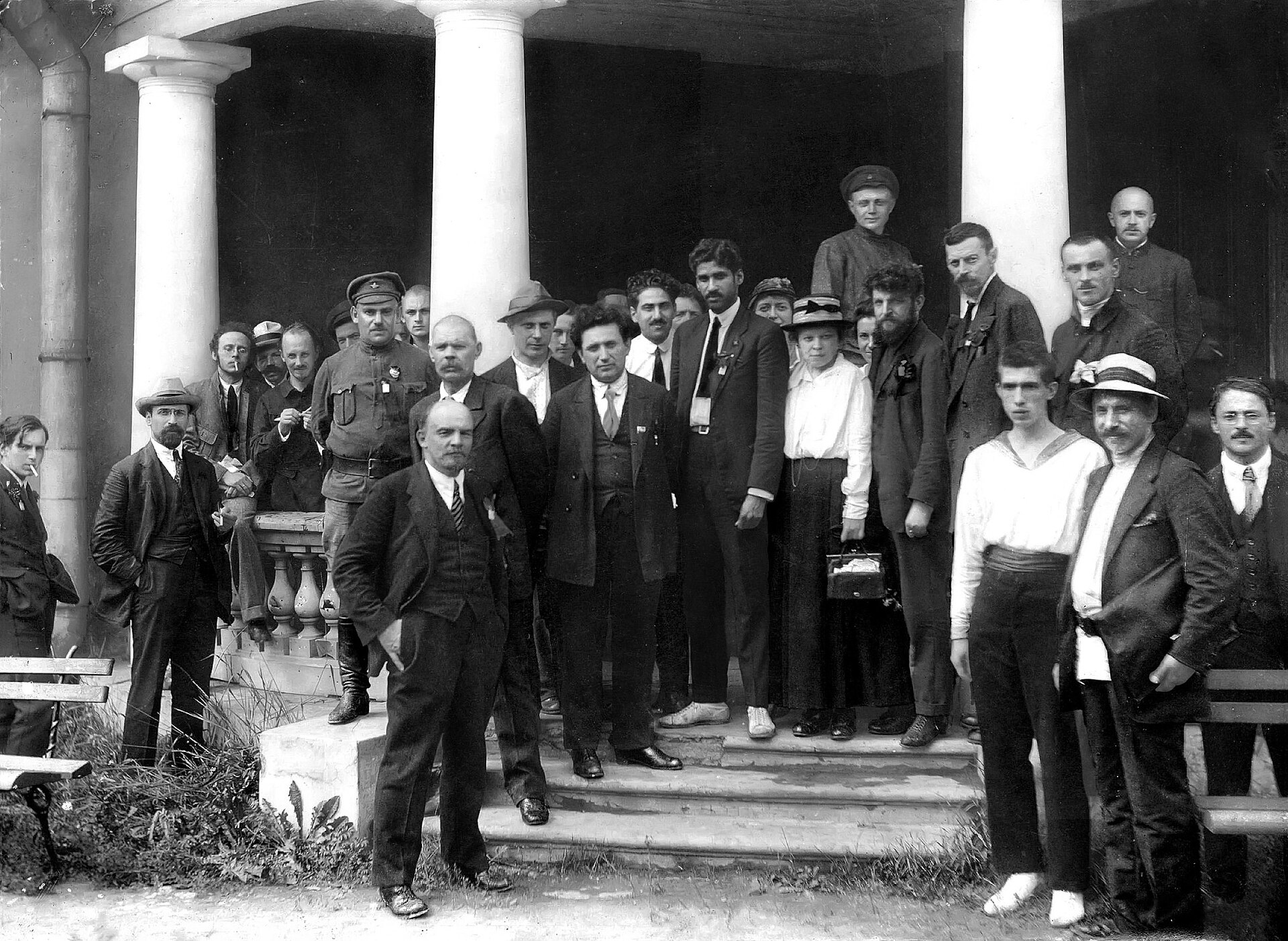
The Communist International, also called the Third International and known by its short name, the Comintern, was founded in Moscow in March 1919.12 The Library of Congress exhibit built from the opened Soviet archives states its purpose plainly: the Bolshevik leaders "created the Communist International (Comintern) to control the Communist movement throughout the world."1 Grigory Zinoviev served as president of its Executive Committee in the early years.3 The name "Third International" placed it in a line after the First International of Marx's day (1864 to 1876) and the Second International of the socialist parties (founded 1889), whose collapse in August 1914, when most of its parties backed their own governments in the war, Lenin treated as a betrayal. Lesson 01 covers that earlier history.
The Comintern was set up as a single world party with national sections. Each member party was formally "the Communist Party of (country), Section of the Communist International." The structure was meant to work the way the Bolshevik party worked inside Russia: decisions made at the top were binding on every level below. In practice, because the Comintern's headquarters, money, staff and leadership were in Moscow, and because the Soviet party was by far its strongest member, the Comintern's line followed the needs and orders of the Soviet leadership. The Library of Congress exhibit concludes that even after the Comintern was dissolved in 1943, the Soviet party's Central Committee carried on the same work, continuing to use communist parties of other nations "as instruments of Soviet foreign policy."1

The seven world congresses
The Comintern held seven world congresses. The Marxists Internet Archive, which keeps the published proceedings, lists them as follows.2
| Congress | Date | What it is remembered for |
|---|---|---|
| First | March 1919, Moscow | Founding of the International |
| Second | July to August 1920 | The Twenty-One Conditions of admission3 |
| Third | June 22 to July 12, 1921, Moscow | Approval of theses establishing the Red International of Labor Unions (Profintern)3 |
| Fourth | November 1922, Petrograd | The "united front" tactic; the year the Comintern forced the two American parties to merge1 |
| Fifth | June to July 1924 | "Bolshevization" of the member parties after Lenin's death |
| Sixth | July to August 1928 | The "Third Period" and the line of "class against class" |
| Seventh | August 1935 | The Popular Front against fascism3 |
The gaps between congresses grew longer as the Soviet party took tighter hold: one a year from 1919 to 1922, then four years, then seven. Between congresses the Executive Committee met in "enlarged plenums," thirteen of them from February 1922 to December 1933, according to the same archive listing.2 After 1935 no further congress was held before the dissolution.
The Executive Committee (ECCI)
The Executive Committee of the Communist International, abbreviated ECCI from its initials, governed between congresses. It sent instructions to national parties, received their reports, approved or removed their leaders, and sent its own representatives (often called "reps" in American party records) to sit in on national party meetings. The Twenty-One Conditions made its word law: condition 16 states that "All decisions by congresses of the Communist International and by its Executive Committee are binding" on member parties.4 The ECCI had a Presidium and a Political Secretariat at the top, regional secretariats (an Anglo-American secretariat dealt with the United States and Britain), and departments for organization, agitation and propaganda, and international liaison. The Presidium that signed the dissolution statement in 1943 included Georgi Dimitrov, Klement Gottwald, Andrei Zhdanov, Dmitry Manuilsky, Otto Kuusinen, Wilhelm Pieck, Maurice Thorez and Palmiro Togliatti (signing as "Ercoli").5
The American party learned how the ECCI's power worked in 1929. When Jay Lovestone, then the party's leader, resisted Moscow's line, Stalin told the American delegation that the Lovestone group would perish if it did not "submit to the will of the Comintern." Lovestone was removed, and the American party accepted the decision. Module 81 lesson 01 tells the story with the source.
The Twenty-One Conditions (1920)
The Second Congress, in July and August 1920, adopted the terms every party had to accept to join. Zinoviev presented them, and delegates approved them by a large majority.3 Lenin's own draft had nineteen points, written in July 1920; the congress adopted twenty-one.6 A new translation from the original Russian in the Comintern archive (RGASPI fond 489), published by the historian John Riddell in 2022, gives these passages:4
- Condition 3, on illegal work: "In almost every country in Europe and America the class struggle is entering the phase of civil war." From this it followed that each party had to build a parallel secret organization alongside its legal one.
- Condition 4, on the armed forces: refusal to carry on propaganda in the army "would be tantamount to a betrayal of revolutionary duty."
- Condition 12, on organization: "The parties belonging to the Communist International must be built on the basis of the principle of democratic centralism."
- Condition 14, on the Soviet state: each party was bound "to give unconditional support to every soviet republic in its struggle against the forces of counter-revolution."
- Condition 16, on discipline: "All decisions by congresses of the Communist International and by its Executive Committee are binding."
- Condition 21, on expulsion: "Party members who reject on principle the conditions and theses" laid down by the International were to be expelled.
Lenin's draft adds the demand that in countries under a state of siege or emergency laws "legal and illegal work should be combined," and that "Communist cells formed in every military unit" do their work largely in secret.6 These were public documents. When American anti-communists in the 1940s and 1950s argued that a member of the Communist Party had pledged obedience to a foreign body and accepted the need for a secret apparatus, they were reading the Comintern's own published rules. Module 81 lesson 01 discusses what that argument proved and what it did not.
The OMS: the international liaison service
The Comintern's most secret department was the OMS, from the Russian Otdel mezhdunarodnoi svyazi, the International Liaison (or Communications) Department. Historians date its creation to 1921. Its work was the plumbing of the world movement: couriers who carried instructions and reports, the delivery of money to national parties, false passports, codes and ciphers, radio links, safe addresses and the hiding of Comintern agents abroad. Osip Piatnitsky, an old Bolshevik organizer, directed the Comintern's organizational and liaison work for most of the 1920s and 1930s until he was arrested in the purge and killed in 1938.7
The OMS overlapped with the Soviet intelligence services. It used the same couriers and safe houses, and many of its people moved between the Comintern and the NKVD or GRU. Haynes and Klehr, with the Russian archivist Fridrikh Firsov, documented in The Secret World of American Communism (1995) how Comintern channels carried money to the American party and how the party's secret apparatus fed people to Soviet intelligence.7 David Garrow's 1995 review of that book in Newsday summarized its conclusion: the American party was in part "a conspiracy financed by a hostile foreign power that recruited members for clandestine work."8 By the late 1930s the OMS had been taken into the security police's orbit, and many of its staff were purged. The exact year of the change is given differently by different historians (1935 or 1937), and the department's renaming as a "communications service" is not documented in any primary source this lesson could open; both points are listed as unverified.
Schools of the movement
The Comintern ran schools in Moscow to train party officials from abroad. The best known was the International Lenin School, which took promising members of national parties for courses in Marxist-Leninist theory, party organization and, for some students, underground methods; many later CPUSA leaders passed through it. The Communist University of the Toilers of the East (known by its Russian initials, KUTV, and in English as the "Eastern University") trained students from Asia and, for a time, Black Americans. The Library of Congress's 2001 report on the CPUSA records that arrived from Moscow cites a 1924 Comintern letter "providing a subsidy of $1,282 to send 10 black Americans to the 'Eastern University,' a Comintern school in Moscow."9 Describing a 1926 memo on Soviet subsidies to the American movement, the same report explains: "Different Soviet agencies subsidized different American Communist activities."9 The film of the party's records that the Library received from Moscow holds "435,165 frames on 326 reels."9
Profintern, the Young Communist International and the auxiliaries
Around the Comintern stood a ring of international bodies for particular groups of people. Each worked under the Comintern's direction and had national affiliates.
- The Red International of Labor Unions (Profintern), 1921 to 1937. The Third Congress approved the theses for its founding in 1921.3 It organized communist trade unionists and competed with the socialist union international based in Amsterdam. In the United States its affiliate was William Z. Foster's Trade Union Educational League (1920s), later the Trade Union Unity League (1929 to 1935), which ran separate "red" unions during the Third Period before the party sent its members back into the main unions under the Popular Front. The Marxists Internet Archive dates the Profintern's records 1921 to 1937.2
- The Young Communist International (KIM, from its Russian initials), 1919 to 1943. It directed the youth leagues of the national parties, including the Young Communist League in the United States, and was dissolved with the Comintern.2
- International Red Aid (MOPR, from its Russian initials). It raised money and ran campaigns for imprisoned communists. Its American section was the International Labor Defense, which ran the defense campaign for the Scottsboro defendants in the 1930s and was later merged into the Civil Rights Congress (lesson 11).
- The Peasant International (Krestintern) for farm movements, and a women's secretariat, were smaller bodies of the 1920s.
From "class against class" to the Popular Front
The Comintern's line changed on orders from the top, and every member party changed with it. The Sixth Congress in 1928 announced a "Third Period" of capitalist crisis in which socialist and labor parties were treated as enemies, sometimes called "social fascists." Seven years later the Seventh Congress reversed course. Georgi Dimitrov, the Bulgarian communist who had become the Comintern's leader, delivered the main report on August 2, 1935. He endorsed the definition adopted by the Executive Committee's Thirteenth Plenum (December 1933): fascism in power was "the open terrorist dictatorship of the most reactionary, most chauvinistic and most imperialist elements of finance capital," and called for an anti-fascist People's Front built on a united front of workers' parties.10 The Popular Front (1935 to 1939) was the period in which the American party grew fastest and built its widest network of allied groups. The Library of Congress exhibit gives the party about 12,000 members at the forced merger of 1922 and about 75,000 by 1938.1
The line turned again on August 23, 1939, when the Soviet Union signed its pact with Nazi Germany, and once more on June 22, 1941, when Germany invaded the Soviet Union. American communists followed each turn within days. Those reversals, more than any document, persuaded many former members and many observers that the party took its orders from abroad. Lesson 05 traces the turns year by year.
The Comintern in the Terror
The Comintern's own staff suffered in the Great Terror of 1936 to 1938. Foreign communists living in Moscow, especially Polish, German, Hungarian and Yugoslav exiles, were arrested in large numbers, and the Polish party was dissolved by the Comintern in 1938 with most of its leaders in Moscow shot. Lewis Siegelbaum's essay for the Michigan State University project Seventeen Moments in Soviet History places the Comintern's decline in that setting: its subordination to the Soviet party, the purges of member parties and the "mutual denunciation and arrest in 1937."3 Piatnitsky, who had run the liaison work for years, was among those killed.7
Dissolution, May 1943, and what took its place
On May 15, 1943, in the middle of the war and with Stalin seeking good relations with his British and American allies, the Presidium of the ECCI sent all communist parties a statement proposing "To dissolve the Communist International as a guiding centre of the international labor movement." The Marxists Internet Archive's headnote to the text records that "Upon receiving endorsement by these parties, the Communist International was dissolved forthwith."5 Among the signers were Dimitrov, Gottwald, Zhdanov, Manuilsky, Kuusinen, Pieck, Thorez and "Ercoli" (Togliatti), and the statement was endorsed by party representatives in exile in Moscow, among them Dolores Ibarruri of Spain, Ana Pauker of Romania and Matyas Rakosi of Hungary.5
The dissolution changed the address, not the work. The Library of Congress exhibit states that after 1943 the Soviet party's Central Committee continued to use foreign communist parties as instruments of Soviet policy.1 The Comintern's files and some of its staff passed to Central Committee departments, the best known of which became the International Department of the Central Committee, which handled relations with non-ruling communist parties, the front organizations described below and, as later archive research showed, the secret payments to the American party that continued into the late 1980s (module 81 lesson 01 gives the figures with sources). The 1951 House Committee on Un-American Activities report on the communist "peace" campaign called the Cominform, founded in 1947, the Comintern's "successor" and said the "pattern of control" was the same.11
The security police: Cheka to FSB
The Soviet political police began six weeks after the Bolshevik seizure of power and, under one name or another, never stopped. The most convenient record of its many renamings is the official history page of Russia's Federal Security Service (FSB), which traces its own descent from the Cheka of 1917 and gives the date and the chief of each stage. The dates below follow that page, checked against the Library of Congress exhibit of documents from the Soviet archives and the Encyclopaedia Britannica entry on the KGB.121314 That the FSB claims the Cheka as its ancestor is itself a fact worth weighing: the line of succession is not a charge made by its opponents, it is the agency's own account of itself.

The Cheka, 1917 to 1922
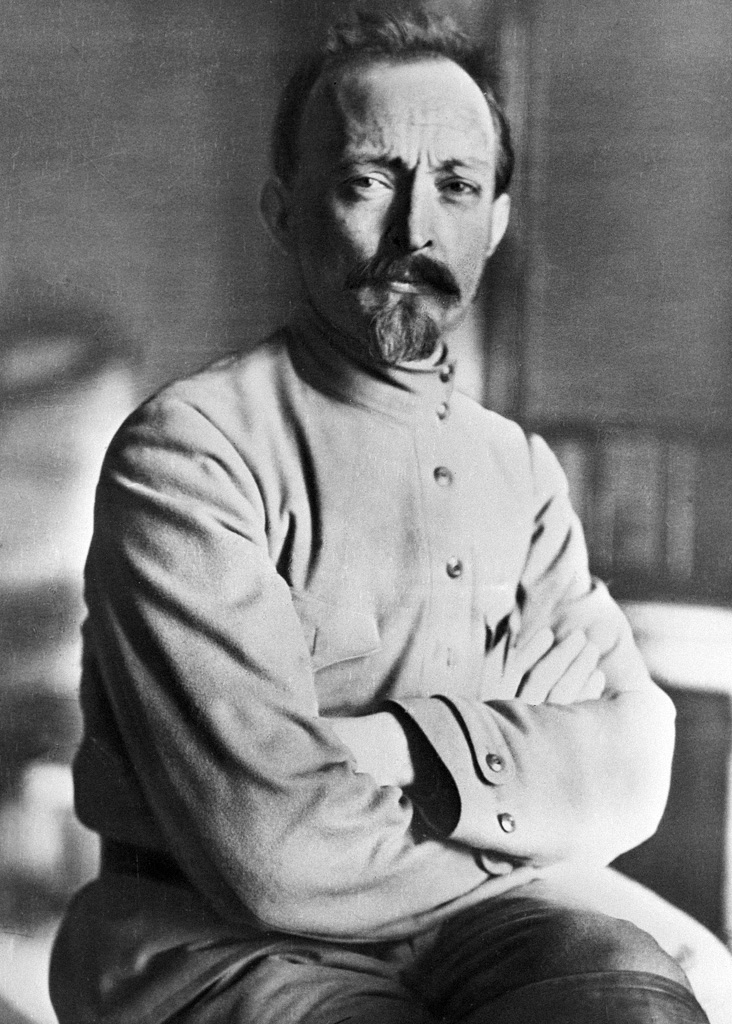
On December 20, 1917, a decree of the Council of People's Commissars created the All-Russian Extraordinary Commission for Combating Counter-Revolution and Sabotage, known by its Russian initials VChK or simply as the Cheka. Felix Dzerzhinsky, a Polish-born revolutionary, was named its first chairman and held the post until February 6, 1922. From July to August 1918 Yakov Peters stood in as acting chairman.12 The Library of Congress exhibit notes that the Cheka was established as "a temporary institution to be abolished once Vladimir Lenin and the Bolsheviks had consolidated their power."13 It was not abolished; it grew. Britannica gives a staff of more than 250,000 by 1921.14 The Cheka carried out the Red Terror proclaimed in September 1918, ran the first concentration camps of the Soviet state and shot hostages and suspected enemies without trial. Lesson 02 gives that history. Members of the Soviet and Russian security services still call themselves "chekists," and the FSB's history section opens with the Cheka.
The GPU and OGPU, 1922 to 1934
On February 6, 1922, the Central Executive Committee abolished the Cheka and created the State Political Directorate (GPU) inside the People's Commissariat of Internal Affairs of the Russian republic. After the founding of the Soviet Union, the Presidium of the Union's Central Executive Committee created the Unified State Political Directorate (OGPU) on November 2, 1923. Dzerzhinsky remained chairman until his death on July 20, 1926, and was followed by Vyacheslav Menzhinsky, who led the OGPU until 1934.12 The Library of Congress exhibit observes that the GPU was at first less powerful than the Cheka.13 That did not last. The OGPU carried out the deportation of the peasants labeled "kulaks" during collectivization, from 1930, and built the camp system that became known by the initials of its administration, the Gulag. The OGPU's foreign department, inherited from the Cheka, ran the first Soviet intelligence networks abroad.
The NKVD, 1934 to 1946
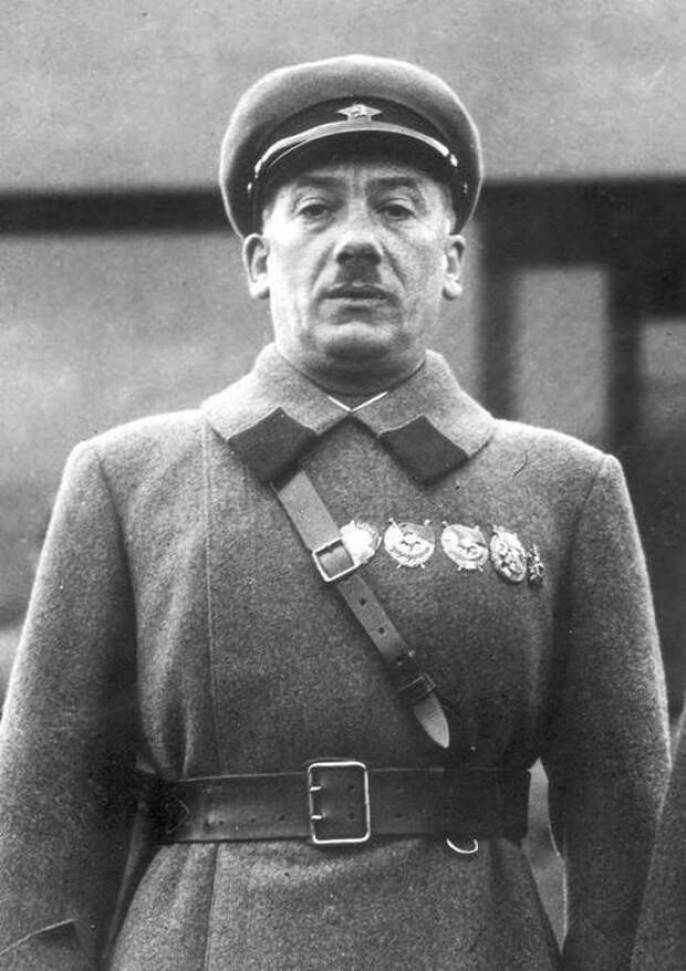
On July 10, 1934, by decree of the Union's Central Executive Committee, the state security organs were folded into the People's Commissariat of Internal Affairs of the USSR, the NKVD.12 The Library of Congress exhibit says the renamed police became "a direct instrument of Stalin."13 Its chiefs, by the FSB's account, were Genrikh Yagoda from 1934 to 1936, Nikolai Yezhov from 1936 to 1938 and, from November 1938, Lavrentiy Beria.12 Yagoda and Yezhov were both later arrested and shot, Yagoda after the third Moscow show trial of March 1938 and Yezhov in 1940; Beria was shot in 1953 (see below).
The NKVD under Yezhov carried out the mass operations of 1937 and 1938, the Great Terror. Reference data compiled by the Soviet Ministry of Internal Affairs in 1953, as reported by the research site GlobalSecurity.org, count 1,575,259 people arrested by NKVD bodies in 1937 and 1938, of whom 1,344,923 were sentenced, "including 681 692 people were shot."15 Those are the police's own counts of its own work. Wider estimates that include deaths in the camps and in deportation are higher; lessons 02 and 14 set out the ranges and who made them.
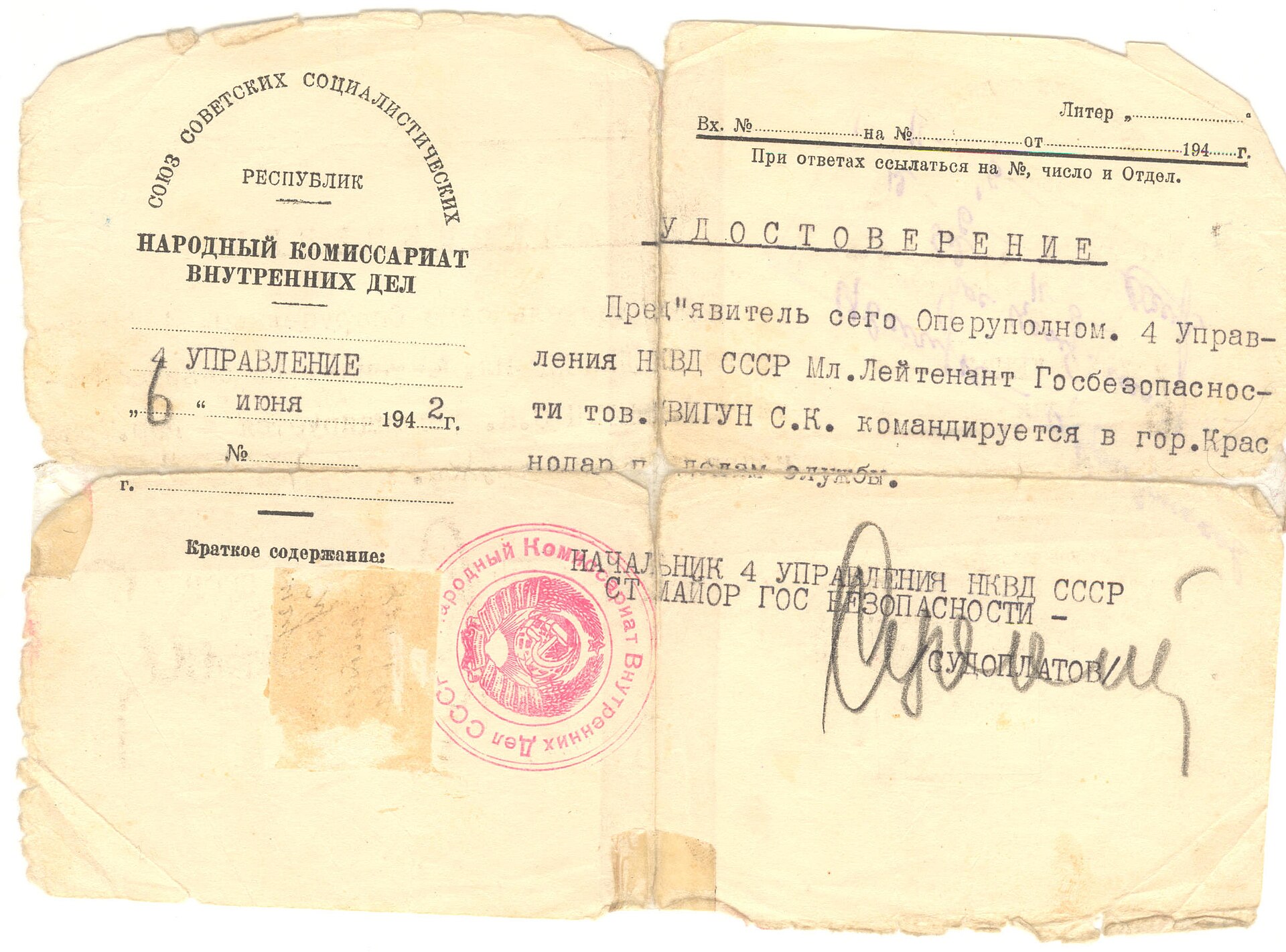
The NKVD's foreign intelligence directorate (known as INO, and later as the First Directorate) ran the Soviet civilian intelligence networks in the United States in the 1930s and 1940s, working from the "legal" station (rezidentura) in the Soviet embassy and consulates, from cover jobs at Soviet trade bodies such as Amtorg, and through "illegal" officers who lived under false identities. The same service carried out the murder of Leon Trotsky in Mexico in August 1940. Lesson 12 and the people entries for Vasily Zarubin, Elizabeth Zarubina and Pavel Sudoplatov in lesson 09 give the American details.

The NKGB and the MGB, 1941 to 1953
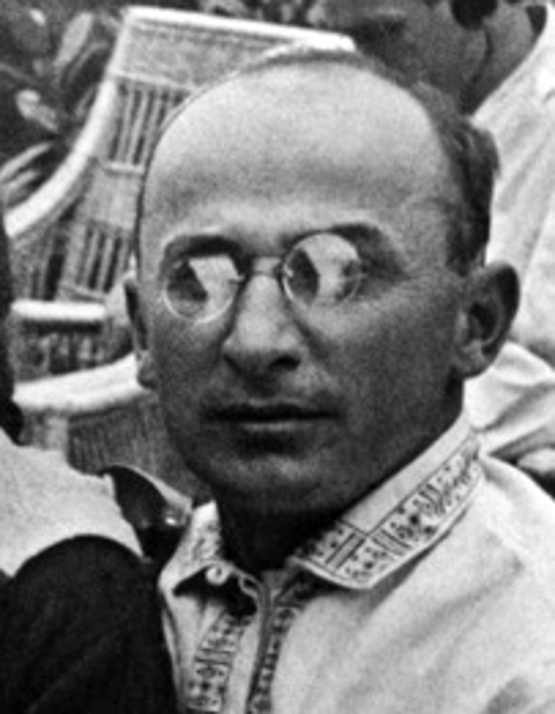
The service was split and rejoined several times during and after the war. On February 3, 1941, the NKVD was divided into two commissariats: the NKVD under Beria and a People's Commissariat of State Security (NKGB) under Vsevolod Merkulov. In July 1941, after the German invasion, the two were merged again into a single NKVD. In April 1943 the NKGB was created a second time, again under Merkulov.12 That second NKGB is the service whose New York and Washington cables were later partly decrypted in the Venona project; the cables of 1943 to 1945 are its traffic. On March 15, 1946, when the commissariats were renamed ministries, the NKGB became the Ministry of State Security (MGB). The FSB page names Viktor Abakumov as minister; standard reference works record that Vsevolod Merkulov held the post for its first weeks and that Abakumov replaced him in May 1946. Semyon Ignatiev held the post from 1951 to 1953.12 Britannica notes that the internal affairs side became the MVD at the same time, and that both became ministries in 1946.14
The MVD and the fall of Beria, 1953
On March 5, 1953, the day of Stalin's death, the leadership decided to merge the Ministry of Internal Affairs and the Ministry of State Security into a single MVD under Beria. On June 26, 1953, Sergei Kruglov took over the MVD.12 The change of chief on that date reflects Beria's arrest by his colleagues in the party leadership, who feared his control of the police; he was tried and shot in December 1953. The episode convinced the post-Stalin leadership to separate state security from the ordinary police and to place it more firmly under the party's control.

The KGB, 1954 to 1991
On March 13, 1954, the Committee for State Security (KGB) attached to the Council of Ministers of the USSR was created.12 Its chairmen, according to the FSB's history page, were:12
| Chairman | Years |
|---|---|
| Ivan Serov | 1954 to 1958 |
| Alexander Shelepin | 1958 to 1961 |
| Vladimir Semichastny | 1961 to 1967 |
| Yuri Andropov | 1967 to 1982 |
| Vitaly Fedorchuk | May to December 1982 |
| Viktor Chebrikov | 1982 to 1988 |
| Vladimir Kryuchkov | 1988 to August 1991 |
| Vadim Bakatin | August to November 1991 |
Andropov, the longest-serving chairman, went on to lead the Soviet party from 1982 to 1984. Kryuchkov was one of the leaders of the failed coup against Mikhail Gorbachev in August 1991, which is why his term ends that month. The KGB combined foreign intelligence (its First Chief Directorate), counterintelligence at home, the guarding of the borders, the protection of leaders, government communications and the policing of dissent. The Library of Congress exhibit notes that the KGB was used to "suppress political and religious dissent" and displays a March 21, 1988 report from Chairman Chebrikov on the KGB's 1987 investigations into the distribution of anonymous writings hostile to the regime.13 In the United States, KGB officers worked under diplomatic cover at the embassy in Washington, the consulate in San Francisco and the Soviet mission to the United Nations in New York. The KGB archivist Vasili Mitrokhin, who copied files for years and brought his notes to Britain in 1992, is the source of the Mitrokhin archive used by Christopher Andrew in The Sword and the Shield (1999).
After 1991: the SVR and the FSB
On December 3, 1991, Gorbachev signed the law "On the reorganization of the organs of state security." Under it the KGB of the USSR was abolished, and on its base two transitional bodies were created: the Inter-republican Security Service and the Central Intelligence Service of the USSR, the latter now the Foreign Intelligence Service of the Russian Federation (SVR).12 Inside Russia the line ran through several short-lived bodies before reaching its present name:12
- May 6, 1991: a KGB of the Russian republic (RSFSR), led by Viktor Ivanenko, created by protocol between Boris Yeltsin and Kryuchkov.
- November 26, 1991: that body renamed the Federal Security Agency (AFB).
- January 24, 1992: the Ministry of Security (MB) of the Russian Federation, under Viktor Barannikov and then Nikolai Golushko.
- December 21, 1993: the Ministry of Security abolished and the Federal Counterintelligence Service (FSK) created, under Golushko and then Sergei Stepashin.
- April 3, 1995: Yeltsin signed the law on the organs of the Federal Security Service (FSB), as legal successor of the FSK. Its directors have been Mikhail Barsukov (1995 to 1996), Nikolai Kovalev (1996 to 1998), Vladimir Putin (July 1998 to August 1999), Nikolai Patrushev (1999 to 2008) and Alexander Bortnikov (from May 2008).
Bortnikov was still listed as director on the FSB's history page when it was checked for this lesson. In September 2026 the Russian investigative outlet iStories, as reported by Meduza, cited unnamed sources saying that a major reorganization of the FSB was planned, possibly starting in October, and that Bortnikov had long been asking to retire; First Deputy Director Sergei Korolev had been standing in for him more often, and other candidates reported under consideration were Ivan Tkachev and Vladislav Menshchikov.16 As of early November 2026 no change had been announced: the official site of the National Antiterrorism Committee, which the FSB director chairs, reported on October 13, 2026 that "FSB Director A. V. Bortnikov" had chaired a meeting of the committee.27 The SVR's director, Sergei Naryshkin, appointed in October 2016, was quoted as "Director of Russia's Foreign Intelligence Service (SVR)" by the Russian state news agency TASS on October 21, 2026.17 Current cases involving these services, and the American response, are in module 81 lesson 13.
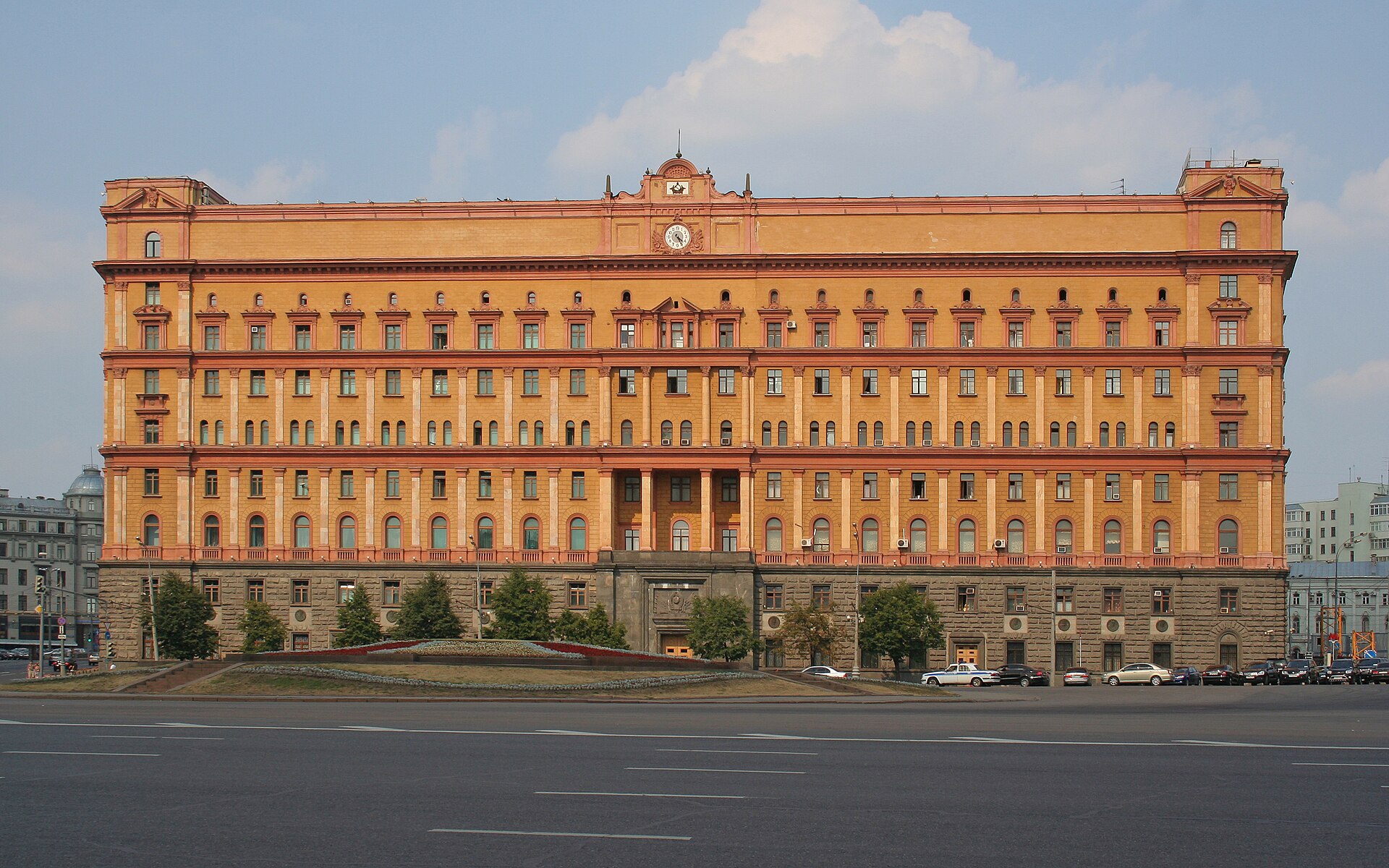

How the Venona literature names the services
Readers of module 81 and of the Venona books will meet "KGB" used for the wartime service. The NSA's translators and historians such as Haynes and Klehr adopted that usage because it is the name most readers know, and module 81 follows them. For accuracy: the New York and Washington stations whose cables were read belonged to the NKVD until April 1943 and to the NKGB from then until March 1946. In the cables, the KGB stations call the military intelligence service "the neighbors."18
The GRU: Soviet military intelligence
Soviet military intelligence was a separate service from the political police, part of the Red Army's general staff, with its own officers, networks, codes and cable traffic. David Durant's 2017 survey for the Cold War and Internal Security Collection at East Carolina University's Joyner Library gives the outline: a first military intelligence body was founded in November 1918; the organization that became the GRU took shape in April 1921 as the Razvedupr, also called the Fourth Directorate; and it was officially named the Main Intelligence Directorate (GRU, from the Russian initials) on February 16, 1942.18 Its rivals in the political police nicknamed it "the neighbors." Durant notes that the KGB usually ranked above the GRU and sometimes placed its own people at the GRU's head: Ivan Serov, removed as KGB chairman, ran the GRU from 1958 to 1963. In the 1930s, after GRU networks abroad were exposed, the NKVD's foreign intelligence branch took over many of them.18 The historian Jonathan Haslam, quoted by Durant, judged that in the early years "military intelligence seemed more promising than its civilian counterpart, both larger and more substantial."18
The GRU ran several of the American and British sources that mattered most:
- Whittaker Chambers's apparatus. Chambers worked in the 1930s as a courier for the GRU, reporting to its officer Colonel Boris Bykov, until he broke with the party in April 1938.18 The documents he later produced, including the microfilm known as the Pumpkin Papers, came from that network. Module 81 lesson 03 tells the Hiss case.
- Alger Hiss. A March 1945 cable from the KGB's Washington station reported that a source code-named ALES had been working "continuously" with "the neighbors" (the GRU) since 1935. Durant, quoting Haynes, Klehr and Vassiliev's Spies (2009), pp. 20 to 21, renders the line as "Ales has been continuously working with the neighbors (i.e. the GRU) since 1935"; other published translations word it slightly differently.18 The identification of ALES with Hiss is accepted by the NSA's analysts, by Haynes and Klehr and by Durant, and disputed by a smaller group of writers; module 81 lesson 02 and lesson 12 of this module set out the argument.
- Walter Krivitsky. A senior Soviet military intelligence officer in western Europe, he defected in 1937, wrote In Stalin's Secret Service (1939) and gave testimony to the House committee on un-American activities in 1939.18 He was found dead in a Washington hotel in February 1941.
- Klaus Fuchs. Britain's Security Service (MI5) states that Fuchs, a German refugee physicist, made contact in late 1941 with the exiled German communist Jurgen Kuczynski, who put him in touch with the GRU; in 1942 he was handed to another GRU agent, Ursula Beurton, code-named SONYA.19 When Fuchs went to the United States with the British mission to the Manhattan Project, the NKGB took over contact with him, through the courier Harry Gold (lesson 12). He confessed in early 1950 and received the "maximum sentence - fourteen years' imprisonment."19
- Igor Gouzenko. The Ottawa cipher clerk whose defection in September 1945 exposed a Soviet ring in Canada worked for the GRU station in the Soviet embassy, as module 81 lesson 01 describes.
- The Cold War. Durant also records the GRU colonel Georgi Bolshakov, who posed as a journalist and carried a back channel with Attorney General Robert Kennedy during the Cuban Missile Crisis, and Colonel Oleg Penkovsky, a GRU officer who spied for the CIA and Britain and was arrested in Moscow in 1962.18
The GRU kept its name and its separate existence after 1991. Its officers have been charged in American and British cases in the 2010s and 2020s, which module 81 lesson 13 covers.
SMERSH, 1943 to 1946
SMERSH, a contraction of the Russian for "death to spies," was a wartime military counterintelligence organization. The reference site GlobalSecurity.org, drawing on Russian sources, records that Stalin directed its creation on April 19, 1943, and that the State Defense Committee's decision followed on April 21; its formal title was the Chief Counterintelligence Directorate of the People's Commissariat of Defense, and Viktor Abakumov was its only chief, reporting directly to Stalin.20 Its task, in the words of the founding decision as quoted, was the "fight against espionage, sabotage, terrorism" by foreign intelligence within the Red Army. In practice its officers also hunted collaborators in territories retaken from Germany and screened, imprisoned and sometimes executed returning Soviet prisoners of war.20 SMERSH was disbanded in spring 1946, and Abakumov moved to the Ministry of State Security as minister (GlobalSecurity.org dates his appointment October 18, 1946; other reference works give May 1946).20 The FSB's archive has published SMERSH documents, including a collection of Abakumov's special reports to Stalin, and the FSB still celebrates SMERSH officers as part of its own lineage.
SMERSH had no role in American espionage. Its name became famous in the West through spy fiction, which used it as a stand-in for Soviet intelligence long after the real organization had ceased to exist.
How Moscow directed a national party
The diagram below draws together the lines of command, money and recruitment that ran from the Soviet leadership to the American party and beyond it into the United States government. Each line is documented in a source cited in this lesson or in module 81.
- The political line. The Soviet party leadership set policy; the Comintern's Executive Committee turned it into binding decisions for member parties (condition 16); after 1943 the Central Committee's departments carried on the work.41 In 1922 the Comintern forced the two American parties, then about 12,000 members, to unite and "follow the party line established in Moscow."1
- The money line. "Different Soviet agencies subsidized different American Communist activities," the Library of Congress report explains in describing a 1926 memo in the Comintern files.9 Payments went through Comintern liaison channels before 1943 and through Central Committee channels afterward. Garrow's review of The Secret World of American Communism reports that the Moscow documents show subsidies beginning as early as 1919.8
- The secret apparatus. The Twenty-One Conditions required every party to keep an illegal organization beside its legal one.4 In the American party this was the underground run in the 1930s by J. Peters (Jozsef Peter), which included the Ware group in Washington (lesson 12, and the Peters entry in lesson 08). Garrow summarizes the archive finding that the party's secret apparatus assisted Moscow in "special work," including the penetration of American government agencies.8
- The intelligence lines. The NKVD (later NKGB) and the GRU each ran their own officers in the United States. Both used the party as a pool from which to recruit, asked party leaders such as Earl Browder for help in vetting sources, and passed some sources from one service to the other. Module 81 lesson 02 gives the evidence from Venona and the Vassiliev notebooks.
Amtorg and other covers
Before the United States recognized the Soviet Union in November 1933 there was no Soviet embassy in Washington, and the Amtorg Trading Corporation in New York, the Soviet Union's official purchasing and sales agency in the United States, served as the main Soviet presence. It also served as cover for intelligence officers, who held trade jobs while running agents, and it continued in that role after recognition. The clearest documented case is Gaik Ovakimian. A State Department memorandum of May 5, 1941, printed in Foreign Relations of the United States, records that Ovakimian, described as "a Soviet engineer connected with Amtorg," was arrested by the FBI in New York that day in an espionage investigation, held "as a material witness," and arraigned on a complaint under the Foreign Agents Registration Act; bail was set at $25,000 and paid in cash the next day.21 Historians of Soviet intelligence identify Ovakimian as the NKVD's chief in New York in the late 1930s, the officer who developed many of its industrial and scientific sources. Other cover institutions included the Soviet Purchasing Commission during the Lend-Lease years, the TASS news agency and, after 1945, the Soviet mission to the United Nations.

The Cominform, 1947 to 1956
The Information Bureau of the Communist and Workers' Parties, known as the Cominform, was founded at a conference at Szklarska Poreba in Poland that opened on September 22, 1947. The historian Gale Stokes, writing in the Encyclopedia of Russian History, lists its nine member parties: those of the Soviet Union, Bulgaria, Czechoslovakia, Hungary, Poland, Romania, Yugoslavia, France and Italy.22 At the founding conference Andrei Zhdanov restated the doctrine of "two camps," a democratic camp led by the Soviet Union and an imperialist camp led by the United States. The Cominform's journal, For a Lasting Peace, For a People's Democracy!, was edited in Belgrade.22
The Cominform's most important act came at its second meeting, in Bucharest in June 1948, when it expelled the Yugoslav party of Josip Broz Tito after Tito refused Stalin's control.22 Its third meeting, in Hungary in November 1949, turned to the "peace movement," according to the House committee's 1951 report.11 The Cominform was dissolved on April 17, 1956, two months after Khrushchev's secret speech and as part of his reconciliation with Tito.22 The House committee's 1951 report noted that William Z. Foster, the American party's chairman, quickly acknowledged the Cominform's "significance and authority," though the American party was never a member.11
The Warsaw Pact, 1955 to 1991
The Treaty of Friendship, Cooperation and Mutual Assistance was signed in Warsaw on May 14, 1955, by Albania, Bulgaria, Hungary, the German Democratic Republic, Poland, Romania, the Soviet Union and Czechoslovakia. The Avalon Project at Yale Law School keeps the text. Article 4 bound each party, "In the event of armed attack in Europe on one or more of the Parties to the Treaty," to come to the aid of the state attacked by all means it judged necessary, including armed force; Article 5 stated that "The Contracting Parties have agreed to establish a Joint Command of the armed forces"; and Article 11 provided that "The present Treaty shall remain in force for twenty years," with automatic extension.23 The pact was signed in the same month that West Germany joined NATO, May 1955.
Its forces were used against its own members: in Hungary in 1956 (by Soviet troops) and in Czechoslovakia in August 1968, when Soviet, Polish, Hungarian and Bulgarian forces (with East German support) crushed the Prague Spring. Lesson 03 tells both. According to the European Network Remembrance and Solidarity, Albania suspended its membership in 1960 and left on September 12, 1968; East Germany left on September 25, 1990, on the eve of German unification; an agreement ending military cooperation was signed in Budapest on February 25, 1991; and the pact's political structures were dissolved in Prague on July 1, 1991, which the network calls "tantamount to the final dissolution of the Warsaw Pact."24
Comecon, 1949 to 1991
The Council for Mutual Economic Assistance, known in the West as Comecon or CMEA, was founded in January 1949 under Soviet leadership as the Soviet answer to the Marshall Plan and the West European economic cooperation it built. Britannica gives its founding members as the Soviet Union, Bulgaria, Czechoslovakia, Hungary, Poland and Romania, with Albania joining in February 1949 (and ceasing active participation at the end of 1961), East Germany in September 1950, Mongolia in June 1962, Cuba in 1972 and Vietnam in 1978; Yugoslavia took part in some work under a 1964 agreement without full membership. Its headquarters were in Moscow.25 After the revolutions of 1989 the members agreed in 1991 to wind it up. The Czech Center for Documentation of Totalitarian Regimes dates the formal dissolution to September 28, 1991; other sources give June 28, 1991, the date of the final session in Budapest.26 Comecon divided production among member states according to plans set in Moscow and priced trade in "transferable rubles." The economics are in module 51, lesson 07.
The international fronts
A "front," in the vocabulary of the movement and of its opponents, was an organization that presented itself as independent and broad (for peace, for youth, for women, for labor) while its direction, money and line came from the communist movement. After the Second World War a set of international fronts was built, mostly in 1945 and 1946, with headquarters in Paris, Prague, Budapest, Vienna and other cities, and with national affiliates around the world. The main ones were:
- The World Federation of Trade Unions (WFTU), founded in 1945 as a federation of union centers from the Allied countries. When the Marshall Plan divided it, the British, American and other non-communist unions left in 1949 to form a rival international, and the WFTU remained under communist direction. Its general secretary in 1950 was the French communist Louis Saillant, whom the House committee's 1951 report called the head of "the Communist-controlled World Federation of Trade Unions."11
- The World Federation of Democratic Youth (WFDY), founded in London in 1945, and the International Union of Students (IUS), founded in Prague in 1946. Together they organized the World Festivals of Youth and Students.
- The Women's International Democratic Federation (WIDF), founded in Paris in 1945. The Cominform's own journal, as quoted in the House committee's report, counted the "World Congress of the Democratic Women's Federation held in Budapest (autumn 1948)" among the milestones of the peace campaign.11
- The World Peace Council (WPC) and its forerunners, described next.
- Smaller bodies for lawyers (the International Association of Democratic Lawyers), journalists (the International Organization of Journalists) and scientists (the World Federation of Scientific Workers).
The World Peace Council and the Stockholm Appeal
The House Committee on Un-American Activities set out the history of the postwar peace campaign in its Report on the Communist "Peace" Offensive, released April 1, 1951, under Chairman John S. Wood.11 The report traces the campaign through the Wroclaw Congress of Intellectuals (1948), the Scientific and Cultural Conference for World Peace in New York (March 25 to 27, 1949), and the first World Congress of Partisans of Peace, which the Cominform journal described as "held in Paris and Prague on April 20-25" (1949) and claimed "represented 600,000,000 organized fighters for peace."11 Its Permanent Committee met in Stockholm from March 15 to 19, 1950, with 120 delegates, and launched a world petition for the banning of atomic weapons, the Stockholm Appeal.11 The Permanent Committee became the World Peace Council after the Second World Peace Congress of November 1950.
The organizers claimed a total of 273,470,566 signatures, in a tabulation presented by Frederic Joliot-Curie, chairman of the World Peace Committee in Paris. The House report pointed out that "235,000,000, or 86 percent, of these alleged signatures come from Communist-dominated countries where the petition has been officially approved and refusal to sign would constitute defiance of the government," and that "The Soviet Union is said to have rolled up 100,000,000 signatures in 2 weeks."11 The report also called the Cominform the "successor to the Communist International" and stated that it "has given this campaign top priority."11 In the United States the American party's paper told every member that he "has the duty to rise to this appeal," and the party named members who pledged 500 signatures "heroes and heroines of peace."11
The House report was a committee document written to prove a case, and its framing ("A Campaign To Disarm and Defeat the United States") is advocacy. Its facts about the Cominform's direction of the campaign, however, rest largely on the Cominform's own published journal, which it quotes at length, and the later opening of the Soviet and East European archives has not overturned them. Many of the individuals who signed the appeal or attended the congresses were not communists, and some were pacifists or clergy acting on their own convictions. The direction of the organization and the motives of each signer are separate questions. Lesson 11 covers the American groups that took part, and the Attorney General's list.
What the record shows and what it does not
Documented fact. The Comintern's published rules made its decisions binding on member parties and required every party to keep a secret organization beside its legal one.4 The Comintern forced the American factions to merge in 1922.1 The Comintern's files show Soviet subsidies to American communist activities from the earliest years.98 The security police's line of succession from the Cheka to the FSB is documented by the FSB itself.12 The NKVD's own counts record 681,692 people shot in 1937 and 1938.15
Their own words. Dimitrov's 1935 report, the Twenty-One Conditions and the 1943 dissolution statement are all published texts.1045 The Cominform's journal, quoted in the House committee's report, claimed credit for organizing the peace campaign.11
The accusation. American anti-communists said in the 1940s and 1950s that the CPUSA was directed and paid by Moscow and that its secret apparatus served Soviet intelligence. The party denied both.
The archive evidence. The opened Comintern files, the Venona decrypts and the KGB notebooks copied by Alexander Vassiliev confirmed both charges in their essentials. Module 81 lessons 01 and 02 give the documents.
Scholarly reading. Haynes, Klehr and Firsov concluded that the party was in part "a conspiracy financed by a hostile foreign power that recruited members for clandestine work."8 Ellen Schrecker, in Many Are the Crimes (1998), accepted that the party had a secret apparatus and that some members spied, while arguing that most rank-and-file members knew nothing of it and that the domestic response went far beyond the threat; module 81 lesson 12 weighs that argument.
Open questions. The internal files of the Russian foreign intelligence service (SVR) and of the GRU remain closed. The full records of the OMS, of the Central Committee's International Department after 1943, and of the GRU's American networks have not been opened to independent historians. What is known of them comes from the Comintern files opened in the 1990s, Venona, the Vassiliev notebooks, the Mitrokhin archive and defectors' accounts.
Claims checked
"The Comintern was a voluntary association of independent national parties."
Rating: Refuted. Party publications of the 1920s and 1930s described the Comintern as a world party of equals, and some later defenders of the American party argued that its members made their own decisions. The Comintern's own rules made the decisions of its congresses and Executive Committee binding on every member and required the expulsion of members who rejected them.4 The Library of Congress exhibit built from the Comintern's files describes it as created "to control the Communist movement throughout the world" and records that it forced the American parties to merge and follow Moscow's line.1 The removal of Jay Lovestone in 1929 (module 81 lesson 01) shows the rule enforced against an American leader who had his own party's majority.
"Dissolving the Comintern in 1943 ended Moscow's direction of foreign parties."
Rating: Refuted. The 1943 statement dissolved the Comintern "as a guiding centre," and Western governments welcomed it as a sign of good faith during the war.5 The Library of Congress exhibit states that the Soviet party's Central Committee continued to use foreign parties as tools of Soviet foreign policy after 1943, and the archives document continuing subsidies to the American party.1 The Cominform was founded four years later.22
"The American Communist Party was funded by Moscow."
Rating: Supported. The Comintern files that reached the Library of Congress include the 1926 memo that, in the Library's description, shows that different Soviet agencies "subsidized different American Communist activities" and the 1924 school subsidy.9 Garrow's review of The Secret World of American Communism reports subsidies from as early as 1919.8 Module 81 lesson 01 gives the later amounts with Haynes's account of payments continuing until 1988.
"The KGB ran all the atomic spies."
Rating: Partly supported. The civilian service (NKVD, then NKGB, which Venona writers call the KGB) ran the Rosenberg network, Theodore Hall and, in the United States, Klaus Fuchs. But Fuchs began as a GRU source in Britain, recruited through Jurgen Kuczynski and handled by Ursula Beurton (SONYA), according to MI5.19 The GRU also ran its own networks in North America, including the Canadian ring exposed by Gouzenko. The two services competed and sometimes passed sources between them.18
"Today's FSB is simply the KGB renamed."
Rating: Partly supported. The FSB's official history presents itself as the heir of the Cheka, OGPU, NKVD, MGB and KGB, and its director from 1998 to 1999 was a former KGB officer, Vladimir Putin.12 But the KGB's functions were divided in 1991: foreign intelligence went to the SVR, and other parts (border troops, government communications, guard service) went to separate agencies for some years, though several were later folded back into the FSB. The FSB is the KGB's domestic successor, not the whole of it.
"The 273 million signatures on the Stockholm Appeal showed what the world's people wanted."
Rating: Refuted. The figure was the organizers' own claim. The House committee's report noted that 86 percent of the claimed signatures came from communist-ruled countries where the petition was officially approved and refusing to sign meant defying the government, and that the Soviet Union claimed 100 million signatures in two weeks.11 A petition gathered under those conditions cannot measure opinion. That does not mean every signer outside the bloc was insincere.
"Every peace and disarmament group of the era was a Soviet front."
Rating: Unsupported. The World Peace Council and its congresses were directed by the communist movement, as the Cominform's own journal made clear.11 But pacifist and religious peace groups older than the Cold War, such as Quaker bodies, existed independently, and the record does not support extending the label to every group that called for disarmament. Each organization needs its own evidence. Lesson 11 applies that test to American groups.
"Amtorg was nothing but a front for Soviet espionage."
Rating: Partly supported. Amtorg was a real trading corporation that handled a large share of Soviet purchases in the United States. It was also used as cover for intelligence officers, as the 1941 arrest of Gaik Ovakimian, "a Soviet engineer connected with Amtorg," shows.21 Both descriptions are true of the same institution.
"SMERSH was the Soviet agency that hunted Western spies around the world."
Rating: Refuted. SMERSH was a wartime military counterintelligence directorate, created in April 1943 and disbanded in spring 1946.20 Its work was inside the Red Army and the territories it occupied. The idea of a worldwide SMERSH comes from postwar fiction. Soviet foreign intelligence in the Cold War was the work of the MGB and then the KGB's First Chief Directorate, and of the GRU.
Hard questions and answers
If the Twenty-One Conditions were public, why did the archives matter?
A civil liberties advocate of the 1950s could answer the anti-communist reading of the conditions by saying that rules on paper prove nothing about practice: many organizations have rhetoric their members ignore. The rules showed what the Comintern demanded. The archives showed what the American party did: that it accepted Moscow's money, that its leaders took orders on leadership and line, and that its secret apparatus supplied people to Soviet intelligence.89 The combination closed the gap between text and practice that the party's defenders had relied on.
Why does it matter that the FSB traces itself to the Cheka?
Because institutions that celebrate their history tend to keep its habits. The FSB's history section names Dzerzhinsky first and runs through Yagoda, Yezhov and Beria without a break.12 A historian of either school would add that the methods of the 2020s are not the mass terror of 1937. A skeptic would answer that the line is the service's own claim, made with pride. Both observations are drawn from the same page.
Were ordinary party members part of the secret apparatus?
Most were not. The apparatus was small, and recruitment into it was selective; the Venona and Comintern evidence names a few hundred people with covert relationships to Soviet intelligence, out of a party that passed through tens of thousands of members (module 81 lesson 02). Schrecker's emphasis on that point is consistent with the evidence. The anti-communist point is also consistent with it: the party as an institution, through its leaders and its apparatus, served Soviet intelligence, and members could not know which of their comrades were involved.
Why did the Soviets run two competing intelligence services in the United States?
Military intelligence served the army's general staff and the political police served the party leadership; each wanted its own sources. The rivalry was real, and the KGB stations' name for the GRU, "the neighbors," reflects it.18 For American counterintelligence the split created problems as well as openings: a source exposed in one network might not reveal the other, and the two services' cables used different codes, which is why some Venona circuits were read and others hardly at all (module 81 lesson 02).
Is a House Un-American Activities Committee report a reliable source?
For opinions, no more than any advocacy document. For facts it quotes from the Cominform's own journal or from the petition organizers' own claims, it is a usable record, and those quotations can be checked against the originals. The 1951 report's figures on signatures are the organizers' figures, which is exactly why its comment on them is useful.11 Lesson 14 discusses how to weigh committee reports among other sources.
What is still unknown, and where would the answers be?
The files of the SVR and the GRU, the operational files of the KGB's First Chief Directorate on American sources, and the postwar International Department records on payments to Western parties remain largely closed in Moscow. The closing of the Memorial society in Russia in December 2021 (lesson 04) made independent research in Russia harder. The most useful open collections are the Wilson Center Digital Archive, the Library of Congress's Comintern microfilm of the CPUSA records, the NSA's Venona releases and the Vassiliev notebooks, which lesson 14 lists.
Still open
These items could not be confirmed against a primary source before publication. The lesson states them as open, and they stay on the fact-check list.
- Details of the OMS (founding in 1921, its heads, the year it passed under security police control, given as 1935 or 1937 by different historians, and any renaming as a communications service) come from secondary works not opened page by page; the footnote 7 citation to The Secret World of American Communism and Venona p. 59 has no page check and no URL.
- Osip Piatnitsky's arrest and death in 1938 are stated from secondary accounts not opened for this lesson.
- The International Lenin School's dates and program, and the statement that many later CPUSA leaders attended it, are not footnoted to a source opened for this lesson.
- The characterizations of the Fifth Congress (1924, 'Bolshevization') and Sixth Congress (1928, 'Third Period', 'class against class', 'social fascists') are standard in the scholarship but were not checked against a source opened for this lesson.
- The Comintern's dissolution of the Polish Communist Party in 1938, and the regional secretariat structure of the ECCI, are stated without a footnote.
- International Red Aid (MOPR), the International Labor Defense and Scottsboro, the Krestintern, and the Trade Union Educational League and Trade Union Unity League dates are stated without footnotes.
- Execution dates of Yagoda (1938), Yezhov (1940) and Beria (December 1953), Trotsky's murder (August 1940), Krivitsky's death (February 1941), Andropov's party leadership (1982 to 1984), Kryuchkov's role in the August 1991 coup and Mitrokhin's 1992 move to Britain are from the general record and other lessons, not footnoted here.
- The founding places and years of the WFTU (1945), WFDY (London, 1945), IUS (Prague, 1946) and WIDF (Paris, 1945), the 1949 split of the WFTU, and the minor fronts (IADL, IOJ, WFSW) are not footnoted to an opened source.
- Comecon's formal dissolution date: the Czech documentation center gives September 28, 1991; June 28, 1991 (final session in Budapest) is widely given elsewhere but was not confirmed from an opened source.
- The statement that the Warsaw Pact was signed nine days after West Germany joined NATO is not footnoted.
- Gaik Ovakimian's identification as NKVD chief in New York is from secondary accounts; the FRUS memorandum confirms only the arrest, the Amtorg connection, the registration charge and bail.
- The NKGB's taking over Fuchs in the United States through Harry Gold is stated from the general record (see lesson 12), not from the MI5 page, which does not mention the NKVD or NKGB.
- The GlobalSecurity.org figures for the Great Terror are a secondary report of the 1953 MVD reference data, not the archival document itself.
- FSB and SVR heads were confirmed as of the latest dated reports found (Bortnikov: National Antiterrorism Committee site, October 13, 2026; Naryshkin: TASS, October 21, 2026); a change announced after those dates would not be reflected.
- The date of Abakumov's appointment as minister of state security: GlobalSecurity.org gives October 18, 1946; reference works give May 1946 (after Merkulov); no primary decree was opened.
- The ALES cable (Venona 1822, March 30, 1945) could not be opened at nsa.gov (403); its wording is taken from Durant's quotation of Spies and checked against the American Scholar's quotation ("since 1935 has been continuously working with the NEIGHBORS").
- The Stalin speech of May 14, 1929 ("submit to the will of the Comintern") is quoted from module 81 lesson 01; the marxists.org copy could not be located for this check.
Learn more
- Library of Congress: Revelations from the Russian Archives: Documents and translations from the opened Soviet archives on the Comintern and the American party.
- FSB official history page (Russian): The agency's own account of its descent from the Cheka, with dates and chiefs.
- HUAC, Report on the Communist 'Peace' Offensive (1951): Quotes the Cominform journal at length on the World Peace Council and the Stockholm Appeal; read the quotations and weigh the framing.
- The Comintern's Twenty-One Conditions, new translation: The full membership terms in a translation from the archive original.
- Durant, The 'Neighbors': The GRU in America: A short history of Soviet military intelligence's American operations from Chambers to the 2018 indictments.
- Wilson Center Digital Archive: Translated documents on the Cominform, the Warsaw Pact and Soviet bloc decision making.
Notes
- Library of Congress, "Soviet Union and the United States," Revelations from the Russian Archives (exhibit, 1992), on the Comintern, the 1922 merger of the American parties and membership of about 12,000 (1922) and about 75,000 (1938) (retrieved Nov. 6, 2026). Read it online. ↩
- Marxists Internet Archive, "Communist International" index: list of the seven world congresses, the ECCI enlarged plenums (1922 to 1933), and the Profintern (1921 to 1937) and Young Communist International (1919 to 1943) archives (retrieved Nov. 6, 2026). Read it online. ↩
- Lewis Siegelbaum, "The Third or 'Communist' International," Seventeen Moments in Soviet History, Michigan State University (on the founding in March 1919, Zinoviev, the Twenty-One Conditions, the Profintern theses of the Third Congress, the 1935 Popular Front and the 1943 dissolution) (retrieved Nov. 6, 2026). Read it online. ↩
- "The Comintern's Twenty-One Conditions (1920)," new translation from the Russian original (RGASPI fond 489, delo 16), published by John Riddell, April 20, 2022; consulted with Riddell, ed., Workers of the World and Oppressed Peoples Unite: Proceedings and Documents of the Second Congress, 1920 (Pathfinder, 1991) (retrieved Nov. 6, 2026). Read it online. ↩
- Presidium of the Executive Committee of the Communist International, statement on the dissolution of the Communist International, submitted to all parties May 15, 1943; text at Marxists Internet Archive (retrieved Nov. 6, 2026). Read it online. ↩
- V. I. Lenin, "Terms of Admission into Communist International," written July 1920 (19 points), first published in The Second Congress of the Communist International, Verbatim Report (Petrograd, 1921); Lenin, Collected Works, 4th English ed., vol. 31 (Progress Publishers, 1965), pp. 206 to 211; text at Marxists Internet Archive (retrieved Nov. 6, 2026). Read it online. ↩
- Harvey Klehr, John Earl Haynes and Fridrikh Igorevich Firsov, The Secret World of American Communism (Yale University Press, 1995), on Comintern liaison channels, money and the CPUSA secret apparatus; see also John Earl Haynes and Harvey Klehr, Venona: Decoding Soviet Espionage in America (Yale University Press, 1999), p. 59. The OMS details (founding 1921, Piatnitsky's role and his death in 1938) are drawn from these and other secondary works and were not checked page by page for this lesson. ↩
- David J. Garrow, "American Communists in the Kremlin's Pocket," review of Klehr, Haynes and Firsov, The Secret World of American Communism, Newsday (New York), April 20, 1995, part II, pp. B6, B8 (retrieved Nov. 6, 2026). Read it online. ↩
- "Red Ink: Records of the Communist Party USA Opened," Library of Congress Information Bulletin 60, no. 2 (February 2001): the 1926 memo on subsidies, the 1924 subsidy of $1,282 for ten Black Americans at the "Eastern University," and the 435,165 frames on 326 reels (retrieved Nov. 6, 2026). Read it online. ↩
- Georgi Dimitrov, "The Fascist Offensive and the Tasks of the Communist International in the Struggle of the Working Class against Fascism," main report to the Seventh World Congress of the Communist International, August 2, 1935; Dimitrov, Selected Works, vol. 2 (Sofia Press, 1972); text at Marxists Internet Archive (retrieved Nov. 6, 2026). Read it online. ↩
- U.S. House of Representatives, Committee on Un-American Activities (82nd Cong., 1st sess., John S. Wood, chairman), Report on the Communist "Peace" Offensive: A Campaign To Disarm and Defeat the United States, April 1, 1951; full text at Internet Archive (retrieved Nov. 6, 2026). Read it online. ↩
- Federal Security Service of the Russian Federation (FSB), "Istoriya sozdaniya" (History of creation), official history page, in Russian: dates and chiefs of the VChK, GPU, OGPU, NKVD, NKGB, MGB, MVD, KGB, MSB, KGB RSFSR, AFB, MB, FSK and FSB (retrieved Nov. 6, 2026). Read it online. ↩
- Library of Congress, "Internal Workings of the Soviet Union," Revelations from the Russian Archives (exhibit, 1992), section on the secret police and the March 21, 1988 report of KGB chairman V. Chebrikov (retrieved Nov. 6, 2026). Read it online. ↩
- Encyclopaedia Britannica, "KGB" (predecessor agencies, Cheka staff of more than 250,000 in 1921, the 1946 ministries) (retrieved Nov. 6, 2026). Read it online. ↩
- GlobalSecurity.org, "Stalin's Great Terror," citing reference data of the USSR Ministry of Internal Affairs (1953): 1,575,259 arrested by NKVD bodies in 1937 to 1938, 1,344,923 sentenced, 681,692 shot (retrieved Nov. 6, 2026). Read it online. ↩
- Meduza, "Russia's dominant security agency, the FSB, is reportedly preparing for a leadership shake-up and major overhaul as early as October," September 13, 2026 (URL dated September 14), reporting iStories and unnamed sources (retrieved Nov. 6, 2026). Read it online. ↩
- TASS, "International relations undergo profound transformation, says Russian intelligence chief," Moscow, October 21, 2026, quoting "Sergey Naryshkin, Director of Russia's Foreign Intelligence Service (SVR)" (page dated 2026-10-21 in its metadata; retrieved Nov. 6, 2026). Read it online. ↩
- David Durant, "The 'Neighbors': The GRU in America, from 'Ales' to 'Fancy Bear'," Cold War and Internal Security Collection blog, J. Y. Joyner Library, East Carolina University, April 27, 2017 (updated July 2018), quoting the 1945 cable on ALES and Jonathan Haslam, Near and Distant Neighbors (2015) (retrieved Nov. 6, 2026). Read it online. ↩
- Security Service (MI5), "Klaus Fuchs," history page (retrieved Nov. 6, 2026). Read it online. ↩
- GlobalSecurity.org, "SMERSH" (formation directed by Stalin April 19, 1943, State Defense Committee decision of April 21, 1943; Abakumov its only chief; disbanded spring 1946; gives Abakumov's appointment as minister of state security as October 18, 1946, a date other reference works place in May 1946) (retrieved Nov. 6, 2026 from Jeff Pierson's PC; the site refuses data-center requests). Read it online. ↩
- Memorandum by the Assistant Chief of the Division of European Affairs (Loy Henderson), Washington, May 5, 1941, on the arrest of Gaik Ovakimian, Foreign Relations of the United States, 1941, vol. I, document 922 (Office of the Historian, U.S. Department of State) (retrieved Nov. 6, 2026). Read it online. ↩
- Gale Stokes, "Communist Information Bureau," Encyclopedia of Russian History (Macmillan Reference, 2004), at Encyclopedia.com (retrieved Nov. 6, 2026). Read it online. ↩
- Treaty of Friendship, Co-operation and Mutual Assistance (Warsaw Pact), signed at Warsaw, May 14, 1955; text at the Avalon Project, Yale Law School (retrieved Nov. 6, 2026). Read it online. ↩
- Daria Czarnecka, "Dissolution of the Warsaw Pact, 1 July 1991," European Network Remembrance and Solidarity, August 21, 2015 (retrieved Nov. 6, 2026). Read it online. ↩
- Encyclopaedia Britannica, "Comecon" (founding January 1949, members and dates of admission, Moscow headquarters, 1991 reorganization) (retrieved Nov. 6, 2026). Read it online. ↩
- Centrum pro dokumentaci totalitnich rezimu (Center for Documentation of Totalitarian Regimes), iBadatelna dictionary, "Council for Mutual Economic Cooperation" (founded January 1949, dissolved September 28, 1991) (retrieved Nov. 6, 2026). Read it online. ↩
- National Antiterrorism Committee of the Russian Federation (Natsionalny antiterroristichesky komitet), official site, news item of October 13, 2026: "Direktor FSB Rossii A.V. Bortnikov provel zasedanie Natsionalnogo antiterroristicheskogo komiteta" (FSB Director A. V. Bortnikov chaired a meeting of the National Antiterrorism Committee) (retrieved Nov. 6, 2026). Read it online. ↩
Check yourself
1. Which of the Twenty-One Conditions made the decisions of Comintern congresses and the Executive Committee binding on all member parties?
Condition 16 states that all decisions by congresses of the Communist International and by its Executive Committee are binding. Condition 3 dealt with illegal work, 12 with democratic centralism and 21 with expelling members who rejected the conditions.
2. According to the FSB's own history page, on what date was the Cheka created?
The Council of People's Commissars created the All-Russian Extraordinary Commission (VChK, the Cheka) on December 20, 1917. February 6, 1922 is the GPU and July 10, 1934 the NKVD.
3. What was the OMS?
The OMS (Otdel mezhdunarodnoi svyazi) was the Comintern's secret liaison service. The GRU was military intelligence and Amtorg the trade agency.
4. Which Soviet service first ran Klaus Fuchs as a source in Britain, according to MI5?
MI5 states that Fuchs was put in touch with the GRU through Jurgen Kuczynski in late 1941 and handed to the GRU agent Ursula Beurton (SONYA) in 1942.
5. When was the KGB created?
The Committee for State Security attached to the USSR Council of Ministers was created on March 13, 1954. March 15, 1946 is the MGB, December 3, 1991 the law abolishing the KGB, and April 3, 1995 the FSB law.
6. What did the House Un-American Activities Committee's 1951 report say about the Stockholm Appeal's claimed 273 million signatures?
The report noted that 235,000,000, or 86 percent, of the claimed signatures came from communist-dominated countries where the petition had official approval.
7. Which statement about the Comintern's dissolution in 1943 is supported by the Library of Congress exhibit on the Soviet archives?
The exhibit states that after 1943 the Central Committee continued to use foreign parties as instruments of Soviet foreign policy. The Cominform followed in 1947.
8. What was SMERSH?
SMERSH was created in April 1943 as the Chief Counterintelligence Directorate of the People's Commissariat of Defense under Abakumov and was disbanded in spring 1946.
Terms in this lesson
- Comintern
- The Communist International (Third International), founded in Moscow in March 1919 to direct the world communist movement; dissolved by its Presidium's statement of May 15, 1943.
- ECCI
- The Executive Committee of the Communist International, which governed between congresses and whose decisions were binding on member parties under condition 16 of the Twenty-One Conditions.
- Twenty-One Conditions
- The terms of admission to the Comintern adopted at its Second Congress in 1920, including binding Comintern decisions, a parallel illegal organization and unconditional support for the Soviet state.
- OMS
- The Comintern's International Liaison Department (Otdel mezhdunarodnoi svyazi), created in 1921, which handled couriers, money, passports, codes and communications for the world movement.
- Profintern
- The Red International of Labor Unions (1921 to 1937), the Comintern's trade union international.
- Cheka
- The All-Russian Extraordinary Commission for Combating Counter-Revolution and Sabotage (VChK), created December 20, 1917 under Felix Dzerzhinsky; the first Soviet political police.
- NKVD
- The People's Commissariat of Internal Affairs of the USSR, which absorbed the state security police on July 10, 1934 and carried out the Great Terror of 1937 and 1938.
- NKGB
- The People's Commissariat of State Security, split from the NKVD in February 1941 and again from April 1943 to March 1946; the service whose wartime cables Venona partly decrypted.
- KGB
- The Committee for State Security of the USSR, March 13, 1954 to December 1991; its foreign intelligence passed to the SVR and its domestic functions eventually to the FSB.
- GRU
- Soviet (and Russian) military intelligence, a separate service from the political police, officially named the Main Intelligence Directorate on February 16, 1942; called 'the neighbors' in KGB cables.
- SMERSH
- From the Russian for 'death to spies': the wartime military counterintelligence directorate (April 1943 to spring 1946) headed by Viktor Abakumov.
- Cominform
- The Information Bureau of the Communist and Workers' Parties, founded at Szklarska Poreba in September 1947 by nine parties; expelled Yugoslavia in 1948; dissolved April 17, 1956.
- Warsaw Pact
- The treaty of May 14, 1955 binding the Soviet Union and seven East European states in a military alliance with a joint command; its political structures were dissolved July 1, 1991.
- Front organization
- A body presented as independent and broad (for peace, youth, women or labor) whose direction and line came from the communist movement, such as the World Peace Council.
Sources
- Library of Congress, Revelations from the Russian Archives: Soviet Union and the United States (1992) checked 2026-10
- Library of Congress, Revelations from the Russian Archives: Internal Workings of the Soviet Union (1992) checked 2026-10
- Red Ink: Records of the Communist Party USA Opened, Library of Congress Information Bulletin (February 2001) checked 2026-10
- HUAC, Report on the Communist 'Peace' Offensive (April 1, 1951) checked 2026-10
- FRUS 1941, vol. I, doc. 922: memorandum on the arrest of Gaik Ovakimian (May 5, 1941) checked 2026-10
- Warsaw Pact text, Avalon Project (May 14, 1955) checked 2026-10
- Comintern dissolution statement, Marxists Internet Archive (May 15, 1943) checked 2026-10
- Lenin, Terms of Admission into Communist International (July 1920) checked 2026-10
- The Comintern's Twenty-One Conditions (1920), translation published by John Riddell (1920 (translation 2022)) checked 2026-10
- Dimitrov, report to the Seventh Comintern Congress (August 2, 1935) checked 2026-10
- Marxists Internet Archive, Communist International index (1919 to 1943) checked 2026-10
- FSB, History of creation (official history page, Russian) (retrieved Nov. 6, 2026) checked 2026-10
- Siegelbaum, The Third or 'Communist' International, Seventeen Moments in Soviet History (n.d.) checked 2026-10
- Durant, The 'Neighbors': The GRU in America (April 27, 2017) checked 2026-10
- MI5, Klaus Fuchs (n.d.) checked 2026-10
- Garrow, review of The Secret World of American Communism, Newsday (April 20, 1995) checked 2026-10
- Stokes, Communist Information Bureau, Encyclopedia of Russian History (2004) checked 2026-10
- Czarnecka, Dissolution of the Warsaw Pact, ENRS (August 21, 2015) checked 2026-10
- Encyclopaedia Britannica, KGB (n.d.) checked 2026-10
- Encyclopaedia Britannica, Comecon (n.d.) checked 2026-10
- iBadatelna dictionary, Council for Mutual Economic Cooperation (n.d.) checked 2026-10
- GlobalSecurity.org, Stalin's Great Terror (n.d.) checked 2026-10
- GlobalSecurity.org, SMERSH (n.d.) checked 2026-10
- Meduza, FSB reportedly preparing for leadership shake-up (September 13, 2026) checked 2026-10
- TASS, SVR Director Sergey Naryshkin (October 21 (year not shown)) checked 2026-10
- Klehr, Haynes and Firsov, The Secret World of American Communism (Yale, 1995) (1995) checked 2026-10
- TASS, Naryshkin as SVR director, October 21, 2026 (2026-10-21) checked 2026-10
- National Antiterrorism Committee (Russia), official site (2026-10-13) checked 2026-10