Lesson 2 of 14 · about 75 minutes
World Communism, 1917 to 1945: Revolution, the Comintern, Stalin and the War
Updated November 6, 2026
You'll be able to
- Convert 1917 and early 1918 Russian dates between the Old Style and New Style calendars and place the main events from February 1917 to Yalta in order.
- Explain from the documents what the Cheka, the Red Terror resolution of September 5, 1918 and the Kronstadt suppression show about the Soviet state under Lenin.
- Quote and explain the Twenty-One Conditions that bound member parties, the American party among them, to the Comintern and the Soviet state.
- State the main famine, Gulag, Great Terror and Katyn figures as ranges, naming who produced each figure, when and by what method.
- Describe the Nazi-Soviet Pact and its secret protocol, and what the Pact required of communist parties abroad.
- Rate common claims about the period (Lenin versus Stalin, the Holodomor, the Terror's death toll, Katyn, Yalta) as Supported, Partly supported, Unsupported, Refuted or Unresolved.
Start here: the short version
Between March 1917 and February 1945 a small revolutionary party took power in Russia, kept it by force, built a one-party state with a political police at its center, and created an international organization, the Communist International or Comintern, that bound communist parties around the world, the American party among them, to decisions made in Moscow. Under Lenin the new state dispersed the Constituent Assembly elected in November 1917, founded the Cheka, declared a "Red Terror" and crushed the Kronstadt sailors who had helped bring it to power. Under Stalin it collectivized agriculture by force, deported about a million peasant households, presided over a famine that killed close to four million people in Ukraine alone, expanded the Gulag camp system, and in 1937 and 1938 carried out the Great Terror, in which the regime's own police recorded 681,692 executions. In August 1939 Stalin signed a pact with Hitler whose secret protocol divided Eastern Europe. In 1940 his police shot about 22,000 Polish prisoners at Katyn and other sites. After Germany invaded the Soviet Union on June 22, 1941, Stalin became an ally of the United States and Britain, dissolved the Comintern in May 1943 and met Roosevelt and Churchill at Tehran and Yalta.12345 This lesson is the reference timeline for those years. It gives both calendars for 1917 and 1918, quotes the founding documents, and sets out every large number as a range with the name of the person or body that produced it.
How this lesson fits the companion
Module 81 begins its story in 1917 because the Americans who feared communist subversion in 1950 were reacting to a real organization with a real record. Module 81, lesson 01 covers the Comintern's Twenty-One Conditions, the founding of the American party in Chicago in 1919, the Popular Front and the Nazi-Soviet Pact as they affected the United States. This lesson stays on the world side of the same years and goes into more detail: the Russian revolutions themselves, the machinery of the one-party state, the famine and the Terror, and the diplomacy of the Second World War. It picks up where lesson 01 (the movement from 1848 to Lenin's return in April 1917) leaves off, and it ends at Yalta in February 1945, where lesson 03 begins.
Three other lessons of this companion carry material that this one only touches. The organizations (the Comintern's Executive Committee and its liaison service, the Cheka and its successors to the KGB, military intelligence) have their own entries in lesson 10. The American party's year-by-year story from 1919 is in lesson 05. The overall count of the dead under communist governments, including the arguments over The Black Book of Communism, is in lesson 04. Marxist economic theory is not retaught here. It is the subject of Module 51, lesson 07: Communism. Pierson's framework for judging how a free society answers a threat of this kind is set out in Module 52, Ordered Liberty.
A word on method. This lesson relies heavily on two kinds of sources. The first is the documents themselves: Lenin's draft of the conditions for joining the Comintern, the Soviet government's resolution on the Red Terror, Stalin's speeches, the text of the Nazi-Soviet Pact and its secret protocol, and the Comintern's own announcement of its dissolution. The second is the archive-based scholarship that became possible after the Soviet archives began to open in 1991, together with the Library of Congress exhibit built from those archives in 1992.6 Where the post-1991 research has revised an earlier estimate, both figures are given, and the earlier one is not hidden.

Reading the dates: two calendars
Russia used the Julian calendar until early 1918. By the twentieth century it ran thirteen days behind the Gregorian calendar used in Western Europe and the United States. The Soviet government ordered the change on January 24, 1918, and as a result the morning after January 31, 1918 was February 14.8 That is why the "February Revolution" happened, by the Western calendar, in March 1917, and why the "October Revolution" was celebrated on November 7.8
This companion follows a simple rule. For events in Russia before February 14, 1918, the date is given first as it appeared in Russia at the time (Old Style, OS) and then in the Western calendar (New Style, NS). After that date there is only one calendar. American newspapers of 1917 used New Style dates, so a reader comparing this lesson with the New York Times of the day should use the second date. Conversions here are made by adding thirteen days, the gap stated by the Seventeen Moments in Soviet History project at Michigan State University, which is the source used for most of the 1917 and 1918 dates below.8
1917: two revolutions
February 1917 (March, New Style): the fall of the tsar
The first revolution of 1917 was not made by the Bolsheviks. It began on February 23 (March 8 NS), when working women in Petrograd marked International Women's Day by protesting food shortages and the price of bread. The crowds grew over several days. By February 27 (March 12 NS) key army units had gone over to the protesters and seized arsenals, and on the following day the tsar's ministers were arrested. Nicholas II, persuaded by his own generals and by members of the State Duma that only his abdication could restore order, gave up the throne, ending more than three centuries of Romanov rule. On March 2 (March 15 NS) a committee of the Duma declared itself the Provisional Government.9
From its first days the Provisional Government shared power with the soviets (councils) of workers' and soldiers' deputies, beginning with the Petrograd Soviet, whose Executive Committee was at first dominated by Mensheviks and Socialist Revolutionaries. Both the government and the soviet parties agreed that only an elected Constituent Assembly could decide the country's permanent form of government.9 The fall of the monarchy brought unprecedented freedom of assembly and expression, new newspapers, parties and trade unions.9 Lenin's arrival at the Finland Station in April 1917 and his April Theses, which called for the soviets to take power, are covered in lesson 01.
October 1917 (November, New Style): the Bolshevik seizure of power
In September 1917 Lenin, then hiding in Finland after the failed July rising, wrote to his party's Central Committee that "The Bolsheviks, having obtained a majority in the Soviets of Workers' and Soldiers' Deputies in both capitals, can and must take state power into their own hands." On October 10 (October 23 NS), back in Petrograd, he won a Central Committee vote of 10 to 2 for a resolution making an armed uprising the order of the day. The two dissenters, Grigory Zinoviev and Lev Kamenev, went public with their objection, and the Provisional Government still did not act.10
The Military Revolutionary Committee of the Petrograd Soviet, under Bolshevik control, became the headquarters of the rising. On October 24 (November 6 NS) Red Guards and soldiers began occupying key points in the city. The next day the Second All-Russian Congress of Soviets was told that power had passed to the soviets. The cruiser Aurora fired blank shells toward the Winter Palace, and Red Guards entered the palace where the remaining ministers waited. When Menshevik and Socialist Revolutionary delegates walked out of the congress in protest, Trotsky told them to go to "the rubbish heap of history."10 The date of the seizure, October 25 by the old calendar, is November 7 by the new.
How the event should be described has been argued ever since. The Soviet state celebrated it for more than seventy years as a revolution of the masses. Its opponents, and many Western historians, described it as a coup by a disciplined minority party.10 Both descriptions have support. The Bolsheviks did hold majorities in the Petrograd and Moscow soviets in the autumn of 1917, and they acted in the soviets' name. They also planned and carried out an armed seizure of the capital in advance of the congress, and they had not won, and did not go on to win, a national election.
The Constituent Assembly, January 1918
The national election came within weeks. The Provisional Government had set voting for the Constituent Assembly for November 12 (November 25 NS), and Lenin allowed the elections to go ahead. Of roughly 42 million votes cast, the various Socialist Revolutionary lists won about half. The Bolsheviks won about ten million votes, about 24 percent, including about half of the soldiers' vote. The Constitutional Democrats (Kadets) won about two million, and other parties (the Mensheviks, national minority parties and others) about eight million.11 On December 13 (December 26 NS) Lenin published nineteen theses in Pravda arguing that the Bolsheviks were not bound by the result, on the grounds that a republic of soviets was a higher form of democracy than a parliament.11
About seven hundred delegates met in the Tauride Palace on January 5, 1918 (January 18 NS). They elected the Socialist Revolutionary leader Victor Chernov as president, approved the armistice with the Central Powers and passed a land law. The soldiers and Red Guards around the building told them to adjourn. When they tried to reconvene the next day, Red Guards acting on orders of the Central Executive Committee of the soviets kept them out.11 The assembly, in Siegelbaum's words Russia's "first exercise in parliamentary democracy," sat for a single session.11 For anyone tracing the claim, common in later anti-communist writing, that communist parties took power by force and held it against the expressed will of the voters, the Constituent Assembly is the first documented case, and it happened under Lenin.
The Cheka, December 1917
On December 7, 1917 (December 20 NS), the Council of People's Commissars (Sovnarkom) created the All-Russian Extraordinary Commission for Combating Counter-Revolution and Sabotage, known from its Russian initials as the Cheka. Its first head was Felix Dzerzhinsky, a Polish Bolshevik.12 The Library of Congress exhibit built from the Soviet archives describes it as set up "as a temporary institution" that was empowered at first only to investigate "counterrevolutionary" crimes, but which "soon acquired powers of summary justice and began a campaign of terror against the propertied classes and enemies of Bolshevism."1
The Cheka was the first of a line of political police bodies: the GPU (1922 to 1923), the OGPU (1923 to 1934), the NKVD (from 1934), the MGB and finally the KGB.12 Most of the men who served with Dzerzhinsky in the early Cheka collegium were themselves arrested and killed in Stalin's purges of 1937 and 1938.12 The full line of succession, with the chiefs from Dzerzhinsky to Andropov and the post-1991 successor services, is in lesson 10.
1918 to 1921: peace with Germany, civil war and the Red Terror
Brest-Litovsk, March 3, 1918
The Bolsheviks had promised peace, and on December 2, 1917 (December 15 NS) they signed an armistice with the Central Powers at Brest-Litovsk, in German-occupied Poland. The treaty itself took three more months. Trotsky, as commissar for foreign affairs, first tried a policy of "neither war nor peace," using the talks as propaganda in the hope that a European revolution would make them pointless. When the German army resumed its advance on February 18, 1918 and raised its demands, Lenin won a majority in the Central Committee for accepting the German terms. The treaty was signed on March 3, 1918.13 Soviet Russia gave up its claims to Ukraine and the Baltic provinces, and the German army moved across Ukraine. Nikolai Bukharin and the "Left Communists" denounced the treaty at the party's Seventh Congress as a capitulation. The Left Socialist Revolutionaries, who had served in the government since December, resigned in protest, and in July 1918 they assassinated the German ambassador, Count Mirbach, as the opening of an uprising in Moscow.13
In March 1918, in the Library of Congress exhibit's words, "the Bolsheviks named their party the Russian Communist Party (Bolshevik)."6 With the Left Socialist Revolutionaries gone from Sovnarkom after the treaty, and their July rising put down, the Bolsheviks governed alone. The Cheka collegium had included several Left Socialist Revolutionaries into 1918. One of them, Viacheslav Aleksandrovich, was deeply involved in the July rising, during which Dzerzhinsky himself was briefly arrested.12 From the summer of 1918 the party that had taken power in the name of the soviets held it without partners.
The Red Terror: the resolution of September 5, 1918
In August 1918 the Cheka official Moisei Uritsky was assassinated, and there was an attempt on Lenin's life. Within days, Sovnarkom adopted a resolution that turned terror from a practice into an announced policy.12 The text, published in the official collection of Soviet laws for 1918, reads in full:
"The Council of People's Commissars, having heard the report of the Chairman of the All-Russian Extraordinary Commission for Combating Counter-revolution, Speculation and Crime about the activities of this Commission, finds: that in the present situation the safeguarding of the rear by means of terror is necessary; that it is necessary to send a greater number of responsible party comrades to the All-Russian Extraordinary Commission for Combating Counter-revolution, Speculation and Crime in order to strengthen its work and to introduce into it a more systematic character; that it is necessary to safeguard the Soviet Republic from class enemies by isolating them in concentration camps; that all persons associated with White Guard organizations, plots and rebellions are liable to be shot; that it is necessary to publish the names of all those shot and the reasons for shooting them."14
The resolution was signed by the People's Commissar of Justice, Kurskii, and it is dated September 5, 1918.14 Three things about it matter for the rest of this companion. It was issued under Lenin's government, years before Stalin held supreme power. It named "concentration camps" as an instrument of policy. The Library of Congress exhibit dates the first Soviet forced labor camps to 1919, under the Cheka.1 And it defined the targets by class and association ("all persons associated with White Guard organizations"), not by proof of an individual act. Trotsky, writing in 1920, put the principle in a single sentence: "Red terror cannot, in principle, be distinguished from armed insurrection."12
Civil war and war communism, 1918 to 1921
From the summer of 1918 the Bolsheviks fought a civil war against a mix of opponents: the "White" armies, the Socialist Revolutionaries who had set up a government of the Constituent Assembly on the Volga (overthrown in November 1918 by the White commander Kolchak, who declared himself "Supreme Ruler"), and, in Ukraine after the German collapse of November 1918, the Ukrainian nationalist Rada, peasant-based anarchist groups and finally Poland.1113 The Library of Congress exhibit dates the Civil War from 1918 to 1921.1
To feed the cities and the Red Army, the state requisitioned grain from the peasants, ran small and large industry, and tried to direct the whole economy. Lenin later called this system "war communism." It was extended in 1920 even after the last White armies were beaten. The Seventeen Moments essay on the New Economic Policy suggests that desperation over shortages, especially of food, was a likelier motive for it than ideological zeal, though historians still disagree.15 The countryside answered with revolts, the cities with strikes, and in March 1921 the sailors of Kronstadt rose.
Kronstadt, March 1921
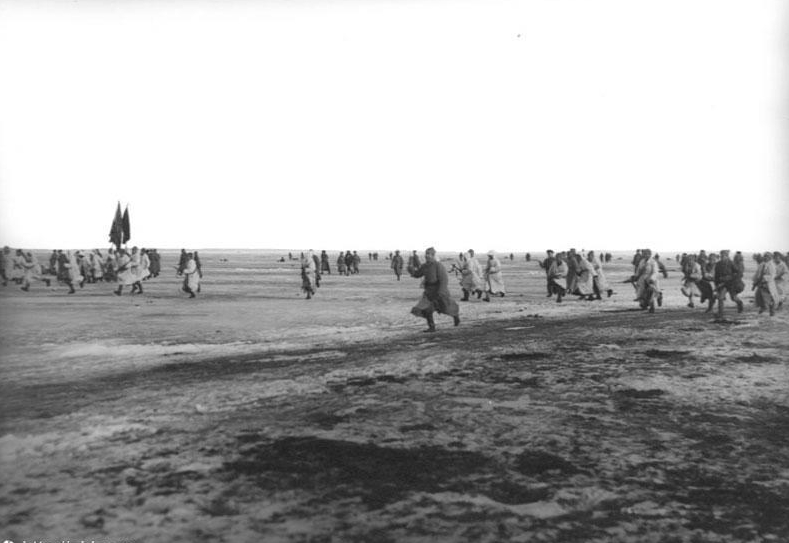
Kronstadt, the naval fortress on Kotlin Island near the head of the Gulf of Finland, had been an important Bolshevik ally in 1917. Its sailors had joined the July rising, and the cruiser Aurora belonged to the Baltic Fleet based there. In the hungry winter of 1920 to 1921, strikes and unrest spread, and on February 26, 1921 local Communist authorities declared martial law. Two days later a delegation from the battleship Petropavlovsk, headed by its chief clerk Stepan Petrichenko, presented fifteen demands to the Kronstadt Soviet: freedom of assembly and speech, equal rations for all working people, an end to the strict economic controls of war communism, and an end to the Bolshevik monopoly on power. A mass meeting of more than 16,000 people on March 1 adopted them unanimously and shouted down the senior Bolshevik Mikhail Kalinin when he tried to speak. The sailors' slogan was "All power to the Soviets, and not the parties."16
Lenin and Zinoviev branded the sailors puppets of the White Army in an ultimatum of March 5. Trotsky organized the assault, with troops under Mikhail Tukhachevsky, and the bombardment began on March 7. After three assaults across the ice, a final night attack began on March 16 with about 45,000 troops, reinforced by delegates from the Tenth Party Congress then meeting in Moscow (about three hundred delegates joined the assault, and ten of them were killed). By March 18 the rising was crushed. Many rebels escaped over the ice to Finland. Many were killed, and many of those captured were executed or sent to camps.1617

The New Economic Policy, 1921
At the same Tenth Party Congress, in March 1921, Lenin introduced the New Economic Policy (NEP). Grain requisitioning was replaced by a tax in kind, set below the old quotas, and peasants were allowed to sell their surplus on the open market. Small industry and services were returned to private hands, the currency was stabilized and foreign concessions were offered, while the state kept what Lenin called "the commanding heights of the economy": large industry, banking and foreign trade. He told the party it had to be pursued "seriously and for a long time."15 By 1926 to 1927 most economic indicators were back near prewar levels, but the policy brought back a class of prosperous peasants (kulaks) and traders (NEPmen), and with them anxiety inside the party. Stalin's victory over his rivals, the First Five-Year Plan and the offensive against the kulaks ended NEP by 1929.15
The economic retreat came with a political tightening. In preparation for the congress, Lenin had written: "The lesson of Kronstadt: in politics -- the closing of the ranks (+ discipline) within the party ... in economics -- to satisfy as far as possible the middle peasantry." On the last day of the congress, March 16, 1921, the delegates approved a resolution "On Party Unity" banning factions, and later in the decade Stalin used that ban as a weapon against his rivals.17 Later communist states that opened markets while keeping one-party rule are taken up in lesson 04.
The Communist International, 1919 to 1920
Founding, March 1919
Lenin and his colleagues did not expect their revolution to survive alone. According to the editorial notes in Lenin's Collected Works, the First Congress of the Communist International met in Moscow from March 2 to 6, 1919, with fifty-two delegates, thirty-four of them with the right to vote. On March 4 the meeting "decided to constitute itself as the Third International, and to take the name of the Communist International."18 The notes list among those represented an "American League of Socialist Propaganda" and the American Socialist Labour Party.18 Many of the bodies on the list were communist parties of territories of the former Russian Empire (Ukraine, Latvia, Lithuania and Byelorussia, Estonia, Armenia, the German colonies in Russia), alongside the German, Austrian, Hungarian, Polish and Finnish parties and small groups from Western Europe and Asia.18
The Library of Congress exhibit sums up what the organization was for: the Bolsheviks "created the Communist International (Comintern) to control the Communist movement throughout the world."6
The Twenty-One Conditions, 1920
The Second Congress met from July 19 to August 7, 1920. Its first session was held in Petrograd. The conditions for admission were debated on July 29 and 30 and again on August 6.19 Lenin drafted the first nineteen; two more were developed in a commission during the congress, giving the total of twenty-one.20 Seventeen Moments describes them as presented by Zinoviev and "overwhelmingly approved by the delegates."21 Lenin's draft, in the translation printed in his Collected Works, includes these requirements:18
- On secrecy: "Communists can place no trust in bourgeois legality. They must everywhere build up a parallel illegal organisation, which, at the decisive moment, will be in a position to help the Party fulfil its duty to the revolution." (point 3)
- On the armed forces: "Persistent and systematic propaganda and agitation must be conducted in the armed forces, and Communist cells formed in every military unit. In the main Communists will have to do this work illegally." (point 4)
- On unions: "Communist cells should be formed in the trade unions, and, by their sustained and unflagging work, win the unions over" (point 9, opening words only)
- On discipline: parties must be "organised on the principle of democratic centralism," with "an iron discipline bordering on military discipline." (point 13)
- On purges: legal parties "must carry out periodic membership purges (re-registrations) with the aim of systematically ridding the party of petty-bourgeois elements." (point 14)
- On loyalty to the Soviet state: "It is the duty of any party wishing to join the Communist International selflessly to help any Soviet republic in its struggle against counter-revolutionary forces." (point 15)
- On authority: "All decisions of the Communist International's congresses and of its Executive Committee are binding on all affiliated parties." (point 17)
- On the name: "Any party seeking affiliation must call itself the Communist Party of the country in question (Section of the Third, Communist International)." (point 18)
The two conditions added at the congress tightened control further. In the translation from the Russian archival text published by the historian John Riddell, the twentieth required parties that had not yet "radically altered their previous policies" to ensure that at least two-thirds of their central committees were made up of members who had publicly favored joining before the congress, and the twenty-first read: "Party members who reject on principle the conditions and theses laid down by the Communist International must be expelled from the party."20
The conditions are the reason the Comintern matters to an American reader. They were public, printed by the Comintern itself, and the American communist parties of 1919 applied to join on these terms. A party that accepted them had agreed in writing to keep a hidden organization alongside its public one, to place Comintern decisions above its own members' votes, and to defend the Soviet state. How the American party lived by those terms, and how Moscow's archives later confirmed it, is told in Module 81, lesson 01 and lesson 02. The Comintern's machinery (its Executive Committee, its liaison and money service, its schools) is in lesson 10.
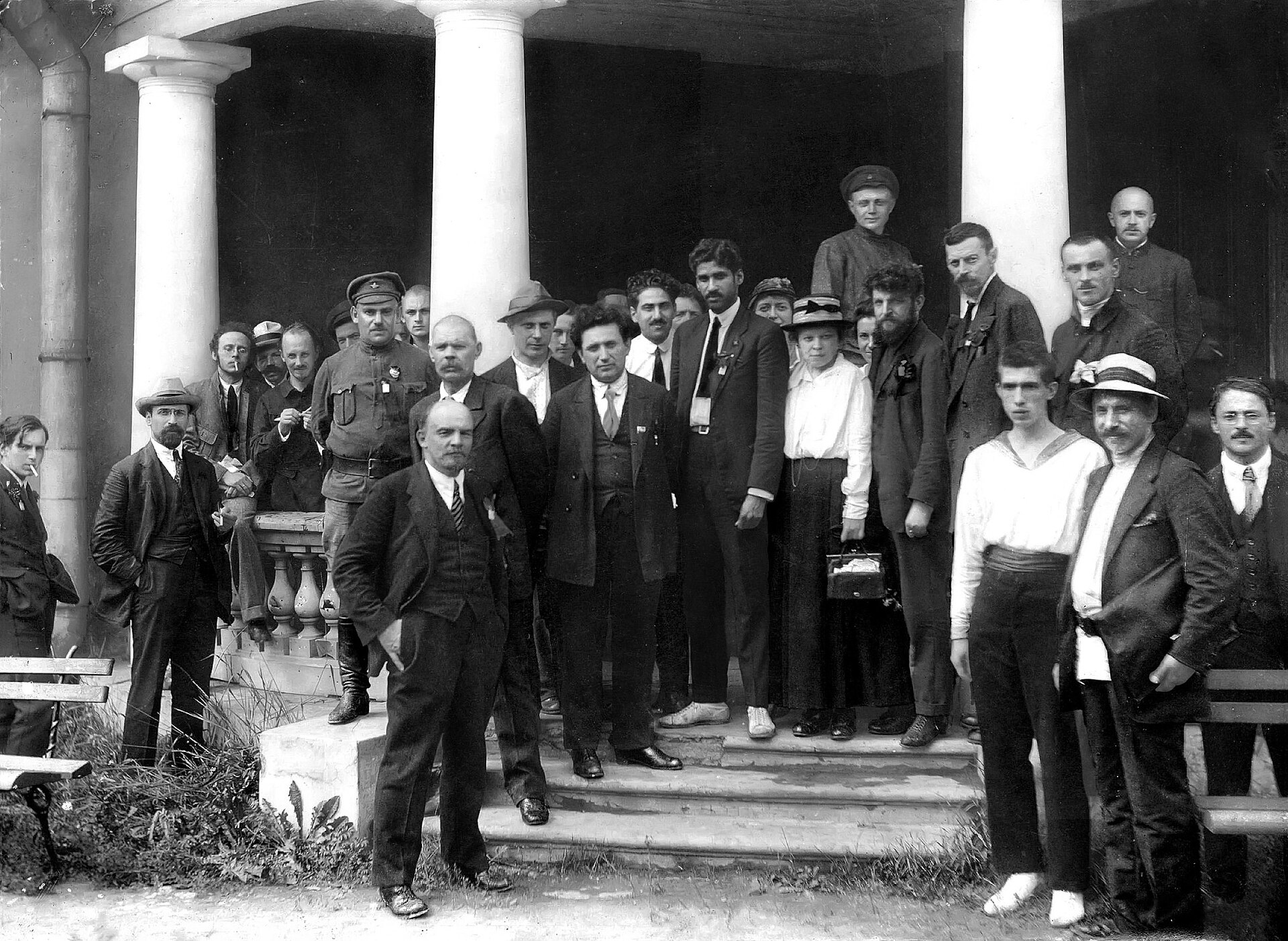

One of the Americans at the Second Congress was the journalist John Reed, who spoke on "America and the Negro question" on July 25.19 His place in the story of Moscow's money for the American party is in Module 81, lesson 01.
1922 to 1929: the Union, Lenin's death and Stalin's rise
The USSR, December 30, 1922
The Union of Soviet Socialist Republics was formally created on December 30, 1922, when the First Congress of Soviets of the USSR approved a Declaration of Union and a Treaty of Union joining the Russian, Ukrainian, Belorussian and Transcaucasian republics.22 The documents spoke of the inadequacy of the "isolated efforts of the separate Republics towards economic reconstruction" and of a common struggle against "capitalist encirclement." Behind them lay a sharp quarrel. Stalin, then commissar of nationalities, had proposed that the non-Russian republics simply enter the Russian republic as autonomous units. Georgian communist leaders objected and were roughly treated by Stalin and Sergo Ordzhonikidze. Lenin, recovering from his first stroke, sided with the Georgians. The constitution, drafted during 1923 with its key decisions made in advance by the Politburo, created a two-chamber central executive committee.22
Lenin's "testament" and his death, January 21, 1924
Stalin had been appointed General Secretary of the party in 1922, two months before Lenin's first stroke in May of that year.23 In notes dictated in December 1922 and January 1923, later known as his "testament," Lenin assessed the leaders who might succeed him. Of the two most prominent he wrote: "Comrade Stalin, having become Secretary-General, has unlimited authority concentrated in his hands, and I am not sure whether he will always be capable of using that authority with sufficient caution." Trotsky, he wrote, was "personally perhaps the most capable man in the present C.C., but he has displayed excessive self-assurance and shown excessive preoccupation with the purely administrative side of the work."24 In an addition taken down on January 4, 1923, he went further: "Stalin is too rude and this defect, although quite tolerable in our midst and in dealing among us Communists, becomes intolerable in a Secretary-General. That is why I suggest that the comrades think about a way of removing Stalin from that post ..."24
Lenin died on January 21, 1924, after a series of three strokes. He was not quite fifty-four. Against his own wishes and his family's, the Politburo had his body embalmed and placed in a mausoleum on Red Square, and five days later Petrograd was renamed Leningrad.25 When Lenin's notes were read to the Central Committee in May 1924, Stalin, Zinoviev and Kamenev had already formed a ruling trio against Trotsky, and they kept the issue from the Thirteenth Party Congress later that month.23
Stalin over Trotsky, 1924 to 1929
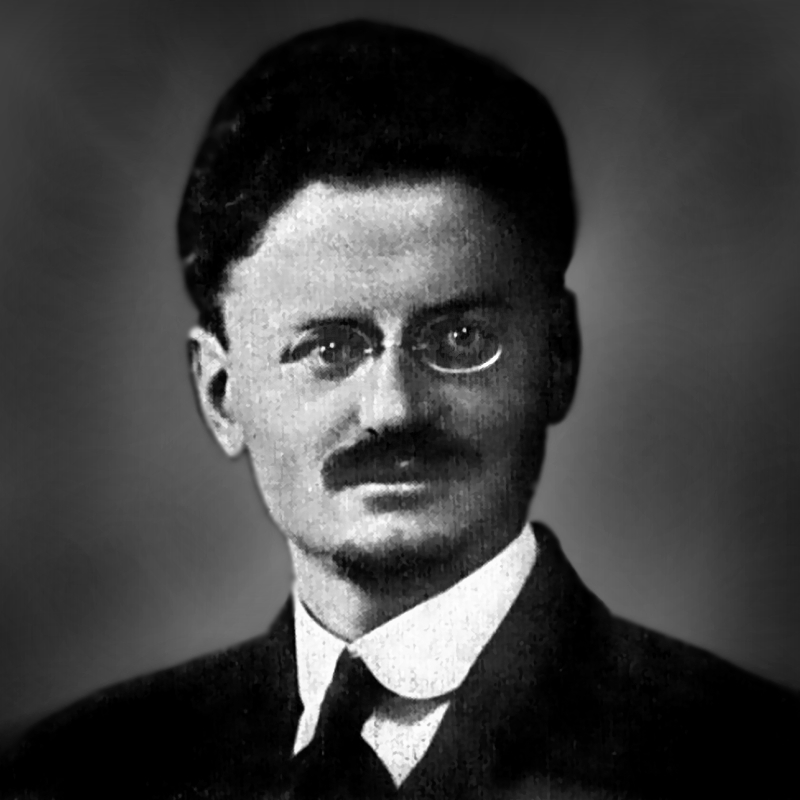
The contest that followed was fought in the language of loyalty to Lenin. Stalin promoted "socialism in one country" and set it against Trotsky's older theory of "permanent revolution," and each side quoted Lenin selectively.25 Trotsky, who had clashed with Lenin before 1917 and joined the Bolsheviks only in mid-1917, was at a disadvantage.23 Stalin then turned on his allies. The Library of Congress exhibit summarizes the result: Trotsky, Zinoviev and Kamenev "were defeated and expelled from the party in late 1927," and Stalin then turned against Nikolai Bukharin, "who was denounced as a 'right opposition,' for opposing his policy of forced collectivization and rapid industrialization at the expense of the peasantry."1 Trotsky spent the rest of his life in exile, writing against Stalin, until he was killed in Mexico in 1940 (see below).

The 1929 Lovestone affair, in which Stalin personally decided the leadership of the American Communist Party in Moscow, belongs to this same consolidation. It is told in Module 81, lesson 01.
Revolution from above, 1928 to 1934
The First Five-Year Plan
The Library of Congress exhibit dates the start of Stalin's "revolution from above" to November 1927 and sets out its two goals, rapid industrialization and collectivization of agriculture, aimed at erasing the capitalism that had returned under NEP. The First Five-Year Plan, adopted by the party in 1928, set targets the exhibit calls unrealistic: "a 250 percent increase in overall industrial development and a 330 percent expansion in heavy industry alone." Industry and services were nationalized, managers were given output quotas by central planners, and trade unions became instruments for raising productivity.1 New industrial centers rose in the Urals and elsewhere, while consumer goods ran short.1
Stalin explained the hurry to a conference of industrial managers on February 4, 1931: "We are fifty or a hundred years behind the advanced countries. We must make good this distance in ten years. Either we do it, or we shall go under."26 The speed came at the expense of the countryside, which was expected to pay for the factories with grain.
Collectivization and "the elimination of the kulaks as a class"
Stalin had first used "extraordinary" (coercive) measures to collect grain in the Urals and western Siberia in the winter of 1927 to 1928, and from that experience he moved to the idea of large collective and state farms.27 By June 1929 one million of some 25 million peasant households had joined 57,000 collectives. Most still held back.27 On December 27, 1929, Stalin told a conference of Marxist students of agrarian questions that the party had "passed from the policy of restricting the exploiting tendencies of the kulaks to the policy of eliminating the kulaks as a class." He added: "To launch an offensive against the kulaks means that we must smash the kulaks, eliminate them as a class."28 The speech was published in Pravda on December 29, 1929.28
On January 5, 1930, the Central Committee called for collectivizing "the huge majority of peasant farms" in the main grain regions by the autumn of 1930, far beyond the 20 percent of arable land the plan had foreseen. Those labeled kulaks faced confiscation, resettlement, deportation, the labor camps or, for those judged most dangerous, execution. By March 1930 about 55 percent of peasant households were at least nominally in collective farms. Stalin then blamed local officials for being "dizzy with success," and within three months more than half of the households that had joined were recorded as having left. The retreat did not last.27 The Library of Congress exhibit puts the toll of dekulakization at "About one million kulak households (some five million people)" deported, and records that by 1940 about 97 percent of peasant households had been collectivized.1 The exhibit's figure dates from 1992. Later archive-based studies count deportees and deaths in more detail, and this lesson does not substitute an unchecked figure for the one opened here.
The famine of 1932 and 1933 and the Holodomor
Collectivization wrecked farm production, and in 1932 and 1933 famine struck Ukraine, the North Caucasus and the lower Volga. The Library of Congress exhibit states that in 1932 Stalin raised Ukraine's grain procurement quota by 44 percent, although Soviet law forbade giving collective farm members any grain until the state's quota was met. Seed grain was confiscated, those caught taking even a handful of grain from a collective farm could be executed or deported, and the NKVD and a system of internal passports kept peasants from leaving their villages. The exhibit adds that the famine was accompanied by a purge of the Ukrainian intelligentsia and of the Ukrainian Communist Party itself.1 It quotes one of Stalin's lieutenants in Ukraine as saying in 1933 that the famine showed the peasants "who is the master here. It cost millions of lives, but the collective farm system is here to stay."1 In Ukrainian the famine is called the Holodomor, "death by hunger."
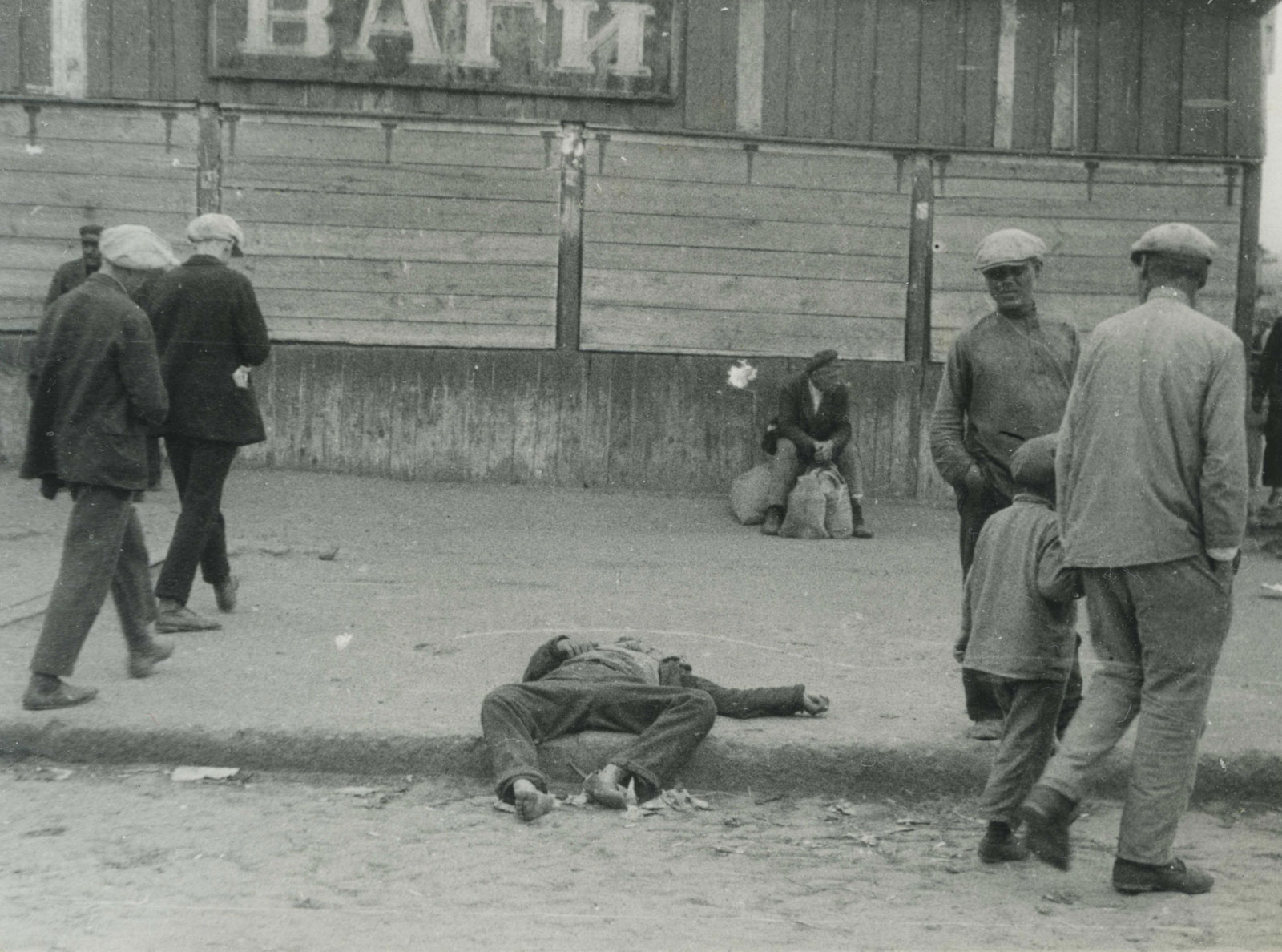

How many died? The estimates have moved as the sources have improved, and three of them show the range:
- The Library of Congress exhibit (1992), written as the archives were first opening, says the death toll in Ukraine "has been estimated between six million and seven million."1
- Anatole Romaniuk and Oleksandr Gladun, writing in Population and Development Review in 2015, put it at "Four to five million," roughly 15 percent of Soviet Ukraine's 30 million people.3
- A demographic team working with Ukrainian and American scholars, counting famine-related deaths of residents of any nationality within Soviet Ukraine's borders in 1932 to 1934, above the normal death rate, estimates 3.94 million deaths, or 4.5 million if the lost births are counted.3
The demographers' method is the most explicit: it counts excess deaths against a baseline, within named borders and years, and it says what it leaves out (deaths among Ukrainians elsewhere in the USSR, studied separately).3 Robert Conquest's The Harvest of Sorrow (1986), a history of collectivization and the famine, was written before the archives opened. Conquest's own figures, and his later revisions, are discussed in the exchange with R. W. Davies cited in the next section.2 Whether the famine in Ukraine was genocide, a deliberate attempt to destroy Ukrainians as a nation, is a separate question from whether Soviet policy caused it. The archive record opened for this lesson supports the second claim firmly. The first remains a matter on which serious historians disagree, and the claims section below rates it accordingly.
The Gulag
The Soviet forced labor camp system dates to 1919, under the Cheka, but the camps grew large only in the early 1930s.1 Britannica dates the Main Directorate of Corrective Labor Camps, the Gulag, to 1930, under the OGPU, and notes an earlier decree of April 15, 1919 that first set up the forced labor camp system.29 Prisoners built the White Sea-Baltic Canal, the Moscow-Volga Canal and the Baikal-Amur railway, cut timber and mined coal, copper and gold in Siberia and the Far North. The Library of Congress exhibit describes inadequate food and clothing, long hours in severe weather and abuse by guards, and concludes that "the death rate from exhaustion and disease in the camps was high."1
The size of the system is one of the questions the archives changed most. Before 1991 Western writers worked from survivors' accounts and estimates. Aleksandr Solzhenitsyn, in The Gulag Archipelago, put the number who served long sentences between 1928 and 1953 at forty to fifty million.29 Figures compiled by the Gulag administration and released by Soviet historians in 1989 gave a total of about 10 million people sent to the camps from 1934 to 1947.29 Writing in 1997, R. W. Davies reported the archival figure for prisons and camps on January 1, 1939 as 1,668,000, "including all types of prisoner," and 2,962,000 for prisons, camps, colonies and special settlements together.2 Britannica gives Western scholarly estimates of total deaths in the Gulag from 1918 to 1956 as 1.2 to 1.7 million.29 Some historians, among them Golfo Alexopoulos in Illness and Inhumanity in Stalin's Gulag (2017, not opened for this lesson), argue that these counts are too low because the camps released many dying prisoners shortly before death. That argument, and the overall counts, are taken up with the full sources in lesson 04.
Sympathy for the Soviet experiment during the Depression years, and the question of what such sympathy did and did not mean, run through the American cases of the 1940s and 1950s. This companion keeps four claims apart for every person (party membership, espionage, sympathy and association); see the entries in lessons 06 to 09.
The Great Terror, 1934 to 1938
The Kirov murder, December 1, 1934
Sergei Kirov, a full member of the Politburo and head of the Leningrad party organization, was shot dead by a young assassin, Leonid Nikolaev, on December 1, 1934. The Library of Congress exhibit states that "Recent evidence has indicated that Stalin and the NKVD planned the crime," and that Stalin used the killing as the excuse for "draconian laws against political crime" and a hunt for conspirators that lasted four and a half years.1 This lesson treats Stalin's direct part in the killing as unresolved: the exhibit's own wording ("Stalin evidently decided," "Recent evidence has indicated") is cautious, and the sources opened here do not settle it. The use Stalin made of the murder is not in doubt.
The Moscow show trials
Three staged public trials of former leaders marked the Terror. In July and August 1936 Kamenev, Zinoviev and fourteen others were convicted of organizing a "Trotskyite-Zinovievite terrorist center" said to have been formed in 1932 and held responsible for Kirov's murder. In September 1936 Stalin replaced the NKVD chief Genrikh Yagoda with Nikolai Yezhov. A second trial in January 1937 had Yuri Pyatakov and other leaders of the industrialization drive as the chief defendants. Bukharin and Aleksei Rykov, accused at a Central Committee plenum in February and March 1937, were tried with Yagoda and others and sentenced to death in March 1938.30 The process fed on itself: the accused, under what the Seventeen Moments essay calls "severe physical and psychological pressure from their interrogators," named names and confessed to outlandish crimes.30 Between the second and third trials the high command of the Red Army was decimated by arrests and summary executions, and the same fate struck provincial party secretaries, officials among the national minorities and industrial managers.30
How individual American writers and officials responded to the trials at the time is taken up person by person in lessons 06 to 09, where each claim is checked against what the person actually wrote.
The mass operations of 1937 and 1938
The trials were the public face of the Terror. Most of its victims were ordinary people. On July 3, 1937 the Politburo ordered Yezhov to conduct "mass operations" against former kulaks, repeat criminals and other "anti-Soviet elements," who were tried by three-person tribunals (troikas). Yezhov set quotas for each region. The Seventeen Moments essay gives his projected totals as 177,500 exiled and 72,950 executed and states that they "were eventually exceeded."30 The Library of Congress exhibit summarizes the result: during the Great Terror, which "reached its peak in 1937 and 1938, millions of innocent Soviet citizens were sent off to labor camps or killed in prison," and by 1939 the country had been reduced "to a state of complete submission."1
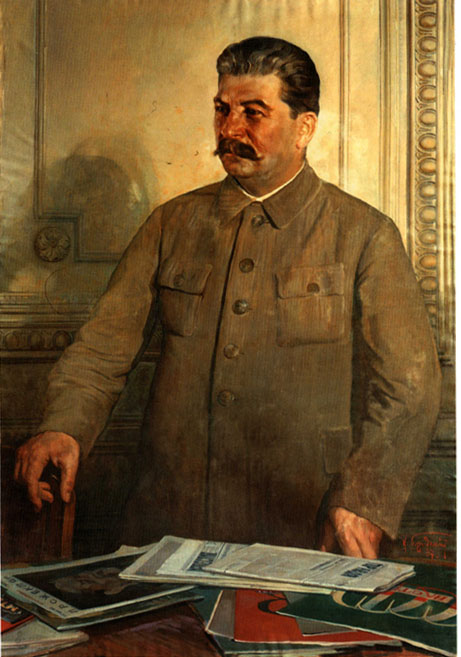

How many were killed: the count and the argument
The best-known Western account before 1991 was Robert Conquest's The Great Terror (1968), written long before the Soviet archives opened. As summarized by the historian R. W. Davies in a 1997 exchange with Conquest in the New Left Review, Conquest had estimated that one million people were executed and two million died in the camps in 1937 and 1938 alone.2 When the NKVD's own figures became available, the official count of executions for 1937 to 1938 was 681,692. Davies called that figure "an appalling indictment of the Soviet regime."2 Conquest, for his part, argued in 1997 that even his old estimate of one million executions was too low and advanced a figure of 1.5 million. Davies reported that the historian Stephen Wheatcroft had consulted three leading Russian specialists, Oleg Khlevniuk, Viktor Zemskov and Arsenii Roginsky, who "all agreed that a figure of 1 million was possibly correct" and that none would accept 1.5 million.2 Conquest accepted that his figure for the number of people in confinement in 1938 had been too high.2
The exchange shows how the numbers argument works. The archives cut some earlier estimates sharply (the number held in the camps at one time) and confirmed others in order of magnitude (executions in the hundreds of thousands to about a million in two years). The two sides of the old argument, one stressing the scale of the crimes, the other the reliability of the archive figures, moved closer together, and a reader in 2026 can state the floor with confidence: by the regime's own records, it shot more than two-thirds of a million of its own people in 1937 and 1938.
The Popular Front and Spain, 1935 to 1939
From the late 1920s the Comintern renounced coalitions with other working-class parties and labeled social democrats "social fascists," and in Germany that line kept the opponents of Nazism divided as Hitler took power in January 1933. The Comintern held to it through 1933 and 1934.31 As Nazi Germany grew more aggressive, Soviet foreign policy under Maksim Litvinov turned to "collective security": the Soviet Union joined the League of Nations in 1934 and signed mutual assistance treaties with France and Czechoslovakia in 1935. In July 1935 the Seventh (and last) Congress of the Comintern formally adopted the Popular Front, an alliance of all forces opposed to fascism, and in 1936 Popular Front coalitions won elections in France and Spain.31
Spain was then torn by civil war after military officers under General Francisco Franco rebelled against the republic with arms and troops from Italy and Germany. Some forty thousand volunteers from around the world joined the International Brigades. The Soviet Union sent advisers and arms, but, wary of alarming Britain and France, it told the Spanish communists to defend the "bourgeois republic" and to oppose the anarchists and Trotskyists who wanted to turn the war into a social revolution. Franco's victory was complete by early 1939.31 In the Popular Front years the American party grew to about 75,000 members by 1938, according to the Library of Congress.6 Many Americans who joined party-led groups in those years did so because they opposed Hitler and Mussolini or supported the Spanish Republic, as Module 81, lesson 01 explains. That fact matters when later lessons sort sympathy and association from party membership and espionage.
The Pact with Hitler, 1939 to 1941
August 23, 1939: the treaty and the secret protocol
On August 23, 1939, in Moscow, Joachim von Ribbentrop for Germany and Vyacheslav Molotov for the Soviet Union signed a treaty of nonaggression. Its first article bound both sides "to desist from any act of violence, any aggressive action, and any attack on each other, either individually or jointly with other powers," and its second promised that if either became "the object of belligerent action by a third power, the other High Contracting Party shall in no manner lend its support to this third power." It was concluded for ten years.32
A secret additional protocol signed the same day divided Eastern Europe. It placed the boundary of German and Soviet "spheres of influence" in the Baltic at the northern border of Lithuania, so that Finland, Estonia and Latvia fell to the Soviet side. In Poland, "the spheres of influence of Germany and the U.S.S.R. shall be bounded approximately by the line of the rivers Narew, Vistula, and San," and whether "the maintenance of an independent Polish state" was desirable "can only be definitely determined in the course of further political developments." The Soviet side declared its interest in Bessarabia. The protocol ended: "This protocol shall be treated by both parties as strictly secret."4 Both texts were published by the U.S. Department of State in 1948 in Nazi-Soviet Relations 1939 to 1941.32
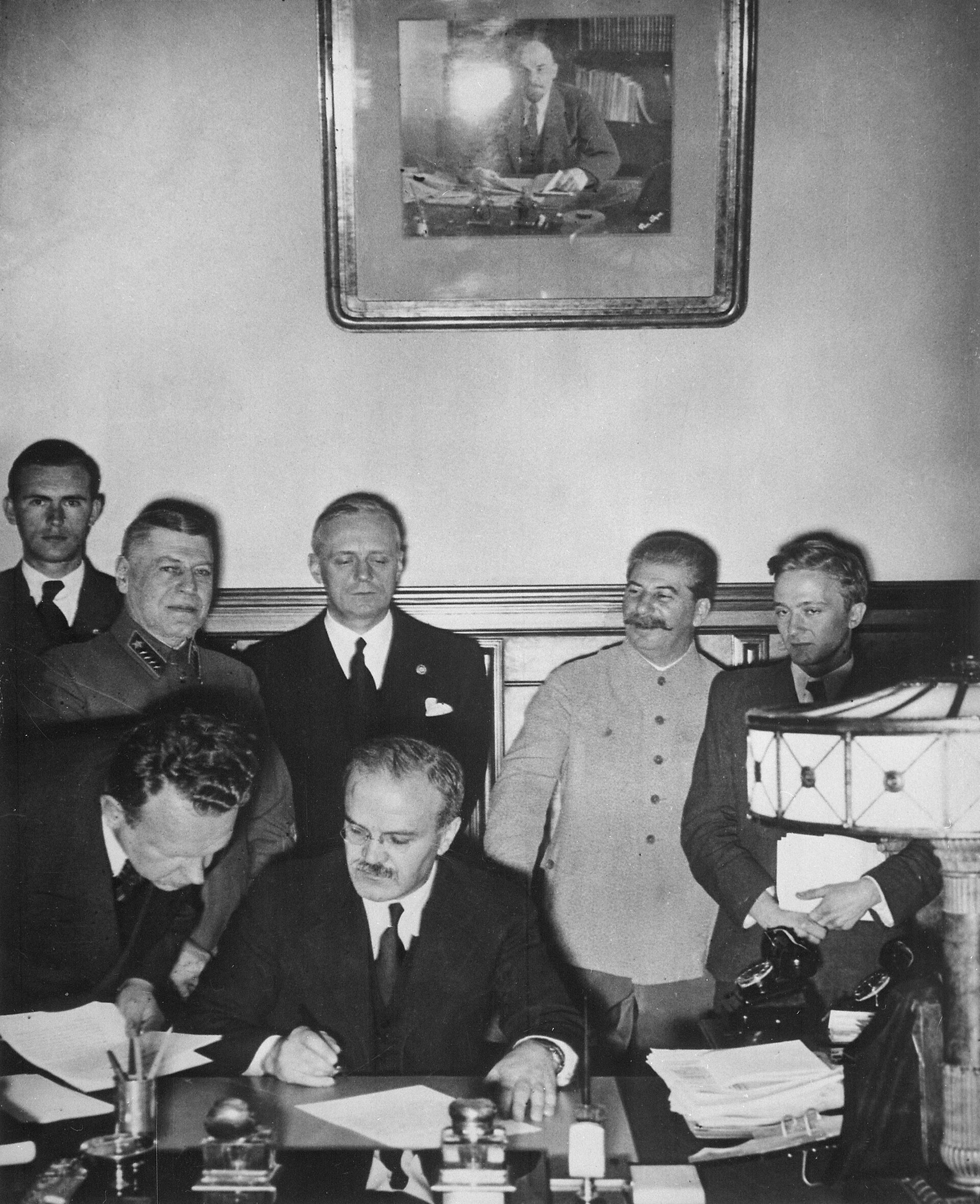

Poland, Finland and the Baltic states
On September 17, 1939, with the Polish army already fighting the Germans in the west, the Red Army crossed into eastern Poland, presenting itself as the liberator of Ukrainian and Belorussian lands, in the partition the secret protocol had agreed.33 In late October (October 24, in the Seventeen Moments account) a "People's Assembly of Western Ukraine" asked to join the Ukrainian Soviet republic, and a Belorussian assembly followed. When Finland refused to cede territory, the Soviet Union invaded it on November 30, 1939. The League of Nations expelled the Soviet Union on December 14, and the Winter War ended in March 1940 with Finland ceding the land first demanded plus Finnish Karelia. On June 15, 1940 Soviet troops entered Lithuania, staged "revolutions" followed in Estonia and Latvia, and in early August 1940 (August 3, in the Seventeen Moments account) the three Baltic states were officially proclaimed Soviet Socialist Republics.33
Katyn, 1940
In the occupied Polish territories Soviet authorities arrested tens of thousands of officers, officials, landowners and intellectuals.34 In the spring of 1940 about twenty-two thousand Polish prisoners were taken to Katyn forest near Smolensk and to other sites and shot. Brian Crozier, writing in the Hoover Digest from Soviet documents acquired by the Hoover Institution, dates the order to a memorandum of March 5, 1940, under which the prisoners were to receive the "supreme measure of punishment" (shooting). He gives the full count from a secret note of March 3, 1959 from the KGB chief Aleksandr Shelepin to Nikita Khrushchev: 21,857 killed, of whom 4,421 were shot in Katyn forest, 3,820 at the Starobelsk camp, 6,311 at the Ostashkov camp and 7,305 in other camps and prisons of western Ukraine and western Belorussia.5 The Seventeen Moments essay, citing the documents handed to Poland in 1992, gives 4,443 for Katyn and about 16,000 at other sites. The small difference between the two Katyn figures is unresolved here.34
When German radio announced the discovery of the Katyn graves on April 13, 1943, Stalin called it a "monstrous invention by the German-fascist scoundrels." When the Polish government in exile in London asked the International Red Cross to investigate, Moscow broke off relations with it.34 The Soviet Union denied responsibility for almost half a century. On April 13, 1990, a TASS statement issued under Gorbachev admitted the crime, ascribed "Direct responsibility" to Beria and called it "one of the gravest crimes of Stalinism," while giving a total of "around 15,000," more than 6,000 short of the true figure.5 The long postwar argument over Katyn belongs to the period of lesson 03.
The murder of Trotsky, August 1940
Trotsky had been living in exile in Coyoacán, Mexico. In May 1940 gunmen raked his house with machine-gun fire. He survived. On August 20, 1940, Ramón Mercader, a Spanish communist and, in Britannica's words, a suspected Stalin agent, attacked him, and Trotsky died the following day.35 What the later record shows about Mercader's ties to Soviet intelligence is examined in the Trotsky and Sudoplatov entries in lesson 09.
What the Pact did to the communist parties
The Pact stunned communists and Soviet sympathizers around the world. The British and French parties, which had led their countries' anti-fascist campaigns, were "compelled by Moscow to perform a volte face" and declare the war against Nazi Germany an "imperialist" venture of their capitalist classes.36 The American party did the same. Its peace campaign of 1940 and 1941, and its reversal on the day Germany invaded the Soviet Union, are documented in Module 81, lesson 01. Whittaker Chambers went to Assistant Secretary of State Adolf Berle within days of the Pact. That story belongs to Module 81, lesson 03.
1941 to 1945: from Hitler's partner to the Grand Alliance
June 22, 1941
Germany invaded the Soviet Union on June 22, 1941.37 The Soviet government cast the struggle as a "Great Patriotic War," drawing on heroes of the Russian past, and worked to reassure its new Western allies. Stalin spoke of "the common onslaught of all freedom-loving nations against the common enemy."36 For communist parties abroad the line reversed overnight. In the United States the American Peace Mobilization, which had picketed the White House, changed its name the same day to the American People's Mobilization and took up the slogan "For Victory Over Fascism."37 The detail of that campaign is in Module 81, lesson 01.
Soviet espionage in the United States during the war, at Los Alamos and in Washington, is the subject of lesson 12 and of Module 81, lesson 02. This lesson does not retell it. Inside the Soviet Union, the Library of Congress exhibit records the wartime deportation of "over 1.5 million people, mostly Muslims," including the Volga Germans, the Crimean Tatars, Kalmyks, Chechens, Ingush and other peoples of Crimea and the North Caucasus.1
The Comintern dissolved, May 1943
On May 15, 1943 the Presidium of the Executive Committee of the Communist International sent all member parties a statement proposing that the organization be dissolved. Upon endorsement by the parties, it was dissolved.38 The statement argued that the Comintern had served its purpose and that the problems of each country's labor movement were now best solved by that country's own party. Its operative paragraph proposed "To dissolve the Communist International as a guiding centre of the international labor movement, releasing sections of the Communist International from the obligations ensuing from the constitution and decisions of the Congresses of the Communist International." It called on all communists to give "all-round support for, and active participation in, the Liberation War of the peoples and States of the anti-Hitler coalition." The signers listed on the published text include Gottwald, Dimitrov, Zhdanov, Kolarov, Kuusinen, Pieck, Thorez, Florin and "Ercoli."38 The Seventeen Moments essay dates the published resolution to May 22, 1943, and calls the organization "already moribund" by then.36
The dissolution did not end Moscow's direction of foreign parties. The Library of Congress exhibit states that "After the Comintern's dissolution in 1943, the Soviet party's Central Committee continued to use Communist parties" abroad. The American documents in the opened archives show the same direction and money continuing after 1943, as Module 81, lesson 01 sets out with the Duclos article of 1945 and the subsidies that ran to 1988.6 The Comintern's postwar successor, the Cominform, is in lesson 03 and lesson 10.
Tehran, November 28 to December 1, 1943
Roosevelt, Churchill and Stalin first met together in Tehran from November 28 to December 1, 1943. The Western leaders committed to Operation Overlord, the invasion of northern France, by May 1944. Stalin promised a new offensive in the east and agreed in principle to enter the war against Japan after Germany's defeat. Stalin pressed for a Polish-Soviet border along the line drawn by Lord Curzon in 1920, with Poland compensated in the west by moving its German border to the Oder and Neisse rivers. Roosevelt obtained Stalin's assurance that the Baltic republics would be reincorporated into the Soviet Union only after referendums, while Stalin insisted the matter be settled "in accordance with the Soviet constitution" without international supervision.39
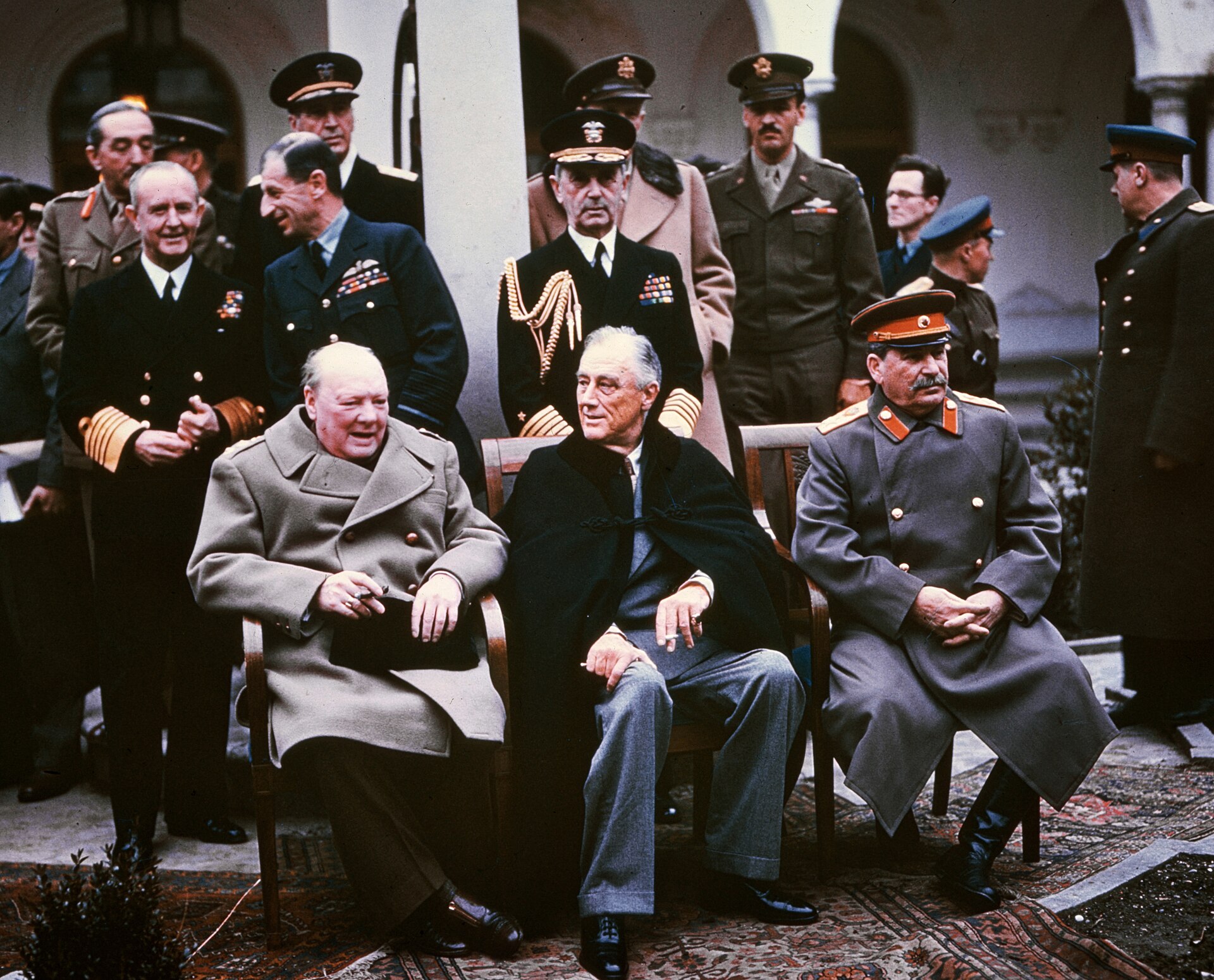
Yalta, February 4 to 11, 1945
The three leaders met again at Yalta, in the Crimea, from February 4 to 11, 1945. The State Department's historians describe the major concrete result as the agreement on Soviet entry into the war against Japan, in exchange for a sphere of influence in Manchuria, southern Sakhalin, a lease at Port Arthur, a share in the Manchurian railroads and the Kurile Islands. The conference also agreed on France's role in occupied Germany, on reparations, on voting in the Security Council of the new United Nations, and on a declaration on Poland "providing for the inclusion of Communists in the postwar national government." The Soviets pledged to allow free elections in all territories liberated from Nazi Germany.40
The Declaration on Liberated Europe, signed at Yalta, committed the three governments to help the peoples of liberated Europe form interim governments "broadly representative of all democratic elements in the population and pledged to the earliest possible establishment through free elections of Governments responsive to the will of the people."41 Within weeks of Roosevelt's death on April 12, 1945, the Truman administration was clashing with the Soviets over Eastern Europe.40 How the promise of free elections was broken, country by country, is the opening of lesson 03. The American charges about Yalta in the McCarthy years, including the claim that the agreements restored Soviet power in Manchuria, are in Module 81, lesson 07, and the presence of Alger Hiss in the American delegation is part of the Hiss case in Module 81, lesson 03.

Timeline, 1917 to 1945
What the record shows and what it does not
Documented fact. The Bolsheviks took power by armed rising on October 25, 1917 (November 7 NS), won about 24 percent in the Constituent Assembly election and dispersed the Assembly after one session.1011 The Cheka was founded in December 1917,12 and a government resolution of September 5, 1918 called terror "necessary," authorized concentration camps and made anyone "associated with White Guard organizations" liable to be shot.14 The Comintern's admission conditions of 1920 required secret organizations, cells in armies and unions, binding obedience to the Executive Committee and defense of the Soviet state.18 The NKVD recorded 681,692 executions in 1937 and 1938.2 The Nazi-Soviet Pact had a secret protocol dividing Eastern Europe.4 Soviet documents put the Polish prisoners shot in 1940 at 21,857.5
Their own words. Lenin, 1920: parties "must everywhere build up a parallel illegal organisation."18 Lenin, January 1923: "Stalin is too rude."24 Stalin, 1929: "eliminate them as a class."28 The Comintern, 1943: dissolved "as a guiding centre of the international labor movement."38 TASS, 1990: Katyn was "one of the gravest crimes of Stalinism."5
The accusation. The anti-communist charge, as American anti-communists made it in the 1940s and 1950s, was that communist parties abroad were instruments of the Soviet state, that the Soviet regime rested on mass terror, and that its famine and purges had killed millions.
The archive evidence. The archives opened after 1991 confirmed the core of the accusation: the terror, the famine's origin in policy, the Katyn crime and the binding of foreign parties to Moscow.16 They lowered some earlier estimates, notably of the camp population at any one time.2
Scholarly reading. Archive-based historians such as Davies and the Russian specialists he cites, and earlier writers such as Conquest, disagree over totals while agreeing that the crimes took place. Their 1997 exchange is a model of how to argue numbers in good faith.2 Courtois's introduction to The Black Book of Communism (1997) and the objections of his co-authors Nicolas Werth and Jean-Louis Margolin are taken up in lesson 04.42
Open questions. Stalin's personal role in Kirov's murder; whether the Ukrainian famine meets the definition of genocide; the full count of deaths caused by the camps, including prisoners released to die; and the gap between the two Katyn-site figures (4,421 and 4,443).
Claims checked
The claims below circulate in books, films, websites, speeches and classroom materials from every side of the argument. Each is rated on the evidence opened for this lesson: Supported, Partly supported, Unsupported, Refuted or Unresolved.
"The October Revolution was the will of the Russian people." Partly supported.
The Bolsheviks did hold majorities in the soviets of both capitals by the autumn of 1917, as Lenin himself pointed out, and they acted in the soviets' name.10 The only national vote of the period, the Constituent Assembly election, gave them about 24 percent, against about half for the Socialist Revolutionary lists, and the Bolsheviks dispersed the Assembly after a single session.11 Popular support in the cities and the army was real. A national mandate was not.
"The terror began with Stalin; Lenin's revolution was democratic." Refuted.
The Cheka was founded in December 1917, the Constituent Assembly was dispersed in January 1918, the Red Terror resolution was adopted on September 5, 1918, and the Kronstadt sailors were crushed in March 1921, all under Lenin's government.12111416 The Library of Congress exhibit records that the first forced labor camps date from 1919.1 What changed under Stalin was the scale and the turning of the police against the party itself: the exhibit notes that before the late 1920s "The machinery of coercion had previously been used only against opponents of Bolshevism, not against party members themselves."1
"The Comintern was a voluntary association of independent national parties." Refuted.
The admission conditions made "All decisions of the Communist International's congresses and of its Executive Committee" binding on member parties, required each to take the name of a "Section" of the Communist International, and required the expulsion of members who rejected the conditions.1820 The Library of Congress describes the Comintern's purpose as "to control the Communist movement throughout the world."6 The 1929 Lovestone case shows the rule in practice for the American party (Module 81, lesson 01).
"The famine of 1932 and 1933 was a natural disaster, or never happened." Refuted.
The famine is documented in the Soviet archives and in photographs taken at the time, such as Alexander Wienerberger's from Kharkiv reproduced above. The Library of Congress exhibit attributes it to forced collectivization, records the 44 percent increase in Ukraine's grain quota in 1932, the confiscation of seed grain, the punishments for taking grain and the internal passport system that kept peasants in their villages.1 A famine produced by state grain seizures and travel bans is a man-made famine.
"The Holodomor was a genocide of the Ukrainian nation." Unresolved.
The Library of Congress exhibit links the famine to a determination to "crush all vestiges of Ukrainian nationalism" and to the simultaneous purge of the Ukrainian intelligentsia and party.1 Historians who accept that the famine was caused by policy still disagree on whether the regime intended to destroy Ukrainians as a national group, which is what the legal term genocide requires, or whether it pursued grain and control with murderous indifference to who died. The sources opened for this lesson establish the policy and the deaths. They do not settle the question of intent, and this companion rates it as unresolved. Recognition of the Holodomor as genocide by governments and legislatures is a political and legal act, distinct from the historical finding; how that question stands in 2026 belongs to lesson 04.
"Seven to ten million died in the Ukrainian famine." Unsupported as stated.
The 1992 Library of Congress exhibit gave six to seven million for Ukraine.1 The demographic work published since then counts 3.94 million excess deaths within Soviet Ukraine in 1932 to 1934 (4.5 million with lost births), and Romaniuk and Gladun give four to five million.3 Figures of seven million and above for Ukraine alone are not supported by the demographic studies opened here. The famine also struck the North Caucasus and the lower Volga, and totals for the whole Soviet famine are a separate, higher count.1
"Stalin's Great Terror killed twenty million people." Unsupported as stated.
The NKVD's own figure for executions in 1937 and 1938 is 681,692; specialists consulted by Wheatcroft judged that the true number may have approached one million, and Conquest argued in 1997 for 1.5 million.2 Large totals such as twenty million combine many different things (the famine, deportations, camp deaths over two decades, executions) and are often attributed to "the Terror" alone. Each component needs its own source and its own range, as in the chart above. The Great Terror of 1936 to 1938, taken by itself, killed hundreds of thousands to about a million and a half people by execution, plus deaths in the camps.
"Katyn was a German crime." Refuted.
The Soviet government itself admitted on April 13, 1990 that the killings were carried out under Beria's direct responsibility, and the KGB chief's 1959 note to Khrushchev counted 21,857 Polish prisoners shot.5 The Soviet claim of German guilt, maintained from 1943 to 1990, was false.34
"The Nazi-Soviet Pact was only a nonaggression treaty; talk of a secret deal is propaganda." Refuted.
The secret additional protocol of August 23, 1939 divided Finland, the Baltic states, Poland and Bessarabia into German and Soviet spheres, and the Red Army moved into eastern Poland on September 17, 1939 and into the Baltic states in June 1940, as the protocol had foreseen.433
"Trotsky was killed on Stalin's orders." Supported, with a note on sources.
The assassin, Ramón Mercader, was a Spanish communist, and Britannica describes him as a suspected Stalin agent.35 The documentary proof of the Soviet intelligence operation behind the killing, including the memoir of the Soviet officer Pavel Sudoplatov, was not opened for this lesson and is examined in the Sudoplatov and Trotsky entries in lesson 09. The rating rests on the consensus of the scholarship and the motive and means on record. The specific documents should be read there.
"At Yalta, Roosevelt handed Eastern Europe to Stalin." Partly supported.
The Yalta texts promised free elections and governments "responsive to the will of the people," and the Soviets pledged free elections in liberated territories.4140 The Americans and British also accepted that future governments of the Eastern European nations bordering the Soviet Union should be "friendly" to the Soviet regime, and the declaration on Poland provided for communists in the postwar government.40 Soviet control of the region came from the Red Army's presence and the communist parties' seizure of power after 1945. What Yalta did was accept Soviet promises of free elections that were then broken. The postwar record, and the American charge that Yalta was a betrayal, are taken up in lesson 03 and Module 81, lesson 07.
"When the Comintern was dissolved in 1943, Moscow stopped directing foreign communist parties." Refuted.
The Library of Congress exhibit states that the Soviet party's Central Committee "continued to use Communist parties" after the dissolution.6 The archive record of Soviet money to the American party until 1988 is set out in Module 81, lesson 01.
Hard questions and answers
An anti-communist asks: why give so much space to Lenin, when the McCarthy-era cases were about Stalin's spies?
Because the institutions that ran those spies were Lenin's. The Cheka, the binding Twenty-One Conditions and the requirement that member parties keep a "parallel illegal organisation" all date from 1917 to 1920.1218 Stalin used them on a larger scale and turned them against the party, but he did not invent them. An American who joined the party's underground in the 1930s was joining a structure whose rules had been written in Lenin's lifetime.
A civil liberties advocate asks: if the old death tolls were too high, were the anti-communists of the 1950s exaggerating?
On some numbers, yes. On the substance, no. The archives cut the camp population figures used by Conquest in the 1960s, and Conquest accepted part of that correction.2 The 1992 Library of Congress figure for the Ukrainian famine (six to seven million) is higher than the demographic estimate published since (3.94 million).13 But the regime's own records show 681,692 executions in two years and some 2.96 million people held in prisons, camps, colonies and special settlements on a single day in 1939.2 An honest reader in 2026 can say both that some anti-communist figures were too high and that the anti-communists were right about what kind of regime it was.
A historian of the Popular Front asks: weren't most foreign communists of the 1930s motivated by opposition to fascism, not loyalty to Moscow?
Many were, and the Popular Front's appeal rested on exactly that.31 The test came in August 1939. When the Pact was signed, the British and French parties were "compelled by Moscow" to reverse their line,36 and the American party did the same (Module 81, lesson 01). Individual members acted from many motives. The parties as organizations followed Moscow. This companion keeps that distinction, between what a member believed and what the party did, in every people entry.
A skeptic asks: why trust Soviet archive figures, when the same regime falsified photographs and staged confessions?
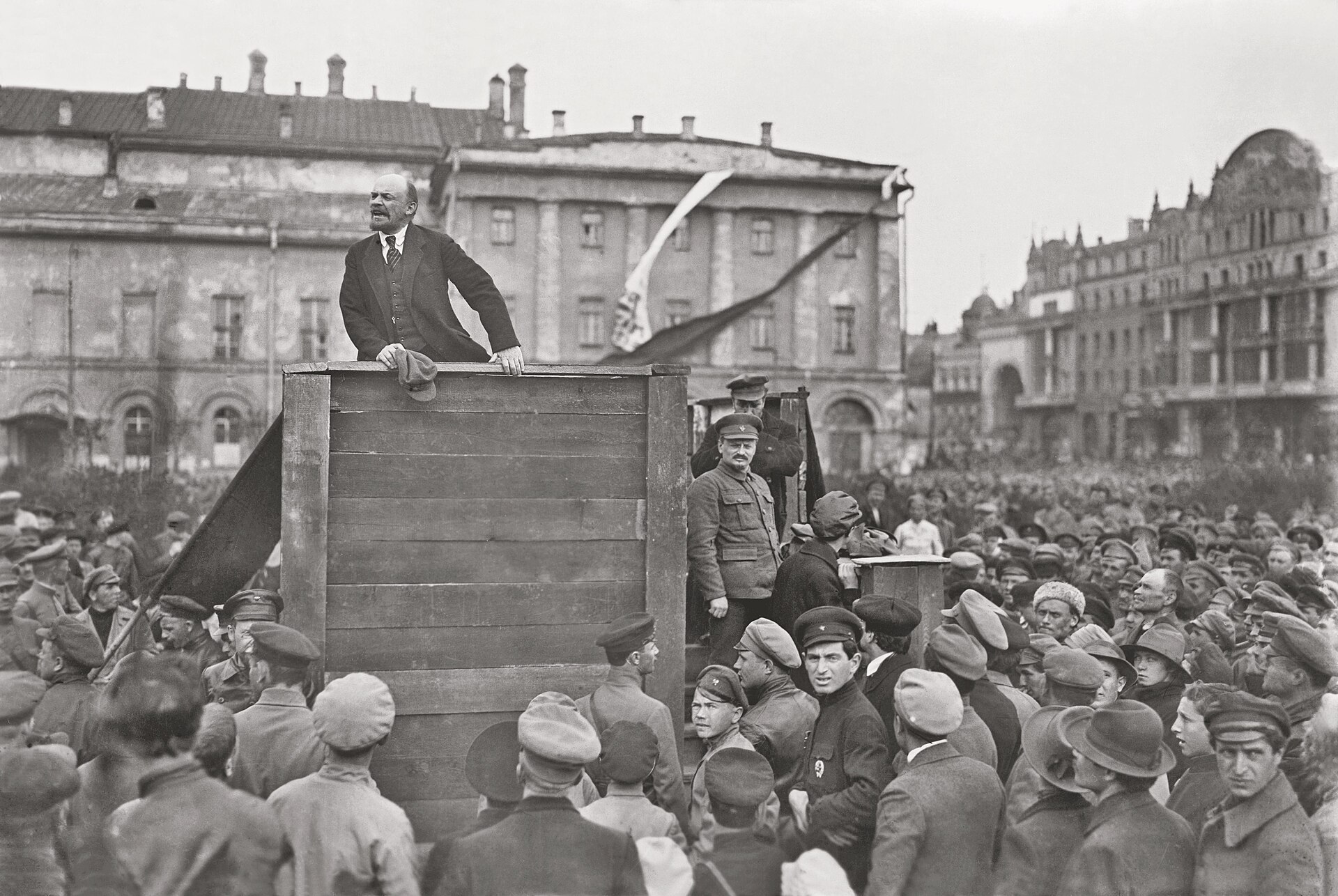
The figures are internal records kept for the regime's own use, and they set a floor. They also agree with independent evidence: demographic data, the Katyn graves found in 1943, and survivor testimony. Historians who rely on them, such as the Russian specialists Davies cites, argue over what the records omit, such as deaths soon after release from the camps.229 The doctored photograph is itself evidence of the point: the Commons record of the 1920 Lenin photograph above notes the original showing Trotsky and Kamenev, and the later version with Trotsky removed.7
A reader of Module 81 asks: what did ordinary Americans in 1950 actually know about these events?
Much of it was public. The Twenty-One Conditions were published by the Comintern itself.18 The nonaggression treaty of 1939 was public. Its secret protocol, by its own terms, was not.4 The German announcement of the Katyn graves was made in April 1943.34 What Americans could not see were the archive figures, the secret protocol's text (published by the State Department only in 1948) and the internal documents of the Soviet party.32 That combination, a regime whose public record was alarming and whose secret record was worse, is the background to Module 81, lesson 01.
Where to go next
Continue to lesson 03 for Yalta's aftermath and the Cold War to 1991. For the organizations named here (the Comintern's Executive Committee, the Cheka to KGB line, the GRU), see lesson 10; for the American party's year-by-year story, lesson 05; for the terms used in this lesson (democratic centralism, kulak, Gulag, Popular Front, troika), the glossary; and for all the numbers in one place, lesson 14. In Module 81, the matching lessons are lesson 01 and lesson 02. For a state-level view of the same years, see Module 74, lesson 04: Communists in Idaho.
Still open
These items could not be confirmed against a primary source before publication. The lesson states them as open, and they stay on the fact-check list.
- The Gulag death totals rest on Britannica's statement of Western scholarly estimates (1.2 to 1.7 million, 1918 to 1956); the archive-based studies (for example J. Arch Getty, Gabor Rittersporn and Viktor Zemskov, American Historical Review, 1993) and the higher estimates of Golfo Alexopoulos were not opened, so no figure from them is given.
- The Library of Congress figure of about one million kulak households (some five million people) deported dates from 1992 and was not checked against later archive-based counts.
- The Holodomor estimates come from the holodomorct.org demography page, which quotes Romaniuk and Gladun (2015) and summarizes the 3.94 million estimate; the underlying journal articles were not opened. The organization behind holodomorct.org was not confirmed from the page text.
- Robert Conquest's estimates are given as R. W. Davies reported them in 1997; Conquest's books and his own 1997 letter were not opened.
- The Seventeen Moments figures for Yezhov's projected quotas (177,500 exiled and 72,950 executed) differ from figures for Order No. 00447 given in other works; the order itself was not opened.
- The Katyn forest count differs between Shelepin's 1959 note as reported by Crozier (4,421) and the Seventeen Moments essay citing the 1992 documents (4,443); the documents themselves were not opened.
- Crozier's description of the March 5, 1940 order as a memorandum 'to Beria' from Stalin was not checked against the document; the lesson says only that the order is dated March 5, 1940.
- Whether Stalin ordered Kirov's murder is stated only as the Library of Congress exhibit's cautious finding; the lesson rates it unresolved.
- The rating of Trotsky's murder as ordered from Moscow rests on Britannica's description of Mercader as a suspected Stalin agent and the general scholarly consensus; Sudoplatov's memoir and Soviet documents were not opened.
- The conversion of 1917 Old Style dates (for example October 10 to October 23) was computed by adding thirteen days, the gap stated by Seventeen Moments; individual converted dates were not checked against a separate New Style source.
- A few context statements carry no footnote and rest on general knowledge: that Lenin and his colleagues did not expect their revolution to survive alone, the reading of Lenin's 'both capitals' as Petrograd and Moscow, and the mention of survivor testimony as independent evidence in the hard questions.
- The Kronstadt figures (more than 16,000 at the March 1 meeting, about 45,000 government troops, about 300 congress delegates in the assault and 10 killed) come from the two Seventeen Moments essays only.
- Seventeen Moments dates the Western Ukrainian assembly's request to October 24, 1939, and the proclamation of the three Baltic Soviet republics to August 3, 1940; other accounts give the assembly's vote in the last days of October and the Baltic admissions to the USSR on August 3, 5 and 6, 1940. The lesson gives the Seventeen Moments dates as that source's.
- Seventeen Moments calls Trotsky the president of the Second Congress of Soviets; other accounts name Lev Kamenev as its chairman. The lesson no longer says who presided.
Learn more
- Seventeen Moments in Soviet History (Michigan State University): Short essays by year with translated primary texts, images and film; the best free starting point for 1917 to 1945.
- Library of Congress: Revelations from the Russian Archives: The 1992 exhibit of documents from the opened Soviet archives, with translations, on the secret police, the Gulag, collectivization and the famine.
- Avalon Project: Nazi-Soviet Pact and Secret Protocol: The text of the protocol that divided Eastern Europe in August 1939.
- Lenin, Terms of Admission into Communist International (1920): Read the conditions in full; they explain why anti-communists treated member parties as more than political parties.
- R. W. Davies, Reply to Robert Conquest (New Left Review, 1997): A short, clear exchange on how the archive figures changed the Terror estimates.
- Brian Crozier, Remembering Katyn (Hoover Digest, 2000): The Shelepin note and the 1990 Soviet admission, from documents at the Hoover Institution.
- Module 81, lesson 01: Why the Fear Was Real, 1917 to 1950: The American side of the same years: the founding of the American party, Moscow's money and the turns of the line.
Notes
- Library of Congress, Revelations from the Russian Archives, exhibit section "Internal Workings of the Soviet System" (1992; online exhibit), subsections on Repression and Terror, Secret Police, the Gulag, Collectivization and Industrialization, Ukrainian Famine and Deportations (retrieved Nov. 6, 2026). Read it online. ↩
- R. W. Davies, "Reply to Robert Conquest," New Left Review I/225 (September to October 1997), on the official figure of 681,692 executions in 1937 to 1938, Conquest's estimates in The Great Terror (1968) and later, the consultation by Stephen Wheatcroft of Oleg Khlevniuk, Viktor Zemskov and Arsenii Roginsky, and archival counts of prisoners on January 1, 1939 (retrieved Nov. 6, 2026). Read it online. ↩
- "Holodomor: Maps and demography," Holodomor education site holodomorct.org, quoting Anatole Romaniuk and Oleksandr Gladun, "Demographic Trends in Ukraine: Past, Present, and Future," Population and Development Review (2015), pp. 318 to 319, and summarizing the demographic estimate of 3.94 million excess deaths (4.5 million including lost births) in Soviet Ukraine, 1932 to 1934, with a reference to Oleh Wolowyna, "A Demographic Framework for the 1932 to 1934 Famine in the Soviet Union" (retrieved Nov. 6, 2026). Read it online. ↩
- Secret Additional Protocol, Moscow, August 23, 1939, signed by Ribbentrop and Molotov, in U.S. Department of State, Nazi-Soviet Relations 1939 to 1941 (1948); Avalon Project, Yale Law School (retrieved Nov. 6, 2026). Read it online. ↩
- Brian Crozier, "Remembering Katyn," Hoover Digest 2000, no. 2 (April 30, 2000), Hoover Institution, on the order of March 5, 1940, Aleksandr Shelepin's note to Khrushchev of March 3, 1959 (21,857 killed) and the TASS statement of April 13, 1990 (retrieved Nov. 6, 2026). Read it online. ↩
- Library of Congress, Revelations from the Russian Archives, exhibit section "Soviet Union and the United States" (1992; online exhibit), on the naming of the Russian Communist Party (Bolshevik) in March 1918, the purpose of the Comintern, CPUSA membership (about 12,000 in 1922 and about 75,000 by 1938) and the Central Committee's use of foreign parties after 1943 (retrieved Nov. 6, 2026). Read it online. ↩
- Wikimedia Commons, file page "After Lenin Speech 1920.jpg," description in Italian and English (photograph by Grigory Petrovich Goldstein, May 5, 1920; note that the original showed Trotsky and Kamenev on the steps and that Trotsky was later removed on Stalin's orders) (retrieved Nov. 6, 2026). Read it online. ↩
- Lewis Siegelbaum, "The New Calendar and Alphabet Reform," Seventeen Moments in Soviet History, Michigan State University (Sovnarkom decision of January 24, 1918; February 1, 1918 became February 14; thirteen-day gap) (retrieved Nov. 6, 2026). Read it online. ↩
- Lewis Siegelbaum, "February Revolution," Seventeen Moments in Soviet History, Michigan State University (retrieved Nov. 6, 2026). Read it online. ↩
- Lewis Siegelbaum, "Bolsheviks Seize Power: The October Revolution," Seventeen Moments in Soviet History, Michigan State University (quoting Lenin's letter of September 1917 to the Central Committee and Trotsky's "rubbish heap of history" remark) (retrieved Nov. 6, 2026). Read it online. ↩
- Lewis Siegelbaum, "Constituent Assembly," Seventeen Moments in Soviet History, Michigan State University (election results, Lenin's theses of December 13, the session of January 5, 1918, and the Volga government overthrown by Kolchak in November 1918) (retrieved Nov. 6, 2026). Read it online. ↩
- Lewis Siegelbaum, "State-Building: State Security," Seventeen Moments in Soviet History, Michigan State University (Cheka founded by Sovnarkom decree of December 7, 1917; its successors; its early collegium; the September 1918 authorization of the Red Terror; Trotsky's 1920 remark on Red terror) (retrieved Nov. 6, 2026). Read it online. ↩
- Lewis Siegelbaum, "Treaty of Brest Litovsk," Seventeen Moments in Soviet History, Michigan State University (armistice of December 2, 1917; German offensive of February 18, 1918; treaty of March 3, 1918; the Left Communists and the Left SRs; Ukraine after November 1918) (retrieved Nov. 6, 2026). Read it online. ↩
- Council of People's Commissars, Resolution on Red Terror, September 5, 1918, Sobranie uzakonenii i rasporiazhenii rabochego i krestian'skogo pravitel'stva (1918), p. 789, signed by People's Commissar of Justice Kurskii; English text from William Henry Chamberlin, The Russian Revolution, 1917 to 1921 (Macmillan, 1935), vol. II, pp. 475 to 476, as reproduced by Seventeen Moments in Soviet History, Michigan State University (retrieved Nov. 6, 2026). Read it online. ↩
- Lewis Siegelbaum, "New Economic Policy," Seventeen Moments in Soviet History, Michigan State University (retrieved Nov. 6, 2026). Read it online. ↩
- James von Geldern, "Kronstadt Uprising," Seventeen Moments in Soviet History, Michigan State University (retrieved Nov. 6, 2026). Read it online. ↩
- Lewis Siegelbaum, "Tenth Party Congress," Seventeen Moments in Soviet History, Michigan State University (congress of March 8 to 16, 1921; Lenin's note on "The lesson of Kronstadt"; the resolution "On Party Unity") (retrieved Nov. 6, 2026). Read it online. ↩
- V. I. Lenin, "Terms of Admission into Communist International," written July 1920, first published in The Second Congress of the Communist International, Verbatim Report (Petrograd, 1921); Collected Works, 4th English ed. (Progress Publishers, 1965), vol. 31, pp. 206 to 211, translated by Julius Katzer, with editorial note 1 on the First Congress (March 2 to 6, 1919); Marxists Internet Archive (retrieved Nov. 6, 2026). Read it online. ↩
- Minutes of the Second Congress of the Communist International, July 19 to August 7, 1920, contents page (sessions on the conditions of admission, July 29 and 30 and August 6; John Reed on July 25), translated by Bob Archer (New Park Publications, 1977); Marxists Internet Archive (retrieved Nov. 6, 2026). Read it online. ↩
- John Riddell, "The Comintern's Twenty-One Conditions, 1920," johnriddell.com, April 20, 2022, new translation from the Russian text in RGASPI fond 489, delo 16 (conditions 20 and 21; first 19 drafted by Lenin) (retrieved Nov. 6, 2026). Read it online. ↩
- "The Third or 'Communist' International," Seventeen Moments in Soviet History, Michigan State University (founding in March 1919; the conditions presented by Zinoviev at the Second Congress) (retrieved Nov. 6, 2026). Read it online. ↩
- Lewis Siegelbaum, "Union Treaty," Seventeen Moments in Soviet History, Michigan State University (December 30, 1922; the Georgian dispute; the 1923 constitution) (retrieved Nov. 6, 2026). Read it online. ↩
- Lewis Siegelbaum, "Lenin's Succession," Seventeen Moments in Soviet History, Michigan State University (retrieved Nov. 6, 2026). Read it online. ↩
- V. I. Lenin, "Letter to the Congress," notes dictated in late December 1922 (the passage on Stalin and Trotsky is dated December 25, 1922), with the addition of January 4, 1923 (taken down by L. F.); Marxists Internet Archive (retrieved Nov. 6, 2026). Read it online. ↩
- James von Geldern, "Death of Lenin," Seventeen Moments in Soviet History, Michigan State University (retrieved Nov. 6, 2026). Read it online. ↩
- J. V. Stalin, "The Tasks of Business Executives," speech to the First All-Union Conference of Leading Personnel of Socialist Industry, February 4, 1931, Works, vol. 13 (Foreign Languages Publishing House, 1954); Marxists Internet Archive (retrieved Nov. 6, 2026). Read it online. ↩
- Lewis Siegelbaum, "Collectivization: Liquidation of the Kulaks as a Class," Seventeen Moments in Soviet History, Michigan State University (retrieved Nov. 6, 2026). Read it online. ↩
- J. V. Stalin, "Concerning Questions of Agrarian Policy in the U.S.S.R.," speech at a conference of Marxist students of agrarian questions, December 27, 1929, first published in Pravda, no. 309, December 29, 1929; Works, vol. 12, pp. 147 to 178; Marxists Internet Archive (retrieved Nov. 6, 2026). Read it online. ↩
- "Gulag," Encyclopaedia Britannica online (founding dates; Solzhenitsyn's estimate; Western scholarly estimates of 1.2 to 1.7 million deaths, 1918 to 1956) (retrieved Nov. 6, 2026). Read it online. ↩
- Lewis Siegelbaum, "The Great Terror," Seventeen Moments in Soviet History, Michigan State University (the three show trials; Yezhov; the Politburo order of July 3, 1937 and the quotas) (retrieved Nov. 6, 2026). Read it online. ↩
- Lewis Siegelbaum, "Popular Front," Seventeen Moments in Soviet History, Michigan State University (the "social fascist" line; collective security; the Seventh Congress of July 1935; Spain and the International Brigades) (retrieved Nov. 6, 2026). Read it online. ↩
- Treaty of Nonaggression between Germany and the Union of Soviet Socialist Republics, Moscow, August 23, 1939, in U.S. Department of State, Nazi-Soviet Relations 1939 to 1941 (1948); Avalon Project, Yale Law School (retrieved Nov. 6, 2026). Read it online. ↩
- Lewis Siegelbaum, "Soviet Territorial Annexations," Seventeen Moments in Soviet History, Michigan State University (eastern Poland, September 17, 1939; Finland and the League of Nations; the Baltic states, June to August 1940) (retrieved Nov. 6, 2026). Read it online. ↩
- James von Geldern, "Katyn Forest Massacre," Seventeen Moments in Soviet History, Michigan State University (German announcement of April 13, 1943; Stalin's denial; documents turned over to Poland in 1992) (retrieved Nov. 6, 2026). Read it online. ↩
- "The Assassination of Leon Trotsky," Encyclopaedia Britannica online (May 1940 attack; attack of August 20, 1940 by Ramón Mercader; death the following day) (retrieved Nov. 6, 2026). Read it online. ↩
- James von Geldern, "End of the Comintern," Seventeen Moments in Soviet History, Michigan State University (resolution of May 22, 1943; the Pact and the British and French parties; the Great Patriotic War) (retrieved Nov. 6, 2026). Read it online. ↩
- Swarthmore College Peace Collection, "American Peoples Mobilization Collected Records, 1940 to 1941," historical note (Germany invaded the Soviet Union on June 22, 1941; the group's change of name and slogan the same day) (retrieved Nov. 6, 2026). Read it online. ↩
- Presidium of the Executive Committee of the Communist International, statement proposing the dissolution of the Communist International, submitted to the member parties May 15, 1943; Marxists Internet Archive, "Dissolution of the Communist International" (retrieved Nov. 6, 2026). Read it online. ↩
- Office of the Historian, U.S. Department of State, "The Tehran Conference, 1943," Milestones in the History of U.S. Foreign Relations (retired series) (retrieved Nov. 6, 2026). Read it online. ↩
- Office of the Historian, U.S. Department of State, "The Yalta Conference, 1945," Milestones in the History of U.S. Foreign Relations (retired series) (retrieved Nov. 6, 2026). Read it online. ↩
- "The Yalta Conference," text of the agreements reached at the Crimea Conference, February 1945, including the Declaration on Liberated Europe, as released by the State Department March 24, 1947; Avalon Project, Yale Law School (retrieved Nov. 6, 2026). Read it online. ↩
- Review of Stéphane Courtois, Nicolas Werth, Jean-Louis Panné, Andrzej Paczkowski, Karel Bartošek and Jean-Louis Margolin, The Black Book of Communism: Crimes, Terror, Repression, trans. Jonathan Murphy and Mark Kramer (Harvard University Press, 1999; French ed. 1997), History Cooperative (reprinted journal review; on the controversy over Courtois's introduction and Werth's and Margolin's rejection of its tone) (retrieved Nov. 6, 2026). Read it online. ↩
Check yourself
1. The Bolshevik seizure of power in Petrograd took place on October 25, 1917 by the Russian calendar of the time. What was the date in the Western calendar?
Russia's Julian calendar ran thirteen days behind the Gregorian; October 25 Old Style is November 7 New Style, the date on which the Soviet state celebrated the revolution.
2. In the Constituent Assembly election of November 1917, about what share of the vote did the Bolsheviks win?
The Bolsheviks won about ten million of roughly 42 million votes, about 24 percent; the Socialist Revolutionary lists won about half. The Assembly met once, on January 5, 1918 (OS), and was then kept out by Red Guards.
3. The Sovnarkom resolution of September 5, 1918 on the Red Terror did which of the following?
The resolution found terror 'necessary,' called for 'isolating them in concentration camps' and declared persons 'associated with White Guard organizations, plots and rebellions' liable to be shot. The mass operations came in 1937.
4. Which requirement appears in Lenin's draft of the conditions for joining the Communist International (1920)?
Point 17 of Lenin's draft says all decisions of the congresses and the Executive Committee 'are binding on all affiliated parties'; point 18 required the name 'Communist Party of the country in question (Section of the Third, Communist International).'
5. According to the NKVD figures reported by R. W. Davies, how many executions were recorded in 1937 and 1938?
The official figure is 681,692. 21,857 is the 1959 KGB count of Polish prisoners shot in 1940; 72,950 is the Seventeen Moments figure for Yezhov's projected executions under the mass operations order.
6. Which estimate of famine deaths in Soviet Ukraine, 1932 to 1934, comes from demographers counting excess deaths within Ukraine's borders?
The demographic estimate is 3.94 million excess deaths, 4.5 million with lost births. The 6 to 7 million figure is the 1992 Library of Congress estimate; 1.2 to 1.7 million is Britannica's range of Western estimates for Gulag deaths.
7. What did the secret additional protocol to the Nazi-Soviet Pact of August 23, 1939 provide for Poland?
The protocol bounded the spheres 'approximately by the line of the rivers Narew, Vistula, and San' and left the question of an independent Polish state to 'further political developments.'
8. When did the Soviet government first admit responsibility for the Katyn killings?
A TASS statement of April 13, 1990 ascribed direct responsibility to Beria and called the killings one of the gravest crimes of Stalinism. April 13, 1943 is the date of the German announcement; March 3, 1959 is the date of Shelepin's secret note to Khrushchev.
Terms in this lesson
- Old Style and New Style
- The Julian calendar used in Russia until February 1918 (Old Style) and the Gregorian calendar used in the West (New Style). In 1917 the gap was thirteen days.
- Cheka
- The All-Russian Extraordinary Commission for Combating Counter-Revolution and Sabotage, the Soviet political police founded December 7, 1917 (December 20 NS) under Felix Dzerzhinsky; the first in a line that ran through the GPU, OGPU and NKVD to the KGB.
- Red Terror
- The Bolshevik campaign against 'class enemies' made official policy by the Sovnarkom resolution of September 5, 1918, which authorized concentration camps and shooting.
- War communism
- Lenin's later name for the Civil War economy of 1918 to 1921: grain requisitioning, state control of industry and the attempt to direct the whole economy.
- New Economic Policy (NEP)
- The partial return to markets introduced at the Tenth Party Congress in March 1921, replacing requisitioning with a tax in kind while the state kept the 'commanding heights'; abandoned by 1929.
- Comintern
- The Communist International (Third International), founded in Moscow March 2 to 6, 1919 to direct communist parties abroad; dissolution proposed May 15, 1943.
- Twenty-One Conditions
- The terms of admission to the Comintern adopted at its Second Congress (July 19 to August 7, 1920), nineteen drafted by Lenin, binding member parties to Comintern decisions and requiring a parallel illegal organization.
- Democratic centralism
- The organizing rule required of Comintern parties in condition 13: decisions made at the center bind all members, with 'an iron discipline bordering on military discipline.'
- Kulak
- A Russian term for a prosperous peasant; in Stalin's collectivization drive the label was applied to peasants targeted for confiscation, deportation, the camps or execution.
- Holodomor
- Ukrainian for 'death by hunger,' the name for the famine of 1932 and 1933 in Soviet Ukraine, caused by Soviet grain procurement and collectivization policy.
- Gulag
- The Main Directorate of Corrective Labor Camps, founded in 1930 under the OGPU; the word is used for the whole Soviet forced labor camp system, whose first camps date from 1919.
- Great Terror
- The wave of arrests, show trials and executions of 1936 to 1938, also called the Yezhovshchina after NKVD chief Nikolai Yezhov; the NKVD recorded 681,692 executions in 1937 and 1938.
- Troika
- A three-person tribunal used to sentence people arrested in the mass operations of 1937 and 1938 without ordinary trial.
- Secret protocol
- The secret additional protocol to the Nazi-Soviet Pact of August 23, 1939, dividing Finland, the Baltic states, Poland and Bessarabia into German and Soviet spheres of influence.
Sources
- Library of Congress, Revelations from the Russian Archives: Internal Workings of the Soviet System (1992) checked 2026-10
- R. W. Davies, "Reply to Robert Conquest," New Left Review I/225 (1997) checked 2026-10
- Holodomor: Maps and demography (holodomorct.org), citing Romaniuk and Gladun (2015) and the 3.94 million demographic estimate (undated) checked 2026-10
- Secret Additional Protocol to the German-Soviet Nonaggression Treaty (Avalon Project) (1939-08-23) checked 2026-10
- Brian Crozier, "Remembering Katyn," Hoover Digest (2000-04-30) checked 2026-10
- Library of Congress, Revelations from the Russian Archives: Soviet Union and the United States (1992) checked 2026-10
- Wikimedia Commons: After Lenin Speech 1920.jpg (file page) (1920-05-05) checked 2026-10
- Lewis Siegelbaum, "The New Calendar and Alphabet Reform," Seventeen Moments in Soviet History (undated) checked 2026-10
- Lewis Siegelbaum, "February Revolution," Seventeen Moments in Soviet History (undated) checked 2026-10
- Lewis Siegelbaum, "Bolsheviks Seize Power," Seventeen Moments in Soviet History (undated) checked 2026-10
- Lewis Siegelbaum, "Constituent Assembly," Seventeen Moments in Soviet History (undated) checked 2026-10
- Lewis Siegelbaum, "State-Building: State Security," Seventeen Moments in Soviet History (undated) checked 2026-10
- Lewis Siegelbaum, "Treaty of Brest Litovsk," Seventeen Moments in Soviet History (undated) checked 2026-10
- Council of People's Commissars, Resolution on Red Terror (text via Seventeen Moments in Soviet History) (1918-09-05) checked 2026-10
- Lewis Siegelbaum, "New Economic Policy," Seventeen Moments in Soviet History (undated) checked 2026-10
- James von Geldern, "Kronstadt Uprising," Seventeen Moments in Soviet History (undated) checked 2026-10
- Lewis Siegelbaum, "Tenth Party Congress," Seventeen Moments in Soviet History (undated) checked 2026-10
- V. I. Lenin, "Terms of Admission into Communist International" (Marxists Internet Archive) (1920-07) checked 2026-10
- Minutes of the Second Congress of the Communist International, contents (Marxists Internet Archive) (1920) checked 2026-10
- John Riddell, "The Comintern's Twenty-One Conditions, 1920" (2022-04-20) checked 2026-10
- "The Third or 'Communist' International," Seventeen Moments in Soviet History (undated) checked 2026-10
- Lewis Siegelbaum, "Union Treaty," Seventeen Moments in Soviet History (undated) checked 2026-10
- Lewis Siegelbaum, "Lenin's Succession," Seventeen Moments in Soviet History (undated) checked 2026-10
- V. I. Lenin, "Letter to the Congress" (Marxists Internet Archive) (1922-12 to 1923-01-04) checked 2026-10
- James von Geldern, "Death of Lenin," Seventeen Moments in Soviet History (undated) checked 2026-10
- J. V. Stalin, "The Tasks of Business Executives" (Marxists Internet Archive) (1931-02-04) checked 2026-10
- Lewis Siegelbaum, "Collectivization," Seventeen Moments in Soviet History (undated) checked 2026-10
- J. V. Stalin, "Concerning Questions of Agrarian Policy in the U.S.S.R." (Marxists Internet Archive) (1929-12-27) checked 2026-10
- "Gulag," Encyclopaedia Britannica (undated) checked 2026-10
- Lewis Siegelbaum, "The Great Terror," Seventeen Moments in Soviet History (undated) checked 2026-10
- Lewis Siegelbaum, "Popular Front," Seventeen Moments in Soviet History (undated) checked 2026-10
- Treaty of Nonaggression between Germany and the USSR (Avalon Project) (1939-08-23) checked 2026-10
- Lewis Siegelbaum, "Soviet Territorial Annexations," Seventeen Moments in Soviet History (undated) checked 2026-10
- James von Geldern, "Katyn Forest Massacre," Seventeen Moments in Soviet History (undated) checked 2026-10
- "The Assassination of Leon Trotsky," Encyclopaedia Britannica (undated) checked 2026-10
- James von Geldern, "End of the Comintern," Seventeen Moments in Soviet History (undated) checked 2026-10
- Swarthmore College Peace Collection, American Peoples Mobilization records, historical note (undated) checked 2026-10
- ECCI Presidium, statement on the dissolution of the Communist International (Marxists Internet Archive) (1943-05-15) checked 2026-10
- Office of the Historian, "The Tehran Conference, 1943" (undated) checked 2026-10
- Office of the Historian, "The Yalta Conference, 1945" (undated) checked 2026-10
- The Yalta Conference agreements, including the Declaration on Liberated Europe (Avalon Project) (1945-02-11) checked 2026-10
- Review of The Black Book of Communism (History Cooperative) (undated) checked 2026-10
- Robert Conquest, The Great Terror: Stalin's Purge of the Thirties (Macmillan, 1968), named for its place in the historiography; not opened for this lesson (1968) checked 2026-10
- Robert Conquest, The Harvest of Sorrow: Soviet Collectivization and the Terror-Famine (Oxford University Press, 1986), named; not opened for this lesson (1986) checked 2026-10