Lesson 1 of 14 · about 55 minutes
Why the Fear Was Real, 1917 to 1950
Updated October 28, 2026
You'll be able to
- You'll be able to explain what the Comintern's Twenty-One Conditions required of member parties and why they mattered to American anti-communists.
- You'll be able to summarize what the Moscow archives opened in the 1990s showed about Soviet funding and direction of the American Communist Party, citing Klehr, Haynes, Firsov and Anderson.
- You'll be able to place the key events from Gouzenko's defection (September 1945) to the Korean invasion (June 25, 1950) in order and explain how each shaped American opinion.
- You'll be able to identify what Chambers, Bentley and labor anti-communists got right, and the evidence that later confirmed it.
- You'll be able to distinguish the fears of 1950 that the evidence now supports from those that went beyond it, especially on timing, membership and the atomic bomb.
- You'll be able to explain the difference between infiltration and espionage as Chambers described it in 1948.
Start here: the short version
The American fear of communism in 1950 did not come from nowhere. From 1919 on, the American Communist Party was founded, financed and steered from Moscow, and it ran a secret apparatus alongside its public one. Records opened in Moscow in the 1990s, and the Venona decrypts released by the National Security Agency from 1995, confirmed much of what former communists such as Whittaker Chambers and Elizabeth Bentley had told the FBI in the 1940s. Between September 1945 and June 1950, a fast run of public events (Igor Gouzenko's defection in Ottawa, the "iron curtain" speech, the Truman Doctrine, the communist takeover in Prague, the Berlin blockade, the first Soviet atomic bomb, the communist victory in China, the Hiss conviction, the Fuchs confession and the invasion of South Korea) gave ordinary Americans good reason to think their government had been penetrated and their country was losing ground.
This lesson sets out what was real, what the anti-communists of the 1940s got right, and where the fear outran the evidence. Two facts frame everything that follows in this module. First, Soviet espionage inside the United States government was real and serious. Second, by the time the public learned the details, in 1948 to 1950, most of those Soviet networks had already been shut down, and the public did not know that either. Lesson 02 covers Venona and the archives in detail, and lesson 03 covers HUAC, the loyalty program and the Hiss case.
Why this lesson starts in 1917
A reader in 2026 who first meets the word "McCarthyism" usually meets it as a name for a panic: accusations without evidence, careers wrecked by rumor, a senator waving a list. Much of that picture is accurate, and later lessons of this module test it claim by claim. A fair account has to start earlier, though, because the people who feared communist subversion in 1950 were reacting to things that had happened, many of which they could read about in their newspapers, and some of which they could not read about because the evidence was locked in government vaults in Washington, Ottawa, London and Moscow.
The ideas behind communism are covered elsewhere on this site and are not retold here. The economic system and its record are the subject of Module 51, lesson 07: Communism, and Marx's theory of class is the subject of Module 58, lesson 09: Marx and the Theory of Class. This lesson is about something narrower: the organization that Lenin's party built to spread its revolution abroad, the American party that joined it, and the evidence that this party served a foreign government. For a regional case study of what communist organizing actually looked like on the ground, see Module 74, lesson 04: Communists in Idaho, What the Evidence Shows.
The timeline below gathers the events this lesson covers. Each is footnoted where it is discussed in the text.
The Bolshevik seizure of power and the Communist International
November 1917: a party that meant to spread
In November 1917 the Bolsheviks, led by Vladimir Lenin, seized power in Petrograd (the city called St. Petersburg before 1914 and again today), and in March 1918 they renamed their organization the Russian Communist Party (Bolshevik).1 Lenin and his colleagues did not see their revolution as a Russian event alone. They expected, and worked for, revolutions in the industrial countries of Europe and America, and they built an international body to organize them.
That body was the Communist International, known by its short name, the Comintern, or as the Third International. It was founded in Moscow in March 1919.2 Grigory Zinoviev served as president of its Executive Committee.2 The Library of Congress exhibit built from the opened archives describes the Comintern as the instrument through which the Soviet party directed foreign communist parties until the Comintern was dissolved in 1943, after which the Soviet party's Central Committee carried on the same work through other offices.1
The Twenty-One Conditions
At its Second Congress, held in July and August 1920, the Comintern adopted terms of membership that every party wishing to join had to accept. Zinoviev presented them, the delegates approved them by a large majority, and they became known as the Twenty-One Conditions.2 Lenin's own draft, written in July 1920 and published in the congress's verbatim report, ran to nineteen points, and the congress added two more.3 The numbering differs between the draft and the adopted text, so this lesson quotes Lenin's draft and identifies points by subject.
Several of the conditions bear directly on the question Americans would ask in the 1940s: was a communist party an ordinary political party, or something else? Lenin's draft required member parties working under restrictive laws to combine legal and illegal work, saying that "they must everywhere build up a parallel illegal organisation" ready to act at the decisive moment.3 It required that all decisions of the Comintern's congresses and of its Executive Committee "are binding on all affiliated parties."3 It required each party "selflessly to help any Soviet republic in its struggle" against counter-revolutionary forces.3 It required parties to purge their membership periodically, to place all party newspapers and publishers under the Central Committee, and to take the name "the Communist Party of the country in question" as a section of the Communist International.3
Read plainly, these are the rules of a disciplined international organization with its headquarters in a foreign capital, a duty to defend the Soviet state, and an instruction to keep a hidden apparatus alongside the public one. American anti-communists in the 1940s and 1950s often cited exactly these features when they argued that the Communist Party of the United States was not a party in the American sense. On the text alone, they had a point: the conditions were public, published by the Comintern itself, and the American parties applied to join on those terms.
An American party built to Moscow's specifications
Two parties in Chicago, 1919
The American movement began in the summer of 1919, when a faction that had broken away from the Socialist Party met in Chicago to form a communist party and instead produced two. The Communist Labor Party held its founding convention from August 31 to September 5, 1919, and the Communist Party of America held its founding convention from September 1 to 7, 1919, both in Chicago.4 The Library of Congress exhibit describes the split: one party drew mainly on recent immigrants from Russia and Eastern Europe and stressed Marxist orthodoxy and proletarian revolution, while the other was dominated by native-born, more pragmatic radicals who sought mass influence. In the exhibit's words, the Americans were so divided that they created two parties instead of one.1
The organizing was not purely American. A Library of Congress report on the party records that arrived from Moscow describes a 1919 letter from Nikolai Bukharin, writing for the Communist International, urging American radicals to form a communist party, and Comintern advice to organize "Communist nuclei among soldiers and sailors."5
Underground, merger and the legal party, 1920 to 1929
For their first years the parties worked largely in secret, as the records of their "underground" conventions show, and they merged in stages under Comintern pressure. Records gathered by the Marxists Internet Archive show a joint unity convention at Bridgman, Michigan, in May 1920 that produced the United Communist Party, a further unity convention at Woodstock, New York, in May 1921 that produced a unified "Communist Party of America, Section of the Communist International," and the founding of a legal, above-ground Workers Party of America in New York from December 23 to 26, 1921.4 The underground party voted to dissolve itself into the legal one in April 1923, and the legal party renamed itself the Workers (Communist) Party in August 1925.4 By the end of the decade it was using the name Communist Party of the United States of America. The Library of Congress exhibit sums up the result: in 1922 the Comintern forced the two American parties, then about 12,000 members, to unite and follow the line set in Moscow.1
1929: Stalin settles an American quarrel
The clearest early proof of who governed the American party came in 1929. Jay Lovestone led the party's majority faction at the time, and his group had been aligned with Nikolai Bukharin, whom Stalin was then pushing out of the Soviet leadership. Lovestone took his case to Moscow. On May 6, 1929, Stalin addressed the American Commission of the Presidium of the Executive Committee of the Communist International, and on May 14 he spoke twice to the Presidium itself on "the American question."6 In the second speech he said that the Lovestone group "will perish if it continues to be stubborn, if it does not submit to the will of the Comintern."6 Lovestone lost the leadership, and the American party, whose members had backed him, accepted the Comintern's decision. Lovestone and his followers carried on for years as a small communist opposition group outside the official party.
The episode matters for two reasons. It showed that the American party's leaders served at the pleasure of the Comintern, not of the party's members. And it turned Lovestone into one of the most effective anti-communists in the American labor movement, a story taken up below.
What the Moscow archives showed
For most of the twentieth century, the relationship between Moscow and the American party was argued over without the documents. Defenders of the party said it was an American organization of idealists who happened to admire the Soviet Union. Its opponents said it was a foreign-directed conspiracy. The argument changed after August 1991, when Boris Yeltsin outlawed the Communist Party in Russia and its archives began to open. The Library of Congress exhibit says the records revealed "the continued financial as well as ideological dependency of the American Communists" on the Soviet party.1
The American party's own records had been secretly shipped to the Soviet Union over the decades and kept in a closed party archive, now the Russian State Archive of Social and Political History. John Earl Haynes, then a historian in the Library of Congress Manuscript Division, learned of them in late 1992 and was the first American scholar to examine them, in Moscow in January 1993. The Library later acquired a microfilm copy of 435,165 frames on 326 reels.5 Haynes wrote in 2001 that the microfilm and a related Comintern records project would make more than 1.4 million pages available to scholars.7
Two books built on these records reached the public first. The Secret World of American Communism, by Harvey Klehr, John Earl Haynes and Fridrikh Igorevich Firsov, was published by Yale University Press in 1995, and The Soviet World of American Communism, by Klehr, Haynes and Kyrill M. Anderson, followed from Yale in 1998. Both reproduce Russian documents in English translation with commentary.
The money
The documents show Soviet money flowing to the American party from its first year to the last years of the Soviet Union. Reviewing The Secret World, Mark Falcoff wrote in Commentary that the party was financed from its inception, including through a grant of several million dollars' worth of diamonds and jewelry.8 The Christian Science Monitor's report on the book, by Ron Scherer, said the documents showed the journalist John Reed receiving the equivalent of more than $1 million from Moscow.9 Sam Tanenhaus, reviewing The Soviet World in the New York Review of Books, described the jewels entrusted to Reed in 1919 and 1920 as worth one million rubles. The two reviews describe the same Reed payment in different currencies, and this lesson does not try to convert one figure into the other.10
The money was routine, not a one-time gift. The Library of Congress summary of the microfilm cites a 1926 memo explaining that "Different Soviet agencies subsidized different American Communist activities," and a 1924 Comintern letter confirming a subsidy of $1,282 to send ten Black Americans to a school in Moscow.5 The subsidies outlasted Stalin by decades. According to Tanenhaus's account of the documents, the party's chairman Gus Hall wrote in 1987 asking Moscow to double the party's annual stipend to $4 million, Moscow gave three million dollars in 1988, and that was the last payment; the payments stopped after Hall denounced Mikhail Gorbachev's reforms in 1989.10 Haynes later said that "the Soviet Union's secret subsidies of the CPUSA were much larger and lasted much longer than we expected," ending only in 1988 with a $3 million secret payment.11
The direction
Money is not the same as control, and the documents speak to control separately. Tanenhaus quotes the conclusion Klehr, Haynes and Anderson drew from the files: "the American Communist party was a creature of the Comintern and, through it, of the Soviet Union."10 The 1929 Lovestone affair is one example. Another is the fall of Earl Browder, the party's leader from the 1930s through the war. Browder dissolved the party in 1944, turning it into a "political association," and was removed after a French communist leader, Jacques Duclos, published an article attacking him. American communists read that article as a signal from Moscow. Tanenhaus reports that page proofs of a Russian version of the Duclos article, found in the archives, carry handwritten corrections by officials in Moscow and that the corrected text was republished in France about three months later, which settled a long-standing argument about whether Moscow was behind it.10
The secret apparatus
The most consequential finding concerned the hidden side of the party that the Twenty-One Conditions had called for. Falcoff summarized it this way: "While the CPUSA operated in the full light of day throughout the 20's and 30's, it also possessed a secret apparatus." He added that "Comintern files establish that the secret apparatus of the CPUSA had integral links to Soviet espionage," and that the documents confirmed that the man Chambers knew as J. Peters was a key figure in the Washington underground.8 The Monitor's report described a party-run espionage service called the "Brother-Son" network, which the authors called "the first direct proof that the CPUSA participated in the theft of American atomic secrets", and quoted their conclusion that "many Americans collaborated with Soviet intelligence."9
That last finding is the hinge of the whole subject. It was the party's secret apparatus, not its public membership, that supplied Soviet intelligence with many of its American sources. Lesson 02 examines the evidence source by source.
Rival readings of the archives
The archives did not end the argument among historians. They moved it. Haynes, who calls his own position "traditionalist," has argued that the documents prove Soviet domination and the party's role in espionage. Historians on the other side of the debate, often labeled "revisionists," answered that the documents published so far were a selection. The historian Randi Storch, writing in the American Historical Association's Perspectives in 2000, criticized work built on documents from Moscow's archives; Haynes, replying in the same publication in January 2001, described himself as one of those "scolded for using 'carefully selected documents'" and noted that he had himself "initiated and supervised the library's acquisition of the CPUSA microfilm."7
Ellen Schrecker, whose Many Are the Crimes (1998) is the leading history of McCarthyism written from the critics' side, conceded the espionage point in a 2000 exchange with Haynes in the Journal of Cold War Studies. She wrote that "There is now just too much evidence from too many different sources" and that the evidence had "finally convinced me of the guilt of the major communist spies." She held to her central judgment that "in this country McCarthyism did more damage to the constitution than the American Communist party ever did."12 Both positions can be true at once, and much of this module consists of separating them.
The underground in Washington: the Ware group
The New Deal brought thousands of young lawyers, economists and administrators to Washington in the 1930s. A small number of them were secret members of the Communist Party, and a smaller number passed government documents to the Soviet Union. The best-known description of how this worked came from Whittaker Chambers, a former party member and courier for the underground who broke with the party in 1938. Testifying before the House Committee on Un-American Activities on August 3, 1948, Chambers described "an underground organization of the United States Communist Party developed, to the best of my knowledge, by Harold Ware."13
Chambers was careful about what the group was for. "The purpose of this group at that time was not primarily espionage," he testified. "Its original purpose was the Communist infiltration of the American Government. But espionage was certainly one of its eventual objectives."13 He said that he knew the organization "at its top level, a group of seven or so men," named Nathan Witt as its head when he knew it, and listed among its members Lee Pressman, Alger Hiss, Donald Hiss, Victor Perlo and Charles Kramer.13
The distinction Chambers drew between infiltration and espionage is worth keeping in mind for the rest of this module. Infiltration meant placing party members in government jobs where they could influence policy, recruit others, and report to the party. Espionage meant handing over secret documents to Soviet intelligence. The first was a political offense against honest government, and in most cases it was not a crime. The second was a crime. The Ware group began as the first and fed the second.
Chambers did not wait until 1948 to tell the government. In September 1939, days after the Nazi-Soviet Pact, he told Assistant Secretary of State Adolf Berle what he knew, and Berle kept notes of the conversation that were later used as evidence in the Hiss perjury trials.14 Little was done with the information for years. The FBI interviewed Chambers in the early 1940s but treated his account as history rather than as a live threat until Elizabeth Bentley's statements in November 1945 gave it new weight.14 The Hiss case itself, including the "Pumpkin Papers" and the two trials, is the subject of lesson 03.
The Comintern records confirmed the outline of Chambers's account. Falcoff's review of The Secret World noted that the documents established that the man Chambers knew as J. Peters, whom Chambers described as the head of the party's underground, was indeed a key figure in the Washington underground.8
The Popular Front, the Pact and the turns of the line
The Popular Front, 1935
For its first fifteen years the American party was small and openly revolutionary. In 1935 the Comintern changed course. At the Seventh World Congress of the Communist International, the Bulgarian communist Georgi Dimitrov delivered the main report on August 2, 1935, calling on communists to build a united front against fascism with parties and groups they had previously denounced.15 In the United States the new line moved communists into coalitions with people who were not communists, inside unions, civil rights groups, writers' organizations, youth groups and relief campaigns, often without saying that they were communists.
The Popular Front was the party's most successful period. The Library of Congress exhibit says membership rose to about 75,000 by 1938.1 Much of the Soviet intelligence activity in Washington that Chambers and Bentley later described took shape in these years. Many Americans who joined party-led groups in this period joined because they opposed Hitler and Mussolini, supported the Spanish Republic, or wanted industrial unions, and many had no knowledge of the secret apparatus. That fact is part of why the later Red Scare caught so many people who were not spies.
August 23, 1939: the Pact
On August 23, 1939, in Moscow, Joachim von Ribbentrop for Germany and Vyacheslav Molotov for the Soviet Union signed a treaty of nonaggression.16 A secret additional protocol, signed the same day, divided Poland, the Baltic region and southeastern Europe into German and Soviet spheres of influence and stated that "This protocol shall be treated by both parties as strictly secret."17 For American communists who had spent four years calling for unity against fascism, the Pact was a test of whether the party answered to its members' convictions or to Moscow. It answered to Moscow. Tanenhaus summarizes the documents: after the Pact the party campaigned against American involvement in the war and portrayed all the warring powers as equally imperialist, with Soviet propaganda treating Nazi Germany slightly more leniently than Britain and France.10
Many members could not follow the turn. The Library of Congress exhibit records that many left after the signing of the Nazi-Soviet Pact of 1939, and again in 1956 after Khrushchev's speech on Stalin's crimes and the Soviet invasion of Hungary.1 Some of those who left became the most informed anti-communists in the country, because they had seen the party from inside. Chambers was one of them: he went to Berle within days of the Pact.14
The "peace" picket and the defense strikes
Two episodes from the Pact period stayed in the memory of anti-communists for a decade. The first was the peace campaign. An Emergency Peace Mobilization conference met in Chicago from August 31 to September 2, 1940, and the organization that grew out of it, the American Peace Mobilization, ran a vigil in which, according to its own records now held by the Swarthmore College Peace Collection, "1,784 persons picketed the White House, for a total of 1,029 hours." Then, the archive's historical note records, "Germany invaded the Soviet Union on June 22nd" of 1941. That same day the group began supporting aid to Britain and the Soviet Union and changed its name to the American People's Mobilization, with the slogan "For Victory Over Fascism."18 An organization that reversed its central demand on the day a foreign country was attacked invited the conclusion that it took its line from that country.
The second episode involved defense plants. When the Supreme Court upheld the non-communist affidavit requirement of the 1947 Taft-Hartley Act in American Communications Association v. Douds (decided May 8, 1950), Chief Justice Fred Vinson's opinion for the Court summarized the evidence Congress had heard. Congress had been told that communist leaders of unions had subordinated their members' interests to strikes ordered by the party, and the Court cited the 1941 strike "at the Milwaukee plant of the Allis-Chalmers Manufacturing Company," which Congress heard was "called solely in obedience to Party orders" to start "the 'snowballing of strikes' in defense plants."19 The Court was careful to say that it could not "assess the validity of each item of evidence."19 Historians still dispute how much of the 1941 strike wave was directed by the party and how much reflected real grievances. What was not in dispute in 1950 was the pattern: the party opposed defense production while Stalin was allied with Hitler and supported it once Hitler attacked Stalin.
The war years and the Duclos article
From June 1941 to the end of the war, the party, like the American People's Mobilization, threw itself behind the war effort and the Roosevelt administration.18 In 1944 Earl Browder went so far as to dissolve the party into a "political association," on the theory that wartime cooperation between the United States and the Soviet Union could continue in peacetime. The article by Jacques Duclos in 1945 condemned this, Browder was removed, the party was reconstituted, and a new leadership took it onto a harder line as the Cold War began. As noted above, the archives show officials in Moscow corrected a Russian version of the Duclos article before it was republished in France.10 For Americans watching in 1945 and 1946, the lesson seemed obvious: each of the party's great reversals, in 1935, 1939, 1941 and 1945, followed a change in Soviet needs.
The membership numbers are small for a country the size of the United States, and the Library of Congress exhibit concludes that the party was significant but never a major political force, a small, sectarian movement whose goals conflicted with American reality.1 The size of the public party was never the real issue, though. The party's importance to the Soviet Union lay in its secret apparatus and in the members and sympathizers who held useful jobs.
Soviet atomic espionage
Of all the secrets the Soviet Union stole, the design of the atomic bomb mattered most, and the case that broke it open is the one that most shaped American fear in 1950. Klaus Fuchs was a German-born physicist and communist who had fled the Nazis to Britain. According to MI5, Britain's security service, he offered information from the British atomic program to the Soviets in late 1941 through Jurgen Kuczynski, was handed in 1942 to a Soviet military intelligence agent, Ursula Beurton (code name SONYA), joined the Manhattan Project in 1943, and returned to Britain in 1946 to work at the Harwell atomic research establishment.20 He passed technical information on bomb design to a courier, Harry Gold, in New York City and Santa Fe.20
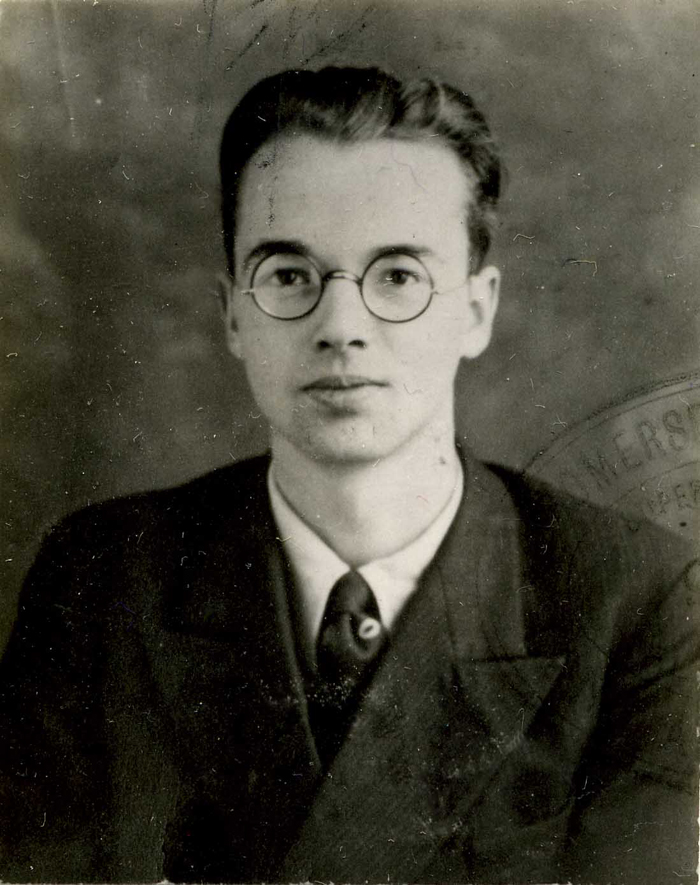

Fuchs was not the only source inside the Manhattan Project. The Venona decrypts, discussed in lesson 02, identified a young Los Alamos physicist, Theodore Hall, as another, and one decrypted 1944 message deals with Soviet intelligence's decision to keep in contact with him. David Greenglass, an Army enlisted man assigned to Los Alamos in 1944 and 1945 who worked in a machine shop there, was Ethel Rosenberg's younger brother. The FBI says his espionage was carried out under the instructions of Julius and Ethel Rosenberg.21 The FBI's own account of the case traces the chain: Fuchs's information led to the identification of Harry Gold, who confessed on May 22, 1950. "Investigation of Harry Gold's admissions led to the identification of David Greenglass," who was charged on June 16, 1950; and Greenglass's statements led to Julius Rosenberg's arrest on July 17, 1950 and Ethel Rosenberg's on August 11, 1950.21 Those arrests fall just after the period this lesson covers, and the Rosenberg trial is taken up in lesson 10.
How much did the spies matter? The Soviet Union tested its first bomb, called RDS-1 by the Soviets and "Joe-1" by the Americans, at Semipalatinsk on August 29, 1949.22 The Atomic Heritage Foundation's history of the Soviet program says Fuchs passed important information about the bomb's design and specifications and cites scholarship estimating that espionage sped the Soviet bomb by six months to two years.22 The same history quotes the congressional Joint Committee on Atomic Energy's judgment that "Fuchs alone has influenced the safety of more people and accomplished greater damage than any other spy."22 Both points are true together: Soviet scientists would have built a bomb without spies, and the spies helped them build it sooner and with less risk of failure.
1945: the secrets start coming out
During the war the Soviet Union was an ally, and Soviet espionage was not a public issue. Two defections in the autumn of 1945, one in Canada and one in the United States, changed that inside government, though it took years for the public to learn the details.
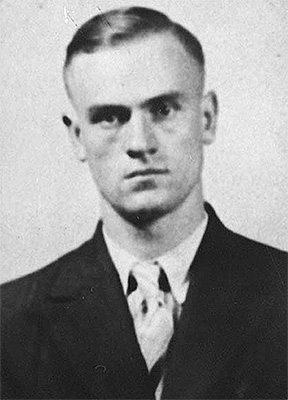
Igor Gouzenko in Ottawa, September 1945
Igor Gouzenko was a cipher clerk for Soviet military intelligence (the GRU), working in the Soviet embassy in Ottawa, where he coded and decoded the embassy's messages to and from Moscow. On September 5, 1945, he walked out of the embassy for the last time, carrying documents he had chosen over the previous weeks.23 The CBC's history of the affair says he took 109 documents, hidden under his shirt, and had marked the most important telegrams by bending their corners.24
His first attempts to defect went badly. According to the CBC account, a newspaper editor at the Ottawa Journal sent him to the police, the Department of Justice was closed, and Prime Minister William Lyon Mackenzie King, when informed, worried that a scandal would disrupt postwar relations with the Soviet Union. That night men from the Soviet embassy broke into the apartment where Gouzenko and his family were staying, Ottawa police and the Royal Canadian Mounted Police responded, and the Canadian government then granted the family protection and asylum.24 The affair was kept secret for about five months.24

The Canadian Royal Commission
When the story became public in early February 1946, the Canadian government acted quickly. By Order in Council P.C. 411 of February 5, 1946, it appointed two justices of the Supreme Court of Canada, Robert Taschereau and R. L. Kellock, as a Royal Commission "to Investigate the Facts Relating to and the Circumstances Surrounding the Communication, by Public Officials and Other Persons in Positions of Trust, of Secret and Confidential Information to Agents of a Foreign Power." The commission's final report is dated June 27, 1946, and runs to five parts.25
The Gouzenko documents pointed to Canadians in public office, government service and science who had passed information to Soviet military intelligence. Fred Rose, a communist member of Parliament, was convicted of spying for the Soviet Union and sentenced to six years.24 Accounts of how many people were detained, charged and convicted differ. One Canadian history site says thirteen people were detained in February 1946 and ten of twenty-three accused were found guilty. The CBC says twenty people were sent to trial and nine were acquitted. The Canadian Encyclopedia says the RCMP arrested thirty-nine suspects and eighteen were convicted.262423 The figures probably count different groups (detained, charged, tried) at different stages, and this lesson does not choose among them.
The Gouzenko affair also became an early civil liberties case. The RCMP made its arrests under the wartime emergency powers of the War Measures Act.23 The mathematician Israel Halperin, for example, was detained for five weeks without charge, questioned by the commission and later acquitted.24 The Canadian experience thus offered Americans both halves of the story that this module tells: a real spy network, and a response that brushed aside ordinary protections for the accused.
Elizabeth Bentley goes to the FBI, November 1945
Elizabeth Bentley was an American communist who worked as a courier for Soviet intelligence under Jacob Golos (also known as Jacob Raisin), her supervisor and lover, who oversaw couriers and sources.27 She approached the FBI in 1945 and, in November 1945, gave the Bureau a full account. On November 30, 1945 she signed a 108-page statement naming dozens of Soviet sources, which the Atomic Heritage Foundation counts as forty-one.28 Kathryn Olmsted's biography Red Spy Queen is the source usually cited for November 7, 1945 as the day her formal debriefing began.29
Bentley's information was explosive inside the government because it named people who held, or had held, responsible federal jobs. It also had a practical weakness. The CIA historian Michael Warner, reviewing Olmsted's biography, writes that Bentley's charges were "substantially correct and almost entirely unsubstantiated by any positive evidence" until the Venona decrypts were declassified in 1995. He adds that Kim Philby, the Soviet agent inside British intelligence, helped Soviet intelligence warn nearly all its operatives to lie low, which is why her leads had petered out by 1948.27 The FBI investigated her leads intensively, but, as Warner notes, by 1948 they had led nowhere that could support espionage charges in court.
Bentley's story became public in the summer of 1948, when she testified before congressional committees. That testimony, and the hearings in which Chambers named Alger Hiss, are covered in lessons 02 and 03. The point for this lesson is timing. By the end of 1945 the FBI and the Canadian government knew, from two independent defectors in two countries, that Soviet intelligence had run networks of sources inside North American governments. The public knew almost nothing until 1946 (Canada) and 1948 (the United States).
The postwar sequence, 1946 to 1950
For an American who read the newspapers, the four and a half years after Gouzenko's defection brought a steady run of events in which communist power advanced abroad and communist agents were exposed at home. None of these events proved that any particular American official was disloyal. Taken together, they made the claim that the government had been penetrated seem not only plausible but likely.
Fulton, Missouri: March 5, 1946
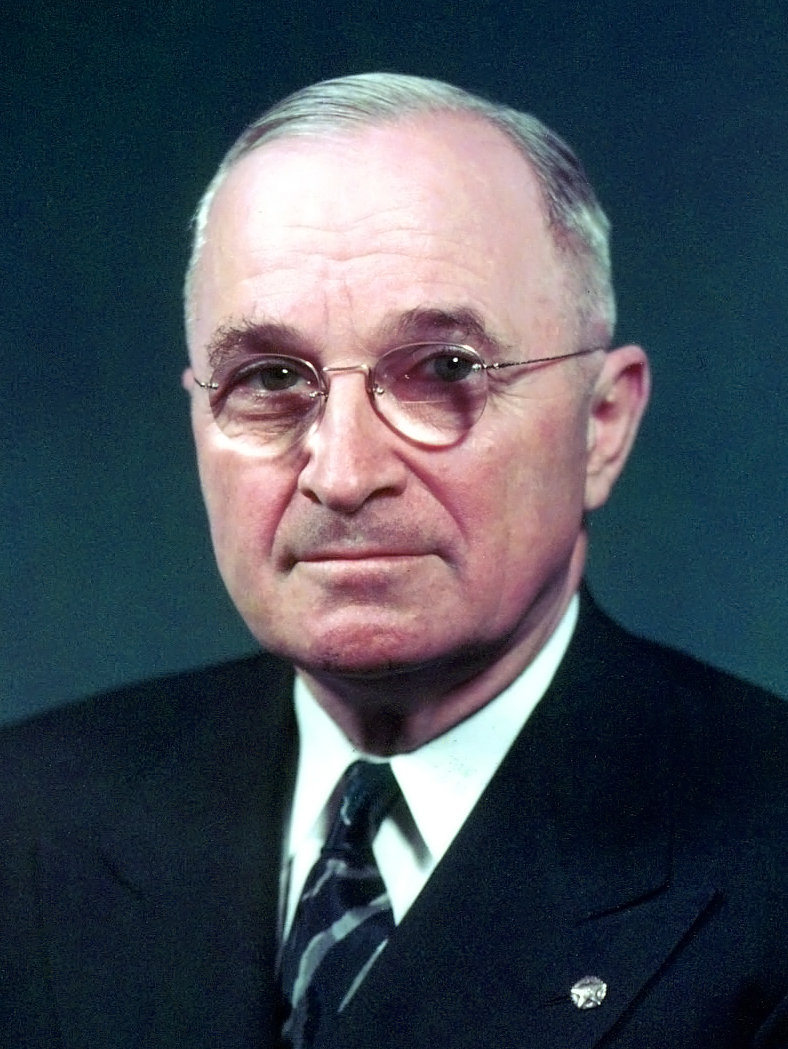
Winston Churchill spoke at Westminster College in Fulton, Missouri, on March 5, 1946. President Harry Truman attended, and both men received honorary degrees.30 His speech, which he titled "The Sinews of Peace," gave the era its most famous image: "From Stettin in the Baltic to Trieste in the Adriatic, an iron curtain has descended across the Continent."31 Less often remembered is the passage that spoke directly to the subject of this module. In a great number of countries "far from the Russian frontiers and throughout the world," Churchill said, "Communist fifth columns are established and work in complete unity and absolute obedience to the directions they receive from the Communist center."31 Coming from the wartime leader of Britain, with the American president in attendance, the charge that national communist parties were instruments of Soviet policy was no longer a fringe opinion.
The Truman Doctrine and the loyalty order, March 1947
On March 12, 1947, Truman asked a joint session of Congress for $400 million in aid to Greece and Turkey.32 "At the present moment in world history nearly every nation must choose between alternative ways of life," he said, and "I believe that it must be the policy of the United States to support free peoples who are resisting attempted subjugation by armed minorities or by outside pressures."3233 The speech committed the United States to resisting communist expansion abroad as a matter of policy.
Nine days later, on March 21, 1947, Truman signed Executive Order 9835, which created a loyalty program for the entire federal civilian workforce. Its standard for refusing or ending employment was that "reasonable grounds exists for belief that the person involved is disloyal" to the government of the United States.34 The order came after officials had learned what Gouzenko and Bentley knew, though the order itself does not mention them. It also directed the Department of Justice to furnish the loyalty boards with the name of each organization the Attorney General designated as "totalitarian, fascist, communist, or subversive," the origin of the Attorney General's list.34 The loyalty program is examined in lesson 03 and its costs in lesson 10. Its date matters here: the federal government's own loyalty apparatus was in place years before Joseph McCarthy took up the subject (lesson 05).

Prague, February 1948
Czechoslovakia came out of the war with a coalition government in which communists shared power with other parties. In February 1948 a group of non-communist ministers resigned during a government crisis, and in late February President Edvard Benes accepted their resignations and appointed a government on the communists' terms. Truman told Congress on March 17, 1948 that "The tragic death of the Republic of Czechoslovakia has sent a shock throughout the civilized world."35 For Americans, Prague was a demonstration of how a disciplined communist party inside a coalition government could take over a country without a foreign invasion. It was the scenario American anti-communists feared most.
Berlin, June 1948 to May 1949
On June 24, 1948, Soviet forces cut off rail, road and water access to the Allied-controlled sectors of Berlin. The Western Allies answered with an airlift that, at its peak, landed a plane at Tempelhof Airport about every forty-five seconds. The State Department's Office of the Historian gives May 12, 1949 as the end of the blockade in one place and says Moscow lifted it on May 11 in another.36 The blockade failed, but it showed that the Soviet Union was willing to use force short of war against the Western powers.
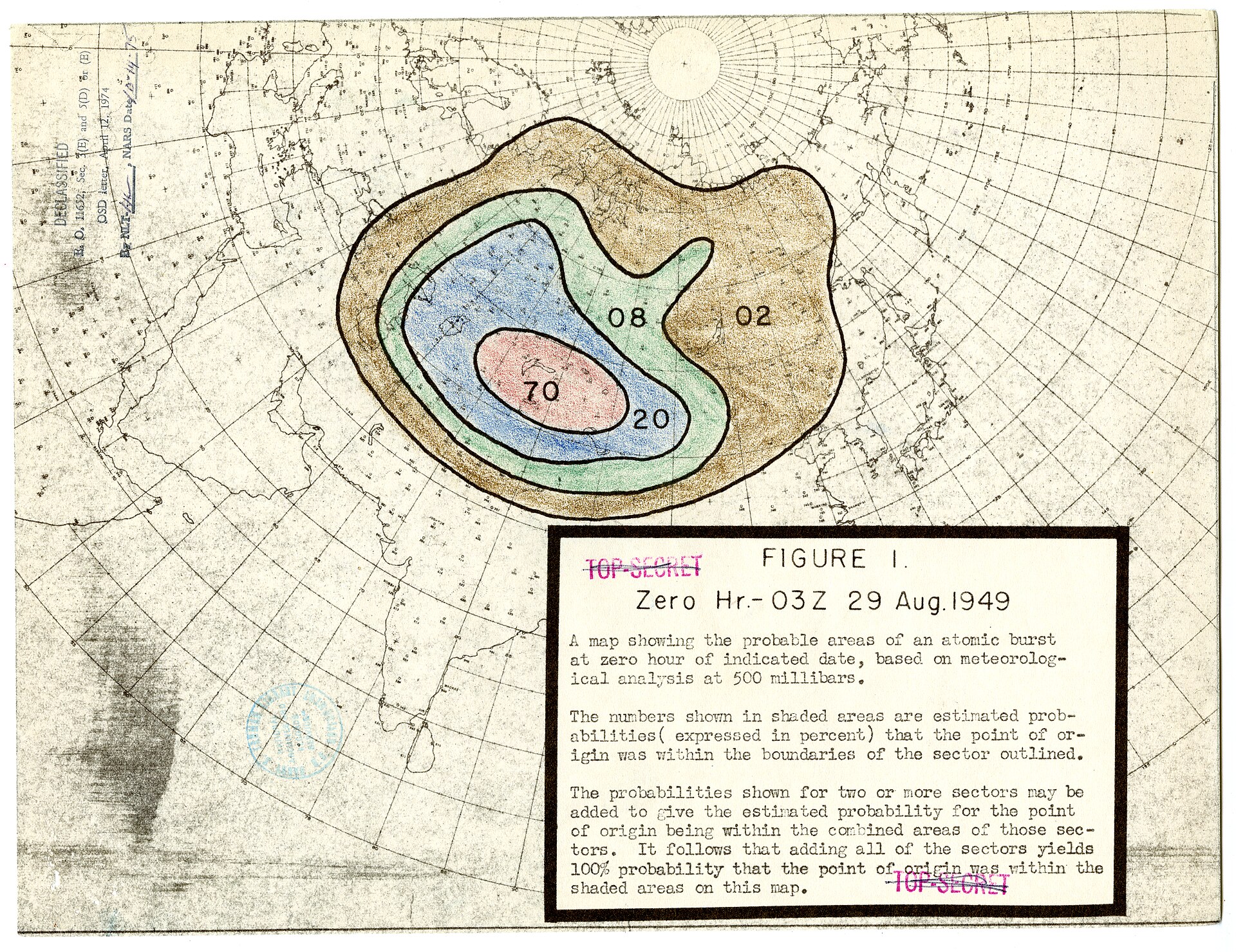
August 29, 1949: the Soviet bomb
The Soviet Union exploded its first atomic device at Semipalatinsk, in what is now Kazakhstan, on August 29, 1949.22 American monitoring detected radioactive traces of the explosion in the days that followed, and government scientists worked out what had happened (the map below is one of their estimates). On September 23, 1949, Truman told the country: "We have evidence that within recent weeks an atomic explosion occurred in the U.S.S.R."37 The statement added that the eventual development of atomic energy by other nations had always been expected.37 The public reaction was nonetheless a shock, and the question of how the Soviets had done it so soon was asked at once. Within five months it had a partial answer in the name Klaus Fuchs.

October 1, 1949: the People's Republic of China
On October 1, 1949, Mao Zedong proclaimed the People's Republic of China.38 The most populous country in the world was now ruled by a communist party allied with Moscow. Two months earlier, in August 1949, the Truman administration had published the "China White Paper," which argued that only Chinese forces could have decided the outcome of the civil war. The State Department's own history notes that the paper did not protect Truman from the charge that the United States had "lost" China.38 That charge, and the claim that disloyal or naive advisers in the State Department had helped bring it about, became central to McCarthy's accusations, and the cases of Owen Lattimore and the State Department's China specialists are examined in lesson 07.
January and February 1950: Hiss and Fuchs
On January 21, 1950, a federal jury found Alger Hiss, a former State Department official, "Guilty on two counts of perjury," and he was sentenced to five years in prison.39 The perjury charges concerned his sworn denials about his dealings with Chambers. To many Americans, the conviction meant that the man Chambers had named in 1948 had been a Soviet source inside the State Department. The Hiss case and its evidence, including the debate that continued for decades, are covered in lessons 02 and 03.
Days later the Fuchs case broke. MI5 began intercepting Fuchs's mail and telephone calls in July 1949 without finding anything incriminating, and its interviewer, William Skardon, confronted him in December 1949. He at first denied everything, then about a month later decided to talk, giving what MI5 calls "a lengthy though somewhat partial confession."20 The confession statement he signed is dated January 27, 1950.40 He was arrested in London on February 2, 1950, charged with espionage for the Soviet Union, pleaded guilty on March 1, and received the maximum sentence of fourteen years under the Official Secrets Act.41 The arrest of a scientist who had worked inside the Manhattan Project, announced less than five months after Truman revealed the Soviet bomb, joined the two events in the public mind. It also set the FBI on the trail of Harry Gold and the Rosenberg network.21
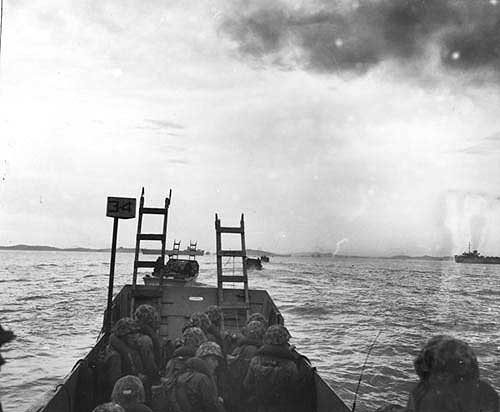
June 25, 1950: Korea
"War broke out along the 38th parallel on June 25, 1950," in the words of the National Archives, when North Korean forces invaded South Korea.42 Two days later Truman announced, "In these circumstances I have ordered United States air and sea forces to give the Korean Government troops cover and support," and he described the meaning of the attack in sweeping terms: "The attack upon Korea makes it plain beyond all doubt that communism has passed beyond the use of subversion" to conquer independent nations and would now use armed invasion and war.43 Within five years of the end of the Second World War, American soldiers were again fighting and dying, this time against an army equipped by the Soviet Union. Documents later released from Soviet files and published by the Wilson Center's Cold War International History Project include notes of a March 5, 1949 meeting between Stalin and a North Korean delegation led by Kim Il Sung and a March 17, 1949 agreement on a Soviet loan for military equipment.44 How directly Moscow planned and approved the June 1950 invasion is a question those archives address in detail, and this lesson does not settle it.

Why reasonable Americans in 1950 believed the government had been penetrated
Put the events in order and look at them from the point of view of a careful newspaper reader in the summer of 1950, someone with no access to secret files and no stake in either party. That reader knew the following.
- The Communist Party of the United States belonged to an international organization whose published rules required a hidden "illegal" apparatus, obedience to decisions made in Moscow, and support for the Soviet state.3
- The party had reversed its positions in step with Soviet interests in 1939 and again in 1941, in plain public view.1810
- A Soviet cipher clerk had exposed a Soviet spy ring inside the Canadian government, and a Canadian Royal Commission led by two supreme court justices had published its findings in 1946.25
- Two former communists, Chambers and Bentley, had testified under oath in 1948 that they had served Soviet networks inside the American government and had named names.1328
- One of the men Chambers named, Alger Hiss, had been convicted in January 1950 of lying under oath about it.39
- The Soviet Union had built an atomic bomb, ending the American monopoly, and a physicist from the Manhattan Project had confessed to giving the Soviets information about its design.3741
- Eastern Europe had fallen behind what Churchill called an iron curtain, Czechoslovakia had gone communist from within, Berlin had been blockaded, China had gone communist, and American soldiers were fighting communist forces in Korea.3135363842
- The President of the United States had himself created a loyalty program for every federal employee, which implied that the government believed there was a problem to find.34
From those facts, the conclusion that communists had penetrated the American government was not paranoid. It was a reasonable inference, and on the main point it was correct. What that reader could not know was just as important. The reader did not know that Army codebreakers, who began work on Soviet cables in February 1943 and needed almost two years to break the KGB's encryption, had been reading parts of Soviet intelligence traffic and identifying sources; that program, later named Venona, stayed secret until 1995.45 The reader did not know that Soviet intelligence, warned by Kim Philby after Bentley's defection, had told its American operatives to lie low, so that most of the networks Chambers and Bentley described had been closed down by the time they testified.27 And the reader did not know which of the hundreds of people now being accused were sources, which were former party members who had never spied, and which had nothing to do with communism at all. The fear in 1950 was a rational response to a real threat, formed with incomplete information about both the size of the threat and its timing. This is the climate in which Joseph McCarthy made his first accusations (lesson 04 and lesson 05).
What the anti-communists of the time got right
"Anti-communist" in the 1940s did not describe a single group. It included conservatives and liberals, Republicans and Democrats, Catholic and Protestant churches, union leaders, intelligence officers, and a remarkable number of former communists. On the core facts covered in this lesson, many of them were right before the documents proved it.
The former communists
Whittaker Chambers and Elizabeth Bentley were attacked in their own time as liars, fantasists or worse, and both had personal failings that their opponents exploited. On the central questions, the record has vindicated them. The Comintern files confirmed Chambers's account of the Washington underground and of J. Peters's role.8 Michael Warner of the CIA History Staff, summarizing the scholarly assessment of Bentley, writes that her charges were substantially correct, and that Venona supplied the positive evidence for them once it was declassified.27 Schrecker, the most prominent historian writing from the critics' side, said in 2000 that the evidence had convinced her of the guilt of the major communist spies.12 Chambers and Bentley knew what they knew because they had been inside, and their reports of how the party's secret apparatus fed Soviet intelligence were accurate.
The labor anti-communists
Some of the most effective anti-communists were union leaders who had fought communist factions for control of their own unions. Jay Lovestone, removed from the American party's leadership on Stalin's orders in 1929, became in 1944 the executive secretary of the American Federation of Labor's Free Trade Union Committee, a post arranged by David Dubinsky of the International Ladies' Garment Workers' Union, from which he worked against communist influence in labor movements in Europe and elsewhere.46 In the Congress of Industrial Organizations, leaders such as Walter Reuther of the United Auto Workers moved against communist-led unions, and Reuther's union signed the Taft-Hartley affidavits and competed with communist-led unions for members. At its eleventh convention in 1949 the CIO expelled the United Electrical, Radio and Machine Workers (UE) and the Farm Equipment Workers, and in 1950 it expelled nine more after internal hearings.4748
The labor anti-communists' central claim was that communist union officials put the party's line ahead of their members' interests. The Pact period gave them their strongest evidence, with the 1941 Allis-Chalmers strike as the example Congress heard most about. Congress accepted that argument when it wrote the non-communist affidavit into the Taft-Hartley Act in 1947, requiring union officers who wanted the protection of the National Labor Relations Board to swear "that he is not a member of the Communist Party or affiliated with such party," and the Supreme Court upheld the requirement in 1950 on the strength of the evidence Congress had gathered about "political strikes."19 Whether the affidavit was wise is a separate question, examined in lessons 09 and 12. The factual premise, that communist union leaders had followed party orders in at least some major cases, was supported by the evidence Congress heard.
Officials and allies
Churchill's charge at Fulton that national communist parties acted "in complete unity and absolute obedience" to Moscow was, for the American party, close to what the archives later showed.3110 The Canadian Royal Commission, working from documents a defector had carried out of the Soviet embassy, established in 1946 what American officials would take years to prove in their own country.25 And the Army codebreakers who started the Venona program in February 1943, while the Soviet Union was still an ally, made the most important counterintelligence discovery of the period.45
Where the fear went beyond the evidence
A fair account has to apply the same test to the fears that it applies to the facts. Several beliefs that were common in 1950 were broader than what the evidence then supported, and in some cases broader than what it supports now.
The timing problem: a threat that was largely past
The most important gap between perception and reality was timing. The Soviet networks in Washington flourished in the 1930s and during the war. By the time Americans heard about them in 1948, the networks had been dismantled. Warner's summary is that Soviet intelligence, alerted through Philby, warned nearly all its operatives to lie low after Bentley's defection in late 1945, which is why her leads had petered out by 1948.27 The government's own loyalty program had been running since 1947.34 The fear of 1950 treated the penetration as a present and growing danger. On the evidence now available, the danger was real but mostly past, and the people most responsible for ending it were defectors, FBI agents and codebreakers working in secret, not the congressional investigators who became famous afterward.
The membership problem: party members were not all spies
The second gap concerned who was dangerous. The party's secret apparatus fed Soviet intelligence, and some members became spies. Most members did not. The Library of Congress describes the party as a small, sectarian movement that was never a major political force, with a membership that rose and fell with the party line.1 The distinction is central to the critics' case. Schrecker, who accepts the guilt of the major spies, still judges that McCarthyism "did more damage to the constitution than the American Communist party ever did," and later lessons of this module test that judgment against the record of who was actually accused.12 Treating membership, past membership, or association as proof of espionage went beyond the evidence in 1950 and still does.
The bomb problem: spies helped, but did not build it
The belief that the Soviet Union had the bomb only because of traitors overstated the case. The Soviets had their own scientists and their own program. The Atomic Heritage Foundation cites scholarship estimating that espionage shortened the Soviet effort by six months to two years, which is a serious gain but not the difference between having a bomb and never having one.22
The China problem: "lost" by whom?
The claim that China was "lost" because of disloyal Americans is the clearest case of a fear outrunning its evidence. The State Department argued in the 1949 White Paper that only Chinese forces could decide the civil war.38 Whether particular American advisers gave bad advice, and whether any of them were influenced by Soviet sources, are questions about specific people, examined in lesson 07. The broader claim that American traitors delivered China to Mao has no support in the documents released since.
The monolith problem
Finally, many Americans in 1950 saw every communist advance, from Prague to Pyongyang, as a single plan directed from Moscow. For the American party, the archives show that this picture was close to the truth: Moscow paid for it and set its line.10 For the communist world as a whole, the picture was less accurate. Yugoslavia's communist government broke with Stalin, and Chinese and Soviet interests later diverged sharply. Those developments lie outside this lesson, but they are a reminder that a threat can be real while particular descriptions of it are too simple.
What the record shows and what it does not
Documented fact.
- The Comintern's published membership terms required a parallel illegal organization, made Comintern decisions binding, and obliged member parties to support Soviet republics.3
- The American Communist Party was organized in 1919, merged under Comintern pressure, and was funded by the Soviet Union from its first years until 1988.4111
- Stalin personally intervened in 1929 to replace the American party's leadership.6
- The party had a secret apparatus that worked with Soviet intelligence.89
- Klaus Fuchs gave atomic bomb design information to the Soviet Union and confessed in January 1950.2040
- Gouzenko's documents exposed a Soviet network in Canada, investigated by a Royal Commission whose report is dated June 27, 1946.25
- Bentley gave the FBI a detailed account in November 1945 that later evidence largely confirmed.2827
Allegation, contested or partly supported.
- That Soviet espionage was still a large, active threat inside the government in 1950. The evidence points to networks largely shut down by 1948.27
- That communist union leaders generally put Moscow's line ahead of their members. Supported for the 1939 to 1941 period and for specific cases such as Allis-Chalmers as presented to Congress; the extent across all unions is disputed.19
- That China was "lost" through American disloyalty. Not supported by the evidence.38
Open question.
- The exact numbers of people detained, charged and convicted after the Gouzenko defection; published accounts disagree.262423
- How much Moscow directed the timing of the June 1950 invasion of South Korea, as distinct from supplying and approving it; this lesson does not rule on it.44
- Party membership in 1950. Estimates vary, and none was verified for this lesson.
Assessed from 2026
Each claim below was widely made by American anti-communists between 1945 and 1950. Each is rated on the evidence now available.
- "The American Communist Party is controlled and financed by Moscow." Supported. The Comintern's own rules required obedience. Stalin replaced the American leadership in 1929. The opened archives show subsidies from 1919 to 1988 and Moscow's hand in the 1945 Duclos article.361011
- "The party is not an ordinary political party; it runs a secret apparatus." Supported. The Twenty-One Conditions called for one, and the Comintern files document its existence and its links to Soviet espionage.38
- "Soviet agents have penetrated the federal government." Supported, for the 1930s and the war years. Chambers's testimony about the Ware group and Bentley's statement to the FBI were later confirmed in their essentials by the Comintern records and the Venona decrypts, as even critics of McCarthyism such as Schrecker accepted.132712
- "The penetration is ongoing and growing in 1950." Unsupported. The available evidence shows that Soviet intelligence shut down its American networks after Bentley's defection, and that her leads had gone dead by 1948.27
- "Spies gave the Soviet Union the atomic bomb." Partly supported. Fuchs and others passed important design information, and scholarship cited by the Atomic Heritage Foundation estimates the gain at six months to two years. The Soviets would have built the bomb regardless.2022
- "Communist union leaders take orders from the party, not their members." Partly supported. True in documented cases and during the Pact period; the Supreme Court in Douds accepted that Congress had evidence for it but expressly declined to assess each item. Not every union led by communists is shown to have behaved this way, and whether the affidavit also caught militant leaders who were not taking orders from the party is taken up in lessons 09 and 10.19
- "National communist parties are Soviet fifth columns" (Churchill, 1946). Supported for the American party; Partly supported as a worldwide generalization. The American evidence fits. The later Yugoslav and Chinese breaks with Moscow show the limits of the generalization.3110
- "China was lost because of disloyal Americans." Unsupported. The civil war was decided by Chinese forces, as the State Department argued at the time. Specific accusations against individuals are assessed in lesson 07.38
- "Any communist, past or present, is a security risk equal to a spy." Unsupported. Most members were never part of the secret apparatus, and many left the party over the Pact or later.112
- "The party is a mass movement capable of taking power in the United States." Refuted. At its peak the party had perhaps 75,000 to 80,000 members and, in the Library of Congress's judgment, never became a major political force.1
Hard questions and answers
If the networks were shut down by 1948, was the fear of 1950 irrational?
No. A citizen in 1950 had no way to know that the networks had gone quiet. That knowledge sat in Soviet files and in the classified Venona program, which was not made public until 1995.45 The evidence the public did have, from Gouzenko to Hiss to Fuchs, pointed toward a serious, recent and possibly continuing problem. The fear was rational given the information available. The question for later lessons is whether officials who had more information, and the investigators who claimed to have it, behaved responsibly with what they knew.
Doesn't the Soviet funding prove every communist was a foreign agent?
It proves the party as an organization served a foreign government, which is what anti-communists said and what many of the party's defenders denied for decades.1110 It does not prove that every member knew about the money, the secret apparatus or the espionage. The Twenty-One Conditions themselves describe the illegal organization as running parallel to the legal party, and the documents discussed in this lesson concern the party's leaders and its secret apparatus, not its rank and file.3 Individual guilt has to be shown individually, which is the standard this module applies.
Why should Chambers and Bentley be believed, when they were former communists and later earned money from their stories?
Their motives were questioned at the time, and fairly. The answer from 2026 is that their accounts can now be checked against documents they never saw: the Comintern files in Moscow and the Venona decrypts held by the National Security Agency. On the main points those documents agree with them.827 That does not mean every detail they gave was right, and later lessons note where their testimony has been questioned.
Were the labor anti-communists just settling scores?
Some were fighting for control of their unions, and those fights were rough on both sides. They also knew from direct experience what the Pact period had looked like inside the unions, and their central factual claim, that some communist union leaders followed party orders even when it hurt their members, is supported by the record Congress compiled and the Supreme Court accepted in 1950.19 The CIO's expulsions of 1949 and 1950 were carried out by the CIO's own elected leadership, not by outside investigators.47
Does the real threat justify what came next?
Not automatically. A real threat answers the question "was there anything to investigate?" It does not answer the separate questions of whether particular accusations were true, whether particular methods were fair, or whether the response was proportionate. Those are the subjects of lessons 05 through 12. Pierson's framework of ordered liberty, set out in Module 52, lesson 01 and lesson 02, is the frame this module uses for weighing a real danger against the limits on the power used to meet it.
How did this play out in a state like Idaho?
Idaho had its own communist organizing and its own Red Scare politics, including Senator Glen Taylor and Senator Herman Welker, who voted against McCarthy's censure and made his own claim about "87 communists." Those stories are told in Module 74, lesson 04 and lesson 06.
Where this module goes next
This lesson has made the case that the threat was real. Lesson 02, Venona and the Archives: What We Know Now, examines the decrypts and the KGB notebooks source by source, including what they show about Hiss, Harry Dexter White, the Rosenbergs and others. Lesson 03, The Machinery Before McCarthy, covers the Dies committee and HUAC, the Hollywood Ten, the federal loyalty program, the Smith Act prosecutions and the Hiss case, all of which were in place before Joseph McCarthy said a word about communism. Readers who want the economic and philosophical background should start with Module 51, lesson 07 and Module 58, lesson 09.
Still open
These items could not be confirmed against a primary source before publication. The lesson states them as open, and they stay on the fact-check list.
- The exact day Elizabeth Bentley's formal FBI debriefing began (November 7, 1945) comes from Kathryn Olmsted's Red Spy Queen as cited in secondary sources; the book itself was not opened. The month (November 1945) and the November 30, 1945 signed statement are confirmed by the Atomic Heritage Foundation.
- Chambers's meeting with Adolf Berle is dated to September 1939 from Chambers's memoir Witness as cited in secondary sources; the exact day (often given as September 2, 1939) was not confirmed from a primary source.
- The FBI interviews of Chambers in the early 1940s (reported as May 1942 and June 1945) rest on secondary sources.
- Numbers of people detained, charged and convicted after the Gouzenko defection differ across the sources consulted (13 detained and 10 of 23 convicted; 20 tried and 9 acquitted; 39 arrested and 18 convicted). The lesson reports the disagreement and does not choose.
- The 109 documents Gouzenko took is from the CBC history; the Canadian Encyclopedia gives no number. The Royal Commission report itself could not be opened (the PDF host returned a script challenge).
- The date President Benes accepted the resignations in Prague (February 25, 1948) is widely given but was confirmed only from Wikipedia; the lesson says 'late February 1948.'
- The Office of the Historian gives both May 11 and May 12, 1949 for the end of the Berlin blockade.
- The 1944 membership figure of about 80,000 is the party's own claim as reported in Sworakowski, World Communism: A Handbook (1973), p. 472, via secondary sources; it was not checked against the book. No 1950 membership figure was verified, so none is given.
- The CIO's 1949 expulsion of the UE and the Farm Equipment Workers and the 1950 expulsion of nine more unions rest on a Bureau of Labor Statistics Monthly Labor Review report (December 1949) located through Wikipedia but not opened, and on secondary accounts. Walter Reuther's role is described from secondary sources.
- Jay Lovestone's 1944 appointment to the AFL Free Trade Union Committee rests on Wikipedia's account citing the New York Times obituary (March 9, 1990) and Ted Morgan's biography; the obituary page was blocked and not opened.
- The Reed payment is described as worth more than $1 million (Christian Science Monitor) and as jewels worth one million rubles (Tanenhaus); the two figures were not reconciled.
- Yugoslavia's break with Stalin and the later Sino-Soviet divergence are mentioned without a footnote as general context.
- Commons pages for the images could not be fetched during this task; captions rely on the IMAGES.md metadata (Gouzenko photo dated 1946; Joe-1 chart dated September 29, 1949; Inchon photo dated September 15, 1950 per the official Marine Corps caption; Fuchs photo date not established).
- Some context sentences carry no footnote and rest on general secondary knowledge: Browder's reasoning for dissolving the party in 1944, the party's adoption of the CPUSA name by the end of the 1920s, and the description of the Popular Front coalitions in the United States.
- The Hiss sentence (five years) is from the FBI history page, which gives January 21, 1950 for both verdict and sentence; other accounts date the sentencing a few days later. The lesson gives the verdict date only.
- The Wilson Center collection opened for this lesson covers 1947 to 1949; documents on Stalin's approval of the 1950 invasion were not opened, so the lesson leaves the question of Moscow's direction of the June 1950 attack open.
- Randi Storch's October 2000 Perspectives article was not opened in the fact check; her position is reported only through Haynes's January 2001 reply, which quotes the phrase 'carefully selected documents.'
Learn more
- Library of Congress: Revelations from the Russian Archives: The Library's exhibit of documents from the opened Soviet archives, with translations, on the Comintern and the American party.
- NSA: Venona historical releases: The government's own release of the Venona translations; the starting point for lesson 02.
- Truman Library: Executive Order 9835: The full text of the 1947 loyalty order, worth reading before lesson 03.
- Ellen Schrecker, comments on Haynes (Journal of Cold War Studies, 2000): A leading critic of McCarthyism concedes the espionage evidence while defending her judgment of the Red Scare.
- Sam Tanenhaus, Keeping the Faith (NYRB, 1998): A readable account of what The Soviet World of American Communism found, by Chambers's biographer.
- Canadian Royal Commission report (1946): The Kellock-Taschereau report on the Gouzenko documents, in five PDF parts.
- Module 51, lesson 07: Communism: The economic system and its record.
- Module 74, lesson 04: Communists in Idaho: A state-level case study of what communist organizing looked like.
Notes
- Library of Congress, Revelations from the Russian Archives, exhibit section "Soviet Union and the United States" (1992; online exhibit). Read it online. ↩
- "The Third or 'Communist' International," Seventeen Moments in Soviet History, Michigan State University (on the founding of the Comintern in March 1919 and the Twenty-One Conditions of July to August 1920). Read it online. ↩
- V. I. Lenin, "Terms of Admission into Communist International," written July 1920, first published in The Second Congress of the Communist International, Verbatim Report (Petrograd, 1921); text at Marxists Internet Archive. Lenin's draft has nineteen points; the congress adopted twenty-one. Read it online. ↩
- Marxists Internet Archive, "Early American Marxism: Communist Party of America History Page" (convention dates and documents, 1919 to 1929). Read it online. ↩
- "Red Ink," Library of Congress Information Bulletin 60, no. 2 (February 2001), on the acquisition of the CPUSA records microfilm (435,165 frames on 326 reels). Read it online. ↩
- J. V. Stalin, speeches on the American Communist Party to the American Commission of the Presidium of the ECCI (May 6, 1929) and to the Presidium of the ECCI (May 14, 1929); text at Marxists Internet Archive. Read it online. ↩
- John Earl Haynes, letter on "the history of the CPUSA," Perspectives on History, American Historical Association, January 2001. Read it online. ↩
- Mark Falcoff, review of Harvey Klehr, John Earl Haynes and Fridrikh Igorevich Firsov, The Secret World of American Communism (Yale University Press, 1995), Commentary (1995). Read it online. ↩
- Ron Scherer, "Soviet Archives Detail How US Communists Aided USSR," Christian Science Monitor, April 11, 1995 (report on The Secret World of American Communism). Read it online. ↩
- Sam Tanenhaus, "Keeping the Faith," New York Review of Books, June 25, 1998 (review of Harvey Klehr, John Earl Haynes and Kyrill M. Anderson, The Soviet World of American Communism, Yale University Press, 1998). Read it online. ↩
- John Earl Haynes, "Q&A with John Earl Haynes, Part I: Soviet Subsidies in America, Guilty Spies, and Karelian Fever," Victims of Communism Memorial Foundation blog, as reproduced by Isegoria, May 16, 2016. Read it online. ↩
- Ellen W. Schrecker, "Comments on John Earl Haynes', 'The Cold War Debate Continues: A Traditionalist View of Historical Writing on Domestic Communism and Anti-Communism,'" Journal of Cold War Studies 2, no. 1 (Winter 2000). Read it online. ↩
- Testimony of Whittaker Chambers, August 3, 1948, in U.S. House of Representatives, Committee on Un-American Activities, Hearings Regarding Communist Espionage in the United States Government, 80th Congress, 2nd session (transcript excerpt reproduced by Hillsdale College). Read it online. ↩
- Whittaker Chambers, Witness (New York: Random House, 1952), pp. 463 to 470, on the September 1939 meeting with Adolf Berle; Berle's notes were later trial evidence. Cited from secondary references; the book was not opened for this lesson. Read it online. ↩
- Georgi Dimitrov, "The Fascist Offensive and the Tasks of the Communist International in the Struggle of the Working Class against Fascism," main report to the Seventh World Congress of the Communist International, August 2, 1935; text at Marxists Internet Archive. Read it online. ↩
- Treaty of Nonaggression between Germany and the Union of Soviet Socialist Republics, Moscow, August 23, 1939, in Nazi-Soviet Relations 1939 to 1941 (U.S. Department of State, 1948); Avalon Project, Yale Law School. Read it online. ↩
- Secret Additional Protocol, Moscow, August 23, 1939, in Nazi-Soviet Relations 1939 to 1941 (U.S. Department of State, 1948); Avalon Project, Yale Law School. Read it online. ↩
- Swarthmore College Peace Collection, "American Peoples Mobilization Collected Records, 1940 to 1941," historical note (Chicago conference August 31 to September 2, 1940; White House picket; June 22, 1941 change of name and position). Read it online. ↩
- American Communications Association v. Douds, 339 U.S. 382 (decided May 8, 1950), opinion of Chief Justice Vinson, quoting Section 9(h) of the National Labor Relations Act as amended by the Labor Management Relations Act of 1947 and summarizing the evidence before Congress. Read it online. ↩
- MI5 (Security Service), "Klaus Fuchs," history page, "The Cold War" section. Read it online. ↩
- Federal Bureau of Investigation, "Atom Spy Case/Rosenbergs," FBI History: Famous Cases and Criminals. Read it online. ↩
- Atomic Heritage Foundation (National Museum of Nuclear Science and History), "Soviet Atomic Program, 1946," June 5, 2014 (date and site of the first Soviet test; estimates of espionage's effect; Joint Committee on Atomic Energy quotation). Read it online. ↩
- "Igor Sergeievich Gouzenko," The Canadian Encyclopedia (Historica Canada). Read it online. ↩
- "Soviet Spy Scandal," Canada: A People's History, CBC (episode 15). Read it online. ↩
- Canada, Privy Council, The Report of the Royal Commission Appointed under Order in Council P.C. 411 of February 5, 1946 to Investigate the Facts Relating to and the Circumstances Surrounding the Communication, by Public Officials and Other Persons in Positions of Trust, of Secret and Confidential Information to Agents of a Foreign Power (Commissioners Robert Taschereau and R. L. Kellock), Ottawa, June 27, 1946; Government of Canada Publications catalogue record. Read it online. ↩
- "Gouzenko Affair," History of Rights (historyofrights.ca), section 4. Read it online. ↩
- Michael Warner, CIA History Staff, review of Kathryn S. Olmsted, Red Spy Queen: A Biography of Elizabeth Bentley (University of North Carolina Press, 2002), Studies in Intelligence 47, no. 2 (2003). Read it online. ↩
- Atomic Heritage Foundation (National Museum of Nuclear Science and History), "Elizabeth Bentley," profile and timeline. Read it online. ↩
- Kathryn S. Olmsted, Red Spy Queen: A Biography of Elizabeth Bentley (Chapel Hill: University of North Carolina Press, 2002), chapter on her defection; the November 7, 1945 date is cited from this book by secondary sources and was not checked in the book itself. The link is to Michael Warner's review of the book, which gives only November 1945. Read it online. ↩
- National Churchill Museum, "Sinews of Peace: History" (Truman's attendance and honorary degrees, March 5, 1946). Read it online. ↩
- Winston S. Churchill, "The Sinews of Peace," address at Westminster College, Fulton, Missouri, March 5, 1946; text at the National Churchill Museum. Read it online. ↩
- Harry S. Truman, address before a joint session of Congress, March 12, 1947 (the Truman Doctrine); National Archives, Milestone Documents. Read it online. ↩
- Office of the Historian, U.S. Department of State, "The Truman Doctrine, 1947," Milestones in the History of U.S. Foreign Relations. Read it online. ↩
- Executive Order 9835, "Prescribing Procedures for the Administration of an Employees Loyalty Program in the Executive Branch of the Government," March 21, 1947; Harry S. Truman Library. Read it online. ↩
- Harry S. Truman, "Special Message to the Congress on the Threat to the Freedom of Europe," March 17, 1948, Public Papers of the Presidents, no. 52; Harry S. Truman Library. Read it online. ↩
- Office of the Historian, U.S. Department of State, "The Berlin Airlift, 1948 to 1949," Milestones in the History of U.S. Foreign Relations. Read it online. ↩
- Harry S. Truman, "Statement by the President Announcing the First Atomic Explosion in the U.S.S.R.," September 23, 1949, Public Papers of the Presidents, no. 216; Harry S. Truman Library. Read it online. ↩
- Office of the Historian, U.S. Department of State, "The Chinese Revolution of 1949," Milestones in the History of U.S. Foreign Relations. Read it online. ↩
- Federal Bureau of Investigation, "Alger Hiss," FBI History: Famous Cases and Criminals. Read it online. ↩
- The National Archives (UK), "Klaus Fuchs confesses," Cold War on File (confession statement dated January 27, 1950). Read it online. ↩
- Foreign Relations of the United States, 1950, vol. I, National Security Affairs; Foreign Economic Policy, editorial note, document 163 (Fuchs arrest February 2, 1950; guilty plea March 1; fourteen-year sentence). Read it online. ↩
- National Archives, "Teaching With Documents: The Korean Conflict" ("War broke out along the 38th parallel on June 25, 1950"). Read it online. ↩
- Harry S. Truman, "Statement by the President on the Situation in Korea," June 27, 1950, Public Papers of the Presidents, no. 173; Harry S. Truman Library. Read it online. ↩
- Wilson Center Digital Archive, Cold War International History Project, collection "Korean War Origins, 1945 to 1950" (includes notes of the March 5, 1949 Stalin meeting with Kim Il Sung's delegation and the March 17, 1949 Soviet loan agreement for military equipment). Read it online. ↩
- National Security Agency, "Venona," Declassification and Transparency Initiatives, Historical Releases (program begun February 1943; first public release July 1995; about 3,000 translations released in six releases). Read it online. ↩
- On Lovestone's later labor career: "Jay Lovestone," Wikipedia (used to locate sources), citing Glenn Fowler, "Jay Lovestone, Communist Leader Who Turned Against Party, Dies," New York Times, March 9, 1990, and Ted Morgan, A Covert Life (Random House, 1999); the 1929 events are documented in Stalin's speeches (note on Stalin, May 1929). Read it online. ↩
- U.S. Bureau of Labor Statistics, "Eleventh Convention of the CIO," Monthly Labor Review 69, no. 6 (December 1949): 640 to 645, on the expulsion of the UE and the Farm Equipment Workers; the 1950 expulsions of nine further unions are reported in secondary sources. This report was located through secondary sources and not opened for this lesson. Read it online. ↩
- University of Washington, Mapping American Social Movements Project, "CIO unions, 1937 to 1955" (on the UE's leadership and its decline in the early 1950s). Read it online. ↩
Check yourself
1. Which requirement appears in Lenin's July 1920 draft of the terms of admission to the Communist International?
Lenin's draft says member parties "must everywhere build up a parallel illegal organisation," and it makes Comintern decisions binding on all affiliated parties.
2. According to the Library of Congress exhibit, about how many members did the two American communist parties have when the Comintern forced them to merge in 1922?
The exhibit says the two parties consisted of about 12,000 members in 1922; membership rose to about 75,000 by 1938.
3. What did the Soviet archives show about Soviet subsidies to the American Communist Party?
Haynes said the subsidies were larger and longer-lasting than expected, ending only in 1988 with a $3 million secret payment; Reed received jewels in 1919 and 1920.
4. How did Whittaker Chambers describe the original purpose of the Ware group in his August 3, 1948 testimony?
Chambers said its purpose "was not primarily espionage" but "the Communist infiltration of the American Government," though espionage "was certainly one of its eventual objectives."
5. What happened on September 5, 1945 in Ottawa?
Gouzenko, a cipher clerk for Soviet military intelligence, defected on September 5, 1945; the Royal Commission report is dated June 27, 1946.
6. Why did Elizabeth Bentley's leads produce few results by 1948, according to CIA historian Michael Warner?
Warner credits Philby with helping Soviet intelligence warn nearly all its operatives to lie low after her defection.
7. Which is the correct order of these events?
Fulton was March 5, 1946; the Truman Doctrine March 12, 1947; the Czech takeover February 1948; the Soviet test August 29, 1949.
8. On the evidence now available, how does this lesson rate the 1950 claim that Soviet penetration of the government was ongoing and growing?
Penetration in the 1930s and war years is supported, but the evidence shows Soviet intelligence shut down its networks after late 1945, and Bentley's leads had gone dead by 1948.
Terms in this lesson
- Bolsheviks
- Lenin's faction of the Russian Social Democratic movement, which seized power in Petrograd in November 1917 and renamed itself the Russian Communist Party (Bolshevik) in March 1918.
- Comintern
- The Communist International, or Third International, founded in Moscow in March 1919 to direct communist parties abroad; dissolved in 1943.
- Twenty-One Conditions
- The terms of membership adopted at the Comintern's Second Congress in July and August 1920, including binding Comintern decisions, a parallel illegal organization and support for Soviet republics.
- CPUSA
- The Communist Party of the United States of America, formed from the merger of the rival parties founded in Chicago in 1919, after several changes of name.
- Secret apparatus
- The hidden side of the American Communist Party, separate from its public organization, which Comintern files show was linked to Soviet espionage.
- Ware group
- The underground organization of party members in 1930s Washington that Whittaker Chambers described in 1948, developed by Harold Ware, aimed first at infiltration and later at espionage.
- Popular Front
- The Comintern line announced in 1935 calling for broad alliances against fascism, the period of the American party's greatest growth.
- Nazi-Soviet Pact
- The nonaggression treaty signed by Germany and the Soviet Union on August 23, 1939, with a secret protocol dividing Eastern Europe; the American party reversed its line to follow it.
- Infiltration and espionage
- Chambers's distinction: infiltration is placing party members in government jobs to influence policy; espionage is passing secret material to a foreign intelligence service.
- Gouzenko affair
- The exposure of a Soviet military intelligence network in Canada after cipher clerk Igor Gouzenko defected in Ottawa on September 5, 1945, investigated by the Kellock-Taschereau Royal Commission.
- Executive Order 9835
- Truman's order of March 21, 1947 creating a loyalty program for federal civilian employees and the basis of the Attorney General's list of designated organizations.
- Venona
- The secret U.S. Army and later NSA program, begun in February 1943, to read Soviet intelligence cables; its translations were released from 1995.
- Section 9(h) affidavit
- The 1947 Taft-Hartley requirement that union officers seeking NLRB protection swear they were not Communist Party members, upheld in American Communications Association v. Douds (1950).
Sources
- Library of Congress, Revelations from the Russian Archives, exhibit section "Soviet Union and the United States" (1992; online exhibit). (1992 (exhibit)) checked 2026-10
- "The Third or 'Communist' International," Seventeen Moments in Soviet History, Michigan State University (undated web essay) checked 2026-10
- V. I. Lenin, "Terms of Admission into Communist International," written July 1920, first published in The Second Congress of the Communist International, Verbatim Report (July 1920) checked 2026-10
- Marxists Internet Archive, "Early American Marxism: Communist Party of America History Page" (convention dates and documents, 1919 to 1929). (1919 to 1929 documents) checked 2026-10
- "Red Ink," Library of Congress Information Bulletin 60, no. 2 (February 2001) checked 2026-10
- J. V. Stalin, speeches on the American Communist Party to the American Commission of the Presidium of the ECCI (May 6 and 14, 1929) checked 2026-10
- John Earl Haynes, letter on "the history of the CPUSA," Perspectives on History, American Historical Association, January 2001. (January 2001) checked 2026-10
- Mark Falcoff, review of Harvey Klehr, John Earl Haynes and Fridrikh Igorevich Firsov, The Secret World of American Communism (1995) checked 2026-10
- Ron Scherer, "Soviet Archives Detail How US Communists Aided USSR," Christian Science Monitor, April 11, 1995 (April 11, 1995) checked 2026-10
- Sam Tanenhaus, "Keeping the Faith," New York Review of Books, June 25, 1998 (June 25, 1998) checked 2026-10
- John Earl Haynes, "Q and A with John Earl Haynes, Part I: Soviet Subsidies in America, Guilty Spies, and Karelian Fever" (as reproduced by Isegoria) (May 16, 2016) checked 2026-10
- Ellen W. Schrecker, comments on John Earl Haynes, "The Cold War Debate Continues," Journal of Cold War Studies 2, no. 1 (Winter 2000) checked 2026-10
- Testimony of Whittaker Chambers, HUAC, Hearings Regarding Communist Espionage in the United States Government, August 3, 1948 (transcript excerpt) (August 3, 1948) checked 2026-10
- Whittaker Chambers, Witness (Random House, 1952) (1952) checked 2026-10
- Georgi Dimitrov, "The Fascist Offensive and the Tasks of the Communist International," report to the Seventh World Congress (August 2, 1935) checked 2026-10
- Treaty of Nonaggression between Germany and the Union of Soviet Socialist Republics, Moscow, August 23, 1939, in Nazi-Soviet Relations 1939 to 1941 (August 23, 1939) checked 2026-10
- Secret Additional Protocol, Moscow, August 23, 1939, in Nazi-Soviet Relations 1939 to 1941 (August 23, 1939) checked 2026-10
- Swarthmore College Peace Collection, "American Peoples Mobilization Collected Records, 1940 to 1941," historical note (1940 to 1941 records) checked 2026-10
- American Communications Association v. Douds, 339 U.S. 382 (May 8, 1950) checked 2026-10
- MI5 (Security Service), "Klaus Fuchs," history page, "The Cold War" section. (undated web page) checked 2026-10
- Federal Bureau of Investigation, "Atom Spy Case/Rosenbergs," FBI History: Famous Cases and Criminals. (undated web page) checked 2026-10
- Atomic Heritage Foundation, "Soviet Atomic Program, 1946" (June 5, 2014) checked 2026-10
- "Igor Sergeievich Gouzenko," The Canadian Encyclopedia (Historica Canada). (undated web article) checked 2026-10
- "Soviet Spy Scandal," Canada: A People's History, CBC (episode 15). (undated web page) checked 2026-10
- Canada, Privy Council, Report of the Royal Commission Appointed under Order in Council P.C. 411 of February 5, 1946 (Kellock-Taschereau Commission) (June 27, 1946) checked 2026-10
- "Gouzenko Affair," History of Rights (historyofrights.ca), section 4. (undated web page) checked 2026-10
- Michael Warner, CIA History Staff, review of Kathryn S. Olmsted, Red Spy Queen: A Biography of Elizabeth Bentley (2003) checked 2026-10
- Atomic Heritage Foundation (National Museum of Nuclear Science and History), "Elizabeth Bentley," profile and timeline. (undated web page) checked 2026-10
- National Churchill Museum, "Sinews of Peace: History" (Truman's attendance and honorary degrees, March 5, 1946). (undated web page) checked 2026-10
- Winston S. Churchill, "The Sinews of Peace," address at Westminster College, Fulton, Missouri, March 5, 1946; text at the National Churchill Museum. (March 5, 1946) checked 2026-10
- Harry S. Truman, address before a joint session of Congress, March 12, 1947 (the Truman Doctrine); National Archives, Milestone Documents. (March 12, 1947) checked 2026-10
- Office of the Historian, U.S. Department of State, "The Truman Doctrine, 1947," Milestones in the History of U.S. Foreign Relations. (undated web page) checked 2026-10
- Executive Order 9835, employees loyalty program, March 21, 1947 (Truman Library) (March 21, 1947) checked 2026-10
- Harry S. Truman, Special Message to the Congress on the Threat to the Freedom of Europe, March 17, 1948 (March 17, 1948) checked 2026-10
- Office of the Historian, U.S. Department of State, "The Berlin Airlift, 1948 to 1949," Milestones in the History of U.S. Foreign Relations. (undated web page) checked 2026-10
- Harry S. Truman, Statement Announcing the First Atomic Explosion in the U.S.S.R., September 23, 1949 (September 23, 1949) checked 2026-10
- Office of the Historian, U.S. Department of State, "The Chinese Revolution of 1949," Milestones in the History of U.S. Foreign Relations. (undated web page) checked 2026-10
- Federal Bureau of Investigation, "Alger Hiss," FBI History: Famous Cases and Criminals. (undated web page) checked 2026-10
- The National Archives (UK), "Klaus Fuchs confesses," Cold War on File (confession statement dated January 27, 1950). (January 27, 1950 (document)) checked 2026-10
- Foreign Relations of the United States, 1950, vol. I, National Security Affairs; Foreign Economic Policy, editorial note, document 163 (February to March 1950 (events described)) checked 2026-10
- National Archives, "Teaching With Documents: The Korean Conflict" ("War broke out along the 38th parallel on June 25, 1950"). (undated web page) checked 2026-10
- Harry S. Truman, "Statement by the President on the Situation in Korea," June 27, 1950, Public Papers of the Presidents, no. 173; Harry S. Truman Library. (June 27, 1950) checked 2026-10
- Wilson Center Digital Archive, Cold War International History Project, collection "Korean War Origins, 1945 to 1950" (1947 to 1949 documents) checked 2026-10
- National Security Agency, "Venona," Declassification and Transparency Initiatives, Historical Releases (1995 to 1996 releases) checked 2026-10
- Glenn Fowler, "Jay Lovestone, Communist Leader Who Turned Against Party, Dies," New York Times, March 9, 1990 (not opened; page blocked) (March 9, 1990) checked 2026-10
- U.S. Bureau of Labor Statistics, "Eleventh Convention of the CIO," Monthly Labor Review, December 1949 (not opened) (December 1949) checked 2026-10
- University of Washington, Mapping American Social Movements Project, "CIO unions, 1937 to 1955" (undated web page) checked 2026-10
- Igor Gouzenko, 1946 (Wikimedia Commons file page) (1946) checked 2026-10
- Joe-1 location prediction chart, U.S. Weather Bureau, Truman Library (Wikimedia Commons file page) (September 29, 1949) checked 2026-10
- Marines at Inchon, official Marine Corps photo A3189 (Wikimedia Commons file page) (September 15, 1950) checked 2026-10
- Klaus Fuchs police photograph, The National Archives UK (Wikimedia Commons file page) (undated (circa 1940 per Commons)) checked 2026-10
- Harry S. Truman presidential portrait, NARA (Wikimedia Commons file page) (circa 1947) checked 2026-10