Lesson 6 of 14 · about 55 minutes
Three Committees Compared: HUAC, SISS and the Permanent Subcommittee on Investigations
Updated October 28, 2026
You'll be able to
- Tell HUAC, SISS and the PSI apart by chamber, parent committee, founding authority and chairmen, and explain why McCarthy was never on HUAC.
- Explain the investigative powers the committees shared (subpoena, contempt under 2 U.S.C. 192, executive and public sessions, one-member hearings) and how they differed in practice.
- Describe the absence of written witness protections and how counsel, cross-examination and the Fifth Amendment worked before each committee, including the label "Fifth Amendment Communists."
- Identify the key staff (Stripling, Matthews, Morris, Cohn, Schine, Flanagan, Kennedy) and explain the July 1953 Democratic walkout and the January 1954 rules.
- Use the Senate's 2003 figures to describe how much of the PSI's work was done in closed session, and explain why the published totals differ.
- Weigh what each committee uncovered that was true against its methods, and rate the main claims about the committees on the evidence available in 2026.
Start here: the short version
Three different bodies of Congress ran the great anti-communist investigations of 1938 to 1957, and the public, then and now, tends to blur them into one. The House Committee on Un-American Activities (HUAC) began as the Dies special committee in 1938 and became a standing committee of the House on January 3, 1945. The Senate Internal Security Subcommittee (SISS) was a subcommittee of the Senate Judiciary Committee, authorized on December 21, 1950, and chaired first by Pat McCarran of Nevada. The Permanent Subcommittee on Investigations (PSI) was a subcommittee of the Senate committee on executive expenditures (renamed Government Operations in 1952). It dated from January 1948, inherited the files of the wartime Truman Committee, and was chaired by Joseph R. McCarthy in 1953 and 1954.1 McCarthy never sat on HUAC.
All three had the subpoena power and could ask their chamber to cite an uncooperative witness for contempt under a federal statute that dated from 1857. None of them, in the years covered here, operated under written rules that guaranteed a witness the right to cross-examine an accuser. Each exposed some things that were true: HUAC heard Whittaker Chambers and Elizabeth Bentley, whose accounts of Soviet espionage were later largely corroborated. SISS assembled, from an Asia research institute's own files, evidence of Communist ties among some of its writers and associates. McCarthy's subcommittee found lax security in some agencies and contractors. Each also damaged people who had done nothing unlawful. McCarthy's subcommittee, by the Senate's own count, questioned 395 witnesses behind closed doors in 1953 alone, against 214 in public, and its 2003 published transcripts show that no witness who came before it in his chairmanship was imprisoned for perjury, contempt, espionage or subversion.1
Why three committees, and why keeping them apart matters
A reader who meets the word "McCarthyism" in a newspaper will often find it attached to the Hollywood Ten, to the Hiss case, to Owen Lattimore, to the firing of schoolteachers in New York, and to the Army-McCarthy hearings, as if a single senator had run all of them. He did not. The Hollywood hearings of 1947 and the Hiss-Chambers confrontation of 1948 belonged to a House committee on which McCarthy never served and which existed years before he reached the Senate. The long investigation of the Institute of Pacific Relations, and the 1952 testimony that later produced perjury charges against Lattimore, belonged to the Senate Judiciary Committee's internal security subcommittee, chaired by Pat McCarran, a Democrat. McCarthy's own vehicle was a third body, an investigating subcommittee of a committee whose formal business was the efficiency of executive departments. Senate Historian Donald A. Ritchie, introducing the 2003 publication of McCarthy's closed-door transcripts, put the point plainly: the term "McCarthyism" came to be "applied collectively to all congressional investigations of suspected Communists, including those by the House Un-American Activities Committee and Senate Internal Security Subcommittee, which bore no direct relation to the permanent subcommittee."1
Keeping the three apart is a matter of accuracy, and it changes how the evidence should be weighed. HUAC and SISS were built, by resolution and statute, to investigate subversion. McCarthy's subcommittee was not. Ritchie noted that "Jurisdictional lines of the Senate assigned loyalty issues to the Internal Security Subcommittee of the Judiciary Committee, but Senator McCarthy interpreted his subcommittee's mandate broadly enough to cover any government-related activity, including subversion and espionage."1 The three bodies also differed in membership, staff, procedure and results. A fair judgment of any one of them has to rest on its own record.
The lesson takes each committee in turn: how it was created and on what authority, what powers it had, what rules (if any) protected witnesses, who ran its staff, what it investigated, and what it found. It then compares them side by side, counts what can be counted, and asks what each uncovered that was true. Earlier lessons in this module set the scene: lesson 01 on why the fear of Soviet espionage was real, lesson 02 on what the Venona decrypts and Soviet archives later proved, and lesson 03 on the Dies committee, HUAC, the Hollywood Ten, the loyalty program, the Smith Act and the Hiss case. This lesson does not retell those stories. It explains the institutions that produced them.
What was real, and what the investigators got right
The starting point for any fair comparison is that the investigators were looking for something that existed. Soviet intelligence services ran agents inside the United States government in the 1930s and 1940s. The decrypted Soviet cables released by the National Security Agency between 1995 and 1996, and the Soviet records examined since, settled that question for most historians, including some who had long doubted it (see lesson 02). John Earl Haynes and Harvey Klehr, in Venona (1999), argued that the decrypts confirmed in broad outline the accounts that former couriers Elizabeth Bentley and Whittaker Chambers gave in 1948, both of whom testified before HUAC that summer.2 The Communist Party of the United States was funded and directed from Moscow. That is also a matter of documentary record now, discussed in lesson 01.
Congress also had a real power to investigate, and good reasons to use it. The executive branch's own security programs were slow and secretive, and Congress had learned during the war, through the Truman Committee, that public hearings could expose waste and misconduct that agencies preferred to hide. The Legislative Reorganization Act of 1946 told every standing committee of both houses to "exercise continuous watchfulness of the execution by the administrative agencies concerned of any laws, the subject matter of which is within the jurisdiction of such committee."3 Investigating whether agencies had employed people who were passing information to a foreign power was squarely within that duty. When Senators Carl Levin and Susan Collins introduced the McCarthy transcripts in 2003, they began with that principle, quoting Madison's line from Federalist 51 that government must be obliged "to control itself," and adding: "It is precisely for the purposes of government controlling itself that Congress investigates."4
What was real, in short: the espionage, the party's direction from abroad, Congress's authority to look into both, and a set of executive-branch security failures that the committees sometimes exposed. What the record does not support is the claim, made most loudly by McCarthy, that his own investigations found ongoing espionage in 1953 and 1954. The sections that follow show where each committee's methods helped it find the truth and where they led it away.
The House Committee on Un-American Activities
Predecessors: the Fish and McCormack-Dickstein committees
The House had investigated subversion twice before the Dies committee. A Special Committee to Investigate Communist Activities was created in 1930 with Hamilton Fish of New York as chairman.5 In 1934 the House created the Special Committee on Un-American Activities Authorized to Investigate Nazi Propaganda and Certain Other Propaganda Activities, under House Resolution 198, adopted March 20, 1934. The National Archives guide describes it as the "forerunner" of HUAC and records that it was known as the McCormack-Dickstein committee after its chairman and vice chairman, John W. McCormack of Massachusetts and Samuel Dickstein of New York. It held public and executive hearings between April 26 and December 29, 1934, examined "hundreds of witnesses," took more than 4,300 pages of testimony, gave particular attention to the pro-Nazi Friends of New Germany and to the Silver Shirts, and reported on February 15, 1935.6 The point is worth carrying forward: the first congressional "un-American activities" committee of the 1930s spent most of its energy on fascist and Nazi propaganda.
The Dies committee, 1938 to 1944
The committee that became HUAC was created on May 26, 1938, by House Resolution 282, which authorized the Speaker to appoint a special committee of seven members "to investigate un-American activities in the United States, domestic diffusion of such propaganda, and all other questions relating thereto," in the words of the Center for Legislative Archives inventory of its records. It was continued by five later resolutions: H. Res. 26 (February 3, 1939), H. Res. 321 (January 23, 1940), H. Res. 90 (February 11, 1941), H. Res. 420 (March 11, 1942) and H. Res. 65 (February 10, 1943). Martin Dies, a Texas Democrat, chaired it for its entire life, which is why it was called the Dies committee.5
The same inventory explains the committee's powers and practices. It "was authorized to hold investigative hearings and to require, through the use of subpoena, the attendance of witnesses and the production of books, papers, and documents as needed. The testimony taken in executive session was secret and was not released to the public without the approval of a majority of the full committee."5 Its surviving records include subpoena files, unpublished executive session transcripts from 1940 to 1944, investigators' log books, card files on individuals and organizations (among them a Chicago office name file and a Washington investigators' file), numbered case files from a Los Angeles office, and "Communist Party Membership Cards and lists." Those card files mattered: the committee built a reference collection on people and groups, and later members argued that the collection was itself a service to the government's security agencies.
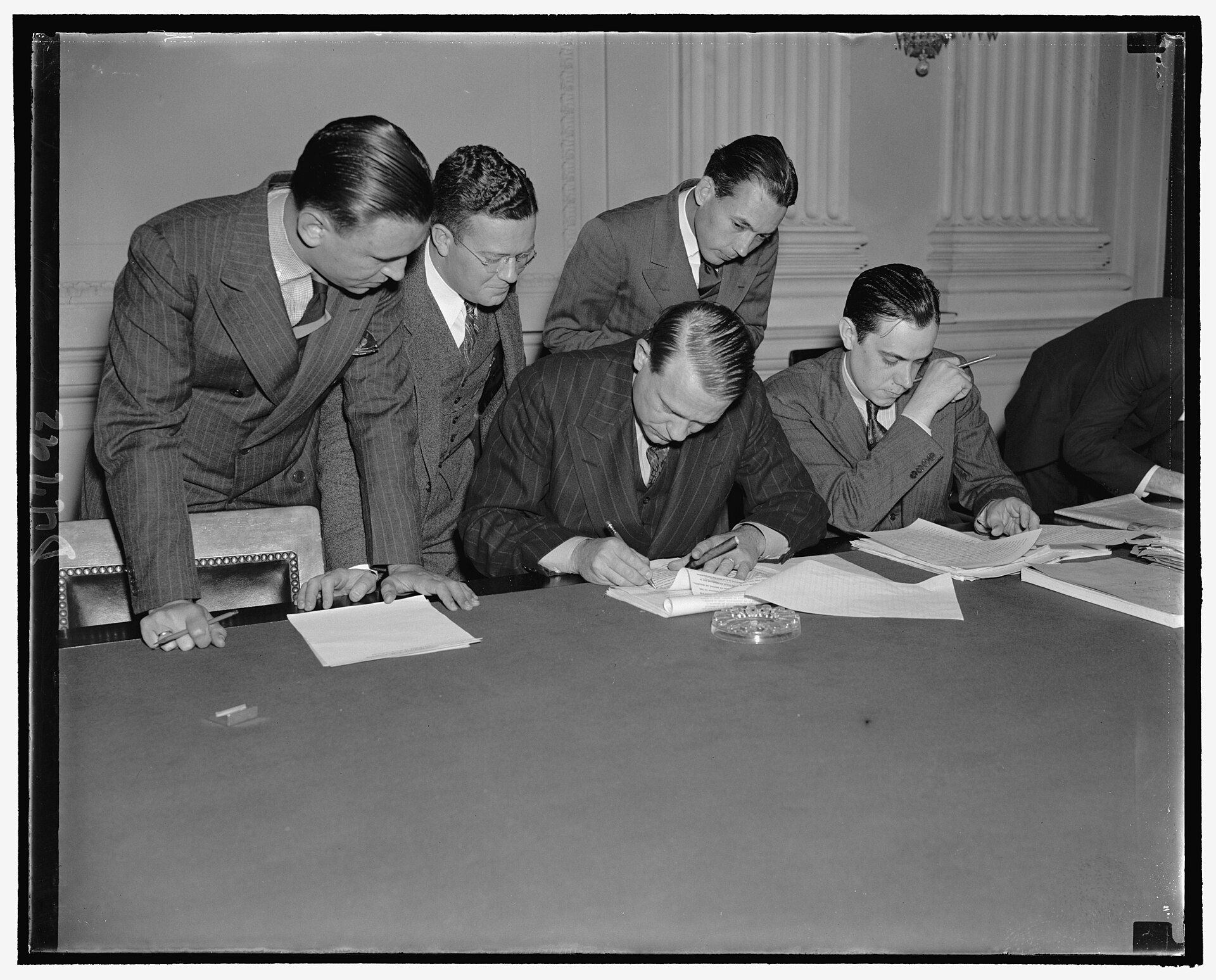

The Dies committee was controversial from its first months. The photograph above, from the Library of Congress, carries the original caption that Dies was reading his statement in reply to President Franklin Roosevelt's attack on the committee in October 1938. The argument that photograph records, between those who saw the committee as a needed watchman over Communist and fascist organizing and those who saw it as a publicity machine aimed at political opponents, followed the committee for the rest of its existence. Both sides could point to evidence. The committee did put on the public record, years before the executive branch acted, testimony about Communist Party control of front groups and unions. It also aired accusations against named people and organizations at hearings where the accused had no right to cross-examine the accuser.
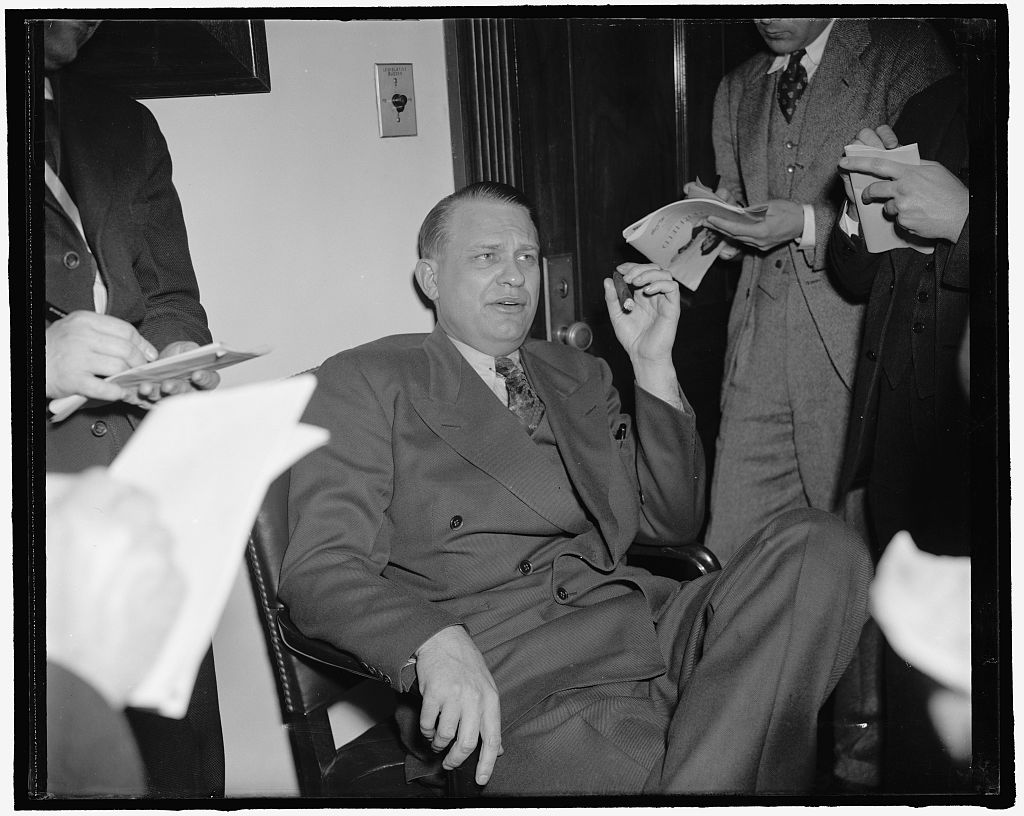

Made permanent on January 3, 1945
Dies left the House at the start of 1945, and the special committee's authority expired with the 78th Congress. On the opening day of the 79th Congress, January 3, 1945, John E. Rankin of Mississippi offered an amendment to the resolution adopting the House rules (H. Res. 5) that added a standing Committee on Un-American Activities. Rankin told the House that there had been "more than 5,000 different occasions in which various agencies of this Government have come to this committee for information on un-American activities," naming the State, War and Navy Departments, Army and Navy intelligence, the Department of Justice and the FBI, and that they had found in its records "a wealth of information that has gone far toward protecting this Nation from saboteurs of all kinds."7 The Congressional Record for that day prints the result of the roll call: "yeas 208, nays 186, not voting 40." One of the yeas was Karl Mundt, a Republican from South Dakota, who rose during the debate to "congratulate the gentleman for introducing his amendment," adding that he spoke "As a member of the Dies committee."7 Mundt will reappear in this lesson as a senator on McCarthy's subcommittee. (An archival description of the same vote held by a congressional archives collection gives the count as 207 to 186. The printed Record is the authority, and the difference is noted here only so that readers who meet the other figure know where it comes from.8)
The National Archives guide to House records summarizes the outcome: "In 1945 the House Un-American Activities Committee was created as a permanent standing committee to replace the temporary Select Committee on Un-American Activities (also known as the Dies Committee) that had existed since 1938." It kept that name until 1969, when it was renamed the Committee on Internal Security, and it was abolished in 1975, its jurisdiction passing to the Judiciary Committee.9 Its records at the National Archives run to well over 2,000 feet, including at least 444 feet of investigative files on individuals and organizations.
The 1946 Act writes HUAC into law
The Legislative Reorganization Act of 1946, signed August 2, 1946, rewrote the committee systems of both houses. For the House it listed a "Committee on Un-American Activities, to consist of nine Members" and gave it, in section 121(q), jurisdiction over "Un-American activities." The same subsection then set out the committee's investigative mandate in language carried over from the Dies resolutions:
"The Committee on Un-American Activities, as a whole or by subcommittee, is authorized to make from time to time investigations of (i) the extent, character, and objects of un-American propaganda activities in the United States, (ii) the diffusion within the United States of subversive and un-American propaganda that is instigated from foreign countries or of a domestic origin and attacks the principle of the form of government as guaranteed by our Constitution, and (iii) all other questions in relation thereto that would aid Congress in any necessary remedial legislation."3
(The National Archives guide quotes the same clause as "the principle or the form of government". The printed Statutes at Large read "principle of the form."9) The Act also put HUAC's subpoena power in the hands of its chairman. The Senate provisions of the same Act gave the subpoena power to each committee and subcommittee as a body,3 but the HUAC clause provided that "Subpenas may be issued under the signature of the chairman of the committee or any subcommittee, or by any member designated by any such chairman, and may be served by any person designated by any such chairman or member." It could "sit and act at such times and places within the United States, whether or not the House is sitting, has recessed, or has adjourned."3 HUAC's 1948 report cited that subsection as the source of "certain special functions not applicable to any other agency of the Government."10
The mandate's key term, "un-American," was nowhere defined. Nor did the Act say anything about the rights of witnesses: whether they could bring counsel, whether counsel could speak, whether a person named by one witness could answer or cross-examine, or whether testimony that damaged a reputation should first be heard in private. Those questions were left to each chairman. Eleven years later, in Watkins v. United States (decided June 17, 1957), Chief Justice Earl Warren wrote of this very mandate: "It would be difficult to imagine a less explicit authorizing resolution," and asked, "Who can define the meaning of 'un-American'?"11
HUAC's staff: Stripling, Mandel and Matthews
HUAC's investigations were driven by a small professional staff, several of whom had served the Dies committee. The committee's report to the 80th Congress, dated December 31, 1948, lists its members (J. Parnell Thomas of New Jersey as chairman, with Karl Mundt, John McDowell, Richard M. Nixon, Richard B. Vail, John S. Wood, John E. Rankin, J. Hardin Peterson and F. Edward Hebert) and two staff officers: "Robert E. Stripling, Chief Investigator" and "Benjamin Mandel, Director of Research."10 J. B. Matthews, who would later work for McCarthy, had been the Dies committee's chief investigator. Ritchie's introduction records that Matthews "served as chief investigator for the House Un-American Activities Committee from 1939 to 1945" and that he "boasted of having joined more Communist-front organizations than any other American, although he had never joined the Communist party."1 The staff's lasting product was the reference collection: the National Archives guide lists a Files and Reference Section of 1,301 feet among HUAC's records.9
Hollywood, 1947
On Monday, October 20, 1947, with "Hon. J. Parnell Thomas (chairman) presiding," HUAC opened its "Hearings Regarding the Communist Infiltration of the Motion Picture Industry," citing as its authority Public Law 601, section 121, subsection Q (the 1946 Act).12 The hearings, their friendly and unfriendly witnesses, the contempt citations of the Hollywood Ten and the studio blacklist that followed are told in lesson 03 and the costs in lesson 10. What matters for this comparison is the form. The hearings were held in public before the press, and witnesses who refused to answer the committee's questions about party membership, citing the First Amendment, were cited for contempt under the federal statute described below. The committee's 1948 report listed "Extensive hearings dealt with Communist penetration of the motion-picture industry" as the second of its accomplishments for 1947 and 1948.10
Hiss and Chambers, 1948
The case that made HUAC's reputation, and Nixon's, began in the summer of 1948. The committee's 1948 report records that "On August 3, 1948, Whittaker Chambers described J. Peters as 'the head of the whole underground United States Communist Party,'" and it notes that, of the officials Chambers named, none had been prosecuted "with the single notable exception of Alger Hiss, indicted for perjury on two counts by a New York Federal grand jury on December 15, 1948."10 Hiss was convicted in January 1950, a fact Ritchie lists among the events that "lent new credibility to McCarthy's charges."1 The details, including the microfilm hidden in a pumpkin on Chambers's Maryland farm, are in lesson 03, and the later evidence about Hiss is weighed in lesson 02. Here the institutional point is that HUAC, through its staff and a determined junior member, pursued in public a lead on which no prosecution had yet been brought, and that its public confrontation of two witnesses produced testimony that a federal jury later found sufficient to convict.
HUAC in the Supreme Court
HUAC contempt cases produced two of the decisions that defined the limits of congressional inquiry. In Quinn v. United States (May 23, 1955), the Court reversed the contempt conviction of a witness who had appeared before a HUAC subcommittee on August 10, 1949, and had referred to the Fifth Amendment without using a set formula. The Court held that "a claim of the privilege does not require any special combination of words."13 In Watkins (1957), the Court reversed the conviction of a labor organizer who had testified before a HUAC subcommittee on April 29, 1954, and had answered questions about himself but refused to say whether others had been Communists. Warren's opinion held that a witness must be told the pertinence of the questions he is compelled to answer, and added a sentence that is still quoted in every argument about congressional investigation: "We have no doubt that there is no congressional power to expose for the sake of exposure."11 The Court's later retreat in Barenblatt v. United States (1959), also a HUAC case, is treated in lesson 09.
The Senate Internal Security Subcommittee
Created December 21, 1950
The Senate had no permanent body devoted to subversion until 1950. In September 1950 Congress passed, over President Truman's veto, the Internal Security Act of 1950 (Public Law 81-831), usually called the McCarran Act after its principal sponsor, Pat McCarran of Nevada, who chaired the Senate Judiciary Committee. Three months later the Senate created a subcommittee to watch over the new law. The National Archives guide to Senate records gives its formal name, the "Special Subcommittee to Investigate the Administration of the Internal Security Act and Other Internal Security Laws," and its authority: "it was authorized under S. Res. 366, 81st Cong., approved December 21, 1950, to study and investigate (1) the administration, operation, and enforcement of the Internal Security Act of 1950 ... and other laws relating to espionage, sabotage, and the protection of the internal security of the United States and (2) the extent, nature, and effects of subversive activities in the United States 'including, but not limited to, espionage, sabotage, and infiltration of persons who are or may be under the domination of the foreign government or organization controlling the world Communist movement or any movement seeking to overthrow the Government of the United States by force and violence.'" The resolution "also authorized the subcommittee to subpoena witnesses and require the production of documents."14
That language is notably more specific than HUAC's. SISS was tied to a statute, the Internal Security Act, and its subject was defined by reference to espionage, sabotage and infiltration by persons under the domination of "the world Communist movement." The guide adds that "Because of the nature of its investigations, the subcommittee is considered by some to be the Senate equivalent to the older House Un-American Activities Committee (HUAC)."14 The House guide, describing related records, calls SISS "the Senate counterpart" of the House committee.9
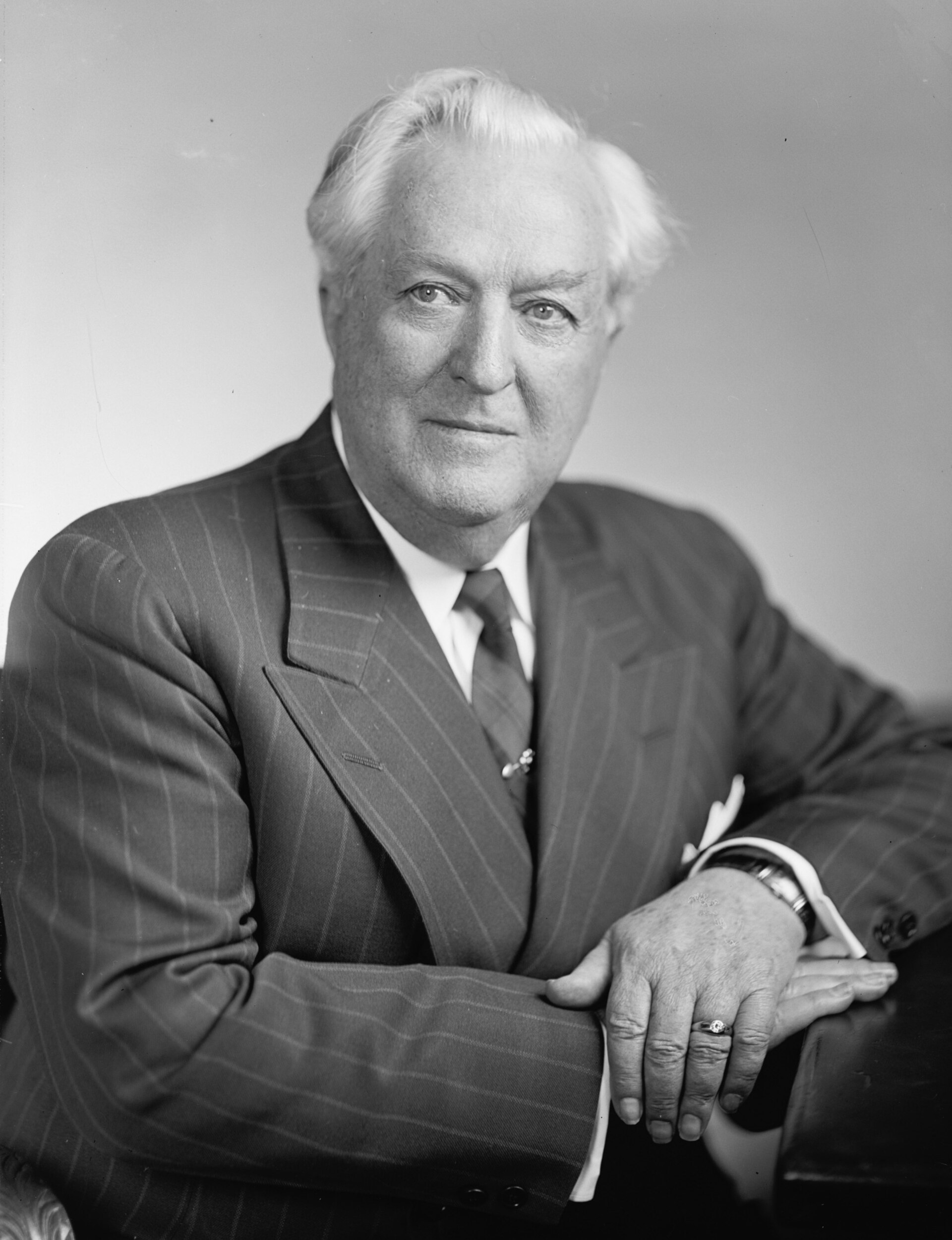

Chairmen: McCarran, Jenner and Eastland
"The chairman of the subcommittee in the 82d Congress was Patrick (Pat) McCarran of Nevada (1950-53)," the National Archives guide records. "William Jenner of Indiana took over during the 83d Congress after the Republicans gained control of the Senate in the 1952 election. When the Democrats regained control in the 84th Congress (1955-56), James O. Eastland of Mississippi became chairman, a position he held until the subcommittee was abolished in 1977."14 The sequence matters for anyone who treats the anti-communist investigations as the project of one party. SISS was created and first run by a Democrat, run in 1953 and 1954 by a Republican, and then run for more than twenty years by a Democrat. Idaho's Senator Herman Welker, a Republican elected in 1950 and one of McCarthy's closest allies, sat on the subcommittee. His role is covered in module 74, lesson 06.
SISS staff and scale
SISS's counsel, Robert Morris, was among the men McCarthy considered for chief counsel of the Permanent Subcommittee before he chose Roy Cohn. Ritchie names "Robert Morris, counsel of the Internal Security Subcommittee" first on McCarthy's list of candidates.1 The subcommittee's output was enormous. The National Archives guide reports that it "published over 400 volumes of hearings and numerous reports, documents, and committee prints," and that its records at the Archives total 547 feet, including transcripts of executive session hearings from 1951 to 1975, personal name files, and central investigative subject files. Its subjects in the 1950s, in the guide's list, included American policy in the Far East, the scope of Soviet activity in the United States, subversion in federal departments (particularly State and Defense), immigration, the United Nations, youth organizations, broadcasting and entertainment, the telegraph and defense industries, labor unions, and "educational organizations."14
The Institute of Pacific Relations, 1951 to 1952
SISS's first major investigation, and the one that best shows its methods, was its inquiry into the Institute of Pacific Relations (IPR). The National Archives guide describes the IPR as a body "established in 1925 to provide a forum for discussion of Asian problems and relations between Asia and the West," supported by grants from the Rockefeller Foundation, the Carnegie Corporation and major corporations. "While the IPR leadership maintained it was a nonpartisan body, others, including some former members, accused it of supporting the Communist line with respect to its analysis of political developments in the Far East. Some people accused the IPR leadership of spying for the Soviet Union. Owen Lattimore, editor of the IPR journal Pacific Affairs, was especially singled out for criticism."14
The way SISS built its case differed sharply from McCarthy's later practice. "To investigate these charges, the SISS took possession of the older files of the IPR, which had been stored at the Lee, Massachusetts farm of E. C. Carter, an IPR trustee. The subcommittee's investigators studied these records for 5 months, then held hearings for nearly 1 year (July 25, 1951-June 20, 1952). The final report of the subcommittee was issued in July 1952 (S. Rpt. 2050, 82d Cong., 2d sess.)."14 Months of document work preceded the first public session, so that questioning could rest on the institute's own correspondence. That is the strongest procedural argument in SISS's favor: the subcommittee could confront witnesses with their own letters.
The report's conclusions were sweeping. A United Press dispatch from Washington on July 2, 1952, the day the Judiciary Committee released it, reported that the committee said Lattimore had been "from some time beginning in the 1930s, a conscious, articulate instrument of the Soviet conspiracy," that he had testified "untruthfully" before its subcommittee five times, and that it asked the Justice Department to present to a grand jury the question whether Lattimore and the diplomat John P. Davies Jr. had committed perjury.15 The report's general findings about the IPR and its influence on American policy in Asia remain disputed among historians, and the case of Lattimore himself is examined in lesson 07.
Lattimore in court
The perjury prosecution that followed is the best available test of SISS's central charge, because it put the subcommittee's conclusions in front of federal judges. Lattimore was indicted on seven counts based on his SISS testimony. The first count charged that he had falsely testified "that he had never been a sympathizer or any other kind of promoter of Communism or Communist interests." On July 8, 1954, the federal Court of Appeals for the District of Columbia Circuit affirmed the district court's dismissal of that count because the word "sympathizer" had no meaning certain enough for a criminal charge. It also affirmed the dismissal of the seventh count, while reinstating two others that the district court had thrown out.16 The government obtained a new two-count indictment on October 7, 1954, charging that Lattimore had lied when he denied being a "follower of the Communist line" and a "promoter of Communist interests." On January 18, 1955, the district court dismissed both counts as too vague to tell him what he was accused of, under the Sixth Amendment and the federal rules of criminal procedure.17 The prosecution was afterward abandoned. No court ever found that Lattimore lied to SISS, and no court found that he had not. The charges failed on their form. The underlying question of what Lattimore was, an independent scholar with sympathies for Soviet positions or something more, is taken up in lesson 07 and lesson 11.
Teachers and the Fifth Amendment, 1952 to 1953
SISS's other major line of inquiry in these years was education. It held hearings on "Subversive Influence in the Educational Process" in New York and elsewhere beginning in 1952, and continued them under Jenner in 1953. One witness in the 1952 New York sessions, Harry Slochower, an associate professor of German at Brooklyn College with 27 years of college teaching, testified on September 24, 1952, that he was not then a member of the Communist Party but invoked the Fifth Amendment when asked about membership in 1940 and 1941. The City of New York then dismissed him summarily under section 903 of its charter, which ended the employment of any city employee who invoked the privilege to avoid answering questions about official conduct.18 Four years later, on April 9, 1956, the Supreme Court, by five votes to four, held his summary dismissal unconstitutional, writing that "we must condemn the practice of imputing a sinister meaning to the exercise of a person's constitutional right under the Fifth Amendment."18
The Harvard Crimson, summarizing the national picture on June 10, 1953, reported that by June 1 "over 100" university teachers had declined to answer the questions of congressional committees on Fifth Amendment grounds and that fifty-four had been dismissed or suspended. It described the Jenner subcommittee's handling of two witnesses who admitted past party membership but refused to name others without invoking the Fifth Amendment, and reported that the committee took no further action against either. The same article recorded that on March 24, 1953, the thirty-four member institutions of the Association of American Universities had adopted a policy that a teacher who invokes the Fifth Amendment "must bear a heavy burden of proof as to his fitness to continue teaching."19 The pattern is the important thing. Congress did not fire anyone. It called witnesses in public, and employers, many of them public institutions, did the rest. That pattern, which HUAC and the Permanent Subcommittee also followed, is examined in lesson 10.
The Permanent Subcommittee on Investigations
From the Truman Committee to the PSI, 1946 to 1952
The Permanent Subcommittee on Investigations was born of the 1946 reorganization and the end of a wartime special committee. Its own published history states that the subcommittee "was originally authorized by Senate Resolution 189 on January 28, 1948," as a unit of the Committee on Expenditures in the Executive Departments, and that it took over the jurisdiction of the Special Committee to Investigate the National Defense Program, the committee Harry S. Truman had chaired during the Second World War.20 Ritchie's 2003 introduction describes the same history this way: "Following the Legislative Reorganization Act of 1946, the Special Committee to Investigate the National Defense Program (popularly known as the Truman committee, for its chairman, Harry S. Truman) merged with the Committee on Expenditures in the Executive Departments to become the Permanent Subcommittee on Investigations."1
The National Archives, which holds the records, is more careful. Its guide says the PSI "is sometimes thought of as the successor" to the Truman Committee: when that committee "was terminated in 1948, the Investigations Subcommittee of the Committee on Expenditures in Executive Departments continued that committee's investigation of war contracts" and "assumed responsibility for the records of the Truman Committee," and some Truman Committee staff moved over, "However, there is no official connection between the Truman Committee and the PSI."21 The two accounts agree on the facts (a 1948 resolution, inherited files and staff, continued investigations) and differ only on whether to call that succession.
The parent committee's mandate under the 1946 Act was administrative. It received "all proposed legislation, messages, petitions, memorials, and other matters" on "Budget and accounting measures, other than appropriations" and "Reorganizations in the executive branch," and it had the duty of "studying the operation of Government activities at all levels with a view to determining its economy and efficiency."3 Under Homer Ferguson of Michigan (1948) and Clyde R. Hoey of North Carolina (1949 to 1952), the Investigations Subcommittee examined export control violations, the trial of the Nazi war criminal Ilse Koch, the sale of post office jobs, and the "5 percenters" accused of selling influence over government contracts.21 On March 3, 1952, by S. Res. 280, the parent committee was renamed the Committee on Government Operations.21 (Ritchie's introduction dates the renaming to 1953. The National Archives guide gives the March 3, 1952, date and the resolution number, and this lesson follows the guide.) The guide adds that the renaming did not change the committee's jurisdictional statement, and calls it "remarkable that the committee could, under this simple mandate, undertake the far-ranging investigations that it did during the 1950's and 1960's."21
McCarthy takes the chair, January 1953
McCarthy had joined the expenditures committee in 1947. As ranking Republican on the subcommittee in the 82d Congress, the PSI history records, he had Senator Margaret Chase Smith removed from it and replaced by Richard M. Nixon.20 When the 1952 elections gave Republicans control of the Senate, seniority made him chairman of both the full Government Operations Committee and its permanent subcommittee. Ritchie explains how that worked: McCarthy "assumed the chairmanship of the Government Operations Committee in January 1953 and exercised prerogative, under then existing rules, to chair the subcommittee as well."1
The membership was narrowly divided. Republicans held "only a one-seat advantage over Democrats in the committee ratios," Ritchie writes. The subcommittee's Republicans were McCarthy, Karl Mundt, Everett Dirksen and Charles E. Potter, its Democrats John L. McClellan of Arkansas, Henry M. Jackson and Stuart Symington. Apart from McCarthy and McClellan, all were in their first terms.1 Mundt, the former Dies committee member, was in Ritchie's phrase "a veteran investigator."
The change in direction was immediate. "Under his chairmanship," Ritchie writes, "the subcommittee shifted from searching out waste and corruption in the executive branch to focusing almost exclusively on Communist infiltration. The subcommittee vastly accelerated the pace of its hearings. By comparison to the six executive sessions held by his predecessor in 1952, McCarthy held 117 in 1953."1 The Senate dates the "McCarthy hearings" phase from February 16, 1953, to March 10, 1954, followed by the Army-McCarthy hearings from March 16 to June 17, 1954.22
The staff: Cohn, Schine, Flanagan and Kennedy
The 1946 Act had tried to professionalize committee staff. Section 202 authorized each standing committee "to appoint by a majority vote of the committee not more than four professional staff members in addition to the clerical staffs on a permanent basis without regard to political affiliations and solely on the basis of fitness to perform the duties of the office," and to remove them by the same majority vote.3 In Ritchie's words, the Act "had created a non-partisan professional staff for each Senate committee. Originally, staff worked for the committee as a whole and were not divided by majority and minority." McCarthy inherited a small staff from Hoey, but "a significant boost in appropriations enabled him to add many of his own appointees."1
For chief counsel McCarthy chose Roy M. Cohn, a former assistant United States attorney in New York who had worked on the prosecutions of William Remington, of Julius and Ethel Rosenberg, and of the Communist Party's national leaders, and who in 1952, as a special assistant to Attorney General James McGranery, had prepared the perjury indictment of Owen Lattimore. Ritchie's staff list shows Cohn serving as chief counsel from January 15, 1953, to August 13, 1954.1 Ritchie's judgment of his methods is direct: "At twenty-six, Roy Cohn lacked any previous legislative experience and tended to run hearings more like a prosecutor before a grand jury, collecting evidence to make his case in open session rather than to offer witnesses a full and fair hearing." Mundt, the veteran of HUAC, "urged Cohn to call administrative officials who could explain the policies and rationale of the government agencies under investigation, and to keep the hearings balanced, but Cohn felt disinclined to conduct an open forum."1
McCarthy appointed Cohn without first removing the previous chief counsel, Francis D. "Frip" Flanagan, whose service on the staff, by the Senate list, ran from July 1, 1945, to June 30, 1953. McCarthy renamed Flanagan "general counsel" without defining the difference. The subcommittee's chief clerk, Ruth Young Watt, recalled that when a decision had to be made, Cohn would say "Ask Frip," and Flanagan would answer "Ask Roy." "In other words," she said, "I'd just end up doing what I thought was right."1
G. David Schine, Cohn's friend, served as the subcommittee's unpaid "chief consultant." Ritchie records that Schine and Cohn rented offices of their own outside the Senate, that Schine made his family's limousine and Waldorf-Astoria suite available when the subcommittee met in New York, that the two made a "much-publicized April 1953 tour" of American information libraries in Europe, and that "In executive sessions, Schine occasionally questioned witnesses and even presided in Senator McCarthy's absence, with the chief counsel addressing him as 'Mr. Chairman.'" Other staff, including James Juliana and Daniel G. Buckley, "similarly conducted hearing-like interrogatories of witnesses." Schine's induction into the Army in November 1953, and Cohn's efforts on his behalf, set off the confrontation told in lesson 08.1
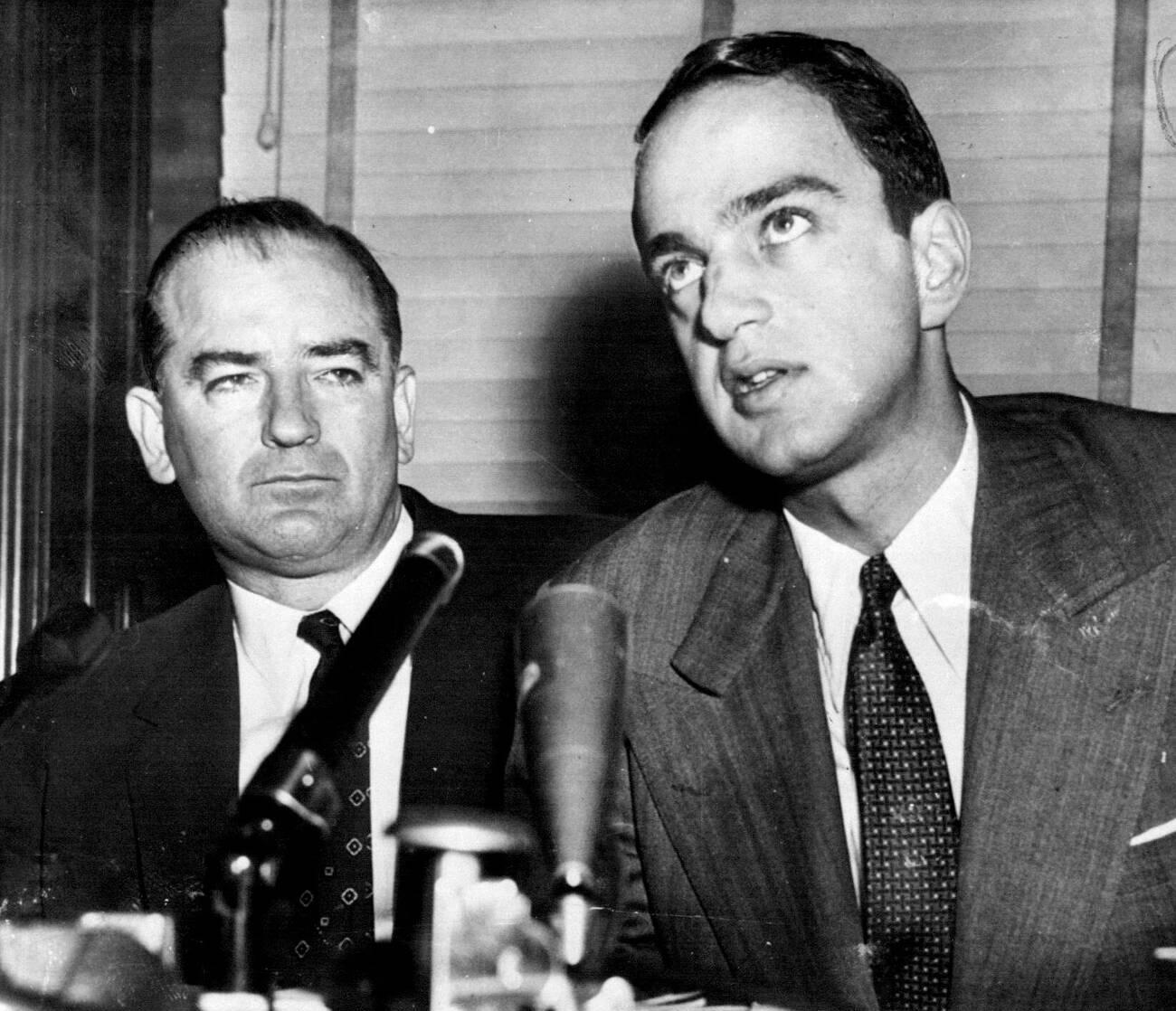

Robert F. Kennedy joined the staff as an assistant counsel on January 15, 1953. His service ended on August 31, 1953. Ritchie writes that he resigned, "telling the chairman that the subcommittee was 'headed for disaster.'" He returned on February 23, 1954, as chief counsel to the Democratic minority and served until January 3, 1955.1 His own later verdict on the staff's work, from his 1960 book The Enemy Within, is quoted by Ritchie: "No real research was ever done. Most of the investigations were instituted on the basis of some preconceived notion by the chief counsel or his staff members and not on the basis of any information that had been developed." Ritchie also notes that the hearings on illegal trade with the People's Republic of China, an investigation Kennedy staffed, "stood apart in tone and substance."1 Staff turnover was heavy: of the twelve staff members McCarthy inherited, only four remained at the end of 1953, and six of the twenty-one new staff added that year left before it ended.1
One-man hearings, short notice and blank subpoenas
Senate committees rarely met with all members present, and the rules allowed a single senator to take testimony when the committee authorized it. Ritchie explains the rule and its effect: "Normally, a quorum of at least one-third of the committee or subcommittee members was needed to take sworn testimony, although a single senator could hold hearings if authorized by the committee. The rules did not bar 'one-man hearings,' because senators often came and went during a committee hearing and committee business could come to a halt if a minimum number of senators were required to hold a hearing."1 McCarthy used that latitude to the full. Hearings were called "on short notice, and often outside of Washington," in New York at the federal courthouse at Foley Square and at the Waldorf-Astoria, at Fort Monmouth, New Jersey, and in Boston, which kept other senators away. Erwin Griswold, dean of Harvard Law School, wrote in 1955 that a witness before a one-man committee faced a "judge, jury, prosecutor, castigator, and press agent, all in one."1
The Army's counsel, John G. Adams, who attended many of these sessions, noted in his 1983 memoir that in theory the committee, not the chairman, issued subpoenas. "But McCarthy ignored the Senate rule that required a vote of the other members every time he wanted to haul someone in. He signed scores of blank subpoenas which his staff members carried in their inside pockets, and issued as regularly as traffic tickets." Ritchie adds that witnesses "repeatedly complained" that subpoenas were served the night before or the morning of a hearing, "making it hard for them to obtain legal representation. Even if they obtained a lawyer, the senator would not permit attorneys to raise objections or to talk for the witness."1 Adams's account is that of an adversary in the Army dispute, and it should be read as such, but Ritchie, writing for the subcommittee in 2003, adopted it.
The executive sessions were not always closed in any strict sense. Adams wrote that McCarthy "allowed in various friends, hangers-on, and favored newspaper reporters," and that afterward "McCarthy would tell the reporters waiting outside whatever he pleased." Telford Taylor, an American prosecutor at Nuremberg, charged that McCarthy had invented "a new and indefensible kind of hearing, which is neither a public hearing nor an executive session." Ritchie records that McCarthy answered Taylor "with an executive session inquiry into Gen. Taylor's loyalty."1 Cohn's defense, also recorded by Ritchie, was that the closed sessions protected witnesses by excluding the press and public, and that unlike a grand jury witness, a person before the subcommittee could have a lawyer sitting beside him.1
The Matthews article and the July 1953 walkout
The subcommittee's partisan balance broke in July 1953 over a staff appointment. When Flanagan left at the end of June, McCarthy named J. B. Matthews, the former Dies committee investigator, as executive director. The Senate staff list gives his service as June 22 to July 18, 1953.1 As the appointment was announced, the July issue of the American Mercury carried an article by Matthews about Communism and the Protestant clergy. Time magazine, in its issue of July 13, 1953, quoted its opening sentence: "The largest single group supporting the Communist apparatus in the U.S. today is composed of Protestant clergymen." Time reported that the subcommittee's three Democrats called the article "a shocking and unwarranted attack," and that the Republican Charles Potter said it was his "present" opinion that Matthews should be fired.23 (The article's title is given in different sources as "Reds and Our Churches" and as "Reds in Our Churches". Ritchie uses the second.1)
On July 9, 1953, President Eisenhower answered a telegram from the national co-chairmen of the Commission on Religious Organizations of the National Conference of Christians and Jews, a Catholic priest, a rabbi and a Protestant minister. "Generalized and irresponsible attacks that sweepingly condemn the whole of any group of citizens are alien to America," he wrote.24 Matthews resigned. The dispute did not end with him, because the real issue was who controlled the staff. Ritchie explains: "Although Matthews resigned voluntarily, it was Senator McCarthy's insistence on maintaining the sole power to hire and fire staff that caused the three Democratic senators to resign from the subcommittee, while retaining their membership in the full Government Operations Committee." McCarthy then named Francis P. Carr Jr. as executive director, with Cohn continuing as chief counsel.1 The 1946 Act's provision that a standing committee's professional staff be appointed "by a majority vote of the committee" offered an argument from statute against the chairman's position, although the subcommittee's own practice had left staffing to him.3
The walkout had consequences its authors may not have intended. With the Democrats gone, Ritchie notes, "other Republican senators also stopped attending the subcommittee's closed hearings," and McCarthy was often the only senator present, "particularly" at hearings "held away from Washington."1 The protest left the chairman freer, for six months, than he had been before it.

The January 1954 rules and the 1955 rules
The Democrats returned in January 1954 on terms. "Not until January 1954," Ritchie writes, "did the remaining subcommittee members adopt rules changes that Democrats had demanded, and Senators McClellan, Jackson and Symington resumed their membership on the subcommittee. These rules changes removed the chairman's exclusive authority over staffing, and gave the minority members the right to hire their own counsel. Whenever the minority was unanimously opposed to holding a public hearing, the issue would go to the full committee to determine by majority vote." Robert Kennedy came back as minority counsel under the new arrangement. Later in 1954 the Senate Republican Policy Committee proposed further rules: a quorum to be present to hold hearings, and no hearings outside the District of Columbia and no confidential testimony unless a majority of members authorized them. "In 1955 the Permanent Subcommittee adopted rules similar to those the Policy Committee recommended."1 The subcommittee's own history adds that the 1955 rules "better protected the rights of witnesses" and strengthened the rights of both parties to appoint staff, to start and approve investigations, and to see all information the subcommittee held.20
What the PSI investigated, 1953 to 1954
Ritchie lists the main lines of inquiry: "hearings on the State Department, the Voice of America, the U.S. overseas libraries, the Government Printing Office, and the Army Signal Corps." The National Archives guide adds Korean War atrocities, Communist infiltration of the United Nations, and the transfer to the Soviet Union of occupation currency plates.121 The cases themselves are told in lesson 07 and the Army confrontation in lesson 08. Here only their institutional character is at issue.
- State Department files. The first closed hearings of 1953 examined a State Department security officer's complaint that personnel files had been "looted" of derogatory information. State Department testimony suggested the filing system had been designed to protect employees' rights in promotion and evaluation. McCarthy "contended that there had been a conspiracy to manipulate the files."1
- Voice of America. The hearings on the government's overseas broadcasting service were never finished. Richard Rovere, who covered them for the New Yorker, wrote that the investigation "just stopped," once "its largest possibilities for tumult had been exhausted."125
- Overseas libraries. Instead of calling the officials who ran the information libraries abroad, "the subcommittee subpoenaed the authors of the books in question, along with scholars and artists who traveled abroad on Fulbright scholarships." Cohn complained of the authors, "we subpoena maybe fifty and five show up."1
- Fort Monmouth and the Army Signal Corps. McCarthy predicted the inquiry would uncover espionage. Ritchie notes that Julius Rosenberg had worked at Fort Monmouth, which persuaded McCarthy and Cohn that a spy ring remained, but that during the war the Soviet Union, as an ally, had openly designated representatives at the laboratories. "McCarthy's pursuit of a spy ring caused officials at Fort Monmouth to suspend forty-two civilian employees. After the investigations, all but two were reinstated in their former jobs."1
- The Army. The Fort Monmouth hearings widened into an attack on the Army's handling of security cases, including the case of Irving Peress (lesson 07), and from there to the Army's charges about Schine. In April 1954 a special subcommittee of the PSI, chaired by Mundt, was appointed to hear the dispute.21
Not every hearing followed the chairman's style. Ritchie singles out the Korean War atrocities hearings chaired by Potter, "whose style, demeanor, and treatment of witnesses contrasted sharply with those that Senator McCarthy conducted," and the China trade inquiry staffed by Kennedy.1
The numbers: how many witnesses, in what kind of session
The Senate's 2003 publication of McCarthy's closed-door transcripts made it possible, for the first time, to count what the subcommittee did in private. The figures come from three Senate sources, and they do not agree exactly.
Ritchie's introduction gives the most detailed count, for 1953, McCarthy's first year as chairman: "the subcommittee took testimony from 395 witnesses in executive sessions and staff interrogatories (by comparison to 214 witnesses in the public sessions), and compiled 8,969 pages of executive session testimony (compared to 5,671 pages of public hearings)." He also counts 117 executive sessions in 1953 against six in 1952.1 The press release that Senator Collins's office issued on May 5, 2003, when the transcripts were released, describes the whole McCarthy chairmanship: the subcommittee "held 161 closed hearings," and "These closed sessions heard testimony from nearly 500 witnesses."26 The Senate's web page on the McCarthy hearings says the subcommittee "conducted 160 closed executive sessions during the 83rd Congress" and that "There were 395 witnesses questioned in the closed sessions," and it dates the published volumes to 2004.22 The five volumes themselves are dated 2003. Volumes 1 to 4 cover 1953 and volume 5 covers 1954.27
The safest reading is that about 395 witnesses were questioned in closed session in 1953 alone, that the total for 1953 and 1954 was higher (the Collins release says nearly 500), and that the subcommittee held about 160 closed sessions over the two years. The senate.gov page's attachment of the 395 figure to the whole 83rd Congress appears to conflate the first-year count with the total. The discrepancy is listed as unresolved in this lesson's notes.
Ritchie's introduction supplies further numbers that matter for judging method. "About a third of the witnesses called in executive session did not appear at any public hearing, and Senator McCarthy often defined such witnesses as having been 'cleared.'" During 1953, "some seventy witnesses before the subcommittee invoked the Fifth Amendment and declined to answer questions concerning Communist activities. Five refused to answer on the basis of the First Amendment, two claimed marital privileges, and Harvard Professor Wendell Furry invoked no constitutional grounds." At the end of his first year as chairman, McCarthy told a witness that "some ... twenty cases" had been submitted to the grand jury "either for perjury or for contempt before this committee." And: "In the end, however, no witness who appeared before the subcommittee during his chairmanship was imprisoned for perjury, contempt, espionage, or subversion. Several witnesses were tried for contempt, and some were convicted, but each case was overturned on appeal."1
Powers compared
On paper the three bodies had similar tools. In practice the differences in where the power sat, and how it was checked, shaped everything.
| Power | HUAC | SISS | PSI under McCarthy |
|---|---|---|---|
| Source of authority | H. Res. 282 (1938) and renewals; House rules amendment, Jan. 3, 1945; sec. 121(q) of the 1946 Act | S. Res. 366, approved Dec. 21, 1950 | S. Res. 189 (Jan. 28, 1948); the parent committee's 1946 mandate on "economy and efficiency" |
| Subpoena | Issued "under the signature of the chairman" or a member he designated | Authorized by the resolution | Held by the committee; in practice signed in blank by the chairman, per John G. Adams |
| Contempt | Referral to the House, then to a U.S. attorney, under 2 U.S.C. 192 | Same statute, through the Senate | Same statute; some convictions, all overturned on appeal |
| Executive sessions | Secret; released only by majority of full committee (Dies era) | Transcripts kept 1951 to 1975 | Most of the work; 117 in 1953; press sometimes admitted |
| Hearings by one member | Subcommittees authorized by the 1946 Act | Subcommittee practice | Allowed if the committee authorized; routine in 1953 |
| Staff | Chief investigator and research director; large reference files | Counsel and research staff; 547 feet of records | Chief counsel chosen by the chairman alone until Jan. 1954 |
The contempt power deserves a word, because it was the sanction behind every subpoena. The statute, first enacted in 1857 and now codified at 2 U.S.C. 192, provides that "Every person who having been summoned as a witness by the authority of either House of Congress to give testimony or to produce papers upon any matter under inquiry before either House ... or any committee of either House of Congress, willfully makes default, or who, having appeared, refuses to answer any question pertinent to the question under inquiry, shall be deemed guilty of a misdemeanor, punishable by a fine of not more than $1,000 nor less than $100 and imprisonment in a common jail for not less than one month nor more than twelve months."28 The word "pertinent" was the hinge on which Watkins later turned.11 A witness who refused to answer on First Amendment grounds risked prosecution under this statute. A witness who invoked the Fifth Amendment generally did not, which is why the Fifth Amendment became the refuge of so many.
Rules for witnesses: counsel, cross-examination and the Fifth Amendment
None of the three bodies' founding documents contained any rights for witnesses. HUAC's 1946 mandate, SISS's 1950 resolution and the expenditures committee's 1946 jurisdiction all speak of the committee's powers and say nothing of the witness's. Rights came, when they came, from the Constitution as courts applied it, from internal rules a committee chose to adopt, and from a chamber's willingness to discipline a chairman.
Counsel. A witness could bring a lawyer. Cohn argued that this made the subcommittee fairer than a grand jury, where a witness testifies alone. But the lawyer's role was to whisper, not to argue. Under McCarthy, Ritchie records, attorneys could neither "raise objections" nor "talk for the witness."1
Cross-examination. No committee gave a person accused by another witness a right to cross-examine. A named person might ask to appear, and sometimes did, but the decision was the committee's. This was the gap that critics of all three bodies pressed hardest, and later procedural reforms closed it only in part.
The Fifth Amendment. The privilege against self-incrimination was the one protection that reliably worked in law, and the courts protected it: Quinn held that no special words were needed to invoke it, and Slochower condemned "imputing a sinister meaning" to its use.1318 Outside the law, invoking it was costly. Ritchie writes that McCarthy "regularly informed witnesses of their right to decline to answer if they felt an answer might incriminate them, but he interpreted their refusal to answer a question as an admission of guilt. He also encouraged government agencies and private corporations to fire anyone who took the Fifth Amendment before a congressional committee." Calling such witnesses "Fifth-Amendment Communists," McCarthy "insisted that 'an innocent man does not need the Fifth Amendment.'"1 Whatever the phrase's origin, HUAC and SISS hearings produced the same result through employers, as the Brooklyn College and university cases show.19
There was also a legal trap that pushed witnesses toward a blanket refusal. In Rogers v. United States (1951), as Ritchie explains, the Supreme Court held that a witness who had admitted a fact about herself could not then refuse, on Fifth Amendment grounds, to name the person to whom she had given the party's records. Lawyers therefore advised witnesses that if they answered any question about their own past they might be compelled to name others, and many declined to answer anything.1 Some witnesses who had been Communists invoked the privilege for exactly that reason, to avoid naming friends, which was a moral choice the law did not recognize. Others had something to hide. The committees, and the public, could not tell the two apart from the refusal alone.
Where each sat in Congress
The organization chart below shows why the three were so often confused, and why they were not interchangeable. HUAC answered to the whole House. SISS answered to the Senate Judiciary Committee, whose chairman, McCarran until 1953, also chaired the subcommittee. The PSI answered to a committee whose formal business was the efficiency of executive departments. Because McCarthy chaired both the full committee and the subcommittee in 1953 and 1954, there was no separate chairman above him to restrain him.
What each uncovered that was true
A fair comparison has to credit each committee with what it got right, using the same standard of evidence applied to its mistakes.
HUAC. HUAC's greatest contribution to the historical record was the testimony of Whittaker Chambers and Elizabeth Bentley in the summer of 1948. Their accounts of Soviet espionage networks in Washington were fiercely disputed at the time. The Venona decrypts released by the NSA in 1995 to 1996 corroborated a large part of what they said about the existence and membership of those networks, as Haynes and Klehr argued in Venona (1999) and, with Alexander Vassiliev, in Spies (2009), drawing on notes from KGB archives.229 Hiss, whom Chambers first accused in public before HUAC, was convicted of perjury in 1950.1 HUAC's Hollywood hearings were aimed at people who, in many cases, had in fact been members of the Communist Party. The question those hearings raise is whether Congress had any business compelling them to say so in public, a question Watkins later sharpened.11 Its files, Rankin told the House in 1945, had been consulted by federal agencies on "more than 5,000 different occasions."7 On the other side of the ledger are its undefined mandate, its chairmen's personal subpoena power, the absence of any protection for people named in testimony, and its role in the blacklist (lesson 10).
SISS. SISS's IPR investigation rested on months of documentary research in the institute's own files, a method far more careful than McCarthy's. Its report charged, on the strength of the institute's own correspondence, that Communists and people sympathetic to Soviet positions had worked in and around a respected research institution whose writers advised officials on American policy in Asia. How far that finding holds, and how much it mattered to policy, historians still dispute. It did not establish, in any forum where the evidence could be tested, its charge that Lattimore had been "a conscious, articulate instrument of the Soviet conspiracy": the perjury prosecution built on the subcommittee's work failed on vagueness, twice.151617 Its education hearings exposed former party members on faculties, some of whom acknowledged membership, and also produced the dismissals of teachers who had broken no law, one of which the Supreme Court found unconstitutional.18
PSI under McCarthy. Ritchie, writing for a subcommittee then chaired by Levin and with Collins as ranking member, gives the subcommittee its due and no more: "The subcommittee's investigations exposed examples of lax security in government agencies and defense contractors, but they failed to substantiate the chairman's accusations of subversion and espionage."1 Some witnesses before the subcommittee had been Communists. Ritchie notes that "Those witnesses against whom strong evidence of Communist activities existed tended to be involved in labor organizing," in unions that the CIO had already expelled, and that those who named others "invariably described union activities, and none corroborated any claims of subversion and espionage."1 The Army's suspension of forty-two Fort Monmouth employees, forty of whom were reinstated, is the plainest measure of the gap between charge and proof.1
Rival readings
Scholars who agree on these facts still read them differently.
M. Stanton Evans, in Blacklisted by History (2007), argued from FBI and congressional records that McCarthy's targets were more often real security problems than his critics admitted, and that the standard account of the period had overlooked or misread evidence in the government's own files. Arthur Herman, in Joseph McCarthy (2000), accepted that Soviet penetration was real and serious while arguing that McCarthy's recklessness harmed the anti-communist cause he claimed to serve.3031
Ellen Schrecker, in Many Are the Crimes (1998), treated HUAC, SISS, the PSI, the FBI, the loyalty program and private employers as parts of one system, in which public exposure before a committee functioned as punishment and the harm fell mostly on people who were not spies. David Oshinsky, in A Conspiracy So Immense (1983), and Richard Rovere, in Senator Joe McCarthy (1959), described McCarthy's subcommittee as driven by publicity rather than evidence. Landon Storrs, in The Second Red Scare and the Unmaking of the New Deal Left (2013), argued that loyalty investigations drove out of government many New Deal economists and policy experts who were not Communists, narrowing the range of American policy debate.32332534
On the narrower question of this lesson, the primary sources cited here fit most closely with the position Haynes and Klehr have taken: the espionage was real and extensive, HUAC's key witnesses of 1948 were largely right, and McCarthy's own investigations added little to what the FBI and the Venona project had already found. Ritchie's 2003 introduction cites Haynes's earlier book, Red Scare or Red Menace? (1996), together with Earl Latham's 1966 study, for the observation that leaked security files shifted McCarthy's attention to lower-level civil servants who were "easier targets to bully."1 The characterizations of these books in this section are paraphrases of their central arguments. Readers should go to the books themselves before quoting them.
What the record shows and what it does not
- Documented fact: HUAC began as the Dies special committee under H. Res. 282 on May 26, 1938, and became a standing committee on January 3, 1945, by a recorded vote of 208 to 186.57
- Documented fact: SISS was authorized by S. Res. 366, approved December 21, 1950, as a subcommittee of the Senate Judiciary Committee, chaired by McCarran, then Jenner, then Eastland.14
- Documented fact: The PSI was authorized by S. Res. 189 on January 28, 1948. McCarthy chaired it, and its parent committee, in 1953 and 1954. He never served on HUAC.201
- Documented fact: In 1953 McCarthy's subcommittee held 117 executive sessions (six in 1952), heard 395 witnesses in closed session and 214 in public, and no witness who appeared before it during his chairmanship was imprisoned for perjury, contempt, espionage or subversion.1
- Documented fact: The three Democrats left the PSI in July 1953 over the chairman's claim of sole power to hire and fire staff, and returned in January 1954 after rules gave the minority its own counsel.1
- Allegation, never proved in court: SISS's 1952 finding that Owen Lattimore was "a conscious, articulate instrument of the Soviet conspiracy." The perjury counts built on his testimony were dismissed for vagueness.151617
- Allegation, not substantiated: McCarthy's 1953 prediction of an espionage ring at Fort Monmouth. Forty of the forty-two suspended employees were reinstated.1
- Open question: The exact total of witnesses McCarthy's subcommittee heard in closed session over both years. Senate sources give "nearly 500" and 395 for different spans.2622
- Open question: How far the IPR report's broader conclusions about the institute's influence on American policy in Asia hold up against the Soviet archival evidence. Historians still disagree.
Assessed from 2026
Each claim below was made at the time, by a committee, its chairman or its defenders, about the committees themselves. Each is rated on the evidence now available.
- Claim: Congress had the authority to investigate Communist infiltration of the government. Supported. The 1946 Act directed every standing committee to exercise "continuous watchfulness" over the agencies in its field, and HUAC and SISS were given subversion as their express subject.314 The Supreme Court in Watkins did not deny the power to investigate. It limited the power "to expose for the sake of exposure."11
- Claim (HUAC, 1945): the committee's files had protected the nation, having been consulted by federal agencies more than 5,000 times. Partly supported. The figure is Rankin's own, given in debate, and no independent count has been found. The files certainly existed on a large scale, as the National Archives holdings show.79
- Claim (HUAC, 1948): the Chambers and Bentley testimony exposed real Soviet espionage networks in the government. Supported. The Venona decrypts and KGB archival notes corroborate the existence of those networks and many identifications, as Haynes, Klehr and Vassiliev documented. The Hiss perjury conviction stands.2291 Individual identifications vary in strength and are weighed in lesson 02.
- Claim (SISS, 1952): Owen Lattimore was "a conscious, articulate instrument of the Soviet conspiracy." Unresolved. No court tested the charge on its merits. The perjury counts failed on vagueness, and the evidence on both sides is weighed in lesson 07.1517
- Claim (McCarthy, 1953): the PSI had authority to investigate subversion and espionage. Partly supported. The parent committee's 1946 mandate covered "the operation of Government activities at all levels," which could include security administration, but the Senate assigned loyalty matters to SISS, and the Senate's own historian wrote that McCarthy "interpreted his subcommittee's mandate broadly enough to cover any government-related activity."31
- Claim (McCarthy, 1953): the Fort Monmouth laboratories harbored an active espionage ring. Unsupported. The subcommittee's own published record, as summarized by Ritchie, found no corroborated subversion or espionage, and forty of forty-two suspended employees returned to work.1
- Claim (McCarthy and Cohn): executive sessions protected witnesses. Partly supported. Closed sessions did screen out cases of mistaken identity, and about a third of closed-session witnesses never appeared in public. But the chairman admitted favored reporters and others and gave the press his own account afterward, as Adams, Taylor and Ritchie recorded.1
- Claim (McCarthy): "an innocent man does not need the Fifth Amendment." Refuted as a statement of law. The Supreme Court in Slochower condemned "imputing a sinister meaning" to the privilege's exercise, and in Quinn protected its invocation without set words. Witnesses also invoked it to avoid naming others, as Ritchie explains.18131
- Claim (McCarthy, July 1953): the chairman alone could hire and fire subcommittee staff. Partly supported. Under the subcommittee's practice in 1953 the chairman did control staffing: the January 1954 rules are described by Ritchie as having "removed the chairman's exclusive authority over staffing," which means he held it until then. Against the claim, the 1946 Act provided for a standing committee's professional staff to be appointed and removed "by a majority vote of the committee," and the subcommittee itself abandoned the practice within six months.31
- Claim (McCarthy, end of 1953): witnesses who defied the subcommittee would "end up in jail." Refuted. McCarthy told a witness that "some ... twenty cases" had gone to the grand jury, but no witness from his chairmanship was imprisoned, and every contempt conviction was overturned on appeal.1
- Claim: the three committees were one operation, "McCarthyism." Refuted. They had different chambers, parents, authorities, chairmen and staffs, and the Senate Historian wrote that HUAC and SISS "bore no direct relation to the permanent subcommittee."1
The method that comes out worst from this comparison is the one-man hearing, convened on short notice, away from Washington, with subpoenas issued without a committee vote and a closed record that only the chairman described. The method that comes out best is SISS's months of documentary preparation before the IPR hearings, though its conclusions outran what the documents could prove in court. HUAC sits between them: its staff and files found real witnesses to real espionage, and its undefined mandate and personal subpoena power produced the abuses the Supreme Court named in 1957. The larger argument about method and mission is taken up in lesson 12, and Pierson's framework for legitimate authority and its limits in module 52, lesson 02.
Hard questions and answers
If the spies were real, why fault the committees at all?
Because the record separates the finding of spies from the methods used against everyone else. The espionage networks of the 1930s and 1940s were exposed mainly by defectors, the FBI and the Venona decrypts. HUAC's contribution was to give two defectors a public hearing in 1948. By 1953, when McCarthy's subcommittee held 117 closed sessions, the wartime networks described by Bentley and Chambers had long since stopped operating, in the account Haynes and Klehr give in Venona, and the subcommittee's own published record shows no corroborated espionage found.21 Faulting the methods is consistent with crediting the cause: Levin and Collins, introducing the transcripts, began by defending the investigative power itself.4
Was McCarthy ever on HUAC?
No. HUAC was a House committee, and McCarthy served only in the Senate, from 1947. The confusion arises because the Hollywood and Hiss hearings, which preceded his Wheeling speech, are often filed under his name, and because Karl Mundt and Richard Nixon served on both HUAC and, as senators, the PSI.10201
Was SISS just McCarthy with better manners?
Not quite. SISS was created by the Senate for the express purpose of investigating subversion, had a statutory anchor in the Internal Security Act, and prepared its first major case from documents for five months before hearings began.14 Its chairmen were Democrats for most of its life. Its central conclusion about Lattimore, however, went beyond what it could prove in court, and its education hearings cost teachers their jobs for invoking a constitutional right, an outcome the Supreme Court condemned in Slochower.1718
Did the Democrats' walkout in July 1953 help or hurt?
Both. In the short run it hurt: with the Democrats gone and Republican members staying away, McCarthy was often the only senator at hearings away from Washington through the autumn of 1953, including the Fort Monmouth sessions that led to the suspension of forty-two employees.1 In the longer run it produced the January 1954 rules that gave the minority its own counsel and a check on public hearings, and Robert Kennedy's return as minority counsel put a former staff member who knew the subcommittee's methods at the Democrats' side on the eve of the Army-McCarthy hearings.1
Why did witnesses take the Fifth if they had done nothing wrong?
Some had something to hide. Many had been Communists in the 1930s or 1940s, which McCarthy himself told witnesses was not a crime, and invoked the privilege because of the rule in Rogers v. United States: once a witness answered about her own past, she could be compelled to name others. Their lawyers warned them of that risk, and many answered nothing about the party at all.1 A smaller number refused on First Amendment grounds and risked prosecution under 2 U.S.C. 192, as the Hollywood Ten had done.28 The Supreme Court in 1956 held that no inference of guilt could lawfully be drawn from the claim of privilege alone.18
What would a fair hearing have looked like in 1953?
The subcommittee itself answered the question in its 1954 and 1955 rules: decisions on staff and investigations shared by both parties, a quorum for hearings, no hearings outside Washington or confidential testimony without majority authorization, and better protection of witnesses' rights.120 Ritchie also points to the later special committee on labor racketeering, formed by PSI members and staff together with the Senate Labor and Public Welfare Committee, with Robert Kennedy as chief counsel, as conducted "in a more bipartisan manner and respectful of the rights of witnesses."1 For how a citizen today can read congressional hearings critically, see lesson 14 and module 52, lesson 08.
Related lessons
- Lesson 03: The Machinery Before McCarthy (Dies, HUAC, the Hollywood Ten, the loyalty program, the Smith Act and the Hiss case)
- Lesson 07: The Cases (State, Fort Monmouth, Voice of America, Peress, Lattimore, Annie Lee Moss and George Marshall)
- Lesson 08: The Army-McCarthy Hearings and the Fall
- Lesson 09: Censure, Watkins, Yates, Barenblatt and the Courts
- Lesson 12: Method Versus Mission
- Module 74, lesson 06: Glen Taylor, Herman Welker and the Red Scare (Welker on SISS)
- Module 51, lesson 07: Communism (the economic system the committees feared)
Still open
These items could not be confirmed against a primary source before publication. The lesson states them as open, and they stay on the fact-check list.
- Witness totals for McCarthy's chairmanship differ among Senate sources: Ritchie's introduction gives 395 executive-session witnesses (with 214 public) for 1953 alone; the Collins release of May 5, 2003, gives 161 closed hearings and nearly 500 witnesses; the senate.gov hearings page gives 160 closed sessions and 395 witnesses for the 83rd Congress and dates the volumes to 2004. Unresolved; the lesson reports all three.
- Ritchie's introduction dates the renaming of the expenditures committee to Government Operations to 1953; the National Archives guide gives March 3, 1952 (S. Res. 280), and in another paragraph cites S. Res. 220. The lesson follows March 3, 1952; the resolution number is not independently confirmed.
- The 1945 vote: the Congressional Record prints yeas 208, nays 186, not voting 40; an archival item gives 207 to 186. The lesson uses the Record.
- The title of J. B. Matthews's July 1953 American Mercury article appears as both "Reds and Our Churches" and "Reds in Our Churches"; the magazine itself was not consulted.
- The text of S. Rept. 2050 (the IPR report) was not opened; its Lattimore finding is quoted from a United Press dispatch of July 2, 1952, and its general findings are summarized from that dispatch and the National Archives guide.
- Characterizations of the books by Evans, Herman, Schrecker, Oshinsky, Storrs, Haynes and Klehr are paraphrases of their central arguments and were not checked against page numbers in this task.
- That the Hollywood Ten had in many cases been Communist Party members, and that the wartime Soviet networks in Washington had stopped operating well before 1953, rest on the general scholarly account (Haynes and Klehr and others) rather than on a primary document opened for this lesson.
- The Internal Security Act's passage over Truman's veto in September 1950 and McCarran's chairmanship of the Judiciary Committee were not re-verified against a primary source in this task.
- Exact date of the Justice Department's final abandonment of the Lattimore prosecution (1955) not confirmed here.
- The McCarran portrait's year (1947 on Commons) is not confirmed by the Library of Congress record and is not stated in the caption.
- The February 17, 1940, Dies photograph: the Library of Congress title gives only his name, position and date; the caption's description of him talking with reporters is taken from what the image shows.
- The date of McCarthy's remark that some twenty cases had gone to the grand jury is given by Ritchie only as the end of his first year as chairman; the lesson does not fix it to a month.
Learn more
- The McCarthy executive session transcripts (five volumes, Senate): Read the closed-door hearings themselves; Ritchie's introduction in volume 1 is the best short institutional account of the PSI in 1953 and 1954.
- National Archives guide to SISS records: Explains the subcommittee's authority, chairmen, the IPR investigation and the scale of its records.
- National Archives guide to HUAC records: HUAC's mandate, history and the organization of its 2,000-plus feet of records.
- Watkins v. United States (1957): The Supreme Court's fullest statement of the limits on congressional investigation, written about HUAC's mandate.
- Legislative Reorganization Act of 1946: The statute that wrote HUAC into the House rules and gave Senate committees their subpoena power and professional staffs.
Notes
- Donald A. Ritchie, "Introduction," and Senate staff lists, in U.S. Senate, Permanent Subcommittee on Investigations, Executive Sessions of the Senate Permanent Subcommittee on Investigations of the Committee on Government Operations, vol. 1, S. Prt. 107-84, 83d Cong., 1st sess., 1953 (Washington: Government Printing Office, 2003), pp. xiii to xxxi. Read it online. ↩
- John Earl Haynes and Harvey Klehr, Venona: Decoding Soviet Espionage in America (New Haven: Yale University Press, 1999). Interpretation; cited for the authors' argument, not quoted. Read it online. ↩
- Legislative Reorganization Act of 1946, Pub. L. 79-601, ch. 753, 60 Stat. 812 (August 2, 1946), sections 102(g), 121(q), 134(a), 136 and 202(a). Read it online. ↩
- Carl Levin and Susan M. Collins, "Preface," in Executive Sessions of the Senate Permanent Subcommittee on Investigations, vol. 1, S. Prt. 107-84 (2003), p. xi. Read it online. ↩
- Charles E. Schamel, Inventory of Records of the Special Committee on Un-American Activities, 1938-1944 (The Dies Committee), Record Group 233, Center for Legislative Archives, National Archives and Records Administration, July 1995, introduction and series 5. Read it online. ↩
- National Archives, Guide to the Records of the U.S. House of Representatives, chapter 22, paragraphs 22.86 to 22.89 (Special Committee on Un-American Activities Authorized to Investigate Nazi Propaganda, 1934 to 1935). Read it online. ↩
- Congressional Record, vol. 91, part 1, 79th Cong., 1st sess., January 3, 1945, pp. 10 to 15 (Rankin amendment to H. Res. 5; remarks of Rankin and Mundt; roll call no. 3: yeas 208, nays 186, not voting 40). Read it online. ↩
- "Oklahoma Congressmen Split Vote on Status of Un-American Activities Committee," archival item CAC_CC_047 (record dated March 15, 1945), congressional archives digital collection; gives the vote as 207 to 186. Read it online. ↩
- National Archives, Center for Legislative Archives, Guide to the Records of the U.S. House of Representatives at the National Archives, 1789-1989, chapter 14, paragraphs 14.4 and 14.107 to 14.112 (House Un-American Activities Committee, 1945 to 1975). Read it online. ↩
- U.S. House, Committee on Un-American Activities, Report of the Committee on Un-American Activities to the United States House of Representatives, Eightieth Congress (committee print, December 31, 1948; Government Printing Office, 1949), front matter and pp. 1 to 7. Read it online. ↩
- Watkins v. United States, 354 U.S. 178 (June 17, 1957), opinion of Chief Justice Warren. Read it online. ↩
- U.S. House, Committee on Un-American Activities, Hearings Regarding the Communist Infiltration of the Motion Picture Industry, 80th Cong., 1st sess., October 20, 1947, opening page. Read it online. ↩
- Quinn v. United States, 349 U.S. 155 (May 23, 1955). Read it online. ↩
- National Archives, Center for Legislative Archives, Guide to the Records of the U.S. Senate at the National Archives, chapter 13, paragraphs 13.69 to 13.77 (Senate Internal Security Subcommittee). Read it online. ↩
- United Press, "Says Lattimore Is Instrument Of Red Conspiracy," Daily Reflector (Greenville, N.C.), July 2, 1952, p. 1, reporting the Senate Judiciary Committee's report on the Institute of Pacific Relations (S. Rept. 2050, 82d Cong., 2d sess.). Read it online. ↩
- United States v. Lattimore, 215 F.2d 847 (D.C. Cir., July 8, 1954). Read it online. ↩
- United States v. Lattimore, 127 F. Supp. 405 (D.D.C., January 18, 1955). Read it online. ↩
- Slochower v. Board of Higher Education of New York City, 350 U.S. 551 (April 9, 1956). Read it online. ↩
- "Education and the Fifth Amendment," Harvard Crimson, June 10, 1953. Read it online. ↩
- U.S. Senate, Permanent Subcommittee on Investigations, "Permanent Subcommittee on Investigations Historical Background," Committee on Homeland Security and Governmental Affairs website. Read it online. ↩
- National Archives, Guide to the Records of the U.S. Senate at the National Archives, chapter 11, paragraphs 11.2, 11.16 and 11.23 to 11.27 (Committee on Expenditures in Executive Departments; Committee on Government Operations; Permanent Subcommittee on Investigations). Read it online. ↩
- U.S. Senate, Senate Historical Office, "McCarthy and Army-McCarthy Hearings," senate.gov (consulted October 28, 2026). Read it online. ↩
- "Investigations: Uncheckable Charge," Time, July 13, 1953. Read it online. ↩
- Dwight D. Eisenhower, message to the national co-chairmen of the Commission on Religious Organizations, National Conference of Christians and Jews, July 9, 1953, The American Presidency Project, University of California, Santa Barbara. Read it online. ↩
- Richard H. Rovere, Senator Joe McCarthy (New York: Harcourt, Brace, 1959), p. 159, as quoted in Ritchie, Introduction, S. Prt. 107-84, vol. 1. Read it online. ↩
- Office of Senator Susan M. Collins, "Permanent Subcommittee on Investigations Releases McCarthy Era Records," press release, May 5, 2003. Read it online. ↩
- U.S. Senate, "Historic Senate Hearings Published" (S. Prt. 107-84, five volumes; volumes 1 to 4 cover 1953, volume 5 covers 1954), senate.gov. Read it online. ↩
- 2 U.S.C. 192, "Refusal of witness to testify or produce papers" (R.S. 102, derived from act of January 24, 1857, ch. 19, sec. 1, 11 Stat. 155; reenacted June 22, 1938, 52 Stat. 942). Read it online. ↩
- John Earl Haynes, Harvey Klehr and Alexander Vassiliev, Spies: The Rise and Fall of the KGB in America (New Haven: Yale University Press, 2009). Interpretation; cited for the authors' argument, not quoted. Read it online. ↩
- M. Stanton Evans, Blacklisted by History: The Untold Story of Senator Joe McCarthy and His Fight Against America's Enemies (New York: Crown Forum, 2007). Interpretation; paraphrased. Read it online. ↩
- Arthur Herman, Joseph McCarthy: Reexamining the Life and Legacy of America's Most Hated Senator (New York: Free Press, 2000). Interpretation; paraphrased. Read it online. ↩
- Ellen Schrecker, Many Are the Crimes: McCarthyism in America (Boston: Little, Brown, 1998). Interpretation; paraphrased. Read it online. ↩
- David M. Oshinsky, A Conspiracy So Immense: The World of Joe McCarthy (New York: Free Press, 1983). Interpretation; paraphrased. Read it online. ↩
- Landon R. Y. Storrs, The Second Red Scare and the Unmaking of the New Deal Left (Princeton: Princeton University Press, 2013). Interpretation; paraphrased. Read it online. ↩
Check yourself
1. On which committee did Senator Joseph McCarthy serve as chairman in 1953 and 1954?
McCarthy chaired the Government Operations Committee and its Permanent Subcommittee on Investigations in the 83d Congress. He never served on HUAC, a House committee, and SISS was chaired by McCarran and then Jenner.
2. How did HUAC become a standing committee of the House?
Rankin's amendment to H. Res. 5 on the opening day of the 79th Congress carried by a roll call of yeas 208, nays 186, not voting 40, as printed in the Congressional Record.
3. What authorized the Senate Internal Security Subcommittee?
The National Archives guide records that SISS was authorized under S. Res. 366, 81st Congress, approved December 21, 1950, to oversee the Internal Security Act of 1950 and investigate subversive activities.
4. According to the Senate Historical Office's 2003 introduction, how many witnesses did McCarthy's subcommittee question in executive sessions and staff interrogatories in 1953, compared with public sessions?
Ritchie counted 395 witnesses in executive sessions and staff interrogatories and 214 in public sessions in 1953. The 117 and 6 figures are executive sessions held in 1953 and 1952.
5. What triggered the resignation of the three Democratic members of McCarthy's subcommittee in July 1953?
Matthews resigned after his American Mercury article caused an uproar, but McCarthy's insistence on sole control of staff hiring led McClellan, Jackson and Symington to resign from the subcommittee.
6. What did the January 1954 rules, adopted when the Democrats returned, provide?
Ritchie's introduction describes exactly these changes. Broader rules on quorums and hearings outside Washington came in 1955.
7. What happened to the perjury charges brought against Owen Lattimore on the basis of his SISS testimony?
The D.C. Circuit affirmed dismissal of the "sympathizer" count in July 1954, the district court dismissed the second indictment in January 1955, and the government dropped the case.
8. In Slochower v. Board of Higher Education (1956), what did the Supreme Court say about a teacher's use of the Fifth Amendment before the Senate Internal Security Subcommittee?
By five votes to four, the Court held Slochower's summary dismissal unconstitutional and wrote that it "must condemn the practice of imputing a sinister meaning" to the privilege's exercise.
Terms in this lesson
- HUAC
- The House Committee on Un-American Activities, a standing committee of the House from January 3, 1945, renamed the Committee on Internal Security in 1969 and abolished in 1975.
- Dies committee
- The House special committee on un-American activities created by H. Res. 282 on May 26, 1938, and chaired by Martin Dies of Texas until 1944. It was HUAC's direct predecessor.
- SISS
- The Senate Internal Security Subcommittee of the Judiciary Committee, authorized by S. Res. 366 on December 21, 1950, and chaired by Pat McCarran, William Jenner and James Eastland until its abolition in 1977.
- Permanent Subcommittee on Investigations (PSI)
- The investigating subcommittee of the Senate committee on expenditures in the executive departments (Government Operations from 1952), authorized January 28, 1948. McCarthy chaired it in 1953 and 1954.
- Truman Committee
- The Senate Special Committee to Investigate the National Defense Program (1941 to 1948). The PSI took over its records and some staff, though the National Archives says there was no official connection.
- Executive session
- A closed committee session. The term comes from the Senate's old practice of considering executive business (treaties and nominations) behind closed doors.
- Subpoena
- A legal order to appear and testify or produce documents. HUAC's chairman could sign subpoenas personally under the 1946 Act, while Senate committees held the power as bodies.
- Contempt of Congress (2 U.S.C. 192)
- The 1857 statute making it a misdemeanor to default on a congressional subpoena or refuse to answer a pertinent question, punishable by one to twelve months in jail and a fine of $100 to $1,000.
- One-man hearing
- A hearing at which a single member takes testimony, allowed when authorized by the committee. McCarthy used it routinely in 1953, often away from Washington.
- Fifth Amendment Communist
- McCarthy's label for witnesses who invoked the privilege against self-incrimination, treating the claim of privilege as an admission. The Supreme Court rejected that inference in Slochower (1956).
- Pertinency
- The requirement in 2 U.S.C. 192 that a question be pertinent to the inquiry. In Watkins (1957) the Supreme Court held that a witness must be told the pertinence of the questions he is compelled to answer.
- Institute of Pacific Relations (IPR)
- A research body on Asia founded in 1925, investigated by SISS from 1951 to 1952 on the charge that Communists had used it to influence American policy in Asia.
- Legislative Reorganization Act of 1946
- Public Law 79-601, which reorganized congressional committees, wrote HUAC's jurisdiction into the House rules, gave Senate committees subpoena power, gave all standing committees professional staffs, and charged them with continuous watchfulness over agencies.
Sources
- Executive Sessions of the Senate Permanent Subcommittee on Investigations, vol. 1 (S. Prt. 107-84), Preface and Introduction (2003) checked 2026-10
- Historic Senate Hearings Published (McCarthy executive session transcripts, five volumes and index) (2003 (page consulted October 28, 2026)) checked 2026-10
- McCarthy and Army-McCarthy Hearings, Senate Historical Office (consulted October 28, 2026) checked 2026-10
- Permanent Subcommittee on Investigations Releases McCarthy Era Records (press release, Senator Susan Collins) (May 5, 2003) checked 2026-10
- Permanent Subcommittee on Investigations Historical Background (consulted October 28, 2026) checked 2026-10
- Guide to House Records, Chapter 14 (House Un-American Activities Committee), National Archives (1989, page reviewed May 26, 2021) checked 2026-10
- Guide to House Records, Chapter 22 (McCormack-Dickstein committee), National Archives (1989) checked 2026-10
- Guide to Senate Records, Chapter 13 (Senate Internal Security Subcommittee), National Archives (1989) checked 2026-10
- Guide to Senate Records, Chapter 11 (Government Operations and the PSI), National Archives (1989) checked 2026-10
- Inventory of Records of the Special Committee on Un-American Activities, 1938-1944 (The Dies Committee) (July 1995) checked 2026-10
- Congressional Record, January 3, 1945 (House), pp. 6 to 31 (January 3, 1945) checked 2026-10
- Oklahoma Congressmen Split Vote on Status of Un-American Activities Committee (archival item) (March 15, 1945) checked 2026-10
- Legislative Reorganization Act of 1946, 60 Stat. 812 (August 2, 1946) checked 2026-10
- 2 U.S.C. 192, Refusal of witness to testify or produce papers (1857, reenacted 1938) checked 2026-10
- Report of the Committee on Un-American Activities to the House, Eightieth Congress (December 31, 1948) checked 2026-10
- Hearings Regarding the Communist Infiltration of the Motion Picture Industry (HUAC) (October 1947) checked 2026-10
- Quinn v. United States, 349 U.S. 155 (May 23, 1955) checked 2026-10
- Watkins v. United States, 354 U.S. 178 (June 17, 1957) checked 2026-10
- Slochower v. Board of Higher Education, 350 U.S. 551 (April 9, 1956) checked 2026-10
- United States v. Lattimore, 215 F.2d 847 (D.C. Cir.) (July 8, 1954) checked 2026-10
- United States v. Lattimore, 127 F. Supp. 405 (D.D.C.) (January 18, 1955) checked 2026-10
- Daily Reflector (Greenville, N.C.), United Press report on the IPR report (July 2, 1952) checked 2026-10
- Education and the Fifth Amendment, Harvard Crimson (June 10, 1953) checked 2026-10
- Investigations: Uncheckable Charge, Time (July 13, 1953) checked 2026-10
- Eisenhower message to the National Conference of Christians and Jews co-chairmen, American Presidency Project (July 9, 1953) checked 2026-10
- Venona: Decoding Soviet Espionage in America (Haynes and Klehr) (1999) checked 2026-10
- Spies: The Rise and Fall of the KGB in America (Haynes, Klehr and Vassiliev) (2009) checked 2026-10
- Blacklisted by History (M. Stanton Evans) (2007) checked 2026-10
- Joseph McCarthy (Arthur Herman) (2000) checked 2026-10
- Many Are the Crimes (Ellen Schrecker) (1998) checked 2026-10
- A Conspiracy So Immense (David Oshinsky) (1983) checked 2026-10
- The Second Red Scare and the Unmaking of the New Deal Left (Landon Storrs) (2013 (Open Library lists 2012)) checked 2026-10