Lesson 12 of 14 · about 60 minutes
Method Versus Mission: Congressional Investigation, Due Process and Accountable Government
Updated October 28, 2026
You'll be able to
- Explain why the anti-communist investigative mission was legitimate, citing the espionage evidence and the constitutional basis of congressional inquiry
- State what Kilbourn, McGrain, Sinclair, Watkins, Barenblatt, Eastland and Mazars allow and forbid, in the Court's own words
- Judge each method of the 1953 and 1954 hearings (naming, association, the Fifth Amendment, executive sessions, one-member hearings, cross-examination, informants, employers) against what it was meant to do and what the record shows it did
- Compare the process a witness had before a committee, a loyalty board and a criminal court
- Describe the reforms that followed: Smith's Declaration of Conscience, Eisenhower's approach, the 1955 House code, the Senate subcommittee rules and the court decisions
- Apply Pierson's ordered liberty framework and a fourteen-point checklist to any investigation today
Start here: the short version
The mission was legitimate. Soviet intelligence had run hundreds of American sources in the 1930s and 1940s, the Communist Party of the United States had served as its auxiliary, and Congress has a constitutional duty to find out whether the executive branch is doing its job. The Supreme Court has said so from 1927 to 2020. The question this lesson asks is narrower and harder: which methods served that mission and which ones damaged both liberty and the mission itself?
The record, now including the 2003 release of the closed-door transcripts of Senator McCarthy's subcommittee, shows that the investigations exposed real lapses in security but did not substantiate the charges of espionage they announced. Naming people before evidence, treating association and the Fifth Amendment as proof, one-senator hearings, leaked files and pressure on employers hurt innocent people, discredited the anti-communist cause in the eyes of many Americans and, by the account of the historians who did the most to prove the espionage was real, threatened the anti-communist consensus itself. Meanwhile the quiet work that did catch spies (codebreaking, FBI casework, prosecutions under rules of evidence, and security hearings with notice and counsel) went on elsewhere. The Senate, the House, the President and the courts all corrected course between 1954 and 1959. Pierson's framework of ordered liberty supplies the test: authority is legitimate when it is limited by law and directed toward justice, and accountable government means the investigators are held to account as well as the investigated. A checklist at the end applies that test to any investigation today.
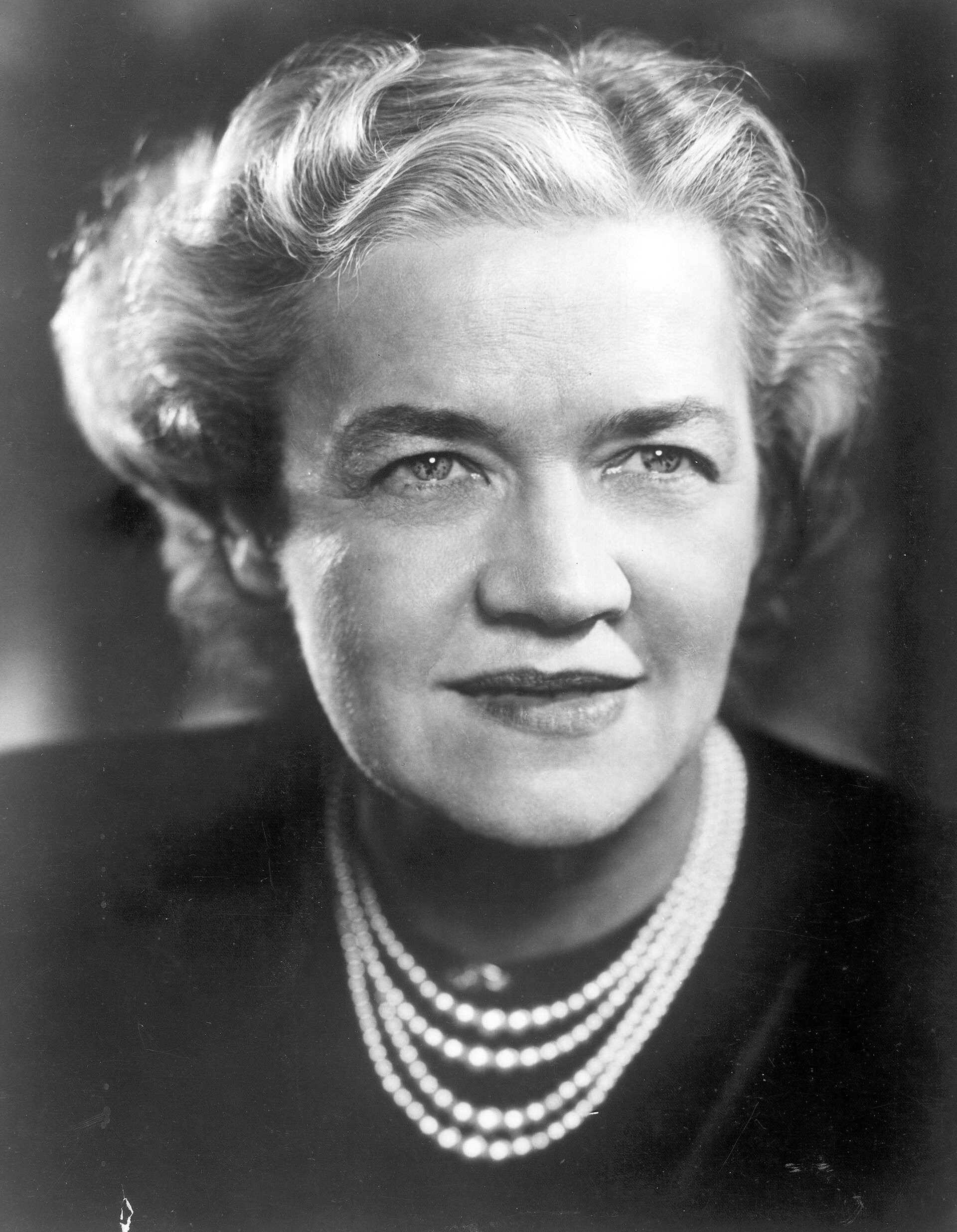
On June 1, 1950, a first-term senator from Maine rose in the Senate chamber and said she would speak "briefly and simply about a serious national condition." Margaret Chase Smith had been in the Senate for a year and a half. She had not named the senator from Wisconsin, and she never did in the speech. She did not need to. "I think that it is high time that we remembered that the Constitution, as amended, speaks not only of the freedom of speech but also of trial by jury instead of trial by accusation," she said. "Whether it be a criminal prosecution in court or a character prosecution in the Senate, there is little practical distinction when the life of a person has been ruined."1
What is easy to forget about that speech is what else it said. Smith accused the Democratic administration of "complacency to the threat of communism here at home and the leak of vital secrets to Russia through key officials." She listed "the Amerasia case, the Hiss case, the Coplon case, the Gold case" as "proved cases" that gave the public every reason for "strong suspicion." And then she drew the line this lesson is about: "There are enough proved cases to make this point without diluting our criticism with unproved charges."1 Smith did not think the mission was wrong. She thought the method was wrecking it.

That distinction between mission and method runs through every lesson in this module. Lessons 01 and 02 laid out why the fear was real. Lesson 06 separated the three committees: the House Committee on Un-American Activities (HUAC), the Senate Internal Security Subcommittee (SISS), and the Senate Permanent Subcommittee on Investigations, which McCarthy chaired in 1953 and 1954. McCarthy was never a member of HUAC. Lessons 08 and 09 told how McCarthy fell and how the courts responded. This lesson steps back and asks the constitutional question underneath all of it: what may a legislature do when it investigates, what does it owe the people it investigates, and how does a free people tell an investigation that protects the republic from one that endangers it?
The mission was legitimate
The threat was real
Any honest account has to start where the anti-communists started. The archives opened in the 1990s and the Venona decryptions released by the National Security Agency from 1995 to 1996 settled what many in the 1950s denied. John Earl Haynes, who with Harvey Klehr wrote Venona: Decoding Soviet Espionage in America (1999), put the conclusion plainly in 2000: "In Venona we concluded that there were more than four hundred" Americans who had knowingly assisted Soviet espionage in the 1930s and 1940s. Haynes described the Communist Party of the United States as "an auxiliary to Soviet espionage" during those years, and wrote that its general secretary, Earl Browder, "supervised his party's cooperation with the KGB and GRU."2 Sources inside the Treasury, the State Department and the Office of Strategic Services passed documents to Moscow. The bomb itself was compromised. Lesson 02 sets out that evidence case by case.
Haynes did not stop at espionage. "In my view the American Communist party was a real danger to American democracy in the context of the early Cold War," he said. "Its chief threat was that of political subversion, not espionage."2 People who argued in the 1950s that the whole issue was a phantom were wrong, and the anti-communists who said the government had been slow, careless and sometimes willfully blind were right about a great deal. The federal Commission on Protecting and Reducing Government Secrecy, chaired by Senator Daniel Patrick Moynihan, judged in its 1997 report that by 1950 "the United States Government possessed information which the American public desperately needed to know: proof that there had been a serious attack on American security by the Soviet Union, with considerable assistance from what was, indeed, an 'enemy within.'"3
Congress has a duty to investigate
The second thing the anti-communist investigators got right was that Congress had every reason, and every right, to ask questions. The executive branch had hired people who turned out to be working for a foreign intelligence service, and it had not told Congress or the public what it knew. A legislature that cannot find out such things cannot legislate about them, fund the agencies that guard against them, or hold the officials responsible to account.
When the Senate published the McCarthy subcommittee's closed transcripts in 2003, the subcommittee's chairman and ranking member, Carl Levin and Susan Collins, opened the volumes with James Madison's argument in Federalist No. 51: "In framing a government which is to be administered by men over men, the great difficulty lies in this: You must first enable the government to control the governed; and in the next place, oblige it to control itself." They added: "It is precisely for the purposes of government controlling itself that Congress investigates." They also recalled Woodrow Wilson's judgment that the "vigilant oversight of administration" was as important as legislation.4
The Permanent Subcommittee on Investigations itself was born from that tradition. It grew out of the wartime Special Committee to Investigate the National Defense Program, chaired by Senator Harry Truman, which merged after the Legislative Reorganization Act of 1946 into the committee that became Government Operations.5 Under Truman the committee had exposed waste and fraud in war contracting. In 1953 the same subcommittee, now chaired by McCarthy, turned almost wholly to communism. Donald Ritchie of the Senate Historical Office, who edited the transcripts, notes that the Senate had assigned loyalty questions to the Internal Security Subcommittee of the Judiciary Committee, "but Senator McCarthy interpreted his subcommittee's mandate broadly enough to cover any government-related activity, including subversion and espionage."5
What the investigators found that was real
Ritchie's introduction, which is the most careful official account of the subcommittee's work, gives the investigators their due. "The subcommittee's investigations exposed examples of lax security in government agencies and defense contractors," he writes, "but they failed to substantiate the chairman's accusations of subversion and espionage."5 Both halves of that sentence matter. Lax security in agencies that handle secrets is a legitimate subject for a legislature, and exposing it is a public service. Announcing espionage that the evidence does not show is something else.
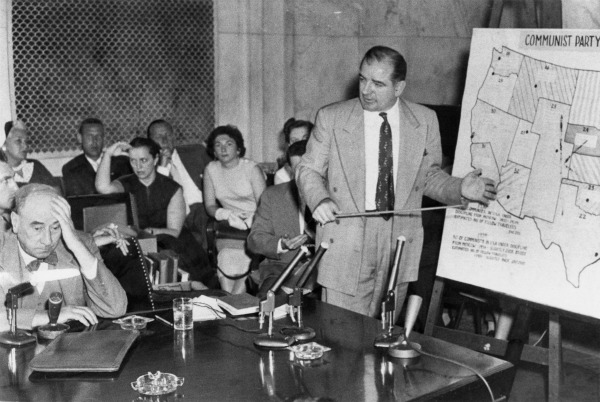
The size of the effort was real too. McCarthy's predecessor had held six executive sessions in 1952. McCarthy held 117 in 1953. In his first year the subcommittee took testimony from 395 witnesses in closed sessions and staff interrogations and 214 in public, and compiled 8,969 pages of closed testimony against 5,671 pages of public hearings.5 The chart below sets those numbers side by side. Most of the work happened where the public could not see it, which is one reason the 2003 release of the transcripts changed what historians can say about the methods.
The power to investigate and its limits: seven cases
The Constitution never mentions a power to investigate. The Supreme Court found it implied in the power to legislate, and over 140 years it has drawn both the power and its limits from the same source. Seven decisions frame the question. They are given here in order, with the language of the opinions quoted exactly.
Kilbourn v. Thompson (1881): no general power over private affairs
The first great case began with a real estate pool and the bankruptcy of Jay Cooke and Company. The House of Representatives investigated, demanded records from a businessman named Hallet Kilbourn, and when he refused, jailed him for contempt. The Court held the House had gone too far. The inquiry, it said, was "judicial and not legislative," since the matter belonged to the bankruptcy courts, and it could result in no valid legislation. The Court laid down a rule that every later case has repeated in some form: "neither of these bodies possesses the general power of making inquiry into the private affairs of the citizen."6 Kilbourn is the case that defenders of witnesses always reach for first. In 1959 Justice Hugo Black cited it against HUAC, writing that the Court in Kilbourn "was seeking to exercise judicial power, and this, it emphatically said, no committee could do."7
McGrain v. Daugherty (1927): the power is real and it reaches private citizens
The Teapot Dome scandal produced the case that established the modern power. A Senate committee investigating the Justice Department under Attorney General Harry Daugherty subpoenaed his brother, Mally Daugherty, a bank president, who refused to appear. The Court upheld the Senate. "A legislative body cannot legislate wisely or effectively in the absence of information respecting the conditions which the legislation is intended to affect or change," wrote Justice Willis Van Devanter, and the power of inquiry, with process to enforce it, "is an essential and appropriate auxiliary to the legislative function."8
The Court did not pretend the power was safe. It acknowledged that "this power of inquiry, if sustained, may be abusively and oppressively exerted," and answered that the same could be said of the power to legislate. It also said that a witness "rightfully may refuse to answer where the bounds of the power are exceeded or the questions are not pertinent to the matter under inquiry."8 Ritchie summarizes the practical result: after McGrain, "a committee could subpoena anyone to testify, including private citizens who were neither government officials nor employees."5
Sinclair v. United States (1929): pertinent questions must be answered
Harry Sinclair, the oilman at the center of Teapot Dome, refused to answer a Senate committee on the ground that the matter was in litigation. The Court upheld his conviction for contempt. Congress's "authority ... to require pertinent disclosures in aid of its own constitutional power is not abridged because the information sought to be elicited may also be of use in such suits." But the same opinion contains one of the strongest statements of the witness's side: "It has always been recognized in this country, and it is well to remember, that few if any of the rights of the people guarded by fundamental law are of greater importance to their happiness and safety than the right to be exempt from all unauthorized, arbitrary or unreasonable inquiries and disclosures in respect of their personal and private affairs."9
Watkins v. United States (1957): no exposure for its own sake
John T. Watkins (no relation to Senator Arthur Watkins, who chaired the 1954 censure committee) was a labor organizer for the United Automobile Workers who had been an official of the Farm Equipment Workers union. On April 29, 1954, he testified before a HUAC subcommittee. He answered every question about himself. He refused to say whether others he had known were party members, telling the subcommittee: "I am not going to plead the fifth amendment, but I refuse to answer certain questions that I believe are outside the proper scope of your committee's activities." He added that he would not answer "any questions with respect to others with whom I associated in the past," people "who to my best knowledge and belief have long since removed themselves from the Communist movement."10 He was convicted of contempt on seven counts.
On June 17, 1957, the Court reversed by a vote of 6 to 1, with Chief Justice Earl Warren writing. The opinion is the most quoted statement of the limits on congressional investigation:
"There is no general authority to expose the private affairs of individuals without justification in terms of the functions of the Congress. ... Nor is the Congress a law enforcement or trial agency. These are functions of the executive and judicial departments of government. No inquiry is an end in itself; it must be related to, and in furtherance of, a legitimate task of the Congress. Investigations conducted solely for the personal aggrandizement of the investigators or to 'punish' those investigated are indefensible."10
Warren also wrote that "The Bill of Rights is applicable to investigations as to all forms of governmental action," that "Abuses of the investigative process may imperceptibly lead to abridgment of protected freedoms," and that people named by witnesses, "and thereby placed in the same glare of publicity are equally subject to public stigma, scorn and obloquy." The holding rested on fairness to the witness: the subcommittee had never made clear what question was under inquiry, so Watkins "was thus not accorded a fair opportunity to determine whether he was within his rights in refusing to answer, and his conviction is necessarily invalid under the Due Process Clause of the Fifth Amendment." The Court added: "We have no doubt that there is no congressional power to expose for the sake of exposure."10
Barenblatt v. United States (1959): the power survives, by balancing
Two years later the Court made clear that Watkins had not ended anti-communist investigations. Lloyd Barenblatt, a former college instructor, refused to tell HUAC whether he had been a party member, citing the First Amendment rather than the Fifth. By 5 to 4, with Justice John Marshall Harlan writing, the Court upheld his conviction. "Where First Amendment rights are asserted to bar governmental interrogation resolution of the issue always involves a balancing by the courts of the competing private and public interests at stake in the particular circumstances shown." The government's interest in self-preservation outweighed Barenblatt's, the majority held, and "So long as Congress acts in pursuance of its constitutional power, the Judiciary lacks authority to intervene on the basis of the motives which spurred the exercise of that power."7 The opinion also called the power of inquiry "as penetrating and far-reaching as the potential power to enact and appropriate under the Constitution."7
Justice Black, joined by Chief Justice Warren and Justice William O. Douglas, dissented in terms that went to the heart of this lesson: "the chief aim, purpose and practice of the House Un-American Activities Committee, as disclosed by its many reports, is to try witnesses and punish them because they are or have been Communists or because they refuse to admit or deny Communist affiliations."7 Justice William Brennan dissented separately. The split shows that by 1959 the dispute was no longer about whether Congress could investigate communism. It was about whether a given committee was investigating or punishing.
Eastland v. United States Servicemen's Fund (1975): the Speech or Debate shield
In 1970 the Senate Internal Security Subcommittee, chaired by Senator James Eastland of Mississippi, subpoenaed the bank records of an organization that ran coffeehouses near military bases and opposed the Vietnam War. The organization sued to block the subpoena. The Court, through Chief Justice Warren Burger, held that the suit could not proceed. "The power to investigate and to do so through compulsory process plainly falls within that definition" of legitimate legislative activity, and once members act within "the legitimate legislative sphere," the Speech or Debate Clause "is an absolute bar to interference."11 Eastland matters to this lesson because it shows the other side of the ledger. Courts will rarely stop an investigation in advance. The protection a witness has lies mostly in the rules the chambers write for themselves, in the political judgment of members, and in the courts' review when the government later tries to punish a witness for contempt.
Trump v. Mazars (2020): the old limits restated
The most recent major case involved subpoenas from three House committees for the personal financial records of a sitting President. Writing for a 7 to 2 majority on July 9, 2020, Chief Justice John Roberts restated the limits from Kilbourn and Watkins in modern form. Congress "may not issue a subpoena for the purpose of 'law enforcement,'" because "those powers are assigned under our Constitution to the Executive and the Judiciary." Congress "has no 'general' power to inquire into private affairs and compel disclosures," and, quoting Watkins, "there is no congressional power to expose for the sake of exposure." Recipients of legislative subpoenas "have long been understood to retain common law and constitutional privileges with respect to certain materials."12
For subpoenas aimed at a President's information, the Court set out four considerations: courts "should carefully assess whether the asserted legislative purpose warrants the significant step" of involving the President, "should insist on a subpoena no broader than reasonably necessary to support Congress's legislative objective," "should be attentive to the nature of the evidence offered by Congress to establish" that purpose, and "should be careful to assess the burdens imposed on the President by a subpoena."12 Those tests were written for a separation-of-powers fight, but they are a fair description of what any careful investigator should ask before compelling testimony from anyone.
What the cases add up to
| Case | Year | What it allows | What it forbids or limits |
|---|---|---|---|
| Kilbourn v. Thompson | 1881 | Inquiry tied to a subject on which the House could legislate | "General power of making inquiry into the private affairs of the citizen"; inquiries that are judicial in nature |
| McGrain v. Daugherty | 1927 | Compulsory process against private citizens; the power is "an essential and appropriate auxiliary to the legislative function" | Questions beyond the bounds of the power or not pertinent may be refused |
| Sinclair v. United States | 1929 | Pertinent questions must be answered even if they bear on pending lawsuits | "Unauthorized, arbitrary or unreasonable inquiries" into private affairs |
| Watkins v. United States | 1957 | Inquiry "related to, and in furtherance of, a legitimate task of the Congress" | Exposure for its own sake; punishment; questions whose pertinence is never made clear |
| Barenblatt v. United States | 1959 | Questions about Communist Party membership in a properly authorized inquiry | First Amendment claims are weighed case by case, not ignored |
| Eastland v. U.S. Servicemen's Fund | 1975 | Subpoenas within the legislative sphere are shielded from suits | The shield covers legitimate legislative activity only |
| Trump v. Mazars | 2020 | Subpoenas with a valid legislative purpose, no broader than necessary | Subpoenas for "law enforcement"; exposure for its own sake |
Two related cases fill in what happened to witnesses after they left the hearing room. In Slochower v. Board of Higher Education (1956), a Brooklyn College professor who had invoked the Fifth Amendment before the Senate Internal Security Subcommittee in 1952 was fired under the New York City Charter, without notice or hearing. The Court held the firing unconstitutional and wrote: "At the outset we must condemn the practice of imputing a sinister meaning to the exercise of a person's constitutional right under the Fifth Amendment." The privilege, it said, "would be reduced to a hollow mockery if its exercise could be taken as equivalent either to a confession of guilt or a conclusive presumption of perjury," and it "serves to protect the innocent who otherwise might be ensnared by ambiguous circumstances."13 In Greene v. McElroy (1959), an aeronautical engineer who lost his security clearance and then his job won reversal because he had never been allowed to confront the evidence. "Certain principles have remained relatively immutable in our jurisprudence," wrote Chief Justice Warren. "One of these is that, where governmental action seriously injures an individual, and the reasonableness of the action depends on fact findings, the evidence used to prove the Government's case must be disclosed to the individual so that he has an opportunity to show that it is untrue." The Court added: "We have formalized these protections in the requirements of confrontation and cross-examination."14
Due process and a legislative hearing
A congressional hearing is not a trial, and nobody in the 1950s claimed it was. The Fifth Amendment says no person shall "be deprived of life, liberty, or property, without due process of law," and the Sixth guarantees "In all criminal prosecutions" the right "to be informed of the nature and cause of the accusation; to be confronted with the witnesses against him; to have compulsory process for obtaining witnesses in his favor, and to have the Assistance of Counsel for his defence."15 Those Sixth Amendment rights belong to the accused in a criminal case. A witness before a committee is not accused of anything in a legal sense, and the committee cannot fine him, jail him (except through a separate contempt prosecution) or fire him.
That is the defenders' strongest procedural point, and it is correct as far as it goes. Roy Cohn, McCarthy's chief counsel, made it at the time. According to Ritchie, Cohn "insisted that the subcommittee gave 'suspects' rights that they would not get in a court of law. Unlike a witness before a grand jury, or testifying on the stand, those facing the subcommittee could have their attorney sit beside them for consultation." The closed sessions, Cohn argued, further protected witnesses by keeping out the press and the public.5
The problem is that the consequences were not confined to the hearing room. Smith's sentence, "there is little practical distinction when the life of a person has been ruined," states the issue from the floor of the Senate in 1950.1 A witness named as a Communist in a televised hearing, or described to reporters after a closed one, could lose a job, a clearance, a passport, a reputation and friends without any tribunal ever deciding anything. The process stopped short of a verdict, but the penalties did not wait for one. That is why the Court in Watkins said the Bill of Rights applies to investigations, and why Pierson's framework counts the suppression of due process among the marks of an unjust order: in "Ordered Liberty Reclaimed," an order is unjust when it "Requires the suppression of constitutionally protected speech, religion, property, or due process."16
The methods in question
Each method below is taken in the same order: what it was meant to do and the best case for it, what the record shows it did, and where it leaves the mission. The sources are the subcommittee's own transcripts and Ritchie's introduction to them, the House and Senate rules adopted afterward, and the court decisions.
Public naming before evidence
The case for naming was that publicity works. Agencies that had sat on security files for years moved when a senator read names aloud, and the public had a right to know whether the government was harboring security risks. Some of the people McCarthy named in 1950 had in fact helped Soviet intelligence. In 2007 Haynes went through the names on McCarthy's lists and in his speeches, checking each against Venona and other evidence, and concluded: "Of the 159 persons listed above, there is substantial evidence that nine assisted Soviet espionage against the United States." He judged that "a number of those on the lists above, perhaps a majority, likely were security risks," but that others, "a minority but a significant one, likely were not, and some, Drew Pearson, Dean Acheson, and George Marshall for example, certainly were not."17 Lesson 11 takes up those findings claim by claim.
Naming before evidence meant that the minority who were not risks, and those who were misidentified, paid the same public price as the guilty. Ritchie found in the transcripts that "the subcommittee occasionally subpoenaed the wrong individuals, and used the closed hearings to winnow out cases of mistaken identity," and that "Some were called as witnesses out of mistaken identity."5 Robert F. Kennedy, who served on the staff in 1953 and returned as minority counsel in 1954, wrote: "No real research was ever done." He added: "Most of the investigations were instituted on the basis of some preconceived notion by the chief counsel or his staff members and not on the basis of any information that had been developed."5 Watkins named the harm in constitutional terms: those identified by witnesses are "placed in the same glare of publicity" and are "equally subject to public stigma, scorn and obloquy."10
Guilt by association
The best case for looking at associations is that Communist Party membership was secret by design. The party's underground members did not carry cards, and front organizations really were used to recruit. Truman's own loyalty order of 1947 allowed boards to consider "Membership in, affiliation with or sympathetic association with" any organization the Attorney General designated as "totalitarian, fascist, communist, or subversive."18 Associations were a legitimate lead for investigators.
As evidence of disloyalty, they were thin. Ritchie's summary of the 1953 transcripts is specific. The subcommittee's dragnet included "a number of perplexed witnesses who had signed a nominating petition" years before, or who "belonged to a union whose leadership included alleged Communists, bought an insurance policy through an organization later designated a Communist front organization, belonged to a Great Books club that read Karl Marx among other authors, had once dated a Communist, had relatives who were Communists, or simply had the same name as a Communist." Witnesses "who swore that they had never joined the Communist party or engaged in espionage or sabotage were held accountable for long-forgotten petitions they had signed a decade earlier or for having joined organizations that the attorney general later cited as Communist fronts."5
The transcripts show what that looked like in a room. On November 5, 1953, an Army Signal Corps employee named Stanley Berinsky, suspended at Fort Monmouth after security officers learned his mother had once been a party member, was asked by the chairman: "Was she still a Communist at heart in 1952?" Berinsky answered, "Well, I don't know how you define that."5 Smith had warned against exactly this in 1950. The exercise of the rights she listed, she said, "should not cost one single American citizen his reputation or his right to a livelihood nor should he be in danger of losing his reputation or livelihood merely because he happens to know someone who holds unpopular beliefs. Who of us does not?"1
The Fifth Amendment treated as proof
Here the defenders have a real point. Many witnesses who took the Fifth were in fact Communists or former Communists, and some were protecting others. Ritchie notes that "Some witnesses invoked the Fifth Amendment to avoid implicating those they knew to be Communists," while others used it as a blanket answer after being warned that answering about themselves could force them to name associates. In Rogers v. United States (1951) the Supreme Court had held that a witness could not refuse to answer out of a "desire to protect others from punishment," and the Justice Department told McCarthy he had the right to order witnesses to say whether they knew of Communists working in the government or defense plants.5 An investigator facing a wall of silence from people he had reason to suspect was not imagining his frustration.
The method went further than frustration. McCarthy, Ritchie writes, "regularly informed witnesses of their right to decline to answer if they felt an answer might incriminate them, but he interpreted their refusal to answer a question as an admission of guilt." He called them "Fifth-Amendment Communists" and insisted that "an innocent man does not need the Fifth Amendment." During 1953 some seventy witnesses before the subcommittee invoked the Fifth.5 The executive branch adopted a milder version of the same inference. On October 13, 1953, President Eisenhower signed Executive Order 10491, which added to the factors in federal security investigations "Refusal by the individual, upon the ground of constitutional privilege against self-incrimination, to testify before a congressional committee regarding charges of his alleged disloyalty or other misconduct."19
The Supreme Court rejected the inference in Slochower in 1956: the privilege would be "a hollow mockery" if its use could be taken as "a confession of guilt."13 Erwin Griswold, dean of Harvard Law School, made the same argument for a general audience in The 5th Amendment Today (1955), the source of his remark that witnesses before McCarthy's one-man hearings faced a "judge, jury, prosecutor, castigator, and press agent, all in one."5 The mission lost something too: a silence turned into a public accusation produced no evidence that could be used anywhere else, and as Ritchie records, no witness who appeared before the subcommittee during McCarthy's chairmanship "was imprisoned for perjury, contempt, espionage, or subversion."5
Executive sessions and leaks
Closed sessions have a legitimate purpose, and Ritchie describes it: "By hearing witnesses privately, the permanent subcommittee could avoid incidents of misidentification and could determine how forthcoming witnesses were likely to be in public."5 The 1955 House rules made closed sessions mandatory when testimony might "defame, degrade, or incriminate any person."20 Used that way, an executive session protects the people being investigated.
Under McCarthy the term took on another meaning. John G. Adams, the Army's counsel, who sat through many of the sessions, wrote that "It didn't really mean a closed session, since McCarthy allowed in various friends, hangers-on, and favored newspaper reporters," and "Nor did it mean secret, because afterwards McCarthy would tell the reporters waiting outside whatever he pleased." Telford Taylor, the American prosecutor at Nuremberg, called it "a new and indefensible kind of hearing, which is neither a public hearing nor an executive session." The transcripts were rarely released, which, Ritchie notes, "ostensibly protected the privacy of those interrogated, but also gave the chairman an opportunity to give to the press his version of what had transpired behind closed doors, with little chance of rebuttal." McCarthy's response to Taylor's criticism was "an executive session inquiry into Gen. Taylor's loyalty."5
One-member hearings
Senate rules in 1953 allowed a single senator to hold hearings if the committee authorized it, and did not bar "one-man hearings." Ritchie explains why: senators "often came and went during a committee hearing and committee business could come to a halt if a minimum number of senators were required." In July 1953, after a fight over McCarthy's insistence on hiring staff without consultation, the three Democratic members (John McClellan, Henry Jackson and Stuart Symington) resigned from the subcommittee, and did not return until January 1954. Hearings were called on short notice and often outside Washington, which kept the other Republican senators from attending. The chairman often sat alone, and at times the unpaid consultant G. David Schine "even presided in Senator McCarthy's absence."5
The effect was to fuse the roles that a fair process keeps apart. One man chose the targets, signed the subpoenas, asked the questions, judged the answers and briefed the press. Army counsel Adams wrote that McCarthy "signed scores of blank subpoenas which his staff members carried in their inside pockets, and issued as regularly as traffic tickets," and witnesses complained that subpoenas arrived "either the night before or the morning of" the hearing, "making it hard for them to obtain legal representation."5 A member of HUAC, Representative Edwin Willis of Louisiana, explained in the 1955 House debate why he backed a two-member minimum: "I personally oppose a one-man hearing. I think fair play requires that not less than two members should be present."21
No right to cross-examine
Legislative fact-finding has never carried a general right of cross-examination, and the courts have not imposed one. That was true before McCarthy and it remained true after the 1955 reforms. The case for the practice is that a committee gathering information for legislation would grind to a halt if every person mentioned could demand to question every witness.
The difficulty arises when the hearing stops gathering information and starts making accusations. An accusation that is never tested is never corrected. Representative Hugh Scott of Pennsylvania, a Republican who had chaired the Rules subcommittee that drafted a code of fair procedures in the previous Congress, listed among the failings of the 1955 House rules that they would "not allow a person under investigation to cross-examine a witness accusing him at a public hearing," would not entitle a witness to "even 24 hours advance notice of a hearing at which his career or reputation would be at stake," and would "allow a committee to issue a public report defaming individuals or groups without notice or hearing."21 In Greene v. McElroy the Court treated confrontation and cross-examination as basic wherever government action "seriously injures an individual" on the basis of disputed facts.14
Informants and leaked files
Security agencies have always depended on informants, and the government has always protected some of them. Truman's loyalty order allowed investigative agencies to "refuse to disclose the names of confidential informants," provided they gave the agency enough information to evaluate them and certified in writing that secrecy was essential.18 That is a legitimate need in counterintelligence, where exposing a source can get the source killed and close the channel.
McCarthy's practice was different in kind. Ritchie writes that "the chairman showed no qualms about using raw investigative files as evidence," and that "His willingness to break the established rules encouraged some security officers and federal investigators to leak investigative files to the subcommittee that they were constrained by agency policy from revealing." The result was perverse: "Rather than lead to the high-level officials he had expected to find, the leaked security files shifted his attention to lower-level civil servants," who, lacking any way to fight back politically, became "easier targets to bully."5 Raw files contain rumor, malice and error alongside fact, which is why the agencies that compiled them had rules about their use.
The clearest test came on May 5, 1954, during the Army-McCarthy hearings. McCarthy had introduced a two-and-a-quarter-page document he presented as information from the FBI about Fort Monmouth. Robert Collier, an assistant counsel to the special subcommittee, went to see J. Edgar Hoover and reported back under oath. Hoover had told him that the FBI's own fifteen-page memorandum of January 26, 1951 and McCarthy's document dealt with the same subject and in some places used identical language, but, Collier testified on Hoover's authority, "This is not a carbon copy or a copy of any communication prepared or sent by the FBI to General Bolling on January 26, 1951, or any other date." The FBI's original had gone to Army intelligence in January 1951.22 Defenders of McCarthy note that the substance matched an FBI warning the Army had received. Critics note that a senator had put into the public record a retyped extract of a classified FBI document he was not authorized to have, and that the FBI declined to vouch for it.
Pressure on employers
The last method reached beyond government. Employers who held defense contracts had a real security interest in knowing whether employees were reliable, and the government had a real interest in telling them. McCarthy, according to Ritchie, "encouraged government agencies and private corporations to fire anyone who took the Fifth Amendment before a congressional committee."5 At Fort Monmouth, the pursuit of a suspected spy ring "caused officials at Fort Monmouth to suspend forty-two civilian employees. After the investigations, all but two were reinstated in their former jobs."5 The firing of Harry Slochower by New York City, without notice or hearing, after his testimony before the Senate Internal Security Subcommittee, shows the same pattern at a different level of government.13
A firing is a penalty, and penalties in a constitutional order are imposed after a process. When a committee's statement triggers a firing that no tribunal ever reviews, the committee has done indirectly what Watkins and Mazars say it may not do directly: punish. Lesson 10 counts what that cost in careers and lives.
The process a witness had, compared
The diagram below sets the protections side by side for four settings in which an American could be accused of disloyalty in the 1950s: McCarthy's subcommittee in 1953 and 1954, a House committee after the 1955 Code of Fair Procedures, a federal loyalty board under Truman's 1947 order, and a federal criminal trial. Each cell rests on the governing text or the documented practice cited below it.
The comparison shows something the usual story skips. Truman's loyalty boards gave far more process than McCarthy's subcommittee: written notice with charges stated "as specifically and completely as, in the discretion of the employing department or agency, security considerations permit," a hearing, counsel, witnesses and affidavits, appeal to the agency head and then to the Civil Service Commission's Loyalty Review Board.18 Their great weakness was the informant. A board could rule on information from people the employee never saw and could not question, and the standard for removal was that "on all the evidence" there were "reasonable grounds" for belief that the person was disloyal.18 Greene v. McElroy addressed that weakness in 1959.14
What legitimate counterintelligence looked like at the same time
While the committees held hearings, the work that actually identified Soviet agents was going on elsewhere, mostly in silence. Its methods were different, and so were its results.
Venona: the quiet work
In 1943 the Army's Signal Intelligence Service, later the Army Security Agency, began collecting Soviet intelligence cables that had been sent mainly from New York. The Moynihan commission recorded that "By 1945, some 200,000 messages had been transcribed." On December 20, 1946, Meredith Gardner, an Army codebreaker, "made the first break into the VENONA code, revealing the existence of Soviet espionage at Los Alamos."23 The Army shared its results with the FBI, whose liaison to the project, Robert Lamphere, first made the project's existence public in a book published in 1986, according to the commission.23 Lesson 02 tells that story in full.
The secrecy was itself compromised early. "In the summer of 1948, Army Security Agency cipher clerk William Weisband passed on information about the VENONA project to the Soviets. This was discovered in 1950."23 Weisband was never prosecuted for espionage. He was sentenced to a year in jail for failing to respond to a subpoena, and the government's knowledge of his espionage stayed secret.3 The commission's verdict on that whole period is that "The Soviets knew that we knew, or could surmise. It was the American public that did not know."23
Prosecutions under rules of evidence
Venona could rarely be used in court. The decrypts would have revealed the program, and their cover names often could not be matched to a person beyond doubt. So the government built cases the slow way. "In January 1950, in the United Kingdom, Klaus Fuchs confessed to espionage while part of the British team at Los Alamos; his activities had turned up in the VENONA files. He implicated Harry Gold as his courier. Gold in turn implicated David Greenglass, who implicated his brother-in-law Julius Rosenberg."3 Each link was established through confessions, witnesses and physical evidence that could be tested before a jury. Theodore Hall, whom "both the Army and the FBI knew" was a Soviet source by 1950, was never charged, because, the commission concluded, "the Government was evidently unwilling to pursue one if it would have meant revealing the existence of the VENONA project."3
The rules of evidence sometimes let the guilty go. Judith Coplon, arrested in March 1949 with Justice Department documents, saw her "convictions in two separate prosecutions" overturned "on procedural grounds." The commission's comment was that "the effort had been made," and that Coplon "was of no further use, and her trial put others on notice."3 That is the cost of a system that requires proof, and it is a cost the Constitution accepts on purpose.
The security clearance process
The third channel was administrative. In 1946, Haynes writes, "the FBI began notifying senior administrators of security concerns about those several score persons identified by Bentley who still worked for the government; most were forced to seek employment in the private sector or found their jobs abolished."2 Truman's Executive Order 9835 of March 21, 1947 created the loyalty program, with hearings before boards of at least three members and appeal to the Loyalty Review Board.18 Eisenhower replaced it with Executive Order 10450 of April 27, 1953, which shifted the test from loyalty to whether employment was "clearly consistent with the interests of the national security," while its preamble invoked "the American tradition that all persons should receive fair, impartial, and equitable treatment at the hands of the Government."24
Haynes credits this whole apparatus, and not the televised hearings, with closing the door. "The largest Soviet World War II espionage networks had been destroyed or neutralized in the wake of Bentley's defection in 1945, the leads into Soviet espionage provided by Venona to American counter-intelligence, by the FBI's full-court press against the CPUSA, and President Truman's loyalty-security program for government employees." He concluded that "by 1950 the shockingly high level of Soviet infiltration of U.S. government agencies that had existed during World War II was largely gone."2 McCarthy's Wheeling speech came in February 1950. On Haynes's reading of the evidence, the hardest part of the counterintelligence work was done before McCarthy took up the issue.
Did the methods damage the mission?
The argument from the historians of espionage
The sharpest case that McCarthy hurt the anti-communist cause comes from the scholars who did the most to prove that cause was justified. Haynes and Klehr were long accused of trying to rehabilitate McCarthy because their work confirmed so much Soviet espionage. Haynes rejected the charge. At a joint appearance with Arthur Herman in February 2000, he said McCarthy "threatened that anti-Communist consensus. He attempted to make anticommunism a partisan weapon." By 1950, Haynes argued, anti-communist liberals and labor leaders had already driven Communists out of the Democratic coalition and the CIO, and "politically an anti-Communist consensus prevailed not only in the Republican Party but in the Democratic Party and the major institutions of liberalism." McCarthy, he said, "painted the New Deal as part of a disguised Communist plot and depicted Truman administration leaders Dean Acheson and George Marshall as participants in a Communist conspiracy," and "There is no basis in Venona or in the Soviet archives" for that charge.2
Haynes's summary is the one most often quoted from that talk: "In my view the new evidence in general vindicates the broad anti-Communist consensus of American politics in the late 1940s and 1950s but does not vindicate Joseph McCarthy in the particular." He also rejected the opposite caricature. McCarthy, he said, was not "some sort of monster who terrorized the nation," and "Rather than the Great Satan he is depicted as in many histories, he was a minor devil."2
The argument has a practical side as well as a political one. A movement that names innocent people alongside guilty ones teaches the public to discount every accusation. Smith saw that in 1950: the American people, she said, "are sick and tired of seeing innocent people smeared and guilty people whitewashed."1 The Moynihan commission made a related point about the secrecy surrounding Venona: "Anyone knowledgeable of the Communist apparat could have predicted that the Government 'secrets' would be attacked as spurious and contrived."3 When the real evidence finally came out in the 1990s, part of the reason it met disbelief was that the loudest anti-communist of the 1950s had spent his credibility on charges the evidence did not support.
Hoover's distance
The FBI's relationship with McCarthy is the subject of real dispute among historians. M. Stanton Evans argues in Blacklisted by History (2007) that the Bureau's files supported many of McCarthy's cases and that the FBI quietly assisted him. Other historians argue that Hoover, whatever his early sympathy, came to see McCarthy as a danger to the Bureau's control of its own files and to the government's case against real Communists. The documented public moment is the one recorded on May 5, 1954, when Hoover declined to vouch for the document McCarthy had put into the record, and asked the committee to seek the Attorney General's opinion before any of its contents were made public.22 An agency that depends on secret sources has every reason to keep its files away from a hearing room, and the episode shows that the senator and the Bureau were no longer working the same way, whatever their shared goal.
The defenders' answer
Defenders of McCarthy answer on several grounds, and each deserves a fair statement. Arthur Herman's Joseph McCarthy (2000) offers what Haynes called a defense, "albeit a qualified one," which Haynes credited with "correcting the excessive, indeed hysterical demonization of McCarthy that has been typical of far too many historical accounts."2 Evans argues that most of McCarthy's cases came from government security files, that a large share involved real security risks the State Department had failed to resolve, and that his opponents in the executive branch withheld the very files that would have tested his charges. Cohn argued that the subcommittee gave witnesses more protection than a grand jury did.5 And it is true that the executive branch kept Venona from Congress and the public, which meant that investigators who suspected espionage could not see the strongest evidence that it existed. The Moynihan commission called that dilemma "awful."3
Those points are real, and they explain why McCarthy found an audience. They do not change what the transcripts show about method: that the subcommittee's investigations "failed to substantiate the chairman's accusations of subversion and espionage," that forty of forty-two suspended Fort Monmouth employees went back to work, and that no witness went to prison for anything he said or refused to say.5 Ellen Schrecker, in Many Are the Crimes (1998), argues from the other side that the harm was spread across a whole system of employers, agencies and committees, of which McCarthy was only the most visible part. The evidence in this lesson is consistent with both of those readings on that point: the damage did not depend on one senator, and one senator made it far worse.
Fort Monmouth as a test case
Fort Monmouth, the Army Signal Corps laboratories in New Jersey, is the clearest test because the suspicion had a real basis. Julius Rosenberg had worked there, and reports had arrived that information from the laboratories was turning up in Eastern Europe. McCarthy and Cohn "were convinced that other Communist sympathizers were still supplying secrets to the enemy." Ritchie adds a point of context: the Soviet Union "had been an ally during the Second World War, and during that time had openly designated representatives at the laboratories, making espionage there superfluous." The witnesses with strong evidence of Communist activity "tended to be involved in labor organizing," and those who named names "invariably described union activities, and none corroborated any claims of subversion and espionage."5 Lesson 07 examines the Fort Monmouth case in detail.
The Declaration of Conscience
Smith's speech of June 1, 1950 came less than four months after Wheeling, when McCarthy's standing was rising. It was the first organized statement from inside his own party against his methods, and it is worth reading for its principles as well as its courage. The Senate Historical Office describes it as a statement Smith introduced "signed by herself and six other Republican senators."25 The six were Charles Tobey of New Hampshire, George Aiken of Vermont, Wayne Morse of Oregon, Irving Ives of New York, Edward Thye of Minnesota and Robert Hendrickson of New Jersey.1
Under the heading "The basic principles of Americanism," Smith said: "Those of us who shout the loudest about Americanism in making character assassinations are all too frequently those who, by our own words and acts, ignore some of the basic principles of Americanism." She then listed them, one to a line:
"The right to criticize.
The right to hold unpopular beliefs.
The right to protest.
The right of independent thought."1
She went on: "The American people are sick and tired of being afraid to speak their minds lest they be politically smeared as 'Communists' or 'Fascists' by their opponents. Freedom of speech is not what it used to be in America. It has been so abused by some that it is not exercised by others."1 She said the Senate's "deliberative character has too often been debased to the level of a forum of hate and character assassination sheltered by the shield of congressional immunity," and that she did not want her party to "ride to political victory on the Four Horsemen of Calumny," which she named as "Fear, Ignorance, Bigotry, and Smear."1
Three features of the speech matter for this lesson. First, it accepted the mission. Smith attacked the administration for "its complacency to the threat of communism here at home," and the joint statement charged the administration with "its oversensitiveness to rightful criticism." Second, it rejected the method by name. The statement said "Certain elements of the Republican party have materially added to this confusion in the hopes of riding the Republican party to victory through the selfish political exploitation of fear, bigotry, ignorance, and intolerance." Third, it was even-handed. "As an American, I do not want a Democratic administration 'whitewash' or 'coverup' any more than I want a Republican smear or witch hunt," Smith said. "As an American, I condemn a Republican Fascist just as much as I condemn a Democrat Communist."1
The Declaration did not stop McCarthy in 1950, and his power grew for three more years. Its principles were vindicated in December 1954, when the Senate censured him with Smith among the senators the National Archives credits with leading the effort, and by the rules both chambers adopted afterward. Lesson 09 tells that story.
The Senate corrects itself: Flanders, Watkins and Welch
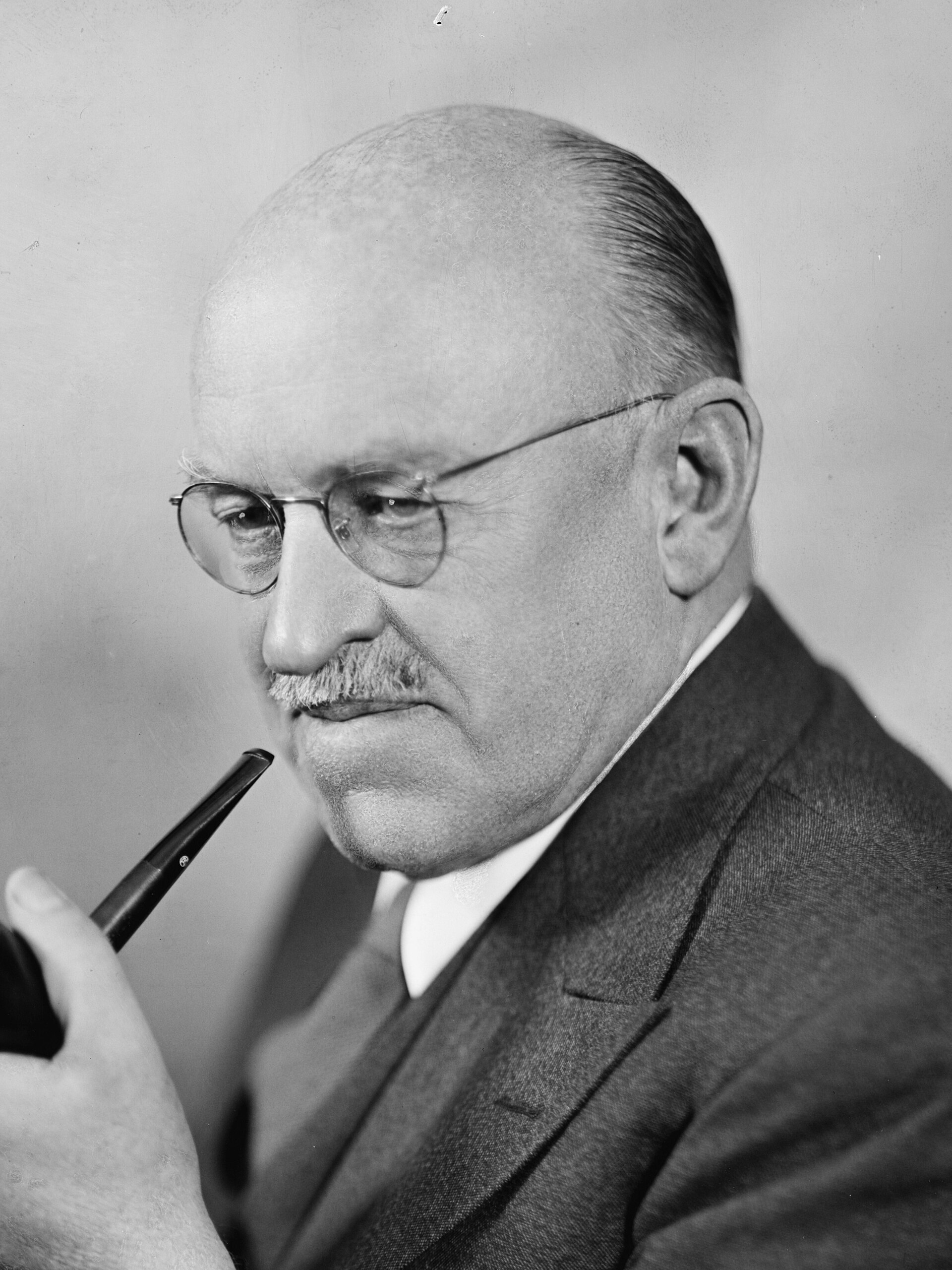

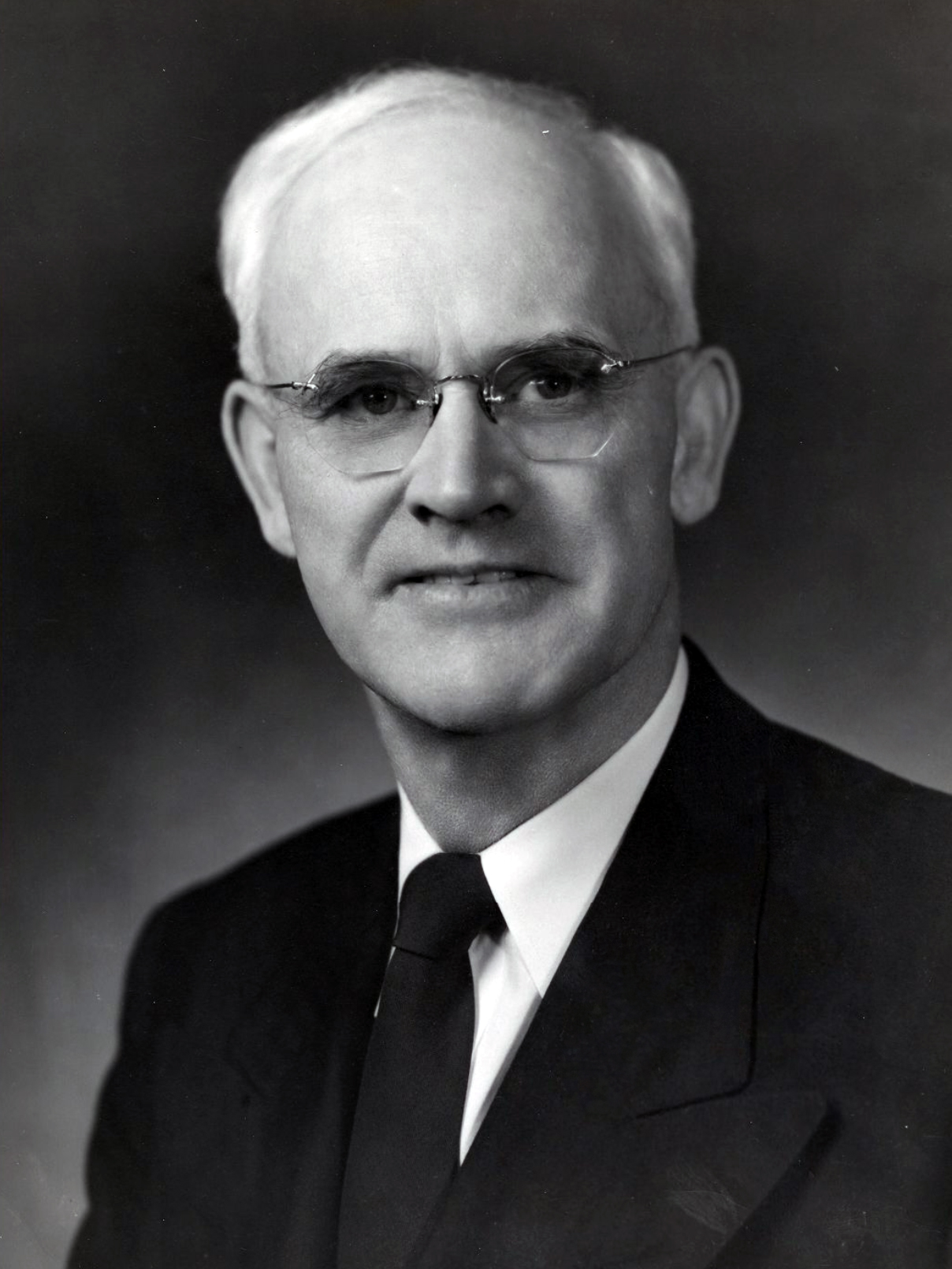
The correction came from inside the institution, through its own procedures. According to the National Archives, Republican senators "Ralph Flanders of Vermont, Arthur Watkins of Utah, and Margaret Chase Smith of Maine led the efforts to discipline McCarthy. Flanders introduced two separate resolutions against McCarthy, one removing McCarthy from his chairmanships and the other calling for his censure." Debate on the censure resolution began on July 30, 1954, and on December 2, 1954 the Senate voted to censure him, describing his behavior as "contrary to senatorial traditions."26 Arthur Watkins chaired the select committee that heard the charges and recommended censure. Idaho's Herman Welker was among those who voted against it, as lesson 06 of the Idaho radicalism module notes.

The turning point in public opinion came earlier, on June 9, 1954, during the Army-McCarthy hearings, when McCarthy charged that a young lawyer at the firm of the Army's counsel, Joseph Welch, had ties to a Communist organization. Welch answered: "Until this moment, Senator, I think I never really gauged your cruelty or your recklessness," and then, "Let us not assassinate this lad further, senator. You have done enough. Have you no sense of decency?"27 The exchange was about method. The young lawyer was not a witness in the hearing, and naming him served no purpose the inquiry required.

Eisenhower's approach
President Dwight Eisenhower's handling of McCarthy is still argued about. The political scientist Fred Greenstein, in The Hidden-Hand Presidency (1982), argued that Eisenhower deliberately refused to attack McCarthy by name and worked against him through others, on the theory that a public fight with the President would only enlarge the senator. Critics then and since have said that silence let McCarthy attack people Eisenhower could have defended. The documents show a President who opposed the methods, tightened the security program, and defended the executive branch's prerogatives, all without naming McCarthy.
On June 14, 1953, at Dartmouth College, while McCarthy's staff was pressing the State Department over books in overseas libraries, Eisenhower departed from the usual commencement themes:
"Don't join the book burners. Don't think you are going to conceal faults by concealing evidence that they ever existed. Don't be afraid to go in your library and read every book, as long as that document does not offend our own ideas of decency. That should be the only censorship. How will we defeat communism unless we know what it is, and what it teaches, and why does it have such an appeal for men, why are so many people swearing allegiance to it?"28
Eisenhower's answer to the threat was to know it and fight it "with something better, not try to conceal the thinking of our own people."28 The same administration, in Executive Order 10450 of April 1953 and the amendment of October 1953, made the security program stricter and counted refusal under the Fifth before a committee as a factor in clearance reviews.2419 Eisenhower did not oppose anti-communist security measures. He opposed doing them by public accusation.
The sharpest move came on May 17, 1954, in the middle of the Army-McCarthy hearings. Eisenhower wrote to Secretary of Defense Charles Wilson directing that Defense employees appearing before the Government Operations subcommittee then holding the Army-McCarthy hearings (with McCarthy temporarily replaced as chairman by Senator Karl Mundt) "are not to testify to any such conversations or communications or to produce any such documents or reproductions" concerning internal advice within the executive branch. He began by affirming the investigative power: "It has long been recognized that to assist the Congress in achieving its legislative purposes every Executive Department or Agency must, upon the request of a Congressional Committee, expeditiously furnish information relating to any matter within the jurisdiction of the Committee, with certain historical exceptions." He grounded the exception in the separation of powers: "This separation is vital to preclude the exercise of arbitrary power by any branch of the Government."29 The letter is one of the foundations of the modern claim of executive privilege, and it shows how quickly a fight over method becomes a fight over the structure of government. A committee that abuses its power invites the executive to claim more of its own.
The reforms afterward
The House Code of Fair Procedures, 1955
On March 23, 1955, the House approved House Resolution 151 by voice vote. Known as the Code of Fair Procedures, it was prepared with Representative Doyle of California, whose name its critics attached to it, and it amended Rule XI to govern investigative hearings.20 Its main provisions:
- A quorum for taking testimony "shall be not less than two," ending one-member hearings in the House.
- "The chairman at an investigative hearing shall announce in an opening statement the subject of the investigation," which answers the problem the Court found in Watkins.
- A copy of the committee's rules must be made available to the witness.
- "Witnesses may be accompanied by their own counsel for the purpose of advising them concerning their constitutional rights."
- If the committee determines that testimony "may tend to defame, degrade, or incriminate any person," it must receive that testimony in executive session, "afford such person an opportunity voluntarily to appear as a witness," and "receive and dispose of requests from such person to subpena additional witnesses."
- "No evidence or testimony taken in executive session may be released or used in public sessions without the consent of the committee."
- Witnesses may submit "brief and pertinent sworn statements in writing for inclusion in the record," and may obtain a transcript of their testimony.20
Hugh Scott thought the code fell far short. He called it "pitifully inadequate" and listed what it left untouched: a committee could still circulate "derogatory information" from its files without notice, release defamatory executive testimony, issue defamatory reports without a hearing, let a chairman start investigations and subpoena witnesses "without consulting the full committee," allow members "publicly to defame a witness," deny cross-examination, and give no advance notice.21 Both readings are fair. The code ended the worst practices of 1953, and it left the witness far short of a defendant's rights.
The Senate subcommittee's rules, 1954 and 1955
The Senate subcommittee changed its own rules in two steps. In January 1954, to bring the three Democrats back, the members adopted changes that "removed the chairman's exclusive authority over staffing, and gave the minority members the right to hire their own counsel." If the minority unanimously opposed holding a public hearing, the question would go to the full committee for a majority vote. Robert Kennedy became minority counsel under those rules. Later in 1954 the Senate Republican Policy Committee proposed rules "that would require a quorum to be present to hold hearings, and would prohibit holding hearings outside of the District of Columbia or taking confidential testimony unless authorized by a majority of committee members." Ritchie records that "In 1955 the Permanent Subcommittee adopted rules similar to those the Policy Committee recommended."5 Later in the 1950s, members and staff of the subcommittee joined a special Senate committee on labor racketeering, with Robert Kennedy as chief counsel, whose work Ritchie describes as "Conducted in a more bipartisan manner and respectful of the rights of witnesses."5
The courts, 1956 to 1959
The courts completed the reforms. Slochower (1956) protected the Fifth Amendment from being treated as a confession. Watkins (1957) required that the subject of an inquiry be made clear and that inquiries serve a legislative task. Barenblatt (1959) confirmed the investigative power while subjecting First Amendment claims to balancing. Greene v. McElroy (1959) required confrontation in security proceedings that lacked explicit authority to dispense with it.1310714 The Levin and Collins preface to the 2003 transcripts summed up the sequence: McCarthy's "freewheeling style caused both the Senate and the Subcommittee to revise the rules governing future investigations, and prompted the courts to act to protect the Constitutional rights of witnesses at Congressional hearings."4
Ordered liberty applied: legitimate authority, its limits, accountable government
Pierson's framework, taught in module 52, gives a vocabulary for judging the whole episode that is older than the cases and does not depend on which party held the gavel. Its working definition is short: ordered liberty is liberty that recognizes a shared duty of holding government accountable and supporting legitimate government.30 Both halves apply to a congressional investigation, and they apply in two directions at once, because an investigating committee is government holding government to account.
Legitimate authority: the investigator as steward
Lesson 02 of the Ordered Liberty module states the framework's test for authority in Pierson's words: "Authority is not self-justifying. It becomes lawful only when it is restrained by morality, limited by law, and directed toward justice." And on those who hold office: "Public officeholders are not rulers but stewards, bound by oath to uphold the Constitution and the natural rights of the people."16 A senator investigating Soviet penetration of the executive branch is exercising exactly that kind of stewardship. The power is limited by law (the cases from Kilbourn to Mazars), restrained by morality (Smith's "trial by jury instead of trial by accusation") and directed toward justice (finding and removing people who betrayed their oaths). On this test the mission passes easily. The anti-communist investigators were right that officials who passed secrets to a hostile power had broken the kind of oath the framework treats as the measure of public duty, and right that Congress had a duty to look.
The same test also condemns misuse. The framework holds that authority "that punishes truth, shelters injustice, or violates conscience loses its legitimacy. It ceases to be authority and becomes oppression."16 Lesson 02 adds the sentence that fits the methods question best: "legality is not the same as legitimacy."31 Most of what McCarthy did was legal under the Senate rules of 1953. One-member hearings were allowed. Closed sessions were allowed. Asking a witness about his mother was allowed. Legality settled none of the harder questions.
Its limits: evidence before accusation
Pierson's own standard for accusing a public official is the best measure of the methods, because it was written for the same task: deciding when someone in government has broken faith. The Breach of Ordered Liberty Framework requires that "The identification of a Breach of Ordered Liberty must rely on objective, verifiable documentation." Its criteria, it says, "ensure that accusations of breach are not speculative, political, or subjective." It insists that "No individual is subject to arbitrary accusation or subjective enforcement," that "Any determination of breach under this framework requires verifiable documentation, and due process must be afforded in any formal enforcement action," and that "The framework explicitly applies only to those who hold elected office or exercise public authority."32 Lesson 02 adds that identifying a breach is not a finding of guilt in any legal proceeding: it supports inquiry, censure, reform and public redress.31
Measured against that standard, McCarthy's methods fail on every count except the subject matter. Naming before evidence is accusation without documentation. Association and family ties are not conduct. Treating the Fifth Amendment as proof makes an accusation subjective by definition. Pressure on private employers reaches private citizens, to whom the framework says its standards of accusation do not extend. One-member hearings remove the check that turns an accusation into a judgment. The framework would have supported a careful inquiry into Harry Dexter White or Lauchlin Currie, built on the documents. It would not support a public hearing about whether a Signal Corps engineer's mother was "still a Communist at heart."
Accountable government in both directions
The framework's rule of moral parity is that "No person is beneath the law's protection, and no official is above its restraint," and that ordered liberty "judges the mob and the magistrate by one standard."30 That rule cuts against both sides of the 1950s quarrel. It condemns an executive branch that kept security problems from Congress and the public, and officials who, like the Under Secretary of War Haynes describes, overruled military counter-intelligence on a suspected spy because highly placed friends vouched for him.2 It also condemns a senator who used the immunity of the floor and the gavel to accuse people who had no way to answer. Smith made the same point in the Senate: "It is strange that we can verbally attack anyone else without restraint and with full protection, and yet we hold ourselves above the same type of criticism here on the Senate floor."1
The framework also describes the citizen as "the moral auditor of government," and it holds that "Authority is never exempt from judgment."3031 A committee is an auditor of the executive. It is also authority, and it is audited in turn by the courts, by its own chamber, by the press and by the voters. Between 1954 and 1959 every one of those auditors acted.
Lawful resistance from inside the system
Lesson 08 of the Ordered Liberty module describes the stages of lawful protest, which start with "lawful speech, publication, assembly, and petition for redress," and it quotes Madison's reminder that "A dependence on the people is, no doubt, the primary control on the government; but experience has taught mankind the necessity of auxiliary precautions."33 The end of McCarthy's power is an example of those precautions working. Smith spoke on the floor. Flanders introduced resolutions. Welch spoke up in a hearing. Watkins's committee took evidence and reported. The Senate voted. John T. Watkins refused to name former associates, accepted prosecution and won in the Supreme Court. Each acted openly, within law and through the institution, which is the kind of resistance the framework counts as support for legitimate government, not opposition to it. The framework's warning about officials applies here too: officials who defy the law commit "a breach of office," and the senators who checked McCarthy did so through the Senate's own rules.31
Method by method
The matrix below applies the framework to each method. "Served the mission" means the method advanced the legitimate goal of finding and removing security risks without punishing people outside a lawful process. "Mixed" means the method has a legitimate form that was misused. "Damaged both" means the method harmed liberty and also weakened the anti-communist cause. The ratings are this lesson's judgments, made from the sources cited in each section above.
Two patterns stand out. The methods that served the mission were ordinary legislative tools used on a stated subject. The methods that damaged both liberty and the mission were the ones that turned the hearing into a punishment, and each of them is a method the 1955 House rules, the 1955 Senate subcommittee rules or the courts later restricted. Those reforms did not weaken Congress's power to investigate communism. Barenblatt upheld that power in 1959, and Eastland shielded a Senate Internal Security Subcommittee subpoena from suit in 1975.711 The reforms took away the methods that had been hurting the cause.
A checklist for judging any investigation today
The questions below turn the cases, the 1955 rules and the framework into a working test. They apply to a congressional committee, a state legislative inquiry, an inspector general, a school board investigation or a newsroom's own reporting. None of them depends on which party is investigating whom. A reporter or citizen who asks them of every investigation, including the ones they agree with, is doing what the framework calls scrutiny.
- Is the mission legitimate? Is there a real problem within the body's authority, something it could legislate on, fund, oversee or correct? Watkins asks whether the inquiry is "related to, and in furtherance of, a legitimate task." Mazars asks whether the asserted purpose "warrants the significant step" being taken.
- Is the subject stated? Has the chair announced, in writing or at the opening, what the investigation is about, so witnesses and the public can judge whether questions are pertinent? The 1955 House code required exactly that.
- Is the scope no broader than necessary? Do the subpoenas and questions match the stated subject, or do they reach into private life, family and old associations? Mazars asks for a subpoena "no broader than reasonably necessary."
- Is there evidence before accusation? Has the body gathered documents and testimony before naming anyone in public? Pierson's breach standard asks for "objective, verifiable documentation."
- Are conduct and association kept apart? Is anyone being judged for what a relative, a friend, an employer or an organization did, rather than for what the person did?
- Is silence treated as silence? Does the body or its members describe a witness who invokes a constitutional privilege as guilty? Slochower says the privilege is not "a confession of guilt."
- Are closed sessions really closed? If testimony is taken privately to protect people, is it kept private, or do members characterize it to the press afterward? Does the body release full transcripts when it releases conclusions?
- Is more than one member present, and is the minority included? Can the minority hire staff, attend, ask questions and object? A one-member hearing fuses accuser and judge.
- Does the accused get a chance to answer? Can a person named in testimony appear, submit a sworn statement, request witnesses and see the evidence? Greene v. McElroy treats confrontation as basic wherever government action "seriously injures an individual" on disputed facts.
- Are sources handled lawfully? Are leaked files, raw intelligence or anonymous tips being treated as proof? Is the body encouraging officials to break the rules that bind them?
- Is punishment left to tribunals? Is the investigation producing firings, blacklists or prosecutions by publicity, outside any process that can be reviewed? Watkins: a legislature is not "a law enforcement or trial agency."
- Does the investigation follow the evidence when it disappoints? When the facts do not support the announced theory, does the body say so? The test of an honest inquiry is what it does with a null result.
- Is the investigator accountable? Who audits the auditors: the chamber's rules, the courts, the press, the voters? Are those checks working?
- Would the same methods be acceptable if the other side were using them? Moral parity in Pierson's framework means one standard for "the mob and the magistrate," and for allies and opponents alike.
Lesson 13 applies these questions to foreign influence and espionage cases in 2026.
What the record shows and what it does not
- Documented fact: Soviet intelligence ran more than four hundred American sources in the 1930s and 1940s, by the count of Haynes and Klehr, and the Communist Party of the United States served as an auxiliary to that espionage.
- Documented fact: The Supreme Court has upheld the congressional power to investigate, including against private citizens, since McGrain v. Daugherty (1927), and has limited it to legislative purposes since Kilbourn v. Thompson (1881).
- Documented fact: McCarthy's subcommittee held 117 executive sessions in 1953 and heard 395 witnesses in closed sessions and staff interrogations. Its investigations exposed lax security and failed to substantiate the charges of subversion and espionage, according to the Senate Historical Office.
- Documented fact: Forty-two civilian employees at Fort Monmouth were suspended during the 1953 investigation, and all but two were reinstated.
- Documented fact: The House adopted its Code of Fair Procedures on March 23, 1955, and the Senate subcommittee adopted new rules in 1954 and 1955.
- Allegation, disputed: That the FBI quietly assisted McCarthy through 1953 and 1954 (argued by Evans) or that Hoover broke with him over method (argued by others). The public record shows only Hoover's refusal on May 5, 1954 to vouch for McCarthy's document.
- Allegation, disputed: That most of the people McCarthy named were real security risks. Haynes judged "perhaps a majority" likely were and that nine of 159 had substantial evidence of assisting espionage.
- Open question: How much the methods harmed the operational work of counterintelligence, as distinct from the reputation of the anti-communist cause. No study has measured it, and much FBI material from the period remains withheld.
- Open question: Whether earlier public release of Venona would have helped the country or deepened the fight. The Moynihan commission called the dilemma "awful" and left it there.
Assessed from 2026
Claim: Congress had both the power and the duty to investigate Communist infiltration of the executive branch. Supported. McGrain called the investigative power "an essential and appropriate auxiliary to the legislative function," Barenblatt upheld questions about party membership, and the Venona evidence shows the infiltration was real.872
Claim: McCarthy's subcommittee uncovered espionage in the agencies it investigated in 1953 and 1954. Unsupported. The Senate Historical Office's review of the full transcripts found the investigations "failed to substantiate the chairman's accusations of subversion and espionage," and no witness before the subcommittee during his chairmanship was imprisoned for perjury, contempt, espionage or subversion.5
Claim: Invoking the Fifth Amendment showed that a witness was a Communist or guilty of something. Refuted as a rule of inference. Slochower held that the privilege cannot be treated as "a confession of guilt." Some witnesses who invoked it were party members, but the invocation itself proved nothing about any individual.135
Claim (Roy Cohn): the subcommittee gave witnesses rights they would not get in a court of law. Partly supported. Witnesses could have counsel beside them, which a grand jury witness could not. They could not cross-examine, often had little notice, and their counsel could not object or speak for them.5
Claim: McCarthy's methods damaged the anti-communist cause. Partly supported. Haynes, whose research confirmed the espionage, argues McCarthy "threatened that anti-Communist consensus" by making anticommunism "a partisan weapon," and Smith warned in 1950 that unproved charges diluted proved ones. Defenders such as Herman and Evans dispute the extent.21
Claim: McCarthy's methods damaged counterintelligence operations. Unresolved. The FBI's refusal to vouch for his document and the leaking of raw files are documented, but no study has measured operational harm, and the largest Soviet networks had been broken before 1950.222
Claim: The Supreme Court's decisions of 1957 ended congressional anti-communist investigations. Refuted. Barenblatt upheld a HUAC contempt conviction in 1959, and Eastland protected a Senate Internal Security Subcommittee subpoena in 1975.711
Claim: The 1955 House reforms gave witnesses trial-type rights. Refuted. The code required an opening statement of subject, a two-member quorum, counsel to advise, and executive sessions for defamatory testimony, but no cross-examination, no advance notice and no protection from defamatory reports, as Representative Scott pointed out at the time.2021
Claim: Eisenhower opposed McCarthy's methods while strengthening federal security. Supported. The Dartmouth address, the letter of May 17, 1954 and Executive Orders 10450 and 10491 document both.28292419
Claim: Margaret Chase Smith's Declaration of Conscience opposed anti-communism. Refuted. The text attacks the administration's "complacency to the threat of communism here at home" and cites proved cases. Its target was the method of "unproved charges."1
Hard questions and answers
If there were hundreds of spies, weren't rough methods justified?
The hundreds of spies are documented. The rough methods did not find them. The sources identified by Venona and the Moscow archives were uncovered by codebreaking, defectors such as Elizabeth Bentley, FBI casework and confessions such as Fuchs's, and most of those networks were broken before 1950, according to Haynes.2 McCarthy's subcommittee, using the methods examined here, did not corroborate a single new case of espionage in 1953 and 1954.5 A method that harms innocent people and catches no spies cannot be defended by the existence of spies it did not catch.
Weren't most of the witnesses who took the Fifth in fact Communists?
Many were, and some were shielding others, which the Supreme Court said in Rogers they had no right to do.5 That fact supports the investigators' frustration. It does not support treating every invocation as proof, because the rule had to apply to all witnesses, including those who invoked the privilege on counsel's advice to avoid being forced to name others or because they feared any answer could be used against them. Slochower's point was that the privilege "serves to protect the innocent who otherwise might be ensnared by ambiguous circumstances."13 A rule that works only against the guilty does not exist.
Didn't Truman's loyalty program have the same flaws?
It had one of the same flaws and lacked most of the others. Under Executive Order 9835, investigative agencies could withhold informants' names, and an employee could be judged on information from people he never faced, a problem the Court addressed in Greene v. McElroy.1814 But the program gave written notice, a hearing, counsel, witnesses and two levels of appeal. The comparison diagram above shows the difference. Critics of the loyalty program, including Ellen Schrecker, count it as part of the same system of sanctions. The documents show it was a system with rules, and the rules were the thing McCarthy's hearings lacked.
Why didn't the government release Venona and settle the argument?
Because the Soviets might not know which messages had been broken, because prosecutions built on decrypts would expose the program, and because, as the Moynihan commission put it, the government feared "equally innocent persons" could be "devastated by the release of government information that incriminated a good many persons, not all of whom were guilty, and for certain not found guilty by a jury."3 The commission's own judgment was that secrecy left "Only the American public" in the dark. Defenders of McCarthy make the same point from the other direction: investigators were working without the best evidence. Both readings agree that the secrecy distorted the public argument.
Do the limits in Watkins and Mazars handcuff congressional oversight today?
They have not in practice. Congress still subpoenas executive officials and private citizens, Barenblatt and Eastland remain good law, and Mazars expressly reaffirmed that the power of inquiry is broad. What the cases forbid is investigation as punishment or law enforcement, and subpoenas broader than the legislative purpose. A committee that states its subject, keeps its questions pertinent and builds its record before it accuses can investigate almost anything within the reach of legislation.101211
Isn't it unfair to judge 1953 by rules written in 1955 and 1957?
The objections were made at the time, by people inside the system. Smith raised them on the Senate floor in June 1950. Telford Taylor and Erwin Griswold raised them in 1953 and 1955. The three Democratic members resigned from the subcommittee in July 1953 over the chairman's control of staff, the Senate Republican Policy Committee proposed rules in 1954, and a Senate under Republican control censured McCarthy that December.1526 Kilbourn had warned against inquiries into "the private affairs of the citizen" in 1881, and Sinclair had praised the right to be free of "unauthorized, arbitrary or unreasonable inquiries" in 1929.69 The later rules wrote down standards the critics had already stated.
Related lessons and modules
- Pierson's framework: What Ordered Liberty Means, Legitimate Authority and Its Limits, and Forms of Lawful Resistance.
- In this module: 06 Three Committees Compared, 08 The Army-McCarthy Hearings and the Fall, 09 Censure, Watkins, Yates, Barenblatt and the Courts, and 13 Foreign Influence and Espionage in 2026.
- Background: Communism in the Economic Systems module, and Communists in Idaho: What the Evidence Shows.
Still open
These items could not be confirmed against a primary source before publication. The lesson states them as open, and they stay on the fact-check list.
- Kilbourn v. Thompson: Justia lists the case as 103 U.S. 168 (1880) for the October 1880 term; the exact decision day in 1881 was not confirmed in this lesson.
- The characterizations of M. Stanton Evans's Blacklisted by History, Ellen Schrecker's Many Are the Crimes and Fred Greenstein's The Hidden-Hand Presidency summarize the books' well-known arguments; no passage from those books was quoted or checked page by page for this lesson.
- The extent of FBI assistance to McCarthy in 1953 and 1954, and the timing of any break by J. Edgar Hoover, are disputed among historians. Only Hoover's statement through Robert Collier on May 5, 1954 is documented here.
- Ralph Flanders's Harris and Ewing portrait carries a Library of Congress placeholder date (1905) and the actual date is unknown. The Margaret Chase Smith portrait is dated only as before 1973.
- The first name of Representative Doyle, credited with H. Res. 151, is not given in the Deschler excerpt, which names him only as "the gentleman from California [Mr. Doyle]"; he is presumed to be Clyde Doyle of California, a HUAC member, but this was not confirmed from a primary source in this check.
- How far McCarthy's methods damaged operational counterintelligence (as distinct from the reputation of anticommunism) is unresolved; no study measuring it was found.
Learn more
- Ritchie's introduction to the McCarthy executive session transcripts (2003): The best short official account of how the subcommittee actually worked, written from the closed transcripts. Read the section "The Rights of Witnesses."
- Watkins v. United States (1957): Chief Justice Warren's opinion is the classic statement of the limits on congressional investigation. Read pages 187 and 197 to 200.
- Trump v. Mazars (2020): Shows how the 1881 and 1957 limits are applied to a modern subpoena fight.
- Smith's Declaration of Conscience, full text: Four pages. Note how much of it criticizes the administration as well as the method.
- Haynes, Exchange with Arthur Herman (2000): A historian of Soviet espionage explains why the evidence vindicates anticommunism but not McCarthy.
- Deschler's Precedents on the rights of witnesses: The text of the 1955 House code and the floor debate, including Hugh Scott's list of what it left out.
- Pierson, Legitimate Authority and Its Limits: The framework's account of legitimate authority and of what a breach is.
Notes
- Margaret Chase Smith, "Declaration of Conscience," remarks in the Senate, June 1, 1950, with the "Statement of Seven Republican Senators," Congressional Record, 81st Cong., 2d sess., 7894-95, as reprinted by the U.S. Senate (SmithDeclaration.pdf). Read it online. ↩
- John Earl Haynes, "Exchange with Arthur Herman and Venona Book Talk," remarks at a joint book talk with Arthur Herman, Borders Books, Washington, D.C., February 2000, posted on Haynes's site. Read it online. ↩
- Commission on Protecting and Reducing Government Secrecy (Daniel Patrick Moynihan, chairman), Report, S. Doc. 105-2 (1997), Appendix A, "Secrecy: A Brief Account of the American Experience," part 7, "The Cold War" (Federation of American Scientists online edition). Read it online. ↩
- Carl Levin, chairman, and Susan M. Collins, ranking member, "Preface," in U.S. Senate, Committee on Governmental Affairs, Executive Sessions of the Senate Permanent Subcommittee on Investigations of the Committee on Government Operations, vol. 1, 83rd Cong., 1st sess., 1953, S. Prt. 107-84 (Washington: GPO, made public January 2003). The preface quotes Federalist No. 51 and Woodrow Wilson. Read it online. ↩
- Donald A. Ritchie, Senate Historical Office, "Introduction," in Executive Sessions of the Senate Permanent Subcommittee on Investigations of the Committee on Government Operations, vol. 1, S. Prt. 107-84 (Washington: GPO, 2003), sections "The Permanent Subcommittee on Investigations," "The Rights of Witnesses" and "Area of Investigation." Ritchie quotes John G. Adams, Without Precedent (1983); Robert F. Kennedy, The Enemy Within (1960); Erwin N. Griswold, The 5th Amendment Today (1955), 67; the executive session transcript of November 5, 1953; and Rogers v. United States (1951). Read it online. ↩
- Kilbourn v. Thompson, 103 U.S. 168 (1881) (October Term 1880). Read it online. ↩
- Barenblatt v. United States, 360 U.S. 109 (1959), decided June 8, 1959; opinion of Justice Harlan; dissent of Justice Black, joined by Chief Justice Warren and Justice Douglas; separate dissent of Justice Brennan. Read it online. ↩
- McGrain v. Daugherty, 273 U.S. 135 (1927), decided January 17, 1927. Read it online. ↩
- Sinclair v. United States, 279 U.S. 263 (1929), decided April 8, 1929. Read it online. ↩
- Watkins v. United States, 354 U.S. 178 (1957), decided June 17, 1957, at 185, 187, 188, 197-98, 200, 214-15; opinion of Chief Justice Warren; Justice Clark dissenting; Justices Burton and Whittaker not participating. Read it online. ↩
- Eastland v. United States Servicemen's Fund, 421 U.S. 491 (1975), decided May 27, 1975; opinion of Chief Justice Burger. Footnote 15 quotes Barenblatt, 360 U.S. at 111, on the power of inquiry being "as penetrating and far-reaching as the potential power to enact and appropriate under the Constitution." Read it online. ↩
- Trump v. Mazars USA, LLP, 591 U.S. ___ (2020), No. 19-715, decided July 9, 2020; opinion of Chief Justice Roberts for a 7 to 2 Court, Justices Thomas and Alito dissenting. Read it online. ↩
- Slochower v. Board of Higher Education of New York City, 350 U.S. 551 (1956), decided April 9, 1956; opinion of Justice Clark. Read it online. ↩
- Greene v. McElroy, 360 U.S. 474 (1959), decided June 29, 1959, at 496; opinion of Chief Justice Warren. Read it online. ↩
- Constitution of the United States, Fifth and Sixth Amendments, Bill of Rights transcription, National Archives. Read it online. ↩
- Jeff A. Pierson, "Ordered Liberty Reclaimed: A Foundation for Liberty," v3.1 (2025), section II.3, "Rightful Use of Authority," and the section on unjust orders. Read it online. ↩
- John Earl Haynes, "Senator Joseph McCarthy's Lists and Venona," April 2007, section "Security Risks" and conclusion, posted on Haynes's site. Read it online. ↩
- Executive Order 9835, "Prescribing Procedures for the Administration of an Employees Loyalty Program in the Executive Branch of the Government," March 21, 1947, parts II, III, IV and V, Harry S. Truman Library transcription. Read it online. ↩
- Executive Order 10491, "Amendment of Executive Order No. 10450 of April 27, 1953, Relating to Security Requirements for Government Employment," October 13, 1953, 18 Fed. Reg. 6583 (October 16, 1953), adding paragraph (8) to section 8(a). Read it online. ↩
- House Resolution 151, 84th Cong., 1st sess., the Code of Fair Procedures, approved by voice vote March 23, 1955, 101 Cong. Rec. 3569, 3585, amending House Rule XI, clause 25, paragraphs (h) through (q), as printed in Deschler's Precedents of the United States House of Representatives, vol. 4, ch. 15, section 13. Read it online. ↩
- House debate on H. Res. 151, March 23, 1955: remarks of Rep. Edwin E. Willis (La.), 101 Cong. Rec. 3571, and of Rep. Hugh D. Scott, Jr. (Pa.), 101 Cong. Rec. 3573-74, as excerpted in Deschler's Precedents, vol. 4, ch. 15, sections 13.1 to 13.3. Read it online. ↩
- Testimony of Robert A. Collier, assistant counsel, May 5, 1954, in U.S. Senate, Special Subcommittee on Investigations of the Committee on Government Operations, Special Senate Investigation on Charges and Countercharges Involving: Secretary of the Army Robert T. Stevens, John G. Adams, H. Struve Hensel and Senator Joe McCarthy, Roy M. Cohn, and Francis P. Carr, part 19, 83rd Cong., 2d sess. (Washington: GPO, 1954), 723-30. Read it online. ↩
- Commission on Protecting and Reducing Government Secrecy, Report, S. Doc. 105-2 (1997), Appendix A, part 6, "The Experience of the Bomb" (Federation of American Scientists online edition), citing Robert Lamphere and Tom Shachtman, The FBI-KGB War (1986). Read it online. ↩
- Executive Order 10450, "Security Requirements for Government Employment," April 27, 1953, 18 Fed. Reg. 2489, preamble and sections 2 and 8, as codified by the National Archives (with later amendments noted). Read it online. ↩
- U.S. Senate, "A Declaration of Conscience," Senate history page, Powers and Procedures, Investigations. Read it online. ↩
- National Archives, "Senate Resolution 301: Censure of Senator Joseph McCarthy (1954)," Milestone Documents; Senate Resolution 301, December 2, 1954, SEN 83A-B4, Records of the United States Senate, Record Group 46. Read it online. ↩
- U.S. Senate, "'Have You No Sense of Decency?'" June 9, 1954, Senate history page, Powers and Procedures, Investigations. Read it online. ↩
- Dwight D. Eisenhower, Remarks at the Dartmouth College Commencement Exercises, Hanover, New Hampshire, June 14, 1953, Public Papers of the Presidents, via the American Presidency Project. Read it online. ↩
- Dwight D. Eisenhower, Letter to the Secretary of Defense Directing Him To Withhold Certain Information from the Senate Committee on Government Operations, May 17, 1954, Public Papers of the Presidents, via the American Presidency Project. Read it online. ↩
- Pierson, "What Ordered Liberty Means," lesson 1 of Ordered Liberty: Civil Anti-Authoritarianism and Resistance, jeffapierson.com, drawing on "Ordered Liberty Reclaimed," his 2025 essay on the two views of liberty and The Ordered Liberty Papers (2025). Read it online. ↩
- Pierson, "Legitimate Authority and Its Limits," lesson 2 of Ordered Liberty: Civil Anti-Authoritarianism and Resistance, jeffapierson.com, sections "What Makes Authority Legitimate," "Civil Anti-Authoritarianism" and "What a Breach Is." Read it online. ↩
- Jeff A. Pierson, Breach of Ordered Liberty Framework: A Civic Standard for Identifying and Responding to Constitutional Violations by Public Officials (first public release, July 10, 2025), "Criteria for Breach," "Evidence Requirements" and "Appendix: Constitutional Validity of Evidence Standards." Read it online. ↩
- Pierson, "Forms of Lawful Resistance," lesson 8 of Ordered Liberty: Civil Anti-Authoritarianism and Resistance, jeffapierson.com, sections "Petition and Press" and "The Jury and the Ballot," quoting Federalist No. 51. Read it online. ↩
Check yourself
1. Which case first held that neither house of Congress has "the general power of making inquiry into the private affairs of the citizen"?
Kilbourn, arising from a House inquiry into the Jay Cooke bankruptcy, held the inquiry judicial in nature and stated the limit on inquiries into private affairs.
2. What did Margaret Chase Smith's Declaration of Conscience say about the threat of communism?
Smith attacked the administration's "complacency to the threat of communism here at home" and said there were "enough proved cases to make this point without diluting our criticism with unproved charges."
3. According to the Senate Historical Office's review of the 1953 transcripts, what did McCarthy's subcommittee investigations accomplish?
Ritchie wrote that the investigations "exposed examples of lax security" but "failed to substantiate the chairman's accusations of subversion and espionage," and no witness was imprisoned.
4. How many of the 42 Fort Monmouth civilian employees suspended during the 1953 investigation were not reinstated?
Ritchie records that officials suspended forty-two civilian employees and that all but two were reinstated.
5. What did the Supreme Court say in Slochower (1956) about invoking the Fifth Amendment?
The Court condemned "imputing a sinister meaning" to the privilege and said it protects the innocent "who otherwise might be ensnared by ambiguous circumstances."
6. Which protection did the 1955 House Code of Fair Procedures add?
H. Res. 151 required a quorum "not less than two," an opening statement of the subject, counsel to advise, and executive sessions for defamatory testimony. Rep. Hugh Scott criticized it for lacking cross-examination and advance notice.
7. Which historian, whose research confirmed extensive Soviet espionage, argued that McCarthy "threatened that anti-Communist consensus"?
Haynes said the new evidence "vindicates the broad anti-Communist consensus" but "does not vindicate Joseph McCarthy in the particular."
8. In Pierson's ordered liberty framework, what must an accusation that an official has breached the public trust rest on?
The Breach of Ordered Liberty Framework requires "objective, verifiable documentation" and says accusations must not be "speculative, political, or subjective."
Terms in this lesson
- Power of inquiry
- Congress's implied constitutional power to investigate and compel testimony and documents in aid of legislation and oversight, upheld in McGrain v. Daugherty (1927).
- Pertinency
- The requirement that a question put to a witness relate to the subject under inquiry. Watkins (1957) held a witness must be told the subject clearly enough to judge whether a question is pertinent.
- Contempt of Congress
- The federal crime of refusing to answer pertinent questions or produce subpoenaed documents (2 U.S.C. 192). It is the main route by which courts review a committee's process.
- Executive session
- A closed committee session. Its legitimate use is to screen witnesses and protect people from defamatory testimony. Under McCarthy it was often followed by one-sided press briefings.
- One-member hearing
- A hearing at which a single legislator takes sworn testimony. Permitted under Senate rules in 1953, ended in the House by the 1955 two-member quorum.
- Guilt by association
- Inferring disloyalty from a person's relatives, friends, petitions or organizations instead of from the person's own conduct.
- Fifth Amendment privilege
- The right not to be compelled to be a witness against oneself. Slochower (1956) held its use cannot be treated as a confession of guilt.
- Code of Fair Procedures
- House Resolution 151, adopted March 23, 1955, which set minimum procedures for House investigative hearings, including a two-member quorum, an opening statement of subject and executive sessions for defamatory testimony.
- Loyalty board
- A panel of at least three agency representatives under Executive Order 9835 (1947) that heard loyalty charges against federal employees, with notice, counsel and appeal but without confrontation of confidential informants.
- Speech or Debate Clause
- Article I, section 6 protection for legislative acts. Eastland (1975) held it bars lawsuits to stop subpoenas issued within the legitimate legislative sphere.
- Executive privilege
- The President's claimed right to withhold certain internal executive communications from Congress, asserted by Eisenhower in his letter of May 17, 1954.
- Ordered liberty (Pierson)
- Liberty that recognizes a shared duty of holding government accountable and supporting legitimate government, with one moral standard for citizens and officials.
- Breach of ordered liberty
- In Pierson's framework, an act by an official outside lawful authority in violation of the oath, which must be identified from objective, verifiable documentation and is not itself a legal finding of guilt.
- Declaration of Conscience
- Margaret Chase Smith's June 1, 1950 Senate speech and the joint statement of seven Republican senators condemning character assassination and unproved charges.
Sources
- Margaret Chase Smith, Declaration of Conscience (June 1, 1950), U.S. Senate reprint (1950-06-01) checked 2026-10
- U.S. Senate, A Declaration of Conscience (history page) (undated) checked 2026-10
- Executive Sessions of the Senate Permanent Subcommittee on Investigations, vol. 1 (S. Prt. 107-84), with Ritchie's introduction (2003) checked 2026-10
- Kilbourn v. Thompson, 103 U.S. 168 (1881) checked 2026-10
- McGrain v. Daugherty, 273 U.S. 135 (1927-01-17) checked 2026-10
- Sinclair v. United States, 279 U.S. 263 (1929-04-08) checked 2026-10
- Slochower v. Board of Higher Education, 350 U.S. 551 (1956-04-09) checked 2026-10
- Watkins v. United States, 354 U.S. 178 (1957-06-17) checked 2026-10
- Barenblatt v. United States, 360 U.S. 109 (1959-06-08) checked 2026-10
- Greene v. McElroy, 360 U.S. 474 (1959-06-29) checked 2026-10
- Eastland v. United States Servicemen's Fund, 421 U.S. 491 (1975-05-27) checked 2026-10
- Trump v. Mazars USA, LLP, No. 19-715 (2020-07-09) checked 2026-10
- Bill of Rights transcription (Fifth and Sixth Amendments), National Archives (1791) checked 2026-10
- Deschler's Precedents, vol. 4, ch. 15, section 13 (House Code of Fair Procedures, H. Res. 151, and debate) (1955-03-23 (resolution); volume published 1970s) checked 2026-10
- Executive Order 9835 (Truman Library transcription) (1947-03-21) checked 2026-10
- Executive Order 10450 (National Archives codification) (1953-04-27) checked 2026-10
- Executive Order 10491, Federal Register, October 16, 1953 (1953-10-13) checked 2026-10
- Army-McCarthy hearings, part 19 (May 5, 1954), testimony of Robert A. Collier (1954-05-05) checked 2026-10
- Eisenhower, Remarks at Dartmouth College Commencement, American Presidency Project (1953-06-14) checked 2026-10
- Eisenhower, Letter to the Secretary of Defense, May 17, 1954, American Presidency Project (1954-05-17) checked 2026-10
- National Archives, Senate Resolution 301: Censure of Senator Joseph McCarthy (1954-12-02) checked 2026-10
- U.S. Senate, "Have You No Sense of Decency?" (1954-06-09) checked 2026-10
- Commission on Protecting and Reducing Government Secrecy, Report (1997), Appendix A, parts 6 and 7 (1997) checked 2026-10
- John Earl Haynes, Exchange with Arthur Herman and Venona Book Talk (2000-02) checked 2026-10
- John Earl Haynes, Senator Joseph McCarthy's Lists and Venona (2007-04) checked 2026-10
- Pierson, Ordered Liberty Reclaimed, v3.1 (2025) checked 2026-10
- Pierson, Breach of Ordered Liberty Framework (2025-07-10) checked 2026-10
- Pierson, Ordered Liberty module, lessons 1, 2 and 8 (2026) checked 2026-10
- Arthur Herman, Joseph McCarthy: Reexamining the Life and Legacy of America's Most Hated Senator (Free Press, 2000) (2000) checked 2026-10
- M. Stanton Evans, Blacklisted by History (Crown Forum, 2007) (2007) checked 2026-10
- Ellen Schrecker, Many Are the Crimes: McCarthyism in America (Little, Brown, 1998) (1998) checked 2026-10
- Fred I. Greenstein, The Hidden-Hand Presidency: Eisenhower as Leader (Basic Books, 1982) (1982) checked 2026-10