Lesson 4 of 14 · about 60 minutes
Joseph McCarthy: Wisconsin, the Marines and the 1946 Senate Race
Updated October 28, 2026
You'll be able to
- You'll be able to trace McCarthy's path from farm boy to circuit judge to senator with dates and official vote totals.
- You'll be able to explain what the Wisconsin Supreme Court found in the 1941 Quaker Dairy case and in State v. McCarthy (1949).
- You'll be able to separate what the records support about McCarthy's Marine service from the Tail Gunner Joe claims, and rate each claim.
- You'll be able to read the 1946 primary returns and explain why the Milwaukee County vote, and the Communist-led unions there, are still argued over.
- You'll be able to describe the sugar, housing and Malmedy episodes of 1947 to 1949 and what they foreshadowed.
- You'll be able to set the sympathetic readings (Herman, Evans) beside the critical ones (Oshinsky, Reeves, Rovere, Tye) and test them against primary sources.
Start here: the short version
Joseph Raymond McCarthy was born on a farm in Grand Chute, near Appleton, Wisconsin, on November 14, 1908. He left school at fourteen, worked on the farm and ran a grocery store, crammed four years of high school into one at Manawa, and earned a law degree from Marquette University in 1935. He lost a race for district attorney as a Democrat in 1936, then won a three-way race for circuit judge in April 1939 with 42.8 percent of the vote. On the bench he cleared a backlog and drew a sharp rebuke from the Wisconsin Supreme Court in the 1941 Quaker Dairy case. He joined the Marine Corps in 1942 and served as the intelligence officer of a dive-bomber squadron, VMSB-235, in the Solomon Islands, where he flew roughly a dozen missions in the rear seat. He later inflated that record into "Tail Gunner Joe," a combat wound and 32 missions. After losing the 1944 Senate primary to Alexander Wiley, he beat Senator Robert M. La Follette Jr. in the Republican primary of August 13, 1946, by 5,378 votes, and won the general election over Howard McMurray with 61 percent. His first three Senate years were spent on sugar controls, housing and the Malmedy war crimes hearings, not on Communists. The official records support the outline of his rise and refute most of the embellishments he added to it.
This lesson follows McCarthy from the farm to the end of 1949, the month-by-month record of the man who would stand up in Wheeling, West Virginia, in February 1950 and claim to hold a list of Communists in the State Department (the subject of lesson 05). The early record matters for two reasons. First, the habits that later defined McCarthy's investigations (speed, appetite for publicity, impatience with procedure, a loose hand with numbers) show up in it years before he said a word about Communism. Second, many of the claims McCarthy made about himself can be checked against official documents that survive: the Wisconsin Blue Books, the reports of the Wisconsin Supreme Court, the Biographical Directory of the United States Congress, Senate records and Marine Corps records as reported by his biographers. Where those documents speak, this lesson lets them decide.
What was real when McCarthy entered politics
The lesson opens, as every lesson in this module does, with what was real. McCarthy did not invent the Communist question, and in 1946 he barely touched it. The danger itself was documented well before he arrived in Washington. In September 1945 the Soviet cipher clerk Igor Gouzenko walked out of the Soviet embassy in Ottawa with documents showing a Soviet spy network in Canada (see lesson 01). In November 1945 Elizabeth Bentley gave the FBI a long statement naming government employees who had passed information to Soviet intelligence. The decrypted Soviet cables later released as Venona, and the archival work of John Earl Haynes and Harvey Klehr, confirmed that several hundred Americans had worked with Soviet intelligence in the 1930s and 1940s, a number of them inside federal agencies (see lesson 02).1
Wisconsin had its own direct experience. The Communist Party had real influence in parts of the Congress of Industrial Organizations (CIO), and one of the best-known cases was in Milwaukee County, at the giant Allis-Chalmers works in West Allis. The president of the plant's United Auto Workers local, Harold Christoffel, was accused of leading a strike in 1941 on Communist Party lines, and in 1947 he told the House Committee on Education and Labor under oath that he was not a Communist. He was convicted of perjury. The Supreme Court reversed that conviction in 1949 on a narrow ground: the trial judge had let the jury find that a quorum of the committee was present from the attendance at the start of the session, and, in the Court's words, "A tribunal that is not competent is no tribunal." The Court never ruled on whether the testimony was true.2 The episode is a fair marker of what the anti-Communists of 1946 had right: Communist-led unions were a genuine political force in Milwaukee, they took direction from a party loyal to Moscow, and they mattered in Wisconsin elections, including, as this lesson shows, the 1946 Senate primary. The irony is that in 1946 those votes probably helped McCarthy.
The larger machinery of anti-Communism was also already running before McCarthy had any part in it: the Dies committee from 1938, the permanent House Committee on Un-American Activities from 1945, Truman's loyalty program of March 1947, the Smith Act prosecutions and the Hiss case (see lesson 03). Ellen Schrecker, in Many Are the Crimes (1998), argues that the movement later named for McCarthy was built by others before him, and that he exploited it rather than created it.3 Arthur Herman, writing from a far more sympathetic position in Joseph McCarthy (2000), treats the Communist danger as serious and real and McCarthy as the late-arriving, flawed spokesman of a legitimate cause, a reading his critic Sam Tanenhaus described in The New York Review of Books as "frankly admiring."45 Readers who want the theory and record of Communism itself will find it in module 51, lesson 07 and in module 58, lesson 09.
The farm in Grand Chute, 1908 to 1929
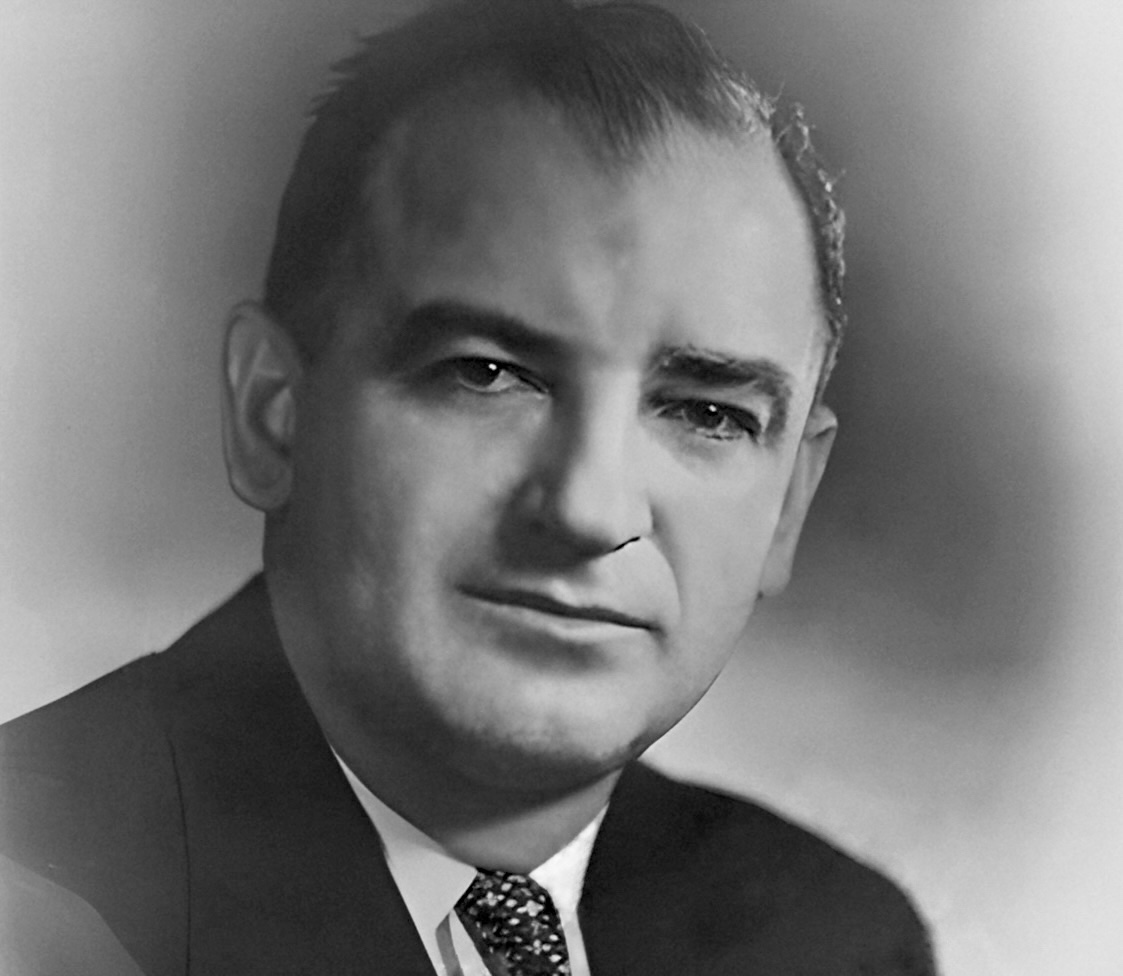

The Biographical Directory of the United States Congress, the official register kept by the House and Senate historians, records that Joseph Raymond McCarthy was "born in Grand Chute, Outagamie County, Wis., November 14, 1908."6 Grand Chute is a farming township on the edge of Appleton in the Fox River valley. His parents were Timothy and Bridget Tierney McCarthy. The Wisconsin Historical Society's career timeline calls him "the fourth of seven children"; several biographies describe a larger family, and the count varies from source to source, so it is best treated as approximate.7 The family was Irish Catholic in a township with many German and Dutch neighbors, and the farm was a working dairy and general farm of modest size.
The official record of the boyhood is thin, and much of what is commonly repeated comes from the biographers. The Congressional directory says only that he "attended a one-room country school."6 McCarthy's own biography in the 1948 Wisconsin Blue Book, which he or his office supplied, says that he "received his early education in the Underhill Elementary School."8 The Wisconsin Historical Society records that he left school at about fourteen and "works on a farm; later runs a grocery store in Manawa."7 The biographies of David Oshinsky (A Conspiracy So Immense, 1983) and Thomas C. Reeves (The Life and Times of Joe McCarthy, 1982) add the detail most readers know: as a teenager he built up a flock of chickens on rented land, ran it as his own business for several years, and lost it when disease and illness ended the venture, after which he took a job managing a grocery store in the small town of Manawa in Waupaca County.910 Reeves, who grew up in Wisconsin and spent years interviewing people who knew McCarthy, is the source most later writers rely on for the size of the flock and the reasons it failed. The particulars (flock size, dates, the exact cause of the loss) are not in any public record and should be read as the biographers' reconstruction.
What is documented is the next step. At Manawa he went back to school. The Congressional directory states that at nineteen he "moved to Manawa, Wis., and enrolled in a high school" and "completed a four-year course in one year."6 His Blue Book biography confirms that he "graduated from Little Wolf High School," the Manawa high school.8 The Historical Society dates the return to 1929 and says he finished "in a year."7 The one-year diploma was real, it was unusual, and it was won with the help of a principal willing to let a grown man work at his own pace. The story became a fixture of his campaigns, and it is one of the few McCarthy stories that the records support without qualification.
Marquette and the law, 1930 to 1935
In 1930 McCarthy enrolled at Marquette University, the Jesuit university in Milwaukee. He paid his way with jobs (the biographers list dishwashing, a filling station and construction work), boxed on the university team and coached boxing, and was known as a debater and a relentless campaigner for student office.9 He began in engineering and moved to the law school after two years. The Congressional directory states that he "graduated from Marquette University at Milwaukee, Wis., with a law degree in 1935," and was "admitted to the bar the same year."6 His Blue Book biography gives the same degree, "LL.B. from Marquette University," in 1935.8
The Marquette years are read in opposite ways. Sympathetic writers, Herman among them, present the farm boy who put himself through high school and law school by work and nerve as an American success story, and as the reason McCarthy later drew such loyalty from working-class and Catholic voters.5 Critical biographers, Oshinsky and Reeves among them, find in the same years the ambition, the taste for gambling and the hunger to win that later marked his Senate career.910 Both readings rest on the same small set of facts, and the documents of the 1930s (a diploma, a law degree, a bar admission) say little about his character either way.
Lawyer and candidate, 1935 to 1939
McCarthy opened a law office in Waupaca in 1935. The Congressional directory records that he "commenced practice in Waupaca" and in 1936 "moved to Shawano, Wis., and continued to practice law."6 In Shawano he joined the practice of Michael G. Eberlein, an established local lawyer and Republican. (The Historical Society's timeline spells the name "Everlin"; the biographies use Eberlein.)7 Business was slow at first, and the biographers agree that he spent much of his energy on politics and on cards.
His first race was as a Democrat. In 1936, the year of Franklin Roosevelt's landslide, McCarthy ran for district attorney of Shawano County on the Democratic ticket and lost. The Historical Society's timeline records the 1936 race in a single line: he ran unsuccessfully for district attorney, as a Democrat.7 In the Wisconsin of the 1930s the Democrats were the third party, behind the Republicans and the La Follette brothers' Progressive Party, and a young Democrat in a rural county had little chance. The point is worth stating plainly because it later became a talking point on both sides. McCarthy's critics used the Democratic start as evidence that he had no fixed principles and joined whatever party offered a path to office. His defenders answered that tens of thousands of young Wisconsin voters were New Deal Democrats in 1936 and Republicans by the 1940s, and that a party switch at twenty-seven proves little. The record shows the switch. It does not settle the motive.
The 1939 judicial race
In 1939 McCarthy ran for judge of Wisconsin's Tenth Judicial Circuit, which then covered Outagamie, Shawano and Langlade Counties. Wisconsin judicial elections are nonpartisan and are held in the spring. The incumbent was Edgar V. Werner, who, by the biographers' account, had held the seat since 1915. McCarthy campaigned on Werner's age, telling voters the judge was older than he was (Werner was in his middle sixties, and the biographers report that McCarthy put his age in the seventies), and he presented himself as a young man ready to clear the court's crowded calendar. He visited farms across the three counties, one by one, a method he would use again in 1946.910
The official returns, printed in the 1940 Wisconsin Blue Book, show that the April 1939 election was a three-way race, a fact often left out of the story:11
- Joseph R. McCarthy: 15,164 votes (Outagamie 8,553; Shawano 4,561; Langlade 2,050)
- E. V. Werner: 11,219 votes (Outagamie 7,419; Shawano 2,689; Langlade 1,111)
- A. N. Whiting: 9,049 votes (Outagamie 2,355; Shawano 2,185; Langlade 4,509)
McCarthy won with 42.8 percent of the 35,432 votes cast, a plurality rather than a majority. He carried Outagamie and Shawano Counties, and Whiting carried Langlade. The same Blue Book lists him as judge of the Tenth Circuit, with Shawano as his home and his term running to January 1946, and the 1944 edition repeats the listing.1112 He took the bench on January 1, 1940, at thirty-one, and he was widely described as the youngest circuit judge in the state's history.
A small detail in the official record deserves notice. The Biographical Directory of the United States Congress, maintained by the Senate Historical Office and the House historian, gives his birth date as November 14, 1908, and the Wisconsin Historical Society's timeline gives the same date.67 The biographies of Senator McCarthy printed in the 1948 and 1952 Wisconsin Blue Books, the state's own official almanac, give it instead as "November 14, 1909," one year later.813 The 1908 date is the one the federal record and the state historical society accept, and it is the one used throughout this module. The sources opened for this lesson do not show who supplied the 1909 date to the Blue Book editors or why, so the error cannot be laid with certainty at McCarthy's door. Its effect, whatever its origin, was to make the young judge and senator one year younger in the state's official record. It fits a pattern this module follows into the 1950s: a fact that could be checked, stated a little wrong in McCarthy's favor. Earlier and larger instances of the same pattern, the war stories of 1944, appear below.
On the bench, 1940 to 1946
Judge McCarthy worked fast. The Historical Society notes that he gained a reputation for "cutting the judicial backlog and awarding quick divorces," and the biographers describe a judge who held court late into the night and travelled across the circuit to dispose of cases.79 Admirers saw energy and efficiency. Reeves, who examined the court records, also found divorces granted with very little inquiry, including for friends and political allies, and a willingness to cut corners on procedure that troubled the local bar.10 The speed itself was not improper, and even his critics grant that the calendar moved.
The Quaker Dairy case, 1941
The one episode from his judicial career that produced a published rebuke from a higher court is the Quaker Dairy case. The opinion survives in the Wisconsin Reports as State ex rel. Department of Agriculture v. McCarthy, 238 Wis. 258, decided June 14, 1941, with Chief Justice Marvin B. Rosenberry writing for the court.14
The facts, as the Supreme Court set them out, were these. The state Department of Agriculture sued the Quaker Dairy Company and others to enforce a milk-marketing statute, section 100.03 of the Wisconsin Statutes, which regulated milk prices and was due to expire at the end of 1941. McCarthy at first granted a restraining order against the dairy. The dairy's lawyer, Mark Catlin Jr., was also a member of the state Assembly, and he obtained a postponement of the trial while the Legislature was in session. When the Legislature adjourned in June 1941 without repealing the law, McCarthy dissolved the restraining order and refused the state's request for an early trial, reasoning that enforcement would cause hardship to a business when the law would soon lapse anyway. He also ordered a court reporter's notes of part of the proceeding destroyed.14
The Supreme Court issued a writ ordering him to reinstate the restraining order. On the notes, its language was blunt: "Ordering destruction of these notes was highly improper." The court added that destroying evidence could support an inference that its contents were unfavorable to the person who destroyed it. On the refusal to enforce the statute, the court held that a judge who declines to enforce a valid law because he thinks enforcement unwise "takes over the legislative function," and it found in the record an infringement on the prerogatives of the Legislature "amounting to an abuse of judicial power."14
McCarthy's defenders have described the case as a policy disagreement over a soon-to-expire price-fixing law that many Wisconsin farmers and dairymen disliked, and they note that he was not disciplined. That is true as far as it goes. The opinion's findings, however, are findings of a court, made on the record, and they concern two habits that would return: treating procedure as an obstacle, and controlling what went into the record. Those are the same issues the Senate raised in 1954 (see lesson 09).
A judge running for the Senate
The Wisconsin Constitution (article VII, section 10) barred circuit judges from holding any other public office of trust, except a judicial one, during the term for which they were elected. McCarthy ran for the United States Senate in 1944 and again in 1946 while still a sitting circuit judge, without resigning the bench. He was re-elected judge in 1945, and the 1948 Blue Book biography states that he "held the office of judge of the 10th circuit court" from "1939 to 1947," that is, until he took his Senate seat.68
In July 1948 a petition was filed with the Board of State Bar Commissioners asking that McCarthy be disciplined as a lawyer for this conduct. The Wisconsin Supreme Court decided the matter in State v. McCarthy, 255 Wis. 234, on June 10, 1949. The court found that McCarthy, by accepting and holding the Senate office during his judicial term, acted "in violation of the terms of the constitution and laws of the state of Wisconsin" and "violated his oath as a circuit judge and as an attorney at law." It then declined to suspend or disbar him. The act, the court wrote, "subjects him to just censure," but "it is one in a class by itself which is not likely to be repeated," and it noted that the conduct "did not meet the condemnation of a majority of the voters at the 1946 election."15
This ruling is often left out of popular accounts, and it is important evidence. A sympathetic reader can fairly say that the state's highest court declined to punish him and left the judgment to the voters, who had already given it. A critical reader can fairly say that the same court found, in a published opinion, that he had broken the state constitution and his oath. Both statements are accurate. Neither cancels the other.
The Marine Corps, 1942 to 1945
Joining up
After Pearl Harbor McCarthy did something many sitting judges did not do: he went to war. As a judge he was exempt from the draft. The Wisconsin Historical Society records that "McCarthy enlists in Marine Corps, although his status as a judge exempts him," and dates the enlistment to June 4, 1942.7 The Congressional directory says he "enlisted in 1942 in the United States Marine Corps."6 In fact he entered as an officer. Oshinsky, in a 2020 article adapted from his biography, writes that McCarthy signed up at a Marine recruiting office in Milwaukee in 1942, publicly saying he would serve "as a private, an officer, or anything else," when he had already written a letter on court stationery requesting an officer's rank, and that he was sworn in as a first lieutenant.16 He kept his judgeship and took leave from it, and other circuit judges covered his calendar while he was away.
That distinction became part of the political story. Larry Tye, in his 2020 biography Demagogue, notes that McCarthy's 1946 advertising claimed he had resigned his job to enlist as a private, and that both claims were untrue.17 The enlistment itself was real and voluntary, and it put a thirty-three-year-old judge in a war zone he could have avoided. That deserves to be said first, because the later embellishments have sometimes been used to suggest he did not serve at all, which is false.
VMSB-235 in the Solomons
McCarthy was trained as an intelligence officer and assigned to Marine Scout Bombing Squadron 235, VMSB-235, a squadron of Douglas SBD Dauntless dive bombers. The squadron was commissioned at the start of 1943 and fought in the Solomon Islands campaign, flying from Henderson Field on Guadalcanal in 1943 and later against Japanese positions on Bougainville and around the Japanese base at Rabaul. Reeves places McCarthy with the squadron as its intelligence officer until July 1944.1610 His job was to brief pilots before missions and debrief them after: to collect what they had seen, assess damage and pass reports up the chain. It was necessary, unglamorous ground work.
He also flew. Squadron officers who were not aircrew could ride along in the rear seat of an SBD, the gunner-observer position with a pair of machine guns, and McCarthy did so a number of times. Oshinsky writes that "McCarthy made about a dozen flights in the tail-gunner's seat," strafing deserted airfields, hitting some fuel dumps and coming under enemy fire at least once, and that a squadron press release credited him with a record 4,700 rounds fired in one sortie, a record that, in Oshinsky's account, he set on a flight arranged for the purpose by firing at coconut trees.16 Reeves put the number of missions at eleven.10 Herman, the most sympathetic of the major biographers, does not dispute the order of magnitude. In a 2000 interview on C-SPAN's Booknotes, Herman said: "He did serve his country in the Pacific. He did have experience flying in missions, including combat missions." In the same interview he added that McCarthy "way exaggerated the number of missions he flew for political purposes."18
Not everyone who served with him remembered combat at all. Oshinsky reports a 1949 letter to the Capital Times of Madison from Marine Captain Jack Canaan, a flyer stationed with McCarthy on Bougainville, who claimed that McCarthy's only combat experience was two missions in one day. Oshinsky writes that the paper, a fierce McCarthy opponent, did not pursue the tip, but that other reporters began their own inquiries.16 The columnist Drew Pearson, another opponent, reported that Marine files failed to show any record of combat missions.19 Those accusations went too far in the other direction. The biographers who examined the squadron's history, critical ones included, credit him with roughly a dozen flights, some of them over defended targets.
The foot and the ladder
McCarthy came home with a limp, and on the campaign trail he let voters believe it was a war wound. In different tellings the injury came from a crash landing or from enemy fire. The record is different. On June 22, 1943, aboard the seaplane tender USS Chandeleur, the ship held the traditional "shellback" initiation for men crossing the equator for the first time. During the hazing, Oshinsky writes, McCarthy had an iron bucket attached to one foot, slipped, fell down a stairwell (a ship's ladder) and broke bones in his foot. Oshinsky describes three fractures of a metatarsal. McCarthy never received a Purple Heart, which is awarded only for wounds received in action against an enemy.16 The Wisconsin Historical Society's timeline states flatly that "he was not a tail-gunner as he later claimed."7
The commendation letter
In his campaigns McCarthy used a citation of commendation signed by Admiral Chester W. Nimitz, commander in chief of the Pacific Fleet, praising Captain McCarthy's service and referring to a "severe leg injury." The citation is genuine in the sense that Nimitz's office signed it. Oshinsky reports that McCarthy apparently wrote the underlying recommendation himself, signed his commanding officer's name to it and sent it forward, where it was signed in routine fashion.16 Sam Tanenhaus summarized the established view in 2000: a letter "signed by Admiral Nimitz but evidently written by McCarthy himself."4 The leg injury it praised was the foot broken in the equator-crossing ceremony.
Medals and the mission count
McCarthy's own mission count grew with each campaign. Oshinsky documents the sequence: fourteen bombing missions claimed in 1944, seventeen in 1947 and thirty-two by 1951.16 The higher number mattered, because twenty-five combat missions was the usual threshold for the Distinguished Flying Cross. While a United States senator, McCarthy asked the Navy Department for decorations based on his claimed missions, and he received the Distinguished Flying Cross and an Air Medal with four stars, and the standard accounts date the awards to 1952. Oshinsky notes that the decorations were awarded for twenty-five missions in combat.16 Tanenhaus wrote that McCarthy "inflated" the number of missions "so as to extract a Distinguished Flying Cross."4 The medals are genuine awards made by the service. The mission count on which they rested was not the count the squadron records support. A senator requesting decorations from a department whose budget he voted on, and receiving them, is the critics' central point, and it is a fair one.
"Tail Gunner Joe"
The nickname began as McCarthy's own campaign image and ended as his opponents' mockery. In the 1946 campaign his literature and advertising presented him as a tail gunner, a phrase his opponents turned against him once the record came out. The Historical Society's catalog entry for a 1944 campaign brochure notes that its text already "stressed his status as a Marine officer among his qualifications for office."20 By the 1950s "Tail Gunner Joe" was a sneer, and in 1977 it became the title of a television film about him. Herman put the outcome precisely in 2000: McCarthy's inflated stories "would spawn the myth of Tailgunner Joe."18
Leaving the Corps
McCarthy left active service in early 1945. Oshinsky writes that he resigned his commission after a request for further leave was refused and that his discharge became official in February 1945.16 Tye, working from McCarthy's military records, dates the resignation's effect to March 1945 and counts "just over twenty-nine months on active duty," a full year of it abroad.17 The Historical Society says he left as a captain.7 The Congressional directory, oddly, says he "resigned as a lieutenant in 1945."6 The biographies agree that he held the rank of captain when he left active duty. The discrepancy in the official directory is a small one and is noted here because readers checking the record will find it.
The 1944 primary against Alexander Wiley
McCarthy's first try for the Senate came while he was still in uniform. In 1944 he entered the Republican primary against the incumbent, Senator Alexander Wiley of Chippewa Falls, a lawyer and dairy farmer first elected in 1938.8 He campaigned on his service. The Historical Society's timeline records that, "Still in uniform, McCarthy runs for U.S. Senate and is defeated in the Republican primary by incumbent Alexander Wiley."7 His 1944 brochure, preserved by the Society, presented him as a Marine officer.20 He finished second in a four-candidate field, well behind Wiley. The totals usually given from the official canvass are about 79,000 votes for McCarthy to about 154,000 for Wiley, which would put McCarthy near 28 percent. (Those totals come from published compilations of the 1946 Blue Book and were not checked against the printed table for this lesson.)
The loss was a gain. McCarthy introduced his name statewide, showed the Republican organization that he could raise money and draw crowds, and learned that a war record was a political asset. He left the Marines in early 1945 and was re-elected to his circuit judgeship that spring.6
The 1946 primary: McCarthy against La Follette
The La Follette seat
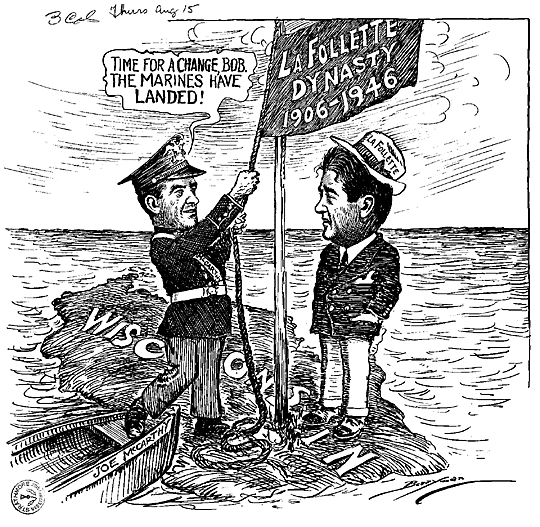
The Senate seat McCarthy wanted had belonged to a La Follette since 1906. Robert M. La Follette Sr., governor and founder of Wisconsin Progressivism, held it until his death in 1925, and his son Robert M. La Follette Jr. ("Young Bob") was elected to succeed him and held it for more than twenty years. A Historical Society photograph caption describes McCarthy's primary win as the victory that ended the La Follette family's hold on the seat, which it dates to 1906.21 Young Bob had won as a Republican, then, with his brother Philip, led the Wisconsin Progressive Party, founded in 1934, and was re-elected on its ticket. By 1946 he was among the most respected members of the Senate, a leading figure in the reform of its committee system and an early critic of Soviet conduct in Eastern Europe.
The Progressives come home
By the end of the war the Progressive Party had collapsed as a separate force. In March 1946 a Progressive convention voted to dissolve the party and return to the Republican primary, and La Follette chose to seek re-election as a Republican.7 The decision had two effects that bear on the result. Many regular Republicans had spent a dozen years fighting the La Follettes and had no wish to welcome them back. And many Progressive voters, especially union members, had moved toward the Democratic Party during the New Deal and were angry at the return to the party of business. Tye writes that the move upset the Democrats, who wanted La Follette's help in building their own party, and alienated organized labor, which had always sided with the Progressives.1717
The Republican organization
Wisconsin Republicans had built an unusual machine to get around the state's primary law: the Republican Voluntary Committee, a private body free of the statutory spending limits that bound party organizations, which could endorse and fund candidates before the primary. Its leading figure was Thomas E. Coleman, an industrialist. Tye reports that Coleman at first called McCarthy "a Johnny-come-lately in Republican politics," and that McCarthy won the organization over by attending its meetings in 71 cities and towns. At the Voluntary Committee's May 1946 convention in Oshkosh, after other contenders (Walter Kohler Jr. and former governor Julius Heil) had stood aside, McCarthy won the endorsement with 2,328 votes to 298 for his remaining opponent.17
With the endorsement came money. Tye puts McCarthy's primary spending at more than $50,000, nearly four times La Follette's $13,000.17 The campaign mailed some 750,000 booklets and about 500,000 penny postcards, and McCarthy covered about 33,000 miles that summer.17 He ran as the young veteran against the absent incumbent.
La Follette's campaign
La Follette barely campaigned. He spent the spring and summer of 1946 in Washington steering the Legislative Reorganization Act of 1946 through Congress as chairman of the Joint Committee on the Organization of Congress, the reform that reshaped the Senate committee system. The National Archives' description of a 1946 cartoon in the Senate's own records says that "La Follette had devoted nearly all of his time to that committee instead of his senatorial campaign, allowing McCarthy to win."22 Tye adds poor health, a weak organization and a failure to take McCarthy or the Democrat Howard McMurray seriously.17 McCarthy attacked La Follette for staying in Washington and, by one summary of the campaign, for "voting in opposition to world co-operation,"23 and he presented himself as the man who had served while others talked.

The Communist-led union vote
The most argued-over question about the 1946 primary is the role of the Communists, and it is the place where this lesson's opening point comes home. La Follette was no friend of the Communist Party. He had criticized Soviet policy in Eastern Europe, and the Communist-led unions of the Wisconsin CIO, strongest in Milwaukee County, worked against him. Wisconsin had an open primary, so any voter could take a Republican ballot. The question is whether Communist-influenced union voters crossed into the Republican primary to vote against La Follette, and whether they decided the outcome.
The official returns put a sharp edge on the question. The 1948 Wisconsin Blue Book prints the county-by-county vote. In Milwaukee County, McCarthy received 48,596 votes (after a recheck by the county election commission corrected an original 48,614) to La Follette's 38,437, a McCarthy margin of 10,159.24 Statewide, McCarthy won by 5,378. Outside Milwaukee County, La Follette led McCarthy by 164,120 to 159,339. In plain terms, McCarthy won the state because he won Milwaukee County, the home of the CIO unions.24 Tye, likewise, writes of "Joe's slender edge coming in Milwaukee, a labor stronghold that had been La Follette territory."17
What the returns cannot show is why individual voters chose as they did. La Follette himself believed the Communists had beaten him. The historian Patrick Maney, in his biography of La Follette, Young Bob, concluded that he was probably wrong about the decisive cause: organized labor mostly voted in the Democratic primary for McMurray, and McMurray's appeal to La Follette's natural supporters to take a Democratic ballot cost La Follette more votes than the Communists did. A summary of Maney's argument also notes that the Communist-led unions did push their members toward McMurray and against La Follette, and that in that sense they helped McCarthy, who was not yet known for anti-Communism at all.23 Tye adds a factor that cut the other way: La Follette, he writes, failed to account for Democrats who crossed into the open Republican primary to vote for McCarthy in the hope that he would be easier than La Follette to beat in November.17 Biographers often repeat a remark attributed to McCarthy during the campaign, to the effect that Communists had the same right to vote as anyone else. No contemporary source for the exact wording was found for this lesson, so it is not quoted here.
The fair reading, from 2026, is that both things are true. Communist-led unions were a real force, they opposed the most prominent anti-Soviet progressive in the Senate, and they helped elect the man who would become the most famous anti-Communist in American history. Whether they were decisive cannot be shown from the returns, because the Milwaukee margin also reflects McCarthy's organization, his money and La Follette's absence.
The result, August 13, 1946
The primary was held on Tuesday, August 13, 1946. The official tabulation in the 1948 Wisconsin Blue Book, "Primary Vote for United States Senator by Counties," gives these statewide totals:24
- Republican: Joseph R. McCarthy 207,935 (the printed total of 207,953 carries a note that it "should be revised" for the corrected Milwaukee figure, which yields 207,935); Robert M. La Follette Jr. 202,557; Perry J. Stearns 29,605.
- Democratic: Howard J. McMurray 62,361, unopposed.
- Socialist: Knappe 3,673, unopposed.
McCarthy's margin was 5,378 votes, about 47.2 percent of the Republican ballots to La Follette's 46.0 percent. Turnout was low, and Tye notes that about two-thirds of eligible voters stayed home.17 La Follette conceded the next day. A Historical Society photograph dated August 15, 1946, shows McCarthy, still a circuit judge, opening congratulatory telegrams in his office.21
The general election against Howard McMurray
In November McCarthy faced Howard J. McMurray, the Democratic nominee. McMurray was a political scientist who had served one term in the House of Representatives from Milwaukee, and he had been the Democratic nominee against Wiley in 1944. The Historical Society's catalog of his campaign brochure describes him as a "former congressman and political scientist."25
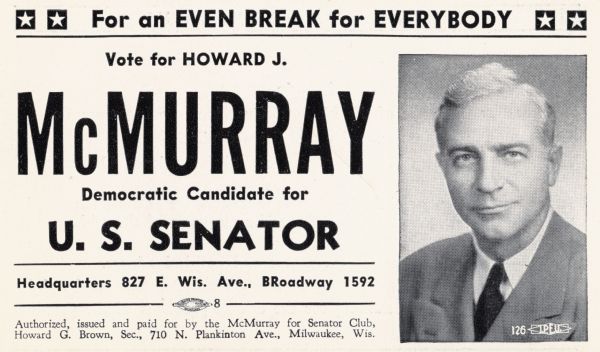

The fall campaign is where McCarthy used the Communist issue most openly before 1950, though still as a minor theme. Biographers describe him suggesting that McMurray was welcome to the support of the Communist Daily Worker and the Communist-led unions, and McMurray answering that he rejected Communist support. The same tactic appears in some accounts of the primary: Tanenhaus, reviewing Herman in 2000, wrote that in the primary "McCarthy smeared his opponent as pro-Communist," meaning La Follette, who was in fact under attack from the Communist-led CIO unions, and that after the primary "he coasted to victory in November."4 The exact words McCarthy used about McMurray could not be checked against a contemporary transcript or newspaper for this lesson, so they are paraphrased here and listed as unverified. What is clear is that 1946 was a national Republican year: the party took control of both houses of Congress, and voters were tired of wartime controls, strikes and shortages. McCarthy ran as the veteran, the farm boy and the young judge, and the Communist charge was a minor note.
The 1948 Blue Book's "Summary Vote for United States Senator by Counties, November 5, 1946" gives the result:26
- Joseph R. McCarthy (Republican): 620,430 (61.3 percent)
- Howard J. McMurray (Democrat): 378,772 (37.4 percent)
- Knappe (Socialist): 11,750
- Cozzini (Independent Socialist Labor): 1,552
The total vote was 1,012,504. McCarthy carried 70 of Wisconsin's 71 counties. McMurray carried only Dane County (Madison), by 25,200 to 23,222, and Portage County was close (McCarthy 5,802, McMurray 5,689). The same Milwaukee County that had given McCarthy his primary margin gave him 151,104 votes to McMurray's 117,163 in November.26 On January 3, 1947, McCarthy took his seat in the Senate.6
The first Senate years, 1947 to 1949
McCarthy arrived in Washington as one of the Republican "class of '46," the large group of freshmen, many of them veterans, who came in with the Republican Congress. Herman, on Booknotes, placed him in that class of war veterans and noted that his first public job had been the judgeship, so that he came to the Senate without experience in a legislature.18 Tanenhaus noted that at thirty-eight he was the youngest member of the Senate.4 For three years he worked on economic and housing questions, built a reputation as a hard-driving and quarrelsome junior member, and said little about Communism. The Senate Historical Office's short biography of him moves directly from his 1946 election to the Wheeling speech of 1950, which is a fair measure of how little his early record registered.27
Sugar rationing and "the Pepsi-Cola Kid"
Sugar was the last major food still rationed after the war. Soft drink bottlers, bakers and candy makers wanted the controls ended, and housewives wanted more sugar for canning. McCarthy took up the cause in 1947 and pressed hard on the Senate floor and in committee to end sugar controls early, clashing with senior senators from both parties over the details. At about the same time he received a personal loan of $20,000 from a Washington lobbyist and bottler for the Pepsi-Cola company, Russell Arundel, who was interested in the sugar question. Reporters and opponents nicknamed him "the Pepsi-Cola Kid."910
The loan and the sugar fight were later examined by the Senate Subcommittee on Privileges and Elections, which in 1951 and 1952 investigated McCarthy's finances and campaign conduct after Senator William Benton of Connecticut moved to expel him. McCarthy refused to appear before that subcommittee, and his "non-cooperation with and abuse of" it in 1952 became one of the two grounds on which the Senate censured him in December 1954.28 (The subcommittee's January 1953 report is described by the biographers and was not opened for this lesson.) The case against McCarthy on sugar is one of appearance and timing. The case for him is that ending sugar rationing was popular, already under way, and supported by many members who took no loans.
Housing and Lustron
Housing was the great domestic shortage of 1947, with millions of returning veterans and families doubled up. McCarthy served on the Joint Committee on Housing, held hearings around the country and became a visible voice on the issue. He favored private construction and opposed large-scale public housing, and the housing law he backed in 1948 was a narrower measure than the Taft-Ellender-Wagner bill that President Truman wanted, and Truman's broader bill passed as the Housing Act of 1949.9 The Lustron Corporation, a maker of prefabricated steel houses that depended on federal loans from the Reconstruction Finance Corporation, paid McCarthy $10,000 for a short pamphlet on housing that he wrote while he sat on the committee dealing with housing policy.910 That fee too was later examined by the Privileges and Elections subcommittee. Sympathetic accounts present the housing work as evidence that McCarthy was an energetic legislator on a real problem. Critical biographers, Oshinsky among them, present the Lustron fee as an early example of a senator's office used for private gain.9
The Malmedy hearings of 1949
The most revealing episode of the early years concerned German soldiers, not Communists. In December 1944, during the Battle of the Bulge, men of a Waffen-SS unit under Joachim Peiper shot American prisoners of war near Malmedy, Belgium, killing 84 at the main site. In the 1946 trial at Dachau, an American military court sentenced 43 defendants to death and 22 to life imprisonment. Defense lawyers and German activists then charged that the confessions had been beaten and tricked out of the prisoners, and the Army appointed a review commission.29 That commission, headed by Justice Gordon Simpson of Texas, is generally reported to have found irregularities in the pretrial investigation and to have recommended commuting death sentences where doubt existed. Its report was not opened for this lesson, and Tye attributes the later commutations chiefly to popular pressure.29
In March 1949 the Senate Armed Services Committee created a subcommittee of Senators Raymond Baldwin of Connecticut (chairman), Estes Kefauver of Tennessee and Lester Hunt of Wyoming to investigate. McCarthy, who was not a member, was allowed to sit in and question witnesses. He treated the hearings as a trial of the American interrogators. He accused the Army of brutality, told one interrogator, Lieutenant William Perl, "I think you are lying," and demanded lie-detector tests. When Baldwin refused, McCarthy walked out (in May 1949, by the standard accounts; Tye gives no month), declaring that "the investigation has degenerated to such a shameful farce that I can no longer take part therein," and charging the subcommittee with trying to "whitewash a shameful episode" in the history of the armed forces.29
The subcommittee's report, issued in October 1949, rejected the most serious charges: it found no proof of the systematic beatings, torture, mock executions and starvation that had been alleged, while agreeing that the Army's pretrial procedures had been flawed and supporting the commutation of sentences where justice required it.30 Tye, writing in Smithsonian in 2020 after working in McCarthy's papers at Marquette University, treats the episode as a case of opportunism and prejudice, noting McCarthy's claim during the hearings that Jewish investigators "intensely hate the German people as a race" and had formed a "vengeance team."29 Later researchers traced some of the material McCarthy relied on to German advocates for the convicted men, among them the lawyer Rudolf Aschenauer. That attribution comes from secondary accounts and is listed as unverified here. Baldwin, a former governor, left the Senate later in 1949, and his biographer called him the "first victim of 'McCarthyism.'"29
The Malmedy episode is the best preview of the McCarthy of 1950 to 1954. The methods were already there: a subcommittee hearing used as a stage, accusations of perjury against witnesses, demands for lie detectors, charges of a cover-up, and a walkout staged for the press. Sympathetic writers have argued that the Dachau procedures were in fact flawed, which the Army's own review found, and that a senator was entitled to press the point. The question was legitimate. The evidence McCarthy relied on, and the way he treated those who disagreed with him, were the trouble. For the committees he would later use, and for the difference between them, see lesson 06.
Timeline, 1908 to 1950
Rival readings side by side
The early McCarthy has been read in four main ways. Each is set out here in the words or close paraphrase of its authors, with the evidence each relies on.
The critical biographers: Oshinsky, Reeves, Rovere, Tye
Richard Rovere's Senator Joe McCarthy (1959), written by a journalist who had watched him in Washington, treats him as a demagogue with no fixed beliefs, and the early career as the record of a man who would say anything to win.31 Reeves's The Life and Times of Joe McCarthy (1982), the most detailed account of the Wisconsin years, was built on interviews and local records, and it documents the campaign against Judge Werner, the methods McCarthy used to clear his calendar, the Quaker Dairy case, the 1944 campaign in uniform and the inflation of the war record. Oshinsky's A Conspiracy So Immense (1983) places McCarthy in the politics of his time and treats the war stories as the first instance of a pattern: a real experience, embellished in steps until it became untrue.10916 Tye's Demagogue (2020), the first full biography to use McCarthy's papers at Marquette, adds the organizational detail of the 1946 race and the Malmedy material.1729
The sympathetic biographers: Herman and Evans
Herman's Joseph McCarthy: Reexamining the Life and Legacy of America's Most Hated Senator (2000) accepts that McCarthy exaggerated his war record ("way exaggerated," in Herman's own phrase) and does not defend the embellishments. Herman's argument is about proportion: McCarthy was a flawed man who served, who rose by hard work from a poor farm, and whose real cause, the Communist danger, was treated with contempt by his enemies. On Booknotes Herman described McCarthy's career as a tragedy that he largely brought on himself.185 M. Stanton Evans's Blacklisted by History: The Untold Story of Senator Joe McCarthy and His Fight Against America's Enemies (2007) is concerned almost entirely with the security cases of 1950 to 1954 and with the documents behind them, and it spends little time on the Wisconsin years. Evans's defense of McCarthy is a defense of the cases, taken up in lesson 07 and lesson 11.32
The historians of the movement: Schrecker and Storrs
Schrecker and Landon Storrs write less about McCarthy the man than about the system of loyalty programs, blacklists and investigations around him. For Schrecker, McCarthy's 1946 victory is a footnote: the anti-Communist apparatus was built by others, and he arrived late to use it.3 Their work matters for this lesson chiefly as a caution against treating McCarthy as the cause of everything later named for him.
The espionage historians: Haynes and Klehr
Haynes and Klehr, whose work on Venona and the Soviet archives established the scale of Soviet espionage, draw a sharp line between the real espionage problem and McCarthy's charges. They credit the anti-Communists with being right about the infiltration of the 1930s and 1940s and fault McCarthy for doing the cause more harm than good.1 Their work has little to say about McCarthy's Wisconsin career, which is itself instructive: the man most associated with exposing Soviet spies had no connection to the cases that exposed them before 1950.
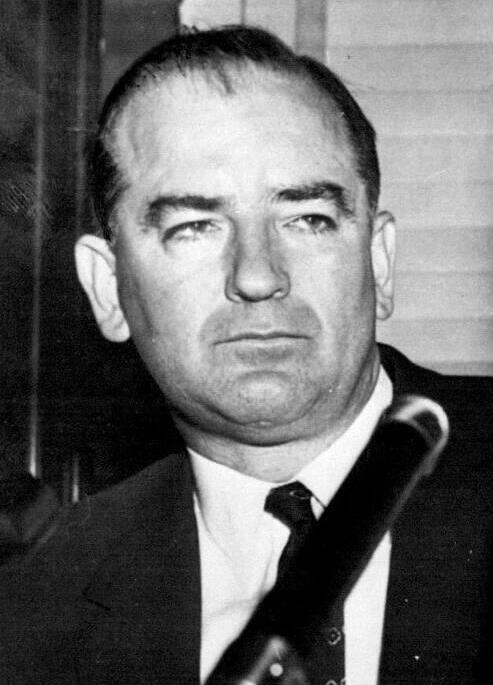

What the record shows and what it does not
Documented fact (official records):
- Born November 14, 1908, in Grand Chute; law degree from Marquette and admission to the bar in 1935 (Biographical Directory). His Senate-era Blue Book biographies give 1909, one year off.
- Elected Tenth Circuit judge in April 1939 with 15,164 votes to 11,219 for Werner and 9,049 for Whiting (1940 Blue Book).
- Rebuked by the Wisconsin Supreme Court on June 14, 1941: ordering destruction of a reporter's notes was "highly improper," and refusing to enforce the statute was an abuse of judicial power (238 Wis. 258).
- Found by the same court on June 10, 1949, to have violated the state constitution and his oath by taking a Senate seat during his judicial term, but not disciplined (255 Wis. 234).
- Won the August 13, 1946 Republican primary 207,935 to 202,557, with a 10,159-vote margin in Milwaukee County; won the November 5, 1946 general election 620,430 to 378,772 (1948 Blue Book).
Documented by biographers from service and squadron records (not reproduced in public official sources opened here): intelligence officer of VMSB-235; roughly a dozen flights in the rear seat (Reeves: eleven); foot broken in the equator-crossing ceremony aboard USS Chandeleur on June 22, 1943; no Purple Heart; Distinguished Flying Cross and Air Medal awarded after he requested them as a senator, on a claimed mission count higher than the records support.
Allegation or interpretation: that he wrote his own commendation letter (Oshinsky and others); that Communist-led union voters decided the 1946 primary; that the Pepsi loan or the Lustron fee bought his votes.
Open question: the exact mission count; how many Milwaukee voters crossed into the Republican primary to vote against La Follette and why; the exact words McCarthy used about McMurray and the Communists in the fall of 1946.
Assessed from 2026
Each claim below is one that McCarthy made about himself, or that his defenders or critics have made about his early career. Each is rated against the evidence now available.
1. "McCarthy was a combat tail gunner who flew 32 missions." Refuted. McCarthy's job was squadron intelligence officer. He flew roughly a dozen missions as a rear-seat gunner-observer (Reeves counts eleven), a real and voluntary risk, but nowhere near 32. His own claims rose from 14 in 1944 to 17 in 1947 to 32 by 1951 (Oshinsky). Even Herman, his most sympathetic biographer, says he "way exaggerated" the count.1618
2. "McCarthy served in the Pacific and flew combat missions." Supported. He volunteered despite a judicial exemption, served in the Solomons with a combat squadron and flew in the rear seat on missions over enemy positions. Critics who claimed he never saw combat at all (the Canaan letter, Pearson's columns) overstated their case.71618
3. "His limp came from a war wound." Refuted. The injury was a broken foot suffered in a fall during the shipboard equator-crossing ceremony on June 22, 1943. He received no Purple Heart.16
4. "Admiral Nimitz commended him for his service." Partly supported. A citation bearing Nimitz's signature exists. The weight of evidence (Oshinsky; Tanenhaus summarizing the record) is that McCarthy drafted the recommendation himself and that Nimitz signed it routinely, so the commendation reflects McCarthy's account of himself more than an independent judgment by his superiors.164
5. "He gave up his judgeship and enlisted as a private." Refuted. He kept his judgeship, took leave, ran for the Senate in 1944 and was re-elected judge in 1945, and he entered the Marines as a commissioned first lieutenant.61617
6. "As a judge he showed contempt for legal procedure." Partly supported. The Wisconsin Supreme Court's 1941 Quaker Dairy opinion found that ordering destruction of the notes was "highly improper" and that his refusal to enforce the statute was an abuse of judicial power, and the 1949 opinion found that he violated the state constitution and his oath. Against that, he was never disciplined, he cleared a real backlog, and one rebuke in six years on the bench does not by itself establish a pattern.1415
7. "McCarthy beat La Follette because of Communist votes." Unresolved. The official returns show that McCarthy's margin came from Milwaukee County, where Communist-led CIO unions opposed La Follette, and that La Follette carried the rest of the state. The returns cannot show who crossed over or why. Maney's study concludes that the larger cause was labor voting in the Democratic primary for McMurray, together with La Follette's absence and McCarthy's money and organization.242317
8. "McCarthy won the 1946 primary by a landslide of popular feeling against the La Follettes." Refuted. He won by 5,378 votes out of 440,097 Republican ballots, about 1.2 percentage points, in a low-turnout primary, and with heavy financial backing from the Republican Voluntary Committee.2417
9. "He was the youngest judge in Wisconsin history." Partly supported. He was thirty when elected and thirty-one when he took office, and he was widely reported as the youngest circuit judge in the state's history. No official list confirming the record was found for this lesson, and his Senate-era Blue Book biographies (1948 and 1952) made him a year younger than he was by giving 1909 for the 1908 birth year in the Biographical Directory.68
10. "In 1946 McCarthy ran as an anti-Communist crusader." Unsupported. His 1946 campaign was built on his war record, his youth and La Follette's absence. He used Communist charges against opponents in passing, but the issue that made him famous did not become his signature until February 1950.71727
11. "The Pepsi loan and the Lustron fee were bribes." Unresolved. The loan and the fee are documented in the biographies and were examined by the Senate's Subcommittee on Privileges and Elections, but no tribunal found them to be bribes, and McCarthy's refusal to answer that subcommittee's questions became a ground for censure. The appearance of impropriety is clear. Corrupt intent was never proven.928
12. "At Malmedy, McCarthy exposed real abuses by Army interrogators." Partly supported. The Army's own review found flaws in the pretrial investigation, and death sentences were commuted. The Senate subcommittee rejected the charges of systematic torture that McCarthy pressed, and his evidence came in part from advocates for the convicted SS men.2930
Hard questions and answers
Is it fair to mock "Tail Gunner Joe" when he did volunteer and did fly?
The mockery is fair only when it is aimed at the right thing. McCarthy volunteered for the Marines when he could have stayed on the bench, served overseas and flew missions in the rear seat of a dive bomber, which was dangerous. A reader sympathetic to McCarthy is right that the volunteering and the flights were real. What is fairly criticized is what he did with them afterward: the false wound, the self-drafted commendation, the inflated mission count and the medals requested from the Navy while he sat in the Senate. The record supports both halves of that sentence.
Did the Communists put McCarthy in the Senate?
They may have helped, and the irony has made the claim popular. The official returns show that McCarthy won Milwaukee County by 10,159 votes while losing the rest of the state by 4,781, and Communist-led CIO unions in Milwaukee were working against La Follette. The returns cannot show how many union members took a Republican ballot or why, and La Follette's own biographer, Maney, judged the Democratic primary pull of McMurray to be a bigger factor. The honest answer is that Communist-led unions contributed to La Follette's defeat and that whether their contribution was decisive is unresolved.
Why should a 1941 milk-price case matter to a reader in 2026?
Because it is a written finding by an independent court, made before McCarthy was famous and before anyone had a political reason to attack him. The court found two things: that he ordered part of the record destroyed, and that he refused to apply a valid law because he disliked its effects. Those are the same questions (control of the record, respect for rules that bind the powerful) that the Senate weighed in 1954. A reader who wants to judge McCarthy by evidence rather than by reputation should start with documents like this one.
Does the switch from Democrat in 1936 to Republican by 1944 show he had no principles?
Not by itself. Many Wisconsin voters and officeholders moved between the Democrats, the Progressives and the Republicans in the 1930s and 1940s, and La Follette himself went from Republican to Progressive and back. The switch is consistent with ambition, and McCarthy's critics read it that way. It is also consistent with a young man's changing views. The record does not settle it.
What would a careful reporter in 1946 have been able to check, and did anyone?
Almost everything in this lesson was checkable in 1946: the Blue Book returns, the Supreme Court's opinion in the Quaker Dairy case, the fact that McCarthy remained a judge, the squadron's records. The Capital Times in Madison, a determined opponent, pressed several of these points, and its partisanship made it easy for McCarthy's supporters to dismiss them. The lesson for any reporter, in the 1940s or now, is to check a candidate's account of himself against the records before the story becomes the legend.
Was the McCarthy of 1950 already visible in 1946 to 1949?
His methods were visible, and his cause was still missing. The Quaker Dairy case, the age misstatement, the war embellishments and above all the Malmedy hearings show the habits that later defined his investigations. The Communist issue, however, appears only in passing before 1950. Whether he adopted it out of conviction, as Herman argues, or as a vehicle for ambition, as Rovere and Oshinsky argue, is a question taken up in lesson 05 and in lesson 12.
Where this leads
On February 9, 1950, in Wheeling, West Virginia, the junior senator from Wisconsin claimed to hold a list of Communists in the State Department, and the obscure man of this lesson became a national figure within weeks. That speech, the changing numbers and the Tydings hearings that followed are the subject of lesson 05: Wheeling and the List. Idaho readers will find the parallel story of their own senators in those years, Glen Taylor and Herman Welker, in module 74, lesson 06. For the principles by which this module judges the use of public power (lawful authority, its limits and due process), see Pierson's framework in module 52, lesson 01 and lesson 02.
Still open
These items could not be confirmed against a primary source before publication. The lesson states them as open, and they stay on the fact-check list.
- 1944 Republican primary totals (about 79,000 for McCarthy and 154,000 for Wiley in a four-way field) come from published compilations of the 1946 Wisconsin Blue Book; the printed 1946 table was not opened.
- Details of the poultry business (flock size, dates, cause of failure) and the Marquette jobs come from the biographies, not official records.
- The number of McCarthy's siblings and his birth order: the Wisconsin Historical Society says fourth of seven; other accounts give larger families.
- The age at which he enrolled at Manawa: the Congressional directory says nineteen; other accounts say twenty.
- Edgar V. Werner's tenure on the bench (since 1915) and age in 1939, and McCarthy's claim about Werner's age, come from secondary accounts.
- The reported date he took the bench, January 1, 1940, and the description of him as the youngest circuit judge in state history are from secondary accounts; no official list was checked.
- Reeves's findings about quick divorces for friends and allies were not checked against court files.
- Harold Christoffel's position as president of UAW Local 248 at Allis-Chalmers and the characterization of the 1941 strike come from general histories; the Supreme Court opinion does not describe them.
- That McCarthy took leave from the bench while in the Marines and that other judges covered his calendar.
- Reeves's count of eleven missions is reported through a secondary source; Oshinsky gives about a dozen. The exact count from squadron records is unresolved.
- The 1952 date of the Distinguished Flying Cross and Air Medal comes from secondary accounts; Oshinsky gives no date.
- The account that McCarthy drafted his own commendation and signed his commanding officer's name rests on Oshinsky and other biographers, not on a document opened for this lesson.
- The 1977 television film titled Tail Gunner Joe is mentioned from general knowledge.
- The rank at which McCarthy left the Marines: the Congressional directory says lieutenant; the Historical Society and biographers say captain.
- The exact words McCarthy used about McMurray and Communist support in the fall of 1946, and the remark about Communists' right to vote attributed to him in the primary, were not found in a contemporary source.
- The role of UAW Local 248 and other Communist-led Milwaukee unions in the primary is reported from secondary accounts (Maney via Reason, Tanenhaus); no union records or contemporary press were opened.
- La Follette's role as chairman of the Joint Committee on the Organization of Congress is from the National Archives description; the committee's leadership was not checked against the Congressional Record.
- McMurray's single House term and his 1944 race against Wiley were not checked against official returns.
- Russell Arundel's identity as the lender, the $20,000 amount, the Lustron $10,000 fee, McCarthy's membership on the Joint Committee on Housing and the 1953 Privileges and Elections report are from the biographies; the report itself was not opened.
- Senator William Benton's 1951 expulsion resolution is cited from general knowledge.
- The Malmedy subcommittee report (October 13, 1949), the Simpson commission findings and the role of Rudolf Aschenauer are described from secondary accounts; the report could not be retrieved from the Library of Congress.
- The date of the Wheeling speech, February 9, 1950, is from general knowledge and is verified in lesson 05.
- General characterizations of the books by Rovere, Reeves, Evans, Schrecker and Haynes and Klehr were not rechecked page by page for this lesson.
- The month of McCarthy's walkout from the Malmedy hearings (May 1949) is from standard accounts; the Smithsonian article cited gives no month.
- The commissioning date of VMSB-235 (start of 1943) and Reeves's dating of McCarthy's service with it to July 1944 were not checked against squadron records or Reeves's text.
- Oshinsky dates McCarthy's discharge to February 1945; Tye says the resignation took effect in March 1945. The exact date was not checked against service records.
- The source of the 1909 birth year in the 1948 and 1952 Wisconsin Blue Book biographies (who supplied it, and why) was not found; the 1908 date follows the Biographical Directory and the Wisconsin Historical Society.
- Alt text for the McMurray brochure and the March 1954 photograph is based on catalog descriptions; those two images could not be viewed during writing (the cartoon was viewed).
Learn more
- Wisconsin Blue Book 1948, pp. 604 and 675 (official 1946 returns by county): The county-by-county tables let any reader check the Milwaukee County margin and the November result directly.
- State ex rel. Department of Agriculture v. McCarthy (1941): The full Quaker Dairy opinion, the most important document on McCarthy's record as a judge.
- David M. Oshinsky, "The Tail Gunner": A short, sourced account of the war record and how the claims grew, by the author of the standard critical biography.
- Arthur Herman on Booknotes: The most sympathetic major biographer in his own words, including his concession that McCarthy exaggerated his missions.
- Wisconsin Historical Society: Joseph R. McCarthy Career Timeline: A compact dated outline from the state's historical society.
- Larry Tye, "When Senator Joe McCarthy Defended Nazis": The Malmedy episode, drawn from McCarthy's papers at Marquette.
Notes
- John Earl Haynes and Harvey Klehr, Venona: Decoding Soviet Espionage in America (New Haven: Yale University Press, 1999). On Gouzenko and Bentley see also lessons 01 and 02 of this module. ↩
- Christoffel v. United States, 338 U.S. 84 (1949) (testimony of March 1, 1947, before the House Committee on Education and Labor; conviction reversed on the quorum instruction). Read it online. ↩
- Ellen Schrecker, Many Are the Crimes: McCarthyism in America (Boston: Little, Brown, 1998). ↩
- Sam Tanenhaus, "Un-American Activities," review of Arthur Herman, Joseph McCarthy, The New York Review of Books, November 30, 2000. Read it online. ↩
- Arthur Herman, Joseph McCarthy: Reexamining the Life and Legacy of America's Most Hated Senator (New York: Free Press, 2000). ↩
- Biographical Directory of the United States Congress, "McCARTHY, Joseph Raymond (1908-1957)" (Office of the Historian, U.S. House of Representatives, and Senate Historical Office). Read it online. ↩
- Wisconsin Historical Society, "Joseph R. McCarthy Career Timeline," historical essay (quotations: "the fourth of seven children"; "works on a farm; later runs a grocery store in Manawa"; "McCarthy enlists in Marine Corps, although his status as a judge exempts him"; "He was not a tail-gunner as he later claimed"). Read it online. ↩
- "Wisconsin Members of the 80th Congress: Senators," biography of Joseph R. McCarthy, The Wisconsin Blue Book, 1948 (Madison: State of Wisconsin, 1948). Read it online. ↩
- David M. Oshinsky, A Conspiracy So Immense: The World of Joe McCarthy (New York: Free Press, 1983; new edition, Oxford University Press, 2005), chapters on the Wisconsin years and the first Senate term. ↩
- Thomas C. Reeves, The Life and Times of Joe McCarthy: A Biography (New York: Stein and Day, 1982). ↩
- "Vote for Circuit Judges, April 1939," Tenth Judicial Circuit, The Wisconsin Blue Book, 1940 (Madison: State of Wisconsin, 1940), p. 627; and the list of circuit judges in the same volume. Read it online. ↩
- List of circuit judges (Tenth Circuit, Joseph R. McCarthy, Shawano, term expiring January 1946), The Wisconsin Blue Book, 1944 (Madison: State of Wisconsin, 1944). Read it online. ↩
- Biography of Senator Joseph R. McCarthy (born "November 14, 1909"), Wisconsin members of Congress, The Wisconsin Blue Book, 1952 (Madison: State of Wisconsin, 1952). Read it online. ↩
- State ex rel. Department of Agriculture v. McCarthy, 238 Wis. 258, 299 N.W. 58 (Wis. June 14, 1941) (Rosenberry, C.J.). Read it online. ↩
- State v. McCarthy, 255 Wis. 234, 38 N.W.2d 679 (Wis. June 10, 1949) (per curiam). Read it online. ↩
- David M. Oshinsky, "The Tail Gunner," MHQ: The Quarterly Journal of Military History 32, no. 3 (Spring 2020), online at HistoryNet, March 17, 2020; adapted from A Conspiracy So Immense. Read it online. ↩
- Larry Tye, excerpt from Demagogue: The Life and Long Shadow of Senator Joe McCarthy (Boston: Houghton Mifflin Harcourt, 2020), published as "Joe McCarthy's first victim: How the senator brought down a La Follette," The Capital Times (Madison), July 8, 2020. Read it online. ↩
- Arthur Herman, interview with Brian Lamb, Booknotes, C-SPAN, aired February 6, 2000, transcript. Read it online. ↩
- "The Truth Behind Tail Gunner Joe McCarthy," Wisconsin Magazine of History (Wisconsin Historical Society), as published online; reports Drew Pearson's statement that Marine files "fail to show any record of combat missions." Author and issue not shown in the online preview. Read it online. ↩
- Wisconsin Historical Society, "McCarthy Campaign Brochure," 1944, Wisconsin political vertical file, image record. Read it online. ↩
- Wisconsin Historical Society, "McCarthy Defeats La Follette," Acme Newspictures photograph, August 15, 1946, image record. Read it online. ↩
- Untitled cartoon depicting Joe McCarthy challenging Robert La Follette, August 15, 1946, Records of the U.S. Senate, Record Group 46, National Archives Identifier 306095, with National Archives description (DocsTeach). Read it online. ↩
- Jesse Walker, "The Communist Party's Role in the Rise of Joseph McCarthy," Reason, April 22, 2014, summarizing Patrick J. Maney, Young Bob: A Biography of Robert M. La Follette, Jr. (1978; Wisconsin Historical Society Press, 2003). Read it online. ↩
- "Primary Vote for United States Senator by Counties, August 13, 1946," The Wisconsin Blue Book, 1948, p. 604 (McCarthy printed total 207,953, with notes that the Milwaukee County figure was corrected on recheck to 48,596 and the total should be revised accordingly). Read it online. ↩
- Wisconsin Historical Society, "McMurray for Senator," campaign brochure of Howard J. McMurray, 1946, image 47770 (catalog description: "former congressman and political scientist"). Read it online. ↩
- "Summary Vote for United States Senator by Counties, November 5, 1946," The Wisconsin Blue Book, 1948, p. 675. Read it online. ↩
- U.S. Senate, Senate Historical Office, "Joseph R. McCarthy: A Featured Biography," senate.gov. Read it online. ↩
- U.S. Senate, "The Censure Case of Joseph McCarthy of Wisconsin (1954)," Senate Historical Office, senate.gov (censure for "non-cooperation with and abuse of" the Subcommittee on Privileges and Elections in 1952). Read it online. ↩
- Larry Tye, "When Senator Joe McCarthy Defended Nazis," Smithsonian Magazine, July 2020. Read it online. ↩
- U.S. Senate, Committee on Armed Services, Malmedy Massacre Investigation: Report of the Subcommittee, 81st Cong., 1st sess., pursuant to S. Res. 42, October 13, 1949 (Library of Congress, Military Legal Resources). Described from secondary accounts; the report was not opened for this lesson. Read it online. ↩
- Richard H. Rovere, Senator Joe McCarthy (New York: Harcourt, Brace, 1959). ↩
- M. Stanton Evans, Blacklisted by History: The Untold Story of Senator Joe McCarthy and His Fight Against America's Enemies (New York: Crown Forum, 2007). ↩
Check yourself
1. According to the 1940 Wisconsin Blue Book, how did McCarthy win the April 1939 election for judge of the Tenth Circuit?
The official returns show McCarthy 15,164, E. V. Werner 11,219 and A. N. Whiting 9,049: a plurality, not a majority.
2. What did the Wisconsin Supreme Court say in 1941 about McCarthy's order to destroy a court reporter's notes in the Quaker Dairy case?
In State ex rel. Department of Agriculture v. McCarthy (1941) the court wrote: "Ordering destruction of these notes was highly improper," and found an abuse of judicial power in his refusal to enforce the statute.
3. What was McCarthy's actual job in Marine squadron VMSB-235?
He was the squadron's intelligence officer. He also flew roughly a dozen missions as a rear-seat gunner-observer (Reeves counts eleven).
4. How did McCarthy actually break his foot in June 1943?
Oshinsky documents the June 22, 1943 shellback initiation aboard the seaplane tender Chandeleur. McCarthy received no Purple Heart.
5. By how many votes did McCarthy defeat Robert M. La Follette Jr. in the August 13, 1946 Republican primary, using the corrected official total?
207,935 to 202,557 is a margin of 5,378. The 10,159 figure is McCarthy's margin in Milwaukee County alone.
6. What do the official county returns show about where McCarthy's 1946 primary margin came from?
McCarthy carried Milwaukee County 48,596 to 38,437 (a 10,159 margin) while La Follette led the rest of the state 164,120 to 159,339.
7. What did the Wisconsin Supreme Court decide in State v. McCarthy (1949)?
The court found a violation of the constitution and his oath, said the act "subjects him to just censure," and dismissed the disciplinary petition as one "in a class by itself."
8. Which 1949 episode best previewed McCarthy's later investigative methods?
At the Malmedy hearings he accused a witness of lying, demanded lie detector tests, charged a whitewash and walked out. He was never a member of HUAC, and Wheeling came in 1950.
Terms in this lesson
- Wisconsin Blue Book
- The official almanac of Wisconsin state government, published every two years, with official election returns by county and biographies of officeholders. It is the primary source for the vote totals in this lesson.
- Tenth Judicial Circuit
- The Wisconsin trial court circuit that in 1939 covered Outagamie, Shawano and Langlade Counties. McCarthy was its judge from 1940 until he entered the Senate in 1947.
- Quaker Dairy case
- State ex rel. Department of Agriculture v. McCarthy (1941), in which the Wisconsin Supreme Court ordered McCarthy to reinstate a restraining order against a dairy and called his order to destroy a reporter's notes "highly improper."
- State v. McCarthy (1949)
- Wisconsin Supreme Court decision finding that McCarthy violated the state constitution and his oath by taking a Senate seat during his term as circuit judge, while declining to discipline him.
- VMSB-235
- Marine Scout Bombing Squadron 235, a squadron of SBD Dauntless dive bombers that fought in the Solomon Islands campaign. McCarthy was its intelligence officer.
- Gunner-observer
- The crewman in the rear seat of a two-seat dive bomber, who operated the rear machine guns and radio. McCarthy flew in this seat on roughly a dozen missions.
- Shellback ceremony
- The traditional naval initiation for sailors crossing the equator for the first time. McCarthy broke his foot during one aboard USS Chandeleur on June 22, 1943.
- Distinguished Flying Cross
- A U.S. military decoration for heroism or extraordinary achievement in aerial flight. McCarthy received it after requesting it as a senator, on the basis of a mission count higher than the records support.
- Wisconsin Progressive Party
- The party founded in 1934 by Robert M. La Follette Jr. and Philip La Follette. It voted in March 1946 to dissolve and return to the Republican primary.
- Republican Voluntary Committee
- A private Wisconsin Republican organization, led in the 1940s by Thomas E. Coleman, that endorsed and funded candidates before the primary outside the spending limits that bound the official party. It endorsed McCarthy in May 1946.
- Open primary
- A primary in which voters may choose either party's ballot without registering by party, as in Wisconsin. It allowed Democratic-leaning and union voters to vote in the 1946 Republican Senate primary.
- Malmedy massacre hearings
- The 1949 Senate Armed Services subcommittee investigation (Baldwin, Kefauver, Hunt) of charges that U.S. Army interrogators abused German SS defendants convicted of killing American prisoners in December 1944. McCarthy sat in, attacked the Army and walked out.
- Subcommittee on Privileges and Elections
- The Senate Rules subcommittee that in 1951 and 1952 investigated McCarthy's finances and campaign conduct, including the Pepsi loan and the Lustron fee. His refusal to cooperate with it was a ground of his 1954 censure.
Sources
- Biographical Directory of the United States Congress: McCarthy, Joseph Raymond (current) checked 2026-10
- Wisconsin Historical Society: Joseph R. McCarthy Career Timeline (undated) checked 2026-10
- The Wisconsin Blue Book, 1948 (biography; primary and general election returns for U.S. Senator, 1946, pp. 604 and 675) (1948) checked 2026-10
- The Wisconsin Blue Book, 1940 (Vote for Circuit Judges, April 1939, p. 627) (1940) checked 2026-10
- The Wisconsin Blue Book, 1944 (circuit judges list) (1944) checked 2026-10
- The Wisconsin Blue Book, 1952 (biography of Senator McCarthy) (1952) checked 2026-10
- State ex rel. Department of Agriculture v. McCarthy, 238 Wis. 258 (1941) (1941-06-14) checked 2026-10
- State v. McCarthy, 255 Wis. 234 (1949) (1949-06-10) checked 2026-10
- Christoffel v. United States, 338 U.S. 84 (1949) (1949) checked 2026-10
- National Archives: Untitled cartoon depicting Joe McCarthy challenging Robert La Follette (NAID 306095) (1946-08-15) checked 2026-10
- Senate Historical Office: Joseph R. McCarthy, A Featured Biography (current) checked 2026-10
- Senate Historical Office: The Censure Case of Joseph McCarthy of Wisconsin (1954) (current) checked 2026-10
- Malmedy Massacre Investigation: Report of the Subcommittee of the Committee on Armed Services (not opened for this lesson) (1949-10-13) checked 2026-10
- Wisconsin Historical Society: McCarthy Defeats La Follette (photograph record) (1946-08-15) checked 2026-10
- Wisconsin Historical Society: McCarthy Campaign Brochure, 1944 (1944) checked 2026-10
- Wisconsin Historical Society: McMurray for Senator brochure, image 47770 (1946) checked 2026-10
- David M. Oshinsky, "The Tail Gunner," MHQ, Spring 2020 (HistoryNet) (2020-03-17) checked 2026-10
- Arthur Herman on Booknotes, C-SPAN (2000-02-06) checked 2026-10
- Sam Tanenhaus, "Un-American Activities," The New York Review of Books (2000-11-30) checked 2026-10
- Larry Tye, Demagogue excerpt, The Capital Times (2020-07-08) checked 2026-10
- Larry Tye, "When Senator Joe McCarthy Defended Nazis," Smithsonian Magazine (2020-07) checked 2026-10
- Jesse Walker, The Communist Party's Role in the Rise of Joseph McCarthy, Reason (summary of Maney, Young Bob) (2014-04-22) checked 2026-10
- Wisconsin Magazine of History: The Truth Behind Tail Gunner Joe McCarthy (online preview) (undated) checked 2026-10
- David M. Oshinsky, A Conspiracy So Immense: The World of Joe McCarthy (1983) checked 2026-10
- Thomas C. Reeves, The Life and Times of Joe McCarthy (1982) checked 2026-10
- Arthur Herman, Joseph McCarthy: Reexamining the Life and Legacy of America's Most Hated Senator (2000) checked 2026-10
- M. Stanton Evans, Blacklisted by History (2007) checked 2026-10
- Richard H. Rovere, Senator Joe McCarthy (1959) checked 2026-10
- Ellen Schrecker, Many Are the Crimes (1998) checked 2026-10
- John Earl Haynes and Harvey Klehr, Venona: Decoding Soviet Espionage in America (1999) checked 2026-10