Lesson 9 of 18 · about 15 minutes
Marx and the Theory of Class
You'll be able to
- Summarize Marx's claim that social existence determines consciousness, in his own words
- Explain what Marx said about religion, including the line most people quote without its first half
- Compare Marx, Madison, and Leo XIII on property and class conflict
- Say why a theory that treats morality as a product of class position leaves rights without a ground above power
- Connect Schaeffer's warnings about elites and authoritarian rule to the Founders' framework of limited government
"The history of all hitherto existing society is the history of class struggles."1 The sentence opens the Manifesto of the Communist Party, which two Germans, Karl Marx and Friedrich Engels, drafted over the winter of 1847 and 1848 and published on 21 February 1848.2 It has no hedge in it. Every society in written history, the authors say, was a story of freeman against slave, patrician against plebeian, lord against serf. (Engels added a note to the 1888 English edition saying the sentence refers to recorded history.)1
The Man and the Method
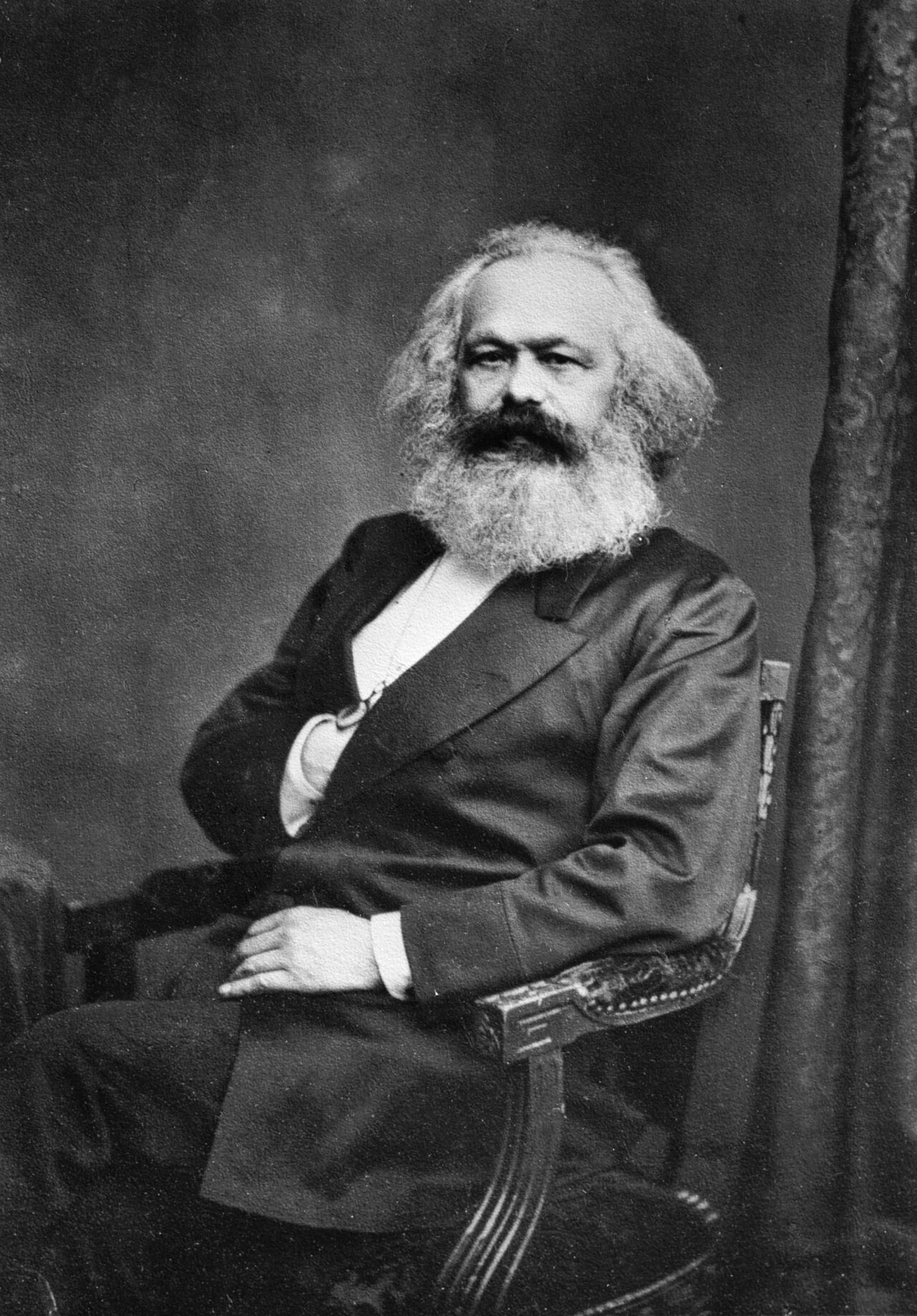
Marx was born in Trier on 5 May 1818 and died in London on 14 March 1883. The first volume of Capital came out in 1867.2 Like Kierkegaard, Marx had to reckon with Hegel, whose system the lesson on Hegel sets out. Marx kept the idea that history moves through conflict and based it on material production, on how people get food, shelter, and tools, instead of on spirit.3
The clearest short statement comes from the preface to a book of 1859. Marx says that the mode of production in material life "determines the general character of the social, political and spiritual processes of life," and then states the point flatly: "It is not the consciousness of men that determines their existence, but, on the contrary, their social existence determines their consciousness."4 Law, religion, and moral ideas are on this view an upper layer, shaped by what is going on underneath. Change the economic base and the ideas change with it.
In the spring of 1845 he wrote himself a set of notes on the philosopher Ludwig Feuerbach, which Engels published in 1888 as an appendix to his own book. The last of them became famous: "The philosophers have only interpreted the world, in various ways; the point is to change it."5 The line says what Marx thought thinking was for.
Religion: The Whole Sentence
Most people know the last four words. Few quote the sentence around them. In an essay written in December 1843 and January 1844, Marx wrote that religious suffering is at once the expression of real suffering and a protest against it. Religion, he went on, is "the sigh of the oppressed creature" and "the opium of the people."6 The full thought is more complicated than the slogan. Marx treats religion as a response to suffering and respects the suffering. He still counts it as an illusion that the abolition of its causes would remove. The Stanford Encyclopedia puts it that he followed Feuerbach in seeing religion as alienation and expected it to wither once material life was set free.3
Myth: Marx called religion a trick the rich play on the poor
The "opium" line comes in the middle of a longer thought in which religion is the "sigh of the oppressed creature" and "a protest against real suffering." Marx still counted religion an illusion, but he did not write it off as a swindle. A Christian will reject his diagnosis, and should reject the one he actually made.6
What the Manifesto Proposes
The Manifesto is a political document, and it says what it wants. In its account, the rise of the bourgeoisie tore up the older bonds between people and "left remaining no other nexus between man and man than naked self-interest, than callous 'cash payment.'"1 The remedy it offers is the rise of the proletariat, the class of wage workers, to power. In chapter 2 the authors give the program in one line: "the theory of the Communists may be summed up in the single sentence: Abolition of private property."7
Then the authors face the objections, and the answer to one shows the whole position. Opponents said that communism "abolishes eternal truths, it abolishes all religion, and all morality." Marx and Engels do not deny that moral ideas have changed over the centuries. They reply that all past society has been a story of class antagonism, in which one part of society exploits another, and that the social consciousness of each age therefore "moves within certain common forms, or general ideas, which cannot completely vanish except with the total disappearance of class antagonisms."7 On the same page they say that the ideas of religious liberty and freedom of conscience "merely gave expression to the sway of free competition within the domain of knowledge."7
The authors regard freedom of conscience, which the Virginia Declaration of Rights of 1776 protected in the "free exercise of religion, according to the dictates of conscience,"8 as a reflection of market conditions. If they are right, a conscience is a product of a class position and has no claim on anyone beyond it. A reader does not have to be a Christian to see the problem. A right that is only the reflection of a social arrangement disappears when the arrangement changes.
The Manifesto ends without softening. "The Communists disdain to conceal their views and aims," the authors write. "They openly declare that their ends can be attained only by the forcible overthrow of all existing social conditions." The last lines promise that "The proletarians have nothing to lose but their chains" and close with the call to working men of all countries to unite.9 A citizen should know that the book says this about means as well as ends. It does not propose a program of reform within a constitutional order. It proposes to replace the order.
What Marx Saw Correctly
Fairness asks for the strongest case, and Marx had one. The complaint was not his alone. Leo XIII, who rejected Marx's remedy, wrote in 1891 that "a small number of very rich men have been able to lay upon the teeming masses of the laboring poor a yoke little better than that of slavery itself."10 A pope and a revolutionary agreed on the facts. And Marx was right that economic interest bends opinion. Madison said the same thing in a more careful key.11
His mistake, on the Christian and natural-law reading, was to infer from the bending of ideas that no idea stands straight. People argue from interest, and they also argue about whether an act is just. A worker who says his wages are stolen is not reporting his class position. He is appealing to a standard he expects the owner to share. Marx's own vocabulary, with words such as "embezzlement," "robbery," and "exploitation," carries that moral charge, which the Stanford Encyclopedia counts as a puzzle in reading him.3
Madison and Leo XIII Answer
The Founders did not ignore class. Madison, writing in Federalist No. 10 on 23 November 1787, was blunt about it: "the most common and durable source of factions has been the various and unequal distribution of property. Those who hold and those who are without property have ever formed distinct interests in society."11 He named the landed, manufacturing, mercantile, and moneyed interests, and said that regulating them "forms the principal task of modern legislation."11 Marx and Madison saw the same fact. They drew opposite conclusions.
Madison held that the causes of faction cannot be removed without destroying liberty, so "relief is only to be sought in the means of controlling its effects." The protection of "different and unequal faculties of acquiring property," he wrote, is "the first object of government."11 His remedy was constitutional. A republic passes public views through "a chosen body of citizens," and a large republic takes in so many interests that a majority is less likely to share a common motive "to invade the rights of other citizens."11 No class is abolished. Each is checked.
The Catholic answer came from Pope Leo XIII in Rerum Novarum on 15 May 1891. He judged that the socialists, by striving to do away with private property, would harm the very workers they meant to help and said private ownership accords with the law of nature.10 He did not leave it there. He told employers to respect in every worker "his dignity as a person," called the defrauding of wages "a great crime," and urged laws that would bring as many people as possible into ownership.10 The pope took the workers' grievance seriously and refused the remedy.
| Source | Date | On property and class | What it proposes |
|---|---|---|---|
| Marx and Engels, Manifesto | February 1848 | History is class struggle; communism in one sentence is the abolition of private property | Revolution by the proletariat that ends class antagonism |
| Madison, Federalist No. 10 | 23 November 1787 | Unequal property is the most common and durable source of faction; protecting unequal faculties is the first object of government | Control the effects of faction through a large, representative republic |
| Leo XIII, Rerum Novarum | 15 May 1891 | Private ownership accords with natural law; workers have dignity and a right to just wages | Protect ownership by law, spread it widely, hold employers to justice |
Where Scholars Disagree
Marx's own view of morality is a live question. The Stanford Encyclopedia notes that he never directly calls capitalism unjust or communism just, and that he deliberately avoids moral language. Scholars differ on why. Allen Wood argues that Marx rejected judgments of justice that span all historical epochs, while others read the principle "from each according to ability" as a theory of justice, and others still think Marx saw communism as passing beyond justice altogether.3 A reader who wants to be fair to Marx should hold that debate open. What the Manifesto says about eternal truths is plain enough, though, and it bears directly on rights.
Schaeffer's Warning and the Founders' Framework
Schaeffer's conclusion in How Should We Then Live? comes in its last chapters, "Manipulation and the New Elite" and "The Alternatives,"12 and it supplies a test for any theory of the state. He argued that authoritarian government follows when people who have lost any fixed standard of right trade their freedoms for personal peace and affluence.13 Dyrness, reviewing the book, reads the conclusion as a warning of totalitarian rule "either by one man or an elite of savants."14
Put the Marxist claim next to that warning. If morality, law, and conscience are products of class position, then nothing sits above whoever holds the state to tell them what they may not do. The state that claims to speak for the working class has no outside check. The Declaration answered that kind of power in advance, by saying that people "are endowed by their Creator with certain unalienable rights" and that governments exist "to secure these rights."15 The rights come first and the government second, and a government that forgets the order has stopped being legitimate.
That is the argument a citizen can use. Marx was right that wealth and power shape ideas, and any honest reader of Federalist 10 will admit it. The Founders took the fact seriously and built an answer out of separated powers, representation, and rights that no majority and no class may cancel. The answer works only if the rights have a source that does not depend on who is winning.
Learn more
- The Communist Manifesto: Read chapters 1 and 2 yourself. They are short.
- Marx on religion, 1844: The full passage behind the 'opium' line.
- Federalist No. 10: Madison on property, faction, and the extended republic.
- Rerum Novarum: A Christian answer to socialism that takes workers seriously.
- Stanford Encyclopedia: Karl Marx: Balanced scholarship on Marx's economics, ideology, and morality.
- Dyrness on How Should We Then Live?: A review that sums up Schaeffer's conclusion on authoritarian rule.
Notes
- Karl Marx and Friedrich Engels, Manifesto of the Communist Party (London, February 1848), chapter 1, "Bourgeois and Proletarians," English translation by Samuel Moore in cooperation with Engels (1888). Read it online. ↩
- Wikipedia, "Karl Marx": born 5 May 1818 in Trier, Prussia; died 14 March 1883 in London; moved to London in 1849; Capital, volume 1, published 1867; the Manifesto drafted from December 1847 to January 1848 and first published 21 February 1848. Read it online. ↩
- Jonathan Wolff and David Leopold, "Karl Marx," Stanford Encyclopedia of Philosophy (first published 26 August 2003; substantive revision 27 March 2025), section 4 on morality (Marx never directly says capitalism is unjust or communism just, and makes a conscious attempt to exclude direct moral commentary; Allen Wood's reading; communism and justice), and section 1.2 on religion and Feuerbach. Read it online. ↩
- Karl Marx, Preface to A Contribution to the Critique of Political Economy (1859), trans. N. I. Stone (Chicago: Charles H. Kerr, 1904), pp. 11-12. The 1904 translation is in the public domain; later translations such as the Progress Publishers text of 1977 word the sentence differently. Read it online. ↩
- Karl Marx, "Theses on Feuerbach," written in spring 1845 and published by Engels, lightly edited, as an appendix to his Ludwig Feuerbach and the End of Classical German Philosophy in 1888, thesis XI, in the English translation by W. Lough (Progress Publishers, 1969) posted by the Marxists Internet Archive. Read it online. ↩
- Karl Marx, "A Contribution to the Critique of Hegel's Philosophy of Right: Introduction," written December 1843 to January 1844 and first published in Deutsch-Franzoesische Jahrbuecher, 7 and 10 February 1844, Paris. Only two short phrases are quoted, from the English text on the Marxists Internet Archive, which does not name the translator; the German original is in Marx-Engels Werke, vol. 1, p. 378. Read it online. ↩
- Marx and Engels, Manifesto of the Communist Party, chapter 2, "Proletarians and Communists," Moore translation (1888). Read it online. ↩
- Virginia Declaration of Rights, 12 June 1776, section 16, Avalon Project, Yale Law School. Read it online. ↩
- Marx and Engels, Manifesto of the Communist Party, chapter 4, "Position of the Communists in Relation to the Various Existing Opposition Parties," Moore translation (1888). Read it online. ↩
- Leo XIII, Rerum Novarum (15 May 1891), sections 3, 4, 9, and 46, and the passage on the duties of employers, Vatican website. Read it online. ↩
- James Madison, Federalist No. 10, New York Packet, 23 November 1787, Avalon Project, Yale Law School. Read it online. ↩
- Wikipedia, "How Should We Then Live?", list of chapters, including chapter 12, "Manipulation and the New Elite," and chapter 13, "The Alternatives." Read it online. ↩
- David D. Pettus, "How Should We Then Live? by Francis A. Schaeffer," EBSCO Research Starters (2022), on manipulative authoritarian government and the surrender of freedoms for personal peace and affluence. Read it online. ↩
- William Dyrness, review of Francis A. Schaeffer, How Should We Then Live?, Themelios 4:2, on the warning of totalitarian rule "either by one man or an elite of savants." Read it online. ↩
- Declaration of Independence, 4 July 1776, second paragraph, Avalon Project, Yale Law School. Read it online. ↩
Terms in this lesson
- Class struggle
- Marx's name for the conflict between groups that stand in different relations to the means of production, such as owner and wage worker.
- Historical materialism
- Marx's theory that the way people produce what they need shapes their laws, politics, ideas, and religion.
- Ideology
- In Marx's use, ideas that look neutral but serve the interests of the ruling class.
- Proletariat
- The class of wage workers who own no means of production.
- Faction
- Madison's word for a group, whether a majority or a minority, united by a passion or interest against the rights of others or the good of the whole.
- Rerum Novarum
- The 1891 encyclical of Pope Leo XIII on the condition of workers. It rejected socialism and defended private property while insisting on just wages and worker dignity.
- Natural right
- A claim that belongs to a person because of what a person is, and not because a government or a class granted it.
Sources
- Marx and Engels, Manifesto of the Communist Party (Moore translation, 1888), Marxists Internet Archive checked 2026-10
- Marx, Contribution to the Critique of Hegel's Philosophy of Right: Introduction (1844) checked 2026-10
- Marx, Preface to A Contribution to the Critique of Political Economy (1859), N. I. Stone translation, 1904 checked 2026-10
- Marx, Theses on Feuerbach (1845) checked 2026-10
- Madison, Federalist No. 10, Avalon Project checked 2026-10
- Leo XIII, Rerum Novarum (1891), Vatican checked 2026-10
- Stanford Encyclopedia of Philosophy, Karl Marx (Wolff and Leopold) checked 2026-10
- EBSCO Research Starters, How Should We Then Live? (Pettus, 2022) checked 2026-10
- Dyrness, review of How Should We Then Live?, Themelios 4:2 checked 2026-10