Lesson 12 of 18 · about 15 minutes
Dewey and the Schools
You'll be able to
- Summarize Dewey's view of the school as a community and democracy as a mode of associated living
- Quote Dewey on the forming of dispositions and say why that makes the question of worldview unavoidable in education
- Describe Dewey's naturalism and his signature on the 1933 Humanist Manifesto
- State Schaeffer's concern about worldview in public schools in his own terms
- Compare the purposes for schools named in the Northwest Ordinance, Washington's Farewell Address, and the Idaho Constitution with Dewey's
"I believe that in this way the teacher always is the prophet of the true God and the usherer in of the true kingdom of God."1 The sentence closes a short essay that John Dewey published in 1897, the year after he opened a school at the University of Chicago. Dewey had left organized religion behind three years earlier, and he still reached for the vocabulary of prophets and kingdoms. The words say what he thought a school was for.
The Chicago Experiment
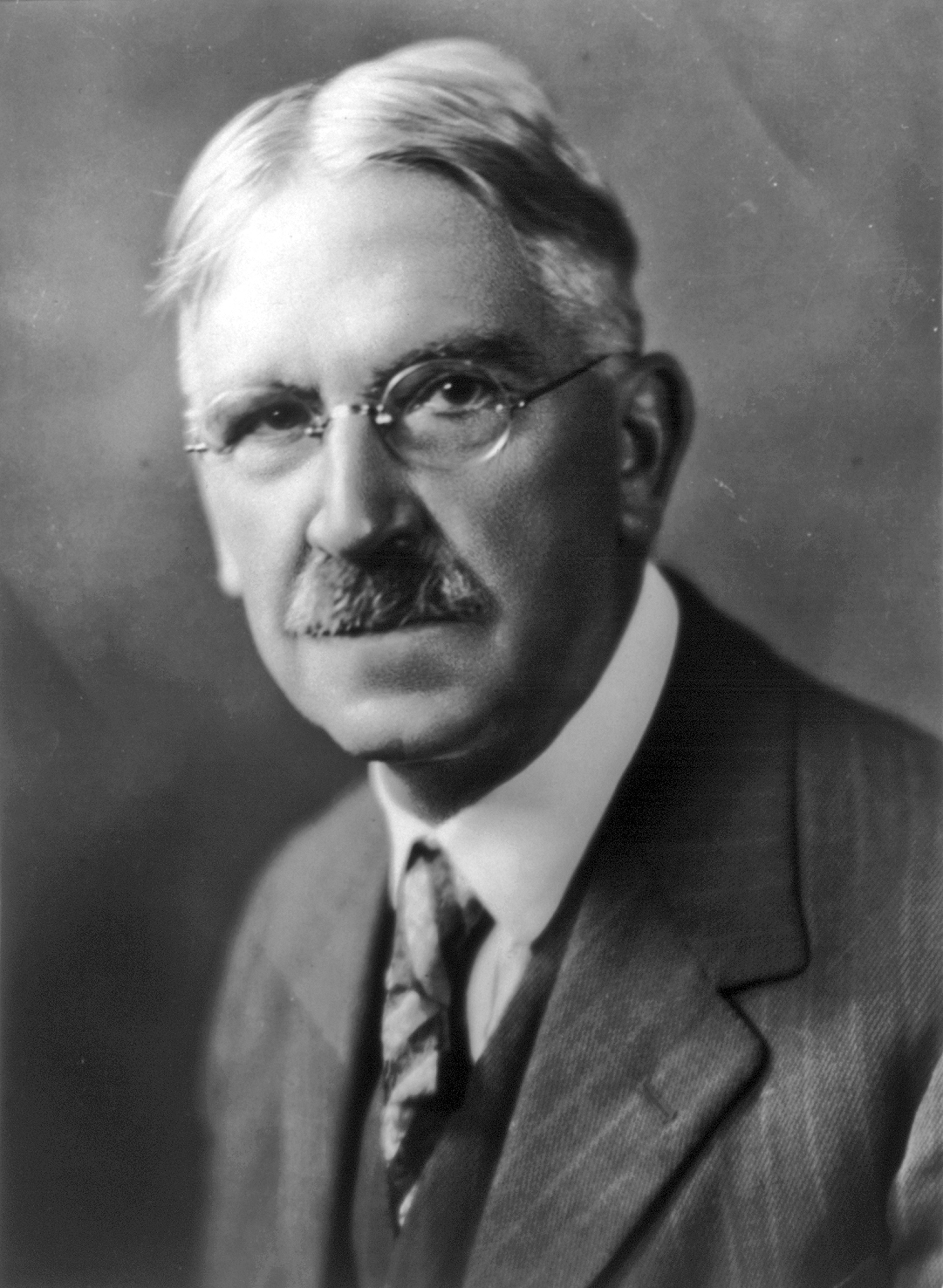
Dewey was born on 20 October 1859 and died in New York City on 1 June 1952.2 At the University of Chicago he founded the Laboratory School, a place to test ideas about how children learn. His wife Alice was its principal from 1896 to 1904. Conflicts over the school led Dewey to resign in 1904 and move to Columbia University and its Teachers College.3
Chicago shaped him in another way. He became active in the city's social causes, including Jane Addams's Hull House, and Addams became a close friend. Dewey and his daughter Jane, who wrote his biography, credited Addams with helping him work out his views on democracy, education, and philosophy.3
His "Pedagogic Creed" is a list of beliefs in the form of single sentences. Two of them carry his whole program. "I believe that the school is primarily a social institution," and "I believe that education, therefore, is a process of living and not a preparation for future living."4 The school, on this view, should be a small community, with real work and real talk in it, instead of a waiting room for adult life. The Stanford Encyclopedia quotes an essay of the same year: "The school cannot be a preparation for social life excepting as it reproduces, within itself, the typical conditions of social life."5
- 1859 Dewey born, 20 October.
- 1896 Laboratory School opens in Chicago.
- 1897 "My Pedagogic Creed."
- 1904 Resigns from Chicago, moves to Columbia.
- 1916 Democracy and Education.
- 1930 "What I Believe."
- 1933 Signs the first Humanist Manifesto. Terry Lectures at Yale (1933 to 1934), published as A Common Faith.
- 1952 Dies, 1 June.
Myth: Dewey wanted children to do whatever they liked
The charge is common and it misses. Dewey held that the child's instincts and interests are a starting point for teaching, and he denied that they are the only one. Family, community, and nation have a legitimate claim to hand on what they know and value, and a teacher's job is to choose the influences that reach the child.5 The Creed says the teacher is "not in the school to impose certain ideas or to form certain habits in the child, but is there as a member of the community to select the influences which shall affect the child."4 You can disagree with where that leads. You should get his position right first.
Democracy as a Way of Living
In Democracy and Education (1916) Dewey gives the case that American schools took up. The superficial explanation of democracy's devotion to education, he says, is that a government resting on popular suffrage cannot succeed unless the people who elect and obey their governors are educated. Then comes the deeper one: "A democracy is more than a form of government; it is primarily a mode of associated living, of conjoint communicated experience."6 A society with many contacts among its members, he argues, breaks down the barriers of class, race, and national territory that keep people from seeing the import of their own actions.6
Dewey did not want children to be passive. He rejected a school built on discipline and memorization as the traditionalists understood them. He also did not want the child to be the only starting point, a point on which the Stanford Encyclopedia is clear. Larger groups such as family, community, and nation, in his view, have a legitimate stake in handing on their interests and values, and the Encyclopedia adds that schools, on his account, must avoid indoctrination.5 Democracy, in his account, depends on education more than on anything else, since schooling forms the habits of investigating a doubtful belief and talking openly about it.7 Those are goods any citizen should want in a school. A child who has learned to test a claim, hear an opponent, and finish a job with others is better equipped to carry self-government. No Christian parent has reason to object to that in itself.
Dewey also had a view about fixed ends. In a later essay, "Creative Democracy" (1939), he warned that "All ends and values that are cut off from the ongoing process become arrests, fixations." He wanted values to keep moving with experience.7 That is where natural law and Dewey part. A natural-law reader holds that some ends, such as the wrongness of murder or the dignity of a person, are not up for revision by the next experiment. The Founders wrote the principle into the Declaration when they called certain rights "unalienable." A school that teaches children to test every belief is doing a good thing, and a school that teaches them that no belief is more than a tool for the moment is doing something else.
The debt to Darwin is part of the picture. The Stanford Encyclopedia's chronology of Dewey's works lists "The Influence of Darwin on Philosophy" among his works (it gave its title to a collection of 1910).3 Pragmatism's account of ideas as instruments that survive by working has a family resemblance to natural selection, and you can read Dewey as an attempt to carry Darwin's picture of life into the school. The lesson on Darwin sets out the other half of that story.
Where Dewey Stood on God
The Stanford Encyclopedia says Dewey grew up in a religious family and belonged to congregations for about thirty-five years, turning away around 1894 as he left for Chicago. After that his loyalties lay outside religion. John McDermott called him an "unregenerate philosophical naturalist."8 In an essay of 1930 he argued for a new kind of faith that was not transcendental and held that "experience itself is the sole ultimate authority." His Terry Lectures at Yale in 1933 and 1934, published as A Common Faith, tried to rebuild religious feeling on a secular base.8
In 1933 he was one of 34 signers of the first Humanist Manifesto, which was written chiefly by Roy Wood Sellars and Raymond Bragg and which presented humanism as a religious movement meant to "transcend and replace previous religions."9 Read against that history, the Creed's final line borrows religious words for a task Dewey placed inside the democratic community.
What Schaeffer Saw in It
Schaeffer took up the humanist documents in A Christian Manifesto (1981). In chapter 4 he answers the Humanist Manifestos of 1933 and 1973 and argues that humanism functions as a religion.10 On public schools he made a plain claim. In an address that Teaching American History reproduces under the title A Christian Manifesto, he said that one view of reality is taught in the public schools, "that the final reality is only material or energy shaped by pure chance," and that no other view can be taught.11
Dewey himself supplies the premise. If we conceive education, he wrote in 1916, as "the process of forming fundamental dispositions, intellectual and emotional, toward nature and fellow men," then philosophy may be defined as the general theory of education.12 A school that forms dispositions toward nature and toward other people cannot avoid taking a view of what a person is, what counts as knowing, and where right and wrong come from, even by declining to say. Dewey and Schaeffer part ways on the source of the answers. For Dewey experience is the last authority. For Schaeffer a Creator has spoken. A school board is where the two meet.
Where educators disagree: Dewey rejected both the traditionalist stress on discipline and memorization and the Romantic view that the child alone sets the course.5 That middle position is easy to lose when either camp quotes him, so a parent or teacher who hears his name invoked does well to ask which Dewey is meant: the reformer of method in the Creed and Democracy and Education, or the naturalist of A Common Faith.
What the Founders Said Schools Are For
Article 3 of the Northwest Ordinance of 13 July 1787 reads: "Religion, morality, and knowledge, being necessary to good government and the happiness of mankind, schools and the means of education shall forever be encouraged."13 Washington's Farewell Address of 1796 pairs the same claim with a duty: "Promote then, as an object of primary importance, institutions for the general diffusion of knowledge. In proportion as the structure of a government gives force to public opinion, it is essential that public opinion should be enlightened."14
The Idaho Constitution ties the school directly to the republic. Article IX, section 1 begins: "The stability of a republican form of government depending mainly upon the intelligence of the people, it shall be the duty of the legislature of Idaho, to establish and maintain a general, uniform and thorough system of public, free common schools."15
| Source | Date | What it says schools are for |
|---|---|---|
| Northwest Ordinance, Article 3 | 13 July 1787 | Religion, morality, and knowledge are necessary to good government, so schools are to be encouraged. |
| Washington, Farewell Address | 1796 | The general diffusion of knowledge, so that public opinion is enlightened. |
| Idaho Constitution, Article IX, Section 1 | Constitution of 1889 | A general, uniform, and thorough system of free common schools, because a republic's stability depends on the intelligence of the people. |
| Dewey, Democracy and Education | 1916 | Forming dispositions toward nature and fellow-men, in a school that is itself a democratic community. |
Line the four up. The first three say a school serves a republic by supplying knowledge, and the first adds religion and morality to the list. Dewey says a school serves democracy by being a small democracy. The Founders assumed a moral and religious ground under the schoolhouse. Dewey moves the ground into the community. For a citizen the practical question is how much of the older ground a given school still stands on.
What a Citizen Can Do
Read the curriculum. Go to the school board meeting. Ask who chose the text. Ask what a course assumes about truth, about persons, and about right and wrong. Ask where it says a right comes from, and what it leaves to families. Ask politely, and ask in writing so the answer is on the record. If a book or a unit teaches a view of reality as the only view, say so on the record and cite the text. If it teaches well and fairly, say that too. Dewey asked for a school that does not indoctrinate. Schaeffer's complaint, that one view is taught as if it were the only view, is the same worry in other words, and both are right to raise it.
Learn more
- My Pedagogic Creed: Dewey's own short statement, in his own words.
- Democracy and Education: Chapter 7 is the one to read first.
- Stanford Encyclopedia: John Dewey: Balanced scholarship on education and on religion.
- Northwest Ordinance: Article 3 on religion, morality, and knowledge.
- Idaho Constitution, Article IX: The state's duty to maintain free common schools.
- A Christian Manifesto, chapter 4: A concise summary of Schaeffer on humanism as a religion.
Notes
- Dewey, "My Pedagogic Creed" (1897), article V, "The School and Social Progress," the closing sentence: "I believe that in this way the teacher always is the prophet of the true God and the usherer in of the true kingdom of God." Read it online. ↩
- Wikipedia, "John Dewey": born 20 October 1859; died 1 June 1952 at his home in New York City. Read it online. ↩
- David Hildebrand, "John Dewey," Stanford Encyclopedia of Philosophy (substantive revision 31 March 2024), section 1 on his life: at Chicago Dewey founded the Laboratory School, and his wife Alice was principal from 1896 to 1904; conflicts led him to resign in 1904 and move to Columbia and Teachers College. Read it online. ↩
- John Dewey, "My Pedagogic Creed" (1897), article II, "What the School Is," and article I, "What Education Is," Wikisource. Read it online. ↩
- Hildebrand, "John Dewey," Stanford Encyclopedia of Philosophy, section 5 on education: schools as micro-communities; the school "cannot be a preparation for social life excepting as it reproduces, within itself, the typical conditions of social life" (1897); Dewey denied that the child was the only starting point and held that larger social groups have a legitimate stake in passing on values; he rejected traditionalists' stress on discipline and memorization and said schools should eschew indoctrination. Read it online. ↩
- John Dewey, Democracy and Education (New York: Macmillan, 1916), chapter 7, "The Democratic Conception in Education." Project Gutenberg ebook 852. Read it online. ↩
- Hildebrand, "John Dewey," Stanford Encyclopedia of Philosophy, section 5.3: schools as sites to learn and experiment with democracy; education is most determinative of whether citizens develop habits of investigating problematic beliefs and communicating openly. Read it online. ↩
- Hildebrand, "John Dewey," Stanford Encyclopedia of Philosophy, section 9, "Religion, Religious Experience and A Common Faith": Dewey belonged to congregations for about thirty-five years and turned away around 1894; John McDermott called him an "unregenerate philosophical naturalist"; in "What I Believe" (1930) he wrote that "experience itself is the sole ultimate authority"; the Terry Lectures of 1933 to 1934 became A Common Faith. Read it online. ↩
- Wikipedia, "Humanist Manifesto": the first manifesto was written in 1933 chiefly by Roy Wood Sellars and Raymond Bragg and published with 34 signatories, including John Dewey; it described humanism as a religious movement. Read it online. ↩
- "Chapter 4: The Humanist Religion," Christ Over All, summary of Francis A. Schaeffer, A Christian Manifesto (Westchester, Ill.: Crossway, 1981): Schaeffer responds in chapter 4 to the Humanist Manifestos of 1933 and 1973 and argues that humanism functions as a religion. Read it online. ↩
- Francis Schaeffer, excerpt titled A Christian Manifesto (an address, which Teaching American History calls a sermon), Teaching American History: "There is only one view of reality that can be taught, and that is that the final reality is only material or energy shaped by pure chance." Read it online. ↩
- John Dewey, Democracy and Education (New York: Macmillan, 1916), chapter 24, "Philosophy of Education": "If we are willing to conceive education as the process of forming fundamental dispositions, intellectual and emotional, toward nature and fellow men, philosophy may even be defined as the general theory of education." Project Gutenberg ebook 852. Read it online. ↩
- Northwest Ordinance, 13 July 1787, Article 3, Avalon Project, Yale Law School. Read it online. ↩
- George Washington, Farewell Address, 1796, Avalon Project, Yale Law School. Read it online. ↩
- Idaho Constitution, Article IX, Section 1, Idaho Legislature. Read it online. ↩
Terms in this lesson
- Progressive education
- A movement, with Dewey among its best-known voices, that stressed learning by doing, the child's interests, and the school as a community.
- Laboratory School
- The experimental school Dewey founded at the University of Chicago in 1896 to test his theories.
- Instrumentalism
- Dewey's view that ideas are tools for solving problems, to be judged by how they work in experience.
- Naturalism
- The view that nature is all there is and that explanations need nothing outside it.
- Humanist Manifesto
- A statement of non-theistic humanist belief. The first appeared in 1933 and was signed by Dewey among 34 others.
- Northwest Ordinance
- The law of 13 July 1787 that organized the territory north of the Ohio River and named religion, morality, and knowledge as necessary to good government.
Sources
- Dewey, My Pedagogic Creed (1897), Wikisource checked 2026-10
- Dewey, Democracy and Education (1916), Project Gutenberg checked 2026-10
- Stanford Encyclopedia of Philosophy, John Dewey (David Hildebrand) checked 2026-10
- Wikipedia, Humanist Manifesto checked 2026-10
- Christ Over All, concise summary of A Christian Manifesto, chapter 4 checked 2026-10
- Francis Schaeffer, A Christian Manifesto (excerpt), Teaching American History checked 2026-10
- Northwest Ordinance, 13 July 1787, Avalon Project checked 2026-10
- Washington, Farewell Address (1796), Avalon Project checked 2026-10
- Idaho Constitution, Article IX, Section 1 checked 2026-10