Lesson 5 of 18 · about 14 minutes
Rousseau and the General Will
You'll be able to
- Quote Rousseau's opening sentence and explain the problem he set out to solve
- Define the general will and its difference from the will of all
- Explain what Rousseau meant by being forced to be free
- Describe how scholars disagree about whether Rousseau leads toward tyranny
- Compare the general will with the American limits on majority power
"Man is born free; and everywhere he is in chains."1 That is the first sentence of Jean-Jacques Rousseau's Social Contract, published in 1762, and few openings in political writing have done more work. The next lines ask how the change came about. Rousseau says: "I do not know. What can make it legitimate? That question I think I can answer."1
The book did not go over well with the authorities. In 1762 both the Social Contract and his novel of education, Emile, were condemned in Geneva, and Emile was condemned in Paris.2 In May 1763 Rousseau gave up his Genevan citizenship.2 Within a generation, his ideas would be carried into the French National Assembly. In 1794, the same year the Terror ended, his remains were moved to the Panthéon in Paris.2 Thirty-two years earlier, Paris had condemned Emile.
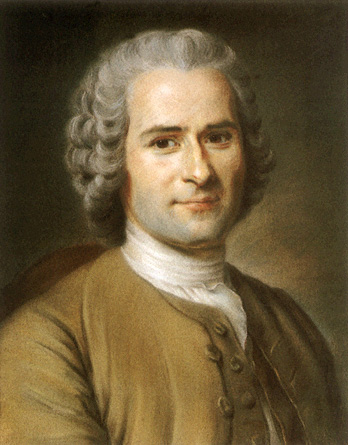
A Watchmaker's Son
Rousseau was born in Geneva in 1712, the son of a watchmaker named Isaac. In April 1728 he converted to Roman Catholicism in Turin. In 1749 he saw the Academy of Dijon's essay question, won the prize in 1750, and saw his First Discourse published in 1751. The Discourse on Inequality followed in 1755 and the novel Julie in 1761.2 In January 1766 he crossed to England with David Hume, and the friendship turned to a famous quarrel within months. Rousseau left England in May 1767.3 He died in 1778.2
He is hard to place. He wrote about nature and feeling, and he also wrote a book of strict civic law. That mix is part of why admirers and enemies alike have claimed him.
Where the Chains Come From
In the Discourse on Inequality (1755) Rousseau gave his answer to why people are unfree. Property was the beginning. "The first man who, having enclosed a piece of ground, bethought himself of saying This is mine, and found people simple enough to believe him, was the real founder of civil society."4 He imagines someone pulling up the stakes and warning the others not to listen to the impostor. The fault lay in society as it had developed, not in the original man.4
The older Christian account, which the Founders inherited, put the trouble in the human heart and built government to restrain it. Madison's "If men were angels" line comes from that account. Rousseau looked for the trouble outside the person, in arrangements. Once a thinker does that, the cure is a better arrangement, and the cure can be applied by force.
The General Will
The Social Contract proposes a new arrangement. Free people join together, each gives himself wholly to the community, and the community as a whole becomes sovereign. The lawmaker is the people assembled, and its will aims at the common good. Rousseau calls this the general will.
He separates it from what voters happen to want. "There is often a great deal of difference between the will of all and the general will; the latter considers only the common interest, while the former takes private interest into account, and is no more than a sum of particular wills."5 The general will is, in his words, the sum of the differences that remain when the pluses and minuses of private interests cancel out.5 It is not what the majority happens to vote for. A majority can be wrong. As Rousseau puts it, "the people is never corrupted, but it is often deceived."5
Notice what that does. If the people can be deceived about their own general will, someone must be in a position to know it better than they do. Rousseau saw the difficulty. In Book II, chapter 7, he brings in a Legislator, a superior intelligence who frames the laws for a people and who, being unable to rely on force or on argument, must turn to "an authority of a different order capable of constraining without violence and persuading without convincing."6 The theory has a place for a teacher who already has the answer. History produced a good many applicants for the job.
Forced to Be Free
The most famous phrase in the book is the one in Book I, chapter 7. To keep the compact from being an empty formula, Rousseau says, it includes an undertaking: whoever refuses to obey the general will "shall be compelled to do so by the whole body." This means, he goes on, that "he will be forced to be free."7
"[W]hoever refuses to obey the general will shall be compelled to do so by the whole body. This means nothing less than that he will be forced to be free."
Jean-Jacques Rousseau, The Social Contract (1762), Book I, chapter 7, trans. G. D. H. Cole. 7
Rousseau's explanation is that the condition secures each citizen against all personal dependence, because each obeys the law all have made and no particular man.7 The Stanford Encyclopedia of Philosophy reads the phrase that way and also notes that it sits in tension with his stated commitment to freedom.2 That tension is the problem. A citizen who disagrees with the law is told that his disagreement is a mistake about his own real will.
The last chapter of the book adds a civil religion. The sovereign should set out a short profession of faith, "not exactly as religious dogmas, but as social sentiments without which a man cannot be a good citizen or a faithful subject." It cannot compel belief, but it may banish whoever does not hold the creed, and if someone professes the dogmas and acts as though he does not believe them, "let him be punished by death."8 The creed itself, in the Stanford summary, affirms a supreme being and an afterlife, holds that the just prosper and the wicked are punished, and calls the social contract and the laws sacred. It tolerates other beliefs but excludes anyone who insists there is no salvation outside his own church.9 A reader raised on the First Amendment will see at once how far this sits from a government with no power to prescribe orthodoxy.
The Revolution Reads Rousseau
When the National Assembly of France adopted the Declaration of the Rights of Man on August 26, 1789, Article 6 began: "Law is the expression of the general will."10 The phrase is Rousseau's. So is the premise of Article 3, that the principle of sovereignty resides in the nation.10 Four years later the revolutionary government turned to terror. The Law of Suspects passed on September 17, 1793, and Robespierre defended the policy in the name of virtue.11 He called terror "an emanation of virtue" and "a natural consequence of the general principle of democracy."12
Robespierre does not quote the Social Contract in that passage, and nothing in Rousseau's text calls for a guillotine. But the logic is recognizable. When the people's will is the source of law, and the leaders speak for the people's real will, those who object are enemies of the people.
| Rousseau's idea | His words | What followed in 1789 to 1794 |
|---|---|---|
| Liberty is lost in society | "Man is born free; and everywhere he is in chains." | The Declaration of 1789 opens with the rights of man. |
| Law is the people's will | The general will is the sovereign's will. | Article 6: "Law is the expression of the general will." |
| Dissent is a mistake | "forced to be free" | Law of Suspects, September 17, 1793. |
| The state may enforce a creed | A civil religion, with banishment for unbelievers | Robespierre joins virtue and terror, February 1794. |
Where Scholars Disagree
The Israeli historian J. L. Talmon argued in The Origins of Totalitarian Democracy (1952) that political messianism came out of the French Revolution and that Rousseau's position may best be understood as "totalitarian democracy," a philosophy in which liberty is realized "only in the pursuit and attainment of an absolute collective purpose."13 Others disagree. The Stanford Encyclopedia of Philosophy notes that hostile writers have linked Rousseau to the authoritarian side of the Revolution and later to fascism and communism, while liberal, civic republican and participatory democratic theorists have drawn on him too.2 It lists three ways of reading the general will: as what citizens decide together, as the common interest apart from what any citizen wants, and as each citizen's will toward the common good.2
A sober view is that Rousseau did not plan a tyranny and that his text supplies the parts for one. He knew that his kind of democracy asks a great deal. In Book III, chapter 4, he says it needs a very small state, great simplicity of manners, a large measure of equality in rank and fortune, and little or no luxury. "Were there a people of gods," he adds, "their government would be democratic. So perfect a government is not for men."14 A kingdom the size of France met few of those conditions in 1789, and the general will had no remedy ready for the failure.
Schaeffer, Madison and the Limits
Chapter 3 of Schaeffer's Escape from Reason has a section headed "Kant and Rousseau."15 The pairing makes sense. Kant located authority in the reasoning individual and Rousseau in the willing collective, and in both cases man alone is the source. Neither needed a Creator to say where the law comes from.
The Americans took a different road. Their Declaration sets rights above any vote: governments secure rights "endowed by their Creator," and a majority cannot vote them away.16 Madison in Federalist No. 10 was blunt about the alternative. A pure democracy, he wrote, "can admit of no cure for the mischiefs of faction," because a common passion will in most cases be felt by a majority, and "there is nothing to check the inducements to sacrifice the weaker party or an obnoxious individual."17 His remedy was a large republic of representatives, with many interests that would have to bargain. Rousseau assumed unity. Madison assumed difference and built for it.
The question for a citizen is practical. When a leader or a movement claims to speak for the people, what is the check? Under the American design, there are several: a written constitution, separated powers, enumerated rights and a press that can say the claim is false. Under the general will there is only the will.
Learn more
- Rousseau, The Social Contract: the full book, with the Discourses, in the Cole translation.
- Rousseau, Stanford Encyclopedia of Philosophy: a careful scholarly guide to the general will and its readings.
- Declaration of the Rights of Man, 1789: where Rousseau's phrase entered French law.
- Robespierre, On the Principles of Political Morality: the speech that links virtue and terror.
- Federalist No. 10: Madison's answer to rule by an undivided majority.
- Klein, The Hume-Rousseau Affair: the quarrel with Hume in detail.
Notes
- Jean-Jacques Rousseau, The Social Contract (1762), Book I, chapter 1, trans. G. D. H. Cole, in The Social Contract and Discourses (London: Dent, 1913), Project Gutenberg. Read it online. ↩
- "Jean-Jacques Rousseau," Stanford Encyclopedia of Philosophy, on his dates and works, the condemnations of 1762, the general will, "forced to be free," the civil religion, and the range of interpretations. Read it online. ↩
- Daniel B. Klein, "The Hume-Rousseau Affair," Adam Smith Works, October 12, 2021. Read it online. ↩
- Rousseau, A Discourse on the Origin of Inequality (1755), Part II, opening, trans. G. D. H. Cole, Internet Modern History Sourcebook, Fordham University. Read it online. ↩
- Rousseau, The Social Contract, Book II, chapter 3, on the will of all, the general will and the people being deceived, trans. Cole, Project Gutenberg. Read it online. ↩
- Rousseau, The Social Contract, Book II, chapter 7, "The Legislator," trans. Cole, Project Gutenberg. Read it online. ↩
- Rousseau, The Social Contract, Book I, chapter 7, "forced to be free," trans. Cole, Project Gutenberg. Read it online. ↩
- Rousseau, The Social Contract, Book IV, chapter 8, "Civil Religion," trans. Cole, Project Gutenberg. Read it online. ↩
- "Jean-Jacques Rousseau," Stanford Encyclopedia of Philosophy, section on the civil religion at the end of The Social Contract. Read it online. ↩
- Declaration of the Rights of Man and of the Citizen, August 26, 1789, Avalon Project, Articles 3 and 6. Read it online. ↩
- "Reign of Terror," Wikipedia, on the Law of Suspects (September 17, 1793) and the course of the Terror. Read it online. ↩
- Maximilien Robespierre, "On the Principles of Political Morality," February 1794, Fordham Internet Modern History Sourcebook. Read it online. ↩
- "Jacob Talmon," Wikipedia, on The Origins of Totalitarian Democracy (1952), political messianism, and his reading of Rousseau. Read it online. ↩
- Rousseau, The Social Contract, Book III, chapter 4, "Democracy," trans. Cole, Project Gutenberg. Read it online. ↩
- Crossway, Francis A. Schaeffer Trilogy, table of contents, Escape from Reason, chapter 3 ("Kant and Rousseau"). Read it online. ↩
- Declaration of Independence, July 4, 1776, National Archives transcript. Read it online. ↩
- Federalist No. 10, November 22, 1787, Avalon Project, on the causes of faction and the defects of pure democracy. Read it online. ↩
Terms in this lesson
- The agreement by which free people form a political community and put themselves under its law.
- General will
- For Rousseau, the people's will directed at the common good alone. It differs from the sum of what individuals privately want.
- Will of all
- The total of private interests, which Rousseau said does not count as the general will.
- Sovereign
- The holder of final authority. For Rousseau it is the whole body of citizens acting as lawmaker.
- Civil religion
- A public creed of a few civic dogmas that Rousseau thought the state may require of citizens.
- Totalitarian democracy
- J. L. Talmon's phrase for a government that claims the people's will as its warrant and then allows no private sphere outside it.
Sources
- Rousseau, The Social Contract and Discourses (Cole translation), Project Gutenberg checked 2026-10
- Stanford Encyclopedia of Philosophy, Jean-Jacques Rousseau checked 2026-10
- Avalon Project, Declaration of the Rights of Man, 1789 checked 2026-10
- Robespierre, On the Principles of Political Morality, Fordham Sourcebook checked 2026-10
- Federalist No. 10, Avalon Project checked 2026-10
- National Archives, Declaration of Independence transcript checked 2026-10
- Klein, The Hume-Rousseau Affair, Adam Smith Works checked 2026-10
- Wikipedia, Jacob Talmon checked 2026-10