Lesson 3 of 18 · about 14 minutes
The Enlightenment Has Two Faces: Edinburgh and Paris
You'll be able to
- Describe the main thinkers and ideas of the Scottish Enlightenment
- Describe the French philosophes and the Encyclopédie
- Compare the American Declaration of 1776 with the French Declaration of 1789
- Explain Burke's objection to governing by abstract reason
- State Himmelfarb's three-Enlightenments thesis and where reviewers disagree with it
In January 1766 two of the most famous writers in Europe rode out of Paris together on their way to England. David Hume, the Scottish philosopher, had worked for years to bring Jean-Jacques Rousseau to safety in Britain, where he arranged lodging for him and later obtained a royal pension from King George III.1 Within months Rousseau was writing Hume furious letters that accused him of plotting his disgrace. The quarrel reached print in the autumn of 1766 and became a sensation across the Continent. Rousseau left England on May 21, 1767, without taking a penny of the pension.1
The two men make a convenient pair. Both were called philosophers of the Enlightenment. Their views of human nature, of reason and of what holds a society together were far apart, and the century's two great political upheavals, in America and in France, followed the divide.
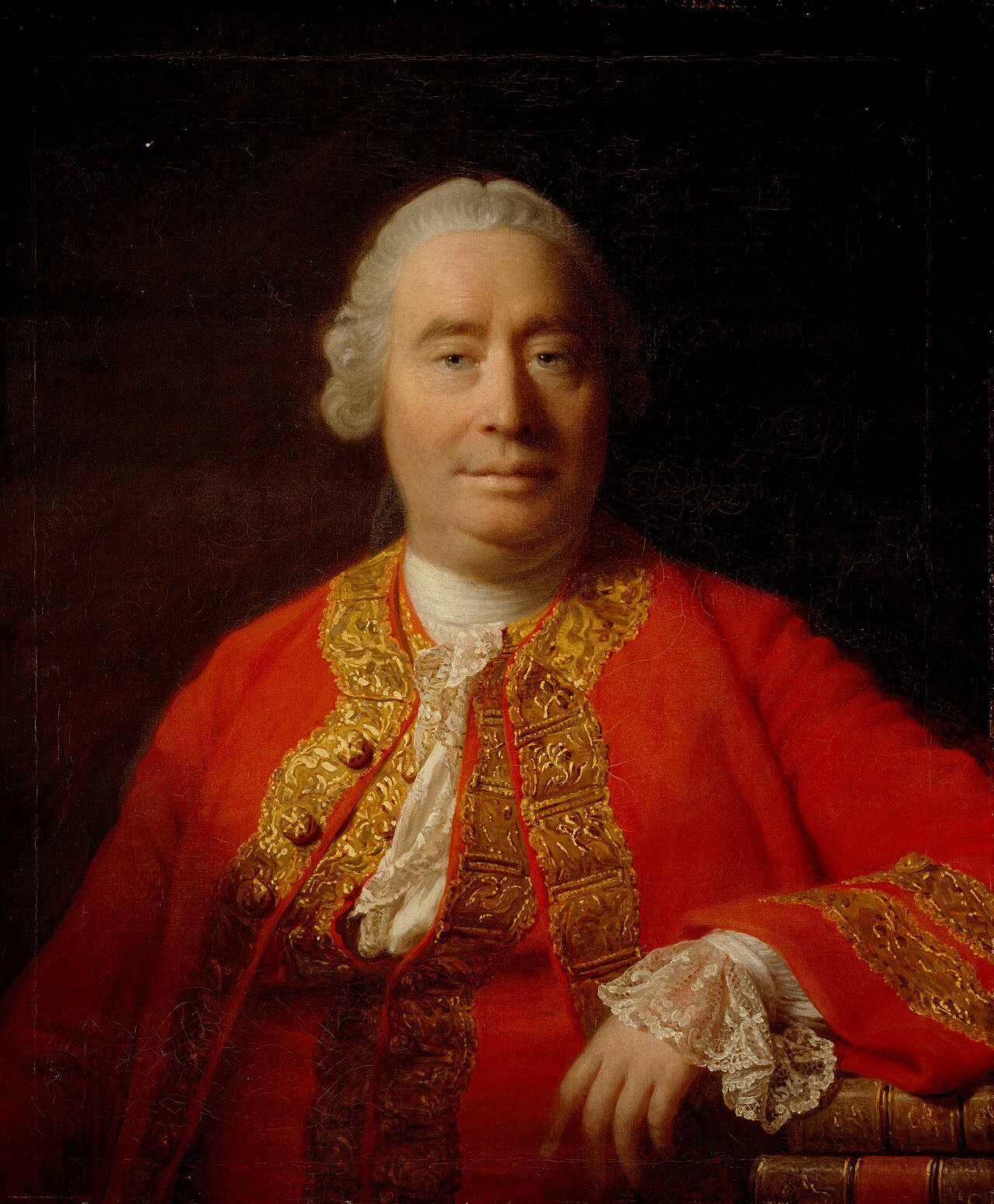
Edinburgh: Sentiment, Sympathy and Common Sense
The Scottish Enlightenment ran from the early eighteenth century into the early nineteenth, and its books are easy to date. Francis Hutcheson (1694 to 1746) published his Inquiry into the Original of our Ideas of Beauty and Virtue in 1725. He argued that people know right from wrong through a moral sense and that benevolence moves them to act on it, and he opposed Thomas Hobbes's view that people are at bottom egoists.2 Hume (1711 to 1776) published his Treatise of Human Nature in 1739 and 1740. Adam Smith (1723 to 1790) studied under Hutcheson and published the Theory of Moral Sentiments in 1759, which rests morality on sympathy and the judgment of an impartial spectator. His Wealth of Nations followed in 1776.2
Thomas Reid (1710 to 1796) answered Hume's skepticism. In his Inquiry into the Human Mind on the Principles of Common Sense (1764) he held that Hume's skepticism was incompatible with common sense, the beliefs on which all people live, such as that the world is real and that a person remains the same person over time. He blamed the "theory of ideas" that Hume's argument started from.3 Adam Ferguson, in his Essay on the History of Civil Society (1767), argued that humans are social from the start, so that there was never a pre-social state of nature.2
The Scots reached America. John Witherspoon brought Scottish common sense realism to Princeton after 1768, taught that morality rests on natural law, and shaped James Madison's thinking.4 He was the only active clergyman and the only college president to sign the Declaration, so the Scottish tradition sat in the room when it was approved.4 Common sense gave American thinkers a way to say that the truths the Declaration calls "self-evident" can be known directly, without a long proof.
Paris: The Philosophes and the Encyclopédie
The French road ran through a book. Denis Diderot edited the Encyclopédie from 1751 until the last plate volumes appeared in 1772, with Jean le Rond d'Alembert as co-editor for part of the run. It came to 28 volumes with more than 71,000 articles and about 2,800 plates, and more than 140 people wrote for it.5 Britannica calls it one of the chief works of the philosophes, men committed to the advance of science and secular thought.6 The government did not like it. A royal edict suspended it in 1752 on the charge that it was "destroying royal authority, fomenting a spirit of independence and revolt," and the crown suspended its privilege again in 1759. The work went on in secret.5
The French writers had real grievances. They lived under an absolute monarchy and a church with the power to censor. Their weapon was reason, and in France reason worked like an acid. It was applied to the church first and then to everything the church supported.
The historian Gertrude Himmelfarb, in The Roads to Modernity (2004), draws the contrast with Britain. She reads the French Enlightenment as rationalist and radical, with reason as the central force. In Britain, she argues, "virtue, rather than reason, took precedence," in the words of Alan Ryan's review: the social virtues of compassion, benevolence and sympathy.7 Keith Windschuttle, summarizing her argument, adds that the philosophes tended to look down on ordinary people, citing her on Diderot, who called the common people incredibly stupid, and on Voltaire, who wanted religion destroyed among respectable people and left to the canaille, "for whom it was made."8
| Question | Edinburgh | Paris |
|---|---|---|
| Main force in human life | Moral sentiment: sympathy and benevolence (Hutcheson, Smith) | Reason applied to every institution (Diderot, d'Alembert) |
| View of religion | Compatible with reform and common life | An obstacle to enlightenment in the philosophes' circle |
| View of ordinary people | Social by nature and capable of virtue | Often looked down on as in thrall to religion |
| Typical political result | Gradual reform under law | Revolution in 1789 and the Terror of 1793 to 1794 |
Two Declarations
The clearest test is to read the two great declarations side by side. The American text of 1776 says people are "endowed by their Creator with certain unalienable Rights" and that governments derive "their just powers from the consent of the governed."9 The French text, adopted by the National Assembly on August 26, 1789, sets out "the natural, unalienable, and sacred rights of man" and does so "in the presence and under the auspices of the Supreme Being."10 Those are close positions, and nobody should pretend otherwise. Article 2 names the rights as "liberty, property, security, and resistance to oppression."10
Article 1 says "Men are born and remain free and equal in rights." Article 4 defines liberty as "the freedom to do everything which injures no one else," and Article 17 calls property "an inviolable and sacred right."10 A reader from Boston or Richmond in 1789 would have recognized every one of those lines. The Assembly wanted a free society, and it wrote down real protections. What the document could not supply was a check on the power it made sovereign.
The difference lies in where sovereignty sits and what law is. Article 3 says "The principle of all sovereignty resides essentially in the nation." Article 6 says "Law is the expression of the general will."10 The phrase general will is Rousseau's, and Lesson 5 follows it. For now it is enough to see that the American text puts the source of rights above the people, in a Creator, and treats government as the people's agent for securing them. The French text puts the source of law in the people's will. A majority that can define law can, in time, define rights, and the Americans designed their Constitution to prevent that. Madison, in Federalist No. 10 (November 22, 1787), wrote that the causes of faction are "sown in the nature of man" and set out to control its effects without destroying liberty. "Liberty is to faction what air is to fire," he wrote, and to abolish liberty to end faction would be a cure "worse than the disease."11
The Road to the Terror
Britannica dates the Reign of Terror from September 5, 1793, to July 27, 1794.12 The Law of Suspects passed on September 17, 1793, and the Law of 22 Prairial, June 10, 1794, sped up the trials. Wikipedia, drawing on Donald Greer's study, reports 16,594 death sentences across France, at least 300,000 suspects arrested and about 17,000 officially executed, with others dead in prison or without trial.13 Robespierre was arrested on July 27 and guillotined on July 28, 1794.13
The Committee of Public Safety's leading voice did not hide his reasoning. In his speech of February 1794, On the Principles of Political Morality, Robespierre said that during a revolution the government's spring is "virtue combined with terror: virtue, without which terror is destructive; terror, without which virtue is impotent." He added: "Terror is only justice prompt, severe and inflexible."14 A government that believes it holds the people's will and the people's virtue finds no limit on what it may do in their name.
Burke's Warning
Edmund Burke saw the danger in 1790, before most of the blood. In his Reflections on the Revolution in France he stood with the English habit against the abstract rights of the French. "We are afraid to put men to live and trade each on his own private stock of reason," he wrote, "because we suspect that the stock in each man is small, and that the individuals would do better to avail themselves of the general bank and capital of nations and of ages."15 Wise men, he added, do not rip out old prejudices at once but "employ their sagacity to discover the latent wisdom which prevails in them."15
The Americans had their own version of the warning, though from a different side. Federalist No. 51 holds that if men were angels no government would be necessary, and it asks the framers to make government control itself.16 Both Burke and Madison distrusted a politics that assumed human goodness would do the work of institutions.
Burke did not call reason useless. He said one generation's reasoning is a small fund beside the experience of many generations, and that lasting institutions carry some of that experience. In Windschuttle's account of Himmelfarb, Burke made the "sentiments, manners, and moral opinion" of the people the basis not only of social relations but of politics.8
Where Scholars Disagree
Alan Ryan, reviewing Himmelfarb in the New York Review of Books, found much to say against her line, though he praised the way she makes it, and he noted that her closing epilogue praises compassionate conservatism. He added that the subtitle misleads, since the book is mostly about her favorite British philosophers.7 The Internet Encyclopedia of Philosophy credits Henry May and Jonathan Israel with a different division, between a moderate Enlightenment and a radical one, and says American thought drew on both.17 Neither scheme makes every Frenchman a radical or every Scot a moderate. Hume was an unbeliever, and Rousseau had no love for the philosophes.
Francis Schaeffer came at the same question from another direction. In the reference summary of How Should We Then Live?, his chapter on the Enlightenment ends with the French Revolution as the logical conclusion of optimism about man cut off from religion.18 The scholars who quarrel over the details land close together on one point. Ideas about what a person is, and where rights come from, produced different governments.
The Scots could not hold the line forever. Hume's skepticism had loosened the ground under the moral sense, and a Prussian professor was already building a new foundation.
Learn more
- Daniel Klein, The Hume-Rousseau Affair: the quarrel between the two Enlightenments told through two famous men.
- Alan Ryan, Faith-Based History: a review of Himmelfarb that tests her three-Enlightenments thesis.
- Declaration of the Rights of Man, 1789: the French text to read beside the American one.
- Robespierre, On the Principles of Political Morality: the Terror explained by its leader.
- Burke, Reflections on the Revolution in France: the full text, in volume 3 of his Works.
- Federalist No. 10: Madison on faction and the extended republic.
Notes
- Daniel B. Klein, "The Hume-Rousseau Affair," Adam Smith Works, October 12, 2021, on the journey of January 1766, Hume's arrangements and the royal pension, Rousseau's accusations, the publication of October 1766 and Rousseau's departure on May 21, 1767. Read it online. ↩
- "Scottish Philosophy in the Eighteenth Century," Stanford Encyclopedia of Philosophy, on Hutcheson (1725), Hume (1739 to 1740), Smith (1759 and 1776), Reid (1764) and Ferguson (1767). Read it online. ↩
- "Thomas Reid," Britannica, on his Inquiry into the Human Mind on the Principles of Common Sense (1764) and his reply to Hume's theory of ideas. Read it online. ↩
- "John Witherspoon," Wikipedia, on his arrival at Princeton in 1768, Scottish common sense realism, natural law, and his influence on Madison. Read it online. ↩
- "Encyclopédie," Wikipedia, on publication from 1751 to 1772, the editors, 28 volumes, about 71,818 articles and 2,784 plates, more than 140 contributors, the royal edict of 1752 and the loss of the privilege in 1759. Read it online. ↩
- "Encyclopédie," Britannica, describing it as one of the chief works of the philosophes. Read it online. ↩
- Alan Ryan, "Faith-Based History," New York Review of Books, December 2, 2004, reviewing Gertrude Himmelfarb, The Roads to Modernity: The British, French, and American Enlightenments (New York: Knopf, 2004). Read it online. ↩
- Keith Windschuttle, "Gertrude Himmelfarb and the Enlightenment," The New Criterion, February 2020, summarizing Himmelfarb on the French, British and American Enlightenments, on Diderot and Voltaire, and on Burke. Read it online. ↩
- Declaration of Independence, July 4, 1776, National Archives transcript. Read it online. ↩
- Declaration of the Rights of Man and of the Citizen, approved by the National Assembly of France, August 26, 1789, Avalon Project, preamble and Articles 2, 3 and 6. Read it online. ↩
- Federalist No. 10, November 22, 1787, Avalon Project. Read it online. ↩
- "Reign of Terror," Britannica, giving September 5, 1793, to July 27, 1794. Read it online. ↩
- "Reign of Terror," Wikipedia, citing Donald Greer's figures, the Law of Suspects (September 17, 1793), the Law of 22 Prairial (June 10, 1794) and Robespierre's execution on July 28, 1794. Read it online. ↩
- Maximilien Robespierre, "On the Principles of Political Morality," February 1794, Internet Modern History Sourcebook, Fordham University. Read it online. ↩
- Edmund Burke, Reflections on the Revolution in France (1790), in The Works of the Right Honourable Edmund Burke, vol. 3, Project Gutenberg. Read it online. ↩
- Federalist No. 51, February 8, 1788, Avalon Project. Read it online. ↩
- "American Enlightenment Thought," Internet Encyclopedia of Philosophy, on the moderate and radical divisions credited to May and Israel. Read it online. ↩
- "How Should We Then Live?," Wikipedia, on the summary of chapter 6, The Enlightenment, and its treatment of the French Revolution. Francis A. Schaeffer, How Should We Then Live? (Old Tappan, N.J.: Revell, 1976). Read it online. ↩
Terms in this lesson
- Philosophes
- The French writers of the Enlightenment, among them Voltaire, Diderot and d'Alembert, who sought to apply reason to religion, society and government.
- Common sense philosophy
- The school of Thomas Reid and others holding that some basic truths are known directly and need no proof from argument.
- Moral sentiments
- The feelings of sympathy and benevolence that Hutcheson and Smith treated as the natural bond of human society.
- General will
- Rousseau's term for the will of the people aimed at the common good. The French Declaration of 1789 says law expresses it.
- Reign of Terror
- The period from September 5, 1793, to July 27, 1794, when the French revolutionary government used mass arrest and execution to defend itself.
- Prejudice (Burke's sense)
- A settled opinion held without a full chain of argument, which Burke thought often carries the stored wisdom of many generations.
Sources
- Stanford Encyclopedia of Philosophy, Scottish Philosophy in the 18th Century checked 2026-10
- Daniel Klein, The Hume-Rousseau Affair, Adam Smith Works checked 2026-10
- Avalon Project, Declaration of the Rights of Man and of the Citizen, 1789 checked 2026-10
- National Archives, Declaration of Independence transcript checked 2026-10
- Robespierre, On the Principles of Political Morality, Fordham Sourcebook checked 2026-10
- Burke, Reflections on the Revolution in France, in Works vol. 3, Project Gutenberg checked 2026-10
- Alan Ryan, Faith-Based History, New York Review of Books, 2004 checked 2026-10
- Keith Windschuttle, Gertrude Himmelfarb and the Enlightenment, The New Criterion checked 2026-10
- Wikipedia, Encyclopédie checked 2026-10