Lesson 4 of 18 · about 14 minutes
Kant and the Split Between Fact and Value
You'll be able to
- Explain Kant's distinction between the world as it appears and the world as it is in itself
- Quote Kant on making room for belief and on the dignity of persons
- State Hume's is-ought problem in his own words
- Describe where Schaeffer's Escape from Reason takes up Kant and how his upper and lower stories fit Kant's two realms
- Say how a split between fact and value bears on the Declaration's claim of self-evident truths
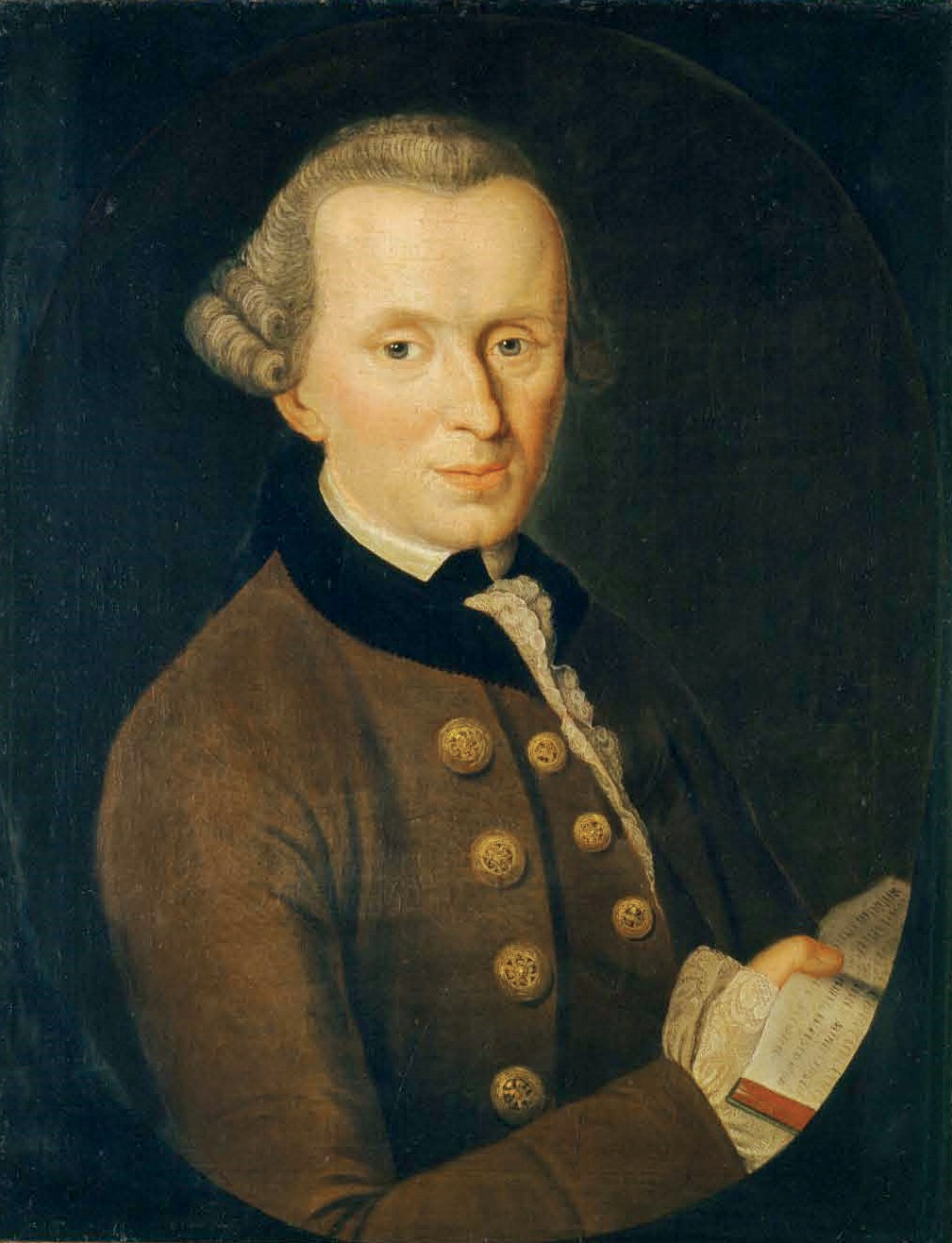
Immanuel Kant was born in Königsberg on April 22, 1724, and died there on February 12, 1804. What he did was write the books that reorganized European philosophy. The Critique of Pure Reason appeared in 1781, with a second edition in 1787. The Groundwork of the Metaphysics of Morals followed in 1785, the Critique of Practical Reason in 1788 and the Critique of the Power of Judgment in 1790.1
In the preface to the second edition of the first Critique, he wrote a sentence that has been quoted ever since. In the Meiklejohn translation it reads: "I must, therefore, abolish knowledge, to make room for belief."2 He meant it as a rescue. To see what he was rescuing, and what it cost, start with the man who set the problem.
Hume's Gap
David Hume had published his Treatise of Human Nature in 1739 and 1740. Near the end of the first section of Book III he stopped to make an observation about every system of morality he had read. The authors begin, he says, by reasoning in the usual way about God or about human affairs. Then "of a sudden" he finds that instead of the usual "is, and is not," he meets "no proposition that is not connected with an ought, or an ought not."3 Hume's point was that this new relation "should be observed and explained," and that no one gave a reason for how it could follow from the earlier propositions, "which are entirely different from it."3
Philosophers call this the is-ought problem. Hume did not claim to have solved it, and the text above is only a request that authors show their work. Read in a hard way, it says that facts alone never yield duties. If that is so, then a claim like "no one ought to harm another in his life, health, liberty, or possessions" cannot be derived from anything in nature.
Locke's answer, as Lesson 2 showed, was that the duty follows from the fact that persons are "the workmanship of one omnipotent, and infinitely wise maker."4 The natural-law tradition has always argued that the gap closes when the "is" includes a Creator and a purpose for human beings. Kant's route was different.
Two Realms
Kant held that human knowledge has two sources, the senses and the understanding, and that neither works alone. "Thoughts without content are void; intuitions without conceptions, blind."2 The mind does not receive the world like a camera. It shapes what it receives. So what science studies is the world as it appears to us, which Kant called phenomena. Things as they are in themselves, noumena, we cannot know by theory.1
This gave Kant a way to protect science. The laws of nature hold without exception for everything that can appear to us. It also gave him a way to protect morality, because it left room for a realm where persons are free. We cannot prove that we are free by looking at nature, where every event has its cause. But we cannot act at all without thinking of ourselves as free.1 The Stanford Encyclopedia of Philosophy puts his position on God, freedom and immortality this way: belief in them rests on a moral basis and not on theoretical proof. Hence he had to "deny knowledge in order to make room for faith."1
| The realm of nature | The realm of freedom | |
|---|---|---|
| What it contains | Phenomena: things as they appear | The moral law and the free person |
| How we reach it | Senses plus understanding; science | Practical reason; conscience and duty |
| Kind of certainty | Theoretical knowledge | Moral conviction, "belief" in Kant's word |
| What it governs | Cause and effect, without exception | Duty, dignity, God, freedom, immortality |
The Moral Law and the Starry Heavens
Kant did not treat the realm of freedom as a lesser one. He thought it carried the highest worth. In the Critique of Practical Reason he closes with a famous passage: "Two things fill the mind with ever new and increasing admiration and awe, the oftener and the more steadily we reflect on them: the starry heavens above and the moral law within."5
The moral law, he said, speaks as an unconditional command, the categorical imperative. One form of it is the rule against using people: "So act as to treat humanity, whether in thine own person or in that of any other, in every case as an end withal, never as means only."6 And persons have a worth that cannot be traded. In the Abbott translation: "In the kingdom of ends everything has either value or dignity. Whatever has a value can be replaced by something else which is equivalent; whatever, on the other hand, is above all value, and therefore admits of no equivalent, has a dignity."6
"Whatever ... is above all value, and therefore admits of no equivalent, has a dignity."
Immanuel Kant, Fundamental Principles of the Metaphysic of Morals (1785), trans. T. K. Abbott. 6
Any Christian reader should see what is good in this. Kant defended the worth of the person against every scheme that treats people as material. His 1793 book Religion Within the Boundaries of Mere Reason drew a censure from the Prussian king, so he was no safe ally of the state either.1 He was no enemy of morality. He wanted to put morality out of the reach of scientific attack.
Duty You Can Test
Kant gave his moral law a test that an ordinary person can apply. "Act only on that maxim whereby thou canst at the same time will that it should become a universal law."6 His own example is a man in a bind who is tempted to borrow money with a promise he does not mean to keep. The man can will the lie. He cannot will that lying should be a universal law, because with such a law there would be no promises at all, and so no one would believe his.6 The rule rules out the exception a person makes for himself.
It is a stern ethic, and it ties neatly to the Founders' sense of equal law. Nobody gets an exemption. It also shows where Kant puts the source of morality: in the reasoning person. The Abbott translation says so directly: "Autonomy then is the basis of the dignity of human and of every rational nature."6
Autonomy, for Kant, meant self-law, a person binding himself by the law his own reason recognizes. He did not mean doing as he pleased. But the word was loose enough to be stretched, and in later lessons it will be. A person who is the author of the moral law can, in time, come to be seen as the author of whatever law he likes.
The Founders' Answer
The Americans did not need Kant to answer Hume. The tradition they used, running through Thomas Reid and John Witherspoon, held that basic truths are known directly by the mind and need no chain of proof. Reid replied to Hume's skepticism on exactly that ground, in his Inquiry of 1764.7 The Declaration's "self-evident" is that kind of claim. Witherspoon carried the same tradition to Princeton and taught that morality rests on natural law.8
So the Founders had a reply to the is-ought problem, and it was not Kant's. Humans are made, they have a nature, and a nature has a purpose. A duty that follows from the Maker's purpose follows from a fact. Kant's answer put the whole weight on reason and freedom inside the person, and left the Maker to be a postulate of practical life. That is the hinge of the argument that follows.
Where Readers Disagree
Scholars read the pieces of this story in more than one way. Hume's paragraph is a request that authors show their work, and later philosophers have taken it either as a proof that no derivation can work or as a challenge that a good derivation could meet.9 Natural-law thinkers take the second view. Kant's two realms are also read in two ways, as two separate worlds or as two ways of regarding the one world, and the Stanford article frames the line as a limit on theoretical knowledge.10 On the second reading Kant is less of a dualist than often supposed.
What nobody disputes is the effect. Kant is the same man who told his age in 1784 to "Dare to know!"11 He believed reason could settle both science and morals, and he was sure of the moral law. He did not foresee the later thinkers who kept his split and dropped his certainty.
How Schaeffer Read the Split
In Escape from Reason (1968), Schaeffer takes up Kant in chapter 3, under the heading "Kant and Rousseau." The same chapter goes on to early modern science, to Hegel, and to Kierkegaard and the line of despair.12 On Douglas Groothuis's summary of the larger scheme, moderns separate faith from reason. Faith sits in an upper story beyond rational analysis, and the lower story covers fact, logic and science. Because reason cannot speak to meaning or value, a person must either make a blind leap of faith or settle into nihilism.13 Kant's two realms, with knowledge below and moral belief above, fit that pattern closely.
The line of despair is Schaeffer's name for the point where thinkers gave up hoping to unify knowledge. In David Steele's account of Schaeffer, Hegel opens the door to it and Kierkegaard is the first to go below it.14 Kant stands earlier in the story. The pattern is easy to test. After Kant, a great deal of European thought treated moral claims as belonging to a different order from claims about the world, and the two orders drifted apart.
What the Split Does to Rights
The Declaration says "We hold these truths to be self-evident," and the sentence goes on to speak of Creator, equality and rights.15 The word is truths. The Founders believed they were stating facts about human beings that anyone could see.
Suppose the only claims counted as knowledge are claims about what is, in the way a laboratory states them. Then "all men are created equal" has to be filed somewhere else. It becomes a value, a preference or a commitment, and rights become what a community has agreed to honor. A right that rests on agreement can be withdrawn by a larger agreement. That is the practical danger in the fact-value split, and it does not depend on anyone's intentions. Kant's own ethics blocked it, because the dignity of the person sat in his realm of freedom as an absolute. His successors did not all keep it there.
Lesson 5 turns to the thinker who placed the source of law in the will of the people. Lesson 6 turns to the one who placed it in history.
Learn more
- Kant, What Is Enlightenment?: Kant at his most readable, in four pages.
- Kant, Fundamental Principles of the Metaphysic of Morals: the Groundwork in full, with the passages on dignity.
- Kant, Critique of Practical Reason: the source of the starry heavens passage.
- Hume, A Treatise of Human Nature: Book III, Part I, Section I, where the is-ought paragraph sits.
- Kant, Stanford Encyclopedia of Philosophy: a scholarly overview of his whole system.
- Douglas Groothuis on Schaeffer: Schaeffer's two stories explained plainly.
Notes
- "Kant," Stanford Encyclopedia of Philosophy, on his dates, the dates of the Critiques and the Groundwork, phenomena and noumena, moral faith, the quotation from Bxxx, and the censure of the 1793 Religion by the Prussian king. Read it online. ↩
- Immanuel Kant, Critique of Pure Reason, trans. J. M. D. Meiklejohn, preface to the second edition (1787) for "abolish knowledge, to make room for belief," and the Transcendental Logic for "Thoughts without content are void"; Project Gutenberg. Read it online. ↩
- David Hume, A Treatise of Human Nature (1739 to 1740), Book III, Part I, Section I, the paragraph beginning "In every system of morality," Project Gutenberg. Read it online. ↩
- John Locke, Second Treatise of Government (1689), chapter II, section 6, Project Gutenberg. Read it online. ↩
- Immanuel Kant, Critique of Practical Reason (1788), trans. T. K. Abbott, the Conclusion, Project Gutenberg. Read it online. ↩
- Immanuel Kant, Fundamental Principles of the Metaphysic of Morals (Groundwork, 1785), trans. T. K. Abbott, Section II, on humanity as an end and on value and dignity; Project Gutenberg. Read it online. ↩
- "Thomas Reid," Britannica, on the Inquiry into the Human Mind on the Principles of Common Sense (1764) and Reid's reply to Hume. Read it online. ↩
- "John Witherspoon," Wikipedia, on common sense realism, natural law and his teaching at Princeton. Read it online. ↩
- Hume, Treatise, Book III, Part I, Section I, where he recommends that authors give a reason for the new relation and says that doing so "would subvert all the vulgar systems of morality." Read it online. ↩
- "Kant," Stanford Encyclopedia of Philosophy, on phenomena and noumena as limits on theoretical knowledge, and on the practical significance of noumena for freedom. Read it online. ↩
- Immanuel Kant, "An Answer to the Question: What Is Enlightenment?" (1784), trans. Mary C. Smith. Read it online. ↩
- Crossway, Francis A. Schaeffer Trilogy, table of contents, Escape from Reason, chapter 3, whose section headings include "Early Modern Science," "Kant and Rousseau," "Hegel" and "Kierkegaard and the Line of Despair." Francis A. Schaeffer, Escape from Reason (London: InterVarsity Press, 1968). Read it online. ↩
- Douglas Groothuis, "Francis Schaeffer: Pastor, Evangelist, Apologist, Prophet," Christian Research Institute, on the upper and lower story. Read it online. ↩
- David Steele, "Why Francis Schaeffer Matters: The Line of Despair, Part 3," Servants of Grace, April 2, 2018, on Hegel, Kierkegaard and the line of despair. Read it online. ↩
- Declaration of Independence, July 4, 1776, National Archives transcript. Read it online. ↩
Terms in this lesson
- Phenomena
- Things as they appear to us within the frame of our senses and understanding. Kant held that science gives knowledge of phenomena.
- Noumena
- Things as they are in themselves, apart from how we perceive them. Kant held that we cannot know them by theory.
- Categorical imperative
- Kant's name for the moral law as an unconditional command, binding whatever we happen to want.
- Is-ought problem
- Hume's observation that writers slide from statements about what is to statements about what ought to be, without showing how the second follows from the first.
- Dignity
- In Kant's ethics, a worth that has no equivalent and cannot be traded, which every rational person has.
- Upper story and lower story
- Schaeffer's picture of modern thought, with facts and science below and meaning, morals and God above, and no stairs between.
Sources
- Kant, Critique of Pure Reason (Meiklejohn translation), Project Gutenberg checked 2026-10
- Kant, Fundamental Principles of the Metaphysic of Morals (Abbott translation), Project Gutenberg checked 2026-10
- Kant, Critique of Practical Reason (Abbott translation), Project Gutenberg checked 2026-10
- Hume, A Treatise of Human Nature, Project Gutenberg checked 2026-10
- Stanford Encyclopedia of Philosophy, Kant checked 2026-10
- Crossway, Schaeffer Trilogy, table of contents checked 2026-10
- Douglas Groothuis, Francis Schaeffer: Pastor, Evangelist, Apologist, Prophet checked 2026-10
- David Steele, Why Francis Schaeffer Matters: The Line of Despair checked 2026-10