Lesson 11 of 18 · about 15 minutes
Modern Art and Music: What Schaeffer Saw
You'll be able to
- Describe how Schaeffer and Rookmaaker linked changes in art and music to changes in belief
- Place five real works or events (1872, 1884, 1904, 1913, 1917, 1952) on the timeline of modern art and music
- Explain Schaeffer's example of John Cage and the mushrooms and what it was meant to show
- State what Art and the Bible argues about the place of the arts in Christian life
- Connect the arts to the Founders' hopes for a free people
The Theatre des Champs-Elysees in Paris, 29 May 1913. The Ballets Russes is giving the first performance of Igor Stravinsky's The Rite of Spring, with Pierre Monteux conducting and Vaslav Nijinsky's choreography on stage. Derisive laughter starts at the opening bars, a high bassoon solo, and grows through the first scene until the dancers cannot hear the music. The performance goes on. About forty of the worst offenders are reportedly thrown out.1
The evening is remembered as a riot, but the word came later, from reviews of performances in 1924. The composer Alfredo Casella thought the demonstrations were aimed at Nijinsky's choreography more than at the music, and the critic Michel-Dimitri Calvocoressi agreed.2 Some details of the night are still argued. No one disputes that something had changed in what an audience would accept.
Two Friends and One Claim
Hans Rookmaaker was a Dutch art historian, born in The Hague on 27 February 1922. He met Francis Schaeffer in 1948, visited the Swiss community of L'Abri from 1955, and in the mid-1960s started the art history department at the Free University Amsterdam. His book Modern Art and the Death of a Culture appeared in 1970. He died suddenly on 13 March 1977.3 Standard biographical summaries say that his approach to culture was heavily influenced by the friendship.4
The claim the two shared is easy to state. The arts are not decoration. A painter, a composer, or a poet works from a view of what the world is and what a person is, and the work shows it, often before the philosophers say it aloud. Rookmaaker's title gives his reading of where modern art had arrived. Schaeffer carried the claim into his own books. Reviewers note that The God Who Is There follows the shift in attitudes to truth through philosophy, art, music, literature, language, and theology.5 In it he gave art a chapter titled "The Second Step: Art" and music one titled "The Third and Fourth Steps: Music and the General Culture."6 Escape from Reason returns to it in a chapter that opens with a section headed "Art as the Upper-Story Leap" and goes on to sections on Andre Malraux, Picasso, Bernstein, and the Theatre of the Absurd.7
Test the idea that art follows belief on its own terms, apart from any verdict on a painter. It predicts that when a culture's picture of reality changes, its pictures change. It also gives a citizen a way to read the arts as evidence about the society around them.
Milestones, Checked
The milestones below are real, and each can be dated.
| Year | Work or event | What happened |
|---|---|---|
| 1872 and 1874 | Monet, Impression, Sunrise | Painted at Le Havre, shown in April 1874. A critic's mocking review gave Impressionism its name. |
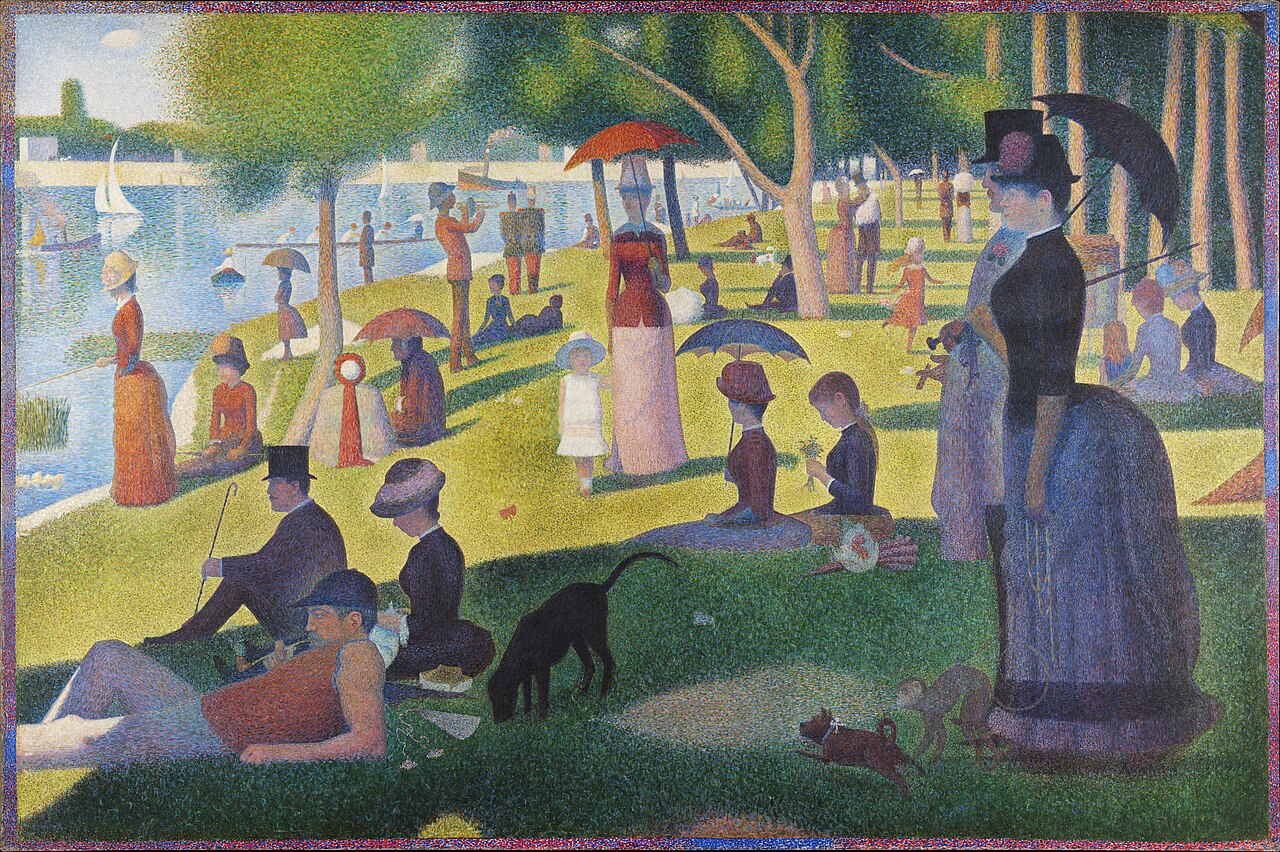
| 1884 to 1886 | Seurat, La Grande Jatte | A scene of Sunday leisure built from small dots of color. |
| 1904 | Cezanne's letter to Emile Bernard (15 April) | He tells Bernard to treat nature in terms of the cylinder, the sphere, and the cone. |
| 1913 | Stravinsky, The Rite of Spring | Paris premiere, 29 May, with shifting accents and two keys sounding at once. |
| 1917 | Duchamp, Fountain | A urinal signed "R. Mutt" submitted to a New York exhibition and hidden from view. |
| 1952 | Cage, 4'33" | Premiere on 29 August at Woodstock: the pianist sits and the room supplies the sound. |
Monet's Impression, Sunrise was painted in 1872 and shown in April 1874. Louis Leroy mocked it in Le Charivari on 25 April, and the label stuck.8 Seurat painted the Grande Jatte between 1884 and 1886, working in tiny dots of color.9 In a letter of 15 April 1904 Cezanne told the younger painter Emile Bernard to treat nature in terms of the cylinder, the sphere, and the cone. Picasso is said to have called him "the father of us all," though the Cezanne scholar Gotz Adriani argues that the Cubists' reading of Cezanne largely ignored his study of nature.10 There is a real scholarly dispute inside the milestone.
In April 1917 a urinal signed "R. Mutt" was submitted to the inaugural exhibition of the Society of Independent Artists in New York. It was never placed in the show area. A journal called The Blind Man defended it, saying it hardly mattered whether Mr. Mutt made the fountain with his own hands: "He CHOSE it." So choice and not craft made the art.11 Marcel Duchamp himself wrote to his sister that a female friend, under a masculine pseudonym, had sent the urinal in, and scholars still argue about who she was.11 The argument of the piece is clear enough. If choosing counts as making, a work needs no skill and no shared standard of beauty.
The Music Is Not Noise
A fair look at the Rite of Spring shows how careful a composer Stravinsky was. The ballet runs about thirty-five minutes in two parts, "Adoration of the Earth" and "The Sacrifice," which ends with a young girl dancing herself to death. The score called for 99 players at the premiere. Its famous stamping chord sounds two keys at once, and the accents shift so that the listener cannot count a steady beat. Stravinsky borrowed the opening bassoon melody from a Lithuanian folk anthology, and he revised the score repeatedly over about thirty years. A corrected version of the 1929 score appeared in 1948.12
That history cuts against a lazy reading. Disorder was not the point of the piece, and no one could write such a score without discipline. What shocked the audience in 1913 was a different account of what music is for: a pagan ritual of sacrifice set to the rhythms of the earth. Whether that is gain or loss is the sort of question Schaeffer wanted Christians to ask in public, with knowledge of the work and a willingness to praise craft where it exists.
Cage and the Mushrooms
John Cage (1912 to 1992) studied Zen with D. T. Suzuki and began to compose by chance operations, letting a coin toss and not his own taste fix the notes.13 On 29 August 1952 at the Maverick Concert Hall in Woodstock, New York, the pianist David Tudor sat at the keyboard for the length of 4'33" and played nothing. Cage held that silence is never empty ("Until I die there will be sounds," he wrote), and the sounds in the hall were the piece.14 He took the work seriously.
A reviewer of The God Who Is There calls Cage the most memorable example in the book and remembers it this way: Cage built music on chance and then, as a wild-mushroom enthusiast, admitted he could not let chance guide what he ate, else he might eat a poisonous one.15 The mushroom hobby is real. Cage taught a mushroom-identification class at the New School in the late 1950s for three years, and in 1962 helped revive the New York Mycological Society.16 Schaeffer's point was about living with one's own presuppositions. A man may build a body of work on the claim that the world is random and still check every mushroom against a field guide, because no one lives as if it were.
Schaeffer's method runs the same way: take an idea seriously enough to live in it, and see whether it survives an ordinary day.
What Schaeffer Wanted Done
Diagnosis was never his whole purpose. In Art and the Bible, first published in 1973 as two essays, he argued from Scripture that the arts belong in Christian life, and that Christians had often been wary of making images and had neglected creativity. The publisher's description quotes him: "The lordship of Christ should include an interest in the arts."17 The same description adds that human creativity reflects being made in the image of a creator God, and that Christians should use the arts to the glory of God, "not just as tracts, mind you."17
Schaeffer also pointed to what the earlier consensus had produced. Reviewing How Should We Then Live?, William Dyrness records Schaeffer's thesis that the Reformation base led to "the art of Rembrandt and Bach," along with the political freedoms of the English and American Revolutions and the rise of modern science.18 A Christian who reads that sentence can take away a task as well as a complaint: the arts are a calling, and one that has been answered before.
Asking Better Questions of a Work
None of this requires a degree in art history. Stand in front of a painting or listen to a piece and ask a few plain things. What does it assume a person is? Does it expect the viewer to share a standard, or does it dissolve the standard? Is there craft, and is the craft in service of something? Rookmaaker spent a career asking those questions of galleries, and Schaeffer taught them to students in a Swiss chalet. They are the same questions a reader asks of a newspaper and a voter asks of a campaign: what does this take for granted, and can it be lived? Children can learn to ask them at a museum door, and a congregation can learn them as easily as a seminar.
What the Founders Hoped For
The men who made the Republic had arts on their minds, though they put the arts last in the order of work. John Adams wrote to Abigail from Paris in May 1780: "I must study Politicks and War that my sons may have liberty to study Mathematicks and Philosophy." His sons were to study mathematics, philosophy, geography, natural history, and naval architecture, then commerce and agriculture, among other subjects, "in order to give their Children a right to study Painting, Poetry, Musick, Architecture, Statuary," and more besides.19 Adams saw the arts as the work of the third generation, paid for by the first two in politics, war, and trade.
Citizens can use that in two ways. They can treat the arts as evidence and ask what a given gallery, concert, or film assumes about a person. And they can treat the arts as a stake in the common life, to be taught, funded, and made. A free people has a right to both. Whether the work in front of you says that a person is a meaningful being made for something, or a pattern in the noise, is a question you are entitled to ask of any work, in any room.
Learn more
- The Rite of Spring: The premiere, the music, and the dispute over the riot.
- Hans Rookmaaker: Schaeffer's friend and the art historian behind Modern Art and the Death of a Culture.
- Art and the Bible: Schaeffer's two essays on the arts and Scripture.
- John Cage, Mycologist: The composer's mushroom years at the New York Botanical Garden.
- Fountain: The 1917 readymade and the quarrel over it.
- Adams to Abigail, 1780: The letter on politics now and painting later.
Notes
- Wikipedia, "The Rite of Spring": premiere on 29 May 1913 at the Theatre des Champs-Elysees, Paris, by the Ballets Russes, conducted by Pierre Monteux with choreography by Vaslav Nijinsky and designs by Nicholas Roerich; derisive laughter from the opening bars; about forty of the worst offenders reportedly ejected. Read it online. ↩
- Wikipedia, "The Rite of Spring": the wording "riot" or "near-riot" did not come about until reviews of later performances in 1924; the composer Alfredo Casella thought the demonstrations were aimed at Nijinsky's choreography rather than at the music, a view shared by the critic Michel-Dimitri Calvocoressi. Read it online. ↩
- Wikipedia, "Hans Rookmaaker": born 27 February 1922 in The Hague, died 13 March 1977; met Francis Schaeffer in 1948; started the art history department at the Free University Amsterdam in the mid-1960s; Modern Art and the Death of a Culture published 1970; visited L'Abri from 1955. Read it online. ↩
- Wikipedia, "Francis Schaeffer": Rookmaaker was a close friend whose friendship heavily shaped Schaeffer's approach to culture. Read it online. ↩
- Sarah Teague, review of Francis A. Schaeffer, The God Who Is There, Christian Today, 22 October 2005: the book follows the shift in attitudes to truth through philosophy, art, music, literature, language, and theology, and names pioneers including Hegel, Picasso, Dylan Thomas, Salvador Dali, and Leonard Bernstein. Read it online. ↩
- Francis A. Schaeffer, The God Who Is There, in the Crossway trilogy edition (The God Who Is There, Escape from Reason, He Is There and He Is Not Silent), table of contents: The God Who Is There, Section One, chapter 3, "The Second Step: Art," and chapter 4, "The Third and Fourth Steps: Music and the General Culture"; Section Two, chapters 3 and 4, on modern mysticism in art, language, music, and literature. Table of contents. ↩
- Francis A. Schaeffer, Escape from Reason (1968), table of contents as printed in the Crossway trilogy edition: chapter 5 begins with "Art as the Upper-Story Leap" and continues with "Poetry: The Later Heidegger," "Art: Andre Malraux," "Picasso," "Bernstein," "Pornography," and "The Theatre of the Absurd." Read it online. ↩
- Wikipedia, "Impression, Sunrise": painted 1872 at Le Havre; shown in April 1874 at the group exhibition now called the first Impressionist exhibition; Louis Leroy's review in Le Charivari, 25 April 1874, mocked it and helped popularize the term. Read it online. ↩
- Georges Seurat, A Sunday on La Grande Jatte, 1884, dated 1884 to 1886 (border added 1888 to 1889), oil on canvas, 207.5 by 308.1 cm, Helen Birch Bartlett Memorial Collection, Art Institute of Chicago, collection record (artwork 27992). Read it online. ↩
- Wikipedia, "Paul Cezanne": letter of 15 April 1904 to Emile Bernard, "Treat nature according to cylinder, sphere, and cone"; Picasso is said to have called Cezanne "the father of us all"; Gotz Adriani argues that later Cubist readings of the remark were largely formalistic misinterpretations. Read it online. ↩
- Wikipedia, "Fountain (Duchamp)": submitted in April 1917 under the name R. Mutt to the first exhibition of the Society of Independent Artists, New York; hidden behind a partition and never shown; photographed at Alfred Stieglitz's studio and published in The Blind Man, whose editorial said Mr. Mutt "CHOSE it"; Duchamp's letter to his sister names "one of my female friends" as the sender; candidates include Louise Norton and Elsa von Freytag-Loringhoven. Read it online. ↩
- Wikipedia, "The Rite of Spring," section on composition: about 35 minutes in two parts, "Adoration of the Earth" and "The Sacrifice"; 99 players at the premiere; bitonality and shifting accents; the opening bassoon melody borrowed from a Lithuanian folk anthology; Stravinsky kept making changes for 30 years or more; Boosey and Hawkes issued a corrected version of the 1929 score in 1948. Read it online. ↩
- "Cage, John," Encyclopedia.com: born 5 September 1912 in Los Angeles, died 12 August 1992; after studying Zen with D. T. Suzuki he used chance operations to let the music speak for itself. Read it online. ↩
- Wikipedia, "4'33"": premiered 29 August 1952 at the Maverick Concert Hall, Woodstock, New York, with David Tudor at the piano; after a visit to an anechoic chamber Cage wrote, "Until I die there will be sounds." Read it online. ↩
- Review of Francis A. Schaeffer, The God Who Is There, Sketches of Time, recounting Schaeffer's example of John Cage, who composed by coin toss but said he could not apply his beliefs to mushroom hunting "else he might eat a poisonous mushroom." Read it online. ↩
- "John Cage, Mycologist," New York Botanical Garden, Science Talk, December 2013: Cage taught mushroom identification at the New School for three years in the late 1950s, and the New York Mycological Society was revived in September 1962. Read it online. ↩
- Francis A. Schaeffer, Art and the Bible: Two Essays (InterVarsity Press; paperback edition 30 November 2006, foreword by Michael Card), publisher description and table of contents: "I. Art in the Bible" and "II. Some Perspectives on Art." Read it online. ↩
- William Dyrness, review of Francis A. Schaeffer, How Should We Then Live?, Themelios 4:2: the Reformation base led to "the art of Rembrandt and Bach," the political freedoms of the English and American Revolutions, and the rise of modern science. Read it online. ↩
- John Adams to Abigail Adams, Paris, after 12 May 1780, Founders Online, National Archives. Read it online. ↩
Terms in this lesson
- Impressionism
- A style begun in Paris in the 1870s that painted light and passing effects. The name came from a mocking review of Monet's Impression, Sunrise in 1874.
- Pointillism
- Seurat's method of building a picture from small dots of pure color that the eye blends at a distance.
- Readymade
- Marcel Duchamp's term for an ordinary manufactured object chosen and presented as art.
- Chance operations
- A way of composing in which coin tosses or similar methods, and not the composer's taste, decide the notes. John Cage used them.
- Upper-story leap
- Schaeffer's phrase for a move in which art or religion claims meaning that reason cannot check.
- Free University Amsterdam
- The Dutch university where Hans Rookmaaker started the art history department in the mid-1960s.
Sources
- Wikipedia, The Rite of Spring (premiere, 29 May 1913) checked 2026-10
- Wikipedia, Hans Rookmaaker checked 2026-10
- Crossway table of contents for Schaeffer's trilogy checked 2026-10
- IVP, Art and the Bible (Schaeffer; foreword by Michael Card) checked 2026-10
- Wikipedia, 4'33" checked 2026-10
- Wikipedia, Fountain (Duchamp) checked 2026-10
- Wikipedia, Impression, Sunrise checked 2026-10
- Wikipedia, Paul Cezanne checked 2026-10
- New York Botanical Garden, John Cage, Mycologist checked 2026-10
- John Adams to Abigail Adams, May 1780, Founders Online checked 2026-10