Lesson 13 of 18 · about 14 minutes
Sartre, Camus and the Absurd
You'll be able to
- Explain what Sartre meant by 'existence precedes essence' and why he said man is condemned to be free
- Describe Camus's idea of the absurd and why he refused both suicide and a leap of faith
- Say how Schaeffer placed secular existentialism in his account of Western thought
- Compare what Sartre and Camus said about choosing and about duty to other people
- See what the Declaration of Independence claims that both men denied
On October 29, 1945, a French philosophy teacher named Jean-Paul Sartre gave a public lecture at the Club Maintenant in Paris.1 The Stanford Encyclopedia of Philosophy says it drew many thousands of Parisians.2 The text came out in 1946 as L'existentialisme est un humanisme, and an English edition followed in 1948.3 His answer to the question of what a person should do was short enough to fit on a card: nobody, and nothing, tells you what to do.
The Lecture That Named a Movement
Sartre was born in 1905 and died in 1980. His big treatise, Being and Nothingness, appeared in 1943 and is still the defining book of the movement.2 The lecture was his defense of that movement against its critics, who charged, among other things, that it was a gloomy philosophy that left people sitting still.4
His case starts with a paper-knife. A craftsman who makes one has an idea of it first, and a purpose. Its essence, Sartre said, comes before its existence.4 Older philosophy, religious or not, pictured human beings the same way: a Maker or a nature fixed what a person was for. Sartre removed the Maker and kept the logic. If there is no God to have a conception of man, then man comes first and defines himself afterward. He gave the idea its famous form, "existence precedes essence," and then spelled it out in one line.4
"Man is nothing else but that which he makes of himself."
Jean-Paul Sartre, Existentialism Is a Humanism, 1946, Mairet translation.4
Sartre meant it as a statement of dignity. A man, he said, is more than a stone or a table because he projects himself into a future he has to make.4 The other side of that dignity was a weight he did not try to soften.
Condemned to Be Free
If no value is written into the universe, then none stands behind a person's choices, and none excuses him. Sartre quoted Dostoevsky, "If God did not exist, everything would be permitted," and called that the starting point of existentialism, not a taunt aimed at it.5 The result is what he called forlornness. A man finds nothing to lean on inside himself or outside. Hence his phrase that man is "condemned to be free": condemned, because he did not create himself, yet free, because once he is in the world he answers for everything he does.5
He gave one concrete case. A pupil came to him during the war. His elder brother had been killed in the German offensive of 1940, and his mother lived alone with him and found her one consolation in him. The young man could go to England to join the Free French or stay home and care for her. Sartre refused to decide for him. "You are free, therefore choose, that is to say, invent," he told him.6
It would be easy to hear that as permission for anything. Sartre argued the opposite, and he argued it in the same lecture. When a man chooses for himself, he said, he chooses for all men, because every act he takes affirms an image of what a human being ought to be.7 His critics have always asked where the "ought" in it comes from if man invents all values. Sartre's answer was that you cannot act without implying one.
In Being and Nothingness he gave the best-known illustration of what he called bad faith, the café waiter who plays at being a waiter, performing the part so completely that he treats it as a nature he cannot help.8 The warning is aimed at the excuse "I had no choice." Sartre thought that excuse always false.
What Schaeffer Saw in It
Francis Schaeffer gave existentialism a place in his map of Western thought. In Escape from Reason (1968) he follows Kierkegaard's influence into two branches, a secular one and a religious one, and he sorts the secular branch into Sartre and Camus in France, Jaspers in Switzerland and Heidegger in Germany.910 He reads Sartre as a man who holds the universe to be rationally absurd and who still insists that a person must authenticate himself by an act of will. Schaeffer's own illustration is a driver who stops in the pouring rain, picks up a stranger and gives him a lift. The act has no rational or logical content, he says, and a driver who speeds up and knocks the man down has authenticated himself in equal measure.10 Hope, in this picture, lives in an upper story cut off from reason, whatever words are used to describe it.
Schaeffer returns to Sartre later, to say that the French writer saw the problem clearly. A finite man who begins only from himself has no infinite reference point, and Sartre drew the conclusion that everything must be absurd.11 He also noted that Sartre, unlike the Theatre of the Absurd that went further, still used words and syntax as they are normally used.12
The driver is Schaeffer's illustration, not Sartre's, and Schaeffer offers it to show where a system leads when it is pushed. Sartre's own lecture reached for the universal. The two accounts meet at one question: when a person chooses, what makes the choice binding on anyone else? Schaeffer's answer was that only a reference point outside man can do that. Sartre's answer was that the act itself commits us. Readers can weigh them against each other because both men saw the question.
Camus and the Absurd
Albert Camus (1913 to 1960) was born in French Algeria and made his name in 1942 with two books. The Stranger came out in June and the essay The Myth of Sisyphus in October.13 He called the gap between our demand for answers and a world that gives none "the absurd."13 The essay begins by asking whether recognizing that gap requires suicide, and says no.14
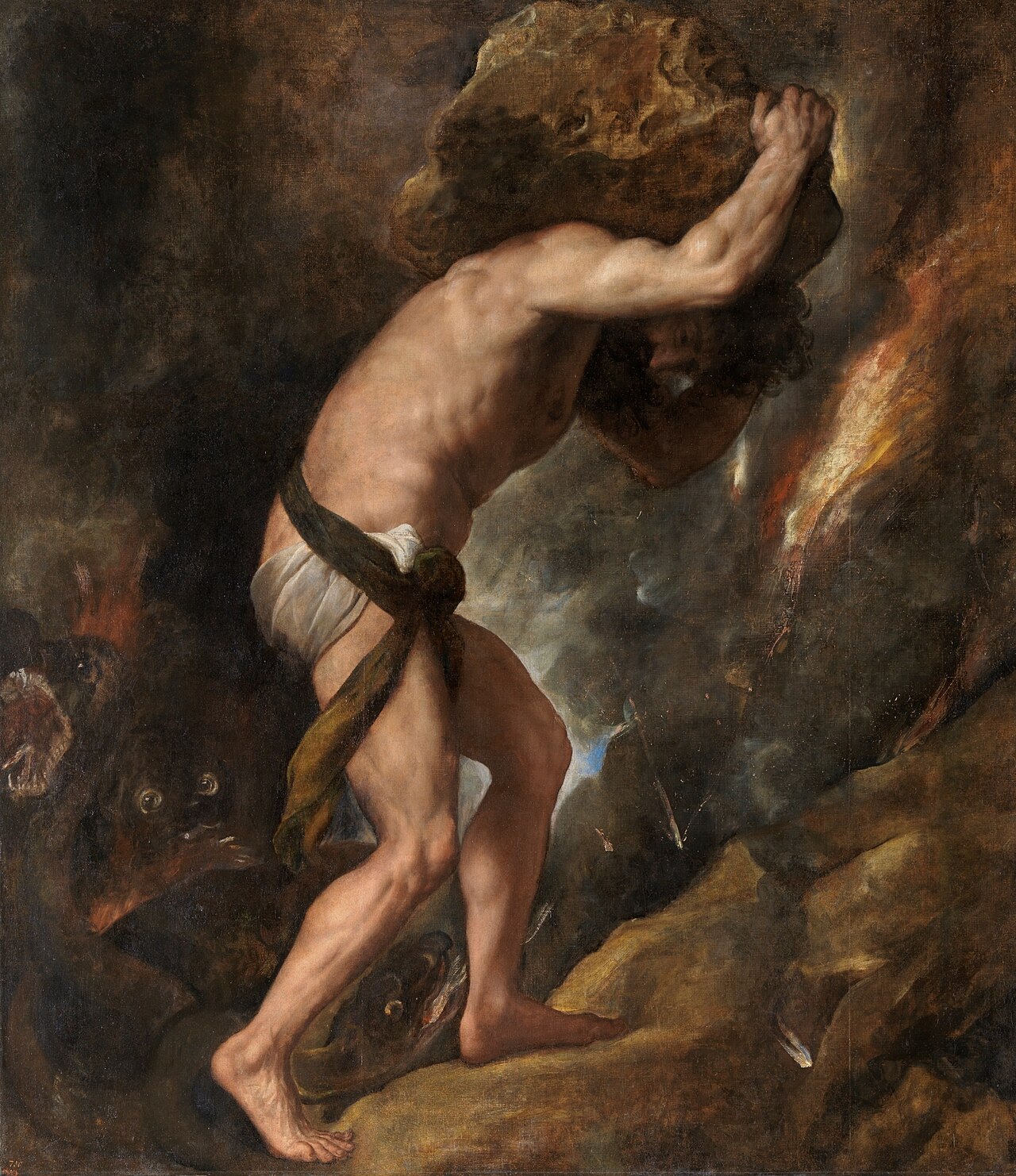
It also says no to the other escape. Camus counted a leap into religious faith, or into a grand abstract system, as "philosophical suicide," because it gives up the lucidity that the absurd depends on.14 What he proposed was continual revolt, a life lived awake and with passion. The last line of the essay is the one people remember. Camus pictures Sisyphus pushing his stone back up the hill forever and concludes, "One must imagine Sisyphus happy."15
Sartre accepted the label existentialist. Camus forcefully separated himself from it, although he worked in the same tradition.13 Schaeffer groups them together as the French secular existentialists, and many textbooks sort them the same way. Camus objected to the grouping, and the disagreement between the two men was real.
The Plague and the Rebel
Camus was no armchair man. In March 1944 he took over as editor of Combat, the main underground newspaper of the non-Communist left.16 That experience stands behind The Plague (1947). A disease closes the Algerian port of Oran. A doctor, Bernard Rieux, works himself to exhaustion against it, with help from a visitor named Tarrou, a clerk named Grand, and a journalist, Rambert, who tries to escape the city to rejoin the woman he loves in Paris. A Jesuit priest, Father Paneloux, preaches that the plague is God's punishment and later preaches differently after watching a child die. Readers have taken the book as an allegory of the French resistance.17 It dramatizes what Camus meant by revolt. There is no promise of victory and no heaven on offer, and the doctor keeps working anyway.
Camus put the theory in The Rebel (1951). He argued that rebellion starts from a refusal that implies a value, and that the value belongs to everyone. His compact statement was "I revolt, therefore we are."18 From there he set limits. Revolutions that throw off every limit end in terror, he held, and good ends do not excuse evil means.19 That is a doctrine of limits, close in spirit to the older idea of a law no ruler may break.
The book cost him his friendship with Sartre. When Les Temps Modernes reviewed it in 1951 and 1952, the two men fell out in public.20 Camus won the Nobel Prize in Literature in 1957 and died in a car accident in France, near Sens, on January 4, 1960, aged 46.21
What the Founders Claimed That Both Men Denied
The Declaration of Independence starts from a claim neither Sartre nor Camus could make. It says "all men are created equal" and that governments are instituted "to secure these rights."22 Rights come first, from a Creator, and government comes second. That order gives a citizen something to say when power overreaches: this is not yours to take.
Sartre had a sincere answer for how a free man should act toward others. It rested on the single choosing self. Camus found a firmer footing in solidarity and limits, and he knew that something outside the self was needed to keep revolt from turning into the terror he feared. Both men were honest about the cost of living without the premise the Founders began with. Schaeffer's reading of them asks the reader to see that cost and to ask what premise could pay it.
A person who believes values are invented has trouble saying why a neighbor's rights bind him when the neighbor is weak and the law is silent. A person who believes there is a moral order that precedes his choices has a place to stand and a reason to hold even a stranger to the same standard that he holds himself. The Founders built the Republic on the second premise. The French writers of 1945 tested the first one with an honesty worth respecting, and Camus in particular showed how much of the second a decent person still carries.
| Source | Starting point | What binds a person |
|---|---|---|
| Sartre, 1945 | No God, no fixed human nature | Each free choice affirms an image of man for everyone |
| Camus, 1942 and 1951 | A silent world, the absurd | Revolt and solidarity, with limits on means |
| Declaration, 1776 | Equal creation, rights from a Creator | Rights that precede government and limit it |
- 1942 Camus publishes The Stranger in June and The Myth of Sisyphus in October.13
- 1943 Sartre publishes Being and Nothingness.2
- 1945 Sartre gives the lecture later published as Existentialism Is a Humanism on October 29.1
- 1947 Camus publishes The Plague.17
- 1951 The Rebel appears and leads to the break with Sartre.1920
- 1957 Camus receives the Nobel Prize in Literature.21
- 1960 Camus dies in a car accident on January 4.21
Learn more
- Stanford Encyclopedia of Philosophy, Jean-Paul Sartre: a clear scholarly guide to his main works and the idea of bad faith.
- Stanford Encyclopedia of Philosophy, Albert Camus: covers the absurd, revolt and the quarrel with Sartre.
- Sartre, Existentialism Is a Humanism: the full lecture in the Mairet translation, short enough to read in one sitting.
- NobelPrize.org, Albert Camus facts: the committee's record of his life and prize.
- Crossway, Schaeffer Trilogy contents: shows where Schaeffer takes up secular existentialism in Escape from Reason.
- National Archives, Declaration of Independence: the full text, for comparing its premise with the ones above.
Notes
- "Existentialism Is a Humanism," University of Notre Dame, Ethics at Work: the lecture was delivered on October 29, 1945, at the Club Maintenant in Paris. Read it online. ↩
- "Jean-Paul Sartre," Stanford Encyclopedia of Philosophy, entry on Sartre (life dates 1905 to 1980, Being and Nothingness 1943, the 1945 lecture and its 1946 publication). Read it online. ↩
- "Existentialism Is a Humanism," Wikipedia, publication details: L'existentialisme est un humanisme (Paris: Nagel, 1946); English edition (London: Methuen, 1948). Read it online. ↩
- Jean-Paul Sartre, Existentialism Is a Humanism, trans. Philip Mairet (1948), as reprinted in Walter Kaufmann, ed., Existentialism from Dostoevsky to Sartre (Meridian, 1956), the passages on the paper-knife and on "man is nothing else but that which he makes of himself." Read it online. ↩
- Sartre, Existentialism Is a Humanism, the passages on forlornness and abandonment, where he quotes Dostoevsky and says man is "condemned to be free." Read it online. ↩
- Sartre, Existentialism Is a Humanism, the story of the pupil whose elder brother had been killed in the German offensive of 1940 and who had to choose between joining the Free French Forces in England and staying with his mother, and Sartre's answer, "You are free, therefore choose, that is to say, invent." Read it online. ↩
- Sartre, Existentialism Is a Humanism, the passage in which he says that in choosing for himself a man "chooses for all men." Read it online. ↩
- "Jean-Paul Sartre," Stanford Encyclopedia of Philosophy, on bad faith and the example of the cafe waiter, which comes from Being and Nothingness (1943) and not from the 1945 lecture. Read it online. ↩
- Francis A. Schaeffer, The Francis A. Schaeffer Trilogy (Wheaton, Ill.: Crossway), table of contents showing Escape from Reason, chapter 4, with its sections "Secular Existentialism" and "Religious Existentialism," and The God Who Is There, part 1, chapter 2, "The First Step in the Line of Despair: Philosophy." Read it online. ↩
- Francis A. Schaeffer, Escape from Reason (London: InterVarsity Press, 1968), chapter 4, section "Secular Existentialism," where Schaeffer names three main schools of secular existentialism, the Swiss, the French and the German, and says that Sartre holds the universe to be rationally absurd and that a person must authenticate himself by an act of will; the example of the driver who stops for a man in the rain, or runs him down, appears in the same discussion of Sartre, as printed in The Francis A. Schaeffer Trilogy (Wheaton, Ill.: Crossway, 1990), text searched at the Internet Archive. ↩
- Schaeffer, Escape from Reason, chapter 7, the passage on man beginning from himself, where Schaeffer says Sartre saw clearly that, finding no infinite reference point, he came to the conclusion that everything must be absurd. ↩
- Schaeffer, Escape from Reason, chapter 5, section "The Theatre of the Absurd," where he says Sartre holds the universe to be absurd but uses words and syntax as they are normally used, while the Theatre of the Absurd deliberately uses abnormal syntax and a devaluation of words. ↩
- "Albert Camus," Stanford Encyclopedia of Philosophy, entry on Camus (1913 to 1960; The Stranger in June 1942 and The Myth of Sisyphus in October 1942; the definition of the absurd; his denial that he was an existentialist). Read it online. ↩
- "The Myth of Sisyphus," Wikipedia: published by Gallimard in 1942, English translation by Justin O'Brien in 1955, and the description of the essay's answer to suicide and to "philosophical suicide." Read it online. ↩
- "Albert Camus," Stanford Encyclopedia of Philosophy, quoting The Myth of Sisyphus: "One must imagine Sisyphus happy" (page 123 in the edition the entry cites). Read it online. ↩
- "Albert Camus," Stanford Encyclopedia of Philosophy: in March 1944 Camus succeeded Pascal Pia as editor of Combat, "the main underground newspaper of the non-Communist left." Read it online. ↩
- "The Plague (novel)," Wikipedia: Oran; Dr. Bernard Rieux, Jean Tarrou, Raymond Rambert, Father Paneloux and Joseph Grand; French publication by Gallimard in 1947; reading of the book as an allegory of the French resistance. (Secondary source; the plot details were not checked against the novel itself.) Read it online. ↩
- "Albert Camus," Stanford Encyclopedia of Philosophy, quoting The Rebel, "I revolt, therefore we are" (page 22 in the edition cited), and on a philosophy of limits. Read it online. ↩
- "The Rebel (book)," Wikipedia: L'Homme revolte, 1951, translated by Anthony Bower; the case against revolutionary violence and for solidarity grounded in human dignity. (Secondary source.) Read it online. ↩
- "Jean-Paul Sartre," Stanford Encyclopedia of Philosophy: the review of The Rebel in Les Temps Modernes in 1951 and 1952 that caused Sartre and Camus to fall out publicly. Read it online. ↩
- "Albert Camus: Facts," NobelPrize.org: Nobel Prize in Literature 1957; born 7 November 1913 in Mondovi, French Algeria; died 4 January 1960 near Sens, France, in a car accident. Read it online. ↩
- Declaration of Independence, 1776, National Archives transcript: "We hold these truths to be self-evident, that all men are created equal," and "That to secure these rights, Governments are instituted among Men." Read it online. ↩
Terms in this lesson
- Existentialism
- A family of twentieth-century philosophies that start from the individual person who exists and chooses, not from a fixed human nature.
- Existence precedes essence
- Sartre's phrase. A person first exists and then makes himself what he is, with no designer who fixed his purpose beforehand.
- Bad faith
- Sartre's term for pretending to oneself that one has no freedom, as when a man says he must act because of his role or his past.
- The absurd
- Camus's name for the clash between a person's demand for meaning and a silent world that supplies none.
- Revolt
- Camus's answer to the absurd: refuse to give in, live fully, and stand with others against injustice.
- Upper story
- Schaeffer's picture of modern thought, in which hope and meaning are placed above a line where reason cannot reach.
- Nobel Prize in Literature
- The 1957 prize awarded to Camus.
Sources
- University of Notre Dame, Existentialism Is a Humanism (lecture date and venue) checked 2026-10
- Stanford Encyclopedia of Philosophy, Jean-Paul Sartre checked 2026-10
- Stanford Encyclopedia of Philosophy, Albert Camus checked 2026-10
- Sartre, Existentialism Is a Humanism (Mairet translation), Marxists Internet Archive checked 2026-10
- NobelPrize.org, Albert Camus facts checked 2026-10
- Crossway, Francis A. Schaeffer Trilogy table of contents checked 2026-10
- National Archives, Declaration of Independence transcript checked 2026-10