Lesson 7 of 18 · about 14 minutes
Kierkegaard and the Leap
You'll be able to
- Describe who Kierkegaard was, what he wrote, and whom he was arguing against
- Explain what Schaeffer meant by the line of despair and why he placed Kierkegaard at the first step below it
- Say what Kierkegaard himself wrote about leaping, and why the phrase 'leap of faith' needs care
- Connect the question of private conviction versus public truth to the Virginia Declaration of Rights and the Declaration of Independence
- Apply the distinction between trust that rests on reasons and belief that has none
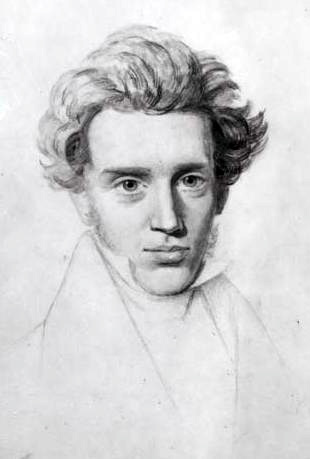
On 1 August 1835 a student in Copenhagen, twenty-two years old and unsure what to do with his life, wrote in his journal that what he lacked was "to find a truth which is truth for me, to find the idea for which I am willing to live and die."1 The young man was Soren Kierkegaard.
Francis Schaeffer and his wife Edith founded the study community L'Abri in Switzerland in 1955.2 He thought the history of Kierkegaard's ideas helped explain why so many modern people, young ones especially, felt cut off from any truth they could live by.
A Copenhagen Life
Kierkegaard was born in Copenhagen on 5 May 1813 and died there on 11 November 1855, at forty-two.3 His father, Michael Pedersen Kierkegaard, was devout and brooding, and some of that darkness went into the son. Soren received a first degree in theology and a Magister degree in philosophy, with a dissertation on irony as practiced by Socrates. He finished the pastoral seminary program and was never ordained.3
In 1840 he became engaged to Regine Olsen, who was eighteen. In 1841 he broke it off and went to Berlin. He left his worldly goods to her in his will. Her husband, Johan Frederik Schlegel, declined the bequest on her behalf apart from a few personal items.3 The books came fast after that. Either/Or and Fear and Trembling both appeared in 1843, the Concluding Unscientific Postscript in 1846, The Sickness Unto Death in 1849.4 Most carried made-up authors' names. "Johannes de silentio" wrote Fear and Trembling. "Johannes Climacus" wrote the Postscript. The masks were deliberate, and they put the argument ahead of the author.
Fame, when it came locally, was the wrong kind. In 1845 and 1846 a satirical paper, The Corsair, made him a figure of ridicule by mocking his appearance. He gave up the idea of becoming a pastor and decided his calling was to stay an author.3
- 1813 Born in Copenhagen on 5 May.
- 1835 Journal entry of 1 August: a truth "for me."
- 1840 to 1841 Engaged to Regine Olsen, then breaks the engagement.
- 1843 Either/Or and Fear and Trembling.
- 1845 to 1846 The Corsair affair. Concluding Unscientific Postscript (1846).
- 1849 The Sickness Unto Death.
- 1854 to 1855 Open attack on the Danish state church, ten issues of The Moment.
- 1855 Collapses on the street and dies on 11 November.
- 1968 Schaeffer publishes The God Who Is There and Escape from Reason, the second with a section on Kierkegaard and the line of despair.
Whom He Was Arguing With
Two targets, one inside the church and one in the university. The university target was the Hegelian system, with its promise to explain history, logic, religion, and the state in one structure. The Stanford Encyclopedia notes that recent scholars, especially Jon Stewart, think Kierkegaard's real opponents were often Danish followers of Hegel, such as the theologian Hans Lassen Martensen, more than Hegel himself.5 Hegel had written that philosophy should beware of the wish to be edifying. Kierkegaard answered that only the truth that edifies is truth for you.5 You can read more about the system he was answering in the lesson on Hegel.
The church target was what he called Christendom. In a nation where everyone was baptized and the clergy drew state salaries, he believed that Christianity had become a matter of birth and manners. In his last years he went public with it. The attack on the state church, made "in the name of New Testament Christianity," ran through ten issues of a pamphlet he founded, The Moment.6 Then he collapsed in the street, was taken to the hospital, and died. Near the end he told his friend Emil Boesen that he was a believer in Christ.6
Kierkegaard died a professed believer who thought the faith of his neighbors had gone slack.
Abraham on the Mountain
The book most often pulled into this lesson's argument is Fear and Trembling. Its author, Johannes de silentio, retells Genesis 22, where God tells Abraham to sacrifice Isaac. He says over and over that he cannot understand Abraham. He can admire him from outside. He contrasts the "knight of infinite resignation," who gives up what he loves and grieves, with the "knight of faith," who gives it up and still takes joy in the finite world, receiving it back in this life.7 To anyone standing outside, the knight of faith looks absurd.7
The book then asks whether Abraham's act involves a "teleological suspension of the ethical," meaning a case where a command from God outranks the ordinary moral rule.7 Readers still argue about the answer. Johannes does not treat faith as a coin toss in the dark. He treats it as a passion that reason cannot manufacture and cannot fully justify. The Stanford Encyclopedia says that faith and offense are rival passions, and that Kierkegaard's account of faith does not rest on historical evidence.7
A second thread comes from The Concept of Anxiety, where anxiety is "the dizziness of freedom," and a morally free act always comes by way of a leap, since reflection alone never forces a choice.8 A person can think about a decision forever. At some point he has to will to stop thinking and commit.8
Myth: Kierkegaard wrote about "the leap of faith"
The phrase is everywhere, and it is hard to find in his books. Mariele Nientied searched the Danish collected works by computer and reported that "leap of faith" does not occur even once in the published writings.9 He did write of a leap in connection with free action, in The Concept of Anxiety. The phrase went on to stand for believing with no reasons at all, and it led readers to label him a fideist or an irrationalist. Nientied argues those labels do not fit him.9
Schaeffer's Line of Despair
Schaeffer's reading starts from a larger story. In Escape from Reason and The God Who Is There, both published in 1968, he describes how culture and modern thought changed their attitude to truth. The old hope was for one unified answer covering both the world of facts and the world of meaning, morals, and persons. When that hope failed, he said, the culture crossed what he called the line of despair, into a world where popular opinion holds that there is no absolute truth.10 Above the line, thinkers still hoped reason could cover everything. Below it, reason was left to handle the facts, and meaning had to come from somewhere else.
On Schaeffer's account Hegel's synthesis opened the door and Kierkegaard was the first to walk through. Reason could not reach the answers that matter most, so a person had to reach them by a leap. Later existentialists, Schaeffer argued, followed him down: Jaspers, Sartre, Heidegger.11 The books use a picture of a two-story house. The lower floor holds what reason and science can test. The upper floor holds God, love, morals, and meaning, and on the modern view no staircase joins them.12 A section headed "Kierkegaard and the Line of Despair" closes chapter 3 of Escape from Reason, and chapter 4 opens with a section headed "The Leap."13 In How Should We Then Live? (1976) he traces the same pattern from Rousseau through Kant and Kierkegaard.14
The worry is easy to follow. If the most important things in life, morals and God and love, belong to a floor where nothing can be checked, they cannot be taught, argued, or defended in public. L'Abri was set up as a study community to help people relate Christianity to all aspects of culture.10 His answer was a different kind of step. Faith, he said, is trust in what God has said and done in real history, taken on good reasons.1215
Two metaphors, and how close they are
Harold O. J. Brown, a theologian who was interim pastor of a church in Klosters, Switzerland, and a professor at Trinity Evangelical Divinity School, compared the two pictures in Christianity Today in 1984. Kierkegaard pictures a man stepping out over twenty thousand fathoms of water. Schaeffer pictures someone lowering himself from a ledge in the fog toward a voice that promises another ledge close below.15 Brown concluded that both men were right about something. Schaeffer was right that faith rests on good reasons and is not absurd. Kierkegaard was right that faith still means letting go of worldly security and taking a real risk.15
Brown also gave the reason both were needed. In Kierkegaard's Denmark, comfortable Christianity had forgotten the risk. In Schaeffer's day, doubt about the truth of Christianity had made people forget that there are good reasons.15 That is a fair way to hold the two together. Kierkegaard was correcting a church that believed too easily. Schaeffer was answering a culture that had stopped believing anything could be known.
Schaeffer's worry about the culture finds support in the history of the phrase itself. A slogan that Kierkegaard never wrote became the common way to describe belief without grounds, and it carried a verdict on faith that his books do not give.9
What This Means for a Republic
American founders faced a version of Kierkegaard's problem and answered it in two parts. The first part protected the individual conscience. The Virginia Declaration of Rights of 12 June 1776 says that religion, "or the duty which we owe to our Creator, and the manner of discharging it, can be directed only by reason and conviction, not by force or violence."16 Kierkegaard would have recognized that: faith that is compelled is no faith, and a state church that hands out Christianity with citizenship has emptied it.
The second part is what keeps the first from collapsing into private feeling. The Declaration of Independence does not say "we feel" or "we have chosen." It says "We hold these truths to be self-evident," and it names "the laws of nature and of nature's God" as the ground of the colonies' claim.17 Those are public claims. They are offered to anyone, tested by reasons, and capable of being right or wrong. Natural rights stand on that footing. If the deepest commitments of a people are all leaps, there is nothing left to appeal to when one citizen wrongs another. A right that is only my leap can be overruled by your leap and the strongest group wins.
So a citizen needs both Kierkegaard and Schaeffer. From Kierkegaard comes the knowledge that conviction has to be owned, and that a nation of the baptized and the merely respectable is not a nation of believers. From Schaeffer comes the insistence that what is owned can still be true for everyone, and that talk about truth belongs in public. The founders held both: conscience free from force, and rights grounded in something that does not change with the vote.
Questions to Carry Away
When someone says "that's just your leap of faith," ask what the claim is about and whether any reasons count for or against it. Some matters are decided by evidence and some by trust, and plenty of both run through ordinary life. A person who marries or takes a witness's word has stepped out on reasons that fall short of proof. The test is what the step rests on.
When a church, party, or office hands out belonging in place of conviction, Kierkegaard's complaint applies. And when a public conversation treats morals as something nobody can discuss because it is all upper-story, Schaeffer's warning applies. The lower floor of Schaeffer's house has its own story, told in the lesson on Darwin.
Learn more
- Stanford Encyclopedia: Soren Kierkegaard: A careful, current overview of his life, pseudonyms, and main arguments.
- Kierkegaard's Leap or Schaeffer's Step?: Harold Brown sets the two pictures of faith side by side.
- Kierkegaard without Leap of Faith: Mariele Nientied on why the famous phrase is not his.
- Why Francis Schaeffer Matters: The Line of Despair, Part 3: A clear summary of Schaeffer on Hegel, Kierkegaard, and the existentialists.
- Virginia Declaration of Rights: Section 16 on religion, reason, and conviction.
- Kierkegaard's 1835 journal entry: The short passage about finding a truth to live and die for.
Notes
- Soren Kierkegaard, journal entry of 1 August 1835, in Soren Kierkegaard's Journals and Papers, ed. and trans. Howard V. Hong and Edna H. Hong, quoted by Christian History Institute, "Quote of the Day, August 1." Read it online. ↩
- Wikipedia, "Francis Schaeffer," on his birth (30 January 1912), death (15 May 1984), the move to Switzerland in 1948, and the founding of L'Abri with Edith Schaeffer in 1955. Read it online. ↩
- John Lippitt and C. Stephen Evans, "Soren Kierkegaard," Stanford Encyclopedia of Philosophy (first published 22 May 2023), section 1, on his dates, education, father, engagement to Regine Olsen, the Corsair affair, and his last years. Read it online. ↩
- Lippitt and Evans, "Soren Kierkegaard," Stanford Encyclopedia of Philosophy, sections 2 and 3, on the pseudonymous works (Either/Or and Fear and Trembling, 1843; Concluding Unscientific Postscript, 1846; The Sickness Unto Death, 1849). Read it online. ↩
- Lippitt and Evans, "Soren Kierkegaard," Stanford Encyclopedia of Philosophy, section 4, on Danish Hegelians such as Hans Lassen Martensen as his main target (citing Jon Stewart, 2003) and the exchange with Hegel on edification. Read it online. ↩
- Lippitt and Evans, "Soren Kierkegaard," Stanford Encyclopedia of Philosophy, section 1, on the attack on the Danish state church "in the name of New Testament Christianity," the ten issues of The Moment, his collapse, and his death on 11 November 1855 after telling Emil Boesen he was a believer in Christ. Read it online. ↩
- Lippitt and Evans, "Soren Kierkegaard," Stanford Encyclopedia of Philosophy, section 3.3.1, on Fear and Trembling, Abraham, the knight of faith, the Absolute Paradox, and the teleological suspension of the ethical. Read it online. ↩
- Lippitt and Evans, "Soren Kierkegaard," Stanford Encyclopedia of Philosophy, section 2, on reflection, choice, anxiety as "the dizziness of freedom," and the one place the entry ties a morally free act to a "leap" (The Concept of Anxiety). Read it online. ↩
- Mariele Nientied, "Kierkegaard without 'Leap of Faith'," Agora (papers of the 26th International Wittgenstein Symposium, 2003). She reports a search of the Danish Samlede Vaerker and finds the phrase "does not occur even once in the published writings." Read it online. ↩
- Sarah Teague, review of Francis A. Schaeffer, The God Who Is There (30th anniversary edition, IVP, 1998), Christian Today, 22 October 2005, on the line of despair and the purpose of L'Abri. Read it online. ↩
- David S. Steele, "Why Francis Schaeffer Matters: The Line of Despair, Part 3," The Aquila Report, 10 April 2018, summarizing Schaeffer on Hegel, Kierkegaard, and the existentialists who followed. Read it online. ↩
- Review of Francis A. Schaeffer, The God Who Is There, Sketches of Time, on the two-story picture, the line of despair, and Schaeffer's answer that God acted in real history. Read it online. ↩
- Francis A. Schaeffer, Escape from Reason (first published 1968), table of contents as printed in the Crossway trilogy edition: chapter 3 ends with "Kierkegaard and the Line of Despair," and chapter 4 begins with "The Leap." Read it online. ↩
- William Dyrness, review of Francis A. Schaeffer, How Should We Then Live?, Themelios 4:2, on Schaeffer's account of Rousseau, Kant, Kierkegaard, and the search for meaning in non-reason. Read it online. ↩
- Harold O. J. Brown, "Kierkegaard's Leap or Schaeffer's Step?," Christianity Today, 14 December 1984 (Current Religious Thought). Read it online. ↩
- Virginia Declaration of Rights, 12 June 1776, section 16, National Archives, Founding Documents (the Avalon Project's transcription omits the word "only"). Read it online. ↩
- Declaration of Independence, 4 July 1776, first and second paragraphs, Avalon Project, Yale Law School. Read it online. ↩
Terms in this lesson
- Existentialism
- A way of doing philosophy that starts from the individual who must choose and act, not from a system that explains everything. Kierkegaard is usually named as its first major figure.
- Pseudonym
- A made-up author's name. Kierkegaard published many books as imaginary authors such as Johannes de silentio and Johannes Climacus so that readers would weigh the argument, not his reputation.
- Line of despair
- Schaeffer's name for the point in modern thought where people gave up hope of one rational answer covering both facts and meaning, and began to look for meaning in a separate realm.
- Upper story and lower story
- Schaeffer's picture of a divided house. The lower floor holds what reason and science can test. The upper floor holds meaning, morals, and God, cut off from reason.
- Christendom
- Kierkegaard's word for a society where being a citizen and being a Christian had become the same thing, so that faith cost nothing.
- Paradox
- For Kierkegaard, a truth that offends ordinary expectation, most of all the claim that God became a man. He did not mean a plain logical contradiction.
- Teleological suspension of the ethical
- Kierkegaard's pseudonym's phrase for the question raised by Abraham and Isaac: can a divine command override the ordinary moral rule?
Sources
- Stanford Encyclopedia of Philosophy, Soren Kierkegaard (Lippitt and Evans) checked 2026-10
- Christian History Institute, Quote of the Day, August 1 (Kierkegaard journal, 1835) checked 2026-10
- Harold O. J. Brown, Kierkegaard's Leap or Schaeffer's Step?, Christianity Today, 1984 checked 2026-10
- Mariele Nientied, Kierkegaard without Leap of Faith, Agora (ALWS), 2003 checked 2026-10
- Crossway table of contents for The God Who Is There, Escape from Reason, He Is There and He Is Not Silent checked 2026-10
- David S. Steele, Why Francis Schaeffer Matters: The Line of Despair, Part 3, The Aquila Report, 2018 checked 2026-10
- National Archives, Virginia Declaration of Rights, 1776 checked 2026-10
- Avalon Project, Declaration of Independence, 1776 checked 2026-10