Lesson 10 of 18 · about 15 minutes
Nietzsche and the Death of God
You'll be able to
- Describe what the parable of the madman in The Gay Science says, including who is laughing
- Explain Nietzsche's claim that giving up the Christian faith means giving up the right to Christian morality
- Quote Nietzsche's attack on the doctrine of equality and say what it would do to the Declaration of Independence
- Compare Nietzsche with Washington and Adams on the link between religion and morals
- State Schaeffer's point about living out presuppositions and say where Nietzsche supports it
A man lights a lantern on a bright morning and runs into the market place shouting, "I seek God! I seek God!"1 The crowd, we are told, "did not believe in God," and it finds him funny. Has he strayed away like a child? Is he afraid of us? Has he taken a sea-voyage? The man jumps into their midst and stares them down. "I mean to tell you," he says. "We have killed him, you and I."1
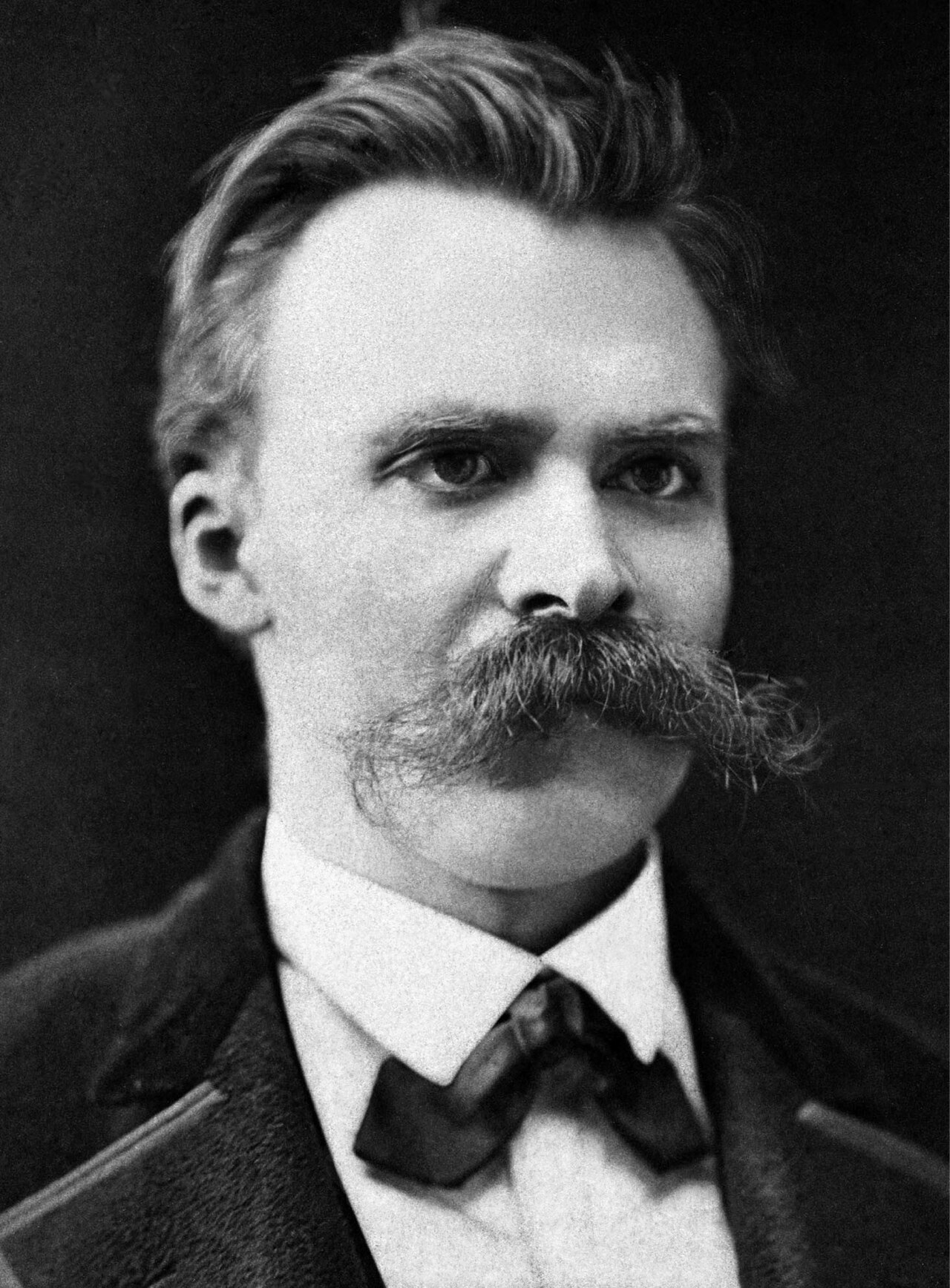
The Madman in the Market
The passage is section 125 of The Gay Science, published in 1882 and expanded in 1887, and it is one of the best-known pages he ever wrote.2 It is also misread. The madman does not cheer. He asks how the deed was done: "How were we able to drink up the sea? Who gave us the sponge to wipe away the whole horizon?" He asks what comes next. "Do we not stray, as through infinite nothingness? Does not empty space breathe upon us? Has it not become colder?"1 He calls the killers "the most murderous of all murderers" and asks who will wipe the blood off.1
Notice who is laughing. The people in the market are not believers shocked by blasphemy. They are the ones who already "did not believe in God." They have dropped the belief without feeling its weight, and the madman's message is that they have no idea what they did. Then he throws the lantern to the ground and says, "I come too early."1 The news, he says, "has not yet reached men's ears."
The parable has a coda. The madman is said to have gone into several churches the same day and sung a requiem for God. Asked to explain himself, he always gave one answer: "What are these churches now, if they are not the tombs and monuments of God?"1 Nietzsche is describing a Europe whose buildings, holidays, and vocabulary still stood after the belief that built them had gone. He thought that could not last. A citizen can use the picture as a test. Ask of any public habit, whether an oath, a holiday, or a promise of equal treatment, how much of it is still held up by the belief that gave it life, and how much is standing on habit alone.
In 1887 Nietzsche added a fifth book and returned to the point in section 343. The most important of recent events, he wrote, is that "God is dead," that "the belief in the Christian God has become unworthy of belief," and it is already casting its first shadows over Europe. The event is too great for most people to have heard of it yet. Those who have grasped it see "what must all collapse now that this belief had been undermined," because "so much was built upon it, so much rested on it, and had become one with it: for example, our entire European morality."3
The Man Behind the Parable
Nietzsche was born in 1844, the son of a Lutheran minister who died in 1849.4 He became a professor of philology at Basel at twenty-four, the youngest ever appointed there. His health was always fragile, and it forced him to take leave in 1876 and 1877, with headaches, nausea, and trouble with his eyesight.5 The works came in a rush: Thus Spoke Zarathustra from 1883 to 1885, Beyond Good and Evil in 1886, the Genealogy of Morality in 1887, Twilight of the Idols in 1888.2 In January 1889 he collapsed in the street in Turin and wrote a series of increasingly deranged letters. A friend found him with dementia. He lapsed into silence and died in 1900, of a stroke complicated by pneumonia.4
During his illness his sister Elisabeth took control of his papers. She eventually published The Antichrist and Ecce Homo, and a selection from his notebooks under the title The Will to Power.4
- 1844 Born, son of a Lutheran pastor.
- Age 24 Appointed to a chair at Basel.
- 1882 The Gay Science, with the madman (section 125).
- 1883 to 1885 Thus Spoke Zarathustra.
- 1887 Gay Science expanded, with section 343. Genealogy of Morality.
- 1888 Twilight of the Idols.
- January 1889 Collapses in Turin.
- 1900 Dies.
Borrowed Capital
Nietzsche's sharpest argument is aimed at his own side, the unbelievers. In Twilight of the Idols, under the heading "G. Eliot," he mocks the English habit of dropping the Christian God and holding all the tighter to Christian morals. His answer: "When we renounce the Christian faith, we abandon all right to Christian morality." Christianity, he goes on, is "a system, a complete outlook upon the world," and if its leading concept is pulled out, "nothing vital remains in our grasp." Its morality "stands or falls with the belief in God."6
He means it as a dare to those who want the fruit and not the root. You may say that you know good from evil by intuition, but that confidence, Nietzsche says, "is simply the outcome of the dominion of Christian valuations."6 The move is available in any age: defend the dignity of the poor, the weak, and the stranger, and leave unsaid what it rests on. Nietzsche thought honest people should notice the gap.
What a Christian Should Grant
Part of Nietzsche's attack on Christianity lands. The Stanford Encyclopedia sums up his complaint as aimed at the side of Christianity that condemns earthly existence and demands that a person repent of his life on earth as the price of admission to a better one. What is wrong with such views, in his judgment, is that they negate life.7 Christians who have met a faith made of nothing but fear of the body and the world know what he meant.
The historic faith says something else. Scripture has God looking over all he had made on the sixth day and finding that it "was very good."8 It says the Word "was made flesh, and dwelt among us."9 A religion that holds the Creator took a body is not a religion of contempt for bodies. Nietzsche's polemic is strongest against a thin version of the faith, and a Christian citizen does better to concede the thinness where it exists than to deny that anyone has ever practiced it.
What He Wanted Instead
He followed the argument where it led, and the Founders' ideal of equality was in its path. In the same book he turns on Rousseau and the French Revolution: "The doctrine of equality! ... But there is no more deadly poison than this; for it seems to proceed from the very lips of justice, whereas in reality it draws the curtain down on all justice." Real justice, he says, would be "To equals equality, to unequals inequality."10
The Declaration of Independence says the opposite in its best-known sentence: "all men are created equal; that they are endowed by their Creator with certain unalienable rights."11 Nietzsche saw where the sentence came from. In the last section of The Antichrist he calls the "equality of souls before God" a falsehood and a pretext, and says it became "the revolution, the modern idea," the principle of decay of the whole social order.12 He traced modern equality to the Christian root, and rejected both. Anyone who claims that equal rights are a neutral, self-standing idea should read him first. The fair reading of him is that he was honest about the price. An atheist who wants equal rights has to explain where they come from, and Nietzsche is a witness that the explanation is not easy.
Where Nietzsche scholars part ways: he is sometimes read as a prophet who welcomed nihilism and sometimes as an enemy of it. The Stanford Encyclopedia says that the main problem he meant to answer was the crisis of nihilism, and that his project was to affirm life against a morality he thought turned people against themselves.7 On either reading he ties the fall of Christian belief to the fall of Europe's morals.
Washington and Adams Said It Too
The Founders made the same link between faith and morals, though they judged the link a reason to guard the faith. George Washington told the American people in his Farewell Address of 1796 that "religion and morality are indispensable supports" of political prosperity. He cautioned: "let us with caution indulge the supposition that morality can be maintained without religion." And he gave his reasons: "reason and experience both forbid us to expect that national morality can prevail in exclusion of religious principle."13
John Adams said it more sharply to the Massachusetts militia on 11 October 1798: "Our Constitution was made only for a moral and religious People. It is wholly inadequate to the government of any other."14
Put Nietzsche between them. All three men agree that the structure of public morality rests on a religious foundation. Washington and Adams build a constitution on it and defend the foundation. Nietzsche wants the building down. The disagreement is real. The three men share one premise, that morals do not stand by themselves.
Schaeffer's Point
Schaeffer's whole method begins here. He held that people act out their presuppositions, the basic beliefs they take for granted, and that for a culture the choice comes down to a very few worldviews: those that begin with man alone and the one that begins with a God who has spoken.15 When he advised Christians how to speak to unbelievers, he told them to "take the roof off" a worldview by walking it through to its logical endpoint.16 The madman does exactly that to the crowd. Nietzsche takes his atheism through to the end and reports what he finds.
Schaeffer made the same point about Rome. He held that Rome fell because absolute values cannot be based only in the state as a consensus of the citizens, and that gods who were finite and sinful could not supply them either.17 A people with nothing above itself has only its own agreement to appeal to, and agreement can be withdrawn. Nietzsche accepted that outcome and tried to build on it. Washington and Adams treated it as the end of self-government.
When someone defends human dignity, the useful question is the friendly one: what is it resting on? Nietzsche would call the question honest. Washington and Adams would call it the main business of a free people. And the Christian answer, that persons are made in the image of a Creator and that moral law is written into the order of things, is not a private upper-floor leap. It is what the Declaration meant by "the laws of nature and of nature's God."11
Learn more
- The Joyful Wisdom: Read section 125 yourself and section 343.
- Twilight of the Idols: The George Eliot passage and the attack on equality.
- Stanford Encyclopedia: Nietzsche: Balanced scholarship on his life and works.
- Washington's Farewell Address: The paragraph on religion and morality.
- Adams to the Massachusetts militia, 1798: The full short letter behind the famous sentence.
- How Should We Then Live? (EBSCO): A plain summary of Schaeffer's presuppositional method.
Notes
- Friedrich Nietzsche, The Joyful Wisdom (La Gaya Scienza), trans. Thomas Common (1910), Book III, section 125, "The Madman." Project Gutenberg ebook 52881. Read it online. ↩
- Anderson, "Friedrich Nietzsche," Stanford Encyclopedia of Philosophy, on his works and dates: The Gay Science (1882, expanded 1887), Thus Spoke Zarathustra (1883 to 1885), Beyond Good and Evil (1886), On the Genealogy of Morality (1887), Twilight of the Idols (1888). Read it online. ↩
- Nietzsche, The Joyful Wisdom, trans. Common, Book V, section 343, "What our Cheerfulness Signifies" (Book V was added to the second edition of 1887). Project Gutenberg ebook 52881. Read it online. ↩
- R. Lanier Anderson, "Friedrich Nietzsche," Stanford Encyclopedia of Philosophy (substantive revision 25 June 2026), on his life: he was appointed to a Basel chair at 24, collapsed in Turin in January 1889, lived on in silence, and died in 1900; his sister Elisabeth took control of his papers and published The Will to Power from notebooks. Read it online. ↩
- Anderson, "Friedrich Nietzsche," Stanford Encyclopedia of Philosophy: he was appointed to the Basel chair at 24, the youngest ever, and his fragile health forced him to take leave in 1876 to 1877; his symptoms included headaches, nausea, and trouble with his eyesight. Read it online. ↩
- Nietzsche, Twilight of the Idols, trans. Anthony M. Ludovici (1911), "Skirmishes in a War with the Age," section 5, on George Eliot. Project Gutenberg ebook 52263. Read it online. ↩
- Anderson, "Friedrich Nietzsche," Stanford Encyclopedia of Philosophy, on affirmation and the crisis of "nihilism," and on his critique of Christianity as negating earthly life. Read it online. ↩
- Genesis 1:31, King James Version, Bible Gateway. Read it online. ↩
- John 1:14, King James Version, Bible Gateway. Read it online. ↩
- Nietzsche, Twilight of the Idols, trans. Ludovici, "Skirmishes in a War with the Age," section 48. Project Gutenberg ebook 52263. Read it online. ↩
- Declaration of Independence, 4 July 1776, first and second paragraphs, Avalon Project, Yale Law School. Read it online. ↩
- Nietzsche, The Antichrist, trans. Anthony M. Ludovici (1911), section 62. Project Gutenberg ebook 52263. Read it online. ↩
- George Washington, Farewell Address, 1796, Avalon Project, Yale Law School. Read it online. ↩
- John Adams to the Officers of the First Brigade of the Third Division of the Militia of Massachusetts, Quincy, 11 October 1798, Founders Online, National Archives. Read it online. ↩
- David D. Pettus, "How Should We Then Live? by Francis A. Schaeffer," EBSCO Research Starters (2022): Schaeffer holds that people act out their presuppositions and that the worldviews are those that begin with man alone and the one that begins with God who has spoken. Read it online. ↩
- Review of Francis A. Schaeffer, The God Who Is There, Sketches of Time: Schaeffer advises "taking the roof off" a worldview by walking it through to its logical endpoint. Read it online. ↩
- Pettus, "How Should We Then Live?," EBSCO Research Starters: Schaeffer's account of Rome, in which neither the city-state as consensus of the citizenry nor finite gods could supply absolute values. Read it online. ↩
Terms in this lesson
- Nihilism
- The loss of belief that anything has real value or meaning. Nietzsche thought it was coming for Europe and wanted to overcome it.
- The madman
- The character in The Gay Science (section 125) who runs into a market with a lantern and announces that God has been killed.
- Genealogy
- A method of asking where an idea came from and whom it served. Nietzsche used it on morals.
- Presupposition
- A basic belief a person assumes without arguing for it. Schaeffer held that people act out their presuppositions whether or not they admit them.
- Natural law
- The idea that there is a moral order built into human nature that reason can know and that no government makes.
- Farewell Address
- George Washington's letter to the American people of 1796, which names religion and morality as indispensable supports of political prosperity.
Sources
- Nietzsche, The Joyful Wisdom (La Gaya Scienza), trans. Thomas Common (1910), Project Gutenberg checked 2026-10
- Nietzsche, Twilight of the Idols, trans. Anthony M. Ludovici (1911), Project Gutenberg checked 2026-10
- Stanford Encyclopedia of Philosophy, Friedrich Nietzsche (R. Lanier Anderson) checked 2026-10
- Washington, Farewell Address (1796), Avalon Project checked 2026-10
- John Adams to the Massachusetts Militia, 11 October 1798, Founders Online checked 2026-10
- Declaration of Independence, Avalon Project checked 2026-10
- EBSCO Research Starters, How Should We Then Live? (Pettus, 2022) checked 2026-10
- Review of The God Who Is There, Sketches of Time checked 2026-10