Lesson 5 of 14 · about 55 minutes
Wheeling and the List: The Claim, the Changing Numbers and the Tydings Hearings
Updated October 28, 2026
You'll be able to
- Explain what was real about State Department security in 1950 and where McCarthy's figures came from.
- Weigh the evidence on whether McCarthy said 205 or 57 at Wheeling, using the newspaper, the radio affidavits and McCarthy's own versions.
- Compare one of McCarthy's 81 cases with the 1947 House investigators' memorandum it was drawn from.
- Describe the Tydings subcommittee's hearings, the loyalty files dispute, the majority report, the minority objections and the Senate's July 1950 votes.
- Quote and place in context Margaret Chase Smith's Declaration of Conscience and identify the six senators who joined it.
- Explain what the Senate found about the 1950 Maryland campaign and the composite photograph of Tydings and Browder.
Start here: the short version
On the night of February 9, 1950, Senator Joseph R. McCarthy of Wisconsin told a Lincoln Day dinner of Republican women at the McLure Hotel in Wheeling, West Virginia, that he held "a list of 205" State Department employees known to the Secretary of State as members of the Communist Party. The next morning's Wheeling Intelligencer printed that sentence, and the radio station that recorded the speech later swore that the delivered words matched a script containing the number 205.12 Within 48 hours, in Salt Lake City, in Reno and in a telegram to President Truman, the number became 57 "card-carrying" Communists. On February 20 he told the Senate he had "approximately 81" cases and that he did not believe he had said 205 at all.34
The numbers came from somewhere real. A 1946 letter from Secretary of State James F. Byrnes reported that screeners had recommended against permanent employment for several hundred people transferred from wartime agencies and that only 79 had been removed, and in 1947 House Appropriations Committee investigators wrote up derogatory material in the State Department's files on 108 individuals.35 What McCarthy claimed about those numbers was something else: that they were known Communist Party members still shaping policy. A Senate Foreign Relations subcommittee under Millard Tydings of Maryland held hearings from March 8, 1950, and its Democratic majority called the charges "a fraud and a hoax." The two Republican members said the inquiry had never been finished.678 Margaret Chase Smith of Maine and six other Republicans issued a "Declaration of Conscience" on June 1, 1950, and in November McCarthy's allies helped defeat Tydings with a campaign the Senate later condemned, including a faked photograph of Tydings with the former Communist leader Earl Browder.910 This lesson follows each number to its source and rates each claim against the record as it stands in 2026.
What was real in February 1950
A fair reading of Wheeling starts with the news that week, because the audience in the Colonnade Room did not hear McCarthy in a vacuum. The National Archives' own teaching guide to the episode lists what had happened in the months before the speech: the Communist victory in China, the Soviet Union's first atomic test, the perjury conviction of former State Department official Alger Hiss, and the confession of the physicist Klaus Fuchs that he had passed atomic secrets to the Soviet Union. The Archives' summary is blunt: "it was clear that government security had been compromised."11 Lesson 01 of this module (Why the Fear Was Real) and lesson 02 (Venona and the Archives) set out that evidence in full, and lesson 03 (The Machinery Before McCarthy) covers the Hiss case and the loyalty program that already existed when McCarthy spoke.
Even Margaret Chase Smith, who would become one of the first Republican senators to challenge McCarthy's methods on the Senate floor, began her Declaration of Conscience by granting the point. "there have been enough proved cases," she said, "such as the Amerasia case, the Hiss case, the Coplon case, the Gold case, to cause nationwide distrust and strong suspicion that there may be something to the unproved, sensational accusations."9 Judith Coplon had been found guilty in March 1950 of attempted espionage, and Harry Gold had been arrested for passing atomic information to the Soviet Union, according to the notes the Senate printed with Smith's speech.9
The State Department itself had a documented security problem that predated McCarthy. At the end of the war, roughly 4,000 employees of wartime agencies such as the Office of Strategic Services, the Foreign Economic Administration and the Office of War Information were moved into the department. Secretary Byrnes reported in 1946 that a screening committee had examined about 3,000 of those case histories and recommended against permanent employment in several hundred cases, and that only 79 of those people had been removed. McCarthy read that letter into the Congressional Record on February 20, 1950, and it is the root of the number 205.3 A year later, investigators for a subcommittee of the House Appropriations Committee went through the department's security files and wrote memoranda on 108 present and former employees. Those memoranda, printed by the Tydings subcommittee in 1950 with the names replaced by numbers, describe real lapses: case No. 107, for example, is a woman who moved from typing for the Soviet Embassy's Information Bulletin to screening cablegrams in the office of a high State Department official, and who listed two Soviet Embassy employees as references on her application, with no recorded action for many months.5 Case No. 1 describes an analyst who, according to an undated security memorandum, "has been closely associated with several subjects of a Russian espionage case."5
So three things were true before McCarthy said a word in Wheeling. Soviet intelligence had placed sources inside the United States government during the 1930s and 1940s. The State Department had absorbed thousands of wartime employees faster than it could check them. And the Truman administration's loyalty program, whose files were closed to Congress by a 1948 presidential directive, gave members of Congress little way to see what the department had found.12 The question for this lesson is what McCarthy did with those facts.
The speech at Wheeling, February 9, 1950
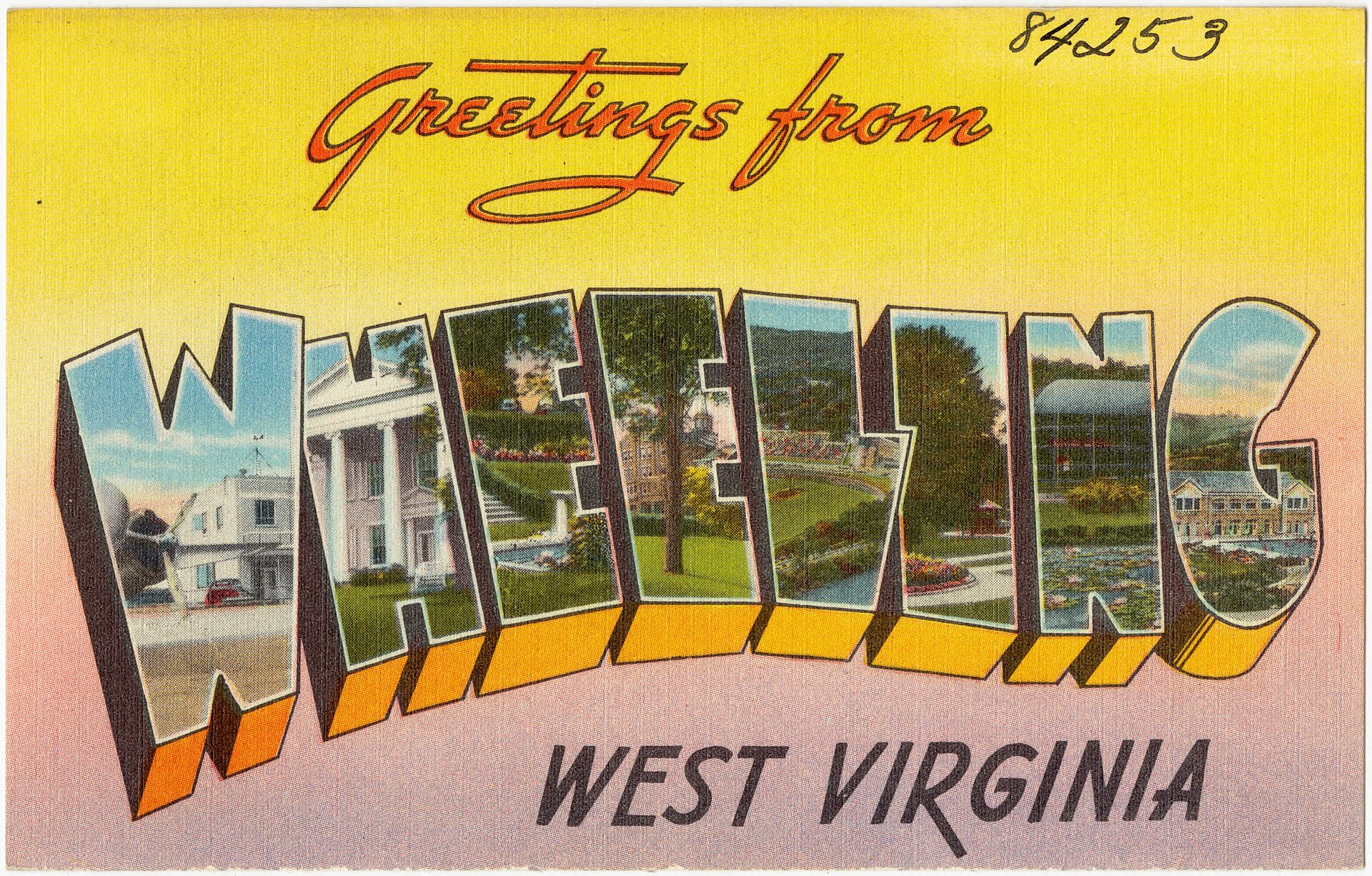

McCarthy was a first-term senator, elected in 1946 (lesson 04, Joseph McCarthy: Wisconsin, the Marines and the 1946 Senate Race), on a Republican speaking tour for Lincoln's birthday. According to Frank Desmond's account in the Wheeling Intelligencer the next morning, he arrived by Capital Airlines late in the afternoon, was driven to the Fort Henry Club, and spoke that night as guest of the Ohio County Republican Women's Club at "the colorful Lincoln Day dinner of the valley women which was held in the Colonnade Room of the McLure Hotel." Desmond counted "more than 275 representative Republican men and women." William Callahan of the Ohio Valley Republican organization introduced him.1 (The club's name appears in several forms in the sources: the Intelligencer wrote "Ohio County Republican Women's Club," Tydings later said "Ohio County Republican Women's Club," and the Senate Historical Office writes "the Women's Republican Club of Wheeling.")1713
The prepared text, which the radio station WWVA's program director and news editor later certified under oath, opened with Lincoln's birthday and a world "split into two vast, increasingly hostile, armed camps." It argued that the difference between the West and the Communist world "is not political, gentlemen, it is moral," and that Marx, Lenin and Stalin had built "the religion of immoralism."2 The Intelligencer quoted the line the Senate Historical Office now uses to open its account of the speech: "Today, we are engaged in a final all-out battle between communistic atheism and Christianity. The modern champions of communism have selected this as the time and, ladies and gentlemen, the chips are down." (The Intelligencer's version continues, after a dash, "they are truly down.")113
The speech then turned to names. The script named John S. Service, the Foreign Service officer the script said was on his way to Calcutta; Gustavo Duran, whom it described as labeled "a notorious international Communist" and who had moved from the State Department to a United Nations post; Mary Jane Keeney (the script spells it Kenney), whom it called "a courier for the Communist Party" now working as an editor at the United Nations; and Julian H. Wadleigh, for 11 years an economist in the Trade Agreements Section, who the script said had admitted taking State Department documents for a Russian spy ring.2 The certified script does not name Harlow Shapley, the astronomer who had chaired the 1949 Scientific and Cultural Conference for World Peace in New York. The Nevada State Journal reported that McCarthy named Shapley at Reno two nights later, and Shapley also appears in the text McCarthy read to the Senate on February 20.161814 The cases of Service, Keeney and Wadleigh are taken up in lesson 07 (The Cases). Then came the sentence that made McCarthy a national figure. In the text of the script as printed by the Senate subcommittee, it reads:
"And, ladies and gentlemen, while I cannot take the time to name all the men in the State Department who have been named as active members of the Communist Party and members of a spy ring, I have here in my hand a list of 205 * * * a list of names that were made known to the Secretary of State as being members of the Communist Party and who nevertheless are still working and shaping policy in that State Department."2
Desmond's newspaper version is slightly different and, if anything, stronger: "I have here in my hand a list of 205 that were known to the Secretary of State as being members of the Communist Party and who, nevertheless, are still working and shaping the policy in the State Department."1 The script went on to say "we are not dealing with spies who get 30 pieces of silver to steal the blueprints of a new weapon. We are dealing with a far more sinister type of activity because it permits the enemy to guide and shape our policy."2 It closed by calling for the day when "the whole sorry mess of twisted, warped thinkers are swept from the national scene so that we may have a new birth of honesty and decency in government."2
The Intelligencer story reports that the senator also took questions from the audience, mostly on the Secretary of Agriculture's plan to destroy surplus potatoes, eggs, butter and fruit, and on old-age and Social Security problems. The 205 sentence was one paragraph in a long dinner speech. Its later importance came from the fact that a reporter wrote it down.1
205 or 57: what did he say?
Within days McCarthy and his defenders began to say that he had never used the number 205 at Wheeling, and the question became the first fight of the McCarthy period. It matters for a plain reason: 205 "members of the Communist Party" known to the Secretary of State is a specific factual claim about a list, and a man who says he holds such a list in his hand should be able to produce it. The evidence falls into five groups.
The newspaper
Frank Desmond's story in the Intelligencer of Friday, February 10, 1950, ran under the headline "McCarthy Charges Reds Hold U.S. Jobs" and put the 205 sentence inside quotation marks.1 When the controversy reached the Senate, Austin V. Wood of the News Publishing Co., which published the paper, wrote to Tydings on March 25, 1950. He said he had talked that day with Desmond, and that Desmond "tells me there can be no doubt that Senator McCarthy did use the figure '205' in referring to his list of men in the State Department who have been named as members of the Communist Party, and members of a spy ring." Wood added: "We, of course, have no knowledge as to the accuracy of the figure. As I have stated above we are only interested in the fact that our reporting was accurate."15
The radio station
WWVA, a Wheeling station, recorded the speech and broadcast it the same evening. On April 25, 1950, two of its employees swore affidavits before a notary in Ohio County. Paul A. Myers, the program director, said he had read "the attached 13-page speech script before it was delivered," had reviewed the station's tape against the script that evening and again the next day, and certified "that the tape recording was the same as the attached script with the exception of interpolations and connective words, such as a's, and's, and the's, which to my way of thinking did not materially change the meaning of the text." James K. Whitaker, the news editor, swore that he "was in charge of the tape recording" at the Hotel McLure, that he "followed the prepared script" as he listened, and that the speech as recorded and broadcast "was in the same form as the attached photostat of the prepared script." Both men initialed each page.2 The printed hearings reproduce the script, and both copies of it contain the 205 sentence.2 What the affidavits do not supply is the recording itself: the printed record contains the certified script, not a transcript made from the tape. That gap is why the dispute could survive at all.
McCarthy's own versions
McCarthy gave at least four accounts of what he had said, and they do not agree with one another.
- Salt Lake City, February 10. The next evening McCarthy did a radio interview in Salt Lake City with a host named Dan Valentine. On July 20, 1950, Tydings played a recording of it on the Senate floor and read the transcript into the Congressional Record. In it McCarthy says: "Last night I discussed the Communists in the State Department. I stated that I had the names of 57 card-carrying members of the Communist Party."7 In the same interview he said the President's loyalty board had given the Secretary of State "the names of 283 out of one small batch that they screened" and that "out of 283, 207 of those are still in the State Department."7
- Reno, February 11, and the telegram. The Nevada State Journal reported that McCarthy told more than 400 Nevada Republicans at the Mapes Hotel about "57 card-carrying members," and added a detail its reporter, Edward Conners, presented as fact: McCarthy "had first typed a total of 205 employees of the State Department who could be considered disloyal to the United States and pro-Communists" and then "scratched out that number and mentioned only '57 card-carrying members.'"16 The same day he wired President Truman: "In the Lincoln Day speech at Wheeling Thursday night I stated that the State Department harbors a nest of Communists and Communist sympathizers who are helping to shape our foreign policy. I further stated that I have in my possession the names of 57 Communists who are in the State Department at present."173
- The Senate floor, February 20. Pressed by Majority Leader Scott Lucas of Illinois, McCarthy said: "Incidentally, the speech in Reno, Nev., and that in Wheeling, W. Va., were recorded, so there is no question about what I said. I do not believe I mentioned the figure 205. I believe I said 'over 200.'"3 Minutes earlier he had told the Senate that at Wheeling he said the State Department refused to discharge "approximately 200" individuals screened by the President's security agency.3 When Lucas objected to his request to insert the speech, McCarthy read aloud a text he called the Wheeling and Reno speech, which said: "I have in my hand 57 cases of individuals who would appear to be either card carrying members or certainly loyal to the Communist Party, but who nevertheless are still helping to shape our foreign policy."18 That sentence does not appear in the script WWVA certified.2
- The Tydings hearings, March 8. When Tydings asked for both the written and the oral versions of his speeches, "because as I recall your testimony, you stated on the floor that you spoke without notes out at Wheeling, at least," McCarthy corrected him: "Not at Wheeling, at Reno, Nev."19
On the Senate floor the exchange with Lucas grew sharp. "I told him three times," McCarthy said. "I read the speech to him. I told him I said there were 57 Communists in the State Department. I told him there were in the State Department 205, who, according to the President's own Security Board, are unsafe risks."4 A few minutes later he added: "I think, without any trouble at all, with sufficient investigation, we can find the 205 for the Senator."4 Senator Herbert Lehman of New York then asked whether McCarthy had submitted the names of the 57 and the 205 to the Secretary of State. "I have given Secretary Acheson nothing," McCarthy answered, adding the word "period," and he went on to say of the 205: "I told the Senator that I did not have those names. All I have is the total number."4
The Senate's test of the evidence
Tydings made the Wheeling question the opening of his July 20, 1950, defense of the subcommittee report. He had the Intelligencer paragraph and the WWVA affidavits enlarged on boards in the Senate chamber, read them aloud, played the Salt Lake City recording, and showed the Nevada State Journal paragraph about the crossed-out 205. "There we have 205 Communists known to Acheson," he said. Of the Salt Lake recording he said, "We have gone from 205, in Wheeling, on the 9th, down to 57 in Salt Lake City, in 24 hours." Then: "That is why I said a hoax and a fraud was practiced on the people of the United States, and, by the eternal gods, that is true."7
The Senate Historical Office's published account, written long after the political fight was over, quotes the 205 sentence from the speech as a matter of record.13 So does the National Archives' teaching guide, which says he claimed "more than 200 employees in the State Department were card-carrying members of the Communist Party" and calls the charge "never substantiated."11
Where the numbers came from
McCarthy did not invent his numbers out of nothing. He took them from government documents and changed what they meant.
The 1946 Byrnes letter: the source of 205
On February 20 McCarthy told the Senate that the root of his Wheeling figure was "a letter from James F. Byrnes, former Secretary of State," reproduced in the Congressional Record of August 1, 1946, at page A4892. He read this passage from it:
"Pursuant to Executive order, approximately 4,000 employees have been transferred to the Department of State from various war agencies such as the OSS, FEA, OWI, OIAA, and so forth. Of these 4,000 employees, the case histories of approximately 3,000 have been subjected to a preliminary examination, as a result of which a recommendation against permanent employment has been made in 285 cases by the screening committee to which you refer in your letter."3
He went on: "In other words, former Secretary Byrnes said that 285 of those men are unsafe risks. He goes on to say that of this number only 79 have been removed. Of the 57 I mentioned some are from this group of 205, and some are from subsequent groups which have been screened but not discharged."3 The Byrnes letter was a reply to Representative Adolph Sabath of Illinois, and historians usually give its figure as 284. And 284 minus 79 is exactly 205, which is how most accounts explain the Wheeling number. The bound Congressional Record of February 20, 1950, prints the figure in McCarthy's reading as 285, which would leave 206. This lesson has not been able to open the 1946 printing of the letter itself, and the one-digit difference is listed as unverified in the notes. Either way the arithmetic shows what 205 was: a count of people screeners had flagged in 1946 for a recommendation against permanent employment, minus the number removed by mid-1946, with no account taken of resignations, later clearances or later firings over the following three and a half years.3
Nothing in the letter, as McCarthy read it, said any of those people were Communist Party members. A recommendation "against permanent employment" by a screening committee could rest on anything from a Communist-front membership to a drinking problem to an incomplete file. McCarthy's Wheeling script turned the residue of a 1946 screening into "a list of names that were made known to the Secretary of State as being members of the Communist Party."2 In Salt Lake City he gave the screening numbers as 283 and 207.7 In Reno and in the telegram to Truman they were "approximately 300 certified to the Secretary for discharge because of communism" and "approximately 80" discharged.1617 The same document produced four different pairs of numbers in four days.
The 1947 "Lee list": the source of 57 and 81
The second source was the set of memoranda prepared in 1947 by investigators for a subcommittee of the House Appropriations Committee of the 80th Congress. The Tydings subcommittee printed them in the appendix to its hearings with this heading: "memoranda concerning data extracted from the State Department loyalty files relative to 108 individuals. These memoranda were prepared in 1947 by investigators for a subcommittee of the House Committee on Appropriations of the Eightieth Congress. These individuals are identified only by numbers."5 Historians call this set the "Lee list," after the investigation's chief, Robert E. Lee, a former FBI agent. A State Department press release issued in May 1950 describes "a report of the House Appropriations Committee investigators, dated January 27, 1948, which accompanied the list of 108 cases which were the basis of Senator McCarthy's speech of February 20, 1950."2021
The memoranda vary enormously. Some describe serious security matters, such as case No. 1 (associates in a Soviet espionage case, two brothers described as party members) and case No. 107 (the former Soviet Embassy typist). Others describe little more than political opinions reported by co-workers, or matters of personal conduct, or files the investigators thought had been handled carelessly. Some subjects had already left the department. The memoranda note that numbers 107 and 108 "are cases of individuals who left the Department, one by resignation and the other by reduction in force."5 According to the standard histories, the State Department told Congress in 1948 that 57 of the 108 were still on its rolls, which is the most likely source of McCarthy's 57. That figure comes from the secondary literature and is flagged as unverified in the primary record for this lesson.2122
The administration answers: Peurifoy and Truman
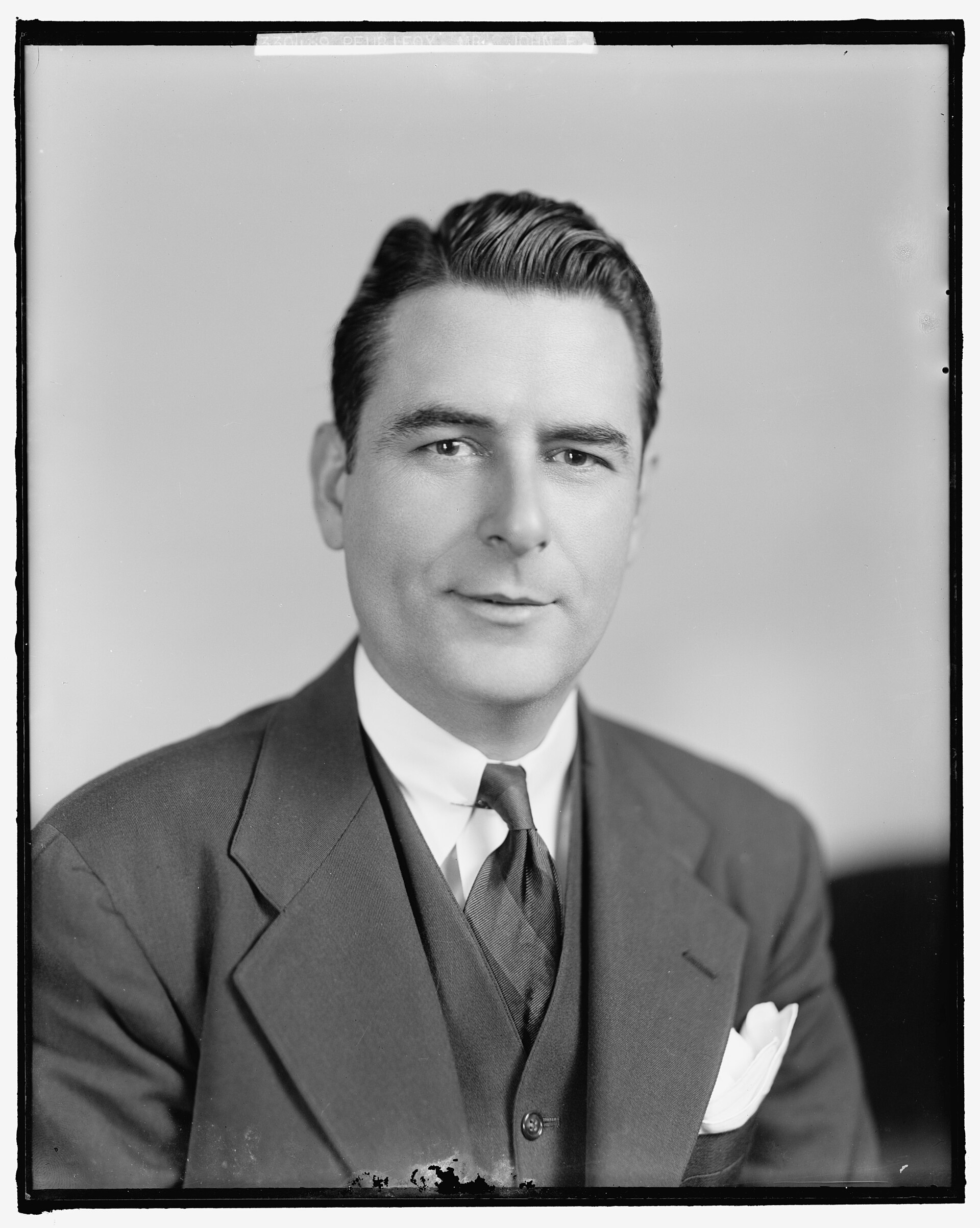

The State Department's response fell to John E. Peurifoy, Deputy Under Secretary of State in charge of administration, the official who ran the department's security and loyalty machinery. The department's loyalty program, as its security chief explained to the Tydings subcommittee, ran up through the Loyalty Security Board to Peurifoy, who decided each case.23 Peurifoy's first move, repeated many times over the following months, was to ask McCarthy for the names. A State Department press release of May 20, 1950, put it this way: "Despite Under Secretary of State Peurifoy's reiterated requests since February 11, 1950, that Senator McCarthy furnish the Department with a list of names of the '205' or '57' accused State Department employees, Senator McCarthy has never furnished the Department or the Secretary of State such a list of names."20 McCarthy's position, stated on the Senate floor, was that a request for names without an opening of the files amounted to saying, in his words, "let us know on whom you have the goods."4
Peurifoy also answered the specific names McCarthy had used. A press release of February 13, 1950, said of Harlow Shapley: "Dr. Shapley has never been an employee of the Department of State," adding that he had served on the American delegation to a UNESCO conference and sat on the National Commission for UNESCO. At the Tydings hearings McCarthy called that release "a misrepresentation of the true facts," because the Secretary of State had twice appointed Shapley to the commission and the department paid his travel and a $10 per diem. In the same breath he said, "I have known Peurifoy to be an upright, honest individual," and suggested that Peurifoy was "issuing these misleading half truths to the American public on orders from higher ups."14 Both statements in the dispute were technically true: Shapley was not a State Department employee, and the department did appoint him to an advisory commission and pay his expenses.
Peurifoy later appeared before the subcommittee at his own request, on June 21, 1950, to deny McCarthy's charge, made in a speech in New London, Connecticut, that he had tried to influence the testimony of Emmanuel Larsen, a defendant in the Amerasia case. Peurifoy testified that Larsen had come to him and said McCarthy had offered to leave Larsen off "his list of 81 names" if Larsen testified against John S. Service. Peurifoy swore there was "not one iota of truth" in the charge against him and said, "I play this game as straight as I know how."24 That is one official's sworn account of a private conversation, and McCarthy's side of it was not tested under oath. It is recorded here because it shows how quickly the dispute over numbers became a dispute over the honesty of named individuals.
President Truman answered more briefly. At his news conference on February 16, 1950, a reporter asked him to comment on "Senator Joseph R. McCarthy's statement that there are 57 Communists in the State Department." Truman replied: "I think the State Department answered that by saying there was not a word of truth in what the Senator said."25 Truman also drafted, and apparently never sent, a reply to McCarthy's telegram. The National Archives describes it as saying that McCarthy was not fit to serve in the government and that the people of Wisconsin must be sorry to be represented by him.26 McCarthy treated the public brush-off as an answer anyway: "when I sent him a telegram and said, 'Mr. President, I have the 57 names; they are yours if you want them'; and when he answered by calling me a liar, I felt I could get no cooperation from the President."4 The telegram itself asked the President to "pick up your phone and ask Mr. Acheson how many of those whom your board had labeled as dangerous Communists he failed to discharge."3
The Senate speech of February 20, 1950: "81 cases"
On the evening of February 20, 1950, McCarthy took the floor under the heading the Record prints as "Communists in Government Service." He began: "I wish to discuss a subject tonight which concerns me more than does any other subject I have ever discussed before this body." He said he had material "from the State Department's own files" and would present it case by case without names: "I have approximately 81 cases. I do not claim to have any tremendous investigative agency to get the facts, but if I were to give all the names involved, it might leave a wrong impression. If we should label one man a Communist when he is not a Communist, I think it would be too bad."34 When Lucas demanded the name in case No. 1, McCarthy offered to give the names privately or to a committee in executive session, and said he would expose them on the floor only if the Senate voted to have him do so. Senator William Langer of North Dakota backed him: the Judiciary Committee, Langer said, had "never made a name public unless we had the consent of J. Edgar Hoover."4
The speech ran for hours, with constant interruptions. The Tydings subcommittee later incorporated by reference 29 pages of the Record for that day alone.27 Its numbering was odd from the start. McCarthy skipped some numbers and doubled others, and the cases did not follow the order of the House investigators' memoranda.2221 According to those historians, most of them can be matched to the 1947 memoranda, because McCarthy read the investigators' descriptions nearly word for word, with changes.
One case compared: McCarthy's case 14 and the investigators' No. 10
Because both documents are in the public record, a reader in 2026 can lay one of McCarthy's cases beside its source. At the first Tydings hearing on March 8, Tydings read aloud McCarthy's case 14 from the Record. It concerned a man "appointed in December 1945 as a translator in the State Department." A report from another investigative agency of January 9, 1946, "advised that the subject should be dismissed as a bad security risk because he was flagrantly homosexual. He had extremely close connections with other individuals with the same tendencies and who were active members of Communist front organizations, including the Young Communist League." The case went on: the department's security office recommended discharge on January 22, 1946; the man was terminated on February 19, 1946; the termination was rescinded on April 1, 1946; a report of September 2, 1947, showed a "high State Department official" trying to get witnesses to repudiate their affidavits; and "this individual, according to the security files of the State Department was a very close associate of active Soviet agents."27
The House investigators' memorandum No. 10 has the same dates and the same events: the December 1945 appointment as a translator "for 'not over a year,'" the report of another agency, the January 22, 1946, recommendation to terminate, the February 19 termination, the April 1 rescission by J. A. Panuch, and a CSA report of September 2, 1947, on Panuch's efforts to get an informant to withdraw an affidavit. It describes "homosexual tendencies," suicide attempts, an arrest record for disorderly conduct, and, from a June 1947 memorandum, "undue interest in naval activities" and "pro-German sentiments during the war."5 It contains no reference to Communist front organizations, to the Young Communist League, or to Soviet agents. The words "Communist" and "Soviet" do not appear in it at all.5
The comparison does not prove that McCarthy had no other source for his additions. He said throughout that he had informants inside the department. It does show that on this case the only file-based source in the public record supports a security concern of the kind the 1940s government treated as grounds for dismissal (lesson 10, What It Cost, covers who was dismissed under the security programs and on what grounds) and does not support the Communist connections McCarthy added to it on the Senate floor. Robert Griffith and David Oshinsky made comparisons of this kind across the whole set in their studies, and reached the conclusion that McCarthy regularly sharpened the investigators' language. M. Stanton Evans, working from the same memoranda decades later, argued that the core security concerns in many files were real whatever the senator's embellishments. Both readings are set out below.222128
Senate Resolution 231
Two days later, on February 22, 1950, the Senate adopted Senate Resolution 231, offered by Lucas and amended on the floor. As adopted, it directed the Foreign Relations Committee "to conduct a full and complete study and investigation as to whether persons who are disloyal to the United States are, or have been, employed by the Department of State," and directed the committee "to procure by subpena and examine the complete loyalty and employment files and records of all the Government employees in the Department of State, and such other agencies against whom charges have been heard."27 During the debate Senator Irving Ives of New York had the words "as charged by the Senator from Wisconsin" struck from the resolution, so that the inquiry would cover the department as a whole. Lucas accepted the change. That amendment became the center of a later argument: Henry Cabot Lodge, Jr., of Massachusetts, said in July that the Senate had told the subcommittee to look at the whole question of foreign penetration and that it had not done so, while the majority treated McCarthy's charges as the object of the inquiry.8
The Tydings subcommittee, March to July 1950
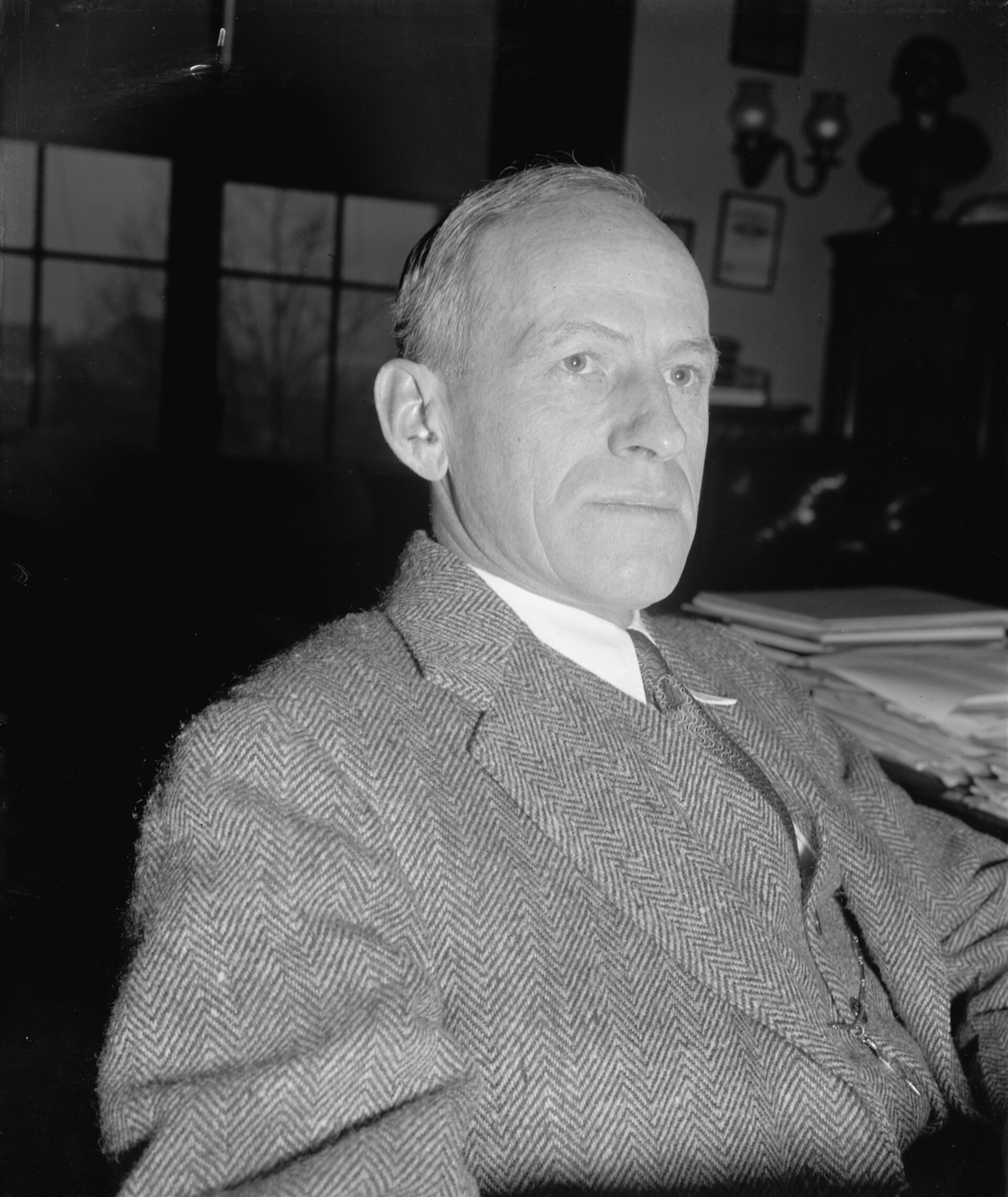

The Foreign Relations Committee, chaired by Tom Connally of Texas, gave the job to a subcommittee of five. The printed hearings list them: Millard E. Tydings of Maryland, chairman, with Theodore Francis Green of Rhode Island and Brien McMahon of Connecticut for the Democratic majority, and Bourke B. Hickenlooper of Iowa and Henry Cabot Lodge, Jr., of Massachusetts for the Republicans. Edward P. Morgan was chief counsel, and Robert Morris served as an assistant counsel.29 Tydings, a conservative Democrat and a veteran of twenty-four years in the Senate, told the Senate in July that he had twice refused the assignment before taking it "as a public duty."730
The subcommittee met for the first time in public on March 8, 1950, in room 318 of the Senate Office Building. Tydings read the resolution into the record and swore McCarthy as a witness. McCarthy said he thought it "an excellent idea to swear all witnesses."27 The printed hearings run to three parts and list 31 hearing days between March 8 and June 28, 1950.29 McCarthy's own testimony fills five separate sections of the printed hearings, and the subcommittee heard named individuals including Dorothy Kenyon, Philip C. Jessup, Esther Brunauer, Haldore Hanson, Owen Lattimore and John S. Service, along with J. Edgar Hoover, Attorney General J. Howard McGrath, Seth Richardson of the Loyalty Review Board, the former Communist editor Louis Budenz, the former Communist leader Earl Browder, and the State Department's security officials.29 The individual cases, and what the evidence now shows about each, are the subject of lesson 07 (The Cases). This lesson stays with the numbers, the files and the verdicts.
The first case McCarthy brought in public, on March 8, was not one of his 81. Asked whether it was one of the cases he had raised on the Senate floor, he answered, "This is not." It was Dorothy Kenyon, a New York attorney whom he described as the United States member of the United Nations Commission on the Status of Women and as "affiliated with at least 28 Communist-front organizations."27 The hearings that followed moved from one public figure to the next, and, as Robert Griffith's study of the inquiry observes, the 81 numbered cases that had prompted the resolution were never taken up one by one in public session.2922
The loyalty files dispute
Resolution 231 told the committee to subpoena the loyalty files. On March 28, 1950, the subcommittee issued subpoenas, served the next day, to the Secretary of State, the Attorney General and the Civil Service Commission for every file on the people McCarthy had described on February 20. The appendix that listed their names was sealed: "This list is confidential and is not being printed in the public record."31 The same day President Truman refused. His letter to Tydings recalled his March 1948 directive "that all reports, records, and files relating to the employee loyalty program be kept in strict confidence, even in instances where subpoenas were received," and quoted Robert H. Jackson, writing as Attorney General in 1941, that disclosure "might also be the grossest kind of injustice to innocent individuals" because "a correction never catches up with an accusation." He enclosed J. Edgar Hoover's list of eight reasons why public disclosure of FBI reports would harm investigations and informants, and offered instead to have the Loyalty Review Board review every case and report to him.12
Truman later relented in part. A June 16, 1950, letter from Deputy Attorney General Peyton Ford listed for the subcommittee the State Department files "relative to the so-called 81 individuals identified through numbers by Senator McCarthy," and assured Tydings that "all of the reports and memoranda furnished the State Department are contained in the files."31 Members read the files under restriction. Lodge told the Senate that "we were not allowed to take any notes out of the White House," that he dictated memoranda from memory after each visit, and that his May 10, 1950, request for an FBI agent to explain the bureau's notations "was flatly turned down by Mr. Peyton Ford."8
McCarthy attacked the files as altered. In a Chicago speech on May 6 he called them "skinny-ribbed bones of the files," "skeleton files," "These purged files" and "phony files." The State Department answered in its numbered press release that "the files transmitted to the Tydings Subcommittee are the full and complete State Department files current as of the date transmitted," checked by a Justice Department representative before delivery.20 Whether material had been removed from any file before 1950 is a question McCarthy raised and the department denied, and the public record available for this lesson does not settle it.
Browder and the other witnesses
The most consequential hearing for Tydings's own future came on April 27, 1950, when Earl Browder, the former head of the Communist Party of the United States, testified.30 Asked by counsel whether he would name Communists in the State Department if he knew of any, Browder said he would not give their names. Tydings then asked him directly whether John Carter Vincent and John S. Service were Communists, urging, "if you felt that you could answer, in the cases of Mr. Vincent and Mr. Service, I would be very grateful to you." Browder first declined, then said that "to the best of my knowledge and belief, they never had any direct or indirect connection with the Communist Party." Tydings replied, "Thank you, sir."42 (McCarthy's later quotation of the exchange, printed in 1951, renders Tydings's plea slightly differently.)32 Six months later that exchange became the caption of a faked photograph, described below.
Hickenlooper, speaking on July 20, put the subcommittee's whole effort at "thirty-some sessions" with "only 35 witnesses."7 Lodge listed what had not been done in the Lattimore matter alone: the 16 persons Budenz named as having relations with Lattimore had not been examined, the heads of the China desk had not been questioned, and the American ambassadors to China during Lattimore's period of influence had not been called.8
The report and the Senate votes, July 1950
The majority report, Senate Report No. 2108 of the 81st Congress, "State Department Employee Loyalty Investigation," was given to the press in mid-July. According to the Senate debate and the standard histories, it found that none of the persons publicly named had been shown to be a Communist or disloyal and that the department's loyalty program was working. The Senate Historical Office quotes its verdict on McCarthy's charges as "a fraud and a hoax."63321 The day after the report was filed, Senator Ives turned its language back on the majority, raising the possibility that "a fraud and a hoax have been perpetrated on the Senate of the United States and the American people" by the subcommittee itself.8 The report itself is not reproduced on any government site this lesson could open, and its other findings are given here as summarized in the Senate debate and the Senate's own histories.
Hickenlooper told the Senate on July 20 that he had never been called to any meeting where the report was considered and "never saw this so-called report until after it had been printed," and "after it had been given to the press at least 1 day before I ever saw it in its final form." He said the full Foreign Relations Committee had struck the word "accepted" and voted only that the document was "received" and would be "transmitted" to the Senate: "The Senate Foreign Relations Committee never approved this document, never adopted it as the act of the Foreign Relations Committee." He had told colleagues weeks earlier that the subcommittee "had done a completely inadequate job" and that it was "no time for a report."7 Tydings disputed this account. He told the Senate that "On June 30, there was a meeting of our committee, which was attended by all five members," at which filing a report came up, that Lodge said he wanted to write his own report and Hickenlooper said he did not want to make one, and that on July 3 he wrote to every member scheduling a further meeting. Hickenlooper replied from the floor: "I did know that a report was being prepared, but I had no opportunity to read it after it was prepared."7 Lodge filed individual views, printed as Part 2 of the report and dated July 20, 1950.34 On the floor the next day he summarized them: on the 81 files, "I was unable to reach conclusions on the files because the leads were not followed up, the evidence was not developed, the credibility of the witnesses was not demonstrated, and all sorts of extremely damaging allegations about the subject of the files were neither proved nor disproved." On Lattimore, "the record which we made does not sustain the charge against Lattimore and ... the record which we made is most inadequate and fragmentary."8 On Ambassador Philip Jessup, Lodge said the subcommittee voted three to clear and two "present," while Tydings described the same vote as "3 to 0" with the Republicans refusing to vote.87
The report reached the Senate floor on July 20, 1950, and the Senate never voted on whether it agreed with the findings. It voted on procedure. Republican senators raised points of order that the document was not a proper committee report and moved to recommit it with instructions to conduct "a full and complete investigation" or to recommend a trained, nonpartisan commission. The chair overruled or sustained the points against them, and Democratic motions to table the Republican appeals carried on four roll calls that day: 45 to 37, 46 to 37, 45 to 35, and 43 to 31.7 On the first of them every senator voting yea was a Democrat and every senator voting nay was a Republican. The nays included Margaret Chase Smith of Maine and five of the six senators who had signed her Declaration of Conscience seven weeks earlier: Aiken, Hendrickson, Ives, Morse and Thye. Tobey was absent. The line did not hold on every vote: on the last roll call, 43 to 31, two Republicans, Wayne Morse of Oregon and Forrest Donnell of Missouri, voted with the Democratic majority.7 Accounts that say the Senate voted "on the report" along party lines are describing these procedural votes, which divided almost entirely by party. Their effect was that the report was received and printed with the Senate's majority standing behind its chairman.
The debate was as bitter as anything the Senate had heard. Tydings, defending the report, read the Wheeling evidence aloud and repeated the words "fraud" and "hoax," and Republicans answered that the report was itself the fraud. Senator Karl Mundt of South Dakota said the document's title, "numbered deceptively as 'Report No. 2108,'" was a misrepresentation that "must be a fraud and such a misrepresentation must be a hoax on the American public." William Jenner of Indiana had an Indianapolis Star editorial titled "The Tydings Whitewash" printed in the Record, and "whitewash" became the word the report's critics used for it.821 The Korean War, which broke out that summer, changed the political setting overnight, and the Senate Historical Office notes that "the outbreak of the Korean War and the highly publicized conviction of Alger Hiss lent credibility to the charges" even after the subcommittee rejected them.6
The changing numbers, in one chart
The chart below sets every number McCarthy used between February 9 and February 20, 1950, beside the two government documents they came from. Each bar is drawn to scale. The colors separate the kinds of claims: numbers presented as Communists, numbers presented as people a loyalty or screening board had flagged, the House investigators' file count, and the "cases" read to the Senate.
Read across, the chart shows three things. The numbers presented as Communists shrank from 205 to 57 within a day and then stayed at 57 until the Senate speech, where they gave way to 81 "cases." The numbers presented as screening results wandered between 205, 207, 283, 285 and 300 depending on the day, though all of them came from one 1946 letter. And at no point between Wheeling and the Senate floor did the number McCarthy attached to "Communists" correspond to any count in a document he later produced.
The Declaration of Conscience, June 1, 1950
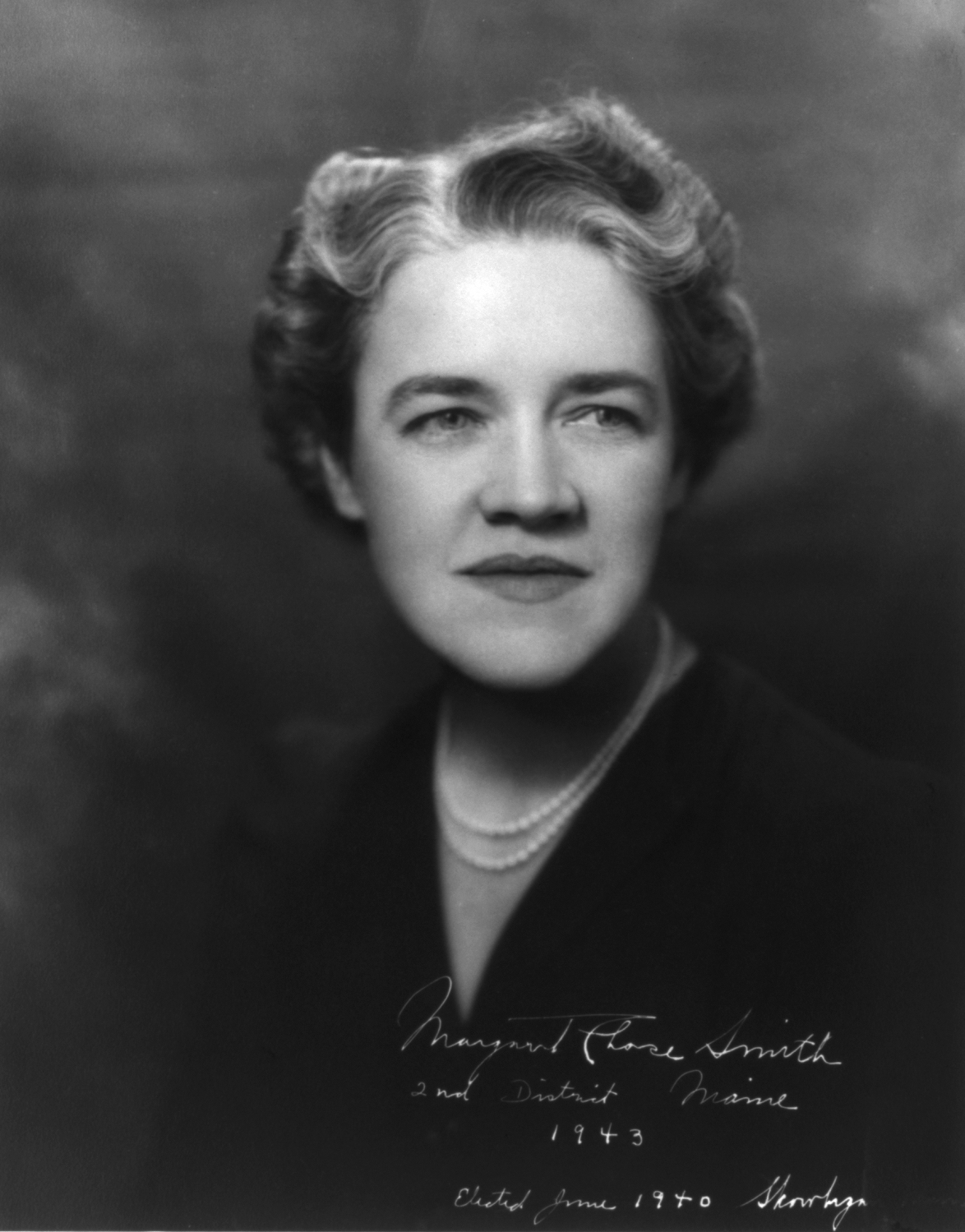

Margaret Chase Smith had succeeded her late husband in the House in June 1940 and won election to the Senate in 1948. In 1950 she was a freshman senator, the only woman in the Senate, and a Republican who counted McCarthy as a friend. The Senate Historical Office records that she was at first impressed by his charges ("It looked as if Joe was onto something disturbing and frightening") and then asked to see his documents. Reading them, "she failed to see their relevance to his charges."35 On June 1, 1950, she spoke for about fifteen minutes. McCarthy sat two rows behind her.35
The speech, as printed in the Congressional Record and reprinted in the Senate's collection of classic speeches, opens: "Mr. President, I would like to speak briefly and simply about a serious national condition. It is a national feeling of fear and frustration that could result in national suicide and the end of everything that we Americans hold dear." Then: "Mr. President, I speak as a Republican. I speak as a woman. I speak as a United States senator. I speak as an American."9
She described what the Senate had become: "But recently that deliberative character has too often been debased to the level of a forum of hate and character assassination sheltered by the shield of congressional immunity." She reminded senators that "the Constitution, as amended, speaks not only of the freedom of speech but also of trial by jury instead of trial by accusation." She listed "some of the basic principles of Americanism," each on its own line: "The right to criticize. The right to hold unpopular beliefs. The right to protest. The right of independent thought." And she said: "The American people are sick and tired of being afraid to speak their minds lest they be politically smeared as 'Communists' or 'Fascists' by their opponents," and "The American people are sick and tired of seeing innocent people smeared and guilty people whitewashed."9
Her criticism ran in both directions, a fact often lost in summaries. She attacked the Truman administration for "its complacency to the threat of communism here at home and the leak of vital secrets to Russia through key officials of the Democratic administration," and said she was not proud of "the obviously staged, undignified countercharges which have been attempted in retaliation from the other side of the aisle." "As an American," she said, "I do not want a Democratic administration 'whitewash' or 'coverup' any more than I want a Republican smear or witch hunt." Her most quoted line was aimed at her own party: "I do not want to see the Republican party ride to political victory on the Four Horsemen of Calumny" and she named them as "Fear, Ignorance, Bigotry, and Smear." (The printed text joins the phrase and the four names with a dash.)9
She then read a five-point "Statement of Seven Republican Senators" and named the six who had "concurred in that declaration": Charles W. Tobey of New Hampshire, George D. Aiken of Vermont, Wayne L. Morse of Oregon, Irving M. Ives of New York, Edward J. Thye of Minnesota and Robert C. Hendrickson of New Jersey.9 Its third point said that "certain elements of the Republican party have materially added to this confusion in the hopes of riding the Republican party to victory through the selfish political exploitation of fear, bigotry, ignorance, and intolerance." Its second point blamed the administration for "its lack of effective leadership," "its complacency to the threat of communism here at home," "its oversensitiveness to rightful criticism" and "its petty bitterness against its critics."9
Smith never used McCarthy's name. He left the chamber without replying. He later called the seven "Snow White and the Six Dwarfs," and, according to the Senate Historical Office, removed her from the Permanent Subcommittee on Investigations, giving her seat to the new senator from California, Richard M. Nixon.3635 President Truman told her at lunch that the declaration "was one of the finest things that has happened here in Washington in all my years in the Senate and the White House."35 Seven weeks later, as noted above, Smith and five of the six co-signers voted with their party on the first procedural roll call over the Tydings report (Morse voted with the Democratic majority on the last of the four). The two positions were consistent with the text of her speech, which asked Republicans to make their case against the administration on "proved cases" and not on "unproved charges."735
Maryland, 1950: the composite photograph
Tydings was up for reelection in November 1950. His Republican opponent was John Marshall Butler. Butler won on November 7 by 43,111 votes.34 The Senate Historical Office, summarizing the official record, says that McCarthy "entered the Maryland campaign on behalf of the Republican challenger" in retaliation for the "fraud and a hoax" report, and that "after a vicious contest, Butler upset Tydings."30
In mid-December Tydings complained to the Rules Committee's Subcommittee on Privileges and Elections about unfair campaign practices and violations of federal and state election law. He did not formally contest the seat. On January 3, 1951, the Senate seated Butler "without prejudice," and a bipartisan group of four senators held public hearings from February 20 to April 11, 1951.30 One of the members of the Privileges and Elections subcommittee that investigated the campaign was Margaret Chase Smith.10 McCarthy was invited to testify and declined, though he filed long individual views that were printed with the report.30
The committee's report, Senate Report No. 647 of the 82nd Congress, issued August 20, 1951, found that the Butler campaign had been managed by Jon M. Jonkel, a Chicago public relations man, with "aggressive assistance from Joseph McCarthy and his staff," in the words of the Senate Historical Office's summary.30 Its centerpiece was a four-page tabloid called "From the Record," falsely attributed to a group called "Young Democrats for Butler." The report found that the Washington Times-Herald printed 500,000 copies and that 303,206 were circulated in Maryland "by mail to box holders and by hand distribution," with more handed to voters at polling places on election day.10 In the lower left corner of page 4 was "a composite photograph" of Tydings and Earl Browder, with this caption:
"Communist leader Earl Browder, shown at left in this composite picture, was a star witness at the Tydings committee hearings, and was cajoled into saying Owen Lattimore and others accused of disloyalty were not Communists. Tydings (right) answered, 'Oh, thank you, sir.' Browder testified in the best interests of those accused, naturally."10
The report explained how the picture was made. A 1950 photograph of Browder taken at the time of his testimony "was trimmed and fitted into position" with "a 1938 photograph of Senator Millard E. Tydings," and the combination was rephotographed. The two men were shown "in intimate conversation, with Senator Tydings an interested and attentive listener." Although the caption called it a composite, the subcommittee found that it "was so prepared as to create an immediate impression to the viewer that it was an actual photograph," and that photographs from the hearings showing both men "were available" but did not show what the campaign wanted shown.10 Jean Kerr, an employee of McCarthy's office, told the subcommittee that the composite was "a lazy man's way of doing it. They should have used the testimony." The campaign treasurer called it "stupid, puerile, and in bad taste."10 (Compare the caption's "Oh, thank you, sir" with the hearing transcript, quoted earlier, in which Tydings said "Thank you, sir.")32
The subcommittee's language was severe. It found "two campaigns within one": a "dignified 'front street' campaign conducted by candidate Butler" and "the despicable 'back street' type of campaign," run by "non-Maryland outsiders," which was "designed to undermine and destroy the public faith and confidence in the basic American loyalty of a well-known figure." "It might be an exaggeration to call this 'back street' campaign a 'big lie' campaign," the report said. "But it certainly is no exaggeration to call it a 'big doubt' campaign." Jonkel himself, it said, had described the strategy as "exploiting the doubt."10 The report called the composite "a shocking abuse of the spirit and intent of the first amendment" and recommended legislation outlawing composite pictures in campaigns.10 It did not recommend unseating Butler, because no existing standard of campaign conduct had been violated in a way the subcommittee thought sufficient. Instead it urged rules that would make "acts of defamation, slander, and libel sufficient grounds" for "declaring a Senate seat vacant."30
McCarthy's individual views defended the picture. "I readily agree that composite photographs in general are improper and are to be condemned in political campaigns," he wrote. "Fortunately, in this particular instance, however, the composite photograph of Tydings and Browder did not as a matter of fact misrepresent the attitude of the former Senator from Maryland toward the notorious Communist leader." He quoted the Browder exchange at length and concluded: "No composite photograph could adequately depict this exchange between Tydings and Browder."32 Senator William Jenner of Indiana, a member of the Rules Committee, filed separate individual views arguing that "doubtful conduct in respect to the Communist issue can and, in fact, did destroy public confidence in a United States Senator and mark him for defeat."34 Jenner's views also printed Tydings's own explanation, given in a telephone interview with U.S. News and World Report days after the election: "the primary campaign for the governorship was so bitter that it demoralized the Democratic Party," and "I ran about 50,000 votes better than the Governor did."34 How much of Butler's margin came from the tabloid, and how much from a divided state Democratic party, cannot be measured from the record.
The Maryland report led directly to the next stage of the story. Senator William Benton of Connecticut, after reading McCarthy's individual views, introduced a resolution calling for McCarthy's expulsion, one step in the long Senate process that ended in his censure in December 1954.3630 That story belongs to lesson 09 (Censure, Watkins, Yates, Barenblatt and the Courts). Idaho's part in the same years, including Senator Herman Welker, who used his own count of "87 communists" and later voted against censure, is told in module 74 (Glen Taylor, Herman Welker and the Red Scare).
Timeline, February to November 1950
The rival readings
Historians have argued about Wheeling and the Tydings inquiry for seventy-five years. The disagreement is narrower than it looks, because almost no one now defends the 205 claim as stated. The argument is about what lay under it. The summaries below are of the authors' published arguments as this lesson understands them. Quotations from the books are not used because the books themselves were not reopened for this lesson, and page-level checks are listed among the unverified items.
The case that the Lee list had substance: Evans and Herman
M. Stanton Evans, in Blacklisted by History (2007), spent years in the Tydings files, the House investigators' memoranda, FBI records and State Department security records. His argument runs this way. The numbers McCarthy used at Wheeling and afterward were traceable to official documents: 205 to the Byrnes letter and 57 and 81 to the House investigators' cases. The cases were the State Department's own security findings, assembled by congressional investigators who were not McCarthy's creatures and who had found genuine laxity, including people retained or reinstated over the objections of the department's security office. The Tydings subcommittee, Evans argued, was set up to investigate McCarthy instead of the department, never examined the 81 cases in any serious way, called few of the relevant security officers, and issued a report its minority members never saw in draft. He also argued that a number of people on the list were later separated under the loyalty and security programs or were shown by later evidence to have had Communist ties, so that the Tydings verdict of a "fraud and a hoax" was itself wrong on the substance.28
Arthur Herman, in Joseph McCarthy: Reexamining the Life and Legacy of America's Most Hated Senator (2000), takes a middle position on Wheeling. He treats the numbers episode as an example of McCarthy's carelessness and showmanship, concedes that the senator exaggerated and changed his figures, and argues that the larger pattern of security failure he pointed toward was real and that his opponents used the numbers dispute to avoid the underlying question.37
The documents printed in 1950 support part of this case. The Byrnes letter and the House investigators' memoranda were real government records. Several memoranda describe serious, unresolved security questions. Lodge's and Hickenlooper's floor statements say that the subcommittee did not follow leads in the files, had no FBI help reading them, never met to adopt the report, and gave its minority members no chance to see the draft. Tydings disputed the last two points, saying all five members met on June 30 to discuss a report.578
The opposing case: Oshinsky, Griffith, Rovere and the Senate Historian
David M. Oshinsky, in A Conspiracy So Immense (1983), and Robert Griffith, in The Politics of Fear (1970), read the same documents and reached the opposite conclusion about McCarthy's conduct. Both trace the numbers to the Byrnes letter and the Lee list. Both argue that the material was three years old by 1950, that many of the people in it had already left the department or had been cleared after fuller investigation, and that McCarthy's descriptions of the cases on February 20 repeatedly went beyond what the investigators had written. Griffith's close comparison of the 81 cases with the memoranda found duplications, gaps in the numbering and sharpened language, and the comparison of case 14 with memorandum No. 10 earlier in this lesson is one instance of what he described. Oshinsky treats the 205 at Wheeling as established by the newspaper and radio evidence and McCarthy's later denials as false.2122 Richard Rovere, who covered McCarthy for The New Yorker, argued in Senator Joe McCarthy (1959) that the shifting numbers showed a man with no list at all, only a stack of papers and a talent for keeping attention on himself.38
The Senate Historical Office takes the same view in its own voice. Its account of the speech quotes the 205 sentence as delivered. Its introduction to the 2003 publication of McCarthy's executive session transcripts, edited by Senate Historian Donald A. Ritchie, describes the Tydings subcommittee as having investigated the charges and "rejected them as 'a fraud and a hoax,'" and notes that the issue "might have died" but for the Korean War and the Hiss and Rosenberg cases.1333 Ellen Schrecker, in Many Are the Crimes (1998), places Wheeling within a much larger anticommunist effort that predated McCarthy, and argues that his numbers mattered less than the political system that rewarded him for them.39
What the espionage evidence adds
John Earl Haynes and Harvey Klehr, whose work on the Venona decrypts and the Soviet archives established that Soviet espionage inside the government was larger than most of McCarthy's opponents had believed, have also written that McCarthy's own lists did a poor job of finding the people Venona identified. In their reading, the real agents of the 1930s and 1940s had mostly left government by 1950, and McCarthy's indiscriminate charges made it harder to deal with the genuine record.40 Lesson 02 (Venona and the Archives) sets out that evidence, and lesson 11 (The Assertions Assessed from 2026) takes up the later fate of the individuals on McCarthy's lists case by case.
McCarthy's own scorecard, 1953
McCarthy kept his own score. In a closed session of his Permanent Subcommittee on Investigations on March 10, 1953, he told a witness: "Keep in mind that since we have named the procommunists and Communists before the Tydings committee, one of them has gone to jail, William Remington. Two have been found unfit by the loyalty board. Fifteen others have been removed under the loyalty program, that we know of. Two have been removed from the United Nations and have refused to answer whether or not they are presently espionage agents." He added, "Keep in mind that Acheson at the time declared that all those I had named had been cleared and they were good, loyal Americans."41 Those figures are McCarthy's own, given in a closed session three years after the fact, and this lesson has not checked them name by name against the files, and lesson 11 takes up that test. They do show what his defenders have always argued: that the dispute over 205 and 57 left open the separate question of whether some of the people behind the numbers were security risks.
What the record shows and what it does not
- Documented: The prepared Wheeling script contained "a list of 205," the Wheeling Intelligencer printed it, and two WWVA employees swore that the delivered speech matched the script.12
- Documented: Within a day McCarthy described his Wheeling claim as "57 card-carrying members of the Communist Party," and on February 20 he told the Senate he did not believe he had said 205.73
- Documented: His figures derive from the 1946 Byrnes letter and the 1947 House Appropriations investigators' memoranda on 108 people, neither of which described its subjects as Communist Party members known to the Secretary of State.35
- Documented: McCarthy never gave the State Department the names of the 205 or the 57, by his own admission on February 20 and by the department's account in May.420
- Documented: Hickenlooper told the Senate he never saw the report before it went to the press, the full committee only "received" and "transmitted" it, and the Senate's July 20 votes were procedural and divided almost entirely along party lines. Tydings answered on the floor that all five members had met on June 30 and discussed filing a report.7
- Documented: The 1950 Maryland campaign circulated more than 300,000 copies of a tabloid with a composite photograph of Tydings and Browder that a Senate committee condemned.10
- Allegation, unproved: That the State Department loyalty files given to the subcommittee had been stripped. McCarthy alleged it, and the department and the Justice Department denied it.2031
- Open question: How many of the 81 people were later found to be security risks or Communist Party members, and on what evidence. McCarthy's 1953 count and Evans's later research claim several, and that count is examined in lesson 11.4128
- Open question: Exactly what McCarthy said aloud at Wheeling, word for word. The station's tape is not in the printed record, and the affidavits certify a script.2
Assessed from 2026
Each claim below is rated Supported, Partly supported, Unsupported, Refuted or Unresolved against the record available in 2026. The ratings apply to the claim as it was made, in the words used at the time.
"McCarthy said 205 at Wheeling." Supported.
The contemporary newspaper report, the reporter's statement through his publisher, two sworn affidavits from the broadcasting station certifying the delivered speech against a script containing 205, and McCarthy's own reference on the Senate floor to "over 200" and "approximately 200" all point the same way.11523 The only contrary evidence is McCarthy's later account, which itself changed: he told a Salt Lake City radio audience the next night that he had said 57, and he read to the Senate a "57 cases" text that does not match the certified script.718 The exact spoken wording of the sentence remains unrecoverable without the tape, so the precise words after "205" are unresolved, while the number itself is as well established as anything in a 1950 speech can be.
"205 members of the Communist Party, known to the Secretary of State, still working and shaping policy." Refuted.
McCarthy's own explanation on February 20 shows that 205 was the residue of a 1946 screening of transferred wartime employees who had received a recommendation against permanent employment, less 79 removed by mid-1946. The Byrnes letter as he read it said nothing about Communist Party membership, and three and a half years of resignations, clearances and dismissals had passed. On the Senate floor McCarthy himself restated the 205 as people the Secretary "refused to discharge" because his board had found them "unsafe risks," a different claim.34
"I have the names of 57 card-carrying Communists in the State Department." Unsupported.
McCarthy made the claim in Salt Lake City, in Reno and to the President.71617 He told Senator Lehman he had not given the names to the State Department, and the department said in May that he never did.420 On February 20 the claim had already become "57 cases of individuals who would appear to be either card carrying members or certainly loyal to the Communist Party."18 No list of 57 card-carrying party members was ever produced.
"These 81 cases come from the State Department's own files." Partly supported.
The cases came from the 1947 memoranda of House Appropriations Committee investigators who had worked from State Department security files, and the department itself called the House list "the basis of Senator McCarthy's speech."205 Some of those memoranda describe serious security concerns.5 The comparison of case 14 with memorandum No. 10 shows that on at least one case McCarthy added Communist and Soviet connections that the file-based source did not contain.275
"The State Department's security screening of 1945 to 1947 had real lapses." Supported.
The Byrnes letter, the House investigators' memoranda (including cases of reinstatement over the security office's objection and months of inaction on serious derogatory information), and Lodge's account of files left with unresolved allegations all support it.358 This is the strongest part of the anti-communist case in 1950, and it did not depend on any of McCarthy's numbers.
The Tydings majority: McCarthy's charges were "a fraud and a hoax." Partly supported.
As applied to the specific claims of 205 and 57 Communist Party members known to the Secretary of State, the verdict is borne out by the record. As a finding that the subcommittee had examined the 81 cases and found nothing, it is weaker: the minority members said the files were read without FBI help and with leads unpursued, the report was not adopted by the full committee, and Hickenlooper said he never saw it in draft.678 Whether particular individuals among the 81 were security risks is a separate question the subcommittee did not settle (see lesson 11).
Truman: "not a word of truth in what the Senator said." Partly supported.
Truman was answering a question about "57 Communists in the State Department," and as to that claim the record supports him.25 As a statement that there was nothing to the security concerns behind the numbers, it went beyond the evidence his own administration's documents contained.35
"The files given to the subcommittee were purged skeletons." Unsupported.
McCarthy offered no evidence of removal in the record examined for this lesson, and the State and Justice Departments stated that the files were complete.2031 Lodge's complaint was different: he said the files were complete enough to raise questions that no one was allowed to pursue.8 Whether anything was removed before 1950 remains unproved.
McCarthy: the composite photograph "did not as a matter of fact misrepresent" Tydings's attitude. Refuted.
The picture joined a 1938 photograph of Tydings with a 1950 photograph of Browder to show a conversation that never took place, and its caption misquoted the hearing transcript. The Senate subcommittee found it was made to look real when real photographs of the two men at the hearing existed.1032 Whatever one thinks of Tydings's questioning of Browder, the image was a fabrication presented to voters as evidence.
McCarthy's 1953 count of results from the Tydings names. Unresolved.
The count of one imprisoned, two found unfit, fifteen removed and two removed from the United Nations was given by McCarthy himself in a closed session and is not checked name by name in the record available to this lesson.41 It is tested in lesson 11.
Hard questions and answers
If the State Department really had security problems, does it matter whether he said 205 or 57?
It matters because the number was the claim. The careless screening of wartime transfers was true and documented, and McCarthy could have said so. What he said at Wheeling was that he held a list of named Communist Party members whom the Secretary of State knew about and kept on the payroll. That is the kind of statement that can ruin people named under it and that can be checked. When it was checked, the list did not exist in the form described, and the number changed the next day.273 A reader sympathetic to the anti-communist cause has the most reason to care, because the real record of Soviet espionage was strong enough to stand without inflated numbers, and the inflated numbers gave opponents an easy way to dismiss the real record.
Was the Tydings subcommittee a fair investigation?
By the testimony of its own minority members, no. Hickenlooper said the report was released to the press before he saw it and that he was never called to a meeting where its adoption could be considered, and Lodge said leads in the files were not followed and FBI help was refused. Tydings answered that all five members met on June 30 to discuss filing a report and that the minority chose to write separately or not at all.78 The majority's answer was that McCarthy, who had made the charges, had the burden of proving them and could not. Both things can be true: McCarthy failed to prove his numbers, and the subcommittee did not finish the broader inquiry the Senate had ordered when it struck the words "as charged by the Senator from Wisconsin" from the resolution.8
Why didn't McCarthy simply give the names to the State Department?
His stated reason, on the Senate floor, was that the department was in effect saying "let us know on whom you have the goods" without opening its files to Congress, and that naming people in public might "label one man a Communist when he is not a Communist."4 He did offer the names to any senator or committee in executive session. The record also shows that he did not have 205 or 57 names of Communist Party members to give: what he had was the House investigators' set of numbered memoranda.205
Was Truman right to refuse to hand over the loyalty files?
He gave serious reasons, quoted from Hoover and from Robert Jackson: protecting informants, protecting the innocent from raw allegations, and protecting investigative methods.12 Against that, the Senate had directed a subpoena, and the result of secrecy was that each side could claim the files proved its case. The compromise, letting members read the 81 files at the White House without notes or FBI help, satisfied no one.8 The general problem of congressional access to executive branch records is taken up in lesson 12 (Method Versus Mission).
Did Margaret Chase Smith contradict herself by voting with McCarthy's side in July?
The roll calls she joined were procedural votes on whether the subcommittee's document was a proper committee report and whether to send it back for a full investigation. Her declaration had criticized the administration as well as her own party and had asked Republicans to rely on "proved cases."97 Voting to reopen an inquiry the minority called incomplete fits that position. She also served on the subcommittee that condemned the 1950 Maryland campaign.10
Did the composite photograph defeat Tydings?
The record cannot say. Tydings himself blamed a bitter Democratic primary for governor in the days after the election. The Senate subcommittee condemned the tabloid but did not find that it decided the result, and it did not recommend unseating Butler.3430 What the record does establish is that a Senate candidate's campaign organization joined with McCarthy's staff and a Washington newspaper to circulate a fabricated image to hundreds of thousands of voters.10
Related lessons
- Lesson 07, The Cases: Service, Lattimore, Kenyon, Jessup and the others named before the Tydings subcommittee.
- Lesson 09, Censure, Watkins, Yates, Barenblatt and the Courts: from the Benton resolution of 1951 to the censure of 1954.
- Lesson 11, The Assertions Assessed from 2026: what became of the people behind the numbers.
- Module 74, lesson 06, Glen Taylor, Herman Welker and the Red Scare: Idaho's senators in the same years.
- Module 52, Legitimate Authority and Its Limits: Pierson's framework for judging when government power, including the power to investigate, exceeds its warrant.
- Module 51, Communism: the economic and political system the anti-communists opposed.
Still open
These items could not be confirmed against a primary source before publication. The lesson states them as open, and they stay on the fact-check list.
- The Byrnes letter's own figure: the bound Congressional Record of February 20, 1950, prints McCarthy's reading as 285; most histories give 284 (284 minus 79 equals 205). The 1946 printing (Congressional Record Appendix, August 1, 1946, p. A4892) and the letter's addressee (Representative Adolph Sabath) were not opened for this lesson.
- The statement that the State Department told Congress in 1948 that 57 of the 108 House-list subjects were still employed comes from secondary histories, not from a primary document opened for this lesson.
- The identification of the 1947 House investigators' chief as Robert E. Lee, a former FBI agent, comes from secondary histories.
- The summaries of the arguments of M. Stanton Evans, Arthur Herman, David Oshinsky, Robert Griffith, Richard Rovere, Ellen Schrecker, and John Earl Haynes and Harvey Klehr are given from the published books without page-level verification in this task; no quotations from them are used. This includes Griffith's findings on numbering gaps and duplications in the 81 cases (the Record confirms only that Jenner had an Indianapolis Star editorial titled "The Tydings Whitewash" printed).
- The full text of the Tydings majority report (S. Rept. 81-2108, part 1) was not opened; its findings are described from the Senate debate of July 20 and 21, 1950, and the Senate Historical Office's quotation of "a fraud and a hoax."
- The date of the Salt Lake City interview (February 10, 1950) rests on Tydings's statement on the Senate floor July 20, 1950; the Reno date (February 11) rests on the Nevada State Journal's "last night" in its February 12 issue.
- Whether the WWVA tape recording of the Wheeling speech still exists is not established; the printed record contains only the certified script.
- The wording of Truman's unsent reply is paraphrased from the National Archives' description, not quoted from the document.
- The exact date in May 1950 when Truman allowed subcommittee members to read the 81 files at the White House was not established from a primary source; Lodge's floor statement and the Ford letter of June 16, 1950, confirm the arrangement.
- McCarthy's March 10, 1953, count of results from the Tydings names (one jailed, two found unfit, fifteen removed, two removed from the United Nations) was not checked name by name.
- Image alt text was written from the catalog records; no dates are stated for the Tydings, Peurifoy and Smith photographs because the catalog dates could not be confirmed.
- The club's name varies in the sources (Ohio County Republican Women's Club in the Intelligencer and in Tydings's speech; Women's Republican Club of Wheeling at the Senate Historical Office).
- Austin V. Wood's title at the News Publishing Co. is not stated in the printed letter; the lesson gives only his company.
Learn more
- Senate Historical Office: The McCarthy Hearings: The Senate's own short history of Wheeling and what followed, with links to the censure and the Declaration of Conscience.
- State Department Employee Loyalty Investigation, Part 2: Read the Intelligencer story, the WWVA affidavits, the speech script and the House investigators' 108 memoranda in their original printing.
- Congressional Record, February 20, 1950: The full floor debate, including the Lucas exchanges and the 81 cases as McCarthy read them.
- Margaret Chase Smith, Declaration of Conscience: The complete text of the speech and the statement of seven senators, four pages.
- Maryland Senatorial Election of 1950, S. Rep. 82-647: How the composite photograph was made, from the testimony of the people who made it, with McCarthy's defense of it.
Notes
- Frank Desmond, "McCarthy Charges Reds Hold U.S. Jobs," Wheeling Intelligencer, February 10, 1950, reprinted in U.S. Senate, Committee on Foreign Relations, State Department Employee Loyalty Investigation: Hearings before a Subcommittee pursuant to S. Res. 231, 81st Cong., 2d sess., Part 2 (Appendix) (Washington: GPO, 1950), pp. 1756 to 1757. Read it online. ↩
- Affidavits of Paul A. Myers, program director, and James K. Whitaker, news editor, radio station WWVA, sworn April 25, 1950, with the photostat of the speech script of February 9, 1950, in State Department Employee Loyalty Investigation, Part 2 (Appendix), pp. 1758 to 1766. Read it online. ↩
- Congressional Record, Senate, 81st Cong., 2d sess., vol. 96, pt. 2, February 20, 1950, pp. 1952 to 1954 (McCarthy's opening, telegram to Truman, exchange with Lucas, reading of the Byrnes letter). Read it online. ↩
- Congressional Record, Senate, February 20, 1950, vol. 96, pt. 2, pp. 1957 to 1959 (exchanges with Lucas, Lehman and Langer; "approximately 81 cases"; case No. 1). Read it online. ↩
- "Memoranda concerning data extracted from the State Department loyalty files relative to 108 individuals," prepared in 1947 by investigators for a subcommittee of the House Committee on Appropriations, 80th Cong., printed in State Department Employee Loyalty Investigation, Part 2 (Appendix), pp. 1771 ff.; memorandum No. 10 at pp. 1777 to 1778; Nos. 107 and 108 at the end of the series. Read it online. ↩
- U.S. Senate, Senate Historical Office, "Joseph R. McCarthy: A Featured Biography," senate.gov. Read it online. ↩
- Congressional Record, Senate, 81st Cong., 2d sess., vol. 96, pt. 8, July 20, 1950, pp. 10688 to 10709 (roll calls at pp. 10688, 10689, 10696 and 10706; Hickenlooper at p. 10698; Tydings's presentation of the Wheeling, Salt Lake City and Reno evidence at pp. 10707 to 10709). Read it online. ↩
- Congressional Record, Senate, 81st Cong., 2d sess., vol. 96, pt. 8, July 21, 1950, pp. 10773 to 10775 (Lodge's statement on his individual views and the 81 files) and surrounding debate (Ives; Mundt). Read it online. ↩
- Margaret Chase Smith, "Declaration of Conscience," Senate, June 1, 1950, Congressional Record, 81st Cong., 2d sess., pp. 7894 to 7895, as reprinted in Robert C. Byrd, The Senate, 1789 to 1989: Classic Speeches, 1830 to 1993 (Washington: GPO, 1994), pp. 621 to 624, with the editors' notes. Read it online. ↩
- U.S. Senate, Committee on Rules and Administration, Maryland Senatorial Election of 1950, S. Rep. No. 647, 82nd Cong., 1st sess., August 20, 1951, pp. 4 to 9 (findings, front street and back street campaigns, recommendations) and pp. 21 to 24 (the tabloid and the composite photograph). Read it online. ↩
- National Archives, Educator Resources, "Telegram from Senator Joseph McCarthy to President Harry S. Truman," background essay (last reviewed September 23, 2016). Read it online. ↩
- Harry S. Truman, letter to Senator Millard E. Tydings regarding disclosure of confidential files on employee loyalty, March 28, 1950, Public Papers of the Presidents: Harry S. Truman, 1950, no. 79. Read it online. ↩
- U.S. Senate, Senate Historical Office, "'Communists in Government Service,' McCarthy Says," February 9, 1950, senate.gov. Read it online. ↩
- Testimony of Senator Joseph R. McCarthy, quoting the State Department press release of February 13, 1950, and Peurifoy's letter of February 16, 1950, State Department Employee Loyalty Investigation, Part 1, pp. 125 to 126. Read it online. ↩
- Austin V. Wood, News Publishing Co., Wheeling, to Senator Millard E. Tydings, March 25, 1950, in State Department Employee Loyalty Investigation, Part 2 (Appendix), p. 1756. Read it online. ↩
- Edward Conners, "McCarthy Blasts State Department," Nevada State Journal (Reno), February 12, 1950, reprinted in State Department Employee Loyalty Investigation, Part 2 (Appendix), pp. 1757 to 1758. Read it online. ↩
- Joseph R. McCarthy, telegram to President Harry S. Truman, February 11, 1950, Papers of Harry S. Truman, President's Secretary's Files, Harry S. Truman Library, National Archives Identifier 201514. Read it online. ↩
- Congressional Record, Senate, February 20, 1950, vol. 96, pt. 2, p. 1956 (the text McCarthy read as his Wheeling and Reno speech). Read it online. ↩
- Testimony of Senator Joseph R. McCarthy, State Department Employee Loyalty Investigation, Part 1, p. 125. Read it online. ↩
- Department of State, press release No. 529, May 20, 1950, analysis of Senator McCarthy's Chicago speech of May 6, 1950, transmitted by John E. Peurifoy to Senator Tydings June 19, 1950, in State Department Employee Loyalty Investigation, Part 2 (Appendix), pp. 1826 to 1827. Read it online. ↩
- David M. Oshinsky, A Conspiracy So Immense: The World of Joe McCarthy (New York: Free Press, 1983), chapters on Wheeling and the Tydings inquiry. Interpretation attributed to the author. Read it online. ↩
- Robert Griffith, The Politics of Fear: Joseph R. McCarthy and the Senate (Lexington: University Press of Kentucky, 1970), chapters on the Wheeling speech, the February 20 speech and the Tydings subcommittee. Interpretation attributed to the author. Read it online. ↩
- Testimony of Donald L. Nicholson, Chief of the Division of Security, and Gen. Conrad E. Snow, Chairman of the Loyalty Security Board, Department of State, State Department Employee Loyalty Investigation, Part 1, pp. 373 to 404. Read it online. ↩
- Statement of John E. Peurifoy, Deputy Under Secretary of State in Charge of Administration, executive session of June 21, 1950, State Department Employee Loyalty Investigation, Part 1, pp. 1229 to 1233. Read it online. ↩
- Harry S. Truman, The President's News Conference, February 16, 1950, item 18, The American Presidency Project. Read it online. ↩
- National Archives, DocsTeach, "President Truman's Unsent Reply to Senator Joseph McCarthy's Telegram," undated draft, Harry S. Truman Library, National Archives Identifier 201514 (description). Read it online. ↩
- State Department Employee Loyalty Investigation, Part 1, hearing of March 8, 1950, pp. 1 to 6 (S. Res. 231 as adopted February 22, 1950; list of Congressional Record pages incorporated; McCarthy sworn; case 14 read by Tydings) and p. 18 (the Kenyon case). Read it online. ↩
- M. Stanton Evans, Blacklisted by History: The Untold Story of Senator Joe McCarthy and His Fight Against America's Enemies (New York: Crown Forum, 2007). Interpretation attributed to the author. Read it online. ↩
- State Department Employee Loyalty Investigation, Part 1 (Washington: GPO, 1950), title page (hearing dates), committee and subcommittee rosters, and table of contents (witnesses and pages). Read it online. ↩
- U.S. Senate, Senate Historical Office, "The Election Case of Millard E. Tydings v. John M. Butler of Maryland (1951)," Contested Senate Elections, case 130, adapted from Anne M. Butler and Wendy Wolff, United States Senate Election, Expulsion, and Censure Cases, 1793 to 1990, S. Doc. 103-33 (GPO, 1995). Read it online. ↩
- Subpoenas of March 28, 1950, with sealed Appendix II, and Peyton Ford, Deputy Attorney General, to Senator Millard E. Tydings, June 16, 1950, State Department Employee Loyalty Investigation, Part 2 (Appendix), pp. 1767 to 1770. Read it online. ↩
- Individual Views of Mr. McCarthy, in Maryland Senatorial Election of 1950, S. Rep. No. 647, 82nd Cong., 1st sess., August 20, 1951, pp. 45 to 46 (quoting the Browder testimony of April 27, 1950). Read it online. ↩
- U.S. Senate, Executive Sessions of the Senate Permanent Subcommittee on Investigations of the Committee on Government Operations, 1953 to 1954, S. Prt. 107-84, vol. 1 (GPO, 2003), Introduction, edited by Donald A. Ritchie, Senate Historical Office. Read it online. ↩
- Maryland Senatorial Election of 1950: Individual Views of Mr. Jenner, S. Doc. No. 81, 82nd Cong., 1st sess. (GPO, 1951), pp. 1 to 2 (preamble, introduction, U.S. News and World Report interview of November 1950) and p. 18, note 42 (Lodge's individual views, S. Rept. 2108, pt. 2, dated July 20, 1950). Read it online. ↩
- U.S. Senate, "Classic Senate Speeches: Margaret Chase Smith, A Declaration of Conscience, June 1, 1950," introduction reprinted from Robert C. Byrd, The Senate, 1789 to 1989: Classic Speeches (GPO, 1994). Read it online. ↩
- U.S. Senate, "A Declaration of Conscience," Investigations: The McCarthy Hearings, senate.gov. Read it online. ↩
- Arthur Herman, Joseph McCarthy: Reexamining the Life and Legacy of America's Most Hated Senator (New York: Free Press, 2000). Interpretation attributed to the author. Read it online. ↩
- Richard H. Rovere, Senator Joe McCarthy (New York: Harcourt, Brace, 1959). Interpretation attributed to the author. Read it online. ↩
- Ellen Schrecker, Many Are the Crimes: McCarthyism in America (Boston: Little, Brown, 1998). Interpretation attributed to the author. Read it online. ↩
- John Earl Haynes and Harvey Klehr, Venona: Decoding Soviet Espionage in America (New Haven: Yale University Press, 1999). Interpretation attributed to the authors. Read it online. ↩
- Executive Sessions of the Senate Permanent Subcommittee on Investigations, S. Prt. 107-84, vol. 1 (2003), executive session of March 10, 1953, testimony of David Cushman Coyle, remarks of the Chairman (McCarthy). Read it online. ↩
- Testimony of Earl Browder, April 27, 1950, State Department Employee Loyalty Investigation, Part 1, pp. 669 to 707 (Morgan's question on naming Communists at pp. 684 to 685; Tydings's question on Vincent and Service and Browder's answer at pp. 706 to 707). Read it online. ↩
Check yourself
1. Which newspaper printed McCarthy's "list of 205" sentence the morning after the Wheeling speech?
Frank Desmond's story in the Wheeling Intelligencer of February 10, 1950, quoted the 205 sentence; the paper's publisher later confirmed Desmond's account to Tydings.
2. What did the two WWVA radio employees swear in their April 25, 1950, affidavits?
Paul A. Myers and James K. Whitaker certified that the recorded and broadcast speech matched the attached script, apart from connective words, and the script contains the 205 sentence.
3. According to McCarthy's own February 20 explanation, where did the figure 205 come from?
He read the Byrnes letter, which reported recommendations against permanent employment in several hundred cases and 79 removals; the difference is the source of 205.
4. What number did McCarthy use in his Salt Lake City radio interview, his Reno speech and his February 11 telegram to Truman?
In all three he spoke of 57 Communists or 57 card-carrying members of the Communist Party.
5. The House Appropriations Committee investigators' 1947 memoranda printed by the Tydings subcommittee covered how many individuals?
The appendix to the hearings prints memoranda on 108 individuals, identified only by numbers; historians call the set the Lee list.
6. What did Senator Hickenlooper tell the Senate on July 20, 1950, about the Tydings report?
Hickenlooper said he never saw the report until after it had been printed and given to the press, and that he never had notice of a meeting at which its adoption could be considered. Tydings disputed him, saying all five members met on June 30 to discuss filing a report.
7. Which of these senators was NOT one of the six who joined Margaret Chase Smith's Declaration of Conscience?
The six were Tobey, Aiken, Morse, Ives, Thye and Hendrickson. Lodge was a minority member of the Tydings subcommittee.
8. What did the Senate committee find about the composite photograph of Tydings and Earl Browder in the 1950 Maryland campaign?
S. Rep. 82-647 found the composite combined a 1938 photo of Tydings with a 1950 photo of Browder and was prepared to give the impression of an actual photograph; more than 300,000 copies of the tabloid were circulated.
Terms in this lesson
- Lincoln Day speech
- A Republican fundraising address given around Lincoln's birthday, February 12. McCarthy's Wheeling speech of February 9, 1950, opened a Lincoln Day tour that continued to Salt Lake City and Reno.
- Byrnes letter
- A 1946 letter from Secretary of State James F. Byrnes reporting how many wartime employees transferred to the State Department had been recommended against permanent employment and how many had been removed. McCarthy used it as the source of 205.
- Lee list
- The common name for the 1947 memoranda by House Appropriations Committee investigators on 108 present and former State Department employees with derogatory material in their files. It was the main source of McCarthy's 81 cases.
- Card-carrying Communist
- A formal, dues-paying member of the Communist Party. McCarthy used the phrase for his 57 names; the documents behind his numbers did not describe their subjects that way.
- S. Res. 231
- The Senate resolution of February 22, 1950, directing the Foreign Relations Committee to investigate whether disloyal persons were or had been employed by the State Department and to subpoena the loyalty files.
- Tydings subcommittee
- The five-member Foreign Relations subcommittee chaired by Millard Tydings of Maryland that held hearings on McCarthy's charges from March 8 to June 28, 1950. Its majority report called the charges a fraud and a hoax.
- Loyalty files
- The investigative records, including FBI reports, kept under Truman's loyalty program. A 1948 presidential directive kept them confidential even against subpoenas, and their release to Congress was the central dispute of the Tydings inquiry.
- Individual views
- A separate statement by a committee member printed with a committee report. Lodge's individual views on the Tydings inquiry were printed as Part 2 of S. Rept. 2108.
- Point of order and motion to table
- Senate procedures by which a member challenges whether an action follows the rules and the majority sets aside an appeal without debate. The July 20, 1950, votes on the Tydings report were of this kind.
- Declaration of Conscience
- Margaret Chase Smith's June 1, 1950, Senate speech and the five-point statement of seven Republican senators condemning smear tactics and the administration's handling of the communism issue.
- Composite photograph
- An image made by combining separate photographs. The 1950 Maryland tabloid joined pictures of Tydings and Earl Browder to show a conversation that did not take place.
- Executive session
- A closed committee meeting. McCarthy's executive sessions of 1953 and 1954 were sealed for fifty years and published by the Senate in 2003.
Sources
- State Department Employee Loyalty Investigation: Hearings, Part 1 (1950) checked 2026-10
- State Department Employee Loyalty Investigation: Hearings, Part 2 (Appendix) (1950) checked 2026-10
- Congressional Record, Senate, February 20, 1950 (bound edition, vol. 96, pt. 2) (1950-02-20) checked 2026-10
- Congressional Record, Senate, July 20, 1950 (bound edition, vol. 96, pt. 8) (1950-07-20) checked 2026-10
- Congressional Record, Senate, July 21, 1950 (bound edition, vol. 96, pt. 8) (1950-07-21) checked 2026-10
- Margaret Chase Smith, Declaration of Conscience (Senate PDF from Byrd, Classic Speeches) (1950-06-01) checked 2026-10
- Maryland Senatorial Election of 1950, S. Rep. 82-647 (1951-08-20) checked 2026-10
- Maryland Senatorial Election of 1950: Individual Views of Mr. Jenner, S. Doc. 82-81 (1951) checked 2026-10
- Truman letter to Tydings on loyalty files, March 28, 1950 (1950-03-28) checked 2026-10
- The President's News Conference, February 16, 1950 (1950-02-16) checked 2026-10
- National Archives: Telegram from Senator Joseph McCarthy to President Truman (1950-02-11) checked 2026-10
- DocsTeach: Truman's unsent reply to McCarthy (1950) checked 2026-10
- Senate Historical Office: Communists in Government Service, McCarthy Says (accessed 2026-10-28) checked 2026-10
- Senate Historical Office: A Declaration of Conscience (accessed 2026-10-28) checked 2026-10
- Senate Classic Speeches: Smith introduction (1994) checked 2026-10
- Senate: Joseph R. McCarthy, A Featured Biography (accessed 2026-10-28) checked 2026-10
- Senate: Contested election case 130, Tydings v. Butler (1995) checked 2026-10
- Executive Sessions of the Permanent Subcommittee on Investigations, S. Prt. 107-84 (2003) checked 2026-10
- M. Stanton Evans, Blacklisted by History (2007) checked 2026-10
- Arthur Herman, Joseph McCarthy (2000) checked 2026-10
- David M. Oshinsky, A Conspiracy So Immense (1983) checked 2026-10
- Robert Griffith, The Politics of Fear (1970) checked 2026-10
- Richard H. Rovere, Senator Joe McCarthy (1959) checked 2026-10
- Ellen Schrecker, Many Are the Crimes (1998) checked 2026-10
- Haynes and Klehr, Venona: Decoding Soviet Espionage in America (1999) checked 2026-10