Lesson 13 of 14 · about 55 minutes
Foreign Influence and Espionage in 2026: What Is Real Today
Updated October 28, 2026
You'll be able to
- Distinguish espionage, undisclosed foreign agency (18 U.S.C. 951), public officials acting as foreign agents (18 U.S.C. 219), FARA registration duties and lawful contact with foreign governments.
- Explain how FARA grew out of the 1930s congressional inquiry into Nazi propaganda, how it relates to the Lobbying Disclosure Act, and what the Justice Department's semi-annual reports show about registrations and enforcement from 2016 to 2025.
- Describe what the February 5, 2025 Attorney General memorandum changed in FARA enforcement and what the record shows about its effects as of October 2026.
- Summarize documented PRC, Russian, Iranian, Egyptian and Qatari-related cases by conduct, charge and court outcome, and separate verdicts from allegations, advisories, mistrials and pardons.
- Explain why the Justice Department ended the China Initiative in February 2022 and what that teaches about investigative method.
- Apply the method standards of lesson 12 to a breaking foreign influence story, using the McCarthy period of 1950 to 1954 as the cautionary comparison.
Start here: the short version
Foreign governments run influence and espionage operations inside the United States in 2026, and the public record proves it with guilty pleas, jury verdicts and sentences. A jury in Brooklyn convicted a Bronx man in May 2026 of running a Chinese government "police station" in Manhattan's Chinatown. Men hired on behalf of Iran's Islamic Revolutionary Guard Corps to kill a journalist in New York are serving 25-year and 15-year sentences. A sitting United States senator was convicted in July 2024 of bribery and of conspiring to act as an agent of Egypt, and was sentenced to 11 years. A Navy sailor was convicted in August 2025 of passing warship data to a Chinese intelligence officer. FBI and CISA have described Chinese state intrusions into American telecommunications and critical infrastructure in public advisories.
The record also shows the limits of the cases. A jury could not agree on a single count against a former New York state official accused of acting for China, and she awaits a retrial. The Justice Department ended its "China Initiative" in February 2022 after its own national security chief said the program had helped create a "harmful perception" of a lower standard for people with ties to China. In February 2025 the Attorney General limited criminal charges under the Foreign Agents Registration Act to conduct "similar to more traditional espionage by foreign government actors," and the Department's own reports show one FARA-related criminal case filed in all of 2025. This lesson sets out what is real, what is alleged, what is unresolved and what changed, with an "as of" date on each item, and then asks what the McCarthy years of 1950 to 1954 teach about investigating real foreign influence without naming people before the evidence is in. Every case below is described by its specific actions, charges and court outcomes.
Then and now: the same question, seventy-five years apart
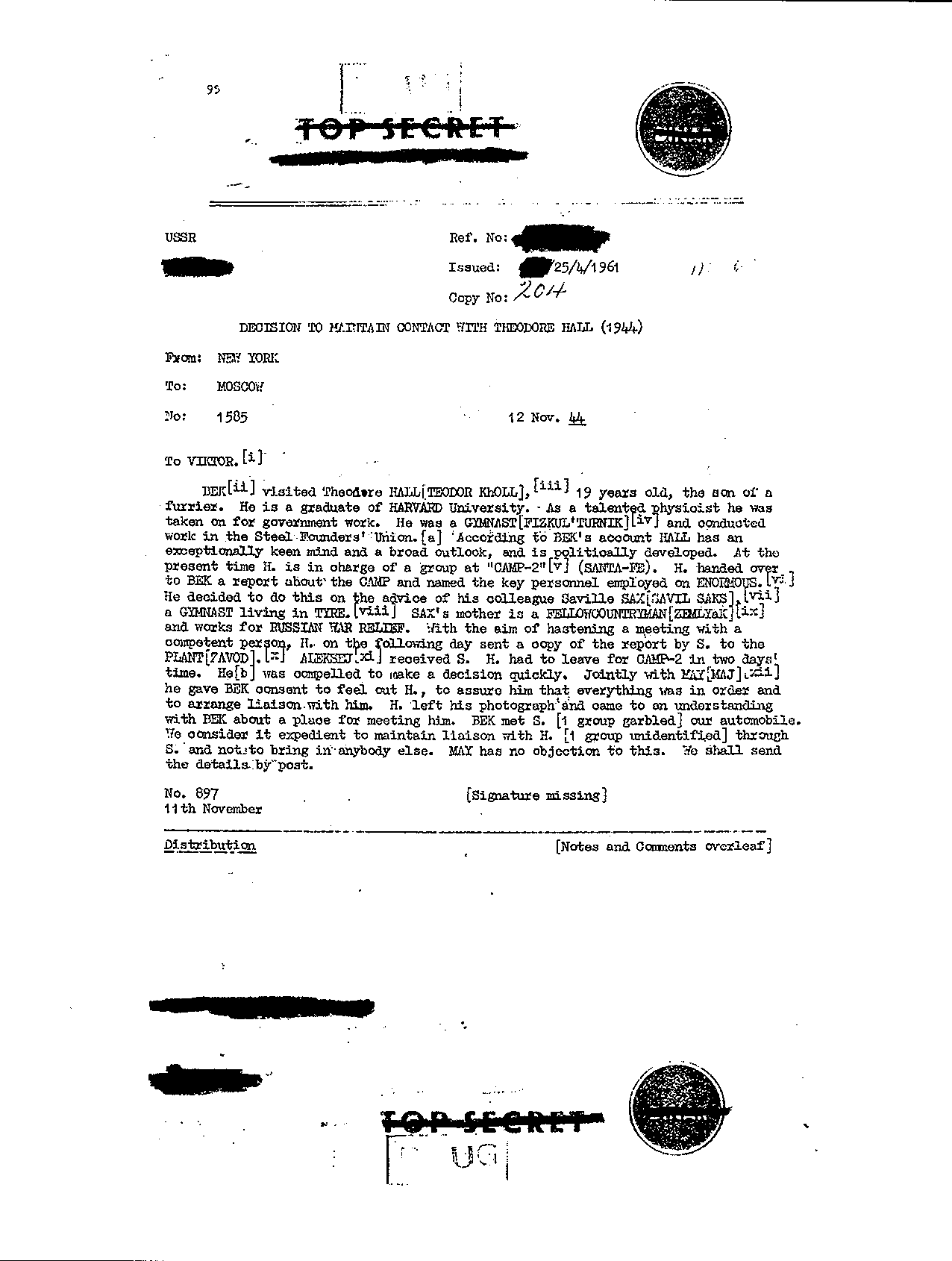
Lessons 01 and 02 of this module showed that the Soviet espionage threat of the 1930s and 1940s was real. The Venona decrypts, the Moscow archives and the confessions of agents such as Klaus Fuchs established that Soviet intelligence recruited Americans inside the atomic program, the Treasury, the State Department and other agencies. Lesson 11 tested Joseph McCarthy's assertions against that record, claim by claim, and lesson 12 set out method standards for any investigation of foreign influence: evidence before accusation, specific charges, a chance to answer, the difference between membership or association and espionage, and accountability for the investigator. This lesson applies the same tests to the present.
The question has not changed since 1950. Foreign states want American secrets, American technology and American policy outcomes, and some of them pay Americans to help. The methods have changed. In 1944 a Soviet officer in New York sent enciphered cables to Moscow, and American codebreakers read some of them years later. In 2024 a Chinese state-sponsored group, according to the FBI and CISA, sat inside the networks of American telephone companies and copied call records. In 1950 a senator held up a list he would not show. In 2026 the Justice Department files an indictment that lists dates, payments and messages, and a jury decides.
The two periods also share a trap. When the threat is real, it is tempting to treat every accusation as proof, every association as guilt and every acquittal as a cover-up. When an accusation proves false, it is tempting to treat the whole threat as invented. Both errors appear in the record of the 1950s and both appear in the record of the 2020s. The rest of this lesson tries to avoid both by sorting each matter into documented fact, allegation and open question.

What is real today, and what the people sounding the alarm got right
Begin where lesson 11 began with the anti-communists of the 1940s: with what they got right. The people in Congress, the FBI, the intelligence agencies and the press who have warned since the mid-2010s that China, Russia and Iran run aggressive operations on American soil have been confirmed by convictions on several fronts.
- Covert state police operations. A federal jury convicted Lu Jianwang on May 13, 2026 of acting as an illegal agent of the People's Republic of China and obstructing justice by destroying evidence, in connection with a "Fuzhou Police Overseas Service Station" at 107 East Broadway in Manhattan.1
- Harassment of people the Chinese government wanted returned. A former New York City police sergeant and two other men were convicted in June 2023 for their roles in an "Operation Fox Hunt" campaign to coerce a man living in New Jersey to return to China. A note left on the family's door in 2018 said the wife and children would be fine if he went back to face a ten-year prison term.2
- Murder plots. Two men tied to a Russian criminal organization were sentenced on October 29, 2025 to 25 years each after a jury found that they took a contract from the Islamic Revolutionary Guard Corps (IRGC) to kill the journalist Masih Alinejad, who lives in New York.3
- Covert propaganda funding. In September 2024 a federal grand jury charged two employees of the Russian state outlet RT with secretly sending nearly $10 million to a Tennessee company that produced American political commentary videos.4
- Bought officials. Senator Robert Menendez was convicted on July 16, 2024 of bribery, of conspiring to act as an agent of the government of Egypt while a public official, and of related crimes, and he was sentenced to 11 years in prison on January 29, 2025.5
- Insiders who sold or leaked secrets. A Navy machinist's mate on the amphibious assault ship USS Essex was convicted of espionage on August 20, 2025 for sending ship information to a Chinese intelligence officer who paid him more than $12,000.6
- Network intrusions. FBI and CISA stated in November 2024 that hackers affiliated with the People's Republic of China had carried out "a broad and significant cyber espionage campaign" against American telecommunications companies.7
The National Counterintelligence Strategy issued in August 2024 summarized the problem in one sentence: the United States faces threats from foreign intelligence entities that are "unprecedented in their breadth, volume, sophistication, and impact."8 A reader does not need to accept every warning issued in Washington to accept the cases above. They rest on evidence that was tested by guilty pleas or by juries.
What the record does not show is just as important. It does not show that every person of Chinese, Russian or Iranian heritage, every university partnership or every contact with a foreign official is an act of espionage. The Justice Department itself reached that conclusion when it ended the China Initiative, discussed below. It does not show that every accusation made in a congressional report has been proved in court. And it does not show that the threat is new: Soviet services did many of the same things in the 1940s, as lessons 01 and 02 document.

The law: what is a crime, what is only a filing, and what is neither
Much public confusion about foreign influence comes from treating very different acts as one thing. American law separates them, and the separation is the first method standard any reader should apply.
- Espionage. Gathering or passing national defense information to a foreign government, or keeping it without authorization, is a crime under the Espionage Act of 1917 (18 U.S.C. sections 793 and 794). Jack Teixeira and the Navy sailor Jinchao Wei, both discussed below, were charged under these provisions.
- Acting as an undisclosed agent of a foreign government. 18 U.S.C. section 951 makes it a crime to act in the United States as an agent of a foreign government without notifying the Attorney General. The Chinese "police station" and Operation Fox Hunt prosecutions used this statute.
- Public officials acting as foreign agents. 18 U.S.C. section 219 bars a public official from acting as an agent of a foreign principal who is required to register under FARA. The Justice Department lists a penalty of up to two years in prison and a fine of up to $250,000.9 Senator Menendez was convicted under the conspiracy version of this charge.
- Registration and disclosure. The Foreign Agents Registration Act (22 U.S.C. section 611 and following) does not forbid lobbying, public relations or political advocacy for a foreign client. It requires the agent to register with the Justice Department and disclose the relationship, the activities and the money.
- Lawful contact. Meeting foreign officials, studying abroad, collaborating with foreign scientists, accepting foreign investment and holding opinions that a foreign government also holds are lawful. Some of these activities are regulated by disclosure rules, export controls or grant conditions, but none is a crime in itself.
The Justice Department states what it calls "an important purpose" of FARA in its reports to Congress: it is "to inform the government and the people of the United States of the identities of persons engaging in political activities for or on behalf of foreign governments, foreign political parties, and other foreign principals, so that their statements and activities can be assessed in light of their associations."10 The same reports add that registration "does not indicate approval by the United States Government" of the agent's activities, and that the Act "does not place any limitations on the political advocacy activities of an agent."10 FARA is a sunlight law. Its theory is that Americans can judge a message for themselves once they know who paid for it.
FARA in 1938: born from the first congressional inquiry into foreign propaganda
FARA is a direct descendant of the committees this module studies. In 1934 the House created a Special Committee on Un-American Activities, known by the names of its two leading members, John McCormack of Massachusetts and Samuel Dickstein of New York, to investigate Nazi propaganda and other foreign propaganda in the United States. Lesson 03 describes that committee and the Dies committee that followed it in 1938. Registration of foreign propaganda agents grew out of that inquiry, and Congress enacted the Foreign Agents Registration Act in 1938.11 The Congressional Research Service describes the origin plainly: the Act followed congressional investigations of German propaganda agents in the years before the Second World War.11
The 1938 Act aimed at propaganda. A 1966 amendment changed its focus toward agents who represent foreign economic and political interests, banned contingent fee contracts and required Justice Department regulations.11 Agents must register within ten days of agreeing to act for a foreign principal. Willful violations carry up to five years in prison; the Congressional Research Service gives the statutory fine as up to $10,000, and the Justice Department lists a maximum fine of $250,000 under the general federal fines law.9 Registrants are normally given a chance to fix deficient filings before any legal action.11 The Attorney General must report to Congress on the administration of the Act every six months. Those semi-annual reports, published from 1942 forward on the Justice Department's website, are the primary source for the numbers in this lesson.12
FARA and the Lobbying Disclosure Act
The Lobbying Disclosure Act of 1995 (2 U.S.C. sections 1601 to 1614) requires lobbyists to register with the Clerk of the House and the Secretary of the Senate. The two laws are run by different bodies: the Justice Department administers FARA and Congress administers the LDA.11 FARA contains eight exemptions, including diplomats, religious, scholastic and scientific activities, and persons registered under the Lobbying Disclosure Act.11 The LDA exemption, in 22 U.S.C. section 613(h), allows a lobbyist for a foreign company (not for a foreign government or political party) to register under the less detailed LDA. Members of Congress have proposed repealing that exemption, and a House Judiciary subcommittee discussed the idea at an April 5, 2022 hearing, according to the Congressional Research Service.11 As of October 28, 2026, no repeal of the LDA exemption has been located in the public record for this lesson.
The registrations show which countries spend most on American opinion. A 2026 Congressional Research Service study of FARA filings from 2001 to 2021 counted registrations for foreign principals in 219 countries, territories and regions. Saudi Arabia and Japan led with 148 registrations each, followed by Ukraine (145), the United Arab Emirates (130), South Korea (127), Canada (118), Qatar (108), Turkey (105) and China (104). Public relations was the most common activity (59.7 percent of registrations) and lobbying the second (28.4 percent).13 Most FARA registrants are open, lawful agents for allied and friendly governments, companies and tourism boards. A FARA filing is evidence of disclosure, not of disloyalty.
FARA enforcement history: decades of quiet, then a turn to prosecution
For most of its life FARA was enforced through letters, inspections and amended filings, not prosecutions. The Justice Department Inspector General's 2016 audit of FARA enforcement is widely reported to have counted only seven criminal FARA cases brought between 1966 and 2015. That figure could not be confirmed against the audit file during this check, and it is listed as unverified.14 After 2016 the Department moved FARA into criminal enforcement. A law firm analysis of the February 2025 memorandum, discussed below, describes the Department's 2019 decision to make FARA a criminal enforcement priority.15
The semi-annual reports from 2022 to 2025 list the criminal cases the Department itself counted as FARA-related:
- 2022. In March, a criminal complaint charged Elena Branson with failing to register under FARA while, the complaint alleged, working for years for the Russian government to arrange meetings for Russian officials and run organizations promoting Russian policy. She had left for Russia in 2020 and remained a fugitive.16 In November, a grand jury in Florida indicted former Representative David Rivera and Esther Nuhfer on FARA and money laundering charges, alleging they lobbied for sanctions relief on behalf of Venezuela's Nicolas Maduro in return for $20 million paid through a consulting agreement with a subsidiary of Venezuela's state oil company.17 A civil suit seeking to force the casino executive Stephen Wynn to register as an agent of the People's Republic of China was dismissed in October 2022 as time-barred.16
- 2023. Gal Luft, co-director of a Maryland think tank, was indicted on FARA, arms trafficking, Iran sanctions and false statement charges. Arrested in Cyprus in February 2023, he fled after release on bail while extradition proceedings were pending and was re-arrested in Cyprus in August 2024. A superseding indictment against Senator Menendez added a charge of conspiring to act as an agent of a foreign principal.18
- 2024. The lobbyist Barry Bennett and the consultant Douglas Watts entered deferred prosecution agreements over a covert company that ran a lobbying campaign financed by a foreign government, with fines of $100,000 and $25,000. Representative Henry Cuellar and his wife were indicted on charges that they took about $600,000 in bribes from an oil company controlled by the government of Azerbaijan and a Mexico City bank. Irada Akhoundova pleaded guilty to failing to register in the related case.19 In the second half of the year, the Department charged Sue Mi Terry (alleged agent of the Republic of Korea), Linda Sun (alleged agent of the People's Republic of China), the RT employees Kostiantyn Kalashnikov and Elena Afanasyeva, and David Rivera again, in a separate case involving a sanctioned Venezuelan businessman.20
- 2025. One case: Dale Britt Bendler, a CIA contractor and former employee, pleaded guilty in April 2025 to acting as an agent of a foreign principal while a public official (18 U.S.C. section 219) and to removing classified material, and was sentenced in November 2025 to concurrent terms of one year and one day.21 For July through December 2025 the Department reported "no criminal FARA cases charged" and no civil enforcement suits.10
Outcomes since filing vary and several are still open as of October 28, 2026. The Cuellar case ended without a trial when President Trump granted Representative Cuellar and his wife a "full and unconditional pardon" on December 3, 2025.22 The outcome of the Terry, Rivera and Luft cases could not be confirmed for this lesson and is listed as unverified.
The February 5, 2025 memorandum: what it said and what it changed
On February 5, 2025, Attorney General Pam Bondi issued a memorandum to all Justice Department employees titled "General Policy Regarding Charging, Plea Negotiations, and Sentencing." Its FARA passage made three changes.23
- It narrowed criminal charging. "Recourse to criminal charges under the Foreign Agents Registration Act (FARA) and 18 U.S.C. section 951 shall be limited" to "instances of alleged conduct similar to more traditional espionage by foreign government actors."23
- It redirected the FARA Unit. The Counterintelligence and Export Control Section of the National Security Division, which houses the FARA Unit, "shall focus on civil enforcement, regulatory initiatives, and public guidance."23
- It disbanded the FBI's Foreign Influence Task Force, which had been created to coordinate investigations of foreign influence operations, explaining the change as a way to free resources for "more pressing priorities" and to end risks of "further weaponization and abuses of prosecutorial discretion."23
A companion memorandum issued the same day, "Total Elimination of Cartels and Transnational Criminal Organizations," disbanded "Task Force KleptoCapture, the Department's Kleptocracy Team, and the Kleptocracy Asset Recovery Initiative," which had pursued the assets of sanctioned Russian oligarchs and other foreign officials.24
What changed in the numbers. The Department's own reports show the shift. In 2024, the reports list ten defendants charged in FARA-related criminal matters. In 2025, they list one, Dale Bendler, whose case combined a section 219 charge with the removal of classified material, which fits the memo's espionage-like category. For July to December 2025 the report states "there were no criminal FARA cases charged" and no civil suits were filed, although the FARA Unit conducted seven books-and-records inspections.10 In the first half of 2025 it conducted 18 inspections.21
What did not change. Registration kept rising. The Department received 89 new registration statements from January to June 2025, the highest half-year figure in the ten years charted above, and 54 more from July to December. The number of active registrants on file reached 565, representing 858 foreign principals, in the second half of 2025.2110 Prosecutions for espionage, for acting as an agent of the People's Republic of China, and for Iranian murder plots continued through 2025 and 2026, as the cases below show. Some of them were charged under section 951 and fit the memo's "traditional espionage" category.
The rival readings. The memorandum's stated rationale is that FARA prosecutions had become a tool that could be turned against political actors and that resources should go to graver threats. Supporters of that view point to the decades in which the Department relied on voluntary compliance and amended filings before it treated FARA as a criminal priority. A Covington and Burling client alert of February 6, 2025 said the memo "arguably contrasts with the Department's approach over the past few years" and appears closer to the Department's practice before 2017, and noted that "the Department does not currently have authority to issue civil fines." Its civil tools are limited to court injunctions that compel registration.15 Those who opposed the change argued that without the prospect of criminal charges, an agent who hides a foreign client faces little more than an order to register. At his 2025 confirmation process for Director of the National Counterintelligence and Security Center, George Wesley Street was asked about both changes. He answered in writing that he was "unaware of any curtailment of FARA-related investigations" and had "not personally seen any impact on the U.S. counterintelligence effort" from disbanding the Foreign Influence Task Force, and deferred to the FBI and Justice Department.25
The proposed rule. On December 19, 2024, the Department submitted a proposed rule to update the FARA regulations, which had last been amended in 2007. It was published in the Federal Register on January 2, 2025, and the comment period closed on March 3, 2025.21 As of October 28, 2026, a final rule could not be located for this lesson. Its status is listed as unverified.
2026 assessment. The memo did what it said. Criminal FARA charging dropped from ten defendants in 2024 to one in 2025, and the FBI's coordinating task force was disbanded. Disclosure under FARA did not collapse; it grew. Whether the narrower criminal posture lets more covert agents go unregistered cannot be measured from public data, because unregistered agents do not appear in the reports. That question is unresolved.
The People's Republic of China: documented cases and their outcomes
The People's Republic of China (PRC) accounts for the largest share of the cases in this lesson. Each one below is described by what the government charged and what a court or jury did, with the status as of October 28, 2026.
The Manhattan "overseas police station"
What was charged. In 2023 (docket 23-CR-316) federal prosecutors in Brooklyn charged Lu Jianwang and Chen Jinping with conspiring to act as agents of the PRC and with obstruction of justice for operating an undeclared police station for the PRC's Ministry of Public Security, the country's main domestic law enforcement and intelligence agency, in an office building at 107 East Broadway in Manhattan's Chinatown.1
What the evidence showed. According to the Justice Department's account of the trial evidence, Lu began working on the station in January 2022 on orders from a Ministry of Public Security official. FBI agents searched the office in October 2022 and recovered a blue banner reading "Fuzhou Police Overseas Service Station, New York, USA." Lu's handler tasked him with collecting information, including locating a pro-democracy advocate who had fled China. After the FBI's search, investigators found that WeChat messages between the defendants and their handler had been deleted.1
Outcome. Chen Jinping pleaded guilty in December 2024 to conspiring to act as an agent of the PRC and was awaiting sentencing as of May 2026. A jury convicted Lu Jianwang on May 13, 2026, after a one-week trial before Judge Nina R. Morrison, of acting as an illegal agent of the PRC and of obstruction of justice. He faces up to 30 years in prison.1 A sentencing date and sentence for Lu could not be confirmed as of October 28, 2026.
Assessment. Supported. The existence and purpose of the station were proved by a guilty plea and a jury verdict. The case is a modern example of what lesson 01 called the real threat: a foreign security service operating covertly on American soil against people living here.
The Linda Sun case: a hung jury and a pending retrial
What was charged. On September 3, 2024, prosecutors in the Eastern District of New York unsealed an indictment charging Linda Sun, a former deputy chief of staff to the governor of New York, with violating and conspiring to violate FARA, visa fraud, alien smuggling and money laundering conspiracy. Her husband, Chris Hu, was charged with money laundering conspiracy, conspiracy to commit bank fraud and misuse of means of identification.26
What was alleged. The indictment alleged that Sun, while working for the state, acted at the direction of PRC and Chinese Communist Party officials by "blocking representatives of the Taiwanese government from having access to high-level New York State officers," changing officials' messaging on issues important to the PRC, obtaining official proclamations for PRC representatives without authorization, and issuing unauthorized invitation letters that helped PRC officials travel to the United States. In return, the government alleged, she and her family received help with millions of dollars in transactions for Hu's business, travel benefits, a job for a cousin in China, and "Nanjing-style salted ducks prepared by a PRC government official's personal chef."26 Later charges, according to press reports, alleged kickbacks tied to New York State contracts for personal protective equipment during the COVID-19 pandemic.27
Outcome. After a trial of more than six weeks, Judge Brian Cogan declared a mistrial on December 22, 2025, because the jurors could not reach a unanimous verdict.2827 In January 2026 the judge set a tentative retrial date of January 18, 2027, and the defense said its lawyers might have to withdraw unless frozen assets were released to pay them.28 A news report of October 6, 2026 stated that a superseding indictment filed September 2, 2026 added a money laundering conspiracy count, bringing the total to 20 counts. That report could not be confirmed against a court filing and is listed as unverified.27 Both defendants have pleaded not guilty and are presumed innocent.
Assessment. Unresolved. The indictment makes specific, checkable allegations, which is the opposite of the 1950 Wheeling method. But twelve jurors who heard the evidence did not agree that it proved any count beyond a reasonable doubt. A reporter in 2026 may describe the charges and the evidence presented. A reporter may not describe Sun as a convicted agent of China.
Operation Fox Hunt prosecutions
What it was. "Fox Hunt" is the name the PRC government gave to a campaign to pressure people it accuses of corruption to return to China. The Justice Department's chief of national security, Matthew Olsen, described it in 2022 as "an illegal multiyear campaign to coerce the return of certain Chinese nationals to China."29 The campaign becomes a crime in the United States when people act here at the direction of the PRC government without notifying the Attorney General, or when they stalk and threaten the targets.
The Brooklyn trial. A federal jury in Brooklyn convicted three men in June 2023 after a three-week trial: Michael McMahon, a former New York City police sergeant working as a private investigator; Zhu Yong; and Zheng Congying. The victims, identified in court papers as John Doe #1 and his family, lived in New Jersey. McMahon obtained the man's address, carried out surveillance and was paid more than $19,000. On September 4, 2018, Zheng and another conspirator left a note on the family's front door saying the wife and children would be fine if the man returned to China to serve a ten-year prison term.2
Outcome. Zhu Yong was sentenced to 24 months and Zheng Congying to 16 months in January 2025. McMahon was sentenced on April 16, 2025 to 18 months in prison and an $11,000 fine by Judge Pamela K. Chen.2 The jury convicted McMahon of acting as an illegal agent of the PRC and of stalking. His 18-month sentence fell between Zheng's 16 months and Zhu's 24 months.
Assessment. Supported. The campaign was real, and its operation in New Jersey was proved to a jury. The case also shows that a person can be convicted as a foreign agent without being a spy in the classic sense, and that a jury, not a press release, decides which acts crossed the line.
Volt Typhoon and Salt Typhoon: state hacking described by CISA and the FBI
The most serious current PRC operations described by the government are not human agents but intrusions into networks. These have not produced public trials of the operators, who are in China, so the evidence is the published technical advisories of American agencies and their allies.
Volt Typhoon. On February 7, 2024, CISA, the National Security Agency, the FBI and partner agencies published advisory AA24-038A, "PRC State-Sponsored Actors Compromise and Maintain Persistent Access to U.S. Critical Infrastructure." The agencies assessed that PRC state-sponsored actors were "seeking to pre-position themselves on IT networks for disruptive or destructive cyberattacks against U.S. critical infrastructure." They reported compromises "primarily in Communications, Energy, Transportation Systems, and Water and Wastewater Systems Sectors," in the continental United States and its territories, "including Guam," and said they had observed Volt Typhoon "maintaining access and footholds within some victim IT environments for at least five years." The advisory called the use of "living off the land" techniques, which rely on tools already present on a victim's systems, "a hallmark" of the group.30 The concern stated in the advisory is the ability to disrupt services in a crisis or conflict, not only to steal information.
Salt Typhoon. On November 13, 2024, the FBI and CISA issued a joint statement on PRC targeting of commercial telecommunications infrastructure. They described "a broad and significant cyber espionage campaign" in which PRC-affiliated actors compromised networks at multiple telecommunications companies, stole customer call records, compromised the private communications of a limited number of people, mainly people involved in government or political activity, and copied certain information that was subject to U.S. law enforcement requests under court orders.7 On August 27, 2025, the FBI, CISA, the National Security Agency and agencies of a dozen other countries issued a joint advisory, AA25-239A, naming three Chinese companies (Sichuan Juxinhe Network Technology, Beijing Huanyu Tianqiong Information Technology and Sichuan Zhixin Ruijie Network Technology) as providers of cyber products and services to China's Ministry of State Security and People's Liberation Army. The head of the FBI's cyber division, Brett Leatherman, said the campaign had targeted more than 600 organizations in 80 countries and had been active "since at least 2019."31
Assessment. Supported as to the intrusions, which American and allied agencies documented with technical indicators that network defenders can check. Attribution to specific PRC agencies and companies rests on intelligence and technical analysis that has not been tested in an American court. A careful writer reports the attribution as the stated assessment of the named agencies.
The end of the China Initiative: a lesson in method
The China Initiative belongs in this lesson because it shows how a real threat can be pursued with a flawed method, which is the central problem of the McCarthy period.
What it was. The Justice Department announced the "China Initiative" in 2018 to focus prosecutions on trade secret theft, economic espionage and related crimes tied to the PRC.29 Over time many of its cases involved academic researchers charged with fraud or false statements for failing to disclose ties to Chinese institutions on grant applications, not with stealing secrets for the PRC.
What went wrong. Several research cases failed in court. The engineer Anming Hu was acquitted in September 2021 after a mistrial, with the judge ruling that no rational jury could find he had schemed to defraud NASA, and prosecutors moved to dismiss charges against the MIT engineer Gang Chen in January 2022. A December 2021 analysis by MIT Technology Review found that about 90 percent of the people charged under the initiative were of Chinese descent and that the Department had removed from its public list several cases that had ended in dismissal or acquittal. These outcomes are reported in news and analysis sources and summarized in reference works. The court records were not opened for this lesson, and the figures are listed as unverified.32
The Department's own conclusion. On February 23, 2022, Assistant Attorney General Matthew Olsen announced the end of the initiative in a speech at George Mason University. "While I remain focused on the evolving, significant threat that the government of China poses, I have concluded that this initiative is not the right approach," he said. "But by grouping cases under the China Initiative rubric, we helped give rise to a harmful perception that the department applies a lower standard to investigate and prosecute criminal conduct related to that country or that we in some way view people with racial, ethnic or familial ties to China differently." He also said he believed "the department's actions have been driven by genuine national security concerns," and he announced a "Strategy for Countering Nation-State Threats" covering China, Russia, Iran and North Korea.29 For research disclosure cases, he said, prosecutors would consider "whether criminal prosecution is warranted or whether civil or administrative remedies are more appropriate."29
The rival readings. One reading holds that the initiative caught real wrongdoing, including real economic espionage cases, and that it was dismantled because of political pressure while the PRC's talent recruitment programs continued. The House Select Committee on the CCP, discussed below, has continued to document research ties between American universities and PRC defense entities, which fits that reading. The other reading holds that the initiative let a national label substitute for individual evidence, chilled legitimate science and swept in people whose only offense was a paperwork omission. The Department's own speech does not resolve the dispute: it rejected the label and the "perception" it created while defending the motives behind it.
Assessment. Partly supported as a method critique. The threat the initiative targeted was real, as the convictions in this lesson show. The method of organizing cases by the nationality of the foreign government, and of prosecuting disclosure failures as if they were espionage, produced acquittals and dismissals and was abandoned by the Department itself. The parallel to 1950 is direct: a real threat does not justify a method that treats a category of people as suspects.
Russia: covert media funding, seized domains and an officer who spied for fifteen years
The September 2024 RT indictment and the Tennessee company
What was charged. On September 4, 2024, the U.S. Attorney's Office for the Southern District of New York unsealed an indictment charging Kostiantyn Kalashnikov, 31, and Elena Afanasyeva, 27, both Russian nationals employed by RT, the Russian state-controlled media outlet formerly called Russia Today, with conspiracy to violate FARA and conspiracy to commit money laundering.4
What was alleged. The indictment alleged that RT deployed nearly $10 million to secretly fund and direct a Tennessee-based online content company, identified in court papers as "U.S. Company-1" and widely identified in news coverage as Tenet Media. Wires to the company totaled about $9.7 million, roughly 90 percent of its bank deposits, from about October 2023 to August 2024. The company published nearly 2,000 videos that drew more than 16 million views on YouTube alone, and Afanasyeva posted or directed hundreds of them under fake personas, according to the government. The Justice Department described the company as "secretly funded, directed, and controlled by RT."4
Who was not charged. No American commentator whose videos appeared on the company's channels was charged. The company's founders are identified only as Founder-1 and Founder-2 in the government's account, and the indictment does not charge them.4 The government's description is of an operation that concealed its Russian source of money from the audience; whether any individual commentator knew the source is a separate question that the charging papers summarized in the release do not resolve, and readers should not assume knowledge that has not been shown.
Outcome. Both defendants were at large when the indictment was unsealed. As of October 28, 2026, no arrest or trial had been reported in the sources checked for this lesson, and the charges have not been tested in court. The defendants are presumed innocent.4
"Doppelganger": the domain seizures
The same day, the Justice Department announced the seizure of 32 internet domains used in a Russian government-directed influence campaign called "Doppelganger," which, according to the Department, spread covert Russian government propaganda, including efforts aimed at the 2024 presidential election. The Department said the campaign was run by the Russian companies Social Design Agency, Structura National Technology and ANO Dialog, under the direction of the Russian Presidential Administration and specifically its First Deputy Chief of Staff, Sergei Kiriyenko. The Treasury Department designated ten individuals and two entities for sanctions in coordination with the seizures.33 The seizures rested on an FBI affidavit filed in court, not on criminal convictions.
Assessment. Supported as to the existence of the campaign and the RT funding scheme, which rest on bank records, sworn affidavits and seized materials described in detail. The criminal charges against the two RT employees remain allegations because no trial has occurred.
Other Russia cases
Peter Debbins. A former Army Special Forces captain, Peter Rafael Dzibinski Debbins, was sentenced on May 14, 2021 to 188 months (about 15.7 years) in prison after pleading guilty to conspiracy to commit espionage. The Justice Department said the conspiracy with a Russian intelligence service ran from December 1996 to January 2011; that Debbins was given a code name in 1997; that he gave Russian agents information about his chemical and Special Forces units and classified information about his deployments; and that he gave them the names of former team members so they could be approached for recruitment.34 The case is the closest modern parallel to the Soviet recruitment of Americans documented in Venona: a long-term relationship, a cover name and a target chosen for access.
Elena Branson. Charged in March 2022 with failing to register under FARA and other offenses, Branson was accused of working for years for the Russian government to coordinate meetings for Russian officials with American political figures and business people and to run organizations promoting Russian policy. She left for Russia in 2020 and remains a fugitive, according to the Department's report.16
Iran: murder-for-hire plots charged from 2022 to 2024 and their outcomes
Iran's cases are the starkest in this lesson because they involve plans to kill people on American soil. The government's 2024 counterintelligence strategy noted that "U.S.-based foreign dissidents are increasingly among the victims of incapacitation, rendition, and assassination attempts."8
The plots against Masih Alinejad
The 2022 plot. Masih Alinejad is an Iranian-American journalist and critic of the Iranian government who lives in New York. According to the Justice Department, high-ranking members of the IRGC offered a leader of a Russian criminal organization, Rafat Amirov, $500,000 to kill her and supplied her home address. A member of the organization, Khalid Mehdiyev, surveilled her Brooklyn home. On July 28, 2022, police stopped him for a traffic violation and found an AK-47-style rifle with 66 rounds of ammunition in his car. Iranian operatives had also tried to kidnap her from the United States in 2020 and 2021.3
Outcome. A jury convicted Amirov and Polad Omarov in March 2025 of murder-for-hire, attempted murder in aid of racketeering and related charges after a two-week trial. Judge Colleen McMahon sentenced each to 25 years in prison on October 29, 2025.3
The 2024 plot. In November 2024 federal prosecutors charged two New York men, Carlisle Rivera and Jonathan Loadholt, with taking an assignment from an Iranian operative, Farhad Shakeri, to kill Alinejad. According to press accounts of the sentencing, the attack was planned for February 2024 during a speaking event at Fairfield University in Connecticut, and Shakeri offered the two men $100,000. Both men pleaded guilty. Judge Lewis J. Liman sentenced Rivera to 15 years on January 28, 2026.35 A court reporter's account states that Loadholt was sentenced to ten years on May 27, 2026. That figure could not be confirmed against a Justice Department release and is listed as unverified.36 Shakeri is believed to be in Iran. He told federal authorities that the IRGC had tasked him with arranging to kill President Trump before the 2024 election. That statement is his account as reported in press coverage of the case, not a fact found by a court.35
Asif Merchant
On March 6, 2026, a federal jury in Brooklyn convicted Asif Merchant, 48, a man with ties to Pakistan and Iran, of murder for hire and attempting to commit an act of terrorism transcending national boundaries. The Justice Department said Merchant admitted at trial that he was a trained operative of the IRGC, came to the United States in April 2024 to recruit hitmen to kill a U.S. official or politician in revenge for the 2020 death of Qasem Soleimani, and paid a $5,000 advance on June 21, 2024 to men who were in fact undercover law enforcement officers. He was arrested on July 12, 2024 before he could leave the country. A New York acquaintance he had approached reported him to law enforcement and became a confidential source.37 He faces up to life in prison. A sentence had not been reported as of the Department's announcement, and none was confirmed for this lesson.
Other charges. In August 2022 the Justice Department charged an IRGC member, Shahram Poursafi, with attempting to arrange the murder of former National Security Advisor John Bolton. He is believed to be outside U.S. custody. The charging release was not opened for this lesson, and the details are listed as unverified.
Assessment. Supported. A jury convicted the men hired in the 2022 Alinejad plot, the two men hired in the 2024 plot pleaded guilty, and a jury convicted Merchant. The role of the IRGC was proved to the extent required by the charges, through recorded communications, payments and, in Merchant's case, his own testimony.
Egypt, Qatar and the Menendez case: a senator bought by foreign interests
The Menendez case is the clearest modern example of what anti-communists in the 1940s feared most: a powerful official serving a foreign state for money.
What was charged. Senator Robert Menendez of New Jersey, then chairman of the Senate Foreign Relations Committee, was indicted in September 2023 with his wife, Nadine Menendez, and New Jersey businessmen including Wael Hana and Fred Daibes. An October 2023 superseding indictment charged that Menendez "promised to take and took a series of acts on behalf of Egypt, including on behalf of Egyptian military and intelligence officials," and added the charge of conspiring to act as an agent of a foreign principal while a public official.18
What the evidence showed. According to the Justice Department's sentencing release, the jury heard that in May 2018 Menendez passed non-public information about the staffing of the U.S. Embassy in Cairo, which reached Egyptian officials through intermediaries; that the same month he ghostwrote a letter on Egypt's behalf urging senators to lift a hold on $300 million in aid; that in July 2018 he signaled through intermediaries that he would approve a weapons sale of nearly $100 million; and that on May 23, 2019 he pressed a senior Agriculture Department official to stop opposing a monopoly on halal certification of meat exports to Egypt held by Hana's company. On the Qatar side, Daibes sought investment from a fund tied to the Qatari government, and Menendez made public statements praising Qatar and passed them to Daibes to share with people connected to the fund, including a press release he sent to Daibes on August 20, 2021 before it was issued. A June 2022 FBI search of the Menendez home found more than $100,000 worth of gold bars provided by Hana or Daibes.5
Outcome. After a nine-week trial, a jury convicted Menendez, Hana and Daibes on July 16, 2024. Judge Sidney H. Stein sentenced Menendez on January 29, 2025 to 11 years in prison and forfeiture of $922,188.10; Hana to 97 months and a $1,250,000 fine; and Daibes to seven years and a $1,750,000 fine.5 Nadine Menendez was convicted at a separate trial in 2025 and sentenced by Judge Stein to 54 months. She surrendered to federal prison on July 10, 2026 and has said she will appeal. As of that date her husband was serving his 11-year sentence.38
Assessment. Supported. The conviction rests on documents, recorded messages, physical evidence and a jury verdict. Note what the case does not show: that Egypt or Qatar are hostile powers. Both are partners of the United States. The law against undisclosed foreign agency applies to allies as well as adversaries, a point the 1950s debate, focused on one adversary, rarely confronted.
Other officials and agents charged with undisclosed foreign ties
Henry Cuellar. In April 2024 a grand jury in the Southern District of Texas indicted Representative Henry Cuellar of Texas and his wife on charges of bribery and of violating the ban on public officials acting as foreign agents. The indictment alleged that they received about $600,000 in bribes from an oil and gas company owned and controlled by the government of Azerbaijan and from a bank in Mexico City, laundered through sham consulting contracts.19 On December 3, 2025, before trial, President Trump granted the couple a "full and unconditional pardon."22 A pardon ends a prosecution; it is not a finding that the allegations were true or false. The case is therefore unresolved on the facts.
Bennett and Watts. In January 2024 the lobbyist Barry Bennett and the consultant Douglas Watts entered deferred prosecution agreements. The Justice Department said a foreign government hired Bennett's firm, which registered under FARA, but that Bennett also directed Watts to set up a separate company, financed by the same government and operated covertly, that ran a campaign to disparage the government's regional rival. The charges were to be dismissed after the men complied with the agreements, including fines of $100,000 and $25,000.19 The case shows the most common form of FARA violation in practice: a registered relationship with an unregistered shadow alongside it.
Insider espionage: Teixeira, the Navy sailors and the 2025 to 2026 cases
Insiders who hold clearances remain the most damaging channel, as they were in the 1940s. Some sell secrets to foreign officers. Some leak them for other reasons. The law treats unauthorized retention and transmission of national defense information as a crime whatever the motive.
Jack Teixeira
Jack Teixeira, an information technology specialist in the Massachusetts Air National Guard, pleaded guilty on March 4, 2024 to six counts of willful retention and transmission of classified information relating to the national defense. The Justice Department said that beginning around January 2022 he posted classified information, including material marked "TOP SECRET," on the social media platform Discord, used a secured workstation at his base to run hundreds of searches unrelated to his duties, and kept going after superiors warned him twice.39 He was sentenced to 15 years in federal prison in November 2024. At a separate court-martial in March 2025 he pleaded guilty to obstructing justice by destroying a phone, a computer hard drive and an iPad and asking a friend to delete messages. He received a dishonorable discharge and no additional prison time.40 No evidence presented in the case showed that he worked for a foreign government. His case is espionage in the legal sense of the Espionage Act, not in the sense of service to a foreign power.
The 2023 Navy sailor cases
On August 3, 2023, the Justice Department announced charges against two Navy sailors in California.41
- Jinchao Wei, a machinist's mate on the amphibious assault ship USS Essex at Naval Base San Diego, was charged with conspiring to send national defense information to a PRC intelligence officer. A jury convicted him on August 20, 2025 of conspiracy to commit espionage, espionage and four counts of violating or conspiring to violate the Arms Export Control Act. The Department said a person posing as a naval enthusiast contacted him on social media in February 2022. The person was a Chinese intelligence officer who paid Wei more than $12,000 over 18 months for photographs, videos and information about the Essex and other ships, some taken from restricted Navy computer systems. Sentencing was set for December 1, 2025.6 A sentence of more than 16 years has been reported in reference sources, but the Justice Department's sentencing announcement could not be opened for this lesson, so the sentence is listed as unverified.
- Wenheng Zhao, a petty officer at Naval Base Ventura County, was charged with receiving about $14,866 in bribes from a PRC intelligence officer posing as a maritime economic researcher in exchange for secretly recording and sending operational plans for a large U.S. military exercise in the Indo-Pacific and photographs of radar system diagrams and blueprints at a base on Okinawa, from August 2021 through at least May 2023.41 He pleaded guilty, and a sentence of 27 months in prison imposed in January 2024 has been reported. The Justice Department's sentencing release could not be opened for this lesson, and the sentence is listed as unverified.
Both sailors were approached online by officers using false identities, the method the National Counterintelligence and Security Center warned of in its April 2025 bulletin on "Online Targeting of Current and Former U.S. Government Employees."42
Cases from 2025 and 2026
Beyond the verdicts already described (Wei in August 2025, Merchant in March 2026, Lu Jianwang in May 2026), the Justice Department's FARA reports record that Dale Britt Bendler, a CIA contractor and former CIA employee, pleaded guilty in April 2025 to acting as a foreign agent while a public official and to removing classified material from the CIA, and received concurrent sentences of one year and one day in November 2025.21 Reference sources also list 2025 arrests of active-duty Army soldiers and a State Department employee on charges of passing military or national defense information to people in China, with guilty pleas in some of them. Those cases were not confirmed against Justice Department releases for this lesson and are listed as unverified.
The National Counterintelligence and Security Center: strategy and threat warnings

The National Counterintelligence and Security Center (NCSC) sits within the Office of the Director of National Intelligence. It describes its mission as leading counterintelligence and security activities across the government to "detect, report, deter, disrupt, investigate, exploit, and defeat" foreign intelligence threats, and it develops the National Counterintelligence Strategy and the National Threat Identification and Prioritization Assessment.42 As of 2026 its director is George Wesley Street, who answered the Senate Intelligence Committee's written questions during his 2025 confirmation process.4225
The 2024 strategy. The current public strategy, the National Counterintelligence Strategy 2024, was issued with a presidential letter dated August 1, 2024. It names the People's Republic of China, Russia, Iran and North Korea as the leading state threats and is organized in three pillars: outmaneuver and constrain foreign intelligence entities; protect America's strategic advantages; and invest in the future. Its nine goals include protecting individuals against foreign intelligence targeting, protecting "Democracy from Foreign Malign Influence," protecting critical technology, critical infrastructure and supply chains, and combating foreign intelligence cyber activity.8 The strategy states that adversaries are increasing efforts to shape American opinion and policy and to inflame social tensions, often because they see such operations as less risky than other options, and that artificial intelligence makes those campaigns more persuasive and better targeted.8 As of October 28, 2026, no replacement strategy had been posted on the NCSC resources page checked for this lesson.42
Public warnings, 2022 to 2026. NCSC publishes "Safeguarding Our Future" bulletins for the public. They include a July 2022 bulletin on PRC influence operations aimed at state and local leaders, a March 2023 bulletin, "Don't Be a Pawn of Repressive Foreign Governments," issued in a dozen languages, an October 2023 bulletin on the Russian intelligence threat, a November 2024 bulletin on protecting critical infrastructure, an April 2025 bulletin on online targeting of current and former government employees, an August 2025 bulletin for academia, and an April 2026 bulletin on "non-traditional collectors" of data, intellectual property and technology.42 The bulletins describe methods and warning signs. They do not name individual Americans as suspects. That is a method choice worth noticing.
In Congress. In written answers to the Senate Intelligence Committee during his 2025 confirmation process, Street named "China, Russia, Iran and North Korea" as presenting "the most significant threats" and said "China and Russia remain the most prolific actors" in efforts to influence American elections.25
Congressional committees in 2025 and 2026: what they did
Congress investigates foreign influence today through standing intelligence and judiciary committees and through one select committee created for the purpose. This section describes them by their actions, as lesson 06 described HUAC, SISS and the Permanent Subcommittee on Investigations.
The House Select Committee on the CCP
Creation and leadership. The House established the Select Committee on the Strategic Competition Between the United States and the Chinese Communist Party by resolution (H.Res. 11) on January 10, 2023. Its chairman in 2025 and 2026 is Representative John Moolenaar of Michigan's Second District.43 Unlike HUAC, it has no permanent standing and was created as a select committee of the House.
Reports in 2025. The committee's report index lists seven reports in 2025, including "DeepSeek Unmasked" (April 16, 2025), on the Chinese artificial intelligence company; "Fox in the Henhouse" (September 5, 2025); "Joint Institutes, Divided Loyalties" (September 11, 2025); "From Ph.D. to PLA" (September 19, 2025); "Selling the Forges of the Future" (October 7, 2025); a November 2025 report on mineral pricing; and "Ten More For Taiwan" (December 18, 2025).44 "Fox in the Henhouse," issued jointly with the House Committee on Education and the Workforce after investigations it said had run over the past two years, reported finding about 1,400 research papers published between June 2023 and June 2025 that acknowledged Defense Department funding and involved PRC collaborators, just over half of them with entities tied to China's defense research and industrial base, and recommended legislation, the SAFE Research Act, to bar federal research funding for collaborations with entities controlled by foreign adversaries.45
Reports and hearings in 2026. In 2026 the committee issued reports including "Inside China's Strategy to Reshape the United Nations" (March 20), "Buy What It Can, Steal What It Must: China's Campaign to Acquire Frontier AI Capabilities" (April 16), "Stranger Pings: Chinese Telecom Companies Infiltrate U.S. Infrastructure" (August 4), a report on Harvard University (August 13) and "Free Trades, Hidden Ties: Exposing Webull's China Links" (October 7).44 It held hearings on "China's Economic Espionage and Subnational Influence in the United States" (June 25, 2026), federal research security (July 15, 2026) and import controls (September 16, 2026).43
The Harvard report as a method case. The August 13, 2026 report, "Compromised Independence: CCP Influence at Harvard University," was issued jointly with the Committee on Education and the Workforce. The committees said they reviewed thousands of pages of documents, conducted transcribed interviews with Harvard personnel and sent Harvard a draft before release. Their conclusions include that Harvard created an entity, Harvard Global, that appeared designed to get around federal foreign funding disclosure laws, and that Harvard removed language from that entity's website after receiving the draft.44 The report names institutions, not private individuals: the compliance officials it describes are not identified by name. It states congressional conclusions. It is not a court finding, and no charge has been filed on the matters it describes. Compare that procedure (documents, interviews, a draft sent to the subject before release, no individuals named without proof) with the procedure lesson 07 documents for the Permanent Subcommittee on Investigations in 1953 and 1954.
The rival readings. Supporters of the committee's work argue that it has documented, from public records and company and university documents, real channels of technology transfer that grant conditions and disclosure laws failed to catch, and that it led to legislation and administrative action. Skeptics argue that reports organized around a single country's influence risk repeating the China Initiative's error of treating ordinary scientific collaboration as suspect. Both readings can be tested against each report's sources, which the committee publishes.
Other committees
The Senate Select Committee on Intelligence reviewed the nomination of the NCSC director in 2025 and put written questions to him on FARA enforcement and the Foreign Influence Task Force, described above.25 The House and Senate Judiciary Committees oversee the Justice Department's FARA Unit and have held hearings on FARA reform, including the April 5, 2022 House subcommittee hearing on the Lobbying Disclosure Act exemption.11 A full list of 2025 to 2026 hearings by these committees on foreign influence was not compiled for this lesson.
The bridge back to 1950 to 1954: investigating real influence without naming people before the evidence
Lesson 11 found that several of the anti-communists' central claims about Soviet espionage were supported by the Venona decrypts and the Moscow archives, while many of Joseph McCarthy's specific accusations against named people were unsupported or refuted. Lesson 12 drew from that record a set of method standards. The 2020s cases above make it possible to test those standards against a live threat.
1. Name the conduct before the person. Every successful case in this lesson began with a specific act: an office opened at 107 East Broadway, a note left on a door, wire transfers to a Tennessee company, a rifle in a car outside a journalist's home, photographs of a warship sent to a handler. McCarthy's Wheeling speech of February 9, 1950 began with a number and a claim of a list (see lesson 05). An investigation that starts from documented conduct can be checked. One that starts from a list of names cannot.
2. Keep the categories separate. Espionage, undisclosed foreign agency, failure to register, research disclosure violations, lawful lobbying for a foreign client and lawful association are different things in law. The China Initiative blurred them and its own sponsors ended it. In 1950 to 1954, past membership in the Communist Party, attendance at a meeting, a signature on a petition and actual espionage were often treated as one category, a failure lessons 07 and 10 document.
3. Let the accused answer before the public verdict. Lu Jianwang, Linda Sun, the Fox Hunt defendants and Senator Menendez were charged in documents that set out the evidence, and each had a trial or the chance of one. Juries convicted Lu, the Fox Hunt defendants and Senator Menendez. The jury in Sun's case could not agree. The process produced different results because the evidence was different. The Senate's censure of McCarthy on December 2, 1954, by a vote of 67 to 22, was based on his conduct toward Senate committees, including his refusal to cooperate with the 1952 inquiry into his own conduct, not on any vote on the truth of his accusations.46
4. Report the outcome, including the inconvenient ones. A hung jury, an acquittal, a dismissal and a pardon are part of the record. So is a guilty plea. A reporter who mentions only the indictment, or only the acquittal, repeats the selective method of the 1950s from one side or the other.
5. Hold the investigator to the same standard. The 2025 memorandum, the end of the China Initiative and the work of the House Select Committee are all exercises of government power over the question of foreign influence. Each should be judged by its effects as shown in the record, with the "as of" date stated, as this lesson has tried to do. The Justice Department's own semi-annual reports, the CISA advisories and the committee reports make that possible in a way the closed files of the 1950s did not. The executive session transcripts of McCarthy's subcommittee were not released until 2003 (see lesson 07).
The sympathetic reading of the 1950 anti-communists, which this module has tried to give fairly, is that they saw a real threat that much of official Washington had underrated. The record of 2020 to 2026 confirms that the same kind of threat exists today. The lesson of 1954 is about method: a real threat is fought best by evidence that can survive a jury, and worst by accusations that cannot.
What the record shows and what it does not
- Documented fact (plea or verdict): a PRC police station operated in Manhattan (Lu, jury verdict May 13, 2026; Chen, plea December 2024); a Fox Hunt harassment campaign in New Jersey (verdict June 2023); IRGC-directed murder plots against Masih Alinejad (verdicts and pleas, sentences of 25 and 15 years); an IRGC operative's plot to hire killers (Merchant, verdict March 6, 2026); Senator Menendez's acts for Egypt and on Qatar's behalf (verdict July 16, 2024; 11 years); a Navy sailor's espionage for a PRC officer (Wei, verdict August 20, 2025); Jack Teixeira's leaks (plea; 15 years).
- Documented by government advisory, not by trial: Volt Typhoon's pre-positioning in U.S. critical infrastructure; Salt Typhoon's intrusions into telecommunications networks; the Russian "Doppelganger" domains.
- Allegation not yet tested in court: the RT funding of a Tennessee video company (defendants at large); the charges against Linda Sun and Chris Hu (mistrial; retrial set for January 2027); FARA charges against Sue Mi Terry and David Rivera (outcomes not confirmed here).
- Ended without a verdict: the Cuellar case (pardon, December 3, 2025).
- Open question: whether the February 2025 narrowing of criminal FARA enforcement has allowed more covert agents to operate unregistered; whether a final FARA regulation will be issued; the sentences of Lu Jianwang and Asif Merchant.
Assessed from 2026
Each claim below is one that circulates in public debate about foreign influence. Each is rated Supported, Partly supported, Unsupported, Refuted or Unresolved, with the evidence and the source, as of October 28, 2026.
- "Foreign governments run espionage and influence operations inside the United States today." Supported. Jury verdicts and guilty pleas in the PRC police station case, the Fox Hunt case, the Wei espionage case, the Alinejad plots and the Merchant case establish it, and FBI and CISA advisories document state intrusions into networks.13630
- "FARA was born from the congressional investigation of Nazi propaganda in the 1930s." Supported. The Congressional Research Service traces the 1938 Act to pre-war congressional investigations of German propaganda agents, the inquiry known as the McCormack-Dickstein committee.11
- "FARA was rarely enforced criminally for most of its history." Partly supported. The Department's own descriptions and its pre-2016 practice of seeking voluntary compliance support the claim, and the 2016 Inspector General audit is widely reported to have counted only seven criminal cases from 1966 to 2015, but that count was not confirmed against the audit file for this lesson.1114
- "The February 2025 memorandum ended FARA enforcement." Partly supported. Criminal FARA-related charging fell from ten defendants in 2024 to one in 2025, and the reports for July to December 2025 list no criminal FARA cases and no civil suits. Registration and inspections continued, and active registrants reached a ten-year high of 565.10212019
- "China ran a secret police station in Manhattan." Supported. A guilty plea (Chen, December 2024) and a jury verdict (Lu, May 13, 2026).1
- "Linda Sun was proven to be a Chinese agent." Unresolved. The indictment's allegations are specific, but the jury could not reach a verdict on any count and the judge declared a mistrial on December 22, 2025. A retrial is tentatively set for January 18, 2027.2628
- "The China Initiative was a sound method for countering PRC espionage." Unsupported. The Justice Department's national security chief ended it in February 2022, concluding it was "not the right approach" and had helped give rise to a "harmful perception" of a lower standard for people with ties to China.29
- "Chinese state hackers are inside American infrastructure and telecommunications networks." Supported as to the intrusions, which FBI, CISA, NSA and allied agencies documented in public advisories in 2024 and 2025; the attribution to specific PRC agencies and companies is the agencies' assessment and has not been tested in court.30731
- "Russia secretly paid for American political video commentary in 2024." Partly supported. An indictment supported by bank records alleges nearly $10 million in RT funding to a Tennessee company, and the government seized 32 Russian influence domains, but the two charged RT employees are at large and the allegations have not been tried.433
- "Iran plotted murders on American soil." Supported. Jury verdicts against Amirov and Omarov (March 2025) and Merchant (March 6, 2026), and guilty pleas by Rivera and Loadholt.33537
- "A United States senator served a foreign government for money." Supported. Menendez was convicted on July 16, 2024 of bribery and of conspiring to act as an agent of Egypt, and sentenced to 11 years on January 29, 2025.5
- "Representative Cuellar was cleared." Unresolved. He was pardoned on December 3, 2025 before trial. A pardon ends a case without a finding on the facts.22
- "The modern system names suspects before the evidence, as McCarthy did." Partly supported. Criminal cases in this lesson named defendants in indictments that set out the evidence and were tested by juries, which differs sharply from the Wheeling method. Congressional reports and public statements still reach conclusions without trials, and the China Initiative showed that category-based suspicion can enter even formal prosecutions.2944
Hard questions and answers
If the threat is as real as these convictions show, why spend so much time on method?
Because the method is what produced the convictions. The cases that ended in guilty verdicts were built on wire records, recovered messages, physical evidence and testimony that twelve jurors accepted. The China Initiative's research cases that collapsed were built on a category. The 1950 to 1954 record teaches the same thing: the spies who were caught, from Klaus Fuchs to the Rosenberg network, were caught by codebreaking, confessions and FBI investigation (see lessons 02 and 10), not by lists read from a podium. A method that convicts the guilty and clears the innocent is the threat-fighting method.
Does the February 2025 memorandum mean foreign agents are now free to operate?
Not according to the record so far. The memo kept criminal charging for conduct "similar to more traditional espionage by foreign government actors," and prosecutions of that kind continued, including the Lu verdict, the Wei verdict and the Merchant verdict. What the record shows is that FARA-only criminal cases nearly stopped (one in 2025, none from July to December), the FBI's coordinating task force was disbanded and the FARA Unit moved to civil enforcement, inspections and guidance. Registrations reached new highs. Whether covert unregistered agents are more active as a result cannot be measured from public data, and the question is unresolved.
The government's evidence against Linda Sun sounds strong. Why not call her a Chinese agent?
Because a jury that heard all of it, including the defense's case, could not agree on any count. An indictment is the government's version of events. A reporter may report what it alleges, what evidence was presented and what the jury did. Calling a person an agent of a foreign power before a verdict is the step McCarthy took again and again, as lessons 05 and 07 show, and it is the step that lesson 12's standards forbid. If the retrial ends in a conviction, the description changes then.
Is the House Select Committee on the CCP a modern HUAC?
The evidence does not support the comparison in its strong form. HUAC in the late 1940s and 1950s subpoenaed individuals, asked them under oath about their political associations and cited those who refused for contempt (lesson 03). The Select Committee's published reports in 2025 and 2026 concern companies, universities, research programs, government agencies and trade, and the Harvard report, for example, names the institution while leaving its compliance officials unnamed. The comparison would become closer if the committee began naming private individuals as agents without proof. A fair reader applies lesson 12's standards to each report as it is issued.
Are allies treated differently from adversaries?
Under the law, no. FARA and section 219 apply to Egypt, Qatar, Azerbaijan and South Korea as they apply to China, Russia and Iran. The Menendez conviction concerned Egypt and Qatar, the Cuellar indictment concerned Azerbaijan and a Mexican bank, and the Terry charges concerned the Republic of Korea. In practice, espionage and transnational repression cases in this lesson involve China, Russia and Iran, the states that the 2024 National Counterintelligence Strategy names as leading threats along with North Korea.8 The 1950s debate focused on one adversary. The 2026 record shows that undisclosed foreign influence comes from friends as well.
What should a reporter check first when a foreign influence story breaks?
Start with the document: is there an indictment, complaint, advisory, report or only a statement? Then the statute: espionage, section 951, section 219, FARA, or no crime at all? Then the status: charged, pleaded, convicted, acquitted, mistried, dismissed or pardoned, with the date. Then the source of each fact: the charging paper, the trial record or a press account. Last, the people named: are they defendants, unnamed "U.S. persons," or private individuals mentioned in passing who are accused of nothing? Lesson 14 gives a full reporter's checklist.
Related lessons and modules
- Lesson 03: The Machinery Before McCarthy covers the McCormack-Dickstein and Dies committees, from which FARA came.
- Lesson 11: The Assertions Assessed from 2026 applies the same claim-by-claim method to McCarthy's accusations.
- Lesson 12: Method Versus Mission sets out the method standards applied in the bridge section above.
- Lesson 02: Venona and the Archives documents the Soviet espionage that was real.
- Lesson 14: Reading the Record provides the reporter's guide, timeline and glossary.
- Module 52: Legitimate Authority and Its Limits, Pierson's framework for judging the limits of government power.
- Module 52: The Incarceration of Japanese Americans, the clearest American example of treating a national or ethnic category as a security threat.
- Module 74: Glen Taylor, Herman Welker and the Red Scare, the Idaho side of the 1950s story.
Still open
These items could not be confirmed against a primary source before publication. The lesson states them as open, and they stay on the fact-check list.
- The DOJ Inspector General's 2016 audit count of seven criminal FARA cases from 1966 to 2015 is widely reported but the audit file could not be opened during this check.
- The October 6, 2026 Vision Times report that a September 2, 2026 superseding indictment added a 20th count (money laundering conspiracy) against Linda Sun and Chris Hu was not confirmed against a court filing; the Sun retrial date of January 18, 2027 is described as tentative and may move if defense counsel withdraws.
- Jonathan Loadholt's reported 10-year sentence (May 27, 2026) comes from a single press source (Inner City Press) and was not confirmed against a Justice Department release.
- Jinchao Wei's sentence (reported in reference sources as more than 16 years) and Wenheng Zhao's sentence (reported as 27 months, January 2024) could not be confirmed against Justice Department sentencing releases.
- Sentences for Lu Jianwang, Chen Jinping and Asif Merchant had not been located as of October 28, 2026.
- The outcomes of the FARA cases against Sue Mi Terry, David Rivera (2022 and 2024 cases) and Gal Luft were not confirmed for this lesson.
- The August 2022 charge against IRGC member Shahram Poursafi over a plot to kill John Bolton is stated from general knowledge; the charging release was not opened.
- The status of the FARA proposed rule published January 2, 2025 (whether a final rule has issued) could not be determined as of October 28, 2026.
- The establishing date of the House Select Committee on the CCP (H.Res. 11, January 10, 2023) is taken from a reference summary of the congress.gov record, which could not be opened.
- The identification of 'U.S. Company-1' in the RT indictment as Tenet Media rests on news coverage, not on the Justice Department release, which does not name the company.
- Reference sources list 2025 arrests of Army soldiers and a State Department employee on charges involving passing information to people in China; those cases were not confirmed against Justice Department releases and are mentioned only generally.
- Whether Robert Menendez has an appeal pending as of October 2026 was not confirmed.
- China Initiative figures: Anming Hu's September 2021 acquittal after a mistrial and the Department's removal of cases from its China Initiative page were confirmed in MIT Technology Review (December 2, 2021); the judge's reasoning in the Hu case, the date charges against Gang Chen were formally dismissed, and the figure that about 90 percent of those charged were of Chinese descent were not confirmed against court records or the article as opened.
- Independent fact check of October 28, 2026: web search was unavailable during the check, so sentences imposed after the cited releases (Lu Jianwang, Chen Jinping, Asif Merchant, Jinchao Wei) and any final outcomes in the Terry, Rivera and Luft cases could not be searched for; status is stated as of the latest source opened.
Learn more
- FARA Reports to Congress (Justice Department): Every semi-annual report since 2001, listing each registrant, its foreign principal, its activities and the money received; the primary data behind this lesson's chart.
- FARA eFile: Browse Filings: Search registrations and filings by registrant or country to see who represents which foreign principal today.
- National Counterintelligence Strategy 2024: The government's own statement of counterintelligence priorities and threats.
- CISA advisory AA24-038A on Volt Typhoon: A technical advisory showing how the government documents state intrusions without a trial.
- Matthew Olsen's February 23, 2022 speech ending the China Initiative: The Justice Department's own explanation of why a category-based program was the wrong method.
- CRS: Foreign Agents Registration Act (FARA): An Overview: A short neutral summary of the law, its history and reform proposals.
Notes
- U.S. Attorney's Office, Eastern District of New York, "Bronx Man Convicted of Operating Police Station for the Chinese Government in New York City and Obstruction of Justice," press release, May 13, 2026 (United States v. Lu Jianwang, 23-CR-316 (S-1) (NRM)). Read it online. ↩
- U.S. Attorney's Office, Eastern District of New York, "Private Investigator Sentenced to 18 Months in Prison for Acting as an Illegal Agent of the People's Republic of China," press release, April 16, 2025. Read it online. ↩
- U.S. Attorney's Office, Southern District of New York, "Two Russian Mob Leaders Sentenced to 25 Years in Prison for Murder-for-Hire Targeting a Journalist on Behalf of the Iranian Government," press release, October 30, 2025. Read it online. ↩
- U.S. Attorney's Office, Southern District of New York, "Two RT Employees Indicted for Covertly Funding and Directing U.S. Company That Published Thousands of Videos in Furtherance of Russian Interests," press release, September 4, 2024. Read it online. ↩
- U.S. Attorney's Office, Southern District of New York, "Former U.S. Senator Robert Menendez Sentenced to 11 Years in Prison for Bribery, Foreign Agent, and Obstruction Offenses," press release, January 29, 2025. Read it online. ↩
- U.S. Department of Justice, Office of Public Affairs, "U.S. Navy Sailor Convicted of Spying for China," August 21, 2025. Read it online. ↩
- FBI and CISA, "Joint Statement from FBI and CISA on the People's Republic of China (PRC) Targeting of Commercial Telecommunications Infrastructure," November 13, 2024. Read it online. ↩
- National Counterintelligence and Security Center, Office of the Director of National Intelligence, National Counterintelligence Strategy 2024, with presidential letter dated August 1, 2024. Read it online. ↩
- U.S. Department of Justice, National Security Division, "FARA Enforcement" (criminal penalties under 22 U.S.C. 618; civil remedies; 18 U.S.C. 219), page updated March 15, 2023. Read it online. ↩
- U.S. Department of Justice, Report of the Attorney General to the Congress of the United States on the Administration of the Foreign Agents Registration Act of 1938, as amended, for the six months ending December 31, 2025, introduction, "Statistical Summary" and "Enforcement and Other Significant Actions," pp. 1 to 4. Read it online. ↩
- Jacob R. Straus, Foreign Agents Registration Act (FARA): An Overview, Congressional Research Service In Focus IF10499, updated January 5, 2024 (history, 1966 amendments, exemptions, LDA relationship, penalties, Table 1). Read it online. ↩
- U.S. Department of Justice, National Security Division, "FARA Reports to Congress" (index of semi-annual reports, 2001 to 2025; archive 1942 to 2000). Chart data from the "Statistical Summary" of each semi-annual report for 2016 through 2025. Read it online. ↩
- Congressional Research Service, Foreign Agents Registration Act (FARA): Foreign Principal Locations and Activities in the United States, In Focus IF13176, March 9, 2026 (data for 2001 to 2021, prepared with the Bush School of Government and Public Service, Texas A&M University). Read it online. ↩
- U.S. Department of Justice, Office of the Inspector General, Audit of the National Security Division's Enforcement and Administration of the Foreign Agents Registration Act, Audit Report 16-24, September 2016 (file could not be opened for this lesson; the count of seven criminal cases from 1966 to 2015 is unverified here). Read it online. ↩
- Covington and Burling LLP, "Attorney General Issues Memorandum Regarding FARA Criminal Enforcement," client alert, February 6, 2025. Read it online. ↩
- U.S. Department of Justice, Report of the Attorney General to the Congress on the Administration of FARA for the six months ending June 30, 2022, "Enforcement and Other Significant Actions" (United States v. Wynn; United States v. Branson). Read it online. ↩
- U.S. Department of Justice, Report of the Attorney General to the Congress on the Administration of FARA for the six months ending December 31, 2022, "Enforcement and Other Significant Actions" (United States v. Rivera, et al.). Read it online. ↩
- U.S. Department of Justice, Report of the Attorney General to the Congress on the Administration of FARA for the six months ending December 31, 2023, "Enforcement and Other Significant Actions" (Luft; Menendez superseding indictment, quoting the indictment). Read it online. ↩
- U.S. Department of Justice, Report of the Attorney General to the Congress on the Administration of FARA for the six months ending June 30, 2024, "Enforcement and Other Significant Actions" (Bennett and Watts deferred prosecution agreements; United States v. Cuellar; United States v. Akhoundova). Read it online. ↩
- U.S. Department of Justice, Report of the Attorney General to the Congress on the Administration of FARA for the six months ending December 31, 2024, "Enforcement and Other Significant Actions" (Terry, Sun, Kalashnikov and Afanasyeva, Rivera; proposed rule). Read it online. ↩
- U.S. Department of Justice, Report of the Attorney General to the Congress on the Administration of FARA for the six months ending June 30, 2025, "Statistical Summary" and "Enforcement and Other Significant Actions" (Bendler; proposed rule). Read it online. ↩
- Fox News, "Trump announces pardon for Rep. Henry Cuellar," December 3, 2025 (quoting the President's statement of a "full and unconditional pardon"). Read it online. ↩
- Attorney General Pamela Bondi, memorandum for all Department employees, "General Policy Regarding Charging, Plea Negotiations, and Sentencing," February 5, 2025 (FARA and 18 U.S.C. 951 passage; Foreign Influence Task Force). Read it online. ↩
- Attorney General Pamela Bondi, memorandum for all Department employees, "Total Elimination of Cartels and Transnational Criminal Organizations," February 5, 2025, section on money laundering and asset forfeiture. Read it online. ↩
- Senate Select Committee on Intelligence, Questions for the Record for George Wesley Street, nominee for Director of the National Counterintelligence and Security Center, 2025, answers to questions 1, 3 and 4. Read it online. ↩
- U.S. Attorney's Office, Eastern District of New York, "Former High-Ranking New York State Government Employee Charged with Acting as an Undisclosed Agent of the People's Republic of China," press release, September 3, 2024. Read it online. ↩
- "Former Hochul Aide Linda Sun Hit With 20th Charge Ahead of Retrial," Vision Times, October 6, 2026 (superseding indictment report not confirmed against a court filing). Read it online. ↩
- Max Parrott, "Linda Sun's defense reveals that they have not been paid, warns they'll have to withdraw for retrial," amNY, January 29, 2026. Read it online. ↩
- Assistant Attorney General Matthew G. Olsen, "Remarks on Countering Nation-State Threats," George Mason University and National Security Institute, Washington, D.C., February 23, 2022. Read it online. ↩
- Cybersecurity and Infrastructure Security Agency, NSA, FBI and partners, "PRC State-Sponsored Actors Compromise and Maintain Persistent Access to U.S. Critical Infrastructure," advisory AA24-038A, February 7, 2024, updated March 7, 2024. Read it online. ↩
- "If you thought China's Salt Typhoon was booted off critical networks, think again," The Register, August 28, 2025, reporting joint advisory AA25-239A of August 27, 2025, "Countering Chinese State-Sponsored Actors Compromise of Networks Worldwide to Feed Global Espionage System" (the CISA advisory page could not be opened for this lesson). Read it online. ↩
- MIT Technology Review, investigation and database of China Initiative cases, December 2, 2021 (reports Anming Hu's acquittal after a mistrial and the Department's removal of 17 cases and 39 defendants from its China Initiative web page; the roughly 90 percent figure cited in the lesson was not found in the page as opened); and MIT Technology Review on the recommended dismissal of charges against Gang Chen, January 15, 2022, https://www.technologyreview.com/2022/01/15/1043319/china-initative-gang-chen-mit/ Read it online. ↩
- U.S. Department of Justice, Office of Public Affairs, "Justice Department Disrupts Covert Russian Government-Sponsored Foreign Malign Influence Operation Targeting Audiences in the United States and Elsewhere," September 4, 2024. Read it online. ↩
- U.S. Attorney's Office, Eastern District of Virginia, "Former Army Green Beret Sentenced for Russian Espionage Conspiracy," press release, May 14, 2021. Read it online. ↩
- CBS News, report on the sentencing of Carlisle Rivera, January 28, 2026; see also Fatma Zehra Solmaz, "US court hands 15-year sentence in murder-for-hire plot targeting Iranian dissident," Anadolu Agency, January 29, 2026, https://www.aa.com.tr/en/americas/us-court-hands-15-year-sentence-in-murder-for-hire-plot-targeting-iranian-dissident/3814143 Read it online. ↩
- Inner City Press, report on the sentencing of Jonathan Loadholt by Judge Lewis J. Liman, May 2026 (single-source report; not confirmed against a Justice Department release). Read it online. ↩
- U.S. Attorney's Office, Eastern District of New York, press release on the conviction of Asif Merchant for murder for hire and attempted terrorism transcending national boundaries, March 2026 (E.D.N.Y. 24-CR-362 (EK)). Read it online. ↩
- Associated Press via ABC7, "Nadine Menendez surrenders to prison Friday amid ongoing breast cancer treatments," July 10, 2026. Read it online. ↩
- U.S. Attorney's Office, District of Massachusetts, "Air National Guardsman Pleads Guilty to Unlawfully Disclosing Classified National Defense Information," press release, March 4, 2024. Read it online. ↩
- "Air National Guardsman Jack Teixeira Court-Martialed," The Enterprise / Cape News, March 17, 2025 (court-martial plea and the 15-year federal sentence imposed in November 2024). Read it online. ↩
- U.S. Department of Justice, Office of Public Affairs, "Two U.S. Navy Servicemembers Arrested for Transmitting Military Information to the People's Republic of China," August 3, 2023. Read it online. ↩
- National Counterintelligence and Security Center, "About" and "Resources" pages (mission statement; National Counterintelligence Strategy; Safeguarding Our Future bulletins, 2022 to 2026), Office of the Director of National Intelligence, accessed October 28, 2026; About page: https://www.odni.gov/about/mission-centers-directorates/ncsc/about/ Read it online. ↩
- House Select Committee on the CCP, home page (press releases and hearings, 2026) and chairman's page; establishing resolution H.Res. 11, 118th Congress, January 10, 2023, https://www.congress.gov/bill/118th-congress/house-resolution/11 (congress.gov record not opened for this lesson). Read it online. ↩
- House Select Committee on the Strategic Competition Between the United States and the Chinese Communist Party, Reports index (2025 and 2026 reports), and "Select Committee Investigation: Exposing CCP Influence at Harvard University," August 13, 2026, https://chinaselectcommittee.house.gov/media/reports/select-committee-investigation-exposing-ccp-influence-at-harvard-university Read it online. ↩
- House Select Committee on the CCP and House Committee on Education and the Workforce, "Fox in the Henhouse," report, September 5, 2025. Read it online. ↩
- United States Senate, "Censure" (list of Senate censure cases; Joseph R. McCarthy, December 2, 1954, vote 67 to 22, grounds). Read it online. ↩
Check yourself
1. What does the Foreign Agents Registration Act require of a person who lobbies in the United States for a foreign government?
FARA is a disclosure law. The Justice Department's reports state that it does not limit political advocacy; it requires registration and disclosure so the public can assess the agent's statements in light of the foreign association.
2. Which 1930s inquiry led toward the enactment of FARA in 1938?
FARA followed the congressional investigation of German propaganda agents in the years before the Second World War, the 1934 to 1935 House special committee led by John McCormack and Samuel Dickstein.
3. What did the Attorney General's memorandum of February 5, 2025 do to criminal FARA enforcement?
The memo limited criminal FARA and section 951 charges to conduct 'similar to more traditional espionage by foreign government actors,' directed the FARA Unit toward civil enforcement and guidance, and disbanded the FBI's Foreign Influence Task Force.
4. According to the Justice Department's reports, how many active FARA registrants were on file during July to December 2025?
The report for the six months ending December 31, 2025 lists 565 active registrants representing 858 foreign principals, the highest figure in the 2016 to 2025 series.
5. What was the outcome of the 2025 trial of Linda Sun and Chris Hu?
Judge Brian Cogan declared a mistrial on December 22, 2025 after jurors could not agree on any count. A retrial was tentatively set for January 18, 2027. The charges remain allegations.
6. Why did the Justice Department end the China Initiative in February 2022, according to Matthew Olsen?
Olsen said the initiative was 'not the right approach' and that grouping cases under its rubric 'helped give rise to a harmful perception that the department applies a lower standard' to China-related conduct, while he defended the motives behind it.
7. Of what was Senator Robert Menendez convicted in July 2024?
A jury convicted Menendez on July 16, 2024 of bribery, conspiring to act as an agent of Egypt while a public official, and related offenses. Judge Sidney Stein sentenced him to 11 years on January 29, 2025.
8. Which statement about Volt Typhoon is supported by the February 2024 CISA advisory?
Advisory AA24-038A assessed that the actors were 'seeking to pre-position themselves' for disruptive or destructive attacks and had kept footholds in some networks 'for at least five years.' No trial of the operators has taken place.
Terms in this lesson
- Foreign Agents Registration Act (FARA)
- A 1938 disclosure law, 22 U.S.C. 611 and following, requiring people in the United States who act for foreign principals in political or similar activities to register with the Justice Department and disclose their activities and money.
- Lobbying Disclosure Act (LDA)
- A 1995 law requiring lobbyists to register with the Clerk of the House and the Secretary of the Senate. Lobbyists for foreign companies (not governments) registered under the LDA are exempt from FARA under 22 U.S.C. 613(h).
- 18 U.S.C. section 951
- The federal crime of acting in the United States as an agent of a foreign government without notifying the Attorney General. Used in the Manhattan police station and Operation Fox Hunt prosecutions.
- 18 U.S.C. section 219
- The federal law barring a public official from acting as an agent of a foreign principal required to register under FARA. Used against Senator Menendez and in the Cuellar indictment.
- Espionage Act
- The 1917 law (18 U.S.C. 793 and 794) that makes it a crime to gather, transmit or improperly retain national defense information. Applied to Jack Teixeira and Jinchao Wei.
- FARA Unit
- The office within the Counterintelligence and Export Control Section of the Justice Department's National Security Division that administers FARA, inspects registrants' records and issues advisory opinions.
- Foreign Influence Task Force
- An FBI task force that coordinated investigations of foreign influence operations; the Attorney General ordered it disbanded on February 5, 2025.
- Operation Fox Hunt
- The PRC government's campaign to pressure people it accuses of crimes to return to China; parts of it carried out in the United States led to convictions in Brooklyn in 2023.
- Volt Typhoon
- The name U.S. agencies give a PRC state-sponsored hacking group that, according to a February 2024 CISA advisory, pre-positioned itself in U.S. critical infrastructure networks.
- Salt Typhoon
- The name given to PRC-affiliated actors who, according to the FBI and CISA, compromised U.S. telecommunications networks and copied call records and some court-ordered intercept information.
- China Initiative
- A Justice Department program announced in 2018 to prioritize China-related prosecutions; ended February 23, 2022 after the Department concluded it was not the right approach.
- Transnational repression
- Efforts by foreign governments to surveil, threaten, coerce or harm dissidents and diaspora members living in other countries, including the United States.
- Deferred prosecution agreement
- An agreement under which prosecutors file charges but agree to dismiss them if the defendant meets conditions such as fines and cooperation, as in the 2024 Bennett and Watts FARA matters.
- Mistrial
- A trial ended without a verdict, for example because the jury cannot agree; the defendant may be tried again and remains presumed innocent.
Sources
- Report of the Attorney General to Congress on the Administration of FARA, six months ending December 31, 2025 (2026) checked 2026-10
- Report of the Attorney General to Congress on the Administration of FARA, six months ending June 30, 2025 (2025) checked 2026-10
- Report of the Attorney General to Congress on the Administration of FARA, six months ending December 31, 2024 (2025) checked 2026-10
- Report of the Attorney General to Congress on the Administration of FARA, six months ending June 30, 2024 (2024) checked 2026-10
- Report of the Attorney General to Congress on the Administration of FARA, six months ending December 31, 2023 (2024) checked 2026-10
- Report of the Attorney General to Congress on the Administration of FARA, six months ending December 31, 2022 (2023) checked 2026-10
- Report of the Attorney General to Congress on the Administration of FARA, six months ending June 30, 2022 (2022) checked 2026-10
- FARA Reports to Congress (index; semi-annual reports 2016 to 2021 used for chart data) (2001 to 2025) checked 2026-10
- FARA Enforcement (Justice Department National Security Division) (2023-03-15) checked 2026-10
- Attorney General memorandum, General Policy Regarding Charging, Plea Negotiations, and Sentencing (2025-02-05) checked 2026-10
- Attorney General memorandum, Total Elimination of Cartels and Transnational Criminal Organizations (2025-02-05) checked 2026-10
- CRS In Focus IF10499, Foreign Agents Registration Act (FARA): An Overview (2024-01-05) checked 2026-10
- CRS In Focus IF13176, FARA: Foreign Principal Locations and Activities in the United States (2026-03-09) checked 2026-10
- Covington and Burling, Attorney General Issues Memorandum Regarding FARA Criminal Enforcement (2025-02-06) checked 2026-10
- EDNY: Bronx Man Convicted of Operating a Police Station for the Chinese Government (2026-05) checked 2026-10
- EDNY: Former New York State Government Employee Charged as Undisclosed Agent of the PRC (Sun and Hu) (2024-09-03) checked 2026-10
- Sun and Hu indictment (2024-09) checked 2026-10
- amNY: Linda Sun's defense warns it may withdraw before retrial (2026-01-29) checked 2026-10
- Vision Times: Linda Sun hit with 20th charge ahead of retrial (2026-10-06) checked 2026-10
- EDNY: Private Investigator Sentenced for Acting as Illegal Agent of the PRC (Operation Fox Hunt) (2025-04-16) checked 2026-10
- CISA advisory AA24-038A (Volt Typhoon) (2024-02-07) checked 2026-10
- FBI and CISA joint statement on PRC targeting of telecommunications infrastructure (2024-11-13) checked 2026-10
- CISA advisory AA25-239A (Salt Typhoon) (not opened for this lesson) (2025-08-27) checked 2026-10
- The Register: Salt Typhoon joint advisory (2025-08-28) checked 2026-10
- Matthew Olsen, Remarks on Countering Nation-State Threats (2022-02-23) checked 2026-10
- SDNY: Two RT Employees Indicted (Tennessee company) (2024-09-04) checked 2026-10
- DOJ: Justice Department Disrupts Covert Russian Government-Sponsored Foreign Malign Influence Operation (Doppelganger) (2024-09-04) checked 2026-10
- Doppelganger seizure affidavit (2024-09-04) checked 2026-10
- EDVA: Former Army Green Beret Sentenced for Russian Espionage Conspiracy (2021-05-14) checked 2026-10
- SDNY: Two Russian Mob Leaders Sentenced to 25 Years (Alinejad plot) (2025-10-30) checked 2026-10
- CBS News: Carlisle Rivera sentencing (2026-01-28) checked 2026-10
- Anadolu Agency: 15-year sentence in Alinejad plot (2026-01-29) checked 2026-10
- Inner City Press: Loadholt sentencing (2026-05) checked 2026-10
- EDNY: Asif Merchant convicted (2026-03) checked 2026-10
- SDNY: Robert Menendez sentenced to 11 years (2025-01-29) checked 2026-10
- ABC7 (AP): Nadine Menendez surrenders to prison (2026-07-10) checked 2026-10
- Fox News: Trump announces pardon for Rep. Henry Cuellar (2025-12-03) checked 2026-10
- D. Mass.: Air National Guardsman Pleads Guilty (Teixeira) (2024-03-04) checked 2026-10
- Cape News: Jack Teixeira court-martialed (2025-03-17) checked 2026-10
- DOJ: Two U.S. Navy Servicemembers Arrested (2023-08-03) checked 2026-10
- DOJ: U.S. Navy Sailor Convicted of Spying for China (2025-08-21) checked 2026-10
- National Counterintelligence Strategy 2024 (2024-08-01) checked 2026-10
- NCSC Resources (Safeguarding Our Future bulletins) (accessed 2026-10-28) checked 2026-10
- NCSC About page (accessed 2026-10-28) checked 2026-10
- Senate Intelligence Committee, Questions for the Record, George Wesley Street (2025) checked 2026-10
- House Select Committee on the CCP: Reports (2025 to 2026) checked 2026-10
- House Select Committee on the CCP: Harvard investigation report page (2026-08-13) checked 2026-10
- House Select Committee on the CCP: Fox in the Henhouse (2025-09-05) checked 2026-10
- House Select Committee on the CCP: home page (accessed 2026-10-28) checked 2026-10
- U.S. Senate: Censure cases (accessed 2026-10-28) checked 2026-10
- MIT Technology Review: China Initiative database (not opened) (2021-12-02) checked 2026-10
- DOJ Inspector General Audit 16-24 of FARA enforcement (could not be opened) (2016-09) checked 2026-10