Lesson 10 of 14 · about 55 minutes
What It Cost: Blacklists, Loyalty Oaths and Careers, Real Spies Caught and Real People Harmed
Updated October 28, 2026
You'll be able to
- Name the Soviet agents convicted, exposed or identified in this era and state what happened to each, from court and FBI records.
- Explain why the Venona decrypts were never used in court and how that shaped the cases of Hall, Coplon and the Silvermaster group.
- Give the official Truman loyalty program figures from the Civil Service Commission and explain why the Eisenhower security figures are disputed.
- Describe the Hollywood blacklist, Red Channels, the University of California oath, the Feinberg Law and the road from Adler (1952) to Keyishian (1967).
- Explain the Lavender Scare as part of the same security programs, using the State Department's own figures.
- State the anti-communist and critical arguments about the programs fairly, and separate documented fact, estimate and open question.
Start here: the short version
The second Red Scare has two ledgers, and an honest account keeps both open on the desk at once. The first ledger records real Soviet agents who were caught, exposed or identified: Klaus Fuchs, Harry Gold, David Greenglass, Julius Rosenberg, Morton Sobell, Judith Coplon, Theodore Hall, Harry Dexter White, the network that Elizabeth Bentley named around Nathan Gregory Silvermaster, and Alger Hiss. Most of them were found by FBI counterintelligence, defectors and the Army's Venona codebreakers, not by congressional committees or loyalty boards. Only a handful were ever convicted of espionage in an American court, partly because the best evidence, the Venona decrypts, was too secret to use.
The second ledger records what the domestic security programs cost. Under Truman's loyalty program the Civil Service Commission reported 4,756,705 loyalty forms checked and 560 people removed or denied employment on loyalty grounds. Eisenhower's Executive Order 10450 (April 27, 1953) widened the net to "security risks," and the administration's own figures on separations were inflated and later disputed. Hollywood's blacklist, Red Channels (1950), university and teacher loyalty oaths, the purge of the State Department's China specialists, and the dismissal of gay federal employees under the same security rules (the "Lavender Scare") cost thousands of careers. Ellen Schrecker estimates that some ten or twelve thousand people lost their jobs, and labels it an estimate.
Both sides of the old argument hold part of the truth. The espionage was real and serious. The security programs, as they were run, mostly removed people for association, belief, private life or bureaucratic caution, and very rarely caught a spy. This lesson lays out the two ledgers, sources every number it can, marks the disputed counts, and rates each claim from 2026.
Two ledgers, one history
Arguments about the McCarthy era usually begin with one ledger and ignore the other. One side lists the spies and asks how anyone could call the fear irrational. The other side lists the ruined lives and asks how anyone could defend the methods. Since the release of the Venona decrypts beginning in July 1995 and the partial opening of Soviet archives in the 1990s, neither list can be waved away.1 The National Security Agency made public about 3,000 Venona translations of Soviet intelligence cables from the 1940s, and the agency's own history of the project states that its exploitation exposed "major KGB espionage agents such as Klaus Fuchs, Harry Gold, David Greenglass, Theodore Hall," along with others.2
At the same time, the federal government's own reports show millions of employees screened, a few hundred removed on loyalty grounds under Truman, thousands more pushed out under Eisenhower's broader security standard, and a separate purge of gay employees that the State Department formally apologized for in 2017. This lesson follows the structure used across this module: what was real and what the anti-communists got right, what was claimed, what the evidence now shows, the rival scholarly readings, and an assessment from 2026.
Earlier lessons supply the background. Lesson 02 explains how the Venona codebreaking worked and what the Moscow archives added. Lesson 03 covers the Dies committee, HUAC, the Hollywood Ten, Truman's loyalty program, the Smith Act and the Hiss case as institutions. Lesson 09 covers the Supreme Court's later decisions (Watkins, Yates, Barenblatt). Lesson 12 asks what congressional investigation and due process should look like. This lesson is the accounting.
Ledger one: real spies and agents caught or exposed
What the anti-communists got right
The starting point is not in dispute among historians who have read the decrypts. Soviet intelligence (the NKVD, later KGB, and the military GRU) recruited Americans during the 1930s and 1940s, many of them members of the Communist Party of the United States, and placed or developed sources in the Manhattan Project, the Treasury, the State Department, the Office of Strategic Services and other agencies. Robert L. Benson's history for the NSA's Center for Cryptologic History describes the Venona traffic as "filled with hundreds of covernames" and says several hundred named or covernamed persons appear in it.2 John Earl Haynes and Harvey Klehr, in Venona: Decoding Soviet Espionage in America (1999), concluded from the decrypts and the archives that the American Communist Party served as an auxiliary of Soviet intelligence and that the scale of penetration was larger than most of the anti-communists' opponents had believed.3
Anti-communists in the 1940s, including FBI Director J. Edgar Hoover, Whittaker Chambers, Elizabeth Bentley and a number of members of Congress, said that Soviet agents were working inside the government. On that core point they were right. M. Stanton Evans, in Blacklisted by History (2007), and Arthur Herman, in Joseph McCarthy (2000), build their defenses of the era on this foundation and argue that the security problem was real enough to justify vigorous screening.4 The question this lesson asks is narrower and harder: which tools caught real spies, and which tools mostly caught other people.
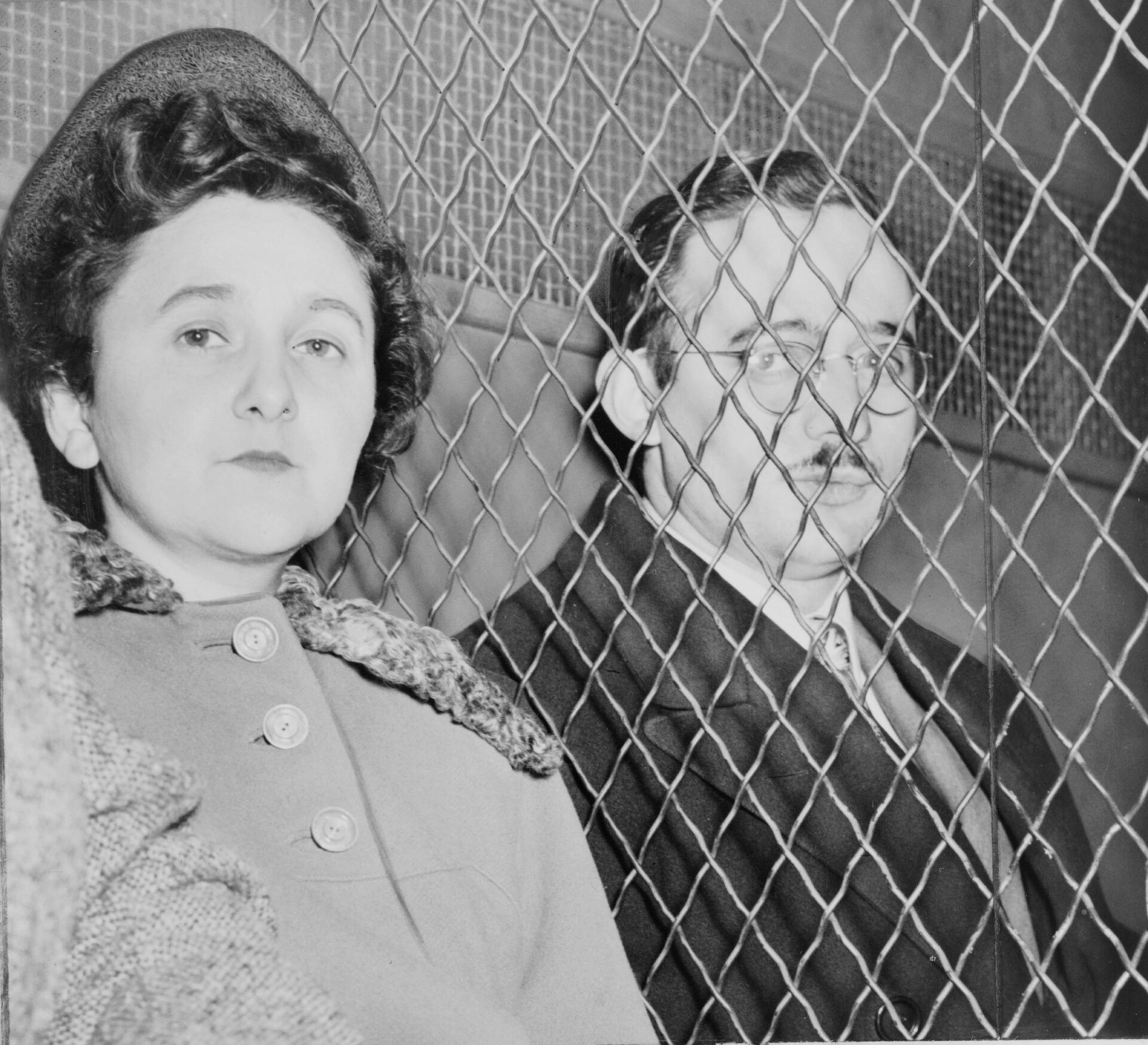

The atomic ring: Fuchs, Gold, Greenglass, the Rosenbergs and Sobell
The atomic espionage cases are the strongest entries in the first ledger, and they unraveled in a chain. Venona analysts identified the source covernamed CHARLES and REST as the German-born British physicist Klaus Fuchs in the summer of 1949, according to Benson's NSA history.2 British authorities arrested Fuchs on February 2, 1950. He confessed, and the FBI's history of the case says he was "convicted and sentenced to 14 years, the maximum penalty under the British Official Secrets Act."5 He was convicted in March 1950 in London, served nine years, was released on June 23, 1959, and moved to East Germany, according to the Atomic Heritage Foundation.6 Fuchs is in this ledger even though he was tried in Britain, because he had passed Manhattan Project design information while working at Los Alamos, and because his confession led the FBI to his American courier.
That courier was Harry Gold, a Philadelphia chemist. The FBI's history records that "On May 22, 1950, Gold confessed his espionage activity to the FBI."5 Gold pleaded guilty. The Temple University Libraries finding aid for his defense lawyers' records lists his sentencing proceedings on December 7 to 9, 1950, and notes a sentence of 30 years in federal prison at Lewisburg, Pennsylvania.7 The Atomic Heritage Foundation says he was paroled in May 1965 after serving just under half of his sentence (the Temple finding aid gives his release as 1966, so the exact date differs between sources).8 Gold died in Philadelphia on August 28, 1972.8
Gold's information pointed to David Greenglass, an Army machinist at Los Alamos, and Greenglass pointed to his brother-in-law, Julius Rosenberg. The FBI's history gives the dates: a complaint against Julius Rosenberg was filed on July 17, 1950, and a complaint against Ethel Rosenberg on August 11, 1950.5 Morton Sobell, an engineer and college friend of Julius, had gone to Mexico; FBI agents took him into custody at the International Bridge in Laredo, Texas, in August 1950.5 The trial began on March 6, 1951. The jury convicted Julius Rosenberg, Ethel Rosenberg and Sobell on March 29, 1951, and on April 5, 1951, Judge Irving Kaufman sentenced the Rosenbergs to death and Sobell to 30 years.9 Greenglass, who pleaded guilty and testified for the prosecution, received 15 years and was released from federal prison on November 16, 1960, according to the FBI.5 After two years of appeals and a refusal of clemency by President Eisenhower, the FBI's history records that "At 8:05 p.m. on June 19, 1953, Julius Rosenberg was executed at Sing Sing Prison, Ossining, New York," and Ethel Rosenberg ten minutes later.5
What the evidence now shows about Julius Rosenberg is not seriously contested. Benson's NSA history identifies the covernames ANTENNA and LIBERAL in the decrypts as Julius Rosenberg and says the FBI made its final identification of the Rosenbergs in 1950.2 Venona shows him running a ring of engineers who passed military electronics and other technical material. Sobell, who denied spying for more than half a century, told Sam Roberts of the New York Times in September 2008, when asked whether he had been a spy: "Yeah, yeah, yeah, call it that." In the same interview he said of Julius's atomic material, "What he gave them was junk."10 Sobell's judgment about the value of the atomic sketches is his own opinion, and historians still argue about how much Greenglass's crude drawings helped Soviet scientists compared with the far more detailed information from Fuchs and Hall.
Ethel Rosenberg: the hardest question in the first ledger
Ethel Rosenberg's case is where the first ledger and the second ledger touch. The trial evidence against her rested heavily on testimony by David and Ruth Greenglass that she typed up David's handwritten notes from Los Alamos. That testimony has not held up. In The Brother (2001), Sam Roberts reported that David Greenglass admitted he could not stand behind it. John Ehrman's review of the book in the CIA's journal Studies in Intelligence (2002) quotes Greenglass's hedged statement: "I frankly think my wife did the typing, but I don't remember." The review summarizes the book's finding that Ruth "lied about Ethel's typing" and that David "backed her up."11 When Ruth Greenglass's grand jury testimony was released in 2008, press reports, including the Times, said that it did not mention Ethel typing the notes; the exact wording of the Times account could not be reopened for this lesson's fact check.10
The evidence still shows that Ethel knew of her husband's espionage. Haynes and Klehr report that a 1944 Venona message describes her as knowing about her husband's work while not working herself.3 Sobell, in the 2008 interview, said much the same: "She knew what he was doing, but what was she guilty of? Of being Julius's wife."10 Historians who accept Julius's guilt, including Haynes and Klehr, have generally described Ethel as a knowing participant in recruiting her brother but not an active agent, and many on every side of the old debate have called her death sentence disproportionate. On the narrow factual question, the verdict that Ethel conspired is partly supported. On the question of whether the evidence used to convict her was honest, it was not.
Theodore Hall: the spy who was never charged
Theodore Hall, the youngest scientist recruited to the Manhattan Project at Los Alamos, gave Soviet intelligence information on the implosion design of the plutonium bomb. Benson's NSA history identifies the covername MLAD as Theodore Hall.2 The FBI questioned Hall and his friend and courier Saville Sax in 1951. Both denied everything, and neither was charged.1213 Encyclopaedia Britannica's account gives the two explanations historians offer: the decrypts may have been "not sufficient to support prosecution," or the government may not have wanted to reveal how far its codebreaking had gone.13 The two explanations fit together. Without a confession or a witness like Gold or Greenglass, the only proof was a set of fragmentary, translated Soviet cables that used covernames, were hearsay as to Hall, and were among the most closely held secrets in the government.
Hall was named publicly only after the 1995 Venona releases. In 1997 he acknowledged his role in a statement in which, as the Atomic Heritage Foundation summarizes it, he said he had believed that an American monopoly on nuclear weapons was dangerous.12 He died in Cambridge, England, on November 1, 1999.13 Hall's case is the clearest example in this lesson of a person whose guilt the record now establishes but whom the legal system of the time could not reach.
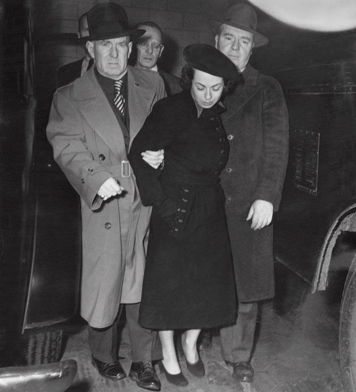

Judith Coplon: guilty in fact, freed by the law
Judith Coplon worked in the Justice Department's Foreign Agents Registration section, a post that gave her access to FBI counterintelligence reports. Benson's NSA history says Venona analysts identified the covername SIMA, first found in a message in 1947, as Judith Coplon.2 The FBI arrested her in New York on March 4, 1949, with Valentin Gubitchev, a Soviet employee of the United Nations, while she carried copies of government documents in her purse. She was convicted twice: in Washington, D.C., in 1949, for taking the documents, and in New York in 1950, with Gubitchev, for conspiracy and attempted espionage.
Neither conviction held, and the reasons matter for anyone who thinks about how security cases should be run. In New York, the Second Circuit, in an opinion by Chief Judge Learned Hand decided December 5, 1950, held that the warrantless arrest was invalid because the statute allowed arrest without a warrant only where the person was likely to escape, and the record did not show that. On the wiretaps, the court held that the trial judge, in deciding whether the government's taps had led to its evidence, had wrongly examined wiretap records in private without letting the defense see them, and had wrongly cut off inquiry into whether a "confidential informant" was in fact a wiretap. Yet the same opinion said plainly that the court was not reversing on the merits, "for the guilt is plain." The disposition reads: "Conviction reversed; cause remanded."14
In Washington, the D.C. Circuit on June 1, 1951, affirmed the conviction itself but sent the case back for a hearing on Coplon's claim that FBI agents had intercepted her telephone conversations with her counsel before and during trial. The court held that such interception, if it happened, would violate the Fifth and Sixth Amendments whether or not it produced any evidence, and that a new trial would then be required.15 The government never retried her, and, as her 2011 obituary reported, it "didn't officially drop the case until 1967."16
The Coplon case shows a pattern that recurs in the first ledger. The FBI knew from Venona that Coplon was a Soviet source but could not say so in court. Its agents then cut corners (a warrantless arrest, wiretaps whose records were withheld from the defense, and alleged interception of a defendant's conversations with her counsel) to build a case it could present. The courts, including one of the most respected judges in American history, enforced the rules even against a defendant whose guilt they thought plain. Anti-communists of the time saw this as proof that legal technicalities protected spies. Defenders of civil liberties saw it as proof that the FBI's methods endangered everyone. The record supports both observations.
Alger Hiss and William Remington: perjury as the proxy charge
Two of the most famous cases of the era ended in perjury convictions rather than espionage convictions, because the espionage itself could not be charged. The FBI's history of the Hiss case explains that Hiss "could not be indicted for espionage because the statute of limitations had run out." A jury convicted him on two counts of perjury on January 21, 1950, and he was sentenced to five years.17 The perjury counts concerned his denials that he had passed documents to Whittaker Chambers and that he had seen Chambers after January 1, 1937. Benson's NSA history says that "Analysts later identified ALES as probably Hiss," referring to a GRU agent mentioned in a 1945 KGB message.2 Most historians who have worked in the Venona and Soviet-bloc material, including Haynes and Klehr, conclude that Hiss was a Soviet agent; a minority of scholars and Hiss's defenders still dispute the ALES identification. Lesson 03 covers the case in detail.
William Remington, a Commerce Department economist, was accused by Elizabeth Bentley of passing information to her during the war. He denied Communist Party membership, was indicted for perjury, and was convicted in 1951. The Second Circuit reversed that conviction for error in the judge's charge to the jury. Remington was indicted again, this time for perjury committed at the first trial, and convicted on two counts; the Second Circuit affirmed on November 24, 1953, in an opinion holding that a witness "could not, in our eyes, lie with impunity" even if the first indictment had been flawed.18 In November 1954, while serving his sentence at the federal penitentiary in Lewisburg, Pennsylvania, Remington was beaten to death by fellow inmates.19 His case belongs in both ledgers: the evidence that he had been a Party member and had given information to Bentley was substantial, and the way he died was a cost no court imposed.
The Amerasia case, 1945
The Amerasia case was the first postwar warning that classified government documents were leaking to pro-Soviet circles, and its quiet ending became a grievance that anti-communists repeated for a decade. In early 1945 the Office of Strategic Services noticed that Amerasia, a small journal on Asian affairs edited by Philip Jaffe, was publishing material from classified government reports. On March 11, 1945, OSS agents under the investigator Frank Bielaski entered the magazine's empty New York office and found a darkroom and copies of secret documents; later FBI searches turned up many more. On June 6, 1945, the FBI arrested Jaffe and his co-editor Kate Mitchell in New York and the State Department official John Stewart Service, the Navy officer Andrew Roth, the State Department employee Emmanuel Larsen and the journalist Mark Gayn in and around Washington. Reviewing Harvey Klehr and Ronald Radosh's The Amerasia Spy Case: Prelude to McCarthyism (University of North Carolina Press, 1996), Donald Lyons reported that "Authorities seized 1,722 documents."20
The outcomes were small. Jaffe pleaded guilty to unauthorized possession of government documents and was fined $2,500; Larsen was fined $500; the charges against Roth were dropped in February 1946; Service, Mitchell and Gayn were never indicted, and Klehr and Radosh, as Lyons summarizes them, describe the handling of the grand jury and of Mitchell's case as a political fix.20 No one was charged with espionage. The prosecutor blamed the FBI's methods (warrantless entries and wiretaps whose evidence might not survive a hearing) for the quick settlement. Klehr and Radosh, drawing on the FBI's surveillance files, add a political account: according to Lyons's review, the Washington lawyer Thomas Corcoran, counsel to the Chinese Nationalist official T. V. Soong, worked behind the scenes, and Service had threatened to air charges of Nationalist corruption at any trial.20 Service was later cleared by State Department loyalty boards several times before being dismissed in 1951 (see the China hands section below). Anti-communists including McCarthy pointed to Amerasia as proof of a cover-up. The evidence now available supports the conclusion that documents were leaked and the case was handled to avoid a trial; it does not show that Service himself was a Soviet agent, and the review of Klehr and Radosh consulted for this lesson does not report that they call him one, though it describes him as indiscreet in what he gave Jaffe.
Harry Dexter White and the Silvermaster network
Elizabeth Bentley, a courier for Soviet intelligence, went to the FBI in 1945. Benson's NSA history says that "In late 1945 KGB agent Elizabeth Bentley told the FBI" about her networks, and that "She gave a 100-page statement, in which she provided many names." He adds two facts that frame everything that followed: "However, she brought no documentary proof," and "No espionage prosecutions resulted directly from her accusations."2
The largest group Bentley described was run by Nathan Gregory Silvermaster, an economist in the Farm Security Administration and later other wartime agencies. Benson notes that Silvermaster "was at one time the only American citizen in the KGB Hall of Fame in Moscow."2 Bentley said the group gathered information from officials in the Treasury, the War Production Board, the Board of Economic Warfare and elsewhere. The most senior person she named was Harry Dexter White, assistant secretary of the Treasury and a principal designer of the International Monetary Fund. Benson's history lists Harry D. White among the agents exposed by Venona and describes a meeting "attended by KGB agent Harry Dexter White."2 White denied the charges before the House Committee on Un-American Activities in August 1948 and died of a heart attack days later, on August 16, 1948, so he was never tried.
Haynes and Klehr, and later Haynes, Klehr and Alexander Vassiliev in Spies: The Rise and Fall of the KGB in America (2009), found that Venona and notes from KGB archives corroborated a large part of Bentley's account, including the Silvermaster group and White's role as a source.3 White's defenders, including some economists and biographers, argue that his contacts with Soviet officials were part of his official duties and that the decrypts show conversation, not espionage. On the weight of the evidence now public, the conclusion that White knowingly provided information to Soviet intelligence is supported, though how much he gave and what difference it made remain debated. What matters for this ledger is that none of the people Bentley named in the Silvermaster network was convicted of espionage. Several left government, some left the country, and Remington (from a different Bentley group) was convicted only of perjury.
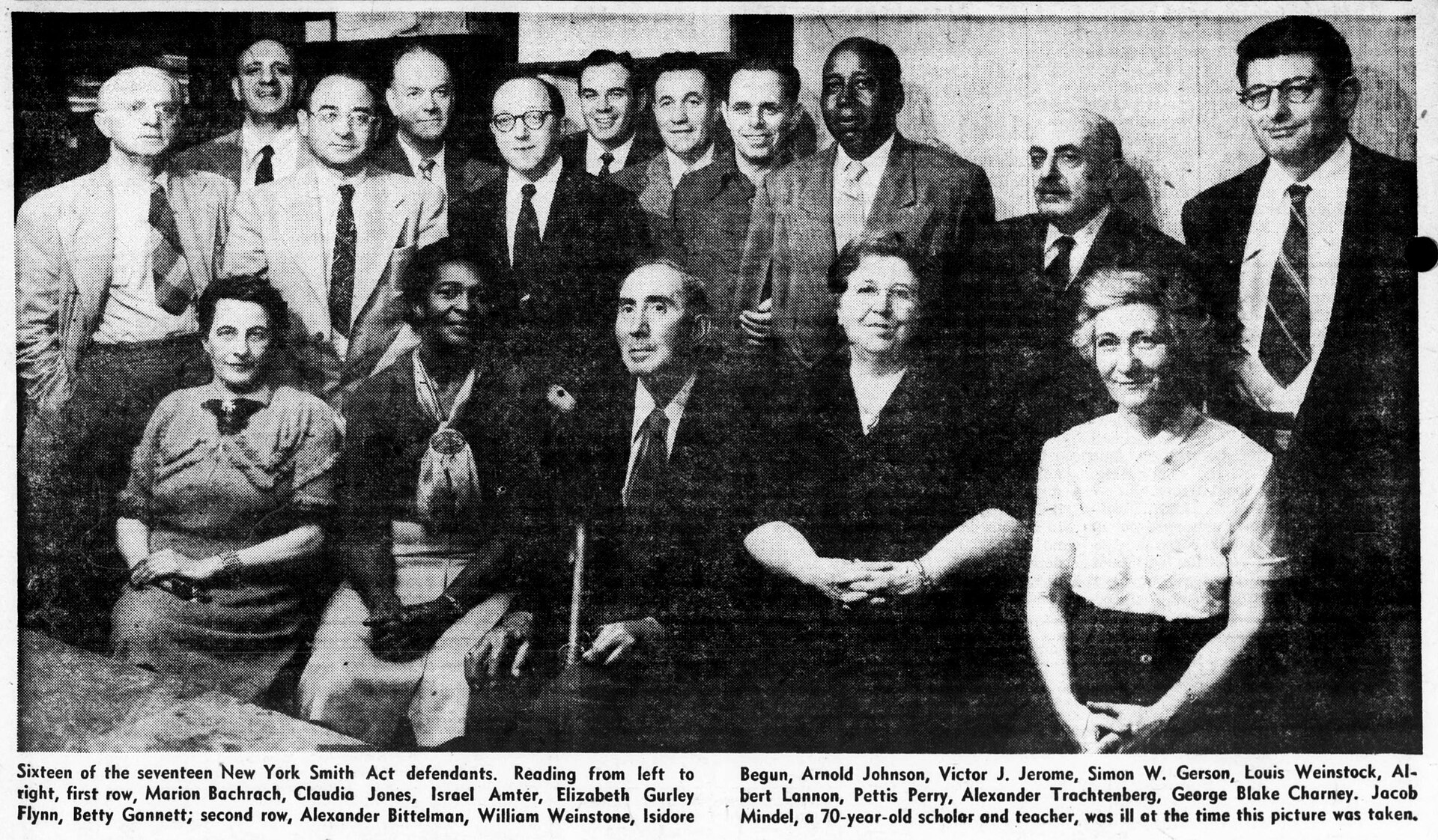

What the Smith Act prosecutions achieved
The Smith Act prosecutions are often listed alongside the spy cases, but they were a different kind of case. The defendants were charged with conspiring to teach and advocate the violent overthrow of the government and to organize the Communist Party for that purpose, not with espionage. In the first trial, in New York, the jury convicted eleven national leaders of the Party on October 14, 1949; ten received five years and $10,000 fines and one, Robert Thompson, three years. The Supreme Court upheld the convictions in Dennis v. United States on June 4, 1951, with Chief Justice Vinson writing for four Justices, Justices Frankfurter and Jackson concurring, and Justices Black and Douglas dissenting.21
The government then indicted "second string" Party leaders in New York, California, Pennsylvania, Hawaii and other states. Histories of the prosecutions put the totals at roughly 144 people indicted and about 105 convicted by the time the cases ended in the late 1950s.22 The Supreme Court then narrowed the statute in Yates v. United States on June 17, 1957, holding that the Smith Act does not reach advocacy of forcible overthrow as an abstract doctrine; in the Court's words, "those to whom the advocacy is addressed must be urged to do something, now or in the future." The Court ordered acquittals for five of the fourteen California defendants and new trials for the other nine.23 After Yates, the government largely abandoned the conspiracy prosecutions. Lesson 09 covers Yates and its companion cases.
What did the prosecutions achieve? Anti-communists argue that they disrupted a Party that was, as Venona and the Moscow archives later confirmed, funded and directed from Moscow and used as a recruiting pool for espionage, and that they forced the Party underground and helped shrink it. Haynes and Klehr's work on the Party's ties to Moscow supports the premise that the Party was not an ordinary political organization.3 Critics, including Schrecker, argue that the prosecutions punished speech, publication and organization rather than any act, that no defendant was shown to have committed espionage or violence, and that the convictions became the legal basis for treating Party membership as grounds for firing, deportation and blacklisting across the private economy.24 Both descriptions are accurate as far as they go. On the narrow question this ledger asks (did the Smith Act catch spies?), the answer is no: it was not designed to, and it did not.
Counting the convictions
No official body ever published a single count of Americans convicted of espionage-related crimes connected with Soviet intelligence in the years 1945 to 1955, so any count has to be built case by case from court and FBI records. The table below includes only cases in this lesson whose outcomes come from primary or official sources. It does not include the Smith Act defendants, who were not charged with espionage, or people named in Venona who were never charged.
| Person | Charge and court | Outcome | Role of Venona |
|---|---|---|---|
| Klaus Fuchs | Official Secrets Act, Britain, 1950 | Convicted after confession; 14 years; released 1959 | Identified him as CHARLES/REST; not used at trial (he confessed) |
| Harry Gold | Espionage, U.S. District Court, Philadelphia | Pleaded guilty; 30 years (December 1950); paroled 1965 | Led investigators toward him through Fuchs; not used at trial |
| David Greenglass | Espionage conspiracy, New York | Pleaded guilty; 15 years; released November 16, 1960 | Cables pointed to him; not used at trial |
| Julius Rosenberg | Conspiracy to commit espionage, New York | Convicted March 29, 1951; executed June 19, 1953 | Identified as ANTENNA/LIBERAL; not used at trial |
| Ethel Rosenberg | Same | Convicted March 29, 1951; executed June 19, 1953 | Described as knowing of her husband's work; not used at trial |
| Morton Sobell | Same | Convicted; 30 years; released 1969; admitted spying in 2008 | Not used at trial |
| Judith Coplon | Espionage-related charges, Washington and New York | Convicted twice; New York conviction reversed (1950); Washington conviction affirmed but remanded for a hearing that could require a new trial (1951); never retried; case dropped 1967 | Identified as SIMA; could not be used, so FBI relied on a sting and wiretaps |
| Alger Hiss | Perjury, New York | Convicted January 21, 1950; five years | Not used at trial; after the 1995 to 1996 releases, ALES was identified as "probably Hiss" |
| William Remington | Perjury, New York | First conviction reversed; second affirmed 1953; killed in prison 1954 | Case rested on Bentley and witnesses |
| Philip Jaffe and Emmanuel Larsen | Unauthorized possession of government documents (Amerasia) | Fines of $2,500 and $500, 1945 | Predated Venona breaks |
Counted strictly, this table shows five people convicted in American courts of espionage or conspiracy to commit espionage in the atomic cases (Gold, Greenglass, Julius and Ethel Rosenberg, Sobell), one more in Britain (Fuchs), one whose two convictions did not stand (Coplon), two convicted of perjury in espionage-linked cases (Hiss, Remington), and two fined for possessing documents (Jaffe and Larsen). Other prosecutions of the era connected to the atomic and industrial espionage networks, such as those of Alfred Dean Slack and Abraham Brothman, would add a few names; they are not tabulated here because their records were not reviewed for this lesson. Even with them, the total of people convicted of espionage-related crimes tied to Soviet intelligence in this period runs to roughly a dozen, against the several hundred named or covernamed persons in Venona that Benson describes.2 Haynes and Klehr give a count of 349 citizens, immigrants and permanent residents of the United States who had covert relationships with Soviet intelligence according to the decrypts; that figure is theirs and is reported here as their estimate.3
Venona: cases decided by evidence that could not be used in court
The gap between those two numbers, a dozen convictions and hundreds of identified sources, is the single most important fact in the first ledger. The Venona decrypts were not introduced in any trial of the period. The NSA's public account confirms that the first translations were released only in July 1995, half a century after the messages were sent.1 Historians give three reasons the decrypts stayed out of court. First, secrecy: the government wanted to protect a codebreaking success, and wanted the Soviets not to learn how much had been read (though, as Benson and others document, Soviet intelligence learned of the project in the late 1940s through its own sources). Second, the nature of the evidence: the messages were fragmentary, used covernames, and were statements by Soviet officers about the defendants, which raised hearsay problems. Third, authentication: proving the decrypts would have required codebreakers to testify about methods that were among the government's most closely held secrets.23
The result was a set of cases decided outside the legal system. The FBI used Venona to identify Fuchs, Gold, Greenglass, the Rosenbergs, Coplon and Hall, but it needed confessions or cooperating witnesses to prosecute. Where it got them (Fuchs, Gold, Greenglass), convictions followed. Where it did not (Hall, Sax, most of the Silvermaster group), the people involved were never charged, and some kept working in sensitive posts for a time or moved abroad. In Coplon's case the FBI tried to build admissible evidence through a staged arrest and wiretaps, and the courts threw out the result. Meanwhile, the officials who knew what Venona showed could not explain to the public, to Congress or to the loyalty boards why they were confident about some people and not others. That secrecy left the public debate to guesswork on every side, and McCarthy's own accusations, assessed claim by claim in lesson 11, were made in that gap.
Ledger two: the costs
What the security programs were for, and what was reasonable about them
The case for screening federal employees was not invented by demagogues. By 1947 the government knew, from Bentley, from Chambers, from the 1945 defection of the Soviet cipher clerk Igor Gouzenko in Canada and from the first Venona breaks, that Soviet intelligence had placed sources in American agencies. Any government that learned that would check who held sensitive posts. President Truman, a Democrat under pressure from a newly Republican Congress, created a Temporary Commission on Employee Loyalty in November 1946 and then issued Executive Order 9835 on March 21, 1947.2526 Defenders of the program, then and now, point out that it gave employees written charges and a hearing before a board, more process than most private employers gave anyone, and that the government has a legitimate interest in the trustworthiness of the people who handle its secrets. Evans argues that the programs were, if anything, too lax in the 1940s, when they cleared people the FBI had flagged.4
The problems lay in what the programs measured. Executive Order 9835 told loyalty boards to consider, among other things, "Membership in, affiliation with or sympathetic association with any foreign or domestic organization" that the Attorney General designated as "totalitarian, fascist, communist, or subversive."25 The Attorney General's list grew to include dozens of groups, many of them front organizations, but also civil rights, ethnic, labor and charitable groups whose members had joined for reasons unrelated to Moscow. Employees usually could not confront the informants whose reports were used against them, because the FBI protected its sources. In 1951, Executive Order 10241 (16 Federal Register 3690) set what the Supreme Court later called "the more stringent loyalty standard," under which a reasonable doubt as to an employee's loyalty was enough for removal, and the Loyalty Review Board reopened cases that agency boards had already decided, including that of John Stewart Service.27
The Truman program in numbers
The official figures come from the U.S. Civil Service Commission, which ran the Loyalty Review Board. As summarized by the political scientist David Fellman in the Wisconsin Law Review in 1957, the Commission's 1953 annual report stated that between 1947 and August 1953 the loyalty forms of "4,756,705 individuals were checked," that "Loyalty boards had cleared 16,503 persons" whose cases went to boards, and that "560 had been removed or denied employment on grounds relating to loyalty."28 Those three numbers are the official core of the Truman program: almost five million name checks, a few tens of thousands of full investigations and board cases, and 560 removals or denials of employment.
Other figures circulate, and they measure different things. The Truman Library's education materials quote Civil Liberties and the Legacy of Harry S. Truman, edited by the historian Richard Kirkendall, for the estimate that "During the loyalty-security program's peak years from 1947 to 1956, over five million federal workers underwent screening," "resulting in an estimated 2,700 dismissals and 12,000 resignations."26 The legal historian Stanley Kutler gave the same estimate of about 2,700 dismissed and 12,000 resigned between 1947 and 1956.29 Those estimates combine the Truman loyalty program with the first three years of Eisenhower's security program and count resignations, which official statistics did not attribute to loyalty findings. Resignations are the most disputed category. A person who resigned while under investigation might have been a Party member avoiding a hearing, an innocent employee who did not want to fight, or someone who left for unrelated reasons and happened to have an open file. The official records do not let historians sort them, and estimates of how many resignations the programs caused are just that.
The same Kirkendall volume adds a point that the official numbers cannot capture: "the program exerted its chilling effect on a far larger number of employees than those who were dismissed."26 Employees stopped joining organizations, signing petitions or subscribing to publications that might appear on a list. The cost of that self-censorship is real but cannot be counted, and this lesson does not try.
Executive Order 10450 and the numbers game
President Eisenhower signed Executive Order 10450 on April 27, 1953, replacing Truman's loyalty program with a broader security program (published at 18 Federal Register 2489).30 The standard changed from loyalty to whether employment was "clearly consistent with the interests of the national security." The order's list of disqualifying conduct went well beyond communism. Section 8(a)(1)(iii) listed "Any criminal, infamous, dishonest, immoral, or notoriously disgraceful conduct, habitual use of intoxicants to excess, drug addiction, or sexual perversion." Section 8(a)(5) as signed in 1953 covered "Membership in, or affiliation or sympathetic association with, any foreign or domestic organization" that was totalitarian, Fascist, Communist or subversive, or that sought to alter the form of government by unconstitutional means. (The narrower wording now shown in the codified text, "knowing membership with the specific intent" of furthering such aims, comes from later amendments to section 8, which the National Archives lists as including Executive Order 11785 of June 4, 1974.)3049 The new order also extended summary suspension powers to all agencies, not only to those like State and Defense that already had them.
Eisenhower's administration then used the program's numbers for political purposes. The historian Michael Birkner, writing in the National Archives' Prologue magazine in 2001, records that in the fall of 1953 the administration announced that "1,456 'Reds' had been ousted from the government," and that Eisenhower "could announce such dramatic numbers only by fudging facts," in part by "counting as a security risk any individual who left the government" with derogatory information in a file. Birkner reports that "almost all of the 1,456 cases Eisenhower cited were of people who had left government service for other than security-related reasons."31 As the figures grew through 1954 and 1955, the dispute grew with them. A Harvard Crimson analysis in October 1956 summarized the record: "Administration figures on security firings ranged from 1,459 up to 9,600," while congressional findings showed that "only 342 employees had actually been removed as security risks," many of them hired after 1953.32 The Crimson was a partisan source in an election year, and its figures should be read as a contemporary press summary; the point that the administration's totals mixed security dismissals with ordinary separations is confirmed by Birkner's archival account.
For a single agency the numbers can be checked more closely. The State Department's own official history of its Bureau of Diplomatic Security reports that "306 employees had been separated from the Department for security reasons" between January 20 and September 30, 1953, that "147 Department employees were terminated after E.O. 10450 went into effect," and that 178 foreign service nationals were also dismissed for security concerns. The same history records that Scott McLeod, the Department's new security chief, announced that he had "fired 16 'moral deviates' and 5 'security risks'" ten days after taking office.33
Hollywood: the Ten, the Waldorf statement and the blacklist
The House Committee on Un-American Activities held its first major Hollywood hearings in October 1947. Ten writers and directors (the "Hollywood Ten") refused to answer whether they were or had been members of the Communist Party, citing the First Amendment, and were cited for contempt of Congress. Lesson 03 covers the hearings. What matters for this ledger is what the studios did next. After a meeting of film executives at the Waldorf-Astoria hotel in New York in late November 1947, the Motion Picture Association of America issued what became known as the Waldorf statement. It said: "We will forthwith discharge or suspend without compensation those in our employ" among the Ten, and "we will not reemploy any of the 10 until such time as he is acquitted" or has cleared himself of contempt and "declares under oath that he is not a Communist." It added: "We will not knowingly employ a Communist."34 That statement turned a congressional contempt case into a private employment ban across an industry. The Ten were convicted of contempt, fined, and served prison terms of up to a year after the Supreme Court declined to review their cases in 1950.
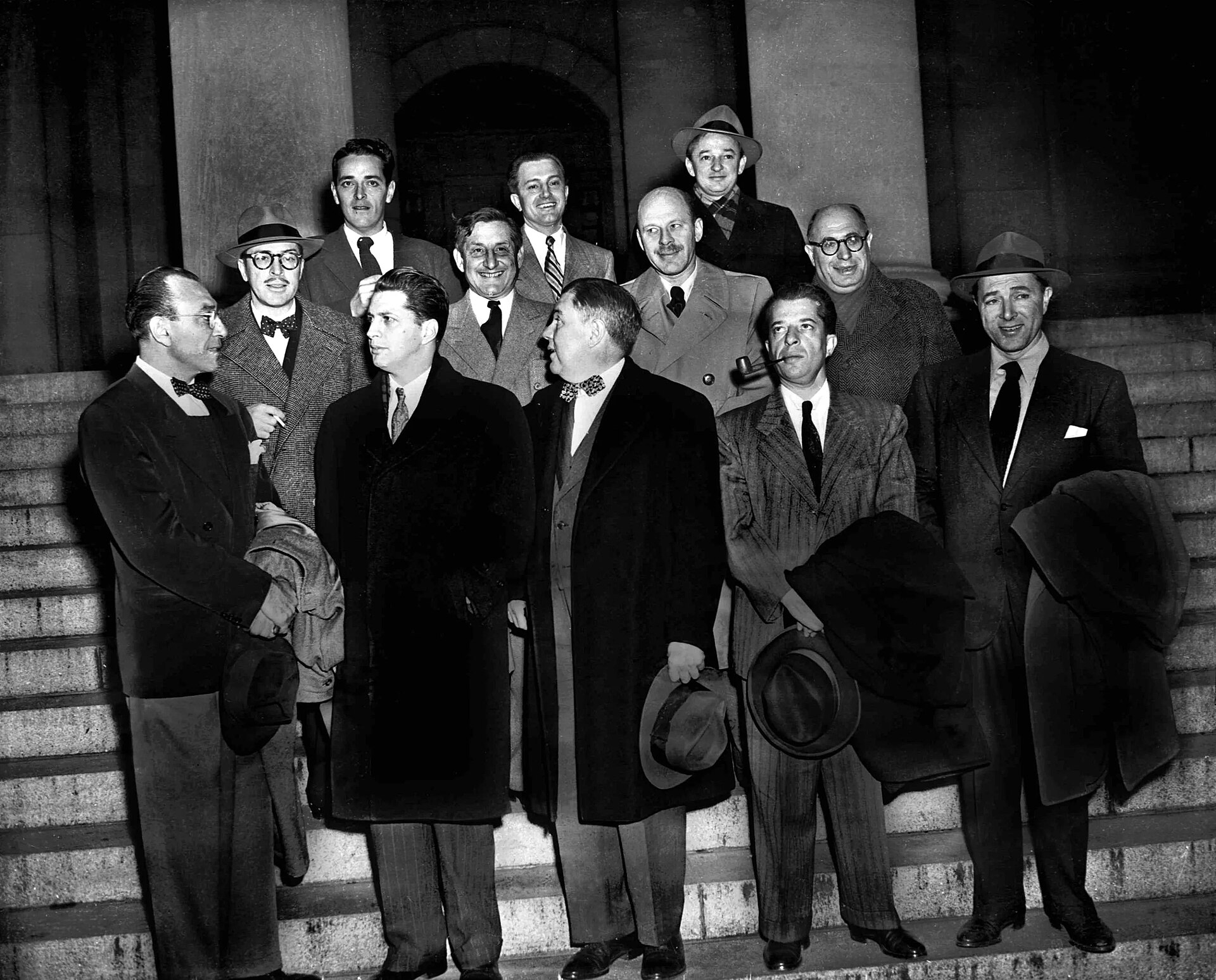

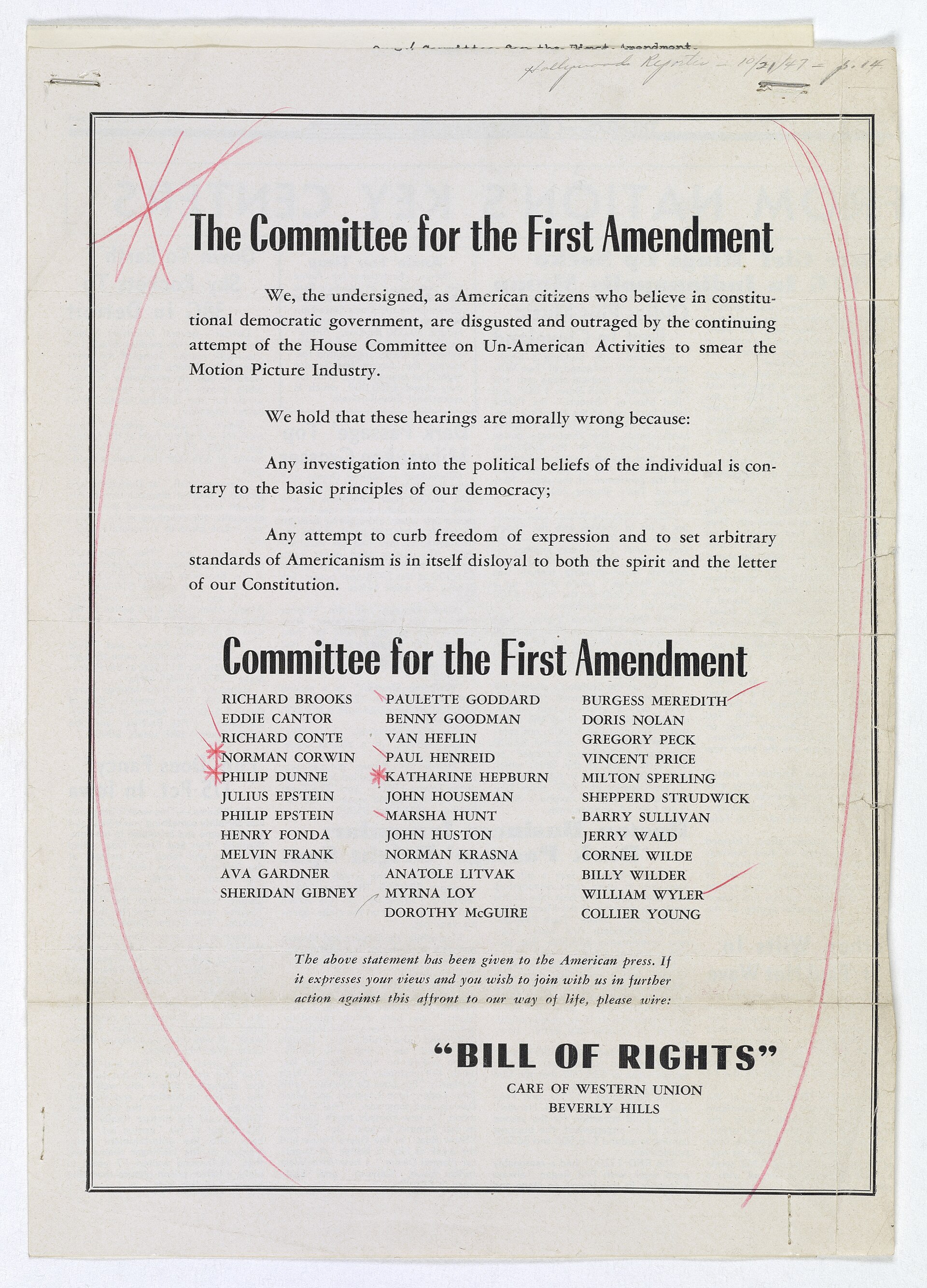

The anti-communist case on Hollywood deserves a hearing. Most of the Ten had in fact been members of the Communist Party, and the Party did organize in Hollywood's guilds and try to influence film content, as Ronald and Allis Radosh argue in Red Star over Hollywood (2005). The Ten's refusal to answer was a coordinated legal strategy, not a spontaneous protest. None of that made the blacklist that followed a security measure. Screenwriters had no access to state secrets, and the blacklist was enforced by private employers, unions, advertisers and pressure groups rather than by any agency with a duty to give a hearing.
The blacklist widened in 1950 and 1951. In June 1950 the publishers of the newsletter Counterattack, founded in 1947 by three former FBI agents, issued Red Channels: The Report of Communist Influence in Radio and Television. Encyclopaedia Britannica describes it as a "compact user-friendly guide" that "listed 151 entertainment industry employees," each with a list of organizations, petitions and events attributed to them, and notes that network and advertising executives used it, which led to cast and staff changes and "destroyed several careers."35 The listings were drawn largely from the Attorney General's list, HUAC reports and the Daily Worker, and they mixed actual Party members with people whose only offense was signing a petition or appearing at a benefit. Inclusion carried no hearing and no appeal; the usual route back to work ran through a "clearance" process with private consultants, a public statement of regret, and often naming others. HUAC's second round of Hollywood hearings, beginning in 1951, added names through cooperating witnesses. Estimates of the total number of people in film, radio and television who lost work through the blacklist run into the hundreds; no list was ever official, so no exact count exists.
The blacklist ended by erosion rather than decree. Blacklisted writers had continued to work under pseudonyms and through front writers throughout the 1950s. The best-known of them, Dalton Trumbo, one of the Ten, had written screenplays under other names. On January 20, 1960, the New York Times reported on its front page that the producer and director Otto Preminger would give Trumbo screen credit under his own name for Exodus. Universal then gave Trumbo credit for Spartacus, produced by and starring Kirk Douglas. Spartacus was released in October 1960 and Exodus in December 1960, both with Trumbo's name on the screen, as Lisa Reynolds Wolfe recounts for Cold War Studies, noting the long-running dispute over whether Preminger or Douglas deserves credit for breaking the blacklist.36 Other blacklisted writers returned to credited work over the following decade, but many careers never recovered, and some of those listed had died or left the industry by then.
Loyalty oaths: universities and teachers
The loyalty oath was the cheapest tool of the era, and it reached the most people. Federal employees, state employees, teachers, professors, defense contractors' workers, and in some places applicants for licenses or public housing were asked to swear that they were not members of the Communist Party or of organizations advocating overthrow of the government. The oath had a defensible premise: a government may ask its employees to affirm allegiance to the constitution. Its weakness as a security measure was obvious from the start. A trained agent would sign it without hesitation, while people with scruples about political tests, many of them not communists at all, would refuse.
The University of California provides the best-documented case. In 1949 the Board of Regents required all university employees to sign an oath that, beyond affirming support for the constitution, disclaimed membership in or belief in organizations, including the Communist Party, that advocated overthrow of the government. Many faculty objected on grounds of academic freedom, tenure and shared governance. In the summer of 1950 the Regents dismissed thirty-one "non-signer" professors, along with other employees; the UC Berkeley Library's history of the controversy notes that none of them had been charged with professional unfitness or personal disloyalty.37 The state legislature meanwhile passed the Levering Act in 1950, requiring an oath of all state employees. On October 17, 1952, in Tolman v. Underhill, the California Supreme Court held that "the Legislature intended to occupy this particular field of legislation," that the Regents' separate oath was therefore invalid, and that the petitioners must be reappointed once they took the oath required of all public employees.38 The court found no question about their loyalty or their qualifications as teachers. The decision rested on state law, not on the First Amendment.
New York's Feinberg Law of 1949 went further, directing the state Board of Regents to list subversive organizations and making membership in a listed organization prima facie evidence of disqualification for teaching in the public schools. On March 3, 1952, in Adler v. Board of Education, the Supreme Court upheld the law. Justice Sherman Minton, for the majority, wrote that teachers "may work for the school system upon the reasonable terms laid down by the proper authorities of New York," and the Court held that the membership presumption could be rebutted at a hearing. Justice William O. Douglas, joined by Justice Hugo Black, dissented: "The present law proceeds on a principle repugnant to our society -- guilt by association."39
The Court began to retreat within the year. On December 15, 1952, in Wieman v. Updegraff, it struck down an Oklahoma oath that barred people from state employment for membership in listed organizations regardless of whether they knew the organizations' purposes: "Indiscriminate classification of innocent with knowing activity must fall as an assertion of arbitrary power."40 Fourteen years later, on January 23, 1967, in Keyishian v. Board of Regents, a 5 to 4 Court in an opinion by Justice William Brennan held key provisions of New York's teacher loyalty machinery unconstitutionally vague, and invalidated the bar on mere knowing membership without specific intent to further an organization's unlawful aims. The Court wrote that the First Amendment "does not tolerate laws that cast a pall of orthodoxy over the classroom." It did not formally overrule Adler; it said that "constitutional doctrine which has emerged since that decision has rejected its major premise."41 That is why Adler is described as overturned in spirit rather than in form.
The State Department's China hands
The purge of the State Department's China specialists is the case in which the costs reached furthest into national policy. After the Communist victory in China in 1949, the question "Who lost China?" turned into a search for officials whose reporting had been critical of Chiang Kai-shek's government or had predicted Communist success. Four career Foreign Service officers in particular lost their careers: John Stewart Service, John Paton Davies Jr., John Carter Vincent and O. Edmund Clubb.
Service's case shows how the machinery worked. According to the Supreme Court's later opinion, the State Department cleared him in 1945, 1946 and 1947, its Loyalty Security Board cleared him again in 1949, and the Department board decided in his favor on October 6, 1950, and again on July 31, 1951. The Loyalty Review Board then took up the case "under the more stringent loyalty standard established by Executive Order No. 10241," found "a reasonable doubt as to Service's loyalty," and advised that he "should be forthwith removed from the rolls." Secretary of State Dean Acheson discharged him on December 14, 1951. On June 17, 1957, in Service v. Dulles, the Supreme Court held the discharge invalid; the official syllabus puts the holding as "petitioner's discharge was invalid because it violated Regulations of the Department of State," and Service returned to the Department.27
Vincent's last post, according to the State Department's Office of the Historian, was as diplomatic agent and consul general in Tangier, Morocco, which he relinquished on April 16, 1953.42 After the Loyalty Review Board found reasonable doubt about him, Secretary of State Dulles reviewed the case, did not sustain a finding of disloyalty, but concluded that Vincent's judgment fell below the standard expected and allowed him to retire. Davies, who had served on the Policy Planning Staff, was dismissed by Dulles on November 5, 1954, on grounds of judgment and discretion rather than loyalty, after repeated investigations had not found him disloyal; his security clearance was restored in 1969.43 Clubb, a veteran consular officer in China, was found a security risk in 1951, was cleared on appeal, and retired in 1952. The State Department's history of Diplomatic Security notes that of the three most prominent targets (Service, Vincent and the scholar Owen Lattimore), "only Vincent had been on McCarthy's list of 81 security risks."33
The anti-communist argument about the China hands, made at the time by the "China lobby" and later by Evans, is that these officers' reporting favored the Chinese Communists, that some had dealings with people later shown to be Soviet sources (the Amerasia case), and that their judgment was rightly questioned.4 The critics' argument, made in many later histories, is that the officers were punished for accurate reporting, and that the loss of the Department's best China expertise left the United States poorly informed about China for a generation, a cost that some historians connect to later misjudgments in Asia. No Soviet or Chinese archival evidence released so far shows that Service, Davies, Vincent or Clubb was an agent of any foreign power. On that point the record now supports the officers. Whether their policy judgments were sound is a separate question that historians still argue.
The Lavender Scare: dismissals under the same security programs
The largest single category of people removed under the federal security programs was not communists. It was gay men and lesbians. The episode, which the historian David K. Johnson named "the Lavender Scare" in his 2004 book of that title, ran through the same offices, files and executive orders as the anti-communist programs.44 Judith Adkins, an archivist at the National Archives' Center for Legislative Archives, called Johnson's book the "definitive monograph" on the subject in a 2016 Prologue article built from Senate records.45
The public start came at the end of February 1950, less than three weeks after McCarthy's Wheeling speech made State Department security a national story and, as Adkins notes, just over a week after his February 20 speech on the Senate floor. Testifying before a Senate Appropriations subcommittee, Deputy Under Secretary of State John Peurifoy revealed, as Adkins summarizes the record, that the Department had ousted "91 homosexual employees as security risks."45 The State Department's own official history of its security bureau puts it in the Department's words: "91 employees in the 'shady category' had been dismissed since January 1, 1947."33 A Senate investigation followed. On December 15, 1950, a subcommittee of the Committee on Expenditures in the Executive Departments chaired by Senator Clyde Hoey of North Carolina issued its interim report, Employment of Homosexuals and Other Sex Perverts in Government (Senate Document 241, 81st Congress), which concluded that homosexuals were "unsuitable for employment in the Federal Government" and treated them as security risks on the theory that they could be blackmailed.45 Adkins notes that the Civil Service Commission later found that 13 of the 91 people fired by State had been rehired elsewhere in the government, one sign of how loosely the early numbers were assembled.45
The State Department's history gives year-by-year figures that show the scale. "The Department fired 54 people it considered to be homosexuals in 1950, 119 in 1951, and 134 in 1952." For comparison, it lists security dismissals on other grounds of "12 in 1950, 35 in 1951, and 70 in 1952," and notes that "74 of the Department's 107 dismissals resulted from homosexuality alone in the first months of 1953."33 In this one department, in these years, people dismissed as homosexuals outnumbered all other security dismissals combined. Eisenhower's Executive Order 10450 then wrote "sexual perversion" into the government-wide list of disqualifying conduct in April 1953.30
How many people lost federal jobs across the whole government? No official total exists, because agencies did not report the grounds consistently and many people resigned rather than face charges. Adkins summarizes historians' estimates as "somewhere between 5,000 and tens of thousands of gay workers" who lost their jobs.45 Johnson's research, drawing on agency records, congressional hearings and interviews, documents that many more people were denied jobs or resigned under pressure than were formally dismissed.44 These are estimates, and they are reported here as such. The Civil Service Commission ended its general bar on employing gay people in 1975, according to Adkins, and the security clearance rules took longer to change.45 On January 9, 2017, Secretary of State John Kerry issued a formal apology: "On behalf of the Department, I apologize to those who were impacted by the practices of the past," adding that the Department reaffirmed its "steadfast commitment to diversity and inclusion for all our employees, including members of the LGBTI community."46
The security rationale deserves a factual answer, not just a dismissal. The argument in 1950 was that people with a secret that could cost them their jobs were vulnerable to blackmail by foreign intelligence services. The circularity of that argument was noted at the time: the vulnerability existed because the government fired people whose secret came out. Johnson's study argues that the purge rested on that assumption rather than on documented cases of American officials blackmailed into espionage over their sexuality.44 The sources reviewed for this lesson cite no such American case from the period. The dismissals are documented fact; the security justification for them is, on the present record, unsupported.
Landon Storrs: the New Deal economists and civil servants
The historian Landon R. Y. Storrs, in The Second Red Scare and the Unmaking of the New Deal Left (Princeton University Press, 2013), used loyalty case files that were opened to her under freedom of information requests to ask a different question: not how many people were removed, but which people were investigated and what that did to policy.47 Her answer is that the loyalty program fell especially hard on a cohort of New Deal policy experts (economists, lawyers and administrators in labor, consumer protection, price control, social welfare and economic planning agencies), many of them women, whose politics placed them in the Popular Front circles of the 1930s and 1940s. Most were not Party members and most were eventually cleared. Storrs argues that the investigations still worked: they drove many out of government, taught others to avoid advocating policies such as national health insurance, stronger labor protections or economic planning that had become associated with disloyalty, and narrowed the range of policy debate inside the executive branch for a generation.47
Her best-known example is Mary Dublin Keyserling, a consumer and labor economist at the Commerce Department, and her husband Leon Keyserling, chairman of Truman's Council of Economic Advisers. Both were investigated on the basis of their associations in the 1930s and both were cleared, but the investigation followed them for years, and Storrs argues that Leon Keyserling moderated his public positions in response.48 Storrs's interpretation is her own, and defenders of the program reply that screening senior economic officials was legitimate when the Silvermaster group had operated in exactly those agencies. Both points can be true. The Silvermaster material in ledger one shows that economic agencies were in fact penetrated; Storrs's files show that the screening also swept up a much larger group of officials whose offense was their policy views and their friends.
Ellen Schrecker's estimates
Ellen Schrecker, in Many Are the Crimes: McCarthyism in America (1998), offers the most widely cited overall estimates of the second ledger. She estimates that roughly ten to twelve thousand people lost their jobs in government, education, entertainment, unions and private industry as a result of the anti-communist programs, and that the number imprisoned (for contempt of Congress, Smith Act violations, perjury and related offenses) ran into the hundreds. She estimates that nearly 3,000 seamen and longshoremen lost their jobs under a single program, the Coast Guard's port security screening.24 Schrecker presents these figures as estimates built from many partial sources, not as official counts, and they should be cited that way. Her broader judgment, that McCarthyism was a sustained episode of political repression carried out mainly by respectable institutions rather than by one senator, is an interpretation that Haynes, Klehr, Evans and Herman each dispute in different ways, while generally accepting that real people were harmed.243
Case outcomes in the loyalty and security programs
The second chart puts the official outcome figures side by side. The top panel shows the Truman program as the Civil Service Commission reported it through August 1953: millions of name checks, a few tens of thousands of cases that went before loyalty boards, and 560 removals or denials. The bottom panel shows the State Department's own year-by-year dismissal figures, which separate people dismissed as homosexuals from people dismissed on other security grounds.2833
The debate stated fairly
The anti-communist argument
The strongest version of the anti-communist case runs as follows. Soviet intelligence did penetrate the American government on a scale that the opponents of the security programs denied for decades, and the Venona decrypts and Soviet archives proved the anti-communists right on that central fact. The Communist Party was not an ordinary political party; it was funded and directed from Moscow and served as a recruiting pool for espionage, so Party membership was a reasonable ground for exclusion from sensitive work. Loyalty and security programs are preventive, not punitive: no one has a right to a government job, and a government may decline to employ people about whom there is reasonable doubt, as private employers do every day. Most of those removed under Truman's program, on this view, were Party members or people with genuine security problems, and the boards cleared the great majority of those who came before them. Evans argues that the programs of the 1940s were too lenient, that people flagged by the FBI were cleared and kept in sensitive posts, and that the outrage over the security programs was out of proportion to their real reach.4 Herman, while critical of McCarthy's methods, argues that the broader anti-communist effort was justified and that its costs have been exaggerated in the popular memory.4 Haynes and Klehr, who are not defenders of McCarthy, argue that the existence of real espionage makes much of the public's alarm understandable, while also criticizing McCarthy's own accusations.3
The critics' argument
The strongest version of the critics' case runs as follows. The spies were caught, where they were caught, by counterintelligence, codebreaking and defectors, not by loyalty oaths, blacklists or congressional hearings. The domestic security programs measured association, belief and private life rather than conduct: membership in organizations on a list, attendance at meetings, friendships, reading habits and sexuality. Their procedures denied people the right to know and confront their accusers. They spread far beyond sensitive posts, into schools, universities, film studios, radio, unions, the merchant marine and private industry, where no state secret was at stake. And the people they removed were overwhelmingly not spies: the official Truman-program removals number in the hundreds, the Eisenhower figures were inflated for political effect, and the largest identifiable group removed under the security rules were gay employees whose "risk" was created by the rules themselves. Schrecker argues that this made the period an episode of political repression carried out by mainstream institutions, and Storrs argues that it permanently narrowed the range of policy ideas in American government.2447 Oshinsky and Rovere, writing earlier about McCarthy himself, made the related argument that the senator's tactics damaged the real anti-communist cause by discrediting it.
Where the evidence settles the argument and where it does not
Some parts of the argument can now be settled by documents. The espionage was real, extensive and concentrated in the 1930s and the war years; that is no longer an open question. The most consequential spies (Fuchs, Hall, Gold, Greenglass, Julius Rosenberg, the Silvermaster group, White) were identified by the FBI and Army codebreakers, and most of their activity had ended before the loyalty boards and McCarthy reached full force; that, too, is documented. The official removal figures for the Truman program are small compared with the millions screened, and the Eisenhower administration's 1953 to 1955 figures were overstated; both points rest on government records.
Other parts cannot be settled with the evidence now public. Nobody can count how many Party members or Soviet sources left government quietly because the programs existed, a deterrent effect that defenders of the programs cite and that no record can measure. Nobody can count the self-censorship that critics cite, which no record can measure either. The resignations that fill the larger estimates cannot be sorted into the guilty, the frightened and the uninvolved. Those questions remain unresolved, and this lesson marks them that way rather than choosing a side.
A comparison: two security programs a decade apart
Pierson's module on ordered liberty includes a lesson on the incarceration of Japanese Americans, and the comparison is instructive. In both cases the government faced a real threat: war with Japan after Pearl Harbor, and Soviet intelligence penetration of the federal government. In both cases the response treated a category of people (persons of Japanese ancestry; people with certain associations or private lives) as a risk to be managed in bulk, rather than identifying individuals by evidence of conduct. In both cases the people actually engaged in espionage were identified by counterintelligence methods rather than by the mass program. The differences are large: the wartime program imprisoned entire families without charge, while the loyalty-security programs cost people their jobs and reputations, not their liberty. But the pattern, a real threat met with a category-based remedy that caught few of the guilty and harmed many of the innocent, is the same, and it is the pattern Pierson's framework of ordered liberty is built to test. See also legitimate authority and its limits.
The Idaho side of the story is covered in module 74's lesson on Glen Taylor, Herman Welker and the Red Scare; Senator Welker was among those who voted against McCarthy's censure.
What the record shows and what it does not
- Documented fact: Klaus Fuchs, Harry Gold, David Greenglass, Julius Rosenberg and Morton Sobell committed espionage for the Soviet Union; all were convicted, and Sobell admitted it in 2008. Theodore Hall, identified in Venona as MLAD, was never charged.
- Documented fact: Judith Coplon's convictions did not stand: the New York conviction was reversed for an invalid warrantless arrest and wiretap errors, and the Washington conviction was sent back for a hearing on the alleged interception of her calls with counsel, even though the Second Circuit wrote that "the guilt is plain."
- Documented fact: The Civil Service Commission reported 4,756,705 loyalty checks and 560 removals or denials of employment on loyalty grounds under the Truman program through August 1953.
- Documented fact: The State Department dismissed more people as homosexuals than on all other security grounds in 1950, 1951 and 1952, by its own official history.
- Documented fact: Thirty-one University of California professors were dismissed in 1950 for refusing the Regents' oath; none had been charged with disloyalty, and the state's highest court invalidated the oath in 1952.
- Disputed count: The number of people removed under Eisenhower's Executive Order 10450. Administration claims ran from 1,456 to 9,600; contemporary congressional findings reported far fewer actual security removals.
- Estimate: Schrecker's ten or twelve thousand jobs lost; the Kirkendall volume's and Kutler's 2,700 dismissals and 12,000 resignations; 5,000 to tens of thousands of Lavender Scare job losses. These are scholarly estimates, not official counts.
- Allegation not proved: That any of the State Department's China hands (Service, Davies, Vincent, Clubb) was a foreign agent.
- Open question: How many undetected sources left government because the programs existed, and how much policy debate the programs suppressed.
Assessed from 2026
Each claim below was made during the period or in the later debate. The rating reflects the evidence available in 2026, with the source that decides it.
- "Soviet agents worked inside the U.S. government and the atomic bomb project." Supported. The NSA's Venona releases and its official history identify Fuchs, Gold, Greenglass, Hall, Julius Rosenberg, Coplon and White among others; Fuchs, Gold and Greenglass confessed, and Sobell admitted his role in 2008.210
- "Julius Rosenberg was a Soviet spy." Supported. Venona identifies him as ANTENNA and LIBERAL; Sobell's 2008 interview confirms the ring's existence.210
- "Ethel Rosenberg was guilty as charged and the evidence against her was sound." Partly supported. The evidence that she knew of and supported her husband's work is substantial; the trial testimony that she typed the stolen notes was false by David Greenglass's later admission, and Ruth Greenglass's grand jury testimony, as reported on its release in 2008, did not mention the typing at all.1110
- "Judith Coplon was framed." Refuted. Venona identifies her as SIMA, and the appeals court that freed her wrote that "the guilt is plain." Her convictions fell because of how the FBI gathered its evidence, not because she was innocent.214
- "The loyalty-security screening programs caught spies." Unsupported. The spies in ledger one were identified by FBI counterintelligence, Venona and defectors. The sources reviewed for this lesson document no espionage case that originated in a loyalty board finding or a loyalty oath. Defenders argue the programs deterred or pushed out undetected sources, which may be true but cannot be measured.226
- "The Smith Act prosecutions stopped Soviet espionage." Unsupported. The defendants were charged with conspiracy to teach and advocate overthrow, not espionage; the Supreme Court narrowed the law in Yates in 1957.2123
- "Eisenhower's program removed 1,456 (later thousands of) communists and security risks." Refuted as a description of communists removed. Birkner's archival account shows the 1953 figure counted separations for unrelated reasons; contemporary congressional findings reported far fewer actual security removals.3132
- "Gay employees were security risks because they could be blackmailed." Unsupported. The Hoey report asserted the risk; the sources reviewed for this lesson, including Johnson's study, document no American case of espionage by blackmail on these grounds in the period, and the State Department formally apologized in 2017.454446
- "The University of California oath protected the university from subversion." Unsupported. None of the 31 dismissed non-signers had been charged with disloyalty, and the California Supreme Court invalidated the oath.3738
- "The China hands were disloyal." Unsupported. Service was cleared repeatedly before the Loyalty Review Board's 1951 finding, and the Supreme Court later voided his discharge; no released archival evidence shows any of the four was a foreign agent.2733
- "Ten to twelve thousand people lost their jobs." Unresolved. This is Schrecker's estimate; no official count exists, and the categories cannot be fully separated.24
- "Most people removed were Communist Party members or genuine security risks." Unresolved. For the 560 Truman-program removals, the records are not public in a form that allows a count; for the Eisenhower separations and the Lavender Scare dismissals, the documented grounds show that most were not removed for communist activity.2833
Hard questions and answers
If the spies were real, why blame the programs that tried to find them?
Because the record shows that different tools did different jobs. The tools that found spies were counterintelligence investigations, the Venona codebreaking and defectors such as Gouzenko, Bentley and Chambers. The tools that produced most of the second ledger (oaths, the Attorney General's list, private blacklists, the security standard's catch-all categories) were aimed at association, belief and private life. Supporting the first set of tools and criticizing the second is consistent, and many anti-communists of the period, including some FBI officials and some members of Congress who voted to censure McCarthy, held that position.
Would the spies have been caught without McCarthy?
The major atomic spies were. Fuchs was identified in 1949 and arrested on February 2, 1950, a week before McCarthy's Wheeling speech; Gold confessed in May 1950; the Rosenbergs were charged in the summer of 1950. None of those cases came from McCarthy or his subcommittee. HUAC's 1948 hearings did bring the Hiss and Bentley material before the public, and that matters to the history; but the identification of the spies came from the FBI and the Army's codebreakers.52 Lesson 05 and lesson 06 keep the committees distinct.
Why not use Venona in court, if it proved guilt?
Because, as historians of the project explain, the decrypts were secret, fragmentary, written in covernames, and hearsay about the defendants, and proving them would have required exposing codebreaking methods.23 The trade-off was real: protecting the source meant that some spies (Hall, most of the Silvermaster group) were never charged, and that the public was asked to trust officials who could not show their evidence. That vacuum is one reason the public debate of the 1950s was conducted on guesswork, and it is a lesson for the security debates of the present, covered in lesson 13.
Weren't the blacklisted Hollywood writers mostly communists?
Many of the Hollywood Ten and of the writers named in the 1951 hearings had been Communist Party members, and the Party did organize in the studios. That is documented and should not be denied. But the blacklist was not a security program: screenwriters held no state secrets, the lists included many people who were never Party members, there was no hearing or appeal, and the main route off the list ran through public confession and naming others. Whether a private industry should exclude people for political membership is a question of liberty and of law, not of national security, and the Supreme Court's later decisions on associational freedom (Wieman, Keyishian) point toward the answer for government employers.4041
Was the Lavender Scare part of McCarthyism or a separate story?
Both. It had its own roots in long-standing hostility to homosexuality and in local police practices, but it ran through the same institutions: the same State Department security office, the same Senate investigations, the same executive orders, and it began in the same weeks of February 1950. The State Department's own figures show that in its offices it was larger than the anti-communist dismissals. Treating it as part of the cost of the security programs follows the documents.3345
Does this record vindicate McCarthy or condemn him?
Neither ledger was written mainly by McCarthy. The spies were found before or apart from him, and most of the costs were imposed by programs that began under Truman, by private employers and by state governments. His contribution, examined in lesson 07 and lesson 11, was to make the issue national and to accuse specific people, most of whom were not the spies that Venona later identified. The two ledgers belong to an entire political system's response to a real threat, and the judgment on that response is the subject of lesson 12.
Where to go next
- Lesson 02: Venona and the Archives, for how the decrypts were broken and read.
- Lesson 03: The Machinery Before McCarthy, for HUAC, the Hollywood Ten, the loyalty program, the Smith Act and the Hiss case.
- Lesson 09: Censure, Watkins, Yates, Barenblatt and the Courts, for how the Supreme Court responded.
- Lesson 12: Method Versus Mission, for due process and accountable government.
- Ordered Liberty: The Incarceration of Japanese Americans, for the comparison of security programs.
- Economic Systems: Communism, for the system the Party served.
- Idaho: Communists in Idaho, what the evidence shows.
Still open
These items could not be confirmed against a primary source before publication. The lesson states them as open, and they stay on the fact-check list.
- Harry Gold's release date: the Atomic Heritage Foundation says parole in May 1965; the Temple University finding aid says release in 1966.
- The totals of about 144 Smith Act indictments and about 105 convictions, and the October 14, 1949 verdict details, come from standard histories (e.g., Belknap) and were not rechecked against a primary source for this lesson.
- Haynes and Klehr's count of 349 Americans with covert relationships to Soviet intelligence is reported as their figure; their book was not reopened during this task.
- Haynes and Klehr's description of a 1944 Venona message saying Ethel Rosenberg knew of her husband's work was not checked against the decrypt itself.
- Schrecker's estimates ('some ten or twelve thousand' jobs lost, imprisonments in the hundreds, nearly 3,000 maritime workers) and their page numbers (p. xiii, p. 267) are taken from secondary citations of Many Are the Crimes; the book was not opened during this task.
- Storrs's findings (use of loyalty case files obtained through FOIA requests, emphasis on women and Popular Front New Dealers, the Keyserling case and Leon Keyserling's moderation) are summarized from her published argument; neither the book nor the 2003 Journal of American History article was opened during this task.
- David K. Johnson's specific findings are summarized from his book's well-known argument and from Adkins's description of it; the book was not opened during this task.
- John Paton Davies's dismissal date (November 5, 1954) and the 1969 restoration of his clearance come from his memoir and the New York Times obituary as cited elsewhere; neither was opened. Details of Vincent's 1953 retirement under Dulles and of O. Edmund Clubb's 1951 finding and 1952 retirement are from standard accounts and were not checked against a primary source.
- Klehr and Radosh's argument that the Amerasia case was settled because of illegal FBI entries and political considerations is attributed through a book review, not the book itself. The sixth Amerasia arrestee, Mark Gayn, is named from standard accounts; the review consulted named five.
- Harry Dexter White's August 1948 HUAC testimony and his death on August 16, 1948 are standard facts not checked against a primary source in this task.
- The Waldorf statement's date: the document collection cited dates it December 3, 1947, while most accounts date the executives' statement to November 25, 1947; the lesson says late November 1947. (Fact check: the purge clause reads "or has purged himself of contempt" in that collection.)
- The Radoshes' finding that most of the Hollywood Ten had been Communist Party members, and the Ten's prison terms of up to a year after the Supreme Court declined review in 1950, are from standard accounts not reopened for this lesson.
- Theodore Hall's 1997 statement is paraphrased from the Atomic Heritage Foundation's summary; its exact wording was not obtained.
- The Harvard Crimson's 1956 figures (1,459 to 9,600 administration claims; 342 removals per congressional findings) are a contemporary press summary; the underlying congressional report was not located.
- Total numbers blacklisted in film, radio and television are not known; the lesson says only that estimates run into the hundreds.
- Image alt text was written from the Wikimedia Commons descriptions; the image files were not viewed during this task.
- Fact check 2026-10-28: the New York Times articles (Sobell interview, September 12, 2008; Davies obituary) could not be opened (site blocked). Sobell's three quotations match the widely reproduced text of the Times interview but were not rechecked against the article itself.
- Fact check 2026-10-28: Ruth Greenglass's 2008-released grand jury testimony is described as reported in the press (no mention of Ethel typing); the transcript itself was not opened.
- Fact check 2026-10-28: the standard account that a grand jury declined to indict Service, Mitchell and Gayn in August 1945 is not stated in the Lyons review cited, which describes the grand jury handling as a political fix; the lesson now says only that they were never indicted.
- Fact check 2026-10-28: Remington's death date (November 1954) and the Hiss perjury count about seeing Chambers after January 1, 1937 are standard facts; the sources cited confirm the killing at Lewisburg and the two perjury counts but not those specific details.
Learn more
- Robert L. Benson, The Venona Story (NSA): The NSA's own short history of the codebreaking, with the identifications of the major spies.
- United States v. Coplon (2d Cir. 1950): Learned Hand's opinion freeing a defendant whose guilt he called plain; a short course in why process matters even in spy cases.
- History of the Bureau of Diplomatic Security, chapter 4: The State Department's official account of its own 1950s security dismissals, including the Lavender Scare figures.
- Judith Adkins, These People Are Frightened to Death (Prologue, 2016): A National Archives archivist's account of the Senate investigations behind the Lavender Scare.
- Michael J. Birkner, Eisenhower and the Red Menace (Prologue, 2001): How the Eisenhower administration handled McCarthy, the Rosenbergs and the security-risk numbers.
- Keyishian v. Board of Regents (1967): The Supreme Court's answer to the teacher loyalty programs, with the 'pall of orthodoxy' passage.
Notes
- National Security Agency, "Venona," Historical Releases (first release of 49 translations in July 1995; about 3,000 translations released in six releases). Read it online. ↩
- Robert L. Benson, The Venona Story (National Security Agency, Center for Cryptologic History), pp. 8, 11 to 19, 30 to 33, 40 (identifications of Fuchs, Gold, Greenglass, Hall, Julius Rosenberg, Coplon, White, Silvermaster; Bentley's statement). Read it online. ↩
- John Earl Haynes and Harvey Klehr, Venona: Decoding Soviet Espionage in America (Yale University Press, 1999); John Earl Haynes, Harvey Klehr and Alexander Vassiliev, Spies: The Rise and Fall of the KGB in America (Yale University Press, 2009). Interpretations attributed to the authors. ↩
- M. Stanton Evans, Blacklisted by History: The Untold Story of Senator Joe McCarthy and His Fight Against America's Enemies (Crown Forum, 2007); Arthur Herman, Joseph McCarthy: Reexamining the Life and Legacy of America's Most Hated Senator (Free Press, 2000). Interpretations attributed to the authors. ↩
- Federal Bureau of Investigation, "Atom Spy Case/Rosenbergs," FBI History, Famous Cases and Criminals (dates of Fuchs arrest, Gold confession, complaints, Sobell apprehension, Greenglass release, executions). Read it online. ↩
- Atomic Heritage Foundation, "Klaus Fuchs" profile (conviction March 1950, 14-year sentence, release June 23, 1959, death January 28, 1988). Read it online. ↩
- Temple University Libraries, Special Collections Research Center, "Pepper Hamilton LLP Harry Gold Records," finding aid (sentencing proceedings December 7 to 9, 1950; 30-year sentence). Read it online. ↩
- Atomic Heritage Foundation, "Harry Gold" profile (30-year sentence, parole May 1965, death August 28, 1972). Read it online. ↩
- Famous Trials, "The Rosenberg Trial: Timeline" (trial opened March 6, 1951; verdict March 29, 1951; sentences April 5, 1951). Read it online. ↩
- Sam Roberts, "Figure in Rosenberg Case Admits to Soviet Spying," New York Times, September 12, 2008. Read it online. ↩
- John Ehrman, review of Sam Roberts, The Brother: The Untold Story of Atomic Spy David Greenglass and How He Sent His Sister, Ethel Rosenberg, to the Electric Chair (Random House, 2001), Studies in Intelligence 46, no. 4 (2002), Central Intelligence Agency. Read it online. ↩
- Atomic Heritage Foundation, "Theodore Hall" profile (questioned by the FBI in 1951, never charged; 1997 acknowledgment; death November 1, 1999). Read it online. ↩
- Encyclopaedia Britannica, "Theodore Hall." Read it online. ↩
- United States v. Coplon, 185 F.2d 629 (2d Cir. December 5, 1950) (L. Hand, C.J.). Read it online. ↩
- Coplon v. United States, 191 F.2d 749 (D.C. Cir. June 1, 1951). Read it online. ↩
- Associated Press, "Analyst Convicted of Spying for Soviets Dead at 89," Moscow Times, March 3, 2011. Read it online. ↩
- Federal Bureau of Investigation, "Alger Hiss," FBI History, Famous Cases and Criminals (verdict January 21, 1950; statute of limitations on espionage). Read it online. ↩
- United States v. Remington, 208 F.2d 567 (2d Cir. November 24, 1953), noting the reversal of the first conviction for error in the jury charge, 191 F.2d 246 (2d Cir. 1951). Read it online. ↩
- "Footnotes to a Tragedy," Dartmouth Alumni Magazine, November 1994, on Gary May, Un-American Activities: The Trials of William Remington (Oxford University Press, 1994). Read it online. ↩
- Donald Lyons, "A Forgotten Spy Case," review of Harvey Klehr and Ronald Radosh, The Amerasia Spy Case: Prelude to McCarthyism (University of North Carolina Press, 1996), Weekly Standard, republished by the Washington Examiner. Interpretation attributed to Klehr and Radosh. Read it online. ↩
- Dennis v. United States, 341 U.S. 494 (June 4, 1951). Read it online. ↩
- Totals of about 144 indicted and about 105 convicted, and the October 14, 1949 verdict and sentences, as given in standard histories of the Smith Act prosecutions, for example Michal R. Belknap, Cold War Political Justice: The Smith Act, the Communist Party, and American Civil Liberties (Greenwood Press, 1977). These totals were not rechecked against Belknap's text for this lesson. ↩
- Yates v. United States, 354 U.S. 298 (June 17, 1957). Read it online. ↩
- Ellen Schrecker, Many Are the Crimes: McCarthyism in America (Little, Brown, 1998), p. xiii (estimates of jobs lost and of people imprisoned) and p. 267 (port security program). Page references as cited in secondary sources. Estimates and interpretation attributed to Schrecker. ↩
- Executive Order 9835, "Prescribing Procedures for the Administration of an Employees Loyalty Program in the Executive Branch of the Government," March 21, 1947, Harry S. Truman Library. Read it online. ↩
- Harry S. Truman Library and Museum, "Truman's Loyalty Program," Presidential Inquiries, quoting Richard S. Kirkendall, Civil Liberties and the Legacy of Harry S. Truman, p. 70. Read it online. ↩
- Service v. Dulles, 354 U.S. 363 (June 17, 1957). Read it online. ↩
- David Fellman, "The Loyalty Defendants," Wisconsin Law Review (January 1957), quoting U.S. Civil Service Commission, Annual Report (1953), pp. 29 to 32. Read it online. ↩
- Stanley I. Kutler, "Executive Orders 9835 and 10450 (1947, 1953)," Encyclopedia of the American Constitution (Macmillan, 1986), via Encyclopedia.com. Read it online. ↩
- Executive Order 10450, "Security Requirements for Government Employment," April 27, 1953, 18 Fed. Reg. 2489, National Archives, Federal Register codification (sections 2, 6 and 8). Read it online. ↩
- Michael J. Birkner, "Eisenhower and the Red Menace," Prologue 33, no. 3 (Fall 2001), National Archives. Read it online. ↩
- "The Eisenhower Administration: Its Security Record," Harvard Crimson, October 3, 1956. Read it online. ↩
- U.S. Department of State, History of the Bureau of Diplomatic Security of the United States Department of State, chapter 4, "McCarthyism and Cold War: Diplomatic Security in the 1950s," pp. 121 to 141 (figures at pp. 126, 128, 129, 140, 141). Read it online. ↩
- Motion Picture Association of America, the Waldorf statement (November 1947), Document 24.7 in Nancy A. Hewitt and Steven F. Lawson, Exploring American Histories, 2nd ed. (Bedford/St. Martin's). Read it online. ↩
- Encyclopaedia Britannica, "Television in the United States: The red scare." Read it online. ↩
- Lisa Reynolds Wolfe, "The End of the Hollywood Black List: Exodus or Spartacus?" Cold War Studies, March 30, 2023 (citing the New York Times, January 20, 1960). Read it online. ↩
- University of California, Berkeley, Library, University Archives, "The Loyalty Oath Controversy, University of California, 1949 to 1951" (online exhibit). Read it online. ↩
- Tolman v. Underhill, 39 Cal. 2d 708 (Cal. October 17, 1952). Read it online. ↩
- Adler v. Board of Education, 342 U.S. 485 (March 3, 1952), opinion of Minton, J.; Douglas, J., dissenting. Read it online. ↩
- Wieman v. Updegraff, 344 U.S. 183 (December 15, 1952). Read it online. ↩
- Keyishian v. Board of Regents, 385 U.S. 589 (January 23, 1967). Read it online. ↩
- U.S. Department of State, Office of the Historian, "John Carter Vincent (1900 to 1972)," People. Read it online. ↩
- John Paton Davies Jr., China Hand: An Autobiography (University of Pennsylvania Press, 2012); Michael T. Kaufman, "John Paton Davies, Diplomat Who Ran Afoul of McCarthy Over China, Dies at 91," New York Times, December 24, 1999. Dismissal date and 1969 clearance as reported in these sources. Read it online. ↩
- David K. Johnson, The Lavender Scare: The Cold War Persecution of Gays and Lesbians in the Federal Government (University of Chicago Press, 2004). Interpretation attributed to Johnson. ↩
- Judith Adkins, "'These People Are Frightened to Death': Congressional Investigations and the Lavender Scare," Prologue 48, no. 2 (Summer 2016), National Archives. Read it online. ↩
- United Press International, "Kerry apologizes to gay community for decades of prejudice by State Dept.," January 9, 2017, quoting the statement of Secretary of State John Kerry. Read it online. ↩
- Landon R. Y. Storrs, The Second Red Scare and the Unmaking of the New Deal Left (Princeton University Press, 2013); Storrs, "McCarthyism and the Second Red Scare," Oxford Research Encyclopedia of American History (2014). Interpretation attributed to Storrs. Read it online. ↩
- Landon R. Y. Storrs, "Red Scare Politics and the Suppression of Popular Front Feminism: The Loyalty Investigation of Mary Dublin Keyserling," Journal of American History 90, no. 2 (September 2003). ↩
- Executive Order 10450, "Security Requirements for Government Employment," April 27, 1953, original text as signed, The American Presidency Project, University of California, Santa Barbara (section 8(a)(1)(iii) and 8(a)(5)); the National Archives codification (note 30) shows section 8 as later amended, including by Executive Order 11785 of June 4, 1974, 39 Fed. Reg. 20053. Read it online. ↩
Check yourself
1. Which tool identified most of the major Soviet atomic spies of the 1940s?
Venona analysts identified Fuchs in 1949, and the FBI followed the chain from Fuchs to Gold, Greenglass and the Rosenbergs. None of these cases came from oaths, the Attorney General's list or McCarthy's subcommittee.
2. Why was Theodore Hall never prosecuted?
Without a confession or cooperating witness, the only proof was codebreaking material the government could not or would not use in court.
3. Why were Judith Coplon's convictions set aside?
The Second Circuit reversed the New York conviction for the invalid warrantless arrest and wiretap errors while writing that 'the guilt is plain'; the D.C. Circuit affirmed the Washington conviction but ordered a hearing on intercepted conversations with her counsel, and she was never retried.
4. According to the Civil Service Commission's 1953 annual report, how many people were removed or denied employment on loyalty grounds under the Truman program through August 1953?
The Commission reported 4,756,705 loyalty checks, 16,503 cleared by boards and 560 removed or denied employment on loyalty grounds.
5. What was wrong with the Eisenhower administration's 1953 figure of 1,456 security separations?
Historian Michael Birkner, writing in Prologue, reports that almost all of the 1,456 cases were people who left for other than security-related reasons.
6. What did the Supreme Court say about Adler v. Board of Education in Keyishian v. Board of Regents (1967)?
The Keyishian Court said 'constitutional doctrine which has emerged since that decision has rejected its major premise,' so Adler is described as overturned in spirit.
7. By the State Department's own official history, in 1950 to 1952 which group was dismissed in larger numbers?
The Department fired 54, 119 and 134 people it considered homosexuals in 1950, 1951 and 1952, compared with 12, 35 and 70 security dismissals on other grounds.
8. How did the Hollywood blacklist begin to break in 1960?
The New York Times reported Preminger's decision on January 20, 1960; both films were released later in 1960 with Trumbo's name on screen.
Terms in this lesson
- Venona
- The U.S. Army and later NSA project that decrypted Soviet intelligence cables of the 1940s. The translations were released beginning in July 1995 and were never used as evidence in any trial of the period.
- Covername
- The code name Soviet intelligence used for a source in its cables, such as LIBERAL (Julius Rosenberg), MLAD (Theodore Hall) or SIMA (Judith Coplon).
- Executive Order 9835
- Truman's order of March 21, 1947, creating the federal employee loyalty program, with loyalty boards and the Attorney General's list of organizations.
- Executive Order 10450
- Eisenhower's order of April 27, 1953, replacing the loyalty standard with a broader security standard that listed conduct such as 'sexual perversion' as disqualifying.
- Loyalty Review Board
- The Civil Service Commission body that reviewed loyalty cases government-wide under the Truman program and could reopen cases agencies had decided, as in John Stewart Service's case.
- Attorney General's list
- The list of organizations designated as totalitarian, fascist, communist or subversive under Executive Order 9835; membership or association counted against employees.
- Smith Act
- The 1940 law making it a crime to advocate, or organize a group to advocate, overthrow of the government by force; used against Communist Party leaders and narrowed by Yates v. United States (1957).
- Waldorf statement
- The November 1947 declaration by film industry executives that they would fire or suspend the Hollywood Ten and 'not knowingly employ a Communist,' the start of the industry blacklist.
- Red Channels
- A 1950 publication by the publishers of Counterattack listing 151 people in radio and television with alleged communist associations; used by networks and advertisers to exclude performers and writers.
- Feinberg Law
- New York's 1949 law directing the listing of subversive organizations and treating membership as prima facie grounds to disqualify public school teachers; upheld in Adler (1952), its key provisions struck in Keyishian (1967).
- Levering Act
- California's 1950 law requiring a loyalty oath of all state employees; the state supreme court held in Tolman v. Underhill (1952) that it displaced the University of California Regents' separate oath.
- Lavender Scare
- Historian David K. Johnson's name for the removal of gay men and lesbians from federal employment under the security programs of the late 1940s and 1950s.
- China hands
- The State Department's career China specialists, including John Stewart Service, John Paton Davies Jr., John Carter Vincent and O. Edmund Clubb, whose careers were ended or damaged after 1949.
- Silvermaster group
- The Soviet espionage network centered on Nathan Gregory Silvermaster that Elizabeth Bentley described to the FBI in 1945; Venona later corroborated much of her account, but no member was convicted of espionage.
Sources
- The Venona Story (Robert L. Benson) (undated NSA Center for Cryptologic History publication) checked 2026-10
- NSA Venona historical releases (1995 to 1996 releases) checked 2026-10
- FBI, Atom Spy Case/Rosenbergs (FBI history page) checked 2026-10
- FBI, Alger Hiss (FBI history page) checked 2026-10
- United States v. Coplon, 185 F.2d 629 (2d Cir. 1950) (1950-12-05) checked 2026-10
- Coplon v. United States, 191 F.2d 749 (D.C. Cir. 1951) (1951-06-01) checked 2026-10
- United States v. Remington, 208 F.2d 567 (2d Cir. 1953) (1953-11-24) checked 2026-10
- Dennis v. United States, 341 U.S. 494 (1951-06-04) checked 2026-10
- Yates v. United States, 354 U.S. 298 (1957-06-17) checked 2026-10
- Adler v. Board of Education, 342 U.S. 485 (1952-03-03) checked 2026-10
- Wieman v. Updegraff, 344 U.S. 183 (1952-12-15) checked 2026-10
- Keyishian v. Board of Regents, 385 U.S. 589 (1967-01-23) checked 2026-10
- Service v. Dulles, 354 U.S. 363 (1957-06-17) checked 2026-10
- Tolman v. Underhill, 39 Cal. 2d 708 (1952-10-17) checked 2026-10
- Executive Order 9835 (Truman Library) (1947-03-21) checked 2026-10
- Executive Order 10450 (National Archives) (1953-04-27) checked 2026-10
- Truman Library, Truman's Loyalty Program (education page) checked 2026-10
- History of the Bureau of Diplomatic Security, chapter 4 (State Department official history) checked 2026-10
- Office of the Historian, John Carter Vincent (reference page) checked 2026-10
- Birkner, Eisenhower and the Red Menace, Prologue (Fall 2001) (2001) checked 2026-10
- Adkins, These People Are Frightened to Death, Prologue (Summer 2016) (2016) checked 2026-10
- Fellman, The Loyalty Defendants, Wisconsin Law Review (1957-01) checked 2026-10
- Kutler, Executive Orders 9835 and 10450, Encyclopedia of the American Constitution (1986) checked 2026-10
- Ehrman, review of The Brother, Studies in Intelligence (2002) checked 2026-10
- Roberts, Figure in Rosenberg Case Admits to Soviet Spying, New York Times (2008-09-12) checked 2026-10
- Atomic Heritage Foundation profiles: Fuchs, Gold, Hall (reference pages) checked 2026-10
- Temple University Libraries, Harry Gold Records finding aid (finding aid) checked 2026-10
- Famous Trials, Rosenberg trial timeline (reference page) checked 2026-10
- Britannica, Theodore Hall (reference) checked 2026-10
- Britannica, Television in the United States: The red scare (reference) checked 2026-10
- Moscow Times (AP), Coplon obituary (2011-03-03) checked 2026-10
- Dartmouth Alumni Magazine, Footnotes to a Tragedy (1994-11) checked 2026-10
- Lyons, A Forgotten Spy Case (review of Klehr and Radosh) (1996) checked 2026-10
- Harvard Crimson, The Eisenhower Administration: Its Security Record (1956-10-03) checked 2026-10
- Waldorf statement, Hewitt and Lawson document 24.7 (1947-11) checked 2026-10
- Wolfe, The End of the Hollywood Black List: Exodus or Spartacus? (2023-03-30) checked 2026-10
- UC Berkeley Library, The Loyalty Oath Controversy (online exhibit) checked 2026-10
- UPI, Kerry apologizes to gay community (2017-01-09) checked 2026-10
- Storrs, McCarthyism and the Second Red Scare (Oxford Research Encyclopedia) (2014) checked 2026-10
- Haynes and Klehr, Venona (1999); Haynes, Klehr and Vassiliev, Spies (2009) (1999; 2009) checked 2026-10
- Schrecker, Many Are the Crimes (1998) (1998) checked 2026-10
- Johnson, The Lavender Scare (2004) (2004) checked 2026-10
- Storrs, The Second Red Scare and the Unmaking of the New Deal Left (2013) (2013) checked 2026-10
- Evans, Blacklisted by History (2007); Herman, Joseph McCarthy (2000) (2007; 2000) checked 2026-10
- Wikimedia Commons: Julius and Ethel Rosenberg (NYWTS, Library of Congress) (1951) checked 2026-10
- Wikimedia Commons: FBI arrests Judith Coplon, March 4, 1949 (1949-03-04) checked 2026-10
- Wikimedia Commons: New York Smith Act defendants, 1951 (1951-11-14) checked 2026-10
- Wikimedia Commons: Hollywood Ten (AP) (1948-01-09) checked 2026-10
- Wikimedia Commons: Statement of the Committee for the First Amendment (1947) checked 2026-10
- Executive Order 10450, original 1953 text (American Presidency Project) (1953-04-27) checked 2026-10