Lesson 8 of 10 · about 24 minutes
Forms of Lawful Resistance
You'll be able to
- Describe petition, press, jury and vote as lawful forms of resistance, with the Olive Branch Petition, the Zenger trial and Bushell's Case as examples
- Distinguish an official's nullification of a law from a private citizen's open civil disobedience, using Kentucky 1799, South Carolina 1832, Ableman v. Booth and Printz v. United States
- Read the key passages of Thoreau and King on unjust law, and compare them with the four conditions the framework sets for civil disobedience
- Explain the Heart Mountain draft resisters and conscientious objection under Seeger as examples of resistance that accepted the law's penalty
- State where Lincoln's Lyceum Address and the framework's stages of protest place the line between resistance and lawlessness
In August 1670 twelve London jurors heard the case against William Penn and William Mead, who were charged with unlawful assembly and tumult for a gathering in Grace-Church-street. The court directed the jury on the law, and the jury acquitted anyway. The court's order, written in Latin, recited that the jurors had acquitted against the law, against full and manifest evidence, and against the court's direction. It fined each of the twelve forty marks, and one of them, Edward Bushell, was committed to Newgate prison.1
Bushell sought a writ of habeas corpus, and Chief Justice Vaughan wrote the reasons the jurors could not be punished. If a juror had to give his verdict on another man's say-so, he argued, then the oath was empty: "A man cannot see by another's eye, nor hear by another's ear." The conclusion was that "the judge could not, nor can fine and imprison the jury in such cases."2 Twelve men had resisted a court by doing the one thing the law asked of them, which was to decide. Nobody threw a punch.
Resistance of this kind is old, and the founders counted on it. Each tool, from the petition to the jury to open disobedience, has a reach, a price and a point where it stops. The earlier lessons showed that power can do injustice in forms the law approves. The question here is what citizens may do about it without wrecking the order they are trying to protect.
Petition and Press
Asking, and asking again
The First Amendment protects "the right of the people peaceably to assemble, and to petition the Government for a redress of grievances."3 The founders wrote it from experience. In 1775 they were still petitioning, and they kept at it after the war had started. On July 5, 1775, eleven weeks after Lexington and Concord, the Second Continental Congress adopted a petition drafted by John Dickinson and sent it to King George III on July 8.4 The petitioners said they were obliged to use "all the means in our power, not incompatible with our safety, for stopping the further effusion of blood."4 The king refused to read it. On August 23 he issued a proclamation declaring that his subjects in the colonies had "proceeded to an open and avowed Rebellion."45
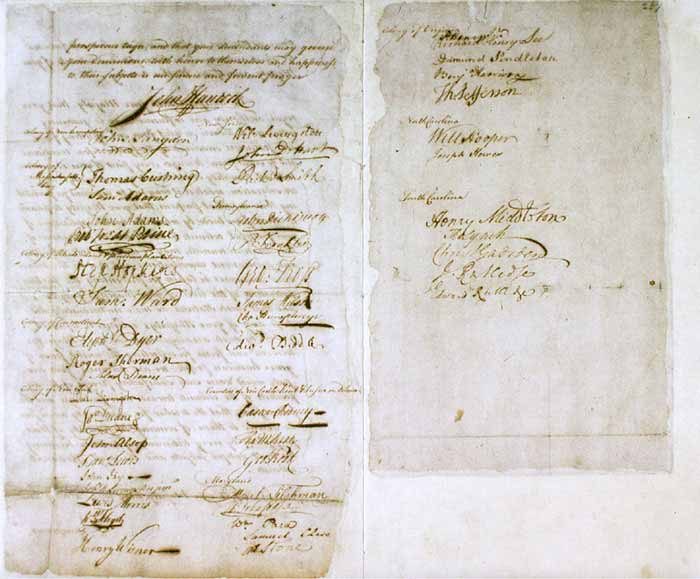
The Declaration of Independence cites the failure of the whole sequence. "In every stage of these Oppressions We have Petitioned for Redress in the most humble terms: Our repeated Petitions have been answered only by repeated injury."7 The order matters. A petition tests a government's willingness to be corrected, and when it fails the testing has still done something. It shows later observers, and the petitioners, that the next step was not taken lightly. The stages of lawful protest in the framework start at the same place, with "lawful speech, publication, assembly, and petition for redress," which it states is "fully protected under natural rights and the First Amendment."8
Printing the truth
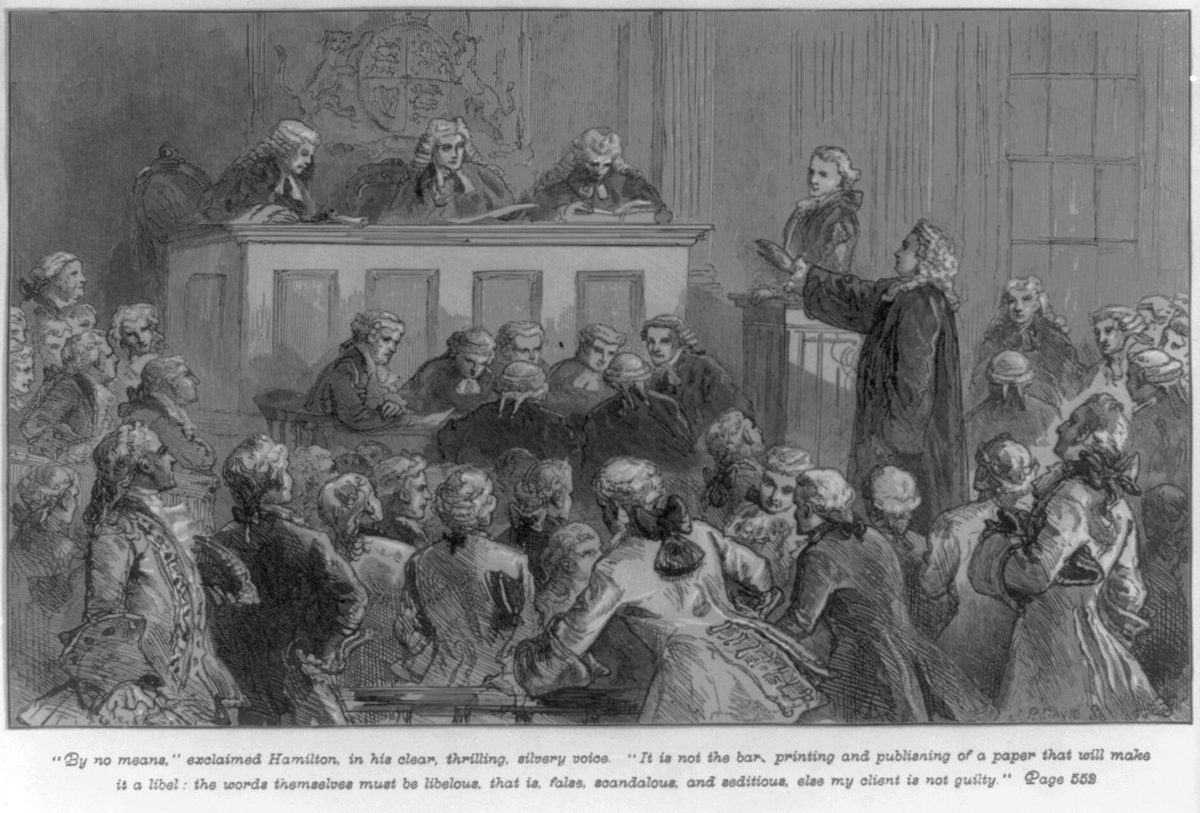
The press is the second old tool. New York's royal governor, William Cosby, tried to silence John Peter Zenger's New-York Weekly Journal. Two grand juries refused to indict Zenger for seditious libel. The governor then used a legal device called an information to bring him before the colony's supreme court. The court disbarred the two attorneys who ran the paper when they tried to represent Zenger, and the case went to a jury on August 4, 1735, with the Philadelphia lawyer Andrew Hamilton arguing it for free. Hamilton conceded that Zenger had printed the words and argued that the truth was a defense. "The laws of our country have given us a right to liberty of both exposing and opposing arbitrary power (in these parts of the world at least) by speaking and writing truth."9 The chief judge told the jurors that they had only to decide whether Zenger printed the words. After about ten minutes they returned a verdict of not guilty.9 Years later Gouverneur Morris called the verdict "the germ of American freedom, the morning star of that liberty which subsequently revolutionized America!"9
Lincoln named the press's enemy in 1838. When he spoke at Springfield he alluded to Elijah Lovejoy, an abolitionist minister and newspaper editor who was shot to death in a mob attack on his printing press.11 Zenger faced a hostile governor and won before a jury. Lovejoy faced a crowd and was killed. One was lawful pressure on power. The other was the mob, a kind of lawlessness that sometimes passes for popular will.
The Jury and the Ballot
Bushell's jurors and Zenger's both made a point the founders absorbed: a jury of neighbors is a check on the government as real as any legislature. A jury sees what the law does when applied to a particular defendant, and it can decline to convict. The first stage of protest in the framework names the ordinary tools in plain terms: lawful speech, publication, assembly and petition for redress, with peaceful rallies, critical essays, boycotts and symbolic protest as examples.8
Madison explained why the vote is not enough by itself. "A dependence on the people is, no doubt, the primary control on the government; but experience has taught mankind the necessity of auxiliary precautions."12 The ballot is the main check and the other tools are the auxiliary precautions. They share one feature: each is open to everyone, each is public, and each leaves the structure of the government standing. A voter who loses an election has not lost the republic. A juror who acquits has not abolished the court.
When Officials Nullify
Kentucky, South Carolina and Jackson
Some resistance comes from governments instead of citizens. In 1798 the Virginia General Assembly protested the Alien and Sedition Acts and declared that when the federal government exercised powers not granted, "the states who are parties thereto, have the right, and are in duty bound, to interpose for arresting the progress of the evil."13 The Kentucky Resolution of December 3, 1799, went further: "a nullification, by those sovereignties, of all unauthorized acts done under colour of that instrument, is the rightful remedy."14 Both pledged attachment to the Union, and both described their protest as a defense of the Constitution.
On November 24, 1832, a South Carolina convention put the idea into practice. It declared the federal tariff acts of 1828 and 1832 "null, void, and no law, nor binding upon this State, its officers or citizens."15 President Jackson answered on December 10. He called the power to annul a federal law, "assumed by one State, incompatible with the existence of the Union, contradicted expressly by the letter of the Constitution." On secession, the next step the nullifiers were threatening, he wrote: "Secession, like any other revolutionary act, may be morally justified by the extremity of oppression; but to call it a constitutional right, is confounding the meaning of terms."16 That sentence draws a line this lesson depends on. Revolution can be a moral act. An official who calls it a constitutional procedure is confusing the people.
The case that cuts the other way
The history is harder than the principle. In 1854 Sherman Booth was charged under the Fugitive Slave Act of 1850 with helping a man escape federal custody in Milwaukee. A justice of the Wisconsin Supreme Court issued a writ of habeas corpus, found the detention illegal and ordered him freed, and the state's supreme court entered a final judgment that refused obedience to the writ of error from Washington. In Ableman v. Booth, Chief Justice Taney wrote that the "supremacy of the State courts over the courts of the United States, in cases arising under the Constitution and laws of the United States, is now for the first time asserted and acted upon in the Supreme Court of a State." The Court held that "the judgment of the Supreme Court of Wisconsin must therefore be reversed."17 Taney's holding rested on the law of supremacy. The statute he enforced returned people to slavery. Wisconsin's judges were officials sworn to the Constitution, and they set aside a federal statute to keep a man out of jail for helping a fugitive. The lesson on slavery showed how a lawful claim and a just one can part. Here they part inside a single case.
The framework's rule for officials
The framework draws a hard line about officials. Its definition of civil disobedience is for individuals: "Civil disobedience is an individual moral witness. Public officials have sworn oaths to uphold the law. When they defy it, they violate their duty."18 In its treatment of breaches by public officials, sanctuary policies adopted by governments are classed as a form of nullification, and the objection that they express state sovereignty is answered with a flat line: "Sovereignty does not include nullification."19 The framework's statement on immigration enforcement lists "peaceful protest, sanctuary, legal advocacy, and public dissent" among commendable forms of resistance.20 The two statements divide by actor. Sanctuary that is private, an individual or a congregation giving shelter and accepting the legal risk, is a commendable form of resistance. Sanctuary that is a government choosing which federal law to enforce is nullification.
The leading objection comes from the Supreme Court. In Printz v. United States (1997), the Court held that the federal government "may neither issue directives requiring the States to address particular problems, nor command the States' officers, or those of their political subdivisions, to administer or enforce a federal regulatory program."21 On that view a city that declines to use its own officers for federal purposes has not nullified anything. It has used a power the Constitution gives it. Ordered Liberty answers from the oath and the Supremacy Clause. The two positions are set side by side here, as Kentucky and Jackson were.
| Form | Example | What it risked |
|---|---|---|
| Petition | Olive Branch Petition, July 17754 | The king refused to read it. |
| Press | Zenger, 17359 | Prosecution for seditious libel; acquitted. |
| Jury verdict | Bushell's jurors, 16701 | Fines of forty marks each and prison for Bushell. |
| State nullification | South Carolina, 183215 | A presidential proclamation against it.16 |
| Open disobedience | Thoreau's night in jail; King at Birmingham2223 | Jail, accepted openly. |
| Draft refusal | Heart Mountain resisters, 194424 | Three years in federal prison; pardoned in 1947. |
Civil Disobedience
Thoreau
Henry David Thoreau published "Resistance to Civil Government" in 1849. He had refused to pay a poll tax, and in the essay he reports the result: "I was put into a jail once on this account, for one night." He explained why a just man might accept that: "Under a government which imprisons any unjustly, the true place for a just man is also a prison."22 He wrote that if the machinery of government requires you "to be the agent of injustice to another, then, I say, break the law. Let your life be a counter friction to stop the machine."22
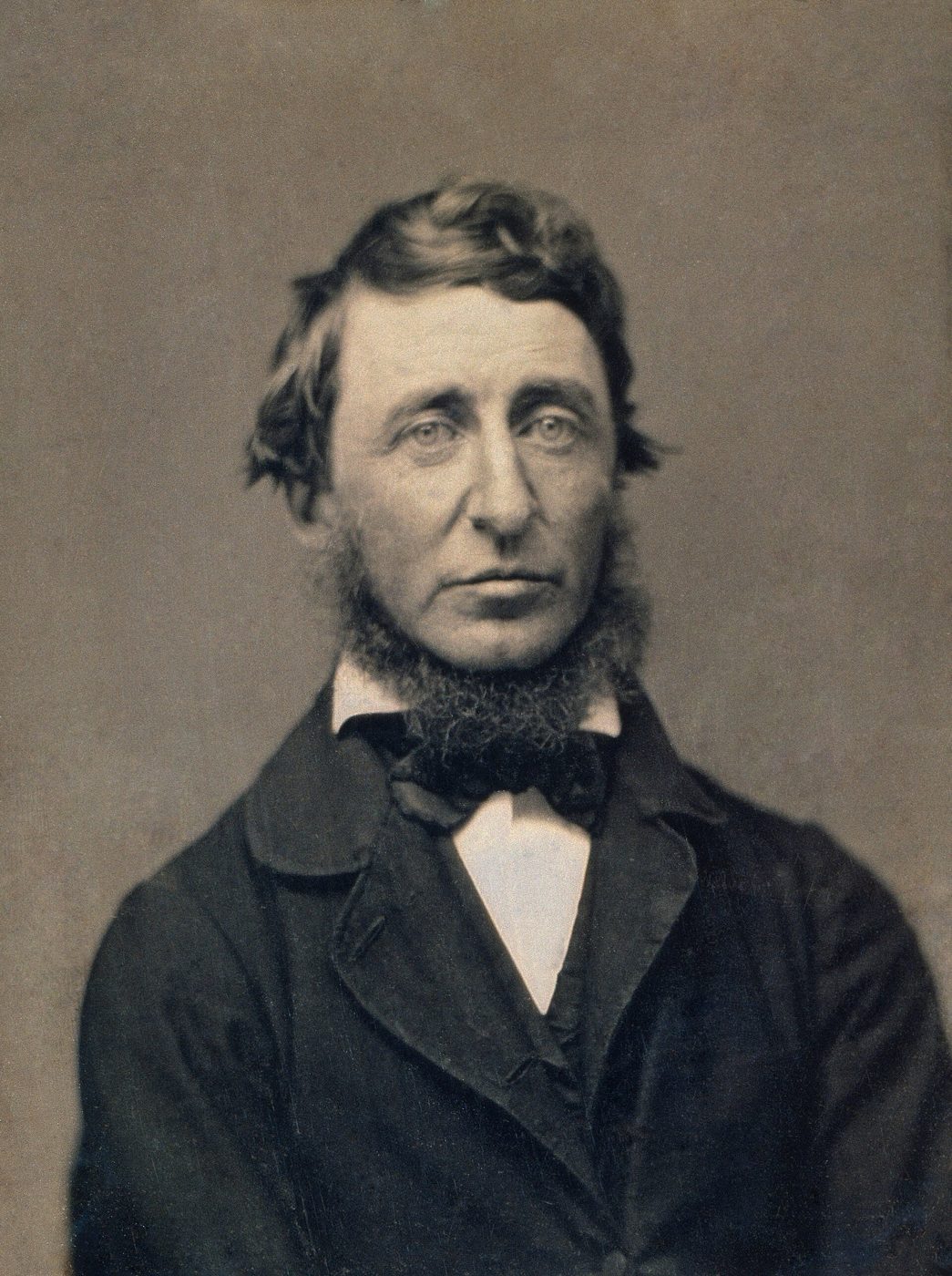
The framework's notes on its sources state the condition that resistance come "only after peaceful avenues are exhausted."26 Thoreau's own essay puts the matter in other terms: "As for adopting the ways which the State has provided for remedying the evil, I know not of such ways. They take too much time, and a man's life will be gone."22 The condition about exhausting remedies is the framework's own. King's four steps, which begin with fact-finding and negotiation, sit closer to it.
King
Martin Luther King Jr. wrote from the Birmingham city jail on April 16, 1963. He set out four basic steps for any nonviolent campaign: "collection of the facts to determine whether injustices exist; negotiation; self-purification; and direct action."23 He drew on two Christian teachers to say how a person tells a just law from an unjust one. "I would agree with St. Augustine that 'an unjust law is no law at all.'" And in the terms of Aquinas, "An unjust law is a human law that is not rooted in eternal law and natural law."23
"One who breaks an unjust law must do so openly, lovingly, and with a willingness to accept the penalty. I submit that an individual who breaks a law that conscience tells him is unjust, and who willingly accepts the penalty of imprisonment in order to arouse the conscience of the community over its injustice, is in reality expressing the highest respect for law."
Martin Luther King Jr., Letter from Birmingham Jail, April 16, 1963.23
The passage is the core of the argument that civil disobedience supports a legal order. The disobedient person is not hiding. He does not resist arrest or destroy anything. He pays. In the same letter King accused the "white moderate" of being "more devoted to 'order' than to justice," a line the framework takes up directly.23 The charge is aimed at anyone who treats the quiet of a society as the same thing as its health. Ordered Liberty answers it by refusing to separate the two, and by holding that order without justice is not ordered liberty at all. Whether a particular order is just is the question King asked, and the one his critics asked of him.
The four conditions
The framework sets four conditions for legitimate civil disobedience. It must be nonviolent. It must be transparent, carried out openly and without disguise. It must be defensive, a response to a specific injustice and not an attempt to overturn the law generally. And it must accept the lawful consequence, which means obeying orders to disperse and not resisting arrest, passively or otherwise.18 Property destruction and blocking access to public or private facilities are treated as violence that falls outside the category, and the objection that civil disobedience is illegal is answered in a sentence: "Legality and morality are not the same."18 Civil disobedience is also described as "a last-resort act of conscience," most justifiable when peaceful alternatives are exhausted.18 In the framework's reading of the Concord Principle, civil disobedience "accepts punishment as part of protest and generally avoids confrontation," and "CPoR affirms both as valid paths," pacifism being the other.27
The framework's stages of protest rise in order. The first is expression and dissent, which is fully protected. The second is nonviolent civil disobedience, which is conditional on the four requirements. The third is active obstruction of injustice, which it calls grave protest, peaceful but assertive disruption that must be "provably defensive" and aimed at rights under imminent threat. The fourth is defensive self-protection, physical force only when life, liberty or property is directly and unlawfully threatened.8 Each step up the scale brings heavier conditions, and the higher steps have a narrow reach.
The men who would not report
The Heart Mountain camp in Wyoming produced a case of this kind. When the government began drafting Nisei from the camps in January 1944, about 300 young men refused to report for physicals or induction, on the ground that their citizenship rights should be fully restored before they were compelled to serve. The most organized resistance came from Heart Mountain, where a Fair Play Committee took up the cause. Sixty-three Nisei there resisted the draft, and fifty-one of them said they would serve if their citizenship rights were restored. They argued that their prosecutions were test cases of those rights. They were convicted and sentenced to three years in federal prison, their appeals failed, and in 1947 a presidential pardon reached those convicted.24
The men used lawful means, and they refused the order openly, accepted prosecution and appealed. They also made a narrow demand: restore the rights, and they would serve. Applied to the four conditions, the case is nonviolent, transparent, defensive and accepting of the lawful consequence. It also bears on the rule that disobedience is a last resort. These men were citizens confined without individual review and then ordered to serve in a war for the country that confined them, and they chose the courts and accepted the penalty.
Conscience and the draft
The law itself makes room for one form of refusal. In United States v. Seeger (1965), the Supreme Court read the conscientious-objector exemption to cover any "sincere and meaningful belief which occupies in the life of its possessor a place parallel to that filled by the God of those admittedly qualifying for the exemption."28 The Court said local boards and courts "are not free to reject beliefs because they consider them 'incomprehensible.'" Their task is to decide whether the beliefs are sincerely held and whether they are, in the objector's own scheme of things, religious.28 A legislature chose to accommodate conscience before the courts widened the reading. The exemption is an example of a pressure valve written into the law, through which conscience can work.
Where Resistance Becomes Lawlessness
Lincoln's Lyceum Address of January 27, 1838, states the limit. He did not claim there are no bad laws. "Although bad laws, if they exist, should be repealed as soon as possible, still while they continue in force, for the sake of example, they should be religiously observed." Then comes the sentence that fits this lesson: "There is no grievance that is a fit object of redress by mob law."29 His examples show the pattern. In Mississippi, he said, the crowd began by hanging gamblers, and the hanging went on "from gamblers to negroes, from negroes to white citizens, and from these to strangers." A crowd that punishes without trial has no stopping place.29
Lincoln's own words need to be read next to King's. Lincoln wrote that bad laws should be "religiously observed" until repealed. King wrote that one has a moral responsibility to disobey unjust laws. The two address different conduct. Lincoln was writing against mobs, which strike in anonymity and punish without trial, and he was explicit that bad laws should be changed by lawful means. King was writing about a person who acts openly, hurts no one and goes to jail. Both men believed in the law's authority. They disagreed about whether obeying an unjust law preserves it or corrupts it.
The framework puts the boundary where the two men agree: no harm to others, no concealment, no resistance to the penalty. "Property destruction is violence. It undermines the moral force of protest and turns conscience into compulsion."18 Past that line stands the Concord Principle, which allows what it calls violent defensive resistance in a narrow set of cases, under the law of self-defense and five standards that must all be met. That is the subject of the next lesson.
Learn more
- Bushell's Case: The 1670 report, with Chief Justice Vaughan's reasoning on why a jury cannot be punished for its verdict.
- The Olive Branch Petition: The full text of Congress's last petition to the king, with a note on how it was received.
- Thoreau, Resistance to Civil Government: Read the paragraph that begins with the machine of government. It is the shortest argument for refusing to take part in a wrong.
- Letter from Birmingham Jail: King's reply to eight clergymen who asked him to wait. Pay attention to his four steps and to his paragraph on the white moderate.
- Lincoln's Lyceum Address: Lincoln on mobs, bad laws and the survival of free institutions. The section on mob law is short.
- Jackson's Nullification Proclamation: The president's answer to South Carolina, with the passage on revolution that this lesson quotes.
- United States v. Seeger: The 1965 opinion on conscientious objection and what counts as a belief parallel to God.
- Personal Justice Denied, chapter 9: The commission's account of the draft resisters at Heart Mountain and the other responses to confinement.
Notes
- Bushell's Case, 22 Charles II (1670), as reported by Chief Justice Vaughan, Howell's State Trials vol. 6, page 999. The writ of habeas corpus is dated November 9, 1670, and recites the order that fined each of the twelve jurors forty marks for acquitting William Penn and William Mead. Read it online. ↩
- Bushell's Case, Vaughan's argument that a juror "cannot see by anothers eye, nor hear by anothers ear" (the report prints the word without its apostrophe) and that "the judge could not, nor can fine and imprison the jury in such cases." ↩
- First Amendment, text in the National Archives transcription of the Bill of Rights as sent to the states in 1789. Read it online. ↩
- Gilder Lehrman Institute, "Olive Branch Petition, 1775," with the editor's note that the petition was drafted by John Dickinson, adopted July 5, sent to the king on July 8, and that George III refused to read it. The petition text is also in the Journals of the Continental Congress, July 8, 1775 (Avalon Project). Read it online. ↩
- Gilder Lehrman Institute, "Proclamation of Rebellion, August 23, 1775," text of the royal proclamation "For suppressing Rebellion and Sedition." Read it online. ↩
- Scan of the Olive Branch Petition, Library of Congress, via Wikimedia Commons, file "Olive petition petition big.jpg." ↩
- Declaration of Independence, National Archives transcript, the grievance paragraph that begins "In every stage of these Oppressions." Read it online. ↩
- Jeff A. Pierson, "Ordered Liberty Reclaimed: A Foundation for Liberty," v3.1 (July 13, 2025), section VII, "The Stages of Lawful Protest and Civic Defense." Read it on this site. ↩
- National Constitution Center, "On this day, an early victory for the free press" (Constitution Daily). It gives August 4, 1735, as the date of the acquittal, the two grand juries that refused to indict, the disbarment of Zenger's first lawyers, the instruction of Chief Judge De Lancey, and the quotations from Andrew Hamilton and Gouverneur Morris. Read it online. ↩
- Andrew Hamilton defending John Peter Zenger in court, 1734-5, wood engraving, 1877, Library of Congress Prints and Photographs Division, LCCN 2006687175, via Wikimedia Commons. ↩
- Abraham Lincoln, Address before the Young Men's Lyceum of Springfield, January 27, 1838, with the editor's note identifying Elijah Lovejoy as a minister, newspaper editor and abolitionist shot to death during a mob attack on his printing press. Teaching American History, Ashbrook Center. Read it online. ↩
- James Madison, Federalist No. 51, Avalon Project. Read it online. ↩
- Virginia Resolution, December 1798, passed in protest of the Alien and Sedition Acts. Avalon Project. Read it online. ↩
- Kentucky Resolution, approved December 3, 1799 (the second Kentucky Resolutions), Avalon Project. Read it online. ↩
- South Carolina, Ordinance of Nullification, November 24, 1832, Avalon Project. Read it online. ↩
- Andrew Jackson, Proclamation Regarding Nullification, December 10, 1832, Avalon Project. Read it online. ↩
- Ableman v. Booth, 62 U.S. 506, December Term 1858, Chief Justice Taney for the Court. Booth was charged with aiding the escape of a fugitive slave at Milwaukee on March 11, 1854, under the Act of September 18, 1850. Read it online. ↩
- Jeff A. Pierson, "Ordered Liberty Reclaimed: A Foundation for Liberty," v3.1 (July 13, 2025), section VIII, definition of civil disobedience, and the questions and counterpoints on civil disobedience, property destruction and public officials. Read it on this site. ↩
- Jeff A. Pierson, "Breach of Ordered Liberty Framework" (2025 edition), the discussion of sanctuary policies adopted by public officials and the answers to objections about state sovereignty. Read it on this site. ↩
- Jeff A. Pierson, "CPoR Statement on Immigration Enforcement and the Limits of Justified Resistance" (2025), the sentence on peaceful protest, sanctuary, legal advocacy and public dissent. ↩
- Printz v. United States, 521 U.S. 898 (June 27, 1997), the Court's holding that the federal government may not command the officers of the states to administer or enforce a federal regulatory program. Read it online. ↩
- Henry David Thoreau, Resistance to Civil Government (1849; now usually called "Civil Disobedience"), Project Gutenberg edition. The jail night is described in the same essay. Read it online. ↩
- Martin Luther King Jr., "Letter from Birmingham Jail," April 16, 1963. Text from the African Studies Center, University of Pennsylvania. Read it online. ↩
- Commission on Wartime Relocation and Internment of Civilians, Personal Justice Denied, chapter 9, section on the draft: the Fair Play Committee at Heart Mountain, sixty-three Nisei who resisted, three-year sentences, failed appeals, and the 1947 presidential pardon of those convicted. Read it online. ↩
- Benjamin D. Maxham, daguerreotype of Henry David Thoreau, June 18, 1856, National Portrait Gallery, Smithsonian Institution, via Wikimedia Commons, file "Benjamin D. Maxham - Henry David Thoreau - Restored.jpg." ↩
- Jeff A. Pierson, "Ordered Liberty Reclaimed: A Foundation for Liberty," v3.1 (July 13, 2025), the list of sources for the stages of protest, which summarizes Thoreau and King. Read it on this site. ↩
- Jeff A. Pierson, "The Concord Principle of Resistance," Draft 7 (2025), the passage comparing the principle with civil disobedience and pacifism. Read it on this site. ↩
- United States v. Seeger, 380 U.S. 163 (argued November 16-17, 1964, decided March 8, 1965), Justice Clark for the Court. Read it online. ↩
- Lincoln, Lyceum Address, January 27, 1838, the paragraphs on bad laws ("should be repealed as soon as possible") and on mob law. Read it online. ↩
Terms in this lesson
- Petition for redress
- A formal request to government to correct a wrong. The First Amendment protects 'the right of the people peaceably to assemble, and to petition the Government for a redress of grievances.'
- Seditious libel
- The old crime of publishing words that criticize the government, even true ones. John Peter Zenger was tried for it in 1735 and acquitted by a jury.
- Nullification
- The claim that a state, or an official acting for it, may declare a federal law void within its borders. Kentucky asserted it in 1799 and South Carolina acted on it in 1832. Andrew Jackson and the Supreme Court rejected it.
- Civil disobedience
- In the Ordered Liberty definition, the intentional and public refusal to obey a specific law as moral protest, carried out nonviolently, openly, in response to a specific injustice, and with acceptance of the legal consequence.
- Conscientious objection
- A claim of exemption from military service on grounds of conscience. In United States v. Seeger (1965) the Supreme Court read the statute to cover any sincere and meaningful belief that occupies a place parallel to that filled by God in a traditionally religious person's life.
- Mob law
- Lincoln's phrase in his 1838 Lyceum Address for punishment or redress carried out by a crowd outside the law. He wrote that there is no grievance that is a fit object of redress by it.
Sources
- Bushell's Case (1670), Howell's State Trials vol. 6, constitution.org checked 2026-10
- Bill of Rights transcription, National Archives checked 2026-10
- Declaration of Independence transcript, National Archives checked 2026-10
- Olive Branch Petition (1775) and Proclamation of Rebellion (Aug. 23, 1775), Gilder Lehrman Institute checked 2026-10
- National Constitution Center, on the Zenger trial (1735) checked 2026-10
- Federalist No. 51, Avalon Project checked 2026-10
- Virginia Resolution (1798) and Kentucky Resolution (1799), Avalon Project checked 2026-10
- South Carolina Ordinance of Nullification (1832) and Jackson's Proclamation (1832), Avalon Project checked 2026-10
- Ableman v. Booth, 62 U.S. 506 (1859), Cornell LII checked 2026-10
- Printz v. United States, 521 U.S. 898 (1997), Cornell LII checked 2026-10
- Henry David Thoreau, Resistance to Civil Government (1849), Project Gutenberg checked 2026-10
- Martin Luther King Jr., Letter from Birmingham Jail (Apr. 16, 1963) checked 2026-10
- Personal Justice Denied, chapter 9, National Archives checked 2026-10
- United States v. Seeger, 380 U.S. 163 (1965), Cornell LII checked 2026-10
- Abraham Lincoln, Address before the Young Men's Lyceum of Springfield (Jan. 27, 1838), Teaching American History checked 2026-10