Lesson 7 of 10 · about 24 minutes
Immigration Law and Order Today
You'll be able to
- Trace the main stages of federal immigration law from the Naturalization Act of 1790 through the quota era, the 1965 act, employer sanctions in 1986 and expedited removal
- Explain the difference between entering without inspection, which is a crime, and remaining after entry or overstaying, which the Supreme Court has called a civil matter
- State what Yamataya v. Fisher, Zadvydas v. Davis and Arizona v. United States say about due process and the division of federal and state power
- Explain how the Concord Principle of Resistance treats immigration enforcement: lawful removal is legitimate, peaceful protest and advocacy are legitimate, and violent resistance does not meet its five conditions
- Weigh the standard objections to that application, including the detention of citizens in error and the biblical case for compassion toward the stranger
Twice a week an ICE deportation plane lands at the small airport in Twin Falls, Idaho. On Tuesdays and Thursdays around noon, Heather Muth and a few other immigration-rights activists unfurl a banner facing the tarmac. It reads "Human Rights, Not Shuffle Flights." One afternoon Muth used a telescope and counted more than two dozen detainees in shackles being loaded from vans onto the plane.1 Minidoka, the camp described in the last lesson, stood on the plain north of the city. In 1942 and in this decade the government has said it was acting under law.
This lesson is about the law as it stands now. It follows the statutes and the Supreme Court cases on immigration, then shows how the Concord Principle of Resistance applies to enforcement and protest, and then sets out the standard objections and the responses to them. The subject is divisive, and a fair treatment lets each side state what it believes.
Who Counted, and Who Decided
From 1790 to 1965
The first naturalization law, passed on March 26, 1790, let "any alien, being a free white person" who had lived in the country two years apply for citizenship before a court, if he was of good character and took an oath to support the Constitution.2 Race was in the statute from the first day. The Chinese Exclusion Act of 1882 went further. The National Archives calls it the first significant law restricting immigration into the United States, and it banned Chinese laborers for ten years.3 Congress renewed the ban in the Geary Act, which required every Chinese resident to carry a certificate of residence or face deportation.3
In 1893 the Supreme Court upheld the certificate requirement in Fong Yue Ting v. United States. Justice Gray wrote that the right to exclude or expel aliens is "an inherent and inalienable right of every sovereign and independent nation, essential to its safety, its independence, and its welfare."4 That sentence is the root of what lawyers now call the plenary power doctrine. The CPoR statement on immigration cites the case for the same doctrine, which it describes as leaving immigration to the political branches, with the judiciary playing only a limited oversight role.5
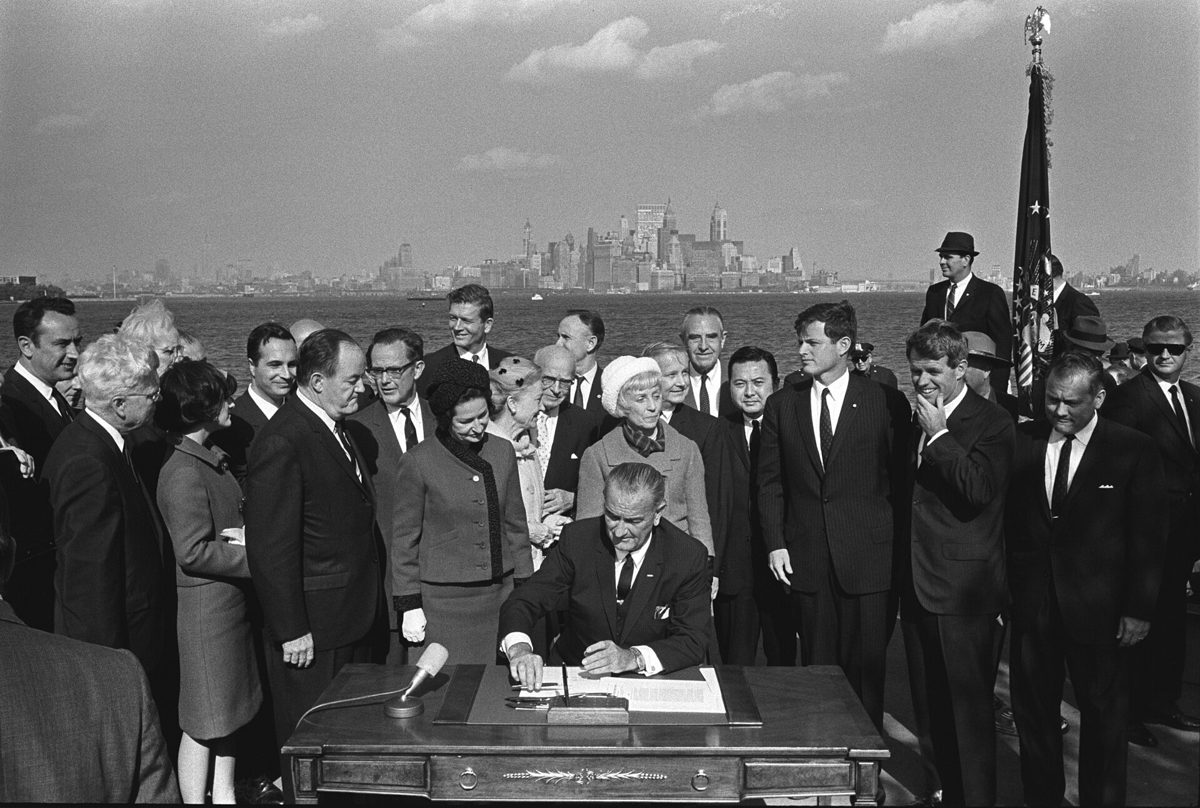
The Immigration Act of 1924 replaced case-by-case exclusion with national quotas set at two percent of each nationality's presence in the 1890 census, and it completely excluded immigrants from Asia.6 The McCarran-Walter Act of 1952 kept the quota system. It ended the exclusion of Asians and allowed them to naturalize, but it still allotted 85 percent of its 154,277 annual visas to people of northern and western European descent, and it counted Asians by race and not by country.7 On October 3, 1965, President Johnson signed a new act on Liberty Island and described what the old system had done: "Only 3 countries were allowed to supply 70 percent of all the immigrants."8 He said that from then on, people would be admitted "on the basis of their skills and their close relationship to those already here."8
From 1986 to now
The next two changes moved the enforcement line. In 1986 Congress made it unlawful for an employer to hire a worker the employer knows is unauthorized, and set civil penalties of $250 to $2,000 per worker for a first order.10 In 1996 it rewrote the inspection section of the Act and created expedited removal, which lets an immigration officer order certain people removed without a hearing before an immigration judge.11 The statute lets the executive branch extend that process to people who have not been admitted or paroled and cannot show two years of continuous presence.11 On January 24, 2025, the Department of Homeland Security used that authority to the full. Before then, officers could use it anywhere in the country against people who had arrived by sea, but against land entrants only within 100 air miles of the border and within their first 14 days. The new notice reached people encountered anywhere in the country who could not show two years of presence.12
- 1790 First naturalization law limits citizenship to "free white" persons.
- 1882 Chinese Exclusion Act, the first significant federal restriction on immigration.
- 1924 National-origins quotas; Asian immigration excluded.
- 1952 McCarran-Walter Act keeps quotas, ends the bar on Asian naturalization.
- 1965 Quotas replaced by skills and family ties; signed on Liberty Island.
- 1986 Employer sanctions under 8 U.S.C. 1324a.
- 1996 Expedited removal created.
- Jan. 2025 Expedited removal extended to the statutory maximum.
- June 2026 D.C. Circuit vacates a stay of that expansion.
The pattern deserves a plain statement. Every one of these laws was passed by Congress, and the Court upheld the Geary Act. Several rested on race or ancestry, and Congress later repealed or rewrote them. In 1965 President Johnson said the new act "corrects a cruel and enduring wrong in the conduct of the American Nation."8 Lawfulness and justice have come apart before, and the previous lesson showed how far. The framework treats that history as a reason to ask two questions of any immigration policy, whether it is law and whether it is just.
What the Statutes Say Today
A crime at the border, a civil matter after
The statute draws a line that arguments about "illegal" immigration often blur. Entering the United States at a place other than one designated by immigration officers, or evading inspection, is a federal crime. For a first offense the penalty is a fine or up to six months in prison, or both, and for later offenses up to two years.13 Once a person is here, the situation changes. In Arizona v. United States (2012) the Supreme Court wrote that removal "is a civil matter" and that "As a general rule, it is not a crime for a removable alien to remain present in the United States."14 A person who overstays a visa has committed no crime of entry at all. Pew Research Center estimates that more than 12 million of the record 14 million unauthorized immigrants in 2023 either entered illegally or overstayed a visa, and it does not separate the two groups in that figure.15
Two paths to removal
Congress built two main routes. In ordinary removal proceedings, the person receives notice of the charges and a hearing before an immigration judge. He may present evidence and cross-examine government witnesses, and he has "the privilege of being represented, at no expense to the Government," by a lawyer of his choosing.16 He may also appeal to the Board of Immigration Appeals, an internal Justice Department body.5 In expedited removal, the officer decides, and a person who says he fears persecution or intends to seek asylum must be referred to an asylum officer for an interview.11
| Ordinary removal | Expedited removal | |
|---|---|---|
| Who decides | An immigration judge, after a hearing.16 | An immigration officer, "without further hearing or review" unless the person claims asylum or fear of persecution.11 |
| Who it reaches | Any noncitizen charged as removable. | Arriving noncitizens, and those designated by the Secretary who were never admitted or paroled and cannot show two years of continuous presence.11 |
| Evidence and counsel | Evidence, cross-examination and counsel at the person's own expense.16 | An interview with an asylum officer for those who claim fear.11 |
The courts are still working out how much the Constitution requires of the second path. A federal district court stayed the January 2025 expansion on the ground that it likely violated due process. On June 23, 2026, the D.C. Circuit vacated that stay. Judge Walker, writing for the court, held that the expansion did not violate due process and vacated the stay.17 Judges Rao and Wilkins wrote separately. The ruling concerned a stay, not a final judgment, and the lesson takes no side in the case. It shows that on the question of how much process a person deserves before removal, serious judges disagree in print.
What the Court Says a Noncitizen Is Owed
A reader who has seen the plenary power language might conclude that noncitizens have no rights against the government. The Court has never said that.

In Yamataya v. Fisher (1903), a young Japanese woman who had landed at Seattle was held for deportation after an inspector found she was likely to become a public charge. She pleaded that she knew no English and had not understood the questions. The Court ruled against her, and in the same opinion it fixed a limit on the government. It had never held, the Court wrote, "that administrative officers, when executing the provisions of a statute involving the liberty of persons, may disregard the fundamental principles that inhere in 'due process of law' as understood at the time of the adoption of the Constitution." One of those principles was "that no person shall be deprived of his liberty without opportunity, at some time, to be heard."19 Officials could not, the Court added, "arbitrarily" seize an alien who had entered and become part of the population and deport him without that chance. "No such arbitrary power can exist where the principles involved in due process of law are recognized."19
In Zadvydas v. Davis (2001), Justice Breyer extended the point to detention. The government argued that a person's status as an alien could justify holding him indefinitely after a removal order. The Court read the statute to allow detention only for a period reasonably necessary to carry out removal, set six months as a presumptively reasonable period, and said the Due Process Clause "applies to all 'persons' within the United States, including aliens, whether their presence here is lawful, unlawful, temporary, or permanent."20
Arizona settled a different question, which level of government may act. The Court held that the federal government's power over immigration is "broad" and "undoubted," and struck down parts of Arizona's S.B. 1070 as preempted. In its description of the federal system it noted that discretion is built in: "Unauthorized workers trying to support their families, for example, likely pose less danger than alien smugglers or aliens who commit a serious crime," and an officer may weigh whether a person has children born here, long ties to the community, or distinguished military service.14 Federal officers also hold real power. Under 8 U.S.C. 1357 they may question anyone believed to be an alien about his right to remain, and may arrest without a warrant an alien they have reason to believe is unlawfully present and likely to escape before a warrant can be obtained.21
The Concord Principle Applied to Immigration Enforcement
Enforcement is lawful, and dissent is legitimate
The CPoR statement on immigration is narrow in purpose. It does not argue for a particular policy. It asks when force against immigration enforcement could ever be justified under the Concord Principle of Resistance, and it answers that, in the ordinary case, it cannot.5 The principle allows defensive force only when five conditions are all met. The person using force must not be the aggressor. The threat must be immediate. The response must match the threat. Every peaceful and lawful remedy must have been tried. And an informed, impartial public must see the resistance as reasonable.22
Applied to removal, the principle's conditions fail one after another. A removal order is an administrative act with appeals, so the threat is neither immediate nor lethal. Violence against officers would be out of proportion to it. Asylum claims, appeals and political advocacy remain open. And the average informed citizen would see an attack on an officer as extreme.5 On the first condition, a person who "knowingly violated immigration law" is not "the passive target of an unprovoked attack."5 The reasoning is the same for those acting for someone else. Attacking immigration officers or federal buildings is "initiating force to obstruct lawful processes."22
The framework is just as direct about what remains permitted. "CPoR affirms that peaceful protest, sanctuary, legal advocacy, and public dissent are appropriate and morally commendable forms of resistance."5 The counterpoint section of the brief adds: "Peaceful protests, legal advocacy, or appeals for reform fall outside the scope of this framework." The framework governs force, and nothing else.23 The conclusion is short: "Violence may express outrage, but it does not establish justice."22 Muth's banner at the Twin Falls airport is the kind of act the framework calls legitimate.
The framework does not claim that every removal is just. It holds that removal that is lawful and carried out with due process "is not morally unjust and would never justify resistance." The framework's concern is with enforcement that skips due process, which it treats as a separate matter from a removal ordered after notice and a hearing. Neither case would justify force.5 It also notes that many people described as "criminals" in deportation statistics have committed minor or old offenses, and that green-card holders can be removed for decades-old offenses.5
The trespass argument
The distinctive part of the CPoR brief is its argument that unlawful presence is a form of trespass. Law, ethics and natural rights, the brief holds, each treat unauthorized entry onto another's property as a violation of consent. The brief extends this from a house to a nation. A homeowner decides who enters, and "a nation has the ethical authority to decide who may reside within its borders." Entering without permission is "national-level trespass," and overstaying a visa is like a guest who refuses to leave.22 The brief concludes that immigration without authorization is "a principled form of trespass." Unauthorized immigrants, it holds, "however peaceful or sympathetic, bypass the moral process that binds citizens together under a common rule."22 It reads Scripture the same way, citing Deuteronomy on boundary stones and Acts 17:26, where Paul says God "marked out" the "boundaries of their lands."22
Objections and Responses
The CPoR brief ends with an appendix of six counterpoints, each stated against the framework and each answered. Three objections are set out here with the framework's responses. The brief is worth reading in full.
The statute draws the line differently
The strongest legal objection is the one in the section above. If remaining after entry is generally "not a crime," as the Supreme Court said in Arizona, then the analogy to trespass, which is a crime or a tort in nearly every state, is looser than it sounds.14 Entry without inspection is criminal and carries up to six months.13 A visa overstay is a civil violation. The response is that the trespass argument is a moral one: it treats unlawful presence as a violation of consent and does not claim it is a federal crime. The moral and legal categories do not line up, and the Court itself has treated the civil character of removal as important. The first condition also asks whether the person using force is legally and morally innocent. In the main brief that innocence is "absent" for someone who entered unlawfully, and the counterpoint section explains that innocence means "the absence of coercion or aggressive violation," not obedience to every law.2223
The citizen who gets caught
The framework's case against force depends on the premise that removal is "lawfully conducted and respecting due process."5 The objection is that the premise fails in practice. A ProPublica analysis reported in October 2025 found that federal immigration agents had detained at least 170 U.S. citizens in recent months, including nearly 20 children, some held for days without a lawyer, and said that was almost certainly an undercount.24 Expedited removal also gives the officer wide control over the facts, including the question of whether a person can show two years of presence, a burden the notice places on the person.12 The previous lesson showed what follows when a government acts on a category and gives individuals no review. The framework holds that an order which punishes the innocent "is unjust, even if it is temporarily legal."25 Its answer to this objection is remedies: the response to unjust enforcement is "legal challenge, reform, and exposure."23 The framework separates the two situations. A removal ordered after notice and a hearing is lawful enforcement. The detention of a citizen, or of anyone denied due process, is a separate wrong that those remedies are meant to correct.
Scripture also speaks of the stranger
The CPoR brief builds a biblical case for boundaries and consent, and the counterpoint it lists is that compassion should rank above order.23 The texts critics cite are plain. "You shall treat the stranger who sojourns with you as the native among you, and you shall love him as yourself, for you were strangers in the land of Egypt."26 And, in Jesus' account of the final judgment: "I was a stranger and you welcomed me."27 The Southern Baptist Convention's 2011 resolution shows that people who share the framework's faith and its respect for law can still weigh this differently. It says Romans 13 teaches that "the rule of law is an indispensable part of civil society." It states that "Undocumented immigrants are in violation of the law of the land" and that governing authorities "have the right and responsibility to maintain borders." It also asks its churches to minister to all people "regardless of country of origin or immigration status," calls for "a just and compassionate path to legal status, with appropriate restitutionary measures," and declares that it is not to be read as support for amnesty.28 The brief replies that Jesus did not equate compassion with lawlessness: "A society that abolishes boundaries in the name of love loses both justice and love."23 The resolution agrees with the framework on the law and with its critics on the stranger. The framework accepts compassion toward immigrants as consistent with the law, and holds that compassion does not make a removal ordered after due process unjust.
Back in Twin Falls the work goes on in the open. Muth's tools are a banner, a telescope and a count of how many people she sees board. The framework calls that kind of witness legitimate, and nothing in the statutes the officers work under forbids it. The officers load the plane and Muth counts. Both stay inside the law.
Learn more
- 8 U.S.C. 1229a, Removal proceedings: The statute that sets out the hearing, the right to counsel at no government expense, and the burden of proof. Short enough to read in one sitting.
- Yamataya v. Fisher: A 1903 opinion about a young Japanese woman who landed at Seattle. The paragraph on notice and the chance to be heard is the part to read.
- Arizona v. United States: The 2012 opinion on state immigration laws. Its summary of the federal scheme is the clearest short account of how removal works.
- Pew Research Center on the unauthorized population: Estimates by state, country and workforce share, with a plain account of how the numbers are built and where they are uncertain.
- On Immigration and the Gospel: The 2011 Southern Baptist resolution. It affirms Romans 13 and secure borders and also demands that churches treat every person with compassion.
- Johnson's remarks on the 1965 act: A short speech with a long footnote: the president's own account of what the quota system did to families.
Notes
- Kirk Siegler, "Trump's immigration push has largely spared farms. Idaho dairymen worry it won't last," NPR, republished by OPB, September 28, 2026. Source for the Tuesday and Thursday flights at Twin Falls, the banner, and the quotations from Heather Muth. Read it online. ↩
- An Act to establish an uniform Rule of Naturalization, March 26, 1790, 1 Stat. 103, section 1. Read it online. ↩
- National Archives, "Chinese Exclusion Act (1882)," milestone document, with the account of the Geary Act, the 1943 repeal and the 1924 quotas. Read it online. ↩
- Fong Yue Ting v. United States, 149 U.S. 698 (1893). The petitioners were Chinese laborers who had not obtained the certificate of residence required by the Act of 1892. Read it online. ↩
- Jeff A. Pierson, "CPoR Statement on Immigration Enforcement and the Limits of Justified Resistance" (2025, undated draft marked for discussion), including its appendices on the Immigration and Nationality Act and on criminal aliens. ↩
- Office of the Historian, U.S. Department of State, "The Immigration Act of 1924 (The Johnson-Reed Act)," Milestones: 1921-1936. Read it online. ↩
- Office of the Historian, U.S. Department of State, "The Immigration and Nationality Act of 1952 (The McCarran-Walter Act)," Milestones: 1945-1952. Read it online. ↩
- Lyndon B. Johnson, "Remarks at the Signing of the Immigration Bill, Liberty Island, New York," October 3, 1965, American Presidency Project. Read it online. ↩
- Yoichi Okamoto, photograph of President Johnson at Liberty Island, October 3, 1965, Lyndon B. Johnson Library, item C666-16A-WH65, via Wikimedia Commons, file "Johnsonliberty.jpg." ↩
- 8 U.S.C. 1324a, "Unlawful employment of aliens," added by Pub. L. 99-603, title I, section 101(a)(1), November 6, 1986, 100 Stat. 3360. Subsection (a) bars knowingly hiring an unauthorized alien, and subsection (e)(4) sets civil penalties of $250 to $2,000 per worker for a first order. Read it online. ↩
- 8 U.S.C. 1225, "Inspection by immigration officers; expedited removal." The notes record that Pub. L. 104-208, div. C, section 302(a) (September 30, 1996) amended the section generally. Subsection (b)(1)(A)(iii) lets the Secretary designate noncitizens who have not been admitted or paroled and cannot show two years of continuous presence. Read it online. ↩
- Department of Homeland Security, "Designating Aliens for Expedited Removal," 90 Fed. Reg. 8139 (January 24, 2025). The notice recalls the 2019 and 2022 notices and says the new designation restores the full scope allowed by statute. Read it online. ↩
- 8 U.S.C. 1325(a), "Improper entry by alien": first offense, a fine or up to six months in prison, or both; later offenses, a fine or up to two years. Read it online. ↩
- Arizona v. United States, No. 11-182 (June 25, 2012), Justice Kennedy for the Court. The passages on the federal scheme, on removal as a civil matter and on discretion are in Part II. Read it online. ↩
- Pew Research Center, "U.S. Unauthorized Immigrant Population Reached a Record 14 Million in 2023," August 21, 2025. The report also gives 27 percent of the foreign-born population, 4.1 percent of the U.S. population, and 9.7 million unauthorized workers, 5.6 percent of the workforce. Read it online. ↩
- 8 U.S.C. 1229a, "Removal proceedings," subsection (b)(4): the privilege of counsel "at no expense to the Government," a reasonable opportunity to examine the evidence, to present evidence and to cross-examine government witnesses. Read it online. ↩
- Make the Road New York v. Mullin, No. 25-5320 (D.C. Cir. June 23, 2026), Judge Walker for the court, with separate opinions by Judges Rao and Wilkins. Read it online. ↩
- Portrait of Kaoru Yamataya, The Seattle Times, October 16, 1906, page 1, via Wikimedia Commons, file "KaoruYamataya.jpg." Public domain because published before 1931. ↩
- Yamataya v. Fisher, 189 U.S. 86 (1903), argued February 24 and decided April 6, 1903. Read it online. ↩
- Zadvydas v. Davis, No. 99-7791 (June 28, 2001), Justice Breyer for the Court. Read it online. ↩
- 8 U.S.C. 1357(a), "Powers of immigration officers and employees," which lists what officers may do without a warrant, including interrogating a person believed to be an alien about his right to remain and arresting an alien they have reason to believe is unlawfully present and likely to escape before a warrant can be obtained. Read it online. ↩
- Jeff A. Pierson, "A Concord Principle of Resistance (CPoR) Analysis," designated CPoR Brief No. 1: Sovereignty and Immigration (July 2025), sections on trespass, on applying the five standards to immigration, and the biblical appendix. Read it on this site. ↩
- Jeff A. Pierson, CPoR Brief No. 1: Sovereignty and Immigration (July 2025), "Appendix: Counterpoint-Response," items 1 through 6. Read it on this site. ↩
- Here & Now (WBUR), "U.S. citizens arrested by ICE have been 'kicked, dragged and detained for days,' ProPublica reports," republished by WRKF, October 16, 2025, summarizing a ProPublica analysis that found at least 170 citizens detained and called it almost certainly an undercount. Read it online. ↩
- Jeff A. Pierson, "Ordered Liberty Reclaimed: A Foundation for Liberty," v3.1 (July 13, 2025), section on the balanced responsibilities of citizens and government, where moral parity is the first expectation, and the section on who decides when an order is unjust. Read it on this site. ↩
- Leviticus 19:33-34 (ESV). Read it online. ↩
- Matthew 25:35-40 (ESV). Read it online. ↩
- Southern Baptist Convention, "On Immigration and the Gospel," resolution adopted at the annual meeting in Phoenix, June 14-15, 2011. Read it online. ↩
Terms in this lesson
- Immigration and Nationality Act
- The main federal immigration statute, enacted in 1952 and amended many times since. It is codified in Title 8 of the United States Code, beginning at section 1101, and governs admission, naturalization, removal, asylum and the duties of employers.
- Removal proceeding
- The civil process in which an immigration judge decides whether a noncitizen may be removed from the United States. The person receives notice, a hearing, the chance to present evidence, and the privilege of counsel at no expense to the government. The Supreme Court calls removal a civil matter, not a criminal one.
- Expedited removal
- A procedure created by Congress in 1996 under which an immigration officer may order certain noncitizens removed without a hearing before an immigration judge. A person who says he fears persecution must be referred for an interview with an asylum officer.
- Plenary power
- The doctrine, from Fong Yue Ting v. United States (1893), that Congress and the President hold very broad authority over who may enter and stay, so that courts review immigration decisions only lightly. Later cases insist that the Constitution still applies.
- Employer sanctions
- Civil and criminal penalties on employers who knowingly hire workers who lack authorization, enacted in the Immigration Reform and Control Act of 1986 and now found at 8 U.S.C. 1324a.
- Moral parity
- The first of the expectations in Ordered Liberty Reclaimed: citizens and government operate under the same moral standards, and neither side holds a moral exemption. Applied to enforcement, it binds the officer and the protester alike.
Sources
- Naturalization Act of March 26, 1790, 1 Stat. 103, GovInfo checked 2026-10
- Chinese Exclusion Act (1882), National Archives checked 2026-10
- The Immigration Act of 1924 and The Immigration and Nationality Act of 1952, Office of the Historian, U.S. Department of State checked 2026-10
- Lyndon B. Johnson, Remarks at the Signing of the Immigration Bill, Liberty Island, Oct. 3, 1965, American Presidency Project checked 2026-10
- 8 U.S.C. 1324a, 1325, 1225, 1229a and 1357, Cornell LII checked 2026-10
- Yamataya v. Fisher, 189 U.S. 86 (1903), Cornell LII checked 2026-10
- Zadvydas v. Davis, No. 99-7791 (2001), Cornell LII checked 2026-10
- Arizona v. United States, No. 11-182 (2012), Cornell LII checked 2026-10
- Designating Aliens for Expedited Removal, 90 Fed. Reg. 8139 (Jan. 24, 2025) checked 2026-10
- Make the Road New York v. Mullin, No. 25-5320 (D.C. Cir. June 23, 2026) checked 2026-10
- Pew Research Center, U.S. Unauthorized Immigrant Population Reached a Record 14 Million in 2023 (Aug. 21, 2025) checked 2026-10
- Southern Baptist Convention, On Immigration and the Gospel (2011) checked 2026-10
- Karin Brulliard, A GOP lawmaker supported an immigration crackdown. Her husband paid a price, The Washington Post (May 4, 2026) checked 2026-10
- Kirk Siegler, Trump's immigration push has largely spared farms. Idaho dairymen worry it won't last, NPR/OPB (Sept. 28, 2026) checked 2026-10