Lesson 3 of 10 · about 22 minutes
Lexington and Concord
You'll be able to
- Tell the sequence of April 18-19, 1775 from Gage's orders to the retreat into Charlestown, with names, places and numbers
- Compare the British and colonial accounts of who fired first at Lexington and say what the evidence allows
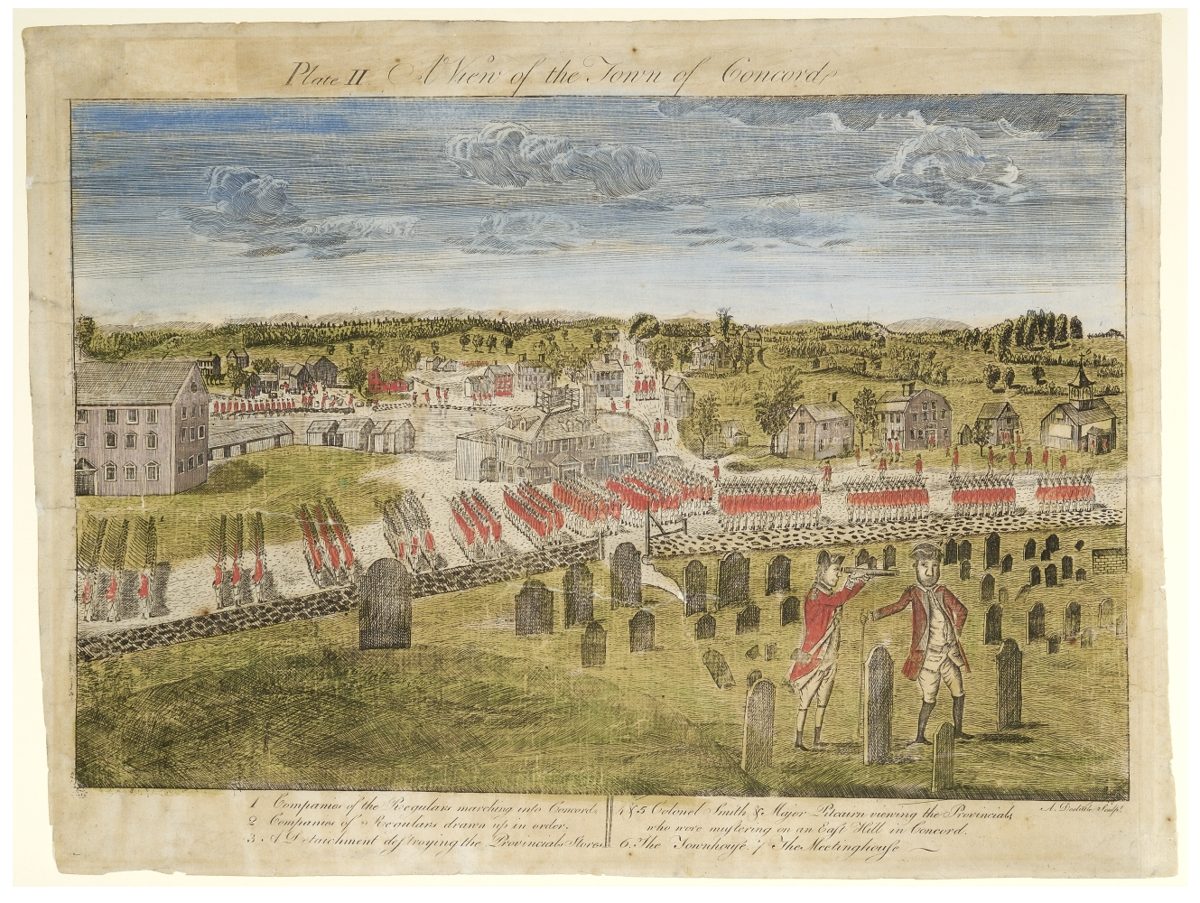
- Explain how Doolittle made his four engravings and what each shows
- Describe how Emerson's Concord Hymn and French's Minute Man turned the day into a national memory
About one o'clock on the morning of April 19, 1775, Captain John Parker of Lexington was told that British officers were riding up and down the road, stopping and insulting people, and that regular troops were on the march from Boston to take the province's stores at Concord. He ordered the militia to meet on the common. Five days later he swore out a statement for a justice of the peace in which he said that the company decided not to meddle with the regulars "unless they should insult or molest us."1 Parker was forty-five. He had fought at Louisbourg and on the Plains of Abraham in the last war, and he knew what a British column looked like.2
By dawn he had somewhere between 70 and 80 men on the green, the figure usually given is 77, in a village of farms around a meetinghouse.3 Down the road came the leading companies of about 700 British soldiers, rowed across the Charles River in the dark and marched through the night. What happened in the next few minutes is still argued. What happened in the next fourteen hours is one of the best documented days in American history.
The Powder Alarm
The road to Lexington began seven months earlier with a barrel count. On September 1, 1774, about 260 regulars of the 4th Regiment under Lieutenant Colonel George Maddison were rowed up the Mystic River before dawn, landed near Winter Hill, and marched a mile to the provincial powder house, which held the largest store of gunpowder in Massachusetts. They took it. They also took two field pieces at Cambridge.4
That would have been a local grievance, but a rumor ran ahead of the facts: the troops had fired on the people and killed six, the navy was bombarding Boston. None of it was true. The report went out through the countryside by rider and church bell, and in a day or two thousands of militiamen were on the roads toward Cambridge, some from as far off as Connecticut.4 The Powder Alarm showed two things. The country could rise in hours, and General Thomas Gage, the military governor of the province, could be pushed to near-panic by something that looked like a fight. Neither lesson was lost on either side.
Over the winter the Massachusetts Provincial Congress, meeting in defiance of Gage, set up a Committee of Safety, raised money for arms, and by the end of October recommended that towns form companies who would "equip and hold themselves in readiness, on the shortest notice." Many towns raised special volunteer companies that drilled at least twice a week and answered an alarm at a minute's warning.5 They stored cannon, powder, tents and provisions in Concord and Worcester. Lesson 4 looks at how those moves were defended as lawful. For now the point is that by April 1775 Concord held exactly the kind of stores Gage wanted.
Gage's Orders
On the night of April 18 Gage put his plan into motion. His written orders to Lieutenant Colonel Francis Smith read:
"you will March with the Corps of Grenadiers and Light Infantry, put under your command, with the utmost expedition and Secrecy to Concord, where you will seize and destroy all artillery, Ammunition, Provisions, Tents, Small Arms, and all Military Stores whatever. But you will take care that the Soldiers do not plunder the inhabitants, or hurt private property."
General Thomas Gage to Lt. Col. Francis Smith, April 18, 1775. 6
Read it twice. Gage ordered destruction of military stores and, in the same breath, ordered his soldiers to keep their hands off the people's property. His orders did not tell Smith to arrest anyone. Gage had received a dispatch from London on April 14 urging him to arrest the leaders of the Provincial Congress, but his orders for the march were limited to seizing the stores.5 He meant it to be a quiet raid. It was not quiet for even a mile.
The Night Riders
Dr. Joseph Warren, one of the few Patriot leaders left in Boston, learned that troops were gathering at the bottom of the Common. Paul Revere put the scene plainly in a letter he wrote to Jeremy Belknap about 1798: "About 10 o'clock, Dr. Warren sent in great haste for me and begged that I would immediately set off for Lexington, where Messrs. Hancock and Adams were, and acquaint them of the movement, and that it was thought they were the objects." Warren had already sent William Dawes by land over Boston Neck.7
The lanterns came from an arrangement Revere had made on the Sunday before. He had agreed with Colonel William Conant at Charlestown "that if the British went out by water, we would show two lanthorns in the North Church steeple; and if by land, one, as a signal." The point of the signal was to reach the men on the Charlestown side if Revere could not cross the river himself. Two friends rowed him over, under the guns of the warship Somerset, with the moon rising. He took a horse from Deacon Larkin and set out at about eleven.7
Near Charlestown Neck he saw two British officers under a tree and turned his horse. One of them chased him into a clay pond. Revere went on through Medford and Menotomy, and, as he wrote, "In Medford, I awaked the captain of the minute men; and after that, I alarmed almost every house, till got to Lexington." At Lexington he found Hancock and Adams at the Reverend Jonas Clarke's house. Dawes arrived half an hour later, and the two set out for Concord, joined on the road by a young doctor, Samuel Prescott, "a high Son of Liberty."7
A mile or so short of Lincoln they were stopped by British officers. Revere was held at pistol point, questioned, and told he would be shot if he ran. Prescott leaped his horse over a stone wall and reached Concord. Revere was marched back toward Lexington and released near the meetinghouse when the militia fired a volley that alarmed his captors, and he made his way back to Clarke's house.7 The popular picture of one man galloping alone to every door is wrong. Revere's own account has three riders, a signal system, a Committee of Safety, local captains, and dozens of other riders that night. The alarm was a network doing what it had been built to do.
Lexington Green
What the officers saw
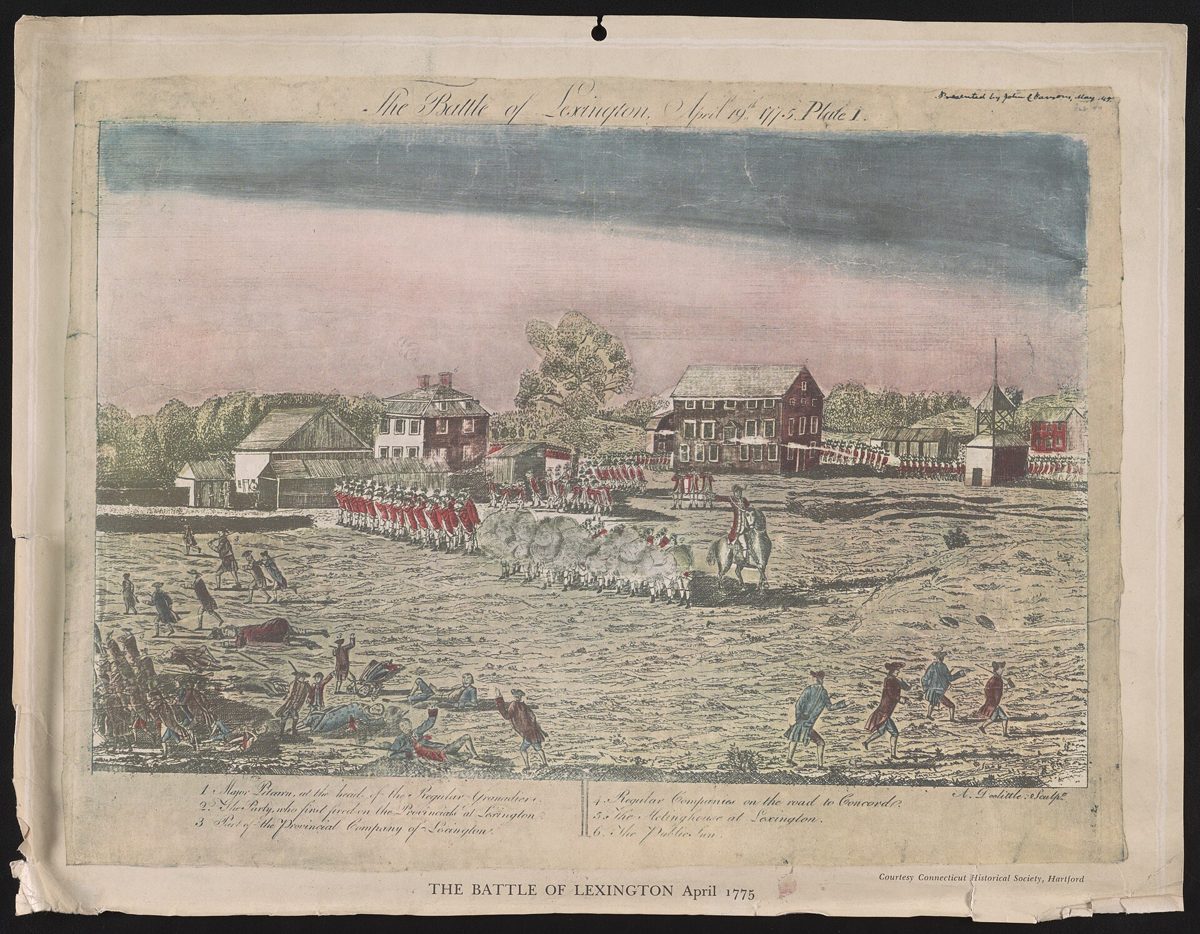
Major John Pitcairn, the marine officer who led the leading six light infantry companies, wrote to Gage a week later. As he approached the village he learned that about 500 armed men had assembled to oppose the troops. Two officers told him a man in the rebel ranks had presented his musket at them and it flashed in the pan. Pitcairn told the men to move forward "but on no account to fire." He saw "near 200 rebels" on the green. As he came within about a hundred yards "they began to file off towards some stone walls on our right flank. The Light Infantry, observing this, ran after them. I instantly called to the soldiers not to fire, but surround and disarm them." Then, he wrote, "some of the rebels who had jumped over the wall fired four or five shots at the soldiers, which wounded a man of the Tenth and my horse," and shots came from a meetinghouse. "Upon this, without any order or regularity, the Light Infantry began a scattered fire, and continued in that situation for some little time, contrary to the repeated orders both of me and the officers that were present."8
What the captain swore
Parker's deposition, taken at Lexington on April 25 under the Provincial Congress's order, tells it differently. The troops made their "sudden Approach," he wrote, and "I immediately ordered our Militia to disperse and not to fire. Immediately said Troops made their appearance and rushed furiously, fired upon and killed eight of our party, without receiving any Provocation therefor from us."1 Paul Revere, who was passing through the militia on his way out of the village with Hancock's trunk, gave a third angle in his own deposition. He counted "about 50 or 60" men on the green and heard the commanding officer say "Lett the troops pass by, and don't molest them, with out The [They] begin first." He then saw the troops come into view behind the meetinghouse, halt, and "one gun was fired, I heard the report, turned my head, and saw the smoake in front of the Troops." After a shout, "the whole fired."9
Myth: Parker said, "Stand your ground. Don't fire unless fired upon, but if they mean to have a war, let it begin here."
The words are cut into the boulder on the green, but no one who was there recorded them. They reach print from Parker's grandson, the preacher Theodore Parker, in 1855, who said he had them from the company's sergeant. Witnesses in 1775 recorded plainer orders: Revere heard an order not to molest the troops unless they began first; Ebenezer Munroe remembered that Parker told the men to stand their ground and not to molest the regulars unless they meddled with them; Parker's own deposition says he ordered the militia to disperse.10 The spirit is the same. The sentence is probably a family memory polished over eighty years.
What the evidence allows
The National Park Service account says that Parker ordered his men to disband, "but a sudden gunshot rang out from an unknown source," and the nervous regulars opened fire on the retreating militia. Eight militiamen were killed and ten wounded.11 Historians who have spent careers on the question still disagree. The shot may have come from a spectator, a militiaman, or a British soldier. What the sources agree on is that the militia company was in the open, with its captain's order to disperse, in front of a larger and disciplined force, and that a few moments later eight Lexington men lay dead or dying and one regular had a thigh wound.3 One of the wounded was Prince Estabrook, an enslaved Black man serving in the militia.3
Ordered Liberty reads the day as defensive on the colonists' side. "Ordered Liberty Reclaimed" states that "the colonists did not initiate force," and that the opening battle was "not an impulsive uprising but the result of years of disciplined protest, petitions for redress, and self-restraint."12 That reading rests on the evidence above, which does not settle who fired the first shot. It does show that nothing in Parker's orders or the militia's formation was aggressive and that the colonists spent the next days putting that in sworn testimony. Lesson 4 returns to what rests on that.
Concord and the North Bridge
The search
Smith's column entered Concord around 7:30 and began to search for arms. A detachment of more than a hundred regulars crossed the Concord River to Colonel James Barrett's farm, where Gage had told them to look for brass cannon. Most of the stores had been moved in advance. Meanwhile militia gathered on the ridges around the town, hoping to avoid bloodshed. Then a plume of smoke rose over the town. The militia officers feared the worst, and after a short council they marched down toward the village.11
"I haven't a man who is afraid to go"
At the North Bridge, around 9:30 a.m. by the NPS count, nearly 400 militiamen faced three companies of British light infantry, 96 men, holding the river crossing.11 Colonel Barrett, commanding, asked Captain Isaac Davis of Acton, a thirty-year-old gunsmith, whether his company would lead. Davis answered: "I haven't a man who is afraid to go." The 37 Acton minutemen marched down the hill to the sound of Luther Blanchard's fife.13
The regulars on the bridge pulled back to the Concord side and formed a line. A few shots rang out, then a volley. According to the American Battlefield Trust's account, Davis was shot through the heart and killed on the spot, and Abner Hosmer was mortally wounded; the fife stopped. Major John Buttrick of Concord ran to the head of the column and shouted the order every New England schoolchild learned: "Fire, fellow soldiers, for God's sake, fire!"13 The volley hit twelve British soldiers, four of them officers; three enlisted men died. They were the first British soldiers killed in the war.11 The British fled back into town.
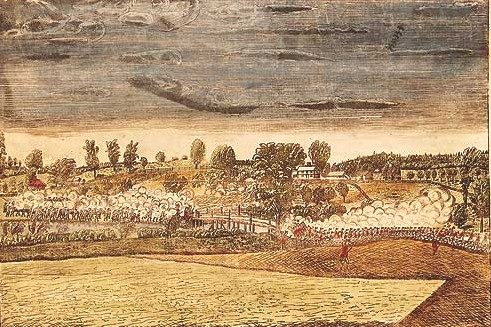
The NPS account ends this part with a sentence that sums up why Concord matters more than Lexington to the question this module asks: "Lexington was a tragedy; The fight at Concord's North Bridge was treason."11 From the colonists' side the first was a massacre and the second a defense. From Gage's side the second was a crime. Which view the facts supported is the subject of the next lesson.
The Road Back to Boston
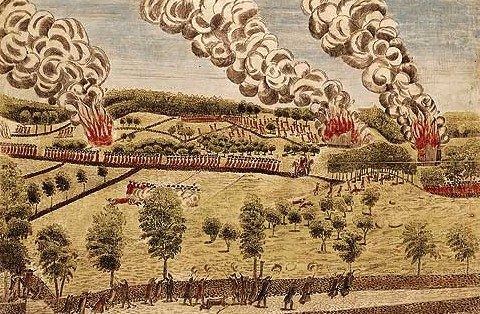
By noon Smith had gathered his wounded and started the eighteen miles home. He was already short of ammunition and had sent back for help. A mile and a half past the center of Concord, minute companies from Reading, Chelmsford and Billerica hit his rear guard at Meriam's Corner. From there the column ran through militia arriving from every town along the road. Smith wrote later that fire came "from behind the walls, ditches, trees, &c., which, as we marched increased to a very great degree, and continued without intermission of five minutes altogether, for, I believe, upwards of eighteen miles." A British officer put it more plainly: "Their numbers increasing from all parts while ours was reducing by deaths, wounds and fatigue."11
At about three the battered column reached Lexington, where Brigadier General Hugh Percy had come up with 1,000 men and two six-pounder cannon. Percy later wrote, "I had the happiness of saving them from inevitable destruction." The combined force marched on, and in Menotomy, now Arlington, the fighting turned to house-to-house combat in which most of the day's casualties occurred. Percy, fearing a trap at the Cambridge bridge, swung north and crossed Charlestown Neck at about seven that evening, under the guns of the fleet.11 The bloodiest stretch lay in Menotomy, where the largest engagement of the day took place on the farm of Jason Russell.3
| Phase | Colonial losses | British losses |
|---|---|---|
| Lexington Green, at dawn | 8 killed, 10 wounded | 1 wounded |
| North Bridge, Concord, about 9:30 a.m. | 2 killed (Isaac Davis, Abner Hosmer) | 3 killed, 12 hit in all |
| Meriam's Corner to Charlestown Neck | Most of the day's remaining losses | Most of the day's remaining losses |
| Whole day (counts differ by source) | 93 to 95 casualties | 273 to 300 casualties |
The totals are not exact because the counts differ. The National Park Service gives 273 British killed, wounded or missing and 95 colonial casualties. Other tallies give 93 colonial and up to 300 British, depending on how the missing are counted.14 When Thomas Hutchinson, the former governor, recorded the news of June 10 in his diary he noted that Smith's own return showed 63 killed, 157 wounded and 24 missing, "a greater number than Darby reported."15 Nearly 4,000 militia and minutemen had engaged, among them about 40 Black or Indigenous men. Peter Salem and Jeffery Hemmenway of Framingham enlisted in their town's minute company as volunteers.11
Doolittle's Engravings
A few days after the fight, Amos Doolittle, a twenty-year-old New Haven engraver and silversmith serving in the Governor's Guards under Captain Benedict Arnold, reached Cambridge with his company. He got leave to visit the battle sites with the painter Ralph Earl. Earl sketched the ground. Doolittle interviewed militiamen and townspeople, and in the winter he engraved four copper plates from Earl's drawings. They were advertised for sale in the Connecticut Journal in December 1775.16
He chose four moments: the British firing on Lexington Green, the regulars marching into Concord, the exchange at the North Bridge, and the burning of houses and the militia's fire from behind walls during the retreat.17 Most historians accept them as a reliable guide to what the ground looked like, with caution about the crowding of figures. Doolittle made the Lexington print before the dispute over the first shot had settled. His plate has the regulars firing in formation at men who are already dispersing, with no muzzle flash on the green from the militia. Wikipedia's note on the plate says fire from the militia "may have occurred but is not depicted." Read it as the American case of the week, drawn with care by a man who had talked to people who were there.
Who Told the Story First
The Provincial Congress knew it was in a race. On April 22 it ordered a committee to take depositions "from which a full account of the transactions of the troops, under general Gage, in their route to and from Concord" could be sent "to England, by the first ship from Salem."18 The depositions went into a book, the schooner Quero carried them across the Atlantic, and the story of the sailing belongs to the next lesson. What matters here is that the colonists wrote their account within days, under oath, and put it in front of the British public before Gage's report arrived.
Stones and Statues
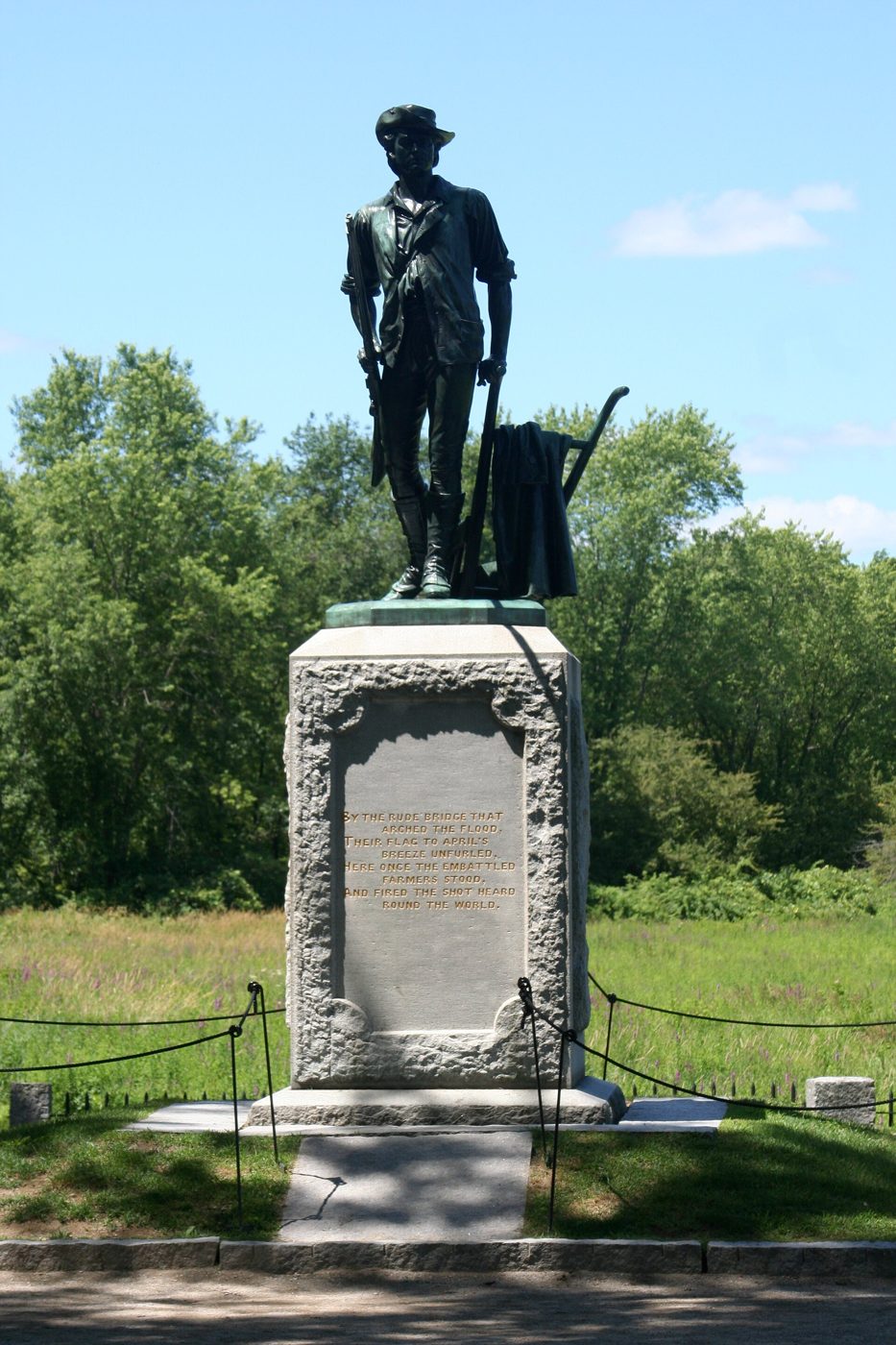
Concord remembered. In 1836 the town raised an obelisk at the North Bridge. For its dedication Ralph Waldo Emerson wrote a hymn, printed on July 4, 1837, that began:
By the rude bridge that arched the flood,
Ralph Waldo Emerson, "Concord Hymn," 1837. 19
Their flag to April's breeze unfurled,
Here once the embattled farmers stood;
And fired the shot heard round the world.
"The shot heard round the world" was fired at the bridge, where the colonial militia first returned fire, not at Lexington, where the disputed shot started the fighting. The poem placed the founding at the North Bridge.
For the centennial, on April 19, 1875, the town unveiled a seven-foot bronze of a young farmer with a musket in one hand and a plow behind him, by a twenty-four-year-old sculptor named Daniel Chester French. It was cast from old Civil War cannon. The first stanza of Emerson's hymn is cut into the base.20 Americans have printed it on bonds, coins and the uniforms of the National Guard ever since.
Why the Principle Is Named for Concord
The Concord Principle of Resistance is named for the battle deliberately. The CPoR brief states that the principle takes its name from the battle, "the first organized act of armed American resistance to British military power." In the document's words, that moment "is not remembered as rebellion, but as a disciplined stand for self-government against unlawful coercion."21 The first blood was shed at Lexington, and the first colonial fire in any numbers came at the North Bridge. The name stands for the whole sequence of April 19. The year-and-a-half of preparation, petition and drill before the fighting is what carries the weight of the principle, and the preparation is the part the record supports.
- Sept. 1, 1774 Powder Alarm: regulars take powder from the provincial magazine near Boston.
- Oct. 1774 The Provincial Congress sets up a Committee of Safety and recommends minute companies.
- Apr. 14, 1775 Dartmouth's dispatch reaches Gage.
- Apr. 18, about 10 p.m. Warren sends Revere and Dawes; regulars gather on Boston Common.
- Apr. 19, about 1 a.m. Parker is told troops are marching; the militia meets on Lexington common.
- Dawn Lexington Green: eight militiamen killed, ten wounded.
- About 7:30 a.m. The regulars enter Concord and search for stores.
- About 9:30 a.m. North Bridge: Davis and Hosmer fall; Buttrick orders the militia to fire.
- Noon Smith begins the 18-mile march back.
- About 3 p.m. Percy's 1,000 men and two guns meet the column at Lexington.
- About 7 p.m. The column crosses Charlestown Neck and the fighting ends.
- Apr. 22-25, 1775 The Provincial Congress takes depositions to send to England.
Learn more
- NPS, Rebellion: April 18 to June 17, 1775: A clear day-by-day account from the park that now protects the Battle Road, with quotations from Gage's orders and the officers' reports.
- National Archives, Who Fired the Shot Heard 'Round the World?: Parker's deposition with a transcript, the Provincial Congress order that produced it, and classroom questions on the competing accounts.
- Paul Revere's 1775 deposition: Revere's own words, written within weeks, including what he heard Parker say and what he saw of the first shot.
- Three Men from Acton: A close look at Isaac Davis, Abner Hosmer and James Hayward, and the minute company that led the attack at the North Bridge.
- News From Lexington: On Amos Doolittle and the four prints he made from Ralph Earl's drawings.
- Emerson's Concord Hymn: Four stanzas. The first is cut into the base of the Minute Man statue.
- The Minute Man statue: How Daniel Chester French's bronze was made and what is buried under its base.
Notes
- Deposition of Captain John Parker, Lexington, April 25, 1775, Massachusetts State Papers, Papers of the Continental Congress, Record Group 360, National Archives, Identifier 595246. Read it online. ↩
- "John Parker (captain)," Wikipedia: born 1729, farmer and mechanic, served at the Siege of Louisbourg (1758) and the Battle of the Plains of Abraham in the French and Indian War. Read it online. ↩
- "Battles of Lexington and Concord," Wikipedia, sections on Lexington and "First shot: Conflicting accounts"; the number of militia on the green is debated and 77 is the figure most often cited. Eight militiamen were killed and ten wounded; one regular was wounded in the thigh. Prince Estabrook, an enslaved Black man serving in the militia, was among the wounded. Read it online. ↩
- "Powder Alarm," Wikipedia, citing Massachusetts Historical Society and period accounts: on September 1, 1774, roughly 260 regulars of the 4th Regiment under Lt. Col. George Maddison were rowed up the Mystic River and marched to the provincial powder house near Winter Hill; false rumors that blood had been shed brought thousands of militiamen toward Boston and Cambridge. Read it online. ↩
- National Park Service, Minute Man National Historical Park, "Organization: October 2024 - April 2025." The page describes the Provincial Congress, the Committee of Safety, the call for companies to "equip and hold themselves in readiness, on the shortest notice," and Dartmouth's dispatch of April 14. Read it online. ↩
- General Thomas Gage to Lt. Col. Francis Smith, April 18, 1775, quoted in NPS, "Rebellion": "you will March with the Corps of Grenadiers and Light Infantry, put under your command, with the utmost expedition and Secrecy to Concord, where you will seize and destroy all artillery, Ammunition, Provisions, Tents, Small Arms, and all Military Stores whatever. But you will take care that the Soldiers do not plunder the inhabitants, or hurt private property." Read it online. ↩
- Paul Revere to Jeremy Belknap, c. 1798, Massachusetts Historical Society (original); excerpted text in "Paul Revere's True Account of the Midnight Ride," Military History Quarterly/HistoryNet. Read it online. Spelling follows the printed excerpt. ↩
- Major John Pitcairn to General Gage, Boston Camp, April 26, 1775. Read it online (Digital History). ↩
- Paul Revere, deposition, 1775, fair copy, Massachusetts Historical Society, transcribed by the American Battlefield Trust. Read it online. ↩
- On the monument's inscription and its source, see "'...and if they mean to have a war, let it begin here'? The Real Words of Captain John Parker," Emerging Civil War (Feb. 18, 2015), which traces the wording to Parker's grandson Theodore Parker (1855) and notes that Ebenezer Munroe recalled "Capt. Parker ordered his men to stand their ground and not to molest the regulars, unless they meddled with us." Read it online. ↩
- National Park Service, Minute Man National Historical Park, "Rebellion: April 18, 2025 - June 17, 2025" (historical context for April 18 to 19, 1775), including Gage's orders to Lt. Col. Francis Smith, the times of the march, the casualty counts, and Smith's and Percy's reports. Read it online. ↩
- Jeff A. Pierson, "Ordered Liberty Reclaimed: A Foundation for Liberty," v3.1 (July 13, 2025), section IX, "Concord, 1775." Read it on this site. ↩
- "Three Men from Acton," American Battlefield Trust (updated April 21, 2025). Davis, a 30-year-old gunsmith, led 37 Acton minutemen; Barrett asked whether the company would lead, and Davis replied, "I haven't a man who is afraid to go." Davis was killed instantly; Buttrick cried, "Fire, fellow soldiers, for God's sake, fire!" Read it online. ↩
- Casualty counts differ by source. NPS, "Rebellion," gives 273 British killed, wounded or missing and 95 colonial casualties. Wikipedia, "Battles of Lexington and Concord," lists 49 colonists killed, 39 wounded and 5 missing (Chidsey; Coburn counts 42 wounded; Fischer counts 50 killed) and 73 British killed, 174 wounded and 53 missing (Gage's returns). The American Battlefield Trust estimates 93 American and 300 British casualties. ↩
- Hutchinson's diary entry for June 10, 1775, quoted in "A Fast Ship from Salem: Carrying News of War," Journal of the American Revolution (April 2015), noting that Smith's return showed 63 killed, 157 wounded and 24 missing. Read it online. ↩
- "Amos Doolittle," Wikipedia: born May 18, 1754, in Cheshire, Connecticut; enlisted in the New Haven company of the Governor's Guards under Benedict Arnold; visited the battle site with Ralph Earl; prints advertised in the Connecticut Journal in December 1775. Read it online. ↩
- Nancy Finlay, "News From Lexington: Contemporary Views of the Opening Battles of the American Revolution," ConnecticutHistory.org (April 19, 2020), on Doolittle's four prints. Read it online. ↩
- "A Fast Ship from Salem: Carrying News of War," Journal of the American Revolution (April 2015), on the Provincial Congress order of April 22, 1775 to take depositions "to be sent to England, by the first ship from Salem." Read it online. See also Teachable Texts, "Who Fired the Shot Heard 'Round the World?" National Archives. Read it online. ↩
- Ralph Waldo Emerson, "Concord Hymn," written for the dedication of the Concord battle monument and printed as a broadside on July 4, 1837. First stanza from the Constitution Society text. Read it online. See also "Concord Hymn," Wikipedia. Read it online. ↩
- National Park Service, "The Minute Man statue by Daniel Chester French": unveiled for the centennial on April 19, 1875; seven feet of bronze cast from old Civil War cannons by the Ames Foundry of Chicopee, Massachusetts; the first stanza of the Concord Hymn is inscribed on the pedestal. Read it online. ↩
- Jeff A. Pierson, "The Concord Principle of Resistance," Draft 7 (2025), "Introduction to the Concord Principle of Resistance." Read it on this site. ↩
Terms in this lesson
- Powder Alarm
- The panic of September 1-2, 1774, after British troops removed gunpowder from the provincial magazine near Boston. False rumors that blood had been shed brought thousands of militiamen onto the roads.
- Minute men
- Companies of younger, readier militiamen, about a quarter of the militia, recommended by the Massachusetts Provincial Congress in October 1774 to be ready on the shortest notice.
- Regulars
- The professional soldiers of the British Army, as distinct from colonial militia.
- Deposition
- A sworn written statement. After April 19 the Massachusetts Provincial Congress took dozens to put the colonists' account on record.
- Grenadiers and light infantry
- The elite flank companies of British regiments. Gage sent them to Concord, with the Marines, a force of about 700.
- Battle Road
- The roughly 18 miles of road from Concord back through Lincoln, Lexington and Menotomy to Charlestown, along which the fighting went on all afternoon.
- Engraving
- A print made from an image cut or etched into a copper plate. Amos Doolittle made four of the battles in 1775.
Sources
- National Park Service, Minute Man National Historical Park: Rebellion, April 18 to June 17, 1775 checked 2026-10
- Deposition of Captain John Parker, April 25, 1775, National Archives checked 2026-10
- Major John Pitcairn's report to General Gage, April 26, 1775, Digital History checked 2026-10
- Paul Revere's deposition, 1775, American Battlefield Trust checked 2026-10
- Paul Revere's letter to Jeremy Belknap, c. 1798, Massachusetts Historical Society (excerpted by HistoryNet) checked 2026-10
- American Battlefield Trust, Three Men from Acton checked 2026-10
- Powder Alarm, overview with sources checked 2026-10
- Connecticut History, News From Lexington: Contemporary Views of the Opening Battles checked 2026-10
- Emerson, Concord Hymn (1837), Constitution Society text checked 2026-10
- National Park Service, The Minute Man statue by Daniel Chester French checked 2026-10