Lesson 12 of 14 · about 75 minutes
Spy Networks and Venona Cover Names: Who Ran Whom
Updated November 6, 2026
You'll be able to
- Describe how a Soviet network in the United States was organized, from Moscow Center and the station to couriers, group leaders and sources.
- Name the members, handlers, cover names and outcomes of the Silvermaster, Perlo and Rosenberg networks and the Fuchs, Gold and Hall lines.
- Explain the difference between a Venona identification confirmed by the Vassiliev notebooks, one found only in the notebooks, a corrected identification and a single-cable inference such as ALES.
- Use the cover-name table to read a published Venona decrypt, and recognize that a cover name alone (Roosevelt was CAPTAIN) proves nothing about loyalty.
- Rate popular claims about the Rosenbergs, Sobell, Hall, Oppenheimer, Hopkins, Amerasia and the Ware group against the 2026 evidence.
- Explain why so few members of documented networks were prosecuted.
Start here: the short version
Soviet intelligence in the United States in the 1930s and 1940s worked through networks: a Soviet officer, a courier, an American group leader and a set of sources who held government jobs or worked in defense plants and laboratories. The largest documented networks were the Silvermaster group and the Perlo group in Washington, both handled by the courier Elizabeth Bentley for her lover Jacob Golos; the Ware group of the early 1930s, described by Whittaker Chambers; and the technical ring of Julius Rosenberg in New York, which reached into the atomic bomb project through David Greenglass. Separate lines ran to Klaus Fuchs through the courier Harry Gold, and to Theodore Hall through Saville Sax and Lona Cohen.123
The Venona decrypts named these people under cover names: ANTENNA and later LIBERAL for Julius Rosenberg, REST and later CHARLES for Fuchs, MLAD for Hall, JURIST and later RICHARD for Harry Dexter White, PAGE for Lauchlin Currie, KOCH for Duncan Lee, PAL and later ROBERT for Nathan Gregory Silvermaster. In 2009 John Earl Haynes and Harvey Klehr checked the Venona identifications against Alexander Vassiliev's notes from KGB files and confirmed 177 of them, found four errors and put real names to 63 cover names the codebreakers had never solved.4 This lesson sets out each network (members, handlers, years, what was passed, how it was exposed and who was prosecuted), then gives a table of about 70 cover names with the basis for each identification and an honest note wherever an identification is disputed. It is a reference shelf for module 81, lesson 02, Venona and the Archives, which tells how the codebreaking was done and what it meant for the McCarthy fight.
How to read this lesson
Every entry below keeps four questions apart, as the rest of this companion does: was the person a Communist Party member, did the person pass information to a Soviet service (espionage), did the person sympathize, or was the person only associated with people who did? A cover name in a Soviet cable answers only part of the second question. It shows that a Soviet officer wrote about someone under a code name. Whether the person behind the name was a recruited source, a hoped-for recruit, or a contact who never knew what the officer was doing depends on what the cables and other documents actually say.
Identifications rest on different kinds of evidence, and the table near the end of the lesson labels each one. The firmest rest on several independent kinds at once: a Venona decrypt whose details fit one person, a matching entry in Vassiliev's notebooks, and a confession, guilty plea or trial verdict. Next come names that the Venona analysts identified and the notebooks later confirmed, with no confession. Then come names that appear only in the notebooks, where Venona left the cover name unidentified. The weakest are inferences from a single cable, such as the long argument over ALES. Haynes and Klehr described the Venona analysts' work in these terms: "Hundreds of Venona cover names were thus identified, mostly with confidence, some less so."4
The ratings used throughout are Supported, Partly supported, Unsupported, Refuted and Unresolved. The individuals in these networks have their own entries in the people lessons of this companion: People A to F (Bentley, Chambers, Coplon, Currie, Fuchs), People G to L (Gold, Gouzenko, the Greenglasses, Theodore Hall, the Hiss brothers, Duncan Lee), People M to R (Morros, Perlo, Peters, Philby, the Rosenbergs) and People S to Z (Silvermaster, Sobell, Ware, White, the Zarubins). The Soviet services themselves (the NKVD and KGB line and the GRU) are described in lesson 10.
The machinery of a network
A Soviet network in the United States had four layers. At the top was Moscow Center, the foreign intelligence directorate of the NKVD (later KGB), or the separate military intelligence service, the GRU. Below it was a station (rezidentura) in New York, Washington or San Francisco, run by officers who held cover jobs in a consulate, the embassy, the Amtorg trading company or a Soviet purchasing commission. Some officers were "illegals," who lived under false identities with no official Soviet cover. Below the officers came couriers and group leaders, usually American Communists, and at the bottom the sources themselves.1
The CIA and NSA history of Venona explains why the CPUSA mattered so much to this structure: some GRU and KGB agents "were themselves CPUSA officers whose clandestine activities were known, to a greater or lesser extent, to the CPUSA leadership and the Comintern." It gives Jacob Golos as the example: a KGB officer (cover name SOUND) who "ran the Soviet-sponsored World Tourists corporation in New York and allegedly also served on the central control commission of the CPUSA."1 Haynes and Klehr, writing in 1999 from the decrypts, put the general point in one sentence: the cables "expose beyond cavil the American Communist party as an auxiliary of the intelligence agencies of the Soviet Union." They added: "While not every Soviet spy was a Communist, most were. And while not every American Communist was a spy, hundreds were."5 The party's own structure and Moscow's direction of it are covered in lesson 11, American Groups.
The KGB also used cover names for places and institutions, and readers of the decrypts meet them constantly. In Venona and in Vassiliev's notebooks the Manhattan Project was ENORMOUS, Los Alamos was CAMP 2, the State Department was BANK, the War Department was ARSENAL, the FBI was HUT, the OSS was CABIN, New York was TYRE, Washington was CARTHAGE, President Roosevelt was CAPTAIN, President Truman was SAILOR, and an American Communist was a FELLOWCOUNTRYMAN.4 Knowing these makes the published cables readable.
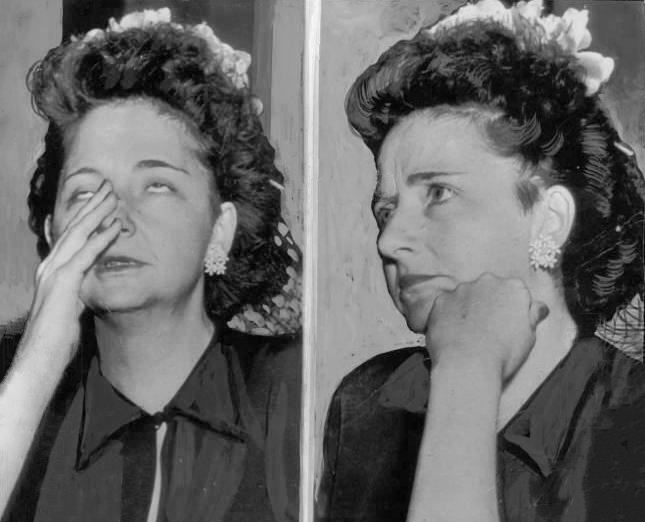

The Ware group (early 1930s)
Who and when
The oldest network in this lesson was a secret Communist Party organization among young federal employees in New Deal Washington. Whittaker Chambers, a former courier for Soviet military intelligence, described it to the House Committee on Un-American Activities on August 3, 1948, as "an underground organization of the United States Communist Party developed, to the best of my knowledge, by Harold Ware," a party organizer who was the son of the Communist leader Ella Reeve Bloor ("Mother Bloor").3 Asked who belonged, Chambers said: "The apparatus was organized with a leading group of seven men, each of whom was a leader of the cell." He named Nathan Witt (its first head, an attorney for the National Labor Relations Board), Lee Pressman, Alger Hiss, Donald Hiss, Victor Perlo, Charles Kramer, John Abt (who later led it) and Henry Collins, and said that "Harold Ware was, of course, the organizer."3 Several of the men had worked in the Agricultural Adjustment Administration.
What it was for
Chambers was careful about the group's purpose, and his words are worth reading exactly: "The purpose of this group at that time was not primarily espionage. Its original purpose was the Communist infiltration of the American Government. But espionage was certainly one of its eventual objectives."3 In this lesson's terms, the Ware group was first a matter of secret party membership and only later, for some members, a pool of recruits for espionage. Chambers told the committee that "certain members of Miss Bentley's organization were apparently recruited" from it in later years.3 Victor Perlo and Charles Kramer, both in Chambers's list, reappear below as members of the Perlo group that Bentley handled in 1944.2
How it was exposed and what followed
The group became public through Chambers's 1948 testimony. Most of the men named refused to answer or denied the charge. Lee Pressman, by then out of the CIO, testified to the committee on August 28, 1950, that he had belonged: he named Charles Kramer as one of the group's members in the Department of Agriculture in 1934, and he added, in the words reproduced from his testimony, "I can state as a matter of knowledge, that for the period of my participation in that group... Alger Hiss was not a member of the group."6 Pressman's admission confirms the existence of a secret Communist group of government employees, which no serious historian now disputes. His statement about Hiss is the testimony of one member about the period of his own participation. The Hiss case, the Baltimore documents, the Pumpkin Papers and the perjury convictions are covered in module 81, lesson 03, and the ALES question is taken up below. No member of the Ware group was prosecuted for espionage. Hiss was convicted of perjury in 1950.7
Rating of the main claim ("a secret Communist group of federal employees existed in Washington in the early 1930s and later fed Soviet espionage"): Supported for the group's existence and its party character; Partly supported for espionage, which on Chambers's own account was a later purpose for some members, not the group's origin.
The Golos and Bentley network (1930s to 1945)
Jacob Golos (SOUND)
Jacob Golos was born Yakov Naumovich Tasin in 1890 in Ekaterinoslav, Ukraine, and became president of World Tourists, a CPUSA-financed travel and shipping agency, in 1932.8 The FBI investigated World Tourists in October 1939 and charged it with failing to register with the Justice Department as an agent of the Soviet Union. Golos pleaded guilty and received a fine and a suspended sentence.8 He kept working. Venona and Vassiliev's notebooks both give him the cover name SOUND.4 He died of a heart attack in late November 1943; the Atomic Heritage Foundation gives November 26, while other accounts give the day before, Thanksgiving Day.8
Elizabeth Bentley (CLEVER GIRL, later MYRNA)
Elizabeth Bentley had moved from the open party into underground work in the late 1930s and served Golos as courier and assistant (the CIA and NSA history describes her as Golos's lover).1 She described her job to the committee in plain words: "I was the person who made trips to Washington and picked up the material and brought it back to Mr. Golos." Asked how often, she said: "About every 2 weeks."2 Her cover name in Venona and in the notebooks was CLEVER GIRL (Russian UMNITSA, also translated "Good Girl" or "Smart Girl") from about 1940 to August 1944 and MYRNA after that.4 After Golos died she ran his groups herself, and she took over the Perlo group, in her words, "in about, I think, March of 1944."2
In 1944 the KGB moved to take its networks out of the hands of American go-betweens. NSA's monograph on the 1944 and 1945 New York and Washington messages says that "Moscow Center and the New York Residency intended to take more direct control of some existing espionage nets," and that "the KGB introduced the 'illegal' ALBERT into their espionage operations." ALBERT, earlier MER, "is found in VENONA more than 50 times," and was Iskhak Abdulovich Akhmerov, "a veteran KGB officer who had two tours of duty in the U.S."9 Silvermaster, Bentley and some of their sources came under ALBERT's control.9
The defection
Bentley went to the FBI in the autumn of 1945. The CIA and NSA history ties her move to the other great defection of that season: "Two defections in autumn 1945 galvanized US counterintelligence." Gouzenko had come first; "A few weeks later, Elizabeth Bentley gave the FBI details about spies in the State and Treasury Department, OSS, the Pentagon, and even the White House."1 Her long signed statement of November 30, 1945, and her July 31, 1948, public testimony named the members of the two Washington groups described next.102 The "Gregory" case, as the Bentley investigations were known inside the government, "produced many leads but led to no espionage prosecutions" (the reasons are treated in module 81, lesson 02).1
The Silvermaster group (about 1941 to 1945)
Members as Bentley named them
Nathan Gregory Silvermaster was an economist with the Farm Security Administration in the Agriculture Department and, briefly in 1943, the Board of Economic Warfare.2 Bentley described his group as "the first group of Government employees, the first Government employees which Mr. Golos had taken on."2 In her July 31, 1948, testimony she named, in this order: Helen Silvermaster ("Mrs. Silvermaster aided in it, although she gave no information. She helped with the photography end of it."), William Ludwig Ullmann of the Treasury and later the Army Air Forces at the Pentagon, Solomon Adler of the Treasury (whose dues she believed she collected, though "at the time I had charge of that group he was in China"), William Taylor of the Treasury, and Harry Dexter White, of whom she said "He gave information to Mr. Silvermaster which was relayed on to me" while adding that "I don't know whether Mr. White was a card-carrying Communist or not."2 She went on to name George Silverman, who held a civilian post with the Air Corps at the Pentagon and furnished, in her words, "quite prolific information"; Frank Coe of the Treasury; William (Bela) Gold of the Foreign Economic Administration; his wife Sonia Gold of the Treasury; Irving Kaplan of the War Production Board, who "was paying his dues to the Perlo group and giving his information to the Silvermaster group"; Norman Bursler of the Justice Department's Antitrust Division; and Lauchlin Currie, the White House aide, of whom she said: "The man was not a Communist but he did give information."2
Cover names and the archive evidence
Most of these people appear in Venona under cover names, and Vassiliev's notebooks confirm the identifications. Silvermaster was PAL (PEL) from 1942 until August 1944 and ROBERT after that; Helen Silvermaster was DORA; Ullmann was POLO, then briefly DONALD, then PILOT; White was JURIST from 1941 to August 1944, briefly LAWYER, and RICHARD from September 1944; Currie was PAGE from 1942 to 1948; George Silverman was AILERON; Frank Coe was PEAK; Bela Gold was ACORN; and Sonia Gold was ZHENYA.4 Solomon Adler appears in Venona only as the unidentified SACHS; the notebooks attach his name to it for 1941 to 1945.4 For Taylor, Kaplan and Bursler, the Haynes and Klehr concordance used for this lesson gives no cover name, so this lesson rests their entries on Bentley's testimony alone.
NSA's monograph called the group "ROBERT's (Greg Silvermaster) large KGB net in government departments and agencies in Washington," and added a striking detail: "In fact, Silvermaster was, at one time, the only American citizen in the KGB Hall of Fame in Moscow."9
What the members said
Silvermaster appeared before the committee on August 4, 1948, read a statement and refused, on grounds of self-incrimination, to answer questions about Bentley. His statement said: "The charges made by Miss Bentley are false and fantastic. I can only conclude that she is a neurotic liar." It continued: "I am not and never have been a spy or agent of any foreign government."11 Ullmann's statement of August 10 was similar: "I am not and never have been a spy or an agent of a foreign government. I have never photographed any Government documents."12 White denied the charges before the committee in August 1948 and died a few days later.1 The decrypts and the notebooks now contradict those denials, as the claims section below rates.
What was passed, and prosecutions
The group passed Treasury, War Production Board and military information, much of it on economic policy, aircraft production and war planning, by Bentley's account; she described Perlo, in the other group, as having "ready access" to aircraft production figures.2 No member of the Silvermaster group was ever tried for espionage. The reasons were the ones described in the CIA history and in module 81: Venona was kept out of court, Bentley brought no documents, and evidence gathered by wiretaps could not be used at trial.13 Lauchlin Currie and Harry Dexter White are the two most senior members; their entries in lesson 06 and lesson 09 take up the scholarly dissents on each.
Rating of the main claim ("the Silvermaster group was a Soviet espionage network inside the Treasury and other wartime agencies"): Supported. Bentley's testimony, the Venona decrypts and the KGB notebooks agree on its leader, its courier and most of its members.
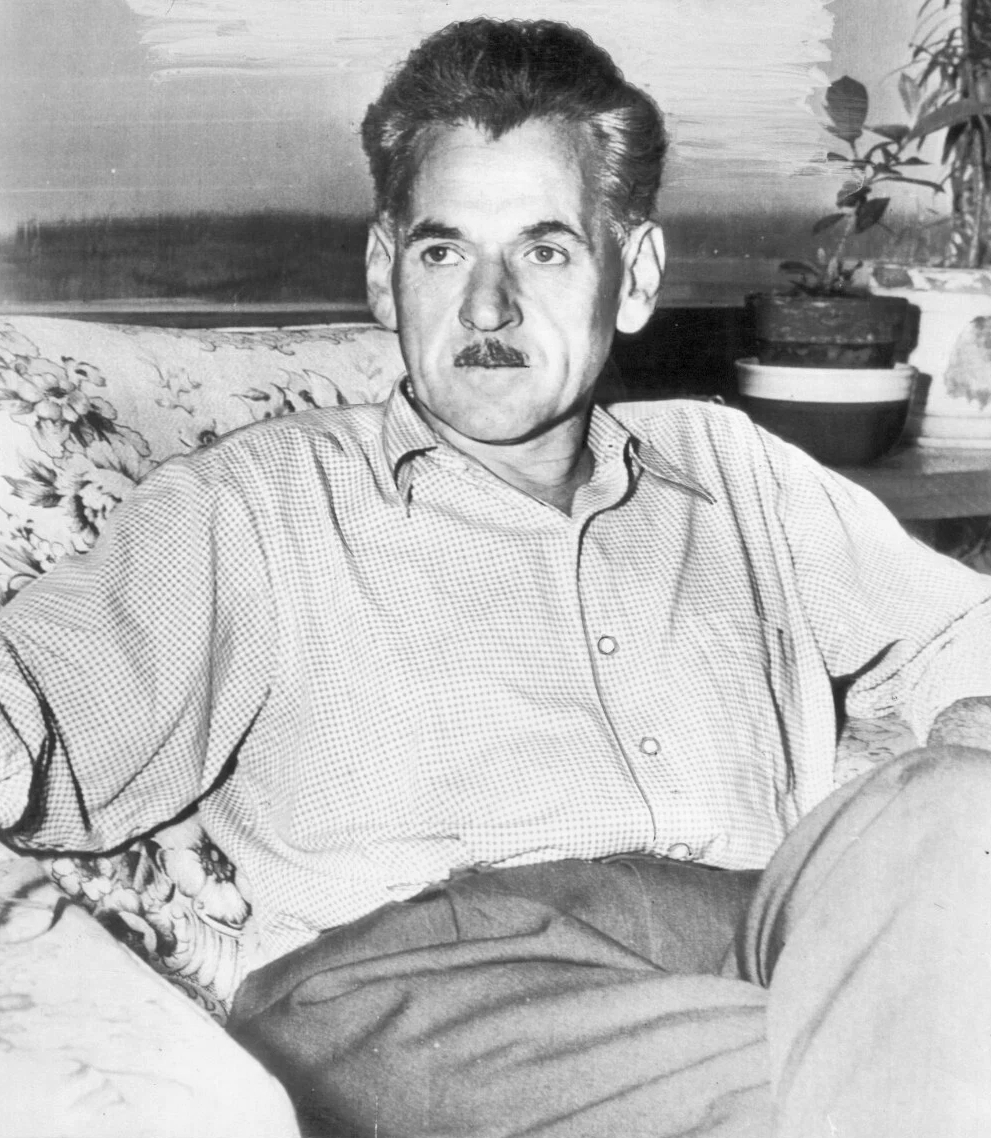

The Perlo group (1944 to 1945)
Members
Bentley's second group was older than her contact with it. She described it as "actually an ex-Communist Party unit that I believe had been set up in Washington in the early thirties," whose members had been "in a minor way collecting information for some years but not in an organized fashion." She called it the Perlo group "because the ostensible leader of it was Victor Perlo," who worked at the War Production Board "in a position that was handling aircraft production figures."2 Before her, she said, "John Abt was the man who took charge of the Perlo group before I had it"; Abt introduced her to the members.2 She named Allan Rosenberg of the Foreign Economic Administration, Donald Wheeler of the OSS, Charles Kramer (born Krevitsky), then on Senate committee staff, Edward Fitzgerald of the War Production Board, Harry Magdoff of the War Production Board and later the Commerce Department, Harold Glasser of the Treasury, and Solomon Leshinsky (she spelled the name "Lischinsky") of UNRRA, of whom she said: "There is just one more who didn't give any information, but I know he belonged to the group." Irving Kaplan, as noted above, straddled both groups.2
Cover names
The notebooks give Perlo the cover name RAID (Venona read it as RAIDER, which Haynes and Klehr think a small codebook error); Harold Glasser was RUBLE; Charles Kramer was PLUMB in 1944 and MOLE in the notebooks; Harry Magdoff was KANT until December 29, 1944, and then TAN; Edward Fitzgerald was TED; and Donald Wheeler was IZRA.4 Two links run from this group to the Ware group: Perlo and Kramer were both on Chambers's 1948 list of the Ware group's leaders.3 Glasser has a separate importance: in a cable of March 5, 1945, which Vassiliev copied in the KGB archive, the Washington station chief Anatoly Gorsky called RUBLE "Our only key to him," meaning ALES (see below). The line is in that March 5 cable, not in the decrypted Venona cable 1822 of March 30.14
Exposure and prosecutions
The group was exposed by Bentley's 1945 statement and her 1948 testimony. Members called before the committee in 1948 refused to answer on grounds of self-incrimination, as Kramer had done before a grand jury.2 None was prosecuted for espionage. Haynes's 2007 study of McCarthy's lists found substantial evidence of espionage for Harold Glasser, one of only nine people on those lists for whom he found it.10
Rating of the main claim ("the Perlo group passed government information to Soviet intelligence"): Supported for Perlo, Glasser, Kramer, Magdoff, Fitzgerald and Wheeler, whose cover names appear in both Venona and the notebooks; Unresolved for Allan Rosenberg and Leshinsky, for whom this lesson found only Bentley's testimony, and Bentley herself said Leshinsky gave no information.
The Rosenberg ring (about 1942 to 1950)
The leader
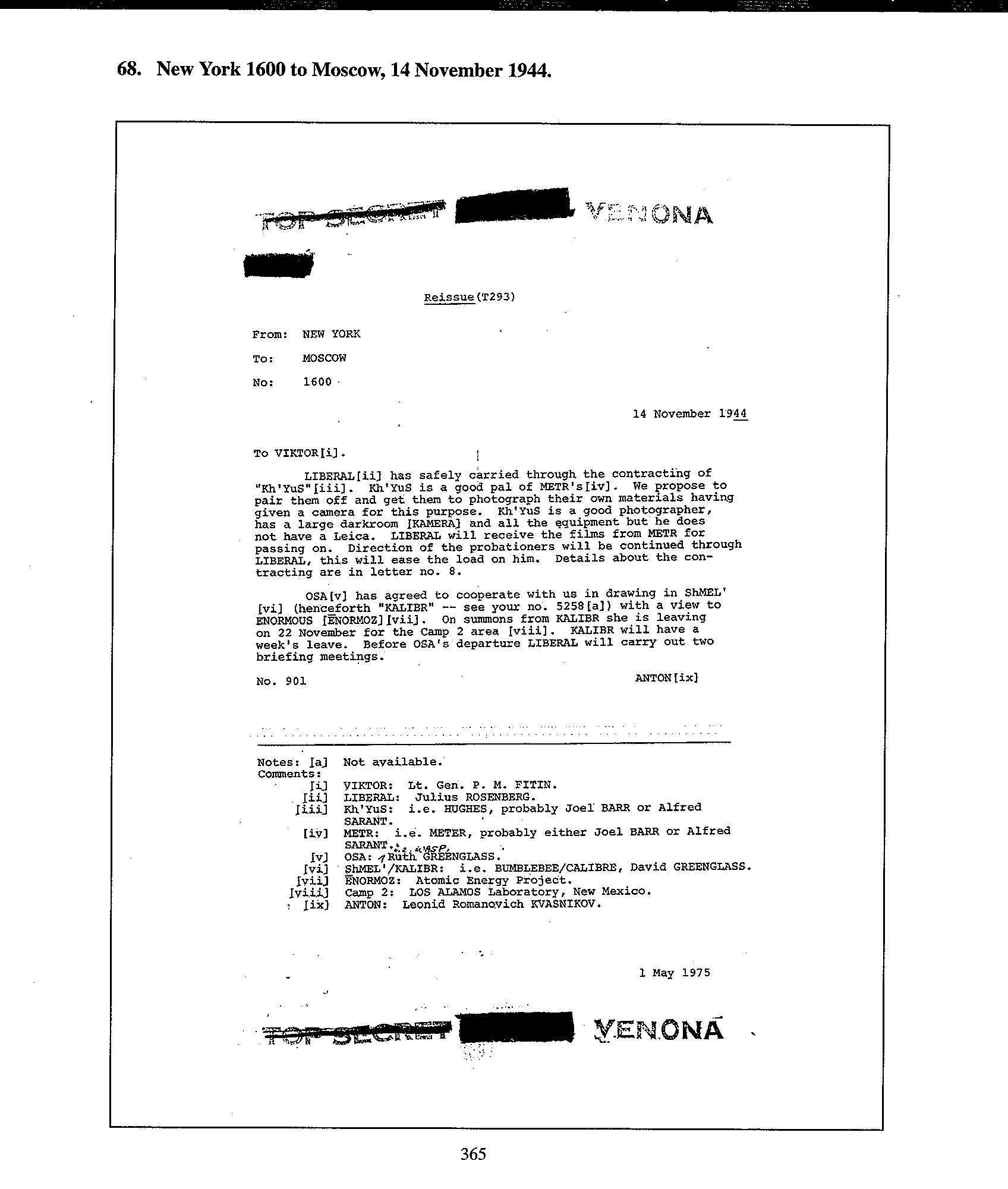
Julius Rosenberg was a New York engineer; the CIA and NSA history describes him as an agent "who collected technological and scientific secrets."1 Venona called him ANTENNA and, from September 1944, LIBERAL.4 PBS's NOVA, working from the released files, counted "Twenty-one deciphered KGB cables, all from 1944 and 1945," that discuss him.15 Haynes and Klehr wrote in 1999: "The Venona messages clearly display Julius Rosenberg's role as the leader of a productive ring of Soviet spies."5 Haynes and Klehr describe the people he recruited as "young Communist engineers."4
Members and their cover names
Joel Barr was SCOUT and, from September 1944, METER; Alfred Sarant was HUGHES; William Perl was GNOME and, from September 1944, YAKOV.4 The notebooks add three people Venona had missed or misread. Morton Sobell's cover name was SENYA, "which does not occur in Venona," Haynes and Klehr report; Venona's one-legged SERB, whom analysts had once suggested was Sobell, was in fact Joseph Chmilevski, "a Philadelphia engineer who had lost his leg fighting in Spain."4 The partly decoded "TU..." was TUK, later NIL, and was Nathan Sussman, a college friend of Julius who worked on aviation radar at Western Electric; "after first lying, he eventually admitted being a Communist, but denied spying."4 And FOGEL, later PERSIAN, a source on the Oak Ridge plant whom no one had identified, was Russell McNutt, a civil engineer on the design team for the K-25 gaseous diffusion plant. The notebooks, Haynes and Klehr write, show that Rosenberg had the distinction "of recruiting two Soviet atomic spies: one at Los Alamos (his long-known brother-in-law, David Greenglass) and one source on Oak Ridge (the hitherto unknown McNutt)."4 (The CIA and NSA history, published before the notebooks were available, had listed FOGEL and PERS among the four assets at Los Alamos; the notebooks place McNutt at Oak Ridge instead.)1
The Greenglasses and Los Alamos
David Greenglass, Ethel Rosenberg's younger brother, was an Army enlisted man assigned to Los Alamos in 1944 and 1945.16 Venona called him BUMBLEBEE in November 1944 and CALIBER (KALIBR) from December 1944; his wife Ruth was WASP.4 KGB New York message 1600 of November 14, 1944, reported that LIBERAL had recruited a photographer for the ring and that Ruth Greenglass had agreed to help draw her husband in; the cable is reproduced below.17 In June 1945, at Albuquerque, Harry Gold approached Greenglass with the words "Julius sent me," and Greenglass matched the piece of a Jello box his wife carried against the piece Gold offered, a recognition sign that traced back to Julius Rosenberg, as the FBI's account describes it.16
Ethel Rosenberg
Ethel Rosenberg had no cover name. NOVA states: "The Venona intercepts reveal that the Soviets never gave Ethel Rosenberg a cover name."15 The CIA and NSA history adds that "Two messages also implicated his wife, Ethel."1 The evidence shows that she knew of her husband's work and helped with it; it does not show her as an active agent with her own sources. Her brother later undercut his own trial testimony against her: he "admitted he lied under oath about his sister Ethel's involvement in espionage" in order "to reduce his own sentence and keep his wife Ruth out of prison."15 In Sam Roberts's 2001 book The Brother, he said he had not seen her typing notes, as he had testified, and knew of it only from Ruth.18 The sentence and its cost are discussed in module 81, lesson 10.
How the ring was exposed
The ring fell in a chain that began with Fuchs. The FBI's own account: British authorities arrested Fuchs on February 2, 1950; his information led to Harry Gold, who confessed to the FBI on May 22, 1950; Gold's admissions led to David Greenglass, who was arraigned on June 16, 1950; Julius Rosenberg was arrested on July 17, 1950, and Ethel on August 11.16 The CIA and NSA history adds the Venona side: in late June 1950 the FBI found that the messages about LIBERAL and ANTENNA "matched the known facts about New York engineer Julius Rosenberg"; he "had been questioned on the basis of David Greenglass' information on 16 June and tailed ever since."1 Morton Sobell left for Mexico with his family on June 22, 1950, and was deported and arrested at Laredo, Texas, on August 18, 1950.16 Joel Barr, then in France, left for Prague the day after Greenglass's arrest, and Alfred Sarant escaped to Mexico in 1950; both later surfaced in the Soviet Union under the names Joseph Berg and Philip Staros and worked on Soviet electronics.1915
Prosecutions
The trial of Julius and Ethel Rosenberg and Morton Sobell began on March 6, 1951; the jury returned guilty verdicts on March 29, 1951; on April 5, 1951, the Rosenbergs were sentenced to death and Sobell to 30 years.16 David Greenglass, who pleaded guilty, received 15 years and was released on November 16, 1960.16 The Rosenbergs were executed at Sing Sing Prison on June 19, 1953, Julius at 8:05 p.m. and Ethel at 8:15 p.m.16 They "were the only persons put to death for espionage in the U.S. during the Cold War," NOVA notes.15 The Soviet handler named in the indictment, Anatoli Yakovlev (real name Yatskov, Venona's ALEKSEY), had left the United States in December 1946 and was severed from the trial.164 Venona was not used at the trial. Barr, Sarant, McNutt and Sussman were never charged.
Rating of the main claim ("Julius Rosenberg ran a Soviet espionage ring"): Supported. Ethel Rosenberg's role as a knowing helper is Supported; the claim that she was an equal partner in the espionage is Partly supported at most.

Klaus Fuchs and Harry Gold (1944 to 1950)
Klaus Fuchs (REST, later CHARLES)
Klaus Fuchs was the German-born British physicist who worked on the Manhattan Project.13 Venona called him REST until October 1944 and CHARLES after that, and the notebooks agree. (This companion spells the second name CHARLES, as the NSA and CIA history and Haynes and Klehr's concordance do; the concordance gives the Russian transliteration as CHARL'Z.)41 In September 1949 the FBI determined that REST and CHARLES, "both denoting a scientist in the wartime Manhattan Project," referred to Fuchs, "author of a paper quoted in one message."1 His sister, Kristel Fuchs Heineman, was ANT.4 British authorities arrested him on February 2, 1950. He admitted Soviet atomic espionage but did not know his American contact's name. He was sentenced to 14 years, "the maximum penalty under the British Official Secrets Act."16 NOVA calls him "perhaps the most damaging spy within the Manhattan Project," and notes that he "served nine years in prison, and then moved to Communist East Germany, where he died in 1988."15
Harry Gold (GOOSE, later ARNO)
Harry Gold was a Philadelphia chemist who, by his own testimony, engaged in Soviet espionage from 1935 until his arrest in May 1950.16 He was GOOSE until October 1944 and ARNO after that.4 His Soviet contact, known to him as "John," was Anatoli Yakovlev, the Soviet vice consul in New York, whose real name was Anatoly Yatskov (Venona's ALEKSEY).164 Gold also worked with Abraham Brothman, whom Venona called CONSTRUCTOR.4 Gold confessed on May 22, 1950.16 On December 9, 1950, Judge James P. McGranery sentenced him in Philadelphia to 30 years in prison, five years more than the government had recommended.20 His testimony, together with Greenglass's, carried the case against the Rosenbergs.
Rating ("Fuchs and Gold passed atomic secrets to the Soviet Union"): Supported, by Venona, the notebooks and both men's confessions.

Theodore Hall and Saville Sax (from 1944)
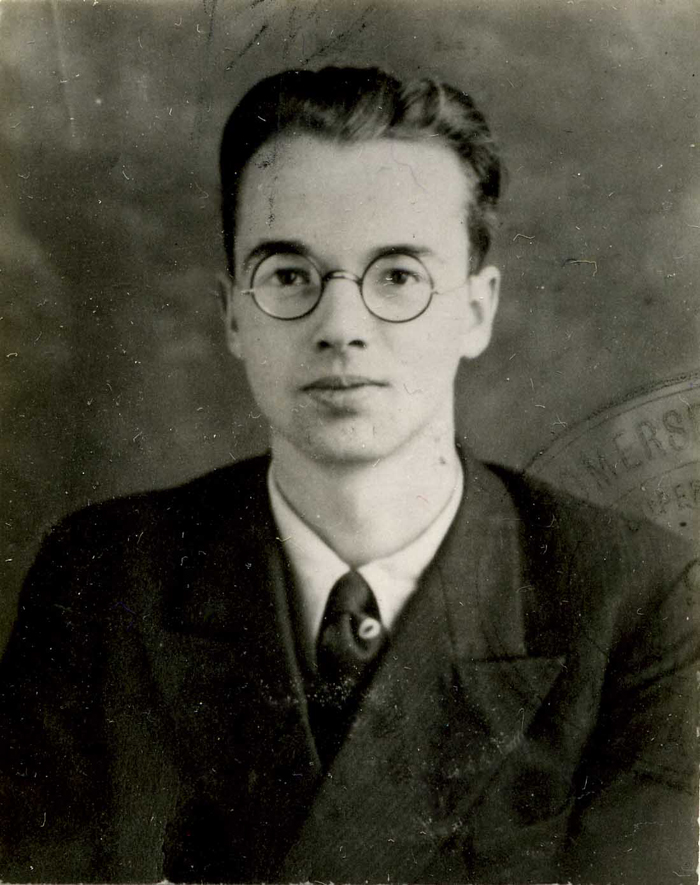
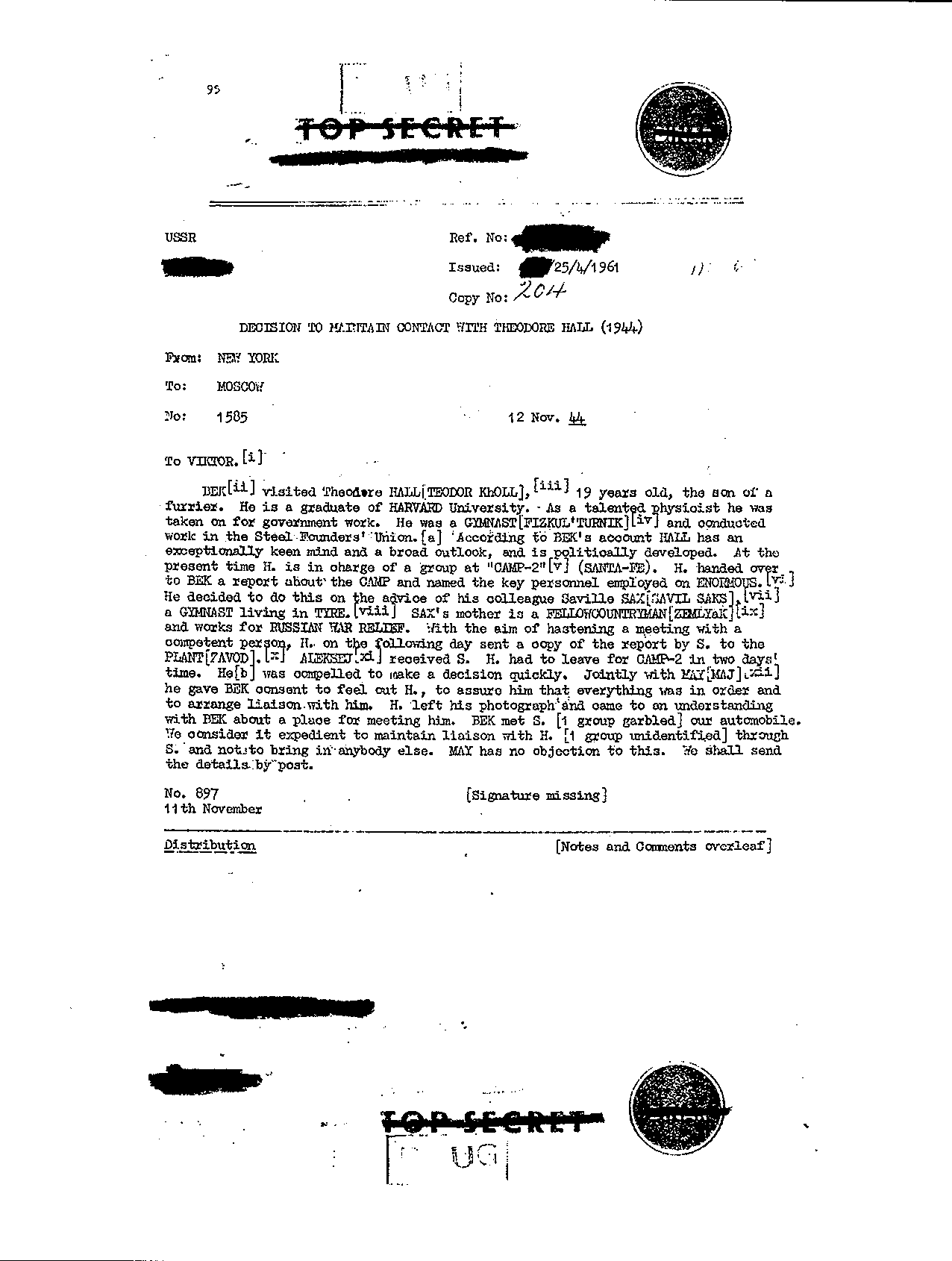
Theodore Hall was a physics prodigy who "attended Columbia University at age 14 and graduated from Harvard at age 18," and was sent to Los Alamos.15 KGB New York message 1585 of November 12, 1944, reported the KGB's first contact with him; his friend Saville Sax, a few years older, helped make the approach.214 The KGB paired their cover names as MLAD ("young") for Hall and STAR ("old") for Sax, a play on the Russian expression "y star, y mlad" (old and young people).4 The CIA and NSA history counts Hall among "at least four agents" at Los Alamos who "reported through couriers such as Lona Cohen to the Soviet consulate in New York, where a KGB sub-residency under a young engineer named Leonid R. Kvasnikov (covername ANTON) coordinated operations."1
The FBI identified MLAD as Hall and questioned him in 1951, "but he was never prosecuted (probably because a case could not have been made without revealing AFSA's program)," the CIA history says.1 NOVA adds: "Neither he nor his principal courier Saville Sax was ever prosecuted."15 Hall's own words came only in 1997, when he gave a written statement to the authors of the book Bombshell. The Associated Press quoted it: "During 1944 I was worried about the dangers of an American monopoly of atomic weapons if there should be a postwar depression."22 He did not confess to a specific act. NOVA's summary is exact: "Till the day he died, on November 1, 1999 at the age of 74, Hall never fully admitted to undertaking espionage."15
Rating ("Theodore Hall gave atomic secrets to the Soviet Union"): Supported by message 1585, the notebooks and the courier evidence, with no confession and no trial.


Morris and Lona Cohen (1940s to 1961)
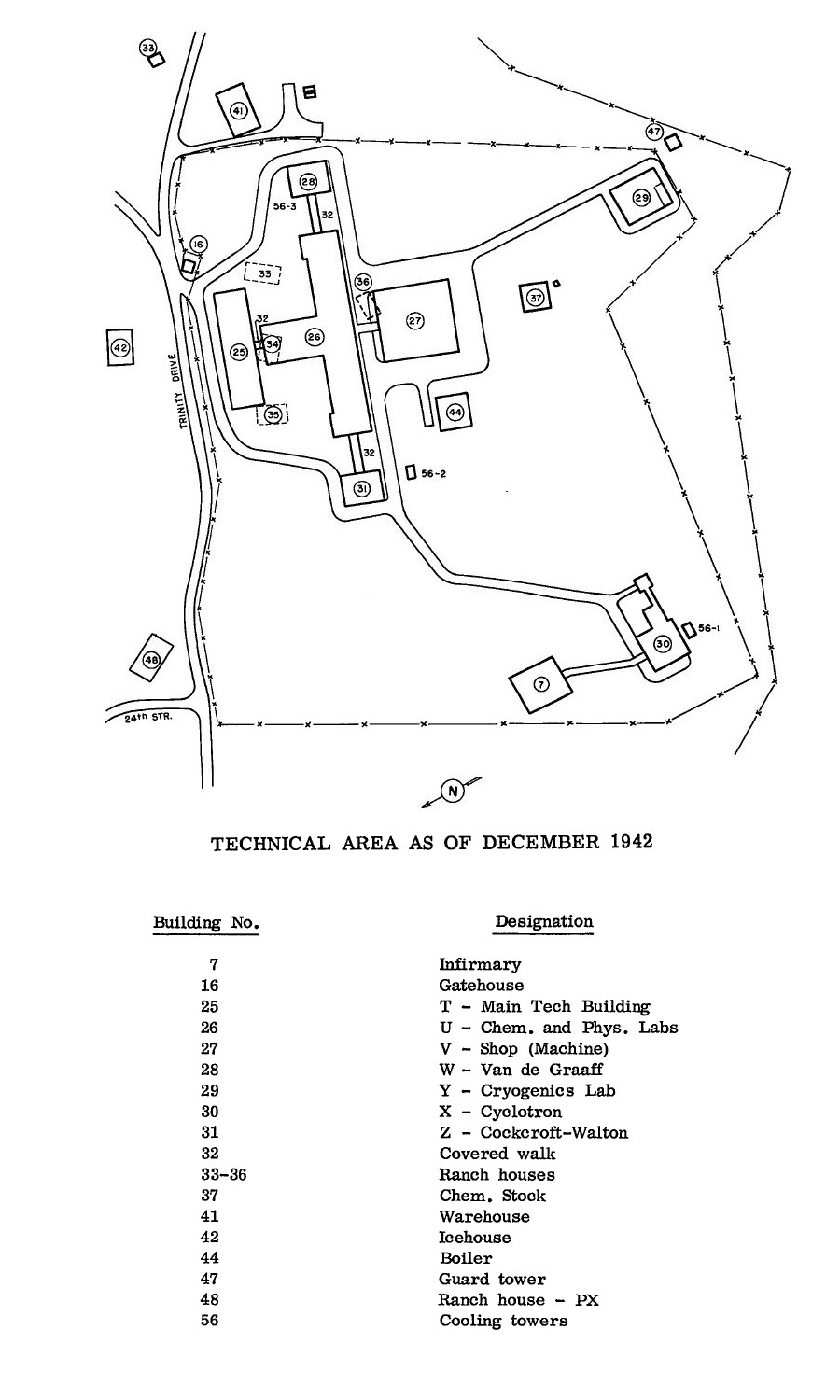
Morris Cohen, who had fought in the Spanish Civil War, and his wife Lona served the KGB as couriers. Venona left their cover names unidentified; Vassiliev's notebooks show that Morris was VOLUNTEER and Lona was LESLIE.4 Lona Cohen carried material from Los Alamos sources to the New York consulate, according to the CIA and NSA history.1 A Venona lead almost reached them in 1949: the cover name NICK "had emerged in 1949 as one Amadeo Sabatini, who had fought in Spain together with KGB asset Morris Cohen. Sabatini apparently kept quiet about Cohen but did point the FBI toward a Jones Orin York," the aircraft worker identified as NEEDLE.1 The Cohens left the United States in 1950, fearing exposure, and in 1954 settled in England as "Peter and Helen Kroger," in a bungalow in Ruislip, outside London.23 On January 7, 1961, Special Branch arrested Harry Houghton and Ethel Gee as they handed the KGB agent Gordon Lonsdale (real name Konon Molody) a bag of secret material from the Admiralty Underwater Weapons Establishment at Portland, Dorset, and at the same time arrested the Krogers at home, where officers found a radio set, a 22-metre aerial in the loft and microdot equipment. The Krogers received 20 years each and were exchanged in 1969 for Gerald Brooke.23
Other atomic sources the notebooks named
Four atomic cover names that Venona left unsolved were named in the notebooks. QUANTUM, who met a senior Soviet diplomat and two KGB officers in Washington in June 1943 and handed over information on the gaseous diffusion method, was Boris Podolsky, the physicist who in 1935 had written a famous paper on quantum mechanics with Albert Einstein and Nathan Rosen; the KGB dropped him when he failed to get a post on the bomb project.4 HURON was Byron Darling, a physicist at the U.S. Rubber Company in Detroit whom the KGB hoped to use to reach Manhattan Project physicists, without success.4 ERIC was Engelbert Broda, an Austrian refugee physicist in the British program at Cambridge.4 RAMSAY was Clarence Hiskey, a Manhattan Project scientist who held an Army reserve commission. The KGB never recruited him, unaware that he was already working for the GRU; the FBI spotted him meeting a GRU agent, and the Army removed him by lifting his exemption from military service and sending him to a remote base in northern Canada.4 The notebooks also corrected the most explosive Venona identification of all: the cover name analysts had read as VEKSEL and tied to J. Robert Oppenheimer was probably a garble of VECTOR, which was Enrico Fermi, and "KGB attempts to contact Fermi failed (as did its attempts to contact Oppenheimer)."4
The Amerasia case (1945)
Amerasia was a small New York journal on Asian affairs edited by Philip Jaffe. On March 11, 1945, OSS investigators found photocopies of about 20 top-secret documents at its office.24 On June 6, 1945, the FBI arrested Jaffe and his assistant Kate Mitchell in New York, and Andrew Roth, Emmanuel Larsen and John Stewart Service in Washington; authorities seized 1,722 documents.24 (Most accounts add a sixth arrest, the journalist Mark Gayn.) The Supreme Court later summarized the charge: "Service, Jaffe and others were arrested and charged with violating the Espionage Act, but the grand jury, in August 1945, refused to indict Service."25 Jaffe was fined $2,500 and Larsen $500; the charges against Roth were dropped in February 1946.24 No one was convicted of espionage.
Was Amerasia a Soviet spy ring? The evidence supports a narrower finding. The documents leaked to a pro-Communist editor, and Service, by Haynes's description, was caught by FBI bugging "having deliberately leaked" State Department information to the journal.10 The CIA and NSA history says that "Venona sheds some light on the Amerasia affair," and it reports that the FBI identified the cover name MARQUIS as Joseph Milton Bernstein, "a GRU agent linked to the Institute of Pacific Relations and Amerasia magazine."1 Service himself is "Not identified in Venona."10 The case is told in full in module 81, lesson 07 and lesson 10.
Rating ("Amerasia was a Soviet espionage operation"): Partly supported. Classified documents were leaked and a GRU agent was linked to the magazine; no member of the State Department group is shown to have worked for a Soviet service.
The Canadian ring and Igor Gouzenko (1945 to 1946)
Igor Gouzenko was the cipher clerk on the staff of the Soviet military attaché in Ottawa, Colonel Zabotin, who ran a Soviet military intelligence network. The Canadian Royal Commission (the Kellock-Taschereau commission) reported: "On the night of September 5th, 1945, Gouzenko left the Embassy with a certain number of documents from his own office, including telegrams sent to Moscow, others received from Moscow, which he had enciphered and deciphered."26 The commission found that "Zabotin did not come here to inaugurate a system of espionage, but to continue and amplify the work of his predecessors," and that photographic equipment for copying documents for Moscow had been installed in Zabotin's house at 14 Range Road.26 It heard "some 116 witnesses" and studied "about 1000 Exhibits."26
Gouzenko's own statement of October 10, 1945, quoted in the report, is one of the clearest contemporary descriptions of how such networks recruited: "the Communist Party in democratic countries has changed long ago from a political party into an agency net of the Soviet Government."26 The documents he took named the British physicist Alan Nunn May, who had worked at the Montreal Laboratory; Moscow's telegrams arranged his contact in London, and Zabotin reported, "We handed over 500 dollars to him."26 Nunn May was arrested in March 1946, pleaded guilty to violating the Official Secrets Act, and "was sentenced to ten years of hard labor, but was released in 1952."27 In Canada, 23 people were accused and ten were found guilty, among them Fred Rose, a member of Parliament, who was sentenced on June 27, 1946, to six years in jail.28 The case reached Washington at once: the CIA and NSA history says Gouzenko "revealed to Canadian authorities that the Soviets had indeed penetrated the Manhattan Project and other agencies."1 Its effect on American opinion is traced in module 81, lesson 01.
Rating ("Gouzenko's documents exposed a real Soviet military intelligence network in Canada that reached atomic research"): Supported.

The Cambridge Five (1930s to 1963)
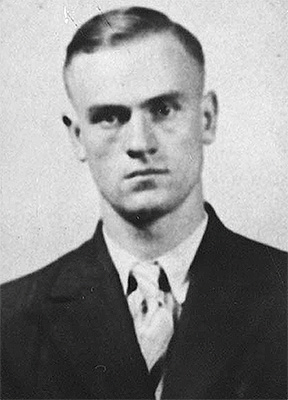
The British network of Harold "Kim" Philby, Guy Burgess, Donald Maclean, Anthony Blunt and John Cairncross was recruited by Soviet intelligence in the 1930s from among Cambridge graduates.29 It touches the American story at two points. Maclean was HOMER in Venona, and the decrypts gave him away: messages containing "Material G" quoted British Foreign Office telegrams sent to the British Embassy in Washington, and by early May 1951 the suspects had narrowed to Maclean, who soon fled to the Soviet Union with Burgess (HICKS).14 And Philby, posted to Washington as British intelligence liaison, received Venona translations and analyses on a regular basis, which, the CIA and NSA history says, let him warn the KGB.13 Confronted in Beirut in January 1963, Philby signed a partial confession dated January 11, 1963; Blunt confessed to MI5 on April 23, 1964 ("give me five minutes while I wrestle with my conscience," the interviewing officer recorded him saying), and Cairncross admitted his recruitment in February 1964.29 Philby's entry is in lesson 08.
Smaller rings and single sources
Judith Coplon (SIMA)
In December 1948 the FBI identified SIMA as Judith Coplon, a Justice Department analyst, and on March 4, 1949, arrested her in New York with Valentin Gubitchev, a Soviet employee of the United Nations.1 "Coplon would become the first person arrested on the basis of a Venona lead," the CIA history states; her convictions were overturned on appeal (see lesson 06 and module 81, lesson 02).113
Laurence Duggan (19, FRANK, SHERWOOD, PRINCE)
Laurence Duggan, in 1943 adviser to the Secretary of State on inter-American affairs, appears under several cover names. The notebooks settled the most argued-over one: source "19," who reported on a 1943 conversation involving Roosevelt and Churchill and whom some scholars had thought was Harry Hopkins, "was not Harry Hopkins, but Laurence Duggan." The KGB had recruited him in the mid-1930s, and he cooperated until he left the State Department in the spring of 1944.4
The Soble ring and Boris Morros (FROST)
The notebooks confirm the Venona cover names of Jack Soble (ABRAM, later CZECH), Boris Morros (FROST, a play on his Russian family name Moroz, "frost") and Mark Zborowski (TULIP, later KANT).4 Haynes and Klehr list Soble and Robert Soblen among the few Venona figures who were prosecuted: "Coplon, Rosenberg, Greenglass, Fuchs, Soble, and Soblen were prosecuted, and the rest were eased out of the government or otherwise neutralized as threats to national security."5 Morros's own entry is in lesson 08. Mark Zborowski has his own entry in lesson 09.
Jones Orin York (NEEDLE) and William Weisband
Jones Orin York, an aircraft worker, was NEEDLE. Questioned in April 1950, York said that one of his former case officers was William Weisband, an employee of the Armed Forces Security Agency, the very agency reading Venona. AFSA suspended Weisband in May 1950.1 Weisband was never tried for espionage; he was jailed for contempt (module 81, lesson 02 has the full account).13
Duncan Lee (KOCH)
Duncan Chaplin Lee, an OSS executive assistant in the agency headed by General William Donovan, was KOCH in both Venona and the notebooks.4 He supplied the KGB with an OSS security list of eighteen employees suspected of being secret Communists; Haynes and Klehr note that the list's suspicion of the future Justice Arthur Goldberg "was mistaken" and that "We know of no significant evidence suggesting Goldberg was a covert Communist."4 Lee testified before the committee on August 10, 1948 (lesson 07 has his entry).2
ALES and the Hiss dispute, in brief
Venona message 1822, KGB Washington to Moscow, March 30, 1945, reports a conversation with a GRU source called ALES. In the translation Haynes and Klehr quote, its first point reads: "Ales has been continuously working with the neighbors since 1935" ("neighbors" being KGB slang for the GRU).14 By June 1950 the FBI had concluded that ALES "referred to former State Department aide Alger Hiss, then serving a sentence for perjury."1 Vassiliev's concordance lists ALES as "likely Alger Hiss," on the strength of a marginal note.4 In 2007 Kai Bird and Svetlana Chervonnaya proposed that ALES was instead Wilder Foote, an assistant to Secretary of State Stettinius; Haynes and Klehr replied that Foote spent the 1930s "editing and publishing local newspapers" in Vermont and that "There is no evidence whatsoever that GRU" had operations there.14 The full argument, with John Ehrman's 2007 review for the CIA's journal, is in module 81, lesson 02. The identification is the majority view and rests on a reasonable chain of inference; it is less firm than LIBERAL, REST or MLAD, and the table below marks it that way. The separate question of Hiss's espionage in the 1930s rests on Chambers's documents and the 1949 and 1950 trials (module 81, lesson 03).
Venona cover-name table: who was who
The table lists people, Soviet officers and sources, with the identification and its basis. "Venona + notebooks" means the NSA and FBI analysts made the identification from the decrypts and Haynes and Klehr found it confirmed in Vassiliev's notebooks (their 2009 Appendix 1). "Notebooks only" means Venona left the name unidentified and the notebooks supplied it (their Appendix 3). "Corrected" means the notebooks overturned the Venona identification (their Appendix 2). Where a confession, guilty plea or trial verdict exists, it is added. All entries are from Haynes and Klehr's 2009 paper unless another source is marked.4 Two cover names sometimes given in popular lists, KHAN and a Venona name for Weisband, could not be matched in the sources used for this lesson and are left out.
| Cover name(s) | Identified as | Role | Basis | Strength |
|---|---|---|---|---|
| ANTENNA, LIBERAL | Julius Rosenberg | Engineer, leader of technical ring | Venona + notebooks, FBI match June 1950, convicted 1951 | Firm |
| (none) | Ethel Rosenberg | Julius's wife | Mentioned in two messages (CIA history), no cover name (NOVA), convicted 1951 | Role disputed |
| BUMBLEBEE, CALIBER (KALIBR) | David Greenglass | Army enlisted man, Los Alamos | Venona + notebooks, confessed June 1950, pleaded guilty | Firm |
| WASP (OSA) | Ruth Greenglass | Helped recruit her husband | Venona + notebooks | Firm |
| SCOUT, METER | Joel Barr | Engineer, Rosenberg ring | Venona + notebooks, fled 1950 | Firm |
| HUGHES | Alfred Sarant | Engineer, Rosenberg ring | Venona + notebooks, fled 1950 | Firm |
| GNOME, YAKOV | William Perl | Engineer, Rosenberg ring | Venona + notebooks | Firm |
| SENYA | Morton Sobell | Engineer, Rosenberg ring | Notebooks only (not in Venona), convicted 1951 | Firm |
| TUK, NIL ("TU...") | Nathan Sussman | Radar engineer, Rosenberg ring | Notebooks only, admitted party membership, denied spying | Probable |
| FOGEL, PERSIAN | Russell McNutt | Engineer, K-25 plant design | Notebooks only | Probable |
| REST, CHARLES | Klaus Fuchs | Physicist, Manhattan Project | Venona + notebooks, confessed 1950 | Firm |
| ANT | Kristel Fuchs Heineman | Fuchs's sister | Venona + notebooks | Firm |
| GOOSE, ARNO | Harry Gold | Courier | Venona + notebooks, confessed 1950 | Firm |
| CONSTRUCTOR | Abraham Brothman | Gold's associate | Venona + notebooks | Firm |
| MLAD (YOUNGSTER) | Theodore Hall | Physicist, Los Alamos | Venona + notebooks, never tried, partial statement 1997 | Firm |
| STAR (OLD) | Saville Sax | Hall's courier | Venona + notebooks | Firm |
| VOLUNTEER | Morris Cohen | Courier | Notebooks only, convicted in Britain 1961 | Firm |
| LESLIE | Lona Cohen | Courier | Notebooks only, convicted in Britain 1961 | Firm |
| QUANTUM | Boris Podolsky | Physicist | Notebooks only, by matching description | Probable |
| HURON, ERNST | Byron Darling | Physicist, U.S. Rubber | Notebooks only | Probable |
| ERIC | Engelbert Broda | Physicist, British program | Notebooks only | Probable |
| RAMSAY | Clarence Hiskey | Manhattan Project scientist; KGB target, already a GRU source | Notebooks only | Probable |
| VEKSEL (read as), VECTOR | Venona said Oppenheimer, notebooks say Enrico Fermi | Target, never recruited | Corrected | Oppenheimer ID wrong |
| SOUND | Jacob Golos | KGB officer, World Tourists | Venona + notebooks | Firm |
| CLEVER GIRL (UMNITSA), MYRNA | Elizabeth Bentley | Courier, later FBI source | Venona + notebooks, her own testimony | Firm |
| PAL, ROBERT | Nathan Gregory Silvermaster | Group leader | Venona + notebooks | Firm |
| DORA | Helen Silvermaster | Photography | Venona + notebooks | Firm |
| POLO, DONALD, PILOT | William Ludwig Ullmann | Treasury, then Pentagon | Venona + notebooks | Firm |
| JURIST, LAWYER, RICHARD | Harry Dexter White | Assistant Secretary of the Treasury | Venona + notebooks, dissent on record | Firm |
| PAGE | Lauchlin Currie | White House aide | Venona + notebooks (1942 to 1948) | Firm |
| AILERON | Abraham George Silverman | Air Corps civilian, Pentagon | Venona + notebooks | Firm |
| PEAK | Frank Coe | Treasury | Venona + notebooks | Firm |
| ACORN | Bela (William) Gold | Foreign Economic Administration | Venona + notebooks | Firm |
| ZHENYA | Sonia Steinman Gold | Treasury | Venona + notebooks | Firm |
| SACHS | Solomon Adler | Treasury, in China | Notebooks only | Probable |
| RAID (Venona RAIDER) | Victor Perlo | War Production Board, group leader | Venona + notebooks | Firm |
| RUBLE | Harold Glasser | Treasury | Venona + notebooks | Firm |
| PLUMB, MOLE | Charles Kramer | Senate committee staff | PLUMB Venona + notebooks, MOLE notebooks only | Firm |
| KANT, TAN | Harry Magdoff | War Production Board, Commerce | KANT Venona + notebooks, TAN notebooks only | Firm |
| TED | Edward Fitzgerald | War Production Board | Venona + notebooks | Firm |
| IZRA | Donald Wheeler | OSS | Venona + notebooks | Firm |
| KOCH | Duncan Chaplin Lee | OSS | Venona + notebooks | Firm |
| DIR, ZONE | Mary Price | Source | DIR Venona + notebooks, ZONE notebooks only | Firm |
| ARENA | Venona said Mary Price, notebooks say Gerald Graze | Source | Corrected | Price ID wrong |
| DAN | Stanley Graze | Source | Notebooks only | Probable |
| MIRAGE | Robert T. Miller | Source | Notebooks only | Probable |
| RUFF | Franz Neumann | OSS | Notebooks only | Probable |
| ALES | Alger Hiss (probable) | GRU source | Single cable plus inference, "likely" in concordance, contested | Disputed |
| POL' | Maxim Lieber | Literary agent, GRU courier | Inference from notebooks and Chambers's Witness | Probable |
| REDHEAD | Hede Massing | Soviet agent, later witness | Notebooks, NSA retrospective histories | Probable |
| STORM | J. Peters (Jozsef Peter) | Party underground figure (lesson 08) | Notebooks only | Probable |
| HELMSMAN | Earl Browder | CPUSA general secretary | Venona + notebooks, Mitrokhin | Firm |
| 19, FRANK, SHERWOOD, PRINCE | Laurence Duggan | State Department | FRANK, SHERWOOD, PRINCE Venona + notebooks, 19 notebooks only | Firm |
| SIMA | Judith Coplon | Justice Department analyst | Venona, FBI match Dec. 1948, arrested 1949 (CIA history) | Firm |
| NEEDLE | Jones Orin York | Aircraft worker | Venona + notebooks, questioned 1950 | Firm |
| NICK | Amadeo Sabatini | Spanish Civil War veteran | Venona (CIA history) | Firm |
| MARQUIS | Joseph Milton Bernstein | GRU agent | Venona (CIA history) | Firm |
| ABRAM, CZECH | Jack Soble | KGB agent | Venona + notebooks, prosecuted | Firm |
| FROST | Boris Morros | Source (lesson 08) | Venona + notebooks | Firm |
| TULIP, KANT | Mark Zborowski | Source (lesson 09) | Venona + notebooks | Firm |
| LIZA | Martha Dodd Stern | Source | Venona + notebooks | Firm |
| PANCAKE | I. F. Stone | Journalist | Venona + notebooks (1936 to 1945), extent of help disputed | Name firm, role disputed |
| HOMER | Donald Maclean | British diplomat | Venona + notebooks, fled 1951 | Firm |
| HICKS | Guy Burgess | British diplomat | Venona + notebooks, fled 1951 | Firm |
| MER, ALBERT | Iskhak Akhmerov | KGB illegal officer | Venona + notebooks | Firm |
| MAXIM | Vasily Zarubin (alias Zubilin) | KGB officer | Venona + notebooks | Firm |
| VARDO | Elizabeth Zarubina | KGB officer | Venona + notebooks | Firm |
| VADIM | Anatoly Gorsky (alias Gromov) | KGB Washington chief | Venona + notebooks | Firm |
| ANTON | Leonid Kvasnikov | KGB officer, atomic line | Venona + notebooks | Firm |
| KALISTRAT | Alexander Feklisov (alias Fomin) | KGB officer | Venona + notebooks | Firm |
| ALEKSEY | Anatoly Yatskov (alias Yakovlev) | KGB officer, Gold's "John" | Venona + notebooks, named in 1950 indictment | Firm |
| VIKTOR | Pavel Fitin | Chief of KGB foreign intelligence | Venona + notebooks | Firm |
The KGB also gave cover names to people it was watching, not recruiting. Roosevelt (CAPTAIN), Truman (SAILOR), Churchill (BOAR), Stettinius (CORPORAL), Morgenthau (NABOB), Harriman (MEN), Walter Lippmann (IMPERIALIST), William Donovan (ANNOUNCER) and Thomas Dewey (KULAK) all have cover names, which shows that a cover name alone says nothing about a person's loyalty.4
Venona by the numbers
NSA's history gives the basic count: "There were about 3,000 VENONA messages translated."30 The CIA and NSA volume of 1996 puts it as "Some 2,900 Soviet intelligence messages."1 The share of traffic that could be read varied greatly. For KGB New York to Moscow, NSA reports that 49 percent of the 1944 messages were readable, 15 percent of the 1943 messages and only 1.8 percent of the 1942 messages; for KGB Washington to Moscow in 1945, only 1.5 percent.30 The first release, on July 11, 1995, was 49 messages on atomic espionage, "the first of several releases of over 2200 translations."31 Haynes and Klehr's count of Americans is the one most often quoted: "The deciphered cables of the Venona Project identify 349 citizens, immigrants, and permanent residents of the United States who had had a covert relationship with Soviet intelligence agencies," of whom "less than half could be identified by their real names and nearly two hundred remained hidden behind cover names."5 The 2009 audit against the notebooks found corroboration for 177 cover names, four errors and 63 new identifications; "Only four errors in identification out of hundreds of correct ones is impressive and reflects well on the care and thoroughness of NSA/FBI analysts," Haynes and Klehr concluded.4 Lesson 14 collects these numbers with the others in this companion (Numbers, Pictures and Infographics).
Timeline: from recruitment to exposure, 1935 to 2009
What the record shows and what it does not
- Documented fact: Elizabeth Bentley named the members of the Silvermaster and Perlo groups under oath on July 31, 1948, and most of them appear under Venona cover names that Vassiliev's notebooks independently confirm.24
- Documented fact: Julius Rosenberg (ANTENNA, LIBERAL) led a ring of engineers that included Barr, Sarant, Perl and Sobell and reached Los Alamos through David Greenglass; the notebooks add McNutt at Oak Ridge and Sussman.45
- The people's own words: Silvermaster called Bentley "a neurotic liar," and Ullmann said, "I have never photographed any Government documents."1112 Pressman admitted belonging to the secret group Chambers described and said Hiss was not a member during his time in it.6 Fuchs, Gold and Greenglass confessed. Hall wrote in 1997 of his 1944 worry about "an American monopoly of atomic weapons" but never fully admitted espionage.2215
- The accusation versus the archive: Bentley's and Chambers's charges were attacked in 1948 as inventions. The decrypts and the notebooks show that the core of what both described was true.14
- Scholarly reading: Haynes and Klehr: the cables "expose beyond cavil" the CPUSA as an auxiliary of Soviet intelligence; also Haynes: of 159 people on McCarthy's lists, substantial evidence of espionage exists for nine.510
- Not shown: that a cover name alone proves espionage (Roosevelt, Truman and Churchill all had one); that Oppenheimer or Harry Hopkins was a Soviet source; that John Stewart Service worked for a Soviet service.410
- Open questions: who stood behind the nearly two hundred unidentified cover names; whether ALES was Hiss beyond reasonable doubt; how much Ethel Rosenberg did; what the closed Russian files would add.5
Claims checked
| Claim and where it is made | Rating | Evidence |
|---|---|---|
| "The charges made by Miss Bentley are false and fantastic. I can only conclude that she is a neurotic liar." (Silvermaster, statement to the House committee, 1948) | Refuted | Silvermaster appears as PAL and ROBERT in Venona and the notebooks. NSA describes ROBERT's "large KGB net in government departments and agencies in Washington."1149 |
| The Silvermaster and Perlo groups were Soviet espionage networks (Bentley, 1948) | Supported | Testimony, decrypts and notebooks agree on leaders, courier and most members.24 |
| The Rosenbergs were innocent victims of a frame-up (the Rosenbergs' defenders from 1951 on) | Refuted for Julius, Partly supported as to the trial testimony against Ethel | Twenty-one cables discuss Julius. The notebooks add two more recruits. Ethel had no cover name, two messages implicate her, and her brother admitted lying about her role.1514 |
| The Rosenbergs "gave Stalin the bomb" (a popular shorthand) | Partly supported | The ring did pass atomic information through Greenglass, but the CIA and NSA history counts at least four atomic agents at Los Alamos, and NOVA calls Fuchs "perhaps the most damaging spy within the Manhattan Project."115 |
| Morton Sobell was an innocent man swept into the case (his defenders for decades, and Sobell himself, who questioned Venona's reliability in 2001) | Refuted as to his membership in the ring | Convicted in 1951.16 The notebooks give him the cover name SENYA and show that the one-legged SERB, once suggested as Sobell, was someone else.4 His 2001 challenge to Venona is summarized in module 81, lesson 02.13 |
| Theodore Hall confessed to atomic espionage | Unsupported | His 1997 statement explained his 1944 worries. NOVA: he "never fully admitted to undertaking espionage." The espionage itself is supported by cable 1585 and the notebooks.221521 |
| Venona proves J. Robert Oppenheimer was a Soviet agent (VEKSEL) | Refuted | The notebooks show VEKSEL was probably VECTOR, meaning Fermi, and that KGB attempts to contact both men failed.4 |
| Harry Hopkins was Soviet agent "19" | Refuted | The notebooks identify "19" as Laurence Duggan.4 |
| The Ware group was a spy ring from its start (frequent shorthand in later writing) | Partly supported | Chambers: its purpose "at that time was not primarily espionage," though espionage was "one of its eventual objectives."3 |
| Alger Hiss was ALES | Partly supported | FBI 1950 and Vassiliev's "likely." The Foote alternative is weak, but no document names Hiss as ALES in plain text.1414 |
| Amerasia was a Soviet spy ring (anti-communists including McCarthy) | Partly supported | Leaks real, a GRU agent (MARQUIS) linked to the magazine, Service not in Venona, no espionage conviction.1102432 |
| Venona identifications are unreliable guesswork (some defenders of the accused since 1995) | Refuted as a general claim | 177 confirmed by an independent KGB source, four errors.413 |
| Every name in a Venona cable was a spy (some popular websites and polemics) | Refuted | Roosevelt, Truman, Churchill, Stettinius and Dewey all have cover names. Arthur Goldberg appears on an OSS suspect list that Haynes and Klehr call "mistaken."4 |
| The Rosenbergs were the only people executed for espionage in the United States during the Cold War | Supported | NOVA states it directly.15 |
| Gouzenko's documents exposed Soviet atomic espionage in North America | Supported | Royal Commission report, Nunn May's guilty plea and ten-year sentence.2627 |
Hard questions and answers
If the networks were real, why were so few people prosecuted?
Because the best evidence could not be used. The Bentley investigation "produced many leads but led to no espionage prosecutions"; FBI agents "could not use evidence gathered by wiretaps in court," and Bentley brought no documents.1 Venona was kept secret and was never put before a jury, which is probably why Theodore Hall was never charged.1 The prosecutions that did happen (Coplon, the Rosenbergs, Sobell, Greenglass, Gold, the Sobles) rested on confessions and witnesses.5 The others, in Haynes and Klehr's words, "were eased out of the government or otherwise neutralized as threats to national security."5 A reader can hold both conclusions: the networks were real, and the legal system convicted only a few of their members.
A civil liberties advocate asks: isn't naming people from cover-name inferences the same method McCarthy used?
No, when it is done carefully, and the care is the difference. McCarthy named people from lists and associations with no Soviet document behind them; Haynes found substantial evidence of espionage for only nine of the 159 he named.10 The identifications in this lesson rest on Soviet documents whose details fit one person, checked against a second and independent Soviet source, and in many cases against confessions. Where the evidence is one cable and an inference (ALES), or notebooks alone (QUANTUM, SACHS), the table says so. The fair test is the one this companion applies to every person: which of the four claims (membership, espionage, sympathy, association) the documents support, and how strongly.
An anti-communist asks: if nearly two hundred cover names were never identified, weren't many spies never caught?
Yes. Haynes and Klehr wrote that of 349 people with covert ties, "nearly two hundred remained hidden behind cover names," and the notebooks named only 63 more.54 The CIA and NSA history notes that anti-communists of the 1950s "suspected that some spies" were still free, "perhaps including a few who were known to the US Government," and the record proves them right in cases such as Hall, McNutt, Sussman and Barr.14 What the record does not support is the leap from unknown spies to particular named officials without Soviet documents; module 81, lesson 11 rates those claims one by one.
A skeptic asks: how can a former KGB officer's handwritten notes confirm anything?
By matching. The notebooks quote archival documents with file and page numbers, titles, authors and dates, and in one case Vassiliev's note of a September 2, 1944, cable is "nearly identical" to the same cable as NSA decrypted it, which shows he was copying real KGB documents.4 The notebooks agree with Venona, which came from intercepted radio and cable traffic, in 177 identifications; they disagree in four, and Haynes and Klehr judge the notebooks right in those four.4 The originals remain closed in Moscow, so a fact found only in the notebooks deserves a little more caution than one confirmed twice; the table marks those as "notebooks only."
A historian asks: why did Soviet intelligence draw so many recruits from the CPUSA?
Because the party offered trusted, disciplined people already practiced in secrecy, and Moscow could reach them through party channels. Gouzenko said as much in 1945: the party in democratic countries had become "an agency net of the Soviet Government."26 The CIA and NSA history adds that some Soviet agents were themselves party officers whose secret work was known to the party leadership.1 Haynes and Klehr's two sentences cover both sides: "While not every Soviet spy was a Communist, most were. And while not every American Communist was a spy, hundreds were."5 The second sentence matters as much as the first: most party members were not spies.
Was Ethel Rosenberg guilty?
Of knowing about and helping her husband's espionage, the evidence says yes: two Venona messages implicate her.1 Of being an active agent with her own cover name and sources, the evidence says no: "the Soviets never gave Ethel Rosenberg a cover name."15 The most damaging trial testimony against her, her brother's account of seeing her type up information on a portable typewriter in 1945, was later disowned by him: he said he had not seen it and knew of it only from his wife.18 A verdict of guilty and a sentence of death are separate questions; module 81, lesson 10 takes up the second.
Where to go next
- Module 81, lesson 02: Venona and the Archives: the codebreaking, Weisband and Philby, the secrecy decision, and the ALES argument in full.
- Module 81, lesson 03: Chambers, Hiss and the 1948 hearings.
- Module 81, lesson 07: The Cases: Amerasia, Service and Fort Monmouth.
- Module 81, lesson 10: What It Cost: the Rosenberg sentence and the people wrongly accused.
- Module 81, lesson 11: McCarthy's claims rated against this evidence.
- Module 81, lesson 13: espionage cases in 2026.
- Module 51, lesson 07: Communism, for the economics, and Module 52, Ordered Liberty, for the framework of liberty under law used across this site.
- In this companion: lesson 10 (the Soviet services), lesson 11 (the CPUSA), lesson 13 (terms such as rezidentura, illegal and one-time pad) and lesson 14 (how to read a Venona decrypt).
Still open
These items could not be confirmed against a primary source before publication. The lesson states them as open, and they stay on the fact-check list.
- The exact date of Jacob Golos's death: the Atomic Heritage Foundation gives November 26, 1943; other accounts give November 25 (Thanksgiving Day). The text gives both.
- Mark Gayn as the sixth Amerasia arrest: the review consulted (Lyons) names five people; most accounts, including module 81, add Gayn. Not confirmed from a source opened for this lesson.
- The cover name KHAN, listed in the writer brief, could not be matched to any person in the Haynes and Klehr concordance or the CIA and NSA history; it is left out of the table.
- No Venona cover name for William Weisband was confirmed from a source opened for this lesson; it is left out of the table.
- Cover names for William Taylor, Irving Kaplan, Norman Bursler, Allan Rosenberg and Solomon Leshinsky were not found in the sources used; their entries rest on Bentley's 1948 testimony alone.
- Which KGB officer handled Julius Rosenberg at each date (Alexander Feklisov later claimed the role in his memoir) was not verified; the network diagram shows the station's officers without assigning handlers.
- The year of Harold Ware's death and the exact founding date of the Ware group were not verified and are not stated.
- Dates for several photographs (Silvermaster, Fuchs, Gouzenko) come from their Wikimedia Commons pages and were not independently verified; captions say so.
- The full text of Venona messages 1600 and 1585 was read through the module 81 lesson and Commons descriptions, not re-read line by line for this lesson; the lesson paraphrases them and quotes no wording from the cables except through Haynes and Klehr.
- Fred Rose's party affiliation is not stated; historyofrights.ca confirms only that he was a member of Parliament and was sentenced on June 27, 1946.
- The readability percentages (1.8, 15 and 49 percent for New York, 1.5 percent for Washington 1945) and the 3,000 figure are cited to Benson's The VENONA Story, which returned 403 or a truncated file on Nov. 6, 2026; the 1.5 percent figure was confirmed independently in NSA's VENONA Historical Monograph 3.
- The 1961 issue date of the NSA translation of message 1585 shown in the figure was not re-checked against the image.
- Bentley's, Silvermaster's and Ullmann's 1948 testimony was checked in one copy (the archive.org scan of the printed hearings); Chambers's August 3, 1948 testimony was checked in two (archive.org scan and the Hillsdale College excerpt).
Learn more
- John Earl Haynes and Harvey Klehr, "Venona and Alexander Vassiliev's Notebooks" (2009): The concordance behind this lesson's table: 177 confirmed identifications, four corrections and 63 new names, with the evidence for each.
- Robert L. Benson, The VENONA Story (NSA Center for Cryptologic History): NSA's own short history of the project, with the readability figures and the release history.
- Benson and Warner, eds., Venona: Soviet Espionage and the American Response (1996): The official CIA and NSA history and chronology of how the cases were made.
- HUAC, Hearings Regarding Communist Espionage in the United States Government (1948): Bentley's and Chambers's testimony and the accused's statements, in full.
- FBI, "Atom Spy Case/Rosenbergs": The FBI's own chronology of the Fuchs, Gold, Greenglass, Rosenberg and Sobell arrests and sentences.
- Module 81, lesson 02: Venona and the Archives: How Venona was broken, why it was kept secret, and the full ALES argument.
Notes
- Robert Louis Benson and Michael Warner, eds., Venona: Soviet Espionage and the American Response, 1939 to 1957 (Washington: National Security Agency and Central Intelligence Agency, 1996), Preface, Introduction and Chronology, pp. vii to xliv (retrieved Nov. 5, 2026). Read it online. ↩
- U.S. House of Representatives, Committee on Un-American Activities, Hearings Regarding Communist Espionage in the United States Government, 80th Cong., 2d sess. (1948), testimony of Elizabeth Terrill Bentley, July 31, 1948, pp. 503 to 520; table of contents for the hearings of August 1948 (retrieved Nov. 5, 2026). Read it online. ↩
- Same hearings (1948), testimony of David Whittaker Chambers, August 3, 1948, pp. 563 to 567 (retrieved Nov. 5, 2026). Read it online. ↩
- John Earl Haynes and Harvey Klehr, "Venona and Alexander Vassiliev's Notebooks: Confirming and Correcting Identified Venona Cover Names and Revealing the Unidentified," paper, 2009 Symposium on Cryptologic History, text and Appendixes 1 to 3 (retrieved Nov. 5, 2026). Read it online. ↩
- John Earl Haynes and Harvey Klehr, Venona: Decoding Soviet Espionage in America (New Haven: Yale University Press, 1999), chapter 1, "Venona and the Cold War" (retrieved Nov. 5, 2026). Read it online. ↩
- Lee Pressman, testimony before the House Committee on Un-American Activities, August 28, 1950, excerpt as reproduced on the website algerhiss.com (a site that argues Hiss's innocence; used here only for the transcribed testimony) (retrieved Nov. 5, 2026). Read it online. ↩
- Liberty and the Republic, Module 81, lesson 03, "The Machinery Before McCarthy" (updated October 28, 2026), section on the Hiss case and its sources. Read it online. ↩
- Atomic Heritage Foundation (National Museum of Nuclear Science and History), "Jacob Golos" profile (retrieved Nov. 5, 2026). Read it online. ↩
- National Security Agency, VENONA Historical Monograph #3: The 1944-45 New York and Washington-Moscow KGB Messages (NSA), as mirrored by The Black Vault (retrieved Nov. 5, 2026). Read it online. ↩
- John Earl Haynes, "Senator Joseph McCarthy's Lists and Venona," April 2007, tables and section "Security Risks" (retrieved Nov. 5, 2026). Read it online. ↩
- Same hearings (1948), statement and testimony of Nathan Gregory Silvermaster, August 4, 1948, beginning p. 587 (retrieved Nov. 5, 2026). Read it online. ↩
- Same hearings (1948), statement and testimony of William Ludwig Ullmann, August 10, 1948, beginning p. 761 (retrieved Nov. 5, 2026). Read it online. ↩
- Liberty and the Republic, Module 81, lesson 02, "Venona and the Archives: What We Know Now" (updated October 28, 2026), sections on the cases Venona opened, the Washington networks, Weisband and Philby, and the skeptics, with its sources (the CIA and NSA history, NSA's histories, and the letters of Morton Sobell and John Lowenthal in The Nation, April 2, 2001). Read it online. ↩
- John Earl Haynes and Harvey Klehr, "Ales is Still Hiss: The Wilder Foote Red Herring," paper, Symposium on Cryptologic History, October 2007, quoting Venona 1822, KGB Washington to Moscow, March 30, 1945, and Anatoly Gorsky's cable of March 5, 1945, from Vassiliev's notebooks (retrieved Nov. 6, 2026). Read it online. ↩
- PBS, NOVA, "Secrets, Lies, and Atomic Spies: Did You Know?" (WGBH, 2002) (retrieved Nov. 5, 2026). Read it online. ↩
- Federal Bureau of Investigation, "Atom Spy Case/Rosenbergs," FBI History, Famous Cases and Criminals (retrieved Nov. 5, 2026). Read it online. ↩
- KGB New York to Moscow, No. 1600, November 14, 1944 (NSA reissue, May 1, 1975), Document 68 in Benson and Warner, eds., Venona (1996), p. 365; image on Wikimedia Commons (retrieved Nov. 5, 2026). Read it online. ↩
- CBS News with the Associated Press, "David Greenglass of Rosenberg spying case dies" (October 2014), citing Sam Roberts, The Brother (2001) (retrieved Nov. 5, 2026). Read it online. ↩
- Katherine A. S. Sibley, "Red Spies in Flight," review of Steven T. Usdin, Engineering Communism: How Two Americans Spied for Stalin and Founded the Soviet Silicon Valley (Yale University Press, 2005), American Diplomacy, November 2006 (retrieved Nov. 5, 2026). Read it online. ↩
- Associated Press report from Philadelphia, December 9, 1950, on the sentencing of Harry Gold by Judge James P. McGranery, in an Oregon newspaper of December 10, 1950, p. 16, Historic Oregon Newspapers (University of Oregon Libraries) (retrieved Nov. 5, 2026). Read it online. ↩
- KGB New York to Moscow, No. 1585, November 12, 1944 (NSA translation issued April 25, 1961); image on Wikimedia Commons (retrieved Nov. 5, 2026). Read it online. ↩
- Associated Press report, The Spokesman-Review (Spokane), September 16, 1997, quoting Theodore Hall's written statement to Joseph Albright and Marcia Kunstel, authors of Bombshell (1997) (retrieved Nov. 5, 2026). Read it online. ↩
- Science Museum (London), "The Krogers' Radio Transmitter," Science Museum Blog (retrieved Nov. 5, 2026). Read it online. ↩
- Donald Lyons, "A Forgotten Spy Case," review of Harvey Klehr and Ronald Radosh, The Amerasia Spy Case: Prelude to McCarthyism (University of North Carolina Press, 1996), published November 27, 1995, and hosted by the Washington Examiner (retrieved Nov. 5, 2026). Read it online. ↩
- Service v. Dulles, 354 U.S. 363 (1957), opinion of Justice Harlan, United States Reports, vol. 354, p. 363, Library of Congress (retrieved Nov. 6, 2026). Read it online. ↩
- Canada, Report of the Royal Commission on the disclosure of secret information to agents of a foreign power (Kellock-Taschereau Commission) (Ottawa, 1946), Section I and Section II ("The General Pattern"), pp. 7 to 31 (copy hosted by historyofrights.ca) (retrieved Nov. 5, 2026). Read it online. ↩
- Atomic Heritage Foundation (National Museum of Nuclear Science and History), "Alan Nunn May" profile (retrieved Nov. 5, 2026). Read it online. ↩
- "Gouzenko Affair," History of Rights in Canada (historyofrights.ca), section 4, on detentions, charges and verdicts, 1946 (retrieved Nov. 5, 2026). Read it online. ↩
- Mark Dunton, "Confessions from the Cambridge Five: a file release from MI5," The National Archives (UK) blog, January 14, 2025 (retrieved Nov. 5, 2026). Read it online. ↩
- Robert L. Benson, The VENONA Story (Fort George G. Meade, Md.: NSA Center for Cryptologic History, 2001; 2019 reprint) (retrieved Nov. 5, 2026). Read it online. ↩
- Central Intelligence Agency, "Press Release on VENONA Documents," July 11, 1995, as archived by the Federation of American Scientists (retrieved Nov. 5, 2026). Read it online. ↩
- Liberty and the Republic, Module 81, lesson 10, "What It Cost" (updated October 28, 2026), section "The Amerasia case, 1945." Read it online. ↩
Check yourself
1. Which Venona cover names were identified as Julius Rosenberg?
Venona and the Vassiliev notebooks both give Rosenberg the cover name ANTENNA and, from September 1944, LIBERAL. MLAD and STAR were Hall and Sax; REST and CHARLES were Fuchs; ALES was probably Hiss.
2. How did Elizabeth Bentley describe her role in the Silvermaster network?
Bentley testified on July 31, 1948: 'I was the person who made trips to Washington and picked up the material and brought it back to Mr. Golos,' about every two weeks. She said Helen Silvermaster helped with the photography.
3. What did Whittaker Chambers say was the original purpose of the Ware group?
Chambers told the committee on August 3, 1948, that the group's purpose 'at that time was not primarily espionage. Its original purpose was the Communist infiltration of the American Government. But espionage was certainly one of its eventual objectives.'
4. What did Vassiliev's notebooks reveal about the Venona source '19'?
Haynes and Klehr report that the notebooks show '19' 'was not Harry Hopkins, but Laurence Duggan,' then adviser to the Secretary of State on inter-American affairs.
5. Which person did the notebooks show was Julius Rosenberg's previously unknown source on the Oak Ridge plant?
FOGEL/PERSIAN was unidentified in Venona; the notebooks show he was Russell McNutt, an engineer on the K-25 design team, recruited by Rosenberg.
6. Why was Theodore Hall never prosecuted?
The CIA and NSA history says he 'was never prosecuted (probably because a case could not have been made without revealing AFSA's program).'
7. How many Venona cover-name identifications did Haynes and Klehr find confirmed in the Vassiliev notebooks in 2009, and how many errors?
They found corroboration for 177 cover names, only four incorrect identifications, and real names for 63 cover names Venona had left unidentified.
8. Which statement about cover names is correct?
Roosevelt was CAPTAIN, Truman SAILOR, Churchill BOAR. WASP was Ruth Greenglass; Ethel Rosenberg had no cover name.
Terms in this lesson
- Cover name
- A code name Soviet intelligence used in its messages for a person, place or organization, such as LIBERAL for Julius Rosenberg or ENORMOUS for the Manhattan Project. A cover name shows that the KGB wrote about someone, not that the person was a source.
- Handler
- The intelligence officer or courier who directs a source, receives material and passes it on. Golos and then Akhmerov handled the Silvermaster group; Yatskov handled Harry Gold.
- Source (agent)
- A person who passes information to an intelligence service. The Venona literature distinguishes active sources from contacts and from people the KGB only hoped to recruit.
- Courier
- A go-between who carries material from sources to a handler. Elizabeth Bentley, Harry Gold and Lona Cohen were couriers.
- Station (rezidentura)
- A Soviet intelligence post in a foreign country, usually inside an embassy, consulate or trade office, such as the KGB station in the New York consulate.
- Illegal
- A Soviet intelligence officer living under a false identity with no diplomatic cover, such as Iskhak Akhmerov (ALBERT).
- Vassiliev notebooks
- Nine notebooks (1,115 pages) of notes a former KGB officer, Alexander Vassiliev, made from KGB archival files in the 1990s and gave to the Library of Congress in 2009.
- Silvermaster group
- The Washington network led by Nathan Gregory Silvermaster (PAL, later ROBERT), with sources in the Treasury, the War Production Board, the Pentagon and the White House, handled by Elizabeth Bentley.
- Perlo group
- A second Washington network, led by Victor Perlo (RAID), that Bentley took over in about March 1944; she described it as an ex-Communist Party unit from the early 1930s.
- Ware group
- The secret Communist group of federal employees in early 1930s Washington organized by Harold Ware and described by Whittaker Chambers in 1948.
- ENORMOUS
- The KGB cover name for the Anglo-American atomic bomb project, the Manhattan Project.
- ALES
- The cover name of a GRU source in Venona message 1822 (March 30, 1945), identified by the FBI in 1950 as probably Alger Hiss; the identification is the majority view among historians but is disputed.
Sources
- Robert Louis Benson and Michael Warner, eds., Venona: Soviet Espionage and the American Response, 1939 to 1957 (Washington: National Security Agency and Central Intelligence Agency, 1996), Preface, Introduction and Chronology, pp. vii to xliv (1996) checked 2026-10
- U.S. House of Representatives, Committee on Un-American Activities, Hearings Regarding Communist Espionage in the United States Government, 80th Cong., 2d sess. (1948), testimony of Elizabeth Terrill Bentley, July 31, 1948, pp. 503 to 520; table of contents for the hearings of August 1948 (July 31, 1948) checked 2026-10
- Same hearings (1948), testimony of David Whittaker Chambers, August 3, 1948, pp. 563 to 567 (August 3, 1948) checked 2026-10
- Same hearings (1948), statement and testimony of Nathan Gregory Silvermaster, August 4, 1948, beginning p. 587 (August 4, 1948) checked 2026-10
- Same hearings (1948), statement and testimony of William Ludwig Ullmann, August 10, 1948, beginning p. 761 (August 10, 1948) checked 2026-10
- John Earl Haynes and Harvey Klehr, "Venona and Alexander Vassiliev's Notebooks: Confirming and Correcting Identified Venona Cover Names and Revealing the Unidentified," paper, 2009 Symposium on Cryptologic History, text and Appendixes 1 to 3 (2009) checked 2026-10
- John Earl Haynes and Harvey Klehr, Venona: Decoding Soviet Espionage in America (New Haven: Yale University Press, 1999), chapter 1, "Venona and the Cold War" (1999) checked 2026-10
- National Security Agency, VENONA Historical Monograph #3: The 1944-45 New York and Washington-Moscow KGB Messages (NSA), as mirrored by The Black Vault (n.d. (1990s)) checked 2026-10
- Lee Pressman, testimony before the House Committee on Un-American Activities, August 28, 1950, excerpt as reproduced on the website algerhiss.com (a site that argues Hiss's innocence; used here only for the transcribed testimony) (August 28, 1950) checked 2026-10
- Federal Bureau of Investigation, "Atom Spy Case/Rosenbergs," FBI History, Famous Cases and Criminals (n.d.) checked 2026-10
- Associated Press report from Philadelphia, December 9, 1950, on the sentencing of Harry Gold by Judge James P. McGranery, in an Oregon newspaper of December 10, 1950, p. 16, Historic Oregon Newspapers (University of Oregon Libraries) (December 10, 1950) checked 2026-10
- PBS, NOVA, "Secrets, Lies, and Atomic Spies: Did You Know?" (WGBH, 2002) (2002) checked 2026-10
- KGB New York to Moscow, No. 1600, November 14, 1944 (NSA reissue, May 1, 1975), Document 68 in Benson and Warner, eds., Venona (1996), p. 365; image on Wikimedia Commons (November 14, 1944) checked 2026-10
- KGB New York to Moscow, No. 1585, November 12, 1944 (NSA translation issued April 25, 1961); image on Wikimedia Commons (November 12, 1944) checked 2026-10
- Associated Press report, The Spokesman-Review (Spokane), September 16, 1997, quoting Theodore Hall's written statement to Joseph Albright and Marcia Kunstel, authors of Bombshell (1997) (September 16, 1997) checked 2026-10
- Canada, Report of the Royal Commission on the disclosure of secret information to agents of a foreign power (Kellock-Taschereau Commission) (Ottawa, 1946), Section I and Section II ("The General Pattern"), pp. 7 to 31 (copy hosted by historyofrights.ca) (1946) checked 2026-10
- Atomic Heritage Foundation (National Museum of Nuclear Science and History), "Alan Nunn May" profile (n.d.) checked 2026-10
- "Gouzenko Affair," History of Rights in Canada (historyofrights.ca), section 4, on detentions, charges and verdicts, 1946 (n.d.) checked 2026-10
- Donald Lyons, "A Forgotten Spy Case," review of Harvey Klehr and Ronald Radosh, The Amerasia Spy Case: Prelude to McCarthyism (University of North Carolina Press, 1996), published November 27, 1995, and hosted by the Washington Examiner (November 27, 1995) checked 2026-10
- Service v. Dulles, 354 U.S. 363 (1957), opinion of Justice Harlan (June 17, 1957) checked 2026-10
- Science Museum (London), "The Krogers' Radio Transmitter," Science Museum Blog (n.d.) checked 2026-10
- Mark Dunton, "Confessions from the Cambridge Five: a file release from MI5," The National Archives (UK) blog, January 14, 2025 (January 14, 2025) checked 2026-10
- Katherine A. S. Sibley, "Red Spies in Flight," review of Steven T. Usdin, Engineering Communism: How Two Americans Spied for Stalin and Founded the Soviet Silicon Valley (Yale University Press, 2005), American Diplomacy, November 2006 (November 2006) checked 2026-10
- CBS News with the Associated Press, "David Greenglass of Rosenberg spying case dies" (October 2014), citing Sam Roberts, The Brother (2001) (October 2014) checked 2026-10
- Central Intelligence Agency, "Press Release on VENONA Documents," July 11, 1995, as archived by the Federation of American Scientists (July 11, 1995) checked 2026-10
- Atomic Heritage Foundation (National Museum of Nuclear Science and History), "Jacob Golos" profile (n.d.) checked 2026-10
- John Earl Haynes, "Senator Joseph McCarthy's Lists and Venona," April 2007, tables and section "Security Risks" (April 2007) checked 2026-10
- John Earl Haynes and Harvey Klehr, "Ales is Still Hiss: The Wilder Foote Red Herring," paper, Symposium on Cryptologic History, October 2007, quoting Venona 1822, KGB Washington to Moscow, March 30, 1945 (October 2007) checked 2026-10
- Robert L. Benson, The VENONA Story (Fort George G. Meade, Md.: NSA Center for Cryptologic History, 2001; 2019 reprint) (2001 (2019 reprint)) checked 2026-10
- Liberty and the Republic, Module 81, lesson 02, "Venona and the Archives: What We Know Now" (updated October 28, 2026), sections on the cases Venona opened, the Washington networks, Weisband and Philby, and the skeptics, with its sources (the CIA and NSA history, NSA's histories, and the letters of Morton Sobell and John Lowenthal in The Nation, April 2, 2001). (October 28, 2026) checked 2026-10
- Liberty and the Republic, Module 81, lesson 03, "The Machinery Before McCarthy" (updated October 28, 2026), section on the Hiss case and its sources. (October 28, 2026) checked 2026-10
- Liberty and the Republic, Module 81, lesson 10, "What It Cost" (updated October 28, 2026), section "The Amerasia case, 1945." (October 28, 2026) checked 2026-10