Lesson 6 of 14 · about 80 minutes
People A to F: Spies, Officials, Accusers and the Accused
Updated November 6, 2026
You'll be able to
- Tell apart the four claims made about any person of the era (membership, espionage, sympathy, association) and say which one the evidence supports for each entry.
- Explain what a Venona identification, a Vassiliev notebook entry, a confession and a verdict each prove, using Currie, Coplon, Duggan and Fuchs as examples.
- Quote what Bentley, Chambers, Currie, Fast and Cohn said in their own words, and compare it with what the archives later showed.
- Identify the accused officials in A to F (Acheson, Davies, Clubb, Condon) who appear in no Soviet source as agents, and explain how a loyal officer could still be dismissed as a security risk.
- Rate popular claims about these people as Supported, Partly supported, Unsupported, Refuted or Unresolved, and name the source that settles each.
- Find each person's place in module 81 and in the other lessons of this companion.
Start here: the short version
This lesson is the first of four alphabetical shelves of people. It covers thirty-six entries whose surnames run from A to F: Soviet sources inside the American government, the defectors who exposed them, the leaders of the Communist Party of the United States (CPUSA) and the Communist International, Soviet intelligence chiefs, the congressional investigators and their staff, and the officials who were accused, cleared, fired or who governed while the fight went on. Each entry gives life dates, a one-line role, what the person did, what the record now shows, the person's own words where a document preserves them, how the scholars on each side read the case, and a rating of the main claim about that person. The pattern that emerges is the one module 81 found: the people who testified that Soviet intelligence had recruited Americans (Elizabeth Bentley and Whittaker Chambers above all) were right about most of the people they named, and the Venona decrypts and the KGB notebooks copied by Alexander Vassiliev confirm it, while several of the most famous targets of Senator Joseph McCarthy and his allies (Dean Acheson, John Paton Davies, O. Edmund Clubb, Edward Condon) do not appear in that evidence as Soviet sources at all.123
Read the entries beside module 81, lesson 02 (Venona and the archives) and lesson 07 (The Cases). The people in G to Z follow in lesson 07, lesson 08 and lesson 09 of this companion.
How to read an entry
Every entry keeps four questions apart, because the evidence for each is different and the era's arguments ran them together. Membership: was the person a member of the Communist Party? Espionage: did the person pass information to, or work for, a Soviet intelligence service (the NKVD, later the KGB, or the GRU, Soviet military intelligence)? Sympathy: did the person admire the Soviet Union or support communist causes in public? Association: did the person know, work beside or defend people in the first three groups? A person can be a member without being a spy (most American Communists were never asked to spy), a spy without being a member (Elizabeth Bentley testified that Lauchlin Currie "was not a Communist but he did give information"), and an associate of spies without being either.4
The evidence is graded the same way in every entry. A Venona identification means that analysts at the Army's Arlington Hall station, later the National Security Agency, and the FBI matched a cover name in a decrypted Soviet cable to a real person; the strength of the match varies. The Vassiliev notebooks are notes on KGB archive files that the former KGB officer Alexander Vassiliev copied in the 1990s; John Earl Haynes and Harvey Klehr checked them against Venona and found that they corroborated "the real names identified by the Venona project for 177 cover names," with "only four cases where Venona analysts made incorrect identifications."2 A confession, a trial verdict or the person's own later admission is stronger still. Testimony by a defector is evidence, not proof, and it is weighed by what later corroborated it.
Ratings apply to the main claim made about the person, stated in each entry: Supported (the evidence available in 2026 confirms it), Partly supported (part is confirmed and part is not, or it is true only in a narrower form), Unsupported (no good evidence for it has appeared), Refuted (the evidence contradicts it) and Unresolved (the evidence is real but points both ways or is not yet open). Life dates follow the Library of Congress Name Authority File unless another note is given.1 Each entry closes with the module 81 lessons where the person appears. The rating method is explained at length in lesson 01.
Who is in this lesson
The thirty-six entries fall into seven groups. The chart counts them, and counts the ratings of each entry's main claim. The largest group is the Soviet sources: eleven people whose work for Soviet intelligence is documented by Venona, the Vassiliev notebooks, a confession or a combination of those. The accused officials form a small group, but they were among the most famous targets of the era, and every one of their main claims is rated Unsupported or Refuted.
A
Dean Acheson (1893 to 1971)
Secretary of State, 1949 to 1953; the senior official McCarthy attacked most often after George Marshall.
Dean Gooderham Acheson was born on April 11, 1893, and grew up in Middletown, Connecticut. He served as Assistant Secretary of State from February 1, 1941, to August 15, 1945, as Under Secretary of State from August 16, 1945, to June 30, 1947, and as Secretary of State from January 21, 1949, to January 20, 1953.5 His years as Secretary covered the founding of the North Atlantic alliance, the communist victory in China and the first year and a half of the Korean War, the events told in lesson 03. Acheson was an author of the policy of containing the Soviet Union, and nothing in the record suggests sympathy for communism. His troubles with the anti-communist campaign came from three directions: his friendship with Alger Hiss, the loss of China on his watch, and McCarthy's decision to make him a symbol.
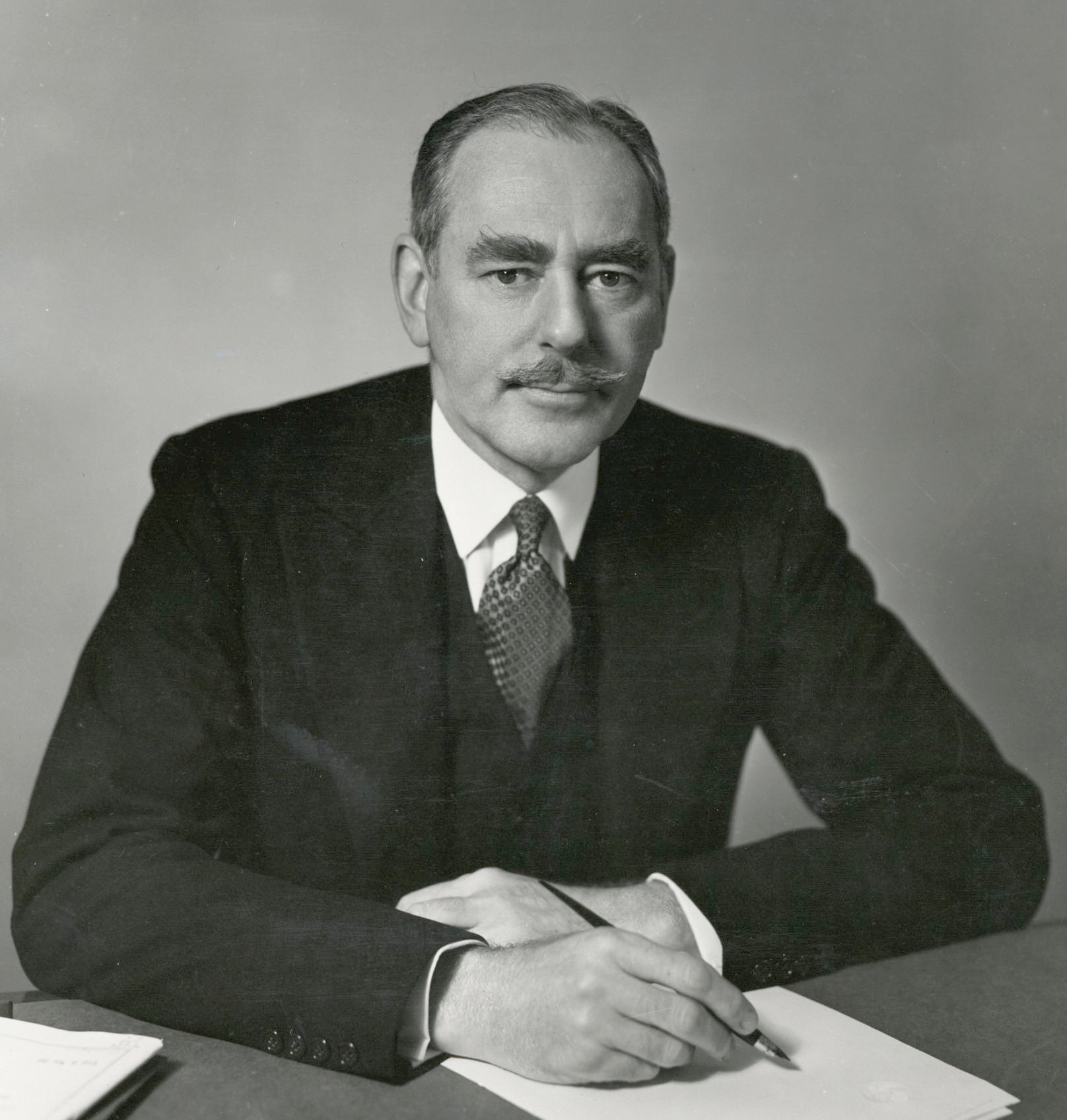

After Hiss was convicted of perjury in January 1950, Acheson told reporters that he would not turn his back on Hiss. The remark was repeated against him for years: in the 1952 campaign Richard Nixon said that Acheson, like Adlai Stevenson, accepted the verdict but had not "turned his back on Alger Hiss."6 McCarthy's Senate speech of June 14, 1951, which was mainly an attack on Marshall, also made Acheson one of its chief targets.3 McCarthy's words, as Haynes and Klehr quote them, described a "conspiracy on a scale so immense as to dwarf any previous such venture in the history of man."7
What the record shows. When John Earl Haynes checked every name McCarthy put forward from 1950 through 1952 against Venona and other evidence, he listed Acheson under "Benign identification in Venona," meaning that Acheson appears in the cables only as an official whose policies Soviet intelligence wanted to learn about.3 Haynes and Klehr wrote in 1999 that "There is no basis in Venona for implicating Acheson or Marshall in a Communist conspiracy."7 The Vassiliev notebooks, which name many State Department sources, do not list Acheson among them.2 On the other side, writers who defend McCarthy's campaign, among them M. Stanton Evans in Blacklisted by History (2007), argue that the State Department under Acheson was slow to act on security warnings and that his loyalty to Hiss showed poor judgment; that is a claim about judgment, and it is separate from the claim of conspiracy.8
Rating. "Acheson was part of a Communist conspiracy, or knowingly protected Soviet agents": Refuted. "Acheson misjudged Hiss": Supported, since the evidence summarized in the Chambers entry below and in module 81 shows Hiss was a Soviet source.
In module 81: lesson 02, lesson 05, lesson 07, lesson 11.
Solomon Adler (1909 to 1994)
Treasury Department economist and representative in China; a member of the Silvermaster group according to Bentley; Soviet cover name SACHS.
Solomon Adler was a Treasury economist who spent much of the war in China as the department's representative. When the House Committee on Un-American Activities (HUAC) questioned Elizabeth Bentley on July 31, 1948, its chief investigator, Robert Stripling, asked whether "one Solomon Adler" was a member of the group of government employees she had serviced. "Yes; he was," she answered, and then qualified it: he took part "Rather remotely, Mr. Stripling, because at the time I had charge of that group he was in China." She said she had never met him and assumed that the party dues Nathan Gregory Silvermaster handed her for "his complete group" included Adler's.4
What the record shows. A source with the cover name SACHS appears in the Venona decrypts but was never identified by the American analysts. The Vassiliev notebooks supply the name: Haynes and Klehr list "Sachs" (1941 to 1945) as Solomon Adler among the cover names that Venona left unidentified and the notebooks reveal.2 Module 81's chart of the Silvermaster group places him in the same category.2 That is two independent channels (Bentley's testimony, which was hearsay as to Adler, and the KGB's own file notes) pointing to the same man. Adler's later life in China, where he worked for the communist government after leaving the United States, is described in the secondary literature but was not checked against a primary source for this lesson; the Library of Congress lists him as the author of The Chinese Economy (1957).1
Rating. "Adler supplied information to Soviet intelligence while a Treasury official": Supported (Bentley's account corroborated by the KGB notebooks; no Venona identification).
In module 81: lesson 02 (Silvermaster group chart).
Yuri Andropov (1914 to 1984)
Soviet ambassador in Budapest in 1956, chairman of the KGB from 1967, General Secretary of the Communist Party of the Soviet Union from 1982 to 1984.
Yuri Vladimirovich Andropov was born on June 15, 1914, according to the Great Soviet Encyclopedia as cited by the Library of Congress, which also records that he became chairman of the KGB (the Committee for State Security) in May 1967.1 He had been posted to Hungary and became ambassador there in 1954; the Marxists Internet Archive's biographical glossary places him in Imre Nagy's office when Soviet troops moved against the Hungarian revolution in 1956.9 His own telegrams from Budapest survive. In one, dated November 1, 1956, he reported, in the archive's summary, that "Imre Nagy has threatened a scandal and the resignation of the government" over Soviet troop movements (in the body of the telegram the warning is relayed by Zoltan Tildy, a minister in Nagy's government); three days later Soviet forces crushed the revolution, as lesson 03 recounts.10 As KGB chairman he directed the campaign against Soviet dissidents described in lesson 10. He succeeded Leonid Brezhnev as party leader in November 1982 and died in February 1984.9
Rating. "Andropov, as ambassador, helped prepare the suppression of Hungary in 1956 and later ran the KGB for fifteen years": Supported.
In module 81: not covered; see lesson 03 and lesson 10 of this companion.
B
Elizabeth Bentley (1908 to 1963)
Communist courier and handler for Soviet intelligence, 1938 to 1944; defector to the FBI in November 1945; the most important witness of the era about Soviet espionage in Washington.
Elizabeth Terrill Bentley, a Vassar graduate, told HUAC on July 31, 1948, that she had joined the Communist Party and that in October 1938 she met Jacob Golos, whom she later learned was president of World Tourists, Inc., a travel company in New York.4 Golos was a Soviet intelligence officer. The joint NSA and CIA history of Venona describes him as running "the Soviet-sponsored World Tourists corporation" and allegedly serving on the CPUSA's central control commission, and describes Bentley, who became his lover, as having "moved from the open Party into underground work in the late 1930s"; she "helped Golos service various agents and run the World Tourists business."11 After Golos died in November 1943 she carried on as courier for the government employees he had organized, until Soviet officers took the networks away from her in 1944. In November 1945 she went to the FBI. J. Edgar Hoover reported her allegations to the White House on November 8, 1945.11
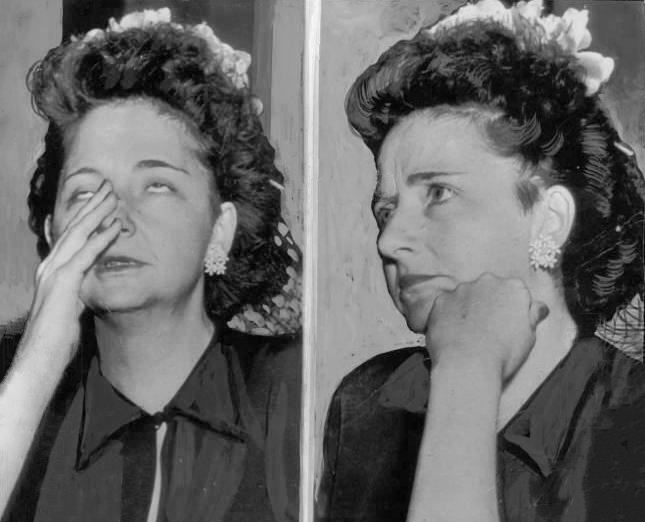

What she said. In public testimony in the summer of 1948 she named the members of two groups of federal employees, one organized around the Treasury and Farm Security economist Nathan Gregory Silvermaster and one around Victor Perlo of the War Production Board. She described the camera set up in the Silvermasters' basement: "a home-made apparatus for photographing documents, for microfilming documents, in their cellar."4 Asked by Stripling about Lauchlin Currie, she said: "The man was not a Communist but he did give information."4 Her account of Currie's most serious act came in reply to Representative Richard Nixon: Silvermaster had told her that "one day Mr. Currie came dashing into Mr. Silverman's house, sort of out of breath, and told him that the Americans were on the verge of breaking the Soviet code."4 She was candid that much of what she knew about the people she never met came through others, and the people she named seized on that. Currie's statement to the committee two weeks later called what she said about him "hearsay three times removed," quoting Representative John Rankin.12
What the record shows. Her cover names appear in the decrypts and in the KGB notebooks. Haynes and Klehr list her as "Clever Girl" from about 1940 to August 1944 and "Myrna" afterwards, both confirmed by the notebooks; the NSA and CIA history renders the first name as SMART GIRL, and the NSA's own Cryptologic Almanac has used "GOOD GIRL," all translations of the Russian word UMNITSA.211 Of the people she named in the Silvermaster and Perlo groups, the notebooks confirm Venona cover names for most of them, and module 81 lesson 02 counts them group by group.2 The CIA history says that the decrypts "corroborated various charges made by Elizabeth Bentley and Whittaker Chambers," and Haynes and Klehr, summing up Venona in 1999, wrote that her charges "that several dozen mid-level government officials, mostly secret Communists, had assisted Soviet intelligence were corroborated in Venona documents."117
What her testimony did not produce was prosecutions for espionage. The CIA history records that the "Gregory" case, the FBI's name for the investigations she started, "produced many leads but led to no espionage prosecutions," because wiretap evidence could not be used in court and the agents could not catch the suspects in the act; by the time she defected, Soviet intelligence had been warned and had shut the networks down.11 Her later life was unhappy and her public story was sometimes embellished. Kathryn Olmsted's biography Red Spy Queen (2002) found that she exaggerated details and her own importance in later retellings, and also that the core of her account held up; Haynes and Klehr reached the same judgment on the core from the KGB side.132 She published a memoir, Out of Bondage, in 1951, and died on December 3, 1963.1
Scholars on each side. For two generations after 1948, Bentley was the symbol of the informer who invented spies, and Haynes and Klehr quote the version of the story common in textbooks, in which "one government official (Harry White) was killed by a heart attack brought on by Bentley's lies."7 Ellen Schrecker, in Many Are the Crimes (1998), accepted after the Venona release that some of the people Bentley named had spied, while arguing that the anti-communist campaign that followed did more damage than the espionage it targeted.14 Writers who defend that campaign, among them Arthur Herman (2000) and M. Stanton Evans (2007), treat Bentley's vindication as proof that the alarm of the late 1940s was justified.158
Rating. "Bentley's accusations of Soviet espionage in the federal government were substantially true": Supported. "Everything she said in later years was accurate": Unsupported; her biographer documents embellishment.
In module 81: lesson 01, lesson 02, lesson 03, lesson 10, lesson 11. Her networks are diagrammed in lesson 12 of this companion.
Lavrentiy Beria (1899 to 1953)
Head of the Soviet secret police (NKVD), 1938 to 1953; signer of the proposal to shoot the Polish prisoners at Katyn; overseer of the Soviet atomic project; executed after Stalin's death.
Lavrentiy Pavlovich Beria was born on March 29, 1899 (March 17 in the old Russian calendar) in Merkheuli, in what is now Georgia, and became deputy to the NKVD chief Nikolai Yezhov in 1938 and then head of the secret police, a post he held in one form or another until 1953.16 The Marxists Internet Archive's glossary, compiled by communists of a different tradition, says of him that he was "Responsible for countless murders on his own initiative as well as on Stalin's orders."17
The document that most directly ties Beria to mass murder is his memo to Stalin dated March 5, 1940. It reported that the NKVD held "14,736 former officers, government officials, landowners, police, gendarmes" in its camps and "18,632 detained people" in prisons in western Ukraine and Belarus, and proposed to "apply to them the supreme penalty: shooting." It was signed by Beria as People's Commissar for Internal Affairs and, according to the published text, approved with the signatures of Stalin, Voroshilov, Molotov, Mikoyan, Kalinin and Kaganovich.18 The killings that followed in April and May 1940 are known by the name of one of the sites, the Katyn forest; the Soviet government denied responsibility until 1990, as lesson 02 explains. After Stalin died in March 1953, Beria's colleagues turned on him. He was arrested, tried in December 1953 and immediately executed; Britannica gives his death as December 23, 1953.16
Rating. "Beria proposed and organized the Katyn executions": Supported by his own signed memo. His supervision of the atomic project, which used the intelligence that Klaus Fuchs and others supplied, is described in the secondary literature and was not checked for this entry.
In module 81: background to lesson 01. See also lesson 02 and lesson 10 of this companion.
Abraham Brothman (1913 to 1980)
Chemical engineer; Soviet source with the cover name CONSTRUCTOR; one of Elizabeth Bentley's early contacts and later a business partner of Harry Gold.
Abraham Brothman ran a small chemical engineering firm in New York. Accounts based on Bentley's FBI statement and Harry Gold's confession place him in the Golos network and later as Gold's employer; those details were not checked against the FBI files for this entry. The Vassiliev notebooks confirm the Venona identification of the cover name "Constructor" (used before October 1944) as Brothman.2 He was one of the many witnesses called in the executive sessions of McCarthy's subcommittee in 1953, according to the subcommittee's published index.19 His conviction in 1950, with his associate Miriam Moskowitz, for conspiring to obstruct a grand jury is reported in the secondary literature and was not checked against the court record for this entry.
Rating. "Brothman supplied technical information to Soviet intelligence": Supported (Venona identification confirmed by the notebooks).
In module 81: background to lesson 10 (the atomic ring). See lesson 12 of this companion.
Earl Browder (1891 to 1973)
General Secretary of the CPUSA, 1934 to 1945; presidential candidate in 1936 and 1940; imprisoned for passport fraud; cover name HELMSMAN in Soviet intelligence traffic; expelled from the party in 1946.
Earl Browder was born in Wichita, Kansas, on May 20, 1891, joined the Socialist Party at sixteen and came into the Communist movement through the trade-union work of William Z. Foster.20 He led the American party through its largest years, from 1934 to 1945, and was its presidential candidate in 1936, when he received 80,195 votes.20 Browder's leadership coincided with the Popular Front, when the party presented itself as a movement of American reform, and with the Nazi-Soviet Pact, when it reversed itself on Moscow's instructions (see lesson 05).
The FBI's raids of 1939 on organizations linked to the party turned up evidence of fraudulent passports, and Browder was arrested for passport fraud. He had made trips abroad on a false passport. He was convicted and sentenced in 1940; the NSA and CIA history records that "President Roosevelt commuted Browder's sentence in May 1942 in the interest of inter-allied relations."11 In 1944 he dissolved the party into a "Communist Political Association" and preached cooperation with American capitalism after the war. In April 1945 the French Communist leader Jacques Duclos published an article attacking that policy, which American Communists read as Moscow's verdict. The Supreme Court's opinion in Communist Party v. Subversive Activities Control Board (1961) summarizes the record: the Association "was reconstituted as the Communist Party U. S. A., Browder was ousted," and the party, in the words of its new chairman William Z. Foster, "suddenly reverted to its basic Communist principles."21 The NSA and CIA chronology dates Browder's removal to June 1945.11 He was expelled in 1946 and spent his last decades outside the movement.20
What the record shows. Browder was more than a political leader. The Vassiliev notebooks confirm the Venona identification of the cover name "Helmsman" as Browder.2 Haynes and Klehr describe the CPUSA in Venona as "an auxiliary of the intelligence agencies of the Soviet Union," and they write that "Party leaders were not only aware of the liaison; they actively worked to assist the relationship."7 His name came up again in 1950 when he testified before the Tydings subcommittee and refused to name Communists in the State Department; McCarthy's allies later used a faked composite photograph of Browder and Senator Millard Tydings in the Maryland Senate race, as module 81 lesson 05 documents.
Rating. "Browder was an independent American radical with no ties to Soviet intelligence": Refuted. "Browder, as party leader, cooperated with Soviet intelligence": Supported.
In module 81: lesson 01, lesson 05 (Tydings testimony and the composite photograph), lesson 12.
Louis Budenz (1891 to 1972)
Labor organizer, Communist editor, and after 1945 a former Communist who became a frequent government witness.
Louis Francis Budenz was a labor activist who joined the Communist Party in the 1930s and rose to edit party newspapers. The Supreme Court's 1961 opinion on the party's registration case describes him as a trusted Communist who edited the Midwest Daily Record, a party paper in Chicago, and who was instructed in 1945 to reprint the Duclos article in the Daily Worker, where he then worked.21 He broke with the party in 1945, returned to the Catholic Church and became a teacher, and for the next decade testified in case after case as the government's expert on how the party worked, including before the Subversive Activities Control Board.21
What he said. Budenz's testimony had two kinds of content. The first was about the party's structure and its ties to Moscow, and on that he was usually corroborated. Before the Subversive Activities Control Board he described a conversation in which party officials discussed whether money for the Midwest Daily Record could be got "from across the sea," as an FBI memorandum put it, and concluded that "funds were actually being sent to this country at that time by the Soviet Union for propaganda purposes."21 The Moscow archives later documented such subsidies, as lesson 11 of this companion shows. The second kind was about individuals, and there he was much weaker. In 1950 he told the Tydings subcommittee, and in 1951 and 1952 the Senate Internal Security Subcommittee, that party leaders had described Owen Lattimore as a Communist; Lattimore does not appear as a Soviet source in Venona or the KGB notebooks.3 When the Subversive Activities Control Board case went back on remand, the government had to produce Budenz's earlier recorded statements to the FBI, and the Supreme Court's opinion details the fight over his testimony about the "Starobin letter" and the "Childs-Weiner conversation."21
Rating. "Budenz was a reliable witness on the party's ties to Moscow": Supported. "Budenz's identifications of individual concealed Communists, such as Lattimore, were reliable": Partly supported at best; some held up and the most famous did not.
In module 81: lesson 05, lesson 07 (the Lattimore case).
C
Whittaker Chambers (1901 to 1961)
Communist Party member from 1924, courier in the Soviet underground in Washington in the 1930s, defector, senior editor at Time, and the accuser of Alger Hiss.
Chambers gave his full name to HUAC as "J. David Whittaker Chambers" and said he was born in Philadelphia on April 1, 1901.22 On August 3, 1948, he testified that he had joined the Communist Party in New York in 1924 and remained in it until 1937.22 He then read a statement that is one of the era's essential documents. He had turned to communism, he said, because "In the writings of Karl Marx I thought that I had found the explanation of the historical and economic causes. In the writings of Lenin I thought I had found the answer to the question, What to do?" Then: "In 1937 I repudiated Marx' doctrines and Lenin's tactics. Experience and the record had convinced me that communism is a form of totalitarianism, that its triumph means slavery to men wherever they fall under its sway, and spiritual night to the human mind and soul."22
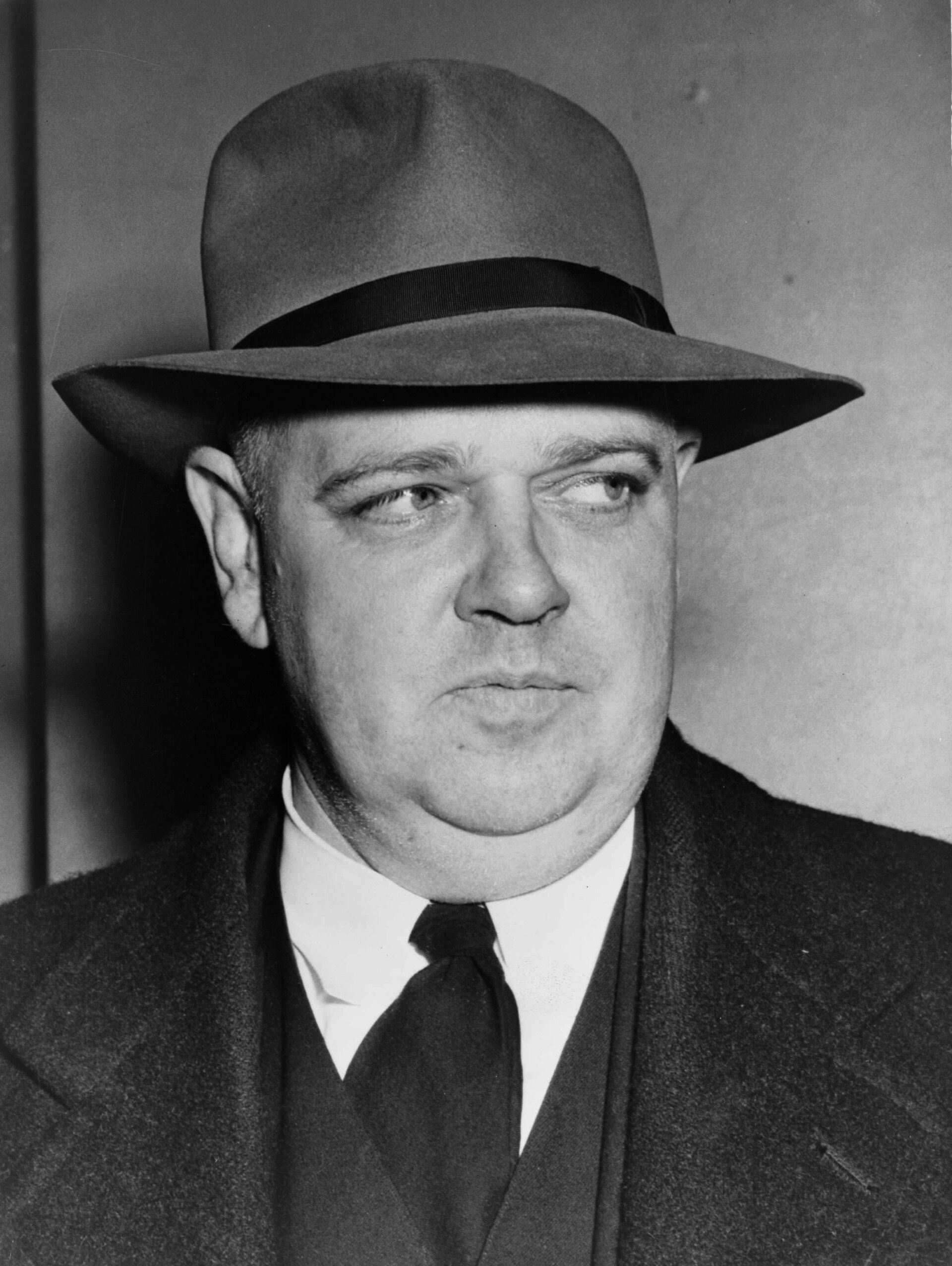

He described an underground group of government employees whose head at first was Nathan Witt of the National Labor Relations Board and later John Abt, with Lee Pressman and Alger Hiss among its members. "The purpose of this group at that time was not primarily espionage," he said. "Its original purpose was the Communist infiltration of the American Government. But espionage was certainly one of its eventual objectives."22 His knowledge of the Hisses was personal and detailed. Asked about their hobbies, he recalled that they were bird watchers and that "once they saw, to their great excitement, a prothonotary warbler," a detail Hiss himself later confirmed to the committee.22 Hiss first told the committee he did not know Chambers; when confronted, he said he had known a writer he called George Crosley.22 Chambers later produced State Department documents and, in December 1948, the microfilm he had hidden in a pumpkin on his Maryland farm (see the canister photograph in module 81 lesson 03). Hiss was convicted of perjury on January 21, 1950.11
What the record shows. Chambers had worked for Soviet military intelligence; the NSA and CIA history calls him a "former GRU courier" and notes that Assistant Secretary of State Adolf Berle and the FBI were slow to act on what he told them in 1939, and that the FBI debriefed him at length on May 10, 1945.11 The same history records that by June 1950 the FBI had concluded that the cover name ALES, in one KGB cable, "referred to former State Department aide Alger Hiss."11 That identification remains contested by a minority of writers (the alternatives are treated in the Hiss entry in lesson 07 and module 81 lesson 02), but the main charge, that Hiss passed documents to Chambers for Soviet intelligence in the 1930s, rests on more than ALES: the documents themselves, the typewriter evidence, the jury verdict and the KGB file notes that Haynes, Klehr and Vassiliev published in Spies (2009), summarized in module 81 lesson 02.23 Sam Tanenhaus's biography Whittaker Chambers (1997) concluded that Chambers told the truth about Hiss, while describing a man whose personal history (his years under assumed names, his secret life) gave his opponents material for attack.24
Chambers published a memoir, Witness, in 1952 and died on July 9, 1961.1 In 1984 President Ronald Reagan awarded him a posthumous Presidential Medal of Freedom. Reagan's diary for March 26, 1984, records that "The news headline one though was the son of Whittaker Chambers accepting for his father."25
Rating. "Chambers was a Soviet underground courier who told the truth about Hiss and the Washington apparatus": Supported. "Chambers's testimony was accurate in every detail from the start": Refuted; he first denied espionage and changed his account when he produced the documents in November 1948, as his own August 1948 description of the group as "not primarily espionage" shows.22
In module 81: lesson 01, lesson 02, lesson 03 (the August 1948 hearings, the confrontation and the pumpkin papers), lesson 14.
O. Edmund Clubb (1901 to 1989)
Foreign Service officer and China specialist; one of the "China hands" whose careers ended in the loyalty-security reviews.
Oliver Edmund Clubb was a career diplomat in China and the last American consul general in Beijing before the communist government took over. He testified before HUAC in 1952, and the Library of Congress catalogs the printed testimony.1 The State Department's loyalty board found against him in 1951; the Secretary of State reversed the finding, and Clubb retired from the Foreign Service in 1952. Those details are reported in the secondary literature and were not checked against the board records for this entry. When Haynes checked the names McCarthy put forward, he listed "Clubb, Oliver Edmund: Not identified in Venona."3
Rating. "Clubb was a Soviet sympathizer or agent whose reporting from China served Moscow": Unsupported. He appears in no Soviet source as an agent, and the charge rested on his contacts and his reporting.
In module 81: lesson 10 (the State Department's China hands).
Frank Coe (1907 to 1980)
Treasury economist, Director of the Division of Monetary Research; named by Bentley; cover name PEAK.
Frank Coe was a Treasury economist who rose to direct the department's Division of Monetary Research; a 1948 HUAC exhibit lists "Frank V. Coe, Director of Monetary Research" as a supervisor on another Treasury employee's personnel form.4 Bentley named him as part of the Silvermaster group. The Vassiliev notebooks confirm the Venona identification of the cover name "Peak" as Coe.2 Coe later served at the International Monetary Fund, invoked the Fifth Amendment before congressional committees, and moved to China, where he worked for the communist government until his death; those later details come from secondary accounts and were not checked here.
Rating. "Coe passed information to Soviet intelligence through the Silvermaster group": Supported (Bentley's testimony confirmed by Venona and the notebooks).
In module 81: lesson 02 (Silvermaster group chart).
Morris Cohen (1910 to 1995) and Lona Cohen (1913 to 1992)
American Communists and KGB couriers in the atomic espionage network; later convicted in Britain under the names Peter and Helen Kroger.
Morris Cohen, born in New York to immigrant parents, fought in the Spanish Civil War, where the NSA and CIA history describes him as a "KGB asset."111 His wife Lona served as a courier for the sources at Los Alamos: the same history says that at least four agents there "reported through couriers such as Lona Cohen to the Soviet consulate in New York."11 The Vassiliev notebooks give their cover names as "Volunteer" (Morris) and "Leslie" (Lona), names that appear in Venona without identification.2 When the FBI began rolling up the atomic network in 1950, the Cohens "avoided the net" and left the United States; as "Helen and Peter Kroger" they "would be convicted of espionage in the United Kingdom in 1961," the CIA history notes, and the Library of Congress records that they were exchanged in 1969 for a Briton jailed in Moscow.111
Rating. "The Cohens were Soviet intelligence couriers for the atomic espionage network": Supported.
In module 81: background to lesson 02 (Theodore Hall). See lesson 12 of this companion.
Roy Cohn (1927 to 1986)
Federal prosecutor in the Remington, Rosenberg and Smith Act cases; chief counsel to McCarthy's Permanent Subcommittee on Investigations, 1953 to 1954.
Roy Marcus Cohn was born on February 20, 1927.1 The Senate Historical Office's introduction to the subcommittee's executive session transcripts, edited by Donald A. Ritchie and published in 2003, gives the essentials. The son of a New York appellate judge, Cohn had been too young to take the bar examination when he graduated from Columbia Law School; a year later he became an assistant United States attorney on the day he was admitted to the bar. In that office "he took part in the prosecution of William Remington," and "also participated in the prosecution of Julius and Ethel Rosenberg, and in the trial of the top Communist party leaders in the United States." In 1952 he served briefly as a special assistant to Attorney General James McGranery and prepared the perjury indictment of Owen Lattimore.19
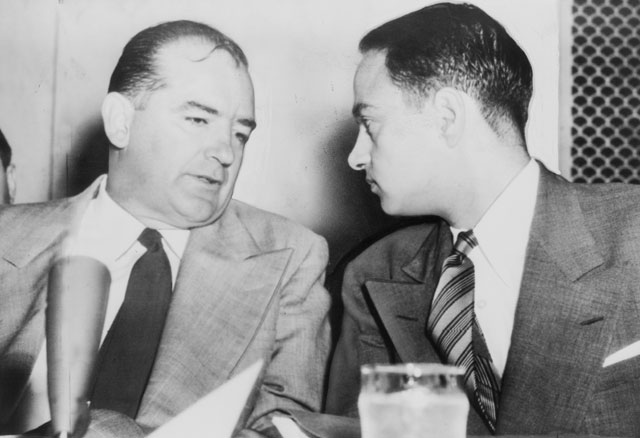

McCarthy offered him the chief counsel's post in December 1952. Ritchie's account describes a chairman who gave his counsel "free rein to conduct investigations," a staff in turmoil (assistant counsel Robert Kennedy, "after literally coming to blows with Roy Cohn, resigned in August" 1953), and hearings called with little preparation; Kennedy complained afterwards that "No real research was ever done."19 Cohn recruited his friend G. David Schine as the subcommittee's unpaid "chief consultant," and the two toured the State Department's overseas information libraries in 1953.19 Schine's induction into the Army in November 1953, and Cohn's efforts on his behalf, led to the Army-McCarthy hearings of 1954 (module 81 lesson 08). The Senate's editors record that Cohn "resigned from the subcommittee staff on July 20" 1954; the introduction to the same volume says he resigned "in August 1954," and the July date is the one tied to the record of staff changes.26
His own words. The Senate editors summarize Cohn's later view: he conceded that McCarthy's "penchant for the dramatic" had invited the storm, but insisted that McCarthy had performed "a substantial service to the country by alerting the country to the menace of communism when most people in this country were not tuned in to how deadly it was." He dismissed charges that their investigations had ruined people: "Name one," he challenged.26 The same editors record that "As a private attorney he was frequently reprimanded for unethical conduct, and was tried and acquitted in 1964, 1969, and 1971 on charges of conspiracy, bribery and fraud. He was eventually disbarred in 1986, just prior to his death."26
Rating. "Cohn's investigations ruined no one": Refuted. The subcommittee's 1953 hearings on the Voice of America, the overseas libraries and Fort Monmouth cost people their jobs on evidence that did not hold up, as module 81 lessons 07 and 10 document. "Cohn was an effective prosecutor in the espionage and Smith Act cases": Supported as to his participation, which the Senate record confirms.
In module 81: lesson 06, lesson 07, lesson 08, lesson 12.
Edward Condon (1902 to 1974)
Physicist, director of the National Bureau of Standards; attacked by a HUAC subcommittee in 1948.
Edward Uhler Condon was a leading American physicist who worked on wartime radar and atomic research and directed the National Bureau of Standards after the war.1 In March 1948 a HUAC subcommittee chaired by J. Parnell Thomas issued a report calling him one of the weakest links in the nation's atomic security, chiefly because of his contacts with Soviet and East European officials and with people the committee considered suspect. The Atomic Energy Commission had cleared him, and the committee never gave him the hearing he requested. Those details come from the secondary literature and were not checked against the report itself for this entry. No Venona or KGB-notebook identification of Condon as a Soviet source has been published in the sources used here.2
Rating. "Condon was a security risk who endangered atomic secrets": Unsupported.
In module 81: background to lesson 03 (HUAC before McCarthy).
Judith Coplon (1922 to 2011)
Justice Department analyst; KGB source SIMA; the first person arrested on a Venona lead.
Judith Coplon was born in Brooklyn; the New York Times obituary, as recorded by the Library of Congress, gives her birth date as May 17, 1922, and her death in Manhattan on February 26, 2011, at 88, while the Moscow Times report of the same death gives her age as 89.127 The NSA and CIA history records that "In December 1948 the FBI identified a Soviet agent covernamed SIMA as Judith Coplon, a young Justice Department analyst recruited by the Soviets" in 1944. "Coplon would become the first person arrested on the basis of a Venona lead. FBI agents detained her in March 1949 along with a KGB official under UN cover; her purse contained ostensibly sensitive documents (which the Bureau had routed through her office as bait)."11 The Soviet official was Valentin Gubitchev.27
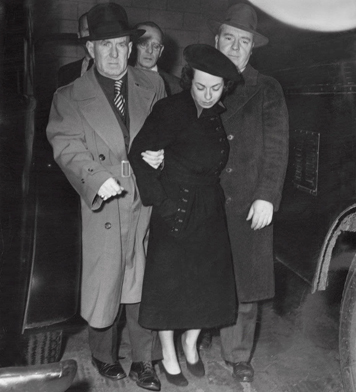

She was tried twice, in Washington and in New York, and convicted both times. Both convictions were overturned on appeal, on grounds that included her arrest without a warrant and the government's illegal wiretaps; one appeals judge wrote that her "guilt is plain" even as the conviction fell.2711 The New York appeal, United States v. Coplon, was decided by the Second Circuit on December 5, 1950, in an opinion by Chief Judge Learned Hand.28 The CIA history adds that FBI witnesses were forbidden to mention Venona and had to attribute the suspicion to a "confidential informant" that was not a wiretap.11 The government never retried her and formally dropped the case in 1967.27 Haynes called the affair "almost a textbook case of how American criminal justice and counterterrorism don't mesh well together."27
Rating. "Coplon spied for the KGB": Supported. "The courts found her innocent": Refuted; the reversals rested on how the evidence was gathered.
In module 81: lesson 02, lesson 10.
Lauchlin Currie (1902 to 1993)
Economist; administrative assistant to President Franklin Roosevelt from 1939; Soviet source with the cover name PAGE.
Lauchlin Currie told HUAC on August 13, 1948, that he was born in 1902 in Nova Scotia.12 An economist, he was assistant director of the Federal Reserve Board's Division of Research and Statistics when, in July 1939, President Roosevelt named him to one of six newly created posts of administrative assistant, according to the original caption of a Harris and Ewing photograph taken that month.29 Bentley named him on July 31, 1948, in the words quoted above: "The man was not a Communist but he did give information." She said he furnished "inside information on this Government's attitude toward China, toward other governments," and that "He once relayed to us the information that the American Government was on the verge of breaking the Soviet code."4
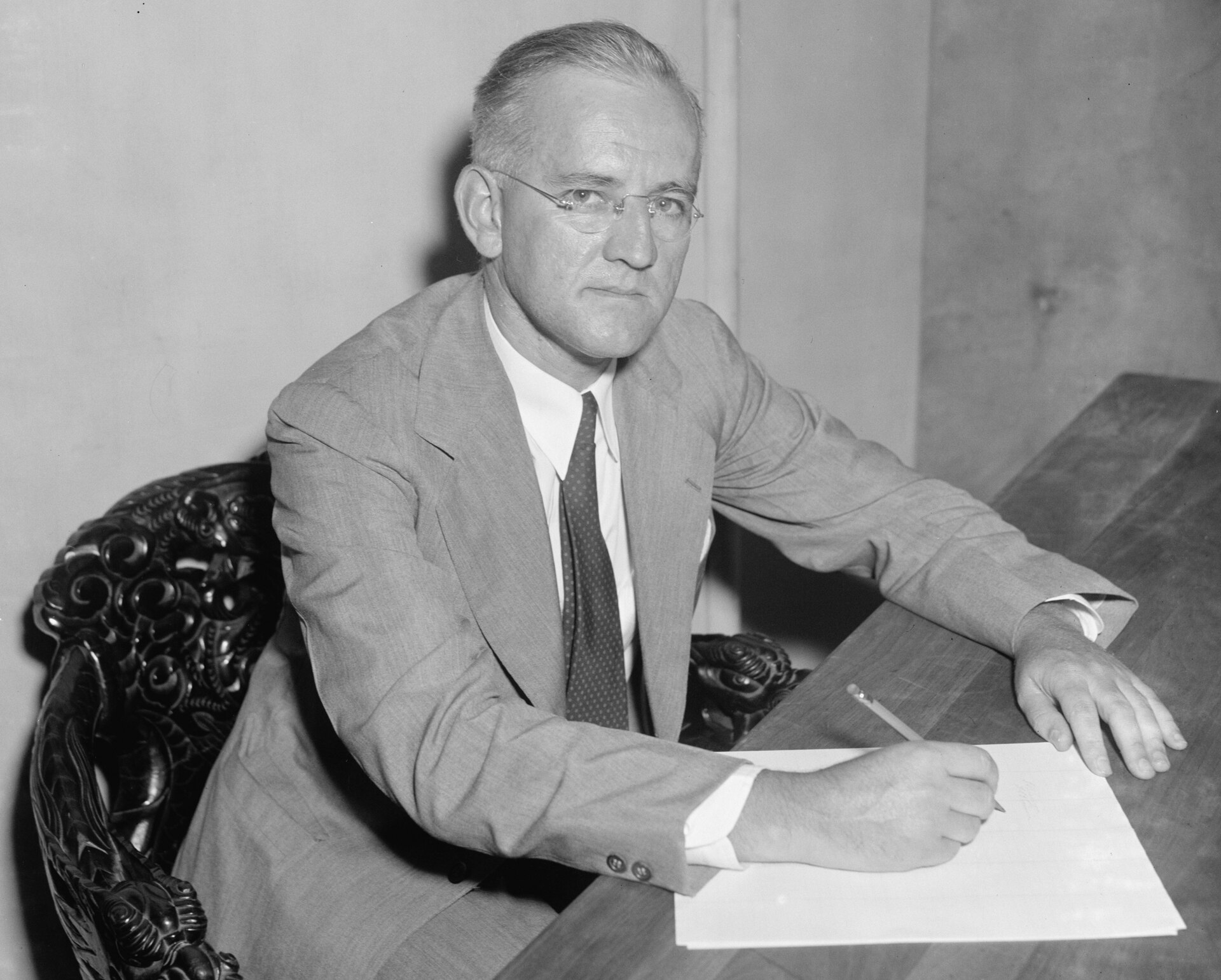
His own words. Currie appeared voluntarily on August 13 and denied everything. "Miss Bentley admitted to you that she had never met me and had never seen me and had never had any communication with me," he said; her statements about him were "hearsay three times removed." He declared that "I am not and never have been a Communist, a member of the Communist Party, a believer in the tenets or doctrines of communism." On the code: "I wish at this point, however, to deny emphatically that I ever stated to Silverman, Silvermaster, or anyone else that the United States was about to break the Russian or any other code."12
What the record shows. Currie's denial was true as to party membership, as far as any record shows, and Bentley herself had said he was not a member. The rest of it does not survive the archives. The cover name PAGE appears in Venona and was identified as Currie; the Vassiliev notebooks use the same name for him from 1942 to 1948.2 Haynes and Klehr wrote in 1999 that Currie "warned the KGB that the FBI had started an investigation of one of the Soviets' key American agents, Gregory Silvermaster," and that "This warning allowed Silvermaster, who headed a highly productive espionage ring, to escape detection and continue spying."7 The NSA and CIA history treats the code warning with care: senior KGB officials "may have become worried when White House aide Lauchlin Currie apparently told Soviet contacts (possibly in spring 1944) that the Americans were about to break a Soviet code," but "Currie's tip probably was too vague to have alarmed Soviet cryptographers."11 When Haynes checked McCarthy's lists, Currie was one of the few names "Identified in Venona as a Soviet Espionage Source," and one that Bentley had already given the FBI in 1945.3
The dissent deserves its place. John Lowenthal wrote in letters to The Nation in 2001 that "Haynes and Klehr use Venona decrypts of Soviet World War II cablegrams to traduce Currie as a spy for the Soviet Union," and that "They falsely assert that Currie fled the United States and renounced his citizenship."30 On the second point Lowenthal had a fair complaint about wording: Currie went to Colombia in 1950 to lead an economic mission, settled there and later became a Colombian citizen, and he died in Bogota in 1993; the exact sequence of his passport and citizenship changes is reported in secondary accounts and was not checked here.1 On the first point, the notebooks, published after Lowenthal wrote, carry the PAGE name across six years, which is hard to square with a mistaken identification.2
Rating. "Currie, a White House aide, helped Soviet intelligence": Supported, with a dissent on record. "Currie was a secret Communist Party member": Unsupported; even his accuser said he was not.
In module 81: lesson 02, lesson 07, lesson 11.
D
John Paton Davies Jr. (1908 to 1999)
Foreign Service officer and China specialist; dismissed by Secretary of State John Foster Dulles in 1954 as a "security risk" after repeated findings of loyalty.
John Paton Davies Jr. was born on April 6, 1908, in Kiating, China, to missionary parents, and served in the Foreign Service from 1931 to 1954. The Truman Library's guide to his papers lists his posts: China in the 1930s, the embassy in Chungking detailed to General Joseph Stilwell from 1942 to 1945, Moscow from 1945 to 1947, the State Department's Policy Planning Staff from 1947 to 1952, Germany, and finally Lima, Peru. He received the Medal of Freedom in 1948 for wartime service in China and India.31 His wartime reports from China, which predicted that the Chinese Communists might win the civil war, made him a target for those who blamed the State Department for the outcome.
The guide records that he was "formally charged with disloyalty and subjected to a series of investigations" and that each investigation confirmed his loyalty; the papers include Loyalty Security Board transcripts of July 23, 1951, Loyalty Review Board transcripts of November 13 to 19, 1952, and Security Hearing Board transcripts of June and July 1954. On November 5, 1954, Dulles dismissed him "as a 'security risk'" on the recommendation of a Security Hearing Board that found him loyal but lacking in "judgment, discretion and reliability." In 1969 the State Department gave him a security clearance. He ran a furniture business in Lima, wrote Dragon by the Tail (1972), and died in Asheville, North Carolina, on December 23, 1999.31 Haynes lists him: "Davies, John Paton: Not identified in Venona."3
Rating. "Davies was disloyal": Refuted by every board that examined him. "Davies was a security risk under the Eisenhower standard": a judgment the 1954 board reached under a rule that required employment to be "clearly consistent with the interests of the national security," which is a lower bar for dismissal than disloyalty.32
In module 81: lesson 10 (the China hands and Executive Order 10450).
Eugene Dennis (1905 to 1961)
General Secretary of the CPUSA after Browder's removal; lead defendant in the 1949 Smith Act trial.
Eugene Dennis, born in Seattle on August 10, 1905, according to the Library of Congress record, signed party pamphlets as "Gen. Sec., Communist Party, U.S.A." by 1947.1 When the party leaders were indicted in July 1948 under the conspiracy provisions of the Smith Act, the case went to trial in January 1949 and ended with guilty verdicts on October 14, 1949. The Supreme Court upheld the convictions in Dennis v. United States on June 4, 1951. "With one exception, each was sentenced to imprisonment for five years and to a fine of $10,000," the opinion records.33 Dennis died on January 31, 1961.1
Rating. "Dennis led a party that took its line from Moscow": Supported. Whether the Smith Act prosecution of teaching and advocacy was consistent with the First Amendment is a separate legal question; the Supreme Court narrowed the law in Yates (1957), as module 81 lesson 09 explains.
In module 81: lesson 03, lesson 09.
Samuel Dickstein (1885 to 1954)
Congressman from New York, vice chairman of the 1934 McCormack-Dickstein committee on Nazi propaganda; reported in KGB files as a paid Soviet source.
Samuel Dickstein represented a Manhattan district in the House.1 The National Archives' guide to House records describes the committee he helped create: the Special Committee on Un-American Activities Authorized to Investigate Nazi Propaganda and Certain Other Propaganda Activities, created on March 20, 1934, and "frequently referred to as the McCormack-Dickstein Committee in reference to its chairman and vice chairman, John W. McCormack of Massachusetts and Samuel Dickstein of New York." It held hearings between April 26 and December 29, 1934, and gathered "more than 4,300 pages of testimony."34 It was the forerunner of the Dies committee and HUAC.
Allen Weinstein and Alexander Vassiliev reported in The Haunted Wood (1999), from KGB files, that Dickstein took payments from the NKVD in the late 1930s in return for information, and that his Soviet handlers gave him the cover name CROOK.35 That account rests on one archival channel and was not checked against the book's pages for this entry.
Rating. "Dickstein, a founder of the House's un-American activities investigations, was a paid Soviet source": Supported by the KGB file notes as Weinstein and Vassiliev report them; there is no Venona or trial evidence.
In module 81: lesson 03, lesson 06.
Martin Dies Jr. (1900 to 1972)
Congressman from Texas; chairman of the House Special Committee on Un-American Activities, 1938 to 1944.
Martin Dies Jr. was born in Colorado, Texas, on November 5, 1900, according to the Biographical Directory of the United States Congress as cited by the Library of Congress, and died in Lufkin, Texas, in 1972.1 He chaired the special committee that the House created in May 1938 and that became the model for the permanent HUAC. Its early hearings drew a sharp public rebuke from President Roosevelt, who said on October 25, 1938, that he was "very much disturbed" by testimony attacking Michigan's governor, Frank Murphy, that "the Dies Committee made no effort to get at the truth," and that it had let itself be used in "a flagrantly unfair and un-American attempt to influence an election."36
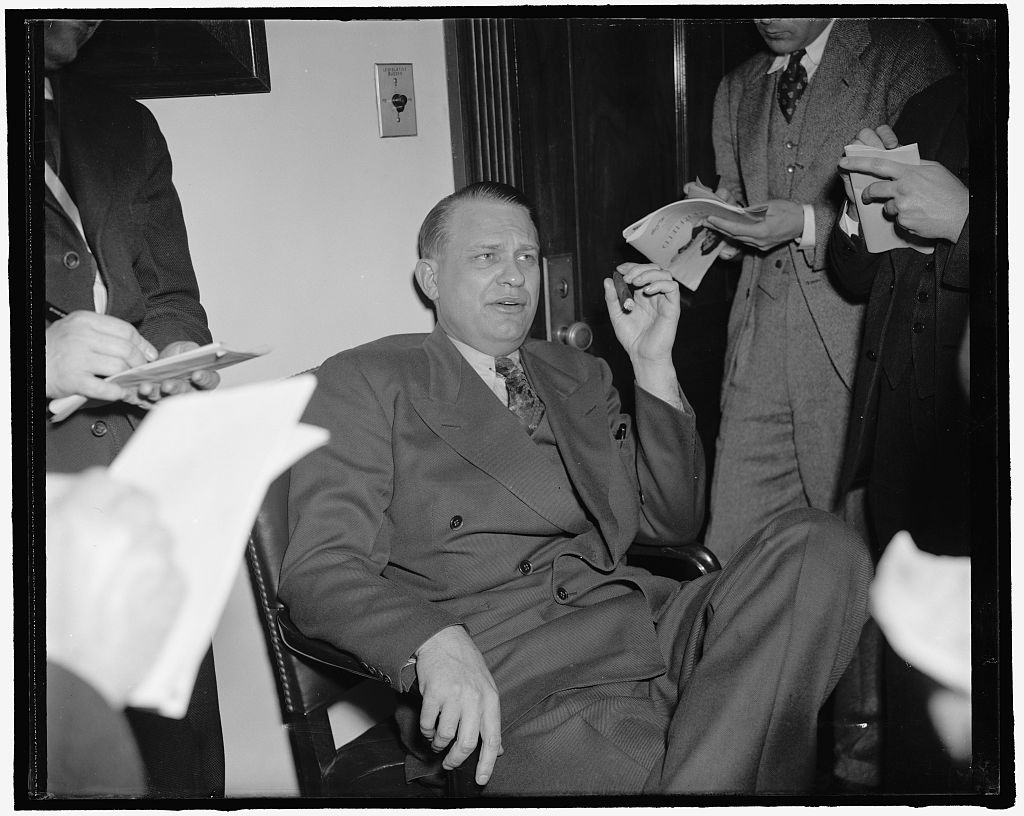

The Dies committee exposed real things, including the CPUSA's control of front organizations and the German American Bund, and it also named federal employees on thin evidence. In a House speech of February 1, 1943, Dies attacked thirty-nine federal employees, and the House then attached to an appropriations bill a section cutting off the salaries of three of them, Goodwin Watson, William E. Dodd Jr. and Robert Morss Lovett. The Supreme Court struck that section down as a bill of attainder in United States v. Lovett (1946), as module 81 lesson 03 explains.37
Rating. "Watson, Dodd and Lovett were disloyal and Congress was right to remove them": Unsupported; no evidence of disloyalty was presented, and the Court held the method unconstitutional. "The Dies committee documented Communist control of front organizations": Supported in substance by later archival findings on the fronts (lesson 11 of this companion).
In module 81: lesson 03, lesson 06.
Georgi Dimitrov (1882 to 1949)
Bulgarian Communist; General Secretary of the Communist International from 1935; leader of communist Bulgaria from 1946.
Georgi Dimitrov was born on June 18, 1882, in Kovachevtsi, Bulgaria, and died near Moscow on July 2, 1949.38 A printer and trade-union leader, he helped found the Bulgarian Communist Party in 1919 and became famous in 1933, when the Nazi government tried him in Leipzig for the Reichstag fire and he was acquitted. At the Seventh World Congress of the Comintern on August 2, 1935, he gave the main report that launched the Popular Front, endorsing the definition of the Comintern Executive's Thirteenth Plenum (December 1933) of fascism in power as "the open terrorist dictatorship of the most reactionary, most chauvinistic and most imperialist elements of finance capital."39 He led the Comintern until its dissolution in 1943 and then communist Bulgaria. Comintern files that passed through his office show Soviet intelligence asking the Comintern for information about American Communists, including a request of October 19, 1944, from the KGB's Pavel Fitin about Judith Coplon.11
Rating. "The Comintern under Dimitrov worked with Soviet intelligence on American cases": Supported by the Fitin request and the documents in The Secret World of American Communism (1995).
In module 81: background to lesson 01. See lesson 10 of this companion.
Martha Dodd (1908 to 1990)
Writer, daughter of the American ambassador to Nazi Germany; Soviet source with the cover name LIZA.
Martha Eccles Dodd was the daughter of William E. Dodd, the historian who served as ambassador in Berlin from 1933 to 1937, and she wrote a memoir of those years, Through Embassy Eyes (1939).1 The Vassiliev notebooks confirm the Venona identification of the cover name "Liza" as Martha Dodd, used from 1936 into the 1950s.2 She and her husband later left the United States and lived in Prague; the circumstances of their departure in the 1950s are described in secondary accounts and were not checked here. Her brother, William E. Dodd Jr., was one of the three employees whose pay Congress cut off in 1943 (see the Dies entry); the evidence about Martha says nothing about him.
Rating. "Martha Dodd worked with Soviet intelligence": Supported (Venona identification confirmed by the notebooks).
In module 81: not covered. See lesson 12 of this companion.
Laurence Duggan (1905 to 1948)
State Department official, head of the Division of American Republics; Soviet source from 1935, known in KGB traffic as "19," FRANK, SHERWOOD and PRINCE.
Laurence Duggan was a senior State Department specialist on Latin America.1 The Haynes and Klehr concordance gives his Soviet cover names: "Frank" in 1942 and 1943, "Sherwood" in August 1944, changed to "Prince" after September 1944, all confirmed by the notebooks, and "19," a number that appears in Venona without identification and that the notebooks show was Duggan's designation starting in 1935 and "as late as August 1944."2 That finding matters for a famous dispute: some writers had argued that "19" in a 1943 cable was Harry Hopkins. The notebooks say it was not (the Hopkins question is rated in lesson 07).2 Duggan died in December 1948 in a fall from a New York office building, days after his name came up in HUAC's inquiries. Haynes and Klehr quote the older textbook version of his story, in which "Laurence Duggan, a senior diplomat" was "driven to suicide by more of Chambers's malignant falsehoods."7 Whether his death was suicide or accident has never been settled; that his Soviet connection was false is no longer a tenable claim.
Rating. "Duggan was a Soviet source inside the State Department": Supported. "He was falsely accused and hounded to death": Refuted as to the falseness; the cause of his death is Unresolved.
In module 81: background to lesson 02. See lesson 12 of this companion.
Allen Dulles (1893 to 1969)
Wartime OSS chief in Bern; Director of Central Intelligence, 1953 to 1961; brother of John Foster Dulles.
Allen Welsh Dulles was born on April 7, 1893, according to the American National Biography as cited by the Library of Congress.1 He ran the Office of Strategic Services station in Bern, Switzerland, during the war and became Director of Central Intelligence in February 1953, early in the Eisenhower administration, serving until November 1961. In 1953 he refused to let McCarthy's subcommittee question CIA officers, a confrontation the senator dropped; the details are reported in secondary accounts and were not checked against the subcommittee record for this entry.
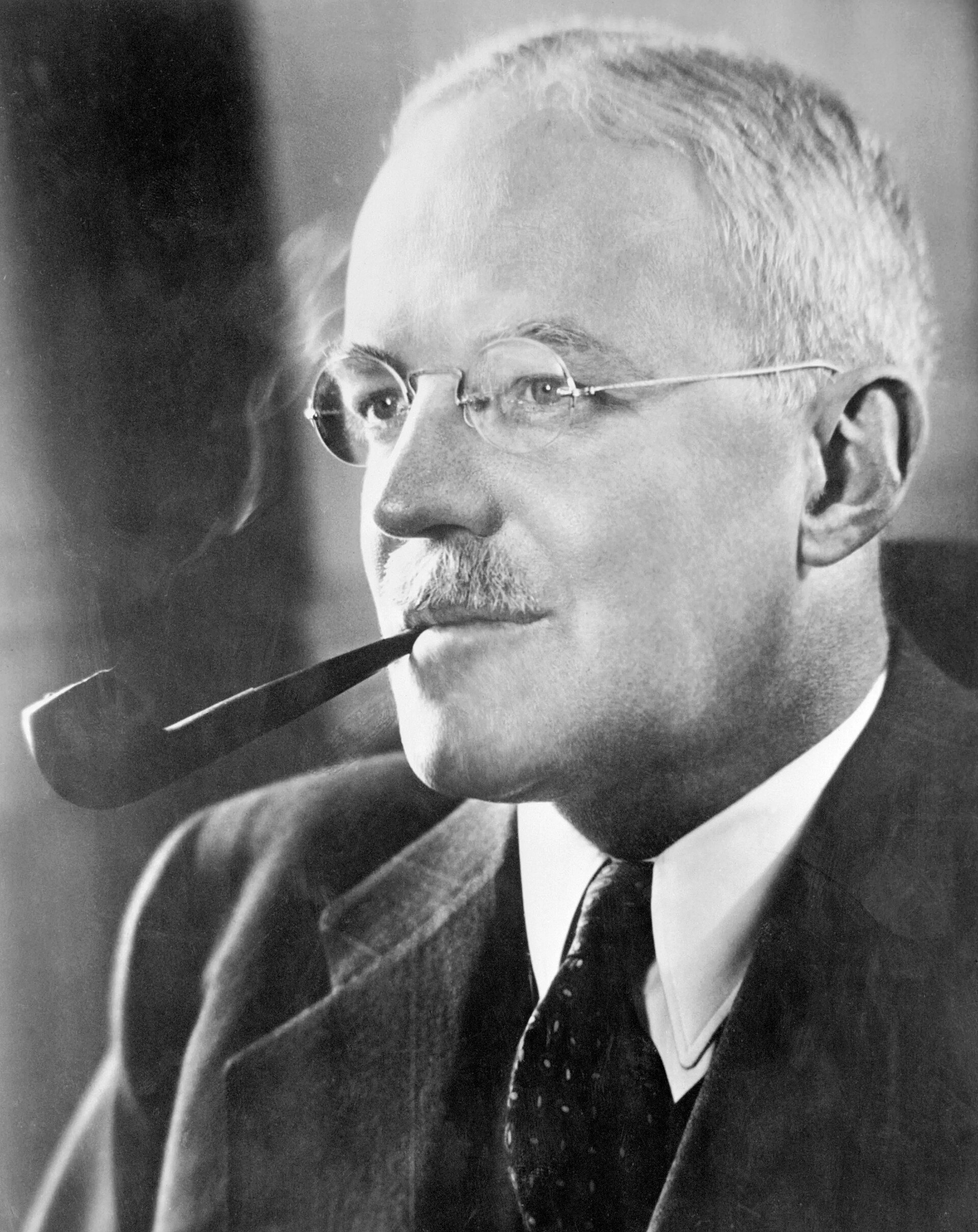

Dulles's name runs through one of the strangest stories of the period, that of Noel Field (see the F entries). Field had known Dulles in the 1930s and worked with his OSS office during the war. Tony Sharp's study Stalin's American Spy (2014) describes Field as "a Soviet agent in the US State Department in the mid-1930s" whose forced confessions, after his arrest in 1949, fed the East European show trials, and the publisher's description says the book also considers whether Field may have been working for Dulles.40 Stalin's security officers believed Field was an American agent, and they used that belief to destroy East European Communists who had known him.
Rating. "Noel Field was secretly working for Allen Dulles and American intelligence": Unresolved. The open record supports Field's Soviet work; it does not settle what he did for Dulles beyond wartime liaison.
In module 81: not covered. See lesson 10 of this companion for the CIA and its Soviet adversaries.
John Foster Dulles (1888 to 1959)
Secretary of State, 1953 to 1959.
John Foster Dulles was born in Washington, D.C., on February 25, 1888, and served as Secretary of State from January 21, 1953, to April 22, 1959; he died on May 24, 1959.41 He took office as McCarthy's subcommittee turned its attention to the State Department's information programs. The Senate's editors write that Dulles, "Dubious about mixing foreign policy and propaganda," viewed the Voice of America "as an unwanted appendage and was not unsympathetic to some housecleaning," and that he accepted the resignation of the International Information Administration's director, Wilson Compton, during the subcommittee's 1953 hearings.19
His most consequential personnel decision in this story was the dismissal of John Paton Davies on November 5, 1954, as a "security risk," on a board finding that Davies was loyal but lacked "judgment, discretion and reliability."31 He also presided over the department's security office under Scott McLeod and over the separations under Executive Order 10450 that module 81 lesson 10 counts. The Supreme Court later held, in Service v. Dulles (1957), that the department had violated its own regulations in firing another China hand, John Stewart Service (see lesson 09 of this companion).
Rating. "Dulles purged the China hands to appease McCarthy": Partly supported. The firings happened, and the Davies decision overrode findings of loyalty; the motive of appeasement is an inference that the documents used here do not prove.
In module 81: lesson 07 (Service v. Dulles), lesson 09, lesson 10.
Felix Dzerzhinsky (1877 to 1926)
Polish-born revolutionary; founder and first chairman of the Cheka, the Soviet secret police.
Feliks Edmundovich Dzerzhinsky was a founder of the Polish Social Democratic Party who, after the Bolshevik seizure of power, "headed the Cheka from its formation in December 1917," and from 1924 also ran the Supreme Council of National Economy; he died of a heart attack in 1926.421 The Cheka (the All-Russian Extraordinary Commission) carried out the Red Terror of 1918 to 1922 and was the first link in the chain of services that ran through the GPU, OGPU, NKVD and KGB, which lesson 10 traces. Soviet intelligence officers called themselves Chekists for the rest of the Soviet era.
Rating. "Dzerzhinsky built the instrument of terror that later Soviet services inherited": Supported.
In module 81: background to lesson 01.
E
Dwight D. Eisenhower (1890 to 1969)
President of the United States, 1953 to 1961; author of Executive Order 10450; the President during McCarthy's fall.
Dwight David Eisenhower, the wartime supreme commander in Europe, took office in January 1953 with a Republican Congress, which made McCarthy chairman of the Senate's Permanent Subcommittee on Investigations.119 Eisenhower's approach to McCarthy was indirect. He replaced Truman's loyalty program on April 27, 1953, with Executive Order 10450, which required each agency head to ensure that the employment of every civilian employee "is clearly consistent with the interests of the national security," a broader standard than Truman's test of loyalty.32 He spoke against the purge of the overseas libraries at Dartmouth College on June 14, 1953, without naming McCarthy: "Don't join the book burners. Don't think you are going to conceal faults by concealing evidence that they ever existed. Don't be afraid to go in your library and read every book."43
When McCarthy attacked the Army in 1954, Eisenhower's staff worked behind the scenes and the President issued his letter of May 17, 1954, directing the Secretary of Defense to withhold from the subcommittee testimony about advice within the executive branch, the episode module 81 lesson 08 documents from the diaries of his press secretary, James Hagerty. The letter told the Secretary that Defense employees appearing before the subcommittee "are not to testify to any such conversations or communications or to produce any such documents or reproductions."44 Historians have argued about the indirection since. Fred Greenstein's The Hidden-Hand Presidency (1982) and David Nichols's Ike and McCarthy (2017) read it as a deliberate strategy that worked; others see a President who let the senator run for a year and a half before acting.45
Rating. "Eisenhower did nothing to stop McCarthy": Refuted as stated, since the Dartmouth speech, the executive-privilege letter and the staff work of 1954 are documented. "Eisenhower avoided confronting McCarthy by name in public": Supported for the period covered by the sources used here.
In module 81: lesson 07, lesson 08, lesson 10, lesson 12.
Gerhart Eisler (1897 to 1968)
Austrian-born German Communist; Communist International representative to the American party; fled the United States in 1949.
Gerhart Eisler was born on February 20, 1897, and died on March 21, 1968.1 The Marxists Internet Archive's glossary describes him as an officer in the Austro-Hungarian army who joined the Communist Party in 1919, worked in the German party under the name Gerhardt, and then "entered Comintern apparatus, which he served in China and USA"; it says he was "Jailed in 1948, returned to DDR in 1949."46 Budenz identified him publicly as the Comintern's representative who had directed the American party. The Subversive Activities Control Board, in findings the Supreme Court quoted in 1961, stated that "Eisler is the only foreign representative shown by the record to have been in the United States subsequent to the announced dissolution of the Communist International."21 He left the United States in May 1949 as a stowaway on a Polish liner while appealing a contempt conviction, and became a propaganda official in East Germany; those details of his departure come from secondary accounts.
Rating. "Eisler was a Comintern agent who supervised the American party": Supported by the Board's findings and his later career in the East German regime.
In module 81: background to lesson 03.
F
Howard Fast (1914 to 2003)
Novelist (Citizen Tom Paine, Spartacus); Communist Party member from about 1943 to 1956; imprisoned for contempt of Congress.
Howard Melvin Fast was born on November 11, 1914, and died on March 12, 2003.1 He was the first of the authors whose books sat on the shelves of the State Department's overseas libraries to be called before McCarthy's subcommittee. In executive session on February 13, 1953, Roy Cohn asked him: "Mr. Fast, are you now or have you ever been a member of the Communist party?" Fast answered: "I must refuse to answer that question, claiming my rights and protection under the First and Fifth Amendments to the Constitution of the United States." Asked whether he had ever been convicted of a crime, he said he had been convicted of contempt of Congress "in the federal court in Washington," received "Three months and a fine," and served the term.47 The Senate's editors note that in his memoirs, The Naked God (1957) and Being Red (1990), "Fast wrote that he had joined the Communist party in 1943 or 1944 and resigned from the party in 1956."47
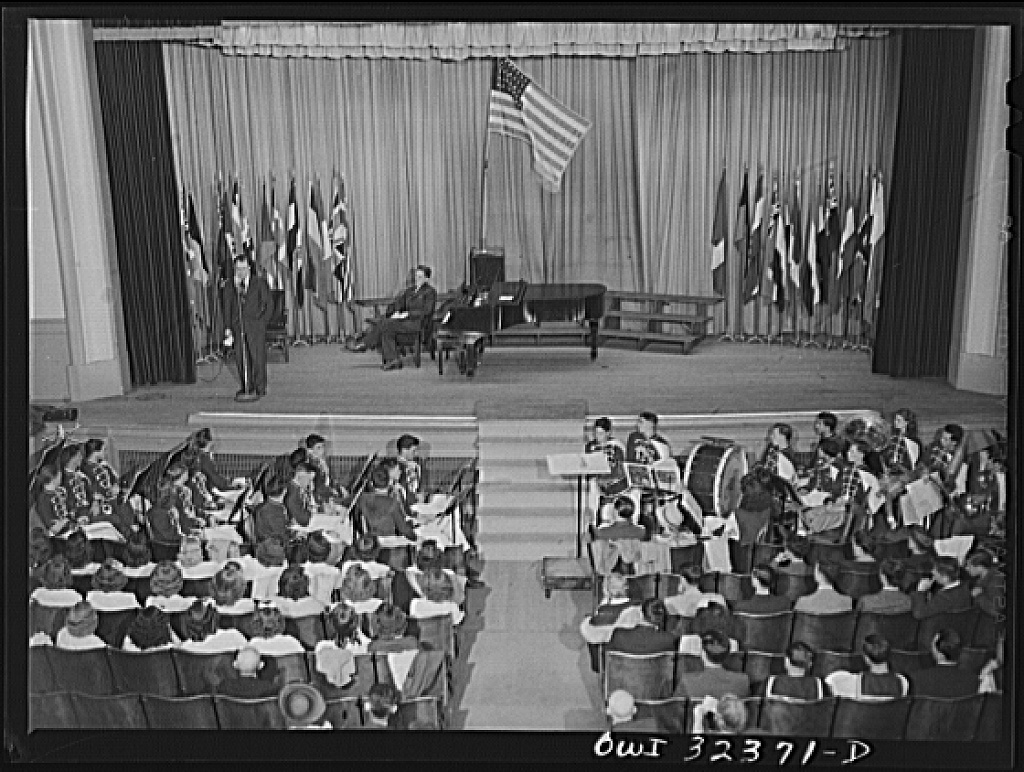

The government's information programs had already acted on him before McCarthy did: module 81 lesson 07 records that in 1952 the Truman administration judged several of Fast's books to be propaganda and removed them. Fast's case shows the four questions in this lesson pulling apart. On membership, his own memoir settles it. On espionage, no source accuses him. On sympathy, he accepted the Stalin Peace Prize in the early 1950s and broke with the party only after Khrushchev's secret speech of 1956, by his own account. On the question that troubled civil liberties advocates, he was punished for refusing to answer a congressional committee, and his books were pulled from government libraries for their author's politics.
Rating. "Fast was a Communist Party member when he wrote his best-known novels": Supported by his own later account. "Fast was a Soviet agent": Unsupported.
In module 81: lesson 07 (the overseas libraries).
Noel Field (1904 to 1970)
State Department official in the 1930s and Soviet agent; relief worker in wartime Europe; prisoner in Hungary, 1949 to 1954.
Noel Haviland Field was a Quaker-raised State Department official who, according to Tony Sharp's study, was "a Soviet agent in the US State Department in the mid-1930s."140 Hede Massing, a Soviet intelligence courier who later defected, testified that she had recruited him (her entry is in lesson 08). He left the department for the League of Nations and during the war ran a Unitarian relief operation in Europe that worked with the OSS. In May 1949 he was lured to Prague, "kidnapped and handed over to the Hungarian secret police," and his forced confessions were used to launch "a devastating series of show-trials" against Czechoslovak, German, Polish and Hungarian party members. "Never tried," the publisher's summary continues, he and his wife were imprisoned in Budapest until 1954 and then given political asylum in Hungary, where they lived the rest of their lives.40
Field's case cuts in two directions. He was a real Soviet agent, which supports the American anti-communists who warned about the State Department in the 1930s. And Stalin's police treated him as an American spy, which let them destroy Communists in Eastern Europe who had known him, a reminder that the Soviet system practiced its own form of guilt by association on a far deadlier scale (see lesson 03 on the show trials).
Rating. "Field was a Soviet agent in the State Department": Supported. "Field was an American intelligence agent": Unresolved (see the Allen Dulles entry).
In module 81: not covered.
Hamilton Fish III (1888 to 1991)
Congressman from New York, 1920 to 1945; chairman of the first House committee to investigate communism, in 1930.
Hamilton Fish III, a decorated officer of the First World War, represented the Hudson Valley in the House for a quarter century and lived to 102.1 In the spring of 1930, after unemployment protests in New York City, the House voted 210 to 18 to investigate subversive activities, and Fish became chairman of the Special Committee to Investigate Communist Activities in the United States. The committee was empowered to examine groups "alleged to advise, teach, or advocate the overthrow by force or violence" of the government, and it toured the country; it held hearings in Seattle on October 3, 1930, and in Portland the next day. Fish called communism "the most far-reaching issue in the world, affecting the civilization of the world," while saying he did not think a communist revolution was likely in the United States. His main legislative proposal was an embargo on Soviet imports.48
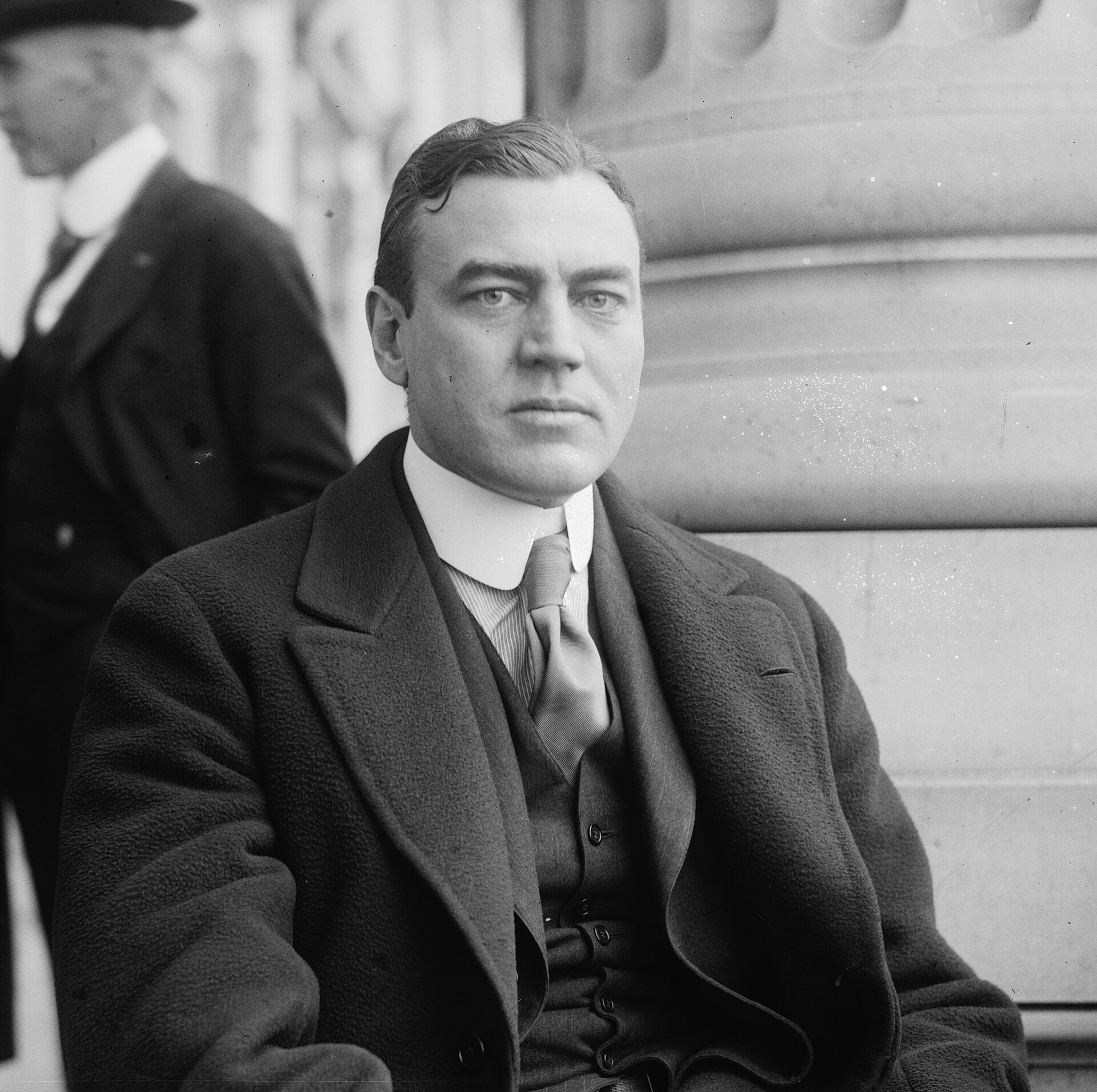

Fish was later better known for his opposition to American entry into the Second World War and his feud with President Roosevelt. His committee's central finding, that the American Communist movement took direction from Moscow, was confirmed by the Comintern archives opened in the 1990s, documented in Haynes and Klehr's The Secret World of American Communism (1995) and in the Subversive Activities Control Board record the Supreme Court reviewed in 1961.21
Rating. "The American Communist movement was directed from Moscow (Fish committee, 1930 to 1931)": Supported.
In module 81: lesson 06 (the Fish committee in the history of the committees).
Pavel Fitin (1907 to 1971)
Chief of Soviet foreign intelligence (the NKVD's, later NKGB's, First Directorate) during the Second World War.
Pavel Mikhailovich Fitin headed Soviet foreign intelligence during the Second World War; the Library of Congress record lists him as head of the First Directorate of the NKGB from 1943 to 1946 and notes that he supplied a list to the American Office of Strategic Services on February 8, 1945, during the brief wartime liaison between the two services.1 The NSA and CIA history describes Stalin directing "Pavel M. Fitin, the 34-year-old chief of the KGB's First Directorate," to seek American intelligence on Hitler's plans for the war in Russia, on Anglo-American war aims and the second front, and on related subjects.11 His cover name in the cable traffic was "Victor," and his request of October 19, 1944, to Georgi Dimitrov for Comintern information about Judith Coplon is one of the documents that tie the Comintern to Soviet espionage in the United States.211
Rating. "Fitin directed the Soviet espionage offensive against the United States during the war": Supported.
In module 81: background to lesson 02.
Ralph Flanders (1880 to 1970)
Republican senator from Vermont, 1946 to 1959; author of the resolution that led to McCarthy's censure.
Ralph Edward Flanders was born on September 28, 1880, served in the Senate from November 1, 1946, to 1959, and died on February 19, 1970.1 A machine-tool engineer and industrialist before he entered politics, he was a Republican, which mattered: the move against McCarthy that ended in censure came from inside the senator's own party. On June 11, 1954, Flanders introduced Senate Resolution 261, which would have removed McCarthy from the chairmanship of the Government Operations Committee and barred him from chairing any of its subcommittees.49 Other senators told him that censure would be easier to pass than an attack on the seniority system, and on July 30, 1954, he introduced the censure resolution, declaring that McCarthy's conduct ran "contrary to senatorial traditions." Senators added 46 specific charges, the Senate referred the matter to a select committee under Arthur Watkins on August 2, and on December 2, 1954, the Senate voted to censure McCarthy.50
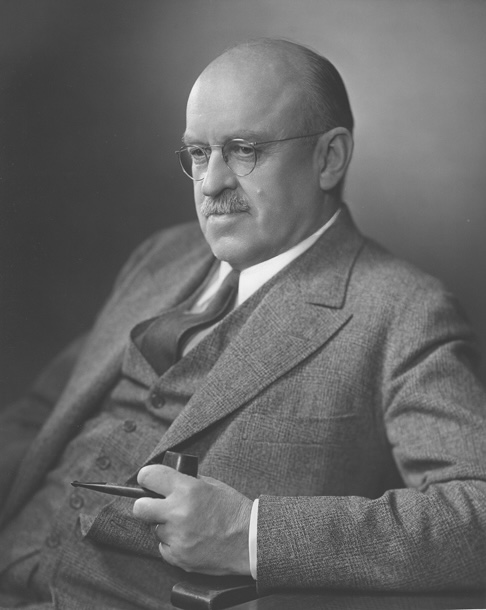

Rating. "The censure was a partisan move by McCarthy's Democratic opponents": Refuted. The resolution's author was a Republican, the select committee had three members of each party, and the senate.gov account notes that McCarthy's Republican colleagues "did not attempt to defend his actions but focused instead on procedural concerns."50
In module 81: lesson 08, lesson 09, lesson 12.
Elizabeth Gurley Flynn (1890 to 1964)
IWW organizer, a founder of the American Civil Liberties Union, Communist Party leader, Smith Act prisoner and in 1961 the party's first woman chair.
Elizabeth Gurley Flynn joined the Industrial Workers of the World as a high school student in 1906 and became one of its best-known speakers, the "Rebel Girl" of the Joe Hill song.5152 She "helped found the ACLU in 1920, only to be expelled in 1940 for having joined the Communist Party three years earlier," according to the Walter P. Reuther Library, which holds her papers; the Marxists Internet Archive dates her joining to 1936.5152 She was arrested in 1951 with other party leaders in the second round of Smith Act prosecutions, convicted after a nine-month trial and imprisoned at the federal women's prison at Alderson, West Virginia, an experience she described in The Alderson Story (1955). In 1961 she became chair of the party, and she died in Moscow on September 5, 1964, where she was given a state funeral in Red Square.5251
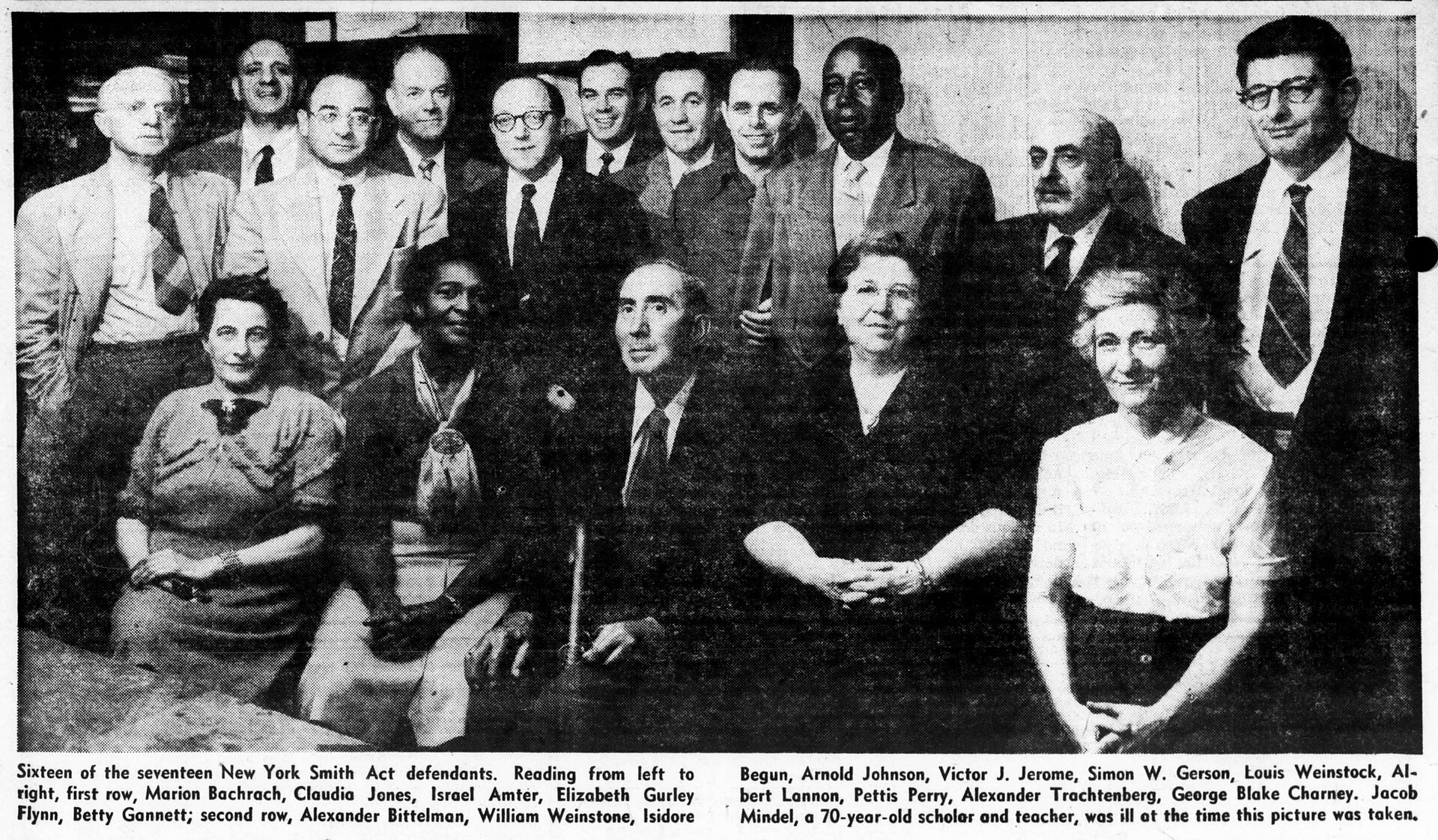

Rating. "Flynn was a Communist Party leader convicted under the Smith Act": Supported. "Flynn was a Soviet spy": Unsupported; the case against her was for conspiracy to teach and advocate, the kind of charge the Supreme Court narrowed in Yates (1957).
In module 81: lesson 10 (the photograph of the 1951 defendants).
William Z. Foster (1881 to 1961)
Steel strike leader of 1919, three-time Communist presidential candidate, and CPUSA chairman from 1945; indicted with the party leaders in 1948.
William Z. Foster was a member of the Socialist Party, a union organizer, "leader of the 1919 US Steel strike and a founding leader of the American CP," and the party's presidential candidate in 1924, 1928 and 1932.53 His book on the 1919 strike, The Great Steel Strike and Its Lessons, appeared in 1920.1 William Z. Foster lost the party leadership to Browder in the 1930s and recovered it in 1945 when the Duclos article brought Browder down; it was William Z. Foster who said the party had "suddenly reverted to its basic Communist principles."21 The Subversive Activities Control Board found that the 1929 reorganization of the American party "followed a solution dictated by Stalin," placing leadership in "a group which included William Z. Foster," and that for a number of years before the party announced its disaffiliation from the Communist International, William Z. Foster "was an official of the International."21 He was indicted with the other party leaders in 1948; the pretrial ruling in the case is reported at 80 F. Supp. 479, but his trial was severed because of his health.33 He died in Moscow in 1961.1
Rating. "William Z. Foster followed Moscow's line": Supported by the Board's findings and his own record.
In module 81: lesson 03 (the Smith Act trial).
Klaus Fuchs (1911 to 1988)
German-born British physicist; member of the British mission at Los Alamos; Soviet source REST and CHARLES; confessed in 1950.
Emil Julius Klaus Fuchs was born on December 29, 1911, and died on January 28, 1988.1 A Communist who fled Nazi Germany in 1933, he became a British physicist and, as the FBI puts it, "a member of a British team working with Americans on development of the atom bomb in Los Alamos."54 The FBI's history records his meetings with his American courier, Harry Gold: in Woodside, Queens, in June 1944; near Central Park West in July 1944; in Cambridge, Massachusetts, early in January 1945, when Gold "received a package of papers"; and in Santa Fe, where "Gold arrived in Santa Fe on Saturday, June 2, 1945 and met Fuchs, who gave him a package of papers," and again in September 1945.54
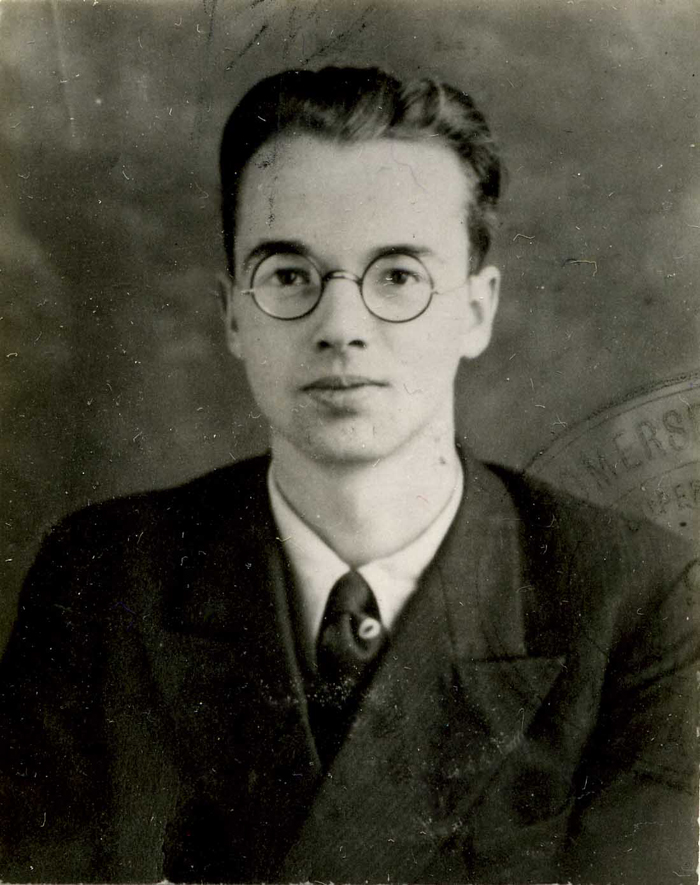

What the record shows. In September 1949 the FBI determined that the cover names REST and CHARLES, "both denoting a scientist in the wartime Manhattan Project," referred to Fuchs, "author of a paper quoted in one message."11 The Vassiliev notebooks confirm both names: "Rest" before October 1944 and "Charles" from October 1944.2 British authorities questioned him, and the NSA and CIA chronology records that "Klaus Fuchs confesses to espionage" on January 24, 1950. The FBI records that he was arrested on February 2, 1950, and "sentenced to 14 years, the maximum penalty under the British Official Secrets Act." His confession led the FBI to Gold, who confessed on May 22, 1950, and through Gold to David Greenglass and Julius Rosenberg.1154 He was released in 1959 and spent the rest of his career in East Germany, where he became a member of its Academy of Sciences, as the Library of Congress record of his later books shows.1
Haynes and Klehr write that from inside the Manhattan Project "two physicists, Klaus Fuchs and Theodore Hall, and one technician, David Greenglass, transmitted the complex formula for extracting bomb-grade uranium from ordinary uranium, the technical plans for production facilities, and the engineering principles for the 'implosion' technique."7 The Soviet test of August 1949 used a design based on that information, a point lesson 03 takes up.
Rating. "Fuchs gave the Soviet Union atomic secrets": Supported by his confession. "Fuchs alone gave Stalin the bomb": Partly supported; he was the most valuable source, but Hall and Greenglass also passed information, and Soviet scientists did their own work.
In module 81: lesson 01, lesson 02, lesson 10.
The people in time
The entries above span a century, but the activity that matters most for module 81 is packed into two decades. The timeline sets the documented years of Soviet intelligence work for the sources in this lesson beside the years of the investigations. Most of the espionage it shows had ended, or had been broken up by Bentley's defection and the Venona leads, before McCarthy spoke at Wheeling in February 1950, which is the point Haynes made when he checked McCarthy's lists against the archives.3
Who accused whom, and what held up
The second diagram follows the accusations. On the left are the people and bodies who made them; on the right, the people they named who have entries in this lesson or are central to it. A solid line means the accusation of Soviet intelligence work or Comintern direction was later corroborated by an independent channel (Venona, the Vassiliev notebooks, a confession or an official finding). A dashed line means no such corroboration has appeared. The pattern is plain: the defectors who had been inside the networks were usually right, and the accusations made from outside, by politicians reading files, by committees or by former Communists repeating what they had heard, were often wrong.
What the record shows and what it does not
Documented fact. Lauchlin Currie, Solomon Adler, Frank Coe, Laurence Duggan, Martha Dodd, Judith Coplon, Klaus Fuchs, Morris and Lona Cohen and Abraham Brothman worked with Soviet intelligence; the evidence for each includes a Venona cover name, a KGB notebook entry, a confession or several of these.21154 Earl Browder, as party leader, was part of that relationship.27 Noel Field was a Soviet agent in the State Department in the 1930s.40
Their own words. Chambers told HUAC in 1948 that "espionage was certainly one of its eventual objectives." Currie told the same committee he never said "that the United States was about to break the Russian or any other code." Fast told McCarthy's subcommittee he would answer no question about the party, "claiming my rights and protection under the First and Fifth Amendments." Cohn later challenged critics to "Name one" person ruined.22124726
The accusation. Dean Acheson, John Paton Davies, O. Edmund Clubb and Edward Condon were accused, in different forums, of serving or shielding communism; Goodwin Watson, William E. Dodd Jr. and Robert Morss Lovett were named in 1943.337
The archive evidence. None of those accused officials appears in Venona or the Vassiliev notebooks as a Soviet source; Acheson appears only in "benign" references.37
Scholarly reading. Haynes and Klehr: the CPUSA was "an auxiliary of the intelligence agencies of the Soviet Union," and "Party leaders were not only aware of the liaison; they actively worked to assist the relationship."7 Schrecker and others accept the espionage and weigh the costs of the response more heavily; Evans and Herman weigh the espionage more heavily and the costs less.14815
Open questions. Whether Noel Field also worked for American intelligence; how Laurence Duggan died; the exact sequence of Lauchlin Currie's passport and citizenship changes; and the reliability of single-channel archival findings such as the KGB notes on Samuel Dickstein.
Claims checked
These are claims about people in this lesson that still circulate in books, films, websites and speeches. Each is rated on the evidence available in 2026.
| Claim and where it is heard | Rating | Evidence |
|---|---|---|
| "Elizabeth Bentley made up her spy rings." (A staple of accounts written before the 1995 Venona release, as Haynes and Klehr document.) | Refuted | The Vassiliev notebooks confirm Venona cover names for most of the people she named, and the NSA and CIA history says the decrypts "corroborated various charges made by Elizabeth Bentley and Whittaker Chambers."2117 |
| "The case against Lauchlin Currie was only hearsay." (Currie's own statement, 1948; Lowenthal, 2001.) | Refuted for 2026, accurate for 1948 | In 1948 Bentley's account of Currie was secondhand, as Currie said. The PAGE cover name in Venona and in the notebooks from 1942 to 1948 is an independent channel.122 |
| "Dean Acheson was part of a Communist conspiracy." (McCarthy, June 14, 1951.) | Refuted | Benign references only in Venona; "no basis in Venona for implicating Acheson or Marshall."37 |
| "Earl Browder was an American reformer with no tie to Soviet espionage." (Some histories of the Popular Front.) | Refuted | HELMSMAN in Venona, confirmed by the notebooks; the party's leaders "actively worked to assist the relationship."27 |
| "Judith Coplon was cleared by the courts." (Repeated in obituaries and popular accounts.) | Refuted | Her convictions were reversed for warrantless arrest and illegal wiretaps; an appeals judge wrote that her "guilt is plain."2711 |
| "Laurence Duggan was hounded to death by false charges." (The older textbook account quoted by Haynes and Klehr.) | Refuted as to falseness | The notebooks give his cover names from 1935 to 1944; the cause of his death is unresolved.27 |
| "Klaus Fuchs alone gave Stalin the bomb." (Popular histories and documentaries.) | Partly supported | Fuchs was the most valuable atomic source, but Theodore Hall and David Greenglass also passed design information.754 |
| "John Paton Davies was disloyal." (Charges heard by loyalty boards, 1951 to 1954.) | Refuted | Each board found him loyal; he was dismissed as a "security risk" on judgment, and given a clearance in 1969.31 |
| "Edward Condon was one of the weakest links in atomic security." (HUAC subcommittee report, March 1948.) | Unsupported | No Soviet source names him; the charge rested on his contacts. The report's wording was not checked against the original here.2 |
| "The censure of McCarthy was a Democratic plot." (Defenders of McCarthy since 1954.) | Refuted | The resolution's author, Ralph Flanders, was a Republican; the select committee was evenly divided between the parties.50 |
| "Eisenhower never lifted a finger against McCarthy." (A common charge against the President.) | Refuted as stated | The Dartmouth speech and the May 17, 1954 letter withholding executive-branch advice from the subcommittee are documented; he did avoid naming McCarthy in public.4344 |
| "McCarthy's investigations ruined no one." (Roy Cohn: "Name one.") | Refuted | Module 81 lessons 07 and 10 document dismissals and careers ended on evidence that did not hold up.26 |
| "Noel Field was really an American agent." (Stalin's security services, 1949; some later writers.) | Unresolved | His Soviet work is documented; the American side of the claim is not settled in the open record used here.40 |
| "The founder of the first un-American activities committee was a Soviet agent." (Said of Samuel Dickstein since 1999.) | Supported, one channel | KGB file notes reported by Weinstein and Vassiliev; no Venona or court evidence.35 |
Hard questions and answers
An anti-communist asks: if Bentley was right, why were so few of the people she named ever prosecuted for espionage?
Because the evidence that would have proved her case could not be used, and the evidence that could be used was not enough. The NSA and CIA history explains that the "Gregory" investigation "produced many leads but led to no espionage prosecutions": wiretap evidence was inadmissible, the FBI could not catch the suspects in the act, and Soviet intelligence, warned by its own sources, had shut the networks down.11 Venona was kept secret, even from the prosecutors' witnesses, to protect the codebreaking. The result, as Haynes and Klehr argue, was that the public had to choose between defectors' testimony and officials' denials without the decrypts that would have settled most cases.7 The Coplon case shows the cost: an agent caught with documents in her purse went free on procedural grounds.1127
A civil liberties advocate asks: Howard Fast and Elizabeth Gurley Flynn went to prison. For what, exactly?
Not for espionage; no source accuses either of it. Fast was convicted of contempt of Congress and served three months, by his own testimony.47 Flynn was convicted under the Smith Act's conspiracy provisions, the charge upheld against the first group of party leaders in Dennis v. United States (1951), which turned on teaching and advocating the violent overthrow of the government.3352 The Supreme Court narrowed that kind of prosecution in Yates (1957), requiring proof of advocacy of action, not merely of abstract doctrine.55 A civil liberties advocate can accept that the CPUSA was tied to Soviet intelligence and still hold that these two prosecutions punished speech and association; module 81 lesson 12 weighs that argument.
A historian of the revisionist school asks: aren't the cables just Soviet officers inflating their results for Moscow?
Some cables do describe hoped-for recruits as sources, and an identification resting on a single cable deserves caution. But the strongest cases in this lesson rest on additional evidence. Haynes and Klehr found that the KGB's own archive notes, copied independently by Vassiliev, confirmed the Venona identifications for 177 cover names and contradicted only four.2 Fuchs confessed; Gold confessed; Coplon was caught with documents; Currie's cover name runs through six years of KGB records.11542 Inflation by field officers cannot explain why two separate record systems agree, or why the people named confessed.
A skeptic asks: Bentley never met Currie. How can her testimony count against him?
On its own, in 1948, it could not count for much, and Currie said so: her statements were "hearsay three times removed."12 What changed is that independent evidence appeared later. The Venona cable traffic and the KGB notebooks name a source PAGE whose position and access match Currie's, from 1942 to 1948.2 Haynes's check of McCarthy's names found Currie "Identified in Venona as a Soviet Espionage Source," and noted that Bentley had named him to the FBI in 1945.3 The lesson for reading the record is that hearsay testimony is a lead, and corroboration from an independent source is what turns a lead into a finding.
A defender of McCarthy asks: Currie was on McCarthy's lists and he was a Soviet source. Doesn't that vindicate McCarthy?
It shows that some names on his lists were real, and it shows where they came from. Haynes checked 159 people McCarthy named from 1950 through 1952 and found substantial evidence of espionage for nine; four of the nine, Currie among them, had already been named by Bentley to the FBI in 1945.3 The same check found the officials McCarthy attacked hardest (Acheson, Marshall, Lattimore, Service, Davies, Clubb) not identified as Soviet sources at all.3 The record supports the warning that Soviet intelligence had penetrated the government. It does not support most of McCarthy's specific accusations or his theory of a conspiracy reaching Acheson and Marshall. Module 81 lesson 11 rates his assertions one by one.
A reader asks: if every board found John Paton Davies loyal, how could he be fired as a security risk?
Because the standard changed. Executive Order 10450 (1953) required that employment be "clearly consistent with the interests of the national security," a test that a loyal officer could fail on findings about judgment or discretion.32 The board that recommended Davies's dismissal found him loyal but lacking in "judgment, discretion and reliability," and the Secretary of State accepted that finding on November 5, 1954.31 Whether that standard was fairly applied to a diplomat whose fault was reporting unwelcome facts about China is the question his case leaves; the State Department's own clearance of him in 1969 is part of the answer.31
Where to go next
The people in G to L, including Harry Gold, Igor Gouzenko, Alger Hiss, J. Edgar Hoover, Harry Hopkins and Owen Lattimore, are in lesson 07. The networks these people belonged to are diagrammed, with a full Venona cover-name table, in lesson 12, and the organizations they served or fought are in lesson 10 and lesson 11. For the story these entries support, return to module 81, especially lesson 02, lesson 07 and lesson 11. Idaho's part in the period, including Senators Glen Taylor and Herman Welker, is in module 74, lesson 06, and the economics of communism in module 51, lesson 07.
Still open
These items could not be confirmed against a primary source before publication. The lesson states them as open, and they stay on the fact-check list.
- The date and exact wording of Dean Acheson's January 1950 remark that he would not turn his back on Alger Hiss were not confirmed in a source opened for this lesson; the text paraphrases it and quotes only Nixon's 1952 version from Time.
- Solomon Adler's and Frank Coe's later lives in the People's Republic of China, and Coe's later service at the International Monetary Fund, come from secondary accounts and were not checked. Frank Coe's life dates (1907 to 1980) were not found in the Library of Congress file and are unverified.
- Andropov's ambassadorship from 1954 and his presence in Nagy's office rest on the Marxists Internet Archive glossary; the months of his succession to Brezhnev (November 1982) and his death (February 1984) were not checked against a primary source.
- Jacob Golos's death in November 1943, and the date Soviet officers took Bentley's networks from her in 1944, were not checked against a source opened for this lesson. Bentley's death date (December 3, 1963) comes from the Library of Congress record, which cites Wikipedia.
- Abraham Brothman's place in the Golos network, his role as Harry Gold's employer, his 1950 obstruction conviction with Miriam Moskowitz and his life dates (1913 to 1980) were not checked against court or FBI records.
- Budenz's departure from the party in 1945 and his return to the Catholic Church are standard in the literature but were not checked against a primary source here.
- Chambers's death date (July 9, 1961) rests on the Library of Congress record, which cites Wikipedia; the publication year of Witness (1952) was not checked against an opened source.
- O. Edmund Clubb's 1951 loyalty board finding, its reversal and his 1952 retirement were not checked against board records.
- Edward Condon: the March 1948 HUAC subcommittee report's wording ("one of the weakest links") and the Atomic Energy Commission clearance are from secondary accounts; the report was not opened.
- Judith Coplon's age at death conflicts between sources: the New York Times obituary (as cited by the Library of Congress) gives May 17, 1922 and age 88; the Moscow Times gives 89. The Learned Hand opinion was read only in excerpt; the "guilt is plain" words are quoted as the Moscow Times reports them.
- Lauchlin Currie's move to Colombia in 1950, his Colombian citizenship and the details of his U.S. passport were not checked; only his life dates (1902 to 1993) are from the Library of Congress record.
- Samuel Dickstein's NKVD payments and the cover name CROOK come from The Haunted Wood as summarized; the book's pages were not checked.
- Martha Dodd's departure from the United States and residence in Prague were not checked.
- Laurence Duggan's post as head of the Division of American Republics and the circumstances and exact date of his December 1948 death were not checked against a primary source.
- Allen Dulles's OSS service in Bern, his dates as Director of Central Intelligence (February 1953 to November 1961) and his 1953 refusal to let McCarthy question CIA officers were not checked against an opened source.
- Gerhart Eisler's public identification by Budenz and his May 1949 flight as a stowaway on a Polish liner are from secondary accounts.
- Howard Fast's Stalin Peace Prize (early 1950s) was not checked against an opened source.
- Noel Field's upbringing, League of Nations work, wartime Unitarian relief work with the OSS, and Hede Massing's testimony that she recruited him were not checked against an opened source; the 1949 to 1954 facts rest on the publisher's description of Tony Sharp's book.
- Pavel Fitin's tenure: the Library of Congress record gives 1943 to 1946 as head of the NKGB First Directorate; his earlier start in 1939 as NKVD foreign intelligence chief is from secondary accounts.
- Ralph Flanders's career as a machine-tool engineer was not checked.
- Elizabeth Gurley Flynn joined the Communist Party in 1936 (Marxists Internet Archive) or 1937 (Reuther Library, by implication); both are reported.
- William Z. Foster's loss of the leadership to Browder in the 1930s, the severance of his trial for health reasons and his death in Moscow were not checked against a primary source; the Dennis opinion confirms only the pretrial ruling reported at 80 F. Supp. 479.
- Klaus Fuchs's flight from Germany in 1933, his release in 1959 and the use of his information in the Soviet bomb of August 1949 rest on module 81 and secondary accounts.
- Roy Cohn's resignation date: the Senate's volume 5 gives July 20, 1954 in an editors' note and "August 1954" in its introduction. The Library of Congress record for Cohn cites a death date of July 24, 1986 from Nicholas von Hoffman's biography, which conflicts with the commonly given August 2, 1986; the lesson gives only the year.
- The photograph 06-elizabeth-gurley-flynn.jpg has no description, date or photographer on Commons, so the fact check replaced it with the 1951 Smith Act defendants photograph (m81-10), whose Commons description names Flynn. The file 06-noel-field.jpg in the module folder is a photograph of the comedian Noel Fielding, not Noel Field, and was not used. The file 06-louis-budenz.jpg has no Commons description and was not used.
- Hamilton Fish III's war decorations were not checked; his House service (Nov. 2, 1920 to Jan. 3, 1945) and life dates are confirmed by the Library of Congress record citing the Biographical Directory.
- The Learned Hand opinion in United States v. Coplon (Leagle) was read only in its opening; the words "guilt is plain" are quoted as the Moscow Times reports them, not from the opinion text.
Learn more
- Haynes and Klehr, Venona and Alexander Vassiliev's Notebooks: The cover-name concordance behind most identifications in this lesson; read it to see which names are confirmed, corrected or newly revealed.
- HUAC 1948 espionage hearings (full text): Bentley, Chambers and Currie in their own words; the primary record for three of the most important entries.
- Benson and Warner, Venona (NSA and CIA, 1996): The government's own history of how the decrypts led to Coplon, Fuchs and Gold, and why Bentley's leads produced no espionage trials.
- Haynes, Senator Joseph McCarthy's Lists and Venona: Name by name, which of McCarthy's targets appear in Venona and which do not.
- Executive Sessions of the Senate Permanent Subcommittee on Investigations, vol. 1: Ritchie's introduction on Cohn and the staff, and the closed-door testimony of Howard Fast and others.
Notes
- Library of Congress Name Authority File (id.loc.gov), headings and source notes for the people in this lesson, for example "Fish, Hamilton, 1888-1991" (n50005249), "Bentley, Elizabeth, 1908-1963" (n82013434), "Dies, Martin, 1900-1972" (n91085053, citing the Biographical Directory of the U.S. Congress), "Coplon, Judith" (n2002029339, citing the New York Times obituary of March 1, 2011), "Andropov, Iu. V., 1914-1984" (n82156220, citing the Great Soviet Encyclopedia), "Fuchs, Klaus, 1911-1988" and "Kroger, Helen" (Lona Cohen) (retrieved Nov. 6, 2026). Life dates follow these records unless another note is given. Read it online. ↩
- John Earl Haynes and Harvey Klehr, "Venona and Alexander Vassiliev's Notebooks: Confirming and Correcting Identified Venona Cover Names and Revealing the Unidentified," paper, 2009 Symposium on Cryptologic History, with Appendix 1 (identifications confirmed) and Appendix 3 (unidentified Venona names revealed by the notebooks) (retrieved Nov. 6, 2026). Read it online. ↩
- John Earl Haynes, "Senator Joseph McCarthy's Lists and Venona," April 2007, tables of the names McCarthy put forward from 1950 to 1952 with their Venona status, and the summary section "Security Risks" (retrieved Nov. 6, 2026). Read it online. ↩
- U.S. House of Representatives, Committee on Un-American Activities, Hearings Regarding Communist Espionage in the United States Government, 80th Cong., 2d sess. (Washington: GPO, 1948), testimony of Elizabeth T. Bentley, July 31, 1948, pp. 503 to 553 (Golos, p. 505; Currie, pp. 519 and 553; Adler), the basement camera passage at pp. 605 to 606, and the exhibit naming Frank V. Coe as Director of Monetary Research. Read on Internet Archive. Read it online. ↩
- Office of the Historian, U.S. Department of State, "Dean Gooderham Acheson," biography and principal offices (retrieved Nov. 6, 2026). Read it online. ↩
- "National Affairs: The Alger Hiss Issue," Time, November 3, 1952 (Nixon's campaign remarks on Acheson and Stevenson). Read it online. ↩
- John Earl Haynes and Harvey Klehr, Venona: Decoding Soviet Espionage in America (New Haven: Yale University Press, 1999), chapter 1, "Venona and the Cold War." Read it online. ↩
- M. Stanton Evans, Blacklisted by History: The Untold Story of Senator Joe McCarthy and His Fight Against America's Enemies (New York: Crown Forum, 2007). Summarized in this lesson's words, not quoted. Read it online. ↩
- Marxists Internet Archive, Encyclopedia of Marxism, Glossary of People, "Andropov, Yuri" (retrieved Nov. 6, 2026). Read it online. ↩
- "Andropov Report, 1 November 1956," telegram from Budapest, Wilson Center Digital Archive; the archive's summary attributes the threat of a scandal and resignation to Imre Nagy, while the telegram's text relays it from Zoltan Tildy (retrieved Nov. 6, 2026). Read it online. ↩
- Robert Louis Benson and Michael Warner, eds., Venona: Soviet Espionage and the American Response, 1939 to 1957 (Washington: National Security Agency and Central Intelligence Agency, 1996), Preface, Introduction (pp. vii to xxx), notes, and Chronology. Read it online. ↩
- U.S. House of Representatives, Committee on Un-American Activities, Hearings Regarding Communist Espionage in the United States Government, 80th Cong., 2d sess. (Washington: GPO, 1948), testimony of Lauchlin Currie, August 13, 1948, pp. 850 to 864 (prepared statement at pp. 852 to 853). Read it online. ↩
- Kathryn S. Olmsted, Red Spy Queen: A Biography of Elizabeth Bentley (Chapel Hill: University of North Carolina Press, 2002). Summarized in this lesson's words, not quoted; the book was not opened for this lesson. Read it online. ↩
- Ellen Schrecker, Many Are the Crimes: McCarthyism in America (Boston: Little, Brown, 1998). Summarized in this lesson's words, not quoted. Read it online. ↩
- Arthur Herman, Joseph McCarthy: Reexamining the Life and Legacy of America's Most Hated Senator (New York: Free Press, 2000). Summarized in this lesson's words, not quoted. Read it online. ↩
- Encyclopaedia Britannica, "Lavrenty Pavlovich Beria" (retrieved Nov. 6, 2026). Read it online. ↩
- Marxists Internet Archive, Encyclopedia of Marxism, Glossary of People, "Beria, Lavrenti" (retrieved Nov. 6, 2026). Read it online. ↩
- L. P. Beria to J. V. Stalin, memorandum, "Top Secret," March 5, 1940, English text as published by Seventeen Moments in Soviet History (Michigan State University), from Tadeusz Piotrowski, Poland's Holocaust (McFarland, 1998), p. 269 (retrieved Nov. 6, 2026). Read it online. ↩
- Donald A. Ritchie, introduction, Executive Sessions of the Senate Permanent Subcommittee on Investigations of the Committee on Government Operations, vol. 1, 83rd Cong., 1st sess. (1953), S. Prt. 107-84 (Washington: GPO, made public January 2003), and the list of witnesses. Read it online. ↩
- Marxists Internet Archive, Encyclopedia of Marxism, Glossary of People, "Browder, Earl" (retrieved Nov. 6, 2026). Read it online. ↩
- Communist Party of the United States v. Subversive Activities Control Board, 367 U.S. 1 (1961), decided June 5, 1961, opinion of the Court (Budenz's testimony on the Starobin letter and the Childs-Weiner conversation; the Board's findings on William Z. Foster, Browder and Eisler). Read it online. ↩
- U.S. House of Representatives, Committee on Un-American Activities, Hearings Regarding Communist Espionage in the United States Government, 80th Cong., 2d sess. (Washington: GPO, 1948), testimony of Whittaker Chambers, August 3, 1948 (statement at pp. 564 to 565), and later sessions, including Hiss's testimony on "George Crosley" and Chambers's testimony at pp. 1078 to 1079 and 1176. Read it online. ↩
- John Earl Haynes, Harvey Klehr and Alexander Vassiliev, Spies: The Rise and Fall of the KGB in America (New Haven: Yale University Press, 2009). Summarized, not quoted. Read it online. ↩
- Sam Tanenhaus, Whittaker Chambers: A Biography (New York: Random House, 1997). Summarized in this lesson's words, not quoted; the book was not opened for this lesson. Read it online. ↩
- Ronald Reagan, White House diary entry, March 26, 1984, Ronald Reagan Presidential Foundation and Institute (retrieved Nov. 6, 2026). Read it online. ↩
- Executive Sessions of the Senate Permanent Subcommittee on Investigations, vol. 5, 83rd Cong., 2nd sess. (1954), S. Prt. 107-84, introduction ("Aftermath") and editors' note on staff changes (Cohn resigned July 20, 1954); the introduction elsewhere says "August 1954." Read it online. ↩
- "Analyst Convicted of Spying for Soviets Dead at 89," The Moscow Times, March 3, 2011 (retrieved Nov. 6, 2026). Read it online. ↩
- United States v. Coplon, 185 F.2d 629 (2d Cir. 1950), argued November 2 and decided December 5, 1950, opinion of L. Hand, Chief Judge (opening paragraph as published by Leagle). Read it online. ↩
- Harris and Ewing, photograph of Lauchlin Currie, Washington, July 17, 1939, Library of Congress Prints and Photographs Division, original caption as reproduced on Wikimedia Commons. Read it online. ↩
- Morton Sobell, John Lowenthal and Stephen Schwartz, letters, "Three Gentlemen of Venona," The Nation (web date March 15, 2001) (retrieved Nov. 6, 2026). Read it online. ↩
- Harry S. Truman Library and Museum, "Davies, John Paton, Jr. Papers," finding aid with biographical sketch and description of the loyalty and security hearing transcripts (retrieved Nov. 6, 2026). Read it online. ↩
- Executive Order 10450, "Security Requirements for Government Employment," April 27, 1953, 18 Fed. Reg. 2489, section 2, National Archives Federal Register codification. Read it online. ↩
- Dennis v. United States, 341 U.S. 494 (1951), decided June 4, 1951 (indictment of July 1948; the pretrial ruling reported at 80 F. Supp. 479; verdict of October 14, 1949; sentences). Read it online. ↩
- National Archives and Records Administration, Guide to the Records of the U.S. House of Representatives at the National Archives, 1789 to 1989, chapter 22, paragraphs 22.86 to 22.87 (Special Committee on Un-American Activities, 1934 to 1935). Read it online. ↩
- Allen Weinstein and Alexander Vassiliev, The Haunted Wood: Soviet Espionage in America, the Stalin Era (New York: Random House, 1999), on Samuel Dickstein. Not checked against the book's pages for this lesson. Read it online. ↩
- Franklin D. Roosevelt, "Statement on the Sit-Down Strikes in Michigan," October 25, 1938, The American Presidency Project, University of California, Santa Barbara. Read it online. ↩
- United States v. Lovett, 328 U.S. 303 (1946), decided June 3, 1946 (section 304 of the Urgent Deficiency Appropriation Act of 1943; Dies's speech of February 1, 1943, naming thirty-nine employees). Read it online. ↩
- Marxists Internet Archive, Encyclopedia of Marxism, Glossary of People, "Dimitrov, Georgi Mikhailovich" (retrieved Nov. 6, 2026). Read it online. ↩
- Georgi Dimitrov, "The Fascist Offensive and the Tasks of the Communist International in the Struggle of the Working Class against Fascism," main report to the Seventh World Congress of the Communist International, August 2, 1935, Marxists Internet Archive (from Dimitrov, Selected Works, vol. 2, Sofia Press, 1972). Read it online. ↩
- Hurst Publishers, description of Tony Sharp, Stalin's American Spy: Noel Field, Allen Dulles and the East European Show Trials (London: Hurst, 2014) (retrieved Nov. 6, 2026). Read it online. ↩
- Office of the Historian, U.S. Department of State, "John Foster Dulles," biography and principal offices (retrieved Nov. 6, 2026). Read it online. ↩
- Marxists Internet Archive, Encyclopedia of Marxism, Glossary of People, "Dzerzhinsky, Felix" (retrieved Nov. 6, 2026). Read it online. ↩
- Dartmouth College, "President Eisenhower's Commencement Address" (address of June 14, 1953) (retrieved Nov. 6, 2026). Read it online. ↩
- Dwight D. Eisenhower, "Letter to the Secretary of Defense Directing Him To Withhold Certain Information From the Senate Committee on Government Operations," May 17, 1954, The American Presidency Project. Read it online. ↩
- Fred I. Greenstein, The Hidden-Hand Presidency: Eisenhower as Leader (New York: Basic Books, 1982); David A. Nichols, Ike and McCarthy: Dwight Eisenhower's Secret Campaign against Joseph McCarthy (New York: Simon and Schuster, 2017). Summarized, not quoted; not opened for this lesson. Read it online. ↩
- Marxists Internet Archive, Encyclopedia of Marxism, Glossary of People, "Eisler, Gerhart" (retrieved Nov. 6, 2026). Read it online. ↩
- Executive Sessions of the Senate Permanent Subcommittee on Investigations, vol. 1, S. Prt. 107-84, executive session of February 13, 1953 (Voice of America; session begins p. 457), testimony of Howard Fast, with the editors' note 9 on his memoirs. Read it online. ↩
- Crystal Hoffer, "The Birth of Anticommunist National Rhetoric: The Fish Committee Hearings in 1930s Seattle," Great Depression in Washington State Project, Civil Rights and Labor History Consortium, University of Washington, 2009 (retrieved Nov. 6, 2026). Read it online. ↩
- Congressional Record, Senate, June 11, 1954, vol. 100, pt. 6, p. 8033 (Flanders's motion and the text of S. Res. 261). Read it online. ↩
- U.S. Senate, "The Censure Case of Joseph McCarthy of Wisconsin (1954)," senate.gov (resolution introduced July 30, 1954; referred August 2; report November 8; vote December 2, 1954) (retrieved Nov. 6, 2026). Read it online. ↩
- Walter P. Reuther Library, Wayne State University, "Elizabeth Gurley Flynn Papers," biographical sketch (retrieved Nov. 6, 2026). Read it online. ↩
- Marxists Internet Archive, Encyclopedia of Marxism, Glossary of People, "Flynn, Elizabeth Gurley" (retrieved Nov. 6, 2026). Read it online. ↩
- Marxists Internet Archive, Encyclopedia of Marxism, Glossary of People, entry for "William Z. Foster" (retrieved Nov. 6, 2026). Read it online. ↩
- Federal Bureau of Investigation, "Atom Spy Case/Rosenbergs," FBI History: Famous Cases and Criminals (retrieved Nov. 6, 2026). Read it online. ↩
- Yates v. United States, 354 U.S. 298 (1957), decided June 17, 1957 (the distinction between advocacy of abstract doctrine and advocacy of action). Read it online. ↩
Check yourself
1. Elizabeth Bentley told HUAC in 1948 that Lauchlin Currie "was not a Communist but he did give information." Which of the four claims does that statement separate?
Bentley said Currie was not a party member but did pass information, the clearest example in this lesson of membership and espionage being separate questions.
2. What independent evidence, unavailable in 1948, now corroborates Bentley's account of Currie?
Haynes and Klehr's 2009 concordance shows the KGB notebooks using PAGE for Currie from 1942 to 1948, confirming the Venona identification.
3. Why were both of Judith Coplon's convictions overturned?
The reversals rested on how the evidence was gathered; one appeals judge wrote that her guilt was plain.
4. How does John Earl Haynes's 2007 check describe Dean Acheson's appearance in Venona?
Acheson appears only as an official whose policies Soviet intelligence wanted to learn about.
5. On what finding was John Paton Davies dismissed on November 5, 1954?
The Security Hearing Board found him loyal; Dulles dismissed him as a security risk under the broader standard of Executive Order 10450.
6. Who introduced the resolution of July 30, 1954, that led to McCarthy's censure?
Flanders, a Republican, introduced the censure resolution after his June 11 resolution to remove McCarthy's chairmanships met resistance.
7. What did the KGB notebooks show about the figure "19" in Soviet cable traffic?
Haynes and Klehr's concordance identifies "19" as Duggan and says it was not Hopkins.
8. When Howard Fast testified before McCarthy's subcommittee on February 13, 1953, what did he do when asked about party membership?
Fast refused to answer; the Senate editors note that his later memoirs say he joined in 1943 or 1944 and left in 1956.
Terms in this lesson
- Cover name
- The code name Soviet intelligence used in its cables for a source or officer, such as PAGE for Lauchlin Currie or CHARLES for Klaus Fuchs.
- Venona identification
- A match made by American analysts between a cover name in a decrypted Soviet cable and a real person; its strength depends on the details in the cables.
- Vassiliev notebooks
- Notes copied from KGB archive files by the former KGB officer Alexander Vassiliev in the 1990s, used by Haynes and Klehr to confirm 177 Venona identifications and correct four.
- Silvermaster group
- A network of federal employees around Nathan Gregory Silvermaster that Elizabeth Bentley said passed information to Soviet intelligence during the war.
- Security risk
- Under Executive Order 10450 (1953), a person whose employment was not clearly consistent with national security; it was a broader standard than disloyalty.
- Bill of attainder
- A law that punishes named persons without a trial; the Supreme Court held in United States v. Lovett (1946) that the 1943 pay cutoff for Watson, Dodd and Lovett was one.
- Popular Front
- The Comintern policy launched by Georgi Dimitrov in 1935 of alliances between Communists and other anti-fascist parties.
- Communist Political Association
- The name Earl Browder gave the CPUSA in 1944; it was reconstituted as the party, and Browder removed, in 1945 after the Duclos article.
- Smith Act
- The 1940 law under which CPUSA leaders, including Eugene Dennis and Elizabeth Gurley Flynn, were convicted of conspiring to teach and advocate violent overthrow.
- Censure
- A formal Senate condemnation of a member's conduct; the Senate censured McCarthy on December 2, 1954, after the Flanders resolution.
- Cheka
- The Soviet secret police founded in December 1917 under Felix Dzerzhinsky, first link in the chain that led to the NKVD and KGB.
- Executive privilege
- The President's claim to withhold internal executive-branch advice from Congress, as in Eisenhower's letter of May 17, 1954.
Sources
- HUAC, Hearings Regarding Communist Espionage in the United States Government (1948) (1948) checked 2026-10
- Executive Sessions of the Senate Permanent Subcommittee on Investigations, vol. 1 (1953) (2003) checked 2026-10
- Executive Sessions of the Senate Permanent Subcommittee on Investigations, vol. 5 (1954) (2003) checked 2026-10
- Benson and Warner, eds., Venona: Soviet Espionage and the American Response (NSA and CIA) (1996) checked 2026-10
- Haynes and Klehr, Venona and Alexander Vassiliev's Notebooks (2009 paper) (2009) checked 2026-10
- Haynes, Senator Joseph McCarthy's Lists and Venona (2007) checked 2026-10
- Haynes and Klehr, Venona: Decoding Soviet Espionage in America, chapter 1 (1999) checked 2026-10
- Library of Congress Name Authority File (2026) checked 2026-10
- Office of the Historian: Dean Gooderham Acheson (2026) checked 2026-10
- Office of the Historian: John Foster Dulles (2026) checked 2026-10
- Beria memorandum to Stalin, March 5, 1940 (Seventeen Moments in Soviet History) (1940-03-05) checked 2026-10
- Andropov Report, 1 November 1956 (Wilson Center Digital Archive) (1956-11-01) checked 2026-10
- Communist Party v. Subversive Activities Control Board, 367 U.S. 1 (1961) (1961-06-05) checked 2026-10
- Dennis v. United States, 341 U.S. 494 (1951) (1951-06-04) checked 2026-10
- United States v. Lovett, 328 U.S. 303 (1946) (1946-06-03) checked 2026-10
- Yates v. United States, 354 U.S. 298 (1957) (1957-06-17) checked 2026-10
- United States v. Coplon, 185 F.2d 629 (2d Cir. 1950) (1950-12-05) checked 2026-10
- FBI, Atom Spy Case/Rosenbergs (2026) checked 2026-10
- Truman Library, Davies, John Paton, Jr. Papers (2026) checked 2026-10
- Executive Order 10450 (National Archives codification) (1953-04-27) checked 2026-10
- Eisenhower letter to the Secretary of Defense, May 17, 1954 (1954-05-17) checked 2026-10
- Roosevelt, Statement on the Sit-Down Strikes in Michigan (1938-10-25) checked 2026-10
- Dartmouth College, President Eisenhower's Commencement Address (1953-06-14) checked 2026-10
- U.S. Senate, The Censure Case of Joseph McCarthy of Wisconsin (1954) (2026) checked 2026-10
- Congressional Record, Senate, June 11, 1954 (S. Res. 261) (1954-06-11) checked 2026-10
- NARA, Guide to the Records of the U.S. House, chapter 22 (1989) checked 2026-10
- Dimitrov, report to the Seventh World Congress, August 2, 1935 (Marxists Internet Archive) (1935-08-02) checked 2026-10
- Marxists Internet Archive, Glossary of People (Andropov, Beria, Browder, Dimitrov, Dzerzhinsky, Eisler, Flynn, William Z. Foster) (2026) checked 2026-10
- Encyclopaedia Britannica, Lavrenty Pavlovich Beria (2026) checked 2026-10
- Reagan, White House diary, March 26, 1984 (1984-03-26) checked 2026-10
- The Moscow Times, Analyst Convicted of Spying for Soviets Dead at 89 (2011-03-03) checked 2026-10
- Time, National Affairs: The Alger Hiss Issue (1952-11-03) checked 2026-10
- The Nation, Three Gentlemen of Venona (letters) (2001) checked 2026-10
- Hoffer, The Fish Committee Hearings in 1930s Seattle (University of Washington) (2009) checked 2026-10
- Reuther Library, Elizabeth Gurley Flynn Papers (2026) checked 2026-10
- Hurst Publishers, Sharp, Stalin's American Spy (2014) checked 2026-10
- Weinstein and Vassiliev, The Haunted Wood (1999) checked 2026-10
- Haynes, Klehr and Vassiliev, Spies (2009) checked 2026-10
- Schrecker, Many Are the Crimes (1998) checked 2026-10
- Evans, Blacklisted by History (2007) checked 2026-10
- Herman, Joseph McCarthy (2000) checked 2026-10
- Olmsted, Red Spy Queen (2002) checked 2026-10
- Tanenhaus, Whittaker Chambers (1997) checked 2026-10
- Greenstein, The Hidden-Hand Presidency; Nichols, Ike and McCarthy (1982) checked 2026-10
- Harris and Ewing photograph of Lauchlin Currie, July 17, 1939 (Commons) (1939-07-17) checked 2026-10